

Crypto World
AI Data Center Gold Rush Sparks Debate on Bitcoin’s Impact


A renewed debate is growing over whether a sustained pivot from Bitcoin (CRYPTO: BTC) miners toward artificial intelligence could impact the network’s security and its role as a store of value. On one side, energy and capital are increasingly chasing higher returns in AI compute, prompting fears that hash power could retreat during downturns and open the door to security concerns. On the other, supporters contend that Bitcoin’s protocol is designed to rebalance automatically: when less-efficient miners exit, difficulty adjusts downward, and profitability converges again as competition for electricity shifts. The discussion isn’t merely speculative. It sits at the intersection of energy economics, infrastructure strategy, and the long-standing premise that Bitcoin’s decentralized ledger remains secure regardless of how capital migrates between sectors.
Key takeaways
- The core economic driver is the relative value of electricity: Bitcoin mining yields roughly $57–$129 per megawatt, while AI data centers can generate $200–$500 per megawatt for the same energy, prompting capital to flow toward AI workloads.
- Major miners and financiers have already signaled a shift: Core Scientific secured up to $1 billion in credit for AI hosting, MARA Holdings signaled a BTC sale to fund AI pivot, and Hut 8 reportedly sealed a $7 billion AI infrastructure agreement with Google in December.
- Bitcoin’s hashpower has fallen since its October peak, down about 14.5% at times, raising questions about network security and the likelihood of a 51%‑style risk during cycles of energy constraint.
- Industry voices are split: some argue that difficulty adjustments will push out the least efficient miners and sustain profitability, while others warn that energy scarcity could undermine security if AI demand outbids miners for power over extended periods.
- Bitcoin’s price action adds a hinge. A single green candle could tilt sentiment toward renewed mining resilience; a prolonged price decline could accelerate the AI pivot and test the network’s energy resilience.
Tickers mentioned: $BTC
Sentiment: Neutral
Price impact: Neutral. The discussion focuses on mining economics rather than immediate price moves, though BTC has posted gains in March.
Trading idea (Not Financial Advice): Hold
Market context: The debate unfolds amid broader crypto-market conditions where energy costs, grid flexibility, and capital allocation between hash rate growth and compute workloads influence miners’ strategic choices, all within a shifting macro and regulatory backdrop.
Why it matters
The question at the heart of the discussion is simple in form but complex in consequence: does a shift of mining power away from traditional Bitcoin production toward AI compute threaten the network’s security, or does it reflect a healthy reallocation of resources toward higher‑yield compute? The answer could reshape how investors view risk, how miners optimize their fleets, and how the broader crypto ecosystem prices energy and capacity for digital assets.
On the security side, some observers warn that a sustained exodus of hash power could compress the margin of safety that underpins Bitcoin’s decentralized security model. A prominent voice in the debate argues that if AI demand exhausts cheaper electricity or drives prices higher for data-center workloads, miners might retreat from public networks, temporarily lowering the hashrate. They worry about scenarios where a handful of actors accumulate outsized control during energy crises, potentially enabling attack vectors. The counterview, however, emphasizes Bitcoin’s built‑in mechanics: when profitability drops, miners turn off, the network’s difficulty recovers downward, and miner incentives align with current energy pricing, restoring a balance that Bitcoin’s protocol has weathered across multiple cycles.
Beyond security, the energy and infrastructure story matters for the broader crypto economy. AI data centers convert electricity into compute at a rate that, in some cases, outpaces Bitcoin mining. This prospect is not purely hypothetical: several players have publicly signaled major shifts toward AI hosting and AI‑related infrastructure. The confluence of AI demand and Bitcoin’s energy footprint raises questions about grid resilience, stranded energy potential, and whether liquidity and risk appetite in the sector will adapt quickly enough to the changing capital flows. In this context, the debate mirrors a broader trend in the digital economy: compute is becoming the dominant commodity, and the allocation of that compute—whether for cryptographic security or AI workloads—will shape the price and reliability of both energy and networks.
Notable voices have framed the discussion with provocative statements and sharp contrasts. The argument that AI is siphoning away Bitcoin’s core value proposition gained traction when traders highlighted substantial revenue differentials: Bitcoin mining revenue per megawatt sits in roughly the $57–$129 range, while AI data centers have reported $200–$500 per megawatt for equivalent power. That delta is the engine driving a reallocation of capital and capacity, at least in the near term. Yet even within this frame, there are counterpoints about the resilience of Bitcoin’s economics. Veteran cryptographers and investors have stressed that a falling hash rate triggers automatic responses in difficulty and profitability, a process that has occurred repeatedly in past bear markets but may unfold differently this time given potential energy constraints and the strategic value of AI workloads.
In addition to the energy calculus, the narrative features concrete corporate moves. Core Scientific, a major data-center operator, reportedly secured up to $1 billion in credit facilities to fund AI hosting initiatives. Meanwhile, Hut 8 signed a substantial AI infrastructure agreement with a tech giant late last year, underscoring the appetite for AI-dedicated capacity in the sector. MARA Holdings, for its part, signaled intentions to monetize some BTC holdings to finance AI pivot strategies. These moves illustrate a sector-wide reallocation that could recalibrate which assets and firms are most influential in the near term. The implications extend beyond mining economics; they touch on how the crypto industry orchestrates energy resilience, investor capital, and governance around network security.
“What happens to Bitcoin is simple: tick tock, next block! Difficult adjusts downwards, the least efficient and AI switchers move out, and Bitcoin mining profitability converges to AI profitability. QED.”
Cost considerations also bleed into sentiment. Some observers argue that the market and the network will adapt as they always have, with energy markets acting as an efficient allocator of resources. Others contend that recent hash power volatility and the potential for rapid shifts in compute demand could introduce new stressors into the system. As one investor put it, when AI outbids miners for electricity, the response is predictable: miners turn off until the difficulty rebalances and profitability returns. It’s a reminder that Bitcoin’s resilience is not about perpetual abundance of hash power, but about the system’s capacity to adapt to changing energy and economic conditions.
“If AI outbids miners for electricity, miners just turn off until the difficulty adjusts and it’s profitable again, that’s literally how Bitcoin works.”
Meanwhile, other voices offer a more optimistic take on the energy dynamics. Bitcoin has historically used stranded energy and flexible loads to stabilize grids, and proponents argue that the network can continue to contribute to energy markets by providing a responsive, demand-side resource that can help balance supply, especially where renewables create intermittency. In this view, the shift toward AI is not a threat but a reallocation of the same resource—electricity—toward higher-value compute tasks, with Bitcoin retaining its role as a secure, verifiable store of value even as capital flows diversify.
Despite the disagreement, a common thread remains: Bitcoin’s price trajectory and the pace of AI‑driven capital reallocation will interact in ways that determine miners’ behavior in the months ahead. Some market participants point to the possibility of a single decisive move—one “green candle” in BTC’s price—that could reanchor miners’ incentives, drawing capital back toward the network. In the absence of that signal, the landscape could remain tense as energy prices and compute demands jockey for position, with each side framing the outcome through its own risk calculus.
As the narrative unfolds, observers keep a close eye on on-chain and market signals. Bitcoin’s price performance, hash rate, and the economics of power provision will collectively shape miners’ strategies and the security posture of the network. The discussion is not about doom; it is about understanding how a high‑stakes compute economy will influence a system designed to withstand disruption by design. The bitcoin ecosystem is a dynamic mix of hardware, software, energy, and capital, and the direction of travel—whether toward AI dominance or a renewed focus on hash power—will define the next phase of this ongoing evolution.
What to watch next
- Reported movements in miner hashrate and energy usage, especially any ongoing declines or stabilizations after the October peak.
- New AI infrastructure investments or partnerships from major miners and technology firms.
- Regulatory developments or policy signals that affect energy pricing, data-center incentives, or crypto mining operations.
- BTC price action and potential “green candle” scenarios that could shift mining economics back toward traditional Bitcoin production.
- Updates on energy-grid integration and the use of stranded energy by crypto miners or AI facilities.
Sources & verification
- Ran Neuner’s post asserting AI as Bitcoin’s primary competitor for energy, linked via https://x.com/cryptomanran/status/2033161262058889251
- Adam Back’s perspective on difficulty, profitability, and convergence via https://x.com/adam3us/status/2033278188059537602
- HashRateIndex data demonstrating bitcoin hashprice trends and network profitability
- Core Scientific credit facility coverage: https://cointelegraph.com/news/core-scientific-secures-up-to-1b-credit-facility-from-morgan-stanley-for-data-center-development
- BTC price coverage and market data: https://cointelegraph.com/bitcoin-price and CoinGlass market data
- On‑chain and market context coverage relating to AI infrastructure deals and mining pivots
AI competition and Bitcoin mining: implications for security and energy
The debate about AI’s influence on Bitcoin’s security has moved from academic conjecture to a real-world energy and capital reallocation story. The central question is whether AI demand can outpace Bitcoin’s need for secure, affordable hash power long enough to alter the network’s risk profile. Supporters of the skeptical view argue that Bitcoin’s design—automatic difficulty adjustment, competitive mining economics, and the ability of miners to turn off during downturns—will preserve security even if some participants shift toward AI workloads. The fundamental mechanism remains straightforward: when hashpower declines, difficulty adjusts, improving profitability for those who stay and those who pivot back as conditions improve. In this framing, a Bitcoin “doomsday” is unlikely, even if the near term looks unsettled.
But the counterargument points to concrete capital movements that could constrain immediate security improvements if AI demand for power remains robust. The figures are stark: Bitcoin mining revenue per MW sits in a modest range, around $57–$129, while AI compute can pull in $200–$500 per MW for the same electricity. If AI deployments scale faster than miners can reallocate, the cost of securing the network could rise relative to alternative compute opportunities, pressuring the incentive structure that has long underpinned Bitcoin’s security model. Industry participants cite both the potential for improved efficiency as the network adjusts and the risk of energy bottlenecks if AI demand remains strong and energy prices stay high. In such conditions, the network’s resilience will depend on how quickly hashpower can reconfigure, how readily energy can be redirected, and how effective automatic adjustments are in realigning profitability.
The human side of the equation is equally important. The sector has already seen miners explore AI hosting and AI infrastructure deals as a way to monetize energy resources more efficiently. Core Scientific’s substantial credit facility for AI hosting, MARA Holdings’ readiness to monetize BTC for AI pivot capital, and Hut 8’s appointment of AI-backed infrastructure arrangements illustrate a broader strategic shift toward compute-centric opportunities. These moves reflect a fundamental trade-off: the crypto mining industry seeks to optimize returns in a world where electricity is a valuable, contested resource, while Bitcoin’s security model relies on a broad and relatively diverse base of hash power. The tension between these objectives will likely shape the sector’s evolution in the months ahead, with the outcome depending on energy prices, regulatory signals, and macro risk sentiment.
In the end, the resilience of Bitcoin’s security hinges on governance by the market as much as by the protocol. A single green candle in BTC’s price could re-anchor mining economics and redirect capital back toward securing the network. Yet even in a scenario of price weakness, the network’s core design provides a built‑in corrective mechanism: as profitability falls, less efficient operators exit, the difficulty adjusts, and the remaining participants recalibrate. The broader energy landscape — still characterized by its variability and potential for using stranded resources — remains a critical backdrop. The coming quarters will reveal how efficiently miners balance the imperative of AI compute with the imperative of maintaining a robust, decentralized security posture for Bitcoin.

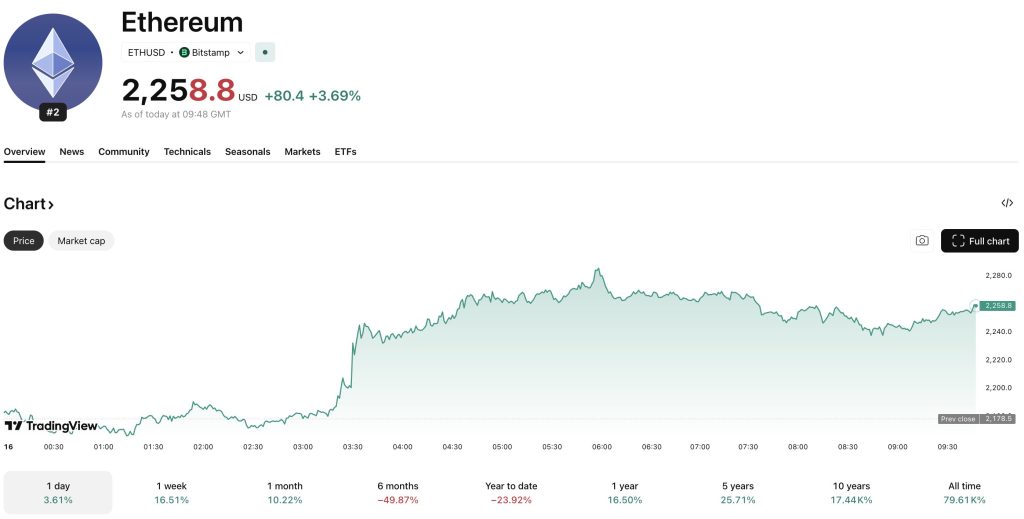
Ethereum USD has reclaimed the $2,200 level, surging from oversold lows near $1,840 in late February as buyers successfully defended the critical $2,000 psychological threshold following a +6% overnight pump into the Monday morning trading session.
This move marks a significant +19% rebound from the capitulation wick of $1,840 seen just weeks ago, validating the bullish thesis for traders watching the $2,050 defense line.
Institutional narratives are also beginning to align with the technical recovery. While price action remains the primary focus, BlackRock recently launched its iShares Staked Ethereum Trust, adding a layer of fundamental support that suggests smart money interest persists despite recent volatility.
This bullish move isn’t isolated to the ETH chart; while it is one of the strongest overnight performers, the total crypto market cap has surged by +2.4% as it closes in on $2.6 trillion.

RSI Bounce From 34 Zone Flags Oversold Exhaustion as Bulls Regroup
The recent market bounce is primarily driven by the RSI entering oversold territory, dropping to 34.19 in late February, signaling seller exhaustion and a potential mean reversion.
When the RSI nears 30, it often draws in value investors. The recovery toward neutral territory suggests a momentum shift towards bulls.
On-chain data supports this view, showing tightened exchange supply and re-establishing the 76.4% Fib retracement level, indicating a technical shakeout rather than a fundamental trend reversal. This combination led to the break above $2,150.
Additionally, the MACD is gaining momentum in the bullish zone on the hourly charts, aligning with the broader Ethereum USD analysis and suggesting the recent downtrend has been invalidated, opening opportunities for continuation if volume remains steady.
DISCOVER: The 16 Best Meme Coins to Buy in March 2025
Can the Ethereum Price Clear $2,320 and Set Sights on $2,500?
With the $2,200 level now acting as a potential support level, the path of least resistance appears to be higher. Immediate resistance sits near the $2,245 to $2,250 zone.
A clear daily close above $2,250 would likely trigger a rapid move toward the next major friction point at $2,280.
If bulls can clear that hurdle, the chart opens up significantly, with the $2,320 resistance region becoming the primary target for the week ahead.
Beyond the immediate technicals, broader market forecasts are becoming increasingly optimistic about a mid-term recovery.
For instance, China’s Alibaba AI recently predicted Ethereum price targets that align with a recovery toward the $2,500 range, contingent on macro stability.
Some analysts speculate that the launch of staked ETH ETFs could be the catalyst that drives Wall Street capital back into the asset, providing the liquidity needed to sustain a move above $2,400.
Downside Risk for Ethereum USD: Critical Support Levels to Watch
Despite optimism, failing to break the $2,300 resistance may lead to a retest of lower support levels, starting at $2,180 and followed by $2,150.
A fall below $2,150 would negate the bullish trend, potentially pushing prices toward the $2,100 pivot. The key support remains at $2,050 to $2,000; a break below this could expose recent lows around $1,840.
Traders should closely monitor the $2,180 level; a high-volume close below it would signal a weakening recovery.
The market is at a critical point, with traders watching the daily close relative to $2,300 for signals of a reversal or prolonged consolidation.
EXPLORE: Best Crypto Presales to Buy in 2026
The post Ethereum USD Reclaims $2,200 as the Crypto Market Booms appeared first on Cryptonews.
Bitcoin’s recent rebound reflects a strengthening base of long-term holders as ETF inflows and corporate treasury buying reshape the asset’s ownership structure, Bernstein said in a Monday research note shared with Cointelegraph.
Bernstein said Bitcoin outperformed gold and major equity indexes over the past week despite heightened conflict in the Middle East, with Bitcoin (BTC) up around 7% and Ether (ETH) up about 9% over the period.
Analysts attributed the shift partly to continued US spot Bitcoin exchange-traded fund (ETF) inflows and the steady accumulation of corporate buyers such as Strategy, which they say are gradually strengthening Bitcoin’s long-term holder base, contributing to a more stable market structure.
“Maybe it takes a physical conflict to realise Bitcoin remains the most portable (cross-border), digital and liquid asset with no counterparty risks,” Bernstein said.
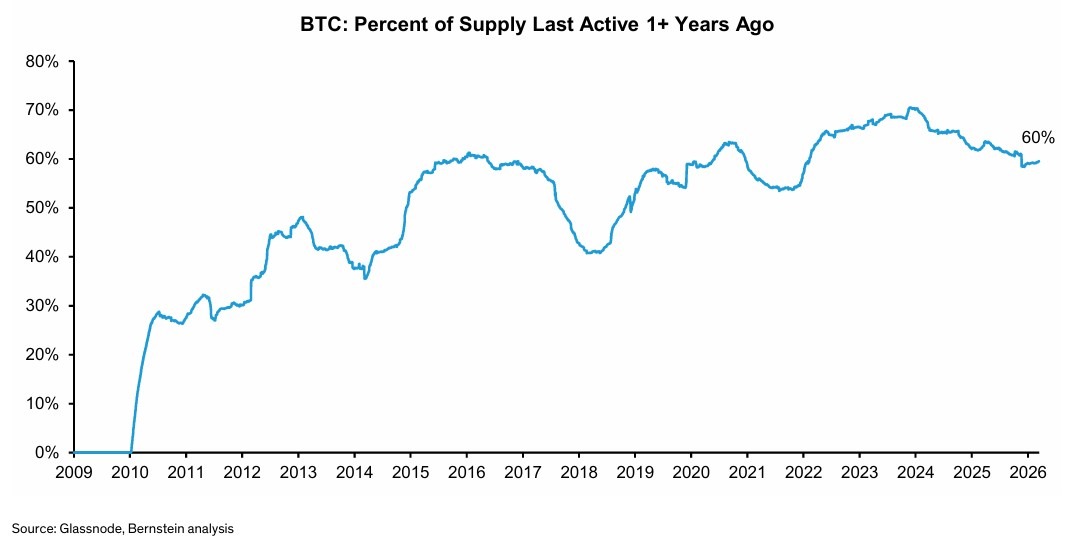
Bernstein’s broader point is that ownership is changing. As roughly 60% of Bitcoin supply has been inactive for more than a year, the market is increasingly dominated by longer-term holders rather than fast-money flows. As more Bitcoin moves into ETFs, corporate treasuries and wallets that rarely transact, short-term sell pressure may matter less, potentially giving the market a more stable base during periods of stress.

ETFs, corporate treasuries fuel Bitcoin resilience
CoinGecko data shows that BTC traded at about $73,208 at the time of writing, up over 8% in the last seven days amid heightened geopolitical tensions in the Middle East.
SoSoValue data shows that US spot Bitcoin ETFs had three consecutive inflow weeks totalling over $2.1 billion. Bernstein attributed the inflows to rising long-term capital allocations through wealth managers, institutional funds, including pension and sovereign funds.
Bernstein said spot BTC ETFs have nearly reversed their year-to-date (YTD) capital outflows, with net withdrawals narrowing to about $460 million, compared with roughly $92 billion in total assets under management (AUM).
Related: Strategy records biggest STRC issuance day with estimated 1,420 BTC buy
Bernstein also pointed to Strategy’s continued Bitcoin accumulation this year.
Strategy added 66,231 BTC year-to-date for roughly $5.6 billion at an average purchase price of around $85,000, according to Bernstein.
On March 9, Strategy announced that it had acquired 17,994 Bitcoin for $1.28 billion between March 2 and 8, pushing its total reserves above 738,000 BTC, worth about $54 billion.
Bitcoin Treasuries data shows that ETFs and exchanges hold about 1.6 million BTC, worth over $117 billion, while public companies hold 1.15 million BTC, worth about $84 billion.
Related: Bybit doubles down on Middle East operations amid regional tensions
Magazine: All 21 million Bitcoin is at risk from quantum computers


The crypto market is on the cusp of a major breakout as bitcoin trades at $73,000 and ether (ETH) at $2,250, its highest level since Feb. 4.
If bitcoin, the largest cryptocurrency by market capitalization, can break above $74,000 on convincing volume, it will likely run back to $80,000, which was a level of support in November before an eventual breakdown in January.
A rejection, on the other hand, would lead to a reversion to a trading range between $62,000 and $72,000, which has persisted for more than a month.
But the main story on Monday is not among crypto majors, it is the altcoin market and memecoins in particular.
PEPE rose by around 20% in the past 24 hours, while BONK and PENGU are also up by double digits. However, “overbought” conditions on the average relative strength index (RSI) suggest a pullback may be in store before any breakout.
Oil remains inflated at above $106 per barrel despite the U.S. reportedly considering a coalition to escort ships through the Strait of Hormuz, a key trade route.
U.S. stock futures are up around 0.5% and crypto-related companies are advancing in pre-market trading. Crypto exchange Coinbase (COIN) was recently 3% higher and Circle Internet (CRCL) added 5%. Bitcoin treasury company Strategy (MSTR) gained 4%.
Precious metals fell and the dollar weakened, reflecting risk-on sentiment.
Derivatives positioning
- Industry-wide futures open interest has risen over 8% to $112.34 billion in 24 hours in a sign of increased risk-taking in the market.
- Open interest (OI) in ether (ETH) and futures increased by 16% and 19%, respectively, leading the growth among major cryptocurrencies. This indicates strong investor preference for smart contract tokens. OI in bitcoin rose more than 5%.
- In ether’s case, OI in coin terms climbed to 14.34 million ETH, the most since September 2025.
- There are signs of speculation in non-serious tokens such as : Open interest tied to the cryptocurrency has jumped over 11%.
- The growth in OI in most major tokens is accompanied by positive perpetual funding rates and cumulative volume deltas. This combination indicates a rising demand for bullish leveraged plays.
- On Deribit, however, puts tied to bitcoin and ether continue to trade pricier than calls across all time frames. That’s a sign of continued demand for downside hedging despite the market bounce. Overhead call selling could be another reason for the persistent put premium.
- In XRP’s case, the $1.40 strike call and put are the most popular, cumulatively boasting a notional open interest of $14 million. That’s nearly 25% of the total XRP options open interest on the exchange.
Token talk
- The altcoin market is in a jubilant mood with the “altcoin season” index hitting 48/100, the highest in just over two months.
- The total crypto market cap excluding bitcoin reached $1.1 trillion on Monday, adding around $40 billion in the past 24 hours and $10 billion since midnight UTC, according to TradingView.
- The best-performing CoinDesk benchmark over the past 24 hours has been the Smart Contract Platform Select Capped Index (SCPXC), which is made up of ETH, SOL, ADA and SUI among layer-1 networks. The SCPXC is up by 6.3%, closely followed by the Memecoin Index (CDMEME), which has risen by 5.2%.
- AI-focused token bittensor (TAO) lost 3.7% since midnight. This is a consolidation move rather than a decline after it surged by more than 69% from March 8 to March 15.
- It appears some of those profits are being rotated into another AI project, , which has benefitted from a 60% increase in daily trading volume to $195 million, with the token rising by 11% as a result.


BlockFills filed for Chapter 11 protection in Delaware, reporting up to $500M in liabilities and $100M in assets.
Crypto lending and trading company BlockFills has filed for Chapter 11 bankruptcy protection following cash flow problems that led to customers being unable to withdraw their money.
The firm, which processed tens of billions of dollars in trades last year, will now be placed under court supervision as it tries to restructure its debts and stabilize operations.
Bankruptcy Filing Comes After Withdrawals Were Frozen
On March 15, court papers showed that Reliz CI Ltd, the company that operates BlockFills, filed for Chapter 11 proceedings in the U.S. Bankruptcy Court in Delaware. According to the filing, the firm has assets worth between $50 million and $100 million and debts worth between $100 million and $500 million.
The company’s board approved the filing with a written resolution dated March 9, 2026. The resolution said that the directors had looked at the company’s liquidity position and strategic options before deciding that a Chapter 11 case was in its best interest as well as that of its creditors.
Furthermore, the board also agreed to bring several advisers on board to help with the bankruptcy process. These include the law firms McDermott Will & Schulte LLP and Katten Muchin Rosenman LLP, as well as Berkley Research Group, which is a financial advisory company.
In early February, BlockFills stopped deposits and withdrawals, with the move coming at a time when the market had been hit by instability after U.S. President Donald Trump imposed new tariffs against several EU nations and later threatened to place 100% tariffs on Canadian goods as well.
At the time, the company claimed the pause was a “protective measure” that would allow it to address liquidity conditions. During the freeze, it still allowed trading activity for its more than 2,000 institutional clients, including hedge funds and asset managers, who, according to the company, had generated more than $61 billion in trading volume on the platform in 2025, which was a 28% jump from the year before.
You may also like:
Creditor List Shows Exposure Across Crypto and Financial Companies
The Sunday filing included a list of 30 of the largest unsecured creditors, with claims ranging from $1 million to more than $17 million. The largest belonged to 007 Capital LLC with an unsecured amount of about $17.1 million, followed by the Richard E. Ward Revocable Trust at about $9.4 million and Artha Investment Partners LLC at just under $7 million.
Other creditors are crypto companies and financial institutions like Nexo Capital and Dominion Capital. The Chicago Blackhawks hockey team also appeared in the document as a disputed trade creditor owed about $1.26 million.
Additionally, some claims, including Dominion’s $4.7 million, are listed as “unliquidated,” which means that the final amount may change as the case goes on. Dominion previously accused BlockFills of misappropriating client funds and refusing to return crypto worth millions of dollars that it had kept on the trading platform.
Binance Free $600 (CryptoPotato Exclusive): Use this link to register a new account and receive $600 exclusive welcome offer on Binance (full details).
LIMITED OFFER for CryptoPotato readers at Bybit: Use this link to register and open a $500 FREE position on any coin!
Bitcoin (BTC) starts the third week of March fighting for a breakout after a trip to near $75,000.
-
BTC price action delivers a strong weekly close, but bulls have a lot of work left to do.
-
Analysis warns that the Bitcoin bear market is still in place, along with a recent death cross.
-
Macro conditions present multiple volatility catalysts as the Federal Reserve interest-rate decision nears.
-
Gold’s comparative weakness in recent weeks is fueling the Bitcoin rotation debate.
-
Multiple market signals are giving cause to reevaluate future price strength.
Traders stay wary as bulls face $75,000 sellers
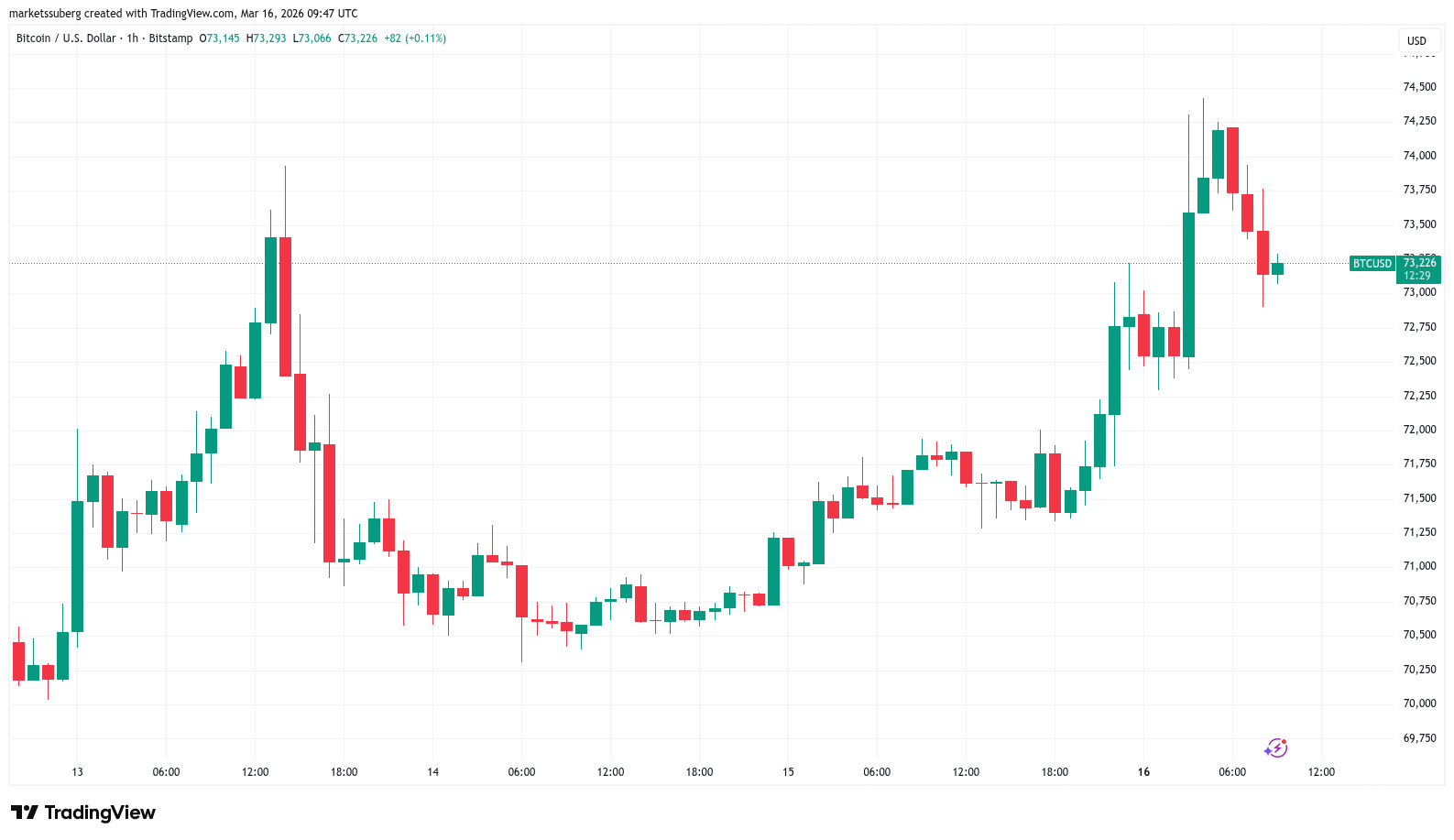
Bitcoin bulls stepped in toward the weekly close to deliver a push to $74,425 — a level that marked new six-week highs.
Data from TradingView shows the price is still maintaining $70,000 as the TradFi trading week gets underway.

The weekly close finally gave BTC/USD a chance to reclaim key trend lines: the 200-week exponential moving average (EMA) at $68,300 and its 2021 record high at $69,400.
Now, the price is also back above its 50-day SMA for the first time since mid-January.
“Dips being bought continuously. Another continued squeeze up seems likely to me,” independent analyst Filbfilb wrote in a post on his Telegram channel about the 50-day reclaim.

Bulls’ next target, trader CrypNuevo and others say, is the $75,000 zone — home to major seller interest.
The 4h long wick is INTERESTING and ideally price drops first on the Monday futures open to give a lower entry.
If price fills that wick, it’ll probably go higher to $75k where I’ll start favoring shorts again for a potential reversal at $75k or at $79k (stronger resistance). pic.twitter.com/cN36vJ5LaV
— CrypNuevo 🔨 (@CrypNuevo) March 15, 2026
CrypNuevo warned that any changes to the macro scenario that imply the end of the Israel-Iran war could result in a “pump and dump” setup where the market initially surges higher, only to give back most or all of its gains, trapping late long positions.
Skepticism characterized many market takes on the day, with trader Killa seeing little reason to shift from a bearish perspective.
So wait a minute…
We have 7 green consecutive daily candles,
We pump over the weekend,
We form a CME gap below,
Directly into supply/liquidity,
At the start of a new weekly open,
And all of a sudden $BTC is bullish? Got it.
— Killa (@KillaXBT) March 16, 2026
Trader and analyst Mark Cullen, meanwhile, demanded that the BTC price clear its swing low from April 2025 around $75,000.
“Lose 71K now and range lows are coming!” he warned X followers.

BTC price death cross implications linger
As Cointelegraph continues to report, long-term market consensus remains hawkish on BTC price action, with calls for new macro lows still present.
Bitcoin thus needs to deliver clear signs of strength before its rebound can be trusted, analysis warns.
Last week, Keith Alan, cofounder of trading resource Material Indicators, flagged a recent death cross on the BTC/USD weekly chart as a key reason to expect those new lows to play out.
“As we sit right now on this very day, we are still in a bear market, and this death cross specifically gives me more confidence in the idea that price is likely, at a macro level, to at least go back and test support before a breakout here,” he said in video analysis.

The support in question could be the local range lows near $60,000, he suggested, or even the 200-week simple moving average (SMA) at $58,900. The latter option would mark a new lower low — something that “often leads to new lower lows.”
“And we could chop here all month, but don’t forget — don’t turn a blind eye to this structure and to this 200-week moving average,” Alan stressed.

What could change the status quo, he added, is a reversal on lower time frames first, with a “decisive uptick” for the 21-day SMA.
Macro volatility risks multiply for Bitcoin
Multiple volatility catalysts make for a tense but exciting macro week to come.
Against the backdrop of the US and Israel-Iran war, US inflation concerns are back as oil spikes and the Federal Reserve is tasked with its next decision on changes to core interest rates.

Markets remain fixed on the fate of the global oil trade, with US President Donald Trump hinting at a possible easing of the Strait of Hormuz blockade at the weekend.
In a post on Truth Social, Trump wrote that “the Countries of the World that receive Oil through the Hormuz Strait must take care of that passage, and we will help — A LOT!”
“The U.S. will also coordinate with those Countries so that everything goes quickly, smoothly, and well,” he pledged.

WTI oil opened the week above the $100 mark, while Bitcoin rose with US stocks futures as TradFi traders returned.
“We now have the Iran war, inflation data, and a Fed meeting all in the same week,” trading resource the Kobeissi Letter summarized on X.
Those inflation prints will come thick and fast, with the latest Manufacturing Purchasing Managers Index (PMI) report from the Institute of Supply Management (ISM) due on Monday.
This currently shows US manufacturing back in expansion mode, and February’s print triggered a bullish response from Bitcoin price action.
“If energy prices remain elevated, manufacturers may have little choice but to pass costs on to retailers and consumers,” Kobeissi commented on the topic.
“The manufacturing recovery is alive, but the inflation threat seems to be back.”

Elsewhere, Wednesday will see both the Fed’s rate decision and the next release of the Producer Price Index (PPI), providing more insight into US inflation trends as the Middle East debacle continues.
As Cointelegraph reported, oil prices in particular have sparked warnings over a major inflation rebound coming next.
Gold rolls over as Bitcoin rebounds
With oil slowly retargeting recent highs above $120, Bitcoin market participants are keen to see BTC take over from gold as a destination for capital during uncertainty.
This has so far failed to materialize, with the past six months marked by successive gold breakouts while BTC/USD plumbs multiyear lows.
Despite the Iran war offering an ideal use case for gold as a safe haven, the precious metal has so far offered a muted response.
“Gold has been consolidating over the past two weeks – even though the escalating Iran conflict would typically be expected to drive prices higher,” analyst Lukas Kuemmerle wrote in his latest “Commodity Report” newsletter.
“The metal’s muted reaction has left many market participants puzzled.”

Kuemmerle described gold’s performance during military conflicts as “mixed,” suggesting that oil was the more suitable hedge.
“Gold offers less protection against the conflict itself, but rather against its monetary and financial side effects – think inflationary pressure, currency devaluation, or fiscal dislocations,” he added.

XAU/USD dipped below the $5,000 mark to start the week, hitting its lowest levels since mid-February. Against Bitcoin, gold dropped to levels not seen since Feb. 5.
At the weekend, crypto trader Michaël van de Poppe again flagged an emerging bullish divergence in relative strength index (RSI) readings for BTC/XAU.
“The weekly RSI remains to be in the oversold territory. Historically, especially in 2015, 2018 and 2022, this has provided a signal that the markets are bottoming and that there’s a reversal happening,” he told X followers.
Van de Poppe said that the daily chart was already giving clues about what was to come, having already forecast capital rotation from gold to Bitcoin.
“I would assume we’ll see a stronger breakout upwards occur in the coming week, as this is the first time it’s breaking above the 21-Day MA since the breakdown in October,” he added, referring to the pair’s 21-day simple moving average trend line.

The most bullish charts in months?
Continuing the discussion of capital flows, onchain analytics platform CryptoQuant sees signs of a broader Bitcoin market recovery.
Related: Key Bitcoin price levels to watch as BTC nears new monthly highs
Inflows to both exchanges and the US spot Bitcoin exchange-traded funds (ETFs), it says, show increasingly bullish patterns, while stablecoin liquidity is increasing — another key driver of market expansion.
“3 different charts are showing activity we haven’t seen in weeks or even months,” contributor Amr Taha summarized in a QuickTake blog post on Monday.
Taha noted that flows from both retail and whale wallets to Binance have “dropped significantly” on rolling 30-day time frames. Whale inflows, for example, fell from $8.8 billion to $4.5 billion in the first two weeks of March.
“Such declines in exchange inflows historically reduce selling pressure, since fewer coins are available on spot markets,” he commented.

At the same time, the US spot ETFs have seen net inflows every trading day since March 9.
“Positive ETF flows reflect direct BTC buying pressure, reinforcing market support from institutional investors,” CryptoQuant continued.

On March 11, meanwhile, a $1 billion minting of the largest stablecoin USDt (USDT) on the Tron network occurred in a significant liquidity event.
“The previous mint event of the same size took place on February 6, which means the March 11 issuance represents the first major liquidity expansion in over a month,” Taha noted.
“The creation of new USDT can signal fresh capital entering the market, potentially increasing available liquidity for trading activity.”

This article does not contain investment advice or recommendations. Every investment and trading move involves risk, and readers should conduct their own research when making a decision. While we strive to provide accurate and timely information, Cointelegraph does not guarantee the accuracy, completeness, or reliability of any information in this article. This article may contain forward-looking statements that are subject to risks and uncertainties. Cointelegraph will not be liable for any loss or damage arising from your reliance on this information.
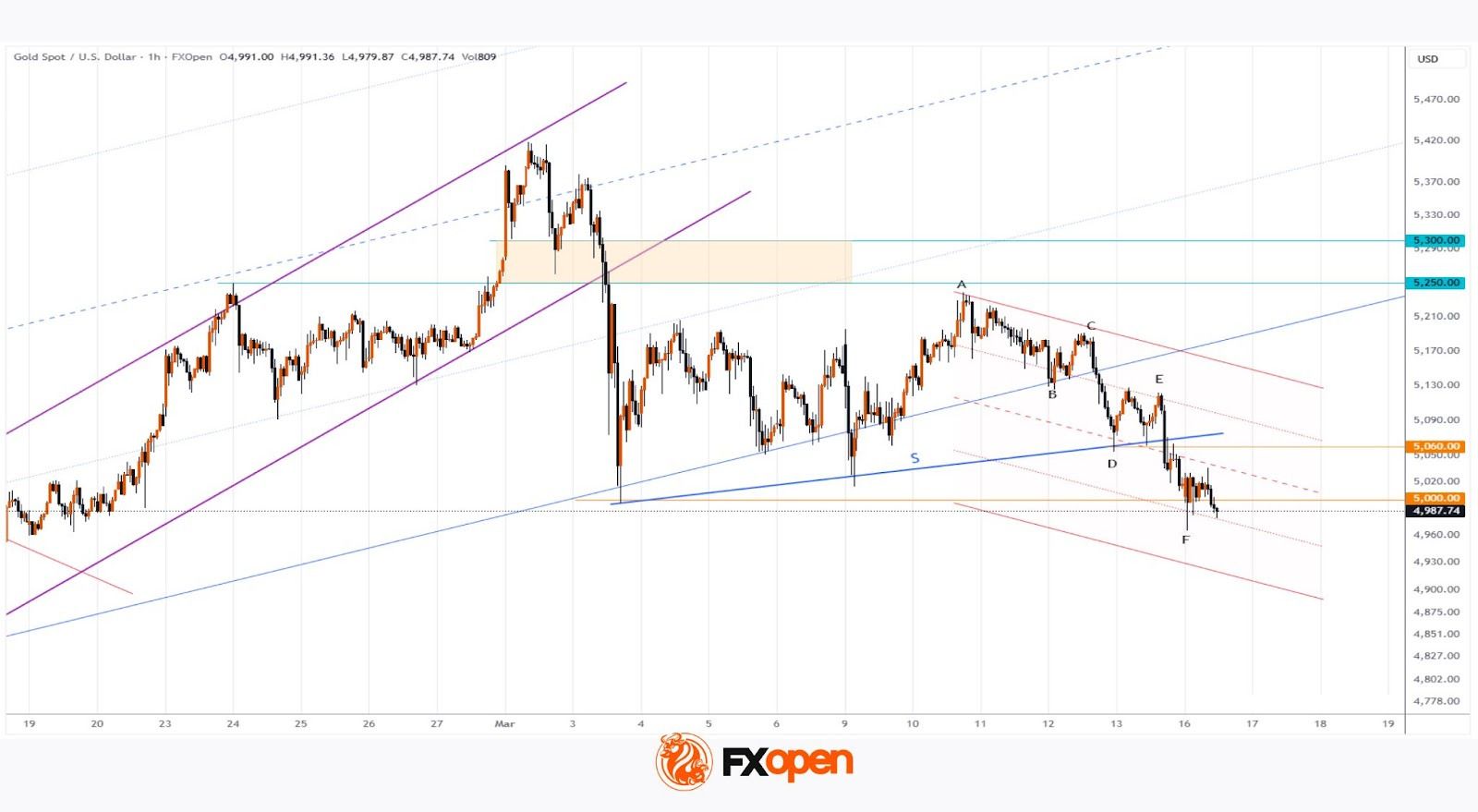
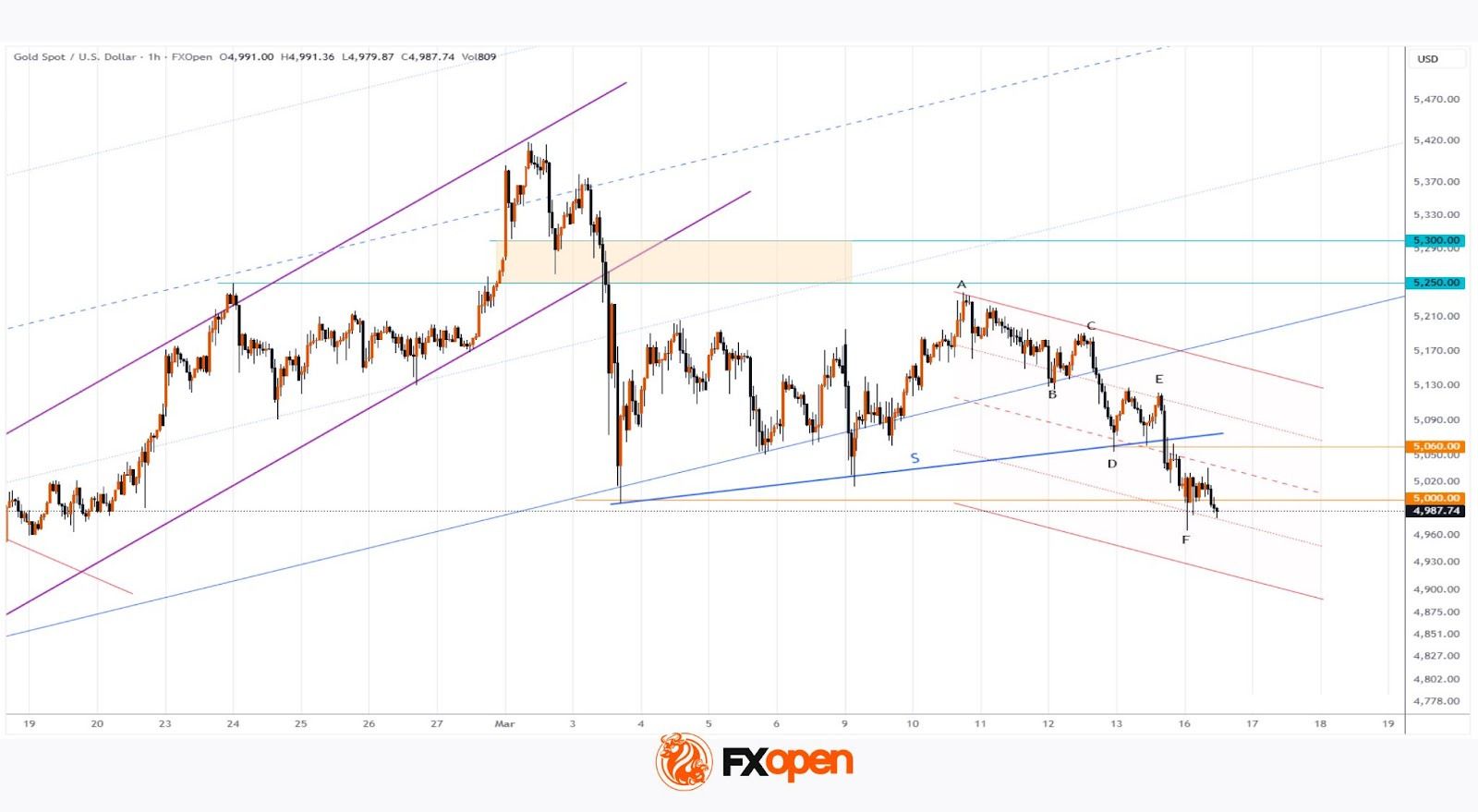
As the XAU/USD chart shows, gold prices today dropped below the 3 March low, reaching levels last seen in the third week of February.
Why Is Gold Declining Despite the War?
Geopolitical turmoil typically supports demand for gold as a safe-haven asset. However, in the current environment — with the Middle East conflict now lasting more than two weeks — the surge in oil prices and the associated inflation risks have moved to the forefront.
Market participants appear to believe that the Federal Reserve will keep interest rates higher for longer. This increases the attractiveness of US dollar-denominated instruments, particularly US Treasuries and money market assets. Rising yields on US government bonds confirm this shift in expectations and simultaneously weigh on gold, which does not generate interest income.
Technical Analysis of XAU/USD
On the morning of 10 March, while analysing gold price movements, we confirmed that the long-term ascending channel remains in effect and also:
→ suggested that its lower boundary could provide support for gold prices;
→ noted that an important test of bullish momentum could come at the breakout level of the purple channel, near $5250.
As indicated by the arrow, the XAU/USD chart showed a continuation of the bullish impulse later that same day. However, the move lost momentum around $5235, forming peak A, after which a sequence of lower highs and lower lows (A–B–C–D–E) developed.
At the same time:
→ the lower boundary of the long-term rising channel was broken following a weak rebound from B to C;
→ a descending channel (shown in red) has now become relevant;
→ the $5060 level may act as an important resistance area, where sellers were strong enough to break the local support S and push gold prices into the lower half of the red channel.
If bears continue to maintain control, the price of an ounce could decline towards the lower boundary of the red channel.
Start trading commodity CFDs with tight spreads (additional fees may apply). Open your trading account now or learn more about trading commodity CFDs with FXOpen.
This article represents the opinion of the Companies operating under the FXOpen brand only. It is not to be construed as an offer, solicitation, or recommendation with respect to products and services provided by the Companies operating under the FXOpen brand, nor is it to be considered financial advice.
Crypto World
Trump-linked WLFI passes proposal letting $5 million stakers buy ‘direct access’ to team
World Liberty Financial, the decentralized finance (DeFi) protocol linked to the family of U.S. President Donald Trump, put a $5 million price tag on ‘direct access’ to team members in an almost unanimous governance vote.
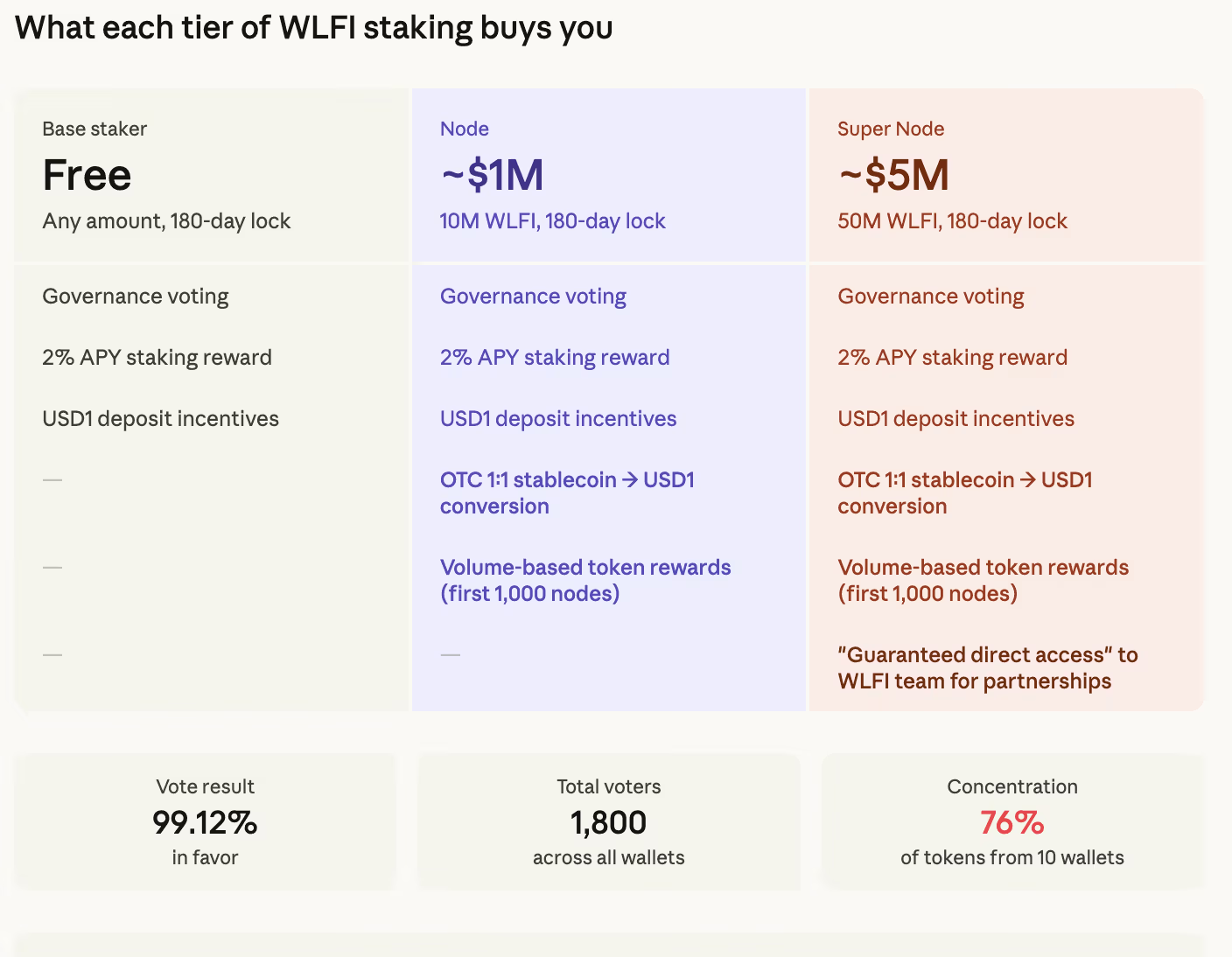
Token holders of the venture backed by Eric and Barron Trump passed a proposal on Friday that creates a three-tier staking system for its WLFI governance token.
The Base tier requires a 180-day lock-up to vote. The Node tier requires staking 10 million WLFI, roughly $1 million, and grants the ability to convert stablecoins to WLFI’s USD1 at 1:1 parity through licensed market makers. The Super Node tier requires 50 million WLFI, roughly $5 million, and grants “guaranteed direct access to the WLFI team for partnership discussions.”

The vote passed 99.12% in favor out of 1,800 votes cast. Over 76% of the voting tokens came from just 10 wallets.
WLFI spokesman David Wachsman told Reuters on Sunday that the “direct access” refers to the business development team and executives, not specific founders, and doesn’t guarantee a partnership.
The company’s own Gold Paper, however, lists co-founders Eric Trump, Barron Trump and Steven Witkoff’s sons Zach and Alex as part of the team “supporting the WLF commitment.”
The proposal’s stated motivation is redirecting value from market makers to long-term participants.
WLFI said that during its USD1 stablecoin expansion, market makers captured millions in arbitrage at roughly 15 basis points per cycle, and WLFI paid millions more in redemption subsidies. The Node and Super Node structure routes those economics to large stakers instead.
The Super Node tier is where the proposal goes beyond governance mechanics. WLFI currently receives “more partnership inquiries than it can productively engage with,” the proposal says.
The $5 million staking requirement “serves as a filter to prioritize projects and platforms that are actively supporting and participating in the WLFI ecosystem, rather than those seeking partnership on a purely opportunistic basis.”
Projects that want to talk to the team now need to invest in WLFI tokens and lock them for six months. That creates buying pressure on the token, reduces circulating supply, and generates a captive audience of large holders who are financially invested in the protocol’s success before any partnership discussion even begins.
Meanwhile, WLFI is also pursuing a national trust bank charter through the OCC, exploring tokenization of real estate and oil and gas assets, and considering the creation of a publicly traded company to hold WLFI tokens.
Crypto World
Australia Senate committee pushes bill to bring crypto platforms under financial services rules


Australia’s Senate Economics Legislation Committee is considering a new bill that would require crypto exchanges and tokenization platforms to operate in accordance with the country’s existing financial services regime.
Summary
- Australia’s Senate Economics Legislation Committee has backed a bill that would bring crypto exchanges and tokenised custody platforms under the country’s financial services licensing regime.
- Platforms that hold customer assets would be required to meet ASIC custody and settlement standards and follow governance and disclosure rules.
Australian regulators are pushing for the passage of the Corporations Amendment (Digital Assets Framework) Bill 2025, which regulators hope will bring “digital asset platforms” (DAPs) and “tokenised custody platforms” (TCPs) under a clear licensing and oversight framework.
The goal is to prevent a repeat of failures involving platforms that hold customer assets, as seen in the past with high profile collapses such as FTX.
As previously reported by crypto.news, the legislation was first introduced in November last year and would require digital asset and tokenized custody platforms to operate under the Corporations Act and the Australian Securities and Investments Commission Act.
To comply with the framework, platforms will have to meet ASIC set custody and settlement standards, provide tailored disclosures for retail clients, and operate under platform-specific conduct and governance requirements, while small providers with annual transaction thresholds under 10 million Australian dollars ($7 million) would be exempt.
However, some industry participants have argued that the bill’s broad “digital token” and “factual control” tests could inadvertently include wallet software and infrastructure providers within the regulatory scope.
Concerns come at a time when firms like Ripple are looking to expand their presence in the Australian market and obtain the required regulatory licenses to operate in the country.
US blockchain firm Ripple Labs backed the concept of “control” as the “appropriate nexus” for defining the regulatory perimeter but said the framework would need adjustments to better accommodate modern security architectures such as multi party computation wallets.
Further, the company warned that under a strict reading of the “factual control” test, technology providers that only hold a single key shard in a multi party setup could be misclassified as regulated custodians even though they cannot independently move client assets.
The committee has acknowledged these concerns but has sided with Treasury’s proposal to refine the regulatory perimeter through future regulations rather than rewriting the core definitions in the bill.
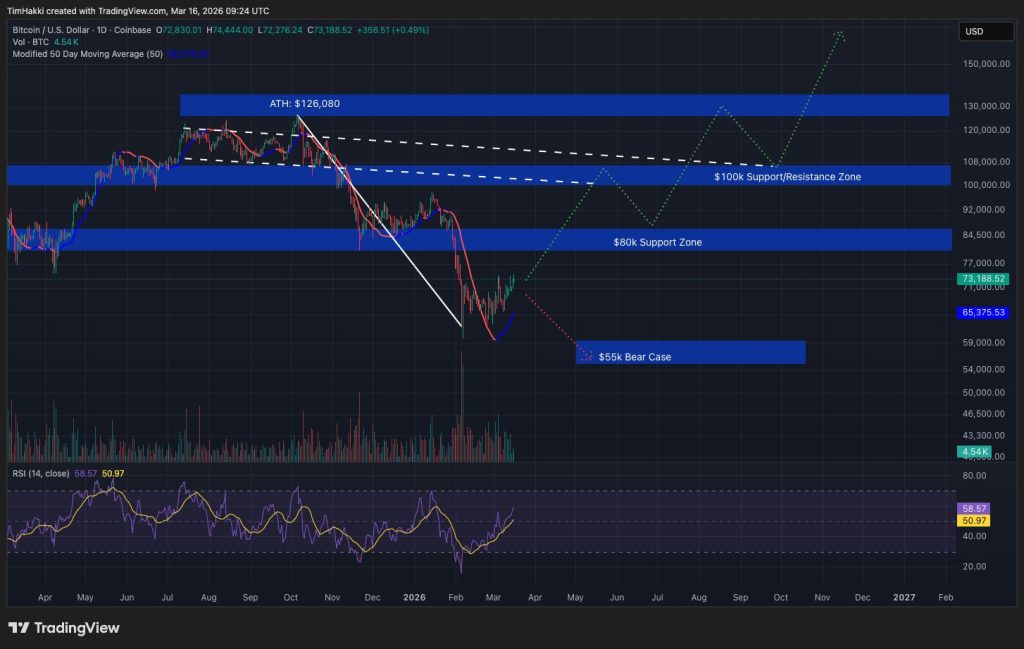
Bitcoin (BTC) trades more and more bullishly these days. The world’s favourite crypto reclaimed a pivotal technical level by surging past its 50-day moving average and briefly rising above $74,000, before pulling back to around $73,300, a 2.4% gain in the last 24 hours, according to CoinGecko.
Traders and fans alike are now wondering if the latest upswing represents a potential end to the consolidation phase that has gripped markets since early February.
So, is buyer conviction finally strengthening?
Discover: The best pre-launch crypto sales
Today’s Bullish Bitcoin Breakout: Is it Sustainable?
Traders widely track the 50-day moving average as a gauge of market health, and Bitcoin’s inability to surpass it in recent weeks has been a source of bearish sentiment.
By clearing $71,125, the asset has flipped a previously formidable resistance level into potential support.
The bullish price action is conspicuous given the backdrop of market fears around the US-Iran conflict, although Bitcoin has largely shrugged off war fears, causing many to wonder if its extended downturn from October 2025 was the market pricing in the possibility of war.
Traders are now mapping the next zones of interest as volatility returns to the market. The technical picture suggests a battle between bulls aiming for new highs and bears looking to fade the rally.

In the bull case, Bitcoin must sustain its position above $73,000 to confirm the breakout. The immediate target is $75,000, a psychological and technical level laden with liquidity. A daily close above $75,000 could open the path toward $80,000, invalidating the bearish structure formed over the last two months.
On the flipside, if the price fails to hold above the 50-day MA at $71,125, the breakout could indicate a “bull trap.” In this event, support levels at $62,000 and $60,500 become the primary downside targets. A drop below recent lows would likely re-engage bearish momentum.
Bitcoin Trades a Little Higher Every Day, But Will it Break Out?
The push toward $75,000 is not just a technical event; it is also a liquidity trigger.
Market makers currently hold net short gamma positions worth billions around the $75,000 strike. As prices approach this level, these entities have to buy the underlying asset to delta-hedge their exposure to neutral, potentially creating a feedback loop that accelerates the rally.
This technical squeeze coincides with on-chain shifts. Large Bitcoin wallets have resumed accumulation as the price stabilizes above $71,000, signaling that “smart money” is positioning for a leg up.
Conversely, some institutional analysts are watching to see if the divergence between Bitcoin and Gold ETFs holds before deciding whether risk-on appetite is truly returning to the crypto sector.
Going forward, if Bitcoin trades above $73,500 for most of this week, it would suggest the bulls are in control, while a low-volume retreat could signal that the 50-day moving average remains a hurdle rather than a launchpad.
Discover: The best meme coins!
The post Bitcoin Trades Above 50-Day Moving Average as Bullish Momentum Builds appeared first on Cryptonews.

Australia’s Senate Economics Legislation Committee has endorsed a bill that would bring crypto exchanges and tokenisation platforms under the country’s existing financial services regime. The Corporations Amendment (Digital Assets Framework) Bill 2025, recommended for passage on March 16, marks a significant step toward a bespoke licensing regime for “digital asset platforms” (DAPs) and “tokenised custody platforms” (TCPs). The move aims to close oversight gaps that emerged in the wake of high‑profile collapses in the digital asset space, including the FTX debacle, and to align digital asset activities with established financial regulation.
Key takeaways
- The committee backed the Corporations Amendment (Digital Assets Framework) Bill 2025, signaling government momentum toward formal licensing for DAPs and TCPs.
- The bill would treat DAPs and TCPs as financial products under the Corporations Act and ASIC Act, pushing many exchanges and custody providers into the Australian Financial Services Licence regime.
- Austere exemptions exist for smaller players, with annual transaction thresholds under A$10 million and certain public blockchain infrastructure carved out from licensing requirements.
- Industry groups cautioned that broad terms like “digital token” and “factual control” could sweep in wallet software and multi‑party computation architectures, potentially widening the regulatory perimeter beyond intent.
- Industry reactions included support from Coinbase Australia but concerns about debanking risks, underscoring the need for clear rules to foster a competitive, innovation‑friendly environment.
Tickers mentioned:
Market context: The move sits within ongoing global regulatory shifts as jurisdictions seek to harmonise digital asset activities with traditional finance rules while balancing innovation with consumer protection.
Why it matters
The proposal to classify DAPs and TCPs as financial products signals a measurable tightening of Australia’s crypto regulatory framework. By requiring compliance with custody, settlement, and disclosure standards set forth by ASIC, the framework seeks to bolster confidence among retail and institutional users that assets held on regulated platforms are safeguarded under robust governance. The designated framework also aims to harmonise standards across platforms that hold customer assets, reducing the risk of fund misappropriation and escalating enforcement actions that followed gaps exposed during major industry disruptions.
From a market perspective, the committee’s recommendation could have two meaningful effects. First, it may accelerate the onboarding of compliant platforms into Australia’s financial services regime, potentially expanding the country’s appeal as a regional hub for digital asset activity. Second, the proposal’s carve‑outs for smaller providers and certain infrastructure projects may preserve a space for innovation and niche services, though the thresholds introduce a calculus for compliance costs that could influence the business models of smaller operators.
The testimony and documents also illustrate the tension between regulatory ambition and technical realities. Industry voices warn that the current wording—particularly terms like “digital token” and “factual control”—could inadvertently encompass wallet software and distributed architectures used by modern custodians. Ripple Labs, for example, argued that while a clear regulatory perimeter is appropriate, modern security architectures such as multi‑party computation wallets should be accommodated. The concern is not only about classification but about ensuring that technology providers aren’t swept into a regime designed for centralized custodians merely because they operate within a multi‑party framework. This debate underscores the challenge regulators face in drawing boundaries that reflect both traditional finance risk controls and evolving cryptographic architectures.
The committee’s stance acknowledged these concerns and endorsed Treasury’s approach to refine the regulatory perimeter through targeted future regulations rather than reopening the core definitions. In practical terms, this means Australia is pursuing a calibrated path: extend licensing to platforms with customer assets while allowing smaller or foundational infrastructure players to operate under exemptions that recognise their different risk profiles.
In parallel, major industry stakeholders have weighed in on the path forward. Coinbase Australia’s leadership welcomed the recommendation as a meaningful step for Australia’s role in the global digital economy, while cautioning that issues such as debanking continue to pose risks in the absence of clear, consistent fintech‑bank collaboration. The emphasis remains on establishing a predictable, rules‑based environment that enables innovation without compromising consumer protection or market integrity.
What to watch next
- The bill moves to the Senate for debate and a final vote, with potential amendments to definitions and exemptions.
- Regulatory guidance or secondary legislation from the Australian Treasury and regulators that clarifies what constitutes “unilateral transfer” rights and how MPC wallets are treated.
- Details on the application and administration of the A$10 million exemption threshold for small providers, including practical examples and reporting requirements.
- Prospective licensing timelines for DAPs and TCPs, including anticipated capital and conduct standards that platforms must meet to obtain an Australian Financial Services Licence.
Sources & verification
- Parliament of Australia, Senate Economics Legislation Committee report on the Corporations Amendment (Digital Assets Framework) Bill 2025 (Tabled Documents 15556).
- Australia introduces bill regulate crypto under existing finance laws — Cointelegraph coverage of the framework’s scope and implications.
- Ripple Labs commentary on regulatory perimeters and security architectures in the context of Australian licensing discussions — Cointelegraph article.
- Coinbase Australia perspective on licensing progress and debanking risks, as reported by Cointelegraph.
- Discussion of the broader regulatory environment following high‑profile digital asset incidents, including references to the FTX collapse.
Australia’s digital asset licensing push gains momentum
The March recommendation by the Senate committee consolidates a long‑running discussion about aligning digital asset activities with Australia’s financial services regime. By treating DAPs and TCPs as financial products, the government signals intent to apply established consumer protections, custody standards, and governance requirements to platforms that hold customer funds. The bill’s architecture suggests a bifurcated pathway: a robust licensing regime for the larger, asset‑holding platforms, and a more measured approach for smaller operators and certain infrastructure services. This approach mirrors global regulatory patterns that balance risk management with the need to avoid stifling innovation.
Proponents argue that a clear, rules‑based framework will attract both retail and professional participants, helping to safeguard assets while enabling legitimate use cases—from regulated token custody to transparent settlement mechanics. Critics, however, warn that overly broad terminology could sweep in a wider ecosystem than intended, potentially elevating compliance costs for startups and deterring competitive dynamics in the Australian market. The Treasury’s preference for incremental refinement rather than wholesale redefinition indicates a deliberate, consultative path forward, one that seeks to harmonise domestic rules with international standards while preserving Australia’s appeal as a digital asset jurisdiction.
Looking ahead, the government and regulators will need to articulate concrete guidance on custody standards, disclosure obligations for retail clients, and governance requirements tailored to platform types. As the regulatory perimeter takes shape, market participants will monitor whether the exemptions for small providers create a workable environment for early‑stage platforms and whether the evolving framework can accommodate future security innovations without diluting risk controls. In the meantime, the industry will likely press for timely regulatory clarity to reduce uncertainty and facilitate strategic investments in Australia’s digital asset ecosystem.

Lewis Norton: Why the Welsh Conservatives are containing ‘devo-scepticism’ and is it sustainable?

ISL: Mumbai City hold off Inter Kashi fightback to secure 2-1 victory | Football News

Fixing AI failure: Three changes enterprises should make now


-
 Tech5 days ago
A 1,300-Pound NASA Spacecraft To Re-Enter Earth’s Atmosphere
-
 Crypto World2 days ago
HYPE Token Enters Net Deflation as HyperCore Buybacks Outpace Staking Rewards
-

 News Videos7 days ago
10th Algebra | Financial Planning | Question Bank Solution | Board Exam 2026
-

 Business6 days ago
ExxonMobil seeks to move corporate registration from New Jersey to Texas
-

 Crypto World7 days ago
Paradigm, a16z, Winklevoss Capital, Balaji Srinivasan among investors in ZODL
-

 Fashion3 days ago
Weekend Open Thread: Addict Lip Glow
-

 Tech6 days ago
ChatGPT will now generate interactive visuals to help you with math and science concepts
-
Sports2 days ago
Why Duke and Michigan Are Dead Even Entering Selection Sunday
-

 NewsBeat5 days ago
Residents reaction as Shildon murder probe enters second day
-

 Business5 days ago
Search Enters Sixth Week With New Leads in Tucson Abduction Case
-
 NewsBeat6 days ago
Pagazzi Lighting enters administration as 70 jobs lost and 11 stores close across Scotland
-

 Business16 hours ago
Search for Savannah Guthrie’s Mother Enters Seventh Week with No Arrests
-

 Tech7 days ago
Despite challenges, Ireland sixth in EU for board gender diversity
-

 Business2 days ago
US Airports Launch Donation Drives for Unpaid TSA Workers as Partial Government Shutdown Enters Fifth Week
-
Crypto World2 days ago
Coinbase and Bybit in Investment Talks: Could Bybit Finally Enter the US Crypto Market?
-

 NewsBeat5 days ago
I Entered The Manosphere. Nothing Could Prepare Me For What I Found.
-

 Business7 days ago
Search Enters 39th Day with FBI Tip Line Developments and No Major Breakthroughs
-

 Business2 days ago
Country star Brantley Gilbert enters growing non-alcoholic beer market
-
 Crypto World6 days ago
Will Chainlink price reclaim $10 amid volatility squeeze?
-

 Sports5 days ago
PWHL, Senators discussing plan to keep Charge in Ottawa

