

Crypto World
Robert Kiyosaki Invests Millions in Bitcoin and Gold Ahead of Predicted 2026 Crash


TLDR
- On March 15, Robert Kiyosaki issued warnings about an intensifying financial “giant crash”
- The author highlighted panic in private credit markets and distress among leading banks
- Kiyosaki deployed millions to acquire oil assets, precious metals, Bitcoin, and Ethereum
- He contrasted his investment strategy with Warren Buffett’s cash-heavy approach
- The financial educator forecasts higher valuations for gold, silver, and Bitcoin post-crash
The bestselling author of Rich Dad Poor Dad, Robert Kiyosaki, issued fresh concerns on March 15 about an escalating financial crisis. His warnings focused on turbulence in private credit markets and mounting pressure on established banking institutions.
“Crash accelerates,” he wrote on X. “Private credit funds are panicked as investors withdraw their money. Major big-name banks and brand-name financial institutions are in trouble.”
Kiyosaki also referenced economist Jim Rickards, noting that he has officially proclaimed the United States has entered a “New Depression.”
In response to these conditions, Kiyosaki revealed he deployed millions of dollars in capital last week. His purchases included additional oil wells, precious metals, and cryptocurrency holdings.
“Last week I took millions in cash and purchased more oil wells, more gold, silver, and bitcoin,” he wrote.
The financial educator confirmed he’s also accumulating Ethereum as part of his diversified acquisition strategy.
Kiyosaki referenced Warren Buffett’s well-known cash accumulation strategy, recognizing it as a tactical approach to maintain liquidity and acquire undervalued assets when markets decline.
Kiyosaki vs. Buffett: Two Different Crash Strategies
Buffett’s company, Berkshire Hathaway, has been building its cash position for some time. Kiyosaki acknowledged the logic, saying “Cash is not trash in a crash.”
However, Kiyosaki emphasized that his investment philosophy differs fundamentally. Rather than stockpiling currency, he’s converting it into tangible assets.
“I doubt Warren Buffett would do what I do,” he wrote.
For investors lacking a clear strategy, Kiyosaki provided straightforward guidance. He suggested that remaining on the sidelines might be the wisest choice during market turbulence for those without a defined plan.
The author also highlighted Middle East geopolitical instability as an influencing factor. He noted that persistent attacks on oil tankers navigating the Strait of Hormuz are elevating crude prices, which directly benefits his Texas-based oil well investments.
Why Kiyosaki Keeps Buying Bitcoin
Kiyosaki has maintained a vocal stance on Bitcoin acquisitions for multiple years. He consistently categorizes it alongside precious metals as a “real asset” due to its mathematically limited supply of 21 million coins.
He has repeatedly stated his conviction that Bitcoin represents a superior investment compared to gold. Market corrections, according to him, present optimal opportunities to expand holdings.
His Bitcoin-related statements have attracted scrutiny for apparent contradictions. One post claimed he never purchased Bitcoin above $6,000, while subsequent posts documented purchases at significantly elevated price levels.
Regardless of the debates, he continues to publicly endorse Bitcoin and Ethereum as fundamental components of his investment approach.
Kiyosaki maintains his belief that valuations for gold, silver, and Bitcoin will surge following a substantial market crash. While acknowledging his predictions could prove incorrect, he expresses strong confidence in his current positions.
The financial author initially forecast his “giant crash” scenario in his 2013 publication Rich Dad’s Prophecy. His warnings have intensified in frequency as 2026 approaches.



Key Takeaways
- Shares of Ulta Beauty tumbled over 10% following its Q4 earnings release, pressured by conservative fiscal 2026 projections and a modest bottom-line shortfall
- The company’s Q4 earnings per share of $8.01 exceeded both internal projections and analyst consensus, while sales reached $3.90B, marking an 11.8% year-over-year increase
- Comparable store sales climbed 5.8% in Q4, with positive momentum across all primary product segments
- Fiscal 2026 comp sales outlook of 2.5%–3.5% fell short of Street expectations, with management signaling flat operating margin performance ahead
- The beauty retailer announced a $1 billion share repurchase program for this year; institutional shareholders control 90.39% of shares, while analyst consensus leans “Moderate Buy” at $671.27 price target
Ulta Beauty delivered what would typically be considered a strong fourth-quarter performance, yet investors fixated on softer full-year projections and a minor earnings shortfall against elevated expectations. Shares plummeted more than 10% following the earnings announcement, extending losses to approximately 19% since Barron’s recommended the stock less than 30 days prior.
The beauty retailer reported Q4 earnings of $8.01 per share, surpassing the consensus forecast of $7.93 by eight cents. Top-line results reached $3.90 billion, representing an 11.8% year-over-year improvement and exceeding analyst projections of $3.81 billion. Gross profit margins also came in ahead of estimates. What triggered the selloff? Earnings missed certain higher-end projections, and the company’s fiscal 2026 outlook proved more conservative than investors anticipated.
For the current fiscal year, management projected comparable sales expansion of 2.5% to 3.5% — landing below Wall Street’s midpoint expectations — while signaling operating margins would remain essentially unchanged. Elevated marketing expenditures, rising incentive-based compensation, and strategic reinvestment initiatives are compressing profitability. The company also faces more challenging year-over-year comparisons following a robust FY25 performance.
With a new chief financial officer recently appointed, the measured guidance approach may reflect fresh leadership caution. Raymond James analyst Olivia Tong observed that the conservative stance aligns with Ulta’s traditional guidance philosophy, potentially reinforced by current macroeconomic and geopolitical uncertainty.
Wall Street Moderates Targets While Maintaining Support
Though the market’s response was severe, few analysts issued downgrades. UBS maintained its “buy” recommendation with an $810 price objective. William Blair analyst William Carden suggested the sharp decline “could reverse quickly” following the reset of 2026 expectations around stable margins. TD Cowen’s Oliver Chen emphasized Ulta’s “low-to-luxe” product range as an enduring competitive advantage.
Overall analyst sentiment remains at “Moderate Buy,” comprising 15 Buy ratings, 10 Hold recommendations, one Strong Buy, and a single Sell rating. The consensus price target stands at $671.27, compared to Monday’s opening price of $535.72 — suggesting substantial upside potential if operational execution meets projections.
Zacks Investment Research shifted its rating from “Strong Buy” to “Hold” in February, ahead of the earnings release. Jefferies, which initiated coverage in January, maintains a “Hold” stance with a $700 target.
Institutional Investors Increasing Stakes
Despite the post-earnings turbulence, several institutional investors expanded their holdings. Holocene Advisors LP increased its ULTA position by 339.6% during Q3, acquiring an additional 293,516 shares for a combined stake valued at approximately $207.7 million. Focus Partners Wealth, Intech Investment Management, and multiple other institutional funds similarly added exposure in recent quarters.
Institutional ownership currently represents 90.39% of outstanding shares.
The company’s Q4 comparable sales growth of 5.8% compares favorably against flat performance in Kohl’s Sephora partnership. Digital channels continue gaining traction, with artificial intelligence-powered personalization identified as a key catalyst. The retailer also plans to introduce a curated TikTok Shop presence, aiming to capture younger demographic segments.
Ulta’s 52-week trading range spans from $323.36 to $714.97. Monday’s opening price of $535.72 sits notably below the 50-day moving average of $665.60 and the 200-day average of $587.65.
Management established fiscal 2026 EPS guidance at $28.05–$28.55, compared to the current analyst consensus of $23.96 for the period.
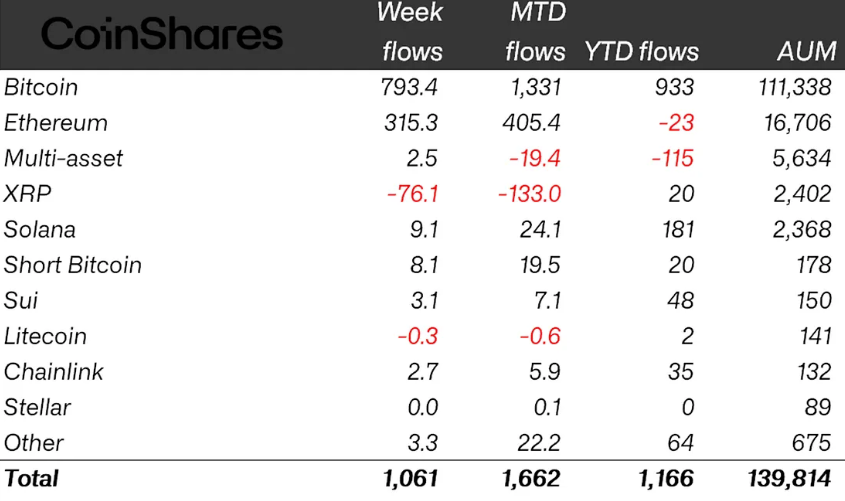
Crypto investment products continued their momentum last week, signaling resilience to geopolitical stress and strengthening the case for Bitcoin’s role as a safe-haven asset.
Crypto exchange-traded products (ETPs) recorded $1.06 billion in inflows last week, led by $793 million into Bitcoin (BTC), CoinShares reported on Monday.
The inflows mark three consecutive weeks of positive flows totaling $2.7 billion, driving net inflows to around $1.2 billion year-to-date.
CoinShares’ head of research, James Butterfill, said the rising momentum over the past few weeks underscores the resilience of digital assets, particularly Bitcoin, as a “relative safe haven” compared with other asset classes.
Since the onset of the Iran crisis, total assets under management (AuM) in digital asset ETPs have risen by 9.4% to nearly $140 billion, he said.
Ethereum ETP flows about to turn neutral with fresh $315 million inflows
With the latest inflows, Bitcoin ETPs increased year-to-date gains to $933 million. Ether (ETH) funds are still in the red, with around $23 million in outflows YTD after $315.3 million of inflows last week.
Butterfill said the launch of new staking ETF listings in the US contributed to the positive momentum, bringing the flows close to a net neutral position.

XRP (XRP) suffered its second week of outflows totaling $76 million, while Solana (SOL) saw $9.1 million of inflows.
Related: Bitcoin ETFs add $251M as Goldman Sachs tops XRP ETF holders
Short-Bitcoin products also recorded inflows of $8.1 million last week, highlighting that market opinion remains “somewhat polarized,” Butterfill said.
Spot Bitcoin ETFs post first five-day inflow streak, year-to-date losses still at $500 million
The majority of Bitcoin fund inflows were driven by US spot Bitcoin exchange-traded funds (ETFs), which recorded their first five-day inflow streak of 2026, attracting $767.3 million in new funds last week.
Despite three consecutive weeks of inflows totaling $2.1 billion, the ETFs remain in negative territory for the year, with approximately $493 million in net outflows year-to-date.

This week will reveal whether US spot Bitcoin ETFs can finally turn positive for 2026, after $1.8 billion in outflows in January and February were partially offset by $1.34 billion in inflows in March.
Magazine: Spot Bitcoin ETFs first green week, crypto ATM losses surge 33%: Hodler’s Digest, Mar. 8 – 14


President Donald Trump’s family-backed crypto project, World Liberty Financial (WLFI) has passed a governance proposal requiring token holders to lock up their tokens for nearly six months in order to participate in protocol voting.
Summary
- WLFI holders approved a governance proposal requiring token holders to stake their tokens for 180 days in order to participate in protocol voting.
- Participants who stake WLFI and vote at least twice during the lock period can earn roughly 2% annual yield.
The proposal received overwhelming support and was approved with 99.12% of 1,800 votes cast in favor, although more than 76% of the voting power came from just ten users.
WLFI introduced the proposal last month, outlining a governance staking system that would require holders of unlocked WLFI tokens to stake their assets before they can participate in votes that determine the direction of the protocol and its broader ecosystem.
According to the firm, the change would ensure that only participants with “long-term alignment to the protocol” are able to influence governance decisions.
The proposal “rewards WLFI holders who have demonstrated the most commitment to WLFI governance and the WLFI ecosystem with additional opportunity to engage in the future of the WLFI ecosystem and potential commercial arrangements,” the document states.
Another goal of the initiative is to promote the adoption of WLFI’s USD1 stablecoin by redirecting value that previously flowed to market makers toward ecosystem participants.
To incentivize participation, the proposal introduces a base reward of roughly 2% annual yield for token holders who stake their WLFI and take part in at least two governance votes during the lock-up period. Meanwhile, holders whose tokens are already locked remain eligible to vote without additional staking requirements.
Further, the proposal documents outline a “Super Node” tier requiring participants to stake 50 million WLFI tokens, worth about $5 million, which would grant them “guaranteed direct access” to the WLFI team for collaboration and partnership discussions.
In a recent statement to Reuters, WLFI spokesman David Wachsman confirmed that the access would be limited to the project’s business development team and executives rather than direct engagement with specific founders. Trump’s sons Eric and Barron are listed in project materials as part of the team supporting the platform.
As part of its longer-term plans centered around the USD1 stablecoin, the platform is also seeking a national trust bank charter from the U.S. Office of the Comptroller of the Currency.
The effort has drawn scrutiny from Washington lawmakers, with some arguing that the application should not move forward unless potential conflicts of interest tied to the project are addressed.
Concerns center on the project’s links to President Donald Trump and members of his family who are financially involved in the venture.
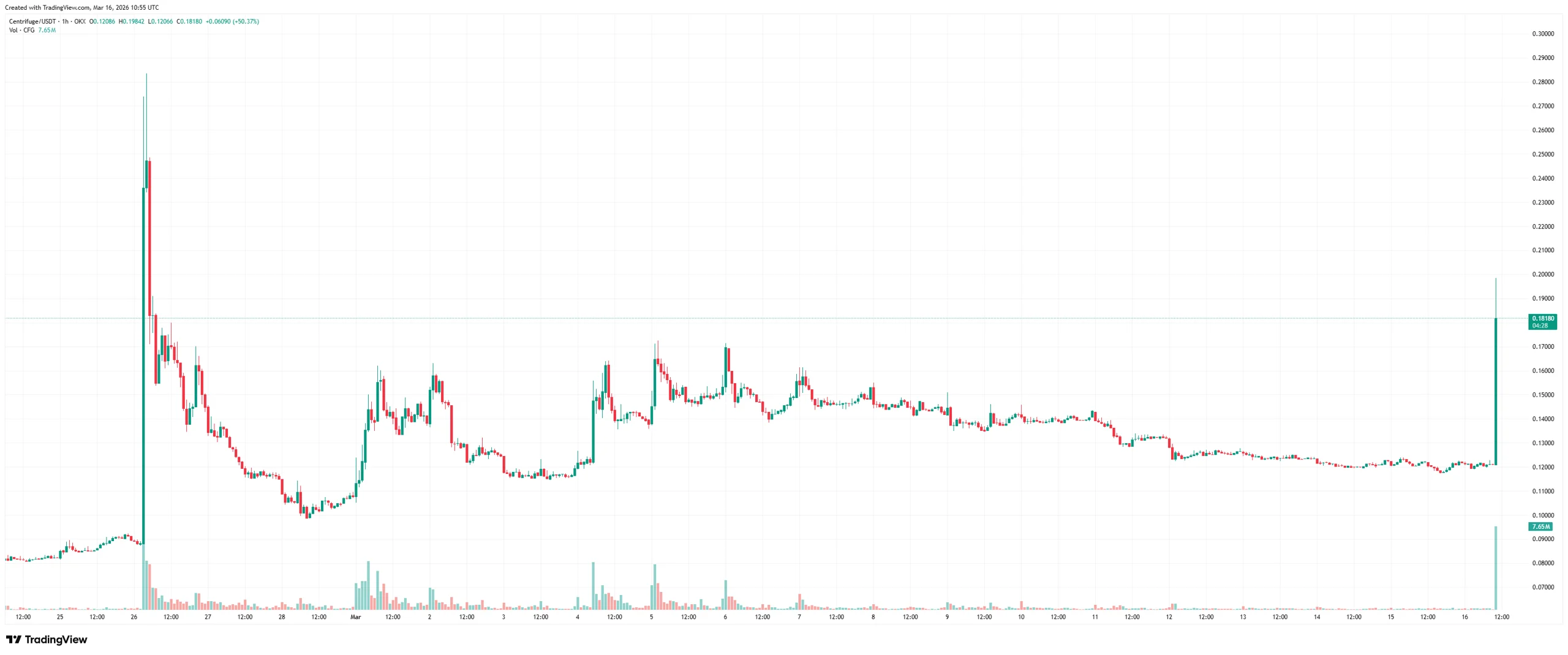
CFG exploded by more than 60% in minutes after Binance announced that it will list the cryptocurrency on its exchange.
Centrifuge’s native cryptocurrency, CFG, has exploded by more than 60% in a matter of moments. This happened after Binance announced it would list the token for spot trading across three pairs. Namely, these are CFG/USDT, CFG/USDC, and CFG/TRY.
According to the official announcement, the trading will open today at 13:00 UTC. Users won’t be able to deposit CFG until one hour after the trading begins.
The price reacted immediately, soaring from around $0.12 to almost $0.2 before retracing to its current price of $0.181.
Moves like these are very typical of exchange listings, especially when it’s a leading name like Binance or Coinbase.
Binance Free $600 (CryptoPotato Exclusive): Use this link to register a new account and receive $600 exclusive welcome offer on Binance (full details).
LIMITED OFFER for CryptoPotato readers at Bybit: Use this link to register and open a $500 FREE position on any coin!
The frog-themed meme coin is today’s biggest gainer, followed by TAO, DOT, and BONK.
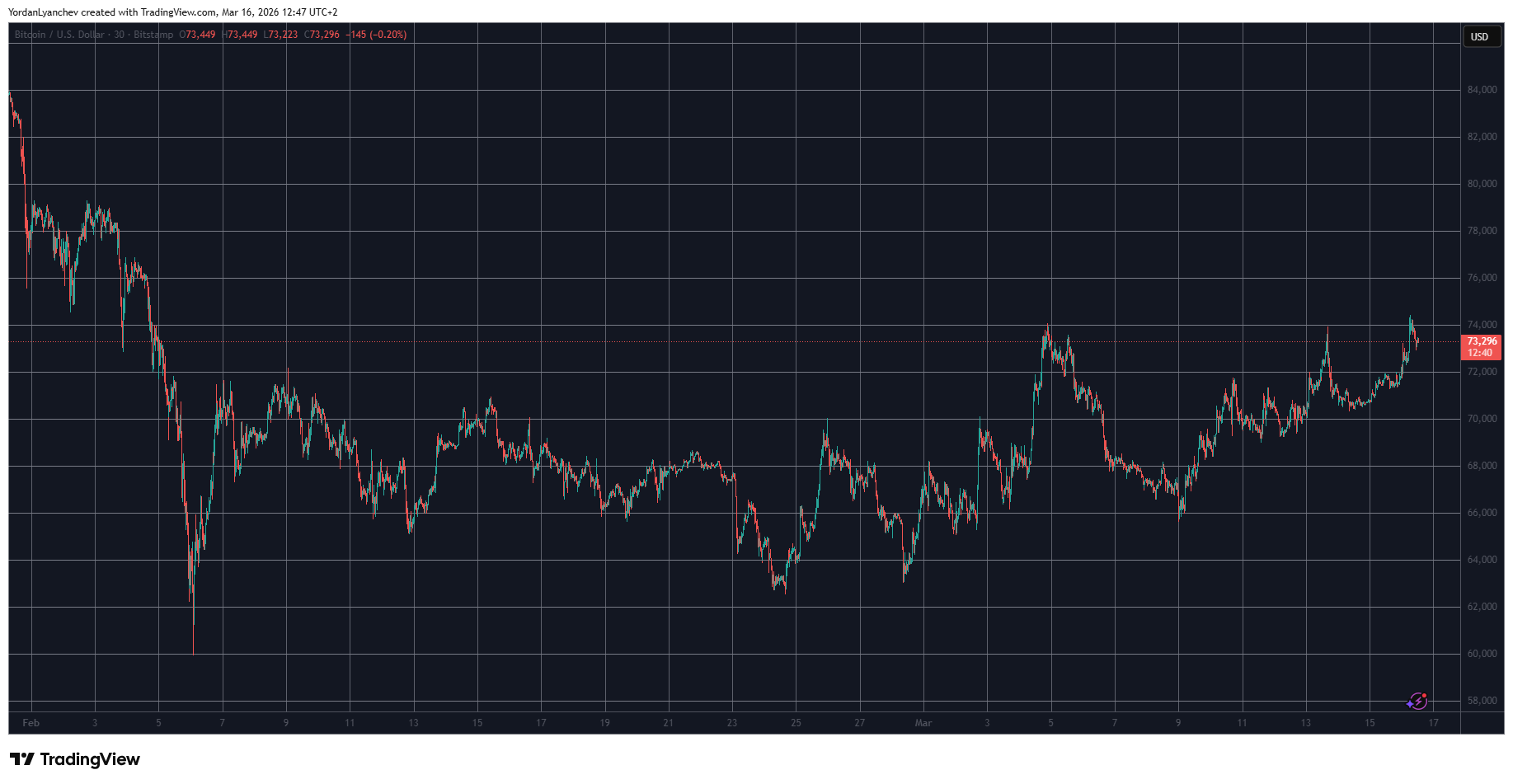
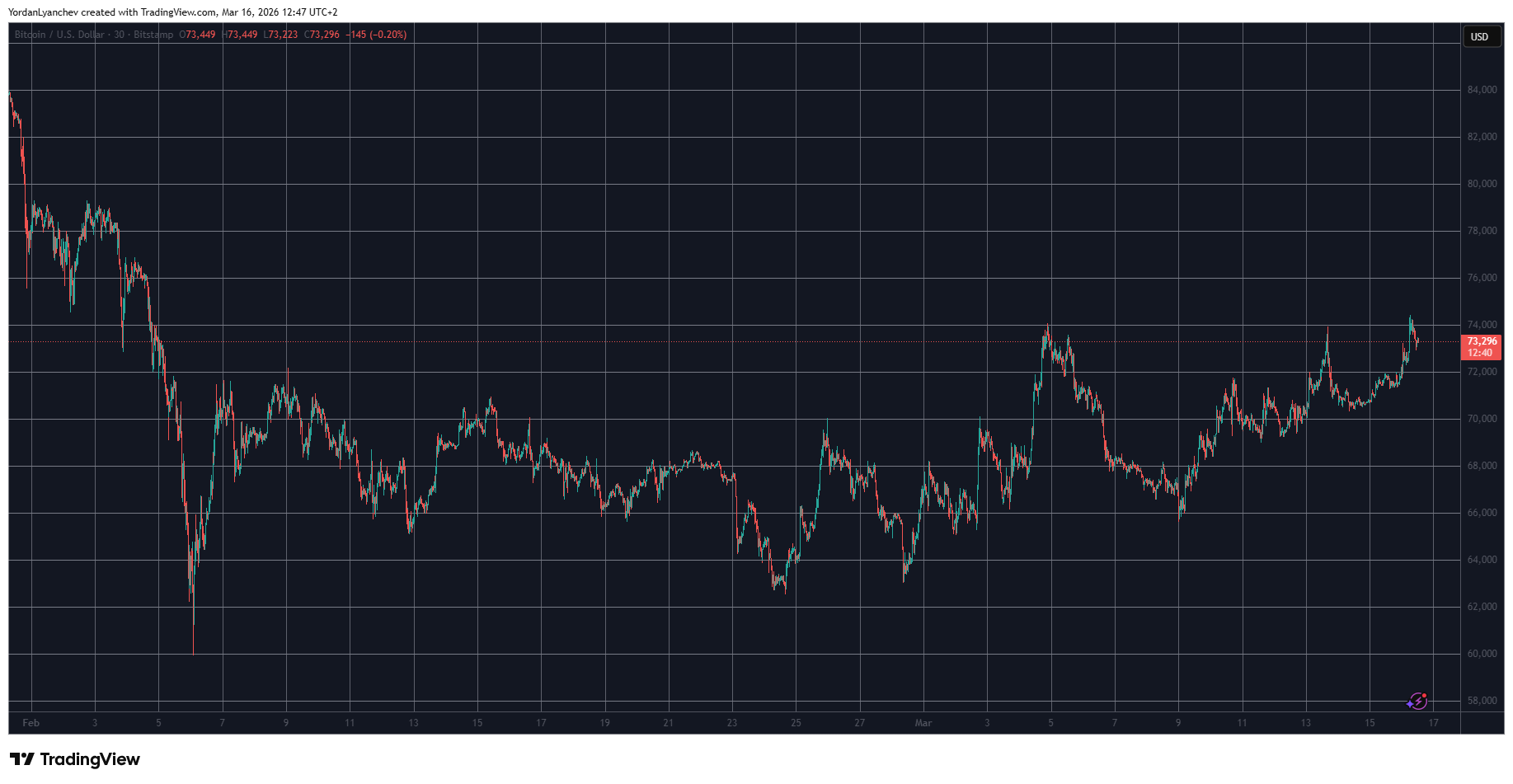
After a relatively quiet weekend despite the latest developments in the Middle East, bitcoin’s price surged on Monday morning to a six-week peak of just over $74,000, where it was stopped.
Many altcoins have produced even more impressive gains, including ETH, which reclaimed the $2,200 level, and ADA, which jumped by 10% at one point.
BTC Saw New Local Peak
The previous business week began quite contrastingly to this one, as BTC’s reaction to the weekend developments on the war front pushed it south to $65,600. However, the bulls intercepted the move and helped the asset recover several grand by Wednesday when it jumped to $68,000 after the CPI numbers came out for February.
After a minor rejection at that point, bitcoin went on the attack once again on Friday. It skyrocketed to $74,000 for the second time in the past 10 days, only to be rejected once again. It dipped further to just over $70,000 during the weekend after the latest set of bombings in the Middle East, but managed to maintain that level.
More volatility was expected on Monday morning when most legacy financial markets opened, including oil. Indeed, fluctuations arrived, but they sent BTC higher to a multi-week peak of just over $74,000. Although it failed there and now sits a grand lower, BTC is still up by 8% weekly.
Its market cap has increased to $1.465 trillion on CG, while its dominance over the alts continues to sit below 57%.
PEPE Soars
Ethereum, Solana, and Cardano are the biggest beneficiaries of today’s market-wide rally. All three have added around 6-8% of value, pushing ETH to well over $2,250, SOL to above $90, and ADA close to $0.40. HYPE, LINK, DOGE, XMR, AVAX, LTC, and XRP are also in the green, albeit in a more modest manner.
There are some double-digit gainers as well. PEPE leads the pack with a notable 18% surge, followed by DOT and TAO. BONK, SHIB, and ZEC are next in line.
The total crypto market cap added almost $100 billion daily and is close to $2.6 trillion on CG as of now.

Binance Free $600 (CryptoPotato Exclusive): Use this link to register a new account and receive $600 exclusive welcome offer on Binance (full details).
LIMITED OFFER for CryptoPotato readers at Bybit: Use this link to register and open a $500 FREE position on any coin!
Disclaimer: Information found on CryptoPotato is those of writers quoted. It does not represent the opinions of CryptoPotato on whether to buy, sell, or hold any investments. You are advised to conduct your own research before making any investment decisions. Use provided information at your own risk. See Disclaimer for more information.
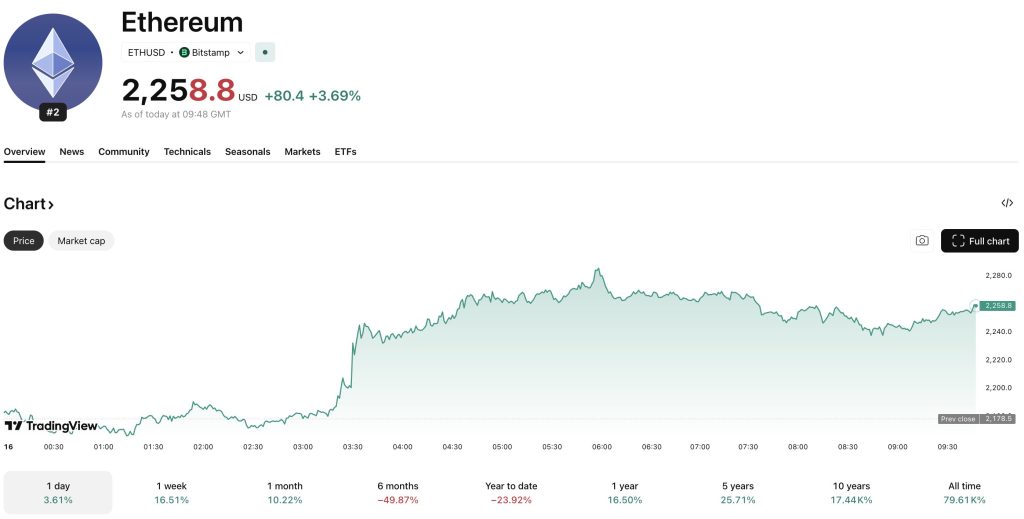
Ethereum USD has reclaimed the $2,200 level, surging from oversold lows near $1,840 in late February as buyers successfully defended the critical $2,000 psychological threshold following a +6% overnight pump into the Monday morning trading session.
This move marks a significant +19% rebound from the capitulation wick of $1,840 seen just weeks ago, validating the bullish thesis for traders watching the $2,050 defense line.
Institutional narratives are also beginning to align with the technical recovery. While price action remains the primary focus, BlackRock recently launched its iShares Staked Ethereum Trust, adding a layer of fundamental support that suggests smart money interest persists despite recent volatility.
This bullish move isn’t isolated to the ETH chart; while it is one of the strongest overnight performers, the total crypto market cap has surged by +2.4% as it closes in on $2.6 trillion.

RSI Bounce From 34 Zone Flags Oversold Exhaustion as Bulls Regroup
The recent market bounce is primarily driven by the RSI entering oversold territory, dropping to 34.19 in late February, signaling seller exhaustion and a potential mean reversion.
When the RSI nears 30, it often draws in value investors. The recovery toward neutral territory suggests a momentum shift towards bulls.
On-chain data supports this view, showing tightened exchange supply and re-establishing the 76.4% Fib retracement level, indicating a technical shakeout rather than a fundamental trend reversal. This combination led to the break above $2,150.
Additionally, the MACD is gaining momentum in the bullish zone on the hourly charts, aligning with the broader Ethereum USD analysis and suggesting the recent downtrend has been invalidated, opening opportunities for continuation if volume remains steady.
DISCOVER: The 16 Best Meme Coins to Buy in March 2025
Can the Ethereum Price Clear $2,320 and Set Sights on $2,500?
With the $2,200 level now acting as a potential support level, the path of least resistance appears to be higher. Immediate resistance sits near the $2,245 to $2,250 zone.
A clear daily close above $2,250 would likely trigger a rapid move toward the next major friction point at $2,280.
If bulls can clear that hurdle, the chart opens up significantly, with the $2,320 resistance region becoming the primary target for the week ahead.
Beyond the immediate technicals, broader market forecasts are becoming increasingly optimistic about a mid-term recovery.
For instance, China’s Alibaba AI recently predicted Ethereum price targets that align with a recovery toward the $2,500 range, contingent on macro stability.
Some analysts speculate that the launch of staked ETH ETFs could be the catalyst that drives Wall Street capital back into the asset, providing the liquidity needed to sustain a move above $2,400.
Downside Risk for Ethereum USD: Critical Support Levels to Watch
Despite optimism, failing to break the $2,300 resistance may lead to a retest of lower support levels, starting at $2,180 and followed by $2,150.
A fall below $2,150 would negate the bullish trend, potentially pushing prices toward the $2,100 pivot. The key support remains at $2,050 to $2,000; a break below this could expose recent lows around $1,840.
Traders should closely monitor the $2,180 level; a high-volume close below it would signal a weakening recovery.
The market is at a critical point, with traders watching the daily close relative to $2,300 for signals of a reversal or prolonged consolidation.
EXPLORE: Best Crypto Presales to Buy in 2026
The post Ethereum USD Reclaims $2,200 as the Crypto Market Booms appeared first on Cryptonews.
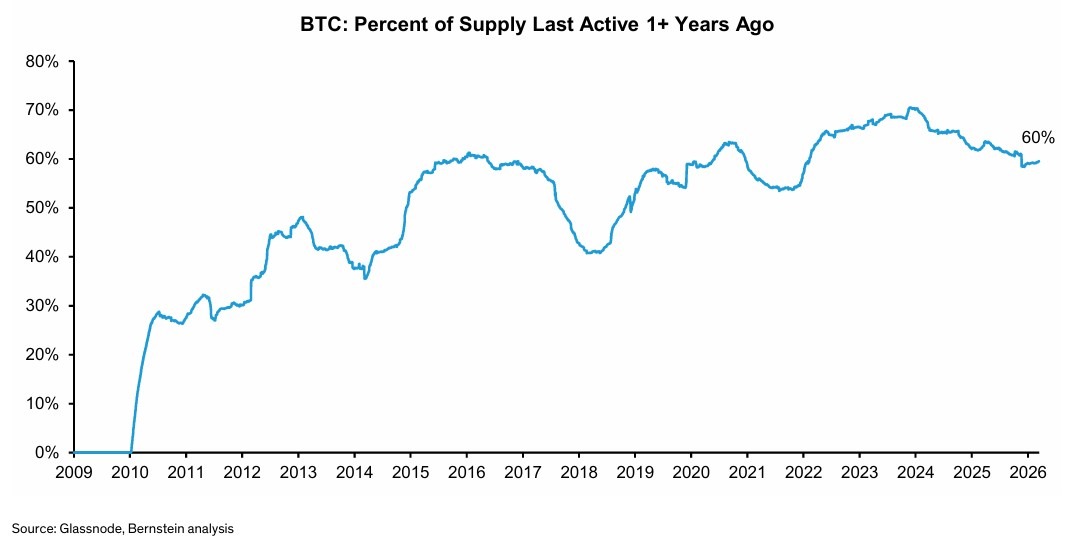
Bitcoin’s recent rebound reflects a strengthening base of long-term holders as ETF inflows and corporate treasury buying reshape the asset’s ownership structure, Bernstein said in a Monday research note shared with Cointelegraph.
Bernstein said Bitcoin outperformed gold and major equity indexes over the past week despite heightened conflict in the Middle East, with Bitcoin (BTC) up around 7% and Ether (ETH) up about 9% over the period.
Analysts attributed the shift partly to continued US spot Bitcoin exchange-traded fund (ETF) inflows and the steady accumulation of corporate buyers such as Strategy, which they say are gradually strengthening Bitcoin’s long-term holder base, contributing to a more stable market structure.
“Maybe it takes a physical conflict to realise Bitcoin remains the most portable (cross-border), digital and liquid asset with no counterparty risks,” Bernstein said.
Bernstein’s broader point is that ownership is changing. As roughly 60% of Bitcoin supply has been inactive for more than a year, the market is increasingly dominated by longer-term holders rather than fast-money flows. As more Bitcoin moves into ETFs, corporate treasuries and wallets that rarely transact, short-term sell pressure may matter less, potentially giving the market a more stable base during periods of stress.

ETFs, corporate treasuries fuel Bitcoin resilience
CoinGecko data shows that BTC traded at about $73,208 at the time of writing, up over 8% in the last seven days amid heightened geopolitical tensions in the Middle East.
SoSoValue data shows that US spot Bitcoin ETFs had three consecutive inflow weeks totalling over $2.1 billion. Bernstein attributed the inflows to rising long-term capital allocations through wealth managers, institutional funds, including pension and sovereign funds.
Bernstein said spot BTC ETFs have nearly reversed their year-to-date (YTD) capital outflows, with net withdrawals narrowing to about $460 million, compared with roughly $92 billion in total assets under management (AUM).
Related: Strategy records biggest STRC issuance day with estimated 1,420 BTC buy
Bernstein also pointed to Strategy’s continued Bitcoin accumulation this year.
Strategy added 66,231 BTC year-to-date for roughly $5.6 billion at an average purchase price of around $85,000, according to Bernstein.
On March 9, Strategy announced that it had acquired 17,994 Bitcoin for $1.28 billion between March 2 and 8, pushing its total reserves above 738,000 BTC, worth about $54 billion.
Bitcoin Treasuries data shows that ETFs and exchanges hold about 1.6 million BTC, worth over $117 billion, while public companies hold 1.15 million BTC, worth about $84 billion.
Related: Bybit doubles down on Middle East operations amid regional tensions
Magazine: All 21 million Bitcoin is at risk from quantum computers


The crypto market is on the cusp of a major breakout as bitcoin trades at $73,000 and ether (ETH) at $2,250, its highest level since Feb. 4.
If bitcoin, the largest cryptocurrency by market capitalization, can break above $74,000 on convincing volume, it will likely run back to $80,000, which was a level of support in November before an eventual breakdown in January.
A rejection, on the other hand, would lead to a reversion to a trading range between $62,000 and $72,000, which has persisted for more than a month.
But the main story on Monday is not among crypto majors, it is the altcoin market and memecoins in particular.
PEPE rose by around 20% in the past 24 hours, while BONK and PENGU are also up by double digits. However, “overbought” conditions on the average relative strength index (RSI) suggest a pullback may be in store before any breakout.
Oil remains inflated at above $106 per barrel despite the U.S. reportedly considering a coalition to escort ships through the Strait of Hormuz, a key trade route.
U.S. stock futures are up around 0.5% and crypto-related companies are advancing in pre-market trading. Crypto exchange Coinbase (COIN) was recently 3% higher and Circle Internet (CRCL) added 5%. Bitcoin treasury company Strategy (MSTR) gained 4%.
Precious metals fell and the dollar weakened, reflecting risk-on sentiment.
Derivatives positioning
- Industry-wide futures open interest has risen over 8% to $112.34 billion in 24 hours in a sign of increased risk-taking in the market.
- Open interest (OI) in ether (ETH) and futures increased by 16% and 19%, respectively, leading the growth among major cryptocurrencies. This indicates strong investor preference for smart contract tokens. OI in bitcoin rose more than 5%.
- In ether’s case, OI in coin terms climbed to 14.34 million ETH, the most since September 2025.
- There are signs of speculation in non-serious tokens such as : Open interest tied to the cryptocurrency has jumped over 11%.
- The growth in OI in most major tokens is accompanied by positive perpetual funding rates and cumulative volume deltas. This combination indicates a rising demand for bullish leveraged plays.
- On Deribit, however, puts tied to bitcoin and ether continue to trade pricier than calls across all time frames. That’s a sign of continued demand for downside hedging despite the market bounce. Overhead call selling could be another reason for the persistent put premium.
- In XRP’s case, the $1.40 strike call and put are the most popular, cumulatively boasting a notional open interest of $14 million. That’s nearly 25% of the total XRP options open interest on the exchange.
Token talk
- The altcoin market is in a jubilant mood with the “altcoin season” index hitting 48/100, the highest in just over two months.
- The total crypto market cap excluding bitcoin reached $1.1 trillion on Monday, adding around $40 billion in the past 24 hours and $10 billion since midnight UTC, according to TradingView.
- The best-performing CoinDesk benchmark over the past 24 hours has been the Smart Contract Platform Select Capped Index (SCPXC), which is made up of ETH, SOL, ADA and SUI among layer-1 networks. The SCPXC is up by 6.3%, closely followed by the Memecoin Index (CDMEME), which has risen by 5.2%.
- AI-focused token bittensor (TAO) lost 3.7% since midnight. This is a consolidation move rather than a decline after it surged by more than 69% from March 8 to March 15.
- It appears some of those profits are being rotated into another AI project, , which has benefitted from a 60% increase in daily trading volume to $195 million, with the token rising by 11% as a result.


BlockFills filed for Chapter 11 protection in Delaware, reporting up to $500M in liabilities and $100M in assets.
Crypto lending and trading company BlockFills has filed for Chapter 11 bankruptcy protection following cash flow problems that led to customers being unable to withdraw their money.
The firm, which processed tens of billions of dollars in trades last year, will now be placed under court supervision as it tries to restructure its debts and stabilize operations.
Bankruptcy Filing Comes After Withdrawals Were Frozen
On March 15, court papers showed that Reliz CI Ltd, the company that operates BlockFills, filed for Chapter 11 proceedings in the U.S. Bankruptcy Court in Delaware. According to the filing, the firm has assets worth between $50 million and $100 million and debts worth between $100 million and $500 million.
The company’s board approved the filing with a written resolution dated March 9, 2026. The resolution said that the directors had looked at the company’s liquidity position and strategic options before deciding that a Chapter 11 case was in its best interest as well as that of its creditors.
Furthermore, the board also agreed to bring several advisers on board to help with the bankruptcy process. These include the law firms McDermott Will & Schulte LLP and Katten Muchin Rosenman LLP, as well as Berkley Research Group, which is a financial advisory company.
In early February, BlockFills stopped deposits and withdrawals, with the move coming at a time when the market had been hit by instability after U.S. President Donald Trump imposed new tariffs against several EU nations and later threatened to place 100% tariffs on Canadian goods as well.
At the time, the company claimed the pause was a “protective measure” that would allow it to address liquidity conditions. During the freeze, it still allowed trading activity for its more than 2,000 institutional clients, including hedge funds and asset managers, who, according to the company, had generated more than $61 billion in trading volume on the platform in 2025, which was a 28% jump from the year before.
You may also like:
Creditor List Shows Exposure Across Crypto and Financial Companies
The Sunday filing included a list of 30 of the largest unsecured creditors, with claims ranging from $1 million to more than $17 million. The largest belonged to 007 Capital LLC with an unsecured amount of about $17.1 million, followed by the Richard E. Ward Revocable Trust at about $9.4 million and Artha Investment Partners LLC at just under $7 million.
Other creditors are crypto companies and financial institutions like Nexo Capital and Dominion Capital. The Chicago Blackhawks hockey team also appeared in the document as a disputed trade creditor owed about $1.26 million.
Additionally, some claims, including Dominion’s $4.7 million, are listed as “unliquidated,” which means that the final amount may change as the case goes on. Dominion previously accused BlockFills of misappropriating client funds and refusing to return crypto worth millions of dollars that it had kept on the trading platform.
Binance Free $600 (CryptoPotato Exclusive): Use this link to register a new account and receive $600 exclusive welcome offer on Binance (full details).
LIMITED OFFER for CryptoPotato readers at Bybit: Use this link to register and open a $500 FREE position on any coin!
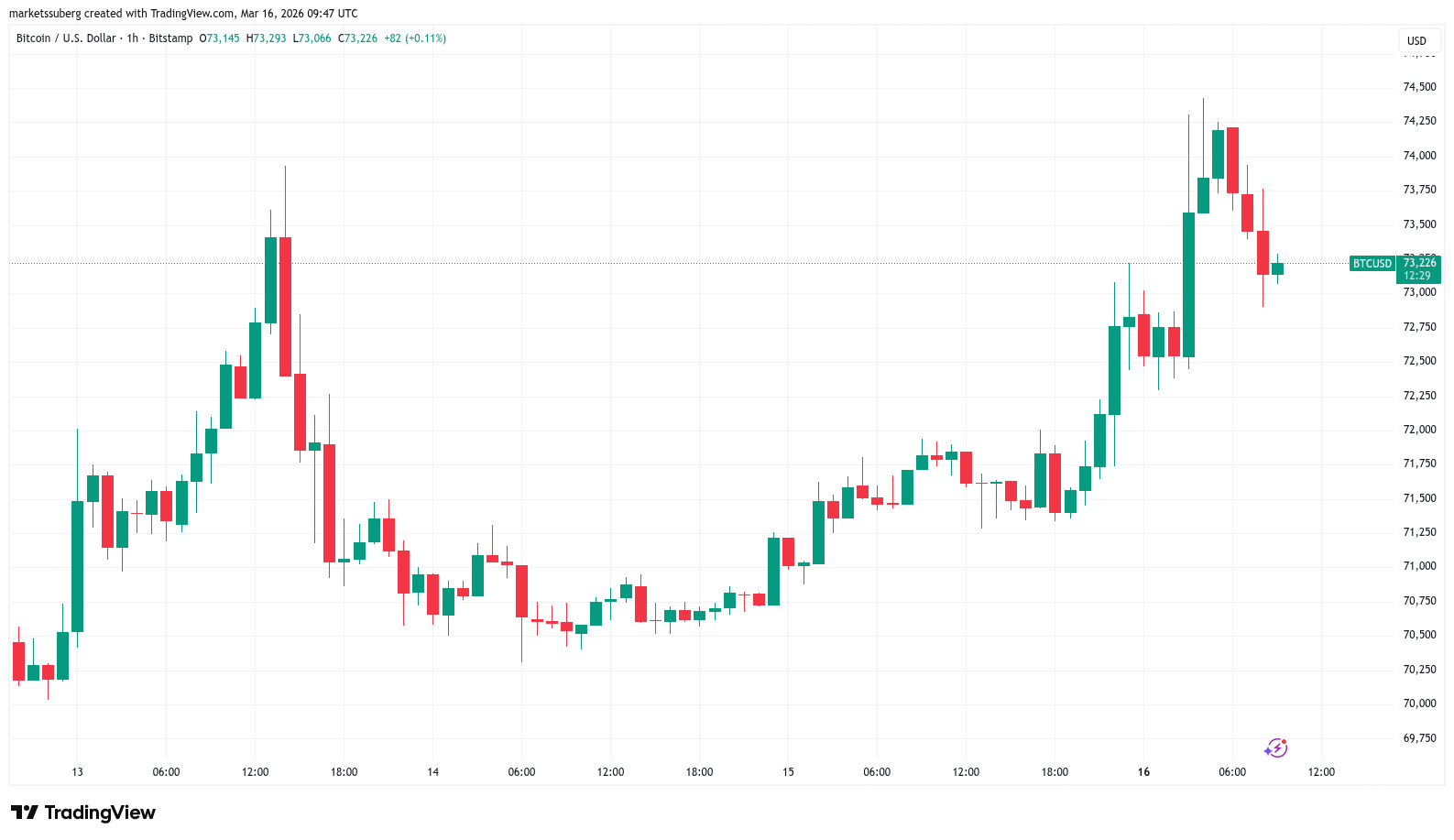
Bitcoin (BTC) starts the third week of March fighting for a breakout after a trip to near $75,000.
-
BTC price action delivers a strong weekly close, but bulls have a lot of work left to do.
-
Analysis warns that the Bitcoin bear market is still in place, along with a recent death cross.
-
Macro conditions present multiple volatility catalysts as the Federal Reserve interest-rate decision nears.
-
Gold’s comparative weakness in recent weeks is fueling the Bitcoin rotation debate.
-
Multiple market signals are giving cause to reevaluate future price strength.
Traders stay wary as bulls face $75,000 sellers
Bitcoin bulls stepped in toward the weekly close to deliver a push to $74,425 — a level that marked new six-week highs.
Data from TradingView shows the price is still maintaining $70,000 as the TradFi trading week gets underway.

The weekly close finally gave BTC/USD a chance to reclaim key trend lines: the 200-week exponential moving average (EMA) at $68,300 and its 2021 record high at $69,400.
Now, the price is also back above its 50-day SMA for the first time since mid-January.
“Dips being bought continuously. Another continued squeeze up seems likely to me,” independent analyst Filbfilb wrote in a post on his Telegram channel about the 50-day reclaim.

Bulls’ next target, trader CrypNuevo and others say, is the $75,000 zone — home to major seller interest.
The 4h long wick is INTERESTING and ideally price drops first on the Monday futures open to give a lower entry.
If price fills that wick, it’ll probably go higher to $75k where I’ll start favoring shorts again for a potential reversal at $75k or at $79k (stronger resistance). pic.twitter.com/cN36vJ5LaV
— CrypNuevo 🔨 (@CrypNuevo) March 15, 2026
CrypNuevo warned that any changes to the macro scenario that imply the end of the Israel-Iran war could result in a “pump and dump” setup where the market initially surges higher, only to give back most or all of its gains, trapping late long positions.
Skepticism characterized many market takes on the day, with trader Killa seeing little reason to shift from a bearish perspective.
So wait a minute…
We have 7 green consecutive daily candles,
We pump over the weekend,
We form a CME gap below,
Directly into supply/liquidity,
At the start of a new weekly open,
And all of a sudden $BTC is bullish? Got it.
— Killa (@KillaXBT) March 16, 2026
Trader and analyst Mark Cullen, meanwhile, demanded that the BTC price clear its swing low from April 2025 around $75,000.
“Lose 71K now and range lows are coming!” he warned X followers.

BTC price death cross implications linger
As Cointelegraph continues to report, long-term market consensus remains hawkish on BTC price action, with calls for new macro lows still present.
Bitcoin thus needs to deliver clear signs of strength before its rebound can be trusted, analysis warns.
Last week, Keith Alan, cofounder of trading resource Material Indicators, flagged a recent death cross on the BTC/USD weekly chart as a key reason to expect those new lows to play out.
“As we sit right now on this very day, we are still in a bear market, and this death cross specifically gives me more confidence in the idea that price is likely, at a macro level, to at least go back and test support before a breakout here,” he said in video analysis.

The support in question could be the local range lows near $60,000, he suggested, or even the 200-week simple moving average (SMA) at $58,900. The latter option would mark a new lower low — something that “often leads to new lower lows.”
“And we could chop here all month, but don’t forget — don’t turn a blind eye to this structure and to this 200-week moving average,” Alan stressed.

What could change the status quo, he added, is a reversal on lower time frames first, with a “decisive uptick” for the 21-day SMA.
Macro volatility risks multiply for Bitcoin
Multiple volatility catalysts make for a tense but exciting macro week to come.
Against the backdrop of the US and Israel-Iran war, US inflation concerns are back as oil spikes and the Federal Reserve is tasked with its next decision on changes to core interest rates.

Markets remain fixed on the fate of the global oil trade, with US President Donald Trump hinting at a possible easing of the Strait of Hormuz blockade at the weekend.
In a post on Truth Social, Trump wrote that “the Countries of the World that receive Oil through the Hormuz Strait must take care of that passage, and we will help — A LOT!”
“The U.S. will also coordinate with those Countries so that everything goes quickly, smoothly, and well,” he pledged.

WTI oil opened the week above the $100 mark, while Bitcoin rose with US stocks futures as TradFi traders returned.
“We now have the Iran war, inflation data, and a Fed meeting all in the same week,” trading resource the Kobeissi Letter summarized on X.
Those inflation prints will come thick and fast, with the latest Manufacturing Purchasing Managers Index (PMI) report from the Institute of Supply Management (ISM) due on Monday.
This currently shows US manufacturing back in expansion mode, and February’s print triggered a bullish response from Bitcoin price action.
“If energy prices remain elevated, manufacturers may have little choice but to pass costs on to retailers and consumers,” Kobeissi commented on the topic.
“The manufacturing recovery is alive, but the inflation threat seems to be back.”

Elsewhere, Wednesday will see both the Fed’s rate decision and the next release of the Producer Price Index (PPI), providing more insight into US inflation trends as the Middle East debacle continues.
As Cointelegraph reported, oil prices in particular have sparked warnings over a major inflation rebound coming next.
Gold rolls over as Bitcoin rebounds
With oil slowly retargeting recent highs above $120, Bitcoin market participants are keen to see BTC take over from gold as a destination for capital during uncertainty.
This has so far failed to materialize, with the past six months marked by successive gold breakouts while BTC/USD plumbs multiyear lows.
Despite the Iran war offering an ideal use case for gold as a safe haven, the precious metal has so far offered a muted response.
“Gold has been consolidating over the past two weeks – even though the escalating Iran conflict would typically be expected to drive prices higher,” analyst Lukas Kuemmerle wrote in his latest “Commodity Report” newsletter.
“The metal’s muted reaction has left many market participants puzzled.”

Kuemmerle described gold’s performance during military conflicts as “mixed,” suggesting that oil was the more suitable hedge.
“Gold offers less protection against the conflict itself, but rather against its monetary and financial side effects – think inflationary pressure, currency devaluation, or fiscal dislocations,” he added.

XAU/USD dipped below the $5,000 mark to start the week, hitting its lowest levels since mid-February. Against Bitcoin, gold dropped to levels not seen since Feb. 5.
At the weekend, crypto trader Michaël van de Poppe again flagged an emerging bullish divergence in relative strength index (RSI) readings for BTC/XAU.
“The weekly RSI remains to be in the oversold territory. Historically, especially in 2015, 2018 and 2022, this has provided a signal that the markets are bottoming and that there’s a reversal happening,” he told X followers.
Van de Poppe said that the daily chart was already giving clues about what was to come, having already forecast capital rotation from gold to Bitcoin.
“I would assume we’ll see a stronger breakout upwards occur in the coming week, as this is the first time it’s breaking above the 21-Day MA since the breakdown in October,” he added, referring to the pair’s 21-day simple moving average trend line.

The most bullish charts in months?
Continuing the discussion of capital flows, onchain analytics platform CryptoQuant sees signs of a broader Bitcoin market recovery.
Related: Key Bitcoin price levels to watch as BTC nears new monthly highs
Inflows to both exchanges and the US spot Bitcoin exchange-traded funds (ETFs), it says, show increasingly bullish patterns, while stablecoin liquidity is increasing — another key driver of market expansion.
“3 different charts are showing activity we haven’t seen in weeks or even months,” contributor Amr Taha summarized in a QuickTake blog post on Monday.
Taha noted that flows from both retail and whale wallets to Binance have “dropped significantly” on rolling 30-day time frames. Whale inflows, for example, fell from $8.8 billion to $4.5 billion in the first two weeks of March.
“Such declines in exchange inflows historically reduce selling pressure, since fewer coins are available on spot markets,” he commented.

At the same time, the US spot ETFs have seen net inflows every trading day since March 9.
“Positive ETF flows reflect direct BTC buying pressure, reinforcing market support from institutional investors,” CryptoQuant continued.

On March 11, meanwhile, a $1 billion minting of the largest stablecoin USDt (USDT) on the Tron network occurred in a significant liquidity event.
“The previous mint event of the same size took place on February 6, which means the March 11 issuance represents the first major liquidity expansion in over a month,” Taha noted.
“The creation of new USDT can signal fresh capital entering the market, potentially increasing available liquidity for trading activity.”

This article does not contain investment advice or recommendations. Every investment and trading move involves risk, and readers should conduct their own research when making a decision. While we strive to provide accurate and timely information, Cointelegraph does not guarantee the accuracy, completeness, or reliability of any information in this article. This article may contain forward-looking statements that are subject to risks and uncertainties. Cointelegraph will not be liable for any loss or damage arising from your reliance on this information.

Rob Reiner Honored At The Oscars By 17 Stars From His Movies

Paedophile nursery worker jailed after sexually abusing young children

Klarna Group plc Shares Surge 8.8% on Chairman’s $50 Million Buy Amid Post-IPO Volatility


-
 Tech5 days ago
A 1,300-Pound NASA Spacecraft To Re-Enter Earth’s Atmosphere
-
Crypto World2 days ago
HYPE Token Enters Net Deflation as HyperCore Buybacks Outpace Staking Rewards
-

 News Videos7 days ago
10th Algebra | Financial Planning | Question Bank Solution | Board Exam 2026
-

 Business6 days ago
ExxonMobil seeks to move corporate registration from New Jersey to Texas
-

 Crypto World7 days ago
Paradigm, a16z, Winklevoss Capital, Balaji Srinivasan among investors in ZODL
-

 Fashion3 days ago
Weekend Open Thread: Addict Lip Glow
-

 Tech6 days ago
ChatGPT will now generate interactive visuals to help you with math and science concepts
-
Sports2 days ago
Why Duke and Michigan Are Dead Even Entering Selection Sunday
-

 NewsBeat5 days ago
Residents reaction as Shildon murder probe enters second day
-

 Business5 days ago
Search Enters Sixth Week With New Leads in Tucson Abduction Case
-
 NewsBeat6 days ago
Pagazzi Lighting enters administration as 70 jobs lost and 11 stores close across Scotland
-

 Business16 hours ago
Search for Savannah Guthrie’s Mother Enters Seventh Week with No Arrests
-

 Tech7 days ago
Despite challenges, Ireland sixth in EU for board gender diversity
-

 Business2 days ago
US Airports Launch Donation Drives for Unpaid TSA Workers as Partial Government Shutdown Enters Fifth Week
-
Crypto World2 days ago
Coinbase and Bybit in Investment Talks: Could Bybit Finally Enter the US Crypto Market?
-

 NewsBeat5 days ago
I Entered The Manosphere. Nothing Could Prepare Me For What I Found.
-

 Business7 days ago
Search Enters 39th Day with FBI Tip Line Developments and No Major Breakthroughs
-

 Business2 days ago
Country star Brantley Gilbert enters growing non-alcoholic beer market
-
 Crypto World6 days ago
Will Chainlink price reclaim $10 amid volatility squeeze?
-

 Business50 minutes ago
Australian shares drop as Iran war enters third week

