

Crypto World
Bitcoin Trades Above 50-Day Moving Average as Bullish Momentum Builds

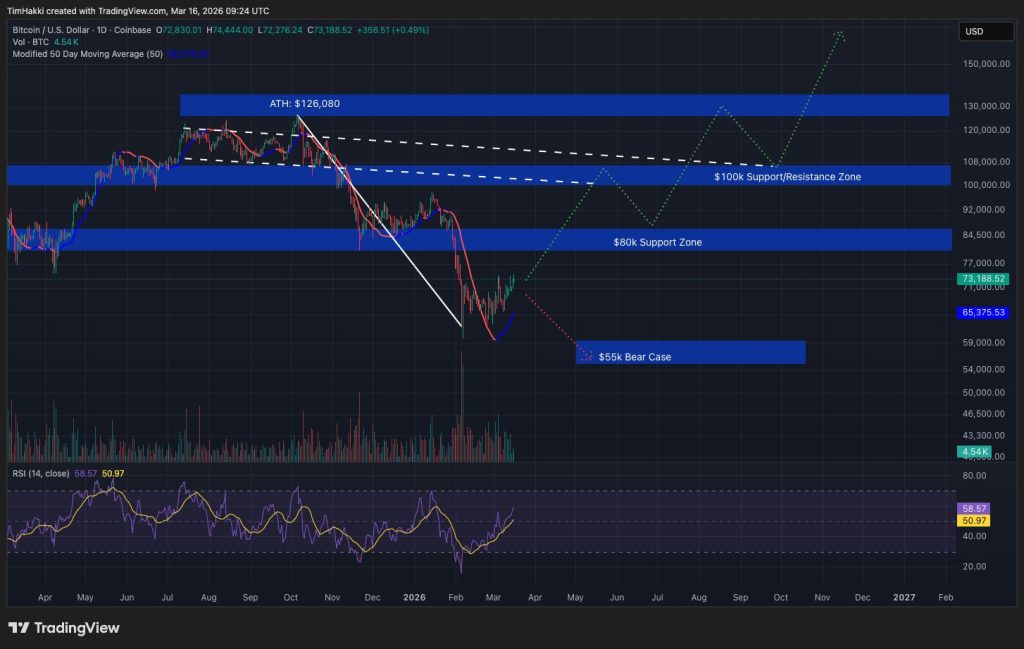
Bitcoin (BTC) trades more and more bullishly these days. The world’s favourite crypto reclaimed a pivotal technical level by surging past its 50-day moving average and briefly rising above $74,000, before pulling back to around $73,300, a 2.4% gain in the last 24 hours, according to CoinGecko.
Traders and fans alike are now wondering if the latest upswing represents a potential end to the consolidation phase that has gripped markets since early February.
So, is buyer conviction finally strengthening?
Discover: The best pre-launch crypto sales
Today’s Bullish Bitcoin Breakout: Is it Sustainable?
Traders widely track the 50-day moving average as a gauge of market health, and Bitcoin’s inability to surpass it in recent weeks has been a source of bearish sentiment.
By clearing $71,125, the asset has flipped a previously formidable resistance level into potential support.
The bullish price action is conspicuous given the backdrop of market fears around the US-Iran conflict, although Bitcoin has largely shrugged off war fears, causing many to wonder if its extended downturn from October 2025 was the market pricing in the possibility of war.
Traders are now mapping the next zones of interest as volatility returns to the market. The technical picture suggests a battle between bulls aiming for new highs and bears looking to fade the rally.

In the bull case, Bitcoin must sustain its position above $73,000 to confirm the breakout. The immediate target is $75,000, a psychological and technical level laden with liquidity. A daily close above $75,000 could open the path toward $80,000, invalidating the bearish structure formed over the last two months.
On the flipside, if the price fails to hold above the 50-day MA at $71,125, the breakout could indicate a “bull trap.” In this event, support levels at $62,000 and $60,500 become the primary downside targets. A drop below recent lows would likely re-engage bearish momentum.
Bitcoin Trades a Little Higher Every Day, But Will it Break Out?
The push toward $75,000 is not just a technical event; it is also a liquidity trigger.
Market makers currently hold net short gamma positions worth billions around the $75,000 strike. As prices approach this level, these entities have to buy the underlying asset to delta-hedge their exposure to neutral, potentially creating a feedback loop that accelerates the rally.
This technical squeeze coincides with on-chain shifts. Large Bitcoin wallets have resumed accumulation as the price stabilizes above $71,000, signaling that “smart money” is positioning for a leg up.
Conversely, some institutional analysts are watching to see if the divergence between Bitcoin and Gold ETFs holds before deciding whether risk-on appetite is truly returning to the crypto sector.
Going forward, if Bitcoin trades above $73,500 for most of this week, it would suggest the bulls are in control, while a low-volume retreat could signal that the 50-day moving average remains a hurdle rather than a launchpad.
Discover: The best meme coins!
The post Bitcoin Trades Above 50-Day Moving Average as Bullish Momentum Builds appeared first on Cryptonews.

Welcome back to Inside DeFi
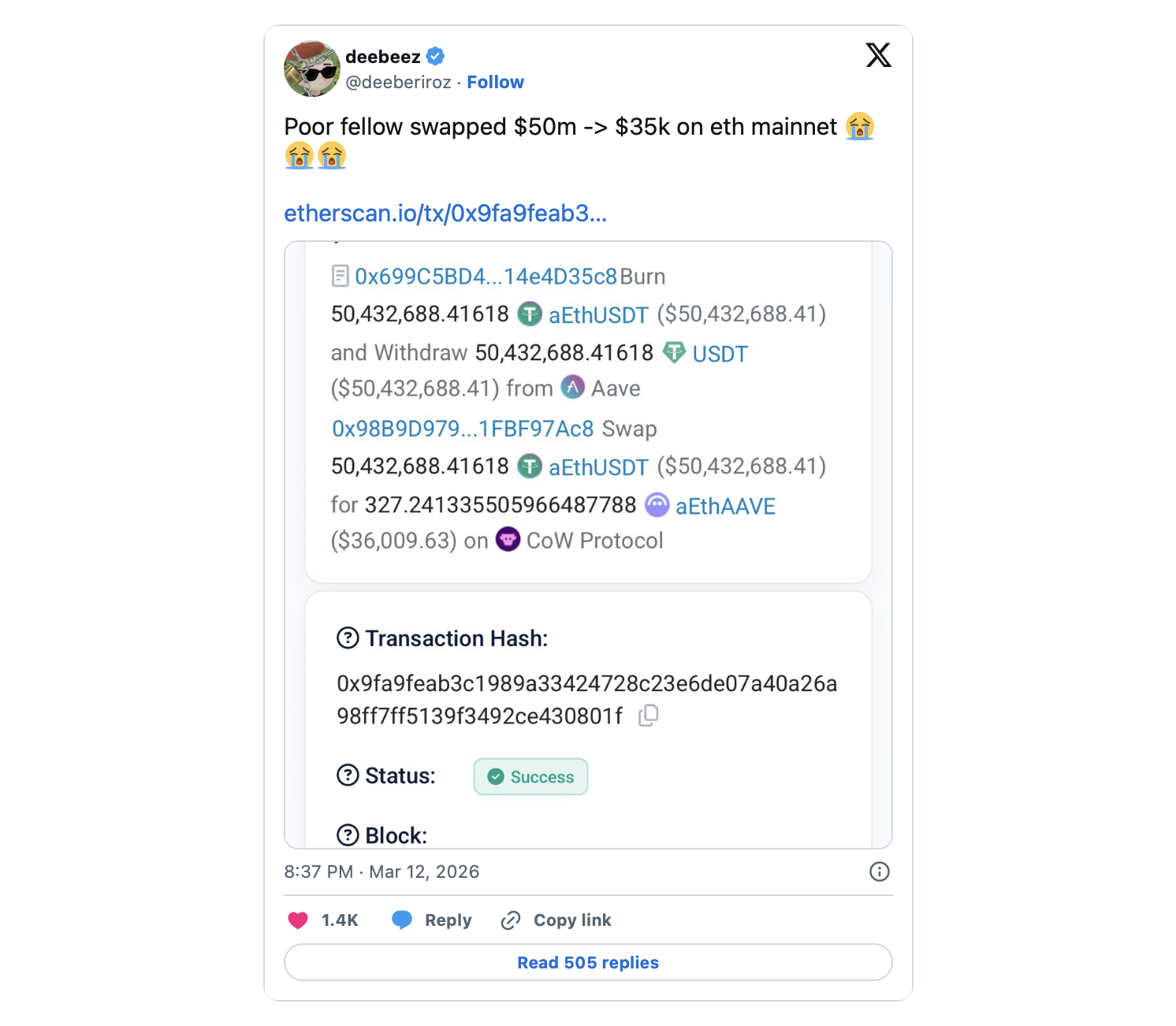
Today’s edition looks at a gung-ho swap which lost the user almost $50 million. It seems multiple warnings can’t save the kind of madman who’s prepared to swap such size from a mobile-based hot wallet.
We also take a look into the move away from DAOs, and finish up with some short snippets from the security space.
Technical difficulties in the Aave sphere
On Thursday, one spectacularly unlucky (or gung-ho) user took a 99.93% loss on a low liquidity $50 million trade.
They swapped $50 million of (Aave-wrapped) USDT to just $35,000 of (Aave-wrapped) AAVE. The trade was made via Aave’s controversial CoW Swap integration which kicked off a months-long governance battle in December.

Read more: Aave Labs faces backlash over CoW Swap integration
That said, swapping such a large sum in a single transaction, apparently from a phone, and after having accepted price impact warnings, doesn’t exactly scream “bulletproof opsec practices.”
While both CoW Swap and Aave have pledged to return the fees, it’s a very small dent in an enormous loss.
Aave founder Stani Kulechov detailed the UI warnings the user ignored, but recognized the result was “far from optimal.”
He also admits the industry needs “additional guardrails… to better protect users.”
Justifying why such swaps aren’t blocked, CoW Swap said, “Preventing users from making trades… can lead to terrible outcomes in some situations (e.g. a market crash).”
Former governance delegate Marc Zeller was quick to rub some salt in the wound. He also pointed out that the loss wouldn’t be possible on the previous swap tool, which Aave Labs replaced.

Read more: Across Protocol accused of looting DAO treasury of $23M
It’s clear who the loser is in this debacle – the one who lost $49,965,000. But the big winners were the MEV bot backrunning the trade and Titan Builder, which apparently made a total of $34 million in tips, sent straight to Coinbase.
The loss wasn’t the only technical glitch in the Aave-sphere this week. Almost $27 million was liquidated the day before due to a faulty update of Chaos Labs’ Correlated Asset Price Oracle.
Are DAOs done?
Now that Aave Labs has flexed its voting power over the DAO, others are taking note.
Across Protocol has proposed ditching the DAO, in favor of a “US C‑corp, via a token-to-equity exchange and token buyout.”
The thinking is that a change in governance will lead to “clearer accountability, faster execution, and a structure that can scale ops, partnerships, and product development over time.”
Co-founder Hart Lambur said “tokens are undervalued and underappreciated… the reality for Across is that having a token generally hurts more than it helps.”
The post goes on to state that the firm’s future focus will be stablecoins and “agentic payments.”
While others are rushing to tokenize equity, Across seems keen on doing quite the opposite.
Sky, formerly Maker DAO, is another (not so explicit) example of centralizing governance, albeit over a longer timeframe.
While some lament the perceived capture of one of DeFi’s longest-established DAOs, it seems to be working for the protocol, economically speaking.
Revenue within each DeFi vertical is concentrated into just one or two winners, as DeFiLlama’s 0xngmi points out. Many of those getting left behind are dropping like flies, or being forced to make tough decisions.

Read more: Across Protocol accused of looting DAO treasury of $23M
The chart comes from an article by Joel John of Decentralisedco, and questions the purpose of tokens. It notes that, while DeFi revenues have grown enormously, “most protocols lack a mechanism to return value to token holders.”
To be useful to holders, tokens must provide “claims to economic activity and the ability to guide governance.”
In cases where one or both of these aren’t in the interests of those holding sway over governance power, we may see more projects tearing off the DAO mask in the weeks and months to come.
Security snippets
A bite sized breakdown of some of the week’s security news.
The ongoing wave of front-end attacks continued to hit popular DeFi projects’ websites this week. Lending protocol Compound Finance and Solana memecoin launchpad BONK.fun were both affected.
No losses were found in relation to the former, while Bubblemaps found $20,000 was lost to the latter.
A SlowMist security researcher, who goes by “23pds,” shared a deep dive into a (possibly North Korean) campaign targeting a range of crypto companies’ supply chains, “from staking platforms, to exchange software providers, to the exchanges themselves.”
The hackers were successful in “exfiltrating proprietary exchange software containing hardcoded secrets.”
Security firm Cantina’s CEO, Hari Mulackal, examined the pressures facing the crowdsourced security model. He says security researchers, customers, and platforms all “hate it.”
In addition to problems with subjective bug severity and costs, Mulackal cites AI, which is “starting to be genuinely useful at finding bugs,” as a growing threat.
To combat endless submissions of slop bounty reports, a staking/penalty system or charge to submit bugs may provide reviewers some respite.
The post came in response to a security researcher’s claim that they “Lost $120K + 1st Place to an AI.”
Read more: DeFi, meet Claude: Moonwell’s ‘vibe-coded’ oracle in $1.8M blowup
Cosmos Labs published an investigation into the root cause of January’s $7 million hack of SagaEVM. The vulnerability was found to affect a number of chains built on the Cosmos EVM stack, specifically those which had used the “ICS20 precompile.”
The report explains that, “under certain execution conditions,” the vulnerability “could allow repeated use of the same token balance within a single transaction.” Affected networks were advised to disable the vulnerable precompile before a permanent fix was deployed.
A price cap oracle mishap saw $27 million in wstETH liquidated on Aave on Tuesday. While the incident isn’t exactly a blackhat exploit, more a failure of Chaos Labs’ code, oracle attacks have seen a recent uptick.
To finish off, in the latest installment of AI behaving badly, one of Alibaba’s research AIs allegedly cryptojacked itself.
The agent broke out of the “bounds of the intended sandbox,” triggering security alerts.
It had hijacked GPU capacity assigned for its own training, repurposing the compute to mine cryptocurrency.
— Jake Harrison

Why most AI service providers build the wrong thing and what to build instead
The building part has never been easier. Everyone obsesses over technical sophistication when the real constraint is finding clients and closing deals. But you still need to build something worth selling.
Most AI service providers build the wrong thing. They build custom bespoke solutions. Complex. Sophisticated. Designed to impress other technical people. The problem: custom work doesn’t scale. It consumes time. It compresses margins. Every client is a fresh project.
The professionals making real recurring revenue build service models that are repeatable, valuable to specific verticals, and don’t require reinventing the wheel with every new client.
The Setup: How Modern AI Development Actually Works
Before we cover the four models, here’s how to actually build these solutions quickly. Open Claude Desktop or Claude Code. Describe the objective. Provide comprehensive customer context their tech stack, current workflows, integrated systems, pain points. The more detailed your context, the better the output.
Claude Code handles the automation logic. For complex workflows, you route to n8n via Synta, which plans, builds, validates, and tests your workflows. No PhD required. No weeks learning node configurations.
The development pipeline: describe the problem, provide context, let tools handle technical execution, review, deploy. Now you can focus on what actually matters: finding customers and communicating value.
Model 1: Speed-to-Lead Response Systems
Setup: $1,500-$5,000 | Monthly Recurring: $300-$1,000
This is the easiest service model to sell because the problem is quantifiable. A speed-to-lead agent responds to new leads instantly, 24/7, without human intervention. Someone submits a form the agent responds within seconds via text or email, asks qualifying questions, captures information, books meetings.
The data backs this up. Responding in 5 minutes versus 30 minutes shows a dramatic difference in qualification rates. Most businesses take hours. Some take days. That’s money leaving the table every single day.
Critical positioning: You’re amplifying human capability, not replacing people. The receptionist isn’t losing their job— they’re freed up from handling cold leads. Framing this as “employee amplification” not “employee replacement” converts objections into signed contracts.
Unit economics are favorable. Operating costs run $20-50 monthly. You charge $500. The math is obvious.
Model 2: Workflow Automation
Setup: $2,000-$5,000 | Monthly Maintenance: $99-$250
Identify the repetitive, manual, low-value tasks consuming your client’s operational time. Email follow-ups nobody sends on time. Proposal generation that takes three hours when it should take 20 minutes. Data entry between systems that don’t talk to each other. Weekly reports consuming half a workday.
You automate one workflow. That’s the service. Leads come in, get qualified, receive personalized follow-up based on what they asked about, route to the CRM. What previously consumed someone’s entire morning runs autonomously.
Critical insight: Invisible automation gets cancelled. Visible automation gets renewed. Build a dashboard showing processed leads, emails sent, time reclaimed. When clients see quantified value, they renew.
Add a monthly maintenance package for $99-$250 to fix issues, optimize processes, and compound recurring revenue.
Model 3: Specialized AI Training Programs
Per Session: $500-$5,000 depending on specialization
Most organizations bought AI licenses. ChatGPT Enterprise, Claude Team, alternatives. Nobody trained their teams to actually use them. The tools sit idle while leadership questions the ROI.
A 90-minute focused workshop solves this. But here’s what matters: generic “Introduction to AI” commands zero premium. That’s a YouTube video. Industry-specific training is premium. “AI for Real Estate Professionals” commands different pricing than “Introduction to AI.” “Claude for Law Firm Associates” justifies a $3,000 session. Generic workshops don’t.
Effective format: immediate applicable wins, hands-on workflow building, department-specific case studies, implementation roadmaps. You’re not selling AI literacy. You’re selling context—deep understanding of their industry, workflow, and pain points translated into business language.
As AI commoditizes technical skills, communication becomes the competitive moat. The person who explains automation to a 55-year-old insurance broker in business terms outearns the person building the most sophisticated agent.
Model 4: Productized Automation
Monthly Recurring: $200-$500 per client | Time Scaling: Zero
This model decouples time from revenue. Find a painful, repetitive task that every business in a niche completes. Build the automation once. Deploy it to unlimited clients in that vertical with monthly maintenance.
Example: A podcast repurposing service. Creators upload raw episodes. Your system generates show notes, social posts, short-form video concepts, newsletters, blog posts—delivered within 24 hours. Charge $297 monthly. Build once, deploy infinitely.
Another example: Real estate automation. Agents add listings. The system generates MLS descriptions, social content, buyer emails, virtual tour scripts. Charge $197 monthly. The workflow doesn’t change. Only the client does.
This is where time stops being a constraint. Twenty clients on productized services, all consuming zero additional hours monthly, generates sustainable recurring revenue that actually scales.
Which Model Should You Start With?
Speed-to-lead is easiest to sell. The ROI is obvious. Most business owners understand the problem immediately. Start here if you want predictable deal flow.
Workflow automation is easiest to build. You’re solving specific problems. Implementation is straightforward. Start here if you want quick wins and case studies.
Training programs are highest margin with lowest technical risk. You’re selling knowledge and positioning, not building complex systems. Start here if you already have industry credibility.
Productized automation is highest upside but requires patience. You spend time building, then you scale without additional effort. Start here once you’ve validated that your solution actually works repeatedly.


Japanese bitcoin treasury firm Metaplanet (3350) said it raised about 40.8 billion yen ($255 million) from global institutional investors through a placement of new shares, part of a financing structure that could provide up to $531 million in total capital to support its bitcoin accumulation strategy.
The Tokyo-listed company priced the new shares at a 2% premium to the market price. The placement was paired with fixed-strike warrants carrying a 10% premium, which could generate an additional 44.5 billion yen if exercised.
The company also introduced a new series of moving strike warrants with what it described as the first mNAV (multiple to net asset value) clause attached to stock acquisition rights.
The mechanism allows the warrants to be exercised only when the company’s shares trade at least 1.01 times its modified net asset value, a metric comparing the firm’s market capitalization with the value of its bitcoin holdings. Metaplanet said the structure ensures any new share issuance increases bitcoin holdings per share.
To manage dilution, the company also suspended the exercise of previously issued warrants representing up to 210 million shares, prioritizing the new structure instead.
Metaplanet plans to use the funds primarily to expand its bitcoin reserves as it pushes toward its long-term goal of holding 210,000 BTC.
Metaplanet closed 5% higher on Monday as bitcoin climbed above $73,000. The firm is the world’s fourth-largest corporate bitcoin treasury company, holding 35,102 BTC.

TLDR
- Micron finalizes PSMC’s Tongluo P5 facility acquisition in Taiwan
- Company reveals plans for a second manufacturing plant at the Tongluo location
- The additional fab will match the scale of its current Miaoli County operation
- Production focus will be on advanced DRAM and high-bandwidth memory technology
- Groundbreaking for the second plant expected before fiscal 2026 concludes
Micron Technology ($MU) is significantly expanding its Taiwan operations. The American memory semiconductor manufacturer announced Monday its intention to construct an additional production facility at the Tongluo location, recently acquired through its takeover of Powerchip Semiconductor Manufacturing Corp (PSMC) assets.
$MU | Micron Completes Acquisition of PSMC Tongluo P5 Fab in Taiwan
👉 𝐊𝐞𝐲 𝐇𝐢𝐠𝐡𝐥𝐢𝐠𝐡𝐭𝐬:
➤ Micron acquires 𝐏𝐒𝐌𝐂 𝐓𝐨𝐧𝐠𝐥𝐮𝐨 𝐏𝟓 semiconductor site in Taiwan.
➤ Facility includes ~𝟑𝟎𝟎,𝟎𝟎𝟎 sq. ft. of 𝟑𝟎𝟎𝐦𝐦 cleanroom space.
➤ Site will expand… pic.twitter.com/w6feTGelnw
— Hardik Shah (@AIStockSavvy) March 16, 2026
The chipmaker has finalized its purchase of PSMC’s Tongluo P5 facility located in Miaoli County. With this acquisition complete, Micron is moving forward with an ambitious expansion plan that includes constructing a second comparable-sized fab at the same location.
This additional manufacturing site will target increased production of cutting-edge DRAM and high-bandwidth memory (HBM) — critical components that drive AI accelerators and data center processors.
Groundbreaking activities are planned to commence before fiscal 2026 ends, which for Micron concludes in late August.
Strategic HBM Expansion
High-bandwidth memory has emerged as one of the semiconductor sector’s most sought-after products. Major AI hardware manufacturers like Nvidia rely on this technology, creating persistent supply constraints across the industry.
Currently ranking third in the HBM market behind SK Hynix and Samsung, Micron’s Taiwan fab expansion represents a strategic effort to strengthen its competitive position.
The Tongluo site establishes Micron’s second Taiwanese manufacturing hub, complementing its existing Taichung facilities.
Co-locating multiple fabs at a single site offers operational advantages, including shared infrastructure expenses and accelerated production scaling through consolidated utilities, logistics networks, and engineering teams.
Strategic Value of the Tongluo Acquisition
Initially announced in the previous year, the PSMC deal has now officially completed. As a former contract manufacturer, PSMC’s Tongluo P5 location provides Micron with ready-to-use manufacturing space that can be adapted for its proprietary DRAM production processes.
The completed acquisition’s financial details have not been publicly revealed by Micron.
While the second Tongluo facility will be comparable in size to the first, specific capacity numbers for either building remain undisclosed at this time.
Taiwan’s dominance in advanced semiconductor manufacturing makes it a strategic location for Micron’s expansion, positioning the company within the region’s established chip production ecosystem and closer to critical supply chain partners.
MU stock was up 5.13% at the time of reporting.



21Shares AG, a Switzerland based issuer of crypto exchange-traded products (ETPs), has announced significant updates to four of its Bitcoin and Ethereum-linked ETPs listed on the London Stock Exchange.
Effective March 26, 2026, the company will appoint FTSE International Limited as an additional index administrator for its program and switch the crypto asset reference prices used for these products.
The affected ETPs include:
- 21Shares Bitcoin ETP (ISIN: CH0454664001, tickers: ABTC / BTCU)
- 21Shares Ethereum Staking ETP (ISIN: CH0454664027, tickers: AETH / ETHU)
- 21Shares Bitcoin Core ETP (ISIN: CH1199067674, tickers: CBTC / CBTU)
- 21Shares Ethereum Core Staking ETP (ISIN: CH1209763130, tickers: ETHC / CETU)
Currently, these products rely on CCIX Bitcoin USD (CCBTC) and CCIX Ethereum USD (CCETH) as their reference prices.
Discover: The top crypto to diversify your portfolio with
How 21Shares and FTSE are Repricing Crypto ETPs
Henceforth, from March 26 onwards, they will transition to the FTSE Bitcoin Index (1HR 1700 CET) for Bitcoin products and the FTSE Ethereum Index (1HR 1700 CET) for Ethereum products. Accordingly, the corresponding new Bloomberg index codes will be FBTC1HRE and FETH1HRE, respectively.
The FTSE Global Digital Asset Index Series, administered by FTSE Russell (part of London Stock Exchange Group), provides institutional-grade benchmarks for digital assets.
These single-asset indices use a methodology involving the FTSE DAR Reference Prices, with the “1HR 1700 CET” variant applying a one-hour lookback to determine fixes at 17:00 Central European Time.
In essence, this aims to deliver reliable, screened pricing for crypto exposures, drawing from vetted exchanges and data sources.
The new changes subsequently enhance the robustness and standardization of pricing for these ETPs, aligning them with FTSE Russell’s established framework amid growing institutional interest in digital assets.
All other product details, including fees, structure, and regulatory listings with the UK’s Financial Conduct Authority, remain unchanged.
21Shares AG, headquartered at Pelikanstrasse 37, 8001 Zurich, Switzerland, emphasized that full details are available in its UK Base Prospectus dated January 8, 2026, accessible on its website. The announcement is not an offer to sell securities, particularly in the United States, where the products are not registered.
All things considered, this move reflects broader trends in the crypto ETP space toward diversified, high-quality index providers to improve transparency and investor confidence in volatile digital asset markets.
As Wall Street deepens its involvement in crypto products and billionaire investors increasingly eye crypto infrastructure, the methodology for weighting and pricing these basket components consequently becomes critical for maintaining accurate exposure to the broader market performance.
The post 21Shares Updates Crypto Reference Prices for Four Key ETPs appeared first on Cryptonews.
For the third Monday in a row, trading in the oil market has opened with a bullish gap, although this time it is not as wide as the gap seen, for example, on 9 March. The reason for the volatility is clear — the ongoing military conflict in the Middle East, with no visible signs of de-escalation so far.
According to the latest media reports:
→ the Strait of Hormuz remains effectively closed;
→ over the weekend the United States struck Iran’s Kharg Island, a key hub for the country’s oil export infrastructure;
→ Iran launched an attack on the oil port of Fujairah in the UAE.
Technical Analysis of XTI/USD
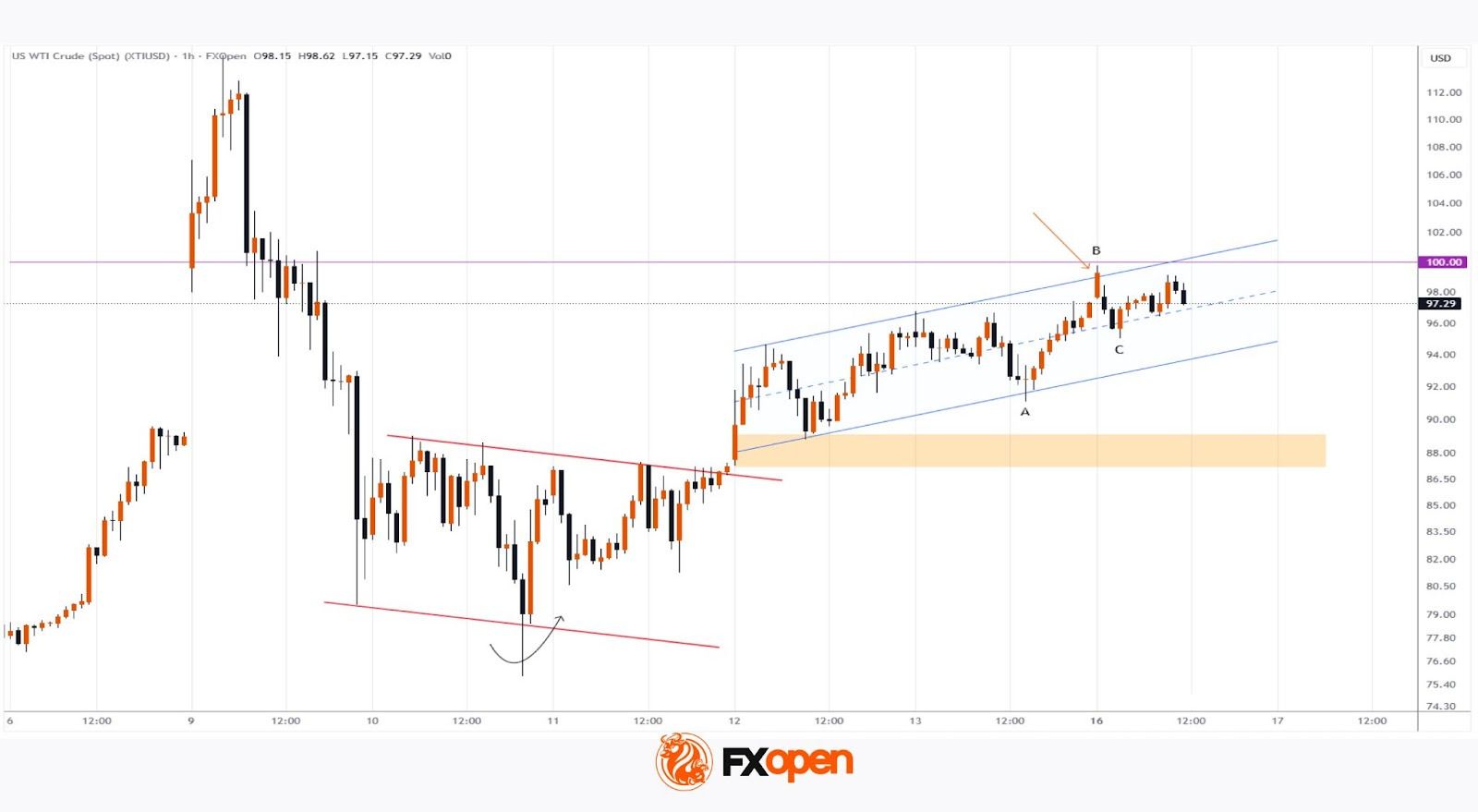
While analysing WTI price movements on 11 March, we:
→ identified a local descending channel (shown with red lines);
→ highlighted a sharp reversal on 10 March (marked with an arrow).
Since then, buying pressure has continued to strengthen, largely driven by developments in the Middle East. As a result:
→ the local descending channel was broken to the upside;
→ the breakout zone later acted as support;
→ the XTI/USD chart formed the structure for an ascending channel (shown in blue).
At present, the market retains a bullish bias. For instance, the pullback from B to C represents roughly a 50% retracement of the A–B impulse, while WTI prices remain close to the psychological level of $100 per barrel.
However, the candlestick structure at the market open (marked with an arrow) suggests that sellers were able to push prices lower. Therefore, even if we see an attempt to break above the $100 level in the near term, it may struggle to gain strong momentum.
Start trading commodity CFDs with tight spreads (additional fees may apply). Open your trading account now or learn more about trading commodity CFDs with FXOpen.
This article represents the opinion of the Companies operating under the FXOpen brand only. It is not to be construed as an offer, solicitation, or recommendation with respect to products and services provided by the Companies operating under the FXOpen brand, nor is it to be considered financial advice.
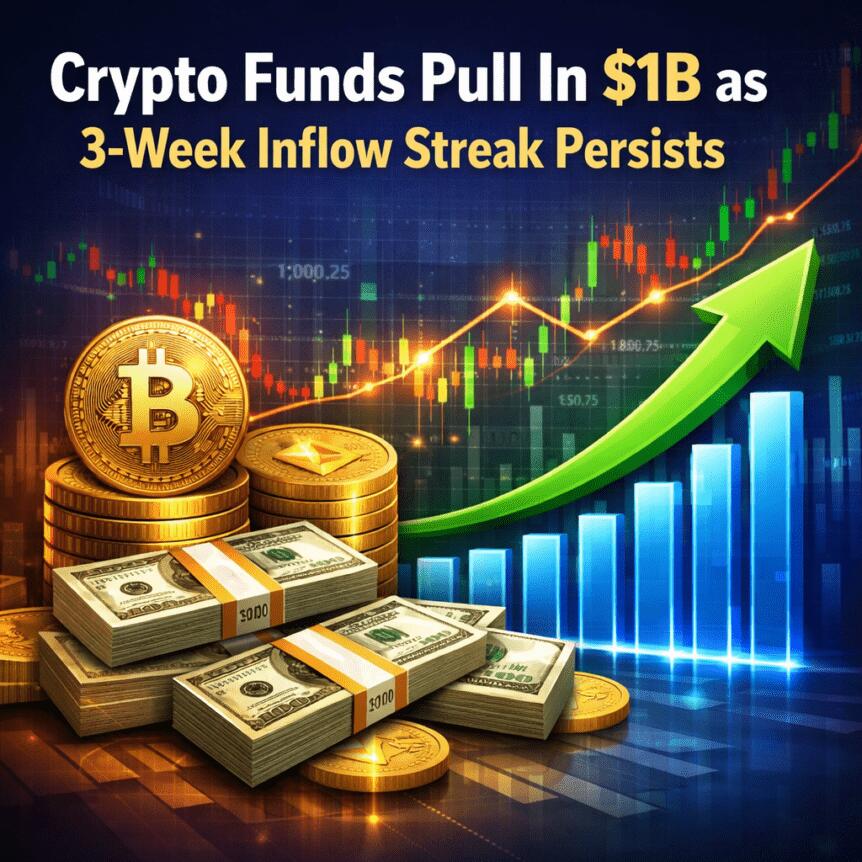
Momentum in crypto investment products persisted last week, underscoring resilience amid geopolitical stress and reinforcing Bitcoin’s role as a potential safe-haven asset. Data from CoinShares show a total of $1.06 billion flowing into crypto exchange-traded products (ETPs), led by $793 million into Bitcoin. The three-week inflow streak now totals roughly $2.7 billion, lifting year-to-date inflows to about $1.2 billion. Industry observers frame this as evidence of continued demand for digital assets, particularly Bitcoin, in a risk-off environment where traditional markets are sensitive to global tensions. Since the Iran crisis began, assets under management in digital-asset ETPs have risen about 9.4% to nearly $140 billion, marking a significant shift in scale and investor confidence.
Key takeaways
- Bitcoin ETP inflows dominated, with about $793 million of the $1.06 billion weekly total, driving three consecutive weeks of positive flows and helping to push year-to-date gains toward the $1.2 billion mark.
- Ether funds posted inflows of roughly $315.3 million last week, yet year-to-date remain in the red by around $23 million; the improved momentum partly stems from the US launch of new staking ETF listings, moving Ether exposure closer to a net-neutral position.
- XRP faced outflows totaling about $76 million for the week, while Solana attracted roughly $9.1 million of inflows, signaling divergent sentiment across major detractors and beneficiaries within the market.
- US spot Bitcoin ETFs kicked off their first five-day inflow streak of 2026, pulling in about $767.3 million, though year-to-date figures still show net outflows near $493 million, indicating a mixed near-term trajectory for spot exposure.
- Short-Bitcoin products drew inflows of around $8.1 million, suggesting a nuanced, somewhat polarized market view on near-term Bitcoin direction.
Tickers mentioned: $BTC, $ETH, $XRP, $SOL
Sentiment: Bullish
Price impact: Positive. The sustained inflows into BTC-focused ETPs and broader digital-asset products point to renewed demand and a potential shift in risk-off capital toward Bitcoin as a hedge.
Market context: The ongoing ETF activity reflects a broader liquidity backdrop and evolving regulatory acceptance of crypto products in major markets. With ETH-related staking products contributing to momentum, investors are watching whether US-listed offerings can sustain inflows in an environment shaped by macro concerns and policy developments around digital assets.
Why it matters
The persistence of inflows into crypto ETPs—especially Bitcoin—thematically reinforces a narrative that has gained traction among institutional participants: digital assets can complement traditional portfolios during periods of macro stress. The fact that Bitcoin-led products drew the lion’s share of inflows while other assets lag or reverse direction highlights the evolving core-periphery dynamics within the crypto sector, where Bitcoin remains the anchors of liquidity and perceived safety. This dynamic matters not only for traders but for asset managers seeking regulated vehicles to provide crypto exposure to a wider audience.
Ethereum’s trajectory reveals a more nuanced story. While Ether funds are still in the red year-to-date, the recent inflows coincide with the launch of new staking ETF listings in the US, which are shaping liquidity and expectations for yield-oriented crypto products. The ability of these products to move flows toward neutral parity signals that institutional appetite for Ether exposure is stabilizing, even as the broader market contends with competing narratives around yield, staking, and regulatory clarity. The reaction to staking ETFs underscores a broader trend: regulated structures can translate macro- and policy-driven developments into measurable capital movement, influencing market liquidity and price discovery across ETH-related instruments.
On the altcoin side, XRP’s outflows contrasted with modest Solana inflows, painting a picture of selective risk sentiment within the broader ecosystem. While XRP has faced persistent selling pressure, Solana’s inflows hint at continued interest in alternative layer-1 ecosystems, albeit at a smaller scale than Bitcoin. The mixed signals among major assets illustrate a market still negotiating the balance between risk, opportunity, and regulatory visibility in a rapidly evolving sector.
Finally, the unfolding story of US spot Bitcoin ETFs—tied to the first five-day inflow streak of the year—offers a useful barometer for the sector’s maturity. Despite three consecutive weeks of inflows totaling around $2.1 billion, the year-to-date tally remains negative, underscoring the volatility inherent in crypto markets and the sensitivity of flows to macro headlines and policy shifts. Investors continue to monitor whether this inflow momentum can translate into sustained positive drift, particularly as other regions contemplate or expand their own regulated crypto products.
What to watch next
- Upcoming weekly flow data to see if Bitcoin-led inflows sustain their momentum into consecutive weeks.
- Status and performance of US staking ETFs and their impact on Ether-related fund flows and pricing dynamics.
- Regulatory developments around crypto ETFs and related products, especially in the US and Europe, that could alter institutional appetite.
- Market reaction to XRP and other major altcoins as wallets and funds re-balance in response to outflows or new product launches.
- Continued monitoring of total assets under management in digital-asset ETPs to gauge whether the 9.4% rise since the Iran crisis translates into a longer-term structural shift.
Sources & verification
- CoinShares Digital Asset Fund Flows Weekly report (volume-277) detailing weekly inflows and annual totals.
- SoSoValue chart documenting weekly flows into US spot Bitcoin ETFs and the five-day inflow streak.
- Cointelegraph article: Bitcoin ETFs add $251M as Goldman Sachs tops XRP ETF holders.
- Cointelegraph article: Spot Bitcoin ETFs five-day inflow streak 2026.
Market reaction and key details
Crypto investment products continued to show resilience as investor demand reinforced Bitcoin’s standing within regulated markets. Bitcoin (CRYPTO: BTC) led the charge, drawing about $793 million of the total inflows of $1.06 billion for the week, sustaining a three-week run that has injected roughly $2.7 billion into digital-asset ETPs. This momentum helped lift year-to-date inflows to approximately $1.2 billion, while total assets under management across digital-asset ETPs rose by about 9.4% since the onset of the Iran crisis, nearing $140 billion. The data suggests a growing willingness among institutional buyers to allocate to regulated crypto products even amid geopolitical tensions that typically heighten risk aversion in traditional markets.
The performance split between assets underscores a nuanced market: Ether (CRYPTO: ETH) funds posted inflows of around $315.3 million, yet year-to-date figures remain negative by roughly $23 million as demand for ETH exposure encounters the broader macro headwinds. The late-week uplift in ETH-related flows was linked to the US’s introduction of new staking ETF listings, a development that appears to be nudging Ether exposure toward net neutrality as product availability expands. The Ethereum narrative reflects how regulated products—especially those tied to staking mechanisms—can shape price dynamics and investor appetite even when asset-specific momentum is uneven.
In contrast, XRP faced outflows of about $76 million, signaling continued selective selling pressure on the asset, while Solana drew about $9.1 million in inflows, illustrating a more modest, but positive, tilt toward SOL among market participants looking for exposure beyond Bitcoin and Ethereum. Short-Bitcoin products also attracted inflows of roughly $8.1 million, a signal that market sentiment remains polarized on near-term direction, with some participants seeking hedges or tactical bets as macro catalysts unfold.
The week’s broader narrative centered on US spot Bitcoin ETFs, which marked their first five-day inflow streak of 2026 by pulling in nearly $767.3 million. Yet, despite these fresh inflows, year-to-date performance for spot BTC funds remains negative—around $493 million—highlighting that the broader bleed from earlier months has yet to be fully offset. The juxtaposition of robust weekly inflows against a still-negative YTD tally underscores the complexity of the environment: liquidity is returning in fits and starts, but the trajectory for the year remains uncertain as stakeholders weigh macro factors and regulatory signals.
Looking ahead, observers expect this week to reveal whether US spot Bitcoin ETFs can sustain positive momentum into the March and April period, following a challenging start to the year characterized by substantial outflows in January and February that were partially offset by inflows in March. The dynamic between spot BTC demand and the evolving landscape of staking and regulated products will likely shape not only fund flows but also price formation across the crypto market as investors reassess risk and return in a shifting regulatory backdrop.
What to watch next
- Follow weekly asset flows to determine if Bitcoin-led inflows become a longer-term pattern rather than a temporary rebound.
- Monitor the performance and uptake of US staking ETFs and any regulatory clarifications that impact Ether exposure through regulated vehicles.
- Track XRP and SOL demand as new product launches and ecosystem developments unfold, potentially reshaping allocations among major altcoins.
Crypto World
PEPE, BONK outpace BTC price, ETH as “barbell strategy” wins out: Crypto Daybook Americas
By Omkar Godbole (All times ET unless indicated otherwise)
Even as bitcoin rallies, non-serious tokens such as memecoins are emerging as the biggest winners.
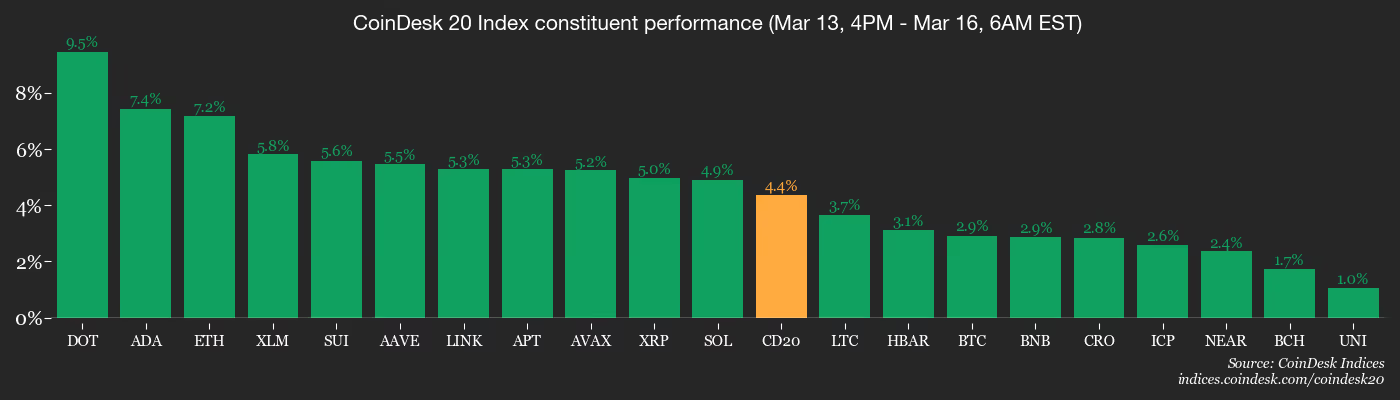
Among the majors, bitcoin jumped more than 2% in 24 hours, and at one point early Monday briefly topped $74,300 for the first time since early February. Other tokens including XRP (XRP) and solana (SOL) gained over 4%, and ether (ETH) rose 7%. The CoinDesk 20 Index added nearly 4%.
But the top-performing token among the top 100 over the past 24 hours is the memecoin PEPE, which has surged 19%. Its compatriots BONK and PENGU are up over 10%, and SHIB also outpaced ether’s 7% rise. In fact, five of the day’s best-performing coins are meme tokens.
This illustrates a trend observed since 2023–24. Observers have dubbed it the “barbell strategy:” holding a serious token like bitcoin, with growing institutional adoption, on one end, while speculating in smaller, non-serious coins such as memecoins on the other.
The behavior contrasts with the previous bull market, when BTC rallies tended to lift more productive sectors of the market, such as DeFi and play-to-earn projects.
One possible reason for the absence of a so-called “meaningful alt season” is the flood of new altcoins, which has spread demand across thousands of projects. CoinMarketCap data show the total number of tokens has surpassed 37.8 million in just three years, highlighting the massive influx of new projects.
Some observers are pinning hopes on the Clarity Act in the U.S. to reinvigorate the broader market. Others caution that time is running short for decisive regulatory action.
In traditional markets, S&P 500 futures traded higher even as oil prices tested the $100 level. Nvidia’s GTC conference begins Monday, and CEO Jensen Huang could outline the company’s AI roadmap, an event the crypto industry will watch closely for signals on data center demand. Stay alert!
Read more: For analysis of today’s activity in altcoins and derivatives, see Crypto Markets Today
What to Watch
For a more comprehensive list of events this week, see CoinDesk’s “Crypto Week Ahead“.
- Crypto
- Macro
- March 16, 8:30 a.m.: Canada consumer price index (CPI) YoY for February (Prev. 2.3%)
- Earnings (Estimates based on FactSet data)
- March 16: Bakkt Holdings (BKKT), post-market, -$0.47
- March 16: Bitcoin Depot (BTM), pre-market, -$0.47
- March 16: Cango (CANG), post-market, -$0.34
Token Events
For a more comprehensive list of events this week, see CoinDesk’s “Crypto Week Ahead“.
- Governance votes & calls
- Decentraland DAO is voting on whether to allow registered users to customize the color of their avatar name tag and to add a more accessible volume slider to the UI sidebar. Voting ends March 16 and 17.
- Unlocks
- March 16: Arbitrum (ARB) to unlock 1.78% of its circulating supply worth $9.65 millon.
- Token Launches
Conferences
For a more comprehensive list of events this week, see CoinDesk’s “Crypto Week Ahead“.
Market Movements
- BTC is up 2.22% from 4 p.m. ET Sunday at $73,300.29 (24hrs: +2.02%)
- ETH is up 5.98% at $2,259.15 (24hrs: +6.57%)
- CoinDesk 20 is up 3.81% at 2,130.70 (24hrs: +3.79%)
- Ether CESR Composite Staking Rate is unchanged at 2.74%
- BTC funding rate is at 0.0041% (4.4435% annualized) on Binance

- DXY is unchanged at 100.29
- Gold futures are down 1.36% at $4,983.70
- Silver futures are down 2.80% at $78.65
- Nikkei 225 closed down 0.13% at 53,751.15
- Hang Seng closed up 1.45% at 25,834.02
- FTSE 100 is unchanged at 10,261.99
- Euro Stoxx 50 is down 0.67% at 5,678.08
- DJIA closed on Friday down 0.26% at 46,558.47
- S&P 500 closed down 0.61% at 6,632.19
- Nasdaq Composite closed down 0.93% at 22,105.36
- S&P/TSX Composite closed down 0.91% at 32,541.93
- S&P 40 Latin America closed down 0.16% at 3,584.57
- U.S. 10-Year Treasury rate is up 1 bps at 4.28%
- E-mini S&P 500 futures are up 0.37% at 6,660.50
- E-mini Nasdaq-100 futures are up 0.45% at 24,504.25
- E-mini Dow Jones Industrial Average futures are up 0.78% at 46,957.00
Bitcoin Stats
- BTC Dominance: 59.22% (-0.29%)
- Ether-bitcoin ratio: 0.03088 (3.24%)
- Hashrate (seven-day moving average): 947 EH/s
- Hashprice (spot): $32.00
- Total fees: 1.97 BTC / $140,987
- CME Futures Open Interest: 111,895 BTC
- BTC priced in gold: 14.8 oz.
- BTC vs gold market cap: 4.92%
Technical Analysis

- The chart shows bitcoin’s daily price swings in candlestick format since September 2025.
- Despite the recent bounce, BTC remains trapped in a sideways grind marked by trendlines connecting highs hit on Feb. 8 and March 4 and lows from Feb. 6 and Feb. 24.
- The next move largely depends on the direction in which the range play is resolved.
- A similar price action unfolded in the two months to mid-January and ended deepening the selloff to nearly $60,000.
Crypto Equities
- Coinbase Global (COIN): closed on Friday at $195.53 (+1.19%), +2.72% at $200.84 in pre-market
- Galaxy Digital (GLXY): closed at $22.35 (+8.34%), +2.68% at $22.95
- MARA Holdings (MARA): closed at $9.32 (+6.39%), +3.54% at $9.65
- Riot Platforms (RIOT): closed at $14.04 (–3.17%), +2.42% at $14.38
- Core Scientific (CORZ): closed at $16.49 (+1.54%), +0.73% at $16.61
- CleanSpark (CLSK): closed at $9.76 (+2.20%), +3.18% at $10.07
- Exodus Movement (EXOD): closed at $8.97 (–9.94%)
- CoinShares Bitcoin Miners ETF (WGMI): closed at $38.28 (+0.83%)
- Circle Internet Group (CRCL): closed at $115.38 (+1.05%), +2.88% at $118.70
- Bullish (BLSH): closed at $36.62 (+1.05%), +2.40% at $37.50
Crypto Treasury Companies
- Strategy (MSTR): closed at $139.67 (+1.70%), +3.10% at $144.00
- Strive Asset Management (ASST): closed at $9.53 (+7.93%), +3.04% at $9.82
- SharpLink (SBET): closed at $7.53 (+0.67%), +5.84% at $7.97
- Upexi (UPXI): closed at $1.11 (+19.35%), +9.91% at $1.22
- Lite Strategy (LITS): closed at $1.18 (+2.61%)
ETF Flows
Spot BTC ETFs
- Daily net flows: $180.4 million
- Cumulative net flows: $56.12 billion
- Total BTC holdings ~ 1.29 million
Spot ETH ETFs
- Daily net flows: $26.7 million
- Cumulative net flows: $11.82 billion
- Total ETH holdings ~ 5.73 million
Source: Farside Investors
While You Were Sleeping
Bitcoin (BTC) found fresh strength during the early Asian trading hours on Monday as bulls eyed further short-term gains.
Key takeaways:
-
Bitcoin price rises to a six-week high of $74,400 on Monday, liquidating $300 million in shorts.
-
The 50-day moving average above $71,120 is a key support level to watch for BTC/USD going forward.
Bitcoin leads market in new relief bounce
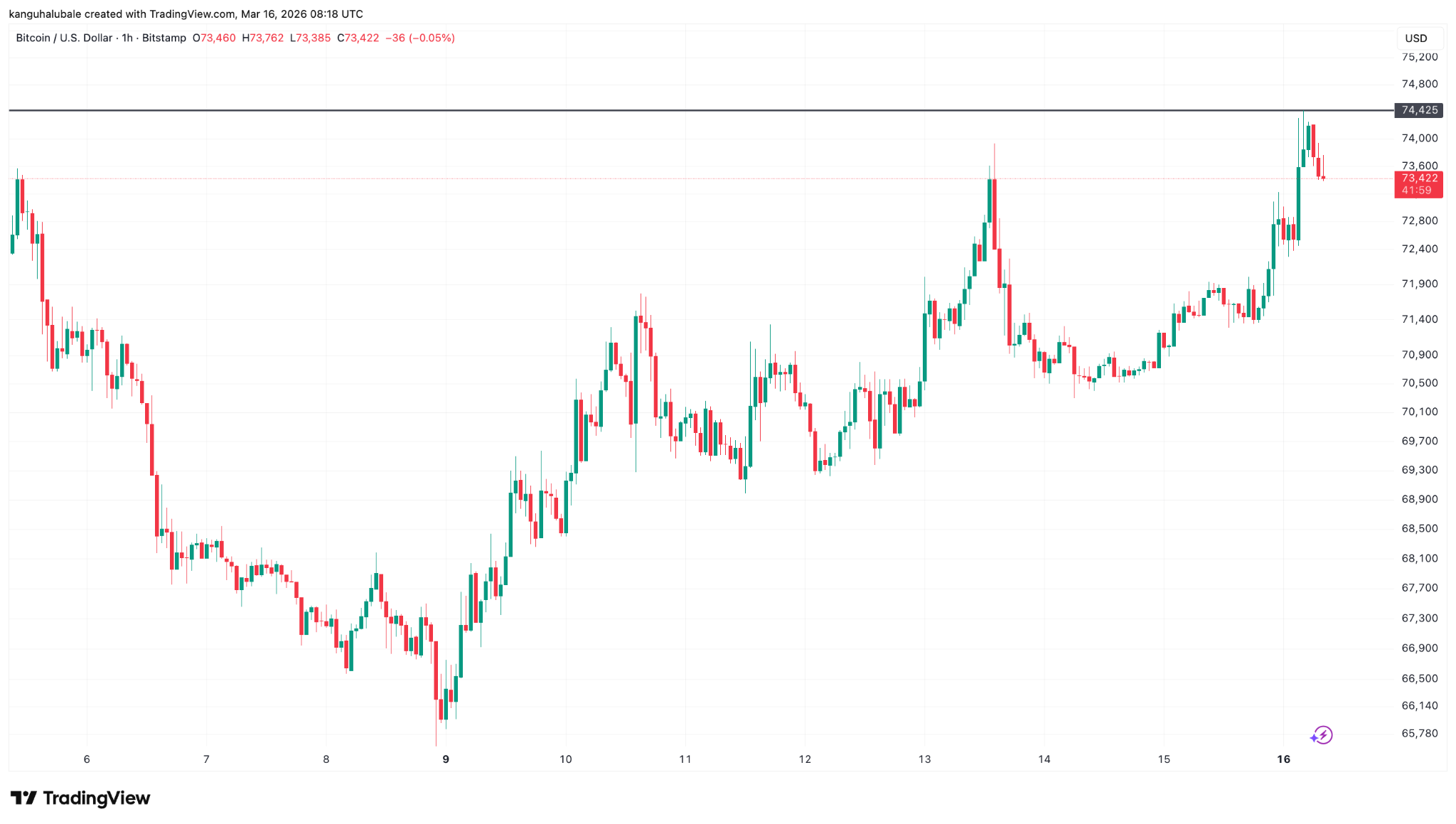
Data from TradingView showed 2.5% daily BTC price gains, with BTC/USD rising as high as $74,400 for the first time since Feb. 4.

Ether (ETH), the largest altcoin by market capitalization, was trading at $2,250 at the time of writing, up 7% over the last 24 hours. Fifth-placed XRP (XRP) has gained nearly 5% over the last day to trade just above $1.48.
Solana (SOL) has also posted significant gains among the top 10 cryptocurrencies, up 6% over the same period. As a result, the global crypto market capitalization is up 4% over the day to $2.49 trillion on Monday.

“Bitcoin pumped $1,800 in just 30 minutes, hitting a 40-day high of $74,300,” analyst Bull Theory said in the latest post on X, adding:
“It’s surprising how risk assets are performing better than safe-haven assets like gold and silver during an active war.”
Bitcoin’s relief rally is accompanied by significant short liquidations across the crypto market totaling $300 million over the last 24 hours. Meanwhile, Bitcoin futures open interest (OI) continued to rise, with monitoring resource Coinglass showing a 6% jump to $49.2 billion in the past 24 hours.
Commenting on the data, Coinglass said that the same pattern of the OI rising in tandem with the price “preceded the last volatility spikes,” adding:
“New fuel is building again.”

Bulls reclaim the 50-day BTC price trend line
Bitcoin’s latest recovery saw it reclaim a key support level in the form of the 50-day simple moving average (SMA) at $71,120.
“Impressive strength on BTC today – set to close a daily candle above its 50MA for the first time in 55 days,” said trader and investor MacroSRG in a Monday post on X.
BTC rallied 33% in just a month following the last time the price reclaimed this trend line after a long period of trading below it.

Bitcoin is also “set to close 8 consecutive daily green candles for the first time since December 2020,” analyst Max Crypto said in an X post, adding:
“Last time this happened, BTC rallied 145% in just 2 months.”
Echoing this, MN Capital founder Michael van de Poppe said that while Bitcoin continues to build momentum, its valuation against gold “rallies substantially,” adding:
“There’s more upside to come; $ETH broke out of the range, which means it’s a matter of time until Bitcoin continues the rally towards $80K.”

Along with the 50-day SMA, the BTC/USD pair now also trades above other key long-term levels, including the 200-week exponential moving average (EMA) and the old 2021 all-time high at $68,300 and $69,400, respectively.
This article does not contain investment advice or recommendations. Every investment and trading move involves risk, and readers should conduct their own research when making a decision. While we strive to provide accurate and timely information, Cointelegraph does not guarantee the accuracy, completeness, or reliability of any information in this article. This article may contain forward-looking statements that are subject to risks and uncertainties. Cointelegraph will not be liable for any loss or damage arising from your reliance on this information.
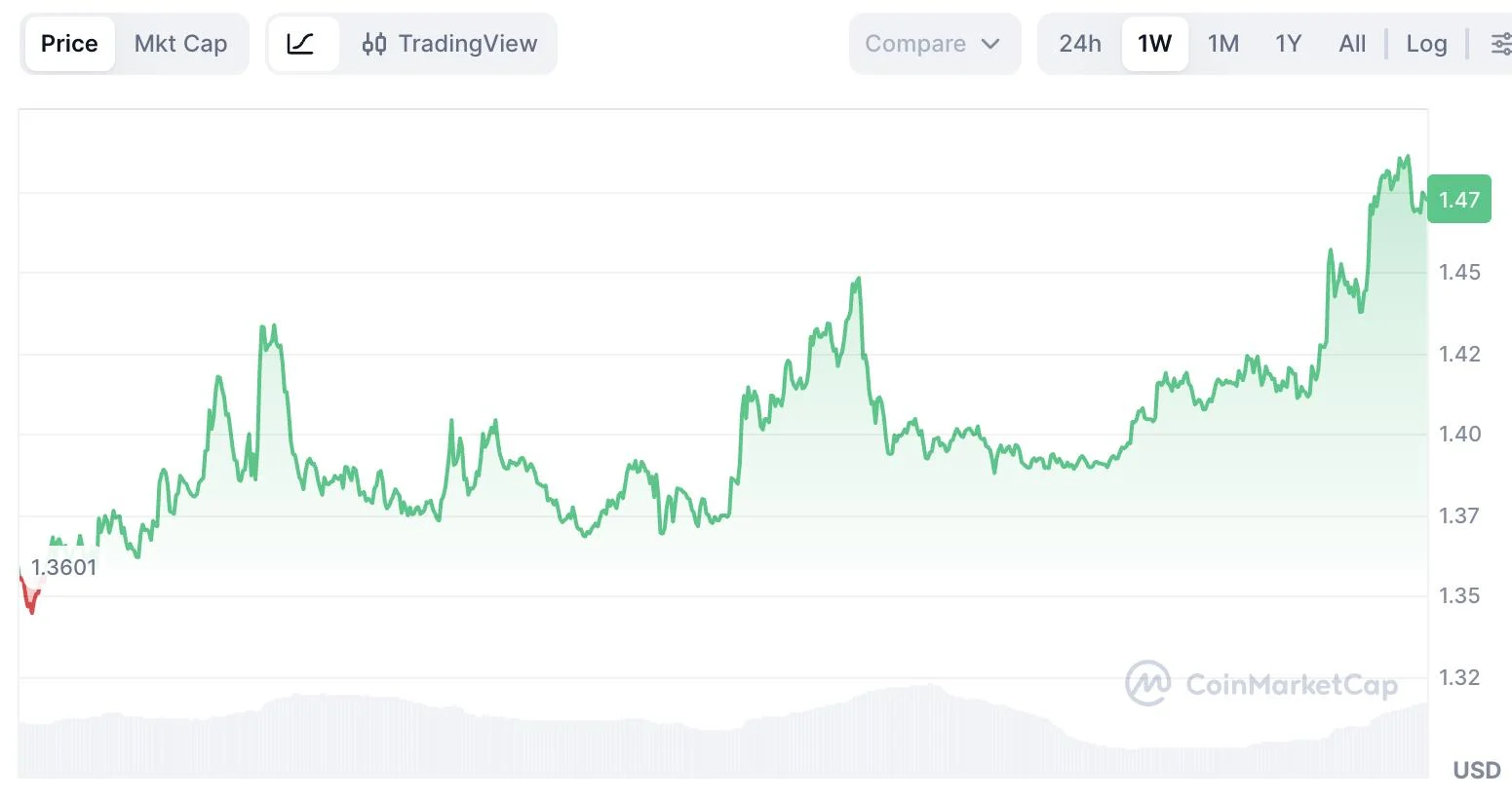
The cryptocurrency market is seeing renewed bullish momentum as XRP climbed to around $1.47, gaining nearly 4% in the past 24 hours. The move highlights growing investor interest in major altcoins as traders rotate back into digital assets amid broader volatility across traditional financial markets.
Meanwhile, Bitcoin surged past $74,000, rising more than 3% in a single day and triggering roughly $115 million in short liquidations. The rally comes as global markets react to geopolitical tensions, with cryptocurrencies showing resilience compared to some traditional assets. Since the start of the latest market volatility, Bitcoin has climbed more than 12% from around $66,000, helping push the total crypto market capitalization toward $2.5 trillion.
As the market heats up, new projects are also entering the spotlight, including the Ethereum-based memecoin APEPEPE, which has officially launched its presale phase. The project is positioning itself within the fast-growing memecoin sector that previously produced breakout successes such as Dogecoin and Shiba Inu. By focusing on community engagement and viral branding, the team behind APEPEPE aims to build momentum during the early stages of its launch.
Institutional activity is also playing a role in the current market strength. U.S. spot Bitcoin ETFs have recorded hundreds of millions of dollars in inflows, helping support Bitcoin’s climb while improving overall sentiment across the crypto sector. However, analysts still warn that macroeconomic uncertainty and global events could create short-term volatility.
Despite these risks, many traders believe the current environment could spark a new wave of innovation and speculative interest across the crypto ecosystem. With major assets like XRP and Bitcoin leading the rally, attention is increasingly shifting toward emerging projects that could capture the next cycle of market excitement.
For early-stage investors and crypto enthusiasts watching the memecoin sector, projects like APEPEPE are gaining attention precisely because they are still in their early phases. As the presale unfolds and the community continues to grow, supporters hope the project could become one of the standout newcomers in the evolving memecoin landscape.
Learn more about APEPEPE:
Website: https://apepepe.com
X (Twitter): https://x.com/realAPEPEPE
Disclaimer: This is a Press Release provided by a third party who is responsible for the content. Please conduct your own research before taking any action based on the content.

Tylil James Sparks Reactions After Cozy Photo With Kae Critch

Splurge Monday’s Workwear Report: Amor Ribbed Silk and Cashmere Midi Dress

Nationwide says to check if you qualify for ‘life-changing’ extra payments


-
 Tech5 days ago
A 1,300-Pound NASA Spacecraft To Re-Enter Earth’s Atmosphere
-
 Crypto World2 days ago
HYPE Token Enters Net Deflation as HyperCore Buybacks Outpace Staking Rewards
-

 Business6 days ago
ExxonMobil seeks to move corporate registration from New Jersey to Texas
-

 Crypto World7 days ago
Paradigm, a16z, Winklevoss Capital, Balaji Srinivasan among investors in ZODL
-

 Fashion3 days ago
Weekend Open Thread: Addict Lip Glow
-

 Tech6 days ago
ChatGPT will now generate interactive visuals to help you with math and science concepts
-
Sports2 days ago
Why Duke and Michigan Are Dead Even Entering Selection Sunday
-

 NewsBeat5 days ago
Residents reaction as Shildon murder probe enters second day
-

 Business5 days ago
Search Enters Sixth Week With New Leads in Tucson Abduction Case
-
 NewsBeat6 days ago
Pagazzi Lighting enters administration as 70 jobs lost and 11 stores close across Scotland
-

 Business17 hours ago
Search for Savannah Guthrie’s Mother Enters Seventh Week with No Arrests
-

 Tech7 days ago
Despite challenges, Ireland sixth in EU for board gender diversity
-

 Business2 days ago
US Airports Launch Donation Drives for Unpaid TSA Workers as Partial Government Shutdown Enters Fifth Week
-
Crypto World2 days ago
Coinbase and Bybit in Investment Talks: Could Bybit Finally Enter the US Crypto Market?
-

 NewsBeat5 days ago
I Entered The Manosphere. Nothing Could Prepare Me For What I Found.
-

 Business7 days ago
Search Enters 39th Day with FBI Tip Line Developments and No Major Breakthroughs
-

 Business2 days ago
Country star Brantley Gilbert enters growing non-alcoholic beer market
-
 Crypto World6 days ago
Will Chainlink price reclaim $10 amid volatility squeeze?
-

 Business2 hours ago
Australian shares drop as Iran war enters third week
-

 Sports5 days ago
PWHL, Senators discussing plan to keep Charge in Ottawa

