
Politics
How Hard Should You Push Yourself In Interval Runs?


If you’re a runner, it can feel tempting to go above your limits to improve your pace, duration, VO2 max, and other metrics.
But lots of research suggests that going easy is beneficial. Elite athletes only spend about 20% of their time intensively training, for instance – they’re mostly “zone 2” running.
You might think the exception to that is the speedy part of interval training, which sees runners switch between jogs and sprints.
But even in those, researchers think we should only be giving it a seven out of 10 effort.
Why might “7/10 effort” help runners?
Researchers wanted to see how running at different intensities affected people’s VO2 max, or their ability to use oxygen efficiently, and their heart rates.
They asked participants to run three times. Each run was three minutes each, with two minutes’ rest in between.
Runners were asked to run at three different levels of perceived intensity: 6/10, 7/10, and 8/10 effort. That was measured by how hard the participants felt they were pushing themselves in their run (they were told to keep the level of difficulty the same throughout).
The longer you spend close to your maximum VO2 and heart rate during exercise, the more your aerobic capacity will increase.
The scientists noticed that people who ran with 6/10 effort in interval training spent less time at 90% of their VO2 max and heart rate levels.
But for those giving it a 7/10 or 8/10, the results were about the same; they spent roughly as long in the 0% or higher zone. And training at 7/10 provided less “ventilatory stress,” or difficulty breathing, than doing so at 8/10.
In other words, 6/10 seemed not to benefit interval runners as much as running at a 7/10 or 8/10. Both of those had the same potential to improve participants’ fitness, but the harder workout was more stressful with no added benefits.
Does the 7/10 rule always help runners?
Probably not. Different runs, and even walks, have their own benefits for runners; this test was only done on interval runs, which involve shorter sprints.
The runners only spent nine minutes in total at this higher level of effort, too. Training your aerobic capacity is helpful for more efficient running, but running slowly and long can train your endurance.
But for short bursts of interval training, the study suggests that forcing yourself too far beyond your limit might not necessarily be better. And as anyone who’s struggled with exhausting sprints will know, any mercy is welcome.


When someone speaks of a genocide against indigenous peoples, you could be forgiven for thinking they’re referring to historical events. Maybe Europeans’ devastating, disease-spreading conquests of the Americas during the 16th century. Or Japan’s campaigns of assimilation and dispossession directed at indigenous Ainu in the 19th and early 20th centuries.
But not anymore. Today, a ‘genocide of indigenous people’ is just as likely to be used to describe the supposed ‘ethnic cleansing’ of white Europeans as it is an event from centuries ago. Take a recent viral GB News clip, featuring someone called Thomas Corbett-Dillon. Introduced as a ‘former Boris Johnson adviser’ (a seemingly tenuous claim), Corbett-Dillon declared that ‘there is a genocide happening on this island because it is being taken over by different people who are not indigenous to this land’.
That pundits are prepared to make such a claim on live TV is a sign of just how normalised elements of the so-called Great Replacement Theory have become among parts of the right. Popularised by French writer Renaud Camus, the theory holds that Western elites are conspiring to replace white populations with immigrants from Africa, the Middle East and Asia. Camus was banned from entering the UK last year – a decision that only amplified his arguments and allowed him to pose as a truth-teller silenced by the elites.
The likes of Corbett-Dillon are far from the only ones to invoke the spectre of ‘genocide’ to advance their cause. Over the past decade, the concept of genocide has been stretched far beyond its historical meaning, which was rooted in the singular horror of the Holocaust. Trans activists have spoken of a ‘trans genocide’. Anti-abortion activists have described abortion as a ‘silent holocaust’ or an ‘American genocide’. And Israel has relentlessly been accused of committing ‘genocide’ in Gaza while waging war against Hamas, the terrorists responsible for the 7 October massacre, the deadliest day for Jews since the Holocaust. In fact, the accusations began in the immediate aftermath of that tragedy, before Israel had even responded militarily.
The likening of abortion rates or high levels of net migration to the most horrendous event in human history may be grim, but it serves a propagandistic purpose: to dress up, in this case, demographic change as a form of genocide that demands extreme action – hence, extremist right-wingers’ fantasies of ‘total remigration’ (the removal of all non-whites from Western countries).
What’s especially striking about the right’s growing willingness to frame anti-immigration arguments in terms of genocide is the extent to which they’ve adopted the morally charged language of the left. After all, the discourse of indigeneity and victimhood was long associated with ‘progressive’ politics. Many conservatives usually recoil from the language of indigenous rights in the context of Australia, Canada, New Zealand or the US. But they now appear all too comfortable invoking it in the context of Britain. In one YouTube video, commentator Carl Benjamin, also known as Sargon of Akkad, even asked why the United Nations Declaration on the Rights of Indigenous Peoples should not apply to the English.
Instead of advocating equality before the law and a shared national identity that transcends ethnicity, too many on the right are now pursuing their own identity politics, complete with their own claim to victimhood.
In the absence of a serious vision for the betterment of society, it seems parts of the right have embraced rhetorical hysteria instead. It is less a political analysis than it is an emotional release. Talking up a fictitious ‘genocide’ allows parts of the right to avoid confronting the significant challenges we face, including those brought about by migration and multiculturalism, from failures of integration to a lack of social cohesion.
None of this means that questions of culture, ethnicity and demographics don’t matter. Concerns about segregation, the entrenchment of ethnic and religious identity politics, and the social consequences of poorly managed immigration are urgent topics for public debate. Too often, anyone airing these concerns has been dismissed as racist or reactionary.
But describing demographic change as ‘genocide’, because migrants settle in Britain and have children, is not only inaccurate, it is morally grotesque, too. It is using the worst crimes in history to score political points. Plus, it poisons the debate and sets people against one another. By pushing the discussion to its most hysterical extremes, some on the right are making the serious conversation we need about immigration and demographic change harder rather than easier.
Those warning of a ‘genocide’ may think they’re speaking for ordinary Brits. But just like the woke left before them, they’ve mistaken their social-media echo chamber for the nation at large.
Inaya Folarin Iman is a spiked columnist and founder of the Equiano Project.

!function(n){if(!window.cnx){window.cnx={},window.cnx.cmd=[];var t=n.createElement(‘iframe’);t.display=’none’,t.onload=function(){var n=t.contentWindow.document,c=n.createElement(‘script’);c.src=”//cd.connatix.com/connatix.player.js”,c.setAttribute(‘async’,’1′),c.setAttribute(‘type’,’text/javascript’),n.body.appendChild(c)},n.head.appendChild(t)}}(document);(new Image()).src=”https://capi.connatix.com/tr/si?token=19654b65-409c-4b38-90db-80cbdea02cf4″;cnx.cmd.push(function(){cnx({“playerId”:”19654b65-409c-4b38-90db-80cbdea02cf4″,”mediaId”:”874f1564-9011-4f01-98c7-7dcaf05586b3″}).render(“69b864dfe4b09a39145e1f9e”);});

Missing: Britain’s “war-fighting readiness” defence investment plan. Expected arrival date: last autumn…

The much-talked-about action-thriller was an awards season front-runner, despite some criticism from audiences over certain portrayals in the film, particularly over the fetishization of Black female characters like Teyana Taylor’s Perfidia Beverly Hills.Speaking to HuffPost from the Oscars press room after the show, the filmmaker acknowledged that he knows “a little bit about that critique,” noting “it’s complicated.”

Deputy leader of Reform Richard Tice has claimed that reports his property empire avoided almost £600,000 in tax is “a desperate Establishment trying to smear” him. Of course, exploiting rent from people’s need for housing with net property assets of over £30 million is entirely anti-establishment and doesn’t epitomise the housing crisis the country is facing.
Tice chats shit
According to the Times, Tice channelled shareholder dividends into an offshore trust and dormant businesses. Doing so, he reportedly avoided hundreds of thousands in tax from the majority of 2018 to 2021. And that’s on multi-million pound profits.
Apparently, a thriving member of the rentier neoliberal capitalist class who treats the essential of housing as an asset is going to help struggling Britons with the cost of living.
Tice recently said:
The cost of living is the number one concern of everybody, and everything that this Government does is just adding to costs for businesses, and they have to pass it on to consumers.
Labour has added ‘costs’ to businesses. But the issue with the government’s rise in employer National Insurance Contributions (NICs) is that they were flat rather than progressive. Labour’s business tax rise impacted less profitable small and medium size outfits. Whereas, highly profitable businesses can afford to pay more in tax to address inflation (through reducing available pounds – the main function of tax).
For example, private equity and venture capital UK firms make as much profit as £5,206,406 per employee. Meanwhile, real estate – like the company Tice owns – is the most profitable overall industry in the UK.
Instead, housing design, location and features should be provided at cost price by the state with that amount paid off in monthly installments. It should be a not for profit industry.
Featured image via the Canary

Adding it was “terrible” of the UK not to back the US in Iran…

!function(n){if(!window.cnx){window.cnx={},window.cnx.cmd=[];var t=n.createElement(‘iframe’);t.display=’none’,t.onload=function(){var n=t.contentWindow.document,c=n.createElement(‘script’);c.src=”//cd.connatix.com/connatix.player.js”,c.setAttribute(‘async’,’1′),c.setAttribute(‘type’,’text/javascript’),n.body.appendChild(c)},n.head.appendChild(t)}}(document);(new Image()).src=”https://capi.connatix.com/tr/si?token=19654b65-409c-4b38-90db-80cbdea02cf4″;cnx.cmd.push(function(){cnx({“playerId”:”19654b65-409c-4b38-90db-80cbdea02cf4″,”mediaId”:”6b280c37-298b-4f9c-9fae-4a6d792cee32″}).render(“69b848bfe4b09a39145deb49”);});

South East Water has said it cannot provide water for new homes planned in the area it’s supposed to provide for. Yet in 2024 it wasted more than 100 million litres of water every day through its creaking pipes.
South East Water put profit over infrastructure
The water company has spent significantly more servicing its debt and paying shareholder dividends than it has on upgrading infrastructure. In the two years to March 2022, South East Water paid £156 million in dividends and £72.8 million in interest. Yet it spent just £179.8 million on infrastructure improvements.
This highlights that water privatisation is the key issue preventing new homes from having water in the area.
If the water company were nationalised, it could be funded by government issued, debt-free flat currency with increased taxes on extreme wealth to control any inflation from the central money creation. Even if the infrastructure were funded by the current system of government borrowing, that has a lower interest rate than the private sector takes on. So debt would be zero or lower under public ownership – offering tens of millions in funding for infrastructure improvements in those two years. And the £156 million in dividends could also have gone on infrastructure improvements.
“Cannot accommodate” housing
A spokesperson for South East Water said:
From our review of the latest housing forecast figures, we have identified that we cannot accommodate additional growth beyond what was assumed in our Water Resources Management Plan 2024 in areas where we do not have a supply-demand surplus… Specifically, in the Tonbridge and Malling area, where we currently lack available headroom in our supplies, we would be unable to accommodate any growth exceeding our 2024 forecast assumptions throughout the entire planning period.
Perhaps there would be enough water supply if the company had invested in infrastructure such as pipe maintenance and reservoirs.
Shambles
On top of being unable to provide new homes with water, the company left 30,000 homes without water in Kent and Sussex in January. And that’s not the first time. In 2023, South East Water left thousands of homes without running water.
It’s clear the profit motive is incompatible with the essential of water.
Featured image via the Canary

Donald Trump’s press secretary has claimed other countries should help the US in the Iran crisis because they are “benefitting greatly” from the war.
The US president urged international partners including the UK to help keep the Strait of Hormuz open by sending warships to the region at the weekend amid Iranian attempts to effectively close the major oil shipping lane.
But, when allies resisted Trump’s pleas, the president sent a chilling warning about the future of Nato – and vowed to “remember” which countries did not assist him.
A reporter asked Trump’s press secretary Karoline Leavitt why nations who were not informed of the US-Israel strikes on Iran in advance should risk their own militaries to help the war.
She replied: “These other countries are benefitting greatly from the United States military taking out the threat of Iran.”
The Iran war has actually sent crude Brent oil prices sky high, exceeding $100 a barrel as Tehran disrupts oil exports from the Gulf region.
This has sparked wider fears about the cost of living as the global markets express great unease about the current conflict.
But Leavitt said: “The rogue Iranian regime has long not just posed a threat to the United States of America but of course to our Gulf and Arab partners in the region.
“As you see, Iran has struck more than 300 civilian targets in the Gulf region.”
Tehran has escalated its aggression against the US military bases in the Middle East with widespread drone and missile attacks.
Leavitt added: “Their ballistic missile capability that the United States military is currently wiping out was a direct and imminent threat to our European allies as well as our bases in the region, which is why President Trump took this action in the first place.”
The White House’s reasoning behind its strikes against Iran have varied significantly, from claims about limiting Tehran’s abilities to make nuclear weapons to pushing for regime change.
Senior figures in the British government have also been unable to explain exactly why the US decided to bomb Iran.
Leavitt also said: “This is something that not the United States but the entire western world has agreed with for many many years, so I think the president is absolutely right to call on these countries to do more, to work with the United States to strengthen the Strait of Hormuz so we can stop this terrorist regime from restricting the free flow of energy.
“The fact they are doing so just underscores why President Trump needed to take this action in the first place.”

In 2026, High Street chains are continuing to close due to a lack of consumer spending power and the move to online shopping. River Island plans to shut 32 of its stores this year. And there were 30% less High Street stores in 2024 then there were in 2014.
But maybe that’s a good thing? Arts venues, independent outlets and community spaces could replace Big Brand consumerism, turning the centrepiece of towns from dull shopping centres to vibrant creative development.
The number of grassroots music venues (GMVs) is still shrinking, but they are making a comeback – unlike High Street chains. That perhaps shows an appetite for the move away from such consumerism and towards creative nourishment. In 2025, the number of GMVs shrank by just nine, the lowest since 2018. Half of GMVs make no profit.
Questionable losses
The thing is, charity shops and stores like Poundland are also closing. Low income people rely on these places for basic goods. While the existence of charity is a sign the system isn’t working, it’s better than nothing. Cancer Research UK plans to close around 90 of its shops by May. At the same time, the government can always take a stake in such necessary outfits, lowering prices and reducing inflation. It can also provide more funding towards cancer research, a disease responsible for over a quarter of all deaths in the UK.
Your town, your choice?
The direction of the town centre could be delivered through people’s engagement with the city council, making each town different rather than endless boring chains in every part of the UK. While Neighbourhood Planning is already a thing, big capital often takes priority under the current system. Another issue is people are too busy working long hours on low salaries.
We can do better than our town centres consisting of people working retail hours on the minimum wage in grey, lifeless buildings. They should be places of excitement, varied education and community, but spaces that still recognise the individual. Pubs and cafes, definitely – but also arts venues, independent stores, and grassroots spaces.
Featured image via the Canary

Talk of a ‘white genocide’ is morally grotesque

Italy v Northern Ireland: World Cup play-off ‘an opportunity to write our names into history’ – Michael O’Neill
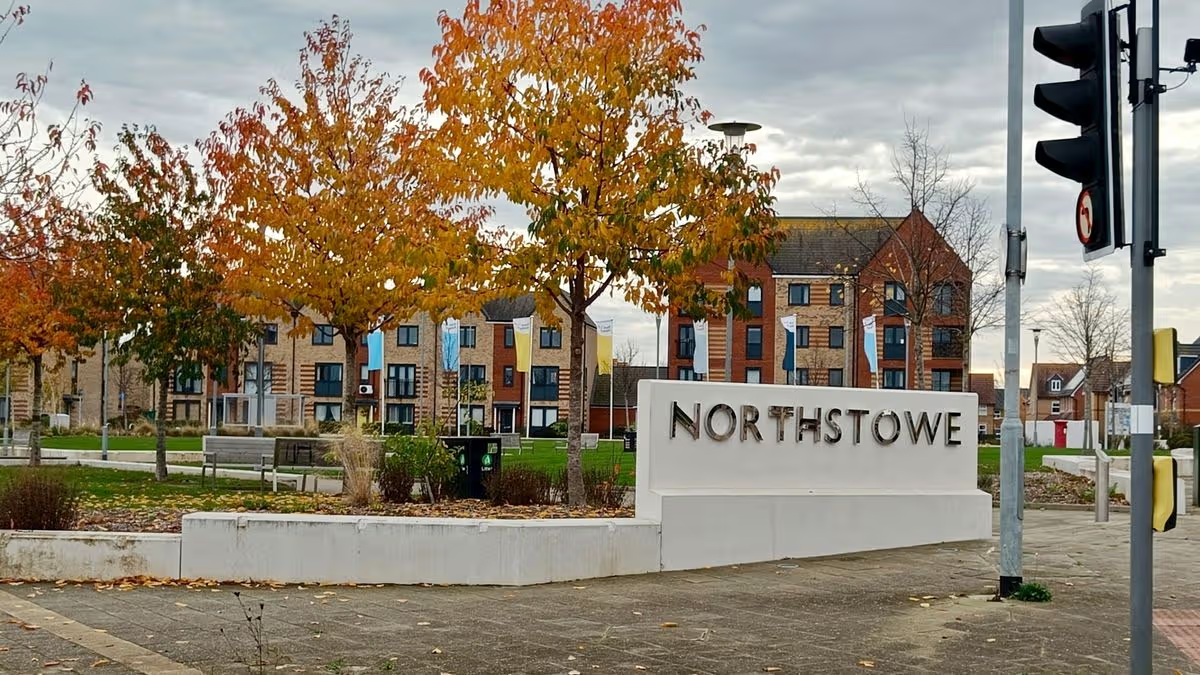
Major project hits ‘important milestone’ as groups compete to take over land


-
 Tech6 days ago
A 1,300-Pound NASA Spacecraft To Re-Enter Earth’s Atmosphere
-
 Crypto World3 days ago
HYPE Token Enters Net Deflation as HyperCore Buybacks Outpace Staking Rewards
-

 Business6 days ago
ExxonMobil seeks to move corporate registration from New Jersey to Texas
-

 Fashion3 days ago
Weekend Open Thread: Addict Lip Glow
-

 Tech6 days ago
ChatGPT will now generate interactive visuals to help you with math and science concepts
-
Sports2 days ago
Why Duke and Michigan Are Dead Even Entering Selection Sunday
-

 NewsBeat5 days ago
Residents reaction as Shildon murder probe enters second day
-
 NewsBeat7 days ago
Pagazzi Lighting enters administration as 70 jobs lost and 11 stores close across Scotland
-

 Business6 days ago
Search Enters Sixth Week With New Leads in Tucson Abduction Case
-

 Business1 day ago
Search for Savannah Guthrie’s Mother Enters Seventh Week with No Arrests
-

 Business2 days ago
US Airports Launch Donation Drives for Unpaid TSA Workers as Partial Government Shutdown Enters Fifth Week
-
Crypto World2 days ago
Coinbase and Bybit in Investment Talks: Could Bybit Finally Enter the US Crypto Market?
-

 NewsBeat5 days ago
I Entered The Manosphere. Nothing Could Prepare Me For What I Found.
-

 Business2 days ago
Country star Brantley Gilbert enters growing non-alcoholic beer market
-

 Business10 hours ago
Australian shares drop as Iran war enters third week
-

 Crypto World6 days ago
Will Chainlink price reclaim $10 amid volatility squeeze?
-

 Sports5 days ago
PWHL, Senators discussing plan to keep Charge in Ottawa
-

 Sports3 days ago
College Basketball Best Bets: Conference Tournament Semifinal Picks
-

 Crypto World10 hours ago
Crypto Lender BlockFills Enters Chapter 11 with Up to $500M in Liabilities
-

 Politics6 days ago
Trump Says Middle East Is ‘Very Lucky’ That He’s President


You must be logged in to post a comment Login