
Crypto World
US, UK, and Canada launch ‘Operation Atlantic’ to tackle crypto fraud



The US, UK, and Canada have today launched a new joint initiative aimed at raising awareness of crypto fraud while simultaneously tackling crypto-related organized crime.
Known as “Operation Atlantic,” the initiative will see the US Secret Service (USSS), the UK’s National Crime Agency (NCA), and Canada’s Ontario Provincial Police contact victims, and potential victims, of crypto fraud and advise them on how to keep their crypto assets safe.
A USSS spokesperson told Protos that the operation will last a week, and that the agencies are working alongside “private industry partners” to identify and contact victims of approval phishing.
They added, “Law enforcement personnel will then provide advice and instructions on how to secure their assets to prevent further losses. Additionally, teams will work to trace and seize stolen funds with the goal of victim restitution.”
Read more: How to stay safe on-chain: Three crypto users lose $876K within hours
One particular crypto scam known as “approval phishing” is highlighted in the initiative. This involves a victim signing off on a fake wallet approval request that gives hackers access to their funds.
Some scammers have drained over $600,000 worth of crypto assets through approval phishing. Last year, one of “the largest supply chain attack[s] in history” used approval phishing to redirect funds to a hacker’s account.
This case, despite its scale, only drained $0.05.
The USSS deputy assistant director for the office of field operations claims, “Approval phishing and investment scams cost victims millions in financial loss each year.”
They also claim that Operation Atlantic “will identify and disrupt these scams in near real-time denying criminals the ability to further profit from their crimes.”
Recognising that scammers often impersonate trusted bodies, the NCA and USSS have created a dedicated phone number and webpage to make it easier for callers to verify legitimacy.
Operation Atlantic was inspired by a 2024 Canadian-led program called “Project Atlas.” In this case, $70 million in funds was reportedly kept from scammers while $24 million in stolen funds were frozen.
One crypto fraud body disbands, another takes its place
Last year, the Trump administration disbanded the Justice Department’s crypto enforcement agency in line with an executive order. The agency was created to tackle “complex investigations and prosecutions of criminal misuses of cryptocurrency.”
Since then, the scale of crypto scams orchestrated by criminal gangs in South Asia has been scrutinized by the US and China, and led to the creation of the US “Scam Center Strike Force.”
This body, which aims to bring scam leaders to justice, partnered with social media giant Meta to help take down 150,000 Facebook accounts. The joint operation with Thai authorities led to the arrest of 21 people.
Thailand’s neighbour, Cambodia, has also led a widespread crackdown against crypto scam compounds that reportedly led to the deportation of 48,000 people detained from raids.
Got a tip? Send us an email securely via Protos Leaks. For more informed news and investigations, follow us on X, Bluesky, and Google News, or subscribe to our YouTube channel.



Bitcoin derivatives data signals a bullish shift after nearly eight days of bearish positioning in the futures market.
Bitcoin derivatives data show that the market structure has changed, with the Integrated Market Index reaching 96 on March 16, its highest level in the last 30 days.
The reading comes after a reversal in taker flow that ended almost 8 days of bearish positioning in the futures BTC market, with the flagship crypto now trading several thousand dollars above its estimated fair value.
Derivatives Indicator Points to Renewed Bullish Structure
According to analyst Axel Adler Jr., Bitcoin’s Integrated Market Index hit 96 while the model’s Price Index rose above 95. The index combines signals from derivatives such as future flows and price deviation to show how much pressure the market is under on a scale of 0 to 100.
A bullish regime, Adler noted, is when the value is above 55, and a bearish regime is when the value is below 45. The model has been in a bearish phase for about 178 hours, starting on February 15 when it fell as BTC dropped toward $63,000 amid sustained negative taker volume and diminishing open interest.
However, per Adler’s analysis, the change happened on March 10, when both the taker flow and the open interest went up at the same time, pushing both the flow and price components back above their bullish thresholds.
With Bitcoin momentarily jumping above $74,000 on March 16, its fair value over 30 days as measured by Adler’s model now sits around $70,000. The gap means the market is worth about $3,400 more, with the market watcher suggesting that these kinds of premiums can occur during times of high demand as long as the derivatives flow index stays high.
Data also shows that the larger crypto market also got stronger in the last 24 hours, with BTC’s move above $74,000 not the only green arrow. Ethereum (ETH) also went over $2,200 as several coins, including Solana (SOL), Dogecoin (DOGE), Cardano (ADA), and Hyperliquid (HYPE), recorded more than 10% gains over the past 7 days.
You may also like:
The rally has brought the crypto market’s value up 2.6% to just under $2.6 trillion, per CoinGecko. However, it wiped out about $380 million in leveraged positions, with around $303 million coming from traders who had bet on falling prices.
BTC Price Movement
At the time of writing, Bitcoin had dropped by a couple of hundred bucks below $74,000. Nevertheless, it was still about 9% higher than it was a week ago and nearly 6% across 30 days.
This is not the first time that BTC has tested $74,000. Last Friday, the number one cryptocurrency encountered a barrier at the same level, causing it to retreat by over $3,000, before the recent recovery.
For now, derivatives data shows sustained buying pressure, with the Integrated Market Index remaining deep in bullish territory. Analysts tracking the model say the first warning sign would be the index falling back below 55 or a decline in futures flow that pushes prices closer to its fair-value benchmark.
Binance Free $600 (CryptoPotato Exclusive): Use this link to register a new account and receive $600 exclusive welcome offer on Binance (full details).
LIMITED OFFER for CryptoPotato readers at Bybit: Use this link to register and open a $500 FREE position on any coin!


After billions in bets on a U.S.–Iran strike and an insider scandal on platforms like Polymarket, Democrats push the DEATH BETS Act, targeting prediction markets that trade on war, terror and death.
Summary
- Polymarket and Kalshi volumes smashed records as traders priced odds of a U.S. strike on Iran and leadership change in Tehran.
- Six Polymarket accounts allegedly used insider information to profit from Iran strike timing, crystallizing fears of geopolitical front‑running.
- Senator Adam Schiff’s DEATH BETS Act would bar CFTC‑regulated venues from listing contracts tied to war, terrorism, assassinations or individual deaths.
Prediction markets just ran into Washington’s moral panic. After a record surge in trading linked to the U.S.–Iran conflict, a senior Democrat is now moving to shut down the sector’s most controversial edge: markets that price war, terrorism and death.
For the week ending March 9, on-chain and regulated prediction venues blew through previous activity highs. Data compiled by Cointelegraph shows nominal volume on Polymarket hit 2.49 billion dollars over the period, while CFTC‑regulated Kalshi posted 2.85 billion dollars, pushing the total nominal volume across all prediction platforms to 14.5 billion dollars and lifting unique users to 2.8 million. The trigger was obvious: escalating U.S.–Iran tensions, with traders aggressively pricing the odds of an American strike.
Polymarket death markets gain scrutiny from lawmakers
That set up the political backlash. U.S. Democratic senator Adam Schiff has introduced the so‑called “DEATH BETS Act,” a bill that would amend the Commodity Exchange Act to explicitly bar federally regulated prediction markets from listing contracts tied to war, terrorism, assassinations, or individual deaths. Regulators have long had discretion over “event contracts,” but this proposal would hard‑code a bright red line around anything that looks like trading on human catastrophe.
Schiff’s move also follows a very specific scandal. Six Polymarket users are accused of using insider information to place roughly 1 million dollars’ worth of winning bets on the timing of a U.S. strike on Iran, crystallizing the sector’s worst optics: privileged actors monetizing sensitive, potentially classified information while the rest of the market thinks it is trading “pure information.” For critics, that episode proves prediction markets are not just forecasting tools, but a new venue for front‑running geopolitics.
For crypto‑native prediction platforms, the message is brutal. Volumes are finally at institutional scale, but the order flow driving that growth is clustering in precisely the categories now being lined up for prohibition. If the DEATH BETS framework becomes a template for other regulators, the sector will be pushed toward more anodyne contracts—macro data, elections, sports—while the most informationally rich, liquidity‑dense markets migrate fully offshore or into gray‑zone DeFi. In market terms, Washington is saying the quiet part out loud: some kinds of “truth markets” will not be allowed to clear.
Total crypto capitalization is up 3.5%, with Layer 1s and memecoins leading the charge.
Crypto markets are off to a strong start this week, with major altcoins surging amid more than $400 million in short liquidations. Stocks rallied while oil dropped 5% after U.S. Treasury Secretary Scott Bessent told CNBC that Iranian oil tankers are being allowed to transit the Strait of Hormuz.
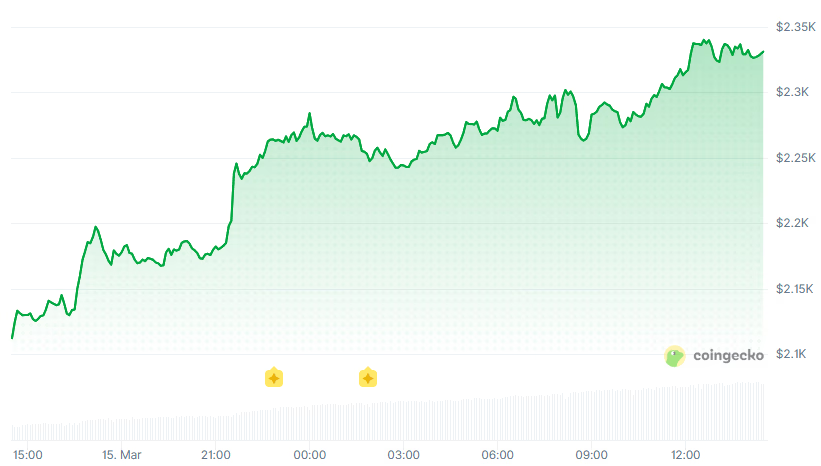
Bitcoin (BTC) is trading at around $74,000, up 3.5% over the past 24 hours. Layer 1 tokens are outperforming, with ETH surging 10% to $2,320, and SOL climbing 8% to $95.
Meanwhile, Polkadot (DOT) rallied 15%, Ripple (XRP) and Cardano (ADA) gained around 9%, and BNB added 2%.

The overall crypto market capitalization climbed 3.5% to $2.61 trillion, according to Coingecko.
Michael Saylor’s Strategy purchased an additional 22,337 Bitcoin between March 9 and March 15 for approximately $1.57 billion at an average price of $70,194 per coin, according to a Monday SEC filing. The acquisition, one of the company’s largest to date, brings its total holdings to 761,068 BTC.
Nearly all of the Top 100 digital assets posted gains over the last 24 hours.
Today’s top gainers are Zcash (ZEC) and PEPE, which both surged 20%.
TRUMP and Bittensor (TAO) are the biggest losers, down 4% and 2%, respectively.
Around 120,000 leveraged traders were liquidated for $542 million in the past 24 hours, according to CoinGlass, with short positions comprising $420 million. Bitcoin accounted for $173 million, while ETH led with $220 million.
Bitcoin exchange-traded funds (ETFs) recorded inflows of $180 million on Friday, bringing last week’s total inflows to $767 million, according to SoSoValue.


Metaplanet sold equity and fixed‑strike warrants at a premium, monetizing stock volatility into up to $531 million of dry powder for a 210,000 BTC, yen‑hedged balance‑sheet bet.
Summary
- Metaplanet raised about $255 million via a private share placement at a 2% premium, paired with fixed‑strike warrants at a 10% premium for another ~$276 million if exercised.
- Warrants only trigger if the stock trades above a Bitcoin‑linked mNAV threshold, turning equity upside and volatility into self‑funding BTC accumulation instead of pure dilution.
- The strategy aims to make Metaplanet “Japan’s MicroStrategy,” swapping yen‑denominated equity for a structurally scarce asset and using BTC as a long‑term currency and equity hedge.
Metaplanet just weaponized its equity to buy more Bitcoin (BTC). This is not a vibes-based CT announcement; it is a highly engineered capital markets trade aimed squarely at becoming “Japan’s MicroStrategy,” with a yen hedge bolted on.
Deal structure in plain language
Metaplanet raised about 255 million dollars from global institutional investors via a private placement of new shares priced at a 2% premium to market. Alongside that, it issued fixed‑strike warrants at a 10% premium, which, if fully exercised, could bring in roughly another 276 million dollars. In total, the company is unlocking up to 531 million dollars in incremental “firepower” to push toward its stated target of holding 210,000 BTC on its balance sheet.
The key innovation is not “we raised money and we’ll buy Bitcoin.” It is the explicit monetization of equity volatility: investors are effectively paying for convexity on the stock, and Metaplanet is harvesting that option value to buy hard assets.
Why the warrant design matters
The warrants are struck 10% above the reference price, so they only get exercised if Metaplanet’s share price trades higher, i.e., if the market buys the Bitcoin accumulation story. That creates a self‑funding loop: volatility and upside in the equity translate directly into more capital to deploy into BTC. Commentators on the thread correctly highlight this as “the real innovation,” noting that Metaplanet benefits both from stock volatility and from Bitcoin appreciation.
In market structure terms, the firm is short call options on its own equity and long Bitcoin. It is selling path‑dependent equity upside today to increase its exposure to a non‑sovereign monetary asset it believes will outperform the yen and, likely, Japanese equities over the long term.
Japan, currency risk, and the “denominator”
Where MicroStrategy pioneered this model in the US, Metaplanet adds another layer: a currency hedge against a structurally weak yen. One international holder in the replies openly frames the move as bullish for Japan, arguing that the yen “could benefit greatly from Bitcoin.” Others go further, calling the strategy a matter of corporate “survival” rather than mere profit, a blunt acknowledgment of what sustained currency debasement does to domestic balance sheets.
Another respondent captures the denominator problem cleanly: institutional capital is “waking up to the reality of the denominator” and “building a fortress out of math,” with volatility as the energy source to forge a new standard. Translated into market terms: Metaplanet is trading a dilutable equity, priced in a weakening unit of account, for an asset with a credibly scarce supply schedule.
Signal to the market
Reaction on X swings from praise—calling the placement a “masterclass in capital strategy”—to confusion and outright skepticism about what Metaplanet is and whether this is a scam. That bifurcation is typical early in any new corporate balance‑sheet regime: most participants do not yet speak the language of corporate‑fi‑meets‑Bitcoin, and the documentation reads like jargon to anyone not trained in derivatives.


- Cardano (ADA) rises above $0.28 as whale accumulation boosts short-term momentum.
- Positive funding rates and higher open interest support near-term gains.
- The key levels to watch are the support at $0.25–$0.27 and the resistance near $0.30–$0.35.
Cardano (ADA) has surged over 8% in the past 24 hours, breaking above key short-term resistance levels.
The price is now hovering around $0.286, bringing the $0.30 mark into focus for traders.
Momentum has picked up sharply as derivatives data show positive funding rates and rising open interest.
This price movement has attracted attention from mid-tier whale wallets.
These investors, holding between one million and ten million ADA, have been actively accumulating during recent dips. Their buying has added upward pressure, tightening available supply in the market.
Meanwhile, larger whale wallets, holding ten million to a hundred million ADA, have been reducing positions, suggesting some distribution at higher price levels, creating a mixed picture in the whale ecosystem.
The balance between accumulation and distribution will likely influence price swings in the coming days.
Technical analysis
From a technical perspective, ADA has broken above a descending trendline that had capped price action near $0.25 for weeks.
This breakout has set the stage for further gains as short-term indicators lean bullish.
The relative strength index (RSI) sits above 50, indicating that momentum favours buyers, but it is not yet in overbought territory.
The MACD has crossed above its signal line, and its histogram is expanding, signalling that buying momentum is gaining strength.

Price action has shown that the 20-day exponential moving average (EMA) is providing support near $0.27.
Eyes are now on the 50-day EMA around $0.29 and the 100-day EMA closer to $0.34.
Breaking these levels could open the door to further upside, but failing to hold above the short-term support zone could result in a pullback.
In addition, Cardano’s open interest is also rising, and the funding rate has turned positive, meaning that long positions are paying shorts, which historically aligns with bullish momentum in the near term.
Cardano price forecast
In the short term, traders should monitor $0.30 as the next psychological resistance.
A breakout above $0.30 could target the $0.34–$0.35 range, guided by key EMAs and prior swing highs.
While momentum indicators suggest room for further upside, the market will need consistent buying volume to sustain higher levels.
On the downside, the immediate support lies near $0.27, with a more significant level around $0.25.
A drop below $0.25 could test deeper support near $0.24, potentially signalling short-term bearish pressure.
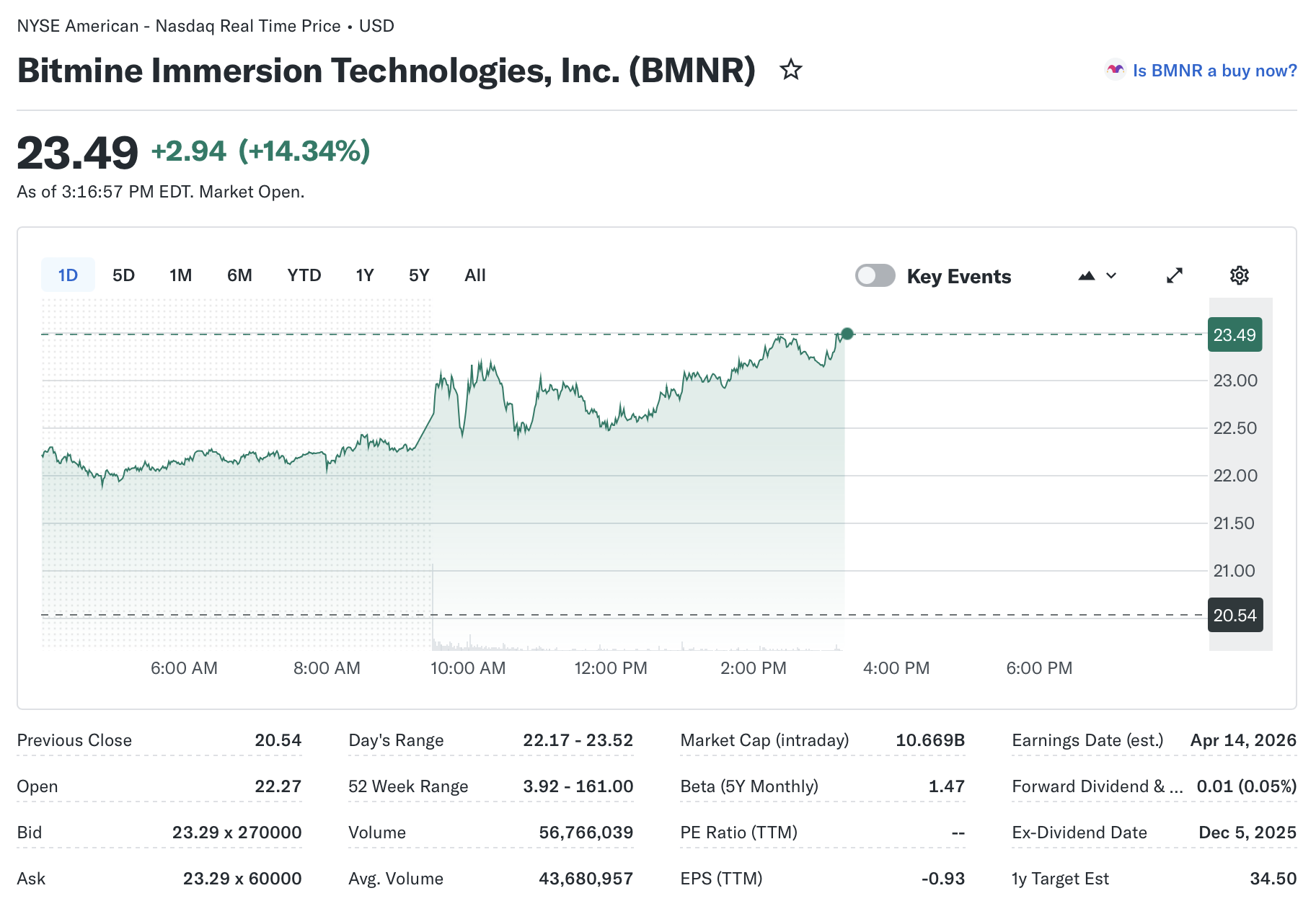
Bitmine Immersion Technologies has accelerated the pace of its Ether purchases in recent weeks, chairman Tom Lee said Monday, following the company’s over-the-counter purchase of 5,000 ETH directly from the Ethereum Foundation.
Lee said Bitmine added 60,999 Ether (ETH) over the past week, up from a recent weekly average of about 45,000 to 50,000 ETH.
The purchases bring the publicly traded company’s Ethereum treasury to 4.596 million ETH, giving Bitmine control of about 3.81% of the token’s total supply. The company said its combined crypto holdings, cash and other investments total about $11.5 billion.
Bitmine said that 3,040,515 ETH, about 66% of its holdings, are currently staked, valued at roughly $6.6 billion at an Ether price of $2,185.
The company estimates its staking operations generate about $180 million in annualized revenue. It plans to expand staking through its Made in America Validator Network (MAVAN), expected to launch in the coming months.
Bitmine said the 5,000 ETH purchase from the Ethereum Foundation was structured to allow the foundation to fund its operations without selling Ether on the open market.
Shares of Bitmine (BMNR) closed Monday trading up almost 14% to $23.39, according to Yahoo Finance data.
Today’s announcement from the Ethereum treasury company coincided with a disclosure by Strategy, the world’s largest Bitcoin treasury company, that it purchased 22,337 BTC for $1.57 billion, bringing its total holdings to more than 760,000 Bitcoin.

Related: Three Ethereum indicators hint that $2.8K is the next ETH price target
Corporate treasuries control over 5% of Ether supply
Public companies holding Ether have largely slowed accumulation over the past month, even as Bitmine continues to rapidly expand its position.
Data from CoinGecko shows that among the 20 largest corporate Ether treasuries, only four companies increased their holdings over the last 30 days. Bitmine added 269,824 ETH during that period, far outpacing SharpLink, which added 3,859 ETH, and Eightco, which added 11,068 ETH.

Eightco also raised $125 million last week to expand investments in blockchain and artificial intelligence. Bitmine led the round with a $75 million investment, while ARK Invest and Payward, the parent company of crypto exchange Kraken, each invested $25 million. As part of the deal, Bitmine chairman Lee joined Eightco’s board.
Across the market, 30 public entities across seven countries collectively hold about 6.6 million ETH valued at around $15.4 billion, representing about 5.47% of Ether’s total supply, according to CoinGecko.
At the time of writing, Ether was trading at around $2,342, up nearly 11% over the past 24 hours, a year-to-date decline at around 21%. The cryptocurrency currently has a market capitalization of about $282 billion, with around 120.7 million ETH in circulation.

Magazine: All 21 million Bitcoin is at risk from quantum computers
Ethereum’s ether (ETH) is stealing the spotlight in Monday’s crypto rally, climbing to a six-week high as investor demand show signs of return to the second-largest digital asset after months of bruising declines.
Ethereum’s native token, ETH, rose to above $2,300, gaining more than 10% over the past 24 hours. That easily outpaced bitcoin’s 3% advance and the CoinDesk 20 Index’s roughly 5% gain, signaling a shift in momentum toward assets beyond bitcoin.
The move comes after a torrid stretch for the broader crypto market, including ether. With the rebound, ETH is still down more than 50% from its August record high and, at one point, had fallen roughly 65% from its peak during the market’s winter slide.
Prices have stabilized in February and March, and institutional flows are beginning to turn supportive.
U.S. spot ether ETFs pulled in more than $160 million in fresh funds last week, marking their strongest weekly inflows since mid-January, according to data from SoSoValue. Global asset manager BlackRock also rolled out a yield-paying Ethereum staking ETF (ETHB), which has already drawn more than $45 million in inflows in its first two trading days, on top of a $104 million seed investment, data from Farside Investors shows.
Meanwhile, BitMine (BMNR), the largest corporate holder focused on Ethereum treasury strategies, has purchased nearly 122,000 ETH — worth roughly more than $280 million at current prices — in the past two weeks, adding another source of demand.
BMNR shares are higher by 13.6% on Monday. Another major ETH treasury company, Sharplink Gaming (SBET) is seeing a 9.1% advance.
Rotation from bitcoin
Analysts say the price action could reflect investors rotating into ether after bitcoin dominated inflows earlier this year.
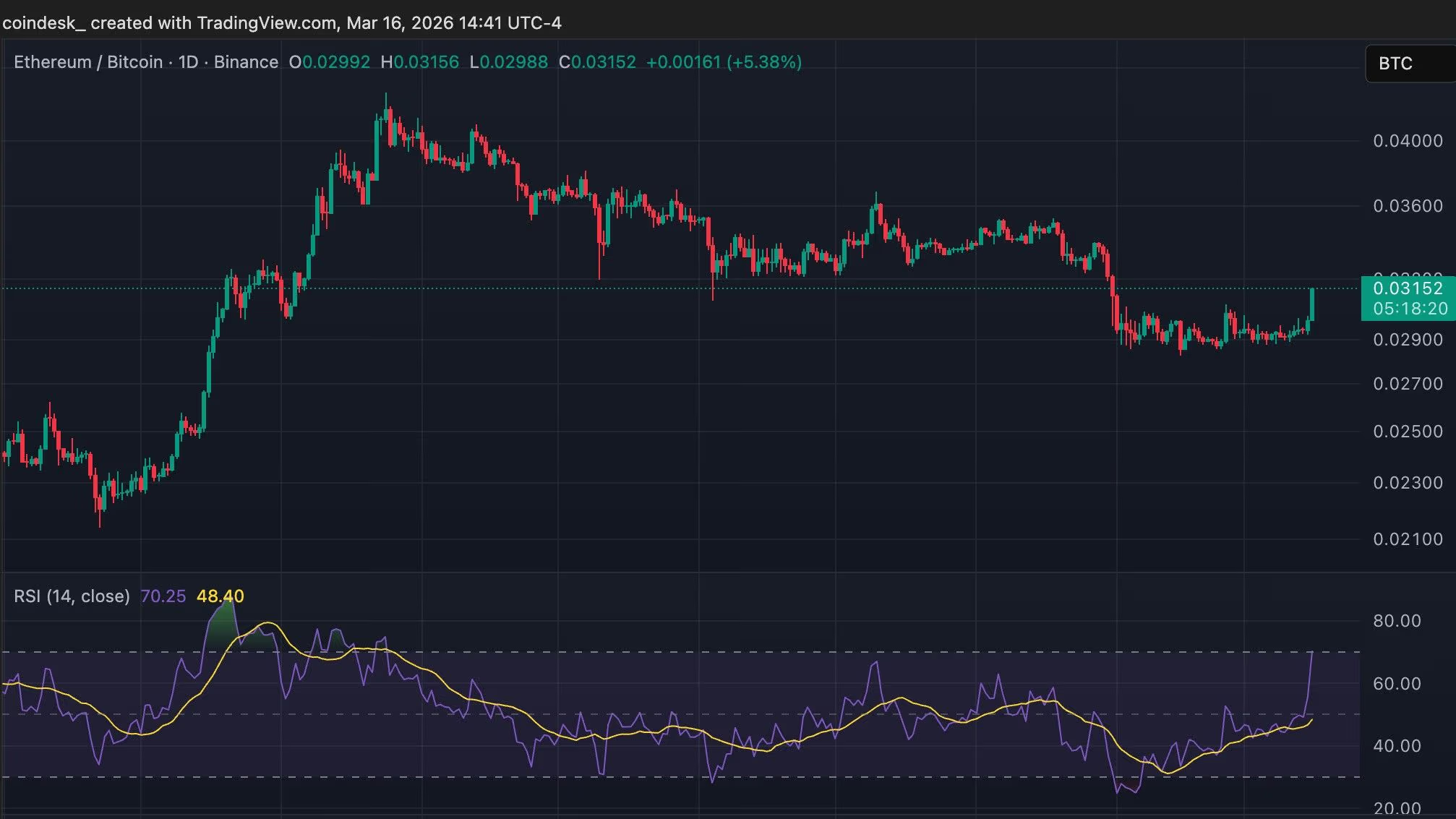
“ETH’s relative strength suggests potential rotation dynamics, possibly tied to network developments and valuation appeal beyond bitcoin,” said Joel Kruger, market strategist at LMAX Group.
He added that ether has broken above an important range against bitcoin where it traded since the end of January. “potentially marking a significant bottom for ETHBTC.”

Adam Saville Brown, head of commercial at Tesseract Group, sees the move as a sign that risk appetite is broadening across the crypto market.
“Ethereum’s outperformance is worth watching,” said Adam Saville Brown, head of commercial at Tesseract Group. “ETH has broken back above $2,200 after weeks of underperformance. That kind of rotation into the second-largest asset suggests risk appetite is broadening, which tends to be a healthy sign.”
Still, he cautioned that the rally could remain sensitive to macro signals.
“If Powell strikes a cautious tone on inflation, altcoin gains will give back faster than bitcoin,” Saville Brown said. “The honest assessment is that the floor looks solid. The ceiling requires more than a rate hold to break through.”
Read more: Ethereum Foundation’s new mandate sparks debate about its role, priorities
Pi now trades like a high‑beta narrative coin: stuck in a 0.18–0.25 band while March unlocks, Open Mainnet progress and listing rumors fight to set the next big move.
Summary
- PI is hovering in the low‑$0.20s with roughly $1 million in daily volume, a $1.8–$1.9 billion cap and a heavy bag of holders still down over 90% from 2025 highs.
- Open Mainnet and ecosystem growth offer real utility potential, but March unlocks in the tens of millions of tokens leave the 0.18–0.20 support zone exposed if miners dump.
- Over the next 3–6 months, baseline models cluster around a 0.30–0.50 grind higher, with a bear case near 0.14 and a bull case pushing toward 0.80–1.00 on perfect‑storm adoption.
Pi Network (PI) is trading like a high‑beta, narrative coin pinned between speculative unlock flows and a long‑awaited mainnet story, with March shaping up as an inflection point for price direction.
Market Snapshot: Range, Liquidity, Structure
Across major offshore venues, PI is changing hands around the low‑$0.20s, with recent spot quotes clustered in the 0.21–0.23 dollar band after a short-term grind higher over the past week. MEXC data puts Pi’s market cap near 1.8–1.9 billion dollars, on roughly 9.6 billion tokens in circulation and light but steady 24‑hour volumes close to 1 million dollars, signalling modest but not dead order books for a top‑50 asset. On a higher timeframe, PI is still down more than 90% versus its 2025 peak near 3 dollars, leaving a heavy overhang of trapped supply and emotionally scarred holders into every rally.
Technically, short-term resistance clusters just above 0.23–0.24 dollars, with analysts watching 0.24–0.25 as the level that would confirm a clean break from the recent range. Support sits in the 0.18–0.20 zone, an area already flagged as structurally important given upcoming token unlocks that could stress bids if sentiment wobbles.
Catalysts: Mainnet, Unlocks, Listings
The key structural shift is the project’s transition into an Open Mainnet, enabling real-world transactions, external integrations, and a move away from “mobile mining app” purgatory. That unlocks a credible path to utility – payments, dapps, marketplace integrations – but it does not remove the near-term mechanical risk from supply hitting the market as KYC migrations and token unlocks accelerate.
Near term, traders are also leaning into the “exchange listing plus Pi Day roadmap” combo trade: speculation around new CEX listings, including tier‑one venues, has already driven spikes when rumors surface. At the same time, token unlock trackers highlight roughly tens of millions of PI scheduled to hit circulation in March, putting the 0.18–0.20 floor at risk if early miners rush to cash out into thin books.
3–6 Month Price Scenarios
Baseline: If Open Mainnet stabilizes, daily active users migrate into actual spenders, and unlock supply is absorbed without major liquidations, PI could grind higher into a 0.30–0.50 range over the coming quarters, implying a 30–130% upside from current levels and a market cap in the 3–5 billion dollar band. This tracks with several quantitative and qualitative models that cluster 2026 fair value around the mid‑double‑cent range, assuming no blow‑off mania.
Bear case: Persistent sell pressure from unlocks, tepid dapp traction, and no top‑tier listings could drag PI back toward 0.14 or lower, effectively revisiting winter lows and erasing the recent bounce. Bull case: A “perfect storm” of strong mainnet adoption, surprise listings, and retail FOMO could push price through 0.50 toward the 0.80–1.00 zone flagged by more optimistic 2026 models, though that would require a sustained re‑rating of Pi as a payments‑style network rather than a fading airdrop meme.
For now, PI trades like an options bet on execution: upside capped by dilution and history, downside controlled by how quickly the network can turn its massive user base into real, on‑chain economic activity.

Bitcoin chases $75,000 as the return of aggressive spot BTC ETF inflows, billion dollar buys from Strategy and an improvement in investors’ risk appetite propel the crypto market.
Bitcoin’s (BTC) price recovery extended into a third week as the price rallied to $74,509, a level not seen since Feb. 4. While markets remain reluctant to confirm whether or not Bitcoin bottomed, the cryptocurrency is up 22.5% from its Feb. 6 low at $60,000 and data point to a renewed institutional investor appetite as a potential key player in the current bullish breakout.
Over the last week, Michael Saylor’s Strategy, the largest public holder of Bitcoin, purchased 22,237 BTC for $1.57 billion.
According to reporting from Bloomberg,
“Inflows to exchange-traded funds suggest a return of institutional confidence. Net flows for the 12 US-listed spot Bitcoin ETFs topped $763 million last week, a third consecutive week of inflows”
On Monday, Metaplanet, a Tokyo-based public company that established Japan’s first corporate Bitcoin treasury, announced that it has raised $255 million in a “private placement” for a new instrument that aims to purchase more Bitcoin. Metaplanet CEO Simon Gerovich said the raise would provide the “additional firepower on our march towards 210,000 BTC.”

Related: Metaplanet raises $255M and adds warrant structure for Bitcoin buys
Adding to the institutional Bitcoin demand narrative, Bitfinex analysts said that “Bitcoin is approaching this week’s FOMC meeting on March 18 with renewed momentum, and has decisively reclaimed the $70,000 level.” The report noted Bitcoin’s market structure had “improved meaningfully” even though BTC has “yet to secure a breakout above local range highs.”

According to Bitfinex analysts, the absorption-to-emissions ratio (AER) highlighted institutional investors “absorbing nearly five times the daily miner supply,” and this, combined with rising BTC futures open interest, indicated that the market was beginning to mirror “healthier” structures seen earlier in the year.
When asked whether Bitcoin had bottomed and if institutional capital flows were responsible for the price upswing, Hyblock analysts explained that “following the sharp drop, the market entered a consolidation phase where open interest declined, shorts used more margin, and both spot and perpetual CVDs pointed to selling pressure.”

The analysts added that:
“Over the past month, that regime (sellers) has shifted. Traders have started increasing leverage on the long side, open interest is rising, and the perps CVD has turned positive while spot flows remain weak. This suggests the push toward the top of the range is largely being driven by derivatives positioning rather than spot demand.”
This article does not contain investment advice or recommendations. Every investment and trading move involves risk, and readers should conduct their own research when making a decision. While we strive to provide accurate and timely information, Cointelegraph does not guarantee the accuracy, completeness, or reliability of any information in this article. This article may contain forward-looking statements that are subject to risks and uncertainties. Cointelegraph will not be liable for any loss or damage arising from your reliance on this information.
Crypto World
T. Rowe Price, a $1.8 Trillion asset manager, is ready to put dogecoin (DOGE) and shiba inu (SHIB) in its new crypto ETF


T. Rowe Price has filed to hold a broad set of digital assets in its new exchange-traded fund (ETF), including bitcoin, ether, dogecoin, and shiba inu.
The asset manager, which has $1.8 trillion in assets under management, filed an amended S-1 registration statement with the U.S. Securities and Exchange Commission (SEC), offering new details about its planned Price Active Crypto ETF, a fund designed to give investors actively managed exposure to digital assets.
The updated filing, submitted Monday, expands on the company’s original October application and outlines the cryptocurrencies the fund may invest in, along with details on custody, trading structure, and potential staking activity.
According to the document, the ETF could hold several digital assets, including bitcoin , ether (ETH), solana (SOL), XRP (XRP), , avalanche (AVAX), , , , hedera (HBAR), , chainlink , stellar lumen (XLM), shiba inu (SHIB), and .
Despite that wide universe, the fund will not hold all of those assets at once. Under normal circumstances, the ETF plans to maintain between five and fifteen crypto assets at a time, using an active management strategy rather than tracking a single token or passively following a benchmark. The portfolio will be rebalanced using quantitative models that incorporate fundamentals, valuation, and market momentum, with the goal of outperforming the FTSE US Listed Crypto Index, the filing said.
The amended filing also confirmed that Anchorage Digital Bank N.A. will serve as the fund’s crypto asset custodian, responsible for safeguarding the digital tokens held by the ETF.
For now, the fund will use a cash subscription and redemption model, meaning investors would create or redeem ETF shares using cash rather than transferring cryptocurrency directly. The filing notes that the structure could evolve to allow in-kind transactions in the future, a model some crypto ETFs use to exchange shares for the underlying digital assets.
Another notable addition in the filing is the possibility that the fund could participate in staking, a process used by some blockchains where token holders lock up assets to help secure the network in exchange for rewards.
T. Rowe Price said staking could be pursued in the future depending on risk considerations, tax treatment and regulatory guidance.
The filing marks another step by the 87-year-old investment firm, which is one of the top 25 asset management firms, toward entering the digital asset market.
If approved, the product would join a growing list of crypto investment vehicles designed to give investors exposure to the sector through traditional brokerage accounts.
The fund’s active approach could set it apart from the wave of spot bitcoin ETFs launched in the U.S. in 2024, allowing managers more flexibility to shift holdings as crypto markets evolve.

Call made to protect North Down biodiverse parkland after widespread destruction

John Fetterman calls Republican SAVE America Act ‘needlessly complicated’

Bitcoin Derivatives Signal Bull Shift After 178-Hour Bear Run


-
 Tech6 days ago
A 1,300-Pound NASA Spacecraft To Re-Enter Earth’s Atmosphere
-
 Crypto World3 days ago
HYPE Token Enters Net Deflation as HyperCore Buybacks Outpace Staking Rewards
-

 Business6 days ago
ExxonMobil seeks to move corporate registration from New Jersey to Texas
-

 Fashion3 days ago
Weekend Open Thread: Addict Lip Glow
-

 Tech6 days ago
ChatGPT will now generate interactive visuals to help you with math and science concepts
-
Sports2 days ago
Why Duke and Michigan Are Dead Even Entering Selection Sunday
-

 NewsBeat5 days ago
Residents reaction as Shildon murder probe enters second day
-
 NewsBeat7 days ago
Pagazzi Lighting enters administration as 70 jobs lost and 11 stores close across Scotland
-

 Business6 days ago
Search Enters Sixth Week With New Leads in Tucson Abduction Case
-

 Business1 day ago
Search for Savannah Guthrie’s Mother Enters Seventh Week with No Arrests
-

 Business2 days ago
US Airports Launch Donation Drives for Unpaid TSA Workers as Partial Government Shutdown Enters Fifth Week
-
Crypto World2 days ago
Coinbase and Bybit in Investment Talks: Could Bybit Finally Enter the US Crypto Market?
-

 NewsBeat5 days ago
I Entered The Manosphere. Nothing Could Prepare Me For What I Found.
-

 Business2 days ago
Country star Brantley Gilbert enters growing non-alcoholic beer market
-

 Business11 hours ago
Australian shares drop as Iran war enters third week
-
 Crypto World6 days ago
Will Chainlink price reclaim $10 amid volatility squeeze?
-

 Sports5 days ago
PWHL, Senators discussing plan to keep Charge in Ottawa
-

 Sports3 days ago
College Basketball Best Bets: Conference Tournament Semifinal Picks
-

 Crypto World11 hours ago
Crypto Lender BlockFills Enters Chapter 11 with Up to $500M in Liabilities
-

 Politics6 days ago
Trump Says Middle East Is ‘Very Lucky’ That He’s President


You must be logged in to post a comment Login