
Crypto World
‘Stop Shorting Bitcoin,’ One Analyst Says as Fresh Price Targets Emerge

Further pump or crash to $40K: what’s next for BTC?
Bitcoin (BTC) surpassed $74,000 briefly earlier today, reaching its highest point since the start of February.
Some analysts are optimistic that a more substantial move to the upside could be forming, especially if the asset breaks above key resistance levels.
‘Stop Shorting BTC’
The primary cryptocurrency started the business week on the right foot, with its valuation surging to almost $74,400 (per CoinGecko’s data) following Donald Trump’s latest remarks regarding the war in Iran. The US President threatened to send troops to Kharg Island and urged America’s NATO allies to form a coalition to reopen the Strait of Hormuz by deploying military ships in the area.
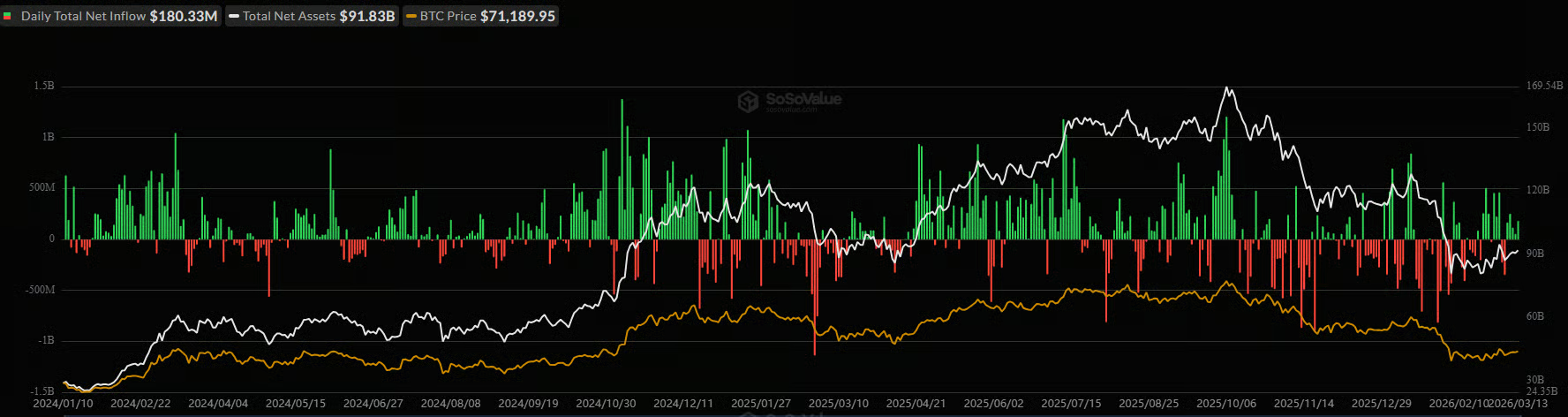
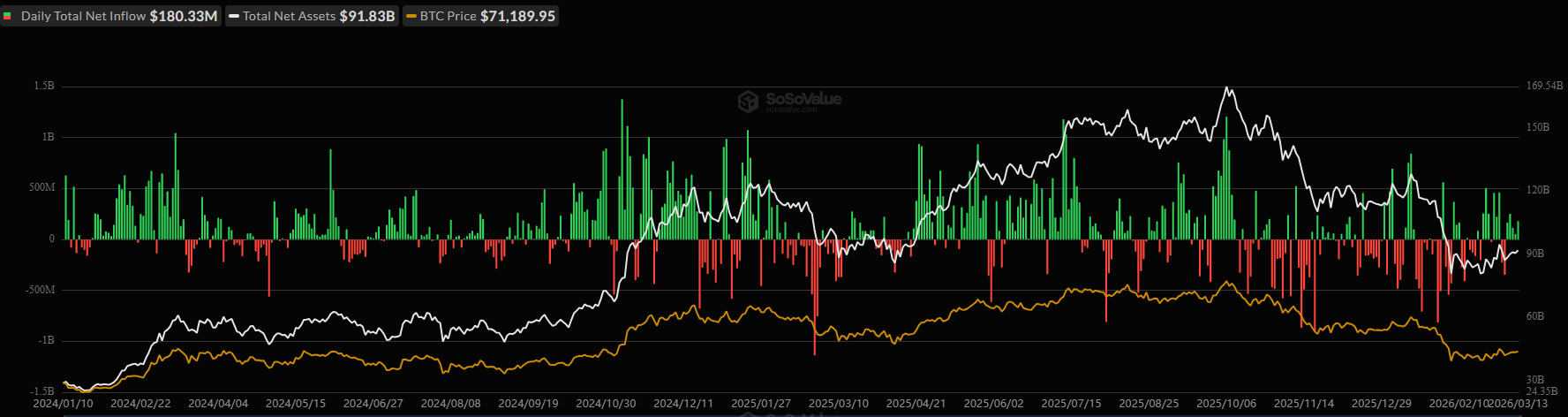
Meanwhile, spot BTC ETFs have attracted hundreds of millions of dollars in inflows over the past several days, a factor that could also have contributed to the asset’s recent price strength.
According to the popular analyst Ali Martinez, a more significant rally could be on the way. In a recent post on X, he claimed that BTC might be forming a local bottom that often comes before a big move north. Martinez noted that Bitcoin’s funding rates have recently flipped negative: a development that has preceded “every major relief rally” in the last four years.
The most recent example dates back to May 2025, when BTC was trading near $95,000. Once funding rates turned negative, the market quickly shifted, and the asset climbed to a historical peak of over $126,000 within months, the analyst reminded.
Besides that, Martinez pointed out that more than 33,000 BTC have been withdrawn from exchanges in the past week. CryptoQuant’s data shows that just a few days ago, the amount of coins stored on such platforms dipped to a six-year low of approximately 2.73 million. This is considered a bullish factor because it reduces immediate selling pressure.
You may also like:

Other analysts on X also think BTC could chart further gains in the near future. Ted, for instance, described the $72,000-$74,000 range as “strong resistance zone,” predicting that a decisive break above it could open the door for an uptrend to as high as $78,000.
Still on Uncertain Ground
Analysts like Leshka.eth remain somewhat cautious about BTC’s short-term prospects. The X user argued that the price is slowly grinding higher within a descending channel toward the $76,000-$80,000 region, warning that a rejection here could trigger a painful crash to as low as $40K.
The analyst who goes by the moniker Klarck also envisioned a potential pullback. They foresaw a bull trap at around $74,000, a “liquidity grab” at $65,000, $62,500, and $60,000, and an eventual plunge to new lows.
BTC’s Relative Strength Index (RSI) is one technical indicator suggesting a price plunge could be imminent. The ratio has surpassed 70, meaning the price has pumped too much in a short period and could be due for a pullback. In contrast, readings under 30 suggest the asset is oversold and on the verge of a potential rally.

Binance Free $600 (CryptoPotato Exclusive): Use this link to register a new account and receive $600 exclusive welcome offer on Binance (full details).
LIMITED OFFER for CryptoPotato readers at Bybit: Use this link to register and open a $500 FREE position on any coin!

Pepe price rose as the best performer in the crypto market amid a market-wide recovery triggered by Bitcoin’s surge past $74,000 support.
Summary
- Pepe price jumped about 21% to a two-week high as the broader crypto market rebounded following Bitcoin’s surge above the $74,000 level.
- Trading activity surged sharply, with PEPE’s daily volume rising more than 380% as nearly $1 billion worth of the token changed hands.
- Technical indicators show bullish momentum building, with PEPE moving above key moving averages while traders watch resistance near the 100-day SMA.
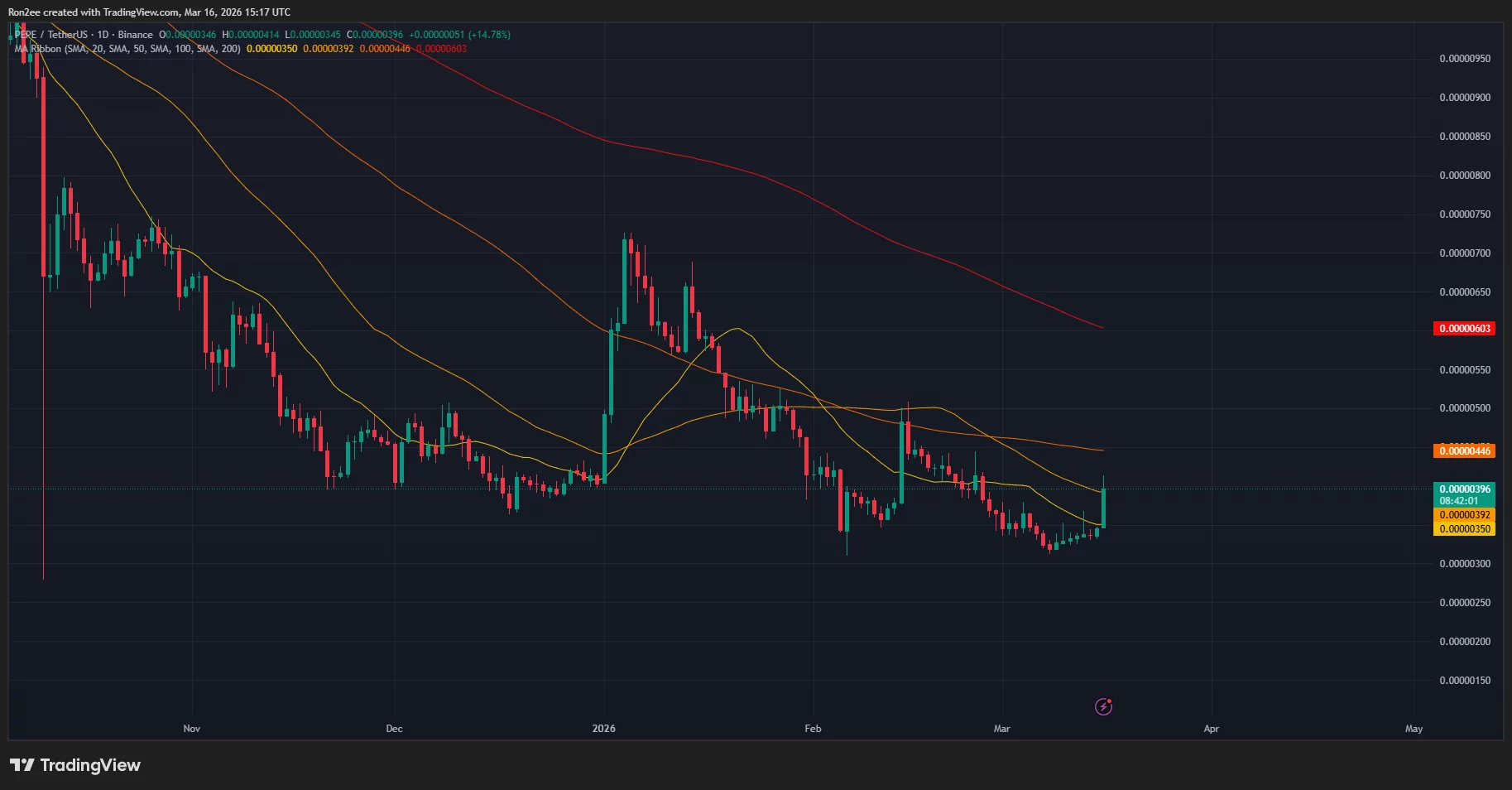
According to data from crypto.news, Pepe (PEPE) price shot up 21% to a two-week high of $0.000040 as of last check on Monday, March 16. Despite this, it still remains nearly 19% below its February high of $0.0000049.
Pepe’s gains came primarily due to a broader market recovery that followed Bitcoin’s surge past the $74,000 resistance level, which boosted investor demand for risk assets. Ethereum (ETH) was also up 8% at the time of writing, while other major coins such as XRP, SOL, DOGE, and ADA also marched higher.
As a high-beta memecoin, PEPE amplified the gains of the broader market, outperforming the global average with its staunch rebound today.
PEPE’s rebound was further fueled by a notable surge in trading activity. Over the past 24 hours, its daily trading volume shot up over 380% as nearly $1 billion worth of Pepe coin exchanged hands between traders.
Technical indicators seem to suggest that the Pepe price could still have steam left to sustain its rally at least over the following sessions.
Notably, the Pepe price has surged past the 20-day and 50-day moving averages as it formed a god candle today. This explosive vertical movement indicates strong buying pressure and a shift in market sentiment.
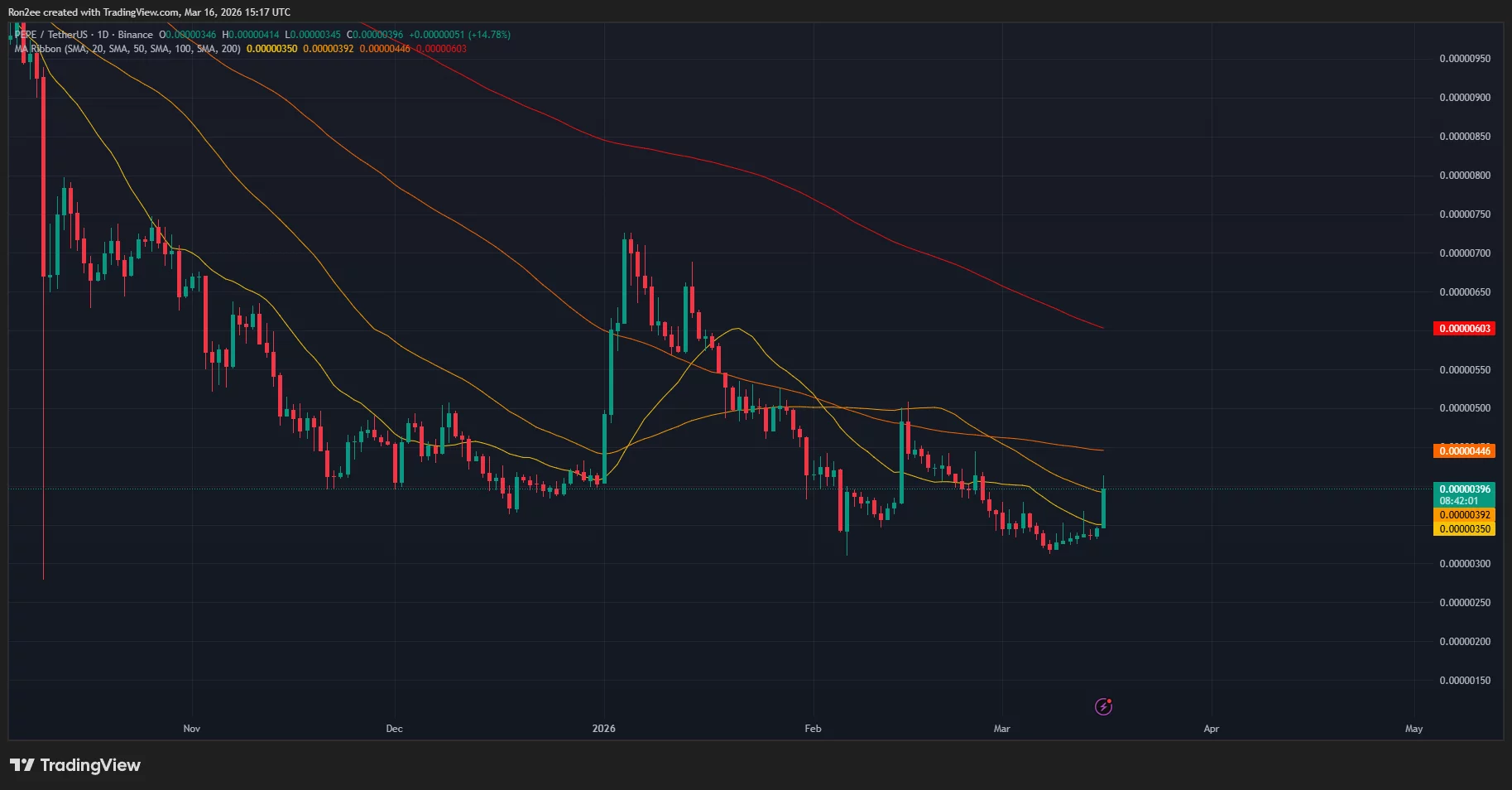
The next target for PEPE stands at the 100-day SMA at $0.0000044, which represents a key resistance level that bulls must flip to confirm a long-term trend reversal.
Momentum indicators like the MACD and RSI show that bulls were still holding the upper hand in the current market structure. The MACD lines were pointing upwards after a bullish crossover, confirming that upward momentum is accelerating.
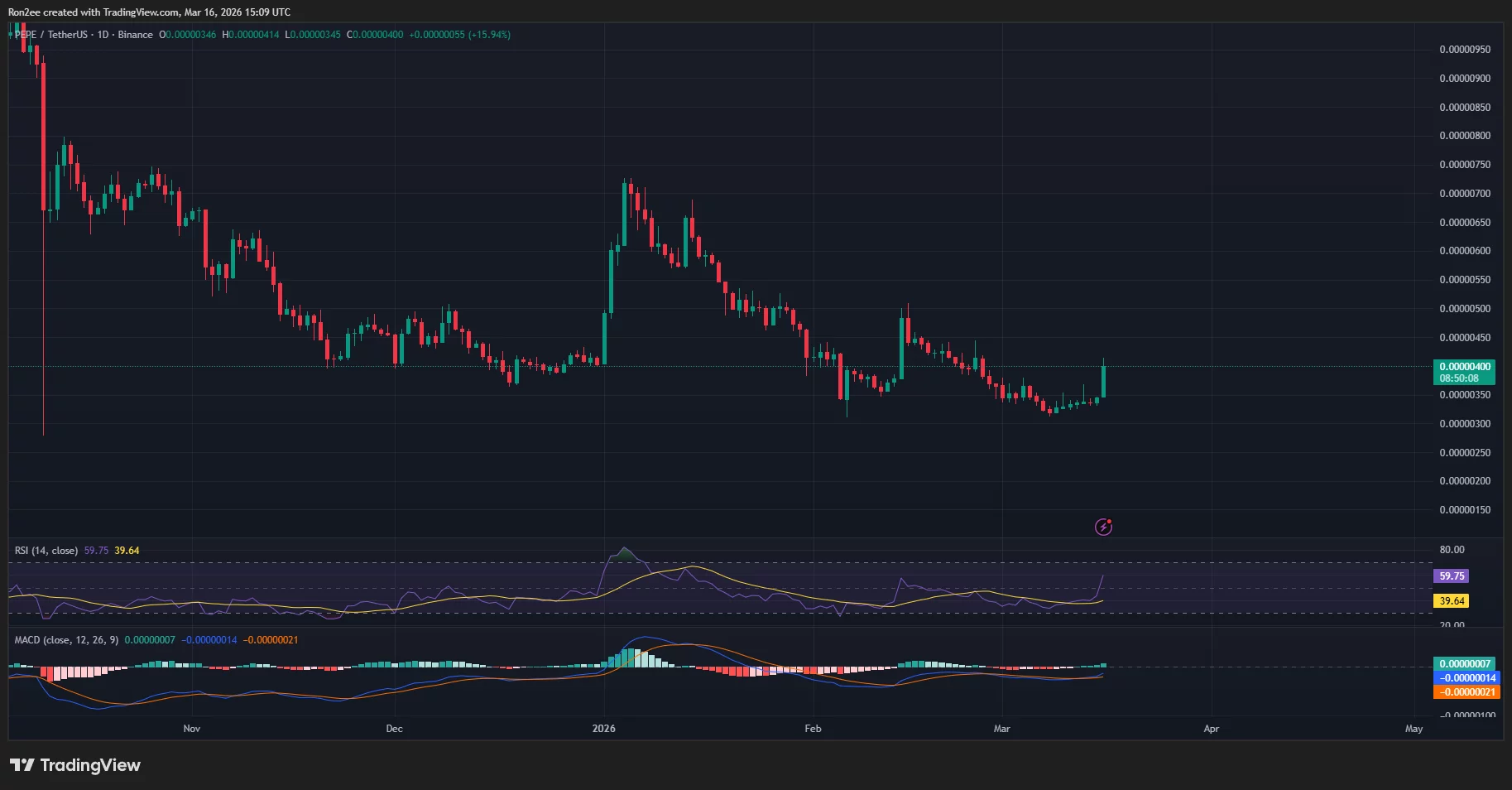
Meanwhile, the RSI has recently surged past the neutral threshold with still room before hitting overbought levels where a reversal usually takes place. This suggests that the current rally has not yet reached a point of exhaustion.
However, there remains a risk to Pepe’s ongoing rally, as is common with highly speculative meme coins with no fundamental utility.
The risk is that Pepe’s rally could likely be a dead cat bounce, a temporary recovery in a declining market where an asset falls back after staunch rallies, as seen for Pepe coin today.
Without sustained organic demand or a broader market breakout, these gains can quickly evaporate as early investors move to take profits.
In case of a retracement, $0.0000039, which aligns with the 50-day SMA, would act as an immediate support level. If this floor fails to hold, the price could slide further to retest lower liquidity zones, potentially wiping out today’s gains.
Disclosure: This article does not represent investment advice. The content and materials featured on this page are for educational purposes only.

TLDR
- Vitalik Buterin supported a Nimbus proposal to merge Ethereum’s two clients into a single program.
- He said running two daemons makes node operation harder for independent validators.
- The Unified Node aims to simplify installation and reduce configuration errors.
- Ethereum introduced separate Beacon and execution clients during the 2022 Merge.
- Buterin linked better user experience with stronger validator decentralization.
Ethereum co-founder Vitalik Buterin called for a simpler node setup for validators. He backed a Nimbus “Unified Node” proposal that merges two Ethereum clients into one program. He said the current design creates avoidable complexity for self-sovereign users.
Vitalik Buterin Backs Unified Node Proposal
Vitalik Buterin supported a Nimbus pull request from the Status-im team that merges Ethereum’s two clients. He said running two daemons creates friction and discourages independent validators. He wrote on X, “Running two daemons and getting them to talk to each other is far more difficult than running one daemon.”
He added that Ethereum should improve usability for self-sovereign participants. He said, “Our goal is to make the self-sovereign way of using Ethereum have good UX.” He also stated that in many cases users need to run their own node.
He said the current method adds needless complexity for operators. He noted that the architecture could change over time. He wrote, “Longer-term, we should be open to revisiting the whole architecture.”
Ethereum introduced separate Beacon and execution clients during the 2022 Merge. The network moved from proof-of-work to proof-of-stake at that time. Validators then needed to manage two background programs simultaneously.
The two programs must communicate correctly for a node to function. Validators must configure both daemons and keep them synchronized. The Nimbus proposal combines these roles into a single executable.
Status-im developers built the Unified Node to reduce setup barriers. The software aims to simplify installation and maintenance. Buterin publicly praised this approach on X.
He has argued for better validator experience for several years. He has linked usability with stronger decentralization. He said simpler tools can encourage broader participation.
Ethereum Node Architecture and Validator Diversity
On Ethereum, validators verify transactions and propose blocks. They use hardware and client software to maintain the blockchain ledger. The ledger records ETH balances and confirms whether coins have been spent.
Proof-of-stake requires validators to lock up ETH to secure the network. Validators earn rewards for correct participation. They face penalties when they fail to perform duties.
In 2024, Elon Musk asked Buterin on X why he posted less frequently. Musk had acquired Twitter for $44 billion and renamed it X. Buterin responded by sharing a blog post on validator decentralization.
He warned about large staking pools operating nodes on identical hardware. He said shared infrastructure can lead to correlated downtime. He argued that such operators should face steeper financial penalties.
He tied these concerns to validator diversity across the network. He maintained that better user experience supports broader node distribution. He continued to raise this issue in public discussions.
Buterin’s recent comments returned to the technical setup. He focused on reducing the need to manage separate daemons. He framed the Unified Node as a step toward simpler operation.



Strategy has bought a whopping $1.57 billion of Bitcoin and now holds 761,058 BTC.
Michael Saylor took to social media to announce that Strategy has bought a massive amount of BTC today.
The firm acquired a total of 22,337 BTC for a total of $1.57 billion, spending roughly $70,194 per bitcoin.
Strategy has acquired 22,337 BTC for ~$1.57 billion at ~$70,194 per bitcoin. As of 3/15/2026, we hodl 761,068 $BTC acquired for ~$57.61 billion at ~$75,696 per bitcoin. $MSTR $STRC https://t.co/6hv6PjzOKQ
— Michael Saylor (@saylor) March 16, 2026
This puts their total holdings at 761,068 BTC bought at approximately $75,696 per bitcoin.
It also means that the most recent price increase was likely due to this particular buy wall. As CryptoPotato reported, BTC pushed above $74,000 today, driving the entire crypto market with it.
It’s worth noting that institutional inflows have also been steady over the past week, with BlackRock’s IBIT spot BTC ETF reporting positive flows for five consecutive days and buying more than $600 million.
Binance Free $600 (CryptoPotato Exclusive): Use this link to register a new account and receive $600 exclusive welcome offer on Binance (full details).
LIMITED OFFER for CryptoPotato readers at Bybit: Use this link to register and open a $500 FREE position on any coin!
TLDR:
- Pi Network has launched the second migration with a gradual rollout for Pioneers, bringing more Pi to Mainnet.
- Two-factor authentication via Mainnet Checklist Step 3 is now required before any Pi migration can begin.
- Blockchain transfers on Pi Network are irreversible, making 2FA enforcement critical for all wallet security.
- Referral mining bonuses will only migrate if referral team members have fully completed the KYC process.
Pi Network has officially announced that the second migrations have begun for Pioneers on Mainnet. The gradual rollout allows users to bring additional Pi to the network.
First migrations for eligible Pioneers continue as normal during this period. To qualify, Pioneers must set up 2FA through the Mainnet Checklist Step 3. This requirement protects wallet security for all participating users.
Two-Factor Authentication Required Before Migration Can Begin
Pi Network has made two-factor authentication (2FA) a strict requirement for all Pioneers seeking migration eligibility. Step 3 of the Mainnet Checklist must be completed before any migration can proceed.
For some users, this step also requires adding a trusted email address to their Pi account. The 2FA setup ensures that only verified account owners can initiate the process.
The enforcement of 2FA comes directly from the permanent nature of blockchain transactions. Any transfer completed on the blockchain cannot be reversed or corrected after it is made.
Pi Network introduced this requirement to protect Pioneers from unauthorized access and accidental errors. Wallet security is treated as a top priority across the migration process.
The Pi Core Team shared the update via social media, confirming that the second migrations have started and will follow a gradual rollout. The announcement noted that this opens the door for pioneers to bring more Pi to Mainnet.
Pioneers can also further participate in the broader ecosystem through this migration opportunity. First migrations for eligible Pioneers remain active and will not be disrupted by this development.
Referral Mining Bonuses Now Part of Second Migration Rollout
Pi Network’s second migrations will also carry referral mining bonuses for qualifying Pioneers. These bonuses are linked specifically to referral team members who have fully completed the KYC process.
Pioneers are being reminded to urge their teams to complete KYC before the relevant deadlines.
Without full KYC completion from Referral Team members, the associated referral bonuses cannot be migrated. This means the total amount of Pi a pioneer migrates may depend on their referral network’s actions. It is a shared responsibility that extends across the entire team structure within Pi Network.
The Pi Core Team confirmed that referral bonuses from KYC-verified referral team members will be included in the second migration.
Pioneers who stay in regular contact with their teams are more likely to benefit from these bonuses. Completing KYC early gives both Pioneers and their teams a better chance of maximizing their Mainnet migration.
TLDR
- Bitmine increased its Ethereum purchases and lifted its treasury to 4.596 million ETH.
- The company bought 5,000 ETH directly from the Ethereum Foundation through an over-the-counter deal.
- Tom Lee said Bitmine added 60,999 ETH in the past week, exceeding its recent weekly average.
- Bitmine now controls about 3.81% of Ethereum’s total supply.
- The company reported total crypto holdings, cash, and investments of about $11.5 billion.
Bitmine Immersion Technologies increased its Ethereum purchases and expanded its treasury to 4.596 million ETH. The company disclosed a direct 5,000 ETH purchase from the Ethereum Foundation. Chairman Tom Lee confirmed the firm accelerated weekly accumulation in recent weeks.
Bitmine Expands Ethereum Holdings and Staking Operations
Bitmine added 60,999 ETH over the past week, Lee said on Monday. He stated that recent weekly purchases averaged between 45,000 and 50,000 ETH. The latest buying pace exceeded that recent range.
The company structured the 5,000 ETH transaction over the counter with the Ethereum Foundation. Lee said the structure allowed the foundation to fund operations without selling on exchanges. As a result, Bitmine avoided open market impact during the purchase.
Bitmine now controls about 3.81% of Ethereum’s total supply. The company reported total crypto holdings, cash, and investments of about $11.5 billion. It said 3,040,515 ETH remain staked, representing about 66% of its treasury.
Bitmine valued its staked Ether at roughly $6.6 billion at a price of $2,185. The company estimates staking generates about $180 million in annualized revenue. It plans to expand operations through its Made in America Validator Network.
Lee said the Made in America Validator Network will launch in the coming months. He stated the network will increase staking capacity and validator participation. The company confirmed it will continue expanding its Ethereum position.
Corporate Treasuries Increase Exposure to Ether and Bitcoin
Corporate entities now hold about 6.6 million ETH across seven countries. CoinGecko data shows those holdings equal about 5.47% of the total Ether supply. Public companies slowed their accumulation during the past month.
Among the 20 largest corporate Ether treasuries, only four increased holdings in 30 days. Bitmine added 269,824 ETH during that period. SharpLink added 3,859 ETH, while Eightco added 11,068 ETH.
Eightco raised $125 million to expand blockchain and artificial intelligence investments. Bitmine invested $75 million in that funding round. ARK Invest and Payward, Kraken’s parent company, each committed $25 million.
As part of the agreement, Lee joined Eightco’s board. The companies confirmed the capital will support growth initiatives. They disclosed the funding details last week.
Earlier today Strategy disclosed a separate Bitcoin purchase. The company acquired 22,337 BTC for $1.57 billion. Strategy now holds more than 760,000 Bitcoin.
Shares of Bitmine, trading under BMNR, closed up nearly 14% at $23.39. Yahoo Finance reported the closing price data. At press time, Ether traded near $2,342, up nearly 11% in 24 hours.
Ether’s year-to-date decline stands near 21%. The cryptocurrency’s market capitalization measures about $282 billion. Circulating supply totals approximately 120.7 million ETH.


Bitcoin derivatives data signals a bullish shift after nearly eight days of bearish positioning in the futures market.
Bitcoin derivatives data show that the market structure has changed, with the Integrated Market Index reaching 96 on March 16, its highest level in the last 30 days.
The reading comes after a reversal in taker flow that ended almost 8 days of bearish positioning in the futures BTC market, with the flagship crypto now trading several thousand dollars above its estimated fair value.
Derivatives Indicator Points to Renewed Bullish Structure
According to analyst Axel Adler Jr., Bitcoin’s Integrated Market Index hit 96 while the model’s Price Index rose above 95. The index combines signals from derivatives such as future flows and price deviation to show how much pressure the market is under on a scale of 0 to 100.
A bullish regime, Adler noted, is when the value is above 55, and a bearish regime is when the value is below 45. The model has been in a bearish phase for about 178 hours, starting on February 15 when it fell as BTC dropped toward $63,000 amid sustained negative taker volume and diminishing open interest.
However, per Adler’s analysis, the change happened on March 10, when both the taker flow and the open interest went up at the same time, pushing both the flow and price components back above their bullish thresholds.
With Bitcoin momentarily jumping above $74,000 on March 16, its fair value over 30 days as measured by Adler’s model now sits around $70,000. The gap means the market is worth about $3,400 more, with the market watcher suggesting that these kinds of premiums can occur during times of high demand as long as the derivatives flow index stays high.
Data also shows that the larger crypto market also got stronger in the last 24 hours, with BTC’s move above $74,000 not the only green arrow. Ethereum (ETH) also went over $2,200 as several coins, including Solana (SOL), Dogecoin (DOGE), Cardano (ADA), and Hyperliquid (HYPE), recorded more than 10% gains over the past 7 days.
You may also like:
The rally has brought the crypto market’s value up 2.6% to just under $2.6 trillion, per CoinGecko. However, it wiped out about $380 million in leveraged positions, with around $303 million coming from traders who had bet on falling prices.
BTC Price Movement
At the time of writing, Bitcoin had dropped by a couple of hundred bucks below $74,000. Nevertheless, it was still about 9% higher than it was a week ago and nearly 6% across 30 days.
This is not the first time that BTC has tested $74,000. Last Friday, the number one cryptocurrency encountered a barrier at the same level, causing it to retreat by over $3,000, before the recent recovery.
For now, derivatives data shows sustained buying pressure, with the Integrated Market Index remaining deep in bullish territory. Analysts tracking the model say the first warning sign would be the index falling back below 55 or a decline in futures flow that pushes prices closer to its fair-value benchmark.
Binance Free $600 (CryptoPotato Exclusive): Use this link to register a new account and receive $600 exclusive welcome offer on Binance (full details).
LIMITED OFFER for CryptoPotato readers at Bybit: Use this link to register and open a $500 FREE position on any coin!


After billions in bets on a U.S.–Iran strike and an insider scandal on platforms like Polymarket, Democrats push the DEATH BETS Act, targeting prediction markets that trade on war, terror and death.
Summary
- Polymarket and Kalshi volumes smashed records as traders priced odds of a U.S. strike on Iran and leadership change in Tehran.
- Six Polymarket accounts allegedly used insider information to profit from Iran strike timing, crystallizing fears of geopolitical front‑running.
- Senator Adam Schiff’s DEATH BETS Act would bar CFTC‑regulated venues from listing contracts tied to war, terrorism, assassinations or individual deaths.
Prediction markets just ran into Washington’s moral panic. After a record surge in trading linked to the U.S.–Iran conflict, a senior Democrat is now moving to shut down the sector’s most controversial edge: markets that price war, terrorism and death.
For the week ending March 9, on-chain and regulated prediction venues blew through previous activity highs. Data compiled by Cointelegraph shows nominal volume on Polymarket hit 2.49 billion dollars over the period, while CFTC‑regulated Kalshi posted 2.85 billion dollars, pushing the total nominal volume across all prediction platforms to 14.5 billion dollars and lifting unique users to 2.8 million. The trigger was obvious: escalating U.S.–Iran tensions, with traders aggressively pricing the odds of an American strike.
Polymarket death markets gain scrutiny from lawmakers
That set up the political backlash. U.S. Democratic senator Adam Schiff has introduced the so‑called “DEATH BETS Act,” a bill that would amend the Commodity Exchange Act to explicitly bar federally regulated prediction markets from listing contracts tied to war, terrorism, assassinations, or individual deaths. Regulators have long had discretion over “event contracts,” but this proposal would hard‑code a bright red line around anything that looks like trading on human catastrophe.
Schiff’s move also follows a very specific scandal. Six Polymarket users are accused of using insider information to place roughly 1 million dollars’ worth of winning bets on the timing of a U.S. strike on Iran, crystallizing the sector’s worst optics: privileged actors monetizing sensitive, potentially classified information while the rest of the market thinks it is trading “pure information.” For critics, that episode proves prediction markets are not just forecasting tools, but a new venue for front‑running geopolitics.
For crypto‑native prediction platforms, the message is brutal. Volumes are finally at institutional scale, but the order flow driving that growth is clustering in precisely the categories now being lined up for prohibition. If the DEATH BETS framework becomes a template for other regulators, the sector will be pushed toward more anodyne contracts—macro data, elections, sports—while the most informationally rich, liquidity‑dense markets migrate fully offshore or into gray‑zone DeFi. In market terms, Washington is saying the quiet part out loud: some kinds of “truth markets” will not be allowed to clear.
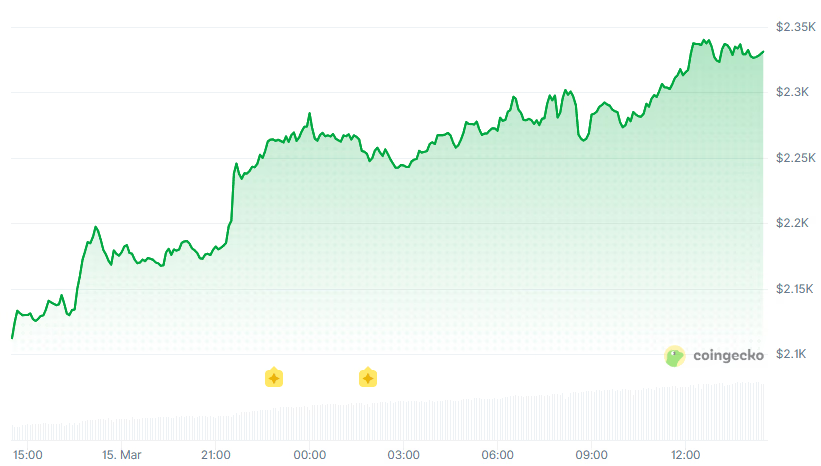
Total crypto capitalization is up 3.5%, with Layer 1s and memecoins leading the charge.
Crypto markets are off to a strong start this week, with major altcoins surging amid more than $400 million in short liquidations. Stocks rallied while oil dropped 5% after U.S. Treasury Secretary Scott Bessent told CNBC that Iranian oil tankers are being allowed to transit the Strait of Hormuz.
Bitcoin (BTC) is trading at around $74,000, up 3.5% over the past 24 hours. Layer 1 tokens are outperforming, with ETH surging 10% to $2,320, and SOL climbing 8% to $95.
Meanwhile, Polkadot (DOT) rallied 15%, Ripple (XRP) and Cardano (ADA) gained around 9%, and BNB added 2%.

The overall crypto market capitalization climbed 3.5% to $2.61 trillion, according to Coingecko.
Michael Saylor’s Strategy purchased an additional 22,337 Bitcoin between March 9 and March 15 for approximately $1.57 billion at an average price of $70,194 per coin, according to a Monday SEC filing. The acquisition, one of the company’s largest to date, brings its total holdings to 761,068 BTC.
Nearly all of the Top 100 digital assets posted gains over the last 24 hours.
Today’s top gainers are Zcash (ZEC) and PEPE, which both surged 20%.
TRUMP and Bittensor (TAO) are the biggest losers, down 4% and 2%, respectively.
Around 120,000 leveraged traders were liquidated for $542 million in the past 24 hours, according to CoinGlass, with short positions comprising $420 million. Bitcoin accounted for $173 million, while ETH led with $220 million.
Bitcoin exchange-traded funds (ETFs) recorded inflows of $180 million on Friday, bringing last week’s total inflows to $767 million, according to SoSoValue.


Metaplanet sold equity and fixed‑strike warrants at a premium, monetizing stock volatility into up to $531 million of dry powder for a 210,000 BTC, yen‑hedged balance‑sheet bet.
Summary
- Metaplanet raised about $255 million via a private share placement at a 2% premium, paired with fixed‑strike warrants at a 10% premium for another ~$276 million if exercised.
- Warrants only trigger if the stock trades above a Bitcoin‑linked mNAV threshold, turning equity upside and volatility into self‑funding BTC accumulation instead of pure dilution.
- The strategy aims to make Metaplanet “Japan’s MicroStrategy,” swapping yen‑denominated equity for a structurally scarce asset and using BTC as a long‑term currency and equity hedge.
Metaplanet just weaponized its equity to buy more Bitcoin (BTC). This is not a vibes-based CT announcement; it is a highly engineered capital markets trade aimed squarely at becoming “Japan’s MicroStrategy,” with a yen hedge bolted on.
Deal structure in plain language
Metaplanet raised about 255 million dollars from global institutional investors via a private placement of new shares priced at a 2% premium to market. Alongside that, it issued fixed‑strike warrants at a 10% premium, which, if fully exercised, could bring in roughly another 276 million dollars. In total, the company is unlocking up to 531 million dollars in incremental “firepower” to push toward its stated target of holding 210,000 BTC on its balance sheet.
The key innovation is not “we raised money and we’ll buy Bitcoin.” It is the explicit monetization of equity volatility: investors are effectively paying for convexity on the stock, and Metaplanet is harvesting that option value to buy hard assets.
Why the warrant design matters
The warrants are struck 10% above the reference price, so they only get exercised if Metaplanet’s share price trades higher, i.e., if the market buys the Bitcoin accumulation story. That creates a self‑funding loop: volatility and upside in the equity translate directly into more capital to deploy into BTC. Commentators on the thread correctly highlight this as “the real innovation,” noting that Metaplanet benefits both from stock volatility and from Bitcoin appreciation.
In market structure terms, the firm is short call options on its own equity and long Bitcoin. It is selling path‑dependent equity upside today to increase its exposure to a non‑sovereign monetary asset it believes will outperform the yen and, likely, Japanese equities over the long term.
Japan, currency risk, and the “denominator”
Where MicroStrategy pioneered this model in the US, Metaplanet adds another layer: a currency hedge against a structurally weak yen. One international holder in the replies openly frames the move as bullish for Japan, arguing that the yen “could benefit greatly from Bitcoin.” Others go further, calling the strategy a matter of corporate “survival” rather than mere profit, a blunt acknowledgment of what sustained currency debasement does to domestic balance sheets.
Another respondent captures the denominator problem cleanly: institutional capital is “waking up to the reality of the denominator” and “building a fortress out of math,” with volatility as the energy source to forge a new standard. Translated into market terms: Metaplanet is trading a dilutable equity, priced in a weakening unit of account, for an asset with a credibly scarce supply schedule.
Signal to the market
Reaction on X swings from praise—calling the placement a “masterclass in capital strategy”—to confusion and outright skepticism about what Metaplanet is and whether this is a scam. That bifurcation is typical early in any new corporate balance‑sheet regime: most participants do not yet speak the language of corporate‑fi‑meets‑Bitcoin, and the documentation reads like jargon to anyone not trained in derivatives.


- Cardano (ADA) rises above $0.28 as whale accumulation boosts short-term momentum.
- Positive funding rates and higher open interest support near-term gains.
- The key levels to watch are the support at $0.25–$0.27 and the resistance near $0.30–$0.35.
Cardano (ADA) has surged over 8% in the past 24 hours, breaking above key short-term resistance levels.
The price is now hovering around $0.286, bringing the $0.30 mark into focus for traders.
Momentum has picked up sharply as derivatives data show positive funding rates and rising open interest.
This price movement has attracted attention from mid-tier whale wallets.
These investors, holding between one million and ten million ADA, have been actively accumulating during recent dips. Their buying has added upward pressure, tightening available supply in the market.
Meanwhile, larger whale wallets, holding ten million to a hundred million ADA, have been reducing positions, suggesting some distribution at higher price levels, creating a mixed picture in the whale ecosystem.
The balance between accumulation and distribution will likely influence price swings in the coming days.
Technical analysis
From a technical perspective, ADA has broken above a descending trendline that had capped price action near $0.25 for weeks.
This breakout has set the stage for further gains as short-term indicators lean bullish.
The relative strength index (RSI) sits above 50, indicating that momentum favours buyers, but it is not yet in overbought territory.
The MACD has crossed above its signal line, and its histogram is expanding, signalling that buying momentum is gaining strength.

Price action has shown that the 20-day exponential moving average (EMA) is providing support near $0.27.
Eyes are now on the 50-day EMA around $0.29 and the 100-day EMA closer to $0.34.
Breaking these levels could open the door to further upside, but failing to hold above the short-term support zone could result in a pullback.
In addition, Cardano’s open interest is also rising, and the funding rate has turned positive, meaning that long positions are paying shorts, which historically aligns with bullish momentum in the near term.
Cardano price forecast
In the short term, traders should monitor $0.30 as the next psychological resistance.
A breakout above $0.30 could target the $0.34–$0.35 range, guided by key EMAs and prior swing highs.
While momentum indicators suggest room for further upside, the market will need consistent buying volume to sustain higher levels.
On the downside, the immediate support lies near $0.27, with a more significant level around $0.25.
A drop below $0.25 could test deeper support near $0.24, potentially signalling short-term bearish pressure.

Brilliant Bruno Fernandes has been worth 25 points to Man Utd this season

Mixed DNA Evidence Offers Hope for Breakthrough

Pepe price rallies over 20% amid market rebound, can it reclaim its February highs?


-
 Tech6 days ago
A 1,300-Pound NASA Spacecraft To Re-Enter Earth’s Atmosphere
-
Crypto World3 days ago
HYPE Token Enters Net Deflation as HyperCore Buybacks Outpace Staking Rewards
-

 Business6 days ago
ExxonMobil seeks to move corporate registration from New Jersey to Texas
-

 Fashion3 days ago
Weekend Open Thread: Addict Lip Glow
-

 Tech6 days ago
ChatGPT will now generate interactive visuals to help you with math and science concepts
-
Sports2 days ago
Why Duke and Michigan Are Dead Even Entering Selection Sunday
-

 NewsBeat5 days ago
Residents reaction as Shildon murder probe enters second day
-
 NewsBeat7 days ago
Pagazzi Lighting enters administration as 70 jobs lost and 11 stores close across Scotland
-

 Business6 days ago
Search Enters Sixth Week With New Leads in Tucson Abduction Case
-

 Business1 day ago
Search for Savannah Guthrie’s Mother Enters Seventh Week with No Arrests
-

 Business2 days ago
US Airports Launch Donation Drives for Unpaid TSA Workers as Partial Government Shutdown Enters Fifth Week
-
Crypto World2 days ago
Coinbase and Bybit in Investment Talks: Could Bybit Finally Enter the US Crypto Market?
-

 NewsBeat5 days ago
I Entered The Manosphere. Nothing Could Prepare Me For What I Found.
-

 Business2 days ago
Country star Brantley Gilbert enters growing non-alcoholic beer market
-

 Business11 hours ago
Australian shares drop as Iran war enters third week
-

 Sports5 days ago
PWHL, Senators discussing plan to keep Charge in Ottawa
-
 Crypto World6 days ago
Will Chainlink price reclaim $10 amid volatility squeeze?
-

 Sports3 days ago
College Basketball Best Bets: Conference Tournament Semifinal Picks
-

 Crypto World11 hours ago
Crypto Lender BlockFills Enters Chapter 11 with Up to $500M in Liabilities
-

 Politics6 days ago
Trump Says Middle East Is ‘Very Lucky’ That He’s President


You must be logged in to post a comment Login