
Crypto World
FATF shifts stablecoin oversight to secondary markets, expands monitoring beyond on- and off-ramps: Financial Action Task Force



The FATF’s latest report pivots regulatory focus from deposit/withdrawal monitoring to tracking peer-to-peer transactions across personal wallets, with issuers now expected to freeze illicit assets on-chain.
The Financial Action Task Force released a new report on March 16, 2026, signaling a major shift in stablecoin regulation toward comprehensive secondary market monitoring. Rather than limiting compliance checks to entry and exit points, the FATF now demands oversight of stablecoins’ entire lifecycle, including peer-to-peer transactions conducted through personal wallets. The update reflects mounting concerns about illicit activity: stablecoins currently account for 84% of unlawful cryptocurrency transactions, according to the report.
The FATF’s expanded mandate requires stablecoin issuers and virtual asset service providers to employ advanced analytics—including multi-hop tracing across multiple transactions—to identify and exclude sanctioned and high-risk addresses from circulation. Issuers are expected to directly freeze on-chain assets flagged through this analysis, closing visibility gaps that previously allowed illicit funds to move through decentralized wallet networks. This represents a significant escalation from earlier guidance focused solely on know-your-customer checks at institutional on- and off-ramps.
Sources: Chainalysis (FATF Secondary Market Monitoring Report, March 2026)
This article was generated automatically by The Defiant’s AI news system from publicly available sources.


[PRESS RELEASE – Vilnius, Lithuania, March 16th, 2026]
WhiteBIT, the largest European exchange by traffic, has announced its selection as one of 11 companies invited to participate in Ghana’s pioneering crypto regulatory sandbox. The sandbox, launched by the Ghana Securities and Exchange Commission in collaboration with the Bank of Ghana, is designed to test and refine regulated digital asset trading in a controlled environment.
WhiteBIT’s inclusion in the sandbox marks a major milestone in the company’s strategic expansion into the African market. As crypto adoption accelerates across the continent, WhiteBIT’s regulated platform and compliance expertise position it to play a central role in helping shape the next generation of digital finance infrastructure.
“WhiteBIT’s mission has always been to deliver secure, compliant, and accessible crypto services,” said Volodymyr Nosov, Founder and President of W Group, which WhiteBIT is a part of. “Being selected for Ghana’s regulatory sandbox not only underscores our commitment to responsible market expansion but also reflects our confidence in Africa’s potential to lead in digital finance.”
The sandbox initiative invites selected licensed firms to operate under regulatory supervision while sharing insights and data that will inform future licensing frameworks for virtual asset service providers (VASPs). The pilot aims to ensure that crypto trading and related services evolve in a manner that protects consumers, enhances transparency, and fosters financial innovation.
A Fast‑Growing Crypto Market
Ghana has emerged as one of Africa’s most dynamic markets for digital asset adoption. According to Chainalysis, Ghana ranks among the top five crypto adoption hubs in Africa, alongside Nigeria, Kenya, and South Africa. More broadly, Africa is currently the third-largest region globally in crypto adoption, following the Asia-Pacific (APAC) and Latin America markets.
According to the central bank, 3 million Ghanaians — approximately 17 % of the adult population — actively use cryptocurrencies, including Bitcoin and stablecoins, for trading, payments, and remittances.
In December 2025, Ghana’s parliament approved the Virtual Asset Service Providers Bill, which legalizes cryptocurrency trading under clear licensing and compliance standards, further creating a solid basis for institutional participation.
Opportunity for Responsible Innovation
Ghana’s regulated sandbox initiative and passage of comprehensive crypto laws signal a strategic shift toward integrating digital assets into the country’s broader financial ecosystem. For WhiteBIT, participation in this program offers a unique opportunity to collaborate with regulators, technologists, and local partners to refine best practices that could extend well beyond Ghana’s borders.
“As Africa’s crypto landscape continues to evolve, WhiteBIT is committed to bringing compliant, secure, and innovative solutions to markets that are ready for next‑generation financial services,” Nosov added.
About WhiteBIT
WhiteBIT is the largest European cryptocurrency exchange by traffic, offering over 900 trading pairs, 350+ assets, and supporting 8 fiat currencies. Founded in 2018, the platform is a part of W Group which serves more than 35 million customers globally. WhiteBIT collaborates with Visa, FACEIT, FC Juventus and the Ukrainian national football team. The company is dedicated to driving the widespread adoption of blockchain technology worldwide.
Binance Free $600 (CryptoPotato Exclusive): Use this link to register a new account and receive $600 exclusive welcome offer on Binance (full details).
LIMITED OFFER for CryptoPotato readers at Bybit: Use this link to register and open a $500 FREE position on any coin!

A former Los Angeles County Sheriff’s Department deputy has been sentenced to more than five years in prison for helping Adam Iza, a jailed crypto founder dubbed “The Godfather,” extort victims.
A California federal court handed Michael Coberg 63 months in prison and an order to pay $127,000 in restitution for helping Iza extort one of his rivals and arrange a drug possession arrest of another person, the Los Angeles US Attorney’s office said on Monday.
Coberg had pleaded guilty in September to conspiracy to commit extortion and conspiracy against rights.
Prosecutors said Coberg was paid at least $20,000 a month for his security services by Iza, the founder of the crypto trading platform Zort, who was known as “The Godfather.”
Iza pleaded guilty in January 2025 to extorting multiple people and is awaiting sentencing.
Prosecutors detail Coberg’s extortion, drug sting
According to prosecutors, in October 2021, Coberg was part of a team that picked up a victim, identified only as “L.A.,” who had a business partner in a financial dispute with Iza.
Coberg brought L.A. to Iza’s house, where Iza recorded a video of L.A. transferring $127,000 to Iza’s bank account while Coberg stood watch.
Coberg also took Iza and L.A. to a shooting range, where prosecutors said Iza held L.A. at gunpoint and demanded he transfer money to him.

Prosecutors said Coberg also conspired with Iza and others to set up a victim, identified only as “R.C.,” to be arrested over drugs.
Related: Former LAPD officer convicted of kidnapping teen in $350K crypto robbery
R.C. had been in a dispute where Iza, Christopher Cadman — a former Sheriff’s Department deputy who pleaded guilty in August to helping Iza — and another deputy had held R.C. at gunpoint to transfer $25,000 to Iza.
Coberg and others set up a sham sting where R.C.’s ex-girlfriend called and convinced them to fly to LA to use drugs together.
R.C. was picked up at the airport, driven to get drugs and was then stopped and arrested by a Sheriff’s Department deputy that Coberg had tipped off.
Prosecutors said in their sentencing memorandum for Coberg that he abused “the awesome power of his badge. And he did so for an all-too-common reason: greed.”
Magazine: Meet the onchain crypto detectives fighting crime better than the cops

[PRESS RELEASE – Tel Aviv, Israel, March 16th, 2026]
Playnance, the Web3 infrastructure company behind the growing GCOIN ecosystem, has announced the launch of GCOIN Staking, a new mechanism designed to strengthen long-term participation in the platform’s expanding Web3 entertainment economy. The program is now live on PlayW3, the flagship Web3 social gaming platform within the Playnance ecosystem, and 250M tokens were locked within hours.
The launch introduces a new opportunity for GCOIN holders to actively participate in the ecosystem through staking and receive rewards distributed through the platform ahead of the upcoming GCOIN Token Generation Event on March 18, expanding the economic layer of the Playnance ecosystem.
The staking program allows GCOIN holders to lock their tokens and participate in ecosystem-driven rewards while encouraging long-term token alignment, reducing circulating supply through voluntary locking, and supporting the sustainability of the GCOIN token economy. Users can stake GCOIN through smart-contract staking pools with a minimum participation threshold of 1,000 GCOIN across four durations of 6, 9, 12, and 18 months, where longer lock periods carry higher reward weight. Rewards begin accumulating 24 hours after activation and can be claimed once the staking period reaches maturity, while early withdrawal remains possible with rewards forfeited.
“Staking allows our community to grow together with the Playnance ecosystem,” said Pini Peter, CEO of Playnance. “As adoption expands, GCOIN holders can take a more active role in the network’s long-term evolution, participating in the ecosystem through staking rewards.”
Playnance introduces a staking mechanism that connects users’ rewards directly to the ecosystem’s operations. Instead of relying on fixed emissions or inflationary rewards, staking rewards are distributed through an ecosystem allocation linked to ecosystem activity, including the social casino and other ecosystem products. As the ecosystem grows and more users participate, rewards are distributed to stakers through an ecosystem allocation, aligning incentives between platform growth and community participation. GCoin holders can stake their tokens to support the ecosystem’s gaming liquidity pool and receive proportional incentive distributions derived from the platform’s daily performance.
GCOIN powers a growing Web3 entertainment economy spanning social gaming, prediction markets, trading environments, and next-generation social casinos. Playnance is leading a structural shift toward decentralized entertainment economies, bringing the global entertainment industry on-chain, all powered by GCOIN. Through staking, community members can participate in the long-term evolution of the ecosystem while contributing to greater stability and sustainability across the Playnance network.
About Playnance
Founded in 2020, Playnance is a Web3 infrastructure company developing live, non-custodial, on-chain products designed to onboard mainstream Web2 users into blockchain environments. The company develops consumer-facing platforms built on shared wallet systems and high-volume on-chain execution, currently processing approximately 2 million transactions per day. Playnance focuses on reducing friction between user experience and blockchain infrastructure by abstracting complexity while maintaining full on-chain transparency and non-custodial architecture.
Binance Free $600 (CryptoPotato Exclusive): Use this link to register a new account and receive $600 exclusive welcome offer on Binance (full details).
LIMITED OFFER for CryptoPotato readers at Bybit: Use this link to register and open a $500 FREE position on any coin!


Bitcoin prices have reached their highest level since early February in a crypto market relief rally as analysts eye $80,000.
Bitcoin prices tapped $76,000 on Coinbase in early trading on Tuesday morning, according to TradingView. It is the highest the asset has traded since the Feb. 6 crash.
Bitcoin did it. It just closed the daily candle above the $74,500 April 2025 low, said analyst ‘Sykodelic’ on Tuesday. “To me, this daily close is a signal that the market wants higher,” they added.
“Hold at these levels for a little longer, and $80k should come in short order. Acceptance back inside the $72k range, and we should expect lower levels again.”
Positive Signals From Technical Indicators
“We have lift-off. Breakout move has begun. Early stages,” said analyst ‘Colin.’
He guessed the height of the potential relief rally would be $80,600, which is a retest of the November 2025 lows with a broader range between $79,000 and $86,000 for a relief rally top.
CryptoQuant analyst Julio Moreno observed that Bitcoin’s Inter-Exchange Flow Pulse (IFP) has recently flipped back into bullish territory.
This technical indicator has historically “marked important transitions in market structure, particularly after prolonged periods of suppressed liquidity rotation between exchanges,” he said.
“In practical terms, the signal suggests that liquidity mobility inside the exchange network is increasing again, a condition typically associated with early expansion phases of market cycles.”
Meanwhile, ‘Daan Crypto Trades’ said there was “good confluence” over at the $83,000 to $84,000 level with both the Bull Market Support band and the big CME gap there. However, the 200-week EMA is still serving as support around $68,000.
You may also like:
$BTC Good confluence over at the ~$83K-$84K level with both the Bull Market Support band and the big CME gap.
Think that’s a good level to watch in the week(s) ahead. To see where price meets the band and how it reacts around it.
On the downside the Weekly 200MA/EMA have held… pic.twitter.com/eFa4wvcDxO
— Daan Crypto Trades (@DaanCrypto) March 16, 2026
Bitcoin is starting to show signs of being “going against the grain of history by successfully weekly closing above the 200-week EMA,” said Rekt Capital. However, there’s also a chance that Bitcoin could “simply meander in and around the 200-week EMA for a while,” he added.
Elsewhere on Crypto Markets
Bitcoin had cooled slightly and was trading at $74,300 at the time of writing, up 9% over the past seven days. Ethereum was also getting a long-overdue lift, surging more than 8% on the day to reach $2,380 before a minor pullback. ETH has gained a whopping 17% over the past seven days.
Altcoins were having their best day in weeks with big gains for XRP, Cardano, Stellar, and Zcash. Meanwhile, the total market cap had reached $2.65 trillion, its highest level since Feb. 4.
Binance Free $600 (CryptoPotato Exclusive): Use this link to register a new account and receive $600 exclusive welcome offer on Binance (full details).
LIMITED OFFER for CryptoPotato readers at Bybit: Use this link to register and open a $500 FREE position on any coin!

TLDR:
- Polymarket was handed a nationwide block by a Buenos Aires court directing ENACOM to restrict access on March 16, 2026.
- LOTBA filed the complaint that led authorities to classify Polymarket as an unlicensed online gambling service in Argentina.
- Polymarket accepted crypto and credit cards with no age or identity verification, raising serious concerns over minor user access.
- Argentina joins Colombia as the second Latin American country to fully restrict the Polymarket prediction market platform.
Polymarket, a crypto-based prediction market platform, faces a nationwide ban in Argentina following a court order on March 16, 2026.
Buenos Aires Judge Susana Parada directed ENACOM to restrict access through all internet providers. The ruling also instructs Google and Apple to remove the platform’s mobile apps from the App Store for Argentine users.
The complaint originated from the Buenos Aires City Lottery, making Argentina the second Latin American country to restrict the platform fully.
Court Rules Polymarket Operates as Unlicensed Gambling Service
The Buenos Aires Justice issued the ban following a complaint from the Lottery of the City of Buenos Aires (LOTBA).
The Argentine Chamber of Casinos, Bingos, and Annexes (CASCBA) joined the complaint soon after. Together, they pushed the case through the Specialized Prosecutor’s Office for Gambling (FEJA).
The Judicial Investigations Corps (CIJ) provided technical assistance during the investigation. Authorities concluded that Polymarket functions as a covert online betting system.
The platform was classified as a “prediction market,” which falls under gambling regulations.
The court found that Polymarket operated in Argentina without any local authorization. It accepted cryptocurrencies and credit cards without requiring identity or age verification. Users could create accounts within minutes, raising concerns among regulators about minors’ access.
Judge Parada stated that these features “significantly increase the risks for users,” pointing directly to the absence of age and identity checks.
The block covers the platform and all its variants, according to the Public Prosecutor’s Office. However, as of 1:05 pm on Monday, the platform remained accessible in Argentina.
Polymarket’s Regional Restrictions and the Broader Debate
Colombia was the first Latin American country to restrict access to Polymarket. Argentina has now followed with a similarly sweeping national ban. This sets a judicial and technical precedent for how predictive platforms may be treated across the region.
The timing of the ban is worth noting. Just before the block, Polymarket drew attention by predicting Argentina’s February inflation data 15 minutes before INDEC published it. That incident added pressure on regulators to act against the platform.
The decision has generated mixed reactions across Argentina. Some observers welcome the move as a step toward protecting vulnerable users from unregulated gambling. Others, meanwhile, warn that it restricts freedom of information and access to global financial tools.
The contrast with the United States is clear. American authorities have moved toward regulating, rather than blocking, prediction market platforms that use cryptocurrencies.
Polymarket grew rapidly during the 2024 U.S. presidential race, gaining attention for giving Donald Trump “55.5% of chances” of winning — a figure that outperformed traditional polls.
The platform’s rise during that election campaign brought it international visibility that regulators in Latin America are now responding to.


Impermanent loss (IL) has long been the Achilles’ heel of liquidity providers (LPs) in decentralized finance (DeFi). Traditional LPs have had to weigh the risk of holding assets in automated market maker (AMM) pools against potential fees earned, often facing losses when token prices diverge. However, the DeFi ecosystem is evolving rapidly, and new strategies are emerging that allow LPs to mitigate impermanent loss more effectively than ever before.
Understanding the Evolution of Impermanent Loss
Impermanent loss occurs when the value of assets deposited in a liquidity pool changes relative to holding them separately. Historically, LPs mitigated IL by choosing stablecoin pairs (like USDC/USDT), which limited volatility but also capped upside potential. As the DeFi landscape matures, innovation has turned toward smart pool designs, dynamic fee structures, and cross-asset hedging, creating a new frontier for LP risk management.
Innovative Pool Designs
1. Concentrated Liquidity Pools
Popularized by platforms like Uniswap V3, concentrated liquidity allows LPs to allocate liquidity to specific price ranges rather than across the entire curve. By doing so, capital efficiency increases and exposure to price divergence decreases. LPs can now focus their liquidity where trading is most likely to occur, earning higher fees with reduced impermanent loss.
2. Dynamic AMMs and Weighted Pools
Projects such as Balancer have introduced variable weight pools, enabling LPs to adjust the proportion of tokens based on market conditions. This flexibility reduces the risk of impermanent loss in volatile markets while still maintaining exposure to multiple assets. Pools with dynamic weights can automatically rebalance as prices shift, acting as an internal hedging mechanism.
3. Stable-Stable and Hybrid Pools
Stable-stable pools (e.g., USDC/DAI) have always minimized IL, but hybrid pools combining stablecoins with volatile tokens in a strategic ratio are gaining traction. These designs allow LPs to capture fees from volatility without full exposure to price swings, creating a smoother risk-return profile.
Hedging Techniques for LPs
Beyond pool design, LPs can adopt active hedging strategies to further reduce impermanent loss:
-
Options and Derivatives: LPs can use decentralized options platforms to hedge against token depreciation. For instance, buying put options on the more volatile token in a pair can offset losses if the price diverges significantly.
-
Synthetic Asset Exposure: Some DeFi protocols allow LPs to create synthetic positions that mirror their LP exposure, enabling risk-adjusted rebalancing.
-
Cross-Protocol Strategies: LPs can leverage lending platforms to earn interest or collateralized yield on one side of their LP position, partially offsetting impermanent loss while maintaining liquidity provision.
The Future: Algorithmic IL Protection
Several protocols are exploring algorithmic approaches to impermanent loss protection. These mechanisms automatically adjust LP positions in real-time, using AI-driven pricing models or volatility metrics to minimize exposure. Over time, this could evolve into a standard feature in DeFi, making IL less of a concern for both novice and professional LPs.
Conclusion
Impermanent loss no longer has to be a passive risk that LPs accept. Through innovative pool designs, dynamic AMMs, hybrid assets, and hedging strategies, DeFi participants can actively protect their liquidity positions while still earning fees. As the ecosystem continues to mature, Impermanent Loss 2.0 represents a new era where risk and reward can be more carefully balanced—and liquidity provision becomes smarter, not just luckier.
REQUEST AN ARTICLE

Unrealized Bitcoin Losses Put Sentiment on the Hook
The sentiments of investors were further worsened with Strategy recording increasing unrealized losses on its Bitcoin holdings. According to market estimates, the company is already experiencing over $900 million in losses in paper because the asset traded at a lower price than its average acquisition price.Also, Bitcoin has temporarily dropped to the lower end of the 74,000 range at the end of Sunday. This drop has driven the price to an amount that is lower than the projected average price of purchase of around $76,000 by Strategy.The drop in value, therefore, has reduced the market value of the huge digital asset base of the firm. Strategy has an approximate of 713,502 BTC that it has accrued in its continuous treasury strategy.
Strategy has been able to raise funds with the help of equity sales and remains with its strategy of buying Bitcoin. Recently, the company sold an estimated 1.569 million shares of its common stock during a trading period between January 20 and 25 and the net proceeds of the sales amounted to approximately 257 million dollars. The capital further supported the latest Bitcoin purchase of the firm in addition to approximately 70,201 shares of its STRC preferred stock in which it raised around 7 million dollars more funds. The company had revealed that it had bought 855 BTC valued around 75.3 million in the last weekly purchasing round.
Strategy shares have also been affected by the trading sentiment by market expectations. According to Polymarket, which is a prediction platform, traders are confident that it is likely that Bitcoin will fall further before it recovers.Moreover, a number of market analysts have changed their views about the cryptocurrency. Peter Brandt, a veteran trader, has recently changed his estimates because of the existing price fluctuations.Peter Schiff, an investor, criticized the approach of the treasury creation of Bitcoin by Strategy. Nevertheless, the executive chairman Michael Saylor indicated that the firm can still go ahead and buy Bitcoin even as the market slump persists.

Editor’s note: HIVE’s BUZZ HPC is expanding its liquid-cooled AI data center footprint in Canada, lifting capacity from 4 MW in Manitoba to 16.6 MW across two provinces. A new British Columbia facility adds 5 MW immediately, with an option for 7.6 MW in 2027. The expansion enables a near-term ramp to over 4,000 GPUs and strengthens BUZZ’s sovereign AI compute strategy, supported by Bell Canada AI Fabric. Notably, deposits already securing the growth pipeline mean no additional capital expenditures are required to secure this capacity.
Key points
- 4x expansion to 16.6 MW of liquid-cooled AI data center capacity across Manitoba and British Columbia.
- British Columbia Phase 1 adds 5 MW immediately, with a Phase 2 option for 7.6 MW in 2027.
- Near-term ramp to over 4,000 GPUs in Canada, with ~2,000 GPUs in Manitoba and ~2,000 in BC.
- No additional capital expenditures required to secure expanded capacity; deposits with the partner secure the growth pipeline.
Why this matters
HIVE’s expansion aligns with its strategy to deliver scalable, renewable-powered AI compute through BUZZ HPC. Extending to British Columbia and enlarging Manitoba broadens Canada’s sovereign compute footprint, enabling faster GPU deployments for AI workloads and enterprise customers. The move strengthens a disciplined, capex-light growth model that leverages existing partnerships while pursuing high-margin, recurring GPU revenue. By accelerating the company’s GPU cloud trajectory, the expansion underscores HIVE’s strategy to position Canada as a hub for AI infrastructure and innovation.
What to watch next
- Timeline for Phase 2 BC expansion (7.6 MW) in 2027.
- Updates on GPU procurement and cloud revenue contracts for BUZZ HPC in Canada.
- Progress toward 6,000 GPUs in Canada and HPC ARR targets by March 31, 2027.
Disclosure: The content below is a press release provided by the company/PR representative. It is published for informational purposes.
HIVE’s BUZZ HPC Expands Data Center Footprint into British Columbia with 4 Times Growth in Liquid-Cooled AI Data Center Capacity
This news release constitutes a “designated news release” for the purposes of the Company’s prospectus supplement dated November 25, 2025 to its short form base shelf prospectus dated October 31, 2025.
San Antonio, Texas, March 16, 2026 — HIVE Digital Technologies Ltd. (TSX.V: HIVE) (Nasdaq: HIVE) (FSE: YO0) (BVC: HIVECO) (the “Company” or “HIVE”), a global leader in sustainable digital infrastructure and AI compute, through its wholly owned subsidiary BUZZ High Performance Computing (“BUZZ”), today announced a 4x expansion of its liquid-cooled AI data center capacity through its previously announced strategic data center partner in Canada, growing the existing 4 megawatts (“MW”) in Manitoba to 16.6 MW of critical IT load across two Canadian provinces (all figures referenced herein are in critical IT load), expanding HIVE’s BUZZ HPC Sovereign AI Compute offering in Canada (all amounts in US dollars, unless otherwise indicated).
The expansion adds a new colocation facility in British Columbia, providing an immediate 5 MW of capacity with an option to scale an additional 7.6 MW. This new immediate capacity facilitates the deployment of upwards of 2,000 next-generation high-power density AI-optimized GPUs in British Columbia, complementing the capacity for approximately 2,000 GPUs in BUZZ’s existing Manitoba facility. In total, the Company now has a near-term ramp to over 4,000 GPUs in Canada through its data center partnerships and its own sites, accelerating the Company’s previously announced GPU AI cloud deployment targets for calendar 2026.
4 Times Growth in Sovereign AI Data Center Runway Across Canada
The Company’s AI colocation footprint with Bell Canada AI Fabric, its strategic data center partner, now spans two provinces in Western Canada:
- Manitoba: 4 MW of critical IT load. BUZZ has deployed 504 next-generation AI-optimized GPUs consuming approximately 1 MW, with 3 MW of remaining capacity to support approximately 1,500 additional GPUs.
- British Columbia (Phase 1): 5 MW of critical IT load, available immediately. This capacity supports the deployment of approximately 2,000 next-generation, high-power-density, AI-optimized GPUs.
- British Columbia (Phase 2): Option for an additional 7.6 MW of critical IT load in 2027, supporting an additional 3,000 next-generation high-power density AI-optimized GPUs.
In aggregate, the Company now has a growth path to over 6,000 new GPU deployments in Canada through this strategic data center partnership with Bell Canada AI Fabric, providing the infrastructure runway for its GPU cloud revenue objectives.
Importantly, no additional capital expenditures are required to secure this expanded colocation capacity. Deposits made by the Company in 2025 with the strategic data center partner are sufficient to secure the full growth pipeline. Standard operational costs associated with GPU procurement, installation, and ongoing data center operations remain separate and are expected as part of normal business activities.
Accelerating AI Cloud Growth
The Company previously disclosed a target of achieving new deployments of 6,000 latest generation GPUs for AI cloud. This colocation expansion provides the infrastructure required to achieve that target on an accelerated basis. 4,000 next-generation AI-optimized GPUs are targeted for contracted revenue in the next 6 months (including 2,000 high-power density GPUs in BC). The Company expects to further expand another 2,000 high-power density GPUs through additional partner data centers or its own data centers, reaching 6,000 GPUs in Canada, with a target of $200 million in contracted annualized run-rate revenue (“HPC ARR”) by the end of this fiscal year (period end March 31, 2027). For new long-term GPU contracts with enterprise clients, the Company is targeting 75% HPC EBITDA.
“Nations that control their own AI compute will lead the next era of global innovation. Canada has the talent, the energy, and now, with BUZZ, the infrastructure to compete at the highest level,” said Frank Holmes, Executive Chairman of HIVE. “Since 2017, HIVE has demonstrated the ability to build, scale, and operate complex digital infrastructure with consistency and rigor across nine time zones and three continents. We are now applying that same discipline to AI. Our dual-engine model, Tier-I Bitcoin mining generating cash flow and Tier-III AI compute delivering high-margin recurring revenue, was built for exactly this moment. This expansion with Bell is a statement of conviction. We believe sovereign AI compute will define the next decade of Canadian innovation, and HIVE intends to be at the center of it. Moreover, in addition to our exciting growth ramp, HIVE owns and operates other data centres in Canada, which prime for conversion for hyperscaler colocation, and even government or military contracts. Notably, indications to management are that our 70 MW site in New Brunswick offers the scale of powered land for hyperscaler needs, and we believe the location of our 7.6 MW Toronto Airport site is very attractive to government or military applications.”
Aydin Kilic, President and CEO of HIVE, added: “This expansion gives us committed liquid-cooled data center capacity across two provinces, and a clear path to over 6,000 next-generation AI-optimized GPUs in Canada. As demand for AI compute ramps, we can move quickly to deploy additional clusters of AI-optimized GPUs online to realize our ARR targets for 2026, while scaling EBITDA in a cap-ex light strategy. The data center infrastructure is now secured, and the demand for compute is strong. We are seeing economics where 3-year deals and 5-year deals for longer-term GPU contracts provide investors with comfort that there is a strong fundamental return on the investment and deployment of these GPU clusters. Investors should expect near-term updates on GPU procurement and cloud revenue contracts as we execute on this accelerated timeline.”
* As used herein, “HPC EBITDA” is defined as earnings from HPC operations before deducting HPC-related interest, taxes, depreciation and amortization. “HPC ARR”, as a metric, represents total HPC revenue only, and does not represent profitability. HPC ARR is presented here as a measure of growth. These non-GAAP measures should be read in conjunction with and should not be viewed as alternatives to or replacements for measures of operating results and liquidity presented in accordance with GAAP in HIVE’s quarterly and annual financial statements. All financial projections reflect current market sentiment and public disclosures as of March 2026; actual outcomes may vary. Investors should conduct their own due diligence.
Capital Allocation and Future Investment Strategy in Europe
As previously disclosed, HIVE has operated in Sweden since 2017, establishing multiple successful datacenter facilities powered entirely by renewable energy. Over that time, HIVE has made meaningful contributions to the local economy by engaging numerous subcontractors and supporting community initiatives such as the Boden Hockey Club. Notably, HIVE was also the first datacenter operator in Sweden to participate in the national grid-balancing program in collaboration with Svenska Kraftnät and Vattenfall, helping stabilize renewable power supply while supporting regional energy infrastructure.
HIVE’s acquisition of the 7 MW datacenter in Boden, Sweden, in November 2023 marked an early step in the Company’s strategic transition from Tier-I digital infrastructure toward Tier-III high-performance computing and artificial intelligence infrastructure. While the site initially operated as part of HIVE’s renewable-powered hashrate production, the facility was subsequently designated for conversion to Tier-III AI and HPC standards capable of supporting enterprise-grade GPU clusters.
As part of this transition, HIVE is progressively phasing down its ASIC-based hashrate production (provided to foreign Bitcoin mining pool customers) at its larger Boden facility, enabling the Company to redeploy resources toward its expanding AI and HPC strategy in Europe.
This strategic shift has been driven by increasing challenges faced by HIVE’s Swedish subsidiaries in their traditional hashrate production business. Recently, the Company has experienced ongoing enforcement actions and what it believes are misapplications of existing tax rules by the Swedish tax authorities. Despite receiving supportive opinions from several respected law firms, a tier-1 accounting firm, and top local academics specializing in Swedish value-added-tax matters, the authorities have imposed a security deposit requirement on disputed tax assessments. Historically, because of the strength of the Company’s case, it had always been granted deferrals, while awaiting a final judicial appeal. These developments have created operational uncertainty and have limited the Company’s ability to continue operating its traditional hashrate production model on a consistent economic basis.
In response to these evolving conditions, HIVE has determined that continuing its ASIC-based hashrate production model may no longer be economically viable in Sweden, and the Company will begin exploring the phase out of these activities.
As a proactive solution, HIVE is shifting its strategic focus toward high-performance computing and artificial intelligence Tier-III datacenters. This transition is already underway with the upgrade of the Company’s 7 MW facility in Boden to a Tier-III design. Construction is currently in progress, and the facility is expected to support GPU clusters based on the NVIDIA GB300 GPU architecture, designed to power demanding AI training and inference workloads.
This investment will position HIVE at the forefront of next-generation digital infrastructure while ensuring the Company remains a contributor to the region’s technological development. For the Boden community, these next-generation datacenters are expected to support local economic growth, strengthen education partnerships, and attract technology-focused businesses, further solidifying the region’s reputation as a hub for digital innovation.
RSU Grants Reinforce Commitment to Sustainable Growth
To ensure the team delivering on HIVE’s current and future vision has direct alignment with shareholders, HIVE is granting 2,849,400 Restricted Share Units (“RSUs”) to employees, officers, directors, and consultants under its RSU plan, with a mandatory one-year TSX Venture Exchange vesting period. This aligns management with investors to build long-term value. Inspired by Harvard Business School research on non-linear incentives, these quarterly milestone-based awards foster innovation and retention—aligning global talent from Paraguay to Sweden with HIVE’s vision for sustainable growth and minimal dilution.
HIVE has shared these RSUs with all employees, both new and long-serving, to preserve its unique culture, which focuses on efficiency and return on invested capital.
About HIVE Digital Technologies Ltd.
Founded in 2017, HIVE Digital Technologies Ltd. is the first publicly listed company to mine digital assets powered by green energy. Today, HIVE builds and operates next-generation Tier-I and Tier-III data centers across Canada, Sweden, and Paraguay, serving both Bitcoin and high-performance computing clients. HIVE’s twin-turbo engine infrastructure-driven by hashrate services and GPU-accelerated AI computing-delivers scalable, environmentally responsible solutions for the digital economy.
For more information, visit hivedigitaltech.com, or connect with us on:
X: https://x.com/HIVEDigitalTech
YouTube: https://www.youtube.com/@HIVEDigitalTech
Instagram: https://www.instagram.com/hivedigitaltechnologies/
LinkedIn: https://linkedin.com/company/hiveblockchain
On Behalf of HIVE Digital Technologies Ltd.
“Frank Holmes”
Executive Chairman
For further information, please contact:
Nathan Fast, Director of Marketing and Branding
Frank Holmes, Executive Chairman
Aydin Kilic, President & CEO
Tel: (604) 664-1078
About BUZZ HPC
BUZZ High Performance Computing (BUZZ HPC), a wholly owned subsidiary of HIVE Digital Technologies Ltd. (TSX.V: HIVE) and an NVIDIA Cloud Partner, delivers enterprise-grade cloud services and large-scale GPU clusters. The platform supports a suite of managed services, including Kubernetes, Slurm, virtual machines, and bare-metal deployments optimized for AI, machine learning, and scientific workloads. Headquartered in Canada with a global reach, BUZZ HPC is one of the first and few Canadian sovereign AI platforms operating at scale. Since 2017, it has deployed supercomputing environments across Canada and the Nordics. Its Tier-III+ data centres powered entirely by renewable energy and engineered with ultra-low Power Usage Effectiveness (PUE) host thousands of industrial-grade GPUs across North America and Europe used for AI model training, fine-tuning and inference.
Through its Green GPU initiative, BUZZ HPC combines AI innovation with sustainability, offering localized expertise and global infrastructure.
Learn more at https://www.buzzhpc.ai
For further information, please contact:
Craig Tavares, BUZZ HPC President and COO
Tel: (604) 664-1078
Neither the TSX Venture Exchange nor its Regulation Services Provider (as that term is defined in policies of the TSX Venture Exchange) accepts responsibility for the adequacy or accuracy of this news release.
Forward-Looking Information
Except for the statements of historical fact, this news release contains “forward-looking information” within the meaning of applicable Canadian securities laws, which may include but is not limited to statements regarding: the anticipated benefits of the partnership between BUZZ HPC and Bell Canada; the expected deployment, timing, capacity, and expansion of BUZZ HPC’s NVIDIA-accelerated infrastructure; the potential impact on Canadian AI innovation, competitiveness, and economic growth; compliance with privacy, cybersecurity, and data residency regulations; the use of renewable energy; and any other future-oriented statements. Forward-looking information is based on current expectations, estimates, forecasts, and projections, as well as management’s beliefs and assumptions, including that the partnership will proceed as planned, infrastructure will be deployed on the expected timelines and within budget, demand for AI computing will continue to grow, and regulatory requirements will remain consistent with current expectations, and other related risks as more fully set out in the Company’s disclosure documents under the Company’s filings at www.sec.gov/EDGAR and www.sedarplus.ca.
Forward-looking information involves known and unknown risks, uncertainties, and other factors that may cause actual results, performance, or achievements to differ materially from those expressed or implied by such forward-looking information. Such factors include, but are not limited to: the risk that deployment timelines may change; that costs may exceed expectations; that demand for AI infrastructure may be lower than anticipated; that partnerships or regulatory approvals may not materialize as expected; that GPU supply and procurement timelines may be subject to change; that revenue projections are based on current market conditions and assumptions that may not materialize; and the risk factors described in the Company’s continuous disclosure documents available on SEDAR+ at www.sedarplus.ca. Readers are cautioned not to place undue reliance on forward-looking information. The Company disclaims any obligation to update or revise any forward-looking information, whether as a result of new information, future events, or otherwise, except as required by law.
Hana Financial Group, one of South Korea’s largest financial conglomerates, has partnered with Standard Chartered on finance and digital assets.
On Sunday, Hana Financial said it signed a business agreement with the United Kingdom’s Standard Chartered Group (SC Group) for cooperation in global financial business and digital asset fields, Yonhap News reported.
The agreement covers collaboration in various global financial sectors, including investment banking, money markets, foreign exchange and digital assets.
“We will create new growth opportunities by generating synergies in future financial areas, including digital assets,” Hana Financial chairman Ham Young-joo said, adding that the companies aim to deploy their extensive networks and diverse financial expertise.
Cointelegraph reached out to Hana Financial and Standard Chartered for comment, but had not received a response by publication.
Hana expands digital finance ties
Hana Financial’s partnership with Standard Chartered expands the company’s digital asset efforts after recently collaborating with major crypto industry players.
Related: South Korea plans to use AI for crypto tax enforcement
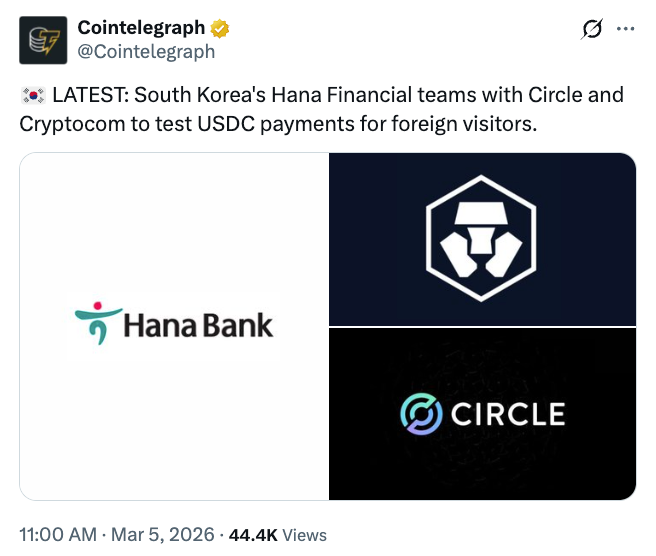
On March 5, the South Korean conglomerate reportedly said it has partnered with the USDC (USDC) issuer Circle and major US crypto exchange Crypto.com. As part of the partnership, Hana Financial pledged to promote stablecoin-based payments for foreign visitors in the country.

“Through this initiative, we seek to confirm the growth potential of stablecoins as a payment tool, expanding cooperation with global digital asset operators,” the company reportedly said, highlighting its commitment to exploring real-world applications of stablecoins.
Standard Chartered strengthens presence in Asia
Standard Chartered CEO Bill Winters emphasized the importance of the Asian financial market in the partnership.
“Korea is a key hub of the Asian financial market, and cooperation with Hana Financial Group, which is strong in global markets, will be an important milestone for our global network business,” he said.
On Friday, Standard Chartered was reported to be one of at least two companies set to receive stablecoin issuer approvals in Hong Kong in late March.
Magazine: China’s ‘50x’ blockchain boost, Alibaba-linked AI mines Bitcoin: Asia Express
Crypto World
Bitmine Stacks ETH, Funds Eightco, and Gains OpenAI Access: Here Is What Tom Lee Is Building
TLDR:
- Bitmine anchored a $125M institutional round for Eightco with a $75M check, gaining indirect OpenAI exposure through it.
- Eightco deployed $50M from the Bitmine-led round directly into an OpenAI stake, linking crypto capital to private AI markets.
- Bitmine added 65,000 ETH in just seven days, growing its total holdings to 4,595,562 ETH as part of its treasury strategy.
- Tom Lee is building a portfolio where ETH accumulation funds AI-sector bets, treating crypto and artificial intelligence as one converging play.
Tom Lee and Bitmine ($BMNR) executed three simultaneous moves that together form one coherent strategy. Bitmine led a $125 million institutional funding round for Eightco, putting in $75 million directly.
Eightco then used $50 million of those proceeds to buy into OpenAI. Separately, Bitmine added 65,000 ETH in seven days, bringing its total to 4,595,562 ETH.
Taken together, the three moves reveal a firm betting on crypto and AI converging — and using one to fund the other.
Three Moves, One Strategy: How the Eightco Deal Connects to OpenAI
The first move was Bitmine anchoring a $125 million round for Eightco with a $75 million check. Other institutional investors covered the remaining $50 million in the raise.
Once the round closed, Eightco directed $50 million of those proceeds into an OpenAI stake. That chain of capital created indirect OpenAI exposure for Bitmine through a public market vehicle.
Milk Road noted on X that Eightco currently trades at under $0.01 per share. Yet Bitmine’s stake in the company is now valued at roughly $83 million.
That figure is already above the original $75 million entry point. The appreciation followed the market reaction to the OpenAI investment becoming public.
Private access to OpenAI is not available through conventional market channels. Tom Lee and Bitmine structured the Eightco route as a way around that barrier.
The move places Bitmine inside the AI arms race at the private level. Most public market investors cannot replicate that position through any standard exchange.
Bitmine also holds a $200 million stake in Beast Industries alongside $1.2 billion in unencumbered cash. That capital base gives the firm room to keep executing deals at scale.
However, the Eightco stake is the one that draws a direct line to artificial intelligence. It is the move that turns a crypto treasury into an AI portfolio.
The ETH Accumulation Is the Engine Powering Every Move
The third move was the quietest — but it runs underneath everything else. Bitmine grew its ETH holdings from 4.53 million to 4,595,562 in a single week.
That is 65,000 ETH added in seven days at a deliberate and consistent pace. The accumulation is not incidental; it is the fuel behind the broader deployment strategy.
The firm also carries 196 BTC, rounding out a crypto-heavy balance sheet. Together with the cash reserves, Bitmine operates with a highly liquid and diversified base.
That liquidity is what made leading a nine-figure round possible on short notice. The crypto holdings function as a war chest, not a long-term passive position.
Each move connects back to the same underlying thesis. ETH builds the treasury, the treasury funds Eightco, and Eightco buys into OpenAI.
The structure creates a chain where crypto accumulation directly enables AI-sector exposure. Tom Lee has constructed a portfolio where the two asset classes work in tandem.
Milk Road summarized the approach clearly — Bitmine is not picking crypto over AI or AI over crypto. Instead, the firm is wagering on a world where the two converge at the infrastructure level.
The Eightco stake makes that thesis concrete and measurable. Every move made this week points in exactly the same direction.

Is it safe to travel to Bahrain? Foreign Office advice after continued Iran-US war strikes

FBI Recovers Shocking New Images in Savannah Guthrie’s Mom Abduction

WhiteBIT Expands into Africa – Joins Ghana’s Crypto Regulatory Sandbox


-
 Tech6 days ago
A 1,300-Pound NASA Spacecraft To Re-Enter Earth’s Atmosphere
-
Crypto World3 days ago
HYPE Token Enters Net Deflation as HyperCore Buybacks Outpace Staking Rewards
-

 Business7 days ago
ExxonMobil seeks to move corporate registration from New Jersey to Texas
-

 Fashion4 days ago
Weekend Open Thread: Addict Lip Glow
-

 Tech7 days ago
ChatGPT will now generate interactive visuals to help you with math and science concepts
-
Sports3 days ago
Why Duke and Michigan Are Dead Even Entering Selection Sunday
-

 NewsBeat5 days ago
Residents reaction as Shildon murder probe enters second day
-

 Business1 day ago
Search for Savannah Guthrie’s Mother Enters Seventh Week with No Arrests
-

 Business6 days ago
Search Enters Sixth Week With New Leads in Tucson Abduction Case
-

 Business3 days ago
US Airports Launch Donation Drives for Unpaid TSA Workers as Partial Government Shutdown Enters Fifth Week
-
Crypto World3 days ago
Coinbase and Bybit in Investment Talks: Could Bybit Finally Enter the US Crypto Market?
-

 NewsBeat6 days ago
I Entered The Manosphere. Nothing Could Prepare Me For What I Found.
-

 Business3 days ago
Country star Brantley Gilbert enters growing non-alcoholic beer market
-

 Sports5 days ago
PWHL, Senators discussing plan to keep Charge in Ottawa
-

 Business20 hours ago
Australian shares drop as Iran war enters third week
-

 Sports3 days ago
College Basketball Best Bets: Conference Tournament Semifinal Picks
-

 Crypto World20 hours ago
Crypto Lender BlockFills Enters Chapter 11 with Up to $500M in Liabilities
-

 Crypto World7 days ago
Will Chainlink price reclaim $10 amid volatility squeeze?
-

 Politics6 days ago
Trump Says Middle East Is ‘Very Lucky’ That He’s President
-
 Crypto World5 days ago
Three Binance Charts May Be Hinting at Bitcoin’s Next Move


You must be logged in to post a comment Login