It feels like a long old while since Baby Jane Doe (who’s looking good and taking formula well) was the talking point of The Pitt season 2. The shift has gotten more difficult over the last few hours, but the worst is yet to come.
The ER is currently under digital lockdown to prevent a cyber attack, meaning no computer records can be accessed, the number of patients practically doubles every five seconds, and replacement Dr. Al-Hashimi (Sepideh Moafi) isn’t making life easier for anyone.
In The Pittseason 2 episode 11, ICE agents are introduced to the ER for the first time, not even allowing Dr. Robby’s (Noah Wyle) next patient to make a call home. It’s bound to be a brutal watch, but when is it on HBO Max?
Advertisement
Article continues below
Advertisement
What time can I watch The Pitt season 2 episode 11 on HBO Max?
The Pitt Season 2 | Official Trailer | HBO Max – YouTube
For US viewers, The Pitt season 2 episode 11 will drop on Thursday, March 19 at 6pm PT/ 9pm ET. As always, it’ll come out on HBO Max, too.
Internationally, you’re looking out for these timings:
US – 6pm PT / 9pm ET
Canada – 6pm PT / 9pm ET
India – Friday, March 20 at 7:30am IST
Singapore – Friday, March 20 at 10am SGT
Australia – Friday, March 20 at 1pm AEDT
New Zealand – Friday, March 20 at 3pm NZDT
You’ll notice that I’ve not included the UK here. That’s because HBO Max doesn’t launch in the UK until March 26. It hasn’t been released on Sky or Now TV either, which are the usual homes to HBO Originals on British shores.
In short: you’ll have to wait until HBO Max makes its UK debut to binge both seasons, but at least you should be able to watch the season finale with everyone else on April 16.
Sign up for breaking news, reviews, opinion, top tech deals, and more.
Advertisement
When do new episodes of The Pitt season 2 come out?
Baby Jane Doe, looking good, taking formula well. (Image credit: HBO)
New episodes of The Pitt will make landfall every Thursday in the US and on Fridays everywhere else. Here are the all-important dates you need to know about:
And of course, you can also follow TechRadar on YouTube and TikTok for news, reviews, unboxings in video form, and get regular updates from us on WhatsApp too.
Fujifilm has just introduced the Instax Mini 13, the latest addition to one of the best selling instant camera lines in the world. It sits comfortably in the palm of your hand from the moment you pick it up, and a metallic silver logo on the front adds a subtle touch of shine without making the whole thing feel fussy or overcomplicated.
Simply twist the lens ring and you’re good to go in one fluid action. Twist it again, and the close-up mode appears, allowing you to take close-up photographs of whatever is directly in front of you. Because of built-in parallax correction, the viewfinder lines up perfectly with the lens, ensuring that everything is centered.
Compact and cute design. Easily twist the lens to turn on and off
Built-in selfie mirror for easy selfies Close-up mode with parallax correction
Features automatic exposure and flash control for bright photos that are not “washed-out”
There’s a tiny mirror on the front to help you line up your own pictures perfectly. You have dual timers built in that clock down from two to ten seconds depending on whether you’re taking a group shot or flying solo. Fujifilm also includes a small wedge piece that snaps into the strap and then be used to raise the camera up on a level surface. The countdown will run automatically while you get everything in place. The exposure settings are also automatically adjusted, regardless of the lighting conditions. The flash has its own small control mechanism that performs an excellent job of balancing the results whether you’re in full light or just in the shade.
Advertisement
If you put two regular AA batteries in the bottom, it will print about a hundred times before needing to be replaced. The camera also includes a feature that allows it to turn off after five minutes of inactivity, which helps to extend the battery life. The film loads at the back, just like any other Instax Mini. Each finished print measures approximately 3.5 x 2 inches overall, with a photo area of 2.5 x 1.75 inches. You’ll have to wait around 90 seconds for the colors to appear properly, however if you’re in cool air, it may take a little longer.
There are five colors, including Dreamy Purple, Frost Blue, Candy Pink, Lagoon Green, and Clay White. The camera alone costs $94 MSRP, and Fujifilm is also releasing a new film pack called Pastel Galaxy, which includes sparkling cosmic motifs in ultra delicate pastel tones along the edges. That gives a fun touch to each print. If you scan prints into your phone, you will find that the companion app now does a better job of isolating the image from the background, resulting in cleaner-looking digital copies. Availability begins in late June. [Source]
Affinity’s latest update to introduces Light UI for a brighter and cleaner workplace, Convert to Curves to eliminate manual tracing by transforming objects into a fully editable vector curves, and Live Tone Blend Groups which blends layers dynamically and non-destructively.
Did you ever wonder how the mechanical voltage regulator — that big black box wired up to the generator on a car from the ’60s or before — worked? [Jonelsonster] has some answers.
For most people in 2026 an old car perhaps means one from the 20th century, now that vehicles from the 1990s and 2000s have become the beloved jalopies of sallow youths with a liking for older cars and a low budget. But even a 1990s vehicle is modern in terms of its technology, because a computer controls the show. It has electronic fuel injection (EFI), anti-lock braking system (ABS), closed loop emissions control, and the like.
Go back in time to the 1970s, and you’ll find minimal electronics in the average car. The ABS is gone, and the closest thing you might find to EFI is an electronic ignition where the points in the distributor have been replaced with a simple transistor. Perhaps an electronic voltage regulator on the alternator. Much earlier than that and everything was mechanical, be that the ignition, or that regulator.
The video below the break has a pair of units, it seems from 1940s tractors. They would have had a DC generator, a spinning coil with a commutator and brushes, in a magnetic field provided by another coil. These things weren’t particularly powerful by today’s standards and sometimes their charging could be a little lackluster, but they did work. We get to see how, as he lifts the lid off to reveal what look like a set of relays.
Advertisement
We’re shown the functions of each of the three coils with the aid of a lab power supply; we have a reverse current relay that disconnects the generator if the battery tries to power it, an over-current relay that disconnects the field coil if the current is too high, and an over-voltage relay that does the same for voltage. The regulating comes down to the magnetic characteristics, and while it’s crude, it does the job.
We remember European devices with two coils and no field terminal, but the principle is the same. There is never a dull moment when you own an all mechanical car.
Nvidia CEO Jensen Huang thinks every company should have an OpenClaw strategy. And Nvidia is here to provide it.
Nvidia has developed NemoClaw, an enterprise-grade AI agent platform, Huang announced during his GTC keynote on Monday. The platform is built on top of OpenClaw, the popular open-source framework for building and running AI agents locally on a company’s own hardware.
The new open source platform is essentially OpenClaw with enterprise-grade security and privacy features baked in. The idea is to turn OpenClaw into a secure platform that enterprises can tap into with one command, giving them control over how agents behave and handle data, according to Nvidia.
“For the CEOs, the question is, what’s your OpenClaw strategy?” Huang said onstage. “We need it. We all have a Linux strategy. We all needed to have an HTTP HTML strategy, which started the internet. We all needed to have a Kubernetes strategy, which made it possible for mobile cloud to happen. Every company in the world today needs to have an OpenClaw strategy, an agentic systems strategy.”
Advertisement
Nvidia worked with OpenClaw’s creator Peter Steinberger to develop NemoClaw, Huang said.
Once released, NemoClaw users will be able to tap any coding agent or open-source AI model, including Nvidia’s NemoTron open models to build and deploy AI agents. The platform allows users to access cloud-based models on their local devices. The platform is hardware agnostic — it doesn’t need to run on Nvidia’s own GPUs — and integrates with NeMo, Nvidia’s AI agent software suite.
For now, Nvidia is describing NemoClaw as an early-stage alpha release. “Expect rough edges. We are building toward production-ready sandbox orchestration, but the starting point is getting your own environment up and running,” the company stated on its website in a note directed toward developers.
Techcrunch event
Advertisement
San Francisco, CA | October 13-15, 2026
Building enterprise AI agent platforms has become the du jour obsession of the AI space in recent months.
Advertisement
OpenAI launched Frontier, its open platform for enterprises to build and manage AI agents, in February. In December, global research firm Gartner released a report about how governance platforms for AI agents would be the crucial infrastructure needed for enterprises to adopt the AI tech. Nvidia clearly got the message.
“OpenClaw gave us, gave the industry exactly what it needed at exactly the time,” Huang said. “Just as Linux gave the industry exactly what it needed at exactly the time, just as Kubernetes showed up at exactly the right time, just as HTML showed up. It made it possible for the entire industry to grab on to this open source stack and go do something with it.”
There are , but most of them are basically digital notebooks. They are great for reading and handwriting notes, but not so great for doing all of that regular tablet stuff like checking emails and doomscrolling. Boox, however, has released a number of E Ink tablets that can , opening up users to the wide world of traditional smartphone apps.
The company’s latest product is a refresh of the Go 10.3 tablet, called the Go 10.3 Lumi. This introduces plenty of new features and, as the name suggests, one is a front light. The tablet has been designed for both natural sunlight and low-light environments. The previous model was great, but it turns into a useless paperweight without access to ambient light.
Boox
Despite the front-facing light, the Go 10.3 Lumi is still lighter than its predecessor, at 12.8 ounces. It’s also on the thinner side, with a 4.8mm profile.
The basic specs are similar to the Go tablet, with an octa-core processor, 4GB of RAM and 64GB of internal storage. It runs on , which is a massive improvement for both security and access to apps. The previous iteration ran on Android 12, and Google . That means no more critical security updates.
Advertisement
In addition to beefed up security, Boox promises the upgrade to Android 15 offers users improved memory management, better multitasking and smoother UI interactions. E Ink devices can be sluggish so I’m all for anything that speeds things up.
It integrates with external keyboards and boasts integrated speakers, which will certainly come in handy when navigating apps downloaded from the Play Store. Despite the screen technology, this is an Android tablet. It should be able to run just about any app available.
However, the E Ink technology will likely run into hiccups with video-based apps and games. It’s just not made for that. This could be a great little gadget for emails and text-based social media, but not for something like TikTok. It should be able to handle non-animated games just fine, like crossword puzzles and stuff like that.
Boox says the tablet gets “substantial battery life” and has been “optimized for extended usage cycles.” The company hasn’t announced detailed battery specs, but did say people “can work all day without looming battery anxiety.” E Ink devices tend to last a good while, so I’m not worried about that.
Advertisement
The Boox Go 10.3 Lumi is available to order right now and costs $450. If you want to save a few bucks and have no interest in a front light, there’s a stripped down version that also runs Android 15 but costs $420.
Artificial intelligence has become a central topic in business strategy discussions, yet many organizations continue to struggle with how to integrate it into everyday operations. Gateway Global AI, a technology company developing voice-first infrastructure, is approaching that challenge from a different angle. According to CTO Jason Trindade, the company focuses on simplifying how businesses deploy AI systems by consolidating multiple functions into a single operational framework.
Gateway Global AI has developed a platform that integrates AI voice systems with business infrastructure. Rather than treating artificial intelligence as a standalone feature, the company’s architecture positions AI as a central operational layer. In practice, that means customer interactions, voice interfaces, and system routing can operate through one coordinated structure rather than a collection of disconnected tools.
Trindade explains that his interest in this area developed while building websites and experimenting with different digital systems over several years. During that process, he began exploring how artificial intelligence interacts with human behavior. He studied behavioral frameworks such as DISC (Dominance, Influence, Steadiness, and Conscientiousness) personality profiles and explored how those concepts might influence AI communication design. According to him, those ideas eventually shaped how Gateway Global AI approaches voice-driven interaction.
“I spent a long time studying how people communicate and how behavior works,” Trindade says. “When we started applying those ideas to AI systems, it became clear that giving AI a behavioral framework can be more effective than simply giving it rules.”
Advertisement
The result is a voice-first platform designed to allow businesses to integrate AI agents into communication channels such as customer calls, service requests, and internal workflows. Instead of functioning as a simple chatbot or voice assistant, the system is designed to operate as a routing layer for AI interactions.
According to Trindade, the router acts as a central entry point for AI interactions across a business. Traditional organizations often have a single point of entry for communication, such as a main phone line or contact system. In a similar way, Gateway Global AI’s platform is designed to allow companies to manage incoming AI-driven interactions through one infrastructure layer. According to Trindade, swapping the phone numbers for QR codes puts voice AI on the IP network, which eliminates bottlenecks and latency.
“What businesses will eventually need is a single point of entry for AI,” he explains. “If artificial intelligence is handling communication and processes, organizations will want one system that manages those interactions in a controlled way.”
A key part of the platform is its portability. The system is designed to run on a single server architecture that can be installed onto existing infrastructure. Trindade notes that this approach grew out of his own development process, during which he spent months reviewing documentation, testing systems, and refining the platform’s structure.
Advertisement
“I built the platform so it can be packaged and deployed like an operating system,” he says. “You can place it onto a server and have the same architecture running almost immediately.”
Gateway Global AI also places a strong emphasis on voice interaction. “Voice AI allows businesses to have natural conversations with customers while still connecting those interactions to the company’s existing digital services,” Trindade says. “In many situations, it can guide people to information that already exists within the company’s ecosystem, whether that’s a website, catalog, or other resources.”
Trindade notes that the broader goal is to make AI systems easier to deploy and manage. In his view, many organizations approach AI projects by focusing first on user interfaces and external features rather than infrastructure. That sequence, he suggests, can make implementation more complicated over time.
From Trindade’s perspective, the company’s platform is designed with scalability in mind, particularly for organizations that operate across multiple locations or serve large customer bases. The architecture supports multi-tenant deployment, he notes, which means a single platform can manage operations across many branches or business units.
Advertisement
Gateway Global AI also plans to expand its ecosystem through developer collaboration. Trindade says the company intends to support software developers who want to build applications on top of the platform’s core infrastructure. The aim is to create a foundation that other developers can extend through APIs and development tools.
Looking ahead, Trindade believes voice-driven interaction will continue to play a growing role in how businesses communicate with customers and manage operations. From his perspective, the next phase of AI adoption will depend not only on new algorithms but also on systems that simplify how organizations implement the technology.
Through Gateway Global AI, Trindade is exploring how infrastructure design, behavioral insights, and voice-based technology might converge to shape that next phase of business AI integration. “Artificial intelligence is evolving quickly,” he says. “The opportunity now is to build infrastructure that allows companies to actually use it in a practical way.”
The AI-powered design platform Picsart is launching an AI agent marketplace, allowing creators to “hire” AI assistants to help them with specific tasks, like resizing and remixing social content, or editing product photos on Shopify.
With over 130 million worldwide users that skew Gen Z, Picsart is like a more advanced Canva for social media managers and content creators. The company reached unicorn status amid the creator economy boom in 2021, but has remained relevant by continuing to ramp up its AI-powered products to serve the current market.
The timing is good for Picsart to launch such a marketplace, since viral projects like OpenClaw have fueled industry demand for agentic AI chatbots that can carry out requests like a personal assistant.
“Creators have been stuck as the operator of every workflow — the one doing, not deciding,” said Hovhannes Avoyan, Picsart founder and CEO, in a statement. “Our Agents change that relationship — you set direction, the agent builds a plan using real data, you approve, it executes.
Advertisement
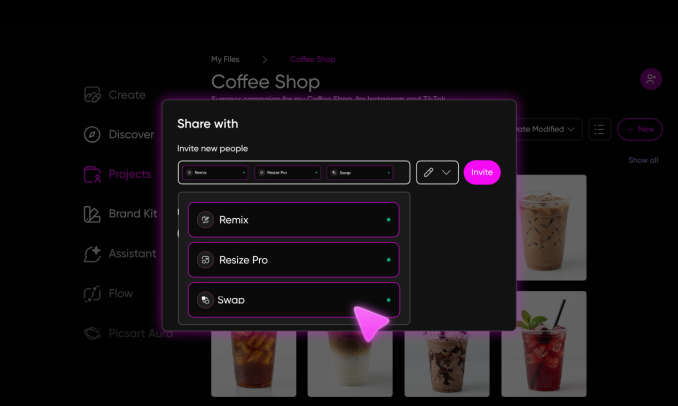
Picsart says that it will introduce more specialized agents each week, but to start, creators can work with four different agents: Flair, Resize Pro, Remix, and Swap.
Image Credits:Picsart
The Flair agent is perhaps the most sophisticated of the bunch, integrating with Shopify to act as an assistant for online store owners. The agent analyzes market trends to make recommendations for how a shop could improve, like suggesting it edit product photos to look more cohesive. In a future update, Flair will be able to run A/B tests and identify underperforming products to proactively offer recommendations for how a creator can improve their sales.
The Resize Pro agent can resize images and videos for the recommended dimensions on various different platforms, but it uses AI to generatively extend the frame if the original media isn’t conducive to a certain size. The AI supposedly will ensure that resized images look like they were composed intentionally and weren’t just cropped haphazardly.
Techcrunch event
San Francisco, CA | October 13-15, 2026
Advertisement
The Remix agent invites the creator to describe a style, like “vintage film,” “watercolor,” or “cyberpunk” and edit an existing photo library to fit within that theme, while the agent feature allows users to change the backgrounds of photos in bulk.
Image Credits:Picsart
For an agent like Flair, which is supposed to work behind the scenes asynchronously to analyze store data, it will be especially helpful that users can chat with these agents on WhatsApp or Telegram. Picsart integrates with those apps specifically since their APIs enable businesses to set up AI chatbots; but as more platforms add similar tools, the functionality could broaden.
“As agents extend to messaging apps creators already use, that conversation happens anywhere — at your desk or from the subway,” added Avoyan.
Advertisement
In some cases, AI agents can prove problematic, since any LLM-based software has the potential to hallucinate and could potentially take actions that the creator did not intend. But Picsart allows users to set “autonomy levels” for agents like Flair, which give the option of requiring creator approval before taking any action. These agents should also be less vulnerable to prompt injection attacks than more public facing agents, assuming that Picsart doesn’t roll out agents that interact more directly with customers or the internet at large.
Like many other AI tools, Picsart offers a free plan with just a few AI credits each week, but users can get significantly more capacity when paying for premium subscriptions, which start at about $10 per month when billed annually. To use an AI agent, you’ll probably need a paid plan.
Normally, a post about the signing of an NFL free agent wouldn’t make it anywhere near these here Techdirt pages. Today, that is not the case. The site For The Win posted a mildly interesting report on the Tennessee Titans signing wide receiver Wan’Dale Robinson to a 4 year, $78 million contract.
But wait, you’re wondering, where does the Techdirt part of this come in? Well, it starts with this passage from the FTW post:
Fortunately there’s wiggle room should things fail to pan out. With only $38 million guaranteed, the Titans can reasonably walk away from this deal after one or two years and start fresh.
This contract isn’t as big as it seems and could be an asset if Robinson’s 2025 was merely his first giant leap forward in a career marked by growth. As it stands, he seems like the name brand version of the Temu receivers Ward played with as a rookie. That’s a good thing, even if it’s an expensive one.
And then it morphs into this, direct from the FTW author of that post:
Advertisement
Let me stipulate a couple of items. There seems to be nothing in Temu’s reach-out that resembles a threat. They aren’t making any demands. All of the communication seems to be polite enough and I’ve seen companies behave far worse than this when their brands are associated with something negative.
That said, this is still the weakest of sauces. Reaching out to a sports reporter as a large retailer brand just because you don’t like a single throwaway joke-line in a story about a free agent signing is a demonstration of the thinnest of skins under any circumstances. It’s all the more so when the brand in question does have very real reputation problems with large swaths of the public, earned or otherwise.
It doesn’t take much in the way of Google-Fu to uncover precisely why the author of the post chose to associate Temu with knockoff quality products. The company is not BBB accredited. It has a 2 out of 5 star review on Trustpilot. There are a ton of Reddit threads just like this one with people sharing their negative experiences buying off of Temu.
I’ve never bought from Temu. But there is a great deal of smoke out there for there to not be any fire. And if Temu really thinks the best path towards correcting its reputational problems is firing off requests to remove references to those problems from articles about professional athletes, well, then I’m beginning to see the real source of the problem here.
Repairs are now off the table for the iPhone 5, closing out support for one of Apple’s most important early designs.
iPhone 5
The company updated its vintage and obsolete products list on March 16, moving the iPhone 5 and 8GB iPhone 4 out of vintage status. The iPhone 5 holds more weight due to its role as the first iPhone with a Lightning port. Apple will no longer provide hardware service or supply parts for the iPhone 5 through its retail stores or authorized repair network. Effectively, it ends the device’s usable lifespan within Apple’s ecosystem for most users. Continue Reading on AppleInsider | Discuss on our Forums
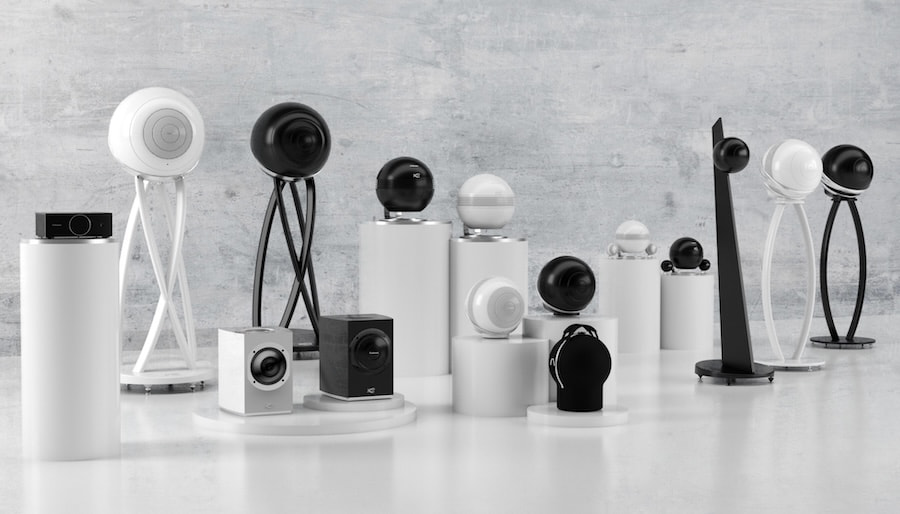
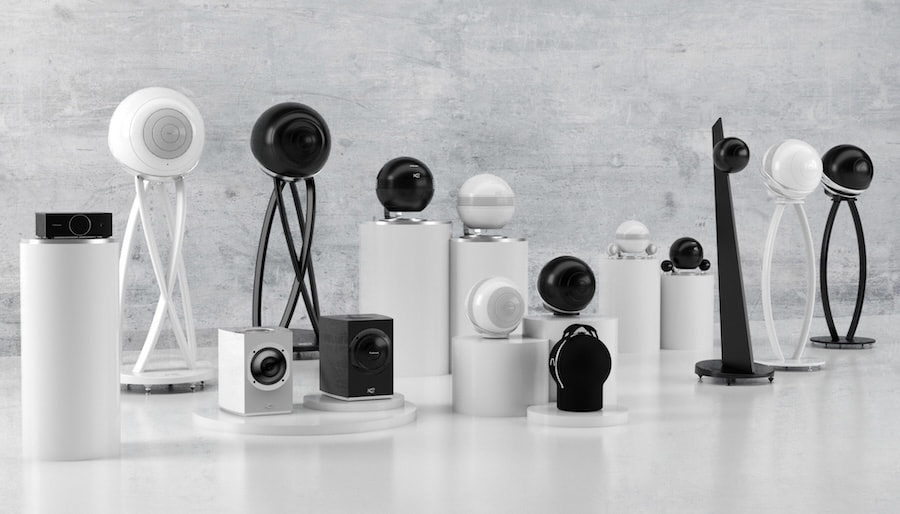
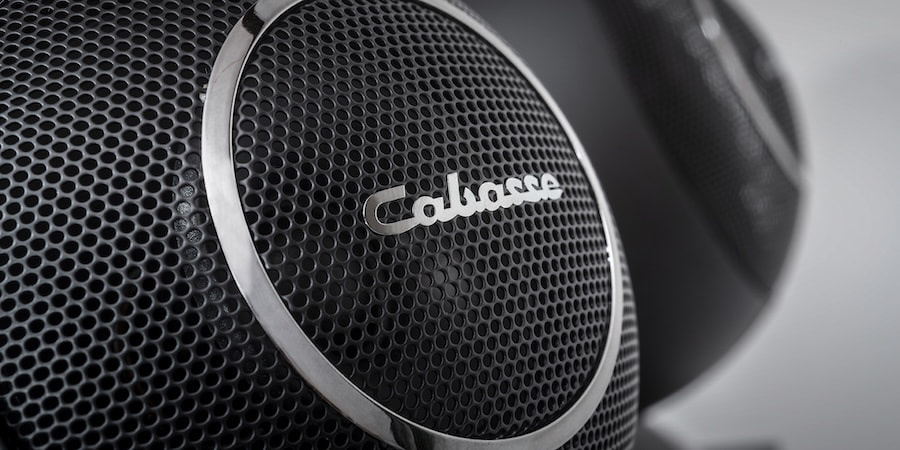
The historic French hi-fi manufacturer Cabasse has entered receivership after more than 75 years in the audio industry, raising serious questions about the future of one of Europe’s most recognizable loudspeaker brands. Known for its spherical speaker designs and deep roots in French acoustic engineering, Cabasse helped shape the sound of high-end audio for generations of listeners. Now the company faces a critical restructuring process that will determine whether the iconic brand can survive.
Cabasse is hardly the only high-end audio brand to run into financial trouble as the industry shifts beneath its feet. Over the past few years, companies such as MQA, Krell Industries, Auralic, and MBL Akustikgeräte have all faced their own versions of financial turbulence as the hi-fi market continues to evolve. To its credit, Cabasse saw some of the writing on the wall years ago and began leaning heavily into wireless and connected speaker systems, while continuing to push the distinctive spherical designs that have long set the brand apart.
But the broader reality is difficult to ignore: there are simply too many brands competing for attention, and a growing number of younger listeners are choosing headphones, earbuds, and more affordable compact bookshelf speakers over the large, traditional loudspeaker systems that once defined the high-end category.
Who Is Cabasse?
Founded in 1950 by Georges Cabasse, the French company quickly established itself as one of Europe’s most technically ambitious loudspeaker manufacturers. Cabasse’s goal from the beginning was straightforward but demanding: reproduce music as faithfully as possible without coloration or distortion. That philosophy pushed the company to invest heavily in acoustic research and eventually led to its development of coaxial driver technology, aligning multiple drivers on a single axis so sound radiates from a single point source.
Advertisement
Cabasse’s engineering work extended well beyond home hi-fi. By the early 1950s the company was already supplying sound systems to French cinemas and large venues, and over the following decades it built loudspeakers for studios, theaters, and broadcast environments while continuing to refine its consumer loudspeaker designs. Innovation remained a defining trait of the brand, with Cabasse introducing active loudspeakers as early as the late 1950s and continuing to refine its coaxial and multi-driver technologies through the 1970s, 1980s, and 1990s.
One of Cabasse’s most recognizable achievements came with the development of its SCS (Spatially Coherent System)approach to driver integration, designed to improve phase alignment and create a more realistic soundstage. That engineering philosophy ultimately led to the creation of La Sphère, one of the most visually distinctive loudspeakers in high-end audio and a product that reinforced Cabasse’s reputation for pushing the limits of loudspeaker design.
More recently, Cabasse has tried to balance its traditional hi-fi engineering with the realities of modern listening habits. Products like the Cabasse Rialto wireless bookshelf system and the Cabasse Pearl Theatre immersive home theater platform demonstrate the company’s push toward connected audio and streaming-focused systems. At the same time, statement products such as La Sphère Evo continue to showcase the company’s commitment to ambitious acoustic engineering, combining Cabasse’s quad-coaxial driver technology with modern DSP processing and extremely high power amplification.
Advertisement
After more than seven decades of loudspeaker innovation, Cabasse remains one of the most recognizable names in French hi-fi, known for its distinctive spherical designs and engineering-driven approach to sound reproduction. What happens next will determine whether that legacy continues.
Cabasse Enters Receivership
French luxury hi-fi manufacturer Cabasse has been placed into receivership by the Montpellier Commercial Court, effective March 9, 2026. The proceedings follow the company’s own filing on February 27, 2026, after it declared a cessation of payments.
As one of France’s oldest and most respected audio brands, Cabasse has reportedly been struggling with falling revenues and mounting debts. Trading of Cabasse shares on Euronext Growth Paris was suspended on February 27 and resumed on March 13, 2026.
The company was acquired by Canon Inc. in 2006. In 2014, French group AwoX acquired Cabasse from Canon for €4.5 million with a strategy focused on luxury wireless audio and returning high-end speaker production to France.
Advertisement
Advertisement. Scroll to continue reading.
AwoX, which was renamed VEOM Group in 2020, has now also filed for judicial reorganisation. VEOM Group, which also owns the Chacon and DiO home automation brands, said its financial situation deteriorated and was “exacerbated by the difficulties of its subsidiary Cabasse.”
In a statement, the company said the court-supervised process is intended to examine “solutions that could ensure the sustainability of the business, preserve jobs, and address outstanding liabilities, while also launching a search for investors through either a recovery plan or a potential divestment.”
The Bottom Line
The receivership process gives Cabasse time to stabilize operations while court administrators search for investors or potential buyers. Parent company VEOM Group, which also owns the Chacon and DiO smart-home brands, has entered judicial reorganisation as well after its financial position deteriorated alongside Cabasse’s struggles. Cabasse represented roughly 29% of VEOM’s revenue in 2025, and when internal engineering and development work are included, the brand accounted for close to half of the group’s overall activity.
Advertisement
What happens next will likely come down to one of two outcomes: new investors recapitalize the company and keep the brand operating, or Cabasse’s assets and technology are acquired by another audio or technology group.
For consumers, the immediate impact may be uncertainty around long-term support for existing products, including warranty service, replacement parts, and software updates for the company’s connected speaker systems. If new ownership emerges, Cabasse could continue developing its distinctive coaxial-driver loudspeakers and wireless platforms. If not, another historic European hi-fi brand may end up folded into a larger group as consolidation continues across the audio industry.





























































You must be logged in to post a comment Login