
Crypto World
China Control over Taiwan by 2026 Targeted, Crypto Market Recovers

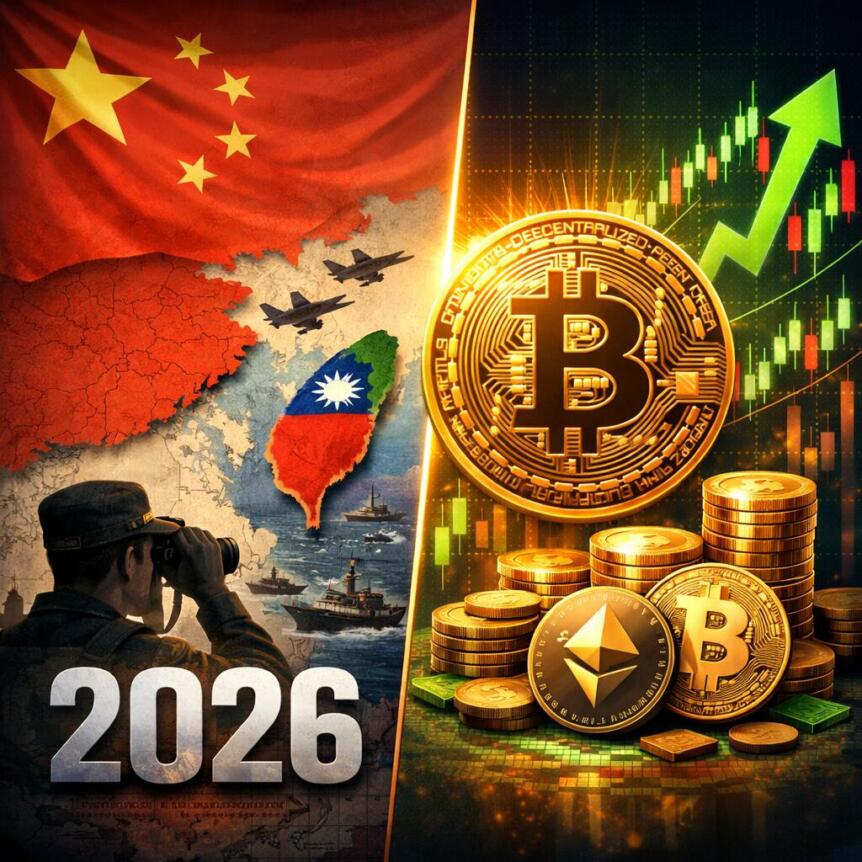
Incidents of military activities near Taiwan are on the rise
The latest news updates indicated that the Chinese army reinforcements augmented activities around Taiwan. The defense authorities of Taiwan have spotted a number of aircraft and naval ships navigating around the island in the recent days.In a case, at least twenty six aircraft of the Chinese military has flown close to the island on Saturday (as per the Taiwan defense ministry). Also, sixteen planes flew into various areas of Taiwanese Air Defense Identification Zone and seven Chinese vessels were also on the water.
The current action is also the part of the continued pressure development by Beijing which is aimed at putting pressure around Taiwan. We have also seen that the Chinese military has been carrying out patrols and exercises in the Taiwan Strait, which enables China to assert its position militarily and at the same time strengthens its self-assertion. There are also more air and naval activities that indicate that Beijing is keen on continuing its presence in the region.
Taiwan has retaliated by enhancing its defensive planning. The National Chung Shan Institute of Science and Technology confirmed fresh initiatives to come up with cost effective air defense ammunition.Lt. Gen. Lee Shih chiang clarified that the systems are meant to counter mass use of low cost weapons. The defense planners of Taiwan are of the view that this will curb the overpowering of the available missile systems.
Political Manoeuvre is a source of tension
Military activity also went along with the heightening of political tensions. Recently Taiwan President Lai Ching-te has highlighted increased defense budget and security of the democratic regime in Taiwan by the country China.Taiwan Affairs office China lamented against such comments and cautioned about any actions that may fuel tensions. Chinese authorities in Beijing mentioned that the leadership in Taiwan must not undertake any measures that enhance confrontation.
In the meantime the cryptocurrency market also began displaying recovery in spite of the geopolitical pressures. Bitcoin rose to almost seventy four thousand dollars and contributed to the general mood in the market since some digital assets appreciated as investors were lured back to risk markets following previous losses. The market players are still monitoring the political situation globally since the situation is still tense.
The geopolitical tensions worked out of Taiwan after China reinforced the timeline of reunification, which was 2026 and the military activity near the island. Taiwan has consolidated defense preparations as the international markets such as cryptocurrencies keep responding to the changing international trends.

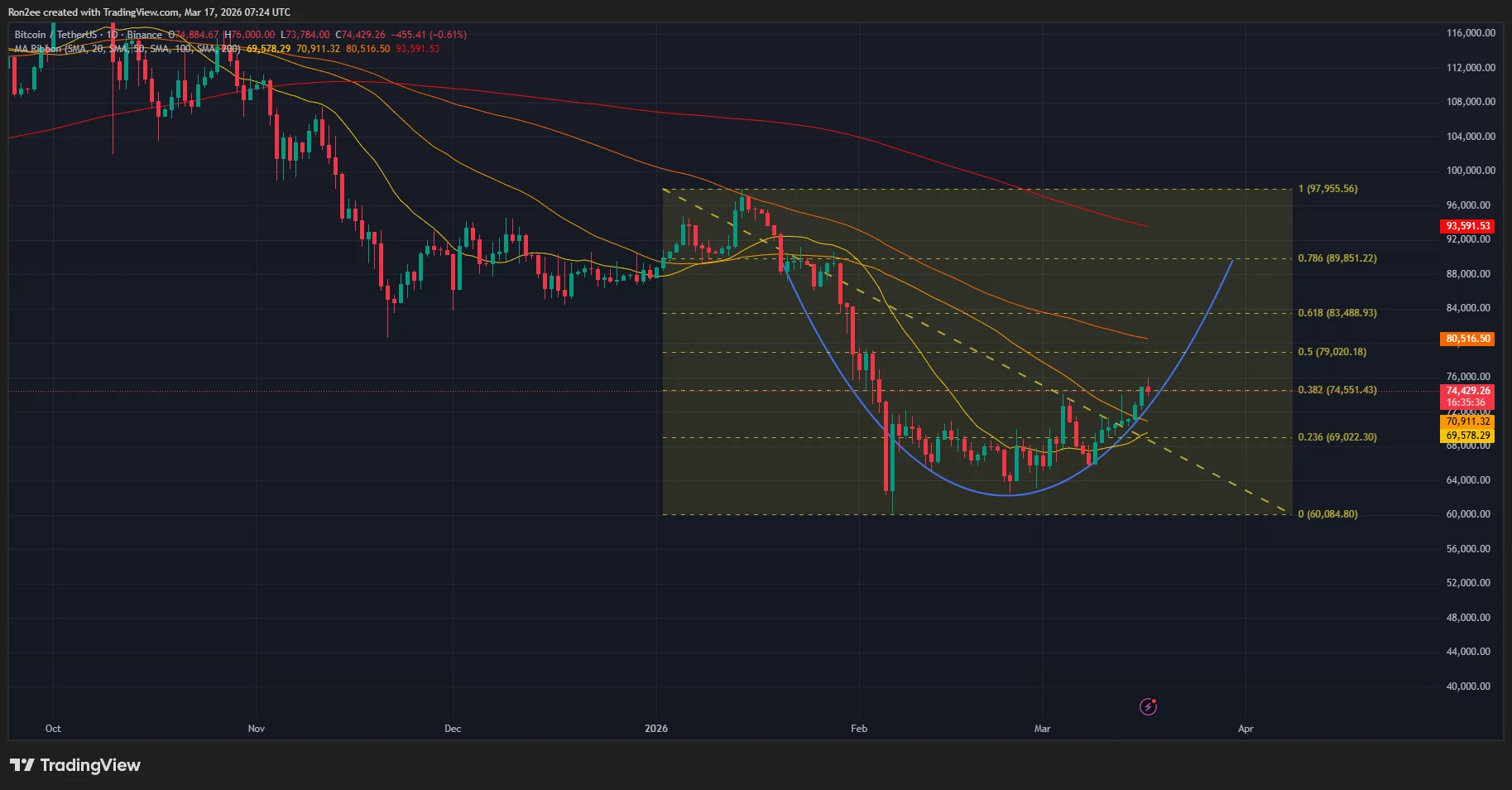
Bitcoin price briefly surged to a six-week high of $75,937 on Tuesday, as over $330 million in short positions were liquidated in the past 24 hours.
Summary
- Bitcoin price briefly surged to a six-week high as over $330 million in short positions were liquidated across the crypto derivatives market.
- Technical indicators point to strengthening momentum, with a potential rounded bottom forming while traders watch resistance near the February highs.
According to data from crypto.news, Bitcoin (BTC) price touched an intraday high of $75,937 on March 17, morning Asian time, as it broke past the $75,000 resistance for the first time since early February. The bounce past the key psychological level triggered a market-wide rally with altcoins such as MemeCore (M), FET, and Zcash (ZEC) leading gains with double-digit rallies on the day.
Bitcoin’s surge led to large-scale liquidations across leveraged crypto markets. According to data from CoinGlass, nearly $498 million was liquidated, with over $330 million coming from short positions as traders closed bearish positions opened during the early February market sell-off. Bitcoin alone specifically accounted for $118 million of those short liquidations.
Another major tailwind that supported today’s rebound is the return of consistent inflows into spot Bitcoin ETFs, signaling strong institutional demand. Data compiled by SoSoValue shows that the 12 U.S. spot Bitcoin ETFs drew in over $200 million over the past day, extending their inflow streak to 6 straight days that drew in nearly $1 billion in total.
Investors are also viewing Bitcoin as a safe-haven asset amid geopolitical tension in the Middle East, especially since traditional safe-haven assets such as gold and silver have shown relative weakness in recent days.
On the daily chart, Bitcoin price seems to be forming a rounded bottom pattern, a typical reversal pattern in technical analysis. The 20-day SMA is closing in on a bullish crossover with the 50-day SMA, a sign that short-term momentum is turning positive.
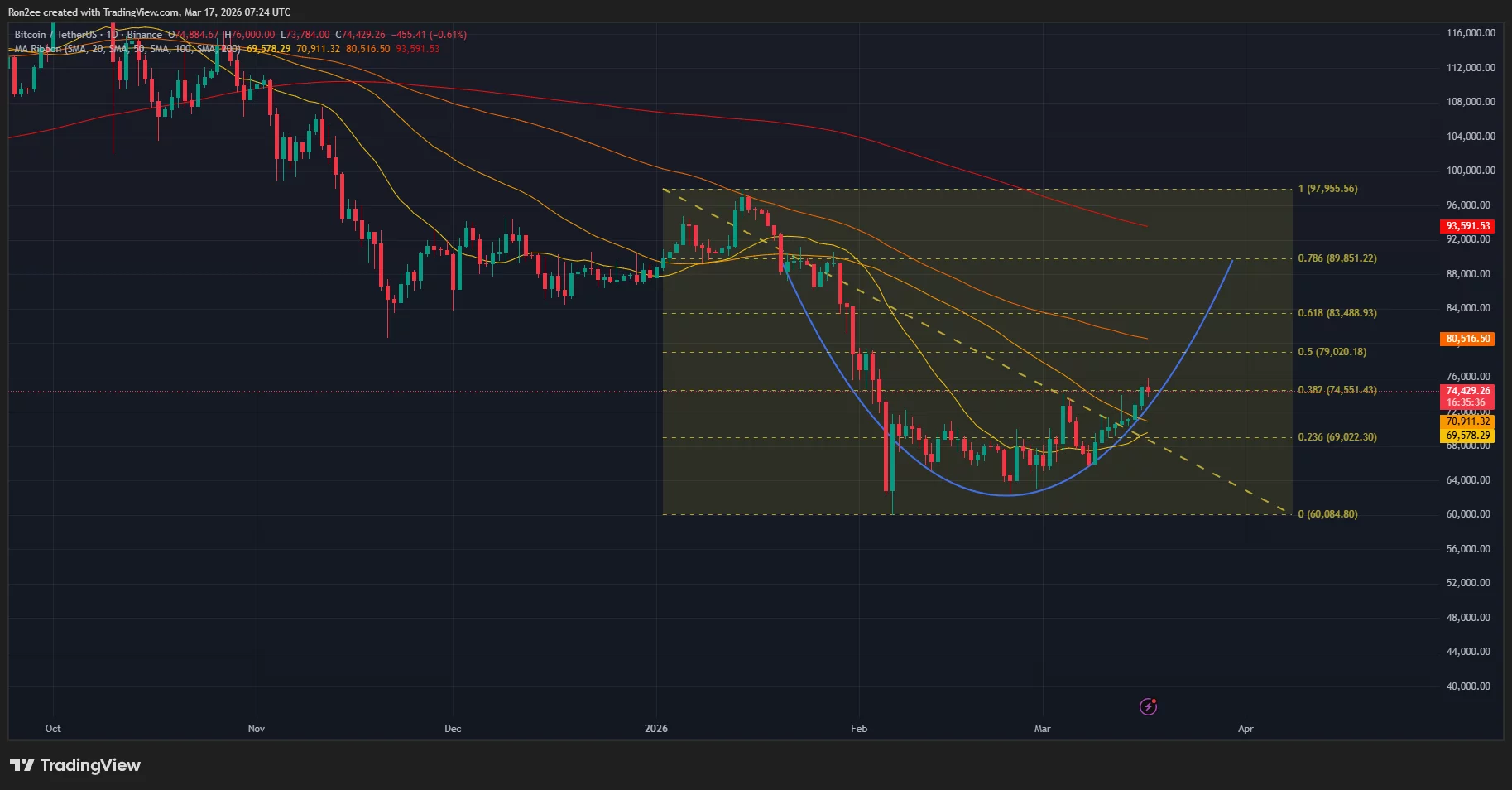
For now, the next key resistance level that traders are watching currently lies at $79,000 highs seen during February, and aligns with the 50% Fibonacci retracement level.
A sharp breakout from this level could push prices to as high as $89,850, which would be the neckline of the double bottom formed. On the contrary, failure to hold $72,000 support could lead to a retest of lower levels.
At press time, Bitcoin price was hovering around $74,000, still holding onto 6% gains over the weekly period.
Disclosure: This article does not represent investment advice. The content and materials featured on this page are for educational purposes only.


The U.S. Securities and Exchange Commission has put forward a proposal which, according to SEC commissioner Hester Peirce, could help clear up years of confusion around how a key broker-dealer rule applies across markets.
Summary
- SEC has proposed limiting Rule 15c2-11 to equity securities, reversing its broader 2021 interpretation that raised questions for crypto assets.
- A 60-day public comment period has been opened as regulators seek feedback on how the rule should apply and whether crypto falls outside its scope
On Monday, the SEC proposed an amendment to Rule 15c2-11 that would limit reporting requirements for broker-dealers in the over-the-counter market to equity securities only, effectively reversing the broader interpretation introduced in 2021.
The SEC Rule 15c2-11 was first introduced in 1971 to ensure broker-dealers maintain up-to-date issuer information before they can publish over-the-counter quotes.
By placing obligations for firms to review and maintain current information about an issuer, the rule was designed to reduce risks in thinly traded markets, particularly in penny stocks.
Without this information, a broker-dealer is not allowed to initiate or resume quotations for a security in OTC markets.
However, the rule was reinterpreted in 2021 to extend beyond equities into other asset classes, and as a result, there have been questions around whether it can apply to crypto assets if they are classified as securities.
The SEC’s proposal would limit the rule’s scope to equity securities.
As such, broker-dealers won’t be required to apply these reporting requirements to crypto assets, even in cases where questions around their classification as securities remain unresolved.
This could make it easier for broker-dealers to support crypto trading and quote digital assets without having to rely on disclosure standards that do not align with how these assets function.
A public comment period has been opened where the commission is seeking feedback on whether the definition of equity securities should extend to crypto assets and how the rule should apply going forward.
According to Commissioner Peirce, who also leads the agency’s crypto task force, the proposal could help address confusion created by the earlier interpretation.
“By its terms, the text of Rule 15c2-11 always has applied to quotations of a ‘security.’ Market participants and other observers including me, however, understood the rule to apply only to quotations of over-the-counter (‘OTC’) equity securities,”
However, it must be noted that there is still no final decision on whether “equity securities” could include crypto assets.
Peirce said she would closely watch “questions about the definition of ‘equity security,’ the rule’s application to crypto assets, and the appropriate next steps with respect to the formation of an ‘expert market.’”


Argentina has ordered a nationwide block of prediction market platform Polymarket, tightening its stance on what authorities describe as unlicensed online betting activity.
Summary
- Argentina has ordered a nationwide block of Polymarket, citing illegal gambling concerns and risks tied to crypto payments and lack of identity checks.
- Regulators have directed ENACOM to enforce the ban and asked Google and Apple to remove the app following complaints from local gaming bodies.
According to local media, a Buenos Aires court has directed regulators to move forward with enforcement after concluding that the platform operated outside the country’s legal gambling framework.
Authorities highlighted consumer protection risks among others, including the use of crypto payments, credit card deposits, and the absence of robust age or identity verification checks that could allow minors to participate.
There are also broader regulatory concerns behind this decision, tied to how prediction markets blur the line between financial speculation and gambling.
Authorities raised concerns about Polymarket’s handling of Argentina’s February inflation rate of 2.9% before the official release. Reports say the platform reportedly reversed its prediction just 15 minutes before the data was published, which authorities found suspicious.
The authorities concluded that the platform functioned as an online betting system rather than a neutral prediction market.
Subsequently, authorities asked the telecom regulator ENACOM to coordinate with internet service providers to enforce the block. Meanwhile, Google and Apple have been ordered to remove the platform’s apps, limiting access for local users.
The latest order also follows multiple complaints from entities such as the Buenos Aires City Lottery and the Argentine Chamber of Casinos and Bingos, which pushed for action against the platform.
Argentina now joins a long list of countries, notably across Europe and Latin America, that have taken action against the platform.
Last year, Colombia and Romania banned the platform, classifying it as unauthorized gambling activity within their jurisdictions.
Similar concerns have been raised across several states in the U.S., where regulators are examining whether event-based contracts offered by platforms like Polymarket fall under existing gambling or derivatives laws.
Separately, Polymarket is also facing scrutiny over its handling of markets tied to sensitive events, including contracts linked to death and violent outcomes, which have drawn criticism from lawmakers and prompted fresh legislative efforts.
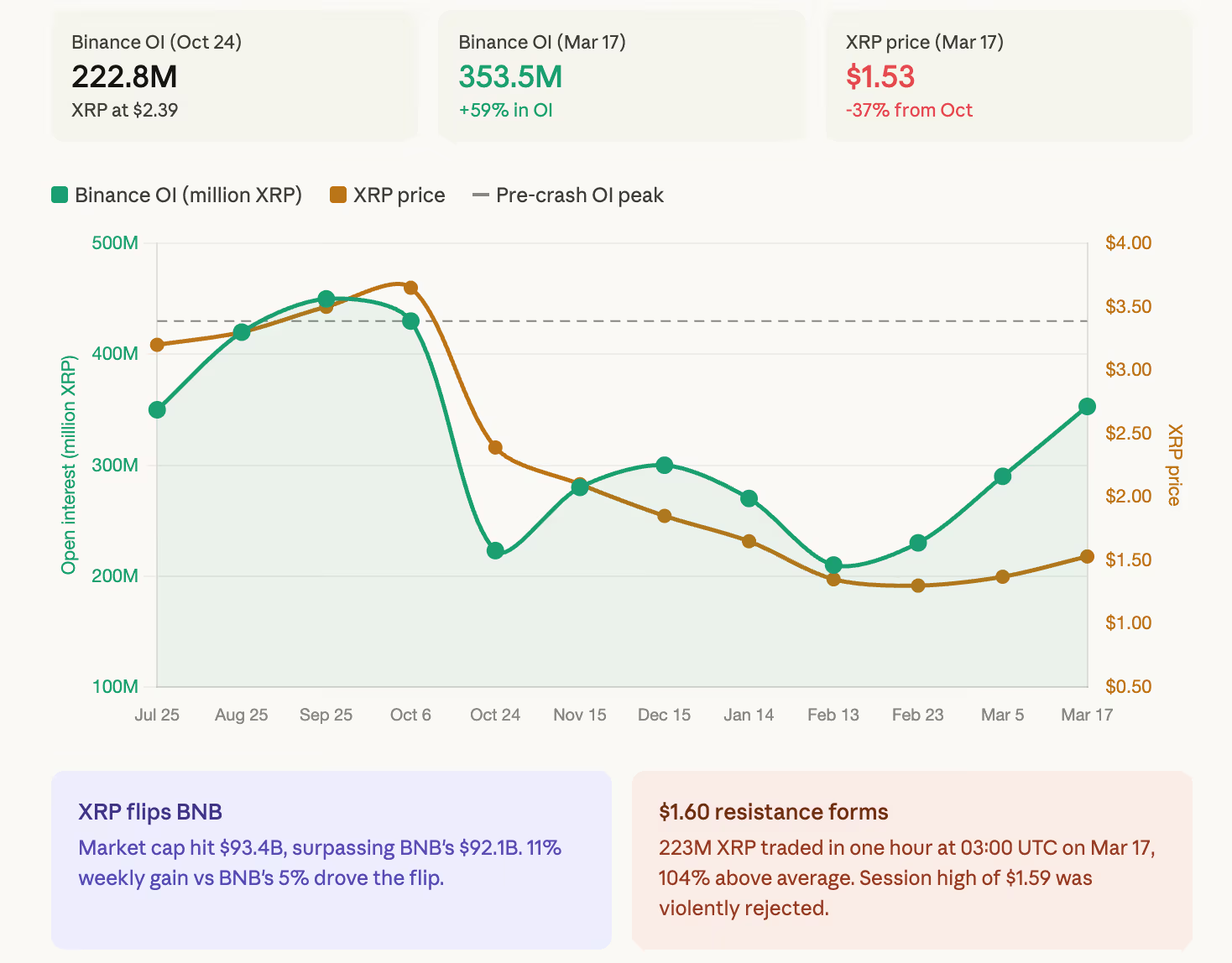
XRP just reclaimed a ranking it hasn’t held in weeks, and the derivatives market suggests traders are positioning for more.
The token surged to $1.53 on Tuesday, up 11% on the week, overtaking BNB to become the fourth-largest cryptocurrency by market cap at $93.4 billion. The move broke through $1.40 resistance, per CoinDesk analytics, with trading volume exploding 125% to $3.22 billion.
Coinglass data shows XRP open interest on Binance has climbed to 353.49 million XRP as of March 17, up from 222.79 million on Oct. 24, 2025, when XRP was trading at $2.39. That’s a 59% increase in open interest while the price is 37% lower. New leveraged positions are building into the recovery rather than unwinding, which is a fundamentally different setup from the deleveraging that dominated January and February.
The Binance OI chart shows the full arc. Open interest peaked above 400 million XRP in September 2025, collapsed during the October crash that took the price from $3.65 to below $2, and spent the next four months slowly rebuilding.

The current 353 million is approaching but hasn’t yet matched those pre-crash levels, which means the market has room to add leverage before hitting the concentration that preceded the last wipeout.
Traders will likely now monitor whether the $1.50-$1.60 zone holds or becomes another failed breakout in a token that has been full of them since October. Open interest building into the move gives it more structural support than previous attempts, but XRP approaching pre-crash leverage levels at 58% below the pre-crash price is a setup that works until it doesn’t.
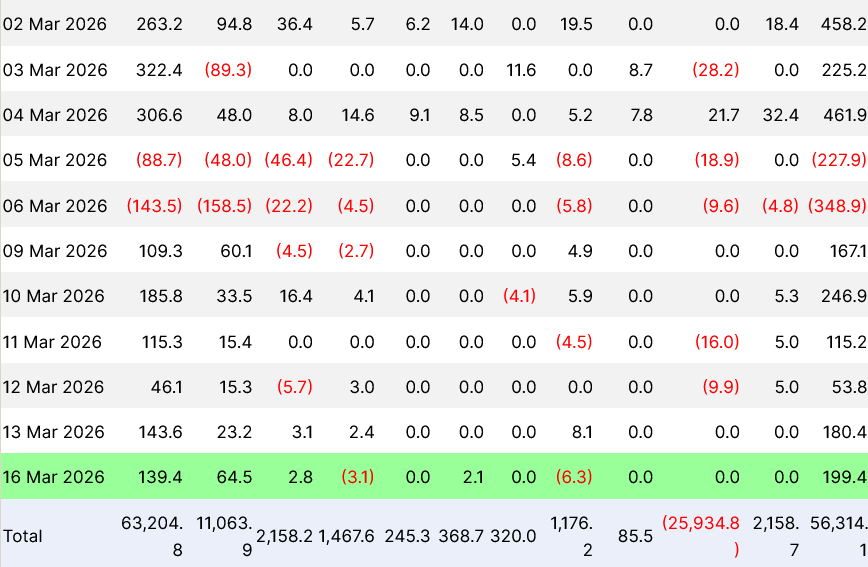
US-based spot Bitcoin exchange-traded funds recorded their sixth day of inflows on Monday as Bitcoin rose over 12% over the period, marking the longest streak of fresh capital into the ETFs since October last year.
Data from Farside Investors shows Bitcoin ETFs raked in $199.4 million of net inflows on Monday. BlackRock’s iShares Bitcoin Trust (IBIT) and the Fidelity Wise Origin Bitcoin Fund led with $139.4 million and $64.5 million in inflows, respectively.
The Bitwise Bitcoin ETF and Franklin Bitcoin ETF tallied inflows of $2.8 million and $2.1 million, while the VanEck Bitcoin ETF and ARK 21Shares Bitcoin ETF saw outflows of $6.3 million and $3.1 million, respectively.
This brings the total net inflows since March 9 to $962.8 million, coinciding with Bitcoin (BTC) rising 12.5% from $65,960 to $74,250 over the period.
The inflow streak follows a much larger nine-day run between September and October 2025, which saw Bitcoin products tally nearly $6 billion worth of inflows.
Bitcoin was significantly higher at the time, hitting an all-time high of $126,080 during that stretch.

The recent rise in Bitcoin ETF inflows and the cryptocurrency’s spot price comes amid ongoing uncertainty between the US and Iran and volatility in the oil markets.
Rumors of progress have helped Bitcoin
However, blockchain analytics platform Santiment said rumors swirling about progress being made by the US, Iran and Israel have been a contributing factor to Bitcoin soaring above the $74,400 mark for the first time in six weeks.
“This bullish momentum has been enough to push FOMO to its highest level since January 2nd,” Santiment noted.
Related: Crypto Biz: Circle stock defies Wall Street and digital asset selloff
“In spite of global uncertainty at the moment, traders are once again seeing crypto as a sector with rise potential in the coming weeks and months.”

The Crypto Fear & Greed Index score, a measure of Bitcoin and crypto market sentiment, also increased five points to 28 on Tuesday — escaping the “Extreme Fear” zone for the first time since late January.
Magazine: Bitcoin’s ‘narrative vacuum,’ Ethereum now inevitable: Trade Secrets

Blockchain data provider Messari has announced a series of layoffs on Monday as its CEO, Eric Turner, stepped down to make way for the company’s “next phase” as an AI-first company.
“Today, I stepped down as CEO of Messari and handed the reins to Diran,” Turner said on X on Monday, referring to Diran Li, who ascended after serving as chief technology officer of the company for more than seven years.
He added that it “wasn’t an easy decision, but it’s the right one for the company’s next phase, and he has my full support.”
Turner took over as interim CEO in July 2024 following founder Ryan Selkis’ resignation. Speaking about the staff cuts, Turner said it was a “difficult day for the team as we say goodbye to many people who helped build Messari.”
There were no details on the number of staff cuts. Messari laid off roughly 15% of its full-time staff in January 2025 and made a similar workforce reduction in February 2023.

Messari pivots to an AI-first company
In a separate post, Diran Li announced that he was stepping into the CEO role at Messari.
“After conversations with Eric and the board, we agreed this is the right step for the company’s next chapter,” he said.
Li confirmed the cuts, stating that the transition also includes a difficult decision: “We’ve parted ways with many teammates who helped build Messari into what it is today.”
“Looking ahead, we’re doubling down on Messari as an AI-first company serving institutions through research and AI products.”
Messari began as a pure crypto research and data company in 2018, and gradually started incorporating AI into its products in 2024.
Related: AI data center gold rush sparks debate over impact on Bitcoin mining
Blockchain intelligence for agentic AI
Last week, Li announced that Messari was opening its data layer to autonomous agents, adopting the x402 protocol to “bring our institutional-grade crypto intelligence to every builder and agent on the internet.”
The move will allow developers and AI agents to autonomously source and pay for data from the blockchain intelligence company using crypto wallets.
Messari is the latest crypto native company to expand from the industry to AI, following in the recent footsteps of Core Scientific, Cipher Mining, MARA Holdings, Hut 8, and Galaxy Digital.
Magazine: Metaplanet’s Japan Bitcoin bet, Bithumb ordered suspension: Asia Express


NFT marketplace OpenSea has decided to delay the launch of its native token, SEA.
Summary
- OpenSea delays SEA token launch, with CEO Devin Finzer citing challenging market conditions and no revised timeline announced.
- Waves reward campaign set to conclude as SEA allocation plans are adjusted.
Announcing the update on X, OpenSea CEO Devin Finzer cited “challenging market conditions” as the primary reason behind the decision.
The SEA token was first introduced in February 2025 and was subsequently set to be released around March 30 as part of its broader rollout plans.
SEA is expected to form the core of OpenSea’s long-term push to build a “trade everything” app, a multi-chain platform that would support token trading, NFTs, and features such as perpetual futures.
As previously reported by crypto.news, the native token would function as both a utility and governance asset, offering discounted trading fees, staking tied to NFT collections, and community participation in platform decisions.
However, the platform is now delaying the rollout amid weak market conditions that have continued to weigh on NFT activity.
For instance, since the start of the year, data from CryptoSlam shows that total NFT market capitalization has dropped by more than 50%, falling from around $3.2 billion in mid January to roughly $1.62 billion.
Further, marketplaces like OpenSea have also seen a sharp decline in activity, with monthly NFT trading volumes now consistently below $500 million, far below levels recorded during the 2021 to 2022 cycle.
Finzer said the team wants to ensure that “every piece is in place” before moving ahead, but did not provide a new timeline for the token launch.
Meanwhile, he also clarified details around its ongoing “Waves” reward program, which has been running since October to determine SEA token allocation for users.
With the launch now delayed, OpenSea is giving users who participated in Waves 3 to 6 the option to claim refunds on platform fees collected during that period, if they agree to forfeit their Treasure Chest rewards. Treasures are point-based rewards that users can use to unlock incentives and prizes within the platform.
“While we’re postponing our March 30 event, we’ll host a separate one in the coming months focused on product updates. It’s been incredible to see the early responses to our mobile app, and we can’t wait to get it into more people’s hands,” he added.

The US Securities and Exchange Commission is moving to reduce years of ambiguity around a broker-dealer reporting rule that had limited which assets could be quoted on the over-the-counter (OTC) market. Rule 15c2-11, originally adopted in 1971 to curb penny-stock fraud, requires broker-dealers to keep current public information about a listed issuer before publishing quotes. In 2021, the rule was reinterpreted to also cover fixed-income securities, a shift that drew backlash from market participants and raised questions about crypto securities. In a Monday statement, the SEC proposed an amendment to limit the rule’s scope to equity securities, effectively reversing the 2021 interpretation. The move arrives amid a broader regulatory push to clarify how crypto assets fit within traditional market structures.
Hester Peirce, a commissioner who leads the SEC’s crypto task force, welcomed the proposal and argued that the commission had created years of uncertainty through a 2020 amendment and its 2021 application. She noted that, by the letter of Rule 15c2-11, the rule has always applied to quotations of a “security,” but market participants and observers understood it to cover only OTC equity securities. The commissioner stressed that long-term relief should have been granted while the agency assessed whether extending the rule to fixed income was appropriate and amended the rule as needed. Instead, she said, the commission issued several rounds of limited relief—often lasting only a few months—fostering ongoing uncertainty in the market.”
Key takeaways
- The SEC proposes narrowing Rule 15c2-11’s reporting obligations to equity securities on OTC markets, reversing the 2021 interpretation that extended it to fixed-income assets.
- The agency has opened a 60-day public comment period to gather feedback on how “equity securities” should be defined and whether crypto assets might fall under that category.
- The proposal highlights the commission’s intent to reduce regulatory ambiguity that has affected market participants and product development, including crypto-related offerings.
- Regulators including the SEC and CFTC have been signaling a broader drive to align crypto oversight with traditional markets, as evidenced by recent coordination efforts.
- The discussion includes questions about the potential creation of an “expert market” and how crypto assets could be treated within that framework.
Tickers mentioned: $BTC, $ETH, $COIN
Market context: The proposal comes amid a broader US regulatory push to bring crypto markets into clearer regulatory alignment. By seeking public input on whether crypto assets might be treated under the equity-security framework, the SEC signals a path toward greater certainty—while leaving open how crypto securities would be defined within an updated interpretation of “security.” The move follows a recent memorandum between the SEC and the CFTC aimed at coordinating oversight of financial markets, including crypto, with the aim of reducing regulatory turf wars between the agencies.
Why it matters
The SEC’s proposal addresses a longstanding friction point for market participants that rely on OTC quotes. By narrowing the scope to equity securities, the agency signals that the reporting requirements may not automatically extend to other asset classes, including crypto-related instruments, unless they are clearly defined as securities under existing frameworks. This could reduce the compliance burden for issuers and broker-dealers dealing in non-equity assets on the OTC platform, while also sharpening the framework for evaluating crypto offerings that may seek to register or quote under traditional market channels.
The move also reflects a broader regulatory stance under the current administration to bring crypto markets under clearer governance. A 60-day public-comment period will let industry participants, exchanges, and other stakeholders weigh in on how to interpret “equity security” and whether crypto assets could be included in that category. As the sector continues to evolve with tokenized assets and new fundraising structures, the SEC is signaling that it intends to refine statutory boundaries rather than rely on ad hoc relief measures that can create market fragmentation.
Beyond the technical interpretation of Rule 15c2-11, the development sits within a larger regulatory dialogue. The SEC and the CFTC have moved toward coordination to supervise financial markets more coherently, including crypto activities. This alignment could shape how future disclosures, investor protections, and market access rules are applied to a wide range of digital-asset offerings, potentially smoothing pathways for compliant token projects or raising the bar for those that fall outside established securities laws.
What to watch next
- 60-day public comment window: Stakeholders should monitor the closing date for formal feedback and any subsequent agency responses or revisions to the proposal.
- Definition of equity security: Watch for clarifications on what constitutes an equity security and how that definition could encompass or exclude crypto assets.
- Crypto asset applicability: Assess whether the SEC will provide further guidance on crypto securities and the criteria for including crypto assets within the scope of Rule 15c2-11.
- Regulatory coordination: Look for developments in the SEC–CFTC coordinated framework and any new guidance on how the two agencies will supervise crypto markets together.
Sources & verification
- SEC press release: Proposes amendments to Exchange Act Rule 15c2-11 (https://www.sec.gov/newsroom/press-releases/2026-28-sec-proposes-amendments-exchange-act-rule-15c2-11)
- SEC speech by Commissioner Hester Peirce on Rule 15c2-11 (https://www.sec.gov/newsroom/speeches-statements/peirce-nal-rule-15c2-11-2021-09-24)
- SEC and CFTC coordination memorandum concerning regulatory oversight of financial markets, including crypto (https://cointelegraph.com/news/sec-cftc-sign-memo-regulate-markets-harmony)
Regulatory update on OTC quotes and crypto implications
The proposed amendment to Rule 15c2-11 represents a recalibration of how the SEC views the intersection of OTC quotation practices and the evolving crypto landscape. While the agency has not irrevocably defined crypto assets as equity securities, the public-comment process will illuminate whether and how the current rule could be extended or adapted to cover crypto instruments that exhibit ownership rights or other features typically associated with securities. In the meantime, market participants should prepare for a potential shift in disclosure requirements for OTC quotations, particularly as new crypto-native products and token offerings seek broader access to traditional market venues.
Related: SEC-CFTC coordination on crypto markets
What the proposal changes for market participants
For broker-dealers and issuers involved in OTC quotations, the narrowing focus to equity securities could ease compliance burdens for non-equity instruments, as long as those assets fall outside the defined scope of “equity security.” However, the public-comment period also invites scrutiny of whether the definition is sufficiently robust to address crypto assets that exhibit security-like characteristics. The commission’s emphasis on a precise, demonstrable ownership or equity-like interest could shape how new crypto projects consider their disclosure strategies before pursuing otc quotation or listing arrangements.
The dialogue underscores a deeper aim: to balance investor protection with market accessibility. By refining when and how assets can be quoted on OTC platforms, regulators aim to reduce unnecessary friction while maintaining transparent information flows that help investors make informed decisions. In the longer term, this could influence token issuers’ strategies for capital formation, exchanges’ quotation policies, and the overall risk profile of OTC markets that have historically served as a bridge between private offerings and public markets.
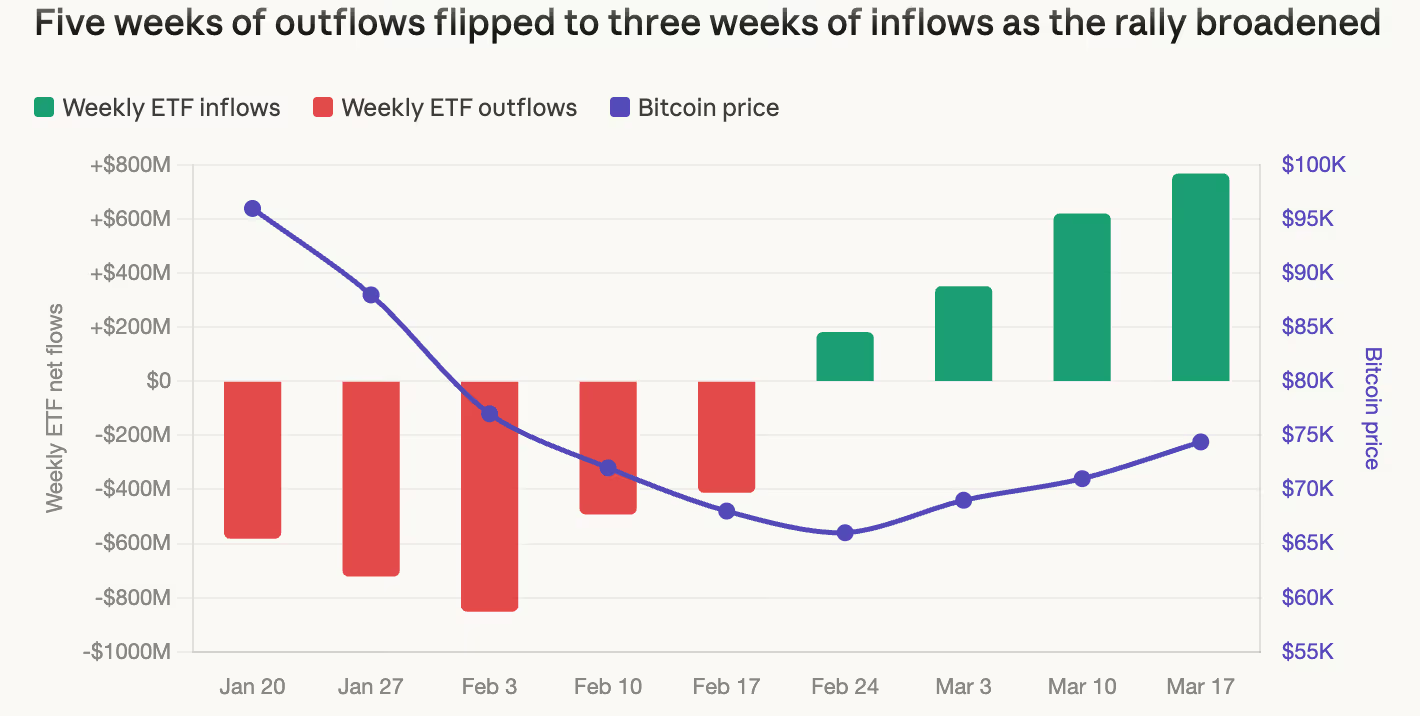
Bitcoin briefly touched $75,912 early Tuesday before pulling back to $74,372, but the intraday volatility is less interesting than the weekly picture beneath it.
CoinDesk reported earlier Tuesday that the push above $75,000 was driven by derivatives activity rather than fresh buying, specifically the closure of large $60,000 put positions that forced market makers to buy spot bitcoin as they rebalanced.
The rapid pullback below $74,400, a former support level from April 2025, confirmed that traders aren’t willing to chase above that level without a fundamental catalyst.
Every major token is up at least 5% over seven days. Ether climbed 13.3% to $2,316. xrp rose 11% to $1.53, olana gained 9.7% to $93.92. Dogecoin added 9.5% to $0.10, back above a dime. BNB rose 5% to $676. This is the broadest sustained rally since before the Iran war began, and it’s happening heading into the most consequential Fed meeting in months.
But the institutional flow data underneath the rally is real and getting harder to dismiss. CF Benchmarks analyst Mark Pilipczuk noted in an email that spot bitcoin ETFs drew roughly $767 million in net inflows last week, the third consecutive week of positive flows and a sharp reversal from the five-week, $3 billion-plus outflow streak earlier in the year.

The gold convergence trade is another signal worth watching. Year-to-date through mid-March, GLD returned roughly 16% while IBIT lost approximately 19%. But that gap has narrowed sharply, with bitcoin outperforming gold by 13.2% since early March. The 90-day correlation between the two shifted from -0.27 to +0.29 over six months. The “digital gold” narrative that looked dead in February is getting oxygen again.
The Fed meeting that begins today and concludes Wednesday is the pivot point. CME FedWatch still prices a 95%+ probability of a hold at 3.5% to 3.75%, so the decision itself is a non-event.
What matters is the dot plot and Powell’s press conference. Oil above $100 makes the stagflation case unavoidable, but the labor market is weakening, with February’s 92,000 job loss still fresh. The Fed is caught between two mandates pulling in opposite directions, and how Powell articulates that tension on Wednesday could set the direction for risk assets through the end of March.
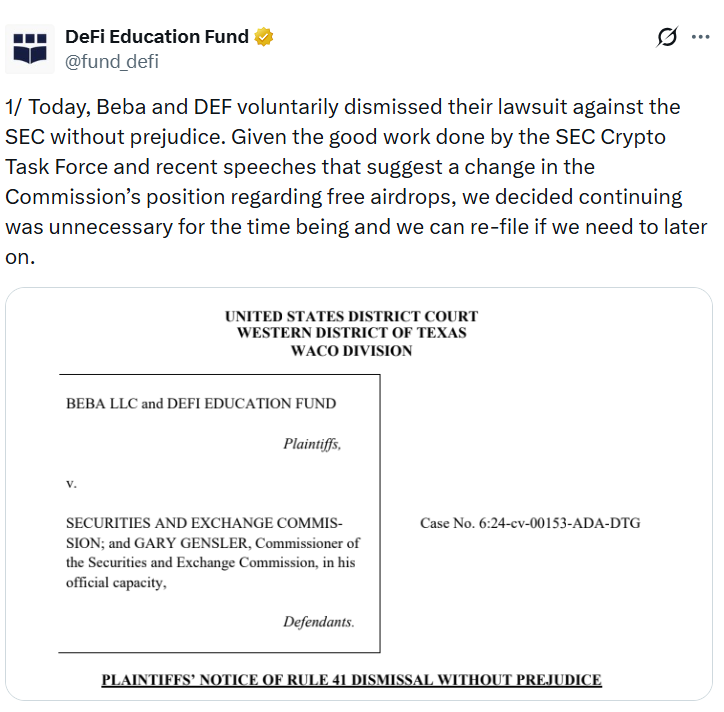
Texas-based apparel company Beba and crypto lobby group DeFi Education Fund have withdrawn a 2024 lawsuit against the US Securities and Exchange Commission (SEC) over its approach to airdrops, citing a recent shift in the regulator’s approach to crypto.
Beba launched a free token airdrop in March 2024 and, together with the DeFi Education Fund, filed a pre-enforcement challenge against the SEC that year.
The lawsuit alleged the regulator had adopted its digital asset enforcement policy without a formal notice-and-comment rulemaking process, in violation of the Administrative Procedure Act.
The voluntary dismissal, filed in the US District Court for the Western District of Texas on Friday, cites the SEC Crypto Task Force’s work and statements by Commissioner Hester Peirce in several speeches last year suggesting airdropped tokens are not securities.
The filing also flags Peirce’s suggestion in May that the SEC is considering an exemption framework for airdrops, and a White House executive action from January encouraging the regulator to establish a “safe harbor for certain airdrops.”
“Given the good work done by the SEC Crypto Task Force and recent speeches that suggest a change in the Commission’s position regarding free airdrops, we decided continuing was unnecessary for the time being and we can re-file if we need to later on,” the DeFi Education Fund said in an X post on Friday.
“The DEF team expects that the SEC Crypto Task Force will address airdrops soon—the foundational issue at hand in this lawsuit,” it added.

Case dismissed without prejudice, for now
The dismissal was filed without prejudice, preserving Beba’s and the DeFi Education Fund’s right to refile if needed.
“Should the expected guidance fail to materialize or be insufficient, Plaintiffs preserve their right to refile their claims,” lawyers acting for the pair wrote in the court document.
SEC’s evolving stance on crypto
Under former SEC Chair Gary Gensler, the agency drew heavy criticism from the crypto industry for allegedly crafting policy through enforcement actions and legal settlements rather than formal rulemaking.
Related: SEC seeks comment on crypto handling in OTC broker-dealer rule
Since Gensler resigned on Jan. 20 2025, crypto proponents have seen a regulatory shift by the SEC, including the dismissal of several long-running enforcement actions against crypto firms.
In a recent case, the SEC dropped a two-year lawsuit against Nader Al-Naji, founder of the blockchain-based social media platform BitClout, for allegedly raising more than $257 million by selling the native token of the BitClout platform and spending more than $7 million on personal items.
Magazine: SEC’s U-turn on crypto leaves key questions unanswered

Wendi McLendon-Covey Missed Oscars Bridesmaids Reunion After ‘Neck Lift’ Surgery

Tactical Bond Exposure For Income-Focused Investors: Why Bonds Matter With Rate Volatility

Bitcoin price hits six-week high driven by short liquidations and ETF inflows


-
 Tech6 days ago
A 1,300-Pound NASA Spacecraft To Re-Enter Earth’s Atmosphere
-
 Crypto World3 days ago
HYPE Token Enters Net Deflation as HyperCore Buybacks Outpace Staking Rewards
-

 Business7 days ago
ExxonMobil seeks to move corporate registration from New Jersey to Texas
-

 Fashion4 days ago
Weekend Open Thread: Addict Lip Glow
-

 Tech7 days ago
ChatGPT will now generate interactive visuals to help you with math and science concepts
-
Sports3 days ago
Why Duke and Michigan Are Dead Even Entering Selection Sunday
-

 NewsBeat6 days ago
Residents reaction as Shildon murder probe enters second day
-

 Business2 days ago
Search for Savannah Guthrie’s Mother Enters Seventh Week with No Arrests
-

 Business6 days ago
Search Enters Sixth Week With New Leads in Tucson Abduction Case
-

 Business3 days ago
US Airports Launch Donation Drives for Unpaid TSA Workers as Partial Government Shutdown Enters Fifth Week
-
Crypto World3 days ago
Coinbase and Bybit in Investment Talks: Could Bybit Finally Enter the US Crypto Market?
-

 NewsBeat6 days ago
I Entered The Manosphere. Nothing Could Prepare Me For What I Found.
-

 Sports6 days ago
PWHL, Senators discussing plan to keep Charge in Ottawa
-

 Business3 days ago
Country star Brantley Gilbert enters growing non-alcoholic beer market
-

 Business21 hours ago
Australian shares drop as Iran war enters third week
-

 Sports4 days ago
College Basketball Best Bets: Conference Tournament Semifinal Picks
-

 Crypto World21 hours ago
Crypto Lender BlockFills Enters Chapter 11 with Up to $500M in Liabilities
-

 Crypto World7 days ago
Will Chainlink price reclaim $10 amid volatility squeeze?
-

 Politics6 days ago
Trump Says Middle East Is ‘Very Lucky’ That He’s President
-

 Tech6 days ago
Clarity as strategy


You must be logged in to post a comment Login