
Crypto World
HIVE expands BUZZ HPC in Canada with 4x AI data center capacity in BC


Editor’s note: HIVE’s BUZZ HPC is expanding its liquid-cooled AI data center footprint in Canada, lifting capacity from 4 MW in Manitoba to 16.6 MW across two provinces. A new British Columbia facility adds 5 MW immediately, with an option for 7.6 MW in 2027. The expansion enables a near-term ramp to over 4,000 GPUs and strengthens BUZZ’s sovereign AI compute strategy, supported by Bell Canada AI Fabric. Notably, deposits already securing the growth pipeline mean no additional capital expenditures are required to secure this capacity.
Key points
- 4x expansion to 16.6 MW of liquid-cooled AI data center capacity across Manitoba and British Columbia.
- British Columbia Phase 1 adds 5 MW immediately, with a Phase 2 option for 7.6 MW in 2027.
- Near-term ramp to over 4,000 GPUs in Canada, with ~2,000 GPUs in Manitoba and ~2,000 in BC.
- No additional capital expenditures required to secure expanded capacity; deposits with the partner secure the growth pipeline.
Why this matters
HIVE’s expansion aligns with its strategy to deliver scalable, renewable-powered AI compute through BUZZ HPC. Extending to British Columbia and enlarging Manitoba broadens Canada’s sovereign compute footprint, enabling faster GPU deployments for AI workloads and enterprise customers. The move strengthens a disciplined, capex-light growth model that leverages existing partnerships while pursuing high-margin, recurring GPU revenue. By accelerating the company’s GPU cloud trajectory, the expansion underscores HIVE’s strategy to position Canada as a hub for AI infrastructure and innovation.
What to watch next
- Timeline for Phase 2 BC expansion (7.6 MW) in 2027.
- Updates on GPU procurement and cloud revenue contracts for BUZZ HPC in Canada.
- Progress toward 6,000 GPUs in Canada and HPC ARR targets by March 31, 2027.
Disclosure: The content below is a press release provided by the company/PR representative. It is published for informational purposes.
HIVE’s BUZZ HPC Expands Data Center Footprint into British Columbia with 4 Times Growth in Liquid-Cooled AI Data Center Capacity
This news release constitutes a “designated news release” for the purposes of the Company’s prospectus supplement dated November 25, 2025 to its short form base shelf prospectus dated October 31, 2025.
San Antonio, Texas, March 16, 2026 — HIVE Digital Technologies Ltd. (TSX.V: HIVE) (Nasdaq: HIVE) (FSE: YO0) (BVC: HIVECO) (the “Company” or “HIVE”), a global leader in sustainable digital infrastructure and AI compute, through its wholly owned subsidiary BUZZ High Performance Computing (“BUZZ”), today announced a 4x expansion of its liquid-cooled AI data center capacity through its previously announced strategic data center partner in Canada, growing the existing 4 megawatts (“MW”) in Manitoba to 16.6 MW of critical IT load across two Canadian provinces (all figures referenced herein are in critical IT load), expanding HIVE’s BUZZ HPC Sovereign AI Compute offering in Canada (all amounts in US dollars, unless otherwise indicated).
The expansion adds a new colocation facility in British Columbia, providing an immediate 5 MW of capacity with an option to scale an additional 7.6 MW. This new immediate capacity facilitates the deployment of upwards of 2,000 next-generation high-power density AI-optimized GPUs in British Columbia, complementing the capacity for approximately 2,000 GPUs in BUZZ’s existing Manitoba facility. In total, the Company now has a near-term ramp to over 4,000 GPUs in Canada through its data center partnerships and its own sites, accelerating the Company’s previously announced GPU AI cloud deployment targets for calendar 2026.
4 Times Growth in Sovereign AI Data Center Runway Across Canada
The Company’s AI colocation footprint with Bell Canada AI Fabric, its strategic data center partner, now spans two provinces in Western Canada:
- Manitoba: 4 MW of critical IT load. BUZZ has deployed 504 next-generation AI-optimized GPUs consuming approximately 1 MW, with 3 MW of remaining capacity to support approximately 1,500 additional GPUs.
- British Columbia (Phase 1): 5 MW of critical IT load, available immediately. This capacity supports the deployment of approximately 2,000 next-generation, high-power-density, AI-optimized GPUs.
- British Columbia (Phase 2): Option for an additional 7.6 MW of critical IT load in 2027, supporting an additional 3,000 next-generation high-power density AI-optimized GPUs.
In aggregate, the Company now has a growth path to over 6,000 new GPU deployments in Canada through this strategic data center partnership with Bell Canada AI Fabric, providing the infrastructure runway for its GPU cloud revenue objectives.
Importantly, no additional capital expenditures are required to secure this expanded colocation capacity. Deposits made by the Company in 2025 with the strategic data center partner are sufficient to secure the full growth pipeline. Standard operational costs associated with GPU procurement, installation, and ongoing data center operations remain separate and are expected as part of normal business activities.
Accelerating AI Cloud Growth
The Company previously disclosed a target of achieving new deployments of 6,000 latest generation GPUs for AI cloud. This colocation expansion provides the infrastructure required to achieve that target on an accelerated basis. 4,000 next-generation AI-optimized GPUs are targeted for contracted revenue in the next 6 months (including 2,000 high-power density GPUs in BC). The Company expects to further expand another 2,000 high-power density GPUs through additional partner data centers or its own data centers, reaching 6,000 GPUs in Canada, with a target of $200 million in contracted annualized run-rate revenue (“HPC ARR”) by the end of this fiscal year (period end March 31, 2027). For new long-term GPU contracts with enterprise clients, the Company is targeting 75% HPC EBITDA.
“Nations that control their own AI compute will lead the next era of global innovation. Canada has the talent, the energy, and now, with BUZZ, the infrastructure to compete at the highest level,” said Frank Holmes, Executive Chairman of HIVE. “Since 2017, HIVE has demonstrated the ability to build, scale, and operate complex digital infrastructure with consistency and rigor across nine time zones and three continents. We are now applying that same discipline to AI. Our dual-engine model, Tier-I Bitcoin mining generating cash flow and Tier-III AI compute delivering high-margin recurring revenue, was built for exactly this moment. This expansion with Bell is a statement of conviction. We believe sovereign AI compute will define the next decade of Canadian innovation, and HIVE intends to be at the center of it. Moreover, in addition to our exciting growth ramp, HIVE owns and operates other data centres in Canada, which prime for conversion for hyperscaler colocation, and even government or military contracts. Notably, indications to management are that our 70 MW site in New Brunswick offers the scale of powered land for hyperscaler needs, and we believe the location of our 7.6 MW Toronto Airport site is very attractive to government or military applications.”
Aydin Kilic, President and CEO of HIVE, added: “This expansion gives us committed liquid-cooled data center capacity across two provinces, and a clear path to over 6,000 next-generation AI-optimized GPUs in Canada. As demand for AI compute ramps, we can move quickly to deploy additional clusters of AI-optimized GPUs online to realize our ARR targets for 2026, while scaling EBITDA in a cap-ex light strategy. The data center infrastructure is now secured, and the demand for compute is strong. We are seeing economics where 3-year deals and 5-year deals for longer-term GPU contracts provide investors with comfort that there is a strong fundamental return on the investment and deployment of these GPU clusters. Investors should expect near-term updates on GPU procurement and cloud revenue contracts as we execute on this accelerated timeline.”
* As used herein, “HPC EBITDA” is defined as earnings from HPC operations before deducting HPC-related interest, taxes, depreciation and amortization. “HPC ARR”, as a metric, represents total HPC revenue only, and does not represent profitability. HPC ARR is presented here as a measure of growth. These non-GAAP measures should be read in conjunction with and should not be viewed as alternatives to or replacements for measures of operating results and liquidity presented in accordance with GAAP in HIVE’s quarterly and annual financial statements. All financial projections reflect current market sentiment and public disclosures as of March 2026; actual outcomes may vary. Investors should conduct their own due diligence.
Capital Allocation and Future Investment Strategy in Europe
As previously disclosed, HIVE has operated in Sweden since 2017, establishing multiple successful datacenter facilities powered entirely by renewable energy. Over that time, HIVE has made meaningful contributions to the local economy by engaging numerous subcontractors and supporting community initiatives such as the Boden Hockey Club. Notably, HIVE was also the first datacenter operator in Sweden to participate in the national grid-balancing program in collaboration with Svenska Kraftnät and Vattenfall, helping stabilize renewable power supply while supporting regional energy infrastructure.
HIVE’s acquisition of the 7 MW datacenter in Boden, Sweden, in November 2023 marked an early step in the Company’s strategic transition from Tier-I digital infrastructure toward Tier-III high-performance computing and artificial intelligence infrastructure. While the site initially operated as part of HIVE’s renewable-powered hashrate production, the facility was subsequently designated for conversion to Tier-III AI and HPC standards capable of supporting enterprise-grade GPU clusters.
As part of this transition, HIVE is progressively phasing down its ASIC-based hashrate production (provided to foreign Bitcoin mining pool customers) at its larger Boden facility, enabling the Company to redeploy resources toward its expanding AI and HPC strategy in Europe.
This strategic shift has been driven by increasing challenges faced by HIVE’s Swedish subsidiaries in their traditional hashrate production business. Recently, the Company has experienced ongoing enforcement actions and what it believes are misapplications of existing tax rules by the Swedish tax authorities. Despite receiving supportive opinions from several respected law firms, a tier-1 accounting firm, and top local academics specializing in Swedish value-added-tax matters, the authorities have imposed a security deposit requirement on disputed tax assessments. Historically, because of the strength of the Company’s case, it had always been granted deferrals, while awaiting a final judicial appeal. These developments have created operational uncertainty and have limited the Company’s ability to continue operating its traditional hashrate production model on a consistent economic basis.
In response to these evolving conditions, HIVE has determined that continuing its ASIC-based hashrate production model may no longer be economically viable in Sweden, and the Company will begin exploring the phase out of these activities.
As a proactive solution, HIVE is shifting its strategic focus toward high-performance computing and artificial intelligence Tier-III datacenters. This transition is already underway with the upgrade of the Company’s 7 MW facility in Boden to a Tier-III design. Construction is currently in progress, and the facility is expected to support GPU clusters based on the NVIDIA GB300 GPU architecture, designed to power demanding AI training and inference workloads.
This investment will position HIVE at the forefront of next-generation digital infrastructure while ensuring the Company remains a contributor to the region’s technological development. For the Boden community, these next-generation datacenters are expected to support local economic growth, strengthen education partnerships, and attract technology-focused businesses, further solidifying the region’s reputation as a hub for digital innovation.
RSU Grants Reinforce Commitment to Sustainable Growth
To ensure the team delivering on HIVE’s current and future vision has direct alignment with shareholders, HIVE is granting 2,849,400 Restricted Share Units (“RSUs”) to employees, officers, directors, and consultants under its RSU plan, with a mandatory one-year TSX Venture Exchange vesting period. This aligns management with investors to build long-term value. Inspired by Harvard Business School research on non-linear incentives, these quarterly milestone-based awards foster innovation and retention—aligning global talent from Paraguay to Sweden with HIVE’s vision for sustainable growth and minimal dilution.
HIVE has shared these RSUs with all employees, both new and long-serving, to preserve its unique culture, which focuses on efficiency and return on invested capital.
About HIVE Digital Technologies Ltd.
Founded in 2017, HIVE Digital Technologies Ltd. is the first publicly listed company to mine digital assets powered by green energy. Today, HIVE builds and operates next-generation Tier-I and Tier-III data centers across Canada, Sweden, and Paraguay, serving both Bitcoin and high-performance computing clients. HIVE’s twin-turbo engine infrastructure-driven by hashrate services and GPU-accelerated AI computing-delivers scalable, environmentally responsible solutions for the digital economy.
For more information, visit hivedigitaltech.com, or connect with us on:
X: https://x.com/HIVEDigitalTech
YouTube: https://www.youtube.com/@HIVEDigitalTech
Instagram: https://www.instagram.com/hivedigitaltechnologies/
LinkedIn: https://linkedin.com/company/hiveblockchain
On Behalf of HIVE Digital Technologies Ltd.
“Frank Holmes”
Executive Chairman
For further information, please contact:
Nathan Fast, Director of Marketing and Branding
Frank Holmes, Executive Chairman
Aydin Kilic, President & CEO
Tel: (604) 664-1078
About BUZZ HPC
BUZZ High Performance Computing (BUZZ HPC), a wholly owned subsidiary of HIVE Digital Technologies Ltd. (TSX.V: HIVE) and an NVIDIA Cloud Partner, delivers enterprise-grade cloud services and large-scale GPU clusters. The platform supports a suite of managed services, including Kubernetes, Slurm, virtual machines, and bare-metal deployments optimized for AI, machine learning, and scientific workloads. Headquartered in Canada with a global reach, BUZZ HPC is one of the first and few Canadian sovereign AI platforms operating at scale. Since 2017, it has deployed supercomputing environments across Canada and the Nordics. Its Tier-III+ data centres powered entirely by renewable energy and engineered with ultra-low Power Usage Effectiveness (PUE) host thousands of industrial-grade GPUs across North America and Europe used for AI model training, fine-tuning and inference.
Through its Green GPU initiative, BUZZ HPC combines AI innovation with sustainability, offering localized expertise and global infrastructure.
Learn more at https://www.buzzhpc.ai
For further information, please contact:
Craig Tavares, BUZZ HPC President and COO
Tel: (604) 664-1078
Neither the TSX Venture Exchange nor its Regulation Services Provider (as that term is defined in policies of the TSX Venture Exchange) accepts responsibility for the adequacy or accuracy of this news release.
Forward-Looking Information
Except for the statements of historical fact, this news release contains “forward-looking information” within the meaning of applicable Canadian securities laws, which may include but is not limited to statements regarding: the anticipated benefits of the partnership between BUZZ HPC and Bell Canada; the expected deployment, timing, capacity, and expansion of BUZZ HPC’s NVIDIA-accelerated infrastructure; the potential impact on Canadian AI innovation, competitiveness, and economic growth; compliance with privacy, cybersecurity, and data residency regulations; the use of renewable energy; and any other future-oriented statements. Forward-looking information is based on current expectations, estimates, forecasts, and projections, as well as management’s beliefs and assumptions, including that the partnership will proceed as planned, infrastructure will be deployed on the expected timelines and within budget, demand for AI computing will continue to grow, and regulatory requirements will remain consistent with current expectations, and other related risks as more fully set out in the Company’s disclosure documents under the Company’s filings at www.sec.gov/EDGAR and www.sedarplus.ca.
Forward-looking information involves known and unknown risks, uncertainties, and other factors that may cause actual results, performance, or achievements to differ materially from those expressed or implied by such forward-looking information. Such factors include, but are not limited to: the risk that deployment timelines may change; that costs may exceed expectations; that demand for AI infrastructure may be lower than anticipated; that partnerships or regulatory approvals may not materialize as expected; that GPU supply and procurement timelines may be subject to change; that revenue projections are based on current market conditions and assumptions that may not materialize; and the risk factors described in the Company’s continuous disclosure documents available on SEDAR+ at www.sedarplus.ca. Readers are cautioned not to place undue reliance on forward-looking information. The Company disclaims any obligation to update or revise any forward-looking information, whether as a result of new information, future events, or otherwise, except as required by law.



Bitcoin’s price climbed to a six-week peak earlier this morning, touching $76,000 after it broke above $70,000 last week. Despite retracing by nearly two grand since then, the asset is still up by $11,000 since its February 28 low when it plummeted immediately after the strikes in the Middle East began.
Now, though, there are more bullish hints ahead, as popular analyst Ali Martinez brought up a key signal that has led to all major BTC rallies in the past three years.
Funding Rates Turn Negative
The funding rates are periodic, small fee payments exchanged between traders holding short and long positions in perpetual futures contracts, keeping those prices aligned with the actual spot BTC price. When the rates are positive, this means that longs are paying shorts, and vice versa.
Although some consider positive rates to be bullish since BTC’s perp price is higher than the spot one as long positions dominate, Ali Martinez actually believes in the opposite and outlined historical examples to prove his theory. The analyst with almost 165,000 followers on X noted that BTC funding rates turning negative is “a signal that has preceded every major relief rally of the last 3 years.”
“Market sentiment is currently at a ‘peak fear’ reset. History shows that when the crowd pays to short, the local bottom is usually in. We’ve seen this script play out with surgical precision:
-
Dec 2022: from $17,800 to $24.8k (+39%)
-
Mar 2023: from $20,000 to $30,700 (+53%)
-
Aug 2023: from $26,400 to $73,000 (+176%)
-
Sept 2024: from $58,000 to $104,500 (+80%)
-
Apr 2025: from $94,700 to $111,600 (+18%)
-
June 2025: from $107,000 to $124,700 (+17%)”
After bitcoin’s breakout past $70,000, the funding rates have reset to -0.004%. The analyst believes smart money is “watching for the inevitable short squeeze” and if history is to keep that 100% strike rate on this indicator, the current dip is “the coiled spring for the next leg up.”
Did the Rally Take Place Already?
Martinez’s original post came as bitcoin’s price traded around $71,000. In the following 24 hours, though, the asset climbed to $76,000, hitting its highest price tag since early February. That’s a 7% gain in a day. The question is whether this was already the rally that he talked about, a claim that could have some substance given the fact that the relief pumps after the funding rates turned negative in the past couple of examples have declined in terms of percentages.
In addition, BTC’s latest moves are mostly impacted by the developments in the Middle East, so if something big is to occur there, more volatility could ensue almost immediately. Nevertheless, the cryptocurrency has outperformed all other asset classes, including gold, since the war began, which could be another positive sign for its short-term price moves.
The post The Metric That Preceded Every Bitcoin Rally Just Flashed Green: Is a BTC Surge Next? appeared first on CryptoPotato.
TLDR
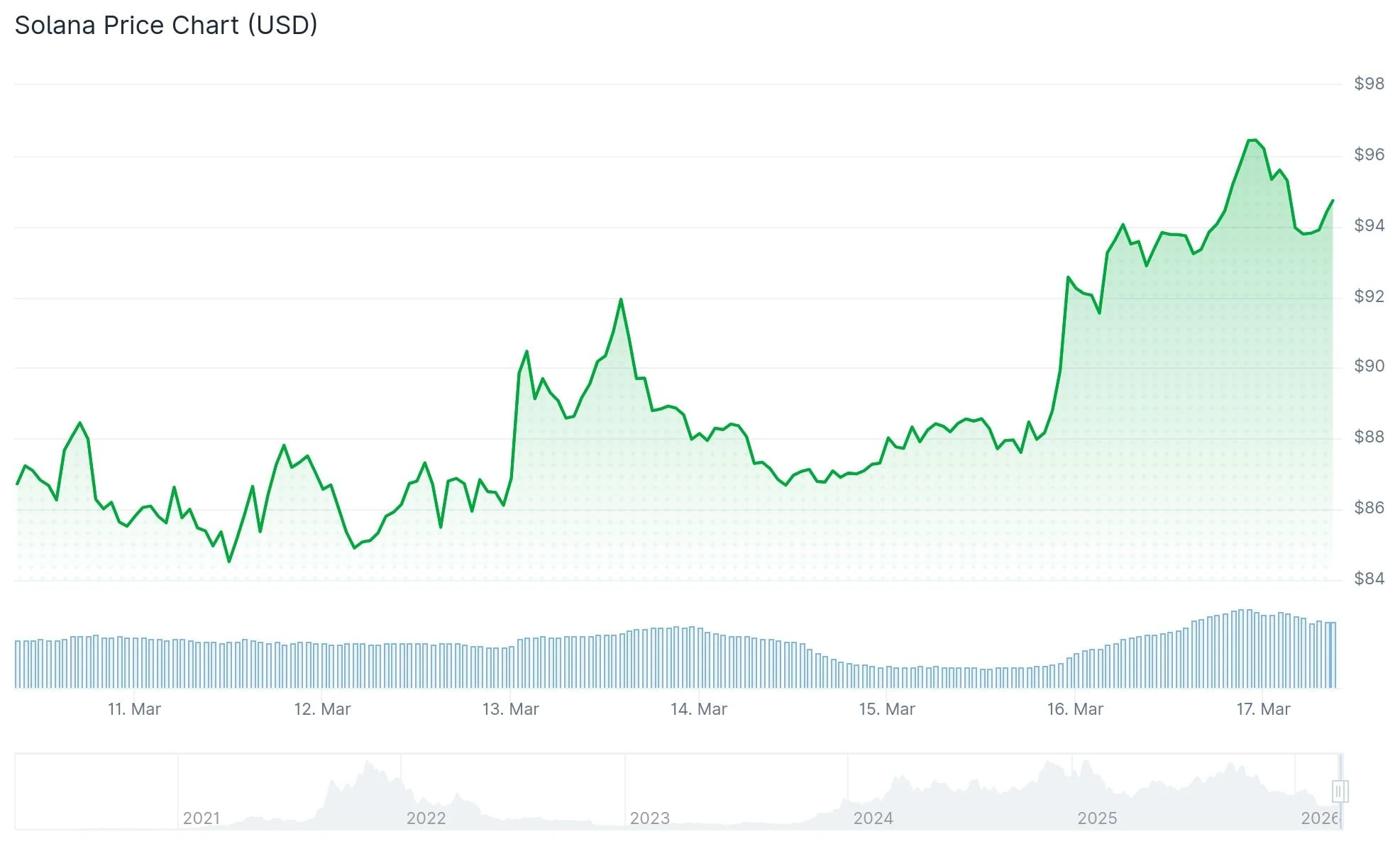
- Solana experienced a 7%+ rally within 24 hours, touching $97.67 while the overall crypto market gained approximately 3.6%.
- The network’s total value locked increased by 25% throughout the past 30 days, demonstrating renewed investor confidence.
- SOL maintains trading above the $92 mark and its 100-hour simple moving average, with bullish support establishing at $94.
- Critical resistance points are positioned at $98 and $100, while downside support exists at $92 and $88.
- The token has appreciated over 40% since hitting its February bottom, as the RSI indicator advances toward 60 from previously oversold territory.
Solana has delivered an impressive 24-hour performance, rallying more than 7% to peak at $97.67 before experiencing a modest retracement to settle around the $95 zone. This upward movement coincides with a broader cryptocurrency market recovery that saw gains of approximately 3.6% during the identical timeframe.
Currently, SOL maintains its position above the $92 threshold and trades above its 100-hour simple moving average. Technical analysis reveals a bullish trend line forming with critical support established at $94 on the hourly timeframe, according to data sourced from Kraken.
Critical Resistance Zones Emerge
The cryptocurrency now encounters resistance around the $95 level, with the subsequent barrier positioned at $98. The psychologically significant $100 threshold represents the primary challenge ahead. Successfully breaking and closing above $100 could pave the way toward $105, with potential extension to $112.
Conversely, should SOL fail to maintain support above $92, the next cushion sits at $88. Breaking beneath $88 would likely bring the $82 level into play.
While the recent upswing correlates with broader market stabilization, Solana has notably outpaced the majority of alternative top-10 cryptocurrencies during this same period.
On-Chain Metrics Validate Price Action
The total value locked within Solana’s ecosystem expanded by 25% over the preceding 30-day period. This metric, which quantifies the amount of capital deployed within a blockchain’s infrastructure, indicates accelerating platform utilization when showing this magnitude of growth.
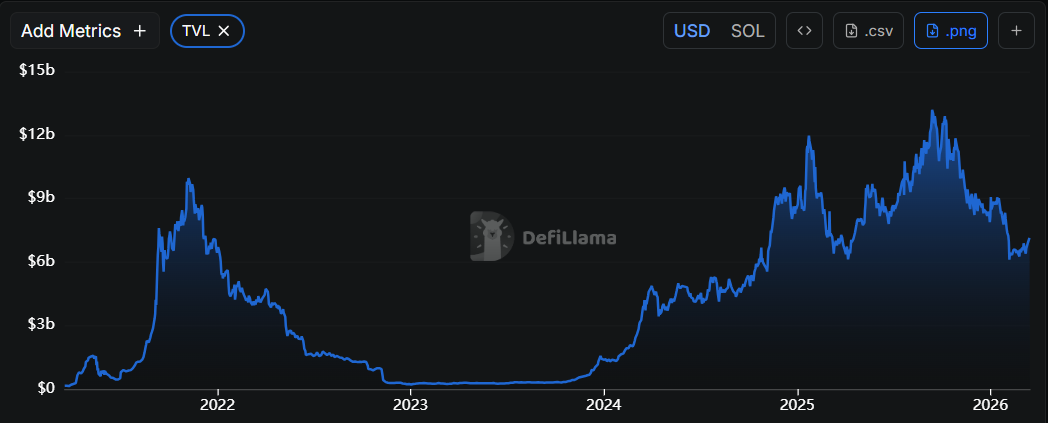
Continuous developer engagement and consistent decentralized application deployments across the network have persisted. These fundamental on-chain indicators have contributed to supporting the current bullish price trajectory.
Solana has appreciated more than 40% from its February trough. The Relative Strength Index has recovered toward the 60 threshold after rebounding from oversold conditions experienced earlier this year.
Price action has been oscillating within a range bounded by $80 support and $95 resistance throughout recent weeks, creating a consolidation formation that market participants frequently monitor for potential breakout opportunities.
The 200-day moving average continues to reside above present price levels, suggesting the long-term directional bias hasn’t completely reversed yet.
SOL is currently valued at approximately $94.62, commanding a market capitalization near $54 billion, with a 52-week trading range spanning from $70.61 to $252.78.

Key Highlights
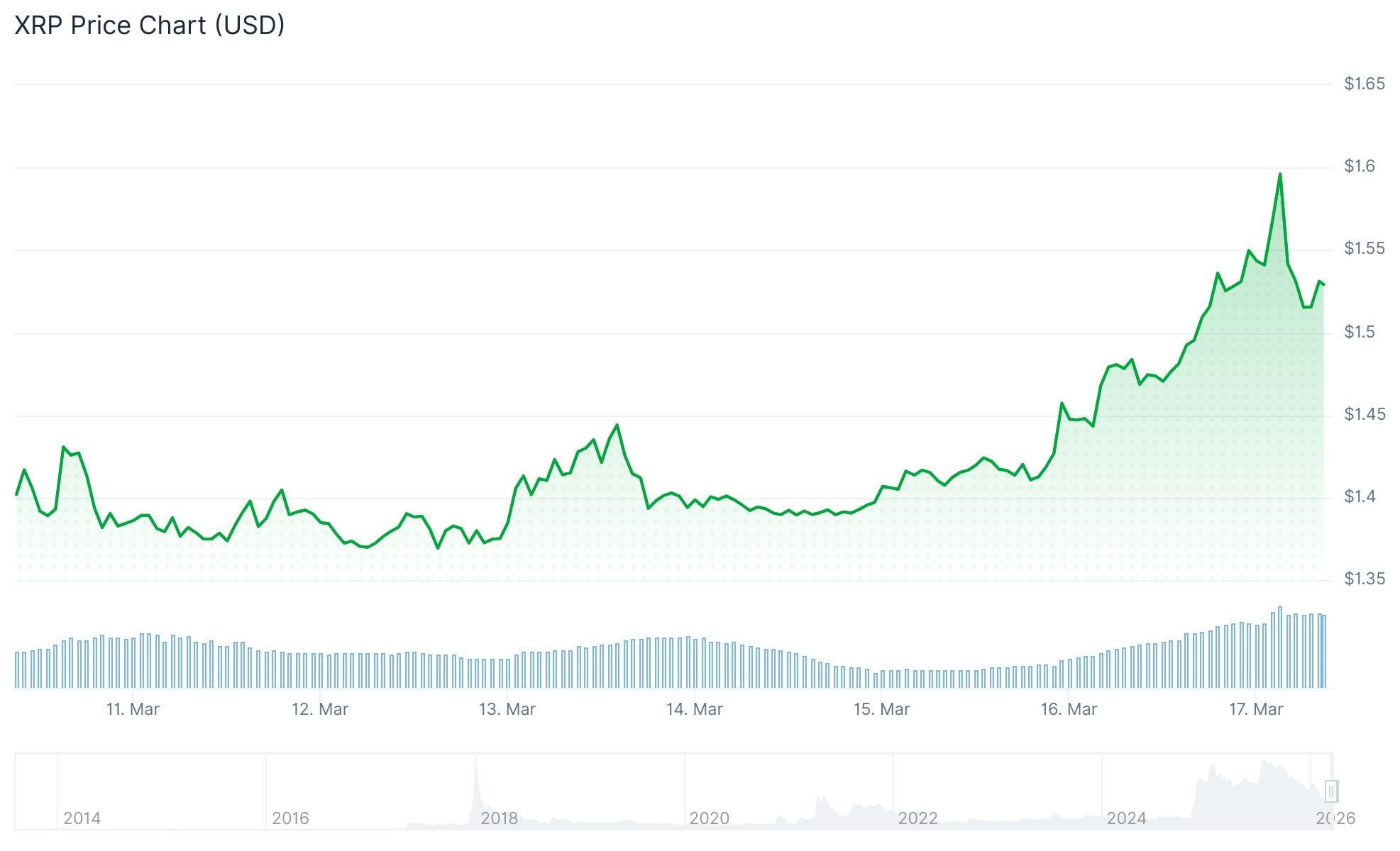
- XRP posted an 11% gain over the past seven days, reaching $1.53 and surpassing BNB to retake the fourth position by market capitalization at $93.4 billion.
- Binance futures open interest increased 59% since October 2025, reaching 353 million XRP as traders add leveraged positions during the uptrend.
- Veteran holders added more than 351 million XRP on March 1 alone, marking the most significant daily accumulation in recent months.
- XRP exchange-traded funds experienced $28 million in net withdrawals during the previous week as institutional participation declined while retail activity strengthens.
- The $1.55 price level continues to serve as significant resistance, with recent bearish price action suggesting potential for short-term correction.
XRP experienced notable upward momentum throughout the past week, advancing 11% to settle near $1.53 as of March 17, 2026. This price action enabled the digital asset to leapfrog BNB, reclaiming the fourth position among cryptocurrencies by total market value at $93.4 billion.
Daily transaction volume surged by 125% to reach $3.22 billion as the token breached a critical resistance threshold around $1.40. This price point had capped upward movement for several weeks, making the breakthrough particularly noteworthy for market participants.
This upward movement unfolds against a backdrop of significant macroeconomic stress. Brent crude oil continues trading near $100 per barrel following persistent supply chain complications in the Strait of Hormuz related to the Iran situation, which has now extended into its third week.
Long-Term Investors Increase Positions Despite Global Uncertainty
Contrary to typical risk-off behavior during periods of macroeconomic stress, XRP’s established holders have intensified their accumulation activities.
Data from Glassnode reveals that long-term holders accumulated more than 351 million XRP on March 1, occurring just one day following the escalation of the Iran conflict. This represents the most substantial single-day accumulation recorded in several months.
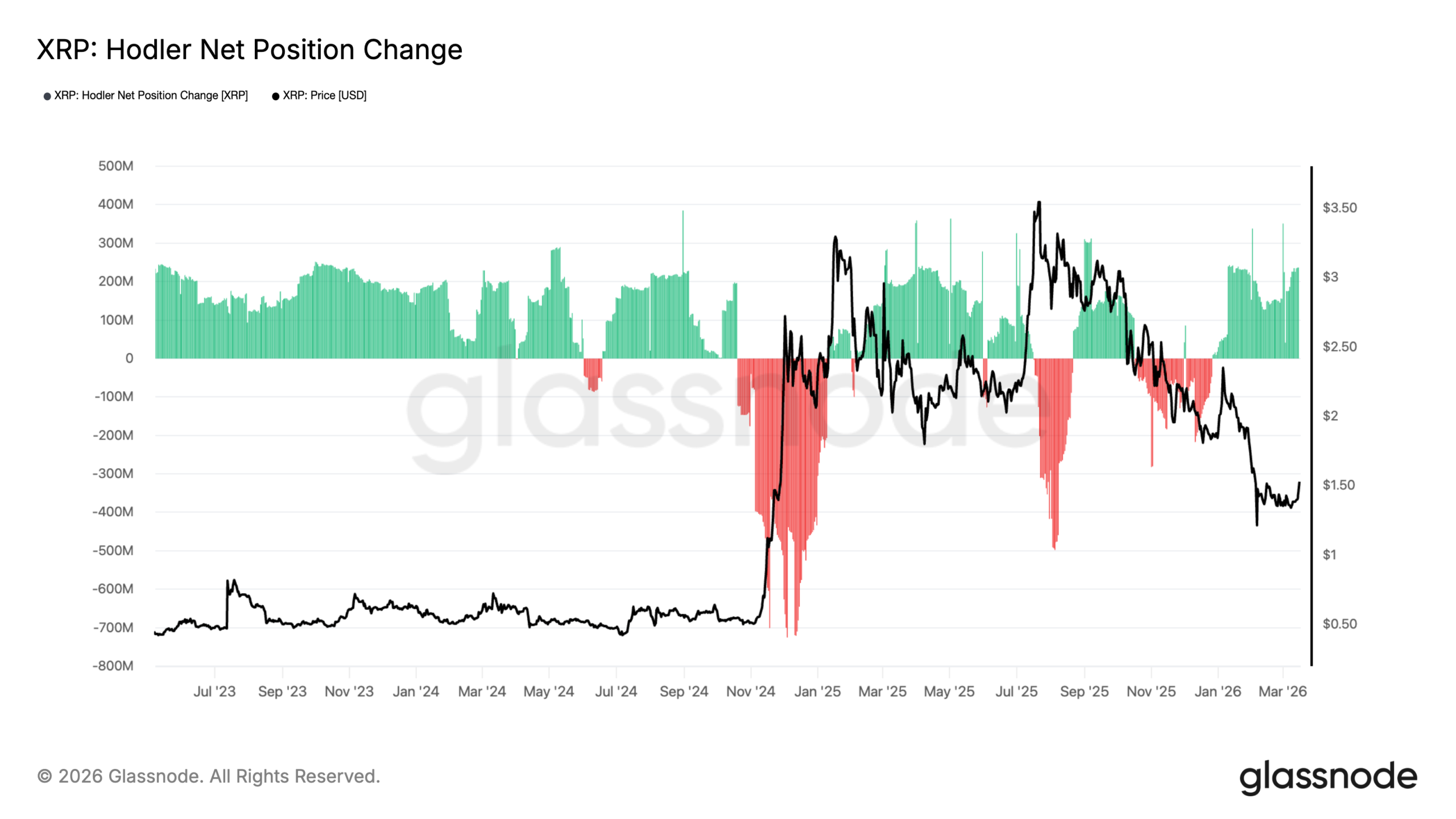
This accumulation pattern has persisted throughout the subsequent period, with consistent net purchasing driving the indicator to its strongest monthly reading since May 2025. Such on-chain behavior typically emerges during market recovery cycles.
Retail participation is showing renewed strength as well. XRP futures open interest expanded to $2.66 billion on Monday, climbing from $2.56 billion recorded the previous day. The Fear & Greed Index improved to 23 from 8 the week prior, although it continues to reflect extreme fear conditions.
Institutional Flows and Token Distribution Controversy
Institutional capital has shifted away from XRP products recently. Investment vehicles tracking XRP registered $76 million in net outflows last week, with exchange-traded funds representing $28 million of that total. Monthly outflows have accumulated to $133 million, reducing total assets under management to $2.4 billion.
Ripple Labs is simultaneously confronting scrutiny regarding its token distribution practices. Industry observers have questioned whether the company’s sale of premined XRP to retail participants, followed by deployment of those funds toward acquisitions, non-XRP initiatives, and equity buybacks, creates an imbalanced value proposition.
Ripple’s Chief Technology Officer David Schwartz has addressed these concerns, though detractors maintain the current structure disproportionately advantages Ripple Labs shareholders over XRP token holders.
From a chart perspective, XRP encountered rejection near its 50-day exponential moving average at $1.55. The digital asset continues trading beneath both its 50-day and 200-day exponential moving averages. A definitive close above $1.60 would be required to signal a meaningful trend reversal.
Binance open interest registered 353.49 million XRP on March 17, nearing but remaining below the pre-correction high of 400 million observed in September 2025.
TLDR
- BTC reached an intraday peak of $75,912 before retreating, with the movement attributed to derivatives mechanics instead of organic demand
- The cryptocurrency sector experienced widespread gains exceeding 5% across major tokens in the previous seven days, marking the strongest coordinated advance since pre-Iran conflict
- Bitcoin spot ETF products recorded $767 million in net inflows during the past week, continuing a three-week streak of positive flows
- Equity index futures declined Tuesday following Monday’s recovery, with the S&P 500, Dow, and Nasdaq futures each falling approximately 0.5%
- Market attention centers on Wednesday’s Federal Reserve policy statement, with rate-hold probability exceeding 99%
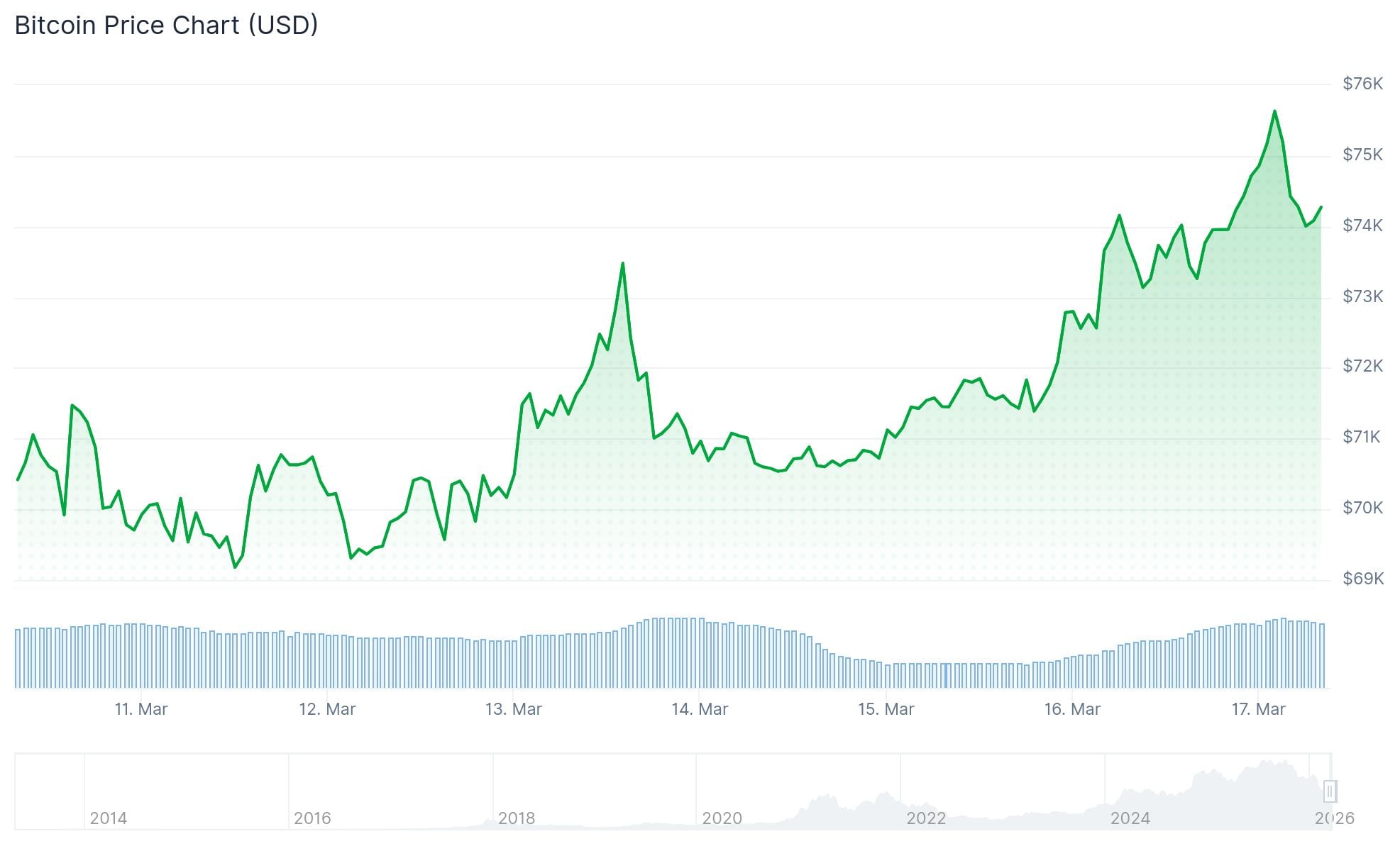
Bitcoin pushed toward the $75,000 threshold on Tuesday for the first time in recent weeks before reversing course. Market analysts suggest the price action reflected technical factors rather than genuine demand expansion.
Chart watchers observed BTC reaching an intraday high of $75,912 during early Tuesday trading hours before retreating to approximately $74,372. CoinDesk market specialists attributed the upward movement to derivatives positioning dynamics—particularly the expiration of substantial put options contracts at the $60,000 strike price, compelling market makers to purchase spot bitcoin for hedging purposes.
The critical price point remains $74,400, which previously served as a support threshold in April 2025. Bitcoin’s rapid pullback beneath this level indicates insufficient buyer conviction to sustain elevated prices without fundamental catalysts.
Despite the intraday volatility, digital asset markets have demonstrated impressive strength throughout the week. Ether climbed 13.3% to reach $2,316. XRP advanced 11% to $1.53. Solana appreciated 9.7% to $93.92. Dogecoin increased 9.5%, reclaiming the $0.10 level. BNB rose 5% to $676.
Market observers characterize this as the most comprehensive sustained cryptocurrency advancement since the outbreak of the Iran conflict.
ETF Inflows Signal Returning Institutional Interest
The optimistic sentiment partly stems from capital allocation into bitcoin exchange-traded products. Spot bitcoin ETFs accumulated approximately $767 million in net inflows throughout the previous week, based on data from CF Benchmarks analyst Mark Pilipczuk.
This represents the third consecutive week of positive capital flows, reversing the trend from earlier in 2025 when these vehicles experienced outflows exceeding $3 billion across five weeks.
Bitcoin has also narrowed its performance differential with gold. Through mid-March on a year-to-date basis, the gold ETF GLD appreciated roughly 16% while bitcoin ETF IBIT declined approximately 19%. However, from early March forward, bitcoin has exceeded gold’s returns by 13.2%.
The 90-day correlation coefficient between these two assets shifted from -0.27 to +0.29 during a six-month period, rekindling discussions about bitcoin’s role as “digital gold.”
Stock Futures Dip After Monday Rebound
Equity markets experienced contrasting momentum. Index futures linked to the Dow Jones Industrial Average, S&P 500, and Nasdaq 100 each declined between 0.4% and 0.5% during Tuesday’s pre-market session after Wall Street posted gains Monday.
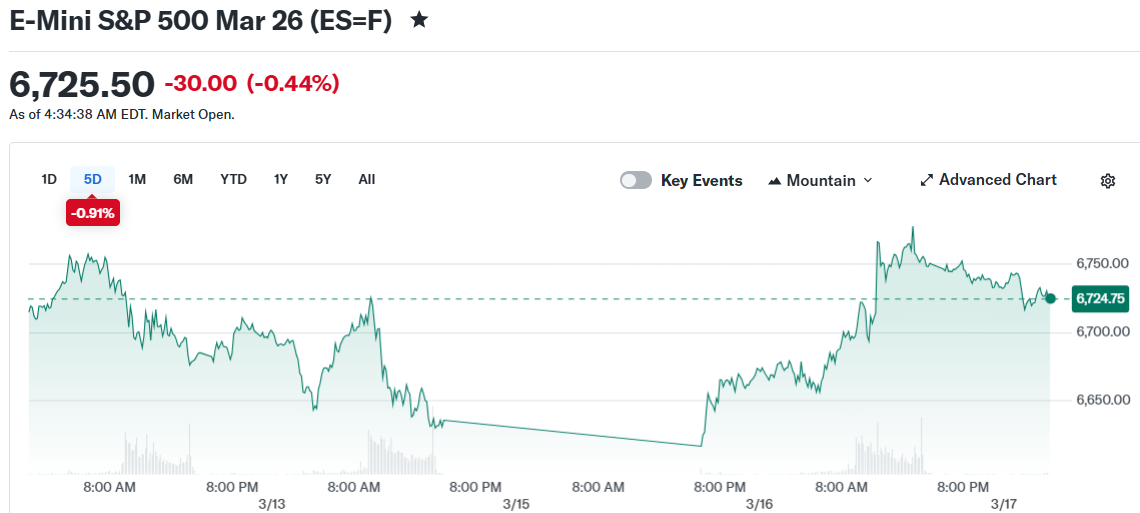
Monday’s advance followed a retreat in crude oil prices. Brent crude settled nearly 3% lower at marginally above $100 per barrel. West Texas Intermediate declined more than 5% to close at $93.50.
Energy markets have exhibited heightened volatility since military operations by the US and Israel against Iran commenced. Treasury Secretary Scott Bessent indicated Iranian tanker traffic continues through the Strait of Hormuz, though President Trump’s proposal for multinational escort operations has received no commitments.
Nvidia commanded attention at its GTC conference where CEO Jensen Huang revealed multiple partnership agreements and projected $1 trillion in semiconductor sales through late 2027.
Quarterly financial results from Tencent, DocuSign, and Oklo are scheduled for Tuesday.
The Federal Reserve commences its two-day policy meeting today, with the official determination scheduled for Wednesday. CME FedWatch data indicates a rate-hold probability surpassing 99%. February’s employment report showed 92,000 job losses, while crude oil prices exceeding $100 per barrel maintain inflation concerns ahead of Chairman Powell’s media briefing.


While the March 30 event is canceled, OpenSea will hold a future product update session to showcase mobile and other features.
OpenSea CEO Devin Finzer confirmed that the much-anticipated debut of the SEA token, which had been scheduled for March 30th, will now be postponed. Acknowledging the delay in a detailed update, Finzer explained that the decision reflects current market challenges in the cryptocurrency sector.
He also noted that token launches occur only once.
SEA Token Debut Pushed Back
The delay stems from a decision by the OpenSea Foundation, which Finzer said has chosen to push back the timeline to ensure all aspects of the project are fully prepared. Finzer explained that the move was deliberate, while also recognizing that it may disappoint users. The exec’s tweet read,
“The reality is that market conditions are challenging across crypto right now, and $SEA only launches once. OpenSea Foundation could force the original date, or we could ensure every piece is in place and make this moment what this community deserves.”
As part of the update, Finzer spoke about several measures designed to address user concerns and maintain engagement. The company will end the current rewards wave. The ongoing phase will be the last. Additionally, the NFT player is offering an optional refund of platform fees retained during rewards waves 3 through 6, which followed the initial Q1 launch commitment.
Users who opt for a refund will have their Treasures, rewards previously issued during these waves, removed from their accounts. For Treasures that users continue to hold, Finzer confirmed the Foundation will still consider them at the token generation event (TGE), independent of historical allocation activity.
Finzer also announced a temporary fee reduction to encourage platform activity. Starting March 31st, OpenSea will set token trading fees to zero for a period of 60 days. The promotion will cover trading across multiple features, including cross-chain tokens, the mobile app, and perpetual contracts. After the 60-day period, a revised fee structure is planned to offer more competitive rates for consistent traders.
While the March 30th launch event will no longer take place, OpenSea plans to host a future event focused on product updates. Finzer revealed that the early reactions to the platform’s mobile application were fairly positive.
You may also like:
Controversies
The delay comes amid previous challenges faced by the platform. Last February, the NFT marketplace suspended its new airdrop reward system following intense, sharp user backlash. Launched with the OS2 beta, the experience points (XP) mechanism was aimed to qualify users for the upcoming SEA token airdrop but drew fire for allegedly promoting wash trading, favoring fee revenue over ecosystem builders, and undermining NFT sustainability.
Prior to that, OpenSea’s 2022 breach exposed 7 million emails through its service provider, including those of major players such as Binance’s Changpeng “CZ” Zhao.
Binance Free $600 (CryptoPotato Exclusive): Use this link to register a new account and receive $600 exclusive welcome offer on Binance (full details).
LIMITED OFFER for CryptoPotato readers at Bybit: Use this link to register and open a $500 FREE position on any coin!
Key Takeaways
- BTC peaked at $75,991 on Tuesday before retreating to approximately $74,291
- U.S. spot Bitcoin ETFs have logged six consecutive sessions of positive inflows, accumulating $962.8 million since March 9
- Short position liquidations totaling $485.6 million within a 24-hour period contributed to the upward price movement
- Escalating geopolitical concerns involving the U.S., Israel, and Iran continue to impact broader market confidence
- Market participants are focused on the Federal Reserve’s upcoming interest rate announcement scheduled for Wednesday
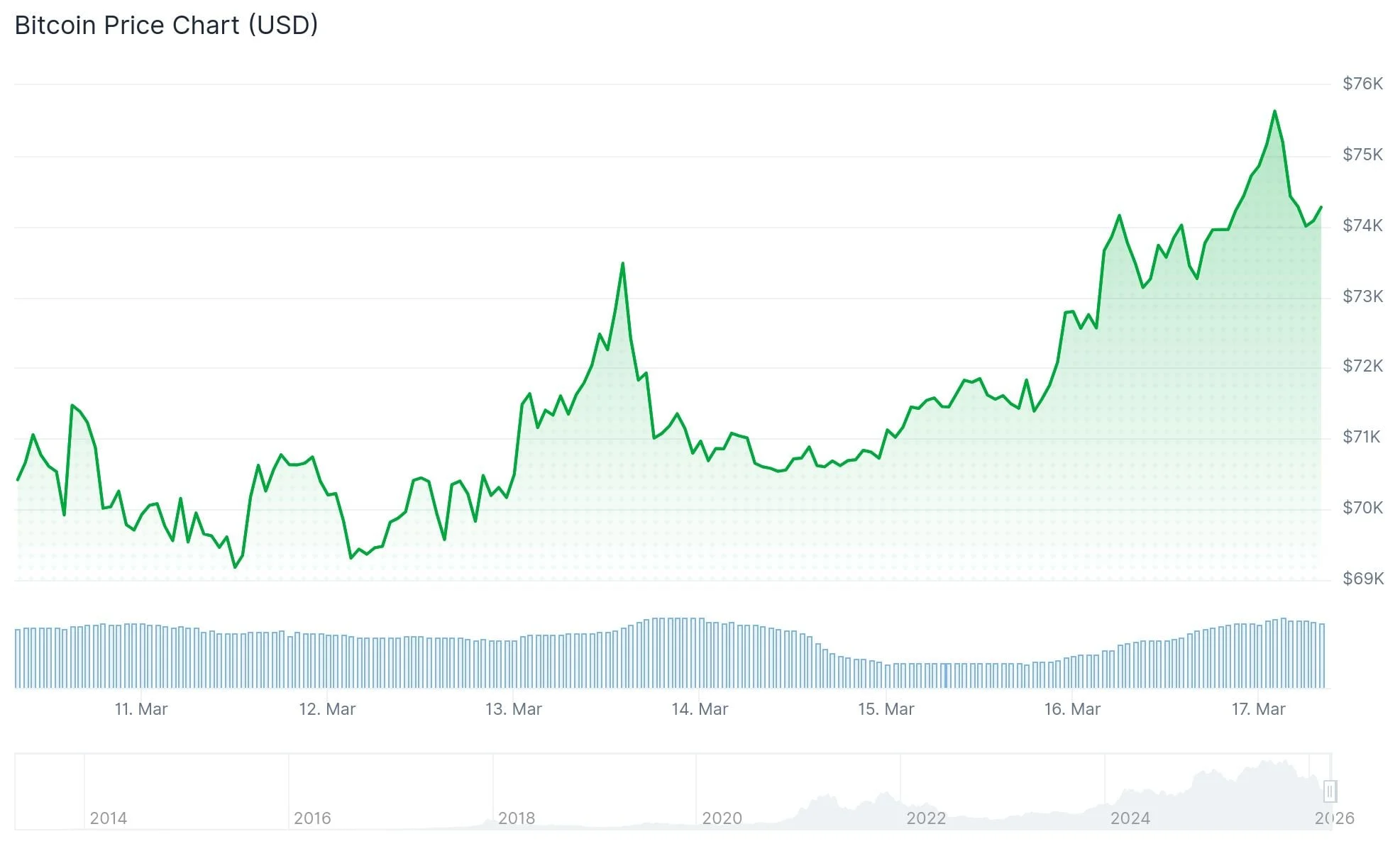
Bitcoin experienced significant price fluctuations over recent trading sessions. The leading cryptocurrency surged to a high of $75,991 before retracing to approximately $74,291 during early Tuesday hours.
This price action coincided with substantial liquidation activity across the cryptocurrency market, with approximately $609 million in total liquidations occurring over the previous 24 hours. Short positions accounted for $485.6 million of these forced closures, based on information from Coinglass.
Market observers attribute the rapid price increase to this liquidation cascade. However, concerns remain about the sustainability of such moves.
“Price movements fueled by liquidation squeezes generally lack staying power without genuine underlying demand, often dissipating within days to several weeks,” explained Dominick John, an analyst with Zeus Research.
Sustained ETF Demand Offers Foundation
Regardless of market volatility, spot Bitcoin exchange-traded funds have demonstrated consistent investor appetite. Monday represented the sixth consecutive trading day with positive flows into U.S.-based Bitcoin ETFs, recording $199.4 million in fresh capital during that session alone.
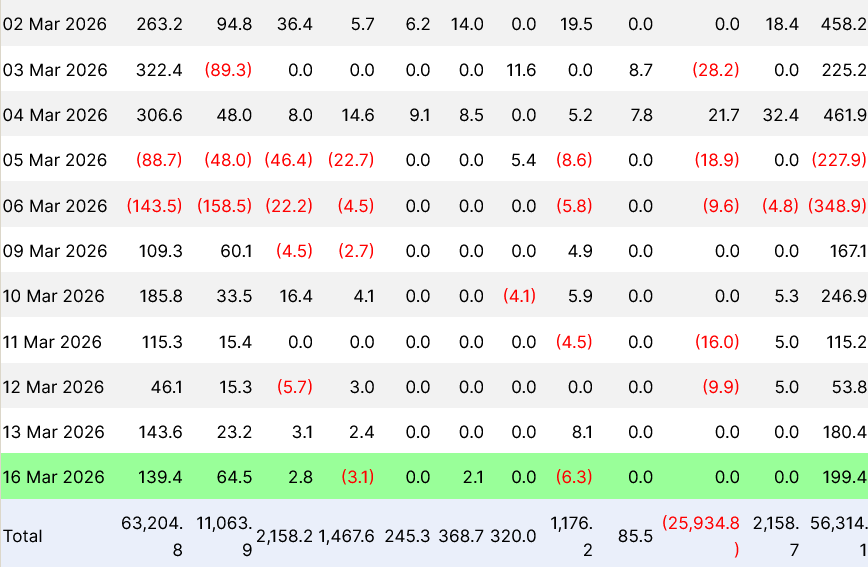
BlackRock’s iShares Bitcoin Trust (IBIT) dominated with $139.4 million in contributions. Fidelity’s Wise Origin Bitcoin Fund captured an additional $64.5 million.
Starting from March 9, cumulative net inflows into these investment vehicles have totaled $962.8 million. Throughout this timeframe, Bitcoin has appreciated 12.5%, climbing from $65,960 to roughly $74,250.
Research from Presto Research highlighted these persistent inflows, alongside ongoing institutional acquisitions, as primary catalysts for the rally. U.S. spot Bitcoin ETFs recorded $767.3 million in net positive flows during the previous week, marking three consecutive weeks of accumulation.
Macroeconomic Developments Command Attention
The escalating situation involving the United States, Israel, and Iran has created uncertainty among market participants. Oil prices surpassed $100 per barrel again on Tuesday, with Brent crude reaching $103 and WTI settling at $96.03.
Elevated energy costs have intensified inflation worries, influencing how investors allocate capital across various asset classes, including digital currencies.
On Monday, President Trump urged international cooperation to resolve disruptions affecting the Strait of Hormuz. Iran had restricted maritime traffic through this critical waterway, which facilitates roughly 20% of worldwide oil transportation.
Santiment, a blockchain data analytics platform, observed that speculation regarding potential diplomatic breakthroughs between the United States, Iran, and Israel helped propel Bitcoin above $74,400 for the first time in six weeks.
The Crypto Fear & Greed Index increased by five points to 28 on Tuesday, marking its exit from “Extreme Fear” status for the first time since late January.
The Federal Reserve will release its interest rate determination on Wednesday. While markets anticipate rates will remain unchanged, participants are paying close attention to any commentary regarding inflationary pressures.
Spot Ethereum ETFs similarly attracted $160.8 million in new investment during the past week, as ETH climbed 3.28% to reach $2,315.

TLDR:
- dtcpay raised $10M in Series A funding led by Temasek-backed Vertex Ventures Southeast Asia & India.
- The company secured a Luxembourg EMI license to offer regulated payment services across the EEA.
- dtcpay holds payment licenses in Singapore, Hong Kong, Australia, the United States, and Canada.
- A Visa partnership in Asia-Pacific gives users access to Infinite and corporate cards for digital and fiat spending.
dtcpay, a Singapore-based digital payments company, has raised US$10 million in a Series A funding round. Vertex Ventures Southeast Asia & India, a Temasek-backed firm, led the investment.
Favour Capital served as the exclusive financial advisor for the round. The funding will support infrastructure development and European market expansion.
Simultaneously, dtcpay announced it has secured an Electronic Money Institution license in Luxembourg, enabling regulated stablecoin and fiat payment services across the European Economic Area.
dtcpay’s Business Model and the Case for Stablecoin Payments
dtcpay was co-founded by Alice Liu and Band Zhao with a focused mandate. The company bridges digital assets with traditional financial systems for everyday use.
Businesses and individuals can accept, store, and transact in stablecoins through its platform. A real-time swap engine enables instant settlement between stablecoins and fiat currencies.
The funding arrives at a turning point for the stablecoin payments sector. Regulatory frameworks are tightening across major economies as compliance demands increase.
Providers must meet higher standards to serve businesses and consumers at scale. dtcpay states it has spent years building infrastructure to meet these requirements.
In the Asia-Pacific market, dtcpay has formed a partnership with Visa. This collaboration includes Visa Infinite cards for individuals and corporate card solutions for businesses.
Both products support transactions in digital assets and fiat currencies. Users benefit from competitive spot rates for their daily spending needs.
Alice Liu, CEO and Co-Founder, outlined the company’s vision for the industry. She said the company aims to build “a platform where faster, safer, and more cost-efficient transactions become the standard for global payments.”
Genping Liu, General Partner at Vertex Ventures Southeast Asia & India, also commented on the investment rationale.
He said the firm sees “significant potential in real-world stablecoin use cases where digital asset infrastructure intersects with regulated financial systems.”
European Licensing Strengthens dtcpay’s Global Regulatory Standing
dtcpay’s Luxembourg EMI license represents a key regulatory achievement for the company. It allows dtcpay to provide regulated payment services across all EEA member states.
This positions the company as a compliant operator within a large, established financial bloc. The license directly supports the European expansion planned with the Series A proceeds.
The Luxembourg license complements an already broad regulatory portfolio held by dtcpay. The company carries a Major Payment Institution license from the Monetary Authority of Singapore.
It also holds licenses and registrations in Hong Kong, Australia, the United States, and Canada. This multi-jurisdictional coverage allows dtcpay to serve clients across diverse global markets.
The new capital will also go toward expanding operations in newly licensed regions. Product enhancements and infrastructure upgrades are among the primary funding priorities.
dtcpay intends to use its Luxembourg EMI license as the gateway for European growth. These steps align with the broader goal of scaling within regulated jurisdictions.
The stablecoin payments sector is attracting growing attention from institutional investors and regulators. dtcpay’s compliance-first model and multi-region licensing position it well for this shift.
Its combination of infrastructure, partnerships, and regulatory coverage sets it apart in the market. The Series A round marks the start of the company’s next phase of international growth.


- Dogecoin price is holding strong above key support near $0.0955.
- A break above $0.1088 could trigger a sharp upward move.
- A push past $0.12 may confirm a bullish trend continuation.
Dogecoin (DOGE) is starting to show signs of life again after a period of slow and uncertain movement.
The memecoin’s price has pushed back above $0.10, and that alone has caught the attention of traders watching for early breakout signals.
While momentum has been building steadily, the real question now is whether this move has enough strength to continue higher.
A tightening range signals a bigger move ahead
The current structure shows Dogecoin holding above a key short-term support zone, which has formed around the $0.0974 to $0.0955 range.
At the same time, price action has been pushing against resistance between $0.104 and $0.105, creating a clear zone where sellers are trying to slow the rally.

Just above that sits a more important barrier around $0.1088, which has historically marked the transition into stronger upward moves.
This combination of rising support and firm resistance is creating a tightening range, and such conditions often lead to sharp breakouts.
The longer the price stays compressed within this zone, the more significant the eventual move tends to be.
For now, the fact that the Dogecoin price is holding above its short-term trendline and the 100-hour moving average suggests that buyers still have control.
However, control does not guarantee continuation, and the next move will depend on how the price reacts at the upper boundary.
Why $0.1088 is real breakout trigger for Dogecoin price
While smaller resistance levels exist below, analysts note that $0.1088 stands out as the true gatekeeper for a larger move.
Past price behaviour shows that once Dogecoin clears this level with conviction, it tends to move quickly into higher trading ranges.
This is why many traders are not just watching for a break above $0.104 or $0.105, but instead waiting for a clean push beyond $0.1088.
A strong move through that level would likely open the door toward the next resistance around $0.1205.
That level sits just above the widely watched $0.12 mark, making it both a technical and psychological target.
If momentum remains strong, the price could even extend further toward $0.1335, which represents a more ambitious upside scenario.
Such a move would not happen in isolation, but rather as a continuation of the current bullish structure that is slowly forming.
The key support levels to watch
Even in a bullish setup, risk management remains essential because support levels define whether the trend is still valid.
The first level to watch sits near $0.0995, which acts as immediate support during short-term pullbacks.
Below that, the $0.0978 and $0.0974 zone becomes more important, as it has repeatedly held as a reliable base.
The most critical level, however, remains $0.0955, which aligns with both the trendline and broader structure support.
A breakdown below this level would weaken the current bullish outlook and increase the chances of a deeper move toward $0.094 or even $0.092.
If selling pressure intensifies further, the next major historical support comes in near $0.0870.
As long as the Dogecoin price stays above the key support cluster, the overall structure continues to favour buyers.
What a breakout above $0.12 could mean
A confirmed breakout above $0.1088 followed by a move through $0.1205 would signal a clear shift in market sentiment.
It would indicate that buyers are no longer just defending support, but actively pushing the market into a new price range.
Crossing the $0.12 level would likely attract additional interest, as it represents a visible milestone for both short-term traders and longer-term participants.
At that stage, Dogecoin would be transitioning from a recovery phase into a more established upward trend.
The path toward $0.1335 would then become more realistic, especially if momentum and volume continue to support the move.
The Pi Network community (Pioneers) have complained about the missing second migrations for years. Now, though, PI is dumping as the process begins.
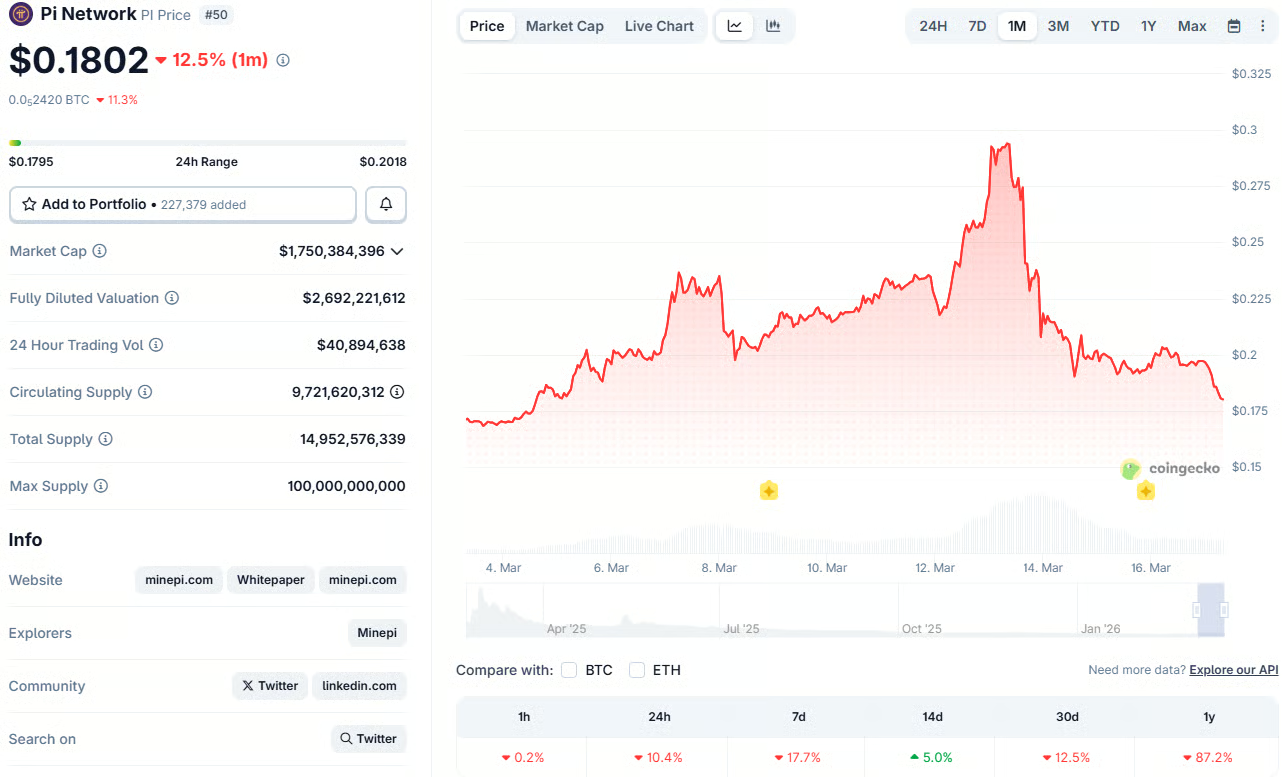
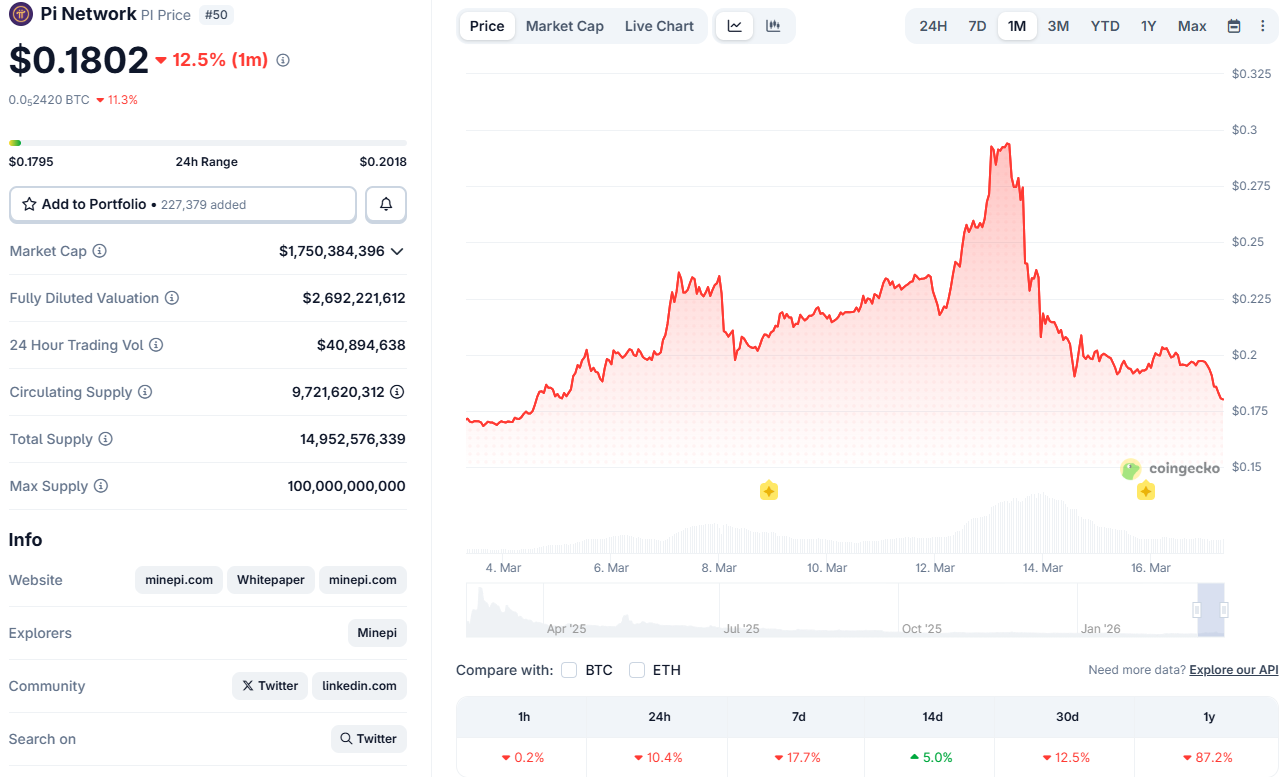
The highly volatile token as of late has dropped once again in the past 24 hours, losing over 10% of value in a nosedive to a two-week low of under $0.18.
The asset has plunged by roughly 40% since the highly anticipated Pi Day on Saturday, even as the team behind the project announced new updates and promises.
Pi Dumps Again
After celebrating its first anniversary as a free-for-trading token in late February, PI rebounded from its all-time low of $0.1312 and started March on the right foot as the community was preparing for the aforementioned Pi Day (March 14) and enjoyed several updates. The asset went on the offensive in the days leading to March 14, especially since the veteran US crypto exchange Kraken announced it would list it for trading starting a day before the Pi Network celebration.
PI exploded by double digits on a few consecutive occasions, skyrocketing from under $0.175 to a five-month peak of almost $0.30. However, the Kraken listing turned out to be a classic sell-the-news event, as once PI went live for trading on the popular exchange, it nosedived immediately by 30% in just a day.
Coincidentally (or not), this massive price drop was on Pi Day. After trying to rebound yesterday to over $0.20, PI has been rejected once more, and now sits at $0.18 after a 11% daily decline. Its market cap has fallen to $1.750 billion, making it the 50th-largest cryptocurrency by that metric. Just a few days ago, PI had entered the top 40 on CoinGecko.
Second Migrations Begin
The Core Team made a big statement on March 14, highlighting the project’s progress in the past several years and laying out some of the goals ahead. One of those caught the Pioneers’ attention in particular, as they have been requesting it for years – the second migrations.
Essentially, this is the process of allowing users to bring additional PI tokens to Mainnet and “further participate in the ecosystem,” the team explained. While the gradual rollout for the second phase is on, the first migrations for eligible Pioneers will “continue as normal.”
You may also like:
Users have to ensure that their Pi Wallet has enabled 2FA through the Mainnet Checklist Step 3 after adding a trusted email to their accounts. Second migrations will also include referral mining bonuses for Referral Team members who have successfully passed KYC.
Pi Network is excited to announce that second migrations have started and will continue with a gradual rollout, opening the door for Pioneers to bring additional Pi to Mainnet and further participate in the ecosystem! While second migrations roll out, first migrations for… pic.twitter.com/KyqCMqcoyi
— Pi Network (@PiCoreTeam) March 16, 2026
Despite the promising words, many users remained skeptical in the comments below the posts, questioning whether this is just more hype without actual implementation.
Binance Free $600 (CryptoPotato Exclusive): Use this link to register a new account and receive $600 exclusive welcome offer on Binance (full details).
LIMITED OFFER for CryptoPotato readers at Bybit: Use this link to register and open a $500 FREE position on any coin!
Disclaimer: Information found on CryptoPotato is those of writers quoted. It does not represent the opinions of CryptoPotato on whether to buy, sell, or hold any investments. You are advised to conduct your own research before making any investment decisions. Use provided information at your own risk. See Disclaimer for more information.
TLDR:
- Nvidia CEO Jensen Huang confirmed Samsung is manufacturing the Groq LP30 AI chip using its 4-nanometer process.
- Samsung shares climbed as much as 5%, outpacing the broader South Korean market, which rose just 2.7% on Tuesday.
- Analysts at Heungkuk Securities project Samsung’s foundry division could reach breakeven by late 2027 despite headwinds.
- AMD CEO Lisa Su is set to meet Samsung Chairman Jay Y. Lee in South Korea to discuss semiconductor cooperation on Wednesday.
Samsung Electronics shares surged as much as 5% on Tuesday after Nvidia CEO Jensen Huang confirmed the South Korean company was manufacturing Nvidia’s newest AI chips.
Huang announced at Nvidia’s GTC developer conference in California. The news shifted market sentiment around Samsung’s long-troubled foundry division.
Analysts now believe the unit could recover as early as next year. Samsung shares settled at 196,800 won, up 4.3%, in early trading on Tuesday.
Samsung Foundry Gains Momentum From Nvidia’s GTC Conference
Samsung’s foundry division has endured years of mounting financial losses. The unit has posted billions of dollars in annual losses, straining the broader company.
However, Nvidia’s public acknowledgment at GTC changed the conversation for investors. Markets responded quickly once Huang’s remarks circulated widely.
At the event, Huang unveiled Nvidia’s new AI inference processor built on Groq chip startup technology. He credited Samsung directly for manufacturing the Groq LP30 chip.
Huang stated, “I want to thank Samsung who manufactures the Groq LP30 chip for us and they’re cranking as hard as they can.” He further confirmed the chips were already in production and would ship in the second half of 2026.
Samsung also displayed the Nvidia chips produced using its 4-nanometer manufacturing process at the conference. That demonstration added further confidence in Samsung’s technical standing.
The 4nm process is regarded as highly competitive across the global foundry market. It places Samsung alongside leading manufacturers in terms of production advancement.
Analyst Sohn In-joon of Heungkuk Securities said the foundry unit could reach breakeven later next year. However, he noted that weak mobile phone demand could still slow recovery.
Rising memory chip prices have been suppressing demand from that segment. Therefore, while the outlook is improving, some headwinds remain in place.
AMD CEO Lisa Su to Meet Samsung Chairman Jay Y. Lee in South Korea
Beyond the Nvidia development, another notable meeting has drawn industry attention. Advanced Micro Devices CEO Lisa Su is set to meet Samsung Chairman Jay Y. Lee on Wednesday.
The meeting will take place in South Korea, according to media reports. Discussions are expected to cover memory chips and logic semiconductor cooperation.
Samsung’s foundry division already counts Tesla and Apple among its major customers. Adding Nvidia, even through the Groq partnership, strengthens that client base considerably.
Meanwhile, a potential AMD collaboration could further expand Samsung’s foundry footprint. Together, these developments suggest a more active commercial pipeline ahead.
The broader South Korean stock market also rose 2.7% on Tuesday. Samsung’s gains outpaced the overall index, reflecting investor confidence specific to the company.
The Nvidia confirmation combined with the AMD meeting prospects pushed sentiment higher. Market watchers are now tracking both fronts closely for further developments.
Samsung’s foundry business continues to face pressure from mobile demand and memory pricing cycles. That said, the Nvidia partnership represents a concrete win for the division’s recovery narrative.
Shipment timelines in the second half of 2026 will be closely monitored by analysts. For now, the market has responded with a clear and measurable show of confidence.

How big data is transforming what we know about the universe

Carey concerned about cost pressures of war

The Metric That Preceded Every Bitcoin Rally Just Flashed Green: Is a BTC Surge Next?

Smart energy pays enters the US market, targeting scalable financial infrastructure

Why Israel is blocking foreign journalists from entering

Bitcoin: We’re Entering The Most Dangerous Phase

They’re Keeping XRP Down Until THIS Happens

Qatar’s Airspace Is Closed. 140 Emergency Flights. The Gulf’s Financial Capital Is Emptying Out.

XRP VS BTC WHY AI WILL CHOOSE XRP – X MONEY WILL USE FIAT FOR NOW? – BUILD WEALTH AT LOW PRICES!
-
 Tech6 days ago
A 1,300-Pound NASA Spacecraft To Re-Enter Earth’s Atmosphere
-
Crypto World3 days ago
HYPE Token Enters Net Deflation as HyperCore Buybacks Outpace Staking Rewards
-

 Business7 days ago
ExxonMobil seeks to move corporate registration from New Jersey to Texas
-

 Fashion4 days ago
Weekend Open Thread: Addict Lip Glow
-

 Tech7 days ago
ChatGPT will now generate interactive visuals to help you with math and science concepts
-
Sports3 days ago
Why Duke and Michigan Are Dead Even Entering Selection Sunday
-

 NewsBeat6 days ago
Residents reaction as Shildon murder probe enters second day
-

 Business2 days ago
Search for Savannah Guthrie’s Mother Enters Seventh Week with No Arrests
-

 Business6 days ago
Search Enters Sixth Week With New Leads in Tucson Abduction Case
-

 Business3 days ago
US Airports Launch Donation Drives for Unpaid TSA Workers as Partial Government Shutdown Enters Fifth Week
-
Crypto World3 days ago
Coinbase and Bybit in Investment Talks: Could Bybit Finally Enter the US Crypto Market?
-

 NewsBeat6 days ago
I Entered The Manosphere. Nothing Could Prepare Me For What I Found.
-

 Sports6 days ago
PWHL, Senators discussing plan to keep Charge in Ottawa
-

 Business3 days ago
Country star Brantley Gilbert enters growing non-alcoholic beer market
-

 Business23 hours ago
Australian shares drop as Iran war enters third week
-

 Crypto World23 hours ago
Crypto Lender BlockFills Enters Chapter 11 with Up to $500M in Liabilities
-

 Sports4 days ago
College Basketball Best Bets: Conference Tournament Semifinal Picks
-

 Crypto World7 days ago
Will Chainlink price reclaim $10 amid volatility squeeze?
-

 Tech6 days ago
Clarity as strategy
-

 Politics6 days ago
Trump Says Middle East Is ‘Very Lucky’ That He’s President


You must be logged in to post a comment Login