With the new tax year approaching, workers are being urged to check their payslips carefully as changes from HM Revenue & Customs (HMRC) take effect on April 6.
Experts say millions of employees may unknowingly be paying the wrong amount of tax due to payroll errors or incorrect tax codes – problems that can quietly drain household finances over time.
At a time when many households are already grappling with rising living costs, even a small error in pay or deductions can quickly create financial strain.
Advertisement
Many workers rarely check their payslips
Despite how important accurate pay is, many employees admit they don’t routinely review their payslips.
Research by HR and payroll platform HBHR found nearly half of UK workers either skim through their payslip or rarely check it in detail.
This leaves significant room for mistakes to go unnoticed. According to the same survey of 2,000 employees, almost a quarter (23%) said they had spotted a mistake on their payslip in the past year.
Payroll problems are not always minor. The research found that:
Advertisement
32% of workers say they couldn’t cope financially if their main pay was wrong or late even once
24% say payroll errors have made it harder to afford essentials such as rent, mortgage payments, food or energy bills
20% say a mistake in their pay caused them to miss a bill or regular payment
The impact is even more pronounced in high-cost areas such as London, where over a third of workers said a payroll mistake had left them unable to cover a bill.
Less than 30 days left until Making Tax Digital! ⏳
If your combined turnover from self-employment and property is over £50,000, you’ll need to use recognised software and send quarterly updates from 6 April.
Beyond simple payroll errors, incorrect tax codes are another major issue affecting employees.
Advertisement
Analysis cited by accounting firm The Accountancy Partnership suggests that around 5.6 million UK workers overpaid tax during the 2023–24 tax year, with an estimated £3.5 billion paid in excess due to incorrect tax codes.
Tax codes determine how much income tax is deducted from wages through the PAYE system operated by HM Revenue & Customs. If the information HMRC holds about a worker’s circumstances is incorrect or outdated, the tax code may also be wrong.
Lee Murphy, managing director at The Accountancy Partnership, said many workers assume automated tax deductions are always accurate.
“Many people assume that because tax is deducted automatically through PAYE, the amount must be correct,” he said.
Advertisement
“But tax codes are based on the information HMRC has about your circumstances, and if that information is outdated or incorrect, you could end up paying too much tax without realising it.”
Why tax codes can change
Tax codes are regularly updated to reflect a person’s circumstances, and sometimes these changes happen without workers noticing.
Common triggers include:
starting a new job
having multiple jobs or sources of income
receiving workplace benefits such as a company car or private healthcare
HMRC adjusting the code to recover tax owed from previous years
If HMRC’s records don’t fully reflect a person’s situation, the code issued could lead to the wrong amount of tax being deducted each month.
Recommended reading:
Advertisement
What workers should look for
Experts say checking a payslip only takes a few minutes but could prevent costly mistakes from continuing for months.
Workers should review:
the tax code listed on their payslip
their gross pay and deductions
whether any unexpected changes appear between payslips
Employees can also confirm their tax code through their HMRC personal tax account or by contacting their employer’s payroll department.
A timely reminder before the new tax year
With payroll and tax changes coming into effect in April, specialists say now is a good moment for workers to review their pay information.
Even small tax code errors can add up significantly over time – and in the current cost-of-living environment, making sure your payslip is accurate could help prevent unnecessary financial pressure.
Around 6pm on Tuesday, 25 February, a property near the B739, between Tarbolton and Monkton, was broken into.
Jewellery and clothes worth approximately £300,000 were stolen during a housebreaking and theft in Ayrshire.
Advertisement
Around 6pm on Tuesday, 25 February, a property near the B739, between Tarbolton and Monkton, was broken into.
Police have since confirmed that jewellery and clothing worth approximately £300,000 were taken.
It is believed two males were involved in the break-in and they would have needed access to a vehicle.
A team of detectives has reviewed CCTV and carried out extensive enquiries in the local area.
Advertisement
Police Scotland Detective Sergeant Davie Gillies, Ayr CID, said: “We are now appealing for the help of the public.
“We believe this house was targeted specifically for its remote location and with the intention of stealing high-value items.
“Our enquiries remain ongoing and I am appealing to anyone who witnessed the incident, who may have seen a car or people acting suspiciously in the area on the day the property was broken into or in the days leading up to it or who may have information which could assist to contact us.
“I would also ask any motorists who were in the area of the B739, between Tarbolton and Monkton, around the time and who may have dash cam footage which could help to get in touch.”
Advertisement
Anyone with any information is asked to contact 101 quoting reference 3693 of 24 February, 2026.
BANGKOK (AP) — The escalating war with Iran is pushing parts of the world into energy triage, forcing governments to choose where to cut demand or absorb costs, while prioritizing dwindling supplies.
Governments in the region are scrambling to adjust — tallying oil reserves, conserving energy, competing for supplies and trying to blunt prices. That brings difficult trade-offs: saving power may slow business activity. Prioritizing cooking gas for households can hurt restaurants and other businesses.
Advertisement
Cooks at a restaurant prepare meals over a charcoal stove following a shortage of liquefied petroleum gas in Mumbai, India, Wednesday, March 11, 2026. (AP Photo/Rafiq Maqbool)
Advertisement
Cooks at a restaurant prepare meals over a charcoal stove following a shortage of liquefied petroleum gas in Mumbai, India, Wednesday, March 11, 2026. (AP Photo/Rafiq Maqbool)
Advertisement
Advertisement
Advertisement
Advertisement
Motorists wait behind a rope for their turn to get fuel at a pump, fearing a possible fuel shortage due to the Iran war, in Dhaka, Bangladesh, Sunday, March 8, 2026. (AP Photo/Mahmud Hossain Opu, File)
Advertisement
Motorists wait behind a rope for their turn to get fuel at a pump, fearing a possible fuel shortage due to the Iran war, in Dhaka, Bangladesh, Sunday, March 8, 2026. (AP Photo/Mahmud Hossain Opu, File)
Advertisement
Advertisement
Advertisement
Tricycle drivers prepare their documents to receive their cash assistance from the government to help in their livelihood as oil prices continue to rise on Tuesday, March 17, 2026, in Manila, Philippines. (AP Photo/Aaron Favila)
Tricycle drivers prepare their documents to receive their cash assistance from the government to help in their livelihood as oil prices continue to rise on Tuesday, March 17, 2026, in Manila, Philippines. (AP Photo/Aaron Favila)
Advertisement
Advertisement
Advertisement
“Even relatively modest constraints on energy use can create a drag on industrial activity,” said Linh Nguyen, with the consultancy Control Risks. She pointed to Vietnam’s energy-intensive export industries and warned that higher fuel costs or conservation measures could quickly raise production costs or slow factory output.
Analysts warn the same hard choices could soon spread beyond Asia to fuel-importing economies in Africa and elsewhere as countries compete for scarce supplies.
“The situation is common across the board,” said Putra Adhiguna of the Jakarta-based Energy Shift Institute. “There is no easy decision for the short term.”
Advertisement
Southeast Asia is rationing scarce energy
With oil prices surging despite releases of some reserves, Southeast Asia is stretching dwindling energy reserves by urging households, businesses and government agencies to slash power use.
In the Philippines, officials have switched to a four-day workweek to cut back on fuel consumption and reduce the government’s energy use by a fifth. Office have been told to switch off computers during lunch breaks and keep air conditioning no lower than 24°C (75°F). Vietnam has urged people to work from home. While in Thailand, the prime minister has even asked officials to take the stairs instead of elevators.
A security guard walks along offices at the Metropolitan Manila Development Authority closed due to the implementation of four-day work week on March 13, 2026 in Pasig, Philippines. (AP Photo/Aaron Favilal)
Advertisement
A security guard walks along offices at the Metropolitan Manila Development Authority closed due to the implementation of four-day work week on March 13, 2026 in Pasig, Philippines. (AP Photo/Aaron Favilal)
Advertisement
Advertisement
Advertisement
Desks remain at an empty office at the Metropolitan Manila Development Authority closed due to the implementation of four-day work week on Friday, March 13, 2026 in Pasig, Philippines. (AP Photo/Aaron Favilal)
Advertisement
Desks remain at an empty office at the Metropolitan Manila Development Authority closed due to the implementation of four-day work week on Friday, March 13, 2026 in Pasig, Philippines. (AP Photo/Aaron Favilal)
Advertisement
Advertisement
Advertisement
Advertisement
But this comes at a cost.
Dieu Linh, a vegetable seller in Hanoi, said even a 10% rise in fuel costs will eat into her thin margins. “If my costs go up by even a little, the profit is almost gone,” she said.
At the same time, countries in the region are competing for limited supplies at higher costs.
Vietnam has asked refineries and fuel distributors to keep fuel supplies high, while Thailand is stretching its roughly two-month oil reserve and seeking other domestic energy sources. Both are using price supports to shield households from rising costs.
Advertisement
Thailand halted exports to protect its limited reserves, contributing to shortages that have closed nearly a third of Cambodia’s roughly 6,000 gas stations.
East Asia searches for new energy suppliers and sources
More than 80% of the liquefied natural gas, or LNG, that passed the Strait of Hormuz in 2024 went to Asia, according to the U.S. Energy Information Administration, and much of it to Japan, South Korea and Taiwan.
Japan’s first line of defense is its vast strategic oil stockpile, amounting to around 254 days’ worth of supplies. This system was set up after the shocks from the 1970s Arab oil crisis.
Advertisement
Part of Eneos group’s Kashima oil refinery is seen as local residents try to catch fish at a wharf in Kamisu, east of Tokyo, Sunday, March 15, 2026.(AP Photo/Hiro Komae)
Advertisement
Part of Eneos group’s Kashima oil refinery is seen as local residents try to catch fish at a wharf in Kamisu, east of Tokyo, Sunday, March 15, 2026.(AP Photo/Hiro Komae)
Advertisement
Advertisement
Japan began releasing about 45 days’ worth of oil reserves this week to prevent fuel prices from surging as crude oil imports slow. It last released reserves after Russia’s invasion of Ukraine in 2022.
This will help keep Japan’s energy-intensive industries running, from automobiles to steel manufacturing and heavy machinery. Companies like Toyota, Mitsubishi and Nippon Steel depend on steady fuel supplies.
But analysts said that tapping reserves isn’t a longterm solution.
Advertisement
A protester holds a sign against Donald Trump’s demands to multiple countries to send warships to keep the Strait of Hormuz open, near the U.S. Embassy in Seoul, South Korea, Monday, March 16, 2026. (AP Photo/Lee Jin-man)
A protester holds a sign against Donald Trump’s demands to multiple countries to send warships to keep the Strait of Hormuz open, near the U.S. Embassy in Seoul, South Korea, Monday, March 16, 2026. (AP Photo/Lee Jin-man)
Advertisement
Advertisement
Advertisement
It will give refineries “some buffer” against disruptions. But this does not increase a country’s overall supply unless it can buy oil released by other nations, said Muyu Xu of the energy consultancy Kpler.
If the crisis drags on, crude oil shortages could return. The releases may keep refineries running for another few weeks, but companies may need to slow production if disruptions continue, she added.
“The fundamental difficulties will not be solved by this action,” said Mika Ohbayashi of the Renewable Energy Institute in Japan, adding that renewable energy was a long-term solution but the Japanese government was uninterested.
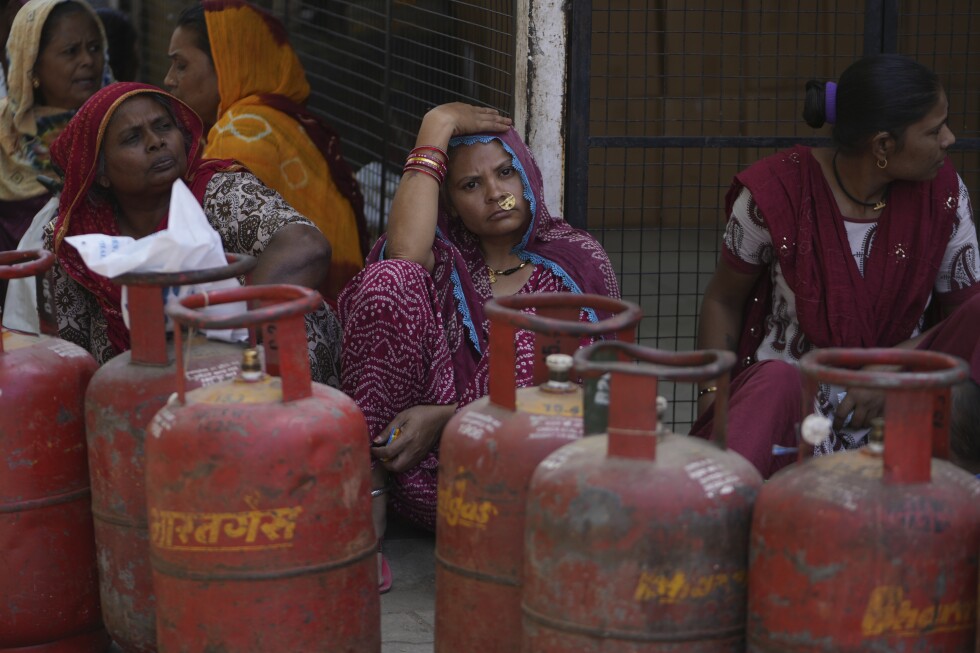
India is prioritizing household needs for its limited supply of liquefied petroleum gas or LPG, which is used for cooking and to power cars.
It has absorbed more than half of the increase driven by global market disruptions under a federal scheme to keep prices low for poor households, said Indian Petroleum Minister Hardeep Singh Puri.
But shortages are already seeping into restaurants and hotels in the world’s second-largest LPG importer, as eateries shorten hours, close temporarily or trim long-simmered curries and deep-fried snacks from their menus.
Advertisement
1 of 7 |
Advertisement
An empty liquefied petroleum gas cylinder is seen beside a temple while a customer waits at a depot for the cylinder to be refilled in Hyderabad, India, Wednesday, March 11, 2026. (AP Photo/Mahesh Kumar A.)
2 of 7 |
A woman talks on mobile as she waits to collect household cylinder of liquefied natural gas from an authorized dealer in Ahmedabad, India, Monday, March 16, 2026. (AP Photo/Ajit Solanki)
Advertisement
3 of 7 |
A worker distributes household liquefied petroleum gas cylinders to customers in Srinagar, Indian controlled Kashmir, Saturday, March 14, 2026. (AP Photo/Dar Yasin)
Advertisement
4 of 7 |
A worker inspects liquefied petroleum gas cylinders, arranged for customer delivery at a distribution centre on the outskirts of Amritsar, India, Friday, March 13, 2026. (AP Photo/Prabhjot Gill)
5 of 7 |
Advertisement
A staff writes on a ledger as workers unload cylinders of liquified natural gas for households at a distribution point, in Kolkata, India, Wednesday, March 11, 2026. (AP Photo/Bikas Das)
6 of 7 |
Women wait to collect household cylinders of liquefied natural gas from an authorized dealer in Ahmedabad, India, Monday, March 16, 2026. (AP Photo/Ajit Solanki)
Advertisement
7 of 7 |
People queue to collect household cylinders of liquefied natural gas from an authorized dealer on a roadside in Srinagar, Indian controlled Kashmir, Saturday, March 14, 2026. (AP Photo/Dar Yasin)
Advertisement
1 of 7 |
Advertisement
An empty liquefied petroleum gas cylinder is seen beside a temple while a customer waits at a depot for the cylinder to be refilled in Hyderabad, India, Wednesday, March 11, 2026. (AP Photo/Mahesh Kumar A.)
1 of 7
An empty liquefied petroleum gas cylinder is seen beside a temple while a customer waits at a depot for the cylinder to be refilled in Hyderabad, India, Wednesday, March 11, 2026. (AP Photo/Mahesh Kumar A.)
Advertisement
Advertisement
2 of 7 |
A woman talks on mobile as she waits to collect household cylinder of liquefied natural gas from an authorized dealer in Ahmedabad, India, Monday, March 16, 2026. (AP Photo/Ajit Solanki)
Advertisement
2 of 7
A woman talks on mobile as she waits to collect household cylinder of liquefied natural gas from an authorized dealer in Ahmedabad, India, Monday, March 16, 2026. (AP Photo/Ajit Solanki)
Advertisement
Advertisement
3 of 7 |
Advertisement
A worker distributes household liquefied petroleum gas cylinders to customers in Srinagar, Indian controlled Kashmir, Saturday, March 14, 2026. (AP Photo/Dar Yasin)
3 of 7
A worker distributes household liquefied petroleum gas cylinders to customers in Srinagar, Indian controlled Kashmir, Saturday, March 14, 2026. (AP Photo/Dar Yasin)
Advertisement
Advertisement
4 of 7 |
A worker inspects liquefied petroleum gas cylinders, arranged for customer delivery at a distribution centre on the outskirts of Amritsar, India, Friday, March 13, 2026. (AP Photo/Prabhjot Gill)
Advertisement
4 of 7
A worker inspects liquefied petroleum gas cylinders, arranged for customer delivery at a distribution centre on the outskirts of Amritsar, India, Friday, March 13, 2026. (AP Photo/Prabhjot Gill)
Advertisement
Advertisement
5 of 7 |
Advertisement
A staff writes on a ledger as workers unload cylinders of liquified natural gas for households at a distribution point, in Kolkata, India, Wednesday, March 11, 2026. (AP Photo/Bikas Das)
5 of 7
A staff writes on a ledger as workers unload cylinders of liquified natural gas for households at a distribution point, in Kolkata, India, Wednesday, March 11, 2026. (AP Photo/Bikas Das)
Advertisement
Advertisement
6 of 7 |
Women wait to collect household cylinders of liquefied natural gas from an authorized dealer in Ahmedabad, India, Monday, March 16, 2026. (AP Photo/Ajit Solanki)
Advertisement
6 of 7
Women wait to collect household cylinders of liquefied natural gas from an authorized dealer in Ahmedabad, India, Monday, March 16, 2026. (AP Photo/Ajit Solanki)
Advertisement
Advertisement
7 of 7 |
Advertisement
People queue to collect household cylinders of liquefied natural gas from an authorized dealer on a roadside in Srinagar, Indian controlled Kashmir, Saturday, March 14, 2026. (AP Photo/Dar Yasin)
7 of 7
People queue to collect household cylinders of liquefied natural gas from an authorized dealer on a roadside in Srinagar, Indian controlled Kashmir, Saturday, March 14, 2026. (AP Photo/Dar Yasin)
Advertisement
Advertisement
The scale of demand in India, the world’s most populous nation, limits how long it can cap prices to shield consumers. The situation could worsen within a week if government subsidies lapse, said Duttatreya Das of the think tank Ember, noting gas supplies were the most immediate concern.
Advertisement
“You can’t store a lot of gas,” Das said, adding that fertilizer factories and small industries will feel the pinch first.
Liberia-flagged tanker Shenlong Suezmax, carrying crude oil from Saudi Arabia, that arrived clearing the Strait of Hormuz, is seen at the Mumbai Port in Mumbai, India, Thursday, March 12, 2026. (AP Photo/Rafiq Maqbool, File)
Advertisement
Liberia-flagged tanker Shenlong Suezmax, carrying crude oil from Saudi Arabia, that arrived clearing the Strait of Hormuz, is seen at the Mumbai Port in Mumbai, India, Thursday, March 12, 2026. (AP Photo/Rafiq Maqbool, File)
Advertisement
Advertisement
Advertisement
Advertisement
Indonesia, a country of 287 million people and Southeast Asia’s most populous nation, also faces hard choices.
While the government has promised to maintain fuel prices throughout Eid al-Fitr, the Muslim holiday marking the end of the fasting month of Ramadan, Adhiguna of the Energy Shift Institute said there is “no clarity about what will happen after that,” adding that this implies fuel prices could increase.
People carry their belongings as they arrive for a free bus trip to their hometowns to celebrate Eid-al Fitr, organized by the Jakarta provincial government in Jakarta, Indonesia, Tuesday, March 17, 2026. (AP Photo/Achmad Ibrahim)
Advertisement
People carry their belongings as they arrive for a free bus trip to their hometowns to celebrate Eid-al Fitr, organized by the Jakarta provincial government in Jakarta, Indonesia, Tuesday, March 17, 2026. (AP Photo/Achmad Ibrahim)
Advertisement
Advertisement
Advertisement
Bus crew wait for passengers as the mass exodus out of Jakarta and other major cities is underway ahead of Eid al-Fitr in Jakarta, Indonesia, Tuesday, March 17, 2026. (AP Photo/Dita Alangkara)
Advertisement
Bus crew wait for passengers as the mass exodus out of Jakarta and other major cities is underway ahead of Eid al-Fitr in Jakarta, Indonesia, Tuesday, March 17, 2026. (AP Photo/Dita Alangkara)
Advertisement
Advertisement
Advertisement
Advertisement
Thailand is also caught in a dilemma. If it ends subsidies that keep prices low, living costs will jump and that could spark a panic if reserves fall further, said Areeporn Asawinpongphan of the Thailand Development Research Institute.
If the conflict continues, Indonesia will have to choose between keeping the subsides that protect customers or cutting funding to keep to budgetary limits. However, this could fuel inflation. Given Indonesia’s limited 20-day reserve, Adhiguna warned that price fluctuations in Indonesia’s fuel market will be swift.
“It will eventually reach a breaking point,” Adhiguna said.
Europe feels the squeeze, too
The European Union is doubling down on its long-term clean energy strategy to cut consumption and rein in prices across the 27-nation bloc that have risen sharply since the war’s start. Officials met in Brussel this week, where they considered ways to improve the region’s energy security.
Advertisement
“We are looking at how we can reduce people’s energy bills,” said European Commissioner for Energy Dan Jørgensen. “We are working on immediate measures to help businesses and our most vulnerable citizens.”
___
Ghosal reported from Hanoi, Vietnam. Associated Press writers Elaine Kurtenbach in Bangkok, Thailand, Sam McNeil in Brussels and Piyush Nagpal in New Delhi, India contributed to this report.
___
Advertisement
The Associated Press’ climate and environmental coverage receives financial support from multiple private foundations. The AP is solely responsible for all content. Find AP’s standards for working with philanthropies, a list of supporters and funded coverage areas at AP.org.
Amid the debate over the new rules, what is more important, the entertainment spectacle or driver satisfaction? And with changes being considered, what sort of things are likely to be changed? – Kevin and Tim
For this answer, I have combined two separate questions that came in. I hope Kevin and Tim don’t mind.
F1 is a sport first and entertainment second. The hope is that it should be entertaining, and effort is made to make sure that’s the case, but sport can’t be entertaining all the time. You get 0-0 draws in football as much as 5-4 thrillers. Not all rugby matches are as compelling as that between France and England on Saturday evening.
Most of the stakeholders in F1 recognise that as a truism.
Advertisement
The new rules were not arrived at from an entertainment-first standpoint, at least not initially. The engine rules were changed to attract new manufacturers – successfully – and only afterwards was it realised that the chassis rules would be problematic.
Primarily, issues revolve around the fact that with such powerful electrical systems, a nominal 50-50 split between internal combustion and electrical power, batteries of the current size, and front-axle recovery not allowed, the cars are energy starved.
It’s fair to say that many people in F1 recognise the chassis rules are a mish-mash of compromises arrived at as a sticking plaster for the engine rules, while at the same time trying to align a series of competing political positions.
It’s hardly a surprise that, in those circumstances, the rules are less than perfect, to say the least.
Advertisement
The fundamentals of the rules won’t change, but it’s recognised that some areas could be tweaked to reduce some of the bigger compromises.
It’s clear from some remarks Mercedes team boss Toto Wolff made after the race in China that certain changes that have come with the new rules are considered welcome.
“From an entertainment perspective, what we’ve seen today between Ferrari and Mercedes was good racing,” Wolff said.
“Many overtakes. We were all part of Formula 1 where there was no overtake, literally. Sometimes we’re too nostalgic about the good old years. But I think the product is good in itself. We saw quite some racing in the midfield also. And that is, I think, the positive.
Advertisement
“Qualifying flat-out would be nice. But when you look at the fans and the excitement that is there, live, the cheering when there’s overtakes and also on social media, the younger fans, the vast majority, through all the demographics, like the sport at the moment.
“We can always look at how we’re improving it. But at the moment, all the indicators say and all the data say people love it. And I spoke with Stefano (Domenicali, the F1 president). He says that, too. So, it is driving the car that, for some, is not most pleasant.”
That sounds a bit like Wolff is saying the drivers can lump it if they don’t like it.
That being said, there is widespread unease at the way the need for energy management has compromised the purity of not only the driving experience but also the essence of the sport – especially in qualifying, and especially in fast corners, many of which some drivers say are now being used for energy recovery and are no longer taken at the limit of grip.
Advertisement
At the moment, there are two levels of energy recovery. When flat out, a maximum of 250kw, in what is known in F1 jargon as ‘super-clipping’. But 350kw once the driver has lifted and/or braked.
One obvious change would be to allow the cars to super-clip – the most efficient way of recovery – at 350kw. That feels like it could happen pretty soon, perhaps even for the Miami Grand Prix in early May.
Another proposal has been to reduce the power from the electrical components from the current 350kw, to 300kw or 250kw. Then deployment would last longer.
More extensive changes, such as changing the split between internal combustion and electrical power so it was more in favour of the engine, or increasing the fuel-energy limit, would require significant changes to the power-units. So that could not happen before next year at the earliest.
Advertisement
It remains to be seen whether there is appetite for that – especially as people are already beginning to wonder what the next engine regulations will be, and exactly when they will come in.
The Doc Martin star has opened up on how he prepared to play the disgraced BBC newsreader
Doc Martin star Martin Clunes has opened up about the challenges of playing disgraced former BBC newsreader Huw Edwards. Edwards, who was born in Bridgend, was one of the highest-paid newsreaders at the public service broadcaster.
Clunes said he hasn’t “judged” the disgraced newsreader in his performance. “I never get into whether I like or dislike a character I’m playing,” he explained.
Having never met Edwards however, Clunes admits he spoke to people who worked with him and “didn’t hear any compliments”, he told The Times.
Advertisement
The 64-year-old, who recently appeared in the new adaption of Wuthering Heights, said he knew portraying Edwards would be a challenge from the beginning.
Power: The Downfall Of Huw Edwards, focuses on how a young vulnerable man, played by Welsh actor Osian Morgan, came into contact with one of the most powerful figures in television.
“Beyond the salacious curiosity around this story, I really thought there was another story worth telling, that of ‘Ryan’ and his family,” the London-born actor said.
Advertisement
“Obviously the press and the media have focussed on the fallen big man, Huw Edwards, which, of course, is a big story. But behind that, there’s this lad and his family whose lives got turned upside down and rather spoiled. I’m not on any social media and I had no idea that this sort of thing went on, I really didn’t.”
Edwards’ downfall came after a report by the Sun in July 2023 alleged that a “top BBC star” had paid a 17-year-old for sexual pictures. Days later his wife named him as the presenter at the centre of the scandal and the newsreader resigned the following April.
Edwards was charged with making indecent images of children in June 2024 following a Metropolitan Police investigation. A month later the former presenter and father of five admitted three offences of making indecent images of children at Westminster Magistrates’ Court. He was sentenced to a six-month jail sentence, suspended for two years.
Clunes said that while preparing for the role, he looked through archive clips of Edwards in an attempt to understand the man behind the newsreader. “I was familiar with Huw Edwards, the newsreader, and how he presented himself when he was reading the news,” he explained.
Advertisement
“But I’ve seen other actors make the mistake of just inhabiting that projected face of a famous person or politician, I knew that we needed the other side of him too.
“Finding archive clips of Edwards away from the news was less easy, but I wanted to make sure I did. I noticed from looking at that archive that he was different when he wasn’t reading the news, and I wanted to make that distinction. If you listen to his rhythms, he’s far more Welsh when he’s not newsreading.”
But even for Clunes, Edwards remains something of a mystery. “The circularity of it is something I’ve thought about. Because he was on the telly in all those homes, every night, and he would have reported on somebody else’s fall from grace. And I wonder how he would have felt.”
Advertisement
Clunes, who is known more for his comedy roles, said it can be uncomfortable dealing with sensitive subject material, but dealt with it by being a “little facetious”, despite taking his work seriously.
“Sometimes it’s harder when a role is more nebulous and you can’t pin your performance on something, but we had transcripts of text messages between Huw Edwards and ‘Ryan’, and they do appear in the script, so we breathed life into them,” he said.
“It was hard towards the end of the story, hearing Osian’s vulnerable voice when Edwards was bullying him, and the hurt of this boy reaching out in a sensitive way. I didn’t feel very nice at the end of those scenes, so again it was definitely good to have Osian in the room to talk to afterwards.
“I’m not a very heavy person, so my way of dealing with things is generally to be a little facetious and sort of lighthearted, even though I take the work very seriously.”
Advertisement
Speaking about filming the phone scenes, he says they always made sure to be in the same room. “Luckily, I did have Osian there with me, who plays Ryan, and he was terrific,” said Clunes.
“A lot of our scenes are seemingly in isolation on phone calls, so we decided to both be there in the room for the other actor. Usually, if you film a phone call, the director or assistant director will read out the other lines, and you have to act to that. But because of the intimate nature of so many of these phone calls, we felt we couldn’t do that.
“There’s an intimacy on the phone. Having us both in the room for filming really helped to create that feeling. There was only one time it wasn’t possible to be in the same place, and I phoned Osian directly for that scene. He’s a brilliant young actor, I was just bowled over by him and really enjoyed working with him.”
When asked how he feels fans will react to seeing him in this role, Clunes says: “I’ve played a murderer before and I’m vile in Wuthering Heights, so this isn’t my first dark role, but I always just take work from what’s on offer, and I’ve never had a plan.
Advertisement
“I’ve always been lucky enough to balance light-hearted jobs like Doc Martin with dramas in-between. I’m not desperate to reshape myself – I’d play someone like Doc Martin again in a heartbeat.”
Power: The Downfall Of Huw Edwards airs on Channel 5 on Tuesday, March 24 at 9pm.
Get daily breaking news updates on your phone by joining our WhatsApp community here. We occasionally treat members to special offers, promotions and ads from us and our partners. See our Privacy Notice
ROME (AP) — Bodies washing ashore day after day. Phone calls from relatives going unanswered. Migrants’ tents abandoned overnight.
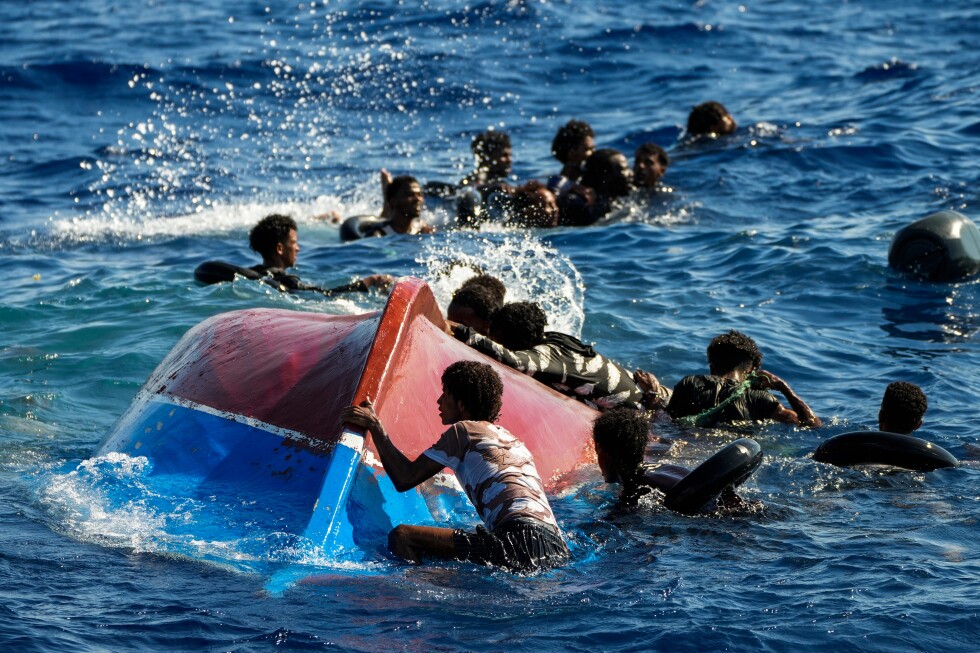
Migrants trying to reach Europe are vanishing in droves in what are known as “invisible shipwrecks” but governments responsible for search and rescue are withholding information about what they know.
The beginning of 2026 ranks as the deadliest start to any year for people trying to cross the Mediterranean — an unprecedented 682 confirmed missing as of March 16 — according to the United Nations’ International Organization for Migration. But the real death toll is almost certainly much higher.
Human rights groups are increasingly struggling to verify tolls as Italy, Tunisia and Malta have quietly restricted information on migrant rescues and shipwrecks along the deadliest migration route in the world. The news barely makes headlines, in part because the lack of transparency prevents journalists from confirming reports.
Advertisement
“It’s a strategy of silence,” said Matteo Villa, a researcher focusing on migration and data at the Italian Institute for International Political Studies think tank.
The organization Refugees in Libya and other human rights groups have been sounding the alarm since late January, reporting more than 1,000 people missing after Cyclone Harry hit the region. But authorities have not confirmed, denied or corrected those reports.
In the weeks that followed the cyclone, more than 20 decomposing bodies washed ashore in Italy and Libya while other human remains were spotted floating in the middle of the sea.
For the families of missing migrants, not knowing their fate is excruciating.
Advertisement
“Europe should know that these people who got drowned in the sea have family members, have dreams, have passions,” Josephus Thomas, a migrant from Sierra Leone and community leader in Tunisia’s coastal town of El Amra, told AP.
FILE– Migrants from Syria and Libya in a wooden boat call for help as they are assisted by Spanish NGO Open Arms during a rescue operation inside Malta’s SAR zone south of the Italian island of Lampedusa in the Mediterranean sea, Thursday, Aug. 11, 2022. (AP Photo/Francisco Seco)
Advertisement
FILE– Migrants from Syria and Libya in a wooden boat call for help as they are assisted by Spanish NGO Open Arms during a rescue operation inside Malta’s SAR zone south of the Italian island of Lampedusa in the Mediterranean sea, Thursday, Aug. 11, 2022. (AP Photo/Francisco Seco)
Advertisement
Advertisement
Advertisement
Sparse information means fewer deaths recorded
Even the U.N.’s migration agency is increasingly unable to verify cases of migrants who die in what is known as “invisible shipwrecks” because of the growing lack of information.
Last year, at least 1,500 people were reported missing whose fates IOM could not confirm, said Julia Black, who leads the organization’s Missing Migrants Project. The issue persists in 2026.
“We started a new secondary data set of what we are calling unverifiable cases because it’s just become so many,” Black said. For this year, they already have more than 400 missing they could not verify.
Advertisement
Many humanitarian organizations that previously filled some of the information gaps are no longer able to do so because of the global wave of funding cuts and government-imposed restrictions across the region.
“We’ve seen the restriction of access for humanitarian actors, which is not right. And now we’re seeing even the restriction of information,” Black said.
The Associated Press repeatedly asked authorities in Tunisia, Italy and Malta why they aren’t sharing information related to migrant rescues at sea and what their policies are. Not one responded.
Advertisement
In this photo taken on Sunday, Sept. 8, 2019, the sun shines over international waters north of Libya in the Mediterranean Sea. (AP Photo/Renata Brito)
Advertisement
In this photo taken on Sunday, Sept. 8, 2019, the sun shines over international waters north of Libya in the Mediterranean Sea. (AP Photo/Renata Brito)
Advertisement
Advertisement
Countries quiet on reports of boats missing after cyclone
Over the years, authorities in the Mediterranean have gradually reduced information related to migrants. But their silence was even more pronounced in late January after Cyclone Harry unleashed heavy rainfall, winds of 100 kph (62 mph), and 9-meter-tall (30 feet) waves.
Hundreds of people had departed from Tunisia’s coastal region of Sfax and disappeared, according to information the group Refugees in Libya gathered from migrants in Tunisia and their relatives abroad.
Advertisement
The group acknowledged it was difficult to be precise “because there is no central system recording departures, losses, or recoveries,” but it warned that the death toll was likely even higher.
“We are looking at boats that never counted how many kids are inside,” Refugees in Libya founder David Yambio told AP.
The AP sent five email requests to the Italian coast guard seeking information on the boats reported missing and search efforts but received no response. An officer who answered the phone said the coast guard did not have “any further verified and confirmed information regarding the circumstances.” AP also filed a Freedom of Information request, which is pending.
The coast guard also declined to comment on an alert it issued on Jan. 24 asking vessels sailing between the Italian island of Lampedusa and Tunisia to be on the lookout for eight small boats in distress carrying some 380 people. The alert was made public by Italian journalist Sergio Scandura.
Advertisement
This picture released by SOS Humanity on Monday, March 16, 2026, shows rescue operations in the Mediterranean Sea one of the deadliest migration route in the world (Barbara Sartore/SOS Humanity via AP)
Advertisement
This picture released by SOS Humanity on Monday, March 16, 2026, shows rescue operations in the Mediterranean Sea one of the deadliest migration route in the world (Barbara Sartore/SOS Humanity via AP)
Advertisement
Advertisement
Advertisement
One survivor rescued from the boats
There is only one known survivor from the boats reported missing during Cyclone Harry. He was floating in the water when a merchant vessel rescued him on Jan. 22. The man told crew members he had been traveling with another 50 people, some of whose bodies could be seen in the water in video of the rescue. Thanks to his testimony, their deaths were included in IOM’s tally.
Advertisement
According to the captain, the survivor was evacuated to Malta. The Maltese Armed Forces did not respond to multiple requests about their involvement or reports that they recovered the man and the bodies.
The Tunisian Foreign Ministry and the Tunisian National Guard also have not responded to multiple requests for information by email and phone.
Frontex, a European Union agency that assists nations with border surveillance, told AP that it spotted eight boats carrying about 160 migrants between Jan. 14 and 24 when the cyclone hit. It said six boats were rescued by Italian authorities, but the fate of the other two remains unknown.
On Feb. 8, migrants prayed and cried during a memorial ceremony in the olive groves near Sfax, presuming their loved ones could not be alive after so many days without news.
Advertisement
“All of us here are in deep trauma, are in deep agony,” Dr. Ibrahim Fofana, a migrant in Tunisia whose relatives have been missing since late January, said in a video shared by Refugees in Libya. He pleaded for authorities to identify the bodies that washed ashore in Italy.
FILE– Migrants from Syria and Libya in a wooden boat call for help as they are assisted by Spanish NGO Open Arms during a rescue operation inside Malta’s SAR zone south of the Italian island of Lampedusa in the Mediterranean Sea, Wednesday, Aug. 10, 2022. (AP Photo/Francisco Seco)
Advertisement
FILE– Migrants from Syria and Libya in a wooden boat call for help as they are assisted by Spanish NGO Open Arms during a rescue operation inside Malta’s SAR zone south of the Italian island of Lampedusa in the Mediterranean Sea, Wednesday, Aug. 10, 2022. (AP Photo/Francisco Seco)
Advertisement
Advertisement
Advertisement
Advertisement
Tighter information follows migration crackdown
Until mid-2024, Tunisian authorities regularly shared the number of migrants they were intercepting at sea, eager to show their European partners compliance with a 2023 deal to curb migration in exchange for financial aid. But the deal was also followed by a brutal crackdown against migrants on land that resulted in thousands being detained or dumped in the desert.
Nongovernmental organizations such as the Tunisian Forum for Economic and Social Rights, known by its French acronym FTDES, which used to compile and share reports on migrant interceptions, were also caught in the crackdown.
In June 2024, Tunisia’s Ministry of Interior stopped releasing any information on migrants, citing security reasons, said Romdhane Ben Amor, FTDES’ spokesperson. But in his opinion, the motives were political. The numbers were incompatible with the narrative that Tunisia was not Europe’s border guard, he said.
Italy’s erosion of information on migrant rescues is even older than Tunisia’s. The Italian coast guard used to provide detailed monthly data on migrants rescued. The monthly reports became quarterly before stopping completely in 2020, Villa said. In 2022, previous reports were also removed from the coast guard’s website.
Advertisement
This year, the Italian coast guard did not share any migration-related press releases despite nearly 5,000 migrants disembarking on Italian shores, according to Italy’s Interior Ministry statistics.
“It is very clearly a political strategy to repress as much information as possible from the public,” Villa said.
___
Brito reported from Barcelona, Spain. Trisha Thomas contributed to this report from Rome.
Fuel prices in some parts of London have surged to as much as 253.9p per litre as the Middle East conflict continues into its third week.
Petrol prices across the UK are up by 7% since November 2023, according to new figures from the RAC, marking a rise from 132.8p per litre to 141.74p per litre.
Global oil supply chains have struggled amidst the closure of the Strait of Hormuz – a waterway in the Persian Gulf where more than a fifth of the world’s oil passes through. And with the strait showing no sign of reopening, more fuel hikes are likely on their way.
In the capital, the Chelsea Cloisters Gulf garage is selling unleaded petrol for 253.9p per litre, while diesel is 264.9p. This is significantly higher than UK fuel prices, which are roughly 141.74p for unleaded petrol and 161.20p for diesel.
Advertisement
The garage does not display its prices outside the garage, only at the pump. It is not known what the price of the petrol at the garage was prior to the war, but The Standard reported the same garage was selling unleaded for 238p per litre just four days ago, representing an increase of almost 16p.
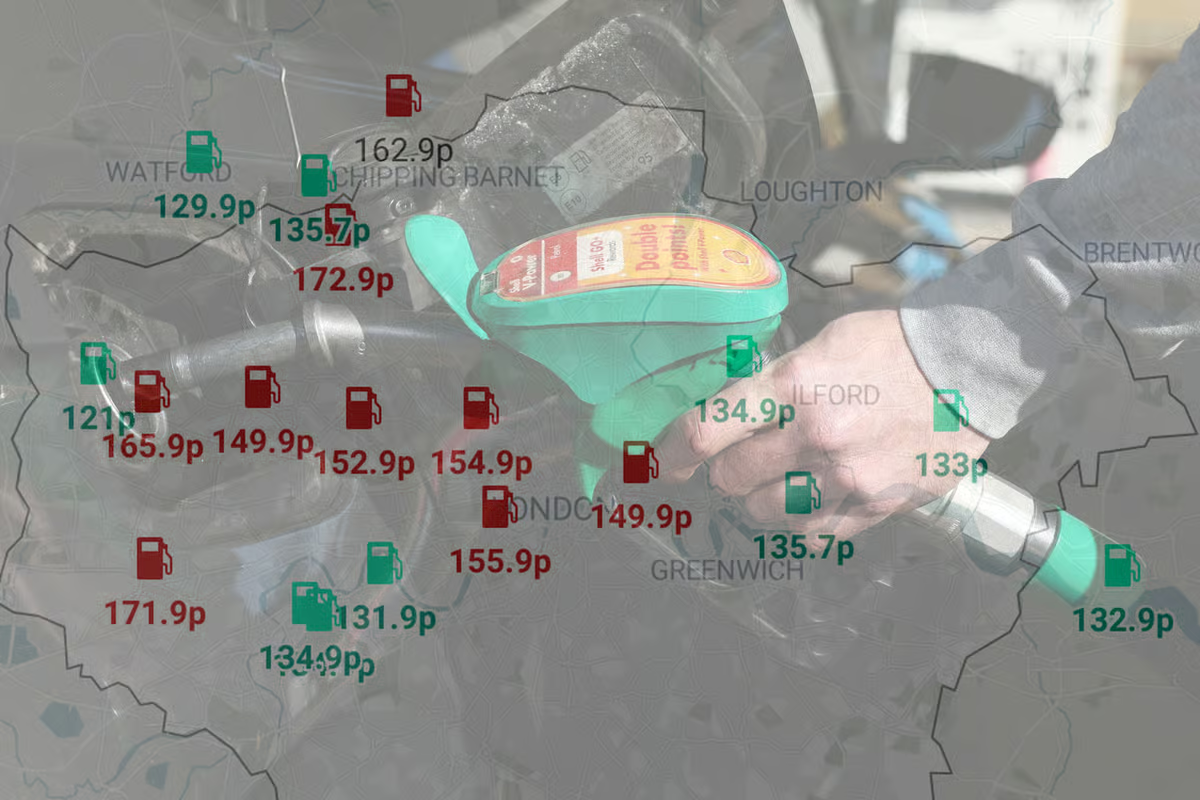
Elsewhere in the capital, prices are well below average. One petrol station in Ruislip, also owned by Gulf, is selling unleaded for 121p per litre, according to comparison site Petrol Prices.
Pumps in the east of London seem to have more favourable prices, in comparison to areas in west and central London.
In figures released by the RAC, Asda was seen to have the cheapest petrol of all the UK supermarkets at 137.8p. Tesco followed at 138.6p, Sainsbury’s at 139p, and Morrisons in last place at 139.1p.
Advertisement
In data analysed by The Standard, American wholesaler Costco has two locations amongst some of the capital’s cheapest petrol retailers.
A service launched by the government in February this year, Fuel Finder, has encouraged retailers to update their prices regularly. Petrol Prices publish the cost of fuel across pumps in London at regular intervals.
Here are some of the cheapest and most expensive petrol stations for unleaded petrol in and around London:
The move, expected to save around £20 million a year, is part of wider reforms under the upcoming Great British Railways (GBR), which will oversee Britain’s rail network and train operations.
Transport Secretary Heidi Alexander said: “These changes will ensure taxpayers’ money goes toward freezing fares and upgrading services, rather than lost to fare dodgers.”
From the second half of 2026, passengers buying discounted tickets from machines will need to:
Advertisement
Scan their railcard or
Enter railcard details, such as the number and their name
Those purchasing via a website or app with a registered account will only need to input this information once, allowing automatic validation for future purchases.
Refund rules tightened for customers
At the same time, refund rules for flexible tickets are being tightened. Starting next month:
Off-Peak and Anytime tickets will only be refundable until 11.59pm the day before travel (unless services are disrupted).
Exceptional circumstances, like medical emergencies, will still be considered.
We’re making changes to ticket refunds. From 1 April 2026, some tickets will only be refundable up until 23:59 the day before they’re valid for travel.
Currently, passengers can return unused tickets within 28 days of expiry without giving a reason, a loophole that has led to refund abuse costing around £40 million annually.
Advertisement
Delay Repay compensation made simpler
The DfT also plans to streamline Delay Repay claims, allowing passengers to claim compensation directly from wherever they buy their ticket, instead of contacting the train operator.
Online ticket retailer Trainline estimates passengers currently miss out on £80 million per year because one-click claims are limited to tickets bought directly from operators.
Under GBR, compensation systems across 14 different operators will be merged to make claiming refunds quicker, simpler, and less confusing.
What passengers need to do ahead of the changes
Passengers can prepare by:
Advertisement
Knowing their start date – if your turnover is above £50,000, ticket validation begins in mid-2026.
Choosing recognised software or apps – including free and paid options, with bridging software for those who still prefer spreadsheets.
Signing up early – don’t wait until the last minute to ensure smooth travel and refund claims.
Jacqueline Starr, CEO of the Rail Delivery Group, said: “The consolidated Delay Repay service will make it easier for all customers to request compensation, regardless of where they bought their ticket, with a more consistent process.”
The move is to better reflect the wide range of pubs in both the city and the vast, rural area the 1,100-member branch covers.
The City Winner is the Last Drop Inn in Colliergate and the White Bear in Stillington is the Country Pub of the Year, beating around 450 others in York Camra’s patch
Branch chairman Chris Tregellis told the Press: “For a modestly sized pub in a modestly sized village the White Bear certainly punches well above its weight.
RECOMMENDED READING:
Advertisement
“The regular beers are consistently excellent but it’s the commitment to frequently changing guest beers which takes this up a notch and makes every visit a treat.
“The commitment to the autovac system ensures that every pint emerges fresh and sparkling. The food in the restaurant bar is also something not to miss.”
The White Bear is currently on the market but since 1995 has been run by Phil and Sue Robinson. The pub has won the seasonal award three times but this is their first annual success.
York Camra’s Chris Tregellis outside the White Bear in Stillington (Image: Pic supplied)
Chris added of the couple: “They have never put a foot wrong. A worthy winner.”
Advertisement
The presentation evening will be Friday May 1.
The Last Drop Inn in Colliergate was once owned by the York Brewery, then the Black Sheep brewery, and now Paul Kemp, and is going on from “strength to strength.”
Like the Robinsons, Paul has also placed his pub on the market, but York Camra says “as with the White Bear, the Last Drop stands out because of quality and choice.”
Paul Kemp of the Last Drop Inn (Image: Darren Greenwood)
Chris continued: “There is always something new to try. Sitting in the front bar is a great place to watch the envious glances of tourists and locals as they pass down Colliergate.”
Advertisement
The Last Drop will be celebrating during its presentation night on Friday April 17.
Paul Kemp who took over the pub in 2023 says he is “absolutely made up” to be an annual winner.
He told the Press: “When we started this project, this award was one of the things we wanted to achieve.”
The pub has been a seasonal winner, it got listed in the Good Pub Guide and this latest award sees it competing regionally.
Advertisement
Paul has been praised for bringing the pub back ‘from the dead’, which he credits on traditional pub values of well-maintained beers, rotating guest beers, and recognisable permanent beers in a friendly and pleasant environment.
“Now it’s about staying there and trying to repeat it,” he said.
And to any potential buyer, Paul added this latest award “shows the potential of gaining a real ale flagship in the centre of York.”
Phil Robinson told the Press he is “ectatic, overwhelmed” to win after 30 years at the White Bear and 40 years in the trade.
Advertisement
Sue and Phil Robinson of the White Bear with Chris Tregellis at an earlier York Camra presentation (Image: Pic supplied)
Phil thanks their wonderful staff and customers for their support, adding he is doing his bit to keep traditional pubs going, which he says are disappearing.
Phil continued: “We support the community in return through sponsorships to the local football, cricket, squash and bowls teams. Other local charities get our support through our monthly charity qub quizzes (last Sunday of the month).
“We offer some great beer, with 5 casks, including our own White Bear Bitter (a 4% traditional ale lovingly brewed by Craig at Rudgate Brewery), Leeds Pale Ale from Kirkstall Brewery and three rotating guest beers from different local breweries; always including a stout, porter, or mild.”
Phil added: “To complement our beer we serve home cooked seasonal food prepared by my wonderful wife Sue and chef Dan.
Advertisement
“We hope this award will bring more business not just to The White Bear but to the village as a whole as we all need support to keep going in these testing times.”
York Camra will officially be announcing its other 2026 award winners later.
The passengers suffered burns from electric shock after the tourist balloon crashed into power lines in Mexico
Two holidaymakers from London were injured after their hot air balloon crashed into power cables before landing on a football pitch.
The passengers have been named locally as Claire Wolstenholme, 43, and her partner, Nicholas Wright, 49.
Claire is said to be in a critical condition after suffering burns from an electric shock.
The crash was reported before 9am yesterday in the Teotihuacan Valley around 25 miles north-east of Mexico City after the pilot allegedly lost control of the balloon.
Advertisement
The couple were treated at the scene before being taken to the hospital.
The balloon ended up on a nearby football field after landing on the power cables inTeotihuacan Valley
The company that took the two Brits out in the hot air balloon has been named by investigators as Happy Puerto.
The pilot, named locally as Santiago Torres, was taken in for questioning by state prosecutors with one unconfirmed report saying he had been arrested.
An investigation into the accident, which left people living near to the football pitch without electricity, was ongoing this morning.
Advertisement
Mexico’s Federal Civil Aviation Agency said in a statement late yesterday: The Federal Civil Aviation Agency (AFAC) reports that at 8.40am this morning, in the municipality of Teotihuacan, State of Mexico, an incident was reported involving a hot-air balloon coming into contact with power lines.
‘Two people were travelling in the aircraft, registered as XA-OZY and operated by Happy Puerto, who suffered burns from an electric shock.
‘They were transferred to Mexico City for treatment at a private hospital.
‘The AFAC is launching an administrative investigation into the incident.’
Advertisement
Hot air balloons have been involved in fatal accidents.
In June last year a hot air balloon caught fire and crashed in Praia Grande in the southern Brazilian state of Santa Catarina, killing eight of the 21 people on board.
In April 2023 a married couple burnt to death and their 13-year-old daughter was injured in a hot air balloon accident over the pre-hispanic ruin site of Teotihuacan close to where yesterday morning’s drama occurred.
The pair killed were named as Jose Nolasco, 50, and his wife Viridiana Becerril, 39.
Advertisement
Footage of the incident taken by an onlooker showed the hot air balloon deflating as flames engulfed the basket below where the Mexican family were enjoying their ride.
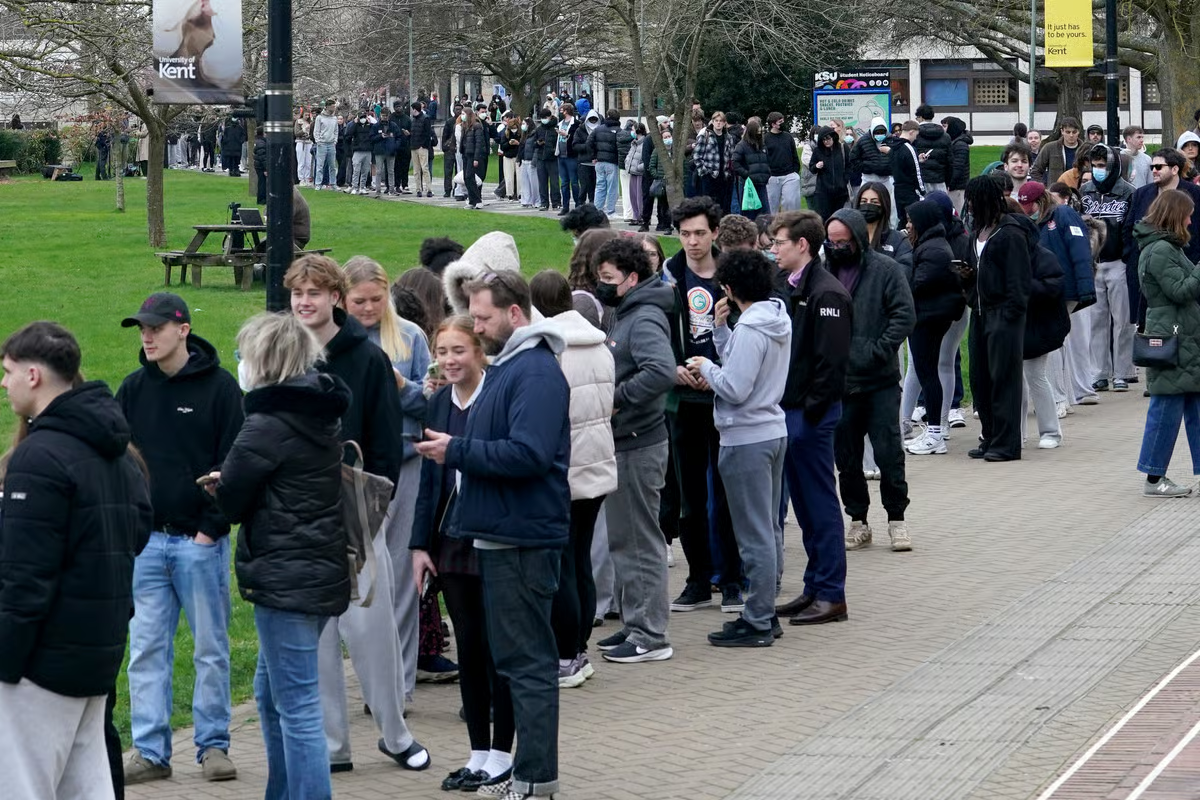
Trish Mannes, UKHSA regional deputy director for the South East, said: “Our investigations have identified that some cases visited Club Chemistry in Canterbury and it is important that anyone who visited the club between March 5 and March 7 now comes forward for preventative antibiotic treatment as a precaution, as well as those offered antibiotics at the university – these students are being contacted directly through the university.”
















































You must be logged in to post a comment Login