Connect with us
DAPA Banner

Business

Wickes profit doubles as DIY retailer targets solar panel leadership

Published

on

Business Live

Home improvement retailer hits £1.6bn revenue as it positions itself to lead fragmented solar installation market

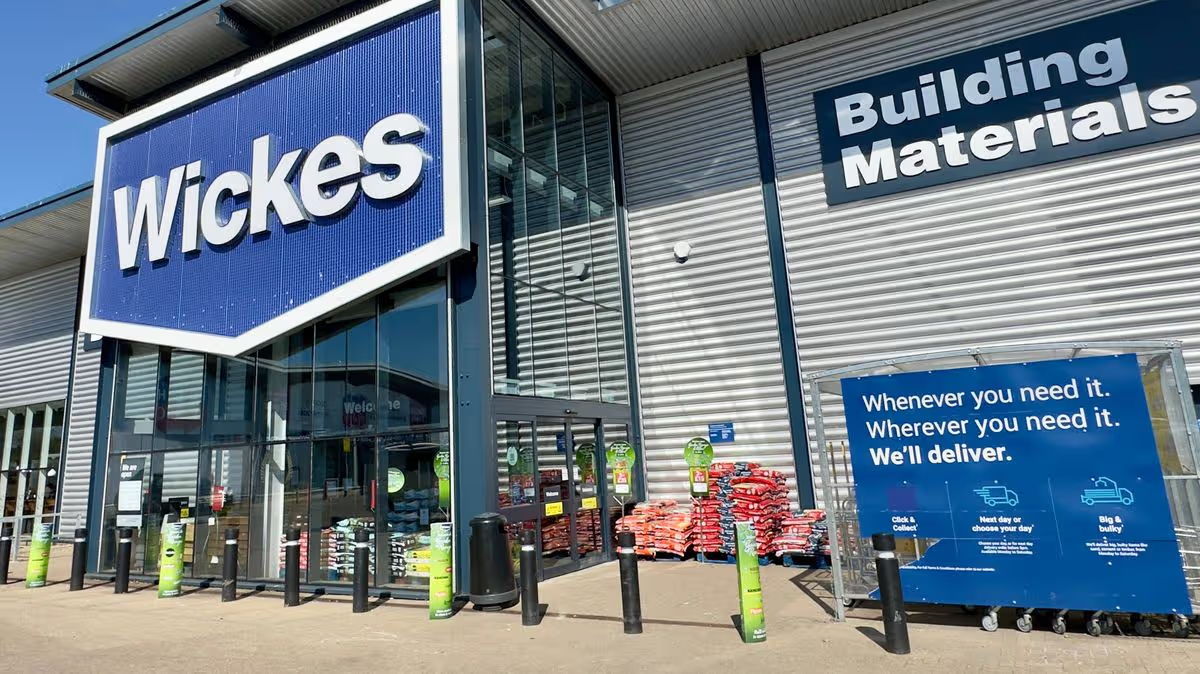
A Wickes home improvement and building materials store on a retail park in Chelmsford, Essex.

A Wickes home improvement and building materials store on a retail park in Chelmsford, Essex(Image: Nigel Harris via Getty Images)

Home improvement retailer Wickes has seen its profit double as the company aims to become a frontrunner in solar panel installation.

Advertisement

The company reported revenue of £1.6bn, an increase of six per cent, while pre-tax profit rose from £23m to £49m for the year ending December 2025.

Wickes was elevated to the FTSE 250 last year, seeing a turnaround after its revenue had been hit by a decrease in consumer demand for high-value items such as kitchen installations.

The DIY retailer’s share price rose in response to the favourable results, reaching 225p in early trading on Tuesday, a rise of five per cent from Monday’s close.

The company celebrated a record market share in retail, although its overall share in home improvement, kitchens and bathrooms is only at five per cent due to the £35bn size of this market, it stated, as reported by City AM.

Advertisement

Expenditure on DIY is increasing as the UK’s housing stock ages, with the majority of the UK’s 29m homes being over 60 years old, according to the tool seller.

A further one in five British homes are more than a century old, and UK houses are among the least energy efficient in Europe, Wickes said.

The group is banking on its solar installation brand as a route for growth, with the total market predicted to be worth £1.5bn per year by 2028.

The firm is ready to capitalise on this “fragmented” market, which currently lacks a clear leader, it said.

Advertisement

“With a trusted brand and significant experience in design and installation services at scale, Wickes is well placed to be a market leader in solar and other home energy solutions.”

Wickes has witnessed stronger performance in its design and installation offerings following a downturn in big-ticket purchases in recent years, with turnover for this division rising 4.4 per cent year on year.

Shoppers are responding favourably to the modifications implemented by Wickes as part of the transformation which propelled it into the FTSE 250, including making face-to-face design appointments more accessible and replacing its telephone reservation system with an online platform.

The home improvement retailer is also venturing into premium appliances and kitchen styling, such as by introducing a high-end pastel shade collection including “Ohio pink”.

Advertisement

As the company’s DIY retail division continues to deliver, Wickes is investing in its TradePro membership programme, which boasts 643,000 active participants – with transactions from these customers up nine per cent year on year.

Wickes launched five new outlets last year, taking its total number of UK locations to 230. The business intends to open four or five new sites this year, as the firm concentrates on refurbishing up to 20 stores with additional space for kitchen and bathroom displays.

“Continued investment in our proven growth levers positions us well for 2026, notwithstanding the uncertain consumer and geopolitical environment, the firm said. Wickes announced a final dividend of 7.3p, resulting in a total annual dividend of 10.9p, which is consistent with the previous year.


Advertisement
Continue Reading
Click to comment

You must be logged in to post a comment Login

Leave a Reply

Business

Beyond Meat dealing with ‘internal control' issue

Published

on

Beyond Meat dealing with ‘internal control' issue

Problem has delayed the publication of the company’s latest financial results and annual report.

Continue Reading

Business

Form 13F AMG Asset Management Group For: 17 March

Published

on


Form 13F AMG Asset Management Group For: 17 March

Continue Reading

Business

Nvidia's Negative Feedback Loop – GTC Update

Published

on

Nvidia's Negative Feedback Loop - GTC Update

Nvidia's Negative Feedback Loop – GTC Update

Continue Reading

Business

Warner Bros CEO to pocket up to $887 million from Paramount deal

Published

on

Warner Bros CEO to pocket up to $887 million from Paramount deal


Warner Bros CEO to pocket up to $887 million from Paramount deal

Continue Reading

Business

General Mills readies return of La Tiara taco brand

Published

on

General Mills readies return of La Tiara taco brand

Relaunch to expand distribution from regional to national.

Continue Reading

Business

More than 200 jobs at risk at carmaker Bentley

Published

on

More than 200 jobs at risk at carmaker Bentley

The news comes as financial results for 2025 show a seventh consecutive year of profitability.

Continue Reading

Business

HMRC criticised over ‘unfair’ interest gap as taxpayers charged 7.75% but paid just 2.75%

Published

on

HMRC has collected an additional £14.4 million in tax from insolvencies over two tax years up to 2023 since it regained its ‘preferential creditor’ status.

HM Revenue & Customs has come under fresh criticism over what tax experts describe as a “deeply unfair” imbalance between the interest it charges taxpayers and the rate it pays on refunds, raising wider concerns about trust, transparency and the efficiency of the UK’s tax system.

According to analysis from audit, tax and advisory firm Blick Rothenberg, taxpayers who fall behind on payments are currently charged daily late payment interest at a rate of 7.75 per cent. By contrast, those owed money by HMRC receive interest at just 2.75 per cent on repayments, even when delays stretch over many months.

Tom Goddard, assistant manager at the firm, said the disparity creates a system that appears heavily weighted in favour of the tax authority. He argued that while taxpayers face escalating financial penalties for delays, HMRC itself is not subject to equivalent consequences when repayments are slow.

The imbalance becomes more pronounced when penalties are factored in. Taxpayers who fail to settle liabilities within 12 months can face additional charges of up to 15 per cent of the outstanding amount, alongside further penalties if tax returns are submitted late. In contrast, there is no comparable compensation mechanism when HMRC delays repayments, even in cases where individuals or businesses suffer financial consequences as a result.

Goddard pointed to the real-world impact of these delays, citing cases where taxpayers have waited more than a year for repayments to be processed. In one instance, a client missed a significant investment opportunity after funds earmarked for deployment were tied up in a prolonged HMRC repayment process. Despite repeated attempts to resolve the issue, the delay persisted due to internal administrative complications and a lack of clear ownership within the organisation.

Advertisement

The broader concern, he suggested, is not only the financial disparity but the operational friction involved in resolving disputes. Taxpayers seeking to reclaim funds often face a lengthy and complex process, involving multiple departments and repeated follow-ups. For many, the cost of professional advice required to navigate the system can offset any financial benefit from the repayment itself.

This dynamic risks creating a perception that the system is both inefficient and adversarial. While HMRC attributes delays largely to administrative pressures, critics argue that the burden of those inefficiencies falls disproportionately on taxpayers, particularly at a time when many individuals and businesses are already under financial strain.

The issue also raises questions about HMRC’s broader transformation agenda. One of the stated priorities in its “Transformational Roadmap” is to improve day-to-day performance for individuals and businesses, with a shift towards a more automated, digital-first system intended to handle up to 90 per cent of queries.

While digitalisation is expected to streamline processes and reduce the estimated £20 billion annual cost of tax administration, there is scepticism about whether it will address underlying service challenges. Critics argue that without sufficient investment in expertise and support, automation alone may not resolve delays or improve outcomes for taxpayers.

Advertisement

Trust remains a central theme in the debate. HMRC has identified closing the UK’s £46.8 billion tax gap as a key objective, but advisers suggest that rebuilding confidence in the system is equally important. A more balanced approach to interest rates and compensation, they argue, could encourage greater cooperation and compliance from taxpayers.

There is also a behavioural dimension to consider. If taxpayers perceive the system as inequitable, they may be less inclined to engage proactively with HMRC or prioritise timely compliance. Conversely, a system that treats delays on both sides more evenly could foster a more collaborative relationship between the tax authority and those it serves.

For now, however, the disparity in interest rates remains a point of contention. As scrutiny of HMRC’s performance intensifies, pressure is likely to grow for reforms that address both the financial imbalance and the operational challenges that underpin it.

Without such changes, critics warn, the gap between policy intent and taxpayer experience will continue to widen, undermining confidence in a system that relies on voluntary compliance to function effectively.

Advertisement

Amy Ingham

Amy is a newly qualified journalist specialising in business journalism at Business Matters with responsibility for news content for what is now the UK’s largest print and online source of current business news.

Advertisement
Continue Reading

Business

UK insolvencies jump 18% as households hit breaking point amid rising costs

Published

on

More than one in five UK employees feel unable to discuss their mental health in the workplace, according to new research. The analysis reveals that 7.5 million workers struggle with anxiety, depression or stress that is caused or exacerbated by their jobs, yet do not feel safe disclosing their difficulties to employers.

Individual insolvencies across England and Wales have surged by 18 per cent year-on-year, in what experts are warning is clear evidence of a deepening household financial crisis as rising borrowing costs, persistent inflation and accumulated debt continue to weigh heavily on consumers.

New data from The Insolvency Service shows that 11,609 people entered insolvency in February 2026, marking a 6 per cent increase on January and a significant jump compared with the same month last year. The figures paint a stark picture of mounting financial strain, particularly among vulnerable households and increasingly, middle-income earners.

The total comprised 768 bankruptcies, 4,210 debt relief orders (DROs) and 6,631 individual voluntary arrangements (IVAs), with DROs reaching their highest monthly level since their introduction in 2009. The record number reflects both structural financial pressures and policy changes, including the removal of the application fee in April 2024, which has made the process more accessible.

However, industry observers say the scale of the increase goes far beyond administrative changes. Darryl Dhoffer, founder of The Mortgage Geezer, described the data as a clear signal that many households have reached a tipping point after years of financial pressure. He pointed to what he described as the “lag effect” of higher interest rates, which is now feeding through into household finances after a prolonged period of tightening monetary policy.

While the Bank of England’s base rate currently stands at 3.75 per cent, elevated borrowing costs have continued to squeeze mortgage holders and consumers carrying unsecured debt. At the same time, inflation, although easing from its peak, remains above target at around 3 per cent, limiting the extent to which households are seeing meaningful relief in day-to-day costs.

Advertisement

Tony Redondo, founder of Cosmos Currency Exchange, said the figures highlight how cumulative financial pressures are now manifesting in real-world outcomes. He noted that while the removal of fees has contributed to the rise in DROs, the broader trend reflects households “finally collapsing under accumulated debt from previous years”.

He warned that the outlook remains fragile, particularly in light of geopolitical uncertainty and the potential for renewed inflationary pressures linked to energy markets. Any sustained increase in inflation could force the Bank of England to keep interest rates higher for longer, further intensifying the strain on borrowers approaching refinancing deadlines.

Financial planners echoed concerns that the current data may represent the early stages of a wider deterioration. Nouran Moustafa, practice principal at Roxton Wealth, said the figures should not be viewed as a one-off spike but rather as part of a broader pattern of economic fragility.

She emphasised that behind the statistics lies significant human impact, with many households operating without any financial buffer. In such conditions, even relatively small increases in costs or interest rates can push individuals into insolvency.

Advertisement

The pressure is not limited to households. Company insolvencies rose by 7 per cent month-on-month to 1,878 in February, although they remain below levels seen during the peak of business failures between 2022 and 2025. Analysts suggest this reflects a mixed picture, with some businesses stabilising while others continue to face tightening margins and weakening demand.

Anita Wright, chartered financial planner at Ribble Wealth Management, said the data reflects a broader liquidity squeeze across the economy. She noted that rising bond yields are feeding into higher borrowing costs for businesses, while consumers facing higher living costs are cutting back on spending, further compressing margins.

This combination of weak growth and persistent inflation, often described as stagflationary conditions, creates a particularly challenging environment for both households and businesses. While some firms have been able to absorb pressures through cost-cutting or the use of reserves, that resilience is finite, and insolvency rates tend to rise once those buffers are exhausted.

The implications are also being felt in the workplace. Kate Underwood, founder of Kate Underwood HR and Training, warned that financial stress among employees is increasingly spilling over into business operations. She highlighted rising levels of absenteeism, reduced productivity and higher staff turnover as workers struggle to cope with mounting financial pressures.

Advertisement

For small businesses in particular, the challenge is acute. Unlike larger corporates, they often lack the financial flexibility to absorb rising wage demands or offer higher salaries, making them more vulnerable to workforce instability driven by cost-of-living pressures.

The latest figures also come at a time when expectations for interest rate cuts have been significantly scaled back. Prior to the recent escalation in geopolitical tensions, markets had anticipated multiple rate reductions in 2026. However, rising oil and gas prices have shifted expectations, with policymakers now more cautious about easing monetary policy.

This change in outlook could prove critical. As Redondo noted, the combination of higher rates, depleted savings and thin margins leaves both households and businesses exposed to further shocks. Should borrowing costs remain elevated or increase further, the risk of a broader wave of defaults and insolvencies could intensify.

For now, the data underscores a fundamental issue facing the UK economy: a growing number of households and businesses are operating with little to no margin for error. In such an environment, the difference between stability and financial distress can be measured in relatively small shifts in costs or income.

Advertisement

As policymakers weigh the next steps on interest rates and fiscal policy, the sharp rise in insolvencies serves as a clear warning signal that underlying financial pressures are not only persistent but increasingly visible across the economy.


Amy Ingham

Amy is a newly qualified journalist specialising in business journalism at Business Matters with responsibility for news content for what is now the UK’s largest print and online source of current business news.

Advertisement
Continue Reading

Business

Natura &Co Holding S.A. 2025 Q4 – Results – Earnings Call Presentation (OTCMKTS:NTCOY) 2026-03-17

Published

on

OneWater Marine Inc. (ONEW) Q1 2026 Earnings Call Transcript

This article was written by

Seeking Alpha’s transcripts team is responsible for the development of all of our transcript-related projects. We currently publish thousands of quarterly earnings calls per quarter on our site and are continuing to grow and expand our coverage. The purpose of this profile is to allow us to share with our readers new transcript-related developments. Thanks, SA Transcripts Team

Continue Reading

Business

Another former sub postmaster dies awaiting payout

Published

on

Another former sub postmaster dies awaiting payout

Tributes are paid to Parmod Kalia who ran a branch in Orpington, who has died aged 67.

Continue Reading

Trending

Copyright © 2025