
Crypto World
A former car dealer turned bitcoin miner just lost $450 million and is pivoting to AI



Cango (CANG), a bitcoin mining company that has transitioned from automotive services, reported full year 2025 revenue of $688.1 million and a net loss of $452.8 million. While, it sold 4,451 BTC in February 2026 to reduce debt and help finance its pivot into AI infrastructure.
The company rapidly scaled its mining operations in 2025, with $675.5 million of revenue coming from bitcoin and 6,594 BTC produced during the year. Despite this growth, profitability deteriorated sharply due to impairment charges on mining machines, fair value losses, and high production costs, which reached roughly $97,000 per Bitcoin on an all-in basis.
The bitcoin sale marks a strategic shift. Rather than accumulating BTC, Cango is now deploying it as a treasury asset. The company said the sale was used to “reduce the overall finance leverage and strengthen the balance sheet,” freeing up capital for new initiatives.
Management is now focused on repositioning the business toward AI. CEO Paul Yu said the firm is “advancing our pivot to become an AI infrastructure provider,” adding that its EcoHash platform aims to deliver “flexible, cost-effective AI inference solutions.” CFO Michael Zhang said losses were “primarily due to non-recurring transformation costs,” while emphasizing efforts to secure capital for AI investments.
This Bitcoin-to-AI pivot reflects a broader industry trend. CoinDesk research shows public miners have continue to sell bitcoin to fund AI developments. This shift is being driven by declining mining margins and the rising demand for high performance computing, prompting miners to repurpose infrastructure and monetize BTC holdings to access the faster growing AI market.
Cango shares trade around $0.68, down 43% over the past three months.

Mastercard agreed to buy BVNK, a stablecoin infrastructure company, for as much as $1.8 billion as it looks to strengthen its support for digital assets and onchain money transfers.
The deal expands Mastercard’s end-to-end support of digital assets and value movement across currencies, rails and regions, the payments company said Tuesday.
U.K.-based BVNK is a stablecoin company enabling businesses to move money in seconds across more than 130 countries. Its infrastructure, used by firms including Worldpay, Deel and Flywire, processes billions of dollars annually and is designed to bridge traditional fiat systems with blockchain-based payments.
By integrating BVNK’s technology, Mastercard said it aims to connect on-chain payments with its global network, enabling use cases such as cross-border transfers, remittances and business-to-business payments.
“We expect that most financial institutions and fintechs will in time provide digital currency services,” said Jorn Lambert, Mastercard’s chief product officer, in a statement. The deal will help bring “the benefits of tokenized money to the real world.”
The agreement comes several months after Coinbase ended $2 billion acquisition talks with the stablecoin startup. At the time, a Coinbase spokesperson declined to provide a reason for the talks’ collapse.
For Mastercard, the acquisition highlights its growing push into digital assets as stablecoin adoption accelerates. Just last week, it announced the launch of its Crypto Partner Program, which brings together more than 85 companies from across the digital asset and payments industries, an effort to link blockchain technology more directly with the infrastructure that underpins global commerce.
Stablecoin payment volumes reached at least $350 billion in 2025, according to the company, with increasing regulatory clarity prompting banks and fintechs to explore offerings tied to tokenized deposits and blockchain-based money movement.
The company also said the combined capabilities will focus on interoperability between fiat and digital currencies while maintaining compliance and security standards expected by financial institutions.
The transaction, which is subject to regulatory approvals, is expected to close before the end of the year.
UPDATE (March 17, 12:45 UTC): Adds details on transaction, background starting in third paragraph, Coinbase’s approach in sixth.
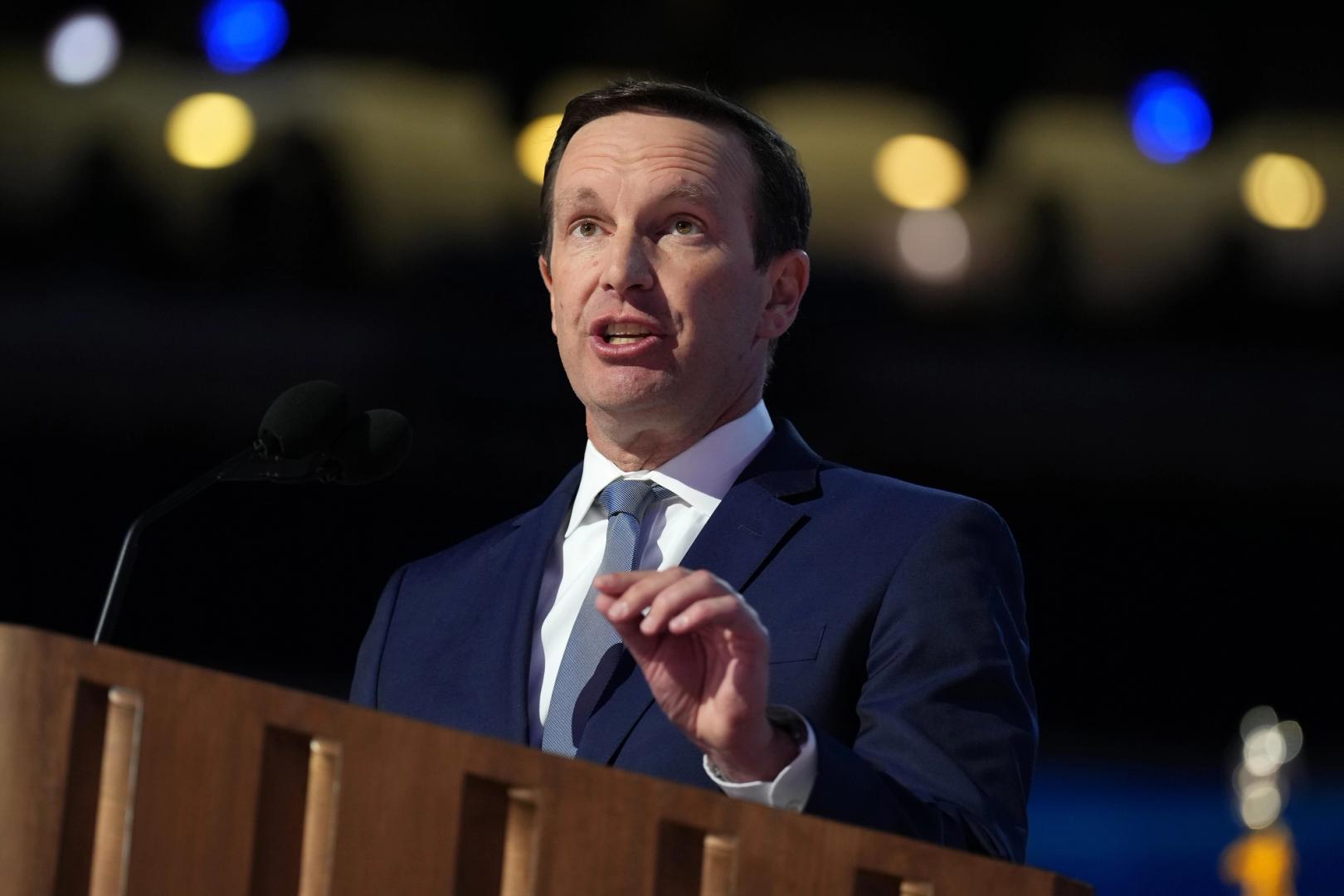
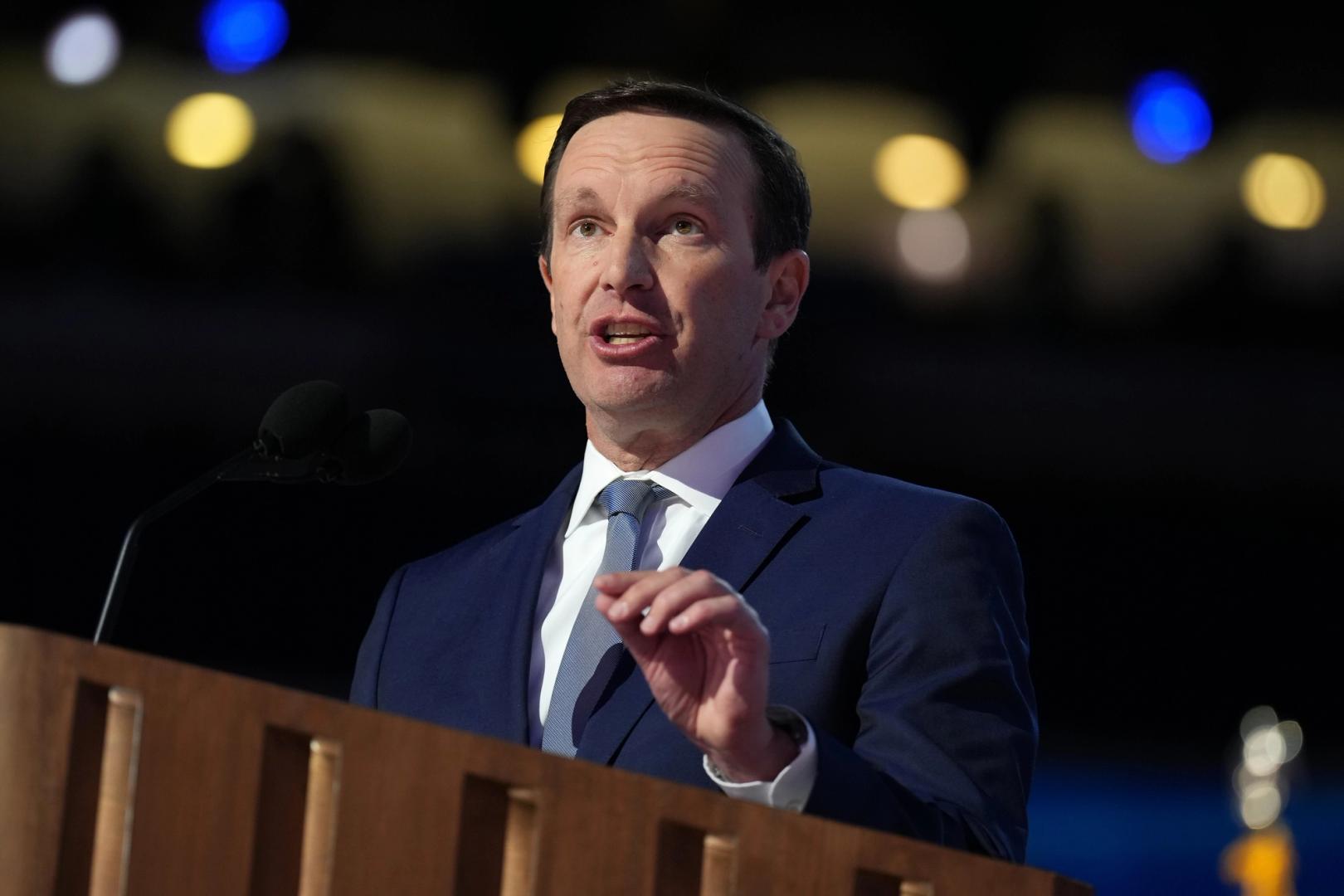
Democratic lawmakers are trying to put a stop to potential manipulation of prediction markets by government officials who bet on events they know are happening, such as U.S. military actions, according to a new bill being introduced Tuesday.
The Banning Event Trading on Sensitive Operations and Federal Functions (BETS OFF) Act would outlaw corrupt wagers from those who already know the outcome of matters including government action, terrorism, war, assassination and other events the bettor has inside knowledge of. It’s backed by Senator Chris Murphy, a Connecticut Democrat on the Senate Foreign Relations Committee who has been a prominent critic of the administration of President Donald Trump, and Representative Greg Casar, a member of the House Committee on Oversight and Government Reform.
The lawmakers said they’re responding to reports that prediction market accounts had placed significant bets before the U.S. operations in Venezuela and Iran. While legislation from Democrats won’t likely be a priority for a Congress that’s still majority-controlled in both chambers by Republicans, the midterm elections are considered likely to swing the House back to a Democratic majority — and possibly the Senate, according to those same prediction markets the lawmakers are focused on. If Democrats control the gavels of congressional committees, their preferred legislation has a better chance at a hearing.
According to the text of the bill, any kind of bet that has the potential for insider trading would be barred. This extends beyond government-related actions, a one-pager shared alongside the bill text said. Events like surprise singers at the Super Bowl halftime show or winners of awards programming would also be barred “because insiders know the outcome in advance.”
The text of the bill itself defines “specified events” as including “any event … the outcome of which is under the complete control of any person; or the outcome of which is known by any person in advance.”
Market manipulation and fraudulent betting is a matter in the hands of the platforms’ regulator, the U.S. Commodity Futures Trading Commission. Trump’s appointed chairman, Mike Selig, is a fan of prediction markets who has argued they can represent an antidote to faulty political polling and media reporting.
They also have a potential insider-trading problem, as seen in a couple of internal disciplinary actions recently taken by one of the leading firms, Kalshi. It suspended and fined two of its users, including a political candidate who had placed a bet on his own candidacy for California governor that he knew the outcome of.
In January, Representative Ritchie Torres, a New York Democrat who’s been a longtime ally of the crypto sector, introduced a bill with dozens of fellow lawmakers on board that was similarly meant to crack down on insider trading after suspicious bets on the actions in Venezuela. And just last week, Senator Adam Schiff of California introduced a bill to ban prediction market contracts tied to war, terror, assassinations or death outright, while fellow Democratic Senator Richard Blumenthal introduced a bill of his own to target insider trading and market manipulation.
Murphy’s bill would similarly block the CFTC from listing contracts touching these areas outright.


Despite Sam Bankman-Fried’s (SBF) best efforts to convince President Donald Trump to grant him a pardon, the latest update from Washington DC isn’t looking good for the FTX founder and convicted felon.
SBF stole over $8 billion from his customers, and was subsequently sentenced to 25 years in federal prison. For months, the convicted fraudster has flooded X with pro-Trump posts, blaming his conviction on “Biden’s lawfare machine” and praising MAGA policies.
However, members of Congress on either side of the aisle are less than impressed.
Senator Bernie Moreno, a pro-crypto Republican, told Politico, “The guy’s a piece of ***t. He shouldn’t be pardoned.”
Meanwhile, Senator Cynthia Lummis, a pro-crypto Democrat, expressed hope that Trump wouldn’t fall for SBF’s transparently self-interested rhetoric.
Mike Flood of Nebraska, another pro-crypto Republican, reacted with disbelief. “He crashed the market. He engaged in massive fraud,” Floodsaid. “Wall Street’s not bringing him back to fix anything,” he said.
Democratic Congressman Sam Liccardo piled on, cynically saying that only a large enough payout for a corrupt pardon would do the trick.
Painting on MAGA lipstick and saying whatever it takes
SBF’s X account, operated by a friend as a proxy for his Bureau of Prisons-permitted communication, has praised a host of Trump’s policies about which SBF has little understanding, including the new TrumpRX drug pricing initiative and “deep state” undermining of MAGA policies.
Out of the blue, SBF has praised Trump’s social media companies. “Dems like censoring ‘misinfo’ on social media. Truth Social & GETTR have always put free speech first.”
SBF discussed sharing a cell block with Sean “Diddy” Combs, and blamed his conviction on a “Clinton-appointed” Democrat judge.
He also sat for an unauthorized jailhouse interview with Tucker Carlson last year in a clear attempt to argue for a pardon. That interview reportedly landed him in solitary confinement.
SBF’s parents, ex-Stanford professors Joseph Bankman and Barbara Fried, have reportedly consulted with Kory Langhofer, a lawyer who worked on Trump’s 2016 and 2020 campaigns.
Unfortunately for him, none of his pardon attempts have worked. Indeed, Trump told The New York Times in January 2026 that he doesn’t plan to grant his pardon request.
A White House spokesperson reiterated to Fortune in February that Trump’s position hasn’t changed.
Read more: Sam Bankman-Fried had a plan to get out of prison, and he’s following it
Other crypto criminals received pardons
While SBF languishes in prison, Trump has pardoned a handful of crypto-adjacent criminals in the past 10 months.
Ross Ulbricht, founder of the narcotics and firearm marketplace Silk Road, walked free on Trump’s second day in office after serving over a decade.
Three BitMEX co-founders who operated a secret trading company that benefited from leveraged customer liquidations, and who pleaded guilty to violating the Bank Secrecy Act, received full pardons in March 2025.
Finally, Binance founder Changpeng Zhao (CZ), who served four months for money laundering violations, got his presidential pardon last October. Binance facilitated a $2 billion investment into Trump’s World Liberty Financial stablecoin shortly before CZ’s pardon.
Of course, SBF’s crimes are in a different category. A jury convicted him on seven counts of fraud and conspiracies and prosecutors called it “one of the largest financial frauds in history.”
SBF directed co-conspirators to alter FTX’s trading account so that Alameda Research could drain customer funds and use leverage on an unlimited basis.
Three associates, including his ex-girlfriend Caroline Ellison, testified that SBF ordered them to commit fraud.
The crypto industry spent four years scrubbing his stain off digital asset legislation.
Senator Lummis publicly dismissed his endorsement of the crypto market structure bill, the CLARITY Act, in February while Senator Elizabeth Warren said SBF’s endorsement should “set off alarm bells.”
Although Warren and Lummis agree on almost nothing when it comes to crypto, they agree on this.
A tough pardon to sell
The weight of SBF’s pardon request far exceeds any prior request.
CZ pleaded guilty to compliance failures while BitMEX ex-CEO Arthur Hayes neglected anti-money laundering protocols.
Although both men had equity stakes in trading companies who profited from trades on their exchanges, their criminal indictments didn’t involve any claims of customer losses. Their offenses were technical.
In contrast, Bankman-Fried stole $8 billion from customers. As such, Trump has said no to his pardon request, the White House has reiterated this stance, and many members of Congress are also in agreement.
Of course, Trump often changes his mind, and there are still three years left in his term.
Got a tip? Send us an email securely via Protos Leaks. For more informed news, follow us on X, Bluesky, and Google News, or subscribe to our YouTube channel.
Crypto World
Huntington Bancshares, First Horizon, M&T Bank, KeyCorp among lenders moving on tokenized deposits


A group of U.S. regional banks is developing the Cari Network, a tokenized deposit platform built on ZKsync, a layer-2 network, as lenders seek a regulated path to modernize digital payments.
The network, announced Tuesday, is being developed with banks including Huntington Bancshares, First Horizon, M&T Bank, KeyCorp and Old National Bancorp. It’s designed to let banks turn customer deposits into digital tokens that can move instantly between institutions — without those funds ever leaving the banking system.
That’s a key distinction from stablecoins, which are often issued by nonbank companies. Cari says its tokens will still represent regular bank deposits, meaning they stay on banks’ balance sheets and remain subject to existing regulations and FDIC insurance.
Under the hood, the system will run on “Prividium”, which is a private, permissioned blockchain built by Matter Labs, the main developer firm building the ZKsync network. Only approved participants — like banks — can use it, and transactions are designed to be both fast and private while still allowing regulators to audit activity when needed.
The effort reflects a growing push by banks to compete with crypto-native payment systems by offering similar speed and round-the-clock settlement, but within familiar regulatory guardrails.
The Mid-Size Bank Coalition of America has backed the project, according to a blog post, highlighting regional lenders’ interest in upgrading payments infrastructure without risking a loss of deposits to newer digital alternatives.
The Cari network will roll out more broadly in 2026, and the banks involved will test how these tokenized deposits are created, transferred between parties and converted back into regular U.S. dollars.
“Banks should be leading the next phase of digital money, not reacting to it,” said Cari CEO Gene Ludwig.
Matter Labs CEO Alex Gluchowski added that the project shows how banks can use blockchain technology while still meeting privacy and compliance requirements.
“Financial infrastructure is undergoing the same shift computing went through decades ago, from siloed databases to shared, programmable infrastructure,” Gluchowski said in the blog post. “With Prividium, banks can issue and move deposits on blockchain infrastructure while preserving the privacy, compliance, and control required by regulated institutions.”
Read more: Deutsche Bank’s L2 Blockchain to Be ‘Public and Permissioned,’ Says Tech Partner
Wall Street investment bank Citigroup lowered its 12-month price targets for bitcoin and ether (ETH), citing slower legislative momentum in the U.S., softer network activity, and reduced expectations for ETF inflows.
Citi now sees bitcoin reaching $112,000 and ether $3,175 over the next year, down sharply from prior forecasts of $143,000 and $4,304.
The revised targets still suggest substantial upside. Bitcoin was trading around $74,000 at the time of publication. Ether was at $2,330.
The bank said inflows remain the key upside driver, though it lowered its 12-month demand assumptions, even as recent ETF demand has picked up modestly despite geopolitical uncertainty.
“ETF demand where we reduce the assumption to $10 billion and $2.5 billion (ETH) is still the most important positive factor,” analyst Alex Saunders said in the Monday report.
Crypto markets have struggled to regain momentum after bitcoin’s run to record highs in October, with prices drifting lower amid weak risk appetite and fading post-halving enthusiasm. BTC has traded below key technical levels, while ether has lagged further, weighed by soft onchain activity. Despite the subdued price action, ETF inflows have remained resilient, helping to stabilize the market even as broader macro uncertainty and geopolitical tensions continue to cap upside.
According to Saunders, the outlook hinges heavily on U.S. regulation. The analyst said the window to pass digital asset legislation this year is narrowing, with market-implied odds falling to around 60%. While broader global policy remains supportive, he argued that headline U.S. legislation would be a stronger catalyst for institutional flows than incremental rulemaking.
The CLARITY Act, a sweeping U.S. crypto market-structure bill, has cleared the House but remains stalled in the Senate as lawmakers negotiate competing proposals, leaving its path forward uncertain.
The legislation is seen as critical because it would establish clear rules for how digital assets are classified and which agencies oversee them, resolving a long-running turf battle between the Securities and Exchange Commission (SEC) and The Commodity Futures Trading Commission (CFTC) that has created legal ambiguity for investors and firms.
By defining categories of tokens and setting registration frameworks for exchanges, the bill aims to reduce regulatory risk and provide the certainty many institutional investors need before allocating more capital to crypto markets.
The analyst also flagged weakening momentum in the crypto market since bitcoin’s October peak, citing futures liquidations, positioning fatigue, and prices sitting below key technical levels. Bitcoin may continue to range trade, with around $70,000 seen as an important psychological level tied to pre-election pricing.
In the bank’s framework, the bull case depends on stronger end-investor adoption, particularly via ETFs, with a target of $165,000 for bitcoin and $4,488 for ether. The bear case reflects recessionary macro conditions, with targets of $58,000 for BTC and $1,198 for ETH.
Ether’s outlook is more uncertain, the report said, given its sensitivity to onchain activity, which has recently been weak. Still, there is potential upside from stablecoin growth, tokenization trends and possible regulatory focus on DeFi, which could lift usage and demand.
Read more: Bitcoin outperforms gold and stocks in global turmoil as ETFs and Strategy accumulate
Ripple, the payments-focused blockchain company closely associated with the XRP Ledger (XRP) network, is expanding its digital asset services in Brazil while preparing to apply for a license with the country’s central bank, a move that would place it under the nation’s new crypto framework.
The company said Tuesday it is rolling out a broader set of services that bundle cross-border payments, digital asset custody, brokerage and treasury tools. It said the combined offering targets banks and fintechs that want to move money across borders, hold crypto and manage liquidity in one system.
It said it also plans to apply for a Virtual Asset Service Provider (VASP) license with the Central Bank of Brazil (BCB), in line with the country’s crypto regulation.
“Latin America has always been a priority market for Ripple — not just because of the scale of the opportunity, but because Brazil has built one of the most advanced and forward-thinking financial ecosystems in the world,” Monica Long, president at Ripple, said in a statement.”
The firm said that several Brazilian firms already use Ripple’s payments network and crypto services. Banco Genial, for example, handles same-day U.S. dollar transfers, while Braza Bank uses the system for foreign exchange flows and issued a real-backed stablecoin on the XRP Ledger. Fintech Nomad and others use the network to shift funds between Brazil and the U.S. and settling in stablecoins.
Ripple is also pushing its custody product in the country, aimed at institutions that need secure storage tied to trading and tokenization. The firm said partners such as CRX and Justoken are using the setup to issue tokenized assets, including real-world assets like commodities.
The Brazil push comes as Ripple has been quickly expanding through acquisitions, building services around trading and digital asset infrastructure. That included the $1.25 billion purchase of prime brokerage Hidden Road and buying corporate treasury business GTreasury for $1 billion. The firm also issues a U.S. dollar stablecoin, the $1.5 billion , via its custody arm.
The firm said it has processed over 100 billion in transactions across its payments ecosystem. Recently, Ripple started a share buyback program that valued the the firm at $50 billion.
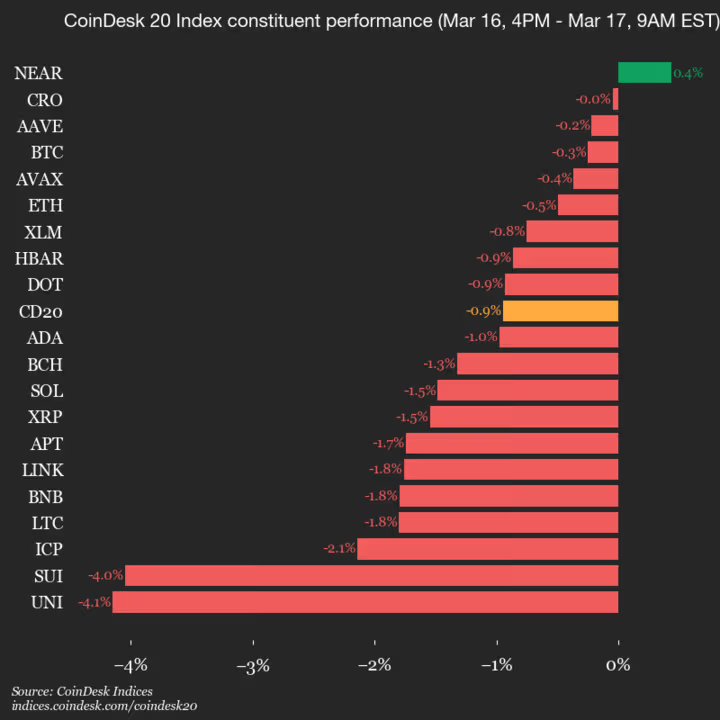
CoinDesk Indices presents its daily market update, highlighting the performance of leaders and laggards in the CoinDesk 20 Index.
The CoinDesk 20 is currently trading at 2148.63, down 0.9% (-20.59) since 4 p.m. ET on Monday.
One of 20 assets are trading higher.

Leaders: NEAR (+0.4%) and CRO (+0.0%).
Laggards: UNI (-4.1%) and SUI (-4.0%).
The CoinDesk 20 is a broad-based index traded on multiple platforms in several regions globally.

Key Takeaways
- Atomic Alchemy, Oklo’s fully-owned subsidiary, obtained its inaugural NRC materials license for isotope handling, processing, and distribution at its Idaho facility.
- This approval creates Oklo’s first commercial revenue opportunity through isotope sales from the Idaho Radiochemistry Laboratory.
- This license is separate from Oklo’s primary advanced reactor projects, which remain pending NRC authorization before power generation can commence.
- A concurrent announcement revealed Oklo’s new partnership agreement with the U.S. Department of Energy for its inaugural reactor deployment at Idaho National Laboratory.
- Shares climbed 4.6% during premarket hours on Tuesday, with quarterly earnings scheduled for release after market close.
On Tuesday, Oklo achieved a significant regulatory victory, albeit with an important distinction. The Nuclear Regulatory Commission awarded its first materials license—though notably, the approval went to Atomic Alchemy, a wholly-owned subsidiary that Oklo acquired in 2025, rather than to the parent company directly.
This authorization permits Atomic Alchemy to accept, store, handle, and sell isotopes through its Idaho Radiochemistry Laboratory located in Idaho Falls. The license specifically covers up to 2 Curies of Radium-226, plus Cobalt-60 and Americium-241 for calibration applications.
These isotopes serve critical functions in medical applications, scientific research, industrial manufacturing, and national defense sectors. Oklo’s CEO Jacob DeWitte addressed the market gap directly: “Demand for critical isotopes is rising, but U.S. supply remains limited.”
The business implications are tangible and immediate. With this licensing approval, Atomic Alchemy can launch commercial isotope sales from its Idaho laboratory—representing the first revenue-generating capability within Oklo’s portfolio. Currently, the parent company has yet to record any revenue.
Crucially, investors should understand that this license differs entirely from the reactor authorization that markets have been anticipating. Oklo’s advanced fast reactor technology continues navigating the NRC approval pathway. Until that separate clearance arrives, the company cannot commercialize electricity generation—which represents its primary long-term business model.
Scope and Implications of the New License
The regulatory approval followed comprehensive review procedures and an on-location inspection of the Idaho operations. Atomic Alchemy’s strategy involves recovering and reprocessing retired radium sources—materials historically classified as waste—converting them into valuable feedstock for medical isotope manufacturing, particularly for targeted alpha therapy applications.
Beyond immediate operations, this laboratory serves as groundwork for larger ambitions. Atomic Alchemy is engineering a multi-reactor isotope production facility featuring up to four Versatile Isotope Production Reactor (VIPR) units, each designed for approximately 15 MWth output capacity.
Tuesday’s announcements included a second development. Oklo formalized an agreement with the U.S. Department of Energy covering design, construction, and operational support for its debut reactor at Idaho National Laboratory through the DOE’s Reactor Pilot Program initiative.
The Meta Partnership and Earnings Expectations
Oklo’s nuclear energy vision has attracted substantial corporate interest. A notable partnership with Meta Platforms involves developing a nuclear energy campus in Ohio’s southeastern region. BofA Securities characterized this arrangement as “one of a few firm, binding partnerships today” within the emerging nuclear sector.
Shares appreciated 4.6% in premarket activity Tuesday as market participants evaluated the regulatory milestone. The company’s quarterly financial results are scheduled for release after the closing bell on the same day.
Oklo maintains its target timeline for commercial nuclear power delivery between late 2027 and 2028.

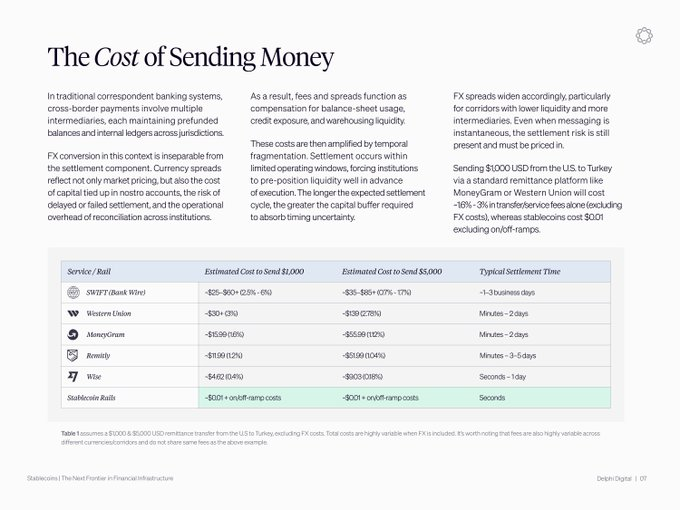
Stablecoins are gaining traction in high-cost cross-border payment corridors in emerging markets as they reduce some of the inefficiencies of legacy foreign exchange (FX) infrastructure, according to research firm Delphi Digital.
Stablecoins are emerging as the cheapest alternative to move US dollars in emerging economies due to the high costs of legacy FX corridors, which can reach up to 8% in combined fees when sending money to Argentina or Nigeria.
Delphi said in a Monday article on X that 81% of the cost in those corridors comes from servicing the underlying banking infrastructure, which it argues gives stablecoin rails a structural advantage.
“Stablecoin rails eliminate most of what makes these corridors expensive to operate.”
“Settlement is atomic, so pre-funded liquidity sitting idle in local currencies is no longer necessary,” Delphi said, adding that volume thresholds and intermediary chains also become obsolete as stablecoins settle directly against the US dollar.
Related: Yield-bearing stablecoins surge as Washington fights over yield
Delphi’s prediction highlights the real-world impact of stablecoins in emerging markets, where locals use them to cut remittance costs to pennies or send instant transactions, bypassing legacy banking infrastructure.

Off-ramps remain a chokepoint for stablecoin adoption
Off-ramps, such as access to bank accounts or interbank rails, remain a significant chokepoint when value needs to move between onchain and legacy environments, according to the company.

Most of the “friction” lies outside the blockchain, they said. While stablecoin minting and burning settle in seconds, bank wires feeding into these systems add significant delays due to batch processing schedules.
“Closing the gap is as much a regulatory problem as a technical one.”
The company added that stablecoins won’t replace the major FX corridors overnight, but the ones in emerging markets where “infrastructure costs dwarf currency risk and banks have largely given up on competing.”
Related: Stablecoin payments startup Kast raises $80M at $600M valuation: Report
Stablecoin supply on the rise despite falling crypto prices
Despite falling cryptocurrency valuations, the stablecoin supply rose 2.5% during the past month, from $308 billion on Feb. 17 to $316 billion as of Tuesday, according to DeFiLlama.
Delphi said emerging markets remain one of the clearest sources of stablecoin demand, particularly where users need cheaper access to dollar liquidity and cross-border transfers.

Investment companies continue pouring capital into stablecoin payment providers. On Tuesday, Singapore-based digital payment company Dtcpay raised $10 million in a Series A funding round led by investment firm Vertex Ventures Southeast Asia & India to fuel the expansion of its compliant stablecoin-based payment network.
Magazine: Crypto wanted to overthrow banks, now it’s becoming them in stablecoin fight
The deal will include $300 million in contingent payments.
Payments giant Mastercard continues with its pro-crypto endeavors, announcing a major acquisition of the stablecoin infrastructure provider BVNK for $1.8 billion.
The move followed another major expansion from last week, when Mastercard tapped Ripple, Binance, PayPal, Circle, and other crypto companies in an attempt to bridge the gap between traditional finance and blockchain.
Mastercard’s Big Acquisition
The definitive agreement for $1.8 billion, including $300 million in contingent payments, will expand Mastercard’s end-to-end support of digital assets and value movement across currencies, rails, and regions, reads the statement.
According to the payments behemoth, the focus of the acquisition will be on real-world use cases such as cross-border remittances, business-to-business transactions, and global payouts, where stablecoins are increasingly seen as faster and more efficient alternatives.
The company emphasized that the key challenge remains integrating crypto-native systems into existing financial infrastructures, despite their evident growth over the past several years. It plans to use its global payment network, which spans over 200 countries, with BVNK’s blockchain capabilities, to deliver “secure, compliant, and scalable payment solutions.”
“We expect that most financial institutions and fintechs will, in time, provide digital currency services, be it with stablecoins or tokenized deposits. We want to support them and their customers with a best-in-class, highly compliant, interoperable offering that brings the benefits of tokenized money to the real world,” commented Jorn Lambert, Chief Product Officer, Mastercard.
He added that this acquisition reinforces what the company has been striving for – using innovation and technology to power economies and empower people. The network’s speed and programmability for every type of transaction are expected to increase with the addition of on-chain rails.
BVNK CEO Jesse Hemson-Struthers described the deal as a major milestone for the entire industry as it would help “define and deliver the future of money” by combining complementary technologies and expertise.
You may also like:
Crypto Adoption on the Rise
Mastercard’s statement explained that the new acquisition aligns with its broader push into the digital asset space, following last week’s announcement about the creation of the Crypto Partner Program. As reported, the company tapped industry giants such as Binance, Gemini, Paxos, Circle, and Ripple, alongside crypto-native and fintech behemoth PayPal, to connect blockchain with its vast global payments infrastructure.
The combined project is expected to offer a “chain-agnostic and asset-agnostic infrastructure” that will allow clients to operate across different blockchain networks without being locked into a single ecosystem.
Binance Free $600 (CryptoPotato Exclusive): Use this link to register a new account and receive $600 exclusive welcome offer on Binance (full details).
LIMITED OFFER for CryptoPotato readers at Bybit: Use this link to register and open a $500 FREE position on any coin!

App Store fees drop in China & Beijing immediately asks for more

Would more North Sea drilling lower UK energy bills? Our analysis says no

APi Group Corporation (APG) Presents at JPMorgan Industrials Conference 2026 Transcript

Smart energy pays enters the US market, targeting scalable financial infrastructure

Why Israel is blocking foreign journalists from entering

Bitcoin: We’re Entering The Most Dangerous Phase

Private Credit: The Next Risk in the Financial System

IF YOU OWN XRP YOU NEED TO KNOW THIS NOW! (Good, Bad and UGLY!) In 48 Hours We Find Out!

3 ways rich people invest in times of market uncertainty! #finance #money #war #invest #economy
-
 Tech6 days ago
A 1,300-Pound NASA Spacecraft To Re-Enter Earth’s Atmosphere
-
 Crypto World3 days ago
HYPE Token Enters Net Deflation as HyperCore Buybacks Outpace Staking Rewards
-

 Business7 days ago
ExxonMobil seeks to move corporate registration from New Jersey to Texas
-

 Fashion4 days ago
Weekend Open Thread: Addict Lip Glow
-

 Tech7 days ago
ChatGPT will now generate interactive visuals to help you with math and science concepts
-
Sports3 days ago
Why Duke and Michigan Are Dead Even Entering Selection Sunday
-

 NewsBeat6 days ago
Residents reaction as Shildon murder probe enters second day
-

 Business2 days ago
Search for Savannah Guthrie’s Mother Enters Seventh Week with No Arrests
-

 Business6 days ago
Search Enters Sixth Week With New Leads in Tucson Abduction Case
-

 Business3 days ago
US Airports Launch Donation Drives for Unpaid TSA Workers as Partial Government Shutdown Enters Fifth Week
-

 Sports6 days ago
PWHL, Senators discussing plan to keep Charge in Ottawa
-
Crypto World3 days ago
Coinbase and Bybit in Investment Talks: Could Bybit Finally Enter the US Crypto Market?
-

 NewsBeat6 days ago
I Entered The Manosphere. Nothing Could Prepare Me For What I Found.
-

 Business3 days ago
Country star Brantley Gilbert enters growing non-alcoholic beer market
-

 Business1 day ago
Australian shares drop as Iran war enters third week
-

 Sports4 days ago
College Basketball Best Bets: Conference Tournament Semifinal Picks
-

 Crypto World1 day ago
Crypto Lender BlockFills Enters Chapter 11 with Up to $500M in Liabilities
-

 Crypto World7 days ago
Will Chainlink price reclaim $10 amid volatility squeeze?
-

 Tech7 days ago
Clarity as strategy
-

 Politics6 days ago
Trump Says Middle East Is ‘Very Lucky’ That He’s President


You must be logged in to post a comment Login