
Crypto World
Will Pi Network price crash to $1.5 as charts confirm a bearish crossover?

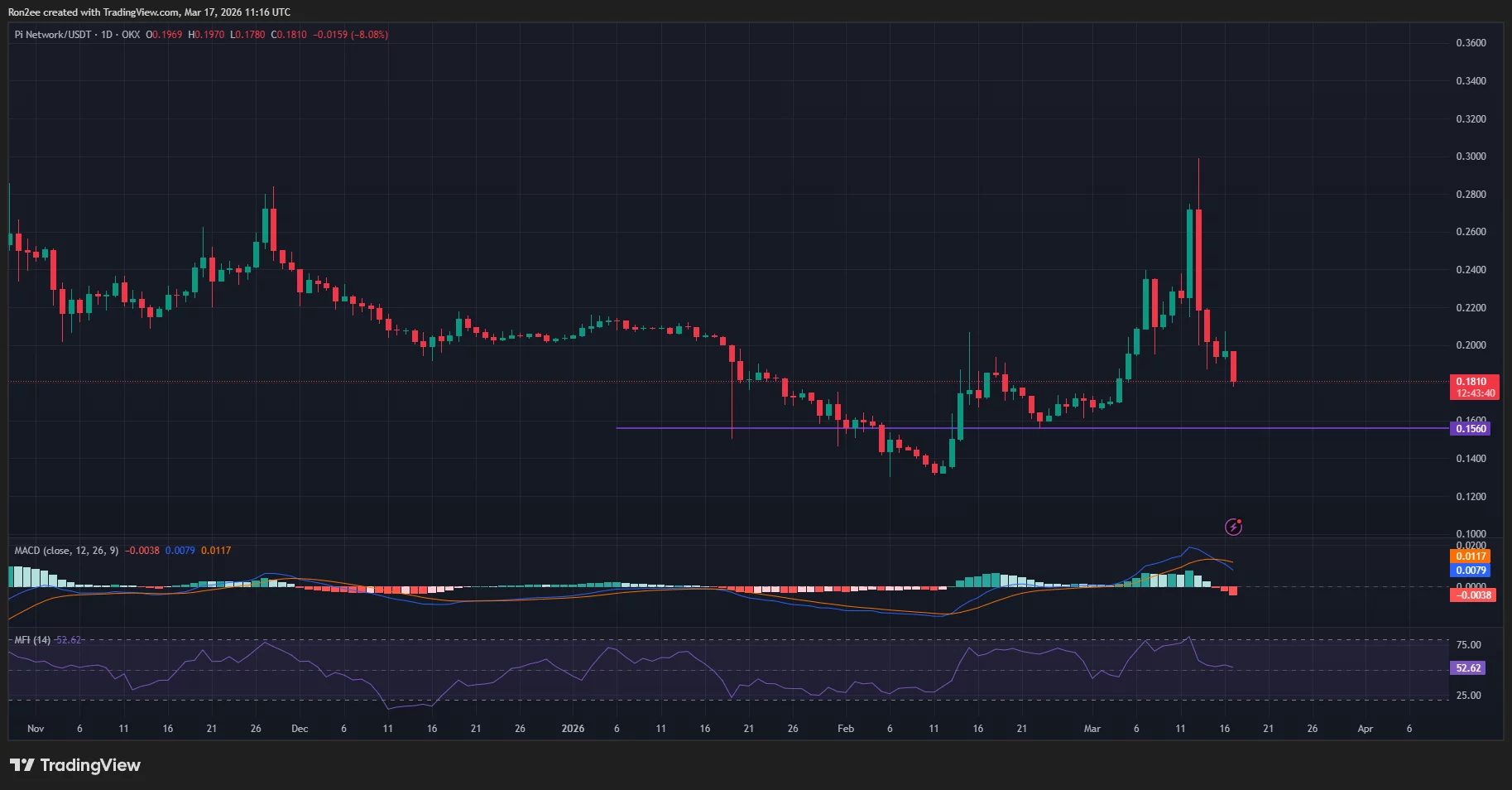
Pi Network price has fallen by over 38% as investors sold the Kraken listing news.
Summary
- Pi Network price has fallen over 10% in the past 24 hours and about 38% from its recent peak as bearish technical indicators signal further downside risk.
- A confirmed MACD bearish crossover and weakening momentum suggest sellers have gained control while the token approaches key support near $0.1900.
- Investor sentiment has also turned cautious ahead of a scheduled unlock of roughly 17 million PI tokens, which could increase supply pressure.
Pi Network (PI) price has dropped over 10% over the past 24 hours and 38% from its highest point on Friday, March 13.
It remains at risk of more downside as technical indicators present a bearish outlook for the coming sessions.
On the 24-hour/USDT price chart, the PI price has confirmed a MACD crossover, which happens when the MACD line crosses below the signal line. When such a bearish crossover forms, an asset has historically signaled a period of consolidation or further price declines as momentum shifts in favour of the sellers.
Additionally, the Pi Network price is closing in on the 50-day SMA, which had been serving as key support for the token during its recent recovery phase. A drop below the $0.176 level could trigger a sharp sell-off, potentially leading to a significant price decline toward the next psychological floor.
At the same time, the Money Flow Index is closing in on neutral territory, a sign that the intense buying and selling pressure in the market is starting to balance out after the recent volatility.
Based on the confluence of bearish technicals, the Pi Network risks a drop to its Feb. 23 low of $0.1560 with no immediate support to cushion the fall if current levels fail to hold.
Pi Network’s recent downtrend began after its listing on crypto exchange Kraken on March 13. Investors likely sold the news as they booked profits after the token surged nearly 30% after the listing.
A more recent bearish development that has turned investors cautious is the token unlock event scheduled for later today. Notably, about 17 million PI tokens will be entering circulation following the event, which adds to the existing supply overhead.
Investors are likely reducing exposure to the token as they expect that the market will not be immediately able to absorb the newly released tokens, which tends to reduce scarcity and put downward pressure on the price.
Disclosure: This article does not represent investment advice. The content and materials featured on this page are for educational purposes only.

Crypto World
DeepSnitch AI Price Prediction: Community Eyes 100x-300x $DSNT Pump; ETH, and HYPE Setups Optimistic
Institutional Ethereum is back with Bitmine, adding 61K ETH in a single week. Now controlling 3.81% of the entire token supply, Bitmine’s latest moves demonstrate that the accumulation era has started, and with it, a possible shift toward altcoins.
While ETH and HYPE may be lucrative if their bullish setups play out, they may not provide the same level of oomph as DeepSnitch AI’s March 31 launch, which is landing at the right moment to capture the momentum.
What makes it even more exciting as an opportunity is that the latest DeepSnitch AI price prediction confirms that the 100x.300x narrative is incredibly robust.

Bitmine ETH accumulation shifts into higher gears
Bitmine Immersion Technologies added nearly $61K ETH last week, according to chairman Tom Lee.
The part of these assets was acquired directly from the Ethereum Foundation, and the total holdings are now sitting north of 4.5M ETH, meaning that Bitmine controls approximately 3.8% of the entire token supply.
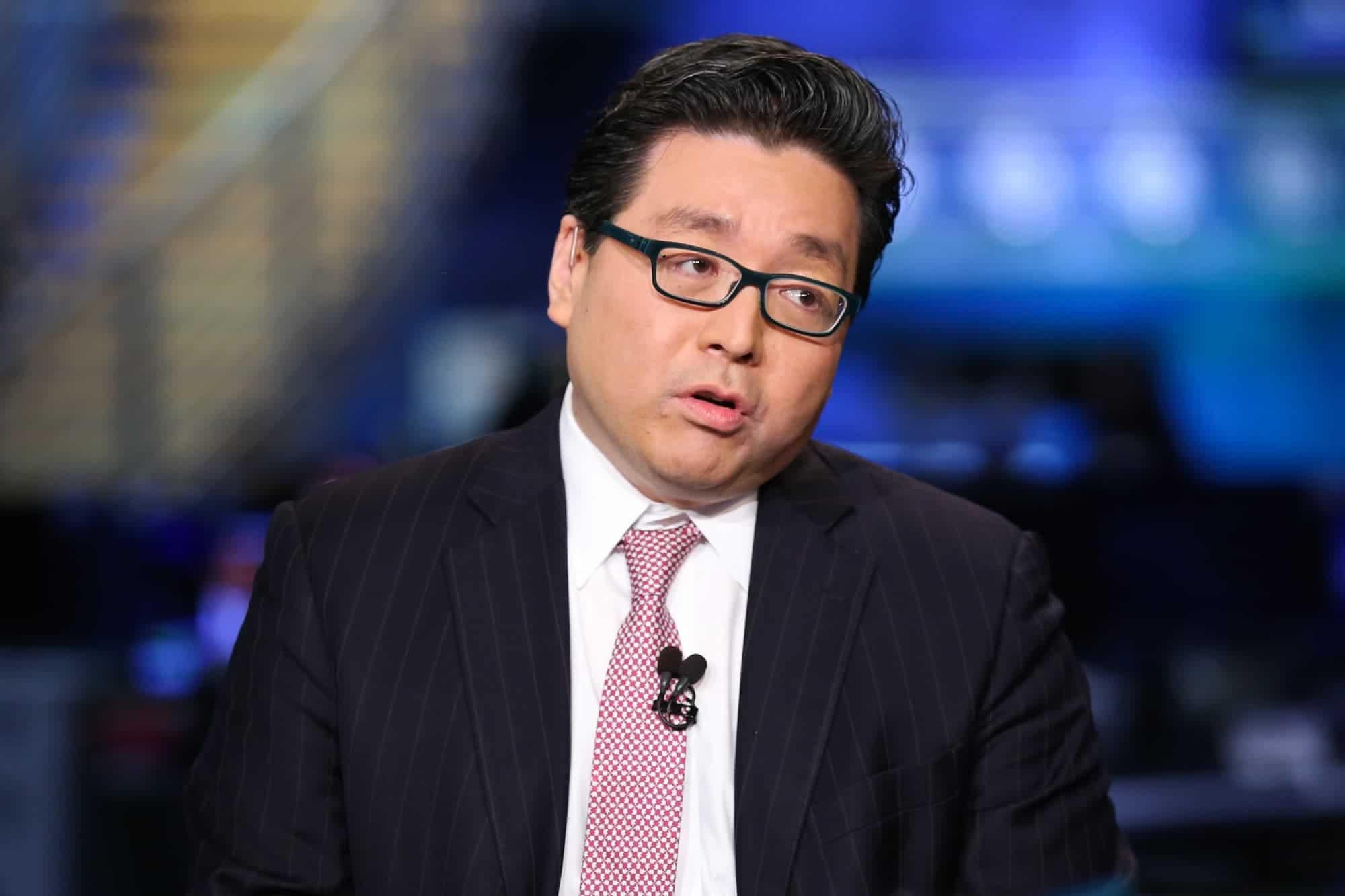
Bitmine plans to scale that further through its Made in America Validator Network, expected to launch in the coming months. Shares of BMNR closed Monday up nearly 14% to $23.39. The announcement landed on the same day Strategy disclosed its 22K BTC purchase.
Since the two largest institutional crypto treasury operations on the planet both made major moves on the same day. The macro signal is hard to ignore, which makes DeepSnitch AI’s March 31 launch well-positioned to fully capture the wider recovery wave, which could boost the odds of the latest DeepSnitch AI price prediction coming true.
Alts you should keep on your radar in March 2026
1. DeepSnitch AI price prediction: Why is the community confident that the DeepSnitch AI token outlook is bullish?
DeepSnitch AI seems to be resilient to choppy markets. Case in point: the presale has raised $2.2M at $0.04487. The trajectory remained consistent, but so did the DeepSnitch AI prediction 2026: 100x minimum and 300x if the cycle turns bullish.
At $0.04487, a 100x minimum puts DeepSnitch AI’s future price at $4.49. Considering that the institutional money is back in crypto, and DeepSnitch AI’s Uniswap listing is exactly at an inflection point.
The ultra bullish DeepSnitch AI price prediction sees the token reaching $13.4, a 300x move, which could represent a longer-term target once the adoption picks up.
With five live AI agents, a central intelligence layer that’s already operational, and a Q2 2026 roadmap adding SnitchGPT and SnitchCast on top of what’s running now, this lends credence to the massive 300x move.
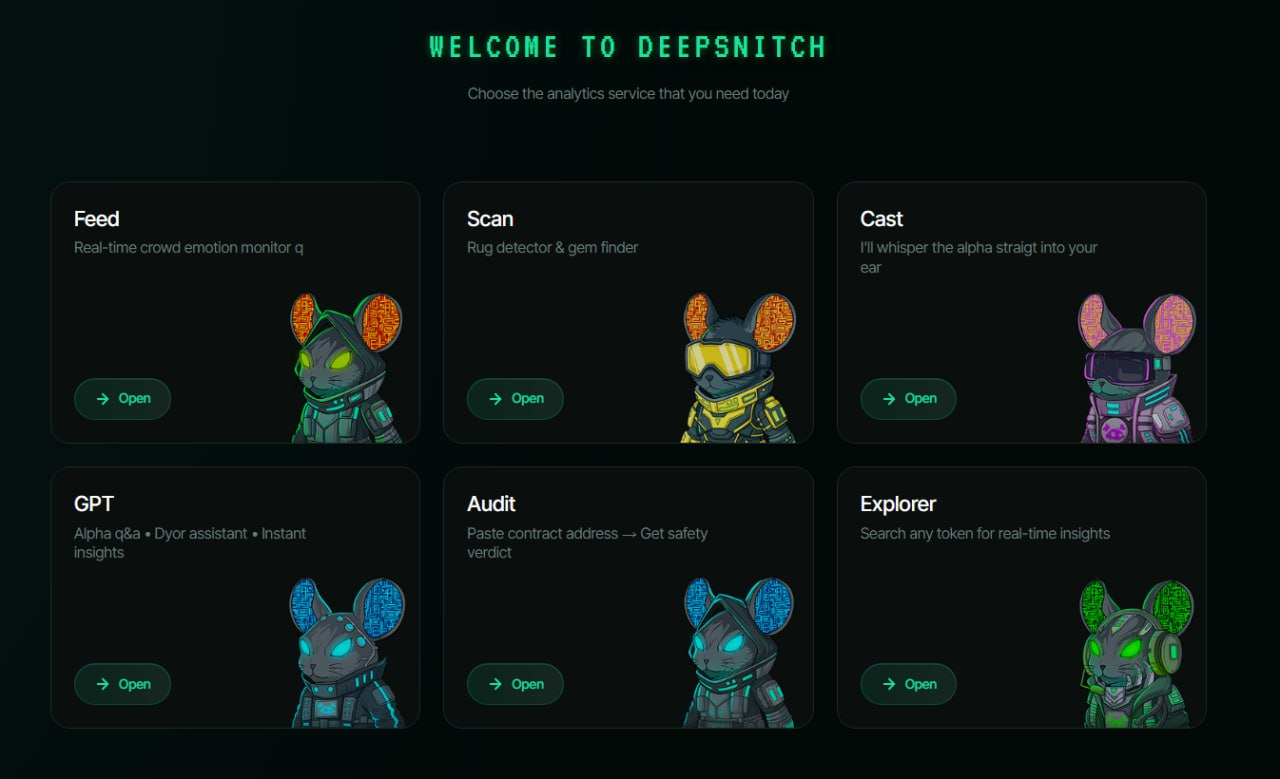
The retention argument is what makes the DeepSnitch AI price prediction much more credible: the solution utilizes five AI agents operating in a central intelligence layer. The tools range from a hidden gem finder to a sentiment tracker and a robust rug scanner.
These projections aren’t empty, though the 41.7M DSNT already staked in presale proves the interest is high, and that is unlikely to be the community open to dumping tokens after launch.
March 31 is reserved for launch, so if you’re eyeing a 100x pump, DeepSnitch AI is likely your best bet.
2. Ethereum price prediction: Will ETH continue its recovery?
According to CoinMarketCap, ETH climbed back up to $2.35K on March 16.
While the DeepSnitch AI price prediction kept spreading around the community, Ethereum experienced multiple weeks of chop in a row. Now, though, things seem to be looking up. With ETH regaining momentum and closing above $2.35K, the path to $2.6K remains open, with the final target seeing a pump to $3.45K.
The 20-day EMA at $2K is the key support to watch on any pullback.
3. Hyperliquid price prediction: Will HYPE reach $50 soon?
HYPE gained over 7% in value in 24 hours, reaching $40 on March 16, according to CoinMarketCap.
With $36.77 flipping to support, the arduous path to $43 followed by $50 remains in play.
For the time being, sellers are unlikely to make erratic moves, but if they somehow tank HYPE below $31.5, the bullish setup will be invalidated, and the coin could drop to $29.
Final words: Don’t miss the window
Large institutional players are once again pouring assets into the crypto market as bears take a small nap.
Since the chop could return unprompted, the DeepSnitch AI price prediction strengthens the project’s robust nature and gives weight to its potential to yield massive returns for holders.
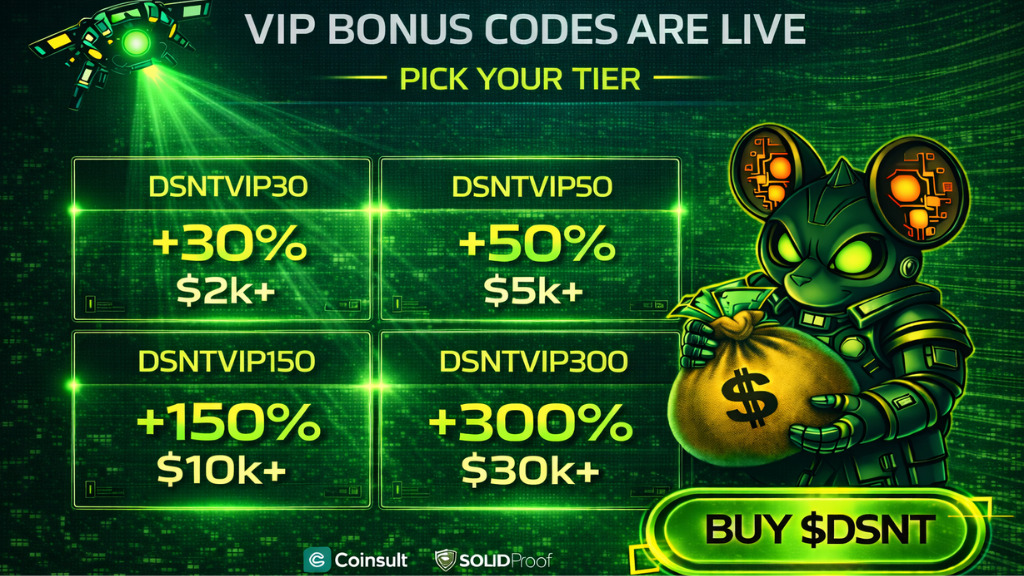
DeepSnitch AI lists on March 31, so the entry at $0.04487 will be gone when the TGE opens. Use DSNTVIP50 for 50% extra tokens on $5K and up. On $30K and above, DSNTVIP300 unlocks 300% on your allocation, which is quite impressive considering this coupon translates into nearly $90K
Don’t miss the window to join the DeepSnitch AI presale. For quick community updates, join the community on X or Telegram.
FAQs
1. What is the DeepSnitch AI price prediction for after the March 31 TGE?
The community projects 100x to 300x from the $0.04487 presale price, putting post-launch targets at $4.49 and $13.46, respectively. The 100x case is built on macro timing and a live product at launch. The 300x target requires sustained adoption growth post-TGE.
2. Why is Bitmine’s ETH accumulation relevant to the degens?
Bitmine adding 61.1K, H in a single week signals accelerating institutional conviction in the broader altcoin market. Historically, sustained institutional inflows into ETH precede retail rotation into early-stage projects.
3. What gives the DeepSnitch AI price prediction credibility beyond the launch pump?
All AI agents are already live, 41.7M DSNT is staked in presale, and traders and investors are betting on a moonshot rally after launch.
The post DeepSnitch AI Price Prediction: Community Eyes 100x-300x $DSNT Pump; ETH, and HYPE Setups Optimistic appeared first on Blockonomi.
Reform UK hasn’t shared its crypto donation addresses with the UK’s Electoral Commission despite the official body’s apparent requests.
The Nigel Farage-led party announced it was accepting crypto donations last year, a situation that’s caused concern about the potential for foreign political interference and dubious funding.
A representative for the electoral commission told Byline Times, “Reform has not shared any crypto wallet address with us.”
They said, “We routinely request a variety of information from parties to ensure they are fulfilling their legal responsibilities,” adding that they “cannot comment any further on the nature of these requests as it may impact our enquiries.”
The commission is also seeking new powers to regulate political crypto donations and told Byline Times that existing laws need to be “strengthened to prevent impermissible foreign funds entering the UK system.”
Read more: Nigel Farage aide George Cottrell bets US war will last four more months
It warned that crypto donations “present particular challenges and risks in meeting electoral law requirements in identifying donors and ensuring they are permissible.”
Byline Times says no crypto donations have been reported to the commission as of yet. However, it said that donations below £500 aren’t subject to reporting rules, and warned that this loophole could allow large donations to be split up into numerous smaller ones.
Reform UK’s crypto processor exempt from UK scrutiny
Reform UK’s crypto donations are processed by a firm called Radom, which gets its virtual asset service provider license through its Poland-based arm.
Crypto donations handled by the Polish entity avoid scrutiny from the UK’s Financial Conduct Authority.
It’s not entirely covered by Europe’s Markets in Crypto-Assets Regulation (MiCA) either, as Polish President Karol Nawrocki has reportedly vetoed implementing MiCA regulations twice.
As of 2026, Poland reportedly has 1,800 virtual asset service providers listed in the country. If it doesn’t implement the MiCA regulation by July 1, 2026, Radom and these firms will have to find regulatory approval from another country within the European Union.
Read more: Huione Group head ‘Boss Xi’ reportedly arrested then released
Byline Times reports that Poland’s current regulatory regime is far from perfect, and claims that obtaining a Polish license only requires a small fee and little to no scrutiny.
Top Polish lawyer Robert Nogacki told Byline Times that the country’s crypto regulations are just “an automated registration roll — low-friction by design, high-risk by consequence — that turned a $150 formality into an exportable badge of EU credibility.”
Byline Times notes that the Huine Group, which allegedly helped launder billions of dollars worth of funds linked to South Asian scam empires, and North Korea’s hacking collective, was also licensed under Poland’s system.
Got a tip? Send us an email securely via Protos Leaks. For more informed news and investigations, follow us on X, Bluesky, and Google News, or subscribe to our YouTube channel.
A falling CDD Multiple means older Bitcoin isn’t moving much, showing long-term holders aren’t selling, and overall selling pressure is low.
Bitcoin briefly neared $76,000 on Tuesday, a level seen for the first time in six weeks, in spite of the global uncertainty as the conflict in the Middle East entered its third week.
Data from Alphractal shows that Bitcoin’s Coin Days Destroyed (CDD) Multiple has fallen to its lowest level since 2022. This indicates minimal movement of older units.
Veteran Holders Stay Put
Alphractal explained that the metric, which measures the intensity of Coin Days Destroyed relative to its historical average, normalizes current activity against a long-term baseline to assess whether long-term holders are spending at elevated or reduced rates.
Current readings suggest that older BTC remains largely dormant, which points to steady holding behavior among long-term investors.
According to the analysis, many of these holders previously distributed coins at higher price levels, leaving the present market dominated by relatively younger supply in circulation. The low CDD Multiple also implies limited selling pressure from mature holdings.
In previous cases, similar low levels in the metric have coincided with consolidation phases, where reduced activity from long-term holders precedes significant directional moves in the market.
Meanwhile, data from Santiment shows that Bitcoin’s recent move has been accompanied by a sharp rise in market optimism. The uptick has pushed FOMO to its highest level since January 2, as social media data from this week indicates a bullish-to-bearish comment ratio of 1.67 across platforms such as X, Reddit, and Telegram. The positive sentiment has outweighed the negative views.
You may also like:
Further data reveal Bitcoin is showing early signs of recovery in buyer activity after heavy selling in February. Despite rising geopolitical tensions and expectations that the Federal Reserve will not cut interest rates at the upcoming FOMC meeting, CryptoQuant found that BTC has remained relatively “resilient” compared to traditional assets like equities and commodities.
Buyer Dominance
Data from Binance and Coinbase indicate that trading volumes are gradually changing in favor of buyers. On February 16, the 30-day average volume delta was strongly negative, at -$145 million on Binance and -$88 million on Coinbase, reflecting broad selling by both retail and institutional investors. This has now turned positive, and reached about +$21 million and +$14 million, respectively.
While this is a clear improvement, analysts say that liquidity remains low, and the trend will need further confirmation to support upward price movement.
Binance Free $600 (CryptoPotato Exclusive): Use this link to register a new account and receive $600 exclusive welcome offer on Binance (full details).
LIMITED OFFER for CryptoPotato readers at Bybit: Use this link to register and open a $500 FREE position on any coin!

[PRESS RELEASE – Kingstown, St. Vincent & the Grenadines, March 17th, 2026]
Non-custodial exchange platform ChangeNOW has announced the rollout of Private Send, a feature designed to prevent direct links between sender and recipient addresses on public blockchains.
Integrated into NOW Wallet, Private Send introduces a toggle within the transaction flow. Instead of a direct wallet-to-wallet transfer, funds are routed through ChangeNOW infrastructure before reaching the final address. To the recipient, the transaction appears standard, while the sender’s address does not appear in the recipient’s transaction history.
Pauline Shangett, CSO at ChangeNOW, says, “Public blockchains were supposed to be about financial freedom, not financial surveillance. Yet today, analytics firms map billions of addresses into clusters, building profiles on ordinary users. Private Send isn’t about hiding from regulators, it’s about stopping the default exposure of every move you make. One click, and the direct link between you and the recipient disappears. That’s it.”
Role of Blockchain Analytics
Blockchain analytics has become standard infrastructure across the industry. A common misconception is that holding crypto in self-custodied wallets ensures anonymity. Analytics firms map billions of addresses into identifiable clusters, linking wallet activity to individuals or entities. Private Send was developed in response to this environment by introducing an intermediary into the transaction flow. The blockchain records the transaction without establishing a direct connection between the sender and the recipient.
Transaction Flow Structure
- Users toggle “Private Send” in NOW Wallet’s standard send flow
- Transaction routes: sender → ChangeNOW → recipient
- Recipient sees funds arriving from a ChangeNOW address
- No additional apps, registrations, or technical knowledge required
Key details
- Most assets available in NOW Wallet
- All transactions undergo standard AML screening
- Geographic availability matches ChangeNOW’s existing restrictions
- Requirement: latest version of NOW Wallet
Typical use cases
- Moving funds between personal wallets without consolidating on-chain history
- Paying vendors or contractors without exposing full portfolio activity
- General privacy-conscious transfers where direct address links are undesirable
Private Send is not a mixing service or an anonymization tool. It operates entirely within ChangeNOW’s compliance framework and does not alter the final transaction record; it only changes the path to the destination.
About ChangeNOW
ChangeNOW is a non-custodial cryptocurrency exchange platform that values speed, security, and user liberty. Since its launch, it has served over 8 million customers worldwide, offering access to over 110 blockchains and 70+ fiat currencies. By combining the best rates from top centralized and decentralized platforms, ChangeNOW offers a seamless experience with simplified onboarding where users have full control over their assets.
Binance Free $600 (CryptoPotato Exclusive): Use this link to register a new account and receive $600 exclusive welcome offer on Binance (full details).
LIMITED OFFER for CryptoPotato readers at Bybit: Use this link to register and open a $500 FREE position on any coin!


Hyperliquid whale positioning hits $3.64B as leverage splits evenly between longs and shorts.
Summary
- Coinglass data via ChainCatcher show total Hyperliquid whale exposure at about 3.644 billion dollars, with 1.821 billion in longs and 1.823 billion in shorts, leaving the long‑short ratio effectively flat at 1:1.
- Longs are sitting on roughly 57.38 million dollars in unrealized profit while shorts are down around 11.16 million, reflecting how the recent grind higher in majors has quietly rewarded leveraged bulls.
- One standout wallet, 0x6c85…f6, is running a 20x ETH long from 2,012.11 dollars with about 15.14 million dollars in paper gains, illustrating how a sharp reversal could turn today’s star trades into the first forced sellers in a cascade.
Leverage on decentralized derivatives venue Hyperliquid (HYPE) has reached eye‑watering levels, with on‑chain data showing whale positions almost perfectly balanced between longs and shorts even as individual traders rack up eight‑figure unrealized profits. According to Coinglass figures cited by ChainCatcher, total whale exposure on Hyperliquid now stands at about 3.644 billion dollars, split into 1.821 billion dollars of long positions and 1.823 billion dollars of shorts. That leaves the long‑short ratio effectively at 1:1, a rare equilibrium that suggests aggressive positioning on both sides of the tape rather than a one‑sided bet on continued upside.
At a P&L level, the skew is less balanced. Long positions are currently sitting on roughly 57.38 million dollars in profits, while shorts are down about 11.16 million dollars, reflecting how the recent grind higher in majors like BTC (BTC) and ETH (ETH) has quietly rewarded leveraged bulls. One address stands out: the whale wallet 0x6c85…f6 has taken a 20x leveraged long on ETH at an entry price of 2,012.11 dollars and is now running an unrealized gain of about 15.14 million dollars. That single trade captures the core dynamic on Hyperliquid right now—a structurally high‑leverage environment where a handful of well‑timed positions can print institutional‑scale P&L in days, but where a sharp reversal could erase paper profits just as quickly.
For market structure, the 3.6 billion‑dollar positioning and near‑perfect long/short balance turn Hyperliquid into a leverage fulcrum for the broader alt and perp complex. When books are this tightly matched, the direction of the next large move often comes down to exogenous catalysts—ETF flows, macro surprises, or idiosyncratic headlines—rather than slow positioning drift. With longs in aggregate comfortably green and shorts nursing losses, the path of least resistance in the near term is still higher; but if the tape turns, those same profitable longs become forced sellers, and the 20x ETH whales that look brilliant today are exactly the ones that can drive a cascade tomorrow.
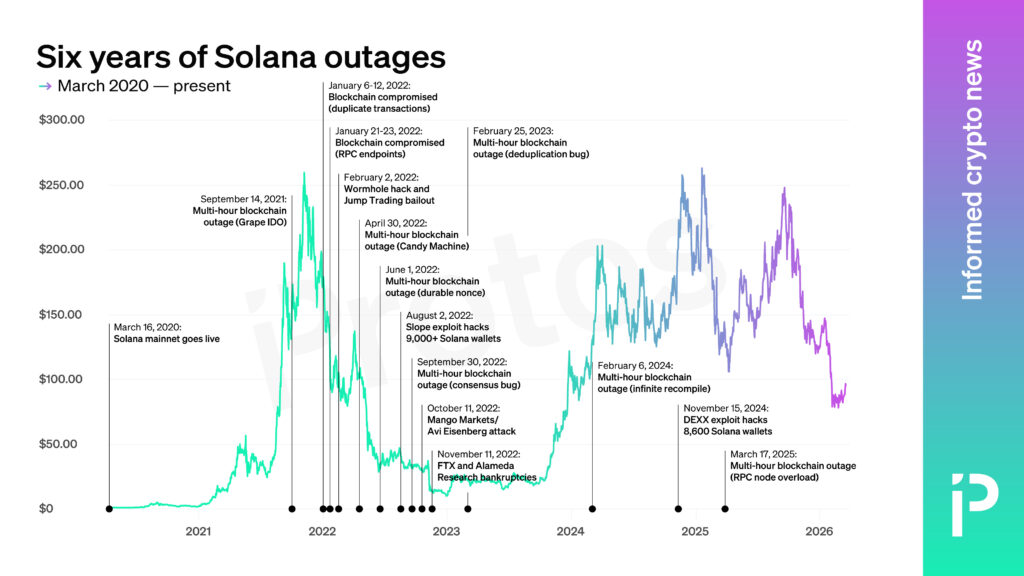
The Solana blockchain turned six years old yesterday, and the community has taken the opportunity to reiterate its motto, “Just one more hard quarter.”
Although intended as a source of pride about the grit and determination of workers under the leadership of founder Anatoly Yakavenko, the motto could just as easily describe the experience of using the Solana blockchain.
Since its first multi-hour outage in 2020, Solana users have endured weeks of combined mainnet disruption, bridge collapses, wallet drains, market manipulation, and the criminal conviction of its once-most influential tokenholder and supporter, Sam Bankman-Fried (SBF).
However, after six years of near-death experiences, Solana is still here. Whether it can credit resilience or stubbornness for its success depends on the user’s perspective on those difficult times.
Even its own social media manager was conflicted, posting a birthday message with a picture that hinted at a solider in the trenches.
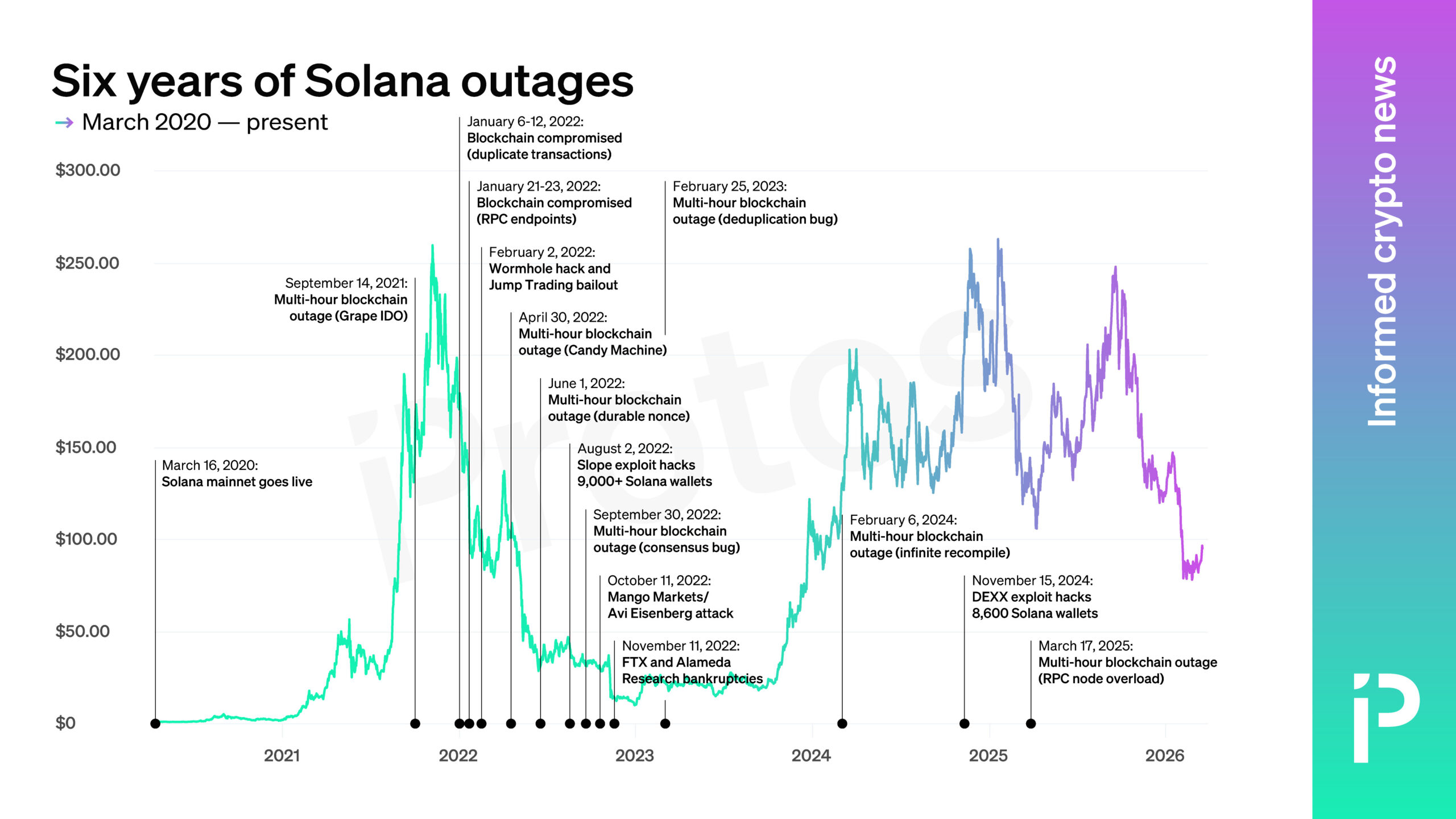
Solana outages since its founding year
Solana’s mainnet, built by former Qualcomm engineer Anatoly Yakovenko, co-founder Raj Gokal, and other developers, went live on March 16, 2020.
Their first catastrophe struck before the network’s first birthday.
On December 4, 2020, a bug in Turbine, Solana’s block propagation system, halted the entire blockchain for six hours. A validator transmitted two conflicting blocks for the same slot, and the network split into partitions.
Nine months later, a series of misfortunes began that would eventually make Solana outages so well-known that its offline status became a meme.
On September 14, 2021, bots flooded the network during Grape Protocol’s IDO on Raydium. Over 300,000 transactions per second overwhelmed validator memory. The chain went dark for 17 hours.
Then 2022 arrived. There’s no other year containing more media attention about a blockchain repeatedly failing than Solana’s outages across almost every month of 2022.
The miracle of Solana surviving 2022
Between January 6 and 12, bots spamming duplicate transactions degraded Solana’s network so badly that transaction success rates dropped 70%.
Another wave of outages from January 21 to 23 repeatedly knocked Solana’s public RPC endpoints offline.
- On February 2, hackers exploited the Wormhole inter-blockchain bridge between Solana and Ethereum, minted 120,000 fraudulently wrapped ether, and stole over $320 million. Within hours, Jump Trading covered the loss from its corporate balance sheet.
- On April 30, NFT minting bots hit the Candy Machine program with millions of requests per second, crashing Solana’s blockchain’s consensus-making. The blockchain was down for about seven hours.
- On June 1, a durable nonce bug stalled blocks for over four hours.
- On August 2, a hacker drained over 9,000 wallets of millions of dollars worth of Solana assets. Slope, a once-popular Solana wallet, had leaked private keys through a misconfigured Sentry server.
- Less than two months later on September 30, a validator’s malfunctioning hot-spare node produced duplicate blocks. A fork-selection bug halted consensus for over eight hours.
- On October 11, Avraham Eisenberg manipulated Mango Markets’ MNGO price oracle and drained over $110 million from the Solana-based exchange. A jury convicted him in April 2024.
Read more: CHART: It’s been 262 days since Solana’s last major outage
‘Sam coin’ crashes as Sam crashes
Solana’s worst days in history began on November 11, 2022. FTX, Alameda Research, and over 100 affiliates filed for Chapter 11 bankruptcy.
Founder SBF had held massive solana (SOL) positions and had become so influential in the Solana community that many people called SOL a “Sam coin” alongside FTT and his other doomed darlings.
The panic around SBF’s demise sent SOL from roughly $33 to under $10 by late December, a 97% collapse from its November 2021 cycle high of $259.
SOL bottomed below $8 in December 2022.
Going into 2023, Solana’s ecosystem hemorrhaged developers, projects, and credibility.
In fact, the bankruptcy estates of Alameda and FTX still hold hundreds of millions of dollars worth of SOL as of writing time. Bankruptcy trustees periodically unstake and liquidate tokens for creditor distributions.
Survival and Solana’s 6th birthday
Unfortunately, Solana kept breaking. On February 25, 2023, a malfunctioning validator broadcast an abnormally large block which overwhelmed Solana’s “Turbine” deduplication logic.
Yet again, the blockchain was offline for nearly an entire day.
Almost a year later, on February 6, 2024, an infinite recompile loop halted Solana’s mainnet for five hours. The bug had been spotted a week earlier but never patched.
With at least seven total blockchain outages totaling at least three full days of combined downtime, Solana users have suffered weeks of degraded performance and years of uncertainty about whether mainnet will remain stable.
Moreover, users have suffered hundreds of millions of dollars in a bridge hack, manipulations of DEX exchanges, and multiple drains of wallets affecting thousands of users.
At its worst moment, they suffered alongside the collapse of one of history’s most notorious fraudsters and dubiously generous patron, SBF.
With SOL now trading at roughly $96 per coin on its sixth birthday, Yakovenko called the celebration “six years of perfection.”
The community motto describes history more aptly: “Just one more hard quarter.”
Got a tip? Send us an email securely via Protos Leaks. For more informed news, follow us on X, Bluesky, and Google News, or subscribe to our YouTube channel.
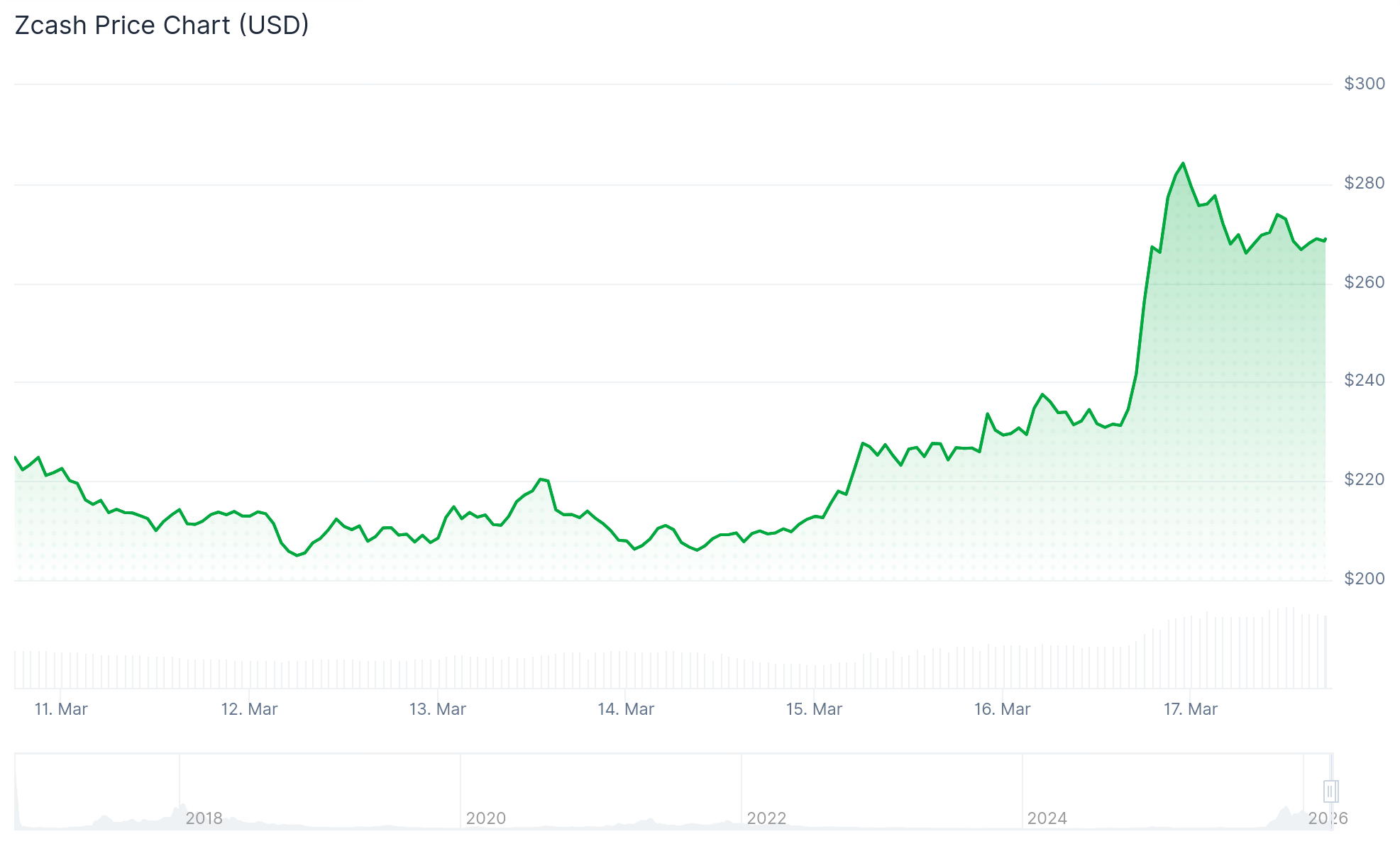
The Winklevoss-backed Zcash treasury company reported $4.8 million in net income in 2025, driven by unrealized gains on its ZEC holdings.
Zcash (ZEC) surged as much as 20% on Monday evening, March 16 — spiking from $231 to as high as $284 — after ZEC digital asset treasury (DAT) firm Cypherpunk Technologies (Nasdaq: CYPH) released its full-year 2025 financial results showing a swing to profitability.
ZEC remains up roughly 9% on the day as of press time today, March 17, trading over $270, making it the top performer among the top-100 large-cap crypto assets, per CoinGecko data.

ZEC’s rally over the past 24 hours appears to be driven by Cypherpunk’s positive financials for 2025, which is the year the company rebranded from a biotech firm to a Zcash-focused DAT. Per the release, Cypherpunk reported net income of $4.8 million for the year ended Dec. 31, 2025, a dramatic reversal from a net loss of $67.8 million in 2024.
According to the firm, the turnaround was driven by $50.4 million in unrealized gains on the fair value of its ZEC treasury holdings, marked to market at period end, Dec. 31. At that time, ZEC was trading near $530 and those holdings were valued at $147.4 million on its balance sheet, according to the firm’s press release.

Shares of CYPH also rallied yesterday and today, and are currently up over 13% today at nearly $0.80, and up over 40% in the past five days, per Yahoo Finance data.
Biotech to DAT Pivot
Cypherpunk was launched in mid-November last year and is backed by Gemini founders Tyler and Cameron Winklevoss, and the firm is the only publicly traded focused on Zcash.
Like several other DATs that launched last year as the experimental strategy exploded into a trend, Cypherpunk pivoted to a DAT via a rebrand from an entirely different industry, namely biotech. The company’s biotech past as Leap Therapeutics still shows up in the books, and the release notes that R&D expenses for what is now the company’s subsidiary fell by more than half last year from the previous year, which also helped it achieve net income.
Buying High, Reporting Profitable
As The Defiant previously reported last month, ZEC had fallen more than 50% since Cypherpunk’s last disclosed purchase on Dec. 30, 2025, when the company added 56,418 ZEC at around $514 per token.
According to the release, total holdings now stand at 294,743.10 ZEC at an average purchase price of $335.89 per token — about 19% higher than current prices, meaning the treasury remains underwater on a cost basis.
Still, Monday’s move suggests markets read the first-ever profit report as a validation of the DAT model applied to ZEC.
ZEC was the top-performing large-cap crypto asset of the year, as The Defiant previously reported, having surged more than 800% over the course of 2025.
The privacy-focused cryptocurrency, which is the second-largest privacy coin by market cap after Monero (XMR), began its extended price rally in the fall, starting in early September. The timing coincided roughly with the Winklevoss’ investment into Leap.
This article was written with the assistance of AI workflows. All our stories are curated, edited and fact-checked by a human.
Arizona Attorney General Kris Mayes filed criminal charges against Kalshi Tuesday, charging the prediction markets platform with operating an unlicensed gambling business and offering election wagering in the state, actions she said violated the state’s laws.
Mayes charged KalshiEx LLC and Kalshi Trading LLC with 20 counts, alleging the platform accepted bets from Arizona on a wide range of events in violation of Arizona law, including sports and elections, like contracts betting on the outcomes of the 2028 presidential race and 2026 state gubernatorial race.
“Arizona law prohibits operating an unlicensed wagering business, and separately bans betting on elections outright,” the attorney general said in a statement.
The charges come just days after the Commodity Futures Trading Commission (CFTC) signaled a more supportive federal stance toward prediction markets, issuing new guidance and launching a rulemaking process under Chairman Mike Selig.
That effort asserted the CFTC’s “exclusive jurisdiction” over event contracts and frames platforms like Kalshi as regulated derivatives venues rather than gambling operators, setting up a direct clash with states such as Arizona that continue to treat sports and election-related contracts.
“Sadly, a state can file criminal charges on paper thin arguments,” a Kalshi spokesperson said in a statement. “States like Arizona want to individually regulate a nationwide financial exchange, and are trying every trick in the book to do it. As other courts have recognized and the CFTC affirms, Kalshi is subject to federal jurisdiction. It’s different from what sportsbooks and casinos offer their customers, and it should not be overseen by a patchwork of inconsistent state laws.”
Different courts have ruled in different ways on whether prediction market providers are subject to state laws. A federal judge in Nevada ruled last year that the company’s sports-related contracts are subject to state gaming regulators. A Massachusetts state court similarly found that sports-related conduct might be subject to state regulations in that state. A federal judge in Tennessee ruled the other way earlier this year, at least temporarily blocking state regulators from enforcing a cease-and-desist against Kalshi.
Notably, most of these contracts and cases were related to sports gambling, and not election-related bets, as Arizona’s case is.
In her statement, Mayes said, “Kalshi may brand itself as a ‘prediction market,’ but what it’s actually doing is running an illegal gambling operation and taking bets on Arizona elections.”
She added that state law prohibits both unlicensed wagering businesses and betting on elections outright.
The charges escalate a widening legal fight between Kalshi and state regulators. The company sued Arizona on March 12 in a preemptive move, part of a broader strategy that has recently included litigation against Iowa and Utah, Mayes’ filing added. Arizona officials also criticized the approach, saying Kalshi is attempting to bypass state-level gambling rules by turning to federal courts.
“Kalshi is making a habit of suing states rather than following their laws,” Mayes said. “In the last three weeks alone, the company has filed lawsuits against Iowa and Utah, and now Arizona.”
Mayes criticized Kalshi saying that instead of operating within the legal frameworks such as Arizona’s, “Kalshi is running to federal court to try to avoid accountability.”
The filing also cited a recent federal court setback for Kalshi in Ohio, where a judge denied the firm’s request for a preliminary injunction and affirmed the state’s authority to enforce its gambling laws.
Kalshi has positioned its event contracts as federally regulated derivatives rather than gambling products, a distinction now being tested across multiple jurisdictions.

Crypto trading and investment company GSR has acquired advisory companies Autonomous and Architech in a $57 million deal to expand its services for tokenized projects, combining launch support, treasury management and capital markets infrastructure under one platform.
The acquisition brings together Autonomous’s operational and financial services for token launches with Architech’s focus on token design and liquidity strategy, integrating both into GSR’s existing trading, market-making and asset management business.
To be sure, many crypto projects face challenges due to their reliance on different providers for structuring, token economics, fundraising, and exchange listings, which can lead to inefficiencies and a lack of coordination, according to Philipp Maume and Mathias Fromberger, writing recently in the Chicago Journal of International Law.
GSR said that its platform will provide treasury services, including liquidity planning, risk management and capital allocation for digital asset reserves.
Architech, founded in 2024, has advised on token launches with a combined peak fully diluted value of more than $10 billion, according to the company. Autonomous provides treasury operations, financial management and coordination with exchanges, custodians and market makers.
Autonomous will continue operating under its existing brand within GSR, while Architech will be integrated into a new digital asset advisory unit.
Related: Mastercard agrees to acquire BVNK in $1.8B stablecoin deal
From ICOs to structured token launches
Token fundraising in crypto has shifted significantly since the initial coin offering (ICO) boom of 2017 and 2018 saw projects raise capital directly from retail investors with minimal coordination across service providers. Today, token launches are often structured through private funding rounds, followed by coordinated exchange listings and liquidity provisioning.
Projects such as Monad raised $225 million in 2024 in a funding round led by Paradigm ahead of a planned token launch.
In November, Coinbase launched a platform for regulated primary token offerings, giving US retail investors access to token sales with compliance requirements, lockups and controlled distribution. The platform debuted with the token sale from Monad, marking one of the first broad opportunities for US retail investors to participate in public token sales in recent years.

Projects are also experimenting with new issuance models tied to broader financial strategies.
Crypto exchange Backpack said its planned token distribution will be linked to business milestones and a potential IPO, with a portion of supply managed within a corporate treasury. In February, the company was reportedly in talks to raise $50 million at a $1 billion pre-money valuation.
Magazine: What’s a ‘Network State’ and are there real-life examples? Big Questions

Global trading and investment firm GSR has expanded its tokenized-asset platform by acquiring two advisory shops, Autonomous and Architech, in a $57 million deal. The strategically timed acquisition unites launch support, treasury management, and capital-markets infrastructure under a single umbrella, aiming to streamline how projects structure token economics, raise funds, and secure liquidity across venues. Autonomous brings in a hands-on treasury-and-exchange coordination capability, while Architech adds token-design acumen and liquidity-strategy expertise, positioning GSR to offer end-to-end guidance for tokenized projects within its existing trading, market-making and asset-management businesses.
Key takeaways
- GSR refashions its service stack by merging Autonomous’s treasury operations and Architech’s token-design work into a unified platform for token launches, treasury planning and market access.
- Autonomous will continue operating under its brand, whereas Architech will be folded into a new digital asset advisory unit within GSR.
- Architech has advised on token launches with a peak fully diluted value above $10 billion, underscoring the scale of projects the firm has influenced.
- The deal reflects a broader industry shift from ad hoc token offerings toward integrated, capital-markets-grade services that cover design, fundraising, liquidity, and governance.
- Regulatory-era developments in token offerings—illustrated by late-2023 to 2024 moves toward regulated primary token offerings in the U.S.—are accelerating institutional participation in tokenized markets.
- Recent market developments, including major platform launches for regulated token offerings and continued consolidation of advisory services, signal a maturing ecosystem for tokenized finance.
Tickers mentioned: $COIN
Market context: Tokenized-asset infrastructure has been consolidating as projects seek cohesive support across design, fundraising, liquidity and custody. In November, Coinbase (EXCHANGE: COIN) launched a platform for regulated primary token offerings, enabling US retail investors to participate in compliant token sales with lockups and controlled distribution. This follows a wave of private rounds and coordinated exchange listings that have become more common as the market shifts away from the early, largely retail-driven ICO model toward regulated, institution-friendly structures. The ongoing evolution is shaping how startups approach token launches and how investors assess risk, liquidity and governance around tokenized ecosystems.
Why it matters
The combination of Autonomous and Architech under GSR’s umbrella signals a shift in crypto advisory services from bespoke, one-off engagements to scalable, end-to-end offerings. By unifying treasury operations, market coordination, token economics, and liquidity strategy, the firm aims to reduce the coordination overhead that often slows token programs or introduces misalignment across providers. For developers, this could translate into faster go-to-market timelines with clearer governance and risk frameworks; for investors, it could mean more predictable token dynamics and better access to liquidity planning and treasury management as part of a broader capital markets workflow.
Architech’s track record—in which token launches it advised carried a combined peak fully diluted value topping $10 billion—illustrates the scale of projects that could benefit from a more integrated advisory approach. Autonomous’s specialization in treasury operations and exchange coordination promises to complement that capability with practical liquidity and counterparty-management processes, including interactions with exchanges, custodians and market makers. The resulting platform could provide token issuers with a unified playbook covering design, fundraising, treasury discipline and market access, reducing the friction that has historically characterized multi-vendor arrangements.
The market context is notably influenced by regulatory experiments and institutional interest in tokenized assets. For example, the Push toward regulated primary token offerings in the U.S. has begun reshaping how early-stage projects structure their sales, given the compliance and distribution controls involved. Articles and industry commentary cited in the deal’s background underscore the importance of aligning token economics with broader financial strategies, rather than viewing token launches as isolated events. Initiatives such as Backpack’s planned token distribution tied to milestones and potential IPOs demonstrate a broader experimentation with how token supply can be linked to corporate milestones and governance goals. This ongoing evolution—paired with the Coinbase platform’s entry into regulated primary offerings—points to a more integrated ecosystem where liquidity planning, treasury reserves, and token design are not disjointed steps but a continuous lifecycle managed within a single platform.
For investors and builders, the deal underscores a clearer pathway from concept to liquidity and exchange readiness. By bringing treasury management and liquidity strategy into the same framework as token design and launch support, GSR’s expanded platform could reduce the risk of mispriced tokens or misaligned incentives. The consolidation also mirrors the broader transformation of the crypto advisory space, moving toward repeatable processes that can scale with project complexity and regulatory expectations while maintaining a focus on risk controls and governance.
In sum, GSR’s acquisition of Autonomous and Architech signals the industry’s intent to professionalize token launches and capital markets infrastructure. If the integration proceeds as described, projects may soon navigate from ideation to market access and ongoing liquidity within a single, coordinated ecosystem rather than juggling multiple specialist providers. The market could increasingly reward teams that demonstrate disciplined treasury management, robust liquidity planning, and cohesive token economics, all bundled into a scalable advisory platform backed by a proven trading and asset-management operation.
The move also invites scrutiny of how such integrated platforms will interact with evolving regulatory regimes and with traditional financial partners. As more projects seek to tokenize real-world assets or build complex incentive structures, the ability to coordinate legal, financial and technical dimensions under a unified umbrella could become a competitive differentiator. GSR’s strategy appears designed to capitalize on that opportunity, aligning token issuance with ongoing capital-management activities, and embedding exchange-ready liquidity and risk controls into the lifecycle of token projects.
Ultimately, the acquisition reinforces the idea that the crypto market is maturing toward a more integrated, institution-friendly model. If successful, this approach could accelerate the pace at which tokenized ventures move from concept to market while maintaining the discipline and oversight that institutional participants demand. For now, the industry will watch how autonomously branded and Architech-integrated advisory units perform within GSR’s broader ecosystem, and how quickly this consolidation translates into real-world efficiency and market participation for tokenized assets.
What to watch next
- Integration milestones for Autonomous and Architech within GSR’s platform (quarters following the deal).
- Rollout of the new digital asset advisory unit and the first combined client engagements.
- Regulatory developments affecting primary token offerings and treasury-management practices in major jurisdictions.
- Adoption signals from token projects seeking end-to-end advisory and liquidity services under one platform.
- Continued coverage of regulated token offerings in the U.S., including implications for retail versus accredited investors.
Sources & verification
- GSR’s acquisition coverage and details on Autonomous and Architech via Chainwire’s report on the $57 million deal.
- Architech’s advisory activity and its claimed peak fully diluted value (> $10 billion).
- Autonomous’s treasury operations and coordination with exchanges, custodians, and market makers.
- Coinbase’s November launch of a regulated primary token offerings platform, including the Monad token sale coverage.
- Chicago Journal of International Law commentary on regulation of ICOs and the need for coordinated service-provider engagement.
Integrated platform signals a new era for tokenized finance
GSR’s strategic purchase of Autonomous and Architech for $57 million marks a concerted effort to unify token-launch services, treasury management and capital markets infrastructure. The deal stitches together Autonomous’s treasury operations and exchange coordination with Architech’s token-design and liquidity-strategy capabilities, embedding them into GSR’s trading, market-making and asset-management framework. The objective is to reduce the fragmentation that has historically complicated token programs when multiple vendors handle different pieces of the lifecycle. By offering end-to-end support—from design to liquidity and governance—GSR aims to deliver a more predictable and scalable path for token projects.
Autonomous will continue to operate under its existing brand within GSR, while Architech will be integrated into a newly formed digital asset advisory unit. Architech’s leadership notes that its advisory work on token launches has connected with a peak fully diluted value above $10 billion, underscoring the scale of projects the firm has guided. This combination could help projects achieve faster go-to-market timelines with a more disciplined approach to treasury and liquidity risk management. The synergy between token economics and market access is particularly important as regulatory scrutiny intensifies around token offerings and as institutions seek structured pathways into tokenized markets.
From the ICO-era to today’s regulated, institution-friendly environment, fundraising approaches have evolved. The piece notes that the industry has shifted toward private funding rounds followed by coordinated listings and liquidity provisioning, a path exemplified by high-profile rounds such as Monad’s $225 million funding in 2024 led by Paradigm ahead of a token launch. In the same breath, Coinbase’s platform for regulated primary token offerings introduced in November represents a real shift in retail access to compliant token sales. The Monad token sale, linked in coverage, serves as a benchmark for how regulated, investor-protected launches might operate in practice. For readers exploring how these trends shape the market, this integration offers a blueprint for how a combined treasury and design platform can function in tandem with regulated, primary offerings.
Industry observers have long argued that token issuance needs to be aligned with corporate finance and governance. The new platform proposed by GSR could help align token economics with treasury reserves, risk management and liquidity provisioning. Projects may benefit from a streamlined approach to structuring, fundraising and exchange readiness, particularly when a single provider can offer governance and compliance oversight in parallel with technical design. The potential to shorten timelines and reduce risk could be attractive to teams looking to bring tokens to market with a higher degree of assurance and oversight, especially in markets where regulatory expectations are continually evolving.
In this context, the deal also underscores the ongoing consolidation of advisory services in the crypto space. Rather than engaging disparate specialists for token economics, treasury, and liquidity, a growing number of players are seeking to bundle these capabilities under a unified platform. The influencers in this transformation include not only GSR and its newly integrated units but also the broader ecosystem of regulated platforms and exchanges that are expanding access to compliant token offerings. As the market continues to mature, such integrated platforms may become a standard capability for token projects seeking to navigate the complexities of fundraising, treasury risk, and market access in a single, coordinated workflow.

EastEnders legend joins David Tennant and Siobhan Finneran in revamped BBC drama
Has the Stock Selloff Ended? Wall Street Sees Value but Remains Focused on Oil Markets.
DeepSnitch AI Price Prediction: Community Eyes 100x-300x $DSNT Pump; ETH, and HYPE Setups Optimistic


-
 Tech6 days ago
A 1,300-Pound NASA Spacecraft To Re-Enter Earth’s Atmosphere
-
 Crypto World4 days ago
HYPE Token Enters Net Deflation as HyperCore Buybacks Outpace Staking Rewards
-

 Fashion4 days ago
Weekend Open Thread: Addict Lip Glow
-
Sports3 days ago
Why Duke and Michigan Are Dead Even Entering Selection Sunday
-

 NewsBeat6 days ago
Residents reaction as Shildon murder probe enters second day
-

 Tech2 days ago
Your Legally Registered ‘Motorcycle’ Might Not Count Under Proposed US Law
-

 Business2 days ago
Search for Savannah Guthrie’s Mother Enters Seventh Week with No Arrests
-

 Business6 days ago
Search Enters Sixth Week With New Leads in Tucson Abduction Case
-

 Sports6 days ago
PWHL, Senators discussing plan to keep Charge in Ottawa
-

 Business3 days ago
US Airports Launch Donation Drives for Unpaid TSA Workers as Partial Government Shutdown Enters Fifth Week
-
Crypto World3 days ago
Coinbase and Bybit in Investment Talks: Could Bybit Finally Enter the US Crypto Market?
-

 NewsBeat6 days ago
I Entered The Manosphere. Nothing Could Prepare Me For What I Found.
-

 Business3 days ago
Country star Brantley Gilbert enters growing non-alcoholic beer market
-

 Business1 day ago
Australian shares drop as Iran war enters third week
-
 Tech2 hours ago
Are Split Spacebars the Next Big Gaming Keyboard Trend?
-

 Crypto World1 day ago
Crypto Lender BlockFills Enters Chapter 11 with Up to $500M in Liabilities
-

 Sports4 days ago
College Basketball Best Bets: Conference Tournament Semifinal Picks
-

 Tech7 days ago
Clarity as strategy
-

 Politics7 days ago
Trump Says Middle East Is ‘Very Lucky’ That He’s President
-
 Crypto World6 days ago
Three Binance Charts May Be Hinting at Bitcoin’s Next Move


You must be logged in to post a comment Login