Connect with us
DAPA Banner

Business

Cardiff Airport sees rise in passengers but still behind pre-pandemic levels

Published

on

Business Live

Its ability to accelerate passenger numbers will hinge on the outcome of legal challenge by Bristol Airport over Welsh Government £205m subsidy support plans

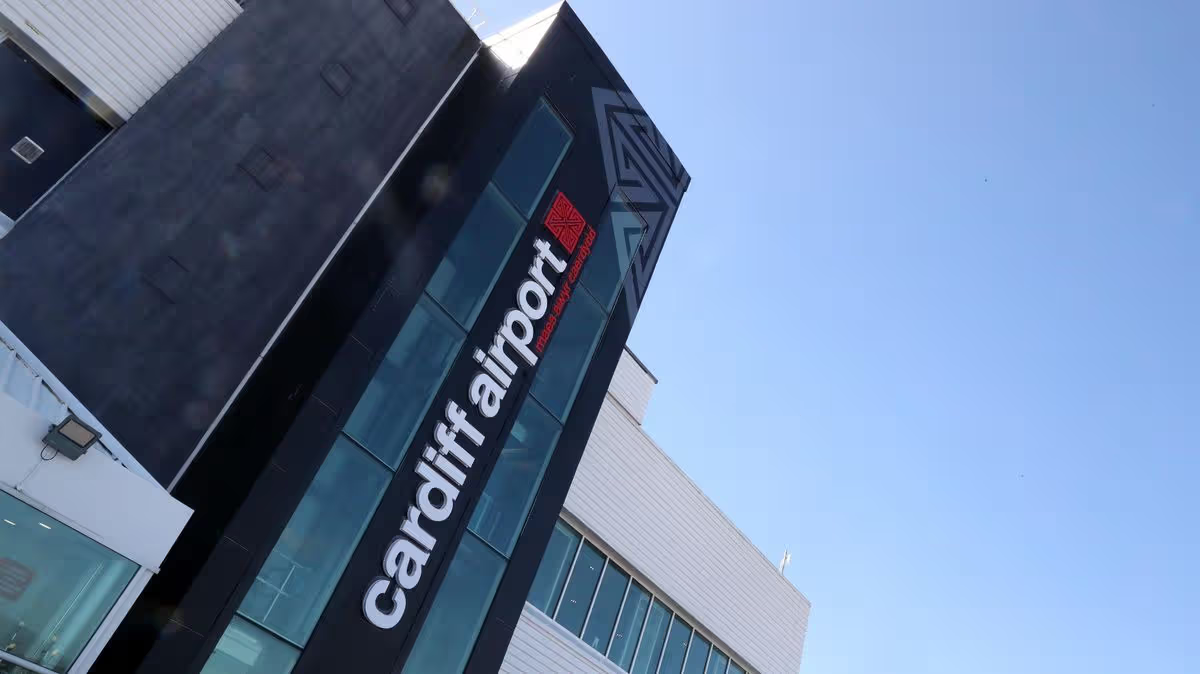
Cardiff Airport.(Image: Cardiff Airport)

Cardiff Airport achieved a near 10% rise in passengers last year, but still remains well below its pre-pandemic level.

The Rhoose-based airport, which is wholly-owned by the Welsh Government, welcomed 963,000 passengers in 2025, up 9% on 2024, with a 4% rise in air traffic movements. The airport said the increase was supported by significant growth from Ryanair and TUI. Cargo volumes, supported by a new base from European Cargo, experienced a 7% increase .

The airport is also continuing to invest in route development, with further new services planned for this year and 2027.

Ryanair is set to operate its busiest ever summer, marking 12 years of operations at the airport. Extra frequency has been added across its five routes, For the summer season TUI will base a fourth aircraft at Cardiff, bringing increased frequencies to Antalya, Enfidha, Gran Canaria, Palma and Tenerife and new routes to Faro and Hurghada.

Advertisement

READ MORE: If we want to address the housing crisis we simply need more buildersREAD MORE: Developer behind what will be Wales’ tallest building appetite for further investment

Further TUI growth is planned for the 2026-27 winter season, with new services to Kittilä (Finland) and the Dominican Republic.

Canadian low cost carrier WestJet, from May 23, will launch a new four-times-weekly service from the airport to Toronto Pearson – the largest and busiest airport in Canada. It connects to all major Canadian cities, as well as the US cities of New York, Los Angeles, Chicago, Miami and Dallas. For its inaugural 2026 summer season the route has released 21,320 seats for sale. Both Cardiff Airport and WestJet said they are “pleased with the sales performance to date.”

KLM continues to operate twice-daily services to Amsterdam, providing global hub connectivity. Moreover, Vueling continues services to Malaga and Alicante.

Advertisement

The airport said that PandO Cruises has expanded its fly-cruise programme with additional flights to Barbados and a new destination. The airport wouldn’t be drawn on providing a projected passenger figure for 2026.

Last month a legal challenge brought by Bristol Airport against Welsh Government plans to provide further subsidy support to the airport over a ten year period of £205m was heard by the Competition Appeal Tribunal.

Around £100m of the subsidy has been earmarked for route development. Long-term the airport is aiming to get back to two million passengers. In 2019, prior to the pandemic, the airport attracted 1.6 million passengers. Its subsidy support is expected to be framed at attracting routes, including more longhaul alongside WestJet, currently not served by Bristol.

As well as being deployed to attract new routes, the subsidy support will also be used to diversify away from passenger-related revenues. The airport is targeting areas such as aviation maintenance, repair and overhaul (MRO) and freight.

Advertisement

Bristol Airport, which in 2025 saw its passenger numbers dwarf Cardiff’s – at 10.8 million, of which around two million are drawn from South Wales – argues that the proposed funding breaches the post-EU state aid regime under the Subsidy Control Act 2022. It says the funding represents unprecedented state support for a UK airport and will put it at a commercial disadvantage relative to its nearest rival.

The Welsh Government’s position is that the airport is not a failing enterprise and that it plays a vital role in supporting the wider Welsh economy. An economic assessment by Grant Thornton estimates it generates a £220m gross value added positive impact on the Welsh economy through the airport’s direct, indirect and induced impacts.

Its subsidy support is expected to be framed at attracting routes, including more longhaul alongside WestJet, currently not served by Bristol.

A judgment from the Competition Appeal Tribunal, which would be subject to appeal, is not expected this side of the Senedd Election in May.

Advertisement

With the £52m acquisition cost of acquiring the airport from Spanish firm Abertis back in 2013, it has invested nearly £200m, with a significant element of repayable loans converted into equity.

The airport, in its last financial year to the end of March 2025, show its revenues improve from £19.33m a year earlier to £19.8m, while on a pre-Ebitda basis (earnings before interest, tax, depreciation, amortisation) and exceptional items it posted a positive £5.7m. However, when factoring in the receipt of an £11.8m Welsh Government grant linked to a five-year post-Covid recovery plan, the Ebitda figure slipped into the red at £5.57m.

Since being acquired by the Welsh Government the airport has accumulated losses of around £60m.

In March last year former airport chief executive Spencer Birns quit his role. The accounts show he received a £151,088 payment, approved by the airport’s remuneration committee, in lieu of notice. No reason for his departure from what was a £131,000 role was given.

Advertisement

The airport’s current chief executive is Jon Bridge, having taken up his role last November. He is a former chief executive of SA Brain and Co.


Continue Reading
Click to comment

You must be logged in to post a comment Login

Leave a Reply

Business

Form 8K Invesco Commercial Real Estate Finance Trust For: 17 March

Published

on


Form 8K Invesco Commercial Real Estate Finance Trust For: 17 March

Continue Reading

Business

Stormrae Hosts Record Breaking Solana-Based AI Challenge With 15,000 Participants

Published

on


Stormrae Hosts Record Breaking Solana-Based AI Challenge With 15,000 Participants

Continue Reading

Business

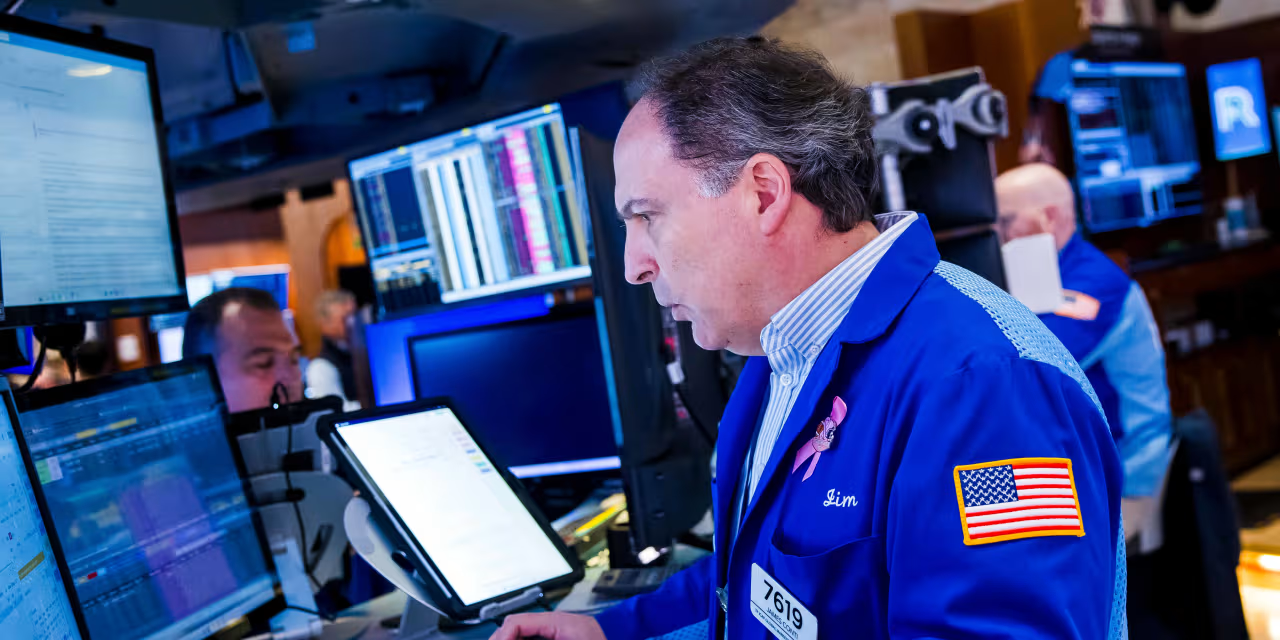
Has the Stock Selloff Ended? Wall Street Sees Value but Remains Focused on Oil Markets.

Published

on

Has the Stock Selloff Ended? Wall Street Sees Value but Remains Focused on Oil Markets.

Has the Stock Selloff Ended? Wall Street Sees Value but Remains Focused on Oil Markets.

Continue Reading

Business

Taylor Farms introduces protein products

Published

on

Taylor Farms introduces protein products

The items include salads and snack packs. 

Continue Reading

Business

US Stocks: Boeing sees profit for commercial airplane division in 2027, later than expected

Published

on

US Stocks: Boeing sees profit for commercial airplane division in 2027, later than expected
Boeing expects its commercial airplane division to turn a profit in 2027, not this year as previously expected due to higher-than-expected costs of its purchase of parts supplier Spirit AeroSystems, its chief financial ‌officer said ⁠on Tuesday, ⁠in a new setback for the U.S. planemaker.

The commercial airplane division lost $632 million in 2025 and $2.1 billion in 2024.

The company expects to increase production of its popular 737 ​MAX jet from roughly 42 aircraft a month to 47 a month by year’s end and to deliver about 500 of the ​jets this year, Chief Financial Officer Jay Malave ⁠said at ‌the Bank of America Global Industrials Conference in ​London.

The single-aisle ​jet is critical to Boeing’s financial recovery. Planemakers receive ⁠the majority of cash from customers when they deliver new ​aircraft.

Advertisement

Deliveries in the first quarter were slightly hampered ​by damage to wiring on about 25 737s, but fixing the problem only required a few more days of work and will not hurt annual deliveries, Malave said.


Boeing shares were down 1% in early trading, continuing a 13% slide in the past month.
Malave said Boeing ‌does not plan to develop a new jetliner anytime soon.Boeing’s first-quarter 787 Dreamliner deliveries will be down slightly from ​a projected ​20 aircraft to ⁠about 15 of the popular widebody jet, mostly due to delays certifying premium-class seat designs, he said.

“The premium seating has been challenging,” he said. “Those are ​very strict, rigorous types of certifications.”

The planemaker wants to increase 787 production from its current rate of eight Dreamliners per month to 10 by the end of 2026. The company is expanding its 787 assembly plant in North Charleston, South Carolina.

Advertisement
Continue Reading

Business

US stock market crash fears ease even as Middle East war rages on

Published

on

US stock market crash fears ease even as Middle East war rages on
Options traders’ fears of a U.S. stock market crash have pulled back nearly to levels seen before the U.S.-Israeli attacks on Iran that made oil prices soar.

The Nations TailDex Index and ‌the Cboe ⁠Skew Index, ⁠two separate gauges that measure how much traders are paying for crash protection, have retreated to near where they stood before the February 28 strikes on Iran. The S&P 500 is still down 2% from pre-war levels.

“TDEX is signaling that investors are now less worried about a “tail event,” or a really steep drop in equity prices, than at any point since the war started,” said ⁠Scott Nations, ‌president of Nations Indexes, an independent developer of volatility and option strategy index products.

“Given the muted response from the S&P 500, this outlook makes ⁠sense, but it’s an important metric to watch,” he said.

Advertisement

On Monday, the TailDex index was at 18.84, just below its closing level of 19.01 on February 27. The Cboe SKEW index finished at 141.49 on Monday, down from 146.67 prior to the air strikes.


Both indexes soared to multi-month highs as soaring oil prices unleashed fear of a sizeable pullback in markets.
The cost of deep out-of-the-money S&P 500 puts – contracts that ‌would offer protection against a 20% drop in the market over the next three months – stands just slightly higher than it was immediately prior to the strikes, ⁠according to Susquehanna Financial Group strategist Christopher Jacobson. “After hitting multi-year highs at times last week, S&P skew levels have declined incrementally as some of that downside tail bid has faded alongside,” Jacobson said.

While fear of a market crash has faded, market anxiety levels are still higher than they were in early February. Nor are investors rushing to bet on a sharp rebound in stocks past old highs.

“We haven’t really seen that skew shift back towards the upside tail,” Jacobson said.

Advertisement
Continue Reading

Business

EV charging VAT ruling could cut public charging costs to 5%

Published

on

Businesses are not required to have a petrol pump on their premises to claim refunds of VAT on fossil fuel expenses, why is it not the same for EV charging?

A landmark tribunal ruling that public electric vehicle (EV) charging should be subject to a reduced 5% VAT rate rather than the standard 20% has sparked renewed debate over fairness in the UK’s charging infrastructure, with potential implications for millions of drivers.

The decision, issued by a First-tier Tribunal, could bring public charging costs into line with those faced by motorists charging at home, addressing what many in the industry have long argued is a structural inequality in the tax system. Currently, drivers with access to off-street parking benefit from the lower VAT rate on domestic electricity, while those reliant on public charging, often urban residents, pay significantly more.

Justin Whitehouse, Managing Director at Alvarez & Marsal Tax, said the ruling reflects “a win for common sense”, highlighting a disparity that has persisted since EV adoption began to scale.

“To most people, it feels inherently unfair that those with a driveway can charge their vehicles at a reduced VAT rate, while those without off-street parking are left paying the full rate,” he said.

The case has also exposed deeper issues within the UK’s VAT framework, particularly around how electricity is classified depending on where it is consumed. The legislation hinges on the definition of “premises”, distinguishing between residential and commercial supply, a distinction that has proven increasingly difficult to apply in the context of modern EV charging networks.

Advertisement

Whitehouse noted that despite sustained lobbying from the industry, HMRC had not clarified its position, making a legal challenge almost inevitable. “The legislation has always been difficult to apply in practice,” he said, pointing to ambiguity that has left operators and consumers navigating an inconsistent system.

The ruling raises the prospect of refunds for drivers and businesses that may have overpaid VAT on public charging, potentially unlocking significant sums across the sector. However, any immediate impact remains uncertain. As a First-tier Tribunal decision, the ruling does not set a binding precedent and could yet be appealed, prolonging uncertainty for both operators and consumers.

Even if upheld, a key question will be how quickly, and to what extent, any VAT reduction is passed on to drivers. While lower tax rates could reduce charging costs in theory, pricing structures across public networks are influenced by a range of factors, including energy wholesale prices, infrastructure investment and operator margins.

In the short term, the decision is likely to intensify pressure on policymakers to address inconsistencies in EV taxation, particularly as the UK accelerates its transition away from petrol and diesel vehicles. Aligning VAT rates between home and public charging has been a longstanding demand from industry groups, who argue that the current system risks penalising those without access to private driveways — often those in cities where EV adoption is critical to meeting emissions targets.

Advertisement

Over the longer term, the case could act as a catalyst for broader reform of how energy usage is taxed in a decarbonising economy, where traditional distinctions between domestic and commercial consumption are becoming increasingly blurred.

For now, the ruling represents a significant moment in the evolution of the UK’s EV ecosystem, one that highlights both the opportunities and the complexities involved in building a fair, scalable and accessible charging infrastructure for the future.


Amy Ingham

Amy is a newly qualified journalist specialising in business journalism at Business Matters with responsibility for news content for what is now the UK’s largest print and online source of current business news.

Advertisement

Continue Reading

Business

Analysts revise AI hyperscaler debt forecasts after Amazon bond sale

Published

on

Analysts revise AI hyperscaler debt forecasts after Amazon bond sale
Analysts anticipate a higher supply of debt being raised by the Big Five hyperscaler companies this year as they race to build out their data center infrastructure, following Amazon’s near-record bond sale last week of roughly $54 billion in investment-grade bonds.

Hyperscalers, which operate vast data centers and other infrastructure to facilitate AI training and deployment, have been raising debt to finance data centers needed to fuel the boom in AI.

“There continues to be an expectation of a lot ‌of capital to ⁠be raised ⁠in this sector,” said John Servidea, co-head of investment-grade debt capital markets at JPMorgan, which led the Amazon deal.

“Whether it’s the companies’ publicly stated capex budgets, or whether it’s various banks’ estimates of the amount of hyperscaler issuance, if you look at all of those, a realistic expectation would be that at some point there’s more,” Servidea added.

Advertisement

Analysts at BofA Global Research on Friday raised their forecast for the hyperscalers’ new debt in 2026 to $175 billion from $140 billion. In early February, Barclays analysts said that U.S. investment-grade corporate bond issuance could be ⁠greater than $2 ‌trillion in 2026, which they said “would exceed even the post‑COVID record levels seen in 2020.”


The five major AI hyperscalers – Amazon, Alphabet’s Google, Meta, Microsoft and Oracle – issued $121 billion in U.S. corporate ⁠bonds last year, versus an average $28 billion per year between 2020 and 2024, according to a January report by BofA Securities. Microsoft and Oracle declined to comment, while the other companies did not immediately respond to requests for comment.
Hyperscalers made up four of the five biggest U.S. high-grade bond deals in 2025, according to a December report by MUFG analysts. Most of those took place in the second half of the year. Oracle sold $18 billion in bonds in September. This was followed in October by Meta’s $30 billion deal and November deals ‍from Alphabet ($17.5 billion) and Amazon ($15 billion).

This year saw a $31.51 billion ‌global bond raise by Alphabet in February, which included a rare 100-year “century” bond as part of the deal.

Most recently, Amazon raised about $37 billion across 11 tranches in the U.S. bond market on March 10. This was followed the ⁠next day by a 14.5 billion euro-denominated ($16.8 billion) bond raise by the company.

The overwhelming demand – nearly four times the total amount sold – for Amazon’s bond sale underlines investor appetite for debt from the major hyperscalers.

Advertisement

Market participants believe the actual and expected debt raise by hyperscalers will keep forecasts for potential record-breaking overall U.S. corporate debt issuance on track, despite quiet days in the primary market preceding and following the escalation of conflict on February 28 between Iran and U.S.-Israeli forces.

“It’s fertile ground right now in capital markets, and you’re also in the first half of the year,” said George Catrambone, head of fixed income, Americas, at asset manager DWS.

Continue Reading

Business

Past The Ides Of March

Published

on

S&P Global Dividend 100 Index: Where High Yield Meets Quality

Past The Ides Of March

Continue Reading

Business

Fortive Corporation (FTV) Presents at JPMorgan Industrials Conference 2026 Transcript

Published

on

OneWater Marine Inc. (ONEW) Q1 2026 Earnings Call Transcript

Fortive Corporation (FTV) JPMorgan Industrials Conference 2026 March 17, 2026 12:20 PM EDT

Company Participants

Mark Okerstrom – Senior VP & CFO

Conference Call Participants

Advertisement

C. Stephen Tusa – JPMorgan Chase & Co, Research Division

Presentation

C. Stephen Tusa
JPMorgan Chase & Co, Research Division

Advertisement

All right. We’re moving along with Mark Okerstrom from CFO of Fortive. Thank you so much for joining us here in lovely Washington, D.C.

Mark Okerstrom
Senior VP & CFO

Yes, thanks. Great to be here.

Advertisement

Question-and-Answer Session

C. Stephen Tusa
JPMorgan Chase & Co, Research Division

Advertisement

Yes. Just wanted to start off with a basic kind of background on what’s happening out in the world today, I kind of have to ask the question about exposures and anything that’s going on in the world that is a concern or impact for Fortive. Middle East wise?

Mark Okerstrom
Senior VP & CFO

Yes. Listen, I’d say we’re on track on the Fortive accelerated strategy, on track in terms of our strategic initiatives. The Middle East for us is a small portion of our revenue. It’s low single digits percentage of our revenue. We are seeing strong demand for products into the Middle East.

Advertisement

So Fluke Industrial Scientific that does gas sensors, again, seen strong demand, some challenges getting shipments into the Middle East. But again, generally, it’s a pretty small portion, and it’s — for better, for worse, it seems like it’s an opportunity as opposed to a risk for us.

C. Stephen Tusa
JPMorgan Chase & Co, Research Division

And how are you guys putting the Middle East and what’s happening over there aside. How are things kind of trending over the course of the quarter, kind of quarter-to-date, point-of-sale trends, software sales, anything like that?

Advertisement

Mark Okerstrom
Senior VP & CFO

Well, I would

Advertisement
Continue Reading

Trending

Copyright © 2025