The announcement, part of an expanded North American leg revealed in mid-March 2026, follows Lil Wayne’s recent additions to his touring schedule. Variety, Pitchfork, Consequence and JamBase reported the new dates, highlighting the tour’s focus on classics from Tha Carter, Tha Carter II and beyond. The Des Moines stop slots between other Midwest shows, including Chicago on July 17 at Huntington Bank Pavilion at Northerly Island and Shakopee, Minnesota, on July 18 at Mystic Lake Casino Hotel.
This marks Lil Wayne’s second major appearance in Des Moines in recent years. He previously headlined what was then Wells Fargo Arena — now rebranded as part of the Iowa Events Center complex — on April 11, 2024, delivering a dynamic set that included shoutouts to local star Caitlin Clark and drew enthusiastic crowds. Fans praised the performance for its intensity and Lil Wayne’s rapid-fire delivery.
The Casey’s Center, a premier venue within the Iowa Events Center, has hosted major acts like Paul McCartney, Eric Church and Elton John. Capacity varies by configuration but typically accommodates large concerts with strong sightlines and acoustics.
Tickets for the July 16 show go on sale Friday, March 20, 2026, at 10 a.m. local time. Primary sales will occur through Hy-VeeTix.com, the official ticketing partner for the Iowa Events Center, and at the Casey’s Center box office when open. Citi cardmembers may access a presale starting earlier — details are listed as “coming soon” on the Hy-VeeTix event page.
Advertisement
For those seeking tickets, start at Hy-VeeTix.com by searching for “Lil Wayne” or navigating to the Casey’s Center events calendar. The site offers interactive seating charts, allowing fans to select specific sections and view prices in real time. General admission or reserved seating options are expected, with prices varying based on demand and location.
Secondary marketplaces like Ticketmaster, SeatGeek, Vivid Seats and Gametime also list or will soon feature inventory for the Des Moines date. These platforms often provide last-minute options or resale tickets, though prices may exceed face value due to fees and demand. SeatGeek and Vivid Seats emphasize buyer guarantees and price comparisons, with some Lil Wayne tickets across his 2026 tour starting around $123 on secondary sites, though Des Moines-specific pricing remains to be seen.
To maximize chances of securing tickets:
– Create accounts in advance on Hy-VeeTix and any preferred resale sites to speed up checkout. – Join Lil Wayne’s official fan club or mailing list via his website or social media for potential presale codes. – Monitor Ticketmaster.com, where Lil Wayne’s broader tour is listed, as some dates route through the platform. – Arrive early for online sales, as popular shows can sell out quickly during onsale rushes. – Consider VIP packages if offered, which may include premium seating, exclusive merchandise or meet-and-greet opportunities — past Lil Wayne tours featured VIP merch bundles with front-row access.
Advertisement
Lil Wayne, born Dwayne Michael Carter Jr., remains one of hip-hop’s most prolific artists, with 15 studio albums, multiple Grammys and a catalog spanning trap anthems, introspective tracks and collaborations. The “20 Years of Carter Classics” tour spotlights material from his breakthrough Tha Carter era, which revolutionized Southern rap and influenced generations. Recent shows have included special guests on select dates, though openers for Des Moines have not been announced.
Fans in Des Moines can expect a set heavy on classics like “Go D.J.,” “Fireman,” “Lollipop,” “A Milli” and “6 Foot 7 Foot,” alongside deeper cuts from the Carter series. Lil Wayne’s live performances are known for high energy, rapid flows and crowd interaction, often extending beyond scheduled times.
The tour extension reflects strong demand following initial 2025-2026 announcements. Lil Wayne has maintained a busy schedule with festival appearances, including BottleRock Napa Valley in May 2026, and continues to release music and collaborate.
For those unable to attend in person, check local radio stations or streaming platforms for potential live broadcasts or post-show coverage. Iowa Events Center officials recommend arriving early for parking and entry, with clear bag policies and standard venue rules in place.
Advertisement
As excitement builds for Lil Wayne’s return, Des Moines rap fans have a prime opportunity to experience one of hip-hop’s icons celebrating his legacy live. Secure tickets promptly through official channels to avoid missing out on what promises to be a memorable night.
Disclosure: This post contains affiliate links. We may receive a commission for purchases made through these links at no additional cost to you.
Boeing expects its commercial airplane division to turn a profit in 2027, not this year as previously expected due to higher-than-expected costs of its purchase of parts supplier Spirit AeroSystems, its chief financial officer said on Tuesday, in a new setback for the U.S. planemaker.
The commercial airplane division lost $632 million in 2025 and $2.1 billion in 2024.
The company expects to increase production of its popular 737 MAX jet from roughly 42 aircraft a month to 47 a month by year’s end and to deliver about 500 of the jets this year, Chief Financial Officer Jay Malave said at the Bank of America Global Industrials Conference in London.
The single-aisle jet is critical to Boeing’s financial recovery. Planemakers receive the majority of cash from customers when they deliver new aircraft.
Advertisement
Deliveries in the first quarter were slightly hampered by damage to wiring on about 25 737s, but fixing the problem only required a few more days of work and will not hurt annual deliveries, Malave said.
Live Events
Boeing shares were down 1% in early trading, continuing a 13% slide in the past month. Malave said Boeing does not plan to develop a new jetliner anytime soon.Boeing’s first-quarter 787 Dreamliner deliveries will be down slightly from a projected 20 aircraft to about 15 of the popular widebody jet, mostly due to delays certifying premium-class seat designs, he said.
“The premium seating has been challenging,” he said. “Those are very strict, rigorous types of certifications.”
The planemaker wants to increase 787 production from its current rate of eight Dreamliners per month to 10 by the end of 2026. The company is expanding its 787 assembly plant in North Charleston, South Carolina.
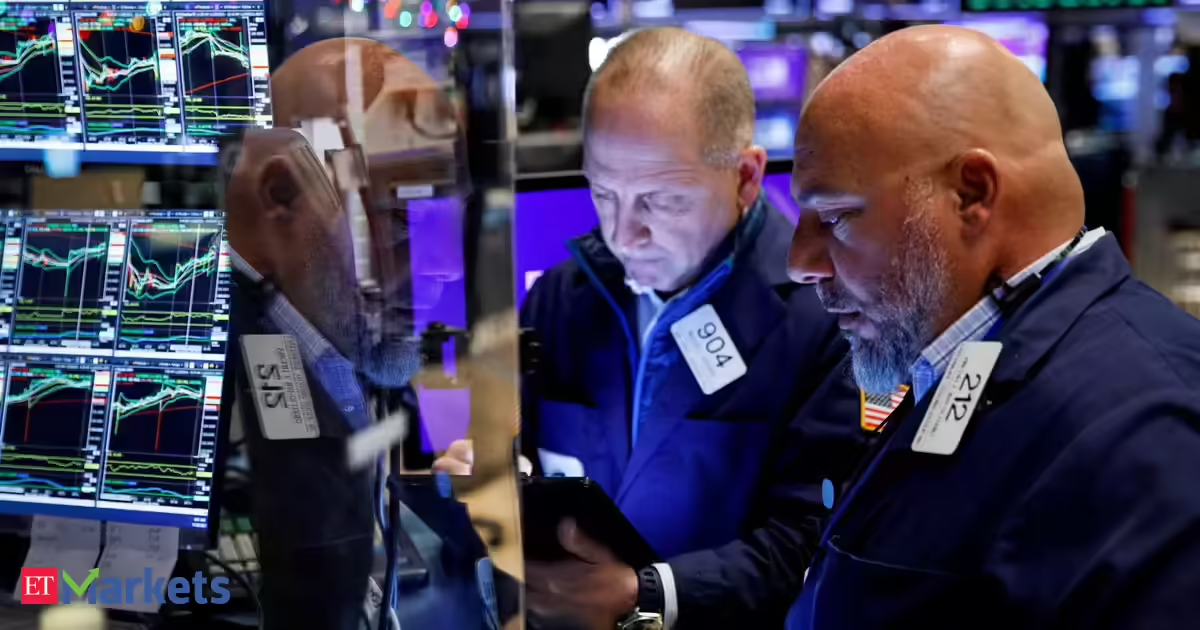
Options traders’ fears of a U.S. stock market crash have pulled back nearly to levels seen before the U.S.-Israeli attacks on Iran that made oil prices soar.
The Nations TailDex Index and the Cboe Skew Index, two separate gauges that measure how much traders are paying for crash protection, have retreated to near where they stood before the February 28 strikes on Iran. The S&P 500 is still down 2% from pre-war levels.
“TDEX is signaling that investors are now less worried about a “tail event,” or a really steep drop in equity prices, than at any point since the war started,” said Scott Nations, president of Nations Indexes, an independent developer of volatility and option strategy index products.
“Given the muted response from the S&P 500, this outlook makes sense, but it’s an important metric to watch,” he said.
Advertisement
On Monday, the TailDex index was at 18.84, just below its closing level of 19.01 on February 27. The Cboe SKEW index finished at 141.49 on Monday, down from 146.67 prior to the air strikes.
Live Events
Both indexes soared to multi-month highs as soaring oil prices unleashed fear of a sizeable pullback in markets. The cost of deep out-of-the-money S&P 500 puts – contracts that would offer protection against a 20% drop in the market over the next three months – stands just slightly higher than it was immediately prior to the strikes, according to Susquehanna Financial Group strategist Christopher Jacobson. “After hitting multi-year highs at times last week, S&P skew levels have declined incrementally as some of that downside tail bid has faded alongside,” Jacobson said.
While fear of a market crash has faded, market anxiety levels are still higher than they were in early February. Nor are investors rushing to bet on a sharp rebound in stocks past old highs.
“We haven’t really seen that skew shift back towards the upside tail,” Jacobson said.
A landmark tribunal ruling that public electric vehicle (EV) charging should be subject to a reduced 5% VAT rate rather than the standard 20% has sparked renewed debate over fairness in the UK’s charging infrastructure, with potential implications for millions of drivers.
The decision, issued by a First-tier Tribunal, could bring public charging costs into line with those faced by motorists charging at home, addressing what many in the industry have long argued is a structural inequality in the tax system. Currently, drivers with access to off-street parking benefit from the lower VAT rate on domestic electricity, while those reliant on public charging, often urban residents, pay significantly more.
Justin Whitehouse, Managing Director at Alvarez & Marsal Tax, said the ruling reflects “a win for common sense”, highlighting a disparity that has persisted since EV adoption began to scale.
“To most people, it feels inherently unfair that those with a driveway can charge their vehicles at a reduced VAT rate, while those without off-street parking are left paying the full rate,” he said.
The case has also exposed deeper issues within the UK’s VAT framework, particularly around how electricity is classified depending on where it is consumed. The legislation hinges on the definition of “premises”, distinguishing between residential and commercial supply, a distinction that has proven increasingly difficult to apply in the context of modern EV charging networks.
Advertisement
Whitehouse noted that despite sustained lobbying from the industry, HMRC had not clarified its position, making a legal challenge almost inevitable. “The legislation has always been difficult to apply in practice,” he said, pointing to ambiguity that has left operators and consumers navigating an inconsistent system.
The ruling raises the prospect of refunds for drivers and businesses that may have overpaid VAT on public charging, potentially unlocking significant sums across the sector. However, any immediate impact remains uncertain. As a First-tier Tribunal decision, the ruling does not set a binding precedent and could yet be appealed, prolonging uncertainty for both operators and consumers.
Even if upheld, a key question will be how quickly, and to what extent, any VAT reduction is passed on to drivers. While lower tax rates could reduce charging costs in theory, pricing structures across public networks are influenced by a range of factors, including energy wholesale prices, infrastructure investment and operator margins.
In the short term, the decision is likely to intensify pressure on policymakers to address inconsistencies in EV taxation, particularly as the UK accelerates its transition away from petrol and diesel vehicles. Aligning VAT rates between home and public charging has been a longstanding demand from industry groups, who argue that the current system risks penalising those without access to private driveways — often those in cities where EV adoption is critical to meeting emissions targets.
Advertisement
Over the longer term, the case could act as a catalyst for broader reform of how energy usage is taxed in a decarbonising economy, where traditional distinctions between domestic and commercial consumption are becoming increasingly blurred.
For now, the ruling represents a significant moment in the evolution of the UK’s EV ecosystem, one that highlights both the opportunities and the complexities involved in building a fair, scalable and accessible charging infrastructure for the future.
Amy Ingham
Amy is a newly qualified journalist specialising in business journalism at Business Matters with responsibility for news content for what is now the UK’s largest print and online source of current business news.
Analysts anticipate a higher supply of debt being raised by the Big Five hyperscaler companies this year as they race to build out their data center infrastructure, following Amazon’s near-record bond sale last week of roughly $54 billion in investment-grade bonds.
Hyperscalers, which operate vast data centers and other infrastructure to facilitate AI training and deployment, have been raising debt to finance data centers needed to fuel the boom in AI.
“There continues to be an expectation of a lot of capital to be raised in this sector,” said John Servidea, co-head of investment-grade debt capital markets at JPMorgan, which led the Amazon deal.
“Whether it’s the companies’ publicly stated capex budgets, or whether it’s various banks’ estimates of the amount of hyperscaler issuance, if you look at all of those, a realistic expectation would be that at some point there’s more,” Servidea added.
Advertisement
Analysts at BofA Global Research on Friday raised their forecast for the hyperscalers’ new debt in 2026 to $175 billion from $140 billion. In early February, Barclays analysts said that U.S. investment-grade corporate bond issuance could be greater than $2 trillion in 2026, which they said “would exceed even the post‑COVID record levels seen in 2020.”
Live Events
The five major AI hyperscalers – Amazon, Alphabet’s Google, Meta, Microsoft and Oracle – issued $121 billion in U.S. corporate bonds last year, versus an average $28 billion per year between 2020 and 2024, according to a January report by BofA Securities. Microsoft and Oracle declined to comment, while the other companies did not immediately respond to requests for comment. Hyperscalers made up four of the five biggest U.S. high-grade bond deals in 2025, according to a December report by MUFG analysts. Most of those took place in the second half of the year. Oracle sold $18 billion in bonds in September. This was followed in October by Meta’s $30 billion deal and November deals from Alphabet ($17.5 billion) and Amazon ($15 billion).
This year saw a $31.51 billion global bond raise by Alphabet in February, which included a rare 100-year “century” bond as part of the deal.
Most recently, Amazon raised about $37 billion across 11 tranches in the U.S. bond market on March 10. This was followed the next day by a 14.5 billion euro-denominated ($16.8 billion) bond raise by the company.
The overwhelming demand – nearly four times the total amount sold – for Amazon’s bond sale underlines investor appetite for debt from the major hyperscalers.
Advertisement
Market participants believe the actual and expected debt raise by hyperscalers will keep forecasts for potential record-breaking overall U.S. corporate debt issuance on track, despite quiet days in the primary market preceding and following the escalation of conflict on February 28 between Iran and U.S.-Israeli forces.
“It’s fertile ground right now in capital markets, and you’re also in the first half of the year,” said George Catrambone, head of fixed income, Americas, at asset manager DWS.
C. Stephen Tusa – JPMorgan Chase & Co, Research Division
Presentation
C. Stephen Tusa JPMorgan Chase & Co, Research Division
Advertisement
All right. We’re moving along with Mark Okerstrom from CFO of Fortive. Thank you so much for joining us here in lovely Washington, D.C.
Mark Okerstrom Senior VP & CFO
Yes, thanks. Great to be here.
Advertisement
Question-and-Answer Session
C. Stephen Tusa JPMorgan Chase & Co, Research Division
Advertisement
Yes. Just wanted to start off with a basic kind of background on what’s happening out in the world today, I kind of have to ask the question about exposures and anything that’s going on in the world that is a concern or impact for Fortive. Middle East wise?
Mark Okerstrom Senior VP & CFO
Yes. Listen, I’d say we’re on track on the Fortive accelerated strategy, on track in terms of our strategic initiatives. The Middle East for us is a small portion of our revenue. It’s low single digits percentage of our revenue. We are seeing strong demand for products into the Middle East.
Advertisement
So Fluke Industrial Scientific that does gas sensors, again, seen strong demand, some challenges getting shipments into the Middle East. But again, generally, it’s a pretty small portion, and it’s — for better, for worse, it seems like it’s an opportunity as opposed to a risk for us.
C. Stephen Tusa JPMorgan Chase & Co, Research Division
And how are you guys putting the Middle East and what’s happening over there aside. How are things kind of trending over the course of the quarter, kind of quarter-to-date, point-of-sale trends, software sales, anything like that?


















































You must be logged in to post a comment Login