

“I woke up in the morning and I literally thought I had a cold. I booked a doctor’s appointment because my throat was hurting and I thought ‘is it a cold? Is it tonsillitis?’”
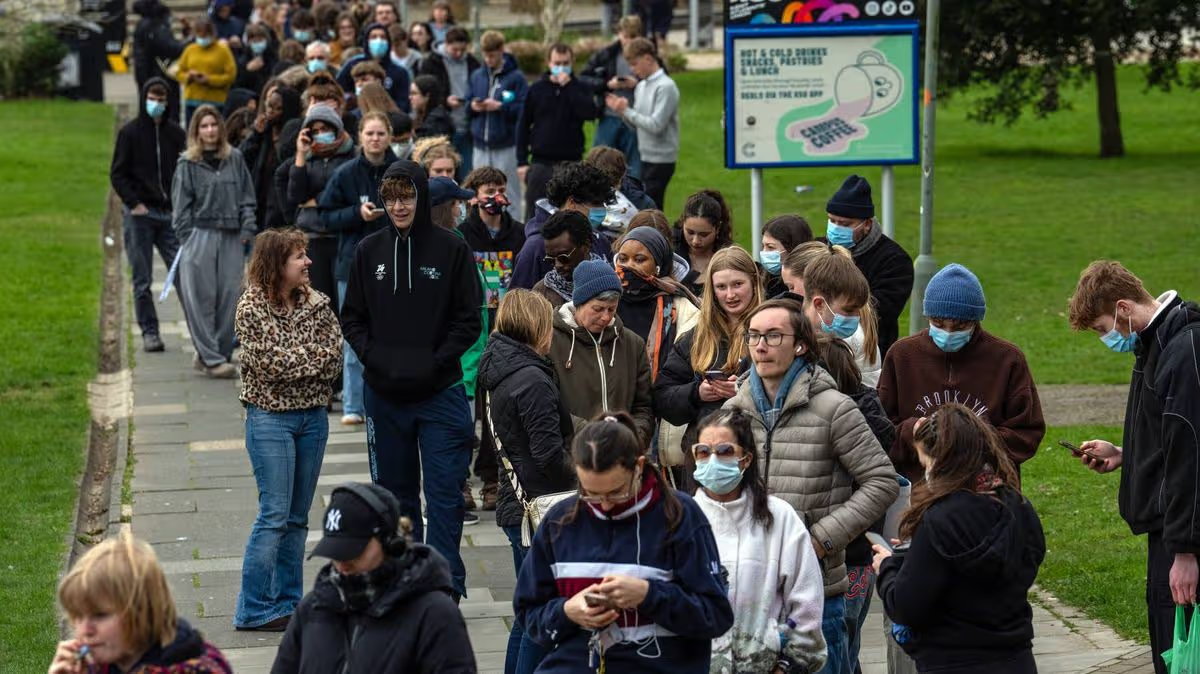
A woman from Kent who was diagnosed with potentially fatal bacterial meningitis last year has shared her experience after two people died in an outbreak. Juliette, 18, and a 21-year-old student from the University of Kent passed away following the outbreak, leading to thousands of students being tested and offered antibiotics.
A Kent woman who battled the life-threatening infection last year has opened up about her own encounter with the disease. The woman, known as Paigeey on social media, had bacterial meningitis – a less common but typically more severe form of the disease, and the same type involved in the current outbreak.
“I woke up in the morning and I literally thought I had a cold,” she explained. “I booked a doctor’s appointment because my throat was hurting and I thought ‘is it a cold? Is it tonsillitis?’
“I’ve never had tonsillitis before, but that’s the kind of feeling that I got in my throat. I went to work, I went to my doctor’s appointment. I booked it before 9am, by the time it was about one o’clock in the afternoon I couldn’t swallow and my voice was going all like husky.”
She added that the doctor couldn’t find anything wrong with her throat, but her glands were swollen, and when a light was shone into her eyes she began to feel ‘unbearable’ pressure in her head. After conducting blood tests, she said the doctor advised her to go to hospital and have a CT scan, reports the Mirror.
“I had to call my mum, she had to get my son from school,” she said. “I went straight to the hospital with all the notes that she gave me. Instantly they took my bloods. A couple of hours later I see a specialist and he put a camera in my nose, down my throat and they said to me ‘we think it’s meningitis’. They put me on steroids, IV, IV steroids, drip, fluids because I couldn’t drink, I could not swallow, my glands were that swollen I literally could not swallow my own spit.
“It got to the point where I could not look at my phone, I could not bear being in the room, the hospital room, I had to have sunglasses, I had to have a jumper over my head. I was crying in pain because of the pressure, and this was all in 24 hours, like less than 24 hours.
“It wasn’t a headache, it was pressure, and I’m literally talking to the point where I wanted to headbutt a wall. The pressure in my head was unbelievable.”
She ended up spending five days in hospital and underwent a lumbar puncture – a procedure, also known as a spinal tap, where a needle is inserted into the lower back to extract fluid – before being discharged with antibiotics. “I was still throwing up constantly,” she said. “I had to go back to hospital about a week later because I was just still being sick. I couldn’t drive, I couldn’t stand up.”
She added: “It was horrific. I’ve never, ever, ever been so poorly in my life, and this was just from a sore throat, that is it.” She described the symptoms as worsening, with a rash over her stomach, chest and back, as well as fever, “non-stop” vomiting, pressure, neck pain, and light sensitivity. “When I went back to the hospital a week later I was on the floor crying,” she said.
“I was in A&E on the floor crying because the light was that bad in my face, so yeah, it’s no joke. Keep safe out there, get checked out, stay safe. I could go on, and on, and on, but those are just the symptoms, and I thought it was tonsillitis.”
She said: “My heart goes out to those affected. Stay safe, be careful, and just look out for the signs and symptoms.”
What is meningitis?
The NHS describes meningitis as “an infection of the protective membranes that surround the brain and spinal cord”. It says it can affect anyone, but is most common in babies, young children, teenagers and young adults.
The organisation warns meningitis can be very serious if not treated quickly, and can cause sepsis, which can be fatal. It can also result in permanent damage to the brain or nerves.
It is usually caused by a bacterial or viral infection – bacterial meningitis is rarer, but more serious, and it is this type of the disease which the two people in Kent died from. Infections can be spread by sneezing, coughing, or kissing, and is usually transmitted by people carrying the virus or bacteria in their nose or throat, but who are not ill themselves.
What are the symptoms of meningitis?
The NHS states that symptoms of meningitis can develop quickly and in any order. Someone with meningitis may not develop all these symptoms.
They can include:
- a high temperature (fever)
- being sick
- a headache
- a rash that does not fade when a glass is rolled over it
- a stiff neck
- a dislike of bright lights
- drowsiness or unresponsiveness
- seizures (fits)




















































You must be logged in to post a comment Login