

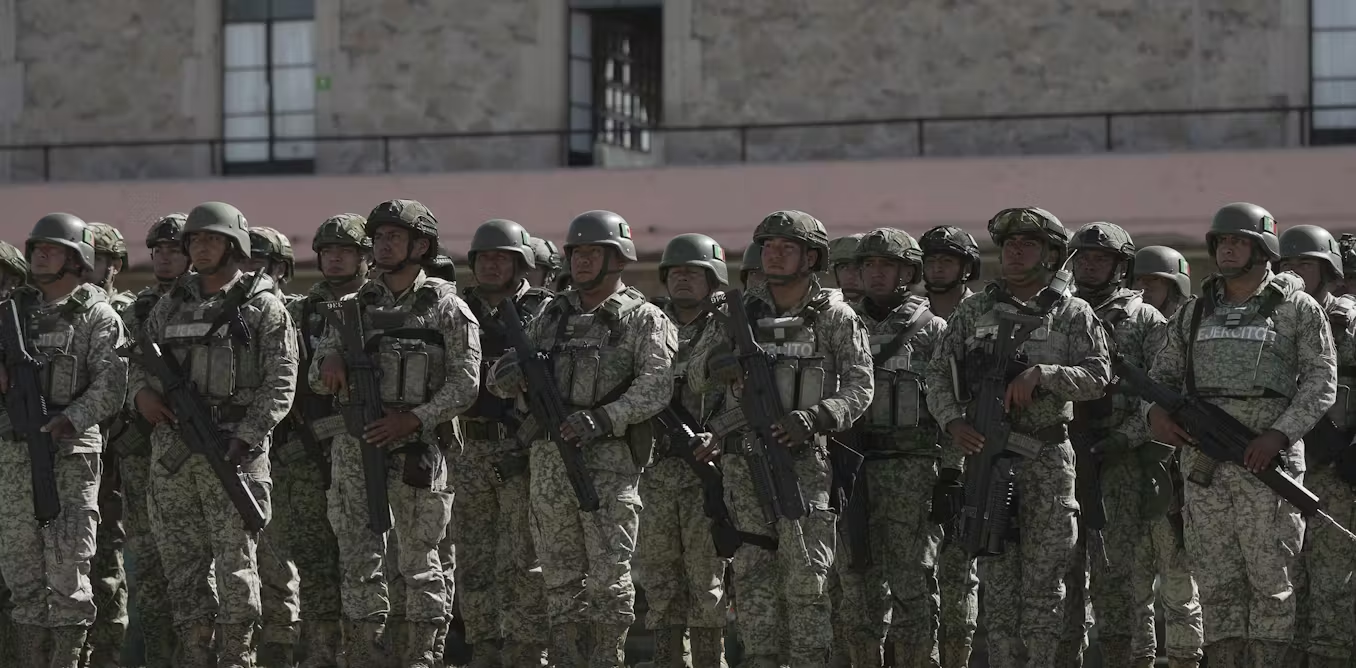
The recent killing of Nemesio Oseguera Cervantes, the leader of the Cártel de Jalisco Nueva Generación (CJNG) who was commonly referred to by his alias “El Mencho”, has once again brought global attention to drug-related violence in Mexico. His death at the hands of the Mexican security forces triggered a wave of retaliatory violence that affected several states.
This situation will undoubtedly occur again. Under Donald Trump, the US government has been ramping up pressure on the Mexican authorities to take stronger action against the cartels that traffic drugs across the border. So now is a good moment to reflect on the main cartels operating in Mexico and the underlying factors that sustain their operations.
For decades, Mexico had three major drug trafficking groups: the Milenio cartel, the Sinaloa cartel and the Golfo cartel. These organisations dominated drug trafficking until the 1980s when the Mexican government, under pressure from the US, intensified its operations against them. This pressure followed the 1985 killing of American Drug Enforcement Administration agent Enrique Camarena by organised crime figures.
But it wasn’t until 2006 that Mexico’s cartel landscape really began to change. That year saw the then-Mexican president, Felipe Calderón, deploy the Mexican army against the cartels in a militarised “war on drugs”. The government’s strategy of targeting senior cartel figures caused these organisations to fragment into smaller groups.
For example, a group of former Mexican special forces commandos who had previously acted as the enforcement arm for the Golfo cartel broke away to form Los Zetas in 2010. Various other factions elsewhere in Mexico also set up their own organisations. These included Beltrán Leyva, La Familia Michoacana, Knights Templar (Caballeros Templarios), CJNG and Guerreros Unidos.
In 2014, following the abduction of 43 student teachers in the Pacific state of Guerrero by Guerreros Unidos, President Enrique Peña Nieto escalated the offensive against Mexico’s cartels. This led to further fragmentation, with some newer organisations such as Santa Rosa de Lima focusing on oil theft. Andrés Manuel López Obrador came to power in 2018 and pressed hard against the Sinaloa cartel.
The detention of senior figures such as Joaquín “El Chapo” Guzmán and Ismael “El Mayo” Zambada caused the Sinaloa cartel to break into two factions: Los Chapitos which is led by El Chapo’s sons and Los Mayos which is headed by El Mayo’s lieutenants. CJNG took advantage of this moment to expand, positioning itself at the centre of Mexican drug trafficking.
The militarised war on drugs has not just caused the number of Mexican drug trafficking organisations to expand, it has also led to a surge in violence. Throughout the 1990s and early 2000s, violence in Mexico was actually declining. But since 2006, when Calderón first deployed the Mexican army against the cartels, homicides have increased from around 10,000 per year to over 30,000.

The rise in violence is also largely a consequence of the deliberate targeting of cartel leaders. Removing leadership produces a sudden succession struggle in an affected organisation, with violence often subsequently employed to prevent or respond to rivals testing the new leadership.
Mexico’s cartel violence is usually highly concentrated, with northern Mexico and the Pacific states experiencing the highest homicide levels. This pattern reflects trafficking routes. Mexico’s northern states are a key corridor for smuggling drugs into the US, while the Pacific coast serves as a major entry point from Asia for the chemicals used to produce fentanyl.
Sustaining cartel operations
The violence perpetrated by the cartels is enabled largely by weapons that are smuggled into Mexico. According to figures published by the US Bureau of Alcohol, Tobacco, Firearms and Explosives, more than half of the weapons seized from criminal groups in Mexico come from the US.
Research shows how close the relationship between US firearms and Mexican cartel violence is. One study from 2019 found that any increase in firearm production in the US increases violence in Mexico. And another, published several years earlier, discovered there was a spike in homicides in Mexico’s northern states when the US government lifted restrictions on the sale of certain assault weapons in 2004.

The Mexican government filed a lawsuit in 2021 that sought to hold American gun makers accountable for their contribution to the rising violence in Mexico. While the lawsuit was rejected unanimously by the US supreme court in 2025, the Mexican authorities have continued to press their US counterparts to take firmer action against arms smuggling from north of the border.
Mexico’s president, Claudia Sheinbaum, made a speech days after El Mencho’s killing in which she asserted that if the US government wants Mexico to prevent drug trafficking, they “have to do their part” and eradicate the flow of weapons.
And, finally, it’s important to recognise that the operations of the Mexican cartels are sustained in large part by drug consumption in the US. Data published by the UN Office on Drugs and Crime suggests that drug seizures, particularly of fentanyl, have increased substantially since 2019.
Until the US takes steps to more effectively reduce demand for drugs among its own citizens, Mexico’s battle against cartel violence will continue.









.jpg?quality=75&auto=webp&width=960)






































You must be logged in to post a comment Login