
Tech
DOGE Didn’t Cut Government Waste. It Was Government Waste.


from the a-failure-at-any-level dept
Look, I get it. Government waste is real. Bureaucratic bloat is real. The desire to have a federal government that spends taxpayer money wisely and operates without unnecessary friction? That’s a pretty standard and quite reasonable desire in American politics. So when Elon Musk showed up promising he could cut $2 trillion in federal spending by bringing the vaunted “efficiency” of the tech world to the government, a lot of people — not just MAGA diehards, but regular people who’d spent time cursing at a federal website built in 2003 or waiting on hold with the DMV — thought: sure, maybe give it a shot. A decade of fawning tech press coverage about Elon Musk will do that to your priors.
We now have the receipts on how that went. And they’re absolutely damning.
Between a comprehensive forensic accounting from the New York Times published in December and a detailed report from House Oversight Committee Ranking Member Robert Garcia released in February, we can now do a proper post-mortem on DOGE. The diagnosis: the patient was dead on arrival, the surgery was performed by people who lied about their credentials, and the bill for the operation far exceeded anything that was supposedly “saved.”
Let’s start with the most basic question: did DOGE save the government money? Because that was, you know, apparently the whole point (or so we were told).
The answer, as the Times bluntly puts it:
But the group did not do what Mr. Musk said it would: reduce federal spending by $1 trillion before October. On DOGE’s watch, federal spending did not go down at all. It went up.
Spending went up. Musk promised $2 trillion in cuts during the campaign, started walking that back almost immediately after the election, and the actual result was that the government spent more money. The entire exercise was supposed to pay for itself many times over. Instead, the taxpayer funded an $81 million operation that produced negative returns.
But DOGE had that website — the “Wall of Receipts” — proudly tallying up all those billions in savings, right? About that. The Times went through the 40 largest items on DOGE’s claimed savings list:
In DOGE’s published list of canceled contracts and grants, for instance, the 13 largest were all incorrect.
At the top were two Defense Department contracts, one for information technology, one for aircraft maintenance. Mr. Musk’s group listed them as “terminations,” and said their demise had saved taxpayers $7.9 billion. That was not true. The contracts are still alive and well, and those savings were an accounting mirage.
Together, those two false entries were bigger than 25,000 of DOGE’s other claims combined.
Of the 40 biggest claims on DOGE’s list, The Times found only 12 that appeared accurate — reflecting real reductions in what the government had committed to spend.
Two fake line items on a spreadsheet claimed more “savings” than 25,000 other entries combined. Of the 40 biggest claims, 28 were wrong. The 13 biggest were all wrong. The very first day the “Wall of Receipts” went live, its largest claim was an $8 billion Department of Homeland Security contract that was off by a factor of 1,000 — the contract was actually worth $8 million, as many folks reported at the time. That’s the kind of error that would get you fired from an introductory accounting course, and these were the people supposedly bringing precision and transparency to the federal government.
The accounting trick DOGE relied on most heavily is worth understanding, because it reveals whether this was mere incompetence or something more deliberate. The Times explains that in many cases, DOGE simply lowered the “ceiling value” of contracts — the theoretical maximum the government could spend, not what it was actually spending — and then claimed the full difference as “savings.” A defense contractor CEO explained this perfectly to stock analysts:
This summer, CACI’s chief executive, John Mengucci, told stock analysts that the change was meaningless.
“It doesn’t change a thing for this company,” he said. His company had always expected to be paid about $2 billion over the contract’s life span. And even if the contract ever did reach the ceiling, he said, the Pentagon could just raise it again.
“There’s no reduction of revenue,” Mr. Mengucci said.
Or to put it in even more understandable terms:
“Does lowering the maximum limit on your credit card save you any money?” said Travis Sharp, a senior fellow at the Center for Strategic and Budgetary Assessments, which studies federal spending. “No, it does not.”
The core of DOGE’s operations was to manufacture pretend statistics so that Musk and friends could claim savings that weren’t real. It was how DOGE manufactured the appearance of progress while delivering essentially nothing. After DOGE initially claimed $55 billion in savings, the website’s own documentation only supported $16.5 billion. Media analysis then showed half of that was a single data entry error (that $8 billion instead of $8 million). A Politico analysis found DOGE had cut only $1.4 billion in actual spending — and even that money couldn’t reduce the deficit because it would be returned to agencies that were legally obligated to spend it. More than one-third of DOGE’s contract cancellations yielded no monetary savings at all.
The Garcia report traces a trajectory that any honest observer should find embarrassing:
During the 2024 presidential campaign, Elon Musk claimed he could reduce the federal deficit by eliminating “at least $2 trillion” in federal spending, promising the destruction of the American social safety net. He began walking back these goals after President Trump’s election victory. In early 2025, Mr. Musk appeared on a variety of conservative-leaning podcasts and media outlets baselessly claiming that fake or stolen Social Security numbers led to more than $500 billion in fraud. Media analysis classified Mr. Musk’s claims about waste and fraud in the federal government as lacking evidence or misleading, saying that he misconstrued Government Accountability Office (GAO) reports or lacked basic understanding of the contracts in question.
So: $2 trillion, then $1 trillion, then $55 billion claimed, then $16.5 billion documented, then $1.4 billion confirmed, then spending went up anyway. That’s quite a trajectory for something that was sold as bringing Silicon Valley precision and efficiency to government.
Okay, fine — DOGE didn’t save much money. But did it at least make the government run better? Did it cut red tape, speed things up, make services less awful?
No. It did the opposite. And this is the part that should really bother anyone who genuinely wanted government reform.
The Garcia report documents in excruciating detail how DOGE’s “efficiency” measures actually added bureaucratic layers:
In one example, a State Department employee described a new requirement for a 250-word essay, extra forms, and days of work and approvals needed to hire a vendor for an embassy event, which previously would have taken a single day. In another, a NASA employee was required to write several detailed paragraphs justifying a purchase of fastening bolts. FDA employees have stated that DOGE requirements have caused significant delays in routine food monitoring tests for items like exposure to heavy metals because spending for every step—from purchasing lab supplies to paying to ship samples between labs—now requires separate department-level approval.
Much efficient. Very savings.
As one federal employee stated:
“It is becoming increasingly difficult to continue to work, which I fear is the point.”
Meanwhile, the services Americans actually rely on got measurably worse:
At the Social Security Administration (SSA), wait times for a callback ballooned to as high as two and a half hours for assistance between January and March 2025. Americans attempting to access the SSA website for assistance frequently found the webpage down or unresponsive as DOGE recklessly implemented changes while cutting information technology (IT) staff. SSA eventually discarded several of the supposed fraud checks implemented by DOGE because they significantly delayed claim processing without meaningfully combatting fraud. Career employees reportedly knew that DOGE’s anti-fraud measures would make little difference but were intimidated into silence for fear of losing their jobs. DOGE also implemented a new requirement for Social Security applicants to verify their identity in person instead of over the phone if they aren’t able to do so online, while at the same time closing regional and local offices and reducing the workforce at those offices that remained. More than six million seniors have to drive nearly 50 miles round trip to reach their nearest Social Security office, more than twice the average distance an elderly person expects to drive in a day.
This was a heist dressed up as a reform — and the damage to everyday Americans wasn’t a bug.
Layoffs at the Food and Drug Administration (FDA) led to delays in clinical trials and getting new drugs to sick patients. Remaining FDA workers reported struggling to meet statutorily mandated schedules for approving both tobacco products and medical products after the Trump Administration announced 3,500 job cuts across the agency. At one point, FDA drug center leadership resorted to asking drug review staff to volunteer to work on contracting and acquisition tasks because the layoffs had eliminated the entire contracting office.
The Times talked to people on the receiving end of the small-dollar cuts that were DOGE’s actual handiwork. An organization providing counseling and rehabilitation services to torture survivors had to close its centers and stop paying 75% of its staff. A program that sent museum staff into low-income Baltimore schools to teach parents about child development was terminated by form letter because it “no longer serves the interest of the United States.” Research projects were killed at the stage where data had been collected but results hadn’t been published, rendering the government’s entire prior investment wasted. And the impact on American people was real.
Mr. Roehm said he was particularly concerned about possible suicides — around a quarter of the torture victims the group served had recently experienced suicidal ideation.
“We know for sure that survivors we are no longer able to serve are suffering,” he said.
Those dollar amounts were small, compared with DOGE’s largest claims. That is, in effect, how DOGE ultimately saved so little but still caused so much disruption. For small business and local communities, relatively modest sums had major effects.
“It’s the small numbers that hurt people,” said Lisa Shea Mundt, whose company, the Pulse of GovCon, tracks government contracts.
This is how DOGE managed to simultaneously save almost nothing and cause enormous disruption: the big-dollar claims were fake, and the real cuts targeted things that were individually small but collectively devastating to the people who depended on them.
And then there’s the corruption angle, which is where this moves from incompetence into something much uglier.
DOGE staff were embedded at nearly every executive branch agency, and many of them were associates or employees of Musk’s own companies. The conflicts of interest were staggering and barely concealed. The Garcia report details how DOGE staff were involved in firing FDA investigators responsible for oversight of Musk’s biotech company Neuralink. DOGE took aim at the Consumer Financial Protection Bureau — which just happened to be the agency that would directly oversee a mobile payments function Musk wanted to add to X. The DOGE staffer who oversaw firings at the CFPB owned approximately $365,000 in shares of companies regulated by the Bureau. Executive branch employees are generally prohibited from working on matters in which they hold a personal stake, but there’s no indication this person took any such precautions.
Elon Musk and DOGE’s active involvement in knee-capping agencies with which he has a direct conflict makes clear that Musk, DOGE, and the broader Trump Administration are focused on weakening accountability for the American people while advancing their own interests.
DOGE staff at the IRS initiated mass firing of skilled specialists responsible for auditing the complex tax filings of large corporations and the ultra-wealthy. The Congressional Budget Office has found that reductions in funding for IRS tax enforcement reduce federal revenues. So DOGE’s “efficiency” move at the IRS will likely cost the government more in uncollected taxes than it could ever have saved.
The same pattern held at the CFPB, which since 2011 had received $7.3 billion in funding but returned over $21 billion to consumers through enforcement actions — a three-fold return on investment. DOGE gutted it anyway. The IRS Direct File program — a free electronic tax filing service that 86% of users said increased their trust in the IRS and was projected to save taxpayers $11 billion once fully operational — was killed after lobbying by for-profit tax preparation companies.
And perhaps most alarming were the data security violations that I’ve written about multiple times. A whistleblower from SSA reported that DOGE operatives had accessed a database containing “the entire country’s Social Security information,” copied it to a high-risk external system, and violated a court order barring them from continued access. The DOJ later had to file “corrections” to prior testimony from senior SSA staff, admitting that DOGE employees had in fact accessed SSA’s most sensitive data and covertly signed a “Voter Data Agreement” with a political advocacy group that sought to overturn election results. And here’s one I had missed:
DOGE’s forced access to Treasury data was particularly noteworthy as a Treasury threat intelligence analysis recommended that DOGE staff “be placed under insider threat monitoring and alerting after their access to payment systems is revoked. Continued access to any payment systems by DOGE members, even ‘read only,’ may have posed the single greatest insider threat risk the Bureau of the Fiscal Service has ever faced.”
At the NLRB, a whistleblower reported that DOGE operatives sent enormous amounts of sensitive case information outside the government to unknown recipients — information that companies like Musk’s SpaceX could use to “get insights into damaging testimony, union leadership, legal strategies and internal data.” OPM’s own Inspector General found that DOGE employees flouted cybersecurity and privacy laws, and that Trump appointees at OPM overrode career civil servants’ warnings about security to force implementation of DOGE’s systems, which may have resulted in a massive national security threat:
Experts have shown evidence raising concerns of potential Russian and Chinese access to OPM servers shortly after DOGE created the government-wide email infrastructure. Separately, information received by Committee Democratic staff indicated that DOGE employees lowered all firewall protections at OPM to enable the exfiltration of data for use outside of a government environment.
Yikes.
And while they were gutting agencies that protect Americans, they also gutted the agencies actually responsible for catching waste, fraud, and abuse. Offices of Inspectors General — the very watchdogs whose mission aligns with what DOGE claimed to be doing — were starved of resources. One OIG lost 20% of its staff and was operating with “the fewest number of auditors in decades.” The DOJ’s Public Integrity Section, which oversees prosecutions of politicians accused of corruption, was purged of all but a fraction of its former employees.
The Garcia report’s conclusion is perhaps the most honest assessment of the whole debacle:
Many analyses have referred to the DOGE disaster as a failure, and DOGE did indeed fail at its stated mission of meaningfully reducing spending and increasing government efficiency. But in the Trump Administration’s vindictive, ideologically motivated, and pointless quest to break the federal government, drive out talented and committed public servants, and make flashy promises of cutting fraud while enriching themselves and their wealthy donors, DOGE was a resounding success.
Now, the Garcia report is a Democratic minority report, and the most committed DOGE defenders will dismiss it on those grounds alone. But the most devastating evidence comes from DOGE’s own website — which kept quietly deleting incorrect entries — from the Times’ independent analysis, from a defense contractor’s CEO telling his shareholders the “savings” were meaningless, from the GAO finding multiple violations of the Impoundment Control Act, from OPM’s own Inspector General, and from the DOJ having to file corrections to its own court filings.
You don’t need to trust a single Democratic politician to see what happened here. You just need to look at the numbers.
Oh, and yes: Musk himself admitted in a podcast interview with MAGA influencer and former DOGE employee Katie Miller (wife of Stephen) in December that DOGE had fallen short and said that if he could go back in time, he wouldn’t do it again, preferring instead to have “worked on my companies.” The man who was going to supposedly save the republic from government bloat decided his actual companies were more worth his time. Musk’s public admission probably shouldn’t carry too much weight either way — he knows DOGE was publicly perceived as a failure and he’s distancing himself — but it is a fitting coda.
This whole thing was billed not just by MAGA faithful, but also by many in the media, as an expected triumph of private sector brilliance over government incompetence. What it actually demonstrated is that when you hand the keys to people who don’t understand how government works, don’t respect the people who do, and have massive personal financial conflicts of interest, you get chaos, corruption, and a bigger bill for taxpayers. The people who were making government work better — the original U.S. Digital Service employees who were building more efficient systems and better websites — got fired and replaced with Musk acolytes who couldn’t tell the difference between a contract ceiling and actual spending.
The MAGA world continues to pretend DOGE was a ruthless cost-cutting machine. The receipts say otherwise: it failed in every direction except enriching corporations connected to the administration. It was a looting operation dressed up as reform.
Filed Under: abuse, doge, efficiency, elon musk, fraud, government spending, waste


A Background Security Improvement in iOS 26.3.1 fixes a WebKit issue in Safari that could break one of the web’s most important safety rules.

Apple has fixed a WebKit bug for Safari and other browsers
Apple released a Background Security Improvement on March 17 for iOS 26.3.1, iPadOS 26.3.1, macOS 26.3.1, and macOS 26.3.2. The update fixes a WebKit flaw that could let a malicious website bypass a key browser security rule.
The company said the issue was caused by a cross-origin problem in the Navigation API and assigned it CVE-2026-20643. Apple addressed the flaw by improving input validation to stop harmful web content from breaking the browser’s protections.
Continue Reading on AppleInsider | Discuss on our Forums

The closures come nine years after the brand opened its first outlet here
Australian premium tea retailer T2 Tea is set to close all three of its outlets and exit Singapore, according to a report from The Business Times.
Its stores at 313@Somerset, Suntec City, and VivoCity are currently running clearance sales with discounts of up to 30%.
When the publication visited the Suntec City branch yesterday (Mar 16), most of its stock had been cleared from the shelves. The store is expected to cease operations on March 25.
Despite the closures, customers can still purchase products via T2 Tea’s online store.
T2 Tea closed all of its UK outlets in 2023
T2 Tea was founded in 1996 in Melbourne, with retail stores in Australia, New Zealand and Singapore. As of June 2025, it reportedly had 62 stores across these markets.

In 2013, it was acquired by Unilever, and later sold to private equity group CVC Capital Partners for about S$6.6 billion in 2021.
T2 Tea entered Singapore in 2017 with a flagship outlet at 313@Somerset, marking its first expansion into Asia. The store offered more than 100 tea blends, ranging from classic options like English Breakfast to signature creations such as Melbourne Breakfast. It also launched a Singapore-exclusive blend inspired by kaya toast.
In recent years, however, the company has faced challenges.
In 2023, it exited the UK market, closing all stores and its online platform there, citing “unprecedented changes” at the time. It had said it would refocus on markets closer to home, including New Zealand and Singapore.
Vulcan Post has reached out to T2 Tea for more information.
- Read other articles we’ve written on Singaporean businesses here.
Featured Image Credit: Gemma Chin via Google Reviews/ T2 Tea Singapore via Instagram
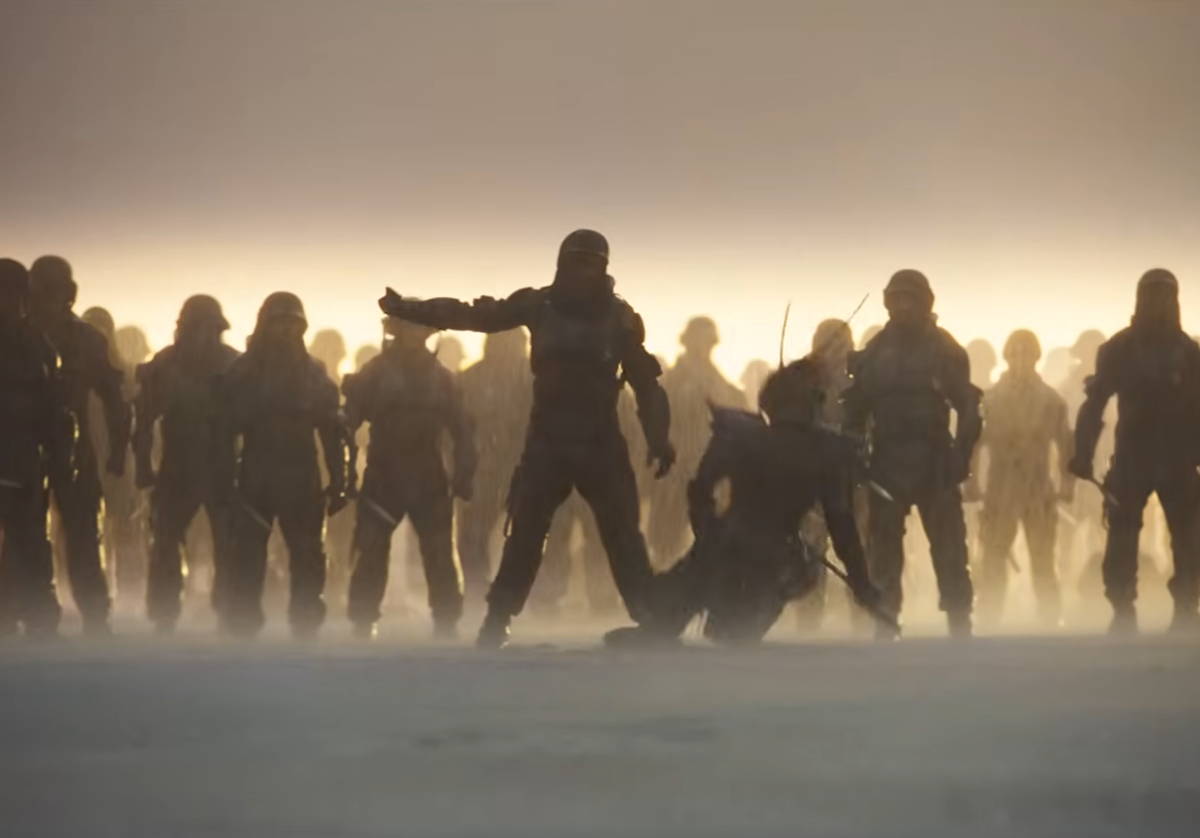
It’s only been two years since Dune: Part Two but we already have a trailer for the third installment. The appropriately-named Dune: Part Three is an adaptation of Frank Herbert’s Dune Messiah book from 1969.
Just like the book, the latest film takes place a number of years after Dune: Part Two. “If the first movie was contemplation, a boy exploring a new world, and the second one is a war movie, this one is a thriller,” . “It is action-packed and tense. More muscular.”
Despite the time jump, most primary actors are returning. This includes Timothée Chalamet, Zendaya and Javier Bardem. Anya Taylor-Joy, who briefly appeared in the second film, is also coming back. The same goes for Jason Momoa, despite his Duncan Idaho character dying in the first film. Book readers will likely understand what that means.
The trailer also highlights the antagonist Scytale, as portrayed by Robert Pattinson. He should be a more nuanced villain than Baron Harkonnen, though that’s not exactly a high bar.
The release date is coming up fast. Dune: Part Three hits theaters on December 18. That’s this year. Villeneuve had intended to take a break after making the second one to focus on a smaller and more personal film, but said that he kept “waking in the middle of the night” with potential images from the third installment.


Video StoreAge is a new company focused on creating physical releases of indie films. The startup aims to take a more authorial approach to distribution, using a patented encrypted USB drive to share its curated titles. Its ultimate goal is to disrupt algorithm-driven distribution in favor of communities and grassroots…
Read Entire Article
Source link


OpenClaw took the tech industry by surprise earlier this year when an Austrian engineer created the first version in roughly an hour. This small project swept through the community like wildfire as the most open-source endeavor on record, allowing anyone to set up a personal AI agent to operate directly on their own PC and accomplish tasks like organizing files or pounding out code without sending any data off to who knows where. At GTC, NVIDIA introduced NemoClaw, a software add-on for OpenClaw that can be installed with a single command. This new layer includes the security features and privacy controls that transform these agents from fun little experiments to useful business solutions.
NemoClaw is simple to integrate into your existing setup since it introduces OpenShell, a runtime that isolates each agent in its own small bubble. Then you can create rules in plain text files that specify which folders the agent may browse, which networks it can connect to, and which external services it can access. Everything else, and we mean everything, is off limits, and every step they make leaves a clear paper trail for you to follow.

Plaud Note Pro AI Voice Recorder, Transcribe & Summarize with AI, App Control, Note Taker for Meetings…
- AI-POWERED TRANSCRIPTION & MULTI-DIMENSIONAL SUMMARIES: Plaud Note Pro is your professional voice transcriber, delivering high-accuracy transcription…
- ENHANCED CONTEXT WITH MULTIMODAL INPUT: Capture audio, type notes, add images, and press to highlight key moments for richer context. During…
- CHAT WITH YOUR RECORDINGS USING “ASK Plaud”: Unlock deeper insights with this interactive AI. Ask questions, extract key points, draft emails, and get…
NVIDIA is marrying this with some of their own open models known as Nemotron, which run locally on whatever hardware is available. You’re talking everything from RTX-powered laptops to entire workstations and dedicated AI systems. When you need a little more horsepower, you can utilize a privacy router to connect to more powerful cloud models while keeping all of your sensitive information in-house. The end result is a framework that allows your agents to work in a mix of local and remote resources while maintaining tight boundaries.
Companies are already putting these components to use in real-world situations. Cisco runs agents that detect security flaws, verify databases, map affected devices, and create a thorough remediation plan, all of which must be checked against the rules in real time. Box uses the same framework to handle invoices and contracts, using abilities that work well with existing access levels. NVIDIA has also partnered with Salesforce, CrowdStrike, and a few more large brands to achieve the same level of control across all of their technologies. OpenClaw agents run 24 hours a day, seven days a week on personal computers, professional workstations, and servers without interfering with anything else. If you have dedicated hardware, you can keep them up and running for hours, if not days, while they work.

It is currently available as an early preview through official sources, such as on Github. Users can begin testing right away, although NVIDIA says some rough edges must be ironed out before they are formally put into production. Developers have complete access to the toolkit, which includes sample models, runtimes, and guidance for creating their own agents. Jensen Huang referred to OpenClaw as the operating system for personal AI, indicating a trend toward software that can be instructed to do things. Peter Steinberger, the original creator of OpenClaw, sees this combination as a method for users to design and run their own secure assistants.


As electronics demand higher energy density, one component has proved challenging to shrink: the capacitor. Making a smaller capacitor usually requires thinning the dielectric layer or electrode surface area, which has often resulted in a reduction of power. A new polymer material could help change that.
In a study published 18 February in Nature, a Pennsylvania State University-led team reported a capacitor crafted from a polymer blend that can operate at temperatures up to 250 °C while storing roughly four times as much energy as conventional polymer capacitors. Today’s advanced polymer capacitors typically function only up to about 100 °C, meaning engineers often rely on bulky cooling systems in high-power electronics. The research team has filed a patent for the polymer capacitors and plans to bring them to market.
Capacitors deliver rapid bursts of energy and stabilize voltage in circuits, making them essential in applications ranging from electric vehicles and aerospace electronics to power-grid infrastructure and AI data centers. Yet while transistors have steadily shrunk with advances in semiconductor manufacturing, passive components such as capacitors and inductors have not scaled at the same pace.
“Capacitors can account for 30 to 40 percent of the volume in some power electronics systems,” says Qiming Zhang, an electrical engineering researcher at Penn State and study author, explaining why it’s important to make smaller capacitors.
A plastics blend more powerful than its parts
The research team combined two commercially available engineered plastics: polyetherimide (PEI), originally developed by General Electric and widely used in industrial equipment, and PBPDA, known for strong heat resistance and electrical insulation. When processed together under controlled conditions, the polymers self-assemble into nanoscale structures that form thin dielectric films inside capacitors. Those structures help suppress electrical leakage while allowing the material to polarize strongly in an electric field, allowing greater energy storage.
The resulting material exhibits an unusually high dielectric constant—a measure of how much electrical energy a material can store. Most polymer dielectrics have values around four, but the blended polymer dielectric in the new work had a value of 13.5.
“If you look at the literature up to now, no one has reached this level of dielectric constant in this type of polymer system,” Zhang says. “Putting two commonly used polymers together and seeing this kind of performance was a surprise to many people.”
Because the material can remain operational even at elevated temperatures—such as those from extreme environmental heat or hot spots in densely built components—capacitors built from this polymer could potentially store the same amount of energy in a smaller package.
“With this material, you can make the same device using about [one-fourth as much] material,” Zhang says. “Because the polymers themselves are inexpensive, the cost does not increase. At the same time, the component can become smaller and lighter.”
How the polymer mix improves capacitors
The researchers’ finding is “a big advancement,” says Alamgir Karim, a polymer research director at the University of Houston who was not involved in the Penn State development. “Normally when you mix polymers, you don’t expect the dielectric constant to increase.”
Karim says the effect likely arises from nanoscale interfaces created when the polymers partially separate. “At about a 50–50 mixture, the polymers don’t fully mix and instead create a very large interfacial area,” he says. “Those interfaces may be where the unusual electrical behavior comes from.”
If the material can be produced at scale, it could help address a key bottleneck in high-power electronics. Higher-temperature capacitors could reduce cooling requirements and allow engineers to pack more power into smaller systems—an advantage for aerospace platforms, electric vehicles, the electric grid, and other high-temperature environments.
But translating the concept from laboratory methods to commercial manufacturing may present challenges, says Zongliang Xie, a postdoctoral researcher at the Lawrence Berkeley National Laboratory. The Penn State team is now producing small dielectric films, but industrial capacitor manufacturing typically requires continuous rolls of material that can extend for kilometers.
“Industry generally prefers extrusion-based processing because it’s easier and cheaper to control,” Xie says. “Scaling to produce great lengths of film while maintaining the same structure and performance could complicate matters. There’s potential, but it’s also challenging.”
Still, researchers say the discovery demonstrates that new performance limits may still be unlocked using familiar materials. “Developing the material is only the first step,” Zhang says. “But it shows people that this barrier can be broken.”
From Your Site Articles
Related Articles Around the Web


Crowds flocked to the AMC Century City theater in Los Angeles this morning for a special IMAX event featuring the first look at the concluding chapter in Denis Villeneuve’s “Dune” saga. Zendaya, Robert Pattinson, Javier Bardem, and Anya Taylor-Joy came out to meet the fans in person, while Timothée Chalamet sent in a video greeting via his phone. The energy in the room altered suddenly, as this plot picks up 17 years after the previous film finished and revolves around what happens when someone gains too much power.
The footage starts with Paul and Chani having a private conversation about what they could name their future child. Ghanima for a girl and Leto for a male, but even it felt tight, a result of how they’d begun to drift apart in the last film. Within seconds, the screen was filled with broader pictures of Paul and Stilgar exploring the cosmos on new planets, as their reach for the Atreides empire grew rapidly. Large sights of fleets of ships slicing across alien sky, as well as soldiers moving across rocky terrain far from Arrakis.
Sale

LEGO Icons Dune Atreides Royal Ornithopter 10327, Collectible Dune Inspired Model for Build and Display…
- Dune building set for adults – Collectible LEGO Icons Dune Atreides Royal Ornithopter building project for fans of the Dune 2021 movie
- What’s in the box? – Everything you need to craft a LEGO replica of the Dune Atreides Royal Ornithopter aircraft with foldout, flappable wings and…
- Minifigure character lineup – Includes Paul Atreides, Lady Jessica, Gurney Halleck, Chani, Leto Atreides, Liet Kynes, Duncan Idaho and Baron…

Chani showed up shortly, this time fighting her way through a violent battle scene. A sandworm can be spotted in the midst of it all, balancing on its back before diving into the melee. Just as Chani was in the middle of it, Alia, now all grown up and played by Anya Taylor-Joy, stepped into several critical frames of her own.

Paul himself provides some of the low, echoing vocals that run under the music throughout, while Robert Pattinson appears as Scytale, the shape-shifter who is as slick as ever and whose loyalties are impossible to read. Jason Momoa has also returned, and Duncan Idaho was seen briefly. Returning cast members include Rebecca Ferguson (Lady Jessica), Florence Pugh (Princess Irulan), and Javier Bardem (Stilgar), who join an already impressive group.

Villeneuve described this installment as a fast-paced thriller centered on action and pressure. Note how, even in the midst of all that upheaval, Paul and Chani’s link remains strong, as he describes it as a steady pulse that runs through everything, with a focus primarily on the two of them. He also emphasizes how the large jump in time allows Alia to become much more vital to the tale, which the previous films just hinted at. Also, it appears that Hans Zimmer has returned to the soundtrack. Fans who left the theater today are already counting down the days until December 18, 2026, when the film is released.

If your house is already lined with Sonos products, you may want a pair of over-ear headphones that know how to play nice with your other speakers. As it turns out, Sonos actually makes a pair of over-ear headphones, the Ace, and they’re currently just $299 on Amazon. That’s a great deal, and one that almost ties the all-time low price for these cans.
Not only do the Sonos Ace integrate with your existing Sonos setup via Bluetooth, they’re also great headphones in their own right. They have a crisp, flat audio profile, something Sonos is known for, and our reviewer Parker Hall specifically called out their ability to handle any song “with a good bass line.” They have great detail, with a dynamic sound that handles a variety of genres well.
They’re also one of the more comfortable headsets you can buy, largely thanks to their impressive lightness. At just 11 ounces, it’s easy to feel like you’re wearing nothing at all, and they have good clamping force on the side that helps take a lot of the pressure off the top of your head. If fit and finish are a top priority for your headset, the Sonos Ace have both by the truckload.
The ANC is right up there with the best headsets you can buy, and in particular handled low-frequency rumbles adeptly. Transparency mode is excellent too, with a clarity to conversations that doesn’t have you feeling like you’re talking to someone through a tin can. While they lack some of the convenience features found on other headsets, they make up for it with multipoint pairing, and you can adjust all the settings to your liking in the Sonos app.
While the Sonos Ace are available in multiple colors, I only spotted the black model marked down to the $300 sale price. As I write this, the white model is in stock at a slightly higher $365, which may or may not be worth it, depending on how much the aesthetics matter to you. If you’re not sold on the Sonos Ace, make sure to check out our full roundup of the best headphones, with hands-on testing from our team of audio experts.
After their dramatic falling-out, it doesn’t seem as though Anthropic and the Pentagon are getting back together.
Instead, the Pentagon is building tools to replace Anthropic’s AI, according to a Bloomberg conversation with Cameron Stanley, the chief digital and AI officer at the Pentagon.
“The Department is actively pursuing multiple LLMs into the appropriate government-owned environments,” he said. “Engineering work has begun on these LLMs, and we expect to have them available for operational use very soon.”
Anthropic’s $200 million contract with the Department of Defense (DOD) broke down over the last several weeks after the two parties failed to come to an agreement over the degree to which the military could obtain unrestricted access to Anthropic’s AI.
While Anthropic sought to include a contractual clause that prohibits the Pentagon from using its AI for mass surveillance of Americans or to deploy weapons that can fire without human intervention, the Pentagon didn’t budge. Instead, OpenAI swooped in and made its own agreement with the Pentagon. The Department of Defense — known under the Trump administration as the Department of War — also signed an agreement with Elon Musk’s xAI to use Grok in classified systems.
It makes sense, then, why the Pentagon would be working on phasing Anthropic’s technology out of its workflows. While some reports said there was a small possibility that Anthropic would reconcile with the Pentagon, this news suggests that the government is preparing to forge ahead without them.
In fact, Defense Secretary Pete Hegseth has declared Anthropic a supply-chain risk, a designation usually reserved for foreign adversaries, which bars companies that work with the Pentagon from working with Anthropic as well. Anthropic is challenging this designation in court.
Tech
Nvidia’s agentic AI stack is the first major platform to ship with security at launch, but governance gaps remain


For the first time on a major AI platform release, security shipped at launch — not bolted on 18 months later. At Nvidia GTC this week, five security vendors announced protection for Nvidia’s agentic AI stack, four with active deployments, one with validated early integration.
The timing reflects how fast the threat has moved: 48% of cybersecurity professionals rank agentic AI as the top attack vector heading into 2026. Only 29% of organizations feel fully ready to deploy these technologies securely. Machine identities outnumber human employees 82 to 1 in the average enterprise. And IBM’s 2026 X-Force Threat Intelligence Index documented a 44% surge in attacks exploiting public-facing applications, accelerated by AI-enabled vulnerability scanning.
Nvidia CEO Jensen Huang made the case from the GTC keynote stage on Monday: “Agentic systems in the corporate network can access sensitive information, execute code, and communicate externally. Obviously, this can’t possibly be allowed.”
Nvidia defined a unified threat model designed to flex and adapt for the unique strengths of five different vendors. Nvidia also names Google, Microsoft Security and TrendAI as Nvidia OpenShell security collaborators. This article maps the five vendors with embargoed GTC announcements and verifiable deployment commitments on record, an analyst-synthesized reference architecture, not Nvidia’s official canonical stack.
No single vendor covers all five governance layers. Security leaders can evaluate CrowdStrike for agent decisions and identity, Palo Alto Networks for cloud runtime, JFrog for supply chain provenance, Cisco for prompt-layer inspection, and WWT for pre-production validation. The audit matrix below maps who covers what. Three or more unanswered vendor questions mean ungoverned agents in production.
The five-layer governance framework
This framework draws from the five vendor announcements and the OWASP Agentic Top 10. The left column is the governance layer. The right column is the question every security leader’s vendor should answer. If they can’t answer it, that layer is ungoverned.
|
Governance Layer |
What To Deploy |
Risk If Not |
Vendor Question |
Who Maps Here |
|
Agent Decisions |
Real-time guardrails on every prompt, response, and action |
Poisoned input triggers privileged action |
Detect state drift across sessions? |
CrowdStrike Falcon AIDR, Cisco AI Defense [runtime enforcement] |
|
Local Execution |
Behavioral monitoring for on-device agents |
Local agent runs unprotected |
Agent baselines beyond process monitoring? |
CrowdStrike Falcon Endpoint [runtime enforcement]; WWT ARMOR [pre-prod validation] |
|
Cloud Ops |
Runtime enforcement across cloud deployments |
Agent-to-agent privilege escalation |
Trust policies between agents? |
CrowdStrike Falcon Cloud Security [runtime enforcement]; Palo Alto Prisma AIRS [AI Factory validated design] |
|
Identity |
Scoped privileges per agent identity |
Inherited creds; delegation compounds |
Privilege inheritance in delegation? |
CrowdStrike Falcon Identity [runtime enforcement]; Palo Alto Networks/CyberArk [identity governance platform] |
|
Supply Chain |
Model scanning + provenance before deploy |
Compromised model hits production |
Provenance from registry to runtime? |
JFrog Agent Skills Registry [pre-deployment]; CrowdStrike Falcon |
Five-layer governance audit matrix. Three or more unanswered vendor questions indicate ungoverned agents in production. [runtime enforcement] = inline controls active during agent execution. [pre-deployment] = controls applied before artifacts reach runtime. [pre-prod validation] = proving-ground testing before production rollout. [AI Factory validated design] = Nvidia reference architecture integration, not OpenShell-launch coupling.
CrowdStrike’s Falcon platform embeds at four distinct enforcement points in the Nvidia OpenShell runtime: AIDR at the prompt-response-action layer, Falcon Endpoint on DGX Spark and DGX Station hosts, Falcon Cloud Security across AI-Q Blueprint deployments, and Falcon Identity for agent privilege boundaries. Palo Alto Networks enforces at the BlueField DPU hardware layer within Nvidia’s AI Factory validated design. JFrog governs the artifact supply chain from the registry through signing. WWT validates the full stack pre-production in a live environment. Cisco runs an independent guardrail at the prompt layer.
CrowdStrike and Nvidia are also building what they call intent-aware controls. That phrase matters. An agent constrained to certain data is access-controlled. An agent whose planning loop is monitored for behavioral drift is governed. Those are different security postures, and the gap between them is where the 4% error rate at 5x speed becomes dangerous.
Why the blast radius math changed
Daniel Bernard, CrowdStrike’s chief business officer, told VentureBeat in an exclusive interview what the blast radius of a compromised AI agent looks like compared to a compromised human credential.
“Anything we could think about from a blast radius before is unbounded,” Bernard said. “The human attacker needs to sleep a couple of hours a day. In the agentic world, there’s no such thing as a workday. It’s work-always.”
That framing tracks with architectural reality. A human insider with stolen credentials works within biological limits: typing speed, attention span, a schedule. An AI agent with inherited credentials operates at compute speed across every API, database, and downstream agent it can reach. No fatigue. No shift change. CrowdStrike’s 2026 Global Threat Report puts the fastest observed eCrime breakout at 27 seconds and average breakout times at 29 minutes. An agentic adversary doesn’t have an average. It runs until you stop it.
When VentureBeat asked Bernard about the 96% accuracy number and what happens in the 4%, his answer was operational, not promotional: “Having the right kill switches and fail-safes so that if the wrong thing is decided, you’re able to quickly get to the right thing.” The implication is worth sitting on. 96% accuracy at 5x speed means the errors that get through arrive five times faster than they used to. The oversight architecture has to match the detection speed. Most SOCs are not designed for that.
Bernard’s broader prescription: “The opportunity for customers is to transform their SOCs from history museums into autonomous fighting machines.” Walk into the average enterprise SOC and inventory what’s running there. He’s not wrong.
On analyst oversight when agents get it wrong, Bernard drew the governance line: “We want to keep not only agents in the loop, but also humans in the loop of the actions that the SOC is taking when that variance in what normal is realized. We’re on the same team.”
The full vendor stack
Each of the five vendors occupies a different enforcement point the other four do not. CrowdStrike’s architectural depth in the matrix reflects four announced OpenShell integration points; security leaders should weigh all five based on their existing tooling and threat model.
Cisco shipped Secure AI Factory with AI Defense, extending Hybrid Mesh Firewall enforcement to Nvidia BlueField DPUs and adding AI Defense guardrails to the OpenShell runtime. In multi-vendor deployments, Cisco AI Defense and Falcon AIDR run as parallel guardrails: AIDR enforcing inside the OpenShell sandbox, AI Defense enforcing at the network perimeter. A poisoned prompt that evades one still hits the other.
Palo Alto Networks runs Prisma AIRS on Nvidia BlueField DPUs as part of the Nvidia AI Factory validated design, offloading inspection to the data processing unit at the network hardware layer, below the hypervisor and outside the host OS kernel. This integration is best understood as a validated reference architecture pairing rather than a tight OpenShell runtime coupling. Palo Alto intercepts east-west agent traffic on the wire; CrowdStrike monitors agent process behavior inside the runtime. Same cloud runtime row, different integration model and maturity stage.
JFrog announced the Agent Skills Registry, a system of record for MCP servers, models, agent skills, and agentic binary assets within Nvidia’s AI-Q architecture. Early integration with Nvidia has been validated, with full OpenShell support in active development. JFrog Artifactory will serve as a governed registry for AI skills, scanning, verifying, and signing every skill before agents can adopt it. This is the only pre-deployment enforcement point in the stack. As Chief Strategy Officer Gal Marder put it: “Just as a malicious software package can compromise an application, an unvetted skill can guide an agent to perform harmful actions.”
Worldwide Technology launched a Securing AI Lab inside its Advanced Technology Center, built on Nvidia AI factories and the Falcon platform. WWT’s vendor-agnostic ARMOR framework is a pre-production validation and proving-ground capability, not an inline runtime control. It validates how the integrated stack behaves in a live AI factory environment before any agent touches production data, surfacing control interactions, failure modes, and policy conflicts before they become incidents.
Three MDR numbers: what they actually measure
On the MDR side, CrowdStrike fine-tuned Nvidia Nemotron models on first-party threat data and operational SOC data from Falcon Complete engagements. Internal benchmarks show 5x faster investigations, 3x higher triage accuracy in high-confidence benign classification, and 96% accuracy in generating investigation queries within Falcon LogScale. Kroll, a global risk advisory and managed security firm that runs Falcon Complete as its MDR backbone, confirmed the results in production.
Because Kroll operates Falcon Complete as its core MDR platform rather than as a neutral third-party evaluator, their validation is operationally meaningful but not independent in the audit sense. Industry-wide third-party benchmarks for agentic SOC accuracy do not yet exist. Treat reported numbers as indicative, not audited.
The 5x investigation speed compares average agentic investigation time (8.5 minutes) against the longest observed human investigation in CrowdStrike’s internal testing: a ceiling, not a mean. The 3x triage accuracy measures one internal model against another. The 96% accuracy applies specifically to generating Falcon LogScale investigation queries via natural language, not to overall threat detection or alert classification.
JFrog’s Agent Skills Registry operates beneath all four CrowdStrike enforcement layers, scanning, signing, and governing every model and skill before any agent can adopt it — with early Nvidia integration validated and full OpenShell support in active development.
Six enterprises are already in deployment
EY selected the CrowdStrike-Nvidia stack to power Agentic SOC services for global enterprises. Nebius ships with Falcon integrated into its AI cloud from day one. CoreWeave CISO Jim Higgins signed off on the Blueprint. Mondelēz North America Regional CISO Emmett Koen said the capability lets his team “focus on higher-value response and decision-making.”
MGM Resorts International CISO Bryan Green endorsed WWT’s validated testing environments, saying enterprises need “validated environments that embed protection from the start.” These range from vendor selection and platform validation to production integration. The signal is converging across buyer types, not uniform at-scale deployment.
What the five-vendor stack does not cover
The governance framework above represents real progress. It also has three holes that every security leader deploying agentic AI will eventually hit. No vendor at GTC closed any of them. Knowing where they are is as important as knowing what shipped.
-
Agent-to-agent trust. When agents delegate to other agents, credentials compound. The OWASP Top 10 for Agentic Applications lists tool call hijacking and orchestrator manipulation as top-tier risks. Independent research from BlueRock Security scanning over 7,000 MCP servers found 36.7% contain vulnerabilities. An arXiv preprint study across 847 scenarios found a 23 to 41% increase in attack success rates in MCP integrations versus non-MCP. No vendor at GTC demonstrated a complete trust policy framework for agent-to-agent delegation. This is the layer where the 82:1 identity ratio becomes a governance crisis, not just an inventory problem.
-
Memory integrity. Agents with persistent memory create an attack surface that stateless LLM deployments do not have. Poison an agent’s long-term memory once. Influence its decisions weeks later. The OWASP Agentic Top 10 flags this explicitly. CrowdStrike’s intent-aware controls are the closest architectural response announced at GTC. Implementation details remain forward-looking.
-
Registry-to-runtime provenance. JFrog’s Agent Skills Registry addresses the registry side of this problem. The gap that remains is the last mile: end-to-end provenance requires proving the model executing in production is the exact artifact scanned and signed in the registry. That cryptographic continuity from registry to runtime is still an engineering problem, not a solved capability.
What running five vendors actually costs
The governance matrix is a coverage map, not an implementation plan. Running five vendors across five enforcement layers introduces real operational overhead that the GTC announcements did not address. Someone has to own policy orchestration: deciding which vendor’s guardrail wins when AIDR and AI Defense return conflicting verdicts on the same prompt. Someone has to normalize telemetry across Falcon LogScale, Prisma AIRS, and JFrog Artifactory into a single incident workflow. And someone has to manage change control when one vendor ships a runtime update that shifts how another vendor’s enforcement layer behaves.
A realistic phased rollout looks like this: start with the supply chain layer (JFrog), because it operates pre-deployment and has no runtime dependencies on the other four. Add identity governance (Falcon Identity) second, because scoped agent credentials limit blast radius before you instrument the runtime. Then instrument the agent decision layer (Falcon AIDR or Cisco AI Defense, depending on your existing vendor footprint), then cloud runtime, then local execution. Running all five simultaneously from day one is an integration project, not a configuration task. Budget for it accordingly.
What to do before your next board meeting
Here is what every CISO should be able to say after running the framework above: “We have audited every autonomous agent against five governance layers. Here is what’s in place, and here are the five questions we are holding vendors to.” If you cannot say that today, the issue is not that you are behind schedule. The issue is that no schedule existed. Five vendors just shipped the architectural scaffolding for one.
Do four things before your next board meeting:
-
Run the five-layer audit. Pull every autonomous agent your organization has in production or staging. Map each one against the five governance rows above. Mark which vendor questions you can answer and which you cannot.
-
Count the unanswered questions. Three or more means ungoverned agents in production. That is your board number, not a backlog item.
-
Pressure-test the three open gaps. Ask your vendors, explicitly: How do you handle agent-to-agent trust across MCP delegation chains? How do you detect memory poisoning in persistent agent stores? Can you show a cryptographic binding between the registry scan and the runtime load? None of the five vendors at GTC has a complete answer. That is not an accusation. It is where the next year of agentic security gets built.
-
Establish the oversight model before you scale. Bernard put it plainly: keep agents and humans in the loop. 96% accuracy at 5x speed means errors arrive faster than any SOC designed for human-speed detection can catch them. The kill switches and fail-safes have to be in place before the agents run at scale, not after the first missed breach.
The scaffolding is necessary. It is not sufficient. Whether it changes your posture depends on whether you treat the five-layer framework as a working instrument or skip past it in the vendor deck.

Apple's latest Background Security Improvement targets a WebKit flaw

Approval for plan to end ‘blight’ of vacant Scarborough premises

US median asking rent hits 4-year low in February


-
 Tech7 days ago
A 1,300-Pound NASA Spacecraft To Re-Enter Earth’s Atmosphere
-
 Crypto World4 days ago
HYPE Token Enters Net Deflation as HyperCore Buybacks Outpace Staking Rewards
-

 Fashion4 days ago
Weekend Open Thread: Addict Lip Glow
-

 Tech2 days ago
Your Legally Registered ‘Motorcycle’ Might Not Count Under Proposed US Law
-
Sports3 days ago
Why Duke and Michigan Are Dead Even Entering Selection Sunday
-

 NewsBeat6 days ago
Residents reaction as Shildon murder probe enters second day
-

 Business2 days ago
Search for Savannah Guthrie’s Mother Enters Seventh Week with No Arrests
-

 Business7 days ago
Search Enters Sixth Week With New Leads in Tucson Abduction Case
-

 Sports6 days ago
PWHL, Senators discussing plan to keep Charge in Ottawa
-

 Business3 days ago
US Airports Launch Donation Drives for Unpaid TSA Workers as Partial Government Shutdown Enters Fifth Week
-
Crypto World3 days ago
Coinbase and Bybit in Investment Talks: Could Bybit Finally Enter the US Crypto Market?
-
 Tech3 hours ago
Are Split Spacebars the Next Big Gaming Keyboard Trend?
-

 NewsBeat6 days ago
I Entered The Manosphere. Nothing Could Prepare Me For What I Found.
-

 Business3 days ago
Country star Brantley Gilbert enters growing non-alcoholic beer market
-

 Business1 day ago
Australian shares drop as Iran war enters third week
-

 Crypto World1 day ago
Crypto Lender BlockFills Enters Chapter 11 with Up to $500M in Liabilities
-

 Sports4 days ago
College Basketball Best Bets: Conference Tournament Semifinal Picks
-

 Tech7 days ago
Clarity as strategy
-

 Politics7 days ago
Trump Says Middle East Is ‘Very Lucky’ That He’s President
-

 Crypto World6 days ago
Three Binance Charts May Be Hinting at Bitcoin’s Next Move


You must be logged in to post a comment Login