A woman from Kingsland, Georgia has been charged with murder after she allegedly took an abortion pill and gave birth to an infant who died hours later at hospital
Somaiyah Hafeez News Reporter and Oliver Radcliffe Live News Reporter
22:26, 17 Mar 2026
A 31 year old woman has been accused of murder following her use of an abortion pill, which resulted in the birth of an infant who passed away hours later.
According to a local police report, 31-year-old Alexia Moore consumed 200mg of Misoprostol, a medication typically used alongside Mifepristone to terminate a pregnancy, on the evening of December 29, 2025. The following day, she delivered at Southeast Georgia Health System Camden Campus hospital.
Advertisement
Georgia’s heartbeat legislation bans terminations once a foetal heartbeat is detected, roughly five to six weeks into gestation. This law came into force on July 20, 2022.
Police records indicate Moore now faces charges including murder, possession of dangerous drugs, and possession of a schedule 2 controlled substance. The arrest documentation states Moore attempted to depart the hospital after trying to terminate the pregnancy herself, and was taken into custody last week on a murder charge, Action News Jax reported.
Hospital personnel notified local authorities about a “suspicious circumstance involving a female patient,” reports the Mirror US.
Officers logged the report on December 30.
Advertisement
“This is an unprecedented murder charge for an alleged abortion, even though no law in the state of Georgia permits such a charge,” Dana Sussman, Senior Vice President of Pregnancy Justice, told Jezebel in a statement.
Ensure our latest stories always appear at the top of your Google Search by making us a Preferred Source. Click here to activate or add us as your Preferred Source in your Google search settings.
“Do they really want to send women to prison for abortions? This will cause untold harm to this woman and to the women of Georgia,” she added. The investigation is ongoing to determine how advanced her pregnancy was.
Advertisement
A criminal defence lawyer from Jackson informed the media that any murder case would hinge on whether prosecutors can demonstrate an intentional act directly resulted in a human fatality. Florida state representative Anna Eskamani, who has previously worked for Planned Parenthood, told the station that “banning abortion does not actually end abortion” and emphasised that abortion medication is generally safer when administered under medical supervision.
The Living Infants Fairness and Equality Act in Georgia has redefined state law to treat an unborn child with a detectable heartbeat differently under several statutes, a shift that legal experts suggest could complicate cases related to pregnancy outcomes.
According to the state code, the detection of a fetal heartbeat now serves as a significant legal benchmark in certain civil and criminal contexts.
US actor Sean Penn has been gifted an Oscar-shaped award made from war-damaged rail metal by Ukraine, after he skipped Sunday’s ceremony to visit the war-torn country.
Penn, 65, won his third Academy Award for his supporting actor role in political thriller One Battle Another but was absent from the ceremony.
In a video posted by Oleksandr Pertsovskyi, the CEO of Ukrainian Railways, Pertsovskyi tells Penn: “You’re missing Oscars… So we made this one. This is from the railcar that was damaged by the Russians”.
A long-time advocate for Ukraine, Penn has visited several times since the Kremlin launched its full-scale invasion of the country four years ago.
And with 2026 being the route’s 100th birthday, this year is the perfect time to discover what is now a cultural icon.
Here, we reveal how to do it well, with a guide that steers you towards an authentic Route 66 experience.
We explain how the road acquired legendary status, the diner in Chicago you should have breakfast at before setting off and the dangers of over-reliance on Google Maps for the journey.
Advertisement
Route 66 isn’t a race, and in the following section, we break down how much time to allow for the journey.
From there, it’s the not-to-be-missed sights that help make the trip so wonderfully eccentric, and some of the best motels to book into for a “good old days” vibe.
The finish comes at Santa Monica Pier, where there are a handful of rituals to undertake to mark the end of a road trip of a lifetime.
The birth of a legend
Advertisement
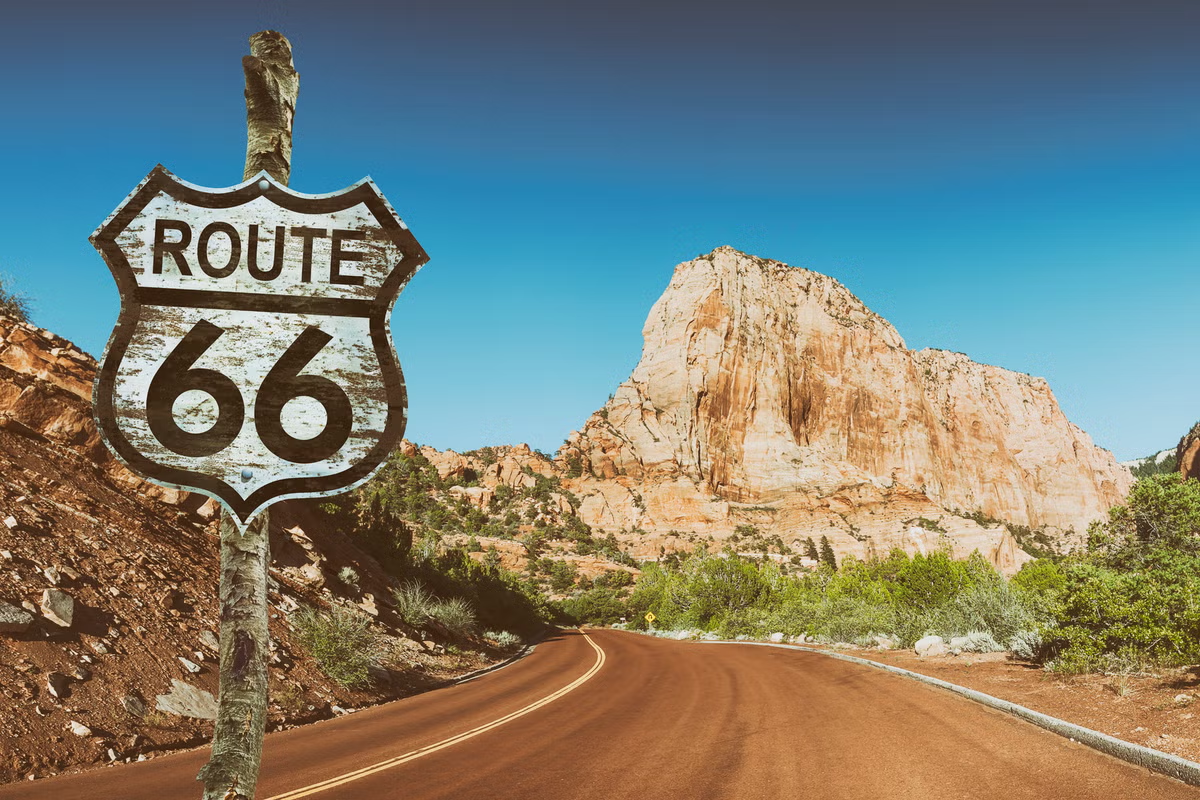
Route 66’s legendary status is partly thanks to the great American novelist John Steinbeck describing it as the ‘Mother Road’ (Getty Images)
Route 66 was commissioned in 1926 and by the time it was finished and fully paved in the late 1930s, it stretched 2,448 miles across Illinois, Missouri, Kansas, Oklahoma, Texas, New Mexico, Arizona, and California, from Chicago to Santa Monica — and it quickly attained legendary status, despite not even being the first long-distance highway, or the busiest.
The route’s journey to cultural icon began with hundreds of thousands of farmers from Oklahoma, Texas, Arkansas and Missouri using it to reach California in search of work, a plight immortalized in the great John Steinbeck’s powerful 1939 novel The Grapes of Wrath, in which he dubs Route 66 the “Mother Road.”
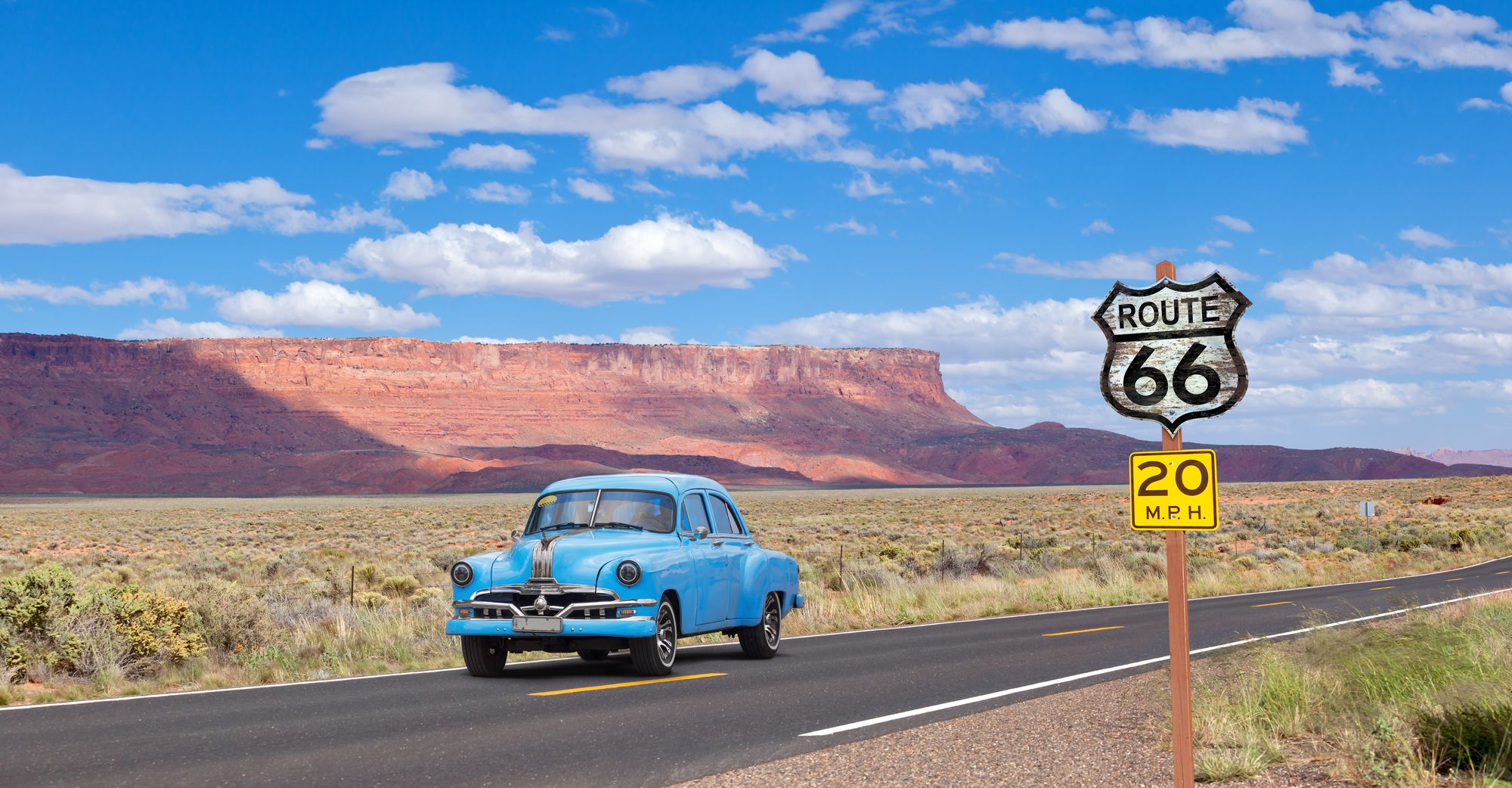
When car ownership exploded after the Second World War, Americans discovered en masse that this road of opportunity was also a journey of adventure that took them through bewitching desert landscapes and past neon-lit motels and diners that would come to symbolize classic road trip culture.
Advertisement
By the time the road was decommissioned in 1985 and replaced by the Interstate Highway System, it was ingrained in popular culture, featuring in songs such as Bobby Troup’s (Get Your Kicks on) Route 66, recorded by artists from Nat King Cole to the Rolling Stones, and making appearances in countless road trip movies.
Ironically, its death made it even more famous, with preservation movements emerging to maintain and restore motels, diners and roadside attractions that were now bypassed — today Route 66 is a patchwork of historic sections.
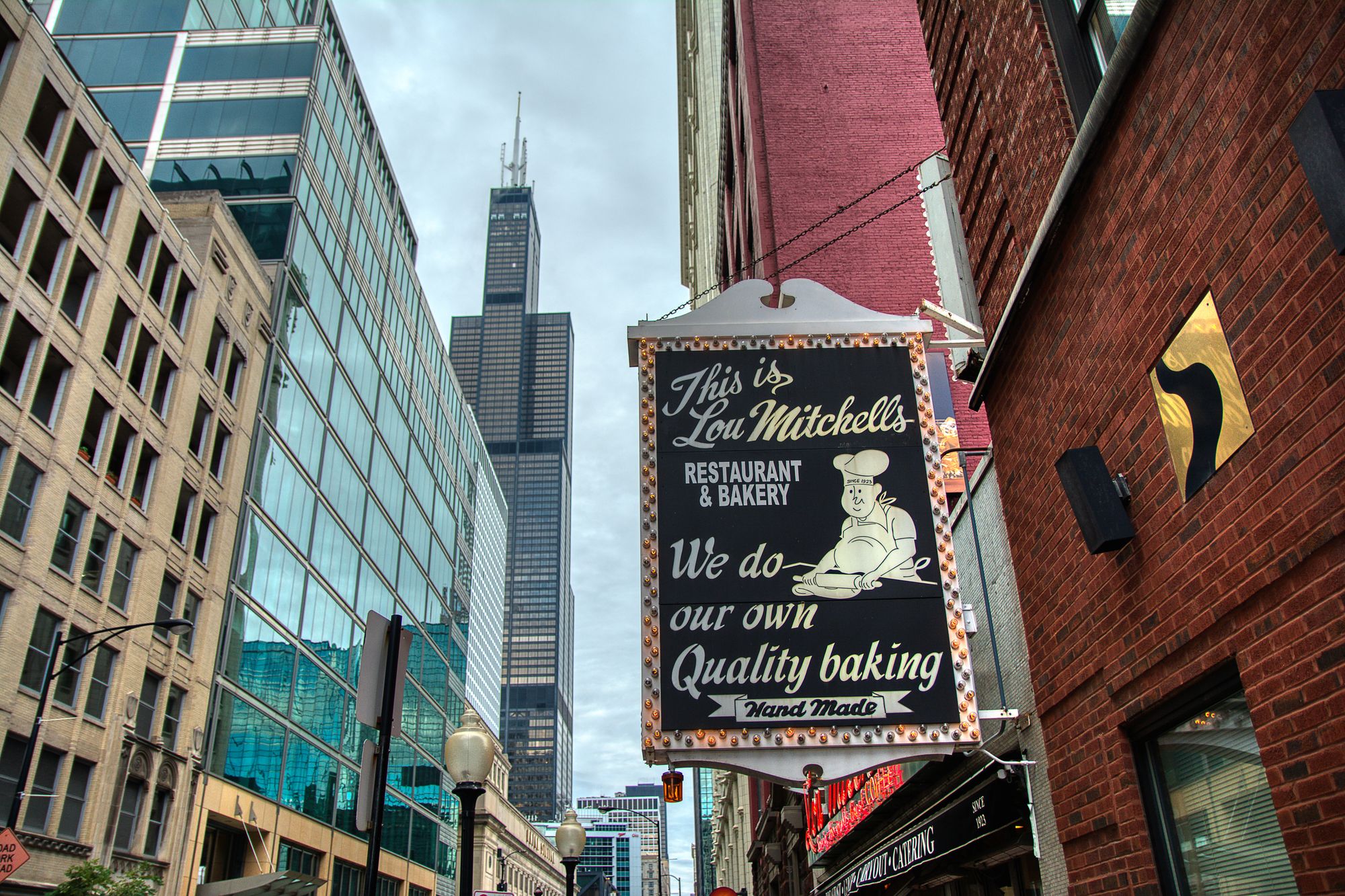
For many, the Route 66 road trip begins in Chicago with breakfast at Lou Mitchell’s restaurant and bakery on W. Jackson Boulevard, located near the official start of the route on Adam Street, close to the Art Institute of Chicago (Getty Images)
Chicago is the traditional launchpad — it’s the historic gateway to the west, and you’ll mostly have the sun behind you — and the ceremonial starting point is amid the skyscrapers of the Windy City’s downtown district, on Adams Street, near the Art Institute of Chicago.
There, you’ll find a modest brown-and-white “Begin Route 66” sign. However, before you drive past it, tradition dictates that you head to nearby Lou Mitchell’s restaurant and bakery on W. Jackson Boulevard, which has been serving breakfast to westbound road-trippers since 1923.
The menu is classic diner fare, from coffee and pancakes to omelets and corned beef hash. And while you wait for a table, the serving staff hand out complimentary donut holes and Milk Duds.
Advertisement
Once you set off, you’ll find yourself in another world in little more than an hour.
Great place to stay:Silversmith Hotel Chicago Downtown is just a three minute walk from the Route 66 and features rooms with mini-refrigerators, coffee makers and wifi.
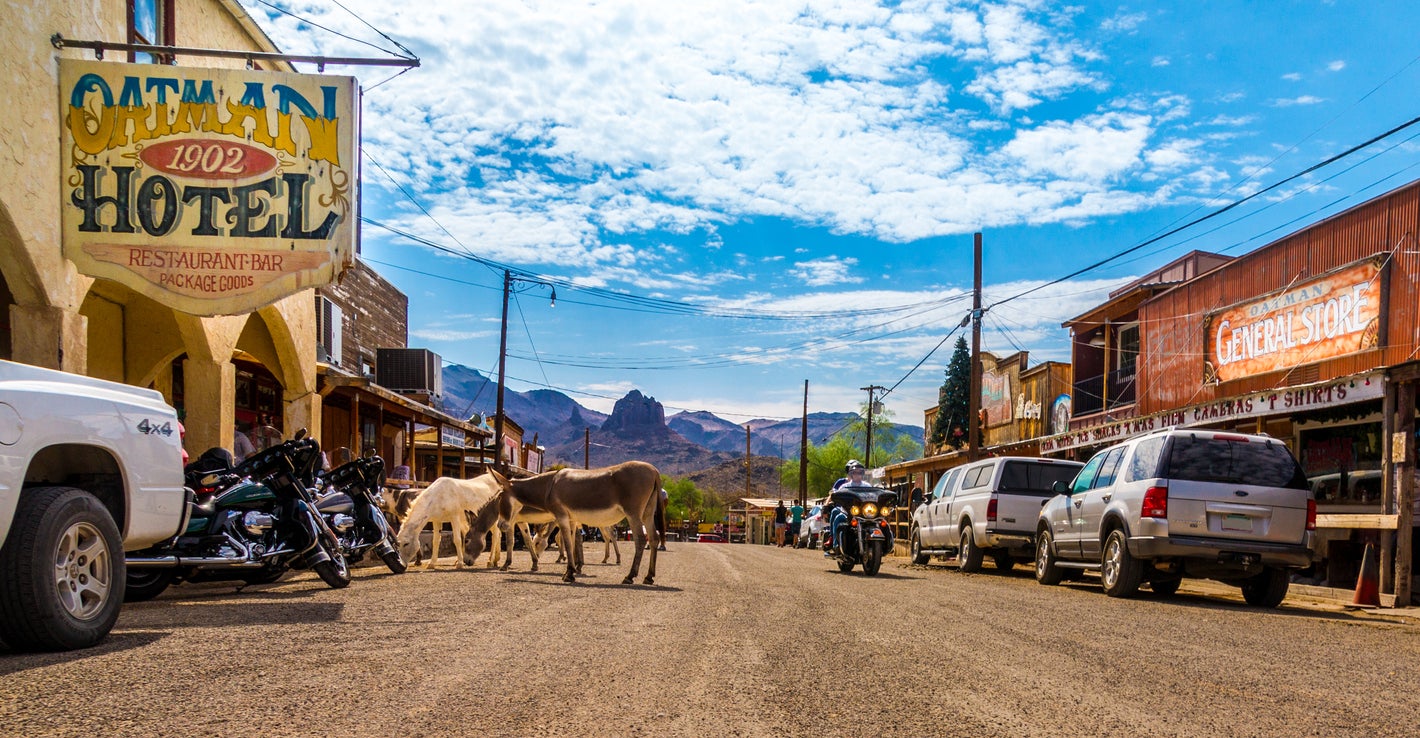
The original Route 66 passes through the former gold mining town of Oatman in Arizona. You’ll be led to fascinating spots like this by following the ‘Historic Route 66’ signs (Getty Images)
Navigation-wise, it would be tempting to type “Route 66” into Google Maps and take it from there.
But that would be a major mistake. It’s worth laboring the point that Route 66 is no longer one long continuous highway, but a mishmash of surviving segments jammed in among newer highways. Some original sections are quite long and scenic, others last for just a few miles before disappearing (and sometimes making a comeback a bit further along).
Ask Google Maps for the route and you’ll likely end up driving along interstates 40, 44 and 55, which replaced large sections of Route 66, and miss some of the most fascinating roadside attractions.
Advertisement
The key is to follow the “Historic Route 66” signs, which will lead you to some of the most compelling sights and scenery.
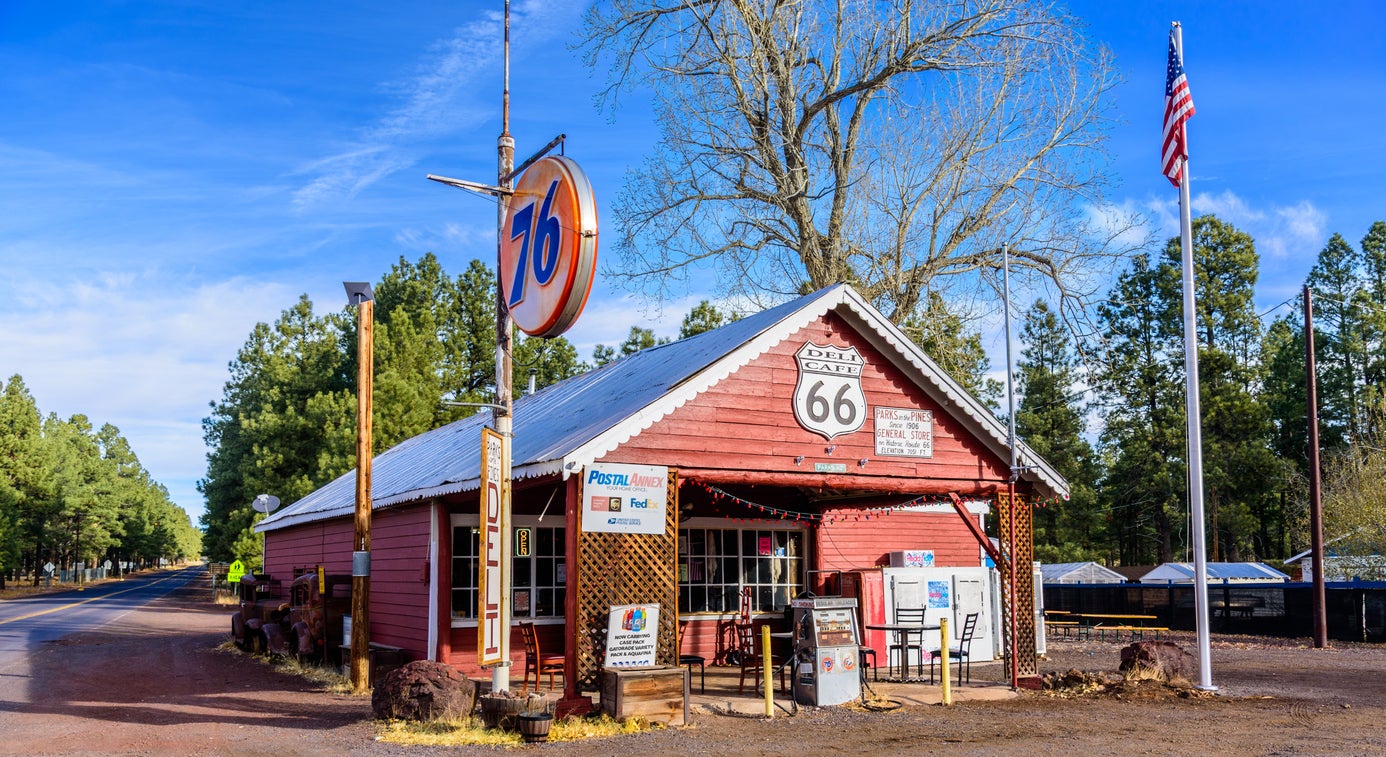
The Parks in the Pines General Store and Deli stands along a quiet stretch of Route 66 between Williams and Flagstaff, its vintage 76 sign and weathered red storefront preserving the classic character of mid-century roadside travel in Northern Arizona (Getty Images)
Ideal: 14 days
Today, Route 66 isn’t a means to an economic end — it’s the main attraction, and driving at your leisure will mean you can fully savor its delights. The Goldilocks time frame? Two weeks, or 150-200 miles a day, if you’re committed to the entire Route 66 Chicago-Santa Monica pilgrimage.
A longer journey means ample time to explore roadside attractions, enjoy vintage motels, and have an extra round of pancakes at a classic diner.
Fair: 10 days
Advertisement
Ten days is a relatively popular timeframe, meaning a pace of around 240 miles a day.
However, some sightseeing will need to be sacrificed. One strategy could be to pick up the pace in the eastern section, then slow down and zero in on the more dramatic scenery offered by New Mexico, Arizona and California in the west.
Doable, but rushed: Seven days
A seven-day trip would mean a slow-fast-slow approach, with sections of interstate used to link the most compelling sights. Stops would need to be picked fairly carefully in advance.
Advertisement
Avoid: Four days or less
Shrinking the journey time to four days or less would reduce the drive to a grueling interstate highway marathon. If simply reaching the finish line is the objective, then note that the drive time is about 40 hours.
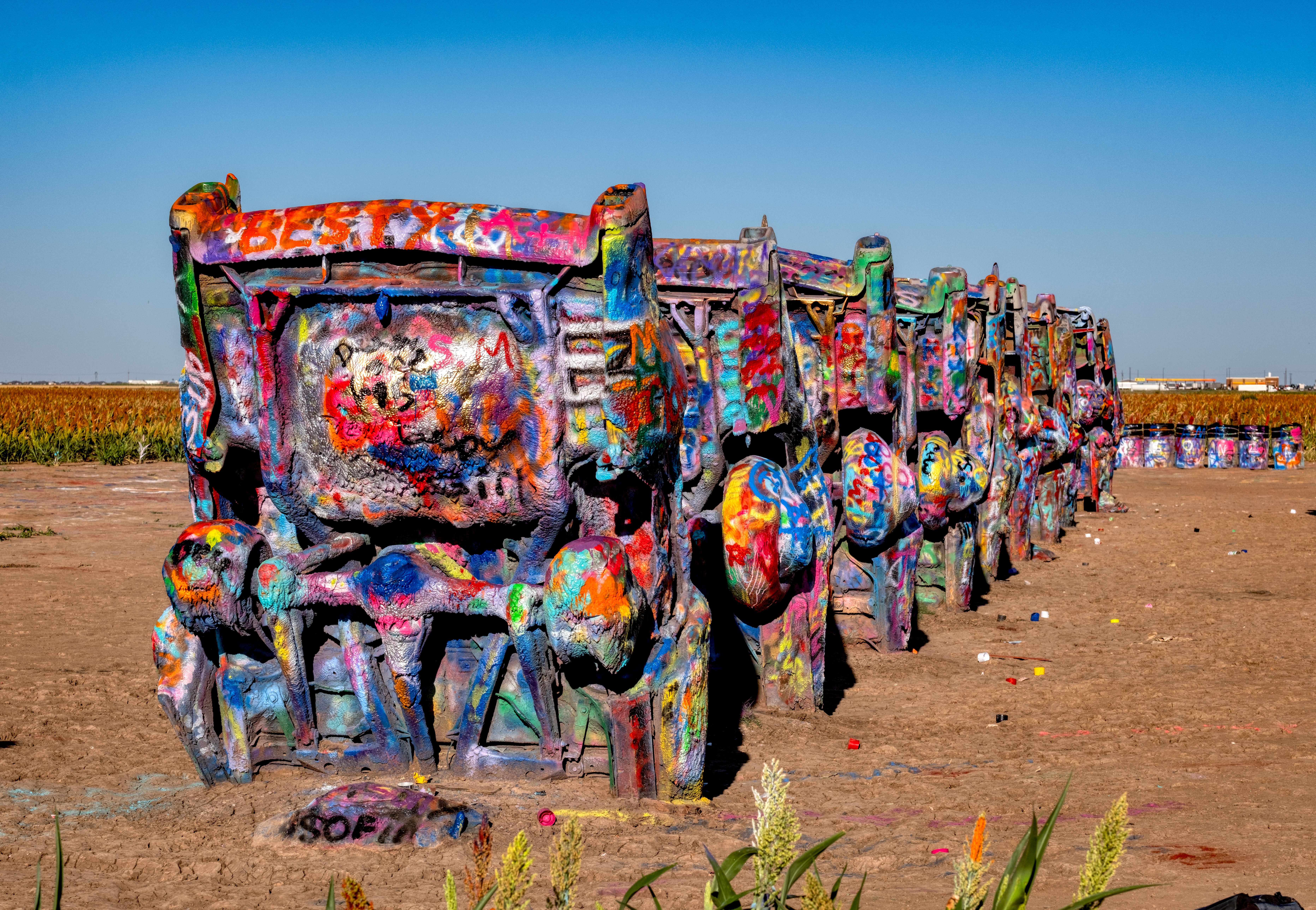
Cadillac Ranch, created in 1974 by the art group Ant Farm, features 10 classic Cadillacs buried nose-first in the ground. It’s a Route 66 must-visit (cadillac ranch texas)
Route 66’s irresistibly eccentric roadside culture doesn’t take long to emerge after leaving Chicago.
Around 90 minutes away is the town of Wilmington, home to the Gemini Giant, a 30-foot fiberglass astronaut holding a rocket, a variation of the “Muffler Man” figures used to advertise roadside businesses across America.
In the small town of Dwight, around 75 miles from Chicago is the beautifully preserved house-and-canopy-style Ambler’s Texaco Gas Station, which dates back to the 1930s.
Advertisement
Cadillac Ranch, just west of Amarillo in Texas, is mandatory. Created in 1974 by the art group Ant Farm, it features 10 classic Cadillacs buried nose-first in the ground at the same angle as the Great Pyramid of Giza. They’re covered in graffiti, and visitors are encouraged to leave their own spray-painted mark.
In Oklahoma, there’s the cheerful Blue Whale of Catoosa, an 80-foot-long bright blue concrete cetacean with a winning smile; and in Arizona you can pull up in the ghost town of Oatman, where burros wander the streets and “gunmen” stage Wild West shootouts.
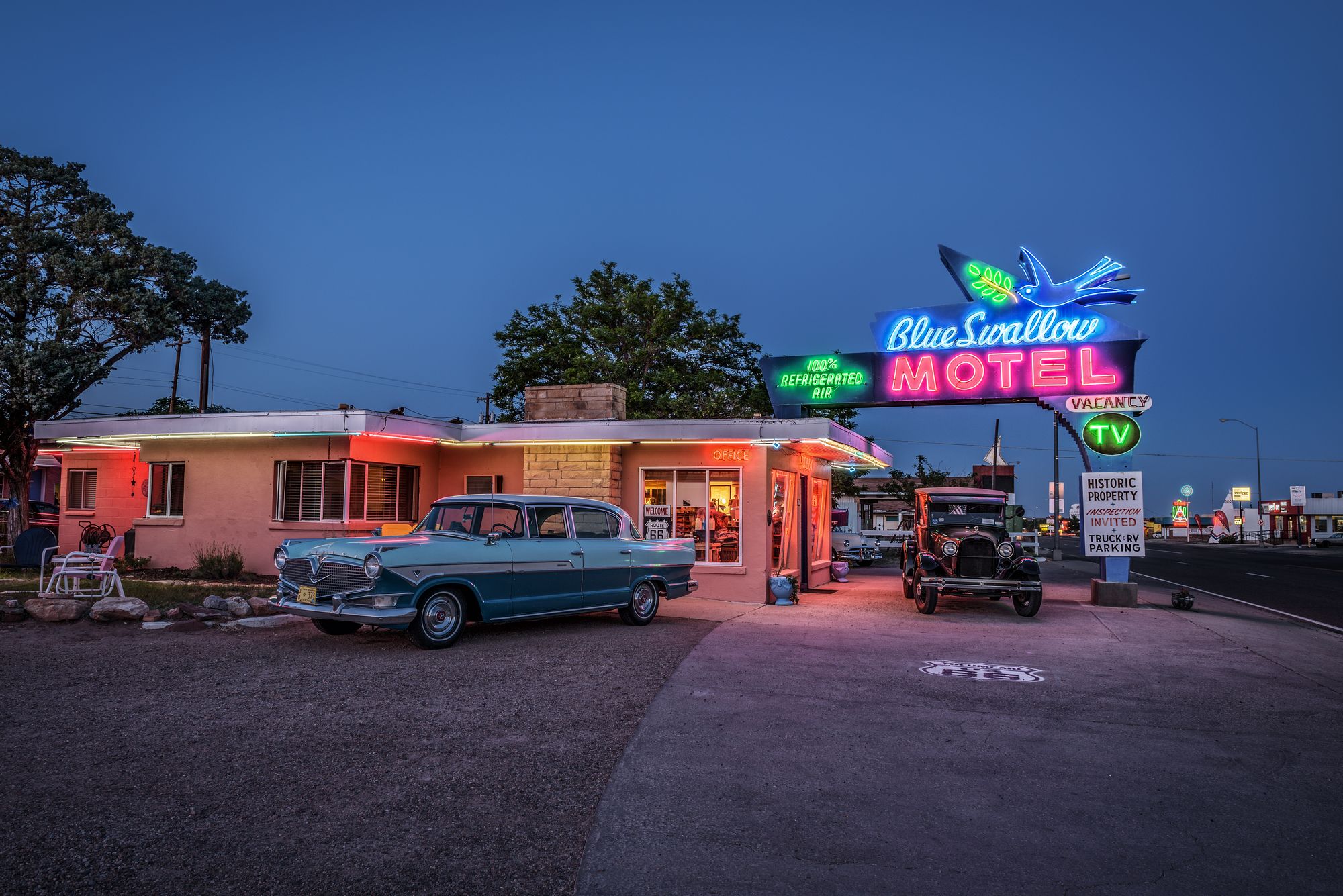
Blue Swallow Motel, Tucumcari, New Mexico still retains a 1940s atmosphere, including a neon sign advertising ‘100% refrigerated air’ (Getty Images)
Skip the chains and book into independent motels to be rewarded with a much more authentic Route 66 experience. Family run motels sprung up in huge numbers during the road trip boom of the 1940s and 1950s and there are still a few beautifully preserved examples you can stay in for a taste of the “good old days.” Here are three of the most celebrated options:
Blue Swallow Motel, Tucumcari, New Mexico
The Blue Swallow Motel has been giving Mother Road travelers a comfortable place to rest since 1939, and its yesteryear charms have been beautifully preserved: the neon sign advertising “100% refrigerated air” still glows above it and the rooms contain 1940s-era rotary dial phones and vintage lamps. Rooms from $120.
Advertisement
Wigwam Motel, Holbrook, Arizona
Guests have been staying in the Wigwam Motel’s distinctive concrete teepees since the 1950s — and while the 15 units include mod cons such as wifi and satellite TV, the original handmade hickory furniture has been retained. Rooms from $105.
Boots Court Motel, Carthage, Missouri
When Boots Court Motel opened in 1939, guests paid $2.50 to stay in one of eight rooms completed in the “streamline moderne” architectural style. Each room came with a carport and the property proudly advertised a “radio in every room.” Today, there are 13 renovated rooms for Route 66-ers to stay in and a visitors center housed in the former gas station. Rooms from $79.
At Santa Monica Pier there is a sign marking the end of Route 66 (Getty Images)
Eight states and nearly 2,500 miles of tarmac later, you’ll arrive at Santa Monica Pier where you’ll find a sign that simply says “End of the Trail.”
Advertisement
It’s not the most celebratory piece of signage, but the exuberant surroundings, from street performers to the pier’s amusement park, make the occasion a fittingly jubilant one.
A popular ritual among road trippers is to take a selfie at the sign, then walk to the end of the pier and look back, inland, at the land mass that’s been tamed, before a dip of the toes in the Pacific Ocean.
Great place to stay:The Shore Hotel (rooms from $235) is directly across the road from the pier and offers rooms with balconies overlooking the beach.
Good to know: Parking around the pier is congested, and while there is a parking deck beneath the pier, it’s recommended to leave your car at the hotel and walk to the finish line.
Craft Social will launch at 24a Newmarket Street in Skipton on March 28.
Founded by Ilkley-based creatives Sophie and Becky, the café aims to encourage slow living, creativity, and screen-free connection through hands-on activities.
The pair said: “After seeing the joy our mobile workshops brought to people over the past year, opening Craft Social as a permanent space felt like the natural next step.
Craft Social, a new craft café founded by Ilkley-based creatives Sophie and Becky, will open on March 28 at 24a Newmarket Street in Skipton, North Yorkshire. (Image: Supplied)
“We wanted to create a calm, welcoming space where people can step away from busy life, get creative and leave feeling proud of what they’ve made.”
Advertisement
With backgrounds in illustration and design, the founders first launched Craft Social as a mobile craft workshop in 2024, running private creative events across Yorkshire.
Buoyed by a successful first year, they decided to create a permanent, community-focused venue.
The café will be screen-free, encouraging visitors to unplug and engage fully with hands-on creative activities.
Standard bookings and walk-ins are welcome, with visitors able to take part in crafts such as painting, beading, and spray painting.
Advertisement
Craft Social will also host regular in-house workshops, starting at £10 per person, and is available for private hire for special occasions from £15 per person.
Guests can also purchase pre-prepared craft kits from £5, designed for use at home and ideal for gifting.
The space will showcase work by local artists and offer them the opportunity to hire the venue and host their own events.
The founders hope the café will become a creative hub for the community.
Advertisement
Visitors will be able to enjoy baked treats and drinks from nearby suppliers as part of the café’s commitment to supporting local businesses.
A launch event will take place on March 28 from 1pm to 4pm, inviting the community to explore the refurbished space, enjoy complimentary drinks, and take part in creative activities.
The café will officially open on April 1 and will operate Wednesday to Saturday from 9.30am to 4pm.
If Arsenal beat Manchester City in the Carabao Cup final at Wembley on Sunday, expect the quadruple talk to be in overdrive by the time those two fixtures come around.
With the attack as fluent here as it has been in weeks and the defence typically secure, Arsenal have all the answers right now.
Mikel Arteta enjoys ideal night
Advertisement
Short of a 7-0 rout and the result wrapped up inside 20 minutes, this was close to a perfect night for Mikel Arteta.
Earlier in the evening, Sporting mounted a comeback against Bodo/Glimt to ensure there would be no quarter-final trip to the Arctic Circle and artificial surface to contend with.
Arteta, meanwhile, was able to make four changes with just over 20 minutes to go, shuffling his pack to suggest he had one eye on that Wembley clash.
Eze was taken off and so too Martin Zubimendi, with Christian Norgaard brought on for some rare minutes. Kai Havertz also got some game time as he looks to get up to full speed again.
Advertisement
Eze provides the X-factor
Eze was not signed to take the safe option. Arsenal have enough players to bring control, to play the percentage pass and maintain attacks.
They needed an X-factor player in the final third and Eze was brought in to bring that unpredictable spark. He did just that, with this perhaps his best performance in an Arsenal shirt away from the north London derbies.
There is nobody else in the Arsenal squad you would back as much to take the ball with his back to goal 25 yards out, swivel, and lash a strike into the top corner that cleanly.
Advertisement
That broke the deadlock and from there Arsenal did not look back. Eze provided those off-the-cuff moments throughout, one lovely flick round the corner to Viktor Gyokeres leading to a chance for Saka.
Saka and White deliver together again
Ben White was brought into the side, lining up at right-back behind Saka for the first time since the 3-2 Carabao Cup win over Chelsea in January.
Plenty has been made of Saka’s dip in form this season and in particular in recent weeks. The return of White, with whom he has formed such a strong partnership over the past few seasons, made a big impact.
Advertisement
The pair know each other’s games so well. Three or four times in the first half, White delayed a pass to Saka perfectly, playing it into his path just as the winger made a dart into space inside.
In the opening 45 minutes, Saka created four chances, at least double any other player on the pitch. White had three touches in the opposition box, behind only Saka and Leandro Trossard.
The partnership was not quite as potent after half-time and a tired White was replaced with 20 minutes remaining, but there was enough there to suggest the trusty duo could be used more often in the run-in.
HONG KONG (AP) — About 90 ships including oil tankers have crossed the Strait of Hormuz since the outset of the war with Iran and it is still exporting millions of barrels of oil at a time when the waterway has been effectively closed, according to maritime and trade data platforms.
Many of the vessels that passed through the strait were so-called “dark” transits evading Western government sanctions and oversight that likely have ties to Iran, maritime data firm Lloyd’s List Intelligence said. More recently, vessels with ties to India and Pakistan have also successfully crossed the strait as governments stepped up negotiations.
As crude prices spiked above $100 a barrel, U.S. President Donald Trump pressured allies and trade partners to send warships and reopen the strait, hoping to bring oil prices lower.
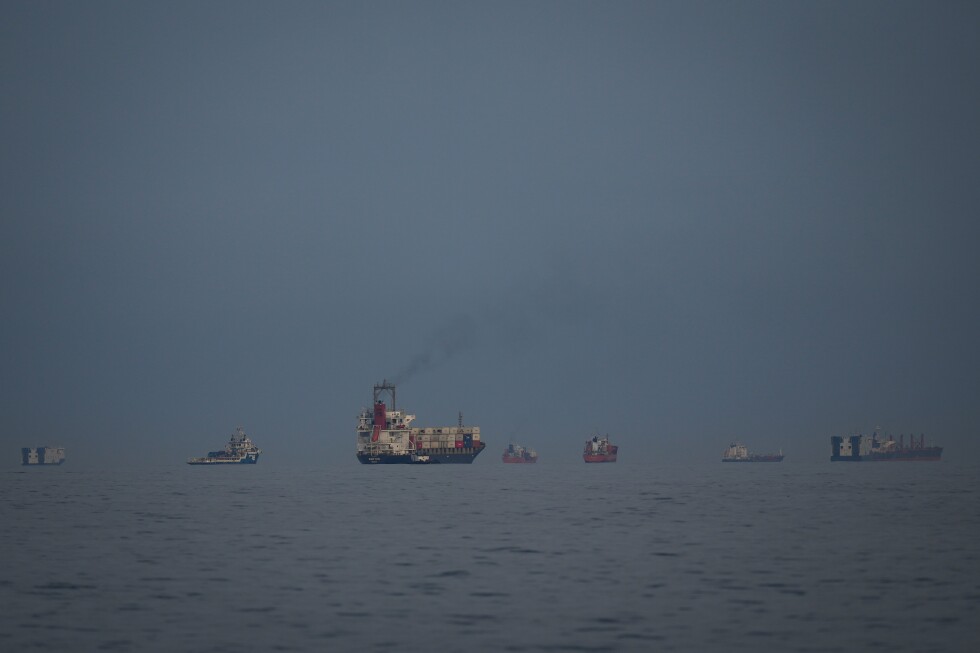
Most shipping traffic through the Strait of Hormuz, a waterway for global oil and gas transport that supplies roughly one-fifth of the world’s crude oil, has been halted since early March, after the war started. About 20 vessels have been attacked in the area.
Advertisement
However, Iran has still managed to export well above 16 million barrels of oil since the beginning of March, trade data and analytics platform Kpler estimated. Due to Western sanctions and associated risks, China has been the biggest buyer of Iranian oil.
There has been ”continued resilience” in Iran’s oil export volumes, said Kpler trade risk analyst Ana Subasic.
Iran has managed to profit from oil sales and also “preserve its own export artery” by using control over the chokepoint, said Kun Cao, client director at consulting firm Reddal.
Iran’s oil export data estimates are largely aligned with maritime traffic data.
Advertisement
At least 89 ships crossed the Strait of Hormuz between March 1 and 15 – including 16 oil tankers, according to Lloyd’s List Intelligence, down from roughly 100 to 135 vessel passages per day before the war. More than one-fifth of the 89 vessels were believed to be Iran-affiliated, while Chinese and Greece affiliated ships are among the rest, it said.
Other vessels also have been getting through.
The Pakistan-flagged crude oil tanker Karachi, controlled by the Pakistan National Shipping Corp., passed through the strait on Sunday, Lloyd’s List Intelligence said.
Shariq Amin, a spokesman at the Pakistan Port Trust, refused to confirm or deny which route the MT Karachi had used but he said the ship would soon safely reach Pakistan.
Advertisement
The India-flagged liquefied petroleum gas (LPG) carriers Shivalik and Nanda Devi, both owned by state-owned Shipping Corp. of India, also traveled through the strait around March 13 or 14, according to Lloyd’s List Intelligence. LPG is used as a primary cooking fuel by millions of Indian households.
India’s foreign minister, Subrahmanyam Jaishankar, told the Financial Times the two vessels’ were able to pass following talks with Iran. Iraq was also in talks with Iran to allow Iraqi oil tankers through the Strait of Hormuz, its state-run news agency reported.
Vessels may be transiting “with at least some level of diplomatic intervention,” said Richard Meade, editor-in-chief of Lloyd’s List. So, Iran may have “effectively created a safe corridor” with some ships passing close to the Iranian coast.
Some vessels near or in the strait were found to have declared themselves as China-linked or with all Chinese crew to reduce risks of being attacked, based on an earlier analysis on ship tracking platform MarineTraffic. Analysts believe they were taking advantage of China’s closer ties with Iran.
Advertisement
Oil prices have jumped more than 40% to above $100 per barrel since the Iran war began, and Iran has threatened it won’t allow “even a single liter of oil” destined for the U.S., and Israel and their allies to pass through.
To try to stabilize oil prices, the U.S. said it was allowing Iranian oil tankers to cross the strait. “The Iranian ships have been getting out already, and we’ve let that happen to supply the rest of the world,” Treasury Secretary Scott Bessent said in an interview with CNBC on Monday.
The U.S. bombed military sites on Kharg Island off the Iranian coast, which is key for Iran’s oil network and exports, but President Donald Trump said he had left its oil infrastructure alone for now.
The latest passages through the Strait of Hormuz show the strait was not simply “closed,” Cao said. “It is better understood as closed selectively against some traffic, while still functioning for Iranian exports and a narrow set of tolerated non-Iranian movements,” he said.
Advertisement
However, if Iran’s plan is to “inflict pain through higher energy prices, the number of tankers it allows through the Strait of Hormuz may be very limited,” Dutch bank ING’s strategists Warren Patterson and Ewa Manthey wrote in a research note.
___
Saaliq reported from New Delhi. AP Writer Munir Ahmed contributed from Islamabad, Pakistan.
A toddler dubbed the ‘Nostradamus baby’ has made chilling predictions in a viral TikTok video, including claims about simulation theory and a catastrophic tsunami called ‘The Flood 2.0’.
Emilia Randall GAU Writer
05:00, 18 Mar 2026
The ‘Nostradamus Baby’, a toddler who has provided some eerie insights into what lies ahead for the remainder of 2026, looks to take the crown from French mystic Nostradamus.
A clip reshared by NebruhTV on TikTok features a toddler being questioned about what he had just been saying. The youngster delivers some bone-chilling forecasts.
Advertisement
The boy stated: “I’m horrified.” He then launches into a disturbing explanation of a simulation conspiracy theory.
He stated: “I just don’t know that everybody living here thinks the earth is real. But it’s not actually real, because some scientists found out… there’s a glitch.”, reports the Mirror.
His mother asks: “So what is our life then?” He responds: “I don’t know. Maybe it’s just a computer… like a simulation. I feel like it’s a scientist testing little tiny people.
“They really thought reality was real down here… but little people like us aren’t actually real.”
Advertisement
The original Nostradamus was a 16th-century seer who predicted countless disturbing events yet to unfold. He composed his predictions in mysterious quatrains, which revealed the destiny of global happenings.
Many featured in his 1555 work ‘The Prophecies’, which included no fewer than 942 quatrains.
Yet, the Nostradamus baby communicates much more directly.
Advertisement
The other catastrophe he foresees is a massive flood. He stated: “There’s gonna be a tsunami… like 800 meters in the air. They call it The Flood 2.0. There’s gonna be sharks… great white sharks… when the flood comes.”
This bears similarity to Nostradamus forecasting Switzerland being drenched in blood.
Many have suggested this could be alluding to a flood.
Advertisement
This prophecy is particularly chilling – and can be connected to a specific location in the modern world. His foreboding verse reads: “Because of the favour that the city will show… the Ticino will overflow with blood…” Switzerland’s scenic Italian-speaking canton is facing a grim and bloody future.
The bloodshed could signal a major disaster, a plague ravaging the area, or some form of natural calamity. Sceptics point out that Nostradamus wrote his works in Middle French, deliberately employing vague Latin terminology.
Among Nostradamus’ more peculiar predictions, one passage reads: “The great swarm of bees will arise by the night ambush”. Some reckon this could come to pass next year as the passage aligns with the number 26.
Advertisement
However, it’s still uncertain what the bees might represent, as it appears unlikely that an enormous bee swarm could cause real damage through “ambush”.
A famous figure struck by lightning In the 26th verse of Century I, Nostradamus darkly foretells “the great man will be struck down in the day by a thunderbolt”. This important figure could span from royalty and world leaders to a prominent celebrity.
However, what remains certain is that this individual will be struck down by a bolt of lightning in broad daylight. Could we potentially witness a lightning strike at a red carpet event in 2026?
This fairytale run to the knockouts will have felt unlikely for Bodo/Glimt after failing to win their first six league phase games, meaning they were left needing results against Manchester City and Atletico to qualify for the play-offs.
And, against the odds, they provided them.
A 3-1 victory over Pep Guardiola’s men brought deserved attention and acclaim, but it was no one-off as Bodo overcame Atleti 2-1 in Madrid to claim a play-off spot.
Knutsen’s side lost to Spurs in the Europa League semi-finals last season, having become the first Norwegian side to reach the last four of a major European competition.
Advertisement
Key to their success has often been their ability to make their home games as tough as possible.
In the north of Norway, Bodo can often be bitterly cold, snowy and windy during the long winter months, with temperatures deep into minus figures.
The difficult weather conditions mean the team play on an artificial pitch made of plastic, something many sides used to playing on grass find difficult to deal with.
Those aspects, coupled with the players’ determination and strong belief in their ability, means many have left Bodo defeated.
Advertisement
They thrashed Jose Mourinho’s Roma 6-1 at home in the Conference League five years ago, while Celtic, Besiktas, Porto and Lazio have also been victims in recent years.
Bodo exit the Champions League having won their past three home games – seeing off Manchester City, Inter Milan and Sporting – and will look to their home record to serve them well once more when they next play European football.
Those experiments seek to answer some of the biggest questions in science. These include learning how the Universe began and how it will end, finding the first ever signs of life on planets orbiting distant stars, detecting black holes that ripple space time, mapping newborn planets around distant stars and analysing their atmospheres for signs of life. All of these are experiments in which, historically, the UK played a leading role. But now, British scientists could be largely locked out of them in the future, if the STFC does not pay its way.
A new trade pact between Indonesia and the United States has recast their economic ties, binding Jakarta’s resource wealth and energy future more closely to Washington’s strategic needs.
Indonesia agreed to widen access for U.S. investors in critical minerals, boost its purchases of U.S. crude and liquefied petroleum gas, back the development of an American coal export corridor and cooperate on small modular nuclear reactors.
In turn, the U.S. trimmed a threatened 32% tariff on Indonesian goods to 19% and granted broader access to the American market, including a zero-tariff entry policy for major products such as palm oil, coffee, cocoa, spices and rubber.
Though the U.S. Supreme Court’s ruling against President Donald Trump‘s tariffs may impact how it is implemented. The deal fits with longer term U.S. efforts to secure critical mineral supply chains, beef up its oil and gas exports and reduce dependence on China.
Advertisement
Meanwhile other export-reliant Southeast Asian economies negotiating with the United States, including Vietnam, are closely watching the Indonesia–U. S. trade deal for clues about the tariff levels and concessions Washington may demand across the region.
Indonesia, the world’s largest nickel producer, has vast mineral reserves needed for electric vehicles and clean energy systems. It’s caught between the conflicting aims of the U.S. and China, a key source of foreign investment and market for Indonesian coal and nickel, analysts say.
China is concentrating on electrification, renewables and dominance of battery supply chains, while the U.S. is pairing its push for mineral access with more fossil fuel exports.
Haryo Limanseto of Indonesia’s Coordinating Ministry for Economic Affairs, said the deal’s energy provisions “balance foreign trade and meet domestic energy needs.”
Advertisement
“The leadership of Indonesia is trying to tread a fine line between the West and China,” said Putra Adhiguna of the Jakarta-based Energy Shift Institute, adding that Chinese influence is “inescapable” since it is Indonesia’s largest trading partner.
US gains a new foothold to Indonesia’s minerals
Indonesia has pledged to promote U.S. investment across its mineral industry, from exploration and mining to refining, transport and export. In some cases, American investors will receive treatment “no less favorable” than domestic firms.
Restrictions on exports of critical minerals to the U.S. will be relaxed to expedite development of Indonesia’s rare earths and critical minerals sector with U.S. partners, promising “greater certainty” for companies involved in extraction to help boost production, the agreement says.
Advertisement
Major policy shifts have altered Indonesia’s mining sector in the past six months and the trade deal’s new restrictions on existing foreign-owned entities in Indonesia will curb excess output from processing plants. Foreign businesses must follow the same tax, environmental, labor and quota rules as other companies.
Indonesia’s critical mineral processing sector is currently dominated by China, which has firms operating or financing multiple nickel smelters and industrial parks.
“Indonesia is absolutely central to this competition because it combines resource endowment with political ambition,” said Kevin Zongzhe Li, with the Center for China Analysis within the Asia Society Policy Institute, a New York-based think tank.
Competition over critical minerals is heating up and the agreement “opens the door for U.S. firms to have a real shot” at “modestly leveling a sector where Chinese industries established first mover advantage,” he said.
Advertisement
Indonesia to purchase more US energy
Indonesia has agreed to cut red tape so that its companies can more easily purchase U.S. energy products.
It plans to buy $15 billion worth of American energy commodities over an unspecified period, mainly fossil fuels such as liquefied petroleum gas, crude oil and gasoline.
Trump’s efforts to persuade Asian countries to buy more American LNG has gained momentum during trade talks, with energy purchases emerging as a way to narrow trade gaps. It’s unclear if the turmoil in oil trading due to the war with Iran might impact that effort.
Advertisement
Indonesia, one of the world’s top coal exporters, will also invest in developing an export corridor from the U.S. West Coast to help make American coal more competitive in global markets, the agreement says.
Indonesia also pledged to work with the U.S. and Japan to deploy small modular nuclear reactors, starting with a potential project in West Kalimantan.
Shift in energy transition policies
The deal reflects changed U.S. energy priorities under the Trump administration, away from cooperation on reducing Indonesia’s climate change -causing emissions.
Advertisement
In 2022, Indonesia joined the Just Energy Transition Partnership, a multi-billion deal where the U.S. and other wealthy nations pledged support for reducing coal use and expanding clean energy. The program was faltering even before Trump withdrew from it last year.
Despite the U.S. withdrawal, Indonesian officials said the $21.4 billion partnership will continue. As of January, at least $3.4 billion, around 15%, of the funds had been received, according to Airlangga Hartarto, Indonesia’s minister for economic affairs.
Adhiguna said the deal’s biggest impact may be political, with Jakarta emulating the U.S. emphasis on fossil fuel use.
“There is the risk that the political leadership of Indonesia is going to fall back into that hole,” Adhiguna said.
Advertisement
That will mean still slower progress in areas like solar energy.
Over the past five years, tropical, sunny Indonesia has installed less than 1 gigawatt of solar energy — compared with roughly 2 GW in Vietnam and nearly 60 GW in India. The International Energy Agency found that fossil fuels, like coal, oil and natural gas, made up nearly 78% of Indonesia’s energy mix in 2023.
Indonesia should prioritize building 100 GW of solar and storage capacity and expand interconnection grids to enable renewable energy sharing, said Dinita Setyawati, with the United Kingdom-registered energy think tank Ember.
Tariff strike down creates confusion
Advertisement
The deal’s future has been clouded by the U.S. Supreme Court’s recent ruling against Trump’s sweeping global tariffs, just after the agreement was reached — casting doubt on the durability of his trade strategy. The agreement requires ratification by Indonesia’s parliament before it can take effect.
That adds another “layer of uncertainty,” said Meha Sitepu, with the Washington-based strategic advisory firm The Asia Group.
Some provisions of the agreement are drawing criticism, including those that are seen as diluting Indonesia’s halal certification requirements in the mostly Muslim country of nearly 288 million, Southeast Asia’s most populous nation.
“Parliamentary approval could be an uphill battle and added uncertainty from the U.S. side may complicate things further,” Sitepu said.
Advertisement
___
Delgado reported from Bangkok, Thailand. Associated Press writer Edna Tarigan in Jakarta contributed to this report.
___
The Associated Press’ climate and environmental coverage receives financial support from multiple private foundations. The AP is solely responsible for all content. Find AP’s standards for working with philanthropies, a list of supporters and funded coverage areas at AP.org.
A cardiologist has warned about three worst foods with high cholesterol – with one popular breakfast item described as a ‘cholesterol bomb’
Christopher Sharp Trendswatch Reporter
04:00, 18 Mar 2026
A leading cardiologist has identified the three worst foods for people aiming to lower their cholesterol levels, with one item labelled a “cholesterol bomb”.
Dr Steven Lome, a cardiologist at Rush Copley in Aurora, Illinois, made the revelations during an appearance on the Physicians Committee podcast, where he outlined the most problematic foods for cholesterol management.
Advertisement
Before examining these foods, it’s worth understanding that cholesterol comes in two primary forms: HDL and LDL. HDL cholesterol is considered ‘good’ cholesterol as it can lower the chances of developing heart disease or suffering a stroke.
LDL cholesterol, conversely, is regarded as bad cholesterol, as excessive amounts can cause arterial blockages and heighten heart disease risk.Consequently, maintaining elevated HDL cholesterol levels whilst keeping LDL cholesterol low is crucial.
When discussing the three principal foods to steer clear of, Dr Lome highlighted processed meats, red meats, and eggs as the primary culprits. He explained: “Processed meats, pepperoni, baloney, salami, sausage, things like that, they’re extremely high in saturated fat and, most of the time most, saturated fat has the biggest impact and they are high in saturated fat.
“They also have a good amount of dietary cholesterol which we need to remember, dietary cholesterol is not an essential nutrient. Processed meats I think by far would be the worst.
Advertisement
“Next, I would put red meats which still would be high in cholesterol and saturated fat significantly so you really want to get rid of those. And then eggs.”
Dr Steven delivered a particularly striking assessment when discussing eggs, stating: “Eggs are a cholesterol bomb, I hear people call them. That yolk is just so full of cholesterol. In most surveys, eggs are the number one source of dietary cholesterol in the American diet.”
The relationship between diet and cholesterol levels extends beyond mere speculation, with numerous studies examining how various foods affect overall health.
Advertisement
Eggs
Multiple research papers have explored the connection between egg consumption and cholesterol levels. One investigation published in the Science Direct journal examined the effect of eggs on blood lipid profiles and whether they warrant inclusion in our diets.
The researchers found: “When combined with healthy eating patterns that include more dietary fibre or fish, eggs may be beneficially associated with lipid outcomes. Overall, these results provide no evidence that egg intake should be limited when consumed as a part of a fibre-rich, heart- healthy diet.”
Meanwhile, separate research indicated that eggs might contribute to elevated LDL cholesterol levels. Published in the Nutrients journal, researchers concluded: “Notably, longer-term high egg-consumption may lead to higher LDL-c/HDL-c ratio and LDL-c. However, RCTs with long tern follow-up are needed to guarantee the association between egg consumption and human health.”
Red and Processed Meat
Advertisement
Both red and processed meat have been associated with a heightened risk of heart disease according to research published by the University of Oxford. Publishing their study in the Critical reviews in Food Science and Nutrition journal they found that higher intakes of red and processed meat could increase the risk of heart disease.
In a statement following the publication of the findings, co-lead author of the study Dr Keren Papier said: “Red and processed meat have been consistently linked with bowel cancer and our findings suggest an additional role in heart disease.
“Therefore, current recommendations to limit red and processed meat consumption may also assist with the prevention of coronary heart disease.”
For more information on how to reduce your cholesterol, visit the NHS website.















































You must be logged in to post a comment Login