The new policy will mean all new hackney carriage vehicle licence applications need to be for wheelchair accessible vehicles (WAVs), zero-emission vehicles (ZEVs), or hybrid electric vehicles (HEVs).
North Yorkshire Council hopes the policy will address the shortage of WAVs currently operating in the county, with just 60 wheelchair accessible hackney carriage vehicles currently licensed.
Councillor Richard Foster, executive member for managing our environment, admitted the policy was a compromise but said he hoped it would increase the number of WAV taxis in the county.
Advertisement
He added: “We have an issue around disability and access to vehicles, but we also realise there are challenges to the trade, especially the hackney carriage trade from app-based taxi hire firms, both in our county and from across borders.
“So we’re hoping that we’ve come up with a policy that reflects the modern world.”
Ahead of the vote, taxi operators warned that the change would force some drivers out of the industry.
Lisa Ridsdale, from the taxi operator Take Me Group, told councillors the policy was “out of touch with rural reality”.
Advertisement
“Requiring all new or replacement taxis to be wheelchair accessible, electric or hybrid might work in cities, but here it’s impractical and potentially devastating.
“Wheelchair accessible or electric vehicles cost in the region of £70,000 to £90,000 when financed, compared to standard cars at around £20,000 to £30,000. Most rural taxi drivers are self-employed, running small businesses with tight margins. For many, this is a financial crucifixion.
“It will mean fewer drivers, fewer taxis, longer waits and reduced service, and the people who rely most on taxis — the elderly, disabled and rural residents — your families will suffer.”
Disability campaigners, however, said the policy did not go far enough to increase the number of WAV taxis.
Advertisement
Asking councillors to change the policy to insist that all new taxis were WAVs, Jackie Snape, chief executive of Disability Action Yorkshire, said: “Without enough accessible vehicles, people face longer waits, fewer spontaneous journeys and reduced opportunities to participate fully in everyday life.
“The public sector equality duty requires the council not only to avoid discrimination but to actively advance equality of opportunity.
“With the current shortage of accessible vehicles, we ask councillors to consider whether the recommended option does enough to meet that duty.”
The new policy will mean private hire operators need to identify a passenger’s accessibility needs prior to taking a booking, to ensure that an appropriate vehicle is provided.
Advertisement
The 10-year age limit on both hackney carriage and private hire vehicles has been replaced with a requirement to meet Euro 6 emission standards.
The council will also issue restricted private hire driver licences for those who drive licensed vehicles for the sole purpose of fulfilling school or social care contracts.
The new policy will be reviewed after a year to ensure it has increased the number of WAV vehicles.
The Wales boss was dismissing the idea that if his side beats Bosnia in their World Cup play-off semi-final that will be playing Italy
Craig Bellamy believes Northern Ireland have a fair chance of beating Italy in Bergamo to stay on course to reach the finals for their first time in 40 years.
Advertisement
The Wales boss was dismissing the idea that if his side beats Bosnia in next Thursday’s World Cup play-off semi-final in Cardiff it is a no-brainer that they will meet Italy in the final 2026 World Cup qualifier.
Should Michael O’Neill’s side beat Italy and Wales beat Bosnia, it will mean a trip to the Cardiff City Stadium on 31 March.
“All I keep hearing from everyone is that if we beat Bosnia we’ll be playing Italy. You wait until you see Northern Ireland,” said Bellamy at the Wales squad announcement.
“This team do not play with the ball, they don’t want the ball, so Italy having the ball is not a problem to them.
Advertisement
“When you haven’t qualified for two major tournaments as a top team like they are, just imagine the pressure Italy are going to be under. I am going to be so intrigued as a football fan to see how they handle that.
“If we take care of Bosnia, and that’s a big if because they are a top team, it wouldn’t surprise me whichever team we faced.”
Wales and Northern Ireland both made their World Cup debuts in 1958 with the Irish squad returning to the finals in 1982 and 1986. Wales didn’t make their second appearance until Qatar four years ago.
“You have to do your homework and I’ve watch both Italy and Northen Ireland. They are two completely different teams, so how we would plan to meet Italy would be different in structure to facing Northern Ireland,” continued Bellamy.
Advertisement
“Bosnia play a little bit similar to Italy in their structure without the ball, even though the Italians can switch. We might be able to use some of our Bosnia groundwork if we played Italy, but if it’s Northern Ireland they press in a completely different way.
“Our structure of work is already planned and already ahead because we don’t have time and we must be ready to hit the ground running as soon as the first game is ticked off.”
Wales’s injury list includes Ben Davies, Keiffer Moore and Chris Mepham, but will have the very much in-form Fulham star Harry Wilson, a hat-trick scorer in the 7-1 final pool win over North Macedonia in their last outing in November, fit to play next week.
When the draw for the qualifiers was made Bellamy warned everyone not to write off O’Neill’s team and claimed they were “the one team I didn’t want to play”.
Advertisement
“Everyone’s writing them off but I’m telling you now, watch out for that result – it’s not going to be straightforward. It will be a tough, tough game for Italy,” Bellamy said.
“Down the years they’ve just had something and they know what they are. They’ve got a brilliant manager who I really, really like.
“I was lucky enough to spend a bit of time with him as well, and I loved him. And no wonder his players do as well. They won’t be playing at their home ground, but I just feel they’ll be comfortable in any situation you throw them into.
“If I was Italy going into that game, with everyone expecting you to win, I’m telling you I’d be edgy. I wouldn’t be comfortable with it.
Advertisement
“Italy is one of the greatest nations in football and that’s a lot of responsibility to shoulder. To have to play a team like Northern Ireland I’d just be thinking ‘let’s get through this and see what happens in the other game’.”
The stars appear to be aligning for both club and country.
The World Cup is a “motivating factor” for Hall, and there remain question marks surrounding just who will line up in his position for England this summer.
Hall, who has won two caps for his country, has yet to earn a call-up under Thomas Tuchel following an injury-disrupted period in his fledgling career.
But that will surely change when the England manager announces his squad for the friendlies against Uruguay and Japan on Thursday.
Advertisement
Tuchel certainly knows him well.
The England boss handed Hall his debut at Chelsea at the age of just 17 in 2022, and has watched the left-back play against his former club and Manchester City this month.
Hall was a highly-rated talent at Chelsea, but he has come a long way since Tuchel first trialled him in a back three against Chesterfield.
Arno Michels, Tuchel’s long-serving assistant at Chelsea, Bayern Munich and Paris St-Germain, knows that better than most.
Advertisement
“It’s incredible to see how Lewis has developed – and he’s still only 21,” he said.
Yet Hall will not be getting carried away.
Hall, by his nature, is a level-headed character, who does not tend to look beyond the next game, and has been kept grounded by a tight-knit family.
He has never lost touch with his roots.
Advertisement
The defender still has a small circle of close friends and has returned to Binfield, where it all started, in each of the past three summers to hand out trophies and medals at the annual junior football tournament he once played in.
Hall has even been back to represent his local cricket club as relatively recently as 2024.
The left-back has not forgotten those who have helped him along the way, either, such as Mark Robinson, his former manager with Chelsea‘s under-23s.
Hall even jumped into the stands to catch up with Robinson after Newcastle‘s 1-0 win at Stamford Bridge at the weekend.
Advertisement
“There’s lots more to come because Lewis is a very humble lad,” Robinson said.
“I can’t see that ever changing. You have got to keep learning, keep improving, and he will do that.”
A teenager has described how a serious head injury sustained while on a football holiday in Ibiza left him on a stroke ward for four months. Daniel Hurst went on an annual football trip to the holiday destination in May last year with his teammates from Yateley United Football Club.
But the trip ended in catastrophe after Mr Hurst, who was 19 at the time, suffered such a horrific head injury that medics did not believe he would survive. After going on an evening out with club members, including his father Steve, Mr Hurst decided to head 300 yards back to the hotel.
But he disappeared and teammates set out to look for him. Several hours later, his father was told by police that a British boy had been taken to hospital with severe head injuries and was not expected to make it through the night.
Advertisement
Mr Hurst was airlifted to Majorca and needed surgery which involved medics removing part of his skull to try to stop the swelling. He was put in a medically induced coma.
After four weeks in hospital on the Spanish island he was stable enough to be airlifted to Frimley Park Hospital in Surrey where he spent four months on a stroke unit in a bed for patients who suffer traumatic brain injuries. He was the youngest ever patient to be cared for on Frimley’s stroke ward.
When he arrived at the hospital he was unable to walk or talk but thanks to the care he received he is now planning to run the London Marathon to raise money for the hospital’s charity. Mr Hurst, who works at a local golf club, is also back playing some football with his teammates. He also wants to raise awareness that “recovery is possible” after such a traumatic injury.
Advertisement
“You have to keep moving forward,” he told the Press Association. “I’ve got the same plans now I did before it happened – I’m trying to improve my golf, I’m running a lot, I go to the gym, things like that. It’s obviously been pushed back a little bit, but not a lot.
“I want to help motivate people (with brain injuries) to just keep going forward – your life is never over. I know it is hard. There were moments when I thought ‘is my life done?’… but you have got to keep going.”
Mr Hurst praised the hospital staff at Frimley Park Hospital, saying that they have kept him motivated. On the marathon, he added: “Even if I just walk it, this year is not about beating my time last year, it is about getting over the finish line.”
In a message to holiday-goers, he said: “I would urge people to just be careful and always stick with at least one or two people, just always stay together.”
Advertisement
His father Steve, 53, added: “The message is just, ‘stick with someone, just be wary of surroundings’, like Dan said. This could happen anywhere.” On the incident, he said: “We couldn’t find Dan, I rang his phone and police answered. They said someone who fits Dan’s description had been admitted to hospital.
“We were told there was a very high chance that he wouldn’t make it – they were quite blunt about the severity of his injuries. I had to ring his mum and tell her what happened, it was horrendous.
“Even after his surgery in Majorca we were told that it was an ‘hour-by-hour, day-by-day’ situation.” Dr Tilly Speirs, consultant stroke physician at Frimley Health NHS Foundation Trust, one of Mr Hurst’s medics, told the Press Association: “When he arrived we had to start right from the beginning and work out what his deficits were and what therapy he was going to need.
Advertisement
“He couldn’t walk when he came to us and it was a really scary time for his family because they didn’t know what was going to happen and whether he would recover. He had post-traumatic amnesia when he arrived… he couldn’t recall what happened the day before or the hour before.
“He survived the head injury but the family didn’t know what that survival was going to look like. As a team we didn’t know either but we knew he needed to have rehab and he’s done remarkably well.
“He had age on his side, he had just run a marathon so he was in good physical condition before this happened. Dan is a testament that with rehab that you can have a good outcome following a traumatic brain injury, it’s not going to be the same for everybody, it really depends on the individual, but he has done remarkably well and I think his future is going to be as bright as it was before he went on that trip.”
– The London Marathon is taking place on Sunday April 26 and Mr Hurst has set up a fundraising page at justgiving.com/page/danhurst20.
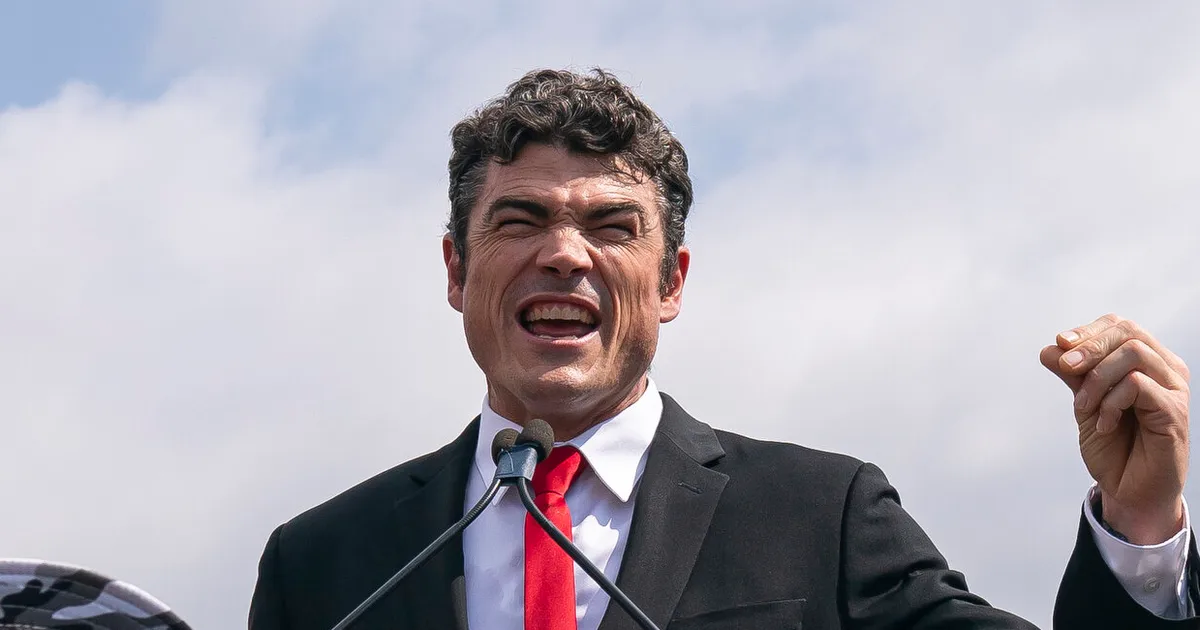
Hours after his head of counter-terrorism quit saying he couldn’t support the war against Iran, President Donald Trump claimed he didn’t really know him that well but that he had “always thought he was weak on security, very weak on security.”
“I always thought he was a nice guy,” Trump told reporters on Tuesday, not long after Joe Kent had announced he had stepped down from running the National Counter-terrorism Centre. “I didn’t know him well.”
That sentiment is at odds with his past praise of the conspiracy theorist who rose in Trump’s estimation for his embrace of the false claim that the 2020 election had been stolen and that the FBI had fomented the January 6, 2021, violent attack on the Capitol.
In fact, Trump’s endless lying about a stolen election enraged his followers, and he himself asked them to converge on Washington DC, on the day of the congressional election certification. It was his own speech hours before the assault, according to many of those who participated, that drove them to violence.
Advertisement
Joe Kent, then-director of the National Counterterrorism Center, testifies in December during the House Homeland Security Committee hearing on “Worldwide Threats to the Homeland.”
Tom Williams via Getty Images
“I think this man has a tremendous future, a very special person,” Trump said of Kent in 2022 as he endorsed his run for Congress in Washington state.
That year, Kent defeated the sitting Republican who had earned Trump’s wrath by voting to impeach him for his coup attempt but then lost the general election to Democrat Marie Gluesenkamp Perez. Kent ran again for that seat in 2024 but lost to Perez a second time.
Trump, after winning back the White House in that election, appointed Kent to a top position in the national security world. “Joe will help us keep America safe by eradicating all terrorism, from the jihadists around the World, to the cartels in our backyard. Congratulations Joe!” Trump wrote in a February 3, 2025, post.
Advertisement
That history apparently was no longer relevant Tuesday for Trump. “I realised that it’s a good thing that he’s out because he said that Iran was not a threat,” he said.
Kent had cited his opposition to Trump’s 17-day-old war. “I cannot in good conscience support the ongoing war in Iran. Iran posed no imminent threat to our nation, and it is clear that we started this war due to pressure from Israel and its powerful American lobby,” he wrote in a social media post that included an image of his resignation letter.
While Kent has embraced anti-immigrant and white nationalist positions over the years, the theory that Israel pushed Trump into the war was actually laid out by Secretary of State Marco Rubio days after the attack began on February 28.
Director of National Intelligence Tulsi Gabbard, a former Democratic congresswoman known for her longtime opposition to a war with Iran and Kent’s supervisor, on Tuesday afternoon released a statement that neither addressed Kent’s departure nor the wisdom of Trump’s decision to attack Iran.
Advertisement
“As our commander in chief, he is responsible for determining what is and is not an imminent threat, and whether or not to take action he deems necessary to protect the safety and security of our troops, the American people and our country,” she wrote. “After carefully reviewing all the information before him, President Trump concluded that the terrorist Islamist regime in Iran posed an imminent threat and he took action based on that conclusion.”
While Trump in his public comments on Tuesday called Kent “a nice guy,” Trump’s aides and supporters were far less charitable.
Press secretary Karoline Leavitt responded to Kent’s letter with a lengthy, 450-word post of her own. “The absurd allegation that President Trump made this decision based on the influence of others, even foreign countries, is both insulting and laughable,” she wrote.
Taylor Budowich, a former top White House aide, claimed that Kent was about to be fired. “Joe Kent is a crazed egomaniac who was often at the centre of national security leaks, while rarely (never?) producing any actual work,” Budowich wrote. “He spent all of his time working to subvert the chain of command and undermine the president of the United States. This isn’t some principled resignation—he just wanted to make a splash before getting canned. What a loser.”
Advertisement
Olivia Troye, once a national security aide to former Vice President Mike Pence, said the White House likely feels the need to damage Kent’s credibility because of his assertion about Iran. “He actually calls out the lack of imminent threat,” she said.
The purpose-built underground structure in the countryside was designed to protect government officials from nuclear warfare, and could have sustained its inhabitants for up to three months
Built during the Cold War era, it appears to be an ordinary cottage from street level, yet conceals a vast subterranean bunker designed to shelter government personnel from potential attacks.
Advertisement
Hidden beneath the Essex countryside near Brentwood lies a disused underground complex. Today operating as the Kelvedon Hatch Secret Nuclear Bunker, it functions as a tourist destination and museum, though its original purpose was far more sinister.
This facility was built to serve as a potential regional government headquarters throughout the Cold War period. As a founding NATO member, Britain occupied a crucial position in the conflict as a fundamental partner to the US.
The purpose-built shelter was designed to accommodate hundreds of military and civilian staff should a nuclear strike occur. In such circumstances, it would function as a command centre where regional government would coordinate population survival efforts and maintain essential governmental functions.
Exploring the bunker
The site now welcomes visitors, offering self-guided tours through the tunnels that reveal what operations would have taken place below ground during a nuclear conflict.
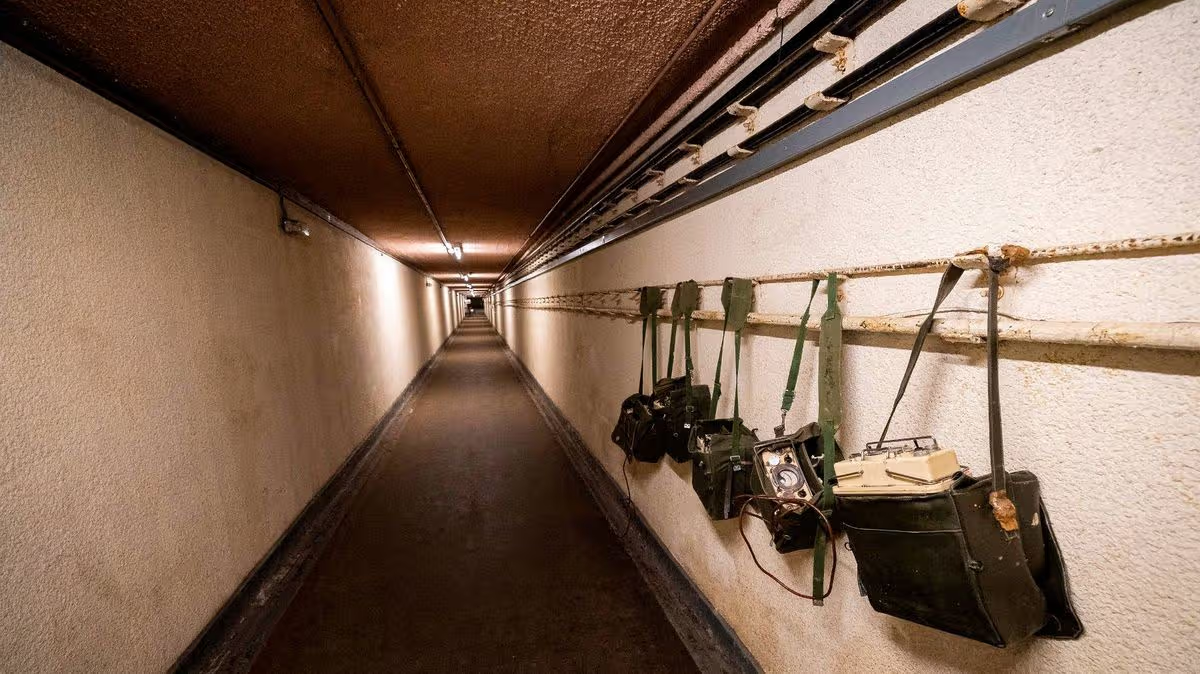
The complex extends 125 feet below the surface, and remarkably, access is gained through what looks like an unremarkable bungalow. The guardhouse sits nestled amongst woodland and opens onto a 100-yard tunnel leading underground.
Considering the logistics and planning involved, the bunker was designed to support several hundred personnel for a maximum of three months – naturally requiring air conditioning and heating systems, an independent water source and power generators.
Additionally, it came fully fitted with radio apparatus, secure telecommunications infrastructure and numerous military systems.
Advertisement
The entire communications and technical equipment was located on the first floor, approximately 80 feet beneath ground level. This floor also housed the critically important ‘plotting room’, where aircraft were monitored and tracked round-the-clock, with any explosion analysis conducted there.
The upper level, meanwhile, accommodated the daily living arrangements for those stationed within. It featured a compact yet well-designed medical facility, multiple washrooms, sleeping quarters and even a substantial canteen – the same dining area visitors use nowadays.
Essential provisions for survival were calculated to last three months, with the assumption this timeframe would allow circumstances to stabilise sufficiently. This would subsequently permit limited ventures outside to obtain additional supplies.
The middle level of the subterranean complex was reserved for governmental use. During the initial construction phase, this level connected to the plotting room through a large opening in the floor, enabling senior RAF commanders to observe developments directly.
The bunker today
The bunker ceased operations in 1992 after becoming obsolete, with its equipment and the surrounding land returned to its initial owners.
The Parish family transformed the facility, converting it into a museum and visitor destination that chronicles Cold War history.
Advertisement
Nowadays, its clandestine status has been somewhat compromised, with the site rather paradoxically advertised throughout the vicinity. Brown tourism signs directing visitors towards the attraction are labelled ‘Secret Nuclear Bunker’ – rather undermining any notion of secrecy.
This intriguing location welcomes spontaneous visits without requiring advance reservations; visitors can arrive and purchase tickets on arrival.
Entry costs £15 for adults, whilst youngsters between five and 16 pay £13. Families can obtain tickets for £38, with additional reductions available for larger parties.
Advertisement
The subterranean attraction opens its doors Thursdays through Sundays, plus during all school holidays and half-term breaks.
To allow sufficient time for a thorough visit, final admission is generally permitted one hour before closure – 4pm on weekdays and 5pm at weekends – though these times are liable to alteration.
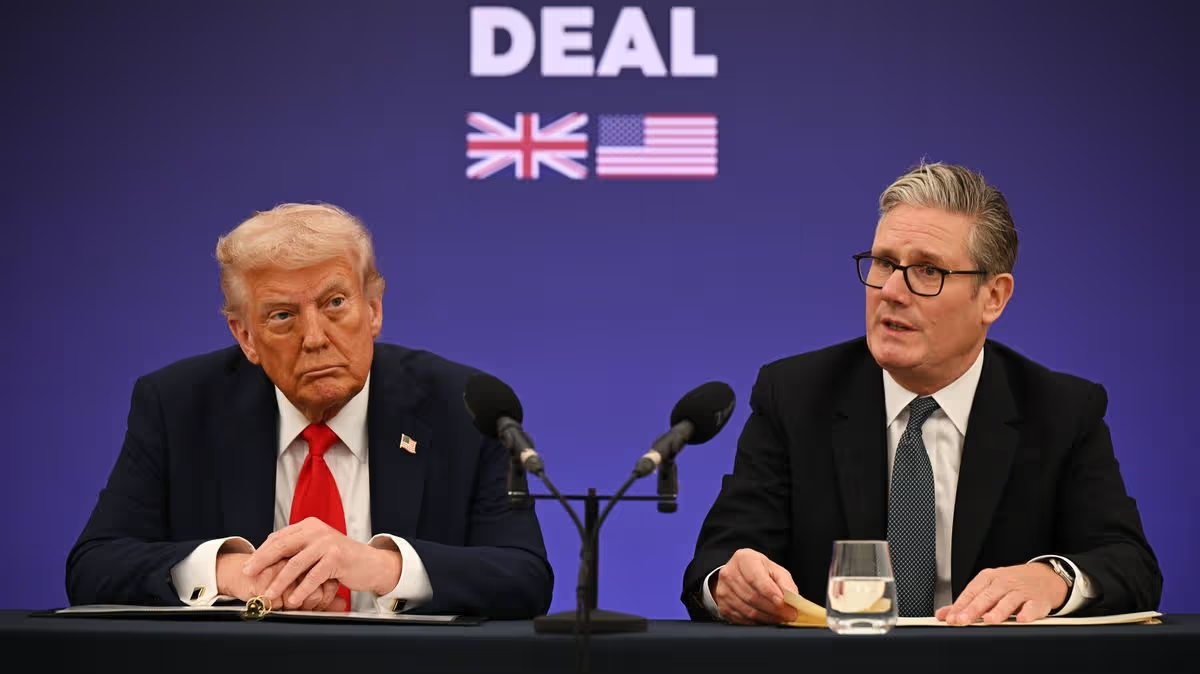
President Donald Trump said Sir Keir Starmer has made a “big mistake” in his response to US calls for support in the war with Iran as he suggested the “good” trade deal he struck with the UK “probably wasn’t appreciated”.
Mr Trump reiterated his criticism of Sir Keir’s stance on the conflict as he again accused him of not offering sufficient military backing. The president has called on allied nations to provide vessels to help open the Strait of Hormuz and has criticised Sir Keir for so far declining to commit the Royal Navy.
Advertisement
With the war now in a third week, oil prices remain above 100 US dollars (£75) per barrel as a result of Iran’s continued blockade of the Strait of Hormuz.
Get MEN Premium now for just £1 HERE – or get involved in our WhatsApp group by clicking HERE. And don’t miss out on our brilliant selection of newsletters HERE.
On Tuesday, Mr Trump posted on his Truth Social platform: “The United States has been informed by most of our Nato ‘allies’ that they don’t want to get involved with our military operation against the terrorist regime of Iran.”
He said he was “not surprised” because he had always considered Nato to be a “one-way street”.
Advertisement
“We will protect them, but they will do nothing for us, in particular, in a time of need,” he wrote.
He then added: “Because of the fact that we have had such military success, we no longer ‘need’, or desire, the Nato countries’ assistance — WE NEVER DID!”
And in the White House, Mr Trump said he “liked” the Prime Minister but felt “disappointed” with his recent position in regard to the conflict with Iran. He also described Sir Keir’s policies on both immigration and energy as a “disaster”.
Mr Trump, who was hosting Irish premier Micheal Martin in the White House on Tuesday to mark St Patrick’s Day, also told reporters he was looking forward to welcoming King Charles on his official state visit to the United States.
The president was asked by reporters in the Oval Office whether his relationship with Sir Keir has been damaged by the UK’s stance over the war in Iran.
“Well, he hasn’t been supportive, and I think it’s a big mistake,” replied Mr Trump.
“You know, they make a lot of money on trade with the United States. I went out of my way. As you know, they couldn’t make a deal with Biden, because they had no real administration to make a deal, Biden. But we made a deal. We made a good deal for them and, frankly, probably wasn’t appreciated.
Advertisement
“I do look forward to seeing the King. He’s going to be coming, as you know, very shortly, but, no, I was disappointed, because Keir was willing to send two aircraft carriers after we won, because essentially … there’s no threat for the aircraft carriers right now.
“And I said, ‘no, no, we want things sent before the war, not after the war is won’. So, yeah, I’m disappointed with Keir. I like him, I think he’s a nice man, but I’m disappointed.”
Mr Trump then repeated his assertion that “unfortunately Keir is no Winston Churchill”.
Advertisement
The president went on the claim that the Prime Minister “doesn’t produce”.
Mr Trump told reporters: “Even the aircraft carriers, he would only send them after we essentially won. I mean, he’s sending them when there are no planes left, when the missiles are down to like 8% of the missiles.”
Asked if he had confidence in the Prime Minister, Mr Trump said: “It’s not for me, it’s really for the people of the UK to have confidence.
“I mean, I’ve been very critical of Keir – and I did it in a friendly way – I said, if you don’t change your energy thing and get away from windmills and go back to oil and gas.
Advertisement
“You have something that no other country has, very few countries have anything like it: The North Sea. You have some of the greatest oil and oil deposits in the entire world. The North Sea, they don’t use it.”
Mr Trump added: “I think he’s a nice man, but I disagree with him on two things. Primarily his immigration policy is a disaster, and his energy policy is a disaster – and they’re about the biggest policies you can have.
“You’ve allowed millions and millions and millions of people to come into your country that shouldn’t be there. And, by the way, that’s all over Europe.”
During the Oval Office exchanges, Mr Trump also said he was “disappointed” with Nato, but that he was not currently rethinking his relationship with the alliance.
Advertisement
He said: “We help other countries and when they don’t help us, I mean, it’s certainly something that we should think about.”
Asked if he was afraid that a ground invasion of Iran would be a repeat of the US-Vietnam war, Mr Trump said: “I’m really not afraid of anything.”
Iran’s stranglehold on the Strait of Hormuz has become a key focus of international attention, with several ships in the area reportedly struck by projectiles or debris from intercepted missiles as Tehran seeks to exert economic pressure on the US.
There is one Dingle who has always kept themselves away from the lawbreaking antics of their family members in Emmerdale, but even they are about to move over to the dark side in Cain Dingle’s (Jeff Hordley) hour of need. Desperate times call for desperate measures.
The Tates have won the fight for Moira Dingle’s (Natalie J Robb) farm, but Joe Tate (Ned Porteous) isn’t done twisting the knife. Though he’s got what he wanted, he’s having too much fun to stop making everyone else’s life a misery.
Cain, meanwhile, is trying to get a Dingle farm up and running to distract himself from all that he’s lost and losing. But it’s falling at the first hurdle with Sam (James Hooton) struggling with this new task and Mackenzie (Lawrence Robb) and Matty (Ash Palmisciano) having to step in to help.
Advertisement
Joe continues taking pleasure in giving Cain bad news (Picture: ITV)
Cain then learns that Joe wants to sell the cows and is furious, especially when Mackenzie reasons that they can’t afford to keep the cows themselves. The nail in the coffin for Cain comes when Sam reveals he missed a meeting about the farm machinery, and Cain jumps straight to catastrophising that everything is over.
But there’s hope for Cain in the form of a hooded figure who wants to do their bit to save the family.
Advertisement
Robert and Aaron are shocked when a panicked Matty arrives to reveal that their herd has disappeared in the night. Joe furiously points the finger at Robert, who denies any involvement. Joe knows who to confront and grabs his wingman Graham Foster (Andrew Scarborough) to challenge the Dingles.
The Dingles are smug in responding that they had nothing to do with the theft, not realising that one of them did.
Graham and Joe go in search of the culprit (Picture: ITV)
The culprit is seen out on a country road rustling the cows, and it’s none other than Belle Dingle (Eden Taylor-Draper), who fancies herself as a bit of a cow rustler.
She’s played a blinder in saving the herd, but being a novice, she’s forgotten one major detail – Cain rings her to warn that the bull she’s nicked has been fitted with a tracker.
Joe and the police are closing in, how will the Dingles protect Belle?
Which countries possess nuclear weapons in 2026 – and exactly what is in their stockpiles? Read on for the complete list.
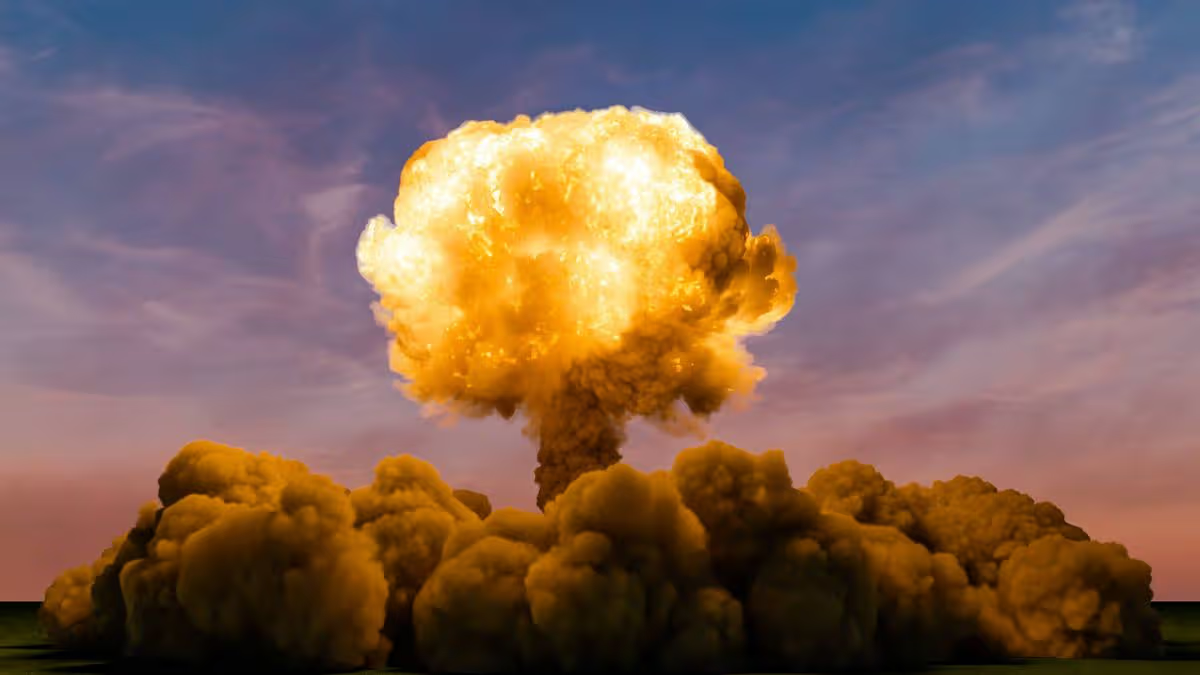
As tensions in the Middle East between the US-Israel alliance and Iran escalate daily, the genuine possibility of nuclear conflict weighs heavily on people’s minds.
Advertisement
Other ongoing conflicts including the Russia-Ukraine war, the Israel-Hamas confrontation, and military hostilities between Pakistan and Afghanistan create a volatile mix of dangerous military operations between nations where at least one side possesses nuclear capabilities.
In an era where knowledge is crucial, staying abreast of current developments is essential. So, for those wondering which nations possess exactly what nuclear arsenal, we’ve compiled the complete breakdown for you, reports the Express.
Countries possessing nuclear weapons in 2026
Russia
Advertisement
United States
China
France
United Kingdom
Advertisement
Pakistan
India
Israel
North Korea
Advertisement
What nuclear arsenal do these 9 nations hold
These nine nuclear-armed states possess an estimated 12,300 warheads collectively as of early 2026, with over 9,614 held in operational military stockpiles for deployment via missiles, ships, aircraft, and submarines according to the Federation of American Scientists’ (FAS) 2025 Status of World Nuclear Forces.
The remaining warheads have been decommissioned but remain largely intact whilst awaiting dismantlement. According to the Federation of American Scientists: “Of the 9,614 warheads in the military stockpiles, some 3,912 are deployed with operational forces (on missiles or bomber bases). Of those, approximately 2,100 US, Russian, British, and French warheads are on high alert, ready for use on short notice.”
This overall figure of 12,241 warheads represents a substantial decrease from the roughly 70,000 warheads held by nuclear-armed nations during the Cold War. However, the total is anticipated to increase steadily throughout the coming decade, with modern weapons being far more advanced than their Cold War predecessors.
Which country possesses exactly what
The precise number of nuclear weapons held by individual nations remains a tightly-guarded state secret, meaning these estimates carry “significant uncertainty” according to the FAS. These figures are also thought to have been compiled before the escalation of tensions involving the US-Israel and Iran conflict.
That said, Russia is believed to possess around 5,459 nuclear warheads, with 1,150 classified as retired – meaning they’ve been removed from the military stockpile but remain intact whilst awaiting dismantlement.
A further 2,591 nuclear warheads sit within the Kremlin’s military stockpile, indicating they’re earmarked for potential military deployment, whilst 1,718 are already strategically positioned – bringing the active nuclear arsenal total to 4,309.
The United States, on the other hand, maintains a total active arsenal of 3,700 nuclear warheads, with 1,670 strategically deployed, 100 non-strategically deployed, and 1,930 held in the military stockpile for potential deployment.
Advertisement
The US additionally holds 1,477 retired nuclear warheads – bringing their total nuclear warheads to 5,177. American nuclear weapons are stationed in five other countries – Turkey, Italy, Belgium, Germany and the Netherlands – as well as on home soil.
Combined, Russia and the United States hold an estimated 87% of the world’s entire inventory of nuclear weapons as of early 2026, and 83% of the stockpiled warheads available for military deployment.
No other nuclear-armed nations apart from Russia and the US currently deem it necessary to maintain more than a few hundred nuclear weapons for their national defence, though many are developing their nuclear capabilities and gradually expanding their arsenals.
China’s overall nuclear inventory is thought to total 600, comprising 576 warheads in reserve stockpile and 24 strategically deployed. It should be noted that most of the nine nuclear-armed nations offer little or no transparency regarding the true scale of their nuclear stockpiles.
France is believed to maintain an active stockpile of around 300 nuclear warheads as of 2026, with 280 strategically deployed, 10 held in reserve and 80 retired, bringing the overall estimated total to 370.
The United Kingdom is thought to possess a total nuclear arsenal of 225 warheads, of which 120 are strategically deployed whilst 105 remain in the reserve stockpile for potential military deployment.
India, Pakistan and Israel never signed up to the Non-Proliferation Treaty (NPT), whose aim is stated as: “Prevent the spread of nuclear weapons and weapons technology, to promote cooperation in the peaceful uses of nuclear energy and to further the goal of achieving nuclear disarmament and general and complete disarmament.”
Advertisement
North Korea, however, initially became a signatory to the NPT as a non-nuclear weapon state, before announcing its withdrawal from the treaty in 2003.
India is estimated to possess roughly 180 nuclear warheads, Pakistan holds 170, and North Korea has approximately 50. These figures are based on the quantity of fissile material – highly enriched plutonium and uranium – that each of these nuclear-armed nations is estimated to have produced.
The precise warhead totals for Israel and North Korea remain unconfirmed, though it is believed North Korea holds sufficient fissile material to construct at least “40-50 individual weapons”, whilst Israel has the “nuclear material for up to 200”.
According to the Arms Control Association: “North Korea likely possesses additional fissile material that is not weaponized, but there is a high degree of uncertainty surrounding these estimates.
Advertisement
“North Korea has uranium enrichment technology and a known uranium enrichment facility at Yongbyon. It likely operates additional covert uranium enrichment facilities at other locations.
North Korea has developed nuclear capable missiles of various ranges, including ICBMs (intercontinental ballistic missiles), and claims to have developed tactical nuclear warheads.”
While the worldwide stockpile of nuclear weapons is gradually decreasing, the rate of those reductions has slowed considerably compared to the past three decades.
French President Emmanuel Macron recently declared that his country would be expanding its nuclear arsenal, stating: “The next 50 years will be an era of nuclear weapons.” Macron also revealed the launch of France’s new nuclear-armed submarine in 2036, named The Invincible.
Advertisement
The total number of warheads held in global military stockpiles is rising, with China, North Korea, India, Pakistan, France, the United Kingdom, and quite possibly Russia, all thought to be steadily bolstering their existing arsenals.
The USA has rapidly depleted its nuclear weapons stockpile in its current war with Iran, including Tomahawk missiles, and it remains to be seen whether it adds more to its existing inventory.
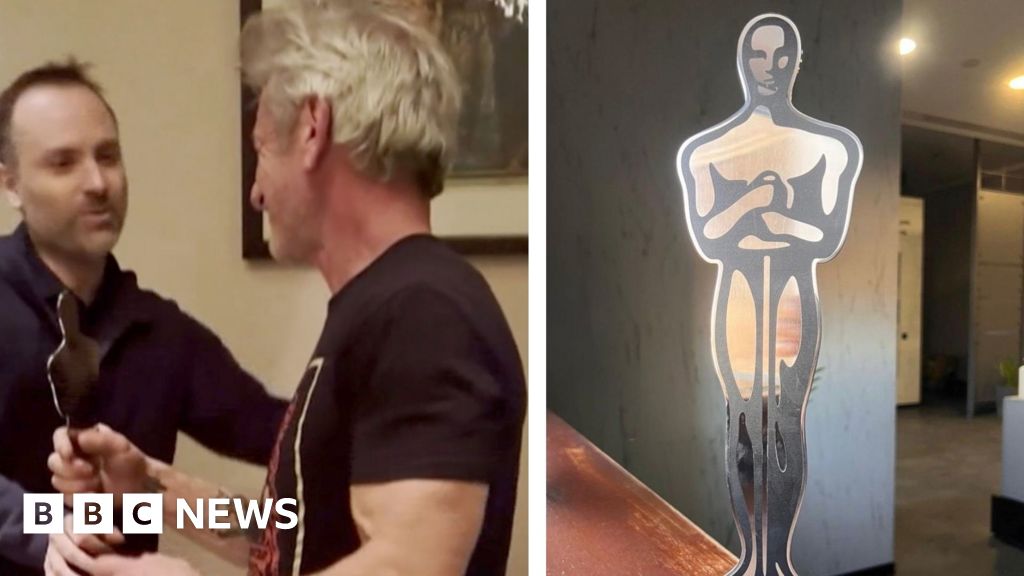
US actor Sean Penn has been gifted an Oscar-shaped award made from war-damaged rail metal by Ukraine, after he skipped Sunday’s ceremony to visit the war-torn country.
Penn, 65, won his third Academy Award for his supporting actor role in political thriller One Battle Another but was absent from the ceremony.
In a video posted by Oleksandr Pertsovskyi, the CEO of Ukrainian Railways, Pertsovskyi tells Penn: “You’re missing Oscars… So we made this one. This is from the railcar that was damaged by the Russians”.
A long-time advocate for Ukraine, Penn has visited several times since the Kremlin launched its full-scale invasion of the country four years ago.
And with 2026 being the route’s 100th birthday, this year is the perfect time to discover what is now a cultural icon.
Here, we reveal how to do it well, with a guide that steers you towards an authentic Route 66 experience.
We explain how the road acquired legendary status, the diner in Chicago you should have breakfast at before setting off and the dangers of over-reliance on Google Maps for the journey.
Advertisement
Route 66 isn’t a race, and in the following section, we break down how much time to allow for the journey.
From there, it’s the not-to-be-missed sights that help make the trip so wonderfully eccentric, and some of the best motels to book into for a “good old days” vibe.
The finish comes at Santa Monica Pier, where there are a handful of rituals to undertake to mark the end of a road trip of a lifetime.
The birth of a legend
Advertisement
Route 66’s legendary status is partly thanks to the great American novelist John Steinbeck describing it as the ‘Mother Road’ (Getty Images)
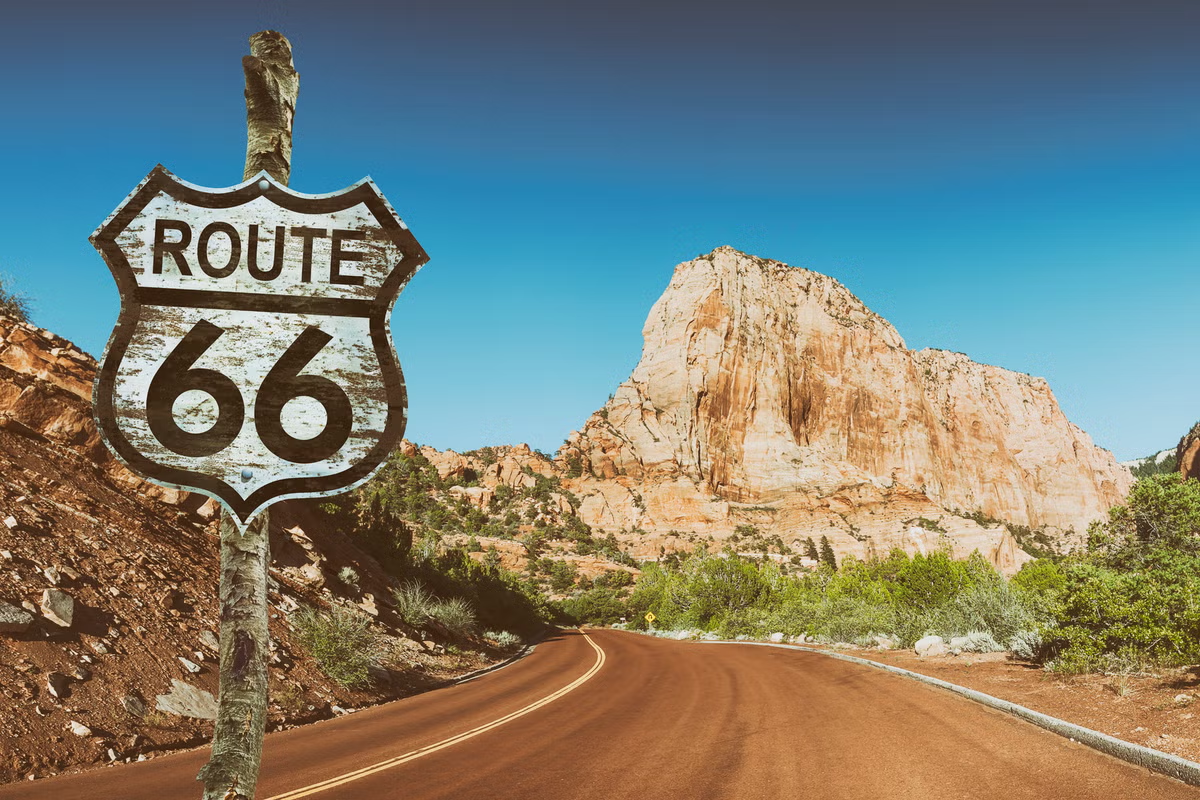
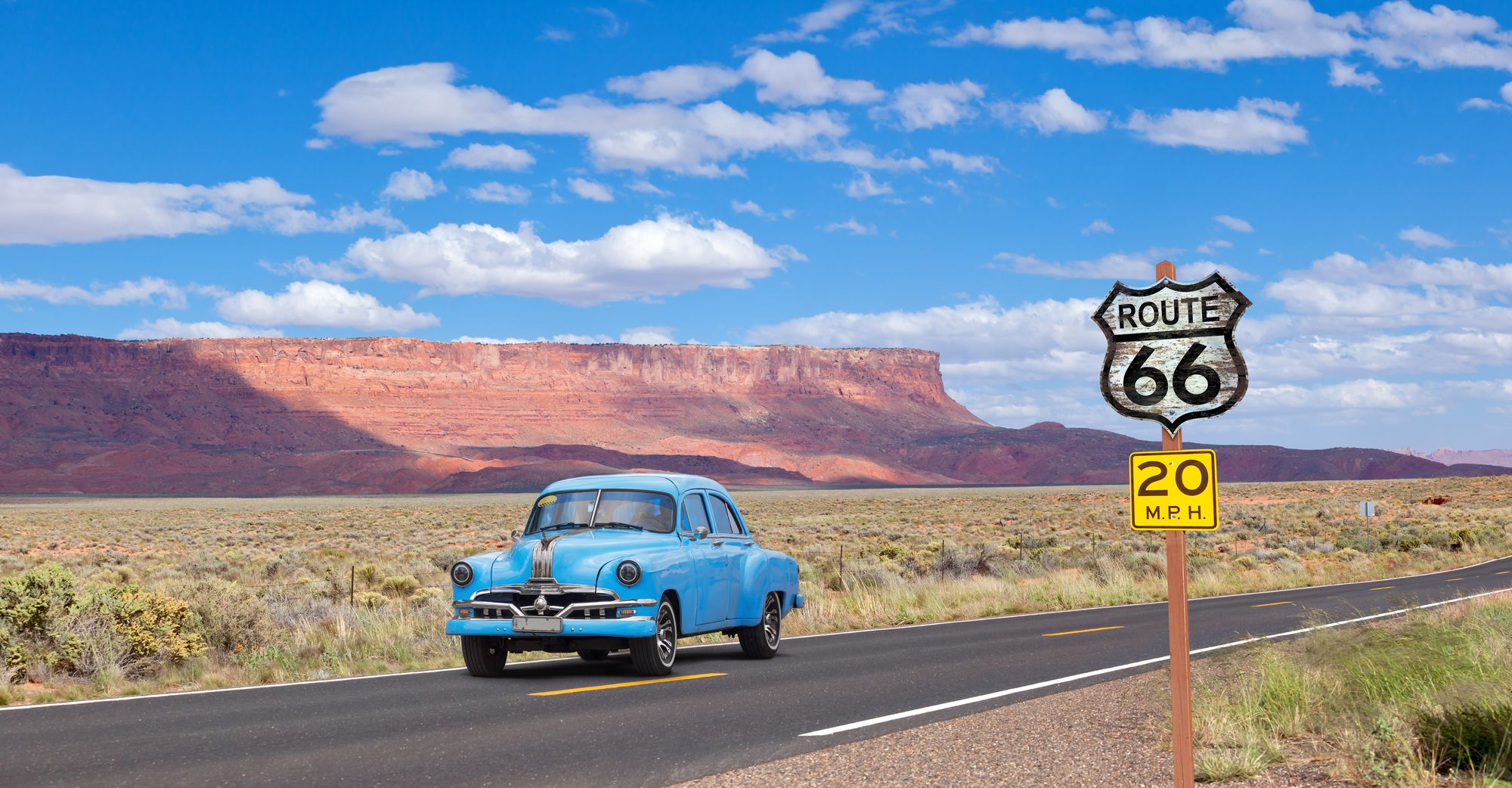
Route 66 was commissioned in 1926 and by the time it was finished and fully paved in the late 1930s, it stretched 2,448 miles across Illinois, Missouri, Kansas, Oklahoma, Texas, New Mexico, Arizona, and California, from Chicago to Santa Monica — and it quickly attained legendary status, despite not even being the first long-distance highway, or the busiest.
The route’s journey to cultural icon began with hundreds of thousands of farmers from Oklahoma, Texas, Arkansas and Missouri using it to reach California in search of work, a plight immortalized in the great John Steinbeck’s powerful 1939 novel The Grapes of Wrath, in which he dubs Route 66 the “Mother Road.”
When car ownership exploded after the Second World War, Americans discovered en masse that this road of opportunity was also a journey of adventure that took them through bewitching desert landscapes and past neon-lit motels and diners that would come to symbolize classic road trip culture.
Advertisement
By the time the road was decommissioned in 1985 and replaced by the Interstate Highway System, it was ingrained in popular culture, featuring in songs such as Bobby Troup’s (Get Your Kicks on) Route 66, recorded by artists from Nat King Cole to the Rolling Stones, and making appearances in countless road trip movies.
Ironically, its death made it even more famous, with preservation movements emerging to maintain and restore motels, diners and roadside attractions that were now bypassed — today Route 66 is a patchwork of historic sections.
For many, the Route 66 road trip begins in Chicago with breakfast at Lou Mitchell’s restaurant and bakery on W. Jackson Boulevard, located near the official start of the route on Adam Street, close to the Art Institute of Chicago (Getty Images)
Chicago is the traditional launchpad — it’s the historic gateway to the west, and you’ll mostly have the sun behind you — and the ceremonial starting point is amid the skyscrapers of the Windy City’s downtown district, on Adams Street, near the Art Institute of Chicago.
There, you’ll find a modest brown-and-white “Begin Route 66” sign. However, before you drive past it, tradition dictates that you head to nearby Lou Mitchell’s restaurant and bakery on W. Jackson Boulevard, which has been serving breakfast to westbound road-trippers since 1923.
The menu is classic diner fare, from coffee and pancakes to omelets and corned beef hash. And while you wait for a table, the serving staff hand out complimentary donut holes and Milk Duds.
Advertisement
Once you set off, you’ll find yourself in another world in little more than an hour.
Great place to stay:Silversmith Hotel Chicago Downtown is just a three minute walk from the Route 66 and features rooms with mini-refrigerators, coffee makers and wifi.
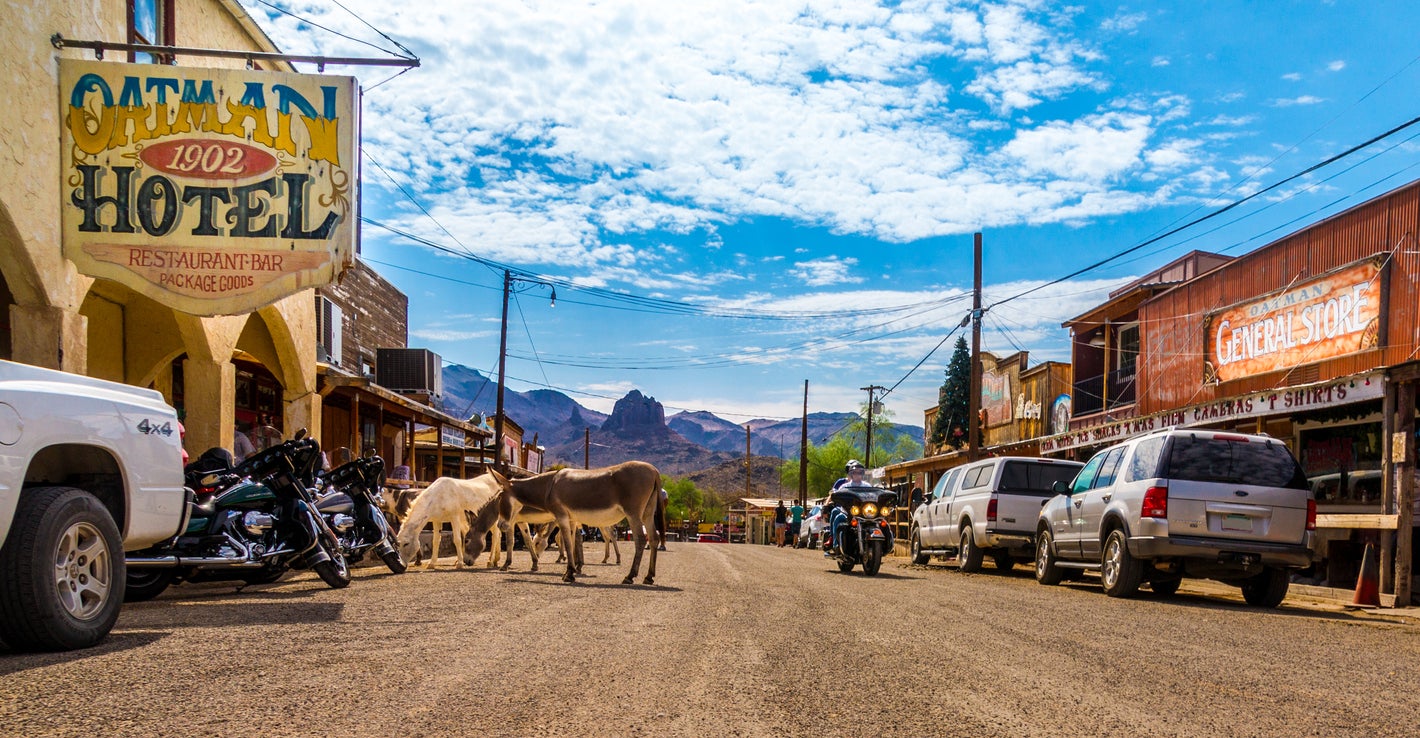
The original Route 66 passes through the former gold mining town of Oatman in Arizona. You’ll be led to fascinating spots like this by following the ‘Historic Route 66’ signs (Getty Images)
Navigation-wise, it would be tempting to type “Route 66” into Google Maps and take it from there.
But that would be a major mistake. It’s worth laboring the point that Route 66 is no longer one long continuous highway, but a mishmash of surviving segments jammed in among newer highways. Some original sections are quite long and scenic, others last for just a few miles before disappearing (and sometimes making a comeback a bit further along).
Ask Google Maps for the route and you’ll likely end up driving along interstates 40, 44 and 55, which replaced large sections of Route 66, and miss some of the most fascinating roadside attractions.
Advertisement
The key is to follow the “Historic Route 66” signs, which will lead you to some of the most compelling sights and scenery.
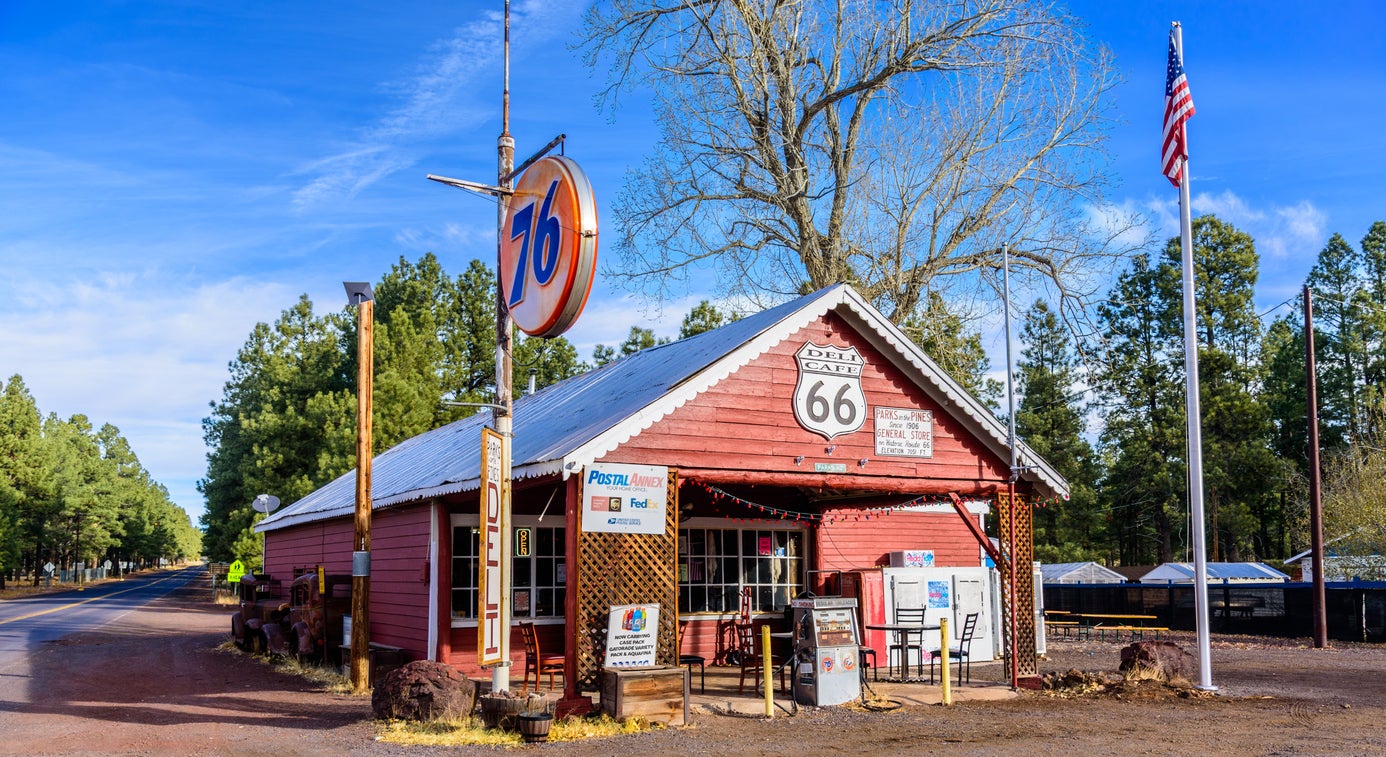
The Parks in the Pines General Store and Deli stands along a quiet stretch of Route 66 between Williams and Flagstaff, its vintage 76 sign and weathered red storefront preserving the classic character of mid-century roadside travel in Northern Arizona (Getty Images)
Ideal: 14 days
Today, Route 66 isn’t a means to an economic end — it’s the main attraction, and driving at your leisure will mean you can fully savor its delights. The Goldilocks time frame? Two weeks, or 150-200 miles a day, if you’re committed to the entire Route 66 Chicago-Santa Monica pilgrimage.
A longer journey means ample time to explore roadside attractions, enjoy vintage motels, and have an extra round of pancakes at a classic diner.
Fair: 10 days
Advertisement
Ten days is a relatively popular timeframe, meaning a pace of around 240 miles a day.
However, some sightseeing will need to be sacrificed. One strategy could be to pick up the pace in the eastern section, then slow down and zero in on the more dramatic scenery offered by New Mexico, Arizona and California in the west.
Doable, but rushed: Seven days
A seven-day trip would mean a slow-fast-slow approach, with sections of interstate used to link the most compelling sights. Stops would need to be picked fairly carefully in advance.
Advertisement
Avoid: Four days or less
Shrinking the journey time to four days or less would reduce the drive to a grueling interstate highway marathon. If simply reaching the finish line is the objective, then note that the drive time is about 40 hours.
Cadillac Ranch, created in 1974 by the art group Ant Farm, features 10 classic Cadillacs buried nose-first in the ground. It’s a Route 66 must-visit (cadillac ranch texas)
Route 66’s irresistibly eccentric roadside culture doesn’t take long to emerge after leaving Chicago.
Around 90 minutes away is the town of Wilmington, home to the Gemini Giant, a 30-foot fiberglass astronaut holding a rocket, a variation of the “Muffler Man” figures used to advertise roadside businesses across America.
In the small town of Dwight, around 75 miles from Chicago is the beautifully preserved house-and-canopy-style Ambler’s Texaco Gas Station, which dates back to the 1930s.
Advertisement
Cadillac Ranch, just west of Amarillo in Texas, is mandatory. Created in 1974 by the art group Ant Farm, it features 10 classic Cadillacs buried nose-first in the ground at the same angle as the Great Pyramid of Giza. They’re covered in graffiti, and visitors are encouraged to leave their own spray-painted mark.
In Oklahoma, there’s the cheerful Blue Whale of Catoosa, an 80-foot-long bright blue concrete cetacean with a winning smile; and in Arizona you can pull up in the ghost town of Oatman, where burros wander the streets and “gunmen” stage Wild West shootouts.
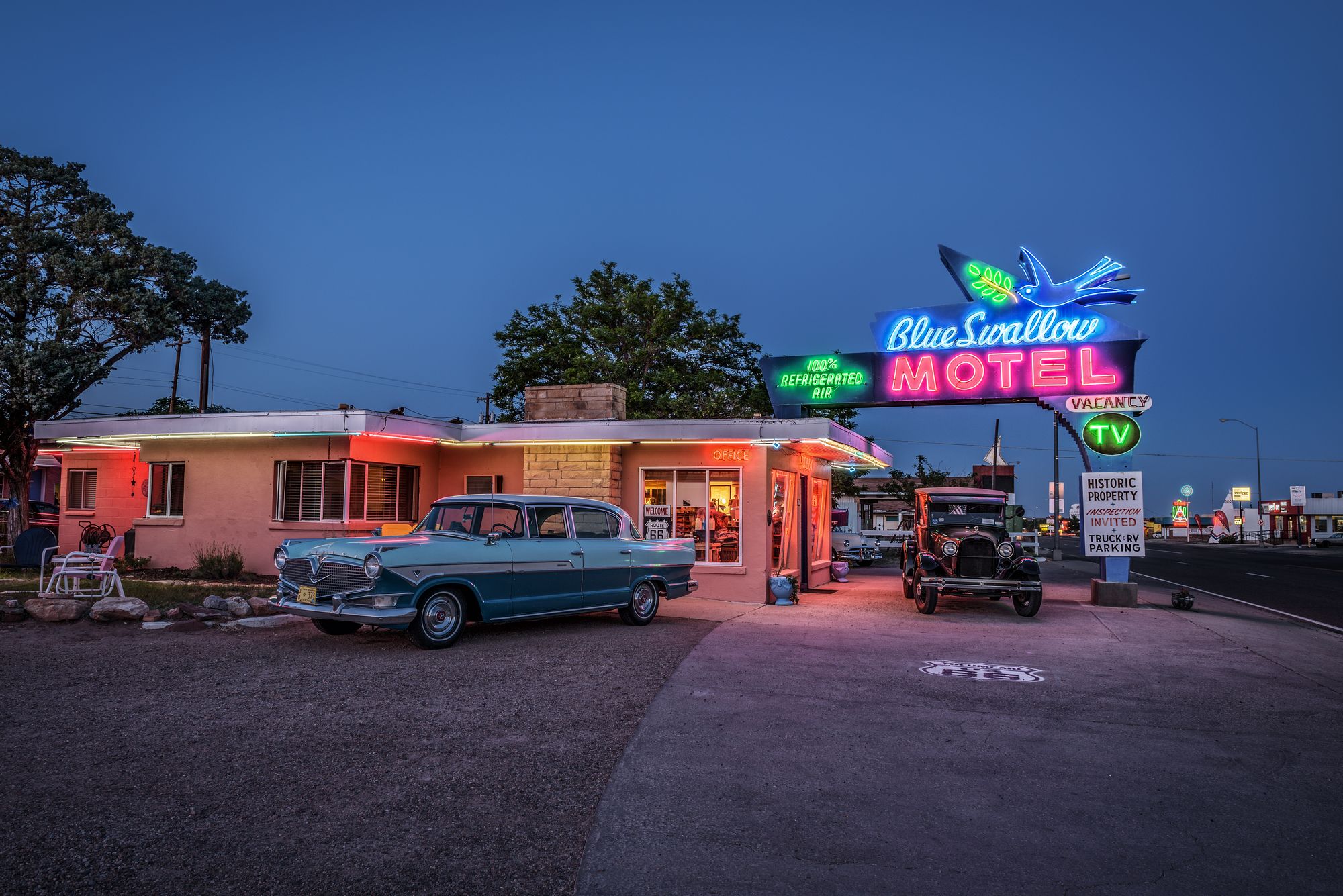
Blue Swallow Motel, Tucumcari, New Mexico still retains a 1940s atmosphere, including a neon sign advertising ‘100% refrigerated air’ (Getty Images)
Skip the chains and book into independent motels to be rewarded with a much more authentic Route 66 experience. Family run motels sprung up in huge numbers during the road trip boom of the 1940s and 1950s and there are still a few beautifully preserved examples you can stay in for a taste of the “good old days.” Here are three of the most celebrated options:
Blue Swallow Motel, Tucumcari, New Mexico
The Blue Swallow Motel has been giving Mother Road travelers a comfortable place to rest since 1939, and its yesteryear charms have been beautifully preserved: the neon sign advertising “100% refrigerated air” still glows above it and the rooms contain 1940s-era rotary dial phones and vintage lamps. Rooms from $120.
Advertisement
Wigwam Motel, Holbrook, Arizona
Guests have been staying in the Wigwam Motel’s distinctive concrete teepees since the 1950s — and while the 15 units include mod cons such as wifi and satellite TV, the original handmade hickory furniture has been retained. Rooms from $105.
Boots Court Motel, Carthage, Missouri
When Boots Court Motel opened in 1939, guests paid $2.50 to stay in one of eight rooms completed in the “streamline moderne” architectural style. Each room came with a carport and the property proudly advertised a “radio in every room.” Today, there are 13 renovated rooms for Route 66-ers to stay in and a visitors center housed in the former gas station. Rooms from $79.
At Santa Monica Pier there is a sign marking the end of Route 66 (Getty Images)
Eight states and nearly 2,500 miles of tarmac later, you’ll arrive at Santa Monica Pier where you’ll find a sign that simply says “End of the Trail.”
Advertisement
It’s not the most celebratory piece of signage, but the exuberant surroundings, from street performers to the pier’s amusement park, make the occasion a fittingly jubilant one.
A popular ritual among road trippers is to take a selfie at the sign, then walk to the end of the pier and look back, inland, at the land mass that’s been tamed, before a dip of the toes in the Pacific Ocean.
Great place to stay:The Shore Hotel (rooms from $235) is directly across the road from the pier and offers rooms with balconies overlooking the beach.
Good to know: Parking around the pier is congested, and while there is a parking deck beneath the pier, it’s recommended to leave your car at the hotel and walk to the finish line.
















































You must be logged in to post a comment Login