


Connect with us
DAPA Banner

NewsBeat

A new U.S. trade deal with Indonesia secures fossil fuels and access to critical minerals

Published

on

A new U.S. trade deal with Indonesia secures fossil fuels and access to critical minerals

A new trade pact between Indonesia and the United States has recast their economic ties, binding Jakarta’s resource wealth and energy future more closely to Washington’s strategic needs.

Indonesia agreed to widen access for U.S. investors in critical minerals, boost its purchases of U.S. crude and liquefied petroleum gas, back the development of an American coal export corridor and cooperate on small modular nuclear reactors.

In turn, the U.S. trimmed a threatened 32% tariff on Indonesian goods to 19% and granted broader access to the American market, including a zero-tariff entry policy for major products such as palm oil, coffee, cocoa, spices and rubber.

Though the U.S. Supreme Court’s ruling against President Donald Trump‘s tariffs may impact how it is implemented. The deal fits with longer term U.S. efforts to secure critical mineral supply chains, beef up its oil and gas exports and reduce dependence on China.

Advertisement

Meanwhile other export-reliant Southeast Asian economies negotiating with the United States, including Vietnam, are closely watching the Indonesia–U. S. trade deal for clues about the tariff levels and concessions Washington may demand across the region.

Indonesia, the world’s largest nickel producer, has vast mineral reserves needed for electric vehicles and clean energy systems. It’s caught between the conflicting aims of the U.S. and China, a key source of foreign investment and market for Indonesian coal and nickel, analysts say.

China is concentrating on electrification, renewables and dominance of battery supply chains, while the U.S. is pairing its push for mineral access with more fossil fuel exports.

Haryo Limanseto of Indonesia’s Coordinating Ministry for Economic Affairs, said the deal’s energy provisions “balance foreign trade and meet domestic energy needs.”

Advertisement

“The leadership of Indonesia is trying to tread a fine line between the West and China,” said Putra Adhiguna of the Jakarta-based Energy Shift Institute, adding that Chinese influence is “inescapable” since it is Indonesia’s largest trading partner.

US gains a new foothold to Indonesia’s minerals

Indonesia has pledged to promote U.S. investment across its mineral industry, from exploration and mining to refining, transport and export. In some cases, American investors will receive treatment “no less favorable” than domestic firms.

Restrictions on exports of critical minerals to the U.S. will be relaxed to expedite development of Indonesia’s rare earths and critical minerals sector with U.S. partners, promising “greater certainty” for companies involved in extraction to help boost production, the agreement says.

Advertisement

Major policy shifts have altered Indonesia’s mining sector in the past six months and the trade deal’s new restrictions on existing foreign-owned entities in Indonesia will curb excess output from processing plants. Foreign businesses must follow the same tax, environmental, labor and quota rules as other companies.

Indonesia’s critical mineral processing sector is currently dominated by China, which has firms operating or financing multiple nickel smelters and industrial parks.

“Indonesia is absolutely central to this competition because it combines resource endowment with political ambition,” said Kevin Zongzhe Li, with the Center for China Analysis within the Asia Society Policy Institute, a New York-based think tank.

Competition over critical minerals is heating up and the agreement “opens the door for U.S. firms to have a real shot” at “modestly leveling a sector where Chinese industries established first mover advantage,” he said.

Advertisement

Indonesia to purchase more US energy

Indonesia has agreed to cut red tape so that its companies can more easily purchase U.S. energy products.

It plans to buy $15 billion worth of American energy commodities over an unspecified period, mainly fossil fuels such as liquefied petroleum gas, crude oil and gasoline.

Trump’s efforts to persuade Asian countries to buy more American LNG has gained momentum during trade talks, with energy purchases emerging as a way to narrow trade gaps. It’s unclear if the turmoil in oil trading due to the war with Iran might impact that effort.

Advertisement

Indonesia, one of the world’s top coal exporters, will also invest in developing an export corridor from the U.S. West Coast to help make American coal more competitive in global markets, the agreement says.

Indonesia also pledged to work with the U.S. and Japan to deploy small modular nuclear reactors, starting with a potential project in West Kalimantan.

Shift in energy transition policies

The deal reflects changed U.S. energy priorities under the Trump administration, away from cooperation on reducing Indonesia’s climate change -causing emissions.

Advertisement

In 2022, Indonesia joined the Just Energy Transition Partnership, a multi-billion deal where the U.S. and other wealthy nations pledged support for reducing coal use and expanding clean energy. The program was faltering even before Trump withdrew from it last year.

Despite the U.S. withdrawal, Indonesian officials said the $21.4 billion partnership will continue. As of January, at least $3.4 billion, around 15%, of the funds had been received, according to Airlangga Hartarto, Indonesia’s minister for economic affairs.

Adhiguna said the deal’s biggest impact may be political, with Jakarta emulating the U.S. emphasis on fossil fuel use.

“There is the risk that the political leadership of Indonesia is going to fall back into that hole,” Adhiguna said.

Advertisement

That will mean still slower progress in areas like solar energy.

Over the past five years, tropical, sunny Indonesia has installed less than 1 gigawatt of solar energy — compared with roughly 2 GW in Vietnam and nearly 60 GW in India. The International Energy Agency found that fossil fuels, like coal, oil and natural gas, made up nearly 78% of Indonesia’s energy mix in 2023.

Indonesia should prioritize building 100 GW of solar and storage capacity and expand interconnection grids to enable renewable energy sharing, said Dinita Setyawati, with the United Kingdom-registered energy think tank Ember.

Tariff strike down creates confusion

Advertisement

The deal’s future has been clouded by the U.S. Supreme Court’s recent ruling against Trump’s sweeping global tariffs, just after the agreement was reached — casting doubt on the durability of his trade strategy. The agreement requires ratification by Indonesia’s parliament before it can take effect.

That adds another “layer of uncertainty,” said Meha Sitepu, with the Washington-based strategic advisory firm The Asia Group.

Some provisions of the agreement are drawing criticism, including those that are seen as diluting Indonesia’s halal certification requirements in the mostly Muslim country of nearly 288 million, Southeast Asia’s most populous nation.

“Parliamentary approval could be an uphill battle and added uncertainty from the U.S. side may complicate things further,” Sitepu said.

Advertisement

___

Delgado reported from Bangkok, Thailand. Associated Press writer Edna Tarigan in Jakarta contributed to this report.

___

The Associated Press’ climate and environmental coverage receives financial support from multiple private foundations. The AP is solely responsible for all content. Find AP’s standards for working with philanthropies, a list of supporters and funded coverage areas at AP.org.

Advertisement

Source link

Continue Reading
Click to comment

You must be logged in to post a comment Login

Leave a Reply

NewsBeat

Meningitis latest LIVE: ‘Explosive’ deadly outbreak cases rise to 20 as health chiefs investigate baby infection

Published

on

Meningitis latest LIVE: 'Explosive' deadly outbreak cases rise to 20 as health chiefs investigate baby infection

With the outbreak, and efforts to contain it affecting many students, Cabinet Office minister Nick Thomas-Symonds told Sky News: “It can be a bit similar sometimes to a hangover so I really urge people who have those concerns and symptoms to be checking on gov.uk website and of course go and get help.”

Source link

Continue Reading

NewsBeat

‘I tried Charlotte Tilbury’s 20% off face mist and it gave me glass skin in one hour’

Published

on

Daily Mirror

Beauty writer Eve Rowlands recently tried Charlotte Tilbury’s new Magic Hydrator Mist face spray. Here’s her honest review

Advertisement

I love a good face mist. My beauty arsenal has, over the years, included a range of brands from the Kendall Jenner-loved Caudalie Beauty Elixir (£28.80), to The INKEY List Hydro-Surge Dewy Face Mist (£8.80) and Avène Thermal Spring Water Spray for Sensitive Skin (£10).

A staple for revitalising my complexion at the start, throughout and at the end of the day, it also helps firm up my skin whilst illuminating and creating that dewy finish. So when I discovered Charlotte Tilbury was launching its own Magic Hydrator Mist, I was excited to try it out and see if it matches the brand’s reputation.

Typically priced at £35, the face mist – which currently has 20% off in the brand’s sale for £28 is billed by Charlotte Tilbury as an ‘oxygenating, hydrating face mist with hyaluronic acid, niacinamide and pollution defence for an instant dewy glow on-the-go’. It promises to diminish signs of ‘digital fatigue’ by 88% – which is great for those of us who work for hours on computers for our job.

READ MORE:

Advertisement

Reportedly influenced by the ‘power of an Oxygen Facial’ – a moisturising skincare treatment that employs pressurised oxygen to administer serums – the mist is loaded with skincare favourites like hyaluronic acid, hyaluronic mesh technology alongside glycerin and niacinamide to, allegedly, boost skin’s hydration in as little as an hour.

Alongside these hero ingredients often spotted in hydrating moisturisers and serums, the mist includes the unique Kombu extract. This extract supposedly diminishes the visible signs of tiredness (ie, lacklustre skin, puffiness) and helps its users maintain a radiant complexion all day long, reports OK!.

Charlotte Tilbury’s Magic Hydrator Mist

 Charlotte Tilbury's Magic Hydrator Mist

£35

£28 with 20% off

Advertisement

Charlotte Tilbury

Buy Now on Charlotte Tilbury

The Magic Hydrator Mist from Charlotte Tilbury launched on Thursday, March 5, and claims to deliver an ‘instant dewy glow on-the-go’.

Designed to be applied as the opening step in any skincare regime – following cleansing, naturally – the mist can also be spritzed at any point during the day to deliver skin a surge of hydration. It can even be utilised for a cooling and soothing sensation after exercise

My review on Charlotte Tilbury’s Magic Hydrator Mist

As directed, I applied this Magic Hydrator Mist following cleansing in the morning. After using my face wash (my current cleansing obsession is the Superfacialist Vitamin C+ Skin Renew Cleansing Oil alongside its Vitamin C+ Brighten Gentle Daily Micro Polish Wash) and gently patting dry, I applied several generous glides of the mist across my face, doing my utmost to ‘avoid the eyes’ – though this proved challenging.

Advertisement

The formula immediately calmed my complexion with its refreshing sensation and I practically straight away noticed a firming effect. Whilst it didn’t appear ‘dewy’ right off the bat – looking more damp as it dried – within an hour or thereabouts, my skin did have a lovely radiance.

Giving it time to sink in, I later applied my serums and moisturisers and this added to its luminousity – noticeably more so than usual. A friend of mine even remarked I’d achieved that desirable ‘glass skin’ look – which I’ll gladly accept.

As the day went on, I reapplied the mist in the afternoon to revitalise my complexion during the post-lunch slump and it certainly enhanced my skin’s glow and vitality.

Advertisement

While most of the mist’s properties had me impressed, one aspect that fell short of my hopes was brightening my eye area with the mist by itself. Several restless nights had created more pronounced shadows beneath them and I’d hoped the mist might address this but, sadly, I likely need a miracle eye cream to combat those.

I also found that the spray dispenser didn’t quite cover as wide a surface area as I’d expected. This meant I required several pumps to coat the entire base.

It’s important to note that the mist isn’t unscented – in fact it has a lovely fragrance. It boasts a bright, fresh, delicately floral aroma, courtesy of its ‘White Tea of Bali’ ingredient, which dissipates after a brief moment on the skin but leaves the bathroom smelling divine.

Advertisement

One additional feature I’d have preferred is a more see-through bottle. Whilst the weight serves as a reasonable guide to how much remains, it would be far more practical to gauge the exact level of liquid inside.

That said, I am thoroughly enjoying the revitalising sensation it provides, not to mention the luminous radiance it gives my complexion when I’d rather skip the makeup. I’m also keen to observe its effect on the fine lines I’m noticing around the corners of my eyes, particularly given its claim to be a ‘radiant skin rescue essence for smoother, younger looking skin’.

Pros:

  • Has an instantly firming sensation
  • Cooling and refreshing
  • Visibly leaves a dewy glow to my skin after an hour
  • Smells lovely
  • Instantly brightens my complexion

Cons:

  • Spray nozzle isn’t continuous and requires a few spritzes to get full coverage
  • The bottle isn’t transparent, meaning there is no telling how much is left in the bottle

Shop the Charlotte Tilbury Magic Hydrator Mist here.

Source link

Advertisement
Continue Reading

NewsBeat

Man targeted homes in 15 Cambridgeshire villages in major burglary spree

Published

on

Cambridgeshire Live

Smith stole thousands of pounds’ worth of items, including gardening tools, machinery, and fishing equipment

A man has been jailed for more than four years after a nine-month long burglary spree across Cambridgeshire. Jj Smith, 21, of Green Lane, Northstowe, targeted homes in Haddenham, Ickleton, Stretham, Isleham, Brinkley, Longstanton, Over, Castle Camps, Weston Colville, Fowlmere, Cottenham, Histon, and Sturmer in Essex.

Advertisement

The incidents took place from May through to December. Smith stole thousands of pounds’ worth of garden tools, machinery, fishing equipment, and a Seat Ateca.

He also tried to break into homes in Soham, Brinkley, and Histon. Smith pleaded guilty to 10 counts of burglary, four attempted burglaries with intent to steal, theft of a motor vehicle, three counts of theft, theft from a shop, two counts of dangerous driving, driving without insurance, making off without making payment, and driving without insurance.

On Thursday, March 12, at Cambridge Crown Court, Smith was sentenced to four years and eight months in prison. He was also disqualified from driving for four years and a month.

Detective Constable Lee Steeden, who investigated, said: “Smith caused significant distress to residents across the county. His offending gravitated in seriousness from thefts to dwelling burglaries, stealing cars and actively making off from police.

Advertisement

“Thanks to the persistence of our officers and information from the public, Smith was arrested. We hope this result provides reassurance that we will take robust action against those who choose to steal from our communities.”

To get more news and top stories delivered directly to your phone, join our new WhatsApp community. Click this link to receive your daily dose of CambridgeshireLive content.

We also treat our community members to special offers, promotions, and adverts from us and our partners. If you don’t like our community, you can check out any time you like. If you’re curious, you can read our Privacy Notice.

Source link

Advertisement
Continue Reading

NewsBeat

Route revealed for 2026 Phoenix Energy Belfast City Marathon

Published

on

Belfast Live

You can start planning your day now

Belfast Marathon 26 Route

Belfast City Marathon organisers have officially revealed the route for the 2026 Phoenix Energy Belfast City Marathon & Team Relay, taking place on Sunday, May 3 2026.

Thousands of runners and relay teams from across Northern Ireland and beyond will take part in one of the city’s biggest annual sporting events, which will once again begin at the iconic Stormont Estate and finish in Ormeau Park.

The 2026 course largely follows the successful 2025 route, guiding participants through many of Belfast’s most recognisable streets and landmarks, with minor adjustments in North and South Belfast.

Participants in both the full marathon and the popular Team Relay will enjoy a scenic city-wide course with thousands of spectators expected to line the streets in support.

Advertisement

The relay changeover points will be situated at Montgomery Road, Boucher Road, Falls Road and Duncairn Gardens. These locations allow relay teams of two to five runners to each complete a section of the marathon distance before passing the baton to the next teammate.

Event organisers encourage participants and spectators to review the route details ahead of race day, particularly those travelling or living along the course, as temporary road closures will be in place to facilitate the event.

Advertisement

Further route information and event updates can be found on the Belfast City Marathon Social Media accounts and website.

With excitement building ahead of race day, organisers are looking forward to welcoming thousands of runners, relay teams, volunteers and supporters for another unforgettable race day experience in the city.

The Phoenix Energy Belfast City Marathon is sponsored by Phoenix Energy, Translink, Kukri Sports, Belfast Live, Daily Mirror, Q Radio, Better, Runna, Marathon Photos Live, iTAB, Deep RiverRock, Charles Hurst, Mac in a Sac, Steigen, Applied Nutrition, Linwoods Health Foods and Belfast City Council. The Official Charity Platform is Give2You.

For all the latest news, visit the Belfast Live homepage here and sign up to our daily newsletter here.

Advertisement

Source link

Continue Reading

NewsBeat

Northern England schools join climate change initiative

Published

on

Northern England schools join climate change initiative

The initiative is part of the Future Citizen 2026 programme, running from March 16 to 22, and aims to raise awareness of fast fashion and promote environmentally-friendly alternatives.

More than 25 schools and colleges in England, Wales, Scotland, and Northern Ireland are taking part in the campaign, which focuses on how fashion choices impact the planet.

Amelia Twine, founder of A Single Thread CIC, the organisation delivering the programme, said: “When schools and colleges embed sustainable fashion skills into the curriculum or extra-curricular culture, they equip young people with practical ways to take climate action in their everyday lives.”

Advertisement

The campaign highlights the UK’s high rate of clothing consumption—an average of 28 new items per person each year—and the estimated 300,000 tonnes of clothing thrown away in household bins annually.

In North Yorkshire, Stokesley School and Sixth Form is taking part by organising a fashion show on March 19 to launch a preloved boutique on campus.

The boutique, supported by the local community, will offer students formalwear for events such as proms, parties, and interviews, while also promoting sustainable fashion.

Further north, Bishop Auckland College in County Durham is hosting a mending circle to encourage sustainability and clothes repair.

Advertisement

The session will promote the “make do and mend” philosophy, teaching students practical sewing and garment repair skills.

In Leeds, the Circular Fashion Incubator CIC is organising the International Circular Fashion Week Conference on March 16 and 17 at the Rose Bowl.

The event will feature talks, demonstrations, and student-led workshops on embroidery, garment embellishment, and repair techniques.

Young people in the Wirral will also have the chance to get involved.

Advertisement

Jane Gorden of Crafters and Makers is running a sewing machine workshop for children aged eight and above, alongside an after-school club focused on patching and visible mending.

Future Citizen’s 2026 theme is “Resilience in Style: Redefining Fashion,” which encourages young people to re-imagine fashion through creativity, community, and conscious decision-making rather than fast consumption.

Source link

Advertisement
Continue Reading

NewsBeat

Why some people still believe that aliens shaped ancient civilisations

Published

on

Why some people still believe that aliens shaped ancient civilisations

Could ancient humans really have built the pyramids without extraterrestrial help? Or do such questions reveal more about modern anxieties than the past itself?

The idea that aliens assisted the builders of ancient monuments was promoted by the Swiss author Erich von Däniken in his bestselling book Chariot of the Gods – published in 1968. Von Däniken died in January 2026, but his vision of ancient astronauts still captivates millions.

The author had pointed to ancient structures such as the pyramids, along with enigmatic ancient artefacts, as supposed evidence that beings from beyond Earth shaped the civilisations of the past.

Though these ideas have been repeatedly debunked, television shows such as the History Channel’s Ancient Aliens continue to air similar narratives.

Advertisement

Erich von Däniken’s theories emerged at a distinct historical moment. They crystallised during the cold war, amid fears of nuclear annihilation, the space race and rapid technological change.

As humans prepared to leave Earth, while simultaneously confronting their own destructive power, the idea of ancient astronauts offered both cosmic reassurance and existential drama. The past became a stage for modern hopes and anxieties.

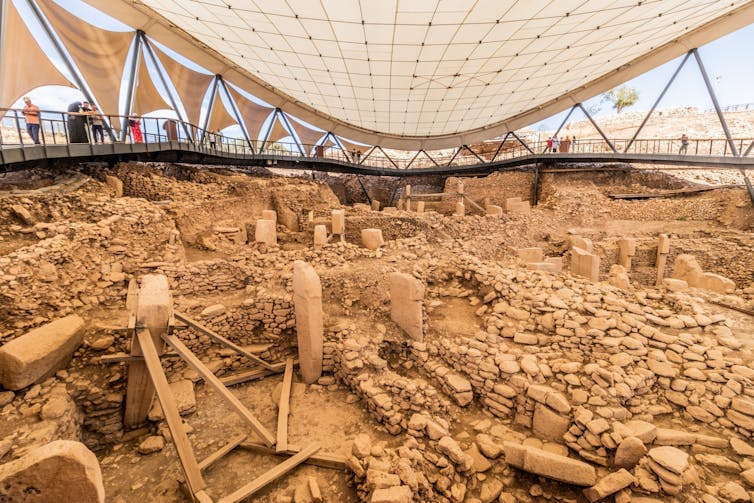
The reason some people feel able to believe in completely unfounded theories relates to the nature of archaeology itself. The discipline works with fragmentary evidence, layered deposits, and interpretations that rarely yield simple conclusions. Sites such as Giza in Egypt, Göbekli Tepe (a Neolithic settlement in modern Turkey known for its monumental pillars decorated with sculptural reliefs), and Troy – also in Turkey – are not unsolved enigmas but the result of decades of systematic excavation and analysis.

At Giza, archaeologists have uncovered planned worker settlements, bakeries and organised food supply systems, demonstrating how thousands of labourers could construct the pyramids over decades.

Advertisement

Göbekli Tepe shows that its monumental stone pillars were erected by hunter-gatherer communities millennia before the invention of writing – not through alien intervention, but through coordinated labour and ritual innovation. At Troy, successive settlement layers reveal centuries of rebuilding, adaptation and regional exchange rather than a sudden technological anomaly.

Archaeological conclusions are cautious, probabilistic and grounded in material evidence. To outsiders, however, caution can resemble hesitation. Pseudoscience fills that perceived gap with spectacle: aliens built the pyramids; mysterious forces raised Göbekli Tepe; forgotten super-technologies shaped Troy’s walls. Stripped of context, evidence becomes entertainment. Complexity is flattened into insinuation.

A typical “ancient aliens” argument illustrates the pattern: the pyramids are extraordinarily precise. Precision, the claim goes, requires advanced technology; therefore, humans without modern machines could not have built them.

The reasoning sounds logical – but it rests on a false dilemma. What disappears from view is precisely what archaeology studies: logistics, labour
organisation, tool assemblages, accumulated craft knowledge – and small imperfections that reveal human hands at work.

Advertisement
Erich von Däniken’s ideas tapped into cold war fears of nuclear annihilation and rapid technological change.
CTK Photo/Radek Petrasek

The lure of the extraordinary

Such explanations satisfy a deep psychological impulse. Where once religion explained purpose, science explains process. The “ancient astronauts” hypothesis exploits proportionality bias – the intuition that extraordinary achievements must have extraordinary causes.

Just as medieval legends framed the pyramids as protection against cosmic catastrophe, modern narratives cast humanity as part of a grand design guided by superior beings. Archaeological sites become props in a cosmic drama.

Humans cease to be creators; the past becomes extraordinary because it was “helped”. The appeal is not confined to fringe audiences. Surveys suggest that many people consider extraterrestrial life possible or even likely.

Many scientists agree that, given the vast scale of the universe, such life is statistically plausible. But plausibility is not proof – and it is certainly not evidence for alien intervention in antiquity.

Advertisement

Distrust amplifies the effect. Universities, museums and academic journals are often portrayed as gatekeepers suppressing inconvenient truths. Scientific refutation becomes evidence of conspiracy.

Academic prose – careful, qualified and precise – struggles to compete with dramatic certainty. Questions such as: “How could humans have built this without modern technology?” already contain the insinuation.

Digital media turbocharge the pattern: visually striking claims circulate faster than methodological explanations. Archaeology emphasises gradual change and cumulative knowledge; pseudoscience promises revelation.

Pseudoscientific archaeology is not just a set of beliefs – it is a lucrative industry. Books on ancient astronauts sell millions of copies worldwide. Television franchises generate steady revenue, and leading figures attract audiences in the hundreds of thousands online.

Advertisement
Gobekli Tepe
Göbekli Tepe is the work of coordinated human labour, not of extra-terrestrials.
Matyas Rehak

By contrast, scholarly work circulates in a radically different economy: monographs are printed in small runs and generate little profit. This is not only a battle of ideas but a battle for attention: spectacle is rewarded more visibly than caution.


Von Däniken’s rhetorical genius lay in ambiguity. He rarely made definitive claims, preferring suggestive questions and selective juxtapositions that turned uncertainty into insinuation.

As he once remarked: “Chariots of the Gods was full of speculation – I had 238 question marks. Nobody read the question marks. They said: Mr von Däniken is saying … I did not say – I asked.” The strategy is disarmingly simple: frame speculation as inquiry and criticism as misunderstanding.

Reclaiming the story

The popularity of pseudoscience is not simply ignorance. It reflects the difficulty of interpreting fragmentary evidence, a hunger for meaning, declining institutional trust and the dynamics of digital amplification.

Yet dismissal alone is not enough. Archaeology does more than recover artefacts; it constructs narratives about how humans organised labour, shared beliefs and transformed landscapes. Those narratives are shaped by contemporary questions — and acknowledging this strengthens rather than weakens the discipline.

Advertisement

Debunking alien claims matters. But so does telling richer, more compelling stories about how humans shaped their own past. Archaeology shows that uncertainty is intellectual honesty, that incremental knowledge is cumulative achievement, and that context deepens wonder rather than diminishes it.

Monuments, cities, and human creativity are achievements of our own making, not traces of lost cosmic visitors. Through cooperation, experimentation and resilience, humans created the extraordinary – without any extraterrestrial assistance.

Through rigorous scholarship and compelling storytelling, archaeology shows that the extraordinary was never alien. It was always human.

Advertisement

Source link

Continue Reading

NewsBeat

Marcus Rashford can move one step closer to dream after Man Utd reunion

Published

on

Manchester Evening News

Marcus Rashford has already reached double figures for goals and assists during his Barcelona loan spell

When Barcelona face Newcastle United on Wednesday evening, the match will represent another chance for Marcus Rashford to compete against one of his former Manchester United colleagues. Rashford, who is currently on loan, won’t be playing against his parent club this season due to United’s failure to qualify for Europe but does have ex-team-mate Anthony Elanga standing between him and a run at Champions League glory.

Advertisement

Elanga, who joined United’s academy as a teenager, came on as a substitute for Rashford when he made his senior debut under Ole Gunnar Solskjaer. He played 55 times for the club before moving to Nottingham Forest in 2023 and then transferring to Newcastle for £55 million last summer.

Both Rashford and Elanga were in the starting line-up when Barcelona defeated Newcastle in the first match week of this season’s Champions League, with the former netting twice in a 2-1 victory. However, they were denied a second reunion in the first leg of the knockout tie between the teams, as Elanga started for Newcastle but was substituted before Rashford came off the Barca bench.

Get MEN Premium now for just £1 HERE – or get involved in our United WhatsApp group by clicking HERE. You can also join our United Facebook page by clicking HERE and don’t miss out on our brilliant selection of newsletters HERE.

The round of 16 clash is finely balanced after Lamine Yamal’s late equaliser denied Newcastle, who thought they had claimed victory through Harvey Barnes. While the Manchester United reunion provides an interesting side story, the second leg will also give Rashford a chance to move closer to realising his dream of a first Champions League title to add to the Europa League he won in 2017.

Advertisement

“I’m learning a lot, it’s a new style of football,” the England international told TNT Sports after his brace in September. “But it’s making me a better player. Honestly, it’s an amazing experience. I’ve always been a huge admirer of Barcelona, every player my age has watched them play, it’s amazing football.”

He also had kind words for Barcelona boss Hansi Flick, saying of the German: “He’s very important. I feel the confidence he’s given me. I knew he was a top manager before I arrived here, but to work with him is a pleasure. I hope the good relationship will continue for the rest of the season.

“For sure, everybody dreams of winning the Champions League. Now I’m at Barcelona, the dream is with Barcelona. I hope we can win the tournament, there’s some very good confidence. Hopefully we can go game by game and keep improving as a team.”

Advertisement

Rashford finished the league phase as Barcelona’s joint-leading scorer in Europe, equalling Fermin Lopez’s tally of five goals. He has reached double figures for goals and assists across all competitions, with a permanent switch to Camp Nou at the season’s conclusion looking likely.

Flick’s side picked up 16 points from their eight league phase fixtures, losing against Paris Saint-Germain and Chelsea but securing a top-eight berth when they fought back to defeat FC Copenhagen on the final matchday. They found the net 22 times throughout their eight matches, with only league leaders Arsenal managing more.

Barcelona clinched the Champions League title four times in a decade from 2005 to 2015, but the subsequent ten years have proved less successful. Their best result in the competition since that 2015 is a run to the semi-finals, something they achieved in 2019 and 2025.

Advertisement

Sky Sports discounted Premier League and EFL package

This article contains affiliate links, we will receive a commission on any sales we generate from it. Learn more
Content Image

£49

£35

Sky

Get Sky Sports here

Sky has slashed the price of its Essential TV and Sky Sports bundle for the 2025/26 season, saving £336 and offering more than 1,400 live matches across the Premier League, EFL and more.

Advertisement

Sky shows at least 215 live Premier League games each season, an increase of up to 100, plus Formula 1, darts, golf and more.

Source link

Continue Reading

NewsBeat

Plans for 80 homes with affordable housing to be built in Cambridgeshire town

Published

on

Cambridgeshire Live

There could be a mix of one to five bedded homes

Plans have been submitted for 80 new homes, including affordable housing, in a Cambridgeshire town. Taylor Wimpey proposes to build the homes on land off Brook Street in Soham.

Advertisement

The houses are proposed to have between one and five bedrooms. Of the 80 homes, there could be 16 ‘affordable’ homes and four self-build plots, giving “residents the opportunity to shape their own homes”, the developers said.

The range of homes will include maisonettes, houses and bungalows. Taylor Wimpey said this “ensures broad appeal to different household sizes and supports a sustainable community structure”.

The developers added that sustainability is at the “heart of the scheme”, with homes designed to be energy efficient. They said: “The proposed scheme will deliver a well‑structured and landscape‑led development, incorporating public open spaces, a new play area, and strong pedestrian connections to The Commons and existing walking routes.

“Carefully arranged streets, varied housing types and integrated green ecological corridors create a cohesive layout that enhances accessibility, supports active travel and provides an attractive, high‑quality environment for new residents.”

Advertisement

The site will also include spaces and ecological features including bat boxes, bird boxes, and habitats for wildlife. Taylor Wimpey is seeking local views before it submits a reserved matters application to East Cambridgeshire District Council.

Anyone who would like to express their views can email brookstreet-soham@taylorwimpey-pr.co.uk. People can submit their comments up to midnight on March 30.

Source link

Advertisement
Continue Reading

NewsBeat

Rivington Brewing taps gold at CAMRA real ale awards

Published

on

Rivington Brewing taps gold at CAMRA real ale awards

The Rivington Brewing Company has been honoured with a Gold Award from CAMRA – the Campaign for Real Ale – in its Champion Beer of Britain Awards, for which Rivington Brewery has won the Northwest heat.

The award was for its Beach House Ale – a hoppy pale ale with notes of citrus, fruit, and lime – at the recent Liverpool Beer Festival.

Chris Sandison CAMRA’s Northwest Regional Tasting Panel Coordinator said: “Congratulations to the team at Rivington Brewery who gained Gold with their Beach House Pale, a fantastic achievement when you consider that they were up against breweries from across the whole of the North West.”

Rivington Brewing Company’s headquarters (Image: Rivington Brewing Company)

Now that it has won the North West heat, Beach House will be entered into the finals of 2027’s Champion Beer of Britain competition to find the best real ale in the country.

Advertisement

The beer will compete against the winners the other regional competitions at the awards.

Beach house clocks in at only 3.8 per cent, making it uncharacteristically light for a craft ale, marking it out as a session IPA.

The Rivington Brewing Company was founded in 2014 by two friends – Ben Stubbs and Mike Richardson.

The duo started on a small plastic brewing kit that Mike received as a wedding present, with no prior experience other than reading ‘How to Brew’ by John Palmer.

Advertisement

The logo for the (now award-winning) Beach House IPA (Image: Rivington Brewing Company)

The team opened their own taproom and bar on a Rivington farm – Home Farm – in 2019.

The farm and attendant campsite overlook Rivington reservoir, framed by views of Rivington Pike.

As well as beer and street food, the team have introduced various extracurricular events into their community.

This includes a monthly walking club, cycling club, and a running club that regularly hosts 70 people.

Advertisement

Source link

Continue Reading

NewsBeat

Wales boss Craig Bellamy believes Northern Ireland have every chance of beating Italy

Published

on

Belfast Live

The Wales boss was dismissing the idea that if his side beats Bosnia in their World Cup play-off semi-final that will be playing Italy

Craig Bellamy believes Northern Ireland have a fair chance of beating Italy in Bergamo to stay on course to reach the finals for their first time in 40 years.

Advertisement

The Wales boss was dismissing the idea that if his side beats Bosnia in next Thursday’s World Cup play-off semi-final in Cardiff it is a no-brainer that they will meet Italy in the final 2026 World Cup qualifier.

Should Michael O’Neill’s side beat Italy and Wales beat Bosnia, it will mean a trip to the Cardiff City Stadium on 31 March.

“All I keep hearing from everyone is that if we beat Bosnia we’ll be playing Italy. You wait until you see Northern Ireland,” said Bellamy at the Wales squad announcement.

“This team do not play with the ball, they don’t want the ball, so Italy having the ball is not a problem to them.

Advertisement

“When you haven’t qualified for two major tournaments as a top team like they are, just imagine the pressure Italy are going to be under. I am going to be so intrigued as a football fan to see how they handle that.

“If we take care of Bosnia, and that’s a big if because they are a top team, it wouldn’t surprise me whichever team we faced.”

Wales and Northern Ireland both made their World Cup debuts in 1958 with the Irish squad returning to the finals in 1982 and 1986. Wales didn’t make their second appearance until Qatar four years ago.

“You have to do your homework and I’ve watch both Italy and Northen Ireland. They are two completely different teams, so how we would plan to meet Italy would be different in structure to facing Northern Ireland,” continued Bellamy.

Advertisement

“Bosnia play a little bit similar to Italy in their structure without the ball, even though the Italians can switch. We might be able to use some of our Bosnia groundwork if we played Italy, but if it’s Northern Ireland they press in a completely different way.

“Our structure of work is already planned and already ahead because we don’t have time and we must be ready to hit the ground running as soon as the first game is ticked off.”

Wales’s injury list includes Ben Davies, Keiffer Moore and Chris Mepham, but will have the very much in-form Fulham star Harry Wilson, a hat-trick scorer in the 7-1 final pool win over North Macedonia in their last outing in November, fit to play next week.

When the draw for the qualifiers was made Bellamy warned everyone not to write off O’Neill’s team and claimed they were “the one team I didn’t want to play”.

Advertisement

“Everyone’s writing them off but I’m telling you now, watch out for that result – it’s not going to be straightforward. It will be a tough, tough game for Italy,” Bellamy said.

“Down the years they’ve just had something and they know what they are. They’ve got a brilliant manager who I really, really like.

“I was lucky enough to spend a bit of time with him as well, and I loved him. And no wonder his players do as well. They won’t be playing at their home ground, but I just feel they’ll be comfortable in any situation you throw them into.

“If I was Italy going into that game, with everyone expecting you to win, I’m telling you I’d be edgy. I wouldn’t be comfortable with it.

Advertisement

“Italy is one of the greatest nations in football and that’s a lot of responsibility to shoulder. To have to play a team like Northern Ireland I’d just be thinking ‘let’s get through this and see what happens in the other game’.”

Click here to sign up to our sport newsletter, bringing you the latest sports news, headlines and top stories.

Source link

Advertisement
Continue Reading

Trending

Copyright © 2025