Rep. Jodey Arrington, R-Texas, explains how Fed Chair pick Kevin Warsh will restore integrity in the Federal Reserve on The Bottom Line.
The U.S. national debt reached another historic milestone on Wednesday as it surpassed $39 trillion for the first time as the federal government’s persistent budget deficits send the debt soaring higher.
New data from the Treasury Department released on Wednesday showed that the gross national debt reached $39,016,762,910,245.14 as of March 17.
The $39 trillion milestone comes about five months after the national debt reached $38 trillion for the first time in late October 2025, which closely followed the $37 trillion milestone being surpassed just two months earlier in mid-August.
Advertisement
America’s debt has grown rapidly over the last decade as the population ages and federal spending on Social Security and Medicare rises. Another key driver of the surging debt is interest expenses incurred from servicing the debt, which have swelled due to higher interest rates meant to curb inflation as well as the growth in the debt itself.
Michael A. Peterson, CEO of the nonpartisan Peter G. Peterson Foundation, told FOX Business that the latest national debt milestone is an opportunity for Americans to “recognize this alarming rate of growth and the significant financial burden we are putting on the next generation.”
“At the current growth rate, we will hit a staggering $40 trillion in national debt before this fall’s elections. Borrowing trillion after trillion at this rapid pace with no plan in place is the definition of unsustainable,” he explained.
Advertisement
Peterson noted that interest payments on the debt – the cost of servicing the debt the federal government has incurred – are the fastest growing line item in the federal budget and that interest costs are projected to total nearly $100 trillion over the next 30 years.
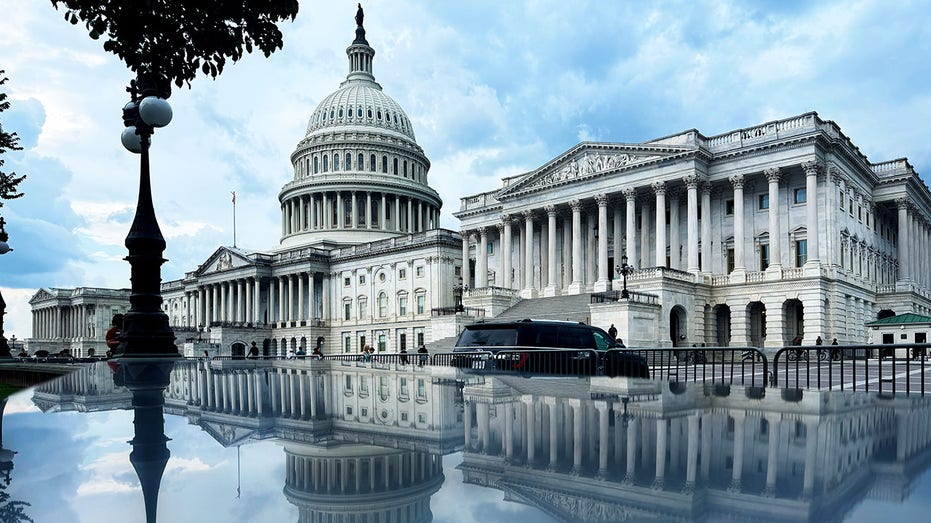
The national debt surpassed $39 trillion for the first time in U.S. history this week. (Demetrius Freeman/The Washington Post via Getty Images / Getty Images)
He went on to say that with voters concerned about affordability, the debt’s cost and economic impact on Americans’ livelihoods should serve as cause for the issue to be a focal point of the debate surrounding this year’s elections.
“America faces complex and critical challenges, both at home and abroad, and putting our debt on a sustainable path will support a stronger, more secure future. The good news is that there are many solutions available, and they all should be put on the table for discussion this campaign season,” Peterson added.
Advertisement
The fiscal headwinds facing the federal government are expected to continue in the years ahead, as spending on programs like Social Security and Medicare rise along with debt service costs and cause projected budget deficits to widen.
The nonpartisan Congressional Budget Office (CBO) released a 10-year budget and economic forecasts which estimated annual budget deficits will rise from their current level of about $1.9 trillion to $3.1 trillion a year a decade from now. That will push the gross national debt from its current level around $39 trillion to $63 trillion in 2036.
Debt held by the public as a share of gross domestic product (GDP), a measure economists prefer to use in comparing a nation’s debt to the size of its economy, will rise from about 100% this year to 108% of GDP in 2030 and further to 120% in 2036.
Advertisement
Those figures will break the record of 106% set in 1946 as the U.S. was in the process of demobilization after the end of World War II.
A recent update from the CBO found that the federal government’s budget deficit for the current fiscal year 2026 topped $1 trillion in the first five months of the fiscal year despite an influx of tax revenue from tariffs, some of which were struck down by the Supreme Court as being illegal.
Some of those tariff revenues may be subject to refunds to the businesses and consumers who paid them, which could widen this year’s deficit if the revenue isn’t replaced.
Palantir Technologies Inc. shares fell modestly Wednesday, closing at $152.77, down $2.31 or 1.49%, as investors locked in gains following a strong rally earlier in the month. The pullback came on elevated volume of about 32.3 million shares, reflecting typical profit-taking in a high-momentum AI stock amid broader market caution over valuations and macroeconomic uncertainties.
Palantir
The Denver-based data analytics and AI platform provider opened at $154.95, ranged from a low of $152.61 to a high of $156.69, and finished with a market capitalization near $371 billion. Palantir (NASDAQ: PLTR) remains well above its 52-week low of $66.12 hit in April 2025 but sits below its November 2025 peak of $207.52. Year-to-date through March 18, 2026, PLTR is down roughly 13%, underperforming the Nasdaq Composite’s modest gains amid sector rotation and renewed tariff concerns.
The latest dip follows a series of bullish developments that have kept Wall Street optimistic. UBS raised its price target to $200 from $180 earlier this week, maintaining a Buy rating and citing Palantir’s accelerating AI adoption and defense sector tailwinds. Wedbush’s Dan Ives highlighted recent AI partnerships as key growth catalysts, while other firms including Rosenblatt and Daiwa issued or reiterated positive calls.
Consensus among roughly 28 analysts stands at Moderate Buy, with an average 12-month target around $188, implying about 23% upside from Wednesday’s close. High-end forecasts reach $260, reflecting confidence in Palantir’s unique position in enterprise AI and government contracts.
The momentum traces back to Palantir’s blockbuster fourth-quarter 2025 earnings released Feb. 2, 2026. Revenue surged 70% year-over-year to $1.41 billion, beating estimates, driven by explosive U.S. commercial growth of 137%. Adjusted operating income and free cash flow also exceeded expectations. Management issued aggressive full-year 2026 guidance: revenue of $7.182 billion to $7.198 billion (61% growth), U.S. commercial revenue exceeding $3.144 billion (at least 115% growth), adjusted operating income of $4.126 billion to $4.142 billion, and adjusted free cash flow of $3.925 billion to $4.125 billion.
Advertisement
The outlook crushed consensus estimates, which had hovered around $6.27 billion for revenue, and underscored Palantir’s “Rule of 40” score hitting a record 127%—a metric combining growth and profitability that few software peers approach.
CEO Alex Karp emphasized the company’s focus on scaling AI models through its Artificial Intelligence Platform (AIP), describing it as “commodity cognition” that differentiates Palantir in a crowded field. The platform’s ontological framework enables rapid deployment of AI across complex datasets, appealing to both commercial enterprises and government agencies.
Recent partnerships have reinforced that narrative. Palantir expanded collaborations with GE Aerospace for military aircraft readiness, Ondas and World View for multi-domain intelligence, Nvidia for sovereign AI operating system architecture, Centrus Energy for uranium enrichment, and LG CNS in a strategic tie-up. AIG partnered with Palantir to build an ontology for its McGill and Partners portfolio, while Polymarket tapped the company to combat betting cheats.
Defense exposure remains a cornerstone. Palantir benefits from a $10 billion U.S. Army framework agreement and a $448 million Navy ShipOS deal, positioning it to capitalize on rising military spending amid geopolitical tensions. The U.S. Army’s recent $20 billion Anduril deal highlighted upside for defense tech players like Palantir and Lockheed Martin.
Advertisement
Commercial momentum is equally compelling. U.S. commercial revenue growth has consistently outpaced overall figures, fueled by AIP adoption in industries from energy to finance. Backlog stood at approximately $4.4 billion post-earnings, providing visibility into future quarters.
Yet challenges persist. Palantir trades at a lofty valuation—around 242 times trailing earnings and high multiples on forward metrics—prompting some analysts to question sustainability. A March 16 note flagged bearish views on the 460% five-year surge, citing potential overvaluation risks. Broader tech sector pressures, including tariff uncertainty under the current administration and AI disruption fears, have contributed to the stock’s sideways-to-down action in early 2026.
Technical indicators show mixed signals. The stock hovers below its 50-day and 100-day moving averages but above shorter-term ones, with RSI in neutral territory suggesting room for recovery without immediate overbought conditions.
Investors continue monitoring upcoming catalysts. First-quarter 2026 results, expected in early May, will test guidance execution, with management projecting revenue of $1.532 billion to $1.536 billion and adjusted operating income of $870 million to $874 million. Any commentary on AIP deal flow or additional government wins could reignite momentum.
Advertisement
Palantir’s evolution from a secretive government contractor—founded in 2003 with CIA backing—to a leading enterprise AI player has been dramatic. Once criticized for opaque accounting and high insider sales, the company achieved consistent profitability and commercial scale in recent years, attracting institutional interest and retail enthusiasm.
As AI hype cycles evolve, Palantir stands out for its practical, ontology-driven approach rather than pure generative models. While competitors like OpenAI and Anthropic dominate headlines, Palantir’s focus on secure, large-scale data integration positions it uniquely for regulated sectors.
Whether the current dip proves a buying opportunity or signals broader caution depends on macro trends and execution. For now, Wall Street’s upgrades and partnership news sustain a constructive outlook, even as near-term volatility lingers.
Palantir shares traded slightly lower in after-hours, around $152.30, ahead of Thursday’s open. Broader markets remain focused on economic data and tech earnings season.
The City of Busselton has lodged an appeal with the state’s environmental watchdog, challenging the approval of a $280 million resort planned for Smiths Beach.
Zalando SE (ZLNDY) Q4 2025 Press Conference Call March 12, 2026 4:00 AM EDT
Company Participants
Simon Thiel – Senior Vice-President of Corporate Affairs Patrick Kofler – Head of Investor Relations David Schröder – Co-CEO & Member of the Management Board Robert Gentz – Co-Founder, Co-CEO, GM & Member of the Management Board Anna Dimitrova – CFO & Member of Management Board
Conference Call Participants
Advertisement
Jason Gowans – Levi Strauss & Co. Frederick Wild – Jefferies LLC, Research Division Luke Holbrook – Morgan Stanley, Research Division Joffrey Meller – BofA Securities, Research Division Monique Pollard – Citigroup Inc., Research Division
Presentation
Simon Thiel Senior Vice-President of Corporate Affairs
Advertisement
Good morning. Welcome to Zalando’s Annual Press Conference and Business Update. My name is Simon Thiel, and I’m heading Corporate Affairs. I wanted to say thank you for joining us today. We will be presenting our full year results 2025 and sharing our plans for the future, and we’re delighted to have so many of you joining our broadcast today.
Patrick Kofler Head of Investor Relations
Good morning also from my side. My name is Patrick Kofler, and I’m heading the Investor Relations department. We have gathered the press, investors and analysts for today’s event. It’s a pleasure to have you all here.
Advertisement
Simon Thiel Senior Vice-President of Corporate Affairs
We will start our conference with a prerecorded presentation by our co-CEOs, Robert Gentz and David Schroder. They will walk you through our progress as we’re successfully executing our strategy. At 9:45 a.m. CET, following the presentation, we will open the virtual floor to a live Q&A session for our journalists with our co-CEOs, Robert and David, and our new CFO, Anna Dimitrova.
Advertisement
Patrick Kofler Head of Investor Relations
For our investors and analysts, at 9:45 a.m. CET, our CFO, Anna Dimitrova, will walk you through the financial development of the last year and
Stocks rose for a second day in a row—and they didn’t even need oil prices to fall this time around.
The Dow Jones Industrial Average rose 47 points, or 0.1%. The S&P 500 was up 0.3%. The Nasdaq Composite was up 0.5%. The major indexes all rose together for a second day in a row for the first time since Feb. 24 and 25, according to Dow Jones Market Data.
Futures tracking the S&P 500 and Dow were both lower before reversing as oil prices pulled back from their overnight highs. At one point the Dow was up 1%, but stocks pulled back from their highs this afternoon as West Texas Intermediate crude oil futures gained 2.9% to $96.21 a barrel.























































You must be logged in to post a comment Login