A gardening expert advised on which flowers you must plant now in spring, with a focus on one that come into bloom in summer and can last for months as cut flowers
As the weather brightens up and we’re heading into spring, you may fancy donning your gardening gloves and reviving your outdoor area. Gardening guru Ish, who goes by @gardening.with.ish online, could have the perfect recommendation for you.
Advertisement
Describing the blooms as “tall, hardy, and low-maintenance,” Ish suggested planting Nigellas at this time of year. “Not only do these work as amazing pollinators, but they will grow in time for wedding bouquets or flower arrangements,” he said enthusiastically in his caption.
Ish also emphasised that “Nigellas can offer bursts of purple flowers all throughout the summer,” enhancing their visual charm and why they’re perfect for beginners.
These plants can be “sown directly in the soil,” or if you’re short on space, you can “start them off in a tray” instead.
He noted that Nigellas flower from “June all the way to September,” and also “last for about 10 days in a vase, so if you’re keen to get some fresh looking flowers, these might work for you”.
Advertisement
Ish revealed his preference for beginning them in a tray before moving them outdoors because it’s “very easy to thin them out”.
He intended to “lightly sprinkle in the seeds,” followed by a “covering and a good water”.
Though Ish warned they must be “about 30cm apart” as they can “really bush out quite a bit”. Beginning them in a tray enables him to “spread them out” when relocating them into the ground.
After sowing the seeds in the tray, he applied a “light dusting of compost over the top” without compacting it, reassuring viewers it would “soon take care of itself”.
Advertisement
He recommended using the seed packet “as a makeshift label” to monitor what’s growing in each section.
Ish explained that when transplanting your Nigellas outside, they flourish in and love “well-drained soil” and enjoy “plenty of sun”. He emphasised they need approximately 20 to 30cm of space to “bush out”.
“When they start to flower, take care of dead-heading as well because the more you take care of it, you’ll actually grow more flowers,” he advised.
Additionally, the plant will “continue providing them [flowers]” regularly until the end of August.
Advertisement
Are you planning on adding Nigellas to your garden, or have you already started? Drop us a comment below…
Today, the Andermatt-Sedrun-Disentis ski area is the largest in central Switzerland, topping out at 3,000 metres and with 180 kms of pistes. It includes the north-facing, snow-sure Gemstock slopes (steep, challenging and a freeriders’ paradise) and the newer Gütsch area, where ultra-modern lifts speed beginners and intermediate skiers up for gloriously sweeping feel-good blue and red runs back to the village.
The majority of the 12-hour waits were at North West Anglia NHS Trust
David Dubas-Fisher Data Investigations Editor
07:00, 21 Mar 2026
Hundreds of patients faced waits of over 12 hours in Cambridgeshire’s A&Es last month. A total of 1,479 attendees at A&E departments across our county had to wait over 12 hours from a decision to admit to admission in February.
That’s actually down from a record of 1,785 in January, but is still the highest number for any month of February. It is still far higher than the numbers seen before the Covid-19 pandemic. In February 2020 just seven attendances at A&E faced a wait of over 12 hours in Cambridgeshire.
Advertisement
The majority of the 12-hour waits (921 of them) were at North West Anglia NHS Trust, while 558 were at Cambridgeshire University Hospital Trust. Cambridgeshire is far from being the only part of the country afflicted with such long waits in A&E.
A total of 54,649 patients spent over 12 hours in A&Es in England last month from a decision to admit to being admitted. That’s the highest number on record for the month of February, up from 47,623 in 2025 and 44,417 in 2024. The number is, however, down compared to January when a record 71,517 people were stuck in A&E for over 12 hours. Last month’s total is the third highest number on record.
You can see how your local trust is performing by using our interactive. Simply enter your postcode and select one of the NHS trusts from the dropdown.
The number of patients seen within four hours at Cambridgeshire A&Es has seen some improvements however. More than half (56.9 percent) of attendances at our county’s Type 1 A&Es waited less than four hours from arrival to admission, transfer or discharge.
Advertisement
That’s up from 54.7 percent in February 2025 and 48.5 percent in February 2024. It is, however, below the national average of 59.4 percent.
Waiting lists
The waiting list at Cambridgeshire’s trusts is falling. There were 146,543 on the county’s waiting lists in January. That’s down slightly from 148,972 in December and a peak of 154,150 in August 2023.
The waiting list was generally split between North West Anglia NHS Foundation Trust (78,406) and Cambridge University Hospitals NHS Foundation Trust (62,482), with another 5,335 at Royal Papworth Hospital NHS Foundation Trust And 320 at Cambridgeshire And Peterborough NHS Foundation Trust.
Nationally, the NHS waiting list has fallen to its lowest level since January 2023. A total of 7.25 million were on the NHS waiting list in England in January. That’s down from 7.43 million a year earlier and a peak of 7.77 million in September 2023.
Advertisement
The waiting list is now at its lowest level since February 2023 when it stood at 7.22 million. The number of people waiting over a year for treatment is at its lowest level since the Covid-19 pandemic. A total of 135,657 had been on the waiting list for over a year as of January.
That’s down from 198,868 in January 2025 and is less than half the number of January 2024 (321,394) and a peak of 436,127 in March 2021.
You can see how your local trust is performing by using our interactive. Simply enter your postcode and select one of the NHS trusts from the dropdown.
Health and Social Care Secretary Wes Streeting said: “After years of rising waiting times, patients are finally starting to see things move in the right direction – with waiting lists at their lowest level for almost 3 years and more people getting treated within 18 weeks.
Advertisement
“Despite record demand this winter, A&E and ambulance services improved – meaning patients are getting help faster when they need it most, thanks to the hard work of NHS staff, better planning and modernisation.
“But we won’t take our foot off the gas. We’ll keep cutting waiting times, backing NHS staff and making sure patients get the high-quality care they deserve.”
NHS National Medical Director Professor Meghana Pandit said: “The NHS was ready to tackle winter head on this year, which is why despite facing record-breaking demand, staff have delivered the shortest winter waiting times for 4 years – while waiting lists have continued to fall.
“This is proof that the NHS is starting to turn a corner for patients – but we know the job is far from done.
Advertisement
“For too long, too many patients have faced the indignity of being treated in hospital corridors. That’s why we’re taking a zero-tolerance approach – with hospital leaders out on the wards and corridors making sure patients are treated with the dignity they deserve.
“I also want to thank the public for their role in supporting the NHS this winter – these figures show the huge impact of the public getting vital winter jabs.”
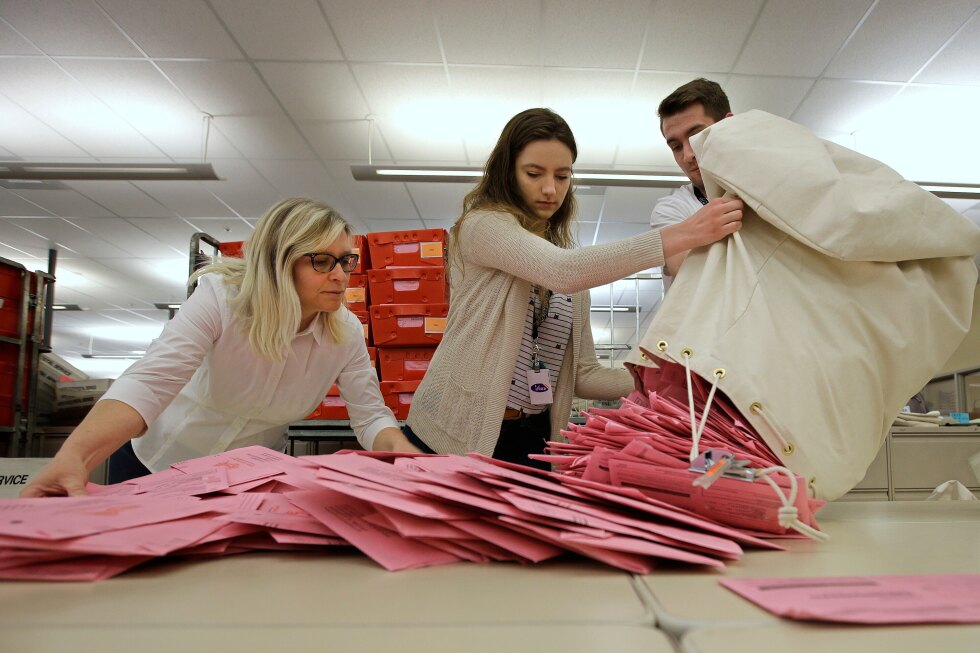
There will be just one Election Day for this fall’s midterm elections — Nov. 3. But voters in 14 states who cast their votes by mail have been given a grace period ranging from a day later to several weeks in which their ballots can be received and counted.
Whether that extra time should be allowed is at the heart of a case that will be argued Monday before the U.S. Supreme Court. If the court strikes down those grace periods, it will leave those states — and their voters — scrambling to adjust with only a few months before absentee ballots are sent out for this fall’s midterm elections.
The implications could extend well beyond the 14 states that give a grace period for regular ballots, depending on how the court ultimately rules. A total of 29 states allow extra time for at least some mail voters, including those who cast military and overseas ballots, according to the National Conference of State Legislatures and the Voting Rights Lab.
In a filing with the court, a group of state and big-city election officials cited “the risks of confusion and disenfranchisement” if mail ballot grace periods were ended suddenly in states where voters have counted on them for years.
Advertisement
Stuart Holmes, director of elections for the Washington Secretary of State’s office, said 127,000 ballots were received after Election Day in 2024, so voters should expect about that many ballots to be rejected if Mississippi loses the case. Washington has the longest grace period of any state, 21 days after Election Day.
If the ruling is that a ballot is invalid even if it’s postmarked by Election Day, “it might as well have never been received,” he said.
“There’s no way to resolve that issue,” Holmes said. “There’s no second chance.”
‘Election Day is E
lection Day’
The practice of counting ballots after Election Day has been a target of President Donald Trump since he sought to “STOP THE COUNT” after the 2020 election. He and his allies argue it delays results and leads to suspicions about the vote tallies. It’s part of Trump’s broader attack on most mail balloting, which he has said breeds fraud despite findings to the contrary and years of experience in numerous states.
Advertisement
The Republican National Committee and the Libertarian Party of Mississippi brought the lawsuit against Mississippi Secretary of State Michael Watson, a Republican, arguing that federal Election Day statutes envision a single day for casting ballots. Grace periods for receiving mail ballots — also in place in the District of Columbia and three U.S. territories — violate federal law, they argue.
“Election Day is Election Day for a reason,” Ohio state Sen. Theresa Gavarone, a Republican, said during debate over her state’s ban on the practice last year. “Allowing ballots to be delivered days after the election does nothing but hurt the integrity and credibility of our elections.”
In briefs supporting Mississippi, voting rights groups, local election officials and organizations representing military and overseas voters defend the right of states to write their own voting rules. The Constitution gives states the authority to set the “times, places and manner” of elections.
Supporters of ballot grace periods told the court that upholding the U.S. 5th Circuit Court of Appeals’ decision to strike down Mississippi’s law would threaten to create chaos and confusion in this year’s midterm elections.
Advertisement
“State legislatures have recognized this issue and set election deadlines that balance the interests of canvassing speed and ballot security depending on the specific needs of each individual state,” a group of local election officials and local governments told the court.
The groups said eliminating grace periods could affect ballot verification activities, provisional ballot processing, and the processing of military and overseas ballots that often happens after Election Day.
Some states already are modifying their laws
All 50 states require ballots to be cast or postmarked on or before Election Day. The 14 states with grace periods for regular ballots accept and count mailed ballots for periods ranging from a single day after the election in Texas to 21 days afterward in Washington state. Mississippi’s disputed grace period is five days.
A November 2025 Brookings Institution study found that mail voting was a practical, secure way to expand voter access, with about four cases of fraud out of every 10 million mail ballots. It was an option used by about 30% of voters across the U.S. during the 2024 presidential election.
Advertisement
With the Mississippi case looming, some states have begun to act on their own.
Four states — Ohio, Kansas, North Dakota and Utah — eliminated grace periods last year, according to the National Conference of State Legislatures and Voting Rights Lab. A fifth, Minnesota, shortened its ballot deadline from the close of polls on Election Day to 5 p.m.
In signing Ohio’s law, Republican Gov. Mike DeWine — who had vowed he wouldn’t sign any more election restrictions championed by fellow Republicans — said the Mississippi lawsuit forced his hand.
“I believe that this four-day grace period is reasonable, and I think for many reasons it makes a lot of sense,” he said at the time, noting that he would prefer to veto the legislation.
Advertisement
But DeWine said a ruling against Mississippi would jeopardize similar laws in other states, including Ohio, and leave inadequate time to adjust.
For Adriane Mohlenkamp, Ohio’s previous grace period provided extra comfort over concerns that circumstances outside her control would prevent her ballot from counting.
“I live in a rural part of the state and sometimes our mail has to go to a larger city and then come back,” said Mohlenkamp, 48, a stay-at-home mom and volunteer in Athens who is not affiliated with either major party. “It gave me a safe feeling, because, even if I do my due diligence and return it in enough time, I can’t always anticipate what it does when it leaves my hands.”
States grapple with postmark uncertainty
Katy Owens Hubler, elections program director at the National Conference of State Legislatures, said that in some large states, it can be difficult to distribute all mailed ballots and have them returned within the allotted timeframe.
Advertisement
She said the postmark issue has become trickier for states after recent changes to mail processing at the U.S. Postal Service.
An updated agency policy, enacted in December, said postmarks might not indicate the first day the Postal Service receives the mail, but rather the day it was handled at one of its processing centers. Those centers can be farther away from some communities because of consolidations, a group of U.S. senators told the postmaster earlier this year.
In response to potential Postal Service processing delays, some states have proposed extending their ballot deadlines — California by three days, Virginia by five hours and Kansas by an hour, depending on the county, according to the NCSL.
Owens Hubler said informing voters of any changes resulting from the Supreme Court’s ruling in the Mississippi case will need to happen quickly.
Advertisement
“It’s not ideal to do it in a big election year like this year,” she said. “Voters do adapt, but if there is a change from a postmarked-by to a received-by date, that needs to be communicated and signaled well in advance.”
In an article for the Record, IPPR Scotland Director Stephen Boyd says benefits play a huge role in tackling poverty.
Next week, new statistics will reveal how much progress the Scottish government has made towards achieving its legally binding target to reduce the rate of child poverty to 10% by 2030.
Advertisement
The statistics will almost certainly confirm that child poverty is trending lower in Scotland than the rest of the UK. This is largely because of actions taken by the Scottish government. Devolution is working to reduce child poverty.
However, the Scottish government’s own modelling shows that, on the basis of current policies, the 2030 target will be missed by some distance. The First Minister’s often-stated ambition to ‘eradicate’ child poverty looks even more remote. The new statistics are likely to confirm this grim reality.
Reducing child poverty isn’t easy but we have a very good understanding of what works. It is possible to make more paid progress. Measures to lower housing costs and provide direct financial support to families are highly effective. Investment in social housing is key to any strategy to reduce child poverty.
The Scottish Child Payment, and other benefits provided directly to families with children, have a very significant impact – indeed, lower housing costs and the SCP largely explain the lower rate of child poverty in Scotland.
Advertisement
But these measures don’t come free and, given the intensifying pressures on the Scottish budget, there are legitimate concerns that the next government might struggle to maintain – let alone increase – investment in these areas.
Whoever takes the reins after May’s election must recognise that there is no viable path to eradicating child poverty that doesn’t involve increasing the Scottish Child Payment and/or other benefits.
Put simply, to reduce child poverty society needs to redistribute resources to those who need them most through the tax and benefit system. If we want to live in a country with much lower rates of child poverty, then we will all have to contribute to achieving it.
Such a country is possible. Recent IPPR Scotland research shows that other countries with significantly lower rates of child poverty are also home to more productive, innovative and dynamic economies. They manage to sustain a virtuous cycle in which better economic performance enables higher social investment which supports further economic development.
Advertisement
At the coming election, politicians need to be clear about their strategy for reducing child poverty. Pretending it can be eradicated with current levels of tax and benefits isn’t serious.
Ukraine launches one of its largest barrages of drones
Ukraine launched more than 280 drones at Russia overnight, Russia’s State news agency reported.
Around 90 drones were shot down in the southern Rostov region, its governor Yuri Slyusar said.
At least 27 drones launched towards the capital were intercepted, Moscow’s mayor Sergei Sobyanin said.
Advertisement
Alisha Rahaman Sarkar21 March 2026 07:30
US removes sanctions on Russian citizens
The US Treasury Department has removed two Russian citizens from its sanctions.
Russian citizens Yurii Korzhavin and Lidiya Korzhavina have been removed from the US sanctions list, the Treasury Department said in an update yesterday.
Advertisement
The move comes as the Trump administration temporarily eased curbs on Russian oil transit and purchases to ease supply pressures, after the US-Israeli war with Iran drove a surge in global crude prices.
Alisha Rahaman Sarkar21 March 2026 07:00
Russia offers to curb Iran support if US halts Ukraine aid – report
Russia has reportedly offered to stop intelligence-sharing with Iran if the US agreed to do the same with Ukraine.
Advertisement
Moscow has stepped up intelligence sharing and military coordination with Tehran since US and Israeli strikes on Iran began three weeks ago, including reportedly supplying coordinates of American military assets in the region.
Washington, however, rejected the quid pro quo last week, two people familiar with the matter, told the Financial Times.
Alisha Rahaman Sarkar21 March 2026 06:25
Advertisement
Ukrainian drones target Moscow
Nearly 30 Ukrainian drones were shot down over the Russian capital and the surrounding region overnight, Moscow mayor Sergey Sobyanin said.
Throughout the latter part of yesterday and during the early hours of today, swarms of Ukrainian drones targeted Moscow, the mayor said, adding that the artillery units were intercepted by Russia’s defence units.
Emergency services responded to the crash sites, and no casualties were reported, he said.
Alisha Rahaman Sarkar21 March 2026 06:00
Advertisement
Czech authorities probe suspected arson at a drone technology company
Czech authorities said Friday they were investigating a fire at a warehouse of a company that makes drone technology as a suspected arson linked to terrorism.
The fire broke out in an industrial zone in the city of Pardubice, some 100 kilometers (60 miles) east of Prague, causing no injuries, police said.
LPP Holding confirmed a fire in one of its buildings. It said it was cooperating with the investigation and declined further comment.
Advertisement
Alisha Rahaman Sarkar21 March 2026 05:30
French navy boards a tanker suspected of being part of Russia’s shadow fleet
The French navy on Friday intercepted and boarded a tanker in the Mediterranean Sea that President Emmanuel Macron said is linked to Russia’s sanctioned shadow fleet shipping oil in violation of international sanctions over Moscow’s war on Ukraine.
According to the French maritime authorities for the Mediterranean, the tanker Deyna is suspected of operating under a false flag designation. The interception took place in the Western Mediterranean and was carried out in cooperation with allies, including the United Kingdom, which monitored the ship, the authorities said.
Advertisement
“This operation aimed to verify the nationality of the vessel,” which was flying the flag of Mozambique and was coming from the Russian port of Murmansk, the maritime authorities said in a statement. The documents found onboard “confirmed doubts about the validity of the flag,” they said.
Alisha Rahaman Sarkar21 March 2026 05:00
Patriarch Filaret, who fought for an independent Ukrainian Orthodox church, dies
Patriarch Filaret of Kyiv — who worked for decades to establish an independent Ukrainian Orthodox church that was free from Moscow‘s religious authority, a schism that foreshadowed the Russia-Ukraine war — died Friday. He was 97.
Advertisement
The Orthodox Church of Ukraine announced his death, citing the “exacerbation of chronic diseases.”
Filaret had a more limited role in recent years as the cultural and religious divide between Ukraine and Russia widened into full-scale warfare. But his legacy includes a long and partially successful effort to gain recognition of an independent Ukrainian Orthodox jurisdiction.
“The person and numerous good deeds of the late Patriarch Filaret rightfully occupy a special place in the modern history of both the local Ukrainian Orthodox Church and Ukraine as a whole,” said Metropolitan Epiphanius of Kyiv, who leads the OCU.
Obit Ukraine Orthodox Filaret (Copyright 2018 The Associated Press. All rights reserved.)
Alisha Rahaman Sarkar21 March 2026 04:30
Advertisement
Ukraine begins compulsory evacuation for children in Donbas
Ukraine has begun the compulsory evacuation of children from the city of Sloviansk, in a sign that the security situation is deteriorating in one of the country’s main remaining strongholds in the Donbas area.
“I signed an order for the compulsory evacuation of children from certain areas of Sloviansk that are most vulnerable to enemy strikes,” Governor Vadym Filashkin wrote on Telegram
.Russian forces have been slowly advancing to the north and east of Sloviansk, and are about 20 km (12 miles) from the edge of the city at various points of the front line of Moscow’s war in Ukraine.
Advertisement
Sloviansk is one of several towns and cities which remain under Ukrainian control in an urban “fortress belt” in the eastern region of Donetsk, which comprises part of the Donbas. Russia sees control of the entire Donbas, known for its coal mines and heavy industry, as its key military goal.
Alisha Rahaman Sarkar21 March 2026 03:45
Ukraine deploys targets to intercept Middle East units
Ukraine has deployed interceptor units to protect critical and civil infrastructure in five Middle Eastern countries, Ukraine’s security council secretary Rustem Umerov said after a visit to the region.
Advertisement
“Work is also underway to expand coverage areas,” Mr Umerov wrote on X.
Alex Croft21 March 2026 03:00
Kremlin tightens security for senior military officials following assassinations
Russia’s security services are set to bolster protection for senior military figures following a spate of series of assassinations and attempted killings, which Moscow attributes to Ukraine.
Advertisement
The announcement from the head of the FSB security service comes after Lieutenant-General Vladimir Alexeyev, deputy head of the GRU military intelligence, was shot three times in his Moscow apartment building on 6 February.
Ukraine has denied any involvement in the incident.
State media quoted FSB chief Alexander Bortnikov confirming Alexeyev’s recovery and stating that security for such high-ranking officials would “of course” be tightened.
It started with a smell. A soldering iron smell, like hot metal wires. But I was driving through an industrial estate in Miles Platting, so I didn’t give it a second thought.
I was on my way back from Ramsbottom. After almost seven miles on the motorway, I’d made my way towards a junction with Manchester Road and was waiting at a traffic light before the plunge into a labyrinth of 20mph residential roads that eventually wound their way to my home.
It was at this junction that my ABS (automatic brake system) warning light started flashing at me from my dashboard.
Now, I’m no mechanic. I bought my second-hand Fiat Panda Pop less than a year ago, a month or so after passing my test, and I just about knew how to open the bonnet and check my tire pressure. But I did know the ABS light coming on is generally not a good sign.
Advertisement
I passed through the junction and pulled over as soon as I could. As I came to a stop, the soldering smell grew stronger, and something caught my eye in the left-hand side of my peripheral vision. I turned my head and watched, mesmerised, as a needle-thin wisp of smoke slowly snaked its way out of the far side of my dashboard.
This was also not a good sign.
Advertisement
All my belongings were scattered across the passenger seat – a backpack with my work laptop, two phones, my housekeys and press card. I knew I had to act quickly and get my stuff out as quickly as possible, and thought it would be easier to access from the passenger door. So, I darted out and around my car. The door wouldn’t budge.
I ran back round to the driver’s seat and swooped up my belongings. By this point more tendrils of smoke had started to emerge from around the dashboard, and the smell of burning plastic and metal pierced into my nostrils. Now I was starting to panic.
I slammed the door shut behind me and for some reason even locked my car as I crossed the street.
By the time I got through to the fire department on 999, my car had started going batsh*t. The lights were flickering, the alarm started going off, the horn was blaring. A thick plume of smoke gathered inside the windscreen. The passenger seat, where I’d fished for my belongings, was ablaze. Minutes later – as I called my editor to tell him, in disbelief, what was happening, all the glass shattered with a tremendous bang and a three-metre high flame shot out of the top of the vehicle.
In complete disbelief, I watched the car I’d been sitting in just a few moments earlier utterly self-destruct.
The Panda – nicknamed Frieda – was my first ever car. I bought Frieda for £4,000 from a garage in Manchester, with the help of some money gifted from my dad, who has since passed away. It was massively granny-core. 2013 license plate. Top speed 80mph (on flat road, with a run-up). And the only way to play anything other than Heritage Radio was to buy a CD.
But I loved my little granny-mobile, which helped me zip across my patch in Oldham and Bury, and across the Peaks to visit my partner in Sheffield without a single problem.
Advertisement
At least until it suddenly burst into flames.
After what could only have been a few minutes but felt like an eternity, a fire engine appeared and fire crew made quick work of Frieda. They left a sad, burnt husk.
Still in shock, I wasn’t sure what to do with myself. I’d never had an accident before, so had no idea who I needed to speak to or where to go. Luckily, one of the very kind firefighters approached me to see if I was ok. He told me to take myself home and ‘make yourself a brew’.
Advertisement
“It’s not like there’s anything more that could go wrong with your car at this point,” he quipped. “Don’t think anyone’s going to steal it in that state.”
Except – someone did.
The next day, when the recovery crew arranged by my insurance company turned up, I got a call out of the blue to inform me my Fiat Panda had disappeared, leaving nothing but a sprinkling of shattered glass.
After some stressed-out calls, it turned out the car had in fact been impounded by GMP – who’d ordered the vehicle to be removed. Probably because by this point, it looked like someone had taken it for a joy-ride, then dumped and petrol bombed it.
Advertisement
Thankfully, I was completely unharmed. But I did spend a few days in shock wondering – What if I’d been a few minutes slower to pull over? What if I’d still been on the motorway? Or come to a stop somewhere busy?
Most of all, I just kept thinking ‘What the actual hell just happened’.
So I asked a mechanic.
Advertisement
“It sounds a bit like a brake failure,” said Dave, whose full name and garage I’m omitting for his peace of mind, after a moment of shocked silence over the phone. “I couldn’t say with any certainty without taking it apart, but it’s the number one cause for truck fires.”
Brake failures are when a mechanical or technical fault stops the brakes from disengaging properly. The friction builds up so much heat, which is funnelled through a ventilation shaft close to the car’s electrics, it can lead to a fire.
It’s likely I might never know what happened. I’ll miss Frieda. But I also feel incredibly lucky that the situation didn’t turn out far worse.
The only thing that keeps haunting me is that smell. At odd moments, when I’m telling this story, or thinking about finding a new car… I’m sure I can smell it wafting in the air. That soldering iron smell, like metal wires melting.
You’ll struggle to find so much power in such a small form factor
This article contains affiliate links, we will receive a commission on any sales we generate from it. Learn more
Advertisement
Portable power stations come in all shapes and sizes – and Bluetti is hoping it has hit the sweet spot for many users with the new Elite 300.
Jam-packed in its relatively small frame is a high-capacity 3kWh battery, meaning that it sits in the ‘serious power’ category rather than casual camping gear. It can comfortably run your home essentials, not just phones and laptops.
The system delivers 2,700W of continuous AC output and 4,800W in lifting mode, making it capable of powering high‑demand appliances such as kettles, microwaves, coffee machines, fridges, freezers, and power tools.
BLUETTI markets this as one of the most compact 3kWh units, and that certainly checks out. You’ll struggle to find so much power in such a small form factor. Be warned: it’s heavy. Still portable enough to lug around using the built-in handles, but 26.3kg is still 26.3kg no matter which way you look at it.
Advertisement
The Elite 300 is pitched as an all-in-one, suitable for home backup, outdoor activities, and professional use. You get 10 output ports, so they cover every device you can think of: 4 AC outlets, 2 USB‑C ports, 2 USB‑A ports, 1 cigarette lighter port, and 1 DC port.
You get plenty of choice when it comes to charging methods, with five to hand: AC. solar, car, AC + solar hybrid, and generator charging. This makes it viable for off-grid living or long camping trips, not just emergency backup. You also get UPS functionality for home use, with a ~10 ms switchover.
It’s worth noting that the power station is not exoanable like modular home battery systems.
The LiFePO₄ battery rated for 6,000+ cycles is a big win, so you can use it daily for a good ten years before major degradation, while you can monitor performance, adjust settings, and manage charging profiles through the Bluetti companion app via Bluetooth and wi-fi. I’ve always found the app rock-solid, but a few users have complained about connection issues.
Advertisement
The Elite 300 is a well-engineered, high-density power station that hits a sweet spot between portability and real home backup capability. A solid choice for serious users – but overkill for casual ones.
Digital Reviews Network: “For all other incidental uses, especially touring and camping, the Bluetti Elite 300 is one travelling companion you want to have along. With its claim to be the smallest 3kWh power station, there should be enough room left in your van to take some more electronics along.”
Advertisement
Greener Ideal: “The BLUETTI Elite 300 is a compact 3 kWh portable power station designed for home backup, RV travel, and off-grid power. With a 2,400 W inverter, fast recharging, and solar compatibility, it delivers reliable electricity for appliances, electronics, and emergency preparedness.”
EcoJet Airlines flights across the UK were scheduled to begin in 2024, starting with an Edinburgh to Southampton route.
The company had also planned to expand to mainland Europe, with long-haul flights planned for the future.
Advertisement
However, EcoJet Airlines has now entered liquidation, according to Companies House.
Court documents revealed that Paul Dounis and Mark Harper from Opus Restructuring were appointed as liquidators last month.
Opus, speaking to The Herald, said the move followed a “voluntary liquidation initiated by the company’s board”.
It added: “EcoJet was a start-up business and has no material assets.
Advertisement
“The members have elected to fund the liquidation process to ensure that the company’s employees receive their full statutory entitlements.”
Despite EcoJet falling into liquidation, Mr Vince, in The Herald, said: “We remain committed to electrifying all forms of transport – aviation is the last frontier and the hardest.
“It’s taking longer than we hoped to get the technology and regulatory pieces of the puzzle in alignment, and so we’re pausing work at this time.”
Advertisement
Royal Air Philippines
Royal Air Philippines is a budget airline based in the Philippines, which first began operations in 2018.
It operates domestic flights in the Philippines and international flights to other Asian countries, including:
Cambodia
China
Hong Kong
Macau
South Korea
Taiwan
Royal Air Philippines started as a charter airline, named Royal Air Charter Service, in 2002, before receiving a Certificate of Public Convenience and Necessity from the Civil Aeronautics Board in 2017, allowing it to offer regular commercial flights (which launched in 2018).
“By 2020, the airline had expanded its fleet with the introduction of Airbus A319/A320 jets – this allowed the airline to carry more passengers and offer long-haul routes,” Alternative Airlines added.
Advertisement
But Royal Air Philippines has now fallen into administration, with around 4,000 flights between January and March (2026) cancelled as a result.
The airline is currently working to provide affected passengers with refunds, according to the Daily Express.
The airline’s website previously read: “We are working on providing refunds and hope to resume flights at an unspecified date in the future.
Advertisement
“Thank you for your patience and understanding. We eagerly anticipate welcoming you aboard soon.”
Access to the Royal Air Philippines website is no longer available, with those trying to access the website greeted with a “ready when you are” message, with a type of ‘loading’ spinning circle.
The failure of Royal Air Philippines is believed to be a result of decreased flight numbers in recent years, Philstar Global said.
Advertisement
Dove Airlines
Dove Airlines is a charter airline based in Kolkata, which launched back in 2007.
The Indian-based airline entered voluntary liquidation in January, according to The Street.
The Street reported the airline has “officially gone dormant” after retiring two of its A340 planes.
Advertisement
UK travel companies that have closed in 2026 (so far)
Four UK travel companies have also ceased trading in 2026, resulting in the cancellation of flights and holiday packages to destinations around the world.
Record View says Holyrood should mirror the Unauthorised Entry Act and bring in banning orders for those who sneak into matches.
The recent Old Firm riot sparked a great deal of hand-wringing from our political leaders.
Advertisement
But there has been little in the way of action to avoid a repeat of the shameful scenes beamed around the world on live television. This weekend in England, however, a change in the law will come into force that could make a difference.
The Unauthorised Entry to Football Matches Act targets fans who force their way into games without paying. It’s a sensible measure and a similar law in Scotland is long overdue.
Ticketless fans forcing their way into games – either through tailgating other supporters or forcing their way through security gates – has become a major problem for clubs. The trend comes as we are witnessing the growth of “ultra” groups across the country.
These young fans bring passion and a party atmosphere to our football stadiums and that has been widely welcomed. But in some cases the boisterous behaviour has spilled over into anti-social behaviour – including gaining entry to games without paying.
Advertisement
English authorities have moved to target this practice – and the Scottish Government cannot simply watch from the sidelines. We have repeatedly seen fans double-up at turnstiles, charge barriers or use counterfeit tickets.
Stewards are shoved aside, paying supporters are crushed against turnstiles and clubs haemorrhage revenue. The English law makes sense because it includes strong deterrents, such as heavy fines and football banning orders.
The solution is straightforward. Holyrood should mirror the Unauthorised Entry Act and bring in banning orders for those who sneak into matches. Ticketless entry is not harmless fun. It is theft from honest fans and a risk to the safety of ordinary supporters.
Life-saving advice
A warning has been issued to parents about the dangers to babies of “co-sleeping”.
Advertisement
It comes after the deaths of 29 babies were linked to the practice after a review of fatal accident inquiries. Solicitor General Ruth Charteris deserves credit for raising her concerns.
Every single one of these fatalities is an unimaginable loss for the families involved. The fact they could have been avoided makes the tragedy even greater. The Lullaby Trust, which advises parents, has issued guidance to keep babies safe.
If you or anyone you know has a wee one, please read the guidance in today’s Record or online – and let’s try to avoid any more needless heartbreak.
Get more Daily Record exclusives by signing up for free to Google’s preferred sources. Click HERE.


















































You must be logged in to post a comment Login