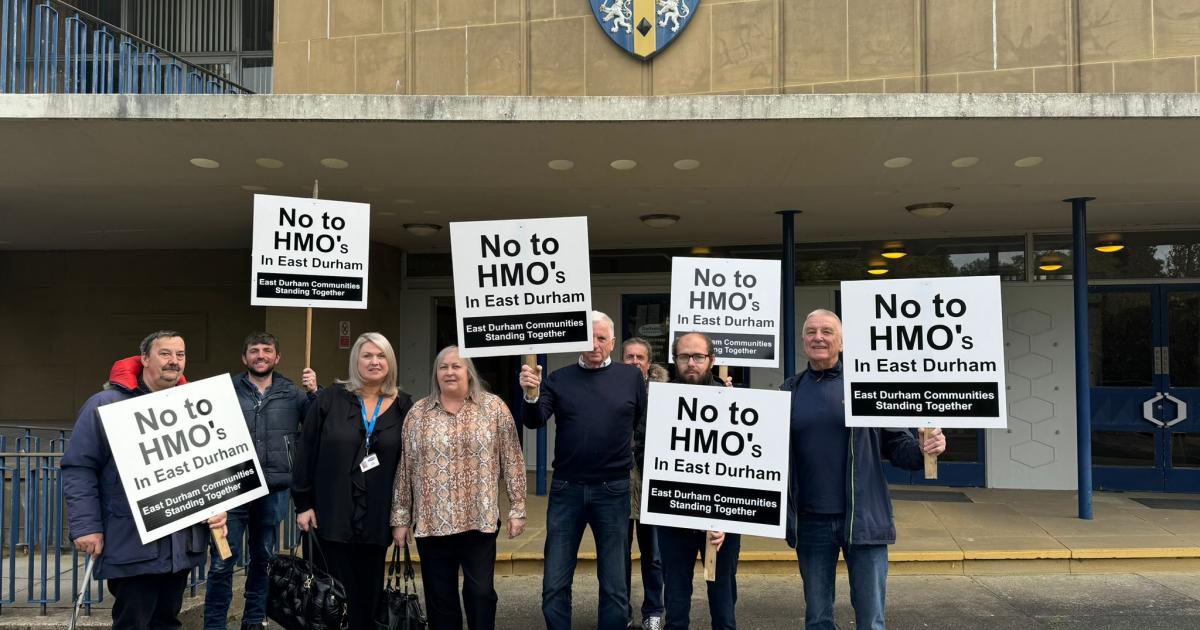
Durham County Council cabinet members backed plans to increase the coverage of Article 4 Directions for Homes in Multiple Occupation (HMOs) beyond Durham City and its surrounding areas to cover the whole county.
Currently, houses can be converted into small HMOs—accommodating between three and six residents—without planning permission. Only properties housing more than six residents require planning consent under existing rules.
Advertisement
The move comes after residents warned that the increase in HMOs is negatively impacting the character of communities.
Nicola Lyons, cabinet member for communities and civic resilience, said: “The policy will benefit both existing residents and future occupiers by protecting residential amenity and ensuring appropriate standards of accommodation.”
The number of HMOs across County Durham communities has steadily increased in recent years after predominantly being utilised for student homes in and around Durham city.
Durham County Council said the shared housing can be an affordable option for residents, but can harm community cohesion by introducing transient residents and the loss of family housing.
Advertisement
“An over-concentration within a locality can have a negative impact on the residential amenities and change the overall character of an area,” said Councillor Cathy Hunt.
Other negative impacts include the loss of family housing and community cohesion due to the presence of a more transient population.
The cabinet member for children and young people’s services added: “It’s important we use our planning powers to maintain mixed and balanced communities and drive up standards of accommodation.”
A planning policy is also being developed to ensure clear guidance when determining HMO applications.
Advertisement
Interim changes detail how applications should not lead to three or more of the 10 nearest properties being HMOs. It should also not result in the ‘sandwiching’ of a residential property between two HMO properties or an HMO and a property that is not a home.
The policy also sets detailed requirements to ensure the HMO accommodation is of a high standard for those living there and that the living conditions of neighbouring residents are protected.
A public consultation on the interim HMO policy will be held from March 25 to May 5, where residents can give their views.
Video game retailer GAME has confirmed all of its remaining standalone stores will close from April 2026
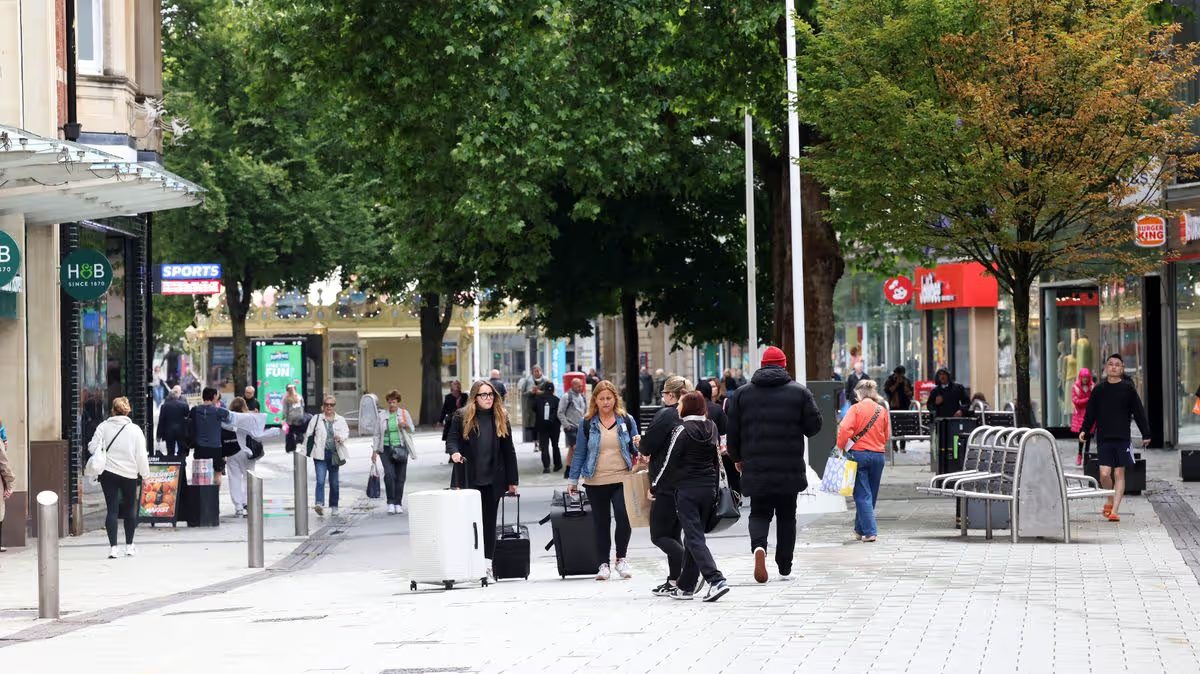
A major high street brand is shutting down all of its standalone stores. GAME has announced all three of its remaining stores will close their doors from April 2026.
Advertisement
The GAME website will carry on trading as normal, and the company will keep its presence on the high street through concession stands in Sports Direct and House of Fraser outlets, currently boasting over 200 locations. This follows GAME filing a notice of intention to appoint administrators earlier this year.
GAME has been scaling back for several years, shutting shops as leases expire, and last year it closed down its Basingstoke headquarters. Stay in the know by making sure you’re receiving our daily newsletter
The final stores that will be closing are in Dudley, Lancaster and Sutton.
In a 2023 interview with GamesIndustry.biz, the chain’s Managing Director, Nick Arran, rejected suggestions that the firm was shifting away from its gaming business to concentrate on other products like toys.
“Gaming is our core business, and we will be the last man standing selling physical video games,” he said, reports the Mirror.
“We see our place in the market as proving that there is a place for physical, whether that be the collector’s editions, which we see as the vinyl of video games, or the gifter who doesn’t want to wrap up a download code for Christmas. But we need to be realistic. We have a business to run, and the expectation is that this will decline. So we need to fill that gap.”
Get daily breaking news updates on your phone by joining our WhatsApp community here. We occasionally treat members to special offers, promotions and ads from us and our partners. See our Privacy Notice
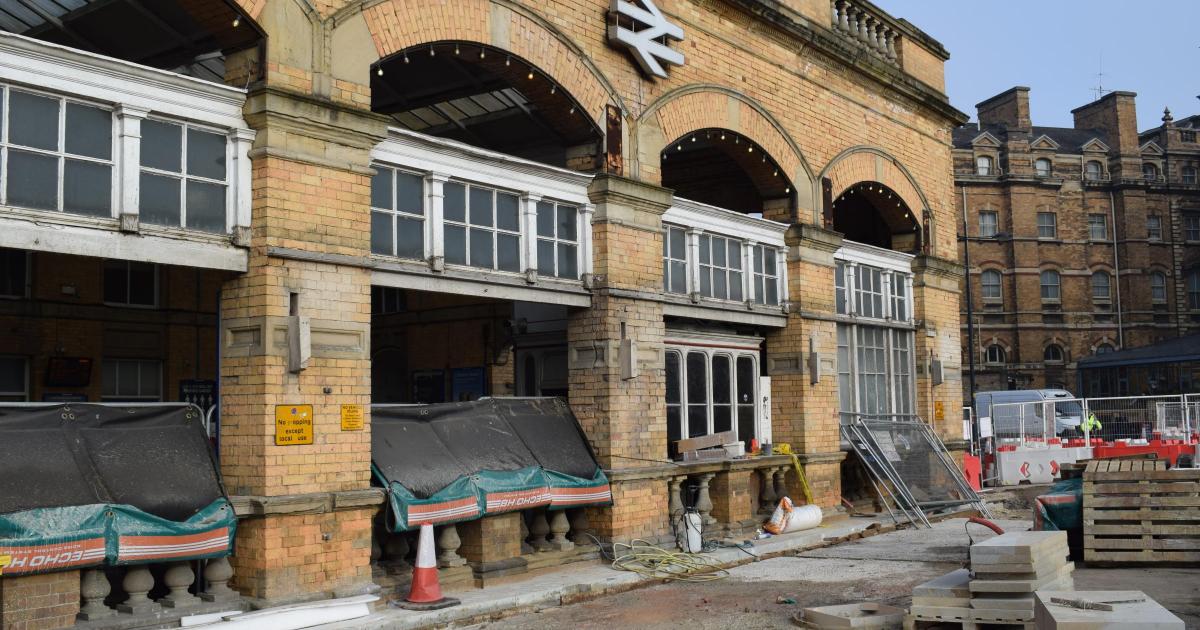
City of York Council confirmed the canopy was removed last weekend (March 14 and 15) as part of the Station Gateway project taking place there.
As reported by The Press, the removal comes after cracks in part of the frontage were discovered to the canopy which is fixed to the station portico, a Grade II* listed structure in Station Road.
Recommended reading:
An application was submitted to City of York Council in November for the emergency removal and the immediate area was fenced off.
Advertisement
An October 2023 structural report showed the canopy structure had deteriorated over time and reached a point of inadequacy.
A new pedestrian crossing opened this morning (March 19) (Image: Kevin Glenton)
A council spokesperson said yesterday: “Contractors worked carefully to safely remove the canopy and maintain the heritage of the portico and station façade.
“Further works will be happening around the station in the coming days.
“A new pedestrian crossing will be opening tomorrow (Thursday 19 March).
Advertisement
“This will be a wide and accessible crossing directly in front of the station entrance.
“This will also be a pedestrian diversion route while work takes place on the footpath near The Milner York hotel.
“The footpath outside the hotel will be closed from tomorrow morning (Thursday 19 March) for two weeks, and pedestrians will be diverted to use the new crossing point during this time.”
Emergency plans were submitted in October last year for the demolition of the canopy (Image: Kevin Glenton)
The arched portico will remain as part of York Station Gateway’s new ‘supercrossing’ over Station Road for pedestrians.
Cops were called to a crash on the major Scots motorway at around 12.30am, with rush hour traffic now affected.
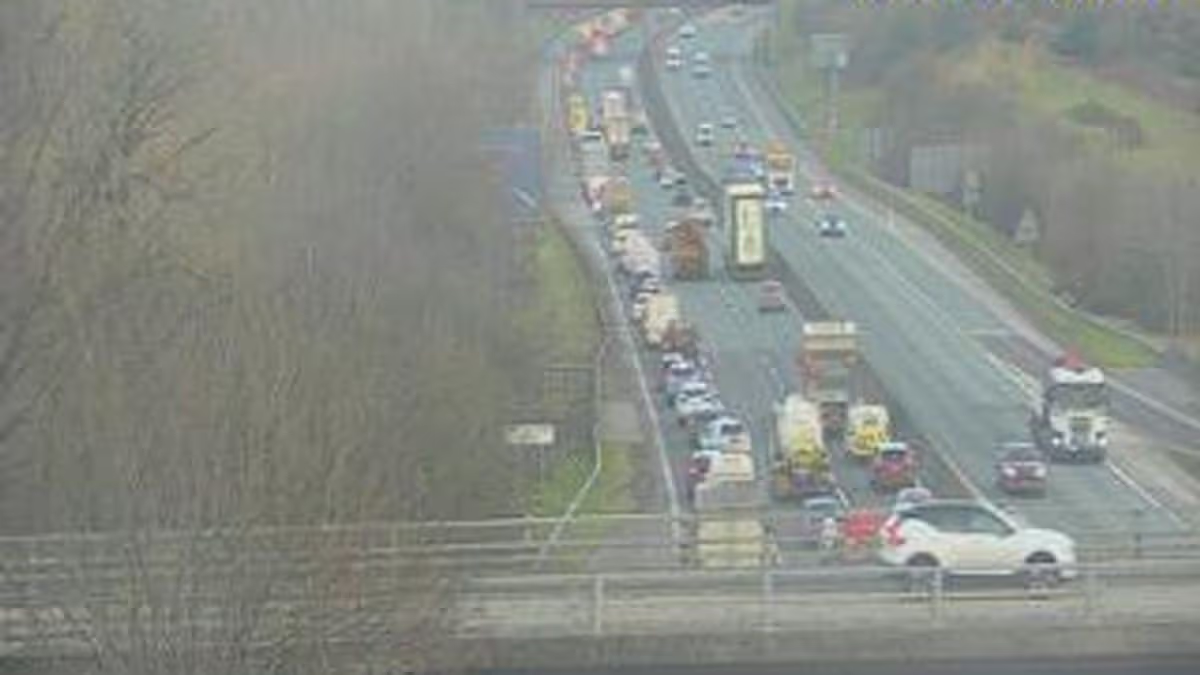
The M80 has been closed in both directions between junctions 8 and 9 at Denny following a crash. The incident happened shortly before 12.30am on Thursday, March 19 when police were called to the major Scots motorway.
Advertisement
It remains unclear how many people or vehicles were involved in the smash, as well as if anyone was injured or requited hospital treatment as a result. The collision is causing significant disruption during rush hour, with drivers facing diversions of up to 17 miles.
Megabus also says around 909 services may be impacted due to the increase in traffic through Stirling. A spokesperson said: “The M80 is closed in both directions between Junctions 9 & 8. Our M8, M9 & M10 services will be subject to delays and diversions. 909 services may be impacted, due to the increase in traffic through Stirling.”
Traffic Scotland has been sharing updates with commuters on the “police incident” since the early hours of the morning. Cameras show heavy congestion at Banknock, where long lines of traffic can be seen building.
The latest, as of 7:45am, is that M80 southbound traffic on the M9 continue eastbound until Junction 7 (Kinnaird) and exit onto the M876 northbound.
Advertisement
They should then exit at Junction 3 (Bowtrees) then re-enter onto the M876 southbound onto the M9 westbound before exiting on the M876 southbound at Junction 8 (Hill of Kinnaird) and continue the M876 southbound before merging back onto the M80 southbound at Junction 8 (Bankhead). This is where the diversion ends.
Northbound traffic on the M80 should exit onto the M876 at Junction 8 (Bankhead) and continue before merging onto the M9, then at Junction 7 (Kinnaird) exit onto the M876. They should exit at Junction 3 (Bowtrees) then re-enter onto the M876 southbound and continue onto the M9 westbound towards Stirling.
A Police Scotland spokesperson said: “The M80 is closed in both directions between junctions 8 and 9, following a report of a road crash which we were called to around 12.25am on Thursday, 19 March, 2026. Diversions are in place.”
Scottish Ambulance Service has been contacted for comment.
Advertisement
Get more Daily Record exclusives by signing up for free to Google’s preferred sources. Click HERE.
Race Across the World first launched back in 2019, with the new series in 2026 set to be the sixth installment.
The award-winning BBC One show sees two-person teams venture across countries with no smartphones, and no bank cards, only limited resources, and the cash equivalent it would cost to fly the route.
The popularity of Race Across the World has even led to a celebrity spin-off version, which first aired back in 2023, and has seen the likes of Roman Kemp, Scott Mills, and Molly Rainford take part.
Advertisement
Race Across the World (series 6) destinations
The latest series of the show will see the groups tasked with travelling more than 12,000km across Europe and Asia, as they hope to be the first to cross the finish line and snap up the £20,000 reward.
🗺️ Ready to Race Across the World?
We have an OFFICIAL start date for series 6 – and a first look at the teams!
The pairs will travel across countries, including Italy, Greece, Turkey and Georgia on their journey, as they are pushed to their mental and physical limits.
They will also venture through Kazakhstan, Uzbekistan and Kyrgyzstan, with the final destination bringing them to the shores of Lake Khovsgol in northern Mongolia.
Meet the teams in the new series of Race Across the World
Series six of Race Across the World will feature five new pairs:
Jo and Kush (best friends)
Katie and Harrison (siblings)
Andrew and Molly (father and daughter)
Puja and Roshni (cousins)
Mark and Margo (in-laws)
When does the new series of Race Across the World start?
The new series of Race Across the World begins on BBC One and BBC iPlayer on Thursday, April 2 at 8pm.
Will you be watching the new series of Race Across the World? Let us know in the poll above or in the comments below.
Rory McIlroy returns to Augusta next month as defending Masters champion
Rory McIlroy anticipates feeling “free” upon his return to Augusta to defend his Masters crown, insisting he’s placing no expectations on himself to secure another green jacket.
Advertisement
The Holywood man’s play-off triumph over Ryder Cup team-mate Justin Rose last April ended an 11-year wait, making him just the sixth player in history to achieve the career Grand Slam.
Back-to-back Masters victories remain an exclusive feat, accomplished by only three individuals – Jack Nicklaus, Nick Faldo and Tiger Woods – whilst merely 18 golfers have claimed multiple titles across the tournament’s 91-year existence, with Scottie Scheffler the most recent addition to that elite group in 2024.
Following Phil Mickelson’s third green jacket triumph in 2010, only three multiple champions have emerged: Bubba Watson (2014), Woods (2019) and Scheffler, a statistic that underpins McIlroy’s relaxed approach to his title defence.
“This is going to be the first time I drive down Magnolia Lane and it’s all going to be about enjoying my week, enjoying the perks that come along with being a Masters champion,” the 36-year-old explained.
Advertisement
“The thing is I know I get to go back to the Masters tournament for the rest of my life and that’s quite a freeing feeling.
“I honestly think that I’ve done it once and it’s not as if I have to win it again to win the Grand Slam.
“I think it was sort of two things won; I obviously wanted to win the Masters so badly but then obviously at the same time knowing what the Masters would give me and the people that it would put me alongside.
“So I think now going to win the Masters just to win the Masters is a nice thing but I think that I’ve won it once and I feel like that will make it a bit easier for me to win again.”
Advertisement
McIlroy held a two-shot lead entering last year’s final round, though it vanished instantly after a double bogey on the opening hole. However, he rebuilt a three-stroke cushion by the time he reached the par-five 13th fairway.
Attempting to safeguard that advantage through conservative play, he instead sent a 90-yard pitch shot into Rae’s Creek for another double bogey, swiftly followed by a further dropped shot—which then sparked his memorable near-eagle approach on the par-five 15th during a turbulent conclusion.
Reflecting on the experience, McIlroy identified the importance of maintaining his attacking instincts throughout.
“When I look back at the round when I played aggressively I was rewarded and I played well and then the first time that my mindset or my tactics went a little bit defensive, like trying to protect the lead, that’s when I got into trouble,” he added.
Advertisement
“Obviously (that’s) what happened on 13 and on 14 and when I got to 15 again I needed to be aggressive. I needed to make a birdie again and I was able to do it.
“So there’s probably a lesson in there somewhere of not taking your foot off the gas. I thought I was sort of doing the smart thing by playing 13 as a three-shotter and trying to protect the lead that I built.
“But in hindsight, everything that went well for me that day and that week was when I played aggressively, when I went for my shots.”
As the reigning champion, McIlroy has the honour of selecting the menu for the champions dinner. Drawing inspiration from his mother Rosie, he’s chosen to include elk sliders and a date and goat’s cheese appetiser. For the main course, attendees can look forward to either Wagyu filet mignon or a fillet of seared salmon, accompanied by an Irish champ (mashed potatoes with spring onions).
In this episode, host Tamara Kormornick is joined by business writer and branding specialist, John Arlidge, to discuss the changing landscape for legacy brands in a tougher environment. The two discuss the burgeoning second-hand market to the prevalence of high quality dupes, and ultimately, the downfall of the retail sector.
The reigning European champions gained a measure of revenge for last summer’s World Club Cup final defeat by handing out an 8-2 thrashing on aggregate following Tuesday night’s 3-0 romp at Stamford Bridge.
Instead, Chelsea rolled out the welcome mat for their visitors who gleefully accepted the early opportunities that allowed them to put the tie to bed within the first 16 minutes in west London.
Advertisement
The Blues were fortunate, in some ways, that Luis Enrique’s side eased off the gas thereafter and scored only once thereafter with Senny Myulu putting the gloss on a comprehensive demolition just after the hour mark.
And while a dejected Terry conceded that much of the damage had already been done at Parc des Princes, he argued that no Chelsea side should ever lose a European knockout game by such a wide margin.
He said: ‘Unfortunately that is the end. You know what does it for me? Being 3-2 down away to PSG and we actually played really well the whole game, or for 70 minutes of it.
Your football fix
Metro‘s Head of Sport James Goldman delivers punchy analysis, transfer talk and his take on the week’s biggest stories direct to your inbox every week.
‘I’m going 3-2 we’ll take that all day long going back to the Bridge, I fancy us against anyone to be able to turn that around and then we go and concede late goals to make it really difficult.
Advertisement
‘And then last night we go and concede after six minutes so everything about last night, I can’t even talk about it. I can’t even actually go into the detail of it. I’m so frustrated.
‘But against any team you cannot lose 8-2 over two legs. I’m sorry you can’t. I don’t care who you are, what team you are you cannot lose 8-2 so really frustrating.’
Midfielder Moises Caicedo, meanwhile, accepted Chelsea’s best had not been good enough after their European campaign went out with a whimper.
Khvicha Kvaratskhelia’s goal killed the tie (Picture: Getty)
‘It was disappointing for everyone,’ said Caicedo, who had given the ball away cheaply in midfield in the build-up to the second goal.
‘Of course we know PSG are a very tough opponent. We tried to show our best, but they are the current champions of the competition. We did our best but we didn’t get what we wanted.’
Advertisement
Chelsea’s embarrassment was complete when 19-year-old midfielder Mayulu came off the bench to blast home PSG’s third, triggering a chorus of boos as supporters began to stream out of the ground.
Individual mistakes had been their undoing in the first leg in Paris and proved the case again here, though the manner in which the European champions punished them was particularly brutal.
Moises Caicedo struggled against PSG (Picture: Getty)
‘We wanted to do better but they are one of the best teams in the world,’ Caicedo said. ‘We are disappointed and want to do better.
‘Everyone was ready to fight, but I think we have four competitions playing every two or three days. Sometimes in this scenario, it’s so difficult because they are doing well. We will keep going.’
Liam Rosenior’s team are in a fight to return to the competition next season. They are sixth in the Premier League after winning only one of their last four games and face a difficult assignment at Everton on Saturday.
Advertisement
After a positive start, the former Strasbourg boss is at risk of seeing his tenure turn sour. Supporters sang the name of former owner Roman Abramovich – typically a sign that discontent is bubbling at Stamford Bridge – while there was a furious reaction to Rosenior’s decision to take off Cole Palmer and Joao Pedro with 30 minutes to go.
Chelsea’s night got worse afterwards when Enzo Fernandez said in a post-match interview with ESPN in Argentina that he does not know whether he will be at the club next season.
‘There are eight games, then the World Cup, then we’ll see,’ he said.
A Portadown nurse who ran a home aestetics clinic has been fined £720 (plus offender levy) after admitting nine offences under medicines regulations.
Registered Nurse, Nafeyka Chavdarova, 44, appeared at Craigavon Magistrates Court where she pleaded guilty to nine charges on Wednesday.
Advertisement
The Court heard that in March 2024 enforcement officers from the Department of Health’s Medicines Regulatory Group (MRG) visited the defendant’s home at Clendenning Avenue, Portadown. It was here where they discovered and seized a range of unlicensed prescription medicines intended for sale or supply from the address — which was operating as an aesthetics clinic.
The charges related to the unlawful possession of prescription medicines intended for sale or supply, which included, injectable Botulinum toxin type A, Hydroxocobalamin, Hyaluronidase and Lidocaine.
In addition, MRG officials also established that the defendant had been unlawfully advertising prescription medicines.
Advertisement
Peter Moore, Senior Medicines Enforcement Officer with the Department of Health who directed the investigation, said: “This conviction sends a clear message that there are consequences if a person attempts to bypass the regulated system and controls which are in place to ensure public safety and integrity of the medicines supply chain.
“I would urge people to consider the implications of buying drugs online or from dubious sources – there is no way of knowing what you are buying is what you think it is, and this can have serious consequences for your health.”
Aaron McKendry, Interim Head of Medicines Regulatory Group, added: “It is extremely important that people take prescription only medicines after consultation with their GP, pharmacist or other healthcare professional who have access to patient health records and can consider the risks and benefits associated with every medicine.
“The Department is committed to taking all possible steps to stop the illegal promotion, supply or misuse of medicines and when appropriate, to alerting the public about the dangers of using medicines outside of the regulated supply chain.”
As war exposes the fragility of global energy supplies, communities are showing how clean power can be local, affordable and owned by the people who use it
If you’d not met the man, and I asked you to picture a ‘Reg Platt’, what would spring to mind? A retired gas fitter? A dogged constable in a Hercule Poirot drama? Almost certainly not a buzzing entrepreneur, with grizzled rock star good looks, who’s driving a revolution in solar power across the rooftops of east London.
So much for nominative determinism.
Advertisement
His company, Emergent Energy, is breaking new ground by enabling a local authority – in this case the London borough of Hackney – to bring clean, green electricity to its council home tenants. In doing so, it’s exploiting recent changes in electricity regulations, which allow locally generated solar power to be supplied directly to nearby households.
Reg Platt’s work with Hackney council is turning social housing into a network of clean power stations. Image: Sam Bush
Advertisement
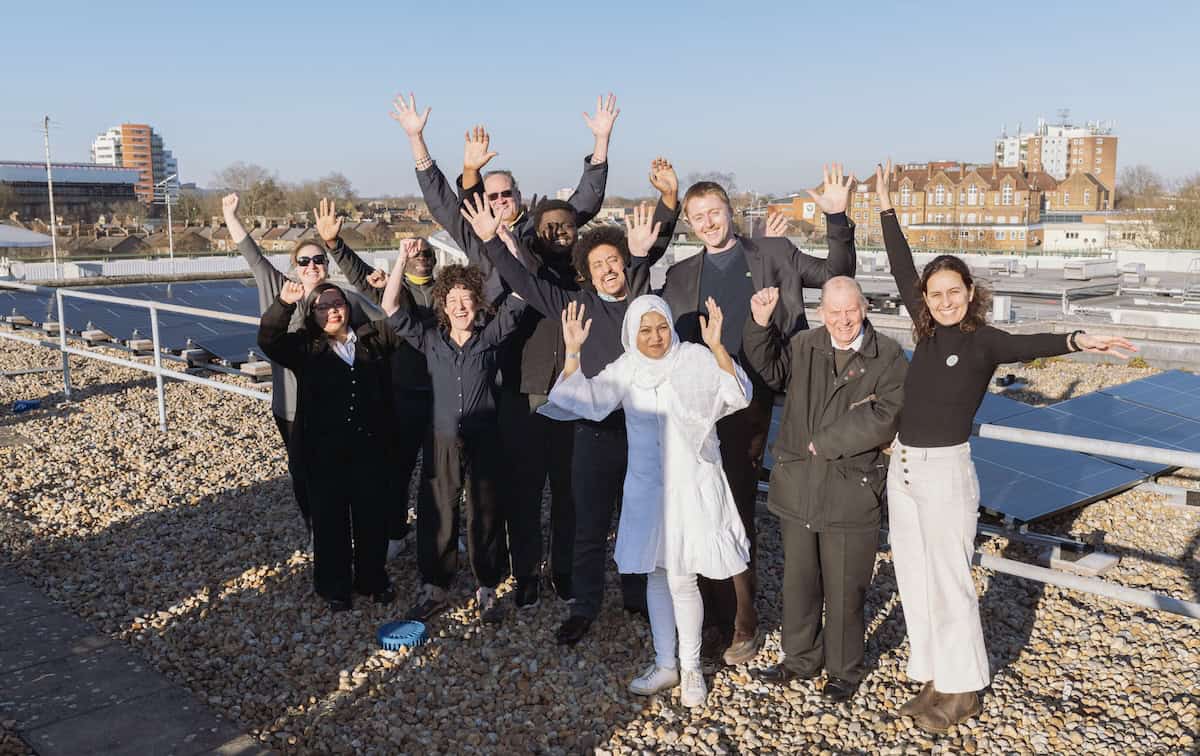
It works like this: Hackney commissions Emergent to install solar power on the sprawling flat roofs of its council flats. Emergent manages the resulting array as a ‘micro grid’, billing residents directly for their electricity use, and exporting surplus power – generated when local demand is low – into the National Grid. The resulting earnings means it’s possible to reduce residents’ typical overall bills by around 15%, not insignificant at a time of spiralling energy costs.
To date, Emergent has installed solar PV across 28 blocks, benefiting 800 residents. “It’s the single largest deployment in the social housing sector,” says Platt, “and the only such project that’s been delivered with zero government funding towards the capital costs. The system pays for itself.”
It appears a win-win for all concerned: residents get cheaper power, Hackney owns the assets and recoups its investment through electricity sales, and Emergent has a business model that is poised to expand across the country. As Platt points out, there are 5m flats in the UK, of which 2m are – like the ones in Hackney – social housing. Not all will be suitable for this approach, but a healthy proportion should be. It’s set to transform the prospects for bringing affordable solar power within reach of millions of Britons, a potential recognised when it won the 2025 Ashden Award for Breaking Barriers.
Advertisement
Of the 5m flats in the UK, like these in Sheffield, many could be suitable for solar, says Platt. Image: Ben Elliott
Born and raised in the Kentish outskirts of London, the young Platt was more artist and activist than entrepreneur. He was working as a musician but drawn to environmentalism under the influence of James Lovelock’s Gaia hypothesis. Radicalised in the early 2000s amid anti-capitalist protests and the Iraq war, he also got involved in the climate movement and helped set up a Transition Towns-style group in Brighton, where he was living at the time.
But Platt soon decided that it was “never going to achieve the sort of change needed relative to the scale of the problem. So, I flipped my career: music became more of a hobby, and I did a master’s in environment, science and society”.
Advertisement
That led to work on personal carbon trading with the Royal Society of Arts, and then with the Institute for Public Policy Research, delving into climate and energy policy. By his own admission, Platt wasn’t initially a natural thinktanker. “I had to work 50% harder than all those Oxbridge people to write those reports.”
It’s the only such project that’s been delivered with zero government funding towards the capital costs. The system pays for itself
But the musician in him gradually found out how to imbue his writing with a creativity that stood out from the crowd. It came in handy when his work on electricity markets coincided with a surge of interest in green energy, boosted when Ed Miliband became leader of the opposition Labour party. “Energy was huge news, and I was in the thick of it, in the press the whole time.”
A policy wonk despite himself, then, and an influential one too, helping shape Labour’s 2015 manifesto. But not as yet an entrepreneur. So, what changed? “I met my wife when I was 30. She’s an entrepreneur [who runs her own fashion brand], and I was just blown away by the scale of the ambition, the potential … I learned that there’s this thing you can do: start a business. It was amazing.”
Fired up, Platt started making plans, leveraging all his accumulated energy knowhow in a drive to work with local authorities on renewables. After a spell pursuing similar goals with green energy company OVO, he made the leap of faith to set up Emergent in 2016.
Advertisement
Platt sees the future of energy as local, shared – and already here. Image: Sam Bush
Now that the Hackney scheme has provided the all-important proof of concept, Emergent is poised to expand, exploiting an energy landscape that is ripe for disruption. “We have this highly centralised industry, yet all the technology is becoming more and more distributed and decentralised, and AI just turbocharges everything.”
Advertisement
Meanwhile, Emergent’s ability to deliver solar direct to poorer communities while actually saving them money is a living reproof to the likes of the Reform party, whose members still pour scorn on net zero and green energy in general. So, what about taking his proven concept into the belly of the beast, and setting up solar in a Reform-controlled council area? “Now that’s an interesting idea”, he muses. “How do we do that? I need to think about that …”
Fire in the grassroots
Three more schemes that capture the potential of community energy
1) People Owned Power
Imagine an entire street as a clean, green power station. That’s the vision captured by activists and filmmakers Hilary Powell and Dan Edelstyn, who set out to see if it was possible on their home street in Walthamstow, east London. The duo’s Power Station film documents their effort to make it happen in their own home, and bring the neighbours along, too.
It echoes and amplifies the work of People Owned Power, founded by energy entrepreneur Howard Johns, which helps householders and groups of neighbours use a mixture of solar panels, batteries, heat pumps, insulation and electric vehicle chargers to dramatically cut their reliance on mains electricity. On average, this is reduced by 80%, while some homes are able to generate 120% of their needs, allowing them to export a surplus to the grid while enjoying ‘zero bills’.
Advertisement
As Johns puts it: “Long-term, we are building the social infrastructure for a decentralised, flexible energy system. Where communities can share energy locally; for a cleaner, more resilient and fairer future.”
2) Repowering London
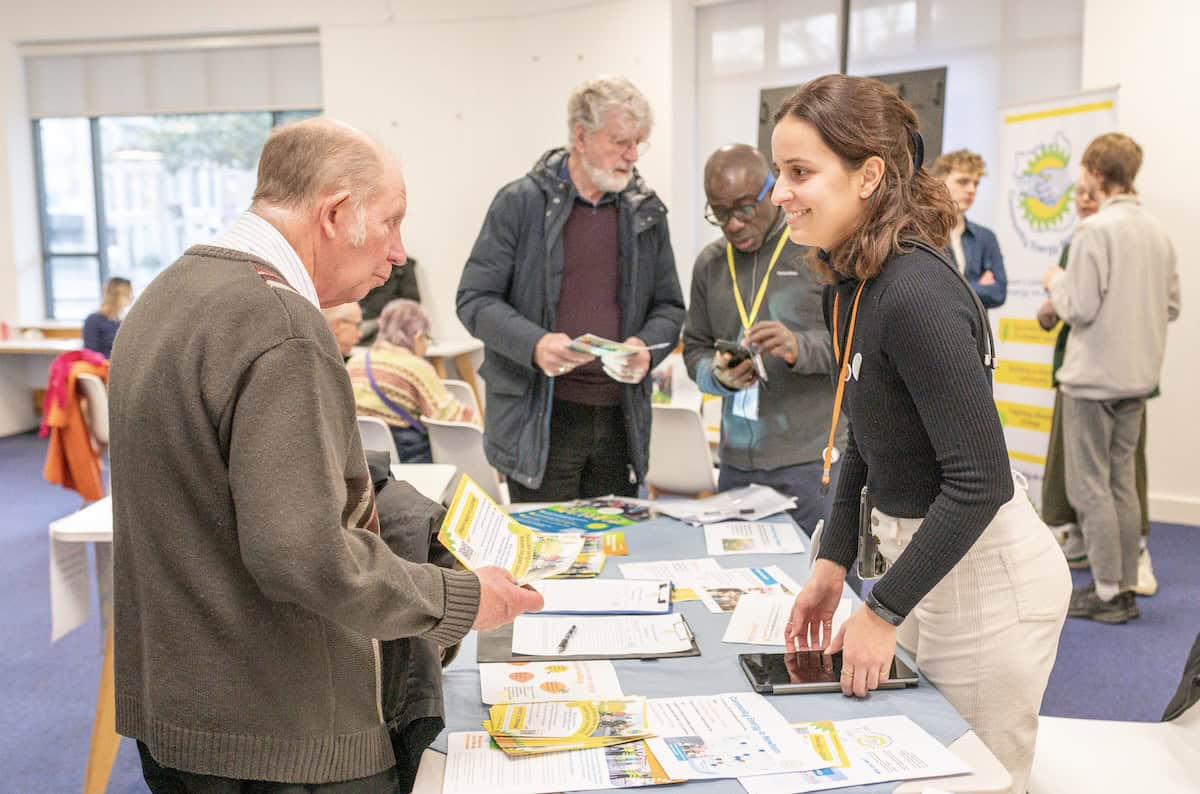
Across the capital, another trailblazer is helping communities access solar power. Repowering London’s schemes range from a pilot supplying local electricity to residents in Brixton, to community-owned solar projects stretching from Lambeth in south London to Barnet in the north. To date, Repowering London has supported 12 local groups across the capital to form community benefit societies – the same co-operative structure that owns Positive News.
One of the most striking is in the borough of Newham, which has one of the highest rates of fuel poverty rates in England. Community Energy Newham has successfully installed solar panels on a number of the borough’s schools and libraries, generating power for pupils and users. It is also working with partners to deliver community-owned heat generation, retrofit support and employment for local people, giving communities the opportunity to own and benefit from their energy systems.
Advertisement
3) OffshoreWind4Kids
Offshore wind is that seemingly rare thing: a British success story. It produces a little under a fifth of the country’s electricity, and as numbers of windfarms grow, not only in the UK but across the world, so do the prospects for more rewarding careers in the sector.
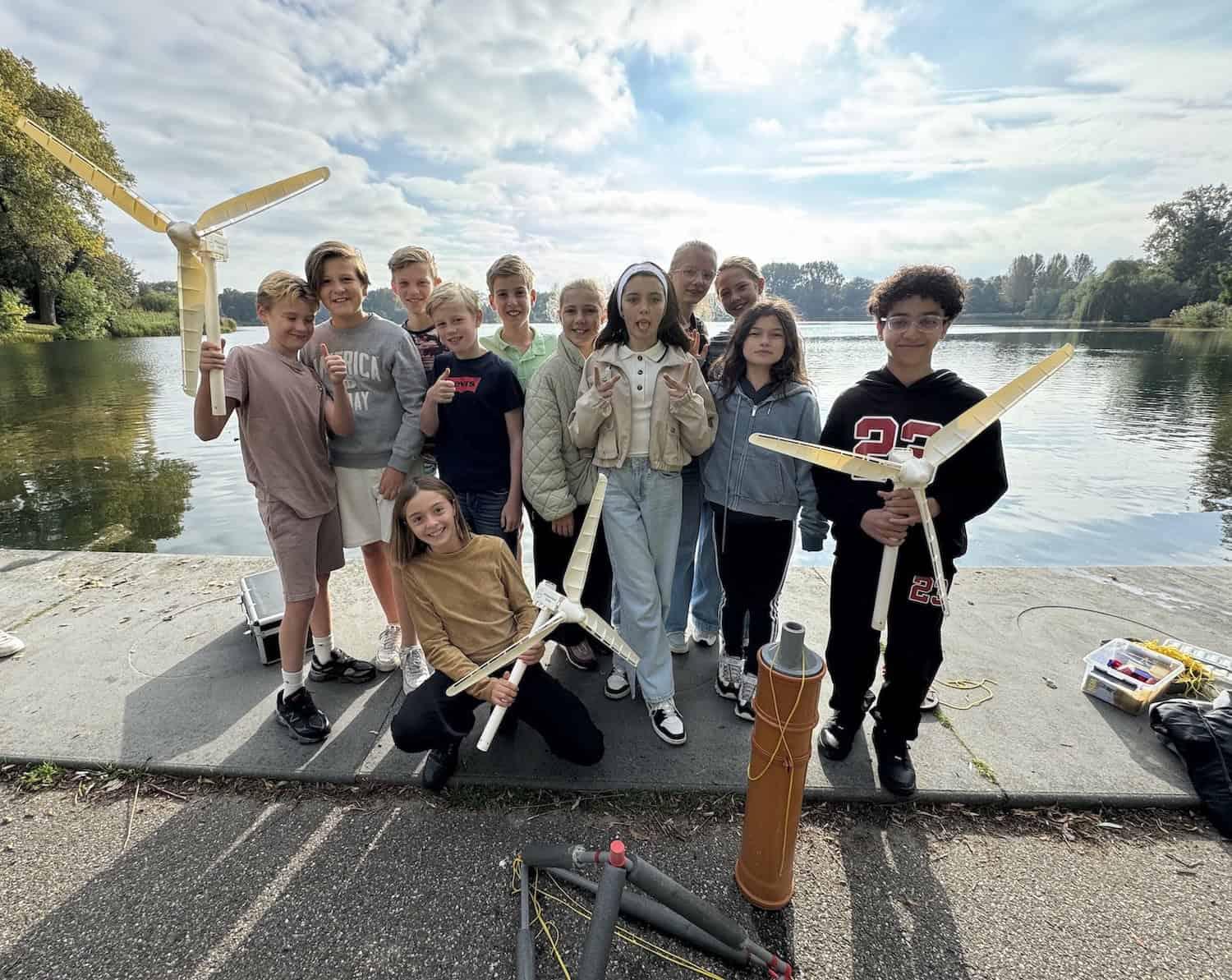
With that in mind, OffshoreWind4Kids is helping children and young people learn all about the technology and its potential, and even have a crack at making their own (scaled down) offshore equipment.
Advertisement
An independent non-profit based in Belgium and supported by the industry, the scheme is now operating across more than 20 countries. Its Floating Wind Challenge, where students compete to design and build the best floating wind support structure, attracts teams from across Asia, Europe and the Americas.
If it included six giant tankers, and warships at the front and back, a convoy could be 12 kilometres (7.5 miles) long given the distance apart which they would be required to keep, explained Prof Clarke, so it would be a very large, slow-moving target for Iranian drones, missiles and fast attack boats.























































You must be logged in to post a comment Login