
Tech
Popular Chrome extension "Save Image as Type" was hijacked, impacting over 1 million users



Google delisted the image conversion tool earlier this month, but not before it had likely been modifying thousands of users’ browsers for several weeks. The group behind the compromise has also been linked to dozens of other hijacked Chrome and Edge extensions.
Read Entire Article
Source link


Viwoods wants you to embrace artificial intelligence with its AiPaper e-reader — but I think it’s actually banking on the wrong features.

Viwoods AiPaper
The e-book reader market is growing, with plenty of companies offering their own takes on the genre.
Some, like most of Boox’s lineup, offer an option that lies somewhere between a Kindle and an iPad. Others, like Durobo’s Krono, want you to focus on portability over all else.
Continue Reading on AppleInsider | Discuss on our Forums

When high school students step into a cybersecurity internship, they enter a field where the stakes are real. The tools, threats and responsibilities extend well beyond the classroom. In rural communities, such opportunities can be transformative — for both learners and the regions working to build a future-ready workforce.
In eastern Alabama, cybersecurity pathways are creating new opportunities for collaboration between educators and employers, reflecting a broader lesson: Workforce development is more impactful when industry helps shape learning early. As cybersecurity threats grow more complex, many employers say preparing future talent does not begin at the point of hiring — it starts earlier, through partnerships connecting classrooms, credentials and real-world experience.
For district leaders and career and technical education (CTE) directors designing career-connected learning, these partnerships can help align instruction with workforce realities while expanding students’ access to high-demand careers.
Industry as a Co-Designer
Cybersecurity is a field that depends on industry insights. The tools and threats defining the work often evolve faster than traditional curriculum cycles, and employers see firsthand how quickly skill requirements change.
Scott Ross, director of information technology at HudsonAlpha Institute for Biotechnology, has seen how quickly the field changes throughout his career. While professional credentials such as Certified Information Systems Security Professional (CISSP) can signal readiness, Ross points to internships and applied experience as equally critical.
“Credentials matter, but they only tell part of the story,” Ross said. “What really prepares students for cybersecurity work is exposure — seeing how systems operate in the real world and understanding the responsibility that comes with protecting them.”
That perspective shapes HudsonAlpha’s engagement with regional education partners. As cybersecurity roles expand across sectors, from defense and healthcare to biotechnology and agriculture, employers are increasingly invested in helping students understand the range of opportunities available and the expectations that come with them.
A Regional Effort Takes Shape
In eastern Alabama, those connections are coordinated through the East Alabama Regional Cybersecurity Alliance (EARCA), a collaboration among K-12 districts, postsecondary institutions and industry partners focused on growing local cybersecurity talent. Rather than operating in isolation, schools and employers are aligning around shared goals: relevant curriculum, meaningful credentials and work-based learning opportunities tied to workforce needs.
Ross sees this regional approach as essential. “Cybersecurity isn’t limited to one industry,” he said. “When education and employers collaborate across sectors, students gain a clearer picture of where these skills apply, and regions build stronger, more adaptable talent pipelines.”
With thousands of unfilled cybersecurity roles in the state, that alignment helps keep learning connected to opportunity.
How Industry Partnerships Shape Learning
For educators, industry engagement can change what is possible inside schools. Tanner Gamble, the computer science and cybersecurity teacher at Childersburg High School in Talladega County, has seen how employer involvement reshapes student motivation and confidence.
“When students know their learning connects directly to real jobs, it changes how they approach the work,” Gamble said. “They’re not just completing assignments; they’re preparing for environments they know they’ll encounter.”
Preparing teachers for industry-aligned instruction is also central to the effort, said Ira Lacy, who trains educators and connects them with employers to support cybersecurity pathways across Alabama.
“When you train teachers using industry practices and give students access to authentic experiences, you start building a pipeline that lasts,” Lacy said. “We’ve seen graduates in North Alabama come back to mentor younger students and invest in their hometowns, and now we’re applying the same approach in eastern Alabama.”
Internships and industry-aligned credentials help validate pathways at the school level by demonstrating clear connections between classroom instruction and real workforce needs.
“Internships and credentials act as the ‘proof of work’ for school cybersecurity programs,” said Hillary Rogers, principal of Childersburg High School. “They bridge the gap between theory and real-world practice, ensuring students aren’t just learning about the digital front lines — they’re equipped to operate in them.”

Learning That Changes Trajectories
That impact is evident in Gavin’s experience, a junior at Childersburg High School who participated in a summer internship with the IT department at Heritage South Credit Union. During the internship, Gavin worked alongside IT staff, troubleshooting real systems, building and maintaining network infrastructure, and learning how access and risk are managed in real-world settings.
The experience opened the door to continued applied learning. Gavin now supports the IT department at Childersburg High School and earned his CompTIA Tech+ certification, an early milestone in a pathway focused on technical skill development and professional responsibility.
“The internship allowed me to start dreaming for myself and what I want my future to look like,” Gavin said. “I’ve always been interested in space, and now I can see different paths, like working in aerospace or eventually leading an IT department near Huntsville.”
For employers and educators, helping students see concrete future pathways is a powerful outcome of early work-based learning.
Why Employers Invest
While not every employer is positioned to host interns, those who engage early gain clearer insight into student readiness and stronger workforce alignment. Early exposure helps employers identify motivated learners and reduce uncertainty in later hiring decisions.
“If we wait until graduation to connect with talent, we’ve missed an opportunity,” Ross said. “Early exposure helps students prepare, and it helps employers build a workforce that understands their needs.”
At a regional level, these investments can contribute to rural economic stability by increasing the likelihood that students will pursue and remain in local careers.
A Blueprint for Other Regions
EARCA is part of broader efforts led by Digital Promise’s Center for Learner Pathway Innovations to develop statewide cybersecurity pathways that connect education and workforce systems. Pathways are strongest when learning, work and community are connected early. For students like Gavin, that collaboration opens doors. For employers, it helps ensure the next generation is ready to meet that demand.

Carl Pei, co-founder and CEO of Nothing, is imagining a future beyond the iPhone — and it’s a device powered by AI agents, not running apps.
“In terms of AI in software, I think people should understand that apps are going to disappear,” said Pei, whose consumer electronics brand makes unique smartphones and other accessories. “So, if you’re a founder or a startup and your app is like where the core value lies, that will be disrupted whether you like it or not.”
Pei made these comments during an interview at the SXSW conference in Austin on Wednesday.
The founder has talked about an AI-first device before, as this vision helped the company close its $200 million Series C funding round last year. At the time, Nothing was pitching the idea of a new kind of smartphone using AI and personalization technology that’s accurate enough for its users to not feel they had to go behind the AI and double-check its output.
At SXSW, Pei expanded on his vision for the AI-first device and the steps needed to get there.
The initial step, which is being tested by some companies today, is an AI feature that can execute a command on the users’ behalf, like booking flights or hotels. Pei, however, dismissed this step as being “super boring.”
The next step is where things could get more interesting, as the AI begins to learn a user’s intentions long-term. For instance, if you wanted to be healthier, the device could give you nudges to help you accomplish your goals.
“I think it gets even more powerful when it starts surfacing suggestions for you; you don’t have to manually come up with an idea…when the system knows us so well, it will come up with things that we don’t even [know] we wanted,” Pei explained, comparing this concept to something like ChatGPT’s memory feature.
In describing how he pictured an AI-first smartphone, Pei said it would be a device that would do things for you without needing to be commanded to.
“The current way we use phones is very old-school. It’s pre-iPhone…there used to be Palm Pilots and PDAs back in the day. And if you think about the user experience, it’s still very similar,” Pei said. “You have lock screens, home screens, apps. You browse different apps. Each app is like a full-screen thing. There’s some kind of app store that allows you to download more apps. So it hasn’t really changed for like, 20 years.”
This frustrated him because the technology consumers are using has evolved quite a bit, but the products we use have not. Even simple tasks have us jumping through multiple steps, he explained.
“It’s very hard to get things done on a phone,” Pei said. “Let’s say we want to grab coffee. That’s an intention. But to execute that intention, we have to go through so many different steps and so many different apps. It’s probably like four apps to grab coffee with somebody — some messaging app, some kind of maps, Uber, calendar.”
He continued: “I think the future of smartphones or operating systems should just be: ‘I know you very well, and if I know your intention, I just do it for you,’ instead of having to go through all the apps manually.”
“It should just do it through AI,” he said.
This also means devices would have an interface that’s not focused on apps for humans to navigate, but would instead feature an interface designed for the AI agent to use.
That doesn’t mean apps are going away in the near-term, Pei cautioned. Nothing’s own operating system even allows users to vibe code their own mini apps today. But eventually, the AI will need to be able to use the “app” in a frictionless way, not trying to mimic human touch on the smartphones by moving through menus and tapping options.
“That’s not the future. The future is not the agent using a human interface. You need to create an interface for the agent to use. I think that’s the more future-proof way of doing it,” Pei said.

If you need a cathartic release from the news that Amazon laid off 16,000 workers, Block chopped nearly half its workforce, Atlassian pared back 10% of staffers, and Meta is reportedly considering another massive round of layoffs, all in the name of AI, then we invite you to browse the responses to a recent Sam Altman post on X.
Altman, the CEO of OpenAI, shared this on Tuesday:
“I have so much gratitude to people who wrote extremely complex software character-by-character. It already feels difficult to remember how much effort it really took. Thank you for getting us to this point.”
The problem with that sweet sentiment is that Altman’s company ushered in the AI now being used as an excuse for developer layoffs and fewer junior developer jobs. And it did so by training on massive volumes of code written the old-fashioned way — by the very people he’s now thanking.
His post implies that developers’ genuinely difficult-to-master craft is now like a rotary telephone: outdated and unnecessary.
Naturally, Altman’s comments attracted memes and responses richer than his post. While some were straight-up angry, (“You’re welcome. Nice to know that our reward is our jobs being taken away”), much of the internet did what it always does: cracked jokes.
There are thousands of comments. Some of our favorites:
Techcrunch event
San Francisco, CA
|
October 13-15, 2026
“Sam’s eulogy for software engineers”
“It’s times like this when I really miss the Sam Altman parody account”
“Dear devs You will lose your jobs forever and be forced to work in the coal mines But you can rest easy knowing sam Altman is grateful. ❤️ 🙏”
“Billion dollar app idea: AI that reads billionaire tweets before they post them and says ‘this is going to make you sound incredibly out of touch, are you sure?’”
“I have gratitude to OpenAI for doing all the AI work so I can have free Chinese open source AI models to use 🙏”
“This reads like something the Mayans would say right before the ceremony starts.”
And finally, another reason to trot out this meme:
Tech
Xiaomi stuns with new MiMo-V2-Pro LLM nearing GPT-5.2, Opus 4.6 performance at a fraction of the cost
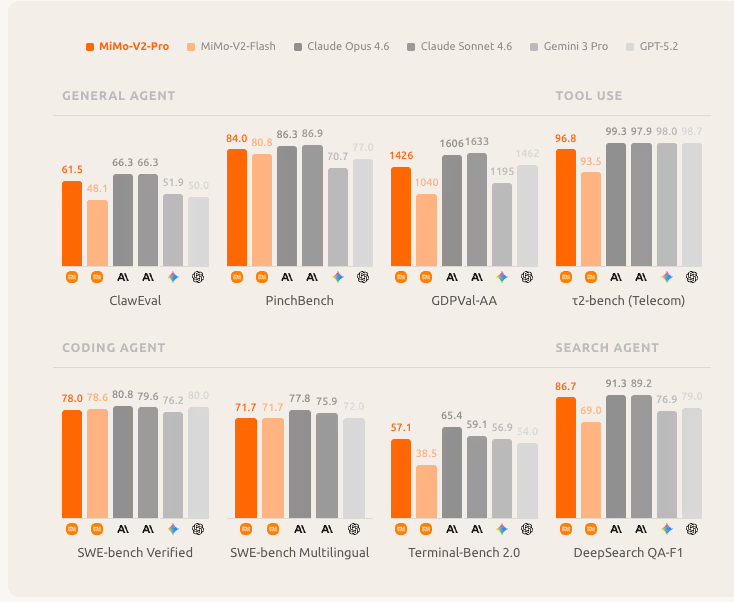
Chinese electronics and car manufacturer Xiaomi surprised the global AI community today with the release of MiMo-V2-Pro, a new 1-trillion parameter foundation model with benchmarks approaching those of U.S. AI giants OpenAI and Anthropic, but at around a seventh or sixth the cost when accessed over proprietary API — and importantly, sending less than 256,000 tokens-worth of information back and forth.
Led by Fuli Luo, a veteran of the disruptive DeepSeek R1 project, the release represents what Luo characterizes as a “quiet ambush” on the global frontier. Furthermore, Luo stated in an X post that the company does plan to open source a model variant from this latest release, ” when the models are stable enough to deserve it.”
By focusing on the “action space” of intelligence—moving from code generation to the autonomous operation of digital “claws”—Xiaomi is attempting to leapfrog the conversational paradigm entirely.
Prior to this foray into frontier AI, Beijing-based Xiaomi established itself as a titan of “The Internet of Things” and consumer hardware.
Globally recognized as the world’s third-largest smartphone manufacturer, Xiaomi spent the early 2020s executing a high-stakes entry into the automotive sector. Its electric vehicles (EVs), such as the SU7 and the recently launched YU7 SUV, have turned the company into a vertically integrated powerhouse capable of merging hardware, software, and now, advanced reasoning.
This pedigree in physical-world engineering informs MiMo-V2-Pro’s architecture; it is built to be the “brain” of complex systems, whether those systems are managing global supply chains or navigating the intricate scaffolds of an autonomous coding agent.
Technology: The architecture of agency
The central challenge of the “Agent Era” is maintaining high-fidelity reasoning over massive spans of data without incurring a prohibitive “intelligence tax” in latency or cost. MiMo-V2-Pro addresses this through a sparse architecture: while it houses 1T total parameters, only 42B are active during any single forward pass, making it roughly three times the size of its predecessor, MiMo-V2-Flash.
The model’s efficiency is rooted in an evolved Hybrid Attention mechanism. Standard transformers typically face a quadratic increase in compute requirements as context grows; MiMo-V2-Pro utilizes a 7:1 hybrid ratio (increased from 5:1 in the Flash version) to manage its massive 1M-token context window. This architectural choice allows the model to maintain a deep “memory” of long-running tasks without the performance degradation usually seen in frontier models.
The analogy: Think of the model not as a student reading a book page-by-page, but as an expert researcher in a vast library. The 7:1 ratio allows the model to “skim” 85% of the data for context while applying high-density attention to the 15% most relevant to the task at hand.
This is paired with a lightweight Multi-Token Prediction (MTP) layer, which allows the model to anticipate and generate multiple tokens simultaneously, drastically reducing the latency required for the “thinking” phases of agentic workflows. According to Luo, these structural decisions were made months in advance, specifically to provide a “structural advantage” for the unexpected speed at which the industry shifted toward agents.
Product and benchmarking: A third-party reality check

Xiaomi’s internal data paints a picture of a model that excels in “real-world” tasks over synthetic benchmarks. On GDPval-AA, a benchmark measuring performance on agentic real-world work tasks, MiMo-V2-Pro achieved an Elo of 1426, placing it ahead of major Chinese peers like GLM-5 (1406) and Kimi K2.5 (1283).
While it still trails Western “max effort” models like Claude Sonnet 4.6 (1633) in raw Elo, it represents the highest recorded performance for a Chinese-origin model in this category.
The third-party benchmarking organization Artificial Analysis verified these claims, placing MiMo-V2-Pro at #10 on its global Intelligence Index with a score of 49. This places it in the same tier as GPT-5.2 Codex and ahead of Grok 4.20 Beta. These results suggest that Xiaomi has successfully built a model capable of the high-level reasoning required for engineering and production tasks.

Key metrics from Artificial Analysis highlight a significant leap over the previous open-weights version, MiMo-V2-Flash (which scored 41):
-
Hallucination rate: The Pro model reduced hallucination rates to 30%, a sharp improvement over the Flash model’s 48%.
-
Omniscience index: It scored a +5, placing it ahead of GLM-5 (+2) and Kimi K2.5 (-8).
-
Token efficiency: To run the entire Intelligence Index, MiMo-V2-Pro required only 77M output tokens, significantly less than GLM-5 (109M) or Kimi K2.5 (89M), indicating a more concise and efficient reasoning process.
Xiaomi’s own charts further emphasize its “General Agent” and “Coding Agent” capabilities. On ClawEval, a benchmark for agentic scaffolds, the model scored 61.5, approaching the performance of Claude Opus 4.6 (66.3) and significantly outpacing GPT-5.2 (50.0). In coding-specific environments like Terminal-Bench 2.0, it achieved an 86.7, suggesting high reliability when executing commands in a live terminal environment.
How enterprises should evaluate MiMo-V2-Pro for usage
For the personas outlined in contemporary AI organizations—from Infrastructure to Security—MiMo-V2-Pro represents a paradigm shift in the “Price-Quality” curve.
Infrastructure decision-makers will find MiMo-V2-Pro a compelling candidate for the Pareto frontier of intelligence vs. cost. Artificial Analysis reported that running their index cost only $348 for MiMo-V2-Pro, compared to $2,304 for GPT-5.2 and $2,486 for Claude Opus 4.6.
For organizations managing GPU clusters or procurement, the ability to access top-10 global intelligence at roughly 1/7th the cost of Western incumbents is a powerful incentive for production-scale testing.
Data decision-makers can leverage the 1M context window for RAG-ready architectures, allowing them to feed entire enterprise codebases or documentation sets into a single prompt without the fragmentation required by smaller context models.
A systems/orchestration decision-maker should evaluate MiMo-V2-Pro as a primary “brain” for multi-agent coordination. Because the model is optimized for OpenClaw and Claude Code, it can handle long-horizon planning and precise tool use without the constant human intervention that plagues earlier models.
Its high ranking in GDPval-AA suggests it is particularly well-suited for the workflow and orchestration layer needed to scale AI across the enterprise. It allows for the creation of systems that can move beyond simple automation into complex, multi-step problem solving.
However, security decision-makers must exercise caution. The very “agentic” nature that makes the model powerful—its ability to use terminals and manipulate files—increases the surface area for prompt injection and unauthorized model access.
While its low hallucination rate (30%) is a defensive boon, the lack of public weights (unlike the Flash version) means internal security teams cannot perform the deep “model-level” audits sometimes required for highly sensitive deployments. Any enterprise implementation must be accompanied by robust monitoring and auditability protocols.
Pricing, availability, and the path forward
Xiaomi has priced MiMo-V2-Pro to dominate the developer market. The pricing is tiered based on context usage, with competitive rates for caching to support high-frequency reasoning tasks.
-
MiMo-V2-Pro (up to 256K): $1 per 1M input tokens and $3 per 1M output tokens
-
MiMo-V2-Pro (256K-1M): $2 per 1M input tokens and $6 per 1M output tokens
-
Cache read: $0.20 per 1M tokens for the lower tier and $0.40 for the higher tier
-
Cache write: Temporarily free ($0)
Here’s how it stacks up to other leading frontier models around the world:
This aggressive positioning is designed to encourage the high-intensity application flows that define the next generation of software. The model is currently available via Xiaomi’s first-party API only, with no current support for image or multimodal input—a notable omission in an era of “Omni” models, though Xiaomi has teased a separate MiMo-V2-Omni for those needs.
The “Hunter Alpha” period on OpenRouter proved that the market has a high appetite for this specific blend of efficiency and reasoning. Fuli Luo’s philosophy—that research velocity is fueled by a “genuine love for the world you’re building for”—has resulted in a model that ranks 2nd in China and 8th worldwide on established intelligence indices.
Whether it remains a “quiet” ambush or becomes the foundation for a global realignment of AI power depends on how quickly developers adopt the “action space” over the “chat window”. For now, Xiaomi has moved the goalposts: the question is no longer just “can it talk?” but “can it act?”

If you’re hunting for a new vacuum, Dyson has surely come up in one way or another. The brand is famous for its powerful vacuum cleaners, but its air power also extends to other parts of the home, including hair care and air purification. It’s a dream household staple; I lugged around an old Dyson vacuum for years until I could upgrade to one of the newer stick models rather than buying something that wouldn’t be as powerful or last as long.
But the cost can make it a hard investment to make, even if it’s worth it. If you’re shopping for one of Dyson’s long-lasting gadgets but have a limited budget, fear not: we’ve got coupon codes to make it a better buy, plus tips on how to get discounts on Dyson’s website. Read on to get all of our Dyson promo codes and coupons, and learn the best ways to shop for a Dyson.
Get a 15% Off Dyson Promo Code When You Register
Usually, you need to be a new customer to get a great discount, but Dyson actually rewards you for being a repeat customer. You can get 15% off your next order by registering your current Dyson product’s serial number.
Sign Up to Unlock a 10% Off Dyson Coupon Code
You can also get 10 percent off your next Dyson purchase without needing a device to register. You’ll want to sign up your mobile number using a pop-up on Dyson’s homepage. That will get you a text, and you’ll have to reply with “Y” to officially register. After you reply, you’ll get a message with a link that will reveal a single-use code for 10 percent off your next purchase at Dyson.
You can also sign up for texts or Dyson’s email newsletters (like this hair care newsletter) to get access to exclusive Dyson sale events, more coupon codes, and new product releases (and several new vacuums are due out this year).
Save up to $600 With This Week’s Dyson Coupons
Dyson always has sales going on its website at the Dyson Deals Hub. The discounts rotate weekly, and there’s always different active coupons in different categories of Dyson products. You might find a nice discount on the V12 vacuum, for instance, or the Dyson Airstrait.
Save 30% When You Shop the Dyson Outlet
Looking for a bigger discount? Try Dyson’s outlet of refurbished vacuums, hair tools, and air purifiers. Youl’l find discounts of up to 30 percent off the original price, and each one is inspected, restored to like-new condition, and backed by Dyson’s official warranty. It’s a good way to get a great discount on products like the Supersonic hair dryers, which you can find for under $200 when refurbished, and Dyson’s multi-stylers can be found for under $300. These do have a shorter warranty period than new products, though; it’ll only be six months to a year rather than two to five years.
Dyson Discount: 20% Off
During the Dyson owner savings event, Dyson owners get rewarded by getting 20% off Dyson technology purchases. When you choose one of the qualifying floorcare or air purifiers, you’ll add your one-time-use code at the payment section when you checkout online at Dyson. Or if you’d rather, you can simply log in and your Dyson discount will automatically be applied at checkout. Plus, if you’d rather, you can also shop at your nearest Dyson Demo Store or make a purchase over the phone. And if you don’t have a Dyson discount code automatically, you can register your machine by calling 1-866-693-9766 to speak to a Dyson expert about Owner Rewards.

Google and cybersecurity companies Lookout and iVerify have detailed a new hacking technique that potentially puts a significant portion of iPhone users in danger, just by visiting the wrong web page. The hack is called “DarkSword” and since it specifically targets several different versions of iOS 18, it could affect “close to a quarter of iPhones,” Wired writes.
DarkSword is a “fileless” hack that leverages a collection of exploits to access sensitive data when an iPhone visits an infected website. Rather than install spyware that hangs around on a user’s phone after messages and other private information are stolen, fileless hacks like DarkSword take control of “the legitimate processes in an iPhone’s operating system to steal data,” according to Wired. Even more troubling, DarkSword deletes any evidence it was running on an iPhone after it finishes stealing your information.
The hack starts as soon as an iOS device encounters an “malicious iframe embedded in a web page,” after which it works its way through your iPhone, gathering sensitive information like passwords before deleting itself. DarkSword can abscond with things like messages and iCloud content, but it’s also specifically designed to access crypto currency wallets, Lookout says, which could indicate who was using DarkSword before it became widely available.
DarkSword has reportedly been used in Ukraine, Saudi Arabia, Malaysia, Turkey and Russia, and its origins could be tied to a different hacking toolkit called Coruna that TechCrunch reports may have been created for the US government by a company called Trenchant. Regardless of where DarkSword came from, the tool didn’t become widely available until its Russian users left DarkSword’s source code on a website for anyone to access, “complete with explanatory comments in English that describe each component and include the ‘DarkSword’ name for the tool,” Wired writes.
Apple patched the exploits that DarkSword and Coruna used in recent updates to iOS 26, the yearly software release from 2025 that followed iOS 18. The problem is that not everyone is using Apple’s latest update. DarkSword targets iOS 18 releases between iOS 18.4 and iOS 18.6.2, and according to Apple’s latest iOS usage stats for developers, around 24 percent of iOS devices are still on iOS 18. Without more detail, it’s hard to know how many people that leaves exposed, but as a rule of thumb, if your iOS device can update to a newer software release, you should do so as soon as possible to stay secure.

With today’s latest Stitch updates, Google is trying to make “vibe design” happen, reports The Verge’s Jay Peters. The AI-native design platform encourages users to describe goals, feelings, or inspiration in “natural language,” rather than starting with traditional blueprints.
In a blog post, Google Labs Product Manager Rustin Banks says that Stitch can turn those inputs into interactive prototypes, automatically map user flows, and support real-time iteration. It introduces voice capabilities that allow users to “speak directly to [the] canvas” for feedback or changes. Tools like DESIGN.md also help users create reusable design systems across various projects.


The Boeing KC-135 Stratotanker is a widely used aerial refueling plane that’s been in continuous service with the United States Air Force for over 60 years. The Stratotanker looks a lot like a Boeing passenger plane, and its set of CFM 56 engines are identical to what powers a 737. But the development of the Stratotanker is more of a case of divergent evolution than militarizing a passenger plane.
 Alex Hevesy/SlashGear
In 1954, Boeing was developing the 367-80 prototype that, if you see it in person at the Air and Space Museum’s Udvar-Hazy Center (like I have), looks a lot like a modern airliner. Boeing had a dual-purpose with what would be called the “Dash 80.” Not even a decade after World War II ended and in the thick of the Cold War, Boeing first showed the Dash 80 to military personnel, and then to the air travel business.
To the businesspeople in charge of the airlines the Dash 80 was impressive. Boeing would eventually develop the prototype into the Boeing 707, a legend in aviation history.
The sales pitch worked

The military was also impressed. 29 aircraft that would eventually become KC-135s were ordered that year in 1954. 732 Stratotankers would eventually leave the assembly line. The Air Force wanted the Dash 80 widened by a foot to accommodate more flexibility as both a tanker and transport aircraft. In 1955, as the Dash 80 was getting shown to the world, test pilot Tex Johnston managed to perform a few barrel rolls in the prototype to get more buyers hyped and to show off what the plane was capable of.
The rest, as they say, is history. 72 years later and the Air Force and Air National Guard are flying the cousin of one of the first ever jet airliners. The current iteration of Stratotanker is a bit different. Namely, it is much more powerful at 86,536 pounds of thrust compared to the Dash 80’s 40,000, and the avionics are firmly in the 21st century, given the Stratotanker’s sometimes dual role as a command center or reconnaissance plane.

Convenience — that’s the whole pitch. A well-built horoscope platform can cut out the noise of scattered websites, manual bookings, and messy screenshot folders, putting your daily ritual right where you need it most. A 2025 Pew Research Center report found that 3 in 10 U.S. adults engage with star-sign guidance at least yearly, though most say they do so mainly for fun rather than for major life decisions.
That distinction matters more than people give it credit for. The most useful tools work best as prompts for self-reflection, scheduling sessions, tracking themes, or anchoring a daily ritual — not as replacements for professional support, and definitely not as certainty machines.
Quick take: A good horoscope platform saves time, centralises your cosmic check-ins, and makes it effortless to stay consistent. A poor one drowns you in generic output, aggressive upsells, vague predictions, or subscription terms that were clearly written to confuse.
What These Platforms Actually Make Easier
The biggest win is convenience — full stop. Instead of bouncing between scattered sites, old screenshots, and manually scheduled calls, everything lives in one place: birth-chart details, daily summaries, personal notes, consultations.
Honestly, for a lot of readers, the practical payoff isn’t “knowing the future.” It’s having a structured nudge for reflection — a recurring habit, a simple way to think through mood, timing, and priorities alongside tools like journaling apps for self-reflection.
What that usually looks like in practice:
- Daily check-ins: short horoscope summaries, transit alerts, or reminders
- Faster access to live sessions, especially via chat, call, or appointment booking
- One dashboard for birth details, saved reports, payment history, and past consultations
- Variety — because some services mix cosmic guidance with tarot, numerology, or reflection prompts
Primary Functions That Matter Most
Not every platform is built the same way, so separating genuinely useful capabilities from filler saves a lot of frustration later. These are the ones that tend to make or break the experience.
1. Birth-chart setup
Most platforms start by asking for your birth date, time, and place. That’s standard. When the service supports deeper chart-based work, that initial setup usually shapes how personalised everything feels going forward.
2. Daily or weekly material
This is what most casual users care about first — no two ways about it. A well-designed platform makes short updates easy to skim while still giving enough context for people who want more than one-liners.
3. Live consultation options
Some services include live chat with an astrologer, voice calls, or bookable sessions with practitioners. That’s genuinely useful if you’d rather get a direct answer than wade through a general library. Honestly, that alone makes it worth trying for a lot of people.
4. Saved history and notes
Good tools reduce friction by keeping previous sessions, favourite practitioners, and your record of past interactions in one spot. Jumping between messages, old screenshots, and scattered websites? Nobody’s got time for that.
5. In-app learning material
Some platforms also publish explainers, FAQs, and introductory guides. When done well, this helps beginners understand chart terminology, compatibility language, and why personalised sessions feel so different from the generic daily stuff.
Before installing anything, check the Google Play Data safety section if you’re on Android — then compare it with the privacy language inside the listing itself. This site’s guide to how to choose safe mobile apps is worth reading before committing to any paid service.
Busy schedule, phone in hand, no interest in travelling anywhere — this format just fits. People who live far from in-person practitioners, or who prefer handling everything digitally, tend to get the most out of it.
Does your goal lean more toward regular reflection than constant prediction? Pairing one of these platforms with habits from digital wellbeing and screen-time guides keeps the whole thing purposeful rather than obsessive.
Good signs you’ll get real value from one:
- Quick access during a commute, break, or evening wind-down
- Wanting written summaries before deciding whether to book a live session
- Comparing styles — chart-based depth versus short daily prompts
- Keeping everything (reminders, personal notes, saved reports) in one spot
Where They Fall Short
Consistency is the problem. Some platforms deliver thoughtful, well-structured material; others recycle copy, lean on weak personalisation, or push pressure-based upsells until you want to throw your phone across the room.
They’re also a poor match if you want strictly evidence-based planning. Treating these tools as reflective prompts — rather than substitutes for financial, medical, legal, or mental-health guidance — keeps expectations somewhere realistic.
Then there’s the overuse issue. If checking in starts making you delay decisions, second-guess perfectly normal plans, or feel more anxious than settled, stepping back makes sense. Lighter alternatives like mood tracking or simple diary tools might serve you better at that point.
How to Choose the Right Platform
Branding doesn’t matter nearly as much as fit. Start with the workflow you actually want, then judge the service against privacy, cost, clarity, and usability.
Android users should keep Google Play Protect enabled and avoid sideloading unknown packages just to access premium tiers. If a service asks for broad permissions that don’t match its core function, review those carefully against your own standards for understanding app permissions on phones.
Simple decision tree
Run through these before downloading anything:
- Only want a daily check-in? Go lightweight — clear free options, minimal notifications
- Want detailed sessions? Prioritise chart depth, readable reports, and transparent pricing
- Want live consultations? Check availability windows, session length, refund rules, and whether practitioner profiles feel specific rather than generic
- Privacy matters more than variety? Pick the platform with the clearest data disclosures and the smallest permission footprint
Implementation Checklist Before You Pay
Read the free experience first — before starting any trial.
- Check how often the platform pushes upgrades or timed offers
- Review the listing for data handling, permissions, and support options
- Confirm whether charges are per session, monthly, or tied to in-app credits
- Look for a visible cancellation path before subscribing
- Save receipts and session history if you plan to compare value over time
Cost, Privacy, and Trust Trade-Offs
Free tiers often feel convenient at first. But they tend to hide the best material behind subscriptions, per-minute calls, or in-app credits. That doesn’t automatically make them bad — it just means judging value based on how often you’ll genuinely use the service.
On iPhone, Apple explains that users can manage or cancel eligible subscriptions through account subscription settings, which is worth reviewing before starting any trial that renews automatically. If the charge runs through a third-party provider rather than Apple, the cancellation path may differ — so read the billing terms carefully before you commit.
Troubleshooting Common Frustrations
The sessions feel too generic
Try a different platform style. Some services are built for broad daily material; others focus on chart-based depth or live practitioner access. Worth shopping around.
The platform is useful but too distracting
Cut notifications, remove widget clutter, and limit usage to one daily check-in. The goal should be clarity — not constant interruption.
You’re unsure whether a paid plan is worth it
Stick with the free tier for at least a week or two, then honestly compare what you actually used against what the subscription adds. Simple as that.
You’re worried about privacy
Re-check the listing, permissions, and account settings. If the data request feels excessive for a horoscope service, skip it and pick something simpler.
Skip it entirely if you want strictly evidence-based planning with zero interpretive layer. Smart move, too, to avoid these platforms when they increase anxiety, drive impulsive spending, or start replacing your own judgement in decisions that need qualified professional help.
Key Takeaways
- These platforms work best as convenience tools for reflection, routine, and easier access
- The right pick depends on whether you want quick daily material, deeper chart interpretation, or live sessions
- Privacy checks, subscription terms, and permission requests matter as much as the sessions themselves
- If a platform adds pressure, confusion, or overspending, it’s the wrong fit — no matter how polished it looks
FAQ
Are astrology apps accurate?
Depends what you mean by accurate. As a reflective tool or themed guide, some users find real value in them; as a certainty machine, the experience is likely to disappoint.
Do I need my exact birth time?
For chart-based functions, an exact or near-exact time can matter. For simple daily horoscope use, it’s often less critical.
Are free tiers enough?
They can be, especially if you only want short daily material. Paid plans make more sense when you genuinely use deeper reports or live sessions.
Can these platforms replace an in-person astrologer?
For convenience, sometimes yes. For depth, it depends on whether the service offers strong practitioner access — and whether you actually prefer digital communication.
How do I know if a horoscope service is safe?
Check the listing, privacy disclosures, permissions, billing terms, and support options before installing or paying.
Do these platforms usually include more than horoscopes?
Some do. Combinations like tarot, numerology, compatibility tools, or general self-reflection prompts aren’t unusual.
What’s the biggest red flag?
Vague material paired with aggressive upsells. If a platform keeps pushing urgency, extra credits, or murky renewals — move on.
Can I cancel a subscription easily?
Usually, but the exact process depends on whether billing runs through Apple, Google Play, or the provider directly. Always check that before starting a trial.

9 Episodes After Ulster’s Death, ‘Will Trent’ Has Officially Found Its Next Great Villain

Messi to lead Argentina in Guatemala friendly before 2026 FIFA World Cup | Football News

Tehran intensifies attacks on Gulf energy facilities after Israel hits Iranian gas field


-
 Crypto World5 days ago
HYPE Token Enters Net Deflation as HyperCore Buybacks Outpace Staking Rewards
-

 Tech3 days ago
Your Legally Registered ‘Motorcycle’ Might Not Count Under Proposed US Law
-

 Fashion6 days ago
Weekend Open Thread: Addict Lip Glow
-
 Tech2 days ago
Are Split Spacebars the Next Big Gaming Keyboard Trend?
-
Sports5 days ago
Why Duke and Michigan Are Dead Even Entering Selection Sunday
-

 Business4 days ago
Search for Savannah Guthrie’s Mother Enters Seventh Week with No Arrests
-

 Business5 days ago
US Airports Launch Donation Drives for Unpaid TSA Workers as Partial Government Shutdown Enters Fifth Week
-
Crypto World5 days ago
Coinbase and Bybit in Investment Talks: Could Bybit Finally Enter the US Crypto Market?
-

 Business3 days ago
Australian shares drop as Iran war enters third week
-

 Business5 days ago
Country star Brantley Gilbert enters growing non-alcoholic beer market
-

 Crypto World3 days ago
Crypto Lender BlockFills Enters Chapter 11 with Up to $500M in Liabilities
-

 Sports5 days ago
College Basketball Best Bets: Conference Tournament Semifinal Picks
-

 Politics22 hours ago
The House | The new register to protect children from their abusers shows Parliament at its best
-

 Business6 days ago
Trump demands Powell cut rates as Iran conflict raises energy prices
-

 Fashion3 days ago
25 Celebrities with Curly Hair That Are Naturally Beautiful
-

 News Videos14 hours ago
RBA board divided on rate cut, unusually buoyant share market | Finance Report | ABC NEWS
-

 Crypto World6 days ago
Senate Votes to Include CBDC Ban in Bipartisan Housing Bill
-

 NewsBeat6 days ago
Deane Road crash near Bolton colleges and university
-

 News Videos6 days ago
Tom Lee: The 100x Opportunity EVEN Bigger Than Bitcoin (New Ethereum Prediction 2026)
-

 Crypto World14 hours ago
Canada’s FINTRAC revokes registrations of 23 crypto MSBs in AML crackdown


You must be logged in to post a comment Login