
Crypto World
Hive Digital reaches AI cloud milestone in Paraguay


Hive Digital Technologies announces an AI cloud milestone in Paraguay, describing the development as a step in expanding its cloud capabilities for AI and research. The notice also references Columbia University LLM research spanning New York to Asuncion, indicating the initiative may involve cross-border collaboration or access to regional compute resources. While the full details are not included here, the announcement highlights a shift in the company’s cloud footprint in an important Latin American market. Readers should watch for additional disclosures on scope, participants, and practical implications as the company provides more specifics.
Key points
- AI cloud milestone reached in Paraguay, as described by the company.
- Release references Columbia University LLM research connecting New York and Asuncion.
- Statement implies cross-border compute resources linked to AI research.
Why it matters
The milestone matters because it signals progress in cloud-enabled AI and potential regional access for researchers and institutions. If the initiative enables cross-border collaboration with Columbia University, it could influence how researchers plan experiments, require infrastructure, and coordinate efforts across North and South America. The public details are limited, but the move may shape attention on AI cloud deployments in Latin America and may guide investors and developers monitoring compute availability and academic partnerships in the region.
What to watch
- Clarification of the milestone’s scope, including services and capacity.
- Any partners or institutions involved beyond Columbia University.
- Upcoming disclosures or timelines for broader availability.
Disclosure: The content below is a press release provided by the company or its PR representative. It is published for informational purposes.
HIVE Digital Technologies Reaches AI Cloud Milestone in Paraguay, Powers Columbia University LLM Research from New York to Asunción
This news release constitutes a “designated news release” for the purposes of the Company’s prospectus supplement dated November 25, 2025 to its short form base shelf prospectus dated October 31, 2025.
San Antonio, Texas, March 18, 2026 — HIVE Digital Technologies Ltd. (TSX.V: HIVE) (Nasdaq: HIVE) (FSE: YO0) (BVC: HIVECO) (the “Company” or “HIVE”), a global leader in sustainable digital infrastructure and AI compute, today announced that its BUZZ AI Cloud platform in Asunción, Paraguay is now operational with live GPU compute nodes serving workloads on the platform by an academic research team from Columbia University in New York.
The Asunción deployment is the first GPU cluster to go live under HIVE’s phased strategy to layer AI and high-performance computing (“HPC”) infrastructure onto its existing renewable energy footprint in Paraguay. The cluster is hosted within a Tier-III data center operated by Paraguay’s largest telecommunications provider and is purpose-built to handle AI model training, inference, and computationally intensive research workloads.
HIVE expects to use the results of the cluster to establish the proof of concept for AI compute between New York and Asuncion. From this proof-of-concept, the Company expects to build future Tier III data center capacity in Yguazú, with infrastructure upgrades required to provide high-availability, low-latency GPU AI cloud compute from Paraguay. Paraguay’s hydroelectric generation capacity and the telecom partner’s nationwide fiber backbone provide the energy and connectivity foundation to support that growth. As regional South American institutional and commercial demand for HPC and AI Cloud develops, the pace and scale of the Company’s Tier III expansion in Paraguay will be guided by customer adoption and the Company’s capital position.
Columbia University Research Team Goes Live on BUZZ Cloud
The Columbia University team is using BUZZ Cloud GPU infrastructure to conduct research focused on large language model (“LLM”) pre-training, including end-to-end training of foundation models. The research team’s use of BUZZ Cloud infrastructure is a non-commercial research engagement intended to generate performance data that will inform the Company’s roadmap for scaling commercial HPC capacity in Paraguay. The team is developing optimization algorithms that improve model quality while reducing computational and memory costs, evaluating their methods using standard training metrics such as loss and perplexity, as well as downstream benchmarks.
Their work begins with small- to medium-scale models (0.2B to 2B parameters, including GPT-2-class and LLaMA-style architectures) and is scaling to larger models (8B+ parameters) using multi-GPU distributed training frameworks. The team’s recent focus includes improving and understanding Muon and MuonClip, the latter of which has been used in training industry-level LLMs such as Kimi K2. In early experiments, Muon has shown roughly 1.3x greater efficiency¹ than standard baselines by exploiting the structure of model weights. The team’s LLM reasoning research was recently accepted for publication by Transactions on Machine Learning Research (“TMLR”), a peer-reviewed journal hosted by the Journal of Machine Learning Research (“JMLR”).
Having the Columbia University research team run active LLM training jobs from New York on GPU infrastructure in Asunción provides HIVE with real-world performance data across latency, throughput, and workload management. The Company intends to use these findings to shape its roadmap for scaling HPC capacity in Paraguay, with initial deployment targets through 2027.
Paraguay: The Western Hemisphere’s Next Potential AI Infrastructure Frontier
Paraguay’s President Santiago Peña earned his Master’s degree in Public Administration from Columbia’s School of International and Public Affairs (“SIPA”) in 2003, creating a notable link between the institution whose researchers are now training LLMs on BUZZ Cloud and the nation whose clean energy powers it.
Management believes large-scale AI compute requires two resources Paraguay can deliver in abundance: reliable, low-cost electricity and fiber connectivity with the bandwidth and security to move data across long distances without degradation. HIVE’s existing 300-megawatt (“MW”) renewable power base, sourced from hydroelectric generation, combined with the telecom partner’s enterprise-grade network infrastructure, creates a platform that can serve demanding workloads originating outside Paraguay’s borders, including from North American institutional clients.
Paraguay’s economy has posted strong growth in recent quarters, backed by stable governance and a policy environment that has welcomed foreign infrastructure investment. HIVE believes those conditions, paired with the country’s distinctive energy profile and expanding digital connectivity, position the country to play a growing role in South America’s AI and high-performance computing future.
Strategic Outlook from HIVE Leadership
Frank Holmes, Executive Chairman of HIVE, stated, “HIVE has 300 MW of renewable hydroelectric power operational in Paraguay, with another 100 MW in development. Before scaling an AI factory, it’s prudent to beta test. This deployment marks our first live GPU compute workload in Asuncion and provides the real-world performance data we need to guide our Tier-III expansion roadmap. We started in Paraguay with Bitcoin mining. Layering AI and HPC infrastructure onto that existing energy base is the next phase, and this cluster is the first step in validating that approach.”
Aydin Kilic, President and CEO of HIVE, added, “We are taking a meaningful and impactful approach to developing a solution to being a leader of GPU AI compute and HPC in South America. Having a research team from Columbia University running LLM training workloads on HIVE’s BUZZ Cloud infrastructure in Asunción is a powerful validation of what we are building. We will use this data to validate our proof of concept for GPU Cloud AI compute from New York to Asunción and to build our roadmap for large-scale HPC capacity in Paraguay by 2027.”
About HIVE Digital Technologies Ltd.
Founded in 2017, HIVE Digital Technologies Ltd. is the first publicly listed company to mine digital assets powered by green energy. Today, HIVE builds and operates next-generation Tier-I and Tier-III data centers across Canada, Sweden, and Paraguay, serving both Bitcoin and high-performance computing clients. HIVE’s twin-turbo engine infrastructure-driven by hashrate services and GPU-accelerated AI computing-delivers scalable, environmentally responsible solutions for the digital economy.
For more information, visit hivedigitaltech.com, or connect with us on:
X: https://x.com/HIVEDigitalTech
YouTube: https://www.youtube.com/@HIVEDigitalTech
Instagram: https://www.instagram.com/hivedigitaltechnologies/
LinkedIn: https://linkedin.com/company/hiveblockchain
On Behalf of HIVE Digital Technologies Ltd.
“Frank Holmes”
Executive Chairman
For further information, please contact:
Nathan Fast, Director of Marketing and Branding
Frank Holmes, Executive Chairman
Aydin Kilic, President & CEO
Tel: (604) 664-1078
¹ Claim of efficiency relates to research methods
Neither the TSX Venture Exchange nor its Regulation Services Provider (as that term is defined in policies of the TSX Venture Exchange) accepts responsibility for the adequacy or accuracy of this news release.
Forward-Looking Information
Except for the statements of historical fact, this news release contains “forward-looking information” within the meaning of applicable Canadian securities laws, which may include but is not limited to statements regarding: the performance of the BUZZ AI Cloud platform in Asunción, Paraguay; the ability to replicate and scale this performance; the benefits and advantages of power supply and Internet connectivity in Paraguay, the reorientation of the Swedish facilities to HPC standards; the expected deployment, timing, capacity, and expansion of BUZZ HPC’s GPU-accelerated infrastructure in general; and any other future-oriented statements. Forward-looking information is based on current expectations, estimates, forecasts, and projections, as well as management’s beliefs and assumptions, including that the benefits of the operations in Paraguay can be replicated and scaled, infrastructure will be deployed on the expected timelines and within budget across all sites, demand for AI computing will continue to grow, and regulatory requirements will remain consistent with current expectations, and other related risks as more fully set out in the Company’s disclosure documents under the Company’s filings at www.sec.gov/EDGAR and www.sedarplus.ca.
Forward-looking information involves known and unknown risks, uncertainties, and other factors that may cause actual results, performance, or achievements to differ materially from those expressed or implied by such forward-looking information. Such factors include, but are not limited to the following risks: deployment timelines may change; costs may exceed expectations; performance expectations may not be achieved; demand for AI infrastructure may be lower than anticipated; partnerships or regulatory approvals may not materialize as expected; and the risk factors described in the Company’s continuous disclosure documents available on SEDAR+ at www.sedarplus.ca. Readers are cautioned not to place undue reliance on forward-looking information. The Company disclaims any obligation to update or revise any forward-looking information, whether as a result of new information, future events, or otherwise, except as required by law.



Bitcoin’s biggest limitation just got shattered. A new protocol went live Thursday, making it simple to put the largest cryptocurrency directly to work in powerful, yield-generating strategies within the booming world of decentralized finance (DeFi).
OpNet, a new smart-contract protocol, was activated on the Bitcoin blockchain, marking the arrival of DeFi-powering smart contracts that run directly on Bitcoin’s foundational layer. This keeps traders’ bitcoin on Bitcoin’s mainnet through standard transactions with BTC as the only fee token.
DeFi powers lending and borrowing activities that allow token holders to earn additional returns on their coin holdings. Holders of tokens native to smart-contract blockchains like Ethereum have always been able to access DeFi seamlessly, because the blockchain itself hosted most of the DeFi industry.
But the promise of DeFi came with a catch: it was closed to bitcoin. Bitcoin owners had to adopt strategies such as wrapping BTC with centralized services like Bitgo or Coinbase, using bridges to move assets to Ethereum or other chains, or depositing into custodial lending platforms to access the industry. Each step introduced counterparty risks that contradicted Bitcoin’s core principle of trustless, self-sovereign money.
OpNet’s mainnet debut claims to solve that issue and represents the first time users can access real DeFi applications, such as swapping, staking and token launches, without bridges, wrapped BTC or leaving Bitcoin’s base layer, potentially eliminating the security risks and custody issues that have plagued previous Bitcoin DeFi attempts.
All users need to do is connect their wallets to DeFi applications, keeping their bitcoin as it is and maintaining full control over their assets.
“Every OpNet transaction is just a Bitcoin transaction. Users are never doing anything but making Bitcoin transactions,” Chad Master, a co-founder of OpNet, said in an interview with CoinDesk. “Connect your BTC wallet, make a trustless swap, and your Bitcoin stays Bitcoin. This is what native DeFi on Bitcoin actually looks like.”
The protocol turns Bitcoin DeFi seamless by embedding contract bytecode, parameters and execution data directly into standard Bitcoin transactions. These are then confirmed by Bitcoin miners, ensuring that decentralized applications operate with their execution and state immutably anchored to Bitcoin’s base layer.
Debuts with DeFi stack and OP-20 standard
OpNet’s mainnet activation includes a live DeFi stack running on Bitcoin layer 1. The initial ecosystem enables permissionless smart-contract deployment and focuses on trading, yield generation and native asset issuance.
That allows developers to introduce tokens under the OP-20 standard and build DeFi applications that settle directly to Bitcoin’s base layer.
Users can access MotoSwap, a decentralized exchange for swapping BTC and OP-20 tokens directly on Bitcoin. The platform includes NativeSwap’s two-phase execution model designed to handle Bitcoin’s slower block times, and staking contracts that let users create yield farms for new assets.
The SlowFi embrace
While other blockchains and protocols yearn for speed, OpNet views Bitcoin’s inherent slowness, characterized by 10-minute block times and L1 congestion dynamics, as features, not bugs, calling it “structural exit friction.”
“This is where the SlowFi thesis becomes real: slower blocks, higher fees during congestion, and capital that stays in protocols long enough to actually build value,” Chad Master said. He argued that this friction makes liquidity stickier, preventing “panic exits” and fostering a more durable DeFi cycle where protocols have time to stabilize and iterate.
Master likened the debut to a replay of a foundational era in crypto:
“We’re basically running back 2020 Ethereum DeFi Summer play-by-play on Bitcoin Layer 1 … But this time, the environment is better. Bitcoin’s 10-minute blocks create natural exit friction that sustains liquidity longer.” This suggests a more robust and sustainable DeFi ecosystem, less prone to the “farm-and-dump” cycles seen on faster chains.
The OpNet team also signaled major stablecoin integration on Bitcoin via the OP-20S extension standard as a key milestone for early Q2 2026, promising to further expand the utility of Bitcoin-native DeFi.


Marszalek was specific about who is being let go: those in roles that, in his words, “do not adapt in our new world.”
Crypto.com founder Kris Marszalek has said the exchange will cut around 12% of its workforce. The move is part of a strategic pivot by the company toward the enterprise-wide integration of AI.
The AI Efficiency Argument
Marszalek made the announcement in a post on his official X account on March 19, stating that Crypto.com would be integrating AI into its business and that firms that fail to do so are setting themselves up for failure.
“Companies that move slowly will be left behind,” warned the CEO. “Companies that move immediately and pair the best AI tools with top-performers will achieve a level of scale and precision that was previously impossible.”
As part of the step, Marszalek confirmed that they will be letting go of at least 12% of the Crypto.com staff, particularly those in what he described as “roles that do not adapt in our new world.”
The announcement follows the company’s acquisition of the AI.com domain for a reported $70 million in February, which it positioned as a launchpad for autonomous AI agents.
Marszalek did not share specific figures on the firm’s total headcount, the exact number of employees being let go, or the financial impact of the restructuring. He did confirm that those affected had been notified and were “receiving resources to support their transition.”
Block Rehires Staff
In February, Block, the company behind payments platforms like Cash App, Afterpay, and Square, reduced its workforce by more than 4,000 employees, with CEO Jack Dorsey justifying the move using the same rationale Marszalek is employing now.
At the time, Dorsey pointed out that the way forward for running companies would be to pair small teams with AI tools, which would improve efficiency.
You may also like:
“We’re already seeing that the intelligence tools we’re creating and using, paired with smaller and flatter teams, are enabling a new way of working which fundamentally changes what it means to build and run a company,” he posted on X.
However, it appears that Block has since rehired a few of the people it had laid off. According to reports, several Block employees posted on their social media that they had received offers to return to work, with one, Andrew Harvard, claiming he was told his layoff was the result of a clerical error.
Binance Free $600 (CryptoPotato Exclusive): Use this link to register a new account and receive $600 exclusive welcome offer on Binance (full details).
LIMITED OFFER for CryptoPotato readers at Bybit: Use this link to register and open a $500 FREE position on any coin!
Crypto World
Capital is rotating into USDT, USDC stablecoins as BTC price wilts: Crypto Daybook Americas
By Omkar Godbole (All times ET unless indicated otherwise)
The big news of the past 24 hours is that the Fed, the world’s most powerful central bank, is unlikely to provide a meaningful bullish catalyst in the near term, and markets are reacting negatively.
As sentiment weakens, capital is flowing not just out of altcoins but also out of bitcoin and into stablecoins, which are essentially tokenized versions of the U.S. dollar.
The Fed on Wednesday kept U.S. interest rates unchanged, explicitly warned of a high degree of uncertainty and offered no hints on what the inflation-activity balance could look like following the Iran war-led oil price spike.
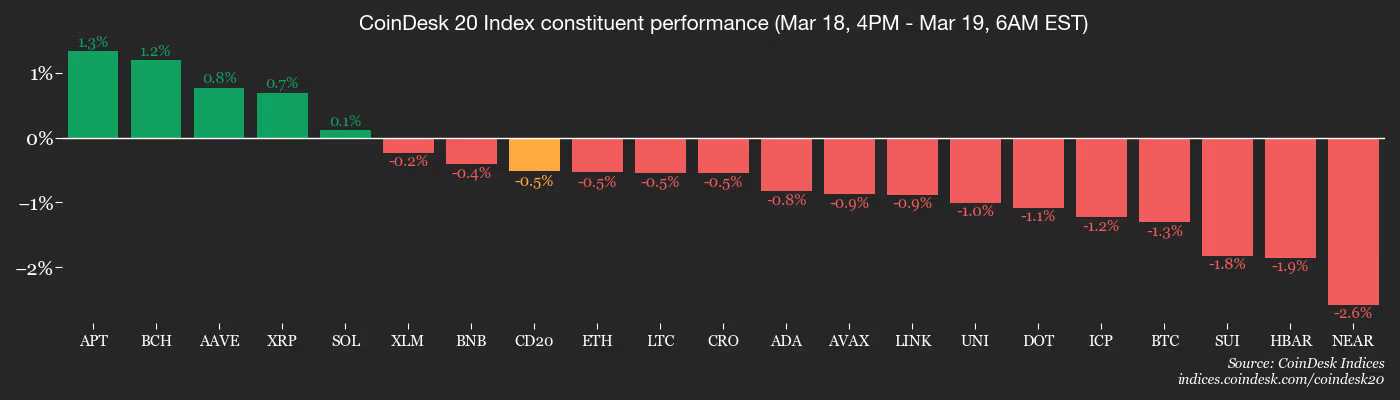
Bitcoin dipped below $70,000 early today and is now down 1% since midnight UTC, extending the decline from nearly $76,000 earlier this week. The CoinDesk 20 Index and major tokens such as ether (ETH), solana (SOL) and XRP (XRP) are following BTC’s lead.
Bitcoin’s dominance also dropped, falling to 58.7% from 59.4% in three days. In other words, its share of the total crypto market has declined with the price, a sign that even the largest cryptocurrency is seeing capital outflows. Traditionally, its share would rise during market slides as investors rotated into BTC from alternative cryptocurrencies, or altcoins.
This time, they are rotating into stablecoins. The world’s leading dollar-pegged tokens, USDT and USDC, share of total crypto market cap has increased to 7.76% from 7% and from 3% to 3.35%, respectively.
The behavior is a sign that investors feel safer in dollar equivalents, understandably so, as the Fed’s lack of clarity has left financial markets at the mercy of oil price swings. The energy market seems broken, with the Strait of Hormuz disrupted, leading to wild, erratic energy import bills worldwide that will ultimately add to inflation.
The market remains constructive at the top, fragile underneath, and still far more dependent on liquidity and positioning than on a broad expansion in conviction, according to agentic trading platform Nansen.
“Across all themes, the same market structure keeps showing up: capital is staying selective,” Nicolai Søndergaard, a research analyst at Nansen, said in an email.
“Central banks are no longer a direct upside catalyst for all of crypto, institutional inflows are supporting the core of the market rather than the full risk curve, prediction markets are capturing attention faster than they are building depth, and altcoins still lack the breadth that usually defines a true risk-on phase,” he added.
In traditional markets, the Dollar Index looked to extend Wednesday’s sharp recovery above 100, and futures tied to the S&P 500 fell, both symptoms of growing risk aversion. Stay alert!
Read more: For analysis of today’s activity in altcoins and derivatives, see Crypto Markets Today
What to Watch
For a more comprehensive list of events this week, see CoinDesk’s “Crypto Week Ahead“.
- Crypto
- March 19: Walrus (WAL) final deadline for Tusky users to migrate their data.
- Macro
- March 19, 8:30 a.m.: U.S. Initial Jobless Claims for week ending March 14 est. 215K (Prev. 213K)
- March 19, 8:30 a.m.: U.S. Philadelphia Fed Manufacturing Index for March (Prev. 16.3)
- March 19, 10:00 a.m.: U.S. New Home Sales for January est. 730K (Prev. 745K)
- March 19, 4:30 p.m.: Fed Balance Sheet for week ending March 18 (Prev. $6.65T)
- Earnings (Estimates based on FactSet data)
- March 19: Gemini Space Station (GEMI), post-market, -$0.91
Token Events
For a more comprehensive list of events this week, see CoinDesk’s “Crypto Week Ahead“.
- Governance votes & calls
- Cratos DAO is voting on extending the current mobile app reward standard deadline by one month to April 30, 2026. Voting ends March 19.
- Unlocks
- Token Launches
Conferences
For a more comprehensive list of events this week, see CoinDesk’s “Crypto Week Ahead“.
Market Movements
- BTC is down 0.94% from 4 p.m. ET Wednesday at $70,240.69 (24hrs: -4.92%)
- ETH is down 0.3% at $2,177.57 (24hrs: -5.85%)
- CoinDesk 20 is down 0.11% at 2,055.04 (24hrs: -4.66%)
- Ether CESR Composite Staking Rate is down 1 bps at 2.74%
- BTC funding rate is at -0.0024% (-2.5754% annualized) on Binance

- DXY is up 0.10% at 100.12
- Gold futures are down 2.73% at $4,689.99
- Silver futures are down 5.03% at $71.55
- Nikkei 225 closed down 3.38% at 53,372.53
- Hang Seng closed down 2.02% at 25,500.58
- FTSE 100 is down 1.90% at 10,109.91
- Euro Stoxx 50 is down 2.12% at 5,615.49
- DJIA closed on Wednesday down 1.63% at 46,225.15
- S&P 500 closed down 1.36% at 6,624.70
- Nasdaq Composite closed down 1.46% at 22,152.42
- S&P/TSX Composite closed down 1.87% at 32,312.67
- S&P 40 Latin America closed down 0.57% at 3,497.26
- U.S. 10-Year Treasury rate is up 6 bps at 4.26%
- E-mini S&P 500 futures are up 0.74% at 6,674.75
- E-mini Nasdaq-100 futures are up 0.78% at 24,625.25
- E-mini Dow Jones Industrial Average futures are up 0.66% at 46,539.00
Bitcoin Stats
- BTC Dominance: 58.68% (-0.25%)
- Ether-bitcoin ratio: 0.03099 (0.22%)
- Hashrate (seven-day moving average): 922 EH/s
- Hashprice (spot): $30.72
- Total fees: 2.62 BTC / $189,559
- CME Futures Open Interest: 117,410 BTC
- BTC priced in gold: 15 oz.
- BTC vs gold market cap: 4.68%
Technical Analysis

- The chart shows bitcoin’s daily price swings in candlestick format since late 2025.
- Prices have declined after probing the upper end of the channel identified by trendlines connecting prominent highs and lows since early February.
- A firm move past the upper end would confirm a bullish breakout. Conversely, a move below the lower end would signal a resumption of the broader downtrend.
Crypto Equities
- Coinbase Global (COIN): closed on Wednesday at $202.29 (–3.78%), –0.94% at $200.38 in pre-market
- MARA Holdings (MARA): closed at $8.92 (–3.46%), –1.01% at $8.83
- Riot Platforms (RIOT): closed at $14.10 (–3.95%), +0.28% at $14.14
- Core Scientific (CORZ): closed at $16.35 (–0.43%), –0.55% at $16.26
- CleanSpark (CLSK): closed at $9.88 (–2.27%), –1.32% at $9.75
- Galaxy Digital (GLXY): closed at $21.58 (–8.17%), –1.25% at $21.31
- Exodus Movement (EXOD): closed at $8.10 (–12.34%), +0.12% at $8.11
- CoinShares Bitcoin Mining ETF (WGMI): closed at $39.10 (–2.57%)
- Circle Internet Group (CRCL): closed at $132.84 (+0.40%), –1.12% at $131.35
- Bullish (BLSH): closed at $38.28 (–4.16%), –0.47% at $38.10
Crypto Treasury Companies
- Strategy (MSTR): closed at $140.56 (–6.47%), –0.89% at $139.31
- Strive Asset Management (ASST): closed at $10.03 (–9.59%), –1.54% at $9.88
- Sharplink (SBET): closed at $7.87 (–5.29%), –0.25% at $7.85
- Upexi (UPXI): closed at $1.07 (–6.96%), –2.80% at $1.04
- Lite Strategy (LITS): closed at $1.18 (–2.48%)
ETF Flows
Spot BTC ETFs
- Daily net flows: -$129.6 million
- Cumulative net flows: $56.38 billion
- Total BTC holdings ~1.3 million
Spot ETH ETFs
- Daily net flows: -$55.5 million
- Cumulative net flows: $11.94 billion
- Total ETH holdings ~5.79 million
Source: Farside Investors
While You Were Sleeping

Key Highlights
- Q2 adjusted earnings per share of $2.93 surpassed the Street’s $2.84 expectation
- Quarterly revenue reached $18 billion, topping the $17.84 billion projection
- Q3 revenue outlook’s midpoint fell short of Wall Street expectations
- Annual earnings forecast tightened to $13.65–$13.90, with midpoint below consensus
- ACN shares declined more than 3% before the bell, adding to a 27% year-to-date slide
Accenture (ACN) exceeded Wall Street expectations for both earnings and revenue in its fiscal second quarter, yet shares tumbled Thursday as the market zeroed in on underwhelming forward-looking guidance and persistent worries about enterprise client spending patterns.
Accenture, $ACN, Q2-26.
Solid growth, steady margins.
Adj. EPS: $2.93 Vs. $2.85 (est.)
Revenue: $18B Vs. $17.8B (est.)
Net Income: $1.83B
Bookings hit $22.1B with AI-led demand building.
Margin expansion remains modest in competitive environment.
Thread below pic.twitter.com/ucLPnbT3Up
— EarningsTime (@Earnings_Time) March 19, 2026

The consulting giant delivered adjusted earnings per share of $2.93 for the quarter, topping analyst expectations of $2.84. Quarterly revenue reached $18.04 billion, representing an 8.3% year-over-year increase and exceeding the consensus forecast of $17.84 billion.
The company secured new bookings totaling $22.1 billion during the period, marking a 6% uptick. CEO Julie Sweet highlighted “strong AI-driven growth” as a central theme, emphasizing advancements in artificial intelligence deployment across enterprise customer bases.
However, the positive quarterly results failed to impress Wall Street. ACN tumbled more than 3% in pre-market activity Thursday, dramatically outpacing the modest 0.3% decline in Nasdaq futures.
The negative market response reflects a challenging year for ACN shareholders. The stock has plummeted 27% year-to-date and 35% over the trailing twelve months—substantially underperforming the Nasdaq Composite, which has only retreated 4.7% in 2026.
Investor anxiety centers not on historical performance but on future prospects. Accenture’s third-quarter revenue guidance spanning $18.35 billion to $19.00 billion places the midpoint at $18.675 billion, trailing the $18.72 billion analyst consensus.
Client hesitation is mounting. Management indicated that enterprise customers are postponing major digital transformation initiatives while emphasizing near-term cost reduction measures.
Government Sector Headwinds Intensify
Accenture identified its federal business as creating a 1% revenue headwind for fiscal 2026, attributable to government agency budget cuts and spending reallocations.
This represents a meaningful challenge considering Accenture’s substantial public sector footprint. The deceleration in federal IT expenditures is impacting numerous large government contractors, with Accenture feeling the pressure.
For the complete fiscal year, Accenture refined its adjusted EPS guidance to $13.65–$13.90, narrowing from the previous $13.52–$13.90 range. The updated midpoint of $13.775 remains beneath the FactSet consensus estimate of $13.86.
The firm also marginally improved its full-year revenue growth projection, now anticipating 4%–6% growth in local currency compared to the earlier 3%–6% range.
Wall Street Maintains Cautious Stance
Industry analysts acknowledge that artificial intelligence could bolster long-term expansion for the company, though sluggish near-term demand isn’t expected to fully recover until 2028, based on current forecasts.
That timeline presents a prolonged waiting period for shareholders already grappling with substantial year-to-date losses. The investment community has remained skeptical about Accenture’s AI-driven growth narrative, partially because the very technology expected to fuel demand might simultaneously disrupt the high-margin consulting services the company provides.
Accenture acknowledged that its fiscal 2026 projection incorporates potential ramifications from Middle East geopolitical tensions, introducing additional uncertainty into the forward outlook.
ACN stock began Thursday’s trading session with a 27% year-to-date decline, and the Q2 earnings release provided little momentum to reverse that downward trend.
The post Accenture (ACN) Stock Plunges 3% Despite Q2 Earnings Beat on Weak Revenue Outlook appeared first on Blockonomi.


Singapore-based crypto exchange Crypto.com is cutting about 12% of its workforce, or roughly 180 employees, as it leans into AI-driven efficiency, joining a growing wave of firms shrinking teams while betting on automation.
“We are joining the list of companies integrating enterprise-wide AI,” a Crypto.com spokesperson told CoinDesk. “As we continue to prioritize resources around key growth areas and drive efficiencies across our business, we reduced our workforce by approximately 12%.”
Kris Marszalek, Crypto.com’s CEO, on X said companies that do not pivot toward the integration of AI into their processes will fail.
“Companies that move slowly will be left behind,” he added. “Companies that move immediately and pair the best AI tools with top performers will achieve a level of scale and precision that was previously impossible. This is where we must go.”
In February, Marszalek said Crypto.com spent $70 million to buy ai.com, signaling his company’s move into artificial intelligence, a sector that reached nearly $1.5 trillion in worldwide spending in 2025, according to Gartner.
The Singapore-headquartered exchange had around 1,500 employees before the cuts.
The move marks the latest round of layoffs at Crypto.com, which has trimmed staff multiple times in recent years amid shifting market conditions and internal restructuring, including a 20% workforce reduction in 2023.
Crypto.com’s layoffs also follow Block’s decision to reduce its 6,000-strong workforce by 40%. Its founder and CEO, Jack Dorsey, cited AI-enabled productivity gains as the reason for the cuts. He said AI allows smaller teams to move faster.
In January, OKX announced it was restructuring its global institutional business, resulting in job losses it claimed were not a “mass layoff.” The exchange didn’t mention the exact number. That same month, Polygon laid off 60 employees, disputing reports it let go 30% of its staff. In the U.S., the technology industry cut about 22,291 jobs last year.
The Crypto.com spokesperson said all employees, who before the layoff totalled roughly 1,500 worldwide, have been notified and will receive resources to support their transition.
The Singapore-based exchange, which boasted 100 million registered accounts and approximately $750 billion in trading volume in 2025, recently received conditional approval from the U.S. Office of the Comptroller of the Currency (OCC) to establish a national trust bank, setting the stage for the exchange to expand its custody services under federal oversight.

The European Central Bank is shifting from policy architecture to practical deployment planning for a potential digital euro. In a published call for industry expertise, the ECB opened two workstreams under its Rulebook Development Group to map how the digital euro would operate across ATMs, payment terminals, and the wider acceptance infrastructure.
The bank outlined that one workstream will develop implementation specifications for ATM and terminal providers, focusing on communication technologies, offline capabilities, and the re-use of existing payment standards. The second workstream will design testing, certification, and approval processes for the payment solutions and infrastructure that would underpin the digital euro ecosystem. This marks a notable move toward translating policy concepts into concrete, interoperable technical requirements across Europe.
At the heart of the initiative is the aim to ensure the digital euro can integrate with current payment systems and hardware while supporting offline transactions and cross-border interoperability within European standards. The ECB’s request for expert input signals a desire to harmonize a future digital currency with the region’s established financial infrastructure, rather than building a separate, standalone system from scratch. The announcement comes as part of ongoing work to define a robust, rules-based framework that could govern how digital euro services are accessed by merchants, payment service providers (PSPs), and end users.
Key takeaways
- The ECB has launched two workstreams under its Rulebook Development Group to define ATM/terminal implementation specifications and to establish testing, certification, and approval procedures for digital euro infrastructure and services.
- Efforts emphasize offline functionality and the reuse of existing European payment standards to support broad interoperability across devices and networks.
- The workstreams will gather input from a cross-section of market participants, including merchants, PSPs, and consumers, with the aim of producing a standardized rulebook for the digital euro ecosystem.
- Europe is coupling policy design with implementation timelines, targeting a 2027-era pilot while clarifying that a final issuance decision depends on the passage of relevant legislation.
- The initiative reflects a broader shift toward practical rollout planning, signaling that the ECB expects to test real-world conditions before any potential issuance.
Aim to bridge policy and practice across Europe’s payments landscape
According to the ECB, one workstream will concentrate on crafting practical implementation specifications for ATM networks and payment terminals. This includes mapping communication technologies, ensuring offline capabilities, and identifying how to reuse and harmonize existing payment standards so that digital euro hardware can function smoothly with current terminals and cashless channels. By prioritizing offline support, the ECB acknowledges the reality that connectivity can be uneven across regions, and resilience will be essential for broad acceptance.
The second workstream will focus on how solutions within the digital euro framework should be tested, certified, and approved before they can be deployed by PSPs and other infrastructure providers. The aim is to create a credible, standardized process that regulators, merchants, and tech partners can rely on as they develop and bring digital euro services to market. Through this structure, the ECB intends to reduce ambiguity around compliance and safety criteria, helping to align a diverse ecosystem of vendors, software platforms, and hardware manufacturers.
Both streams report to the Rulebook Development Group, which includes representatives from merchants, payment service providers, and consumers. The ECB said selected experts are expected to provide technical input to support the development of a standardized rulebook, ensuring that the digital euro’s design choices translate into concrete, testable requirements for market participants.
Timeline and pilot context: moving toward a 2027 milestone
The ECB has previously sketched out a plan to begin selecting EU-licensed PSPs ahead of a 12-month digital euro pilot, anticipated to commence in the second half of 2027. In remarks on Feb. 18, ECB Executive Board member Piero Cipollone indicated that the pilot would involve a limited set of merchants, Eurosystem staff, and PSPs, providing a controlled environment to assess how digital euro transactions unfold in real-world settings.
The pilot is designed to test a narrow slice of the ecosystem—focusing on merchant acceptance, settlement flows, security controls, and user experience—before broader policy decisions are made. The ECB has stressed that its final decision on whether to issue a digital euro will come only after the relevant legislation is enacted, underscoring the program’s regulatory and legislative dependencies as the project moves forward.
The timing aligns with a broader European push to explore programmable money, interoperability, and cross-border payments within a monetary policy framework that remains under public debate. The workstreams’ emphasis on standards, certification, and implementation readiness complements earlier outlining of the Appia roadmap and other tokenized-money initiatives, illustrating a coordinated path from concept to potential deployment.
In practice, the forthcoming rulebook and testing framework would help determine how a digital euro would interact with existing point-of-sale systems, online checkout flows, and offline payment experiences acrossEU member states. The approach seeks to minimize disruption to merchants while maximizing the currency’s reliability, security, and user accessibility across a diverse payments landscape.
What comes next and what to watch
As the ECB progresses through the RDG-led workstreams, market participants will be watching how quickly a standardized rulebook materializes, which PSPs are invited to participate in the pilot, and how the 2027 timeline aligns with legislative developments in the EU. The coordination between policy objectives and implementation specifications will be crucial for assessing the digital euro’s feasibility and potential impact on existing payment rails, cross-border settlement, and consumer protection regimes.
Observers should also monitor how offline capabilities are reconciled with security and risk controls, how interoperability with legacy payment standards is achieved, and how the certification framework will certify both software and hardware components used in digital euro ecosystems. The path from policy to practical deployment remains complex, but the ECB’s latest move signals a deliberate step toward testing and standardization that could shape Europe’s digital monetary future.

Key Highlights
- Q3 revenue reached 284.8 billion yuan ($41.4B), falling short of the 290.7 billion yuan analyst consensus.
- Year-over-year net income plummeted 66–67%, marking the company’s weakest performance since the beginning of 2024.
- Aggressive expenditures on promotional campaigns, rapid delivery services, and artificial intelligence infrastructure contributed to shrinking margins.
- The Cloud division experienced 36% revenue expansion, while AI-focused product sales maintained triple-digit percentage increases for ten straight quarters.
- The company has committed more than $53 billion toward AI development and recently implemented cloud service price increases reaching 34%.
Alibaba delivered disappointing financial results for its December quarter on Thursday, falling below revenue projections while experiencing a steep profit contraction. The announcement triggered a 4% decline in the company’s U.S.-traded shares during premarket hours.
For the quarter ending December 31, 2025, total revenue registered at 284.8 billion yuan ($41.4 billion). Market analysts had projected 290.7 billion yuan. The figure represents just a 2% sales increase — essentially stagnant growth.
Alibaba Group Holding Limited, BABA
The profit picture proved far more troubling. Net income crashed 66% compared to the prior year period, dropping to 15.6 billion yuan from 46.4 billion yuan. Management attributed the decline to a 74% plunge in operating income, fueled by substantial investments in rapid commerce infrastructure, enhanced customer experience initiatives, and technological advancement.
The quarterly performance represents Alibaba’s most significant profit deterioration since the first quarter of 2024.
Chief Executive Eddie Wu offered an optimistic perspective on the results. “This quarter, Alibaba sustained robust investment across our fundamental pillars of AI and consumer engagement,” Wu stated. He characterized artificial intelligence as “among our key growth drivers moving forward.”
Cloud Division Continues Upward Trajectory
Despite the overall challenges, a legitimate growth narrative exists within the financials. Alibaba’s Cloud Intelligence Group achieved 36% revenue expansion, generating 43.3 billion yuan during the three-month period. Revenue from AI-centered products maintained triple-digit growth rates for the tenth consecutive quarter.
The e-commerce giant has committed upward of $53 billion toward artificial intelligence initiatives across multiple years. While this exceeds investments by domestic Chinese competitors, it represents only a fraction of the $650 billion American cloud providers intend to deploy throughout 2026 alone.
Earlier this week, Alibaba introduced Wukong, an enterprise-oriented agentic AI platform. Simultaneously, the company increased cloud computing and storage pricing by as much as 34%, a strategic shift analysts interpret as prioritizing profitability over market share acquisition.
Morgan Stanley analyst Gary Yu characterized the introduction of Alibaba Token Hub — a newly created division consolidating nearly all AI operations under CEO Wu’s direct control — as evidence of “explosive AI demand driven by robust token consumption.”
Growing Competitive Pressures
The quarter presented numerous obstacles for the technology conglomerate.
Alibaba’s core e-commerce operations face intensifying competition from Chinese rivals. The company deployed substantial resources during China’s Lunar New Year celebration, distributing promotional incentives alongside Tencent, ByteDance, and Baidu to boost adoption of its consumer AI application. While competing platforms experienced substantial user growth, Qwen’s engagement remained elevated above pre-campaign baseline levels, according to Morgan Stanley data.
Tencent appears positioned advantageously in the agentic AI landscape, leveraging its WeChat platform and extensive consumer data assets. This represents a fundamental competitive challenge Alibaba cannot easily overcome in the near term.
The quarter also brought an unexpected personnel change. Junyang Lin, principal architect of Alibaba’s Qwen AI systems and a critical contributor to the company’s AI transformation, departed during the period. While official reasons remain undisclosed, the exit prompted concerns regarding strategic continuity in Alibaba’s research initiatives.
Alibaba has pivoted toward emphasizing enterprise customers in response. The newly established Alibaba Token Hub division consolidates AI product offerings under unified management, granting Wu direct authority over the company’s AI monetization strategy.
Alibaba’s cloud pricing adjustment of up to 34% coincided with a comparable action by Baidu, which implemented AI cloud price increases reaching 30%.
The post Alibaba (BABA) Stock Plunges 4% as Earnings Disappoint and AI Costs Mount appeared first on Blockonomi.


The governance token of Venus (XVS), a BNB Chain-based money market with over $1.4 billion in total value locked, has dropped more than 9% in 24 hours after an exploit that left it with $2.15 million in bad debt.
The drawdown comes amid a broad risk asset sell-off that has seen the broader CoinDesk 20 (CD20) index lose 4.6% of its value in the same period.
The exploit, which occurred on March 16, didn’t appear to impact XVS prices until analysis showed major holders, including wallets linked to Justin Sun, moving large amounts to exchanges.
Venus said the exploit, in its Thena market left about $2.15 million in bad debt or loans the system can no longer recover.
The attacker, according to the protocol, spent about nine months accumulating a large position in Thena’s THE token. That accumulation, according to PeckShield, was funded with 7,400 ETH withdrawn from mixing protocol Tornado Cash.
The attacker then donated more than 36 million THE straight to the vTHE contract, skipping the normal cap checks and lifting the market’s exchange rate by about 3.8 times. The gap in code that allowed the attacker to skip these checks, Venus said, is being closed.
With that higher paper value, the attacker posted THE as collateral, borrowed other assets and bought more THE in a thin market, according to Venus.
The buying helped lift THE from about $0.26 to near $0.56. Venus said this was not a flash-loan attack, its oracles kept working and Venus Flux was not affected.
When the attacker later sold THE, the price dropped more than 17% in less than a day and liquidations followed. Analysis puts the value pulled before liquidations at roughly $3.7 million to $5.8 million, with assets including tokenized bitcoin, BNB, and stablecoins being taken.
The damage was mostly limited to THE token and, to a lesser extent, CAKE. It also said no user funds were lost outside the affected pools.
The protocol paused THE borrows and withdrawals, cut THE’s collateral value to zero and tightened rules on other markets identified as at-risk in response to the incident. Markets at-risk include those for , , aave , among others.
The attacking address had been flagged by the community before the incident. Venus did not act as “no rules had been broken, and no exploit had occurred,” it said.
“Venus is a decentralized protocol. As a permissionless protocol, we cannot and should not freeze or blacklist addresses based on suspicion alone,” the protocol wrote on social media. “This is a tension inherent to DeFi, and one we take seriously.”
Governance is expected to decide how to cover the loss through Venus’s risk fund.

Key Takeaways
- Federal safety regulators have advanced their Tesla Full Self-Driving investigation to an engineering analysis phase.
- Approximately 3.2 million Tesla vehicles are included in the expanded probe — representing virtually every Tesla sold domestically.
- Regulators have identified nine collisions connected to the concern, with one resulting in a fatality and two causing injuries.
- Investigators are examining Tesla’s visibility detection system, designed to alert drivers when camera performance deteriorates.
- This advancement in the investigation could result in a vehicle recall or additional regulatory measures if safety deficiencies are confirmed.
Federal transportation safety officials have elevated their examination of Tesla’s Full Self-Driving technology, transitioning to a comprehensive engineering analysis that may culminate in a vehicle recall. The expanded investigation encompasses approximately 3.2 million vehicles — representing nearly Tesla’s complete domestic sales history.
Shares of Tesla (TSLA) declined 1.63% when the announcement became public.
The regulatory focus targets FSD’s visibility monitoring capabilities. This system should identify compromised camera performance — including conditions such as direct sunlight, atmospheric haze, or obstructions — and prompt drivers to assume manual control.
According to NHTSA, evidence under review suggests the system has not performed this critical function adequately, both prior to and following software modifications.
Nine collisions have been associated with this concern. One crash proved fatal. Two additional incidents caused physical injuries.
In accidents examined by federal authorities, the FSD technology failed to identify circumstances that impaired camera function. In several instances, warnings were only triggered moments before collision — providing drivers insufficient opportunity to intervene.
Regulators also discovered additional crashes in comparable low-visibility scenarios where the system completely failed to recognize degraded visibility or provided inadequate warning time for safe driver response.
Tesla’s internal post-crash evaluation indicated that a software enhancement to the visibility detection system might have altered outcomes in three of the nine collisions — had that enhancement been deployed earlier.
Tesla has not issued a statement in response to inquiries.
Understanding the Engineering Analysis Phase
An engineering analysis represents a more thorough stage of federal oversight. This phase empowers NHTSA to obtain comprehensive technical data from the manufacturer and conduct extensive examination of possible defects.
Should the agency determine a safety deficiency exists, it possesses authority to mandate a recall or implement alternative enforcement measures. Tesla has encountered numerous NHTSA investigations in recent years examining different components of its automated driving capabilities.
Implications for Tesla
Tesla’s complete self-driving strategy — including its anticipated autonomous taxi network — relies on maintaining regulatory approval and public confidence in FSD technology.
Any potential recall affecting 3.2 million vehicles would rank among the most substantial in the company’s history and would intensify scrutiny on technology Tesla has positioned as fundamental to its long-term vision.
NHTSA’s investigation advancement continues a trend of heightened regulatory oversight of FSD. During the final months of 2024, the agency initiated a distinct investigation into FSD collisions occurring under diminished visibility circumstances, which encompassed four incidents including one death.
Tesla had not released any public statement regarding the investigation escalation as of Thursday evening.
The post Tesla (TSLA) Stock Drops as Federal Probe Into Full Self-Driving System Intensifies appeared first on Blockonomi.


- Ethereum price was poised above the $2,150 level.
- Bulls were showing resilience as a whale re-accumulated $111 million worth of ETH.
- Another move above $2,000 could push prices towards the $2,500 resistance.
A mysterious Ethereum whale has re-emerged after lying dormant for seven months, and just deployed over $111 million in USDT to accumulate ETH.
The whale’s move came as the ETH price hovered above $2,170 amid a broader slip for cryptocurrencies early Thursday.
As Bitcoin revisited $70,000 support, Ethereum bounced off the crucial $2,150 level, with intraday volume up 39% at over $27 billion.
Ethereum whale spends $111 million to re-accumulate ETH
According to Lookonchain, a whale that exited Ethereum seven months ago as prices jumped towards $4,000 is back.
The mysterious holder has spent 111.62 million USDT to buy 50,706 ETH, executing this fresh buy at an average price of $2,201 per token.
On-chain data shows this purchase mirrors a sale exactly one year prior, when the same address offloaded 28,683 ETH at $3,892 each.
That sale netted $111.62 million, and a re-cumulation worth this exact value highlights a classic “buy-low, sell-high” move.
A mysterious whale returned after 7 months of inactivity and spent 111.62M $USDT to buy back 50,706 $ETH at an average price of $2,201.
1 year ago, this whale sold 28,683 $ETH at an average price of $3,892 for 111.62M $USDT.
What a perfect buy-low-sell-high move!… pic.twitter.com/3F56jkgr2y
— Lookonchain (@lookonchain) March 19, 2026
Waking up after seven months also points to the whale’s positioning amid a potential rebound, and mirrors conviction buys by entities such as Bitmine.
The treasury firm, led by Fundstrat’s Tom Lee, recently bought 60,999 ETH worth over $140.3 million and currently holds 4,595,562 ETH worth over $10.5 billion.
ETH’s rebound above $2,000 coincided with the Ethereum Foundation depositing $7.88 million of the altcoin to Steakhouse, a DeFi asset manager with over a billion dollars in AUM.
The EF currently holds over $400 million of ETH.
Can ETH hold gains above $2,150?
Ethereum’s price rose to highs of $2,386 on Monday, riding a bullish flip that pushed Bitcoin to $76,000.
However, the current price hovers near $2,170, testing support amid Bitcoin’s fresh retest of support around $70,000.
As noted, top coins are retreating as risk assets grapple with global economic headwinds. Inflation and escalating Middle East tensions stand out as key short-term headwinds.
Meanwhile, the technical picture shows ETH hovering near a key support level on the daily chart.
The $2,100 mark currently acts as a pivotal support zone and aligns with a rising trendline.
Prices also track the 50-day exponential moving average, currently acting as resistance near $2,215. This is the hurdle bulls need to surmount for potential upside continuation.

If support holds firm above the aforementioned level, the next target remains $2,400-$2,500. Per the daily chart, the 100 EMA sits at the $2,500 mark.
A breakdown from current levels could allow bears to target $2,000 or lower. Cycle lows near $1,800 offer a robust demand reload zone.

Lidl hopes to open first supermarket in Cambridgeshire’s newest town
Needham raises Red Cat Holdings stock price target on Ukraine opportunity

Bitcoin layer-1 smart-contract platform OpNet debuts with native DeFi stack

Smart energy pays enters the US market, targeting scalable financial infrastructure

Why Israel is blocking foreign journalists from entering

Bitcoin: We’re Entering The Most Dangerous Phase

Financial Seatbelts: 3 Risks Every Youngster Must Cover!#financialfreedom #helthinsurence #shorts

Governor Newsom, First Partner make announcements on financial literacy, wealth access for women

Mad Money 03/17/26 | Audio Only
-
 Crypto World5 days ago
HYPE Token Enters Net Deflation as HyperCore Buybacks Outpace Staking Rewards
-

 Tech4 days ago
Your Legally Registered ‘Motorcycle’ Might Not Count Under Proposed US Law
-

 Fashion6 days ago
Weekend Open Thread: Addict Lip Glow
-
 Tech2 days ago
Are Split Spacebars the Next Big Gaming Keyboard Trend?
-
Sports5 days ago
Why Duke and Michigan Are Dead Even Entering Selection Sunday
-

 Business4 days ago
Search for Savannah Guthrie’s Mother Enters Seventh Week with No Arrests
-

 Business5 days ago
US Airports Launch Donation Drives for Unpaid TSA Workers as Partial Government Shutdown Enters Fifth Week
-
Crypto World5 days ago
Coinbase and Bybit in Investment Talks: Could Bybit Finally Enter the US Crypto Market?
-

 Business3 days ago
Australian shares drop as Iran war enters third week
-

 Business5 days ago
Country star Brantley Gilbert enters growing non-alcoholic beer market
-

 Crypto World3 days ago
Crypto Lender BlockFills Enters Chapter 11 with Up to $500M in Liabilities
-

 Sports6 days ago
College Basketball Best Bets: Conference Tournament Semifinal Picks
-

 Politics1 day ago
The House | The new register to protect children from their abusers shows Parliament at its best
-

 Business7 days ago
Trump demands Powell cut rates as Iran conflict raises energy prices
-

 Fashion3 days ago
25 Celebrities with Curly Hair That Are Naturally Beautiful
-

 News Videos19 hours ago
RBA board divided on rate cut, unusually buoyant share market | Finance Report | ABC NEWS
-

 Crypto World7 days ago
Senate Votes to Include CBDC Ban in Bipartisan Housing Bill
-

 NewsBeat7 days ago
Deane Road crash near Bolton colleges and university
-

 Crypto World19 hours ago
Canada’s FINTRAC revokes registrations of 23 crypto MSBs in AML crackdown
-

 News Videos7 days ago
Tom Lee: The 100x Opportunity EVEN Bigger Than Bitcoin (New Ethereum Prediction 2026)


You must be logged in to post a comment Login