
Crypto World
ECB kicks off Digital Euro work with ATMs and payment terminals


The European Central Bank is shifting from policy architecture to practical deployment planning for a potential digital euro. In a published call for industry expertise, the ECB opened two workstreams under its Rulebook Development Group to map how the digital euro would operate across ATMs, payment terminals, and the wider acceptance infrastructure.
The bank outlined that one workstream will develop implementation specifications for ATM and terminal providers, focusing on communication technologies, offline capabilities, and the re-use of existing payment standards. The second workstream will design testing, certification, and approval processes for the payment solutions and infrastructure that would underpin the digital euro ecosystem. This marks a notable move toward translating policy concepts into concrete, interoperable technical requirements across Europe.
At the heart of the initiative is the aim to ensure the digital euro can integrate with current payment systems and hardware while supporting offline transactions and cross-border interoperability within European standards. The ECB’s request for expert input signals a desire to harmonize a future digital currency with the region’s established financial infrastructure, rather than building a separate, standalone system from scratch. The announcement comes as part of ongoing work to define a robust, rules-based framework that could govern how digital euro services are accessed by merchants, payment service providers (PSPs), and end users.
Key takeaways
- The ECB has launched two workstreams under its Rulebook Development Group to define ATM/terminal implementation specifications and to establish testing, certification, and approval procedures for digital euro infrastructure and services.
- Efforts emphasize offline functionality and the reuse of existing European payment standards to support broad interoperability across devices and networks.
- The workstreams will gather input from a cross-section of market participants, including merchants, PSPs, and consumers, with the aim of producing a standardized rulebook for the digital euro ecosystem.
- Europe is coupling policy design with implementation timelines, targeting a 2027-era pilot while clarifying that a final issuance decision depends on the passage of relevant legislation.
- The initiative reflects a broader shift toward practical rollout planning, signaling that the ECB expects to test real-world conditions before any potential issuance.
Aim to bridge policy and practice across Europe’s payments landscape
According to the ECB, one workstream will concentrate on crafting practical implementation specifications for ATM networks and payment terminals. This includes mapping communication technologies, ensuring offline capabilities, and identifying how to reuse and harmonize existing payment standards so that digital euro hardware can function smoothly with current terminals and cashless channels. By prioritizing offline support, the ECB acknowledges the reality that connectivity can be uneven across regions, and resilience will be essential for broad acceptance.
The second workstream will focus on how solutions within the digital euro framework should be tested, certified, and approved before they can be deployed by PSPs and other infrastructure providers. The aim is to create a credible, standardized process that regulators, merchants, and tech partners can rely on as they develop and bring digital euro services to market. Through this structure, the ECB intends to reduce ambiguity around compliance and safety criteria, helping to align a diverse ecosystem of vendors, software platforms, and hardware manufacturers.
Both streams report to the Rulebook Development Group, which includes representatives from merchants, payment service providers, and consumers. The ECB said selected experts are expected to provide technical input to support the development of a standardized rulebook, ensuring that the digital euro’s design choices translate into concrete, testable requirements for market participants.
Timeline and pilot context: moving toward a 2027 milestone
The ECB has previously sketched out a plan to begin selecting EU-licensed PSPs ahead of a 12-month digital euro pilot, anticipated to commence in the second half of 2027. In remarks on Feb. 18, ECB Executive Board member Piero Cipollone indicated that the pilot would involve a limited set of merchants, Eurosystem staff, and PSPs, providing a controlled environment to assess how digital euro transactions unfold in real-world settings.
The pilot is designed to test a narrow slice of the ecosystem—focusing on merchant acceptance, settlement flows, security controls, and user experience—before broader policy decisions are made. The ECB has stressed that its final decision on whether to issue a digital euro will come only after the relevant legislation is enacted, underscoring the program’s regulatory and legislative dependencies as the project moves forward.
The timing aligns with a broader European push to explore programmable money, interoperability, and cross-border payments within a monetary policy framework that remains under public debate. The workstreams’ emphasis on standards, certification, and implementation readiness complements earlier outlining of the Appia roadmap and other tokenized-money initiatives, illustrating a coordinated path from concept to potential deployment.
In practice, the forthcoming rulebook and testing framework would help determine how a digital euro would interact with existing point-of-sale systems, online checkout flows, and offline payment experiences acrossEU member states. The approach seeks to minimize disruption to merchants while maximizing the currency’s reliability, security, and user accessibility across a diverse payments landscape.
What comes next and what to watch
As the ECB progresses through the RDG-led workstreams, market participants will be watching how quickly a standardized rulebook materializes, which PSPs are invited to participate in the pilot, and how the 2027 timeline aligns with legislative developments in the EU. The coordination between policy objectives and implementation specifications will be crucial for assessing the digital euro’s feasibility and potential impact on existing payment rails, cross-border settlement, and consumer protection regimes.
Observers should also monitor how offline capabilities are reconciled with security and risk controls, how interoperability with legacy payment standards is achieved, and how the certification framework will certify both software and hardware components used in digital euro ecosystems. The path from policy to practical deployment remains complex, but the ECB’s latest move signals a deliberate step toward testing and standardization that could shape Europe’s digital monetary future.

Crypto World
Cheniere Energy (LNG) Stock Soars to Record High Amid Hormuz Crisis and Thai Contract Boost

Key Highlights
- Cheniere Energy (LNG) reached a record intraday peak of $267.24 on March 18, finishing the session up 5.85% at $266.22.
- Natural gas prices climbed 5.59% to $3.20/MMBtu amid ongoing Strait of Hormuz disruptions, marking a 6.90% March gain.
- Thailand’s government confirmed plans to increase its long-term LNG purchase from 1 million tons to 1.3 million tons annually.
- The enhanced Thailand agreement extends through 2041, securing a 15-year revenue stream.
- The company recently announced a $10 billion stock repurchase program following record-breaking quarterly results.
Cheniere Energy posted a historic trading session on Wednesday, March 18, propelled by geopolitical supply constraints and confirmation of an expanded commercial agreement with Thailand.
Shares of the LNG export leader touched an all-time intraday high of $267.24 before closing at $266.22, marking a single-day advance of 5.85%. The stock has now climbed approximately 30% since the start of the year.
This surge aligns with broader momentum in the natural gas market. Spot prices for natural gas increased 5.59% during the session, reaching $3.20/MMBtu. Month-to-date, natural gas has appreciated 6.90%.
The primary catalyst remains the ongoing blockage of the Strait of Hormuz — a vital chokepoint for global energy transportation. This disruption is constricting worldwide LNG availability and driving demand toward American export facilities like those operated by Cheniere.
Thailand Secures Expanded LNG Supply Agreement
Early this week, reports surfaced that Thailand is negotiating to both expand and accelerate LNG shipments under its existing long-term arrangement with Cheniere.
Thailand’s Energy Minister Auttapol Rerkpiboon verified that the nation is boosting its annual LNG commitment from 1 million tons to 1.3 million tons. Initial shipments under the revised terms are scheduled to commence in the second quarter of 2026.
The contract maintains its duration through 2041 — providing Cheniere with guaranteed demand for the next decade and a half. Thailand’s motivation stems from securing reliable energy supplies for its electricity generation infrastructure.
These types of extended, firm-commitment contracts represent the cornerstone of Cheniere’s revenue model.
Robust Financial Performance Underpinning Rally
Cheniere entered this week from a position of financial strength. The enterprise recently unveiled a $10 billion share repurchase authorization and delivered quarterly earnings that exceeded analyst projections.
These financial results bolstered investor sentiment as geopolitical uncertainties intensified. The convergence of earnings outperformance, shareholder capital allocation, and constrained global LNG availability has positioned Cheniere as a preferred investment vehicle for those seeking natural gas exposure.
Technical analysis indicates a “Strong Buy” rating for the stock, with current market capitalization hovering around $52.87 billion.
Typical daily share volume averages approximately 2.1 million, though high-momentum sessions like Wednesday often attract increased participation from trend-following traders.
The stock’s nearly 30% year-to-date appreciation significantly outpaces broader equity market indices.
With the Thailand contract nearing finalization and Hormuz shipping disruptions persisting, Cheniere approaches the remainder of March supported by multiple positive catalysts.

Is BTC yet to feel real pain during this market cycle?
After a solid multi-day run, the primary cryptocurrency lost momentum again, dipping below $70,000.
Numerous analysts caution that the bears still control the market, expecting much more substantial price declines in the near future.
Where’s the Bottom?
The recent FOMC meeting, and especially Chairman Jerome Powell’s subsequent speech, poured cold water on BTC, which earlier this week touched $76,000 for the first time since the beginning of February.
Recall that America’s central bank kept interest rates unchanged for the second consecutive time this year, whereas Powell said the stubborn inflation remains an issue for the local economy. He also outlined the military conflict in Iran, describing the rising price of petrol as another hurdle.
His comments were unfavorable to the cryptocurrency market, whose total capitalization once again slipped below $2.5 trillion. As for Bitcoin, its valuation temporarily fell to as low as $69,500 and currently struggles to remain above that line.
Several analysts have weighed in on BTC’s performance, noting similarities between its recent price action and past cycles. X user Ted pointed out that the current structure closely mirrors the pattern seen in 2022, which ultimately led to a drop to around $16,000. If that historical parallel plays out again, he warned that the price could slip under $50K in the near term.
The analyst who goes by as bee on the social media platform outlined an analogous thesis. They suggested that BTC’s resurgence to nearly $76,000 has been a “fakeout” and bull trap, claiming that “we are still in a bear market” and the valuation could plummet to as low as $46,760 in the coming months. Leshka.eth joined the pessimists’ club, predicting a pullback to almost $53,000 sometime this summer.
You may also like:
The Bullish Case
However, it’s not all doom and gloom, as some key indicators signal BTC may experience another significant revival soon. For instance, whales snapped up 40,000 units in a matter of a single week, potentially positioning themselves for the next leg up. At the same time, spot Bitcoin ETFs have seen strong inflows, suggesting growing institutional demand.
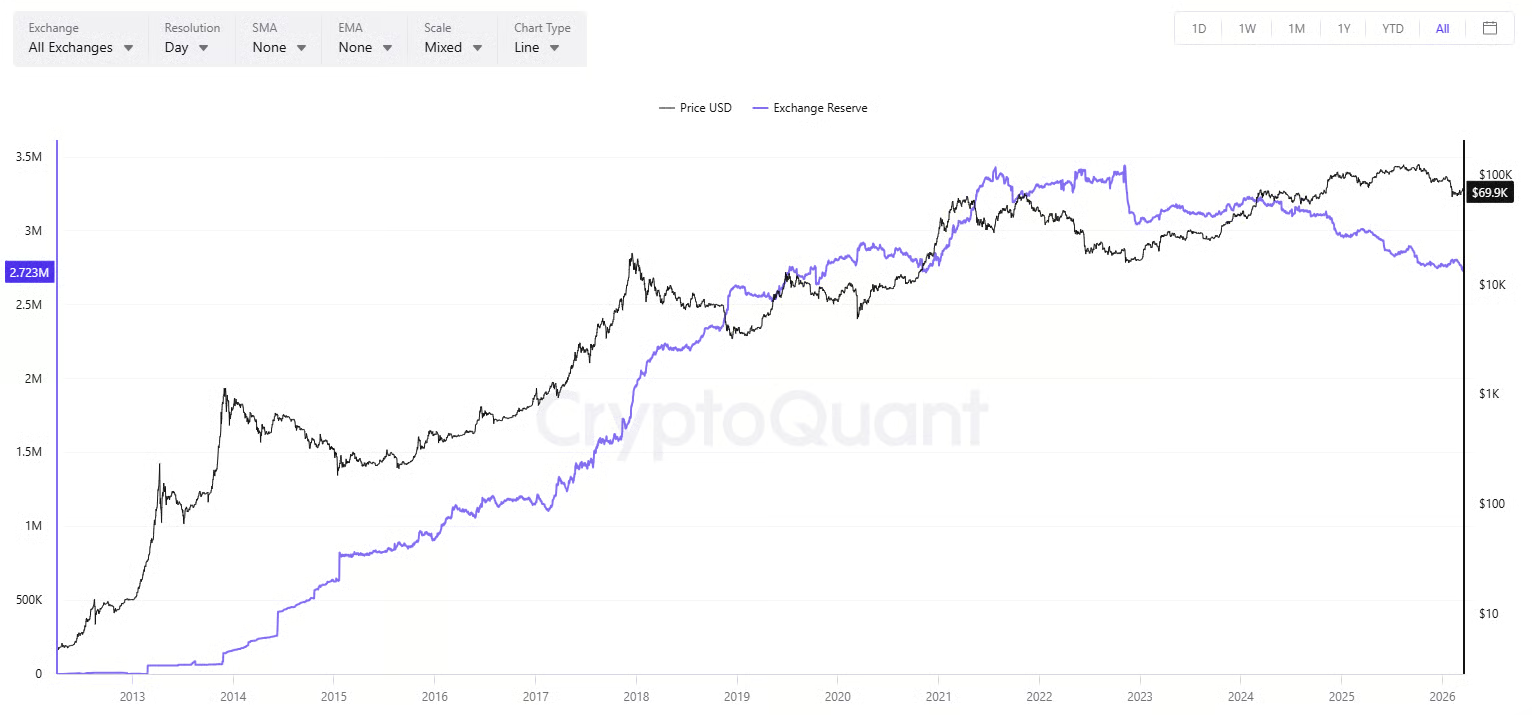
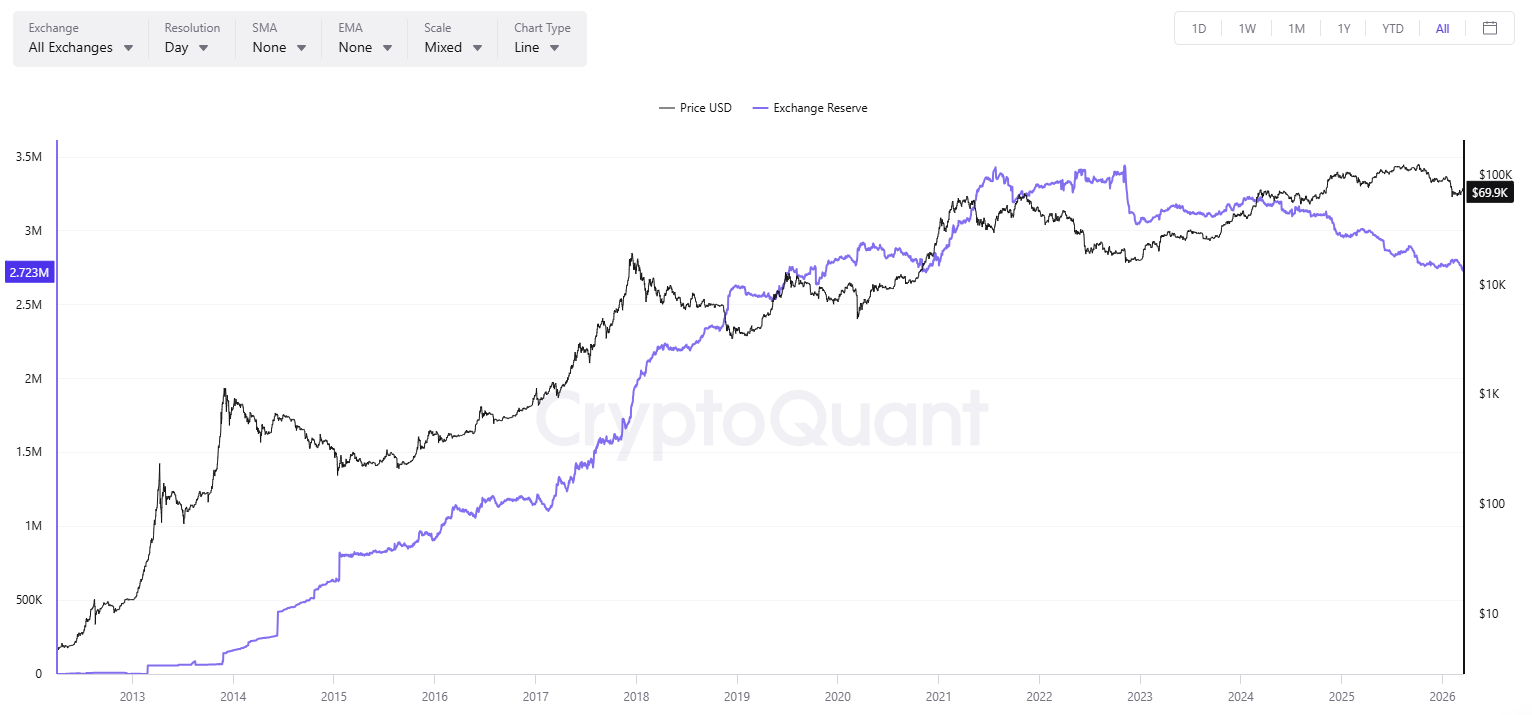
The amount of coins sitting on crypto exchanges should also be mentioned. The figure has been gradually decreasing lately, and earlier today (March 19) dropped to a new six-year low of approximately 2.723 million. This means that many investors continue to abandon centralized platforms and move their holdings to self-custody, thereby reducing immediate selling pressure.
Meanwhile, some analysts, such as Ali Martinez, expect a significant price boom based on the formation of certain setups. Just a few days ago, he noted that BTC’s funding rates have turned negative, and in the past, that has always been a precursor of a “major relief rally.” Martinez reminded that in August 2023, such a development was followed by a whopping 176% price increase for BTC.
Binance Free $600 (CryptoPotato Exclusive): Use this link to register a new account and receive $600 exclusive welcome offer on Binance (full details).
LIMITED OFFER for CryptoPotato readers at Bybit: Use this link to register and open a $500 FREE position on any coin!
Elon Musk has once again taken to X to share a post about Dogecoin, mimicking one of the most famous scenes from the blockbuster movie “The Godfather.”
Summary
- Elon Musk shared a Dogecoin-themed AI video inspired by The Godfather, generating over 18 million views and high engagement on X.
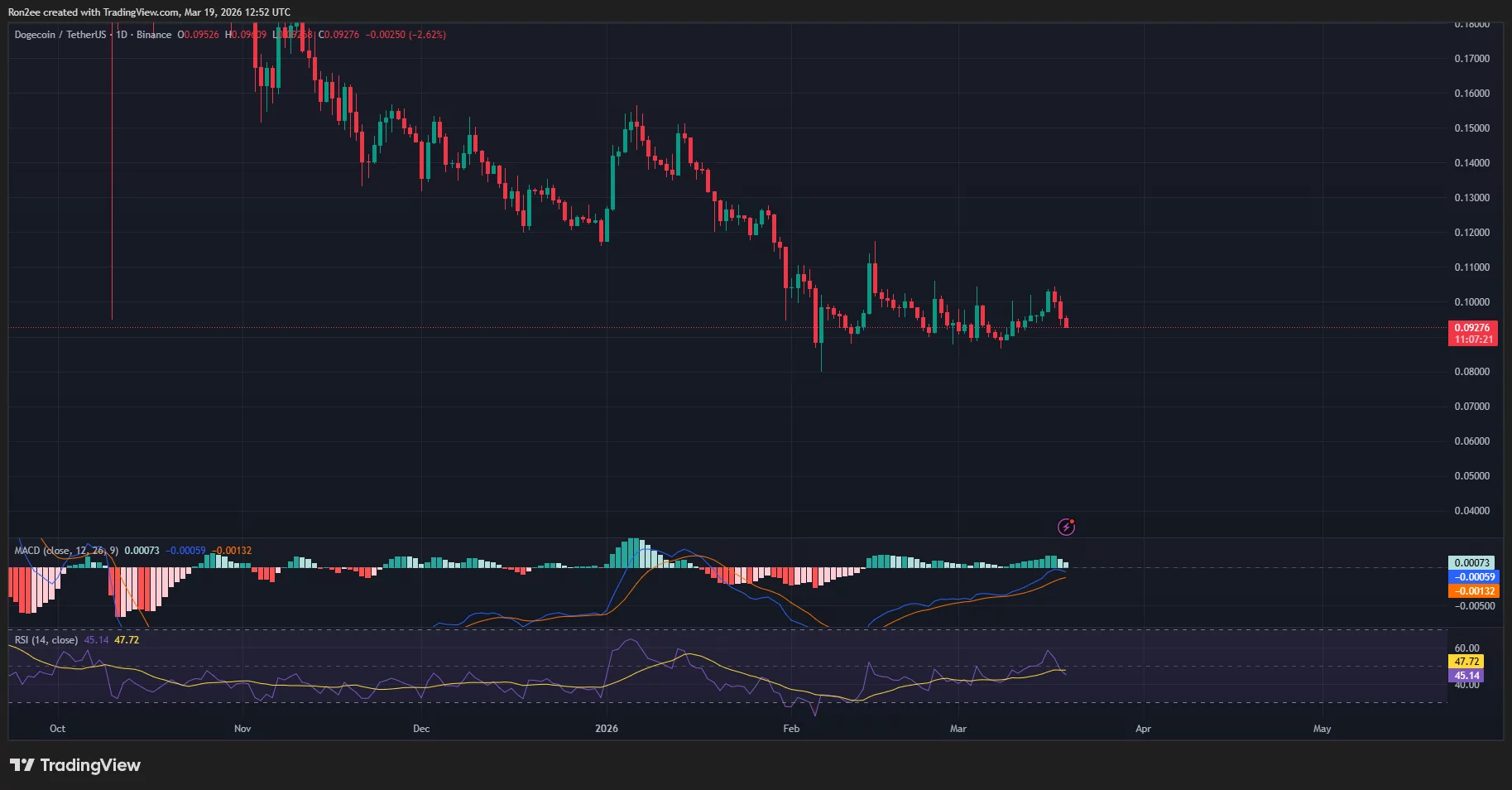
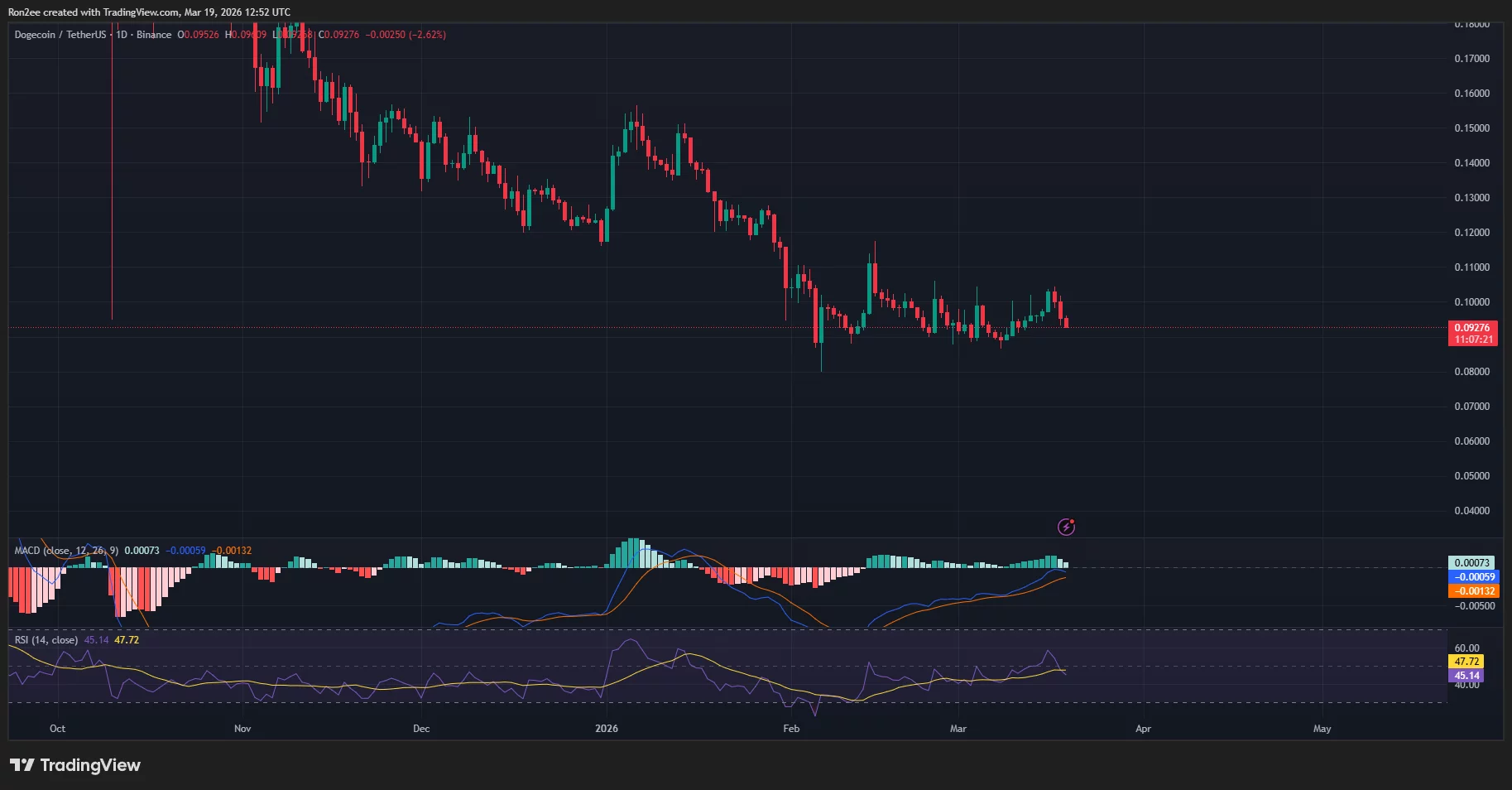
- Dogecoin price showed little reaction, trading around $0.093 and remaining nearly 40% below its yearly high amid broader market weakness.
In a March 19 X post, the X owner and a long-time advocate of the world’s leading meme coin Dogecoin, Musk shared an AI-generated video from the parody X account Sir Doge of the Coin.
In the video, Musk was seen dressed in a black tuxedo with a Shiba Inu dog while seeming to mimic a famous scene played by Marlon Brando as the character Vito Corleone from the classic movie “The Godfather.”
“You come to me on the day of my doge’s wedding, and you ask me for my private key. Are you even a friend? You don’t even think to call me the dogefather,” the AI-generated avatar of Musk said.
At press time, the video had gained over 18.4 million views, 64,000 likes, and over 6,800 retweets, showing the sheer scale of engagement by the crypto community.
The tech tycoon has long been known to advocate Dogecoin, with his social media posts on the meme coin historically triggering massive volatility in Dogecoin (DOGE), often referred to as the “Musk Effect.”
In his past antics, he even once briefly turned the Twitter blue bird logo into the Shiba Inu (Doge) meme for several days. DOGE soared over 30% at the peak of the frenzy. When the logo was changed back three days later, the price dropped by roughly 9%.
However, the most memorable event would be his Saturday Night Live (SNL) Appearance at the peak of the 2021 bull run, where he called himself the “Dogefather” in promos, but jokingly referred to DOGE as a hustle during a sketch. Dogecoin price shot up to an all-time high of $0.73 just before the show. However, it came crashing down nearly 30% to 40% during the broadcast.
This time, Dogecoin’s price has not yet shown any positive momentum following the latest post. Trading at $0.093, the meme coin has fallen over 3.2% as observed at press time. The 10th largest crypto asset in the market has fallen nearly 40% from its year to date high and 87.2% from its all-time high.
Momentum indicators like the MACD and RSI suggest that the meme coin could extend its downtrend, especially since risk-on sentiment is withering amid ongoing geopolitical and macroeconomic uncertainty.
Disclosure: This article does not represent investment advice. The content and materials featured on this page are for educational purposes only.
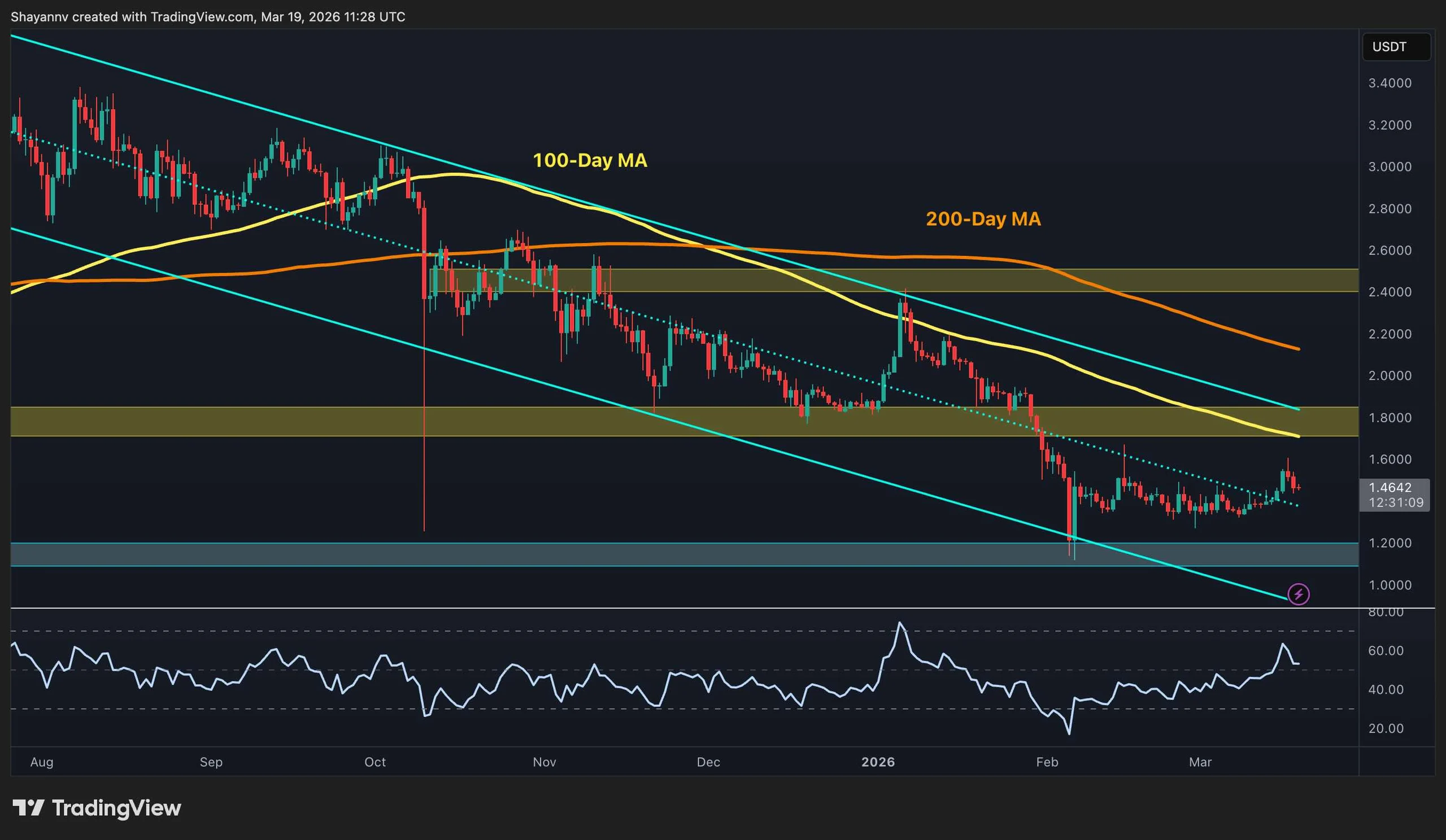
XRP is trying to build a short-term recovery, but the broader trend still leans cautious. The recent bounce has improved momentum on both pairs, yet the price is still trading beneath major trend-defining resistance levels. In other words, sellers are no longer fully in control of the very short term, but buyers have not done enough to claim a real trend reversal either.
XRP/USDT Analysis: The Daily Chart
On the XRP/USDT chart, the asset has pushed back toward the mid-$1.40s after defending the $1.10 to $1.20 demand zone earlier this month. That rebound matters because it keeps XRP off the lows and lifts RSI back into a healthier range, but the price is still stuck inside the descending structure and below the first major supply band around $1.75 to $1.80.
That leaves XRP in a tricky spot. The current move looks constructive, but it still resembles a relief rally inside a larger downtrend rather than a clean breakout. If buyers can force a reclaim of the $1.75 to $1.80 region, the door opens toward the much heavier $2.40 to $2.50 resistance area. But the price would also need to climb above both the 100-day and 200-day moving averages to reach this area. Until then, the bounce is not decisive.
XRP/BTC 4-Hour Chart
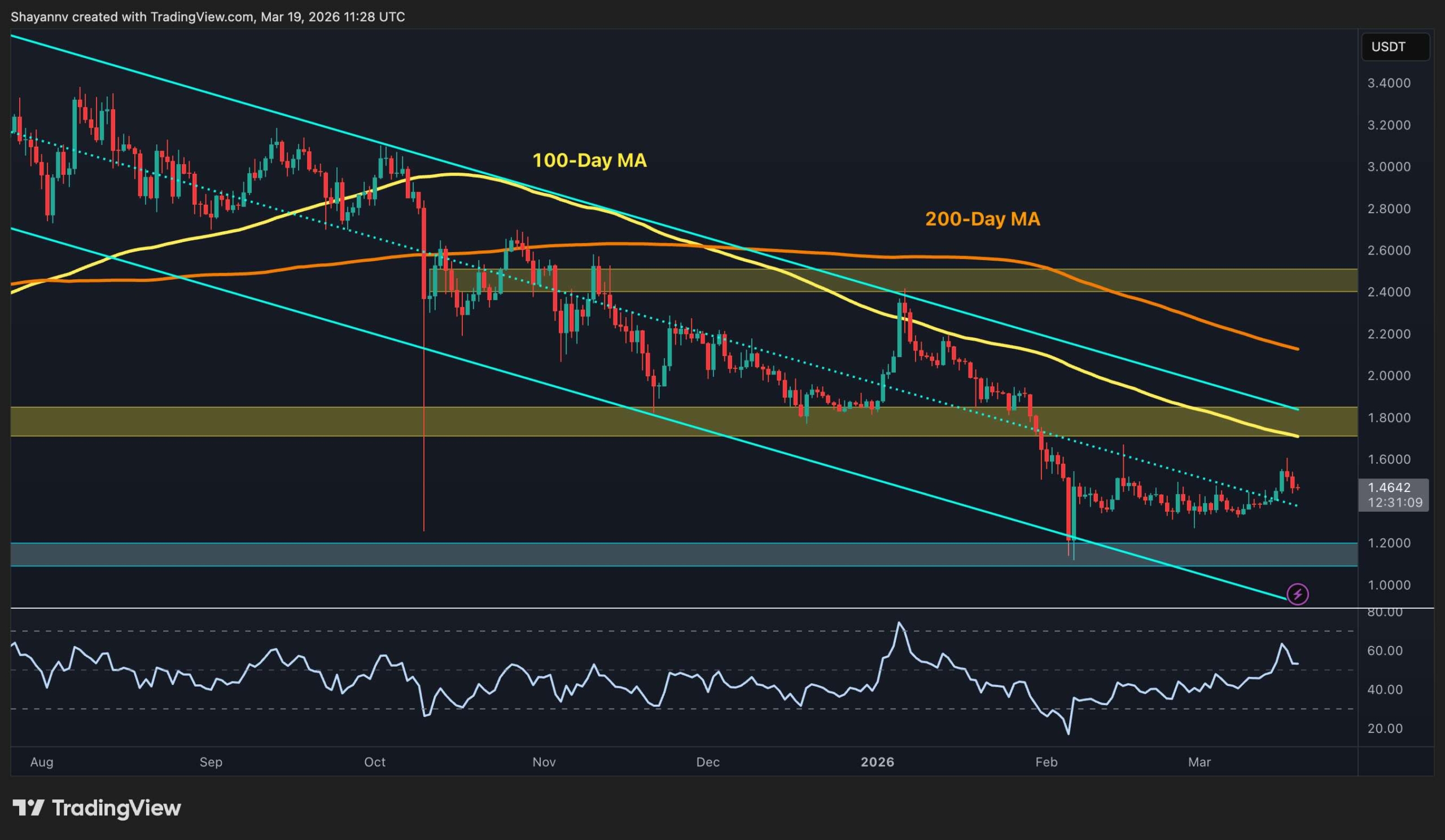
The XRP/BTC pair is telling a similar story. After repeatedly holding the 2,000 sats area, XRP has started to recover a bit and is now pressing back above that support zone. Momentum has improved, and the pair no longer looks as weak as it did during the recent dip, though it is still trading under both the 100-day and 200-day moving averages.
For the BTC pair, the first task is to turn this rebound into follow-through. A push through the 2,100 to 2,200 sats area would be a good start, and lead to a breakout above both key moving averages. But the real test remains higher at 2,400 to 2,500 sats, where layered resistance and the broader downtrend line converge. If XRP gets rejected before that, the market likely falls back into the same sideways-to-bearish range. However, if it breaks through, the tone shifts from simple stabilization to genuine recovery.

Binance Free $600 (CryptoPotato Exclusive): Use this link to register a new account and receive $600 exclusive welcome offer on Binance (full details).
LIMITED OFFER for CryptoPotato readers at Bybit: Use this link to register and open a $500 FREE position on any coin!
Disclaimer: Information found on CryptoPotato is those of writers quoted. It does not represent the opinions of CryptoPotato on whether to buy, sell, or hold any investments. You are advised to conduct your own research before making any investment decisions. Use provided information at your own risk. See Disclaimer for more information.
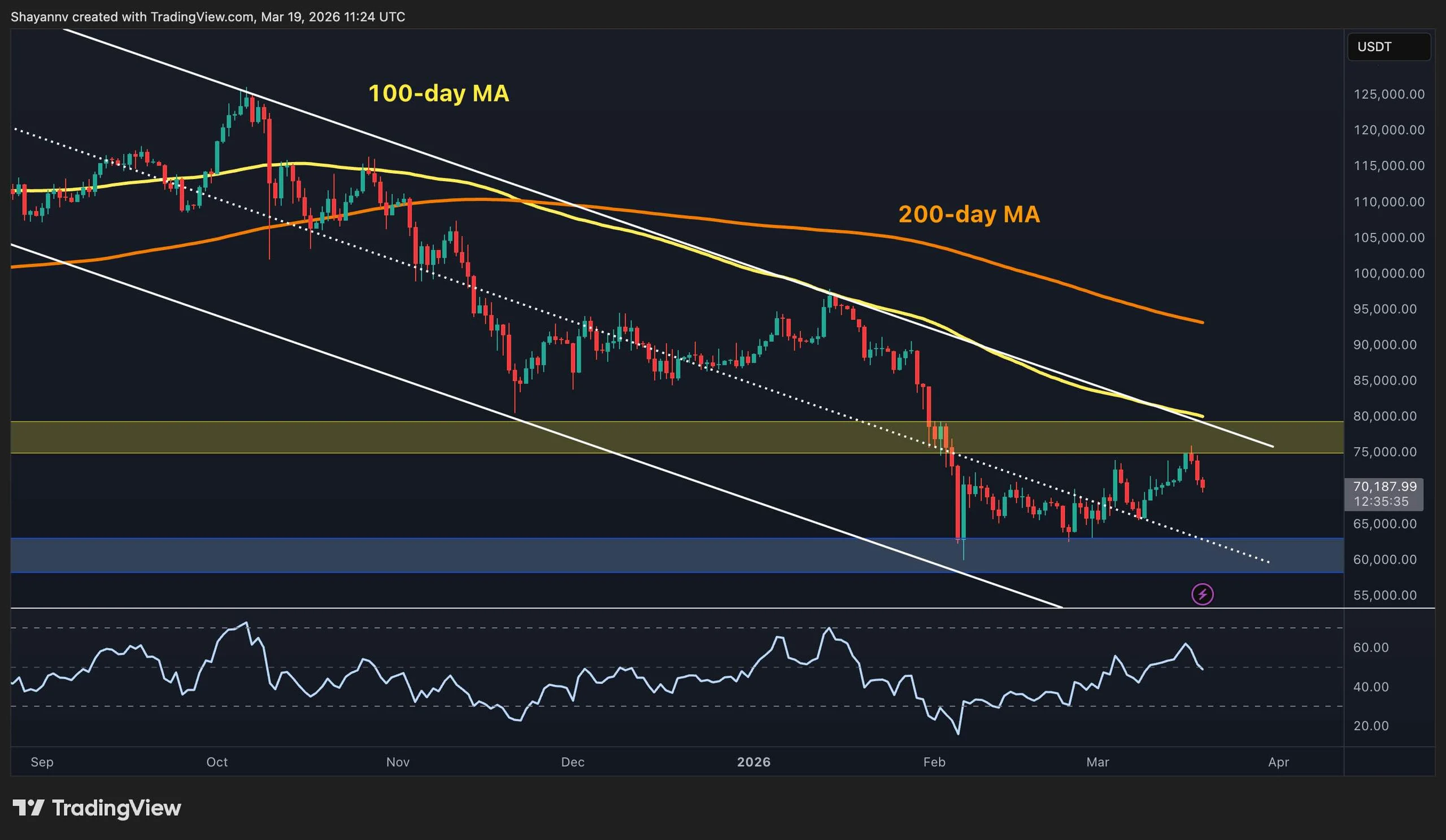
Bitcoin has continued to trade in a precarious zone after months of relentless selling pressure from the October 2025 highs above $125K. The asset is currently hovering below $70,000, attempting to stabilize after a dramatic downtrend, but several technical and on-chain signals suggest the battle between buyers and sellers is far from over.
Bitcoin Price Analysis: The Daily Chart
Looking at the daily timeframe, the broader picture remains firmly bearish. BTC has been trapped inside a descending channel since its peak above $125K, printing a consistent series of lower highs and lower lows. The asset is now trading well below both the 100-day and 200-day moving averages, which are acting as dynamic resistance overhead. The 200-day MA sits around $92K, and the 100-day near $80K, both far above the current price.
The daily RSI has recovered from deeply oversold territory, currently oscillating around the midline. A key horizontal support zone between $58K and $62K (highlighted in blue) held during the February capitulation wick, and that area remains the most critical floor to watch. For any meaningful reversal, however, the market would need to reclaim the $75K–$80K zone, which also aligns with the descending channel’s upper boundary.
BTC/USDT 4-Hour Chart
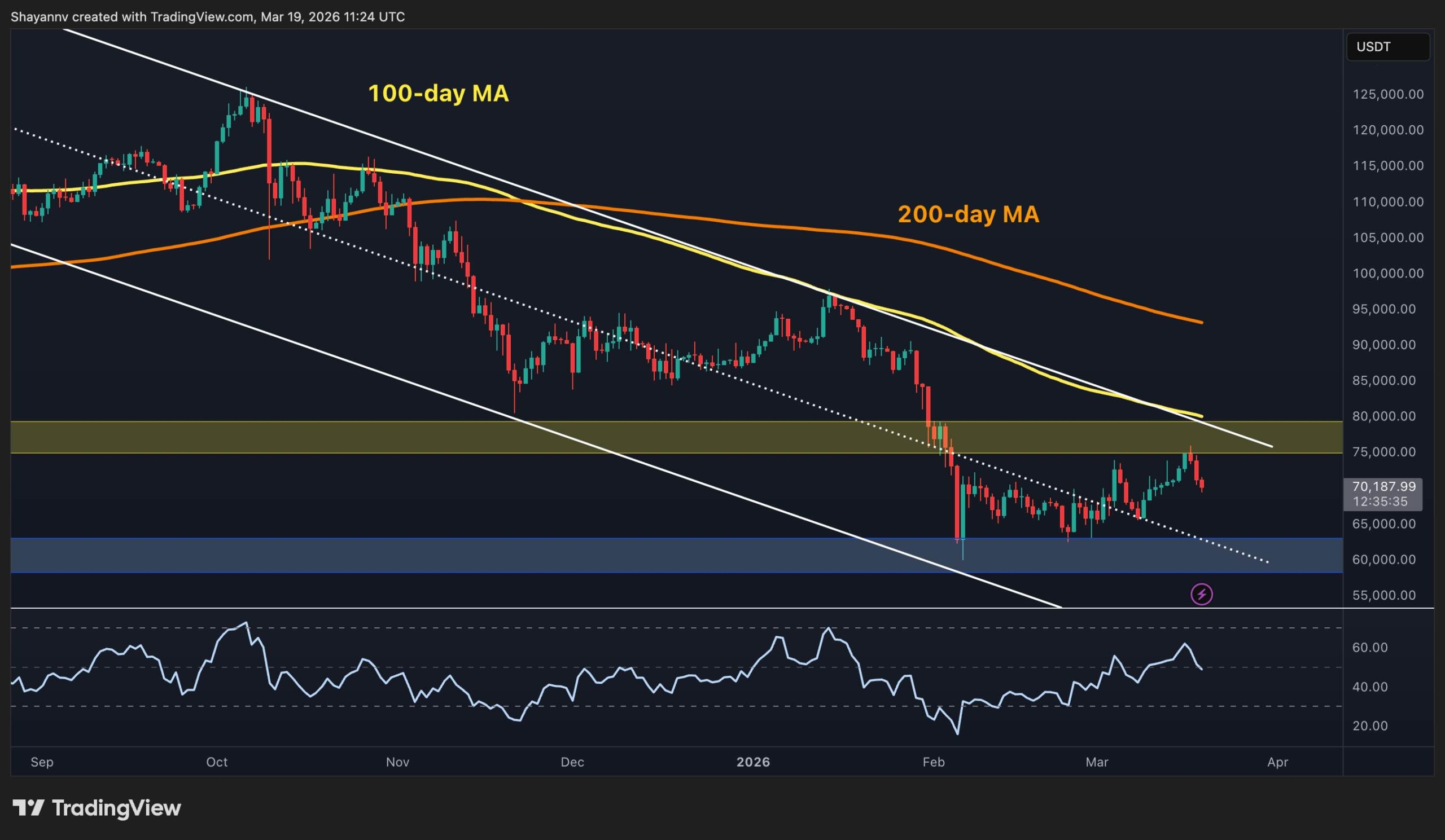
Zooming into the 4-hour chart, a more constructive short-term structure emerges. Since the early February lows near $60K, BTC has been forming an ascending channel pattern with higher lows, supported by a rising trendline. Yet, the price recently tagged the upper resistance near $75K before facing a decisive rejection and pulling back sharply toward $70k.
The area between $74K and $76K has acted as a stubborn supply zone, rejecting multiple attempts to break higher. The 4-hour RSI has also cooled off from overbought conditions and now sits below the 40 level, indicating a change in momentum to relatively bearish. A confirmed break below the rising trendline (~$66K) would likely accelerate selling toward $60K, while a push above $75K could trigger a squeeze toward $80K, and change the market outlook to bullish in the short-term.

On-Chain Analysis
The Exchange Whale Ratio, measuring the proportion of large transactions relative to total exchange inflows, has shown a notable spike in recent weeks. After months of relatively subdued whale activity during the prolonged downtrend, the ratio has jumped sharply from around 0.45 to above 0.6, signaling that large holders are becoming more active on exchanges.
Historically, sharp increases in this metric have coincided with periods of heightened volatility, as whales tend to move coins to exchanges either to sell or to reposition. The current uptick, combined with the price hovering near a technically sensitive zone, suggests that big players are preparing for a decisive move. Whether this translates into distribution (selling) or accumulation at these levels will likely determine BTC’s direction in the coming weeks.

Binance Free $600 (CryptoPotato Exclusive): Use this link to register a new account and receive $600 exclusive welcome offer on Binance (full details).
LIMITED OFFER for CryptoPotato readers at Bybit: Use this link to register and open a $500 FREE position on any coin!
Disclaimer: Information found on CryptoPotato is those of writers quoted. It does not represent the opinions of CryptoPotato on whether to buy, sell, or hold any investments. You are advised to conduct your own research before making any investment decisions. Use provided information at your own risk. See Disclaimer for more information.


- Bittensor price is trapped between key support and strong resistance levels.
- Momentum is cooling, hinting at either consolidation or a drop.
- A break above $300 or below $250 will decide the next major move.
Bittensor (TAO) had shown strong bullish movement for the better part of the year before hitting a snag on March 16.
That rejection triggered a sharp pullback that erased part of the recent gains.
The cryptocurrency has now entered a tense phase, with analysts trying to determine whether the current weakness is a healthy pause or the start of a deeper decline.
Key technical levels shaping the market
Bittensor is currently trading within a well-defined range that has formed over recent price swings.
The upper boundary sits near the $282 to $300 zone, where multiple attempts to break higher have failed.
This area has consistently acted as a ceiling and has attracted strong selling pressure.
A clean move above $282 would shift the market sentiment quickly, signalling renewed strength and possibly opening the path toward $313.
Beyond that, $357 remains a longer-term target if momentum continues to build.

On the downside, the market has shown repeated reactions around the $250 region.
This level aligns closely with a key Fibonacci retracement zone and has become a critical support area.
Below that, analysts note that $168 stands out as another important level where buyers have previously stepped in.
Accumulation or correction?
The current structure presents two clear possibilities. The first is a controlled pullback that leads into accumulation.
In this scenario, the price stabilises between $230 and $250 as larger participants gradually build positions.
This type of behaviour often appears after strong rallies and helps reset momentum.
The second scenario is a deeper correction that extends below current support levels.
This would indicate that selling pressure is stronger than expected and that buyers are not yet ready to defend higher prices.
A breakdown below $233 would strengthen this view and likely accelerate downside movement.
Market indicators currently suggest that momentum is cooling, with the Relative Strength Index (RSI) moving down from overbought levels, signalling a loss of upward pressure.
While this does not confirm a trend reversal on its own, it does suggest caution in the short term.
The bigger picture
Despite the recent weakness, Bittensor continues to stand out due to its underlying purpose.
The network is built around rewarding useful artificial intelligence, creating a system where performance determines value.
This gives the project a foundation that is different from many speculative assets.
Price action often moves ahead of fundamentals, and this appears to be one of those moments.
The market is currently adjusting after a strong run, and this adjustment could take time.
However, whether this turns into accumulation or further decline will depend on how the price behaves around key levels in the coming days.

OP_NET said it is launching a “SlowFi” decentralized finance (DeFi) stack on Bitcoin that uses standard Bitcoin transactions and native BTC fees rather than bridges, wrapped assets or a separate gas token.
According to a Thursday release shared with Cointelegraph, the project is part of a broader push to bring trading and yield-style activity directly onto Bitcoin’s base layer instead of routing it through sidechains, bridges or adjacent networks. OP_NET is betting some users will accept slower and more expensive transactions in exchange for staying fully on Bitcoin.
According to OP_NET co-founder Frederic Fosco, who goes by Danny Plainview, applications run through standard Bitcoin (BTC) transactions using Taproot-based spends, while the platform’s NativeSwap model is designed to support token swaps without wrapped BTC or a separate gas asset. Plainview told Cointelegraph that every transaction on OP_NET is “just a Bitcoin transaction with BTC as the only gas asset.”
The launch lands in the middle of a growing fight inside Bitcoin over whether DeFi-style and data-heavy uses of block space strengthen the network’s fee market or amount to spam that crowds out monetary transactions.
Plainview said a swap would typically cost about $1 to $2 under normal fee conditions and roughly $10 to $20 when blocks are congested, because users pay only standard Bitcoin network fees rather than a separate gas token.

OP_NET describes the model as “SlowFi,” arguing that Bitcoin’s roughly 10-minute block times and congestion-driven exit friction can make liquidity stickier and produce longer-lived DeFi cycles than faster chains.
Related: Fireblocks to integrate Stacks for institutional-grade Bitcoin DeFi
Critics say OP_NET brings Ethereum-style DeFi bloat
Plainview framed layer-1 DeFi as a way to support miner revenue as block subsidies decline, arguing that “miners are bleeding” due to Bitcoin’s halving schedule. “The only thing that keeps miners solvent is a fee market,” he said, insisting that OP_NET does not modify Bitcoin consensus.
Related: Animoca, RootstockLabs partner to bring Bitcoin DeFi to Japanese institutions
That view has drawn criticism from Bitcoin users who argue that pushing DeFi-style activity onto layer 1 dilutes Bitcoin’s monetary focus or clogs block space with nonessential transactions. In recent posts on X, some critics described OP_NET as an attempt to bring Ethereum-style crypto infrastructure onto Bitcoin.
Some maximalists argued that any attempt to expand Bitcoin’s use cases beyond money made its proponents “sh*tcoiners” larping as Bitcoiners.

Plainview pushed back, saying that any fee-paying Taproot transaction should be treated as a legitimate use of block space.
He warned that drawing moral lines around valid transactions handed de facto control of Bitcoin to whoever defines those categories. He said:
“The whole point is that nobody controls it.”
OP_NET keeps DeFi on Bitcoin base layer
OP_NET enters a field already populated by earlier attempts to bring programmability to Bitcoin, including through RSK and Stacks.
RSK operates as a separate Ethereum Virtual Machine-compatible sidechain with its own RBTC gas token and a federated BTC peg, meaning users move value off mainnet and trust a federation to manage the bridge.
Stacks, by contrast, is a Bitcoin-anchored layer-2 with its own STX token and sBTC mechanism, executing smart contracts on a distinct chain that settles periodically to Bitcoin rather than inside L1 transactions.
By keeping execution and fees directly on Bitcoin and avoiding wrapped BTC or new gas assets, Plainview is betting that some users will accept slower, more expensive transactions in exchange for staying entirely on Bitcoin’s base layer.
Magazine: Bitcoin may take 7 years to upgrade to post-quantum — BIP-360 co-author
Evernorth Holdings, an XRP treasury company going public through a SPAC merger, disclosed in a new S-4 filing that it and Pathfinder Digital Assets held about 473.1 million XRP as of the end of last year.
The document also gives investors a clearer look at how that position was built. Evernorth said it used $214.1 million in cash to acquire 84.4 million XRP, which works out to about $2.54 per token for that portion of the treasury. XRP is currently trading at $1.45, or down about 35% from the average purchase price.
The filing also points to a $233.7 million digital asset impairment for 2025 under U.S. accounting rules, reflecting the gap between purchase prices and lower market values at the reporting date.
The filing also shows the treasury did not come only from open-market buying. Ripple, a major player in the XRP ecosystem, contributed 126.8 million XRP to Pathfinder under a contribution agreement.
The sponsor separately contributed 211.3 million XRP through a Series C subscription tied to the broader deal, the filing shows.
Evernorth says it wants to actively manage its treasury rather than simply holding XRP and waiting for the token to rise. The S-4 says the company plans to use Ripple’s RLUSD stablecoin in XRP-based decentralized finance activity, including RLUSD/XRP liquidity pools.
It also expects to lend XRP, provide automated market-maker liquidity, and run options strategies, such as covered calls and cash-secured puts, to further monetize the company’s treasury.
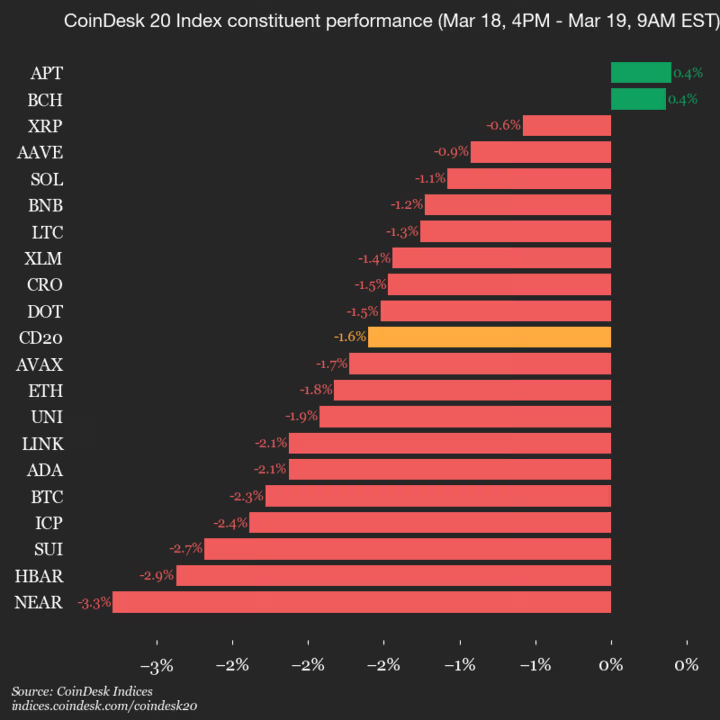
CoinDesk Indices presents its daily market update, highlighting the performance of leaders and laggards in the CoinDesk 20 Index.
The CoinDesk 20 is currently trading at 2029.25, down 1.6% (-33.09) since yesterday’s close.
Two of 20 assets are trading higher.

Leaders: APT (+0.4%) and BCH (+0.4%).
Laggards: NEAR (-3.3%) and HBAR (-2.9%).
The CoinDesk 20 is a broad-based index traded on multiple platforms in several regions globally.

Attendees bring their laptops to install the OpenClaw AI agent during a Baidu event in Beijing, China, on Tuesday, March 17, 2026.
Bloomberg | Bloomberg | Getty Images
BEIJING — So many people in China are rushing to try the OpenClaw artificial intelligence tool that they’re driving up prices for secondhand Mac computers.
That’s according to Jeremy Ji, chief strategy officer and general manager of international business at ATRenew, a used consumer electronics buyer and reseller that works with Apple and retailer JD.com in mainland China.
OpenClaw is an AI agent, a tool that can autonomously conduct personal tasks such as sending emails and shopping online. Usage in China is currently outstripping the U.S., according to American cybersecurity firm SecurityScorecard.
However, the free-to-download software also poses security risks, prompting many users to run OpenClaw on a cloud computing server or laptop separate from their primary device. If allowed direct access to a personal computer, the AI agent could autonomously alter private data such as banking information, or enable hackers to access it more easily.
As people in China jump on the OpenClaw trend, they are turning to preowned computers, Ji said in a phone interview.
He likened the demand surge to the pandemic, when many people bought more personal computing devices since they were working and spending more time at home.
As a result, from March to May this year, Ji said that ATRenew is keeping its prices for Apple products similar to those seen during the peak fall season around new iPhone releases. That contrasts with a typical price drop during the spring.
Ji said prices for a new MacBook are typically 15% higher than the used ones sold through ATRenew.

Apple’s self-developed chips, the latest of which is called the M5, are generally more power-efficient than chips for computers running Windows systems. For early OpenClaw adopters, the popular hardware of choice has been Apple’s Mac Mini.
ATRenew’s Ji said the company is seeing people trade-in their MacBooks with older M1 and M2 chips for computers with the M4 or M5 chip. “We do see the growing demand for laptops, PCs as a whole, but the Mac devices benefit from that trend [to try OpenClaw] above all.”
Consumer interest in more powerful secondhand MacBooks is “still going very strong,” Ji said, noting that ATRenew has had to increase its price for buying back devices in order to increase the supply of secondhand Macs available for purchase. He predicted the trend could continue “throughout the whole year.”

Subscribe now
An Austrian developer, Peter Steinberger, launched OpenClaw in November. But the latest wave of interest in China only picked up early this month as Tencent and other Chinese tech companies used OpenClaw as a way to attract more users.
ATRenew’s Ji declined to share the exact volume of MacBooks handled since late February, but noted the average number of devices the company processed last year was around 100,000 a day. He expects the share of MacBook and other laptop or personal computing devices could grow to 20% of the business, up from 15% right now.
Jensen Huang, CEO of U.S. chip giant Nvidia, told CNBC’s Jim Cramer on Tuesday that OpenClaw is “definitely the next ChatGPT.”
“It is now the largest, most popular, the most successful open-sourced project in the history of humanity,” Huang said.
Overall demand for AI computing power has also driven up prices for memory chips, a key component of smartphones and laptops.
The chip price surge has specifically encouraged more consumers in China to buy used Apple smartphones, rather than flagship Android-based devices, Ji said.

How To Invest In Cryptocurrencies For Beginners | Cryptocurrency Sinhala

Durham Johnston School forced to close after power cut
UBS lowers Oxford Industries stock price target to $35 on Q4 trends

Smart energy pays enters the US market, targeting scalable financial infrastructure

Why Israel is blocking foreign journalists from entering

Bitcoin: We’re Entering The Most Dangerous Phase
How To Invest In Cryptocurrencies For Beginners | Cryptocurrency Sinhala

Waka Flocka On Becoming A Financial Historian #rapper #investments #mindset #mentality

Financial Seatbelts: 3 Risks Every Youngster Must Cover!#financialfreedom #helthinsurence #shorts
-
 Crypto World5 days ago
HYPE Token Enters Net Deflation as HyperCore Buybacks Outpace Staking Rewards
-

 Tech4 days ago
Your Legally Registered ‘Motorcycle’ Might Not Count Under Proposed US Law
-

 Fashion6 days ago
Weekend Open Thread: Addict Lip Glow
-
 Tech2 days ago
Are Split Spacebars the Next Big Gaming Keyboard Trend?
-
Sports5 days ago
Why Duke and Michigan Are Dead Even Entering Selection Sunday
-

 Business4 days ago
Search for Savannah Guthrie’s Mother Enters Seventh Week with No Arrests
-

 Business5 days ago
US Airports Launch Donation Drives for Unpaid TSA Workers as Partial Government Shutdown Enters Fifth Week
-
Crypto World5 days ago
Coinbase and Bybit in Investment Talks: Could Bybit Finally Enter the US Crypto Market?
-

 Business3 days ago
Australian shares drop as Iran war enters third week
-

 Business5 days ago
Country star Brantley Gilbert enters growing non-alcoholic beer market
-

 Crypto World3 days ago
Crypto Lender BlockFills Enters Chapter 11 with Up to $500M in Liabilities
-

 Sports6 days ago
College Basketball Best Bets: Conference Tournament Semifinal Picks
-

 Politics1 day ago
The House | The new register to protect children from their abusers shows Parliament at its best
-
 Business7 days ago
Trump demands Powell cut rates as Iran conflict raises energy prices
-

 Fashion3 days ago
25 Celebrities with Curly Hair That Are Naturally Beautiful
-

 News Videos21 hours ago
RBA board divided on rate cut, unusually buoyant share market | Finance Report | ABC NEWS
-

 Crypto World7 days ago
Senate Votes to Include CBDC Ban in Bipartisan Housing Bill
-

 NewsBeat7 days ago
Deane Road crash near Bolton colleges and university
-

 Crypto World21 hours ago
Canada’s FINTRAC revokes registrations of 23 crypto MSBs in AML crackdown
-

 News Videos7 days ago
Tom Lee: The 100x Opportunity EVEN Bigger Than Bitcoin (New Ethereum Prediction 2026)


You must be logged in to post a comment Login