
Business
UK targets 50% domestic steel production with new import tariffs

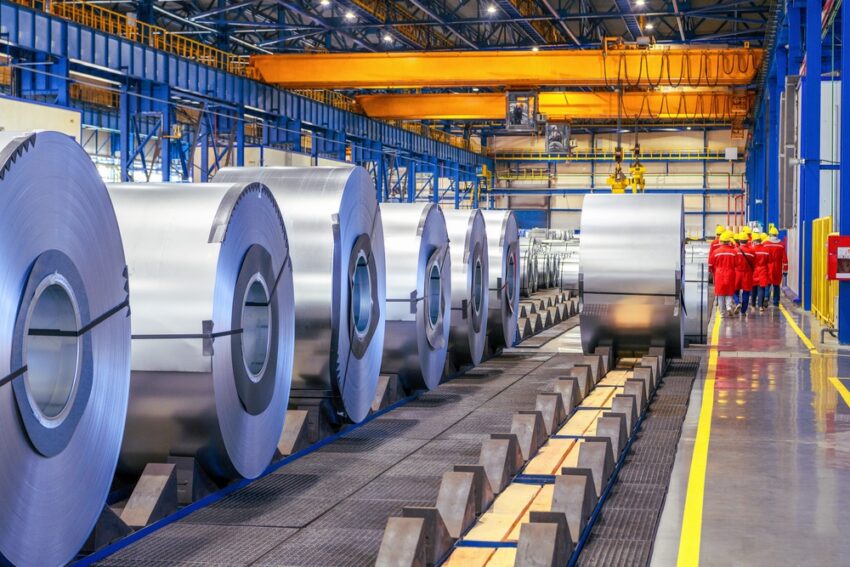
The UK government has unveiled a major intervention in the steel market, setting an ambitious target to produce up to 50 per cent of the steel used domestically while imposing steep new tariffs on imports in a bid to protect the struggling industry.
Under the plans, import quotas will be reduced by 60 per cent from July, with any steel brought into the UK above those limits facing a punitive 50 per cent tariff. The move represents one of the most assertive steps taken by ministers in recent years to bolster domestic manufacturing capacity amid intensifying global competition.
Announcing the measures in Port Talbot, Business Secretary Peter Kyle said the strategy was designed to both strengthen UK industrial resilience and counter what he described as “anti-competitive behaviour” in global steel markets.
He confirmed the government aims to increase the proportion of British steel used in the UK economy from around 30 per cent to 50 per cent, although no specific deadline has yet been set for achieving the target.
The introduction of a 50 per cent tariff on excess imports marks a significant escalation in trade policy. While tariffs are paid by importing firms, the additional costs are typically passed through supply chains, potentially raising prices for manufacturers, construction firms and ultimately consumers.
Ministers insist the policy is not protectionist but rather a necessary safeguard in a market distorted by global overcapacity and subsidised production, particularly from overseas producers able to undercut UK manufacturers.
A transitional arrangement is being considered to soften the immediate impact, with contracts agreed before 14 March potentially exempt from the new tariffs for imports arriving between July and September.
The UK steel sector has broadly welcomed the announcement, having long called for stronger measures to shield it from cheaper imports and volatile global pricing.
Gareth Stace, head of industry body UK Steel, said the strategy represents a long-overdue shift in policy.
He said the UK had lacked a coherent industrial plan for steel for years, despite its central role in national security, infrastructure delivery and the transition to low-carbon energy systems. He added that a clear domestic strategy was essential if the sector is to survive and grow in an increasingly competitive global market.
Trade unions also cautiously backed the move. The GMB said the announcement was welcome but stressed that key questions remain around ownership structures, particularly at major sites such as Scunthorpe, and the long-term technological direction of the industry.
However, the policy has drawn sharp criticism from opposition figures, who argue the tariffs risk increasing costs across the wider economy.
Andrew Griffith warned that higher import costs could ripple through key sectors such as construction, potentially reducing infrastructure investment and placing additional pressure on UK manufacturers already facing tight margins.
The concern reflects a broader economic tension: while tariffs may support domestic producers, they can also raise input costs for downstream industries that rely on competitively priced materials.
The intervention comes at a critical moment for the UK steel industry, which has faced years of financial strain driven by high energy costs, global oversupply and shifting demand.
Although recent government support has helped reduce energy costs for intensive users, UK producers still face higher bills than many European and US competitors. That gap could widen further if global energy markets remain volatile.
Fears are growing that the ongoing conflict in the Middle East could push oil and gas prices higher for longer, increasing operating costs for energy-intensive industries such as steelmaking.
The government’s push to increase domestic steel production also reflects broader strategic concerns. Ministers are keen to ensure the UK retains sovereign capability in critical industries, particularly as geopolitical tensions expose vulnerabilities in global supply chains.
This is underscored by the government’s direct involvement in key steel assets, including sites in Scunthorpe and Rotherham, where public funds are currently being used to maintain operations that might otherwise have ceased.
At the same time, investment in new technology is beginning to reshape the sector. At Port Talbot, Tata Steel is developing an electric arc furnace, which will recycle scrap metal to produce steel with significantly lower carbon emissions — a key component of the UK’s net zero ambitions.
The success of the government’s strategy will ultimately depend on whether it can strike a balance between protecting domestic producers and maintaining competitiveness across the broader economy.
While boosting local production could strengthen supply chain resilience and support jobs, the risk remains that higher costs could dampen demand and investment elsewhere.
For now, the policy signals a decisive shift towards a more interventionist industrial strategy — one that places steel at the heart of the UK’s economic, environmental and national security priorities.

Amy Ingham
Amy is a newly qualified journalist specialising in business journalism at Business Matters with responsibility for news content for what is now the UK’s largest print and online source of current business news.

FOX Business host Charles Payne unpacks AI disruption fears on ‘Making Money.’
An 80-year-old family-owned furniture company — which says it is the largest furniture manufacturer in the world — is cutting hundreds of jobs while restructuring a Texas plant.
Earlier this month, Ashley Furniture filed a Worker Adjustment and Retraining Notification (WARN) with the Texas Workforce Commission, indicating that 266 employees will be laid off by May 7, as the company plans to “consolidate” its Mesquite facility.
“Ashley is consolidating manufacturing operations at its Mesquite, Texas facility with production at other Ashley manufacturing locations. Manufacturing operations at the Mesquite facility will conclude May 7, 2026,” Ashley told Fox News Digital in a statement.
TEXAS RARE-EARTH PROJECT AIMS TO CURB U.S. RELIANCE ON CHINA, STRENGTHEN NATIONAL SECURITY
“Affected employees are being offered opportunities for available positions at other Ashley facilities, including roles in the Mesquite Distribution Center,” the spokesperson continued.
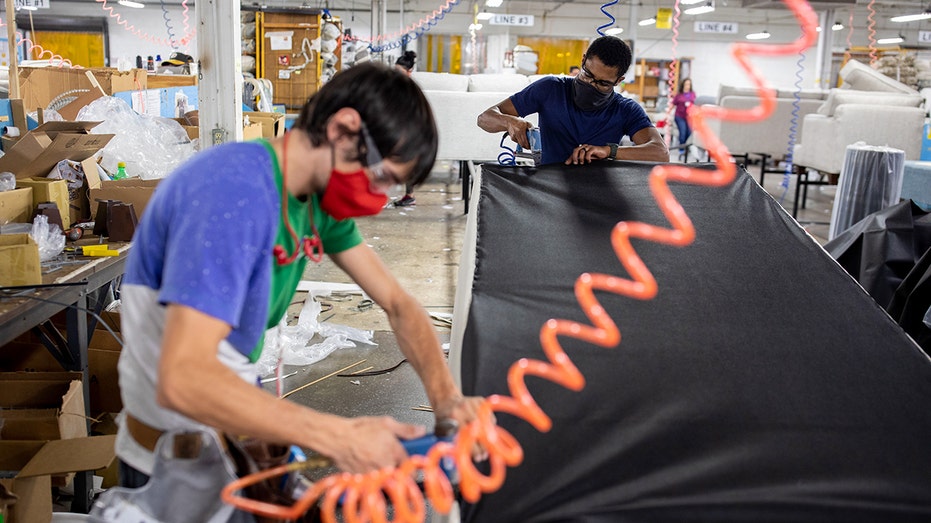
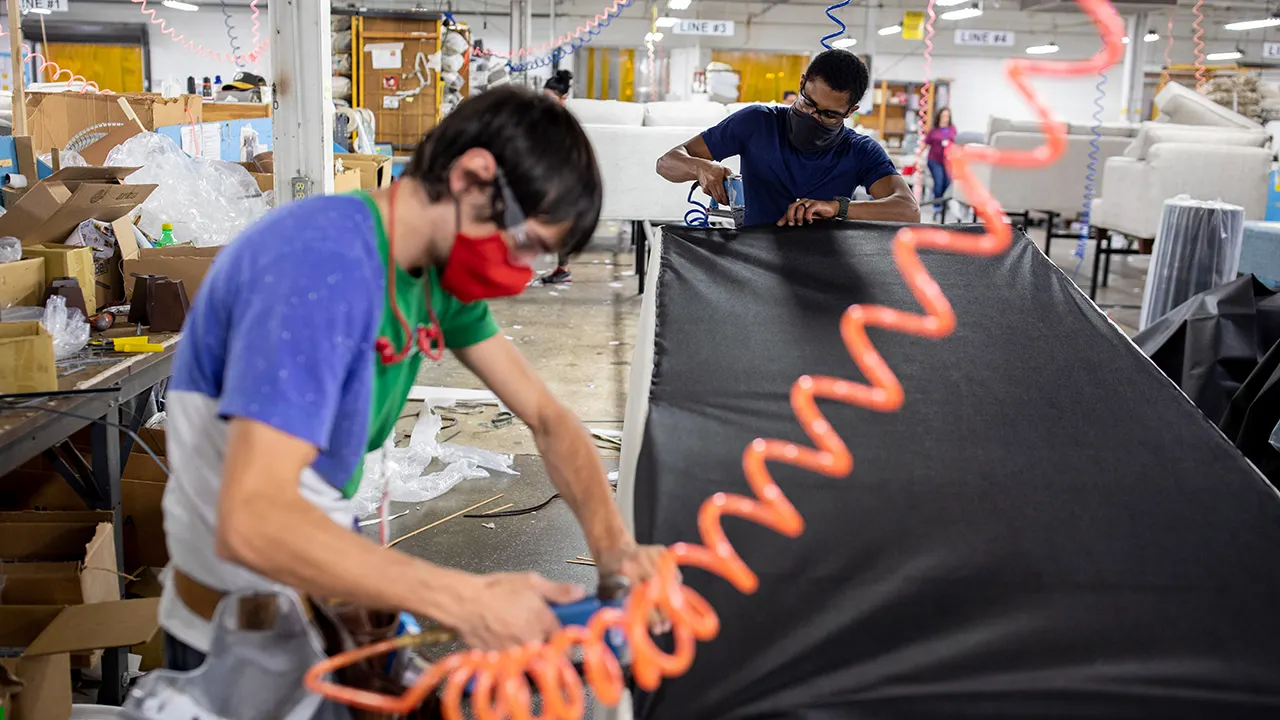
American-based furniture factory workers upholster a couch on Nov. 12, 2021. (Logan Cyrus/Bloomberg via Getty Images / Getty Images)
The formal WARN notice, initially obtained by Texas news outlet Chron, indicated that 109 upholstery training workers, 31 machine operators, 24 packing employees and additional cuts to inspectors, quality supervisors and material handlers would take place.
The state of Texas requires companies with more than 100 employees to provide at least a 60-day notice of closures or layoffs to “offer protection to workers, their families and communities,” according to the WARN Act website.
FOX Business’ Lydia Hu reports from Goose Creek, S.C., inside a Century Aluminum smelting factory detailing how Trump tariffs created jobs and boosted manufacturing capacity on ‘Varney & Co.’
“This decision reflects Ashley’s ongoing efforts to optimize its manufacturing footprint, vertically integrate its facilities and strengthen long-term operational efficiency,” the statement said. “It reinforces our commitment to delivering high-quality products and exceptional service to customers worldwide, while continuing to adapt, grow and operate more efficiently in a dynamic and ever-changing industry.”
In October, the U.S. implemented a 10% tariff on softwood lumber and a 25% duty on certain imported furniture, which remain in effect, according to a White House proclamation. While the Trump administration has said the measures are intended to protect domestic industries and national security, higher costs are pressuring furniture makers that rely on global supply chains.
GET FOX BUSINESS ON THE GO BY CLICKING HERE
PMG Affordable principal Dan Coakley speaks to Fox News Digital about what it may take to making housing affordable again across the country.
The home furnishing sector has also taken a hit as fewer Americans are moving, with mortgage rates hovering around 6% and pending home sales down 5.8% year over year, according to February data from the National Association of Realtors.
Ashley’s move follows broader industry changes, including store closures by companies such as IKEA and layoffs across the auto parts and logistics sectors, potentially signaling a wider recalibration of U.S. manufacturing in 2026.


The certification, based on animal welfare and transparency, was adopted by Whole Foods Market.


Green initiatives are not a key driver according to the Baking & Snack Capital Spending Study.

Homes for Wells provides rented accommodation to 47 families for about 80% of market rate.

Jefferies reiterates Sarepta stock rating on regulatory pathway


Companies are using the nutrient to differentiate.

Treasury Secretary Scott Bessent joins ‘Mornings with Maria’ to discuss the Iran war, surging oil prices, market volatility, Fed uncertainty, Powell’s future and the U.S. strategy to stabilize the global economy.
Treasury Secretary Scott Bessent said the U.S. government will not intervene in oil futures markets even as the administration moves to offset supply disruptions tied to the Iran conflict, arguing that Washington’s response will focus on boosting physical crude availability instead.
“We’re absolutely not doing that,” Bessent told FOX Business’ “Mornings With Maria” on Thursday, when asked about possible Treasury intervention in the futures market. “We’re not intervening in the financial markets. We are supplying the physical markets.”
In an interview with Maria Bartiromo, Bessent said the administration has prepared a coordinated supply response designed to cushion the impact of any temporary disruption around the Strait of Hormuz. He said the U.S. had already moved to “unsanction” Russian oil cargoes already on the water, estimated at about 130 million barrels, and could do the same with roughly 140 million barrels of Iranian oil in floating storage.
“In essence, by the time we unsanctioned the floating Iranian oil, we would have intervened and we would have created about 260 million excess barrels of energy,” Bessent said, calling that a “physical intervention” rather than a financial one.

Secretary of Treasury Scott Bessent said the key to keeping oil prices in America down is to boost the oil supply for the rest of the world. (Nathan Posner/Anadolu via Getty Images / Getty Images)
Bessent said that volume could help cover what he described as a temporary deficit of 10 million to 14 million barrels per day if shipping through the strait is interrupted, providing roughly three weeks of market stabilization. He also pointed to a 400 million-barrel coordinated Strategic Petroleum Reserve release approved last week and said the U.S. could act again unilaterally if needed.
TRUMP WAIVES JONES ACT FOR 60 DAYS IN BID TO FREE UP THE FLOW OF OIL TO US PORTS
“The largest coordinated SPR release in history, 400 million barrels, was approved last week,” he said. “The U.S. could unilaterally do another SPR release to keep the price down.”

About 20% of the world’s oil supply crosses the Strait of Hormuz off the coast of Iran. The Iranian Regime is threatening to attack any vessels that cross the strait without permission. (Fox News / Fox News)
Bessent framed the strategy as part of a broader effort to balance pressure on Iran with energy market stability. He said the U.S. has avoided striking Iranian energy infrastructure even while escalating military operations, arguing the goal is to preserve supply while keeping pressure on Tehran.
GET FOX BUSINESS ON THE GO BY CLICKING HERE
“We have lots of levers,” Bessent said. “We’ve got plenty more that we can do.”
Dan Brouillette, former Energy Secretary under Trump, discusses whether NATO should aid in securing the Strait of Hormuz, oil prices, Cuba’s nationwide blackout and more on ‘Varney & Co.’
CLICK HERE TO READ MORE ON FOX BUSINESS
Supplying the world more oil from Iran is going to ultimately bring down prices in America, according to Bessent, who noted the U.S. does not rely on Middle East oil but the chokepoint on oil through the Strait of Hormuz has indirectly strained supply and spooked crude futures markets.
Business
Where To Buy Lollapalooza Tickets? How to Secure Passes in One-Hour Presale Window Before Prices Rise

With the 2026 lineup freshly announced featuring headliners like Charli XCX, Lorde, Jennie and The Smashing Pumpkins, demand for Lollapalooza Chicago tickets is surging. The festival’s one-hour exclusive presale window for the lowest-priced four-day passes opens Thursday, March 19, at 10 a.m. CT, and organizers warn that these Tier 1 deals vanish quickly as thousands of fans compete for limited inventory.

Lollapalooza returns to Grant Park July 30 through Aug. 2, 2026, promising four days of music across eight stages with more than 170 acts. But snagging tickets at face value — especially the cheapest tiers — requires precise preparation during the brief presale period before the public on-sale at 11 a.m. CT, when prices automatically increase and higher tiers activate.
Festival officials emphasize that the first hour of presale guarantees the lowest four-day ticket prices available all year. General admission four-day passes start at $399 in Tier 1, with GA+ at $735, VIP at $1,599, Platinum at higher levels and ultra-premium Lolla Insider packages reaching $29,000. Single-day tickets are not yet on sale but are expected later, often at steeper prices.
To access the presale, fans must register in advance on the official site. Visit lollapalooza.com/signup and enter an email address or phone number for notifications. Registered users receive a direct link or access code via email or text shortly before or at the 10 a.m. CT start time. Without registration, buyers miss the window entirely and face higher costs or sold-out options.
Veteran attendees and ticketing experts offer these key strategies to maximize chances during the critical one-hour period:
Prepare your account early. Create or log into a Front Gate Tickets profile — the official ticketing platform at lollapalooza.frontgatetickets.com — well ahead of time. Add payment information, shipping details (for wristbands) and any promo codes if applicable. Double-check that your browser is updated and cookies are enabled to avoid login glitches.
Use multiple devices and connections. Open the presale page on a computer, phone and tablet simultaneously. A stable, high-speed internet connection is essential; switch to wired Ethernet if possible or use mobile hotspot as backup. Avoid public Wi-Fi, which can be slow or drop during peak traffic.
Log in 10-15 minutes before 10 a.m. CT. The site often experiences heavy load right at open. Being pre-logged reduces wait times in virtual queues. Refresh the page strategically — too aggressively can trigger anti-bot measures.
Act fast on ticket selection. Once in, select four-day GA or desired tier immediately. Quantity limits apply (typically four per order), so decide in advance. Add to cart quickly, then proceed to checkout without hesitation. Layaway options start at $19 down for GA and $49 for GA+, allowing payment plans without losing the low price.
Monitor official channels. Follow @lollapalooza on X, Instagram and Facebook for real-time updates. The festival posts countdowns and reminders. Join Reddit’s r/Lollapalooza community for live threads where users share queue positions and tips as the window unfolds.
If the lowest tier sells out mid-presale, higher tiers remain available until 11 a.m. CT, when the general public joins and dynamic pricing kicks in. Past years show four-day passes often last into public sale but at increased rates, sometimes jumping $50-$100 per tier.
For those who miss the presale, alternatives exist. Verified resale platforms like StubHub, Vivid Seats, SeatGeek and Ticketmaster’s resale marketplace offer tickets with buyer guarantees against fakes or invalid entry. Prices fluctuate with demand — four-day passes currently hover around $612 and up on secondary sites, while single days start near $316. Avoid unverified sellers on social media or forums to prevent scams.
Festival organizers urge buying only through official channels or trusted partners. Wristbands ship months ahead and include RFID tech for entry; lost or damaged ones can be replaced at will-call with proof.
Demand drivers include the stacked lineup and Chicago’s summer appeal. Headliners span pop, hip-hop, rock and electronic genres, drawing international crowds. Grant Park’s lakefront setting adds to the allure, but capacity remains finite.
Experts note that presale success often hinges on speed and readiness rather than luck. “The one-hour window is designed to reward prepared fans with the best deals,” a Lollapalooza representative said. “Once it’s over, prices rise progressively as tiers deplete.”
Single-day tickets, when released, typically follow similar patterns but sell faster due to targeted artist interest. Fans eyeing specific headliners should monitor for one-day announcements.
As March 19 approaches, registration remains open at lollapalooza.com. Organizers advise acting now to secure access. With tickets historically selling out or escalating rapidly, preparation during this brief presale offers the clearest path to attending Lollapalooza 2026 at the lowest cost.
For the latest, check lollapalooza.com/tickets or the support hub at support.lollapalooza.com. Whether aiming for GA entry or VIP perks, the key is readiness when the clock hits 10 a.m. CT.
Disclosure: This post contains affiliate links. We may receive a commission for purchases made through these links at no additional cost to you.

VTEX: A Riskier Bet As Growth Compresses (Downgrade)

Innovate UK is set to overhaul its funding strategy, shifting away from broad-based support for hundreds of thousands of “innovators” each year to concentrate its £1.1 billion budget on a smaller pool of high-potential companies.
The government’s innovation agency said the move is designed to accelerate the growth of early-stage technology firms capable of scaling into globally competitive businesses, with ambitions to create more UK success stories on the scale of chip designer Arm.
The strategic pivot marks a significant departure from Innovate UK’s previous ambition to support “a million innovators” annually. While the agency reached around 450,000 individuals in 2024, only a small proportion received direct financial backing, prompting concerns that resources were being spread too thinly to deliver meaningful economic impact.
Tom Adeyoola, who took over as executive chair last year, said the shift reflects a more targeted approach focused on outcomes rather than volume.
“It is a shift from a focus on quantity and funding projects to supporting companies and ensuring that they realise their potential,” he said. “We want to help businesses move from breakthrough ideas to becoming industry leaders that drive economic growth.”
Under the new strategy, Innovate UK will scale back or eliminate several longstanding grant schemes, including the widely used Smart Grants programme, which Adeyoola described as too broad due to its “stage agnostic” and “sector agnostic” design.
In its place, the agency will introduce more tightly defined funding streams aligned to specific sectors and stages of business growth. Programmes such as Women in Innovation will also be refocused to support female-led firms with high-growth potential rather than providing generalised support.
The agency has identified six priority sectors from the government’s industrial strategy where it believes the UK has a “genuine right to win”. These include advanced manufacturing, life sciences and digital technologies — spanning areas such as artificial intelligence, semiconductors and quantum computing.
At the same time, Innovate UK is launching a new concierge-style support service, “Velocity”, aimed at helping selected companies navigate funding, regulation and commercialisation challenges more effectively.
A key pillar of the revised approach will be the expansion of targeted funding initiatives such as the £100 million Growth Catalyst scheme, which provides grants covering up to 70 per cent of early-stage project costs and up to 45 per cent for larger research and development programmes.
The agency will also refocus its Business Growth advisory service and more closely align its network of Catapult centres, applied innovation hubs, with the needs of specific companies rather than broader sector engagement.
Adeyoola said Innovate UK would play a more active role in identifying market demand and matching it with emerging technologies, effectively acting as a bridge between research, entrepreneurship and commercial opportunity.
“We will spend more time identifying where demand exists and then supporting the entrepreneurs and academics best placed to meet that demand,” he said.
Central to the strategy is a renewed emphasis on leveraging private investment. Innovate UK believes that its technical validation and endorsement can act as a signal to investors, reducing risk and unlocking additional capital for high-growth firms.
“A key measure of success over my four-year period will be the amount of private capital flowing into companies coming through our system,” Adeyoola said.
To support this, the agency plans to strengthen links with major public finance institutions including the British Business Bank and the National Wealth Fund, while continuing to deliver approximately £1 billion of innovation programmes on behalf of other government departments.
While the new approach is designed to create globally competitive businesses, it raises questions about access to support for smaller or earlier-stage innovators who may fall outside the new criteria.
Innovate UK argues that concentrating resources will ultimately deliver greater economic returns, helping the UK compete more effectively in critical technologies and strengthen its position in an increasingly competitive global innovation landscape.
The strategy signals a clear shift in government thinking, from fostering widespread participation in innovation to backing fewer, more scalable companies capable of delivering outsized growth and long-term economic impact.
Amy Ingham
Amy is a newly qualified journalist specialising in business journalism at Business Matters with responsibility for news content for what is now the UK’s largest print and online source of current business news.

Spiced lamb cutlets with dates, feta, sumac and tahini

Ashley Furniture cuts hundreds of jobs in Mesquite, Texas plant consolidation

Hegseth: Iran War Not ’Forever War’


-
 Crypto World5 days ago
HYPE Token Enters Net Deflation as HyperCore Buybacks Outpace Staking Rewards
-

 Tech4 days ago
Your Legally Registered ‘Motorcycle’ Might Not Count Under Proposed US Law
-

 Fashion6 days ago
Weekend Open Thread: Addict Lip Glow
-
 Tech2 days ago
Are Split Spacebars the Next Big Gaming Keyboard Trend?
-
Sports5 days ago
Why Duke and Michigan Are Dead Even Entering Selection Sunday
-

 Business4 days ago
Search for Savannah Guthrie’s Mother Enters Seventh Week with No Arrests
-

 Business5 days ago
US Airports Launch Donation Drives for Unpaid TSA Workers as Partial Government Shutdown Enters Fifth Week
-
Crypto World5 days ago
Coinbase and Bybit in Investment Talks: Could Bybit Finally Enter the US Crypto Market?
-

 Business3 days ago
Australian shares drop as Iran war enters third week
-

 Business5 days ago
Country star Brantley Gilbert enters growing non-alcoholic beer market
-

 Crypto World3 days ago
Crypto Lender BlockFills Enters Chapter 11 with Up to $500M in Liabilities
-

 Sports6 days ago
College Basketball Best Bets: Conference Tournament Semifinal Picks
-

 Politics1 day ago
The House | The new register to protect children from their abusers shows Parliament at its best
-
 Business7 days ago
Trump demands Powell cut rates as Iran conflict raises energy prices
-

 Fashion3 days ago
25 Celebrities with Curly Hair That Are Naturally Beautiful
-

 News Videos23 hours ago
RBA board divided on rate cut, unusually buoyant share market | Finance Report | ABC NEWS
-

 Crypto World7 days ago
Senate Votes to Include CBDC Ban in Bipartisan Housing Bill
-

 NewsBeat7 days ago
Deane Road crash near Bolton colleges and university
-

 Crypto World23 hours ago
Canada’s FINTRAC revokes registrations of 23 crypto MSBs in AML crackdown
-

 News Videos7 days ago
Tom Lee: The 100x Opportunity EVEN Bigger Than Bitcoin (New Ethereum Prediction 2026)


You must be logged in to post a comment Login