
Crypto World
CZ pushes back against Binance ‘FUD’ as blame game for crypto crash persists



Binance co-founder Changpeng “CZ” Zhao took to social media on Monday to counter a series of allegations he called “pretty imaginative FUD” aimed at himself and his former exchange as the main culprit for the dismal crypto price action.
FUD — short for “fear, uncertainty, and doubt” — is a term widely used in crypto to describe the spread of false, misleading or exaggerated information that sows panic in the market. It has also been used to dismiss criticisms, even legitimate ones, that might affect companies.
In a Monday X post, CZ addressed several narratives: speculation that Binance dumped bitcoin to trigger this weekend’s selloff below $75,000, concerns over the company not moving funds to the Secure Asset Fund for Users (SAFU) as stated last week, and a widely circulated jab that he single-handedly “canceled the supercycle.”
“If I had that power, I wouldn’t be on Crypto Twitter with you lot,” CZ joked, responding to sarcastic takes that blamed him for derailing the so-called crypto supercycle — the long-anticipated surge in digital asset prices driven by adoption and macro trends. The confusion appears to stem from a comment he made earlier, saying he was “less confident” in the supercycle thesis than before.
“That’s all I said,” he wrote. “I assume I would also have the power to snap it back then? I’d be snapping my fingers all day long.”
He also denied reports that Binance itself sold $1 billion in BTC to trigger the weekend selloff, saying that the funds belonged to users trading on the platform. “Binance’s wallet balance only changes when users withdraw,” he said. “Most users keep their balance with Binance and use Binance as a wallet.”
He also defended the slow roll of Binance’s plan to convert its “SAFU fund” from stablecoins to bitcoin — announced last week — saying Binance planned to execute the BTC purchases over 30 days, likely in intervals. “You won’t see them buying using a decentralized exchange (DEX),” he said. “Binance is a CEX with the best liquidity in the world.”
His post comes at a time when parts of the crypto community continue to point fingers at Binance over the October 10 flash crash. The sudden plunge wiped out around $19 billion in leveraged positions, and left lasting impact on crypto market liquidity. Star Xu, founder of rival exchange OKX, has publicly blamed Binance for the event.
Zhao, who stepped down as Binance CEO in 2023 after the exchange agreed to a $4.3 billion settlement with U.S. authorities and was sentenced for four months of prison, remains a central figure in crypto.



House Republicans shut down an Iran war powers resolution on April 10, with Speaker Pro Tempore Chris Smith gaveling the pro forma session to a close before Maryland Democrat Glenn Ivey could propose limiting President Trump’s authority to continue the war with Iran.
Summary
- Republican Speaker Pro Tempore Chris Smith gaveled the session closed before Rep. Glenn Ivey could introduce the Iran war powers resolution.
- Congress is now adjourned until 2:30 PM on Monday, April 13, 2026.
- The blocked resolution would have forced a vote to limit President Trump’s ability to continue the Iran conflict.
In a move that lasted seconds, House Republicans prevented Democrats from forcing a war powers vote on April 10. The brief pro forma session ended before Representative Glenn Ivey of Maryland could formally request unanimous consent to advance a resolution limiting Trump’s Iran war authority.
Rep. Glenn Ivey rose during the pro forma session and asked colleagues to “pass an Iran war powers resolution by unanimous consent.” Before he could finish, Republican Speaker Pro Tempore Chris Smith gaveled the session closed. According to Democracy Now!, Congress then adjourned until 2:30 PM on Monday, April 13, 2026.
The war powers resolution would have invoked the War Powers Resolution Act of 1973, which requires congressional authorization for sustained military engagements. The US-Iran conflict has exceeded the law’s 60-day threshold.
Why Democrats Are Pushing and Republicans Are Blocking
Democrats have argued the Iran conflict requires formal congressional authorization to continue, particularly as the six-week war has disrupted global energy markets and kept Bitcoin locked in a $65,000 to $73,000 range. As crypto.news reported, Bitcoin’s every move higher during the conflict has been directly tied to ceasefire chatter, and every breakdown has triggered rapid selloffs.
Republicans have declined to limit presidential war powers during active negotiations, arguing that constraining Trump’s authority while diplomats are at the table in Islamabad would weaken Washington’s negotiating position with Tehran.
What Happens Next
Congress returns on April 13, the same day the Senate resumes from Easter recess and the same week the CLARITY Act Banking Committee markup is targeted. Democrats are expected to renew their push on the war powers resolution, though their path remains blocked without a Republican willing to break ranks.
As crypto.news noted, markets are watching whether the Islamabad talks produce a durable agreement before Congress reconvenes. Any breakdown in the ceasefire negotiations could immediately reignite volatility across oil and crypto markets, making April 13 a convergence point for regulatory, geopolitical, and market risk simultaneously.


AI crime solving tools are being adopted at an accelerating pace by police agencies across the United States, with results that can be dramatic but that experts and civil liberties advocates say come with serious risks of false leads, wrongful investigations, and violations of due process.
Summary
- US police departments are increasingly using AI to accelerate criminal investigations and pattern recognition.
- Experts warn of risks including AI-generated false leads that could harm innocent people.
- The Washington Post reported April 10 on the growing adoption of AI crime tools across American law enforcement.
The use of artificial intelligence by American law enforcement is no longer experimental. According to The Washington Post, police agencies across the country are deploying AI tools to help investigators analyze evidence, flag patterns, and generate leads faster than traditional methods allow. The results have drawn attention. So have the concerns.
AI tools are being used across US law enforcement for functions including facial recognition, predictive policing, evidence analysis, and cross-database pattern matching. The technology allows investigators to process information at a scale and speed that would not be possible manually, and law enforcement officials say it has helped close cases that might otherwise have gone cold.
The CIA has signaled a parallel move in the intelligence community. As crypto.news reported today, CIA Deputy Director Michael Ellis confirmed the agency plans to integrate AI co-workers across all analytic platforms within two years to help officers identify foreign intelligence trends and draft reports, with Ellis stating the CIA “cannot allow the whims of a single company to constrain our capabilities.”
What Experts Are Warning About
The concerns raised by researchers and civil liberties advocates center on three main areas: the accuracy of AI-generated leads, the lack of transparency in how AI systems reach their conclusions, and the potential for errors to harm innocent people before they can be identified and corrected.
AI systems trained on biased data can generate biased outputs, and in a law enforcement context, a false lead from an AI tool can trigger surveillance, questioning, or arrest before the error is caught. As crypto.news noted, AI has already demonstrated its ability to scale deceptive operations in financial and digital contexts, with blockchain intelligence firm Elliptic warning that “the vast majority of AI-related threats in crypto are in their infancy” while urging vigilance.
The Accountability Question
The deepest concern is structural: when an AI tool generates a lead that leads to a wrongful investigation, who is accountable? Law enforcement agencies have not yet produced clear answers on oversight, audit mechanisms, or remediation. The Washington Post’s April 10 reporting suggests the adoption of these tools has accelerated faster than the accountability frameworks meant to govern them.

Prediction markets around NASA’s Artemis II mission have drawn traders to stake on outcomes and post-flight statements. The ten-day crewed lunar flyby, featuring four astronauts aboard the Orion spacecraft, has become a focal point for market-based event contracts hosted on platforms like Kalshi and Polymarket. The mission, launched from Florida on April 1, is expected to return to Earth with a splashdown around 12:07 am UTC on Saturday, capping a voyage that aims to be the first crewed lunar encounter since the Apollo era.
As of Friday, the volume on Artemis-related event contracts hovered at just over $4,000, illustrating a nascent but real appetite for space events among prediction-market participants. A number of contracts revolved around whether Artemis II would achieve a lunar milestone and what NASA officials would say during the post-splashdown news conference. Kalshi’s market book also included a Moon-landing contract with probabilities pegged at 63% for a manned lunar landing by 2030 and 41% for 2029, underscoring a mixed sentiment on timing.
Key takeaways
- Prediction markets show early-stage liquidity around Artemis II, with around $4k in volume recorded to date.
- Traders are wagering on post-landing remarks, with bets focusing on NASA’s press conference content and potential references to radiation, damage, or political terms.
- Artemis II marks NASA’s first crewed lunar flyby in more than five decades, setting the stage for future lunar milestones and a planned 2028 lunar landing target.
- Separately, Nvidia-backed Starcloud unveiled plans to mine Bitcoin from space, signaling broader ambitions for space-based infrastructure in crypto operations.
Artemis II and the evolving role of prediction markets
Kalshi and Polymarket have offered event contracts tied to Artemis II, including a direct Moon-landing bet and ancillary outcomes tied to mission communications. Market participants have shown particular interest in what NASA will say during the splashdown news conference, with several contracts centered on language and topics that could emerge in that briefing. The modest liquidity — just over $4,000 in trading volume as of Friday — suggests a cautious audience: investors are testing the waters on high-profile space events without yet embracing large-scale risk.
NASA’s Orion spacecraft completed the Moon flyby with a four-person crew after liftoff from Florida on April 1. Artemis I — NASA’s 2022 precursor mission that orbited the Moon without a crew — paved the way for Artemis II, which aims to validate life-support, navigation, and other deep-space systems ahead of planned crewed landings by 2028. If the timelines hold, Artemis II’s success would lend credibility to future spaceflight milestones and could influence how markets price similar event risk in the future.
Space mining and the broader narrative
Beyond the Moon mission, the crypto space is intersecting with space infrastructure in other ways. In March, Starcloud, an Nvidia-backed orbital data center company, announced plans to mine Bitcoin from space. The plan envisions deploying solar-powered orbital data centers with ASIC miners to operate in Earth orbit, a concept that would blend aerospace and crypto hardware in a way few projects have attempted. CEO Philip Johnston described the approach as a long-range endeavor that leverages the inexhaustible energy of space to power mining operations.
While space mining remains speculative, the news highlights a broader appetite among crypto and tech firms to explore cross-domain applications of blockchain technology and computational power. In the near term, Artemis II market activity demonstrates how prediction markets continue to adapt to high-profile events outside traditional finance, even as questions about liquidity, market integrity, and regulatory oversight linger — particularly for bets tied to geopolitical developments.
Looking ahead, Artemis II’s splashdown and NASA briefings will shape how these markets price space event risk, while regulators’ responses to geopolitics bets may influence the future of prediction-market platforms.


AI cybersecurity is now a formal competitive front between OpenAI and Anthropic, with OpenAI finalizing an advanced security product for a limited partner release and Anthropic running a tightly controlled effort called Project Glasswing aimed at finding critical software vulnerabilities before attackers do.
Summary
- OpenAI is finalizing an AI cybersecurity product for release first to a limited set of partners.
- Anthropic’s Project Glasswing is a controlled initiative focused on hunting critical software vulnerabilities proactively.
- Both efforts raise fundamental questions about who controls AI offense and defense tools and who is responsible when things go wrong.
Artificial intelligence has moved from a tool that helps defenders understand threats to one that can independently find and exploit vulnerabilities. OpenAI and Anthropic are now building directly into that space, with implications for governments, enterprises, and the millions of software systems that underpin global financial infrastructure.
OpenAI is finalizing an AI cybersecurity product with advanced capabilities and plans to release it initially to a limited partner group, according to Tech Startups. Anthropic is running a parallel effort internally called Project Glasswing, a tightly controlled initiative designed to hunt down critical software vulnerabilities before malicious actors find them first.
The dual announcements mark a shift in how the two leading AI labs are positioning themselves. Both are moving from general-purpose AI into security-specific products with direct offensive and defensive capability. The question is no longer what AI can do in cybersecurity. It is who controls it and who is accountable when it goes wrong.
What Anthropic’s Track Record Shows
Anthropic has already demonstrated the scale of what AI security tools can achieve. As crypto.news reported, the company limited access to its Claude Mythos Preview model after early testing found it could uncover thousands of critical vulnerabilities across widely used software environments, including a 27-year-old bug in OpenBSD and a 16-year-old remote execution flaw in FreeBSD. Anthropic said: “Given the rate of AI progress, it will not be long before such capabilities proliferate, potentially beyond actors who are committed to deploying them safely.”
Industry data cited by Anthropic shows a 72% year-on-year increase in AI-powered cyberattacks, with 87% of global organizations reporting exposure to AI-enabled incidents in 2025. Project Glasswing is being positioned as Anthropic’s controlled effort to stay ahead of that curve.
The Risk of Dual-Use AI Security Tools
The deeper issue for regulators and the industry is that the same AI tool that finds a vulnerability defensively can find it offensively. As crypto.news noted, a joint study by Anthropic and MATS Fellows found that Claude Sonnet and GPT-5 could produce simulated exploits against Ethereum smart contracts worth $4.6 million in testing, and uncovered two novel zero-day vulnerabilities in nearly 3,000 recently deployed contracts.
That dual-use reality makes the controlled rollout strategies both companies are pursuing essential. But the question of whether limited access is enough to prevent proliferation is one neither lab has fully answered.
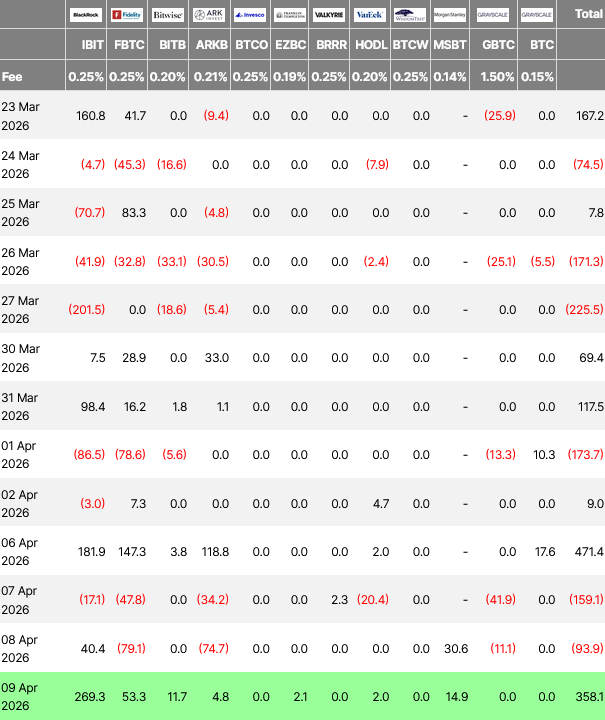
Investors piled $269.3 million into BlackRock’s iShares Bitcoin Trust on Thursday, in its best-performing day since early March, around the time the US-Iran war started to kick into high gear.
The inflows helped to end two days of net outflows among the 12 US spot Bitcoin ETFs, which recorded a net inflow of $358.1 million.
Bitcoin ETF inflows are just one way to gauge retail and institutional demand for Bitcoin.
The Fidelity Wise Origin Bitcoin Fund (FBTC) brought in the second most inflows at $53.3 million, while the new Morgan Stanley Bitcoin Trust (MSBT) was the next biggest contributor, recording $14.9 million on its second day of trading, according to data from Farside Investors.
The Bitcoin ETFs issued by Bitwise and ARK 21Shares saw $11.7 million and $4.8 million worth of inflows, while Franklin Templeton and VanEck’s Bitcoin products tallied around $2 million.

BlackRock’s IBIT has now seen $1.5 billion worth of net inflows this year, withstanding a broader crypto market pullback, which has seen Bitcoin’s price fall from a 2026 high of $97,000 to $72,100 at the time of writing.
BlackRock’s digital assets head, Robert Mitchnick, said in March that investors of BlackRock’s IBIT have shown to be “disproportionately long-term buy and hold” investors — even when there’s been strong selling pressure elsewhere in the Bitcoin ecosystem.
Related: Bitcoin may hit $110K as Strategy absorbs nearly 3x new BTC supply
Meanwhile, Morgan Stanley’s digital asset head, Amy Oldenburg, noted in an interview with Bloomberg on Thursday that MSBT was the institutional bank’s best-performing ETF launch ever.
“This is just the first of a long roadmap of new products on the asset management side,” Oldenburg said.
Morgan Stanley has also filed to list a staked Ether (ETH) ETF and Solana (SOL) ETF.
With the latest day of inflows, US spot Bitcoin ETFs are now close to tipping back to a year-to-date net inflow.
The Bitcoin ETFs finished 2025 at $56.59 billion in net inflows and are currently at $56.51 billion, meaning that they’re just $80 million away from clawing back to their inflow figures at the start of the year.
Magazine: Bitcoin may face hard fork over any attempt to freeze Satoshi’s coins
Aethir, a decentralized GPU cloud infrastructure designed for artificial intelligence, confirmed an attack on its bridge contracts and said it halted the exploit.
The platform said Friday that it had detected and contained an attack on its Aethir (ATH) bridge contracts connecting Ethereum to other chains.
The team behind Aethir said it promptly disconnected the compromised contracts upon detection and worked with major exchanges to blacklist tracked wallets, limiting losses to under $90,000.
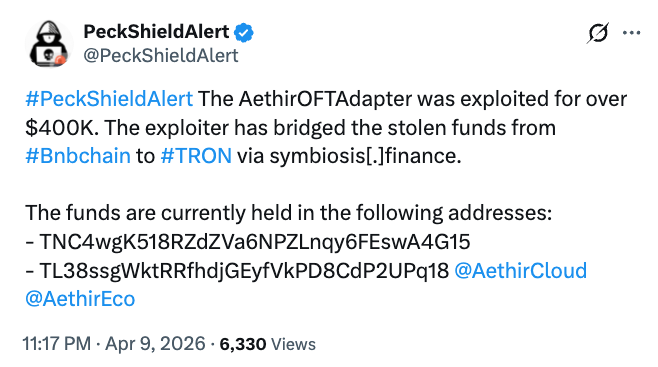
The update came the day after the blockchain analytics platform PeckShield reported an exploit of Aethir’s cross-chain smart contract, AethirOFTAdapter, on Thursday. Estimating the losses at $400,000, PeckShield said the exploiter bridged the stolen funds from the BNB Chain to Tron, pointing to several addresses.
Aethir’s response comes amid a broader wave of hacks in decentralized finance (DeFi), where attackers stole nearly $170 million from dozens of protocols in the first quarter of 2026.

Aethir plans compensation, says main ATH supply on Ethereum is unaffected
After disconnecting the compromised contracts, Aethir said its main ATH supply on Ethereum is fully intact and unaffected.
The platform said it will release a full compensation plan next week and share a list of attacker wallets, along with a detailed post-mortem and repayment plan on Discord.

“Aethir remains fully operational,” Aethir said, adding that the platform is working with authorities and exchanges to freeze funds and trace the attackers.
Related: Drift sends onchain message to wallets tied to $280M exploit
Among partner exchanges that responded to the attack, Aethir mentioned exchanges such as Binance, South Korea’s Upbit and Bithumb, as well as HTX. It noted that the Web3 cybersecurity platform ZeroShadow contributed to the hack investigation by providing expert analysis.
Aethir reported record revenue in 2025
Aethir is a decentralized GPU cloud computing network that provides distributed infrastructure for AI, gaming and enterprise workloads. Instead of relying on centralized data centers, Aethir aggregates GPU resources across a global network.
The platform reported $127.8 million in revenue in 2025, saying its decentralized physical infrastructure network (DePIN) stack counted at least 440,000 GPU containers across 94 countries by the end of the year.
The platform is backed by major Web3 investors, including Animoca Brands, Hashkey and others, with over $140 million in funds raised for the ecosystem.
Magazine: Nobody knows if quantum secure cryptography will even work


AI therapy chatbots are the target of accelerating state-level legislative bans, with Maine sending a prohibition bill to the governor on April 10 and Missouri moving a similar measure through an omnibus health care bill.
Summary
- Maine’s LD 2082 would prohibit clinical use of AI in mental health therapy while allowing administrative applications.
- Missouri’s HB 2372 would ban AI from therapy, psychotherapy, and mental health diagnosis, with a $10,000 first-violation penalty.
- The legislation reflects a growing state-level consensus that AI should not replace licensed human therapists in clinical settings.
Two US states moved this week to formally restrict or ban the clinical use of AI in mental health therapy, reflecting a surge in legislative activity targeting therapy chatbots that has picked up significant speed in 2026. The actions in Maine and Missouri are the clearest examples yet of how states are moving faster than the federal government on AI mental health regulation.
Maine’s LD 2082 was sent to the governor on April 10. The bill would prohibit the clinical use of AI in mental health therapy while allowing it in purely administrative roles. Missouri’s HB 2372 goes further, covering therapy services, psychotherapy services, and mental health diagnoses, with a $10,000 penalty for first violations enforced by the state Attorney General, according to the Transparency Coalition.
The distinction both bills draw, between clinical treatment and administrative support, reflects a legislative approach that aims to preserve AI’s efficiency benefits in healthcare while drawing a firm line against AI replacing licensed clinical judgment in therapeutic settings.
Why States Are Acting Now
The surge in state-level AI regulation is driven in part by the rapid proliferation of commercial therapy chatbot products marketed directly to consumers, some of which have been deployed in clinical or clinical-adjacent settings without the same oversight applied to human practitioners. Critics say these products have been reaching vulnerable people while regulatory frameworks remained largely silent.
As crypto.news reported, AI is now being embedded across government agencies in sensitive analytical roles, creating pressure on policymakers at every level to define where AI can and cannot substitute for human judgment. The therapy chatbot bans are a direct legislative answer to that pressure in a healthcare context.
The Broader AI Regulation Trend
The therapy chatbot bans are part of a wider legislative wave. More than 10 anti-prediction market bills have been introduced in Congress since January 2026, and state legislatures across the country have filed dozens of AI-focused measures targeting different sectors.
As crypto.news noted, the federal government is simultaneously accelerating AI adoption and fighting legal battles over where AI authority begins and ends. States appear to be filling the vacuum, passing binding restrictions on specific high-risk applications while Washington debates broader frameworks.
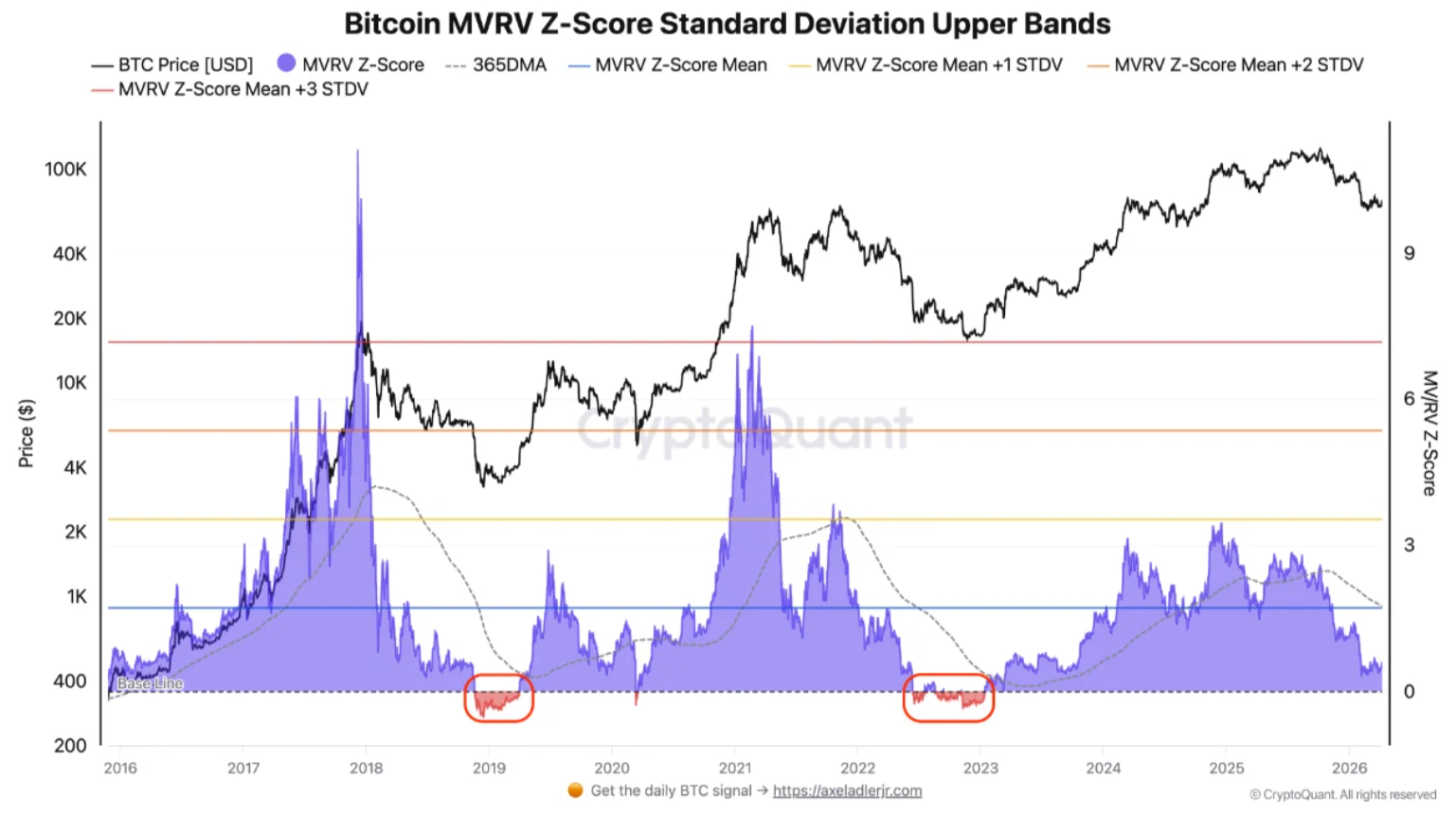
New BTC price analysis predicted that the bear market would bottom out later in the year, before beginning a “two-year accumulation phase.”
Bitcoin (BTC) should find a floor near $55,000 in the second half of 2026, a new prediction says.
Key points:
-
Bitcoin’s MVRV Z-score metric still needs to match old bear-market bottoms to signal trend change, says CryptoQuant.
-
That should result in a trip to $55,000 in late 2026 before a market rebound.
-
Going forward, the next cycle top is expected in the second half of 2029.
Bitcoin MVRV Z-score gives new $55,000 target
In one of its “Quicktake” blog posts on Friday, onchain analytics platform CryptoQuant set out the timeline for Bitcoin’s next “iron bottom.”
“Bear market bottoming is a marathon of exhaustion,” contributor Sunny Mom wrote.
“While data suggests we are halfway through, a final ‘wash-out’ is likely still ahead. As the saying goes: history may not repeat itself, but it often rhymes.”
CryptoQuant flagged three onchain indicators to support the theory that the next bear-market bottom is still ahead. Among them is the market value to realized value (MVRV) Z-score.
MVRV measures the price at which the BTC supply last moved, also known as its realized cap, versus the value of all BTC in existence (its market cap). The Z-score divides the resulting ratio by the standard deviation of market cap, giving clear “overvalued” and “undervalued” ranges for Bitcoin at a certain price point.
“This valuation metric is cooling but has yet to enter the negative/undervalued zone,” the analysis noted.
“Every ‘iron bottom’ in history has seen this score dip below zero; currently, the market is merely cooling, not despairing.”

The last time that the MVRV Z-score dipped below zero was during the bottoming phase of Bitcoin’s last bear market in 2022. Sunny Mom sees history “rhyming” between October and December this year.
“Target: $55K – $60K, coinciding with a sub-zero MVRV Z-Score,” they concluded.
Bottom to precede “two-year accumulation phase”
In January, Cointelegraph reported on two-year rolling Z-score values already undercutting old bear-market floors and other periods of intense market stress.
Related: Bitcoin RSI ‘nearly perfectly’ copying end of 2022 bear market: Analysis
At the time, crypto trader Michaël van de Poppe predicted that Bitcoin was “near the end” of its latest macro drawdown.
Meanwhile, Crypto Mom saw the second half of 2029 as a likely blow-off top for Bitcoin’s next bull run.
“Rationale: Following a late 2026 bottom, we expect a two-year accumulation phase,” they argued, without giving a price target.
“Combined with the April 2028 Halving, the market typically peaks 12–18 months post-halving, making late 2029 the likely window for the next parabolic bull run.”

This article is produced in accordance with Cointelegraph’s Editorial Policy and is intended for informational purposes only. It does not constitute investment advice or recommendations. All investments and trades carry risk; readers are encouraged to conduct independent research before making any decisions. Cointelegraph makes no guarantees regarding the accuracy or completeness of the information presented, including forward-looking statements, and will not be liable for any loss or damage arising from reliance on this content.

French officials are pushing for tighter oversight of crypto from two directions, as a Bank of France official called for stricter limits on non-euro stablecoins under the European Union’s Markets in Crypto-Assets Regulation (MiCA), and lawmakers in Paris advanced a separate reporting requirement for some self-custody holdings.
Denis Beau, First Deputy Governor of the Bank of France, delivered a speech at the EUROFI High Level Seminar in March, calling on the EU to restrict the use of stablecoins for payments, particularly those pegged to non-euro currencies.
Published on the Bank for International Settlements (BIS) website on Thursday, he said the Bank of France has been “pressing for a strengthening” of MiCA in this regard.
In a separate move, France’s National Assembly adopted on April 7 a provision in an anti-fraud bill that would require annual reporting of self-hosted crypto wallets above a 5,000 euro threshold, according to Gregory Raymond, founder of local outlet The Big Whale.
Taken together, the developments show French policymakers hardening their stance as Europe weighs how to contain the growing role of US dollar-linked stablecoins while tightening oversight of crypto assets held outside regulated platforms.
Bank of France presses for tougher MiCA limits
Addressing ways to respond to the global dominance of US dollar-pegged stablecoins, which account for 98% of the stablecoin market, Beau highlighted the role of supporting tokenized central bank money and private money, as well as stronger regulation.
While reporting progress on tokenization initiatives related to settlement infrastructure, such as Pontes and Appia, the official suggested that current regulatory measures might not be sufficient to address the issue.

“MiCA only partially addresses the risks posed by changes in the sector, particularly in the event of widespread adoption of stablecoins issued by non-European players,” Beau said.
Related: ECB paper questions if DeFi DAOs are decentralized enough to sit outside MiCA
In 2025, Bank of Italy Governor Fabio Panetta said MiCA had a limited impact on the adoption of compliant stablecoins in Europe, pointing to the digital euro as a key tool to address the issue.
France moves to require reporting self-custodial holdings
Separately, France’s National Assembly on April 7 adopted a provision in an anti-fraud bill that would require taxpayers to report certain self-hosted crypto holdings to the tax administration each year.
The measure would apply when the fair value of assets held in self-hosted wallets exceeds 5,000 euros, though the bill has not yet completed the legislative process.

Raymond said the proposal has faced opposition from lawmakers and parts of the government and tax administration, who raised concerns about enforcement limits and potential data security concerns.
The developments come as the community prepares to gather at Paris Blockchain Week next week, a major industry event hosted by Chain of Events. According to media reports, President Emmanuel Macron is expected to deliver a special address at the conference, which is scheduled for April 15-16 at the Carrousel du Louvre.
Magazine: How crypto laws changed in 2025 — and how they’ll change in 2026


The acting CDC director blocked the publication of CDC vaccine research showing COVID-19 vaccine benefits on April 10, citing methodology concerns that experts say reflect a research design used in vaccine effectiveness studies for decades.
Summary
- The acting CDC director blocked a research paper demonstrating COVID-19 vaccine benefits from being published.
- Experts say the study’s methodology is a long-established standard for measuring vaccine effectiveness.
- The move has drawn immediate backlash from the scientific and medical communities as the latest instance of administration interference with public health data.
A decision by the acting director of the Centers for Disease Control and Prevention to block a vaccine effectiveness study from publication has drawn sharp condemnation from researchers and public health experts on April 10. The intervention is being characterized as part of a broader pattern of the administration interfering with the release of government-funded scientific findings.
According to Democracy Now!, the acting CDC director blocked a study demonstrating the benefits of COVID-19 vaccines from publication, citing concerns about the research methodology. Experts responded immediately, noting the design used in the blocked study is the same approach that has been standard practice in vaccine research for decades.
Blocking the study removes from public record data developed using federal resources. Public health researchers described the intervention as highly irregular, noting that methodological disputes are normally addressed through peer review, not by preventing publication entirely.
The Scientific and Medical Backlash
Multiple researchers and public health officials said publicly on April 10 that suppressing vaccine effectiveness data poses direct risks to the clinical and policy decisions that rely on CDC-published evidence. Vaccine protocols at hospitals, clinics, and public health agencies are calibrated against published CDC data, and blocking a study denies practitioners access to evidence they would otherwise use.
The decision has drawn comparisons to other recent cases of the administration restricting data-related activities for political reasons. Anthropic sued the US government in March after alleging retaliation for refusing certain military uses of its technology, with the company arguing the government was using legal mechanisms to restrict information and capabilities that conflicted with its preferences.
A Pattern of Data Interference
Critics say the CDC decision is not an isolated event but part of a consistent approach by the administration to control what scientific information enters the public domain. The acting director offered no alternative process by which the blocked findings could be reviewed and eventually published.
As crypto.news reported, the administration has simultaneously been accelerating the deployment of AI tools across federal agencies, raising questions among civil liberties advocates about who decides what information government agencies produce, share, and suppress.

Li Auto Stock Rises 3% in Hong Kong as March Deliveries Rebound and New L9 Launch Looms in China EV Recovery

Iran War Powers Vote Blocked by House GOP

Kai Cenat Gets Mention Amid Adin Ross And Reggie Feud


-

 Business5 days ago
Three Gulf funds agree to back Paramount’s $81 billion takeover of Warner, WSJ reports
-

 Sports6 days ago
India men’s 4x400m and mixed 4x100m relay teams register big progress | Other Sports News
-

 Politics7 hours ago
US brings back mandatory military draft registration
-

 Fashion8 hours ago
Weekend Open Thread: Veronica Beard
-

 Business7 days ago
Expert Picks for Every Need
-

 Tech3 days ago
How Long Can You Drive With Expired Registration? What Florida Law Says
-

 Business6 days ago
No Jackpot Winner, Prize to Climb to $231 Million
-

 Fashion5 days ago
Massimo Dutti Offers Inspiration for Your Summer Mood Board
-
 Sports8 hours ago
Man United discover Nico Schlotterbeck transfer fee as defender reaches Dortmund agreement
-

 Fashion3 days ago
Let’s Discuss: DEI in 2026
-

 Crypto World2 days ago
Bitcoin recovers as US and Iran Agree a Ceasefire Deal
-

 Business5 hours ago
Tesla Model Y Tops China Auto Sales in March 2026 With 39,827 Registrations, Beating Cheaper EVs and Gas Cars
-

 Crypto World2 days ago
Canary Capital Files SEC Registration for PEPE ETF
-

 Business6 days ago
Akebia Therapeutics, Inc. (AKBA) Discusses Pipeline Progress and Strategic Focus on Kidney Disease Treatments at R&D Day – Slideshow
-

 Business13 hours ago
OpenAI Halts Stargate UK Data Centre Project Over Energy Costs and Copyright Row
-

 Politics7 days ago
The UK should not pay a penny in slavery reparations
-

 Tech5 days ago
Gamer Restores the Original PlayStation Portal From Two Decades Ago
-

 Tech5 days ago
Samsung just gave up on its own Messages app
-

 Tech5 days ago
Italian court says Netflix must refund customers up to $576 over price hikes
-

 Tech5 days ago
Haier is betting big that your next TV purchase will be one of these
You must be logged in to post a comment Login