Dean Markson, 27, admitted assaulting the victim to his severe injury and permanent disfigurement at Merryton Tower on May 27 last year.
15:50, 19 Mar 2026Updated 15:53, 19 Mar 2026
A thug has been jailed for 32 months after a Motherwell man was attacked with a bottle and a machete outside his home.
Dean Markson, 27, admitted assaulting the victim to his severe injury and permanent disfigurement at Merryton Tower on May 27 last year.
Hamilton Sheriff Court heard the victim was walking home from the shops about 3.25pm when he was attacked.
Advertisement
Markson ran towards him and struck him on the head with an Eldorado wine bottle, knocking him to the ground.
He continued to inflict blows until the bottle slipped out of his hand and smashed. Another male then struck the victim repeatedly on the head and back with a machete.
The pair left the scene in a car but police officers identified Markson from CCTV images. His DNA was on the broken bottle.
The victim’s partner returned home to find him injured. Worried about the amount of blood he had lost, she called an ambulance.
Advertisement
He had a number of cuts, the most serious of which was a 5cm wound to his back that was closed with stitches.
Markson has previous convictions for assault but defence lawyer Matthew McGovern said there was nothing on his record since 2020 and he had been attempting to “change his lifestyle”.
He has had addiction issues in the past that led to serious health problems and put his involvement in this assault down to “poor decision-making”.
Advertisement
Sheriff John Hamilton KC said it appeared from a criminal justice social work report that Markson had become involved in a “misguided revenge attack” on the victim.
The sheriff told him: “It seems you felt there was some justification for it.
“There seems to have been some planning as you waited for him to walk past as he came back from the shops.
“He suffered a number of significant wounds and it’s fortunate his injuries were not more serious given he was struck by a bottle and a machete.
Donald Trump made a Pearl Harbour gag so awkward that it triggered painful groans from Oval Office reporters.
Advertisement
The US President was sat down next to the Japanese Prime Minster, no less, when he decided to joke about the Second World War.
‘Why didn’t you tell me about Pearl Harbour?’ he asked a Japanese reporter, despite having been born five years after the attack on the Hawaiian naval base.
It all started with an innocent question to Trump about why the US did not warn its allies before they launched their first wave of strikes against Iran last month.
The press pack in the Oval Office shuddered at the excruciating gaffe (Picture: EPA)
The President began as you would expect: ‘Well, one thing, you don’t want to signal too much. You know, when we go in, we went in very hard, and we didn’t tell anybody about it because we wanted…surprise.’
Advertisement
That last word appeared to spark an idea for a joke in Trump’s head as his counterpart Sanae Takaichi squirmed in her seat.
He asked ‘Who knows better about surprise than Japan?’, which got some awkward chuckles from behind the camera.
Unfortunately Trump continued: ‘Why didn’t you tell me about Pearl Harbor?’
Advertisement
Cue shocked noises from the press pack. Ms Takaichi’s face was a picture.
The President added: ‘You believe in surprise I think much more so than us.
‘And we had a surprise.. and because of that surprise we probably knocked out 50% of what we did and much more than we anticipated doing.’
The surprise Japanese attack on US warships in Pearl Harbour, Hawaii, on December 7, 1941 killed 2,390 Americans.
Advertisement
The Pearl Harbour attack killed more than 2000 Americans (Picture: Hulton Archive/Getty Images)
The US declared war on Japan the next day, with the then President Franklin D. Roosevelt calling it ‘a date which will live in infamy.’
It led to a brutal four-year war across Asia, which ended in Japanese surrender in August 1945, after the US unleashed two atomic bombs on Hiroshima and Nagasaki.
Ms Takaichi, who has just won a resounding election victory at home, has enjoyed a close relationship with Trump since entering office.
The US President’s visit to Japan last October was widely seen as heralding in a new ‘golden age’ in bilateral ties.
The relationship has appeared more tense since the start of the US and Israeli war against Iran.
Advertisement
Trump demanded Japan and other countries help secure the vital Strait of Hormuz to protect oil shipments being fired upon by Iran.
That request received a lukewarm response, leading the President to post that the US did ‘NOT NEED THE HELP OF ANYONE!’
Trump and Ms Takaichi have formed a close partnership (Picture: Alex Wong/Getty Images)
In a joint statement along with the UK, France, Germany, Italy and the Netherlands published today, Japan expressed its shared ‘readiness to contribute appropriate efforts to ensure safe passage’ through the strait.
Pouring more praise on Trump in the Oval Office, Ms Takaichi said: ‘I firmly believe that it is only you, Donald, who can achieve peace across the world.
‘I am ready to reach out to many of the partners in the international community to achieve our objective together.’
Endometriosis is a painful, debilitating condition affecting 10% of women worldwide. It occurs when tissue similar to the lining of the uterus (known as lesions) grows elsewhere in the body – usually within the pelvis.
Treating endometriosis can be difficult. Usually, treatment involves either preventing the growth of these lesions in the first place or removing lesions surgically. But even when lesions have been surgically removed, symptoms often don’t go away.
Traditionally, endometriosis has been thought of as a gynaecological condition. But mounting evidence suggests this characterisation downplays the disease’s complexity. Endometriosis appears to affect far more than just the reproductive system. According to a growing body of research, it influences immune function throughout the whole body.
Recognising it as a whole-body, immune-driven disease could help explain why symptoms range far beyond pelvic pain. It would also explain why treatment is so challenging and often does little to reduce symptoms.
Advertisement
A disease of the whole immune system
Inflammation – the body’s natural response to injury or illness – is a normal part of immune response. It also plays a key role in the menstrual cycle.
But if inflammation becomes chronic or uncontrolled, it can cause problems. This is seen in autoimmune conditions such as rheumatoid arthritis, where the immune system overreacts even when there is no threat.
Chronic inflammation is also known to play a central role in endometriosis. But the effects of this uncontrolled immune response may be far more widespread than previously thought. According to recent research, the immune response appears to extend into the bloodstream and other body systems. This may explain why endometriosis causes such far-reaching, whole-body symptoms.
In people with endometriosis, immune cells appear to be less able to clear lesions. Yet, at the same time, people with endometriosis have higher levels of immune proteins such as IL-6 and IL-1β in their blood. These immune proteins, known as cytokines, are a type of messenger released by cells to promote inflammation.
Together, these dysfunctional cells make it possible for lesions to grow and persist. This immune dysregulation also has ripple effects across the body, contributing to the wide range of symptoms sufferers experience.
Systemic inflammation offers a compelling explanation for these symptoms. Circulating cytokines, such as those mentioned earlier, are known to influence brain function and energy regulation. Higher levels of cytokines (including IL-6) have also been linked to poorer concentration, disrupted sleep and fatigue in some autoimmune and chronic pain disorders.
Advertisement
These same processes may be occurring in endometriosis. This suggests that invisible symptoms could be biological consequences of ongoing inflammation – not secondary effects of pain.
A dysfunctional immune system may also help to explain why emerging research hints at an overlap between endometriosis and autoimmune diseases.
In 2025, a large scale study looked at 330,000 patients with endometriosis and 1.2 million controls (people who didn’t have the condition). The study found that compared to the controls, people with endometriosis had roughly twice the odds of being diagnosed with an autoimmune condition – such as rheumatoid arthritis, lupus, multiple sclerosis or Hashimoto’s disease – within two years of their endometriosis diagnosis.
This doesn’t mean endometriosis is itself an autoimmune disease. But it does suggest shared mechanisms – including chronic inflammation, dysregulated immune cell activity, and problems with the immune system recognising the body’s own tissue properly.
Advertisement
These overlapping features strengthen the case for understanding endometriosis as a systemic immune disorder.
Reframing endometriosis
Viewing endometriosis in this way could transform how it’s diagnosed, treated and understood. It could also help us get closer to finding a solution for the condition.
Current treatments primarily target the reproductive system. But if endometriosis involves widespread immune dysfunction, then therapies that modulate immune pathways may offer more effective long-term relief.
Advertisement
Seeing endometriosis as a systemic condition can empower patients, as well. This reframing may help them understand that symptoms such as fatigue, joint pain, cognitive difficulties and immune sensitivity are not imagined or unrelated. Rather, they’re part of the condition’s broader biology.
Seeing it this way may support patients in advocating for themselves in healthcare settings, where systemic symptoms are often dismissed or deprioritised.
A systemic framing also opens space for patients to explore complementary management strategies aimed at reducing inflammation or improving overall wellbeing. While not curative, some people find gentle movement, stress regulation techniques and heat–cold contrast therapy helpful for managing pain or inflammatory flares.
A growing body of research shows that endometriosis is not solely a reproductive condition or a “bad period”. It’s a multi-system, inflammatory disorder with far-reaching health effects throughout the body.
Advertisement
Understanding endometriosis as a systemic immune disease is a crucial step toward better treatments, better support and, ultimately, better health outcomes.
Nowadays, there’s an app, watch or device to track all activities, from sleeping to exercising, so it can be hard to see the wood for the trees.
Running watches have come on leaps and bounds since their earlier predecessors, which focused on step-counts and distance measurements, to offer everything from finding new routes and marking your pace to tracking other sports and monitoring daily activity.
This cutting-edge tech couldn’t be more timely, either. In its Year in Sport 2024 report, Strava found that running, particularly with others, is on the rise. Participation in running clubs grew by 64 per cent in the UK last year; 54 per cent of runs logged in the UK were marked ‘social’; and walking clubs were just behind running with 52 per cent growth globally. Add to that general increased interest in our health and well-being – particularly among Gen Z – and it’s hardly surprising that manufacturers are in a race to the finish line when it comes to catering to this huge (and lucrative) market.
But whether you run solo or together, what should you look for when perusing and choosing the perfect running watch?
Advertisement
GPS running watch v basic fitness tracker
Firstly, decide whether you want a fitness tracker – which will usually monitor basic running data such as step counts, distance and calories – or a running watch, packing all the same features as a fitness tracker with the addition of built-in GPS technology to record and find routes, analyse your performance and optimise your training. Look for styles with dual-frequency for strong GPS even when on the most remote runs where signal is poor.
The latest running watches boast built-in heart-rate monitors, usually through sensors on your wrist, although sometimes via a separate chest strap, to track pulse and BPM to create more bespoke training programmes. While more expensive, many big brands offer their best models with and without heart-rate monitors to cater to different budgets.
In addition to recording all of the above, multi-sport watches can adapt to monitoring specific sports, from swimming to running and skiing. Naturally, these are waterproof.
Advertisement
More specifically, look for other features such as battery life – crucial for longer runs, hikes and even marathons – durability for being able to withstand a bit of rough and tumble (a scratch-proof screen, for example) and connectivity for WiFi, Bluetooth as well as Strava and Apple Health. Finally, don’t underestimate the importance of design: if it’s comfortable on the wrist and looks stylish, chances are you’ll stick to your training.
Here are the best running watches to encourage you to get out there, whatever the weather.
The teacher sent sexually explicit texts and photos to an adult while children were in the building
Amy Fenton Senior reporter and Kirstie McCrum Deputy Head of News, Live News Network
18:21, 19 Mar 2026
A primary school teacher who transmitted sexually explicit messages, voice recordings and images whilst in the toilets during school hours has been barred from the profession.
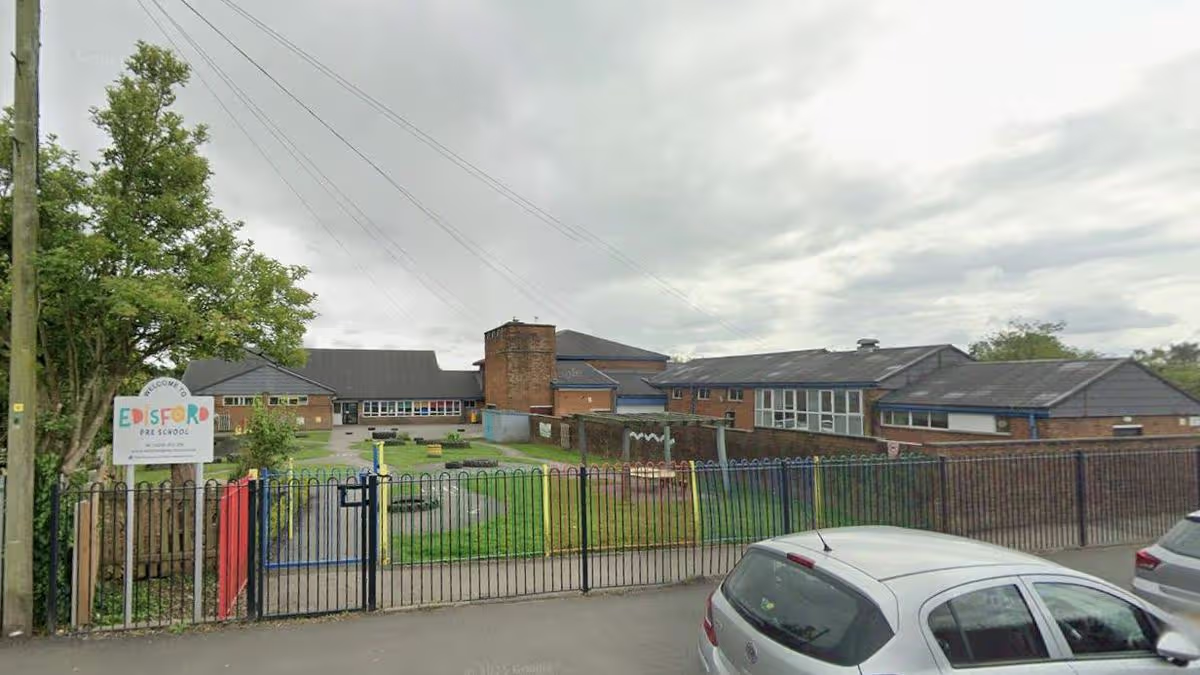
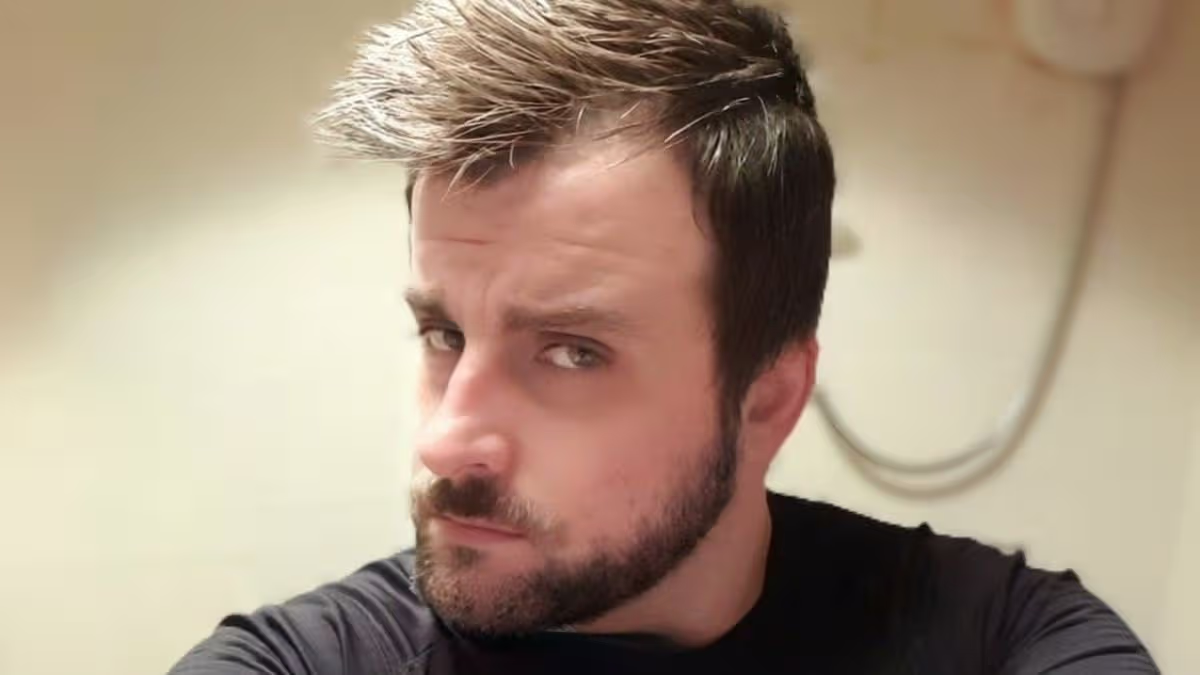
Ben Walker had begun his employment at Edisford Primary School in Clitheroe in September 2016. He stepped down in November 2023 following his admission of sending sexually explicit material to a woman whilst on school grounds on July 13, 2022.
Advertisement
A Teaching Regulation Agency (TRA) panel has prohibited Mr Walker from teaching. He is unable to seek removal of the prohibition for two years, reports Lancs Live.
In his determination, Stuart Blomfield from the TRA stated: “Mr Walker admitted to having sent sexualised voice notes and images of him shirtless and having exposed himself to Person A, who was an adult not connected with the School. The panel has been provided with copies of the messages which indicate that the conversation was mutual between Mr Walker and Person A.
“The photographs of Mr Walker with his shirt off, and one with him appearing to expose himself (although this is redacted in the panel’s bundle of documents), are taken in the same room – which appears to be the toilets.”
“The panel is therefore satisfied that those photographs were taken at School. Mr Walker has admitted that those photographs were taken in the male toilets at School, although for clarity, the panel notes that Mr Walker asserted these were the male staff toilets.
Advertisement
“For the avoidance of doubt the panel is satisfied that no children saw Mr Walker take the photos in question, nor is there any suggestion that any child heard Mr Walker making or receiving the sexualised voice notes. Notwithstanding this, the panel is of the view that children were still on School premises and were therefore in the vicinity of Mr Walker when he was engaging in the alleged activity.
“The panel accepts that the risk of children witnessing his activities was probably low, but it cannot rule out there was at least some risk of exposing a child to harm by carrying out the activities on School premises. The panel considered whether the messages were sexually motivated.
“The nature of some of the messages that the panel has had sight of are particularly graphic and are unquestionably of a sexual nature. They indicate the participants’ desire to engage in a sexual relationship and the panel is therefore satisfied that Mr Walker was sexually motivated in sending the messages.
Although the images appear to have been taken by Mr. Walker in the main part of the bathroom, rather than in a locked cubicle. The images show a door and two sinks, behind and next to where Mr Walker is standing(respectively). The [REDACTED] confirmed that the image appeared to have been taken by Mr Walker in the main part of the bathroom, and that there was no lock on the door into the bathroom.
Advertisement
“The panel’s concern is that if a child had inadvertently entered the staff toilet at the time, the harm to that child could have potentially been significant.”
The prohibition order bars Mr Walker from teaching indefinitely, meaning he is unable to work in any school, sixth form college, relevant youth accommodation or children’s home in England. An application to have the prohibition order lifted cannot be made until March 2028.
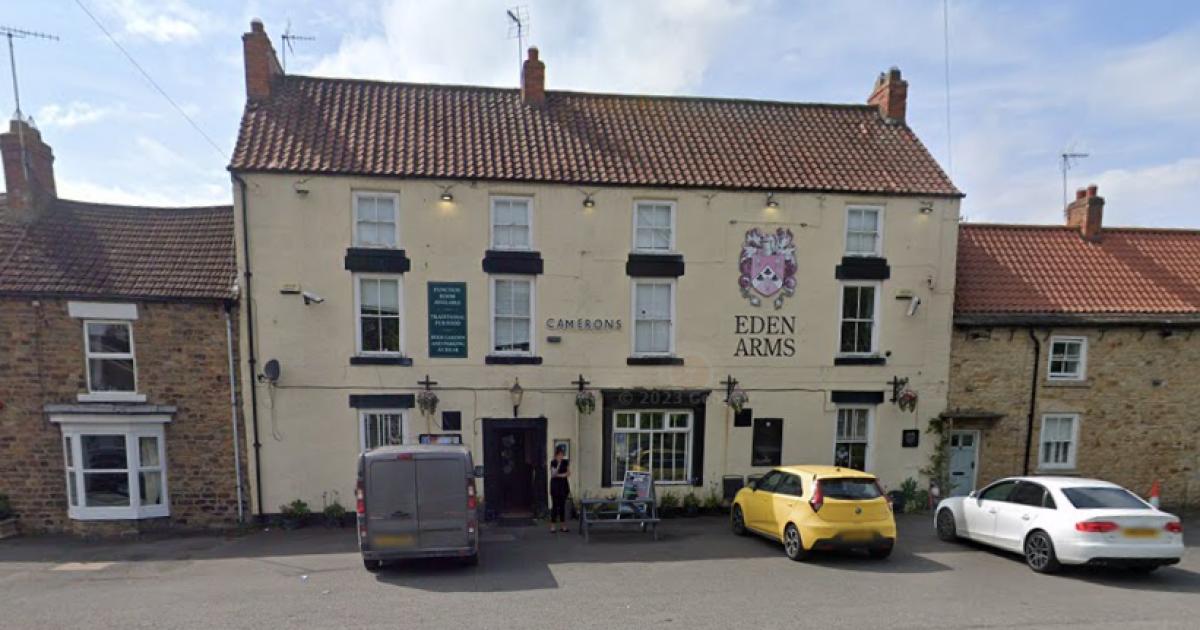
The Eden Arms, on Staindrop Road in West Auckland will reopen at 2pm on Friday (March 20), promising a “fantastic afternoon and evening filled with a great atmosphere, good company, and plenty of entertainment”.
Writing on Facebook, the pub said: “Come along and help us celebrate as we officially open our doors.
“Bring your friends and family and be among the first to experience everything The Eden Arms has to offer. Let’s make it a day to remember.”
Advertisement
There will be live entertainment from 7pm, with disco and karaoke to follow. Customers are encouraged to bring their “singing voices and dancing shoes”.
The pub previously said: “After lots of hard work redecorating, refreshing and making some exciting upgrades, we’re getting ready to reopen very soon.
Advertisement
“We can’t wait to welcome everyone back and meet you all.”
The pub will open from 12pm seven days a week and will have seven large TV screens and a separate space for a dart board complete with ring light, backboard and counter.
The new landlords have also said they will “work hard” to get the beer garden ready for the Fifa World Cup.
They said they’ll be large TV’s, a stage, outside bar and play area.
The University of Cambridge has said the hub will ‘connect entrepreneurs, investors, corporates, and researchers’
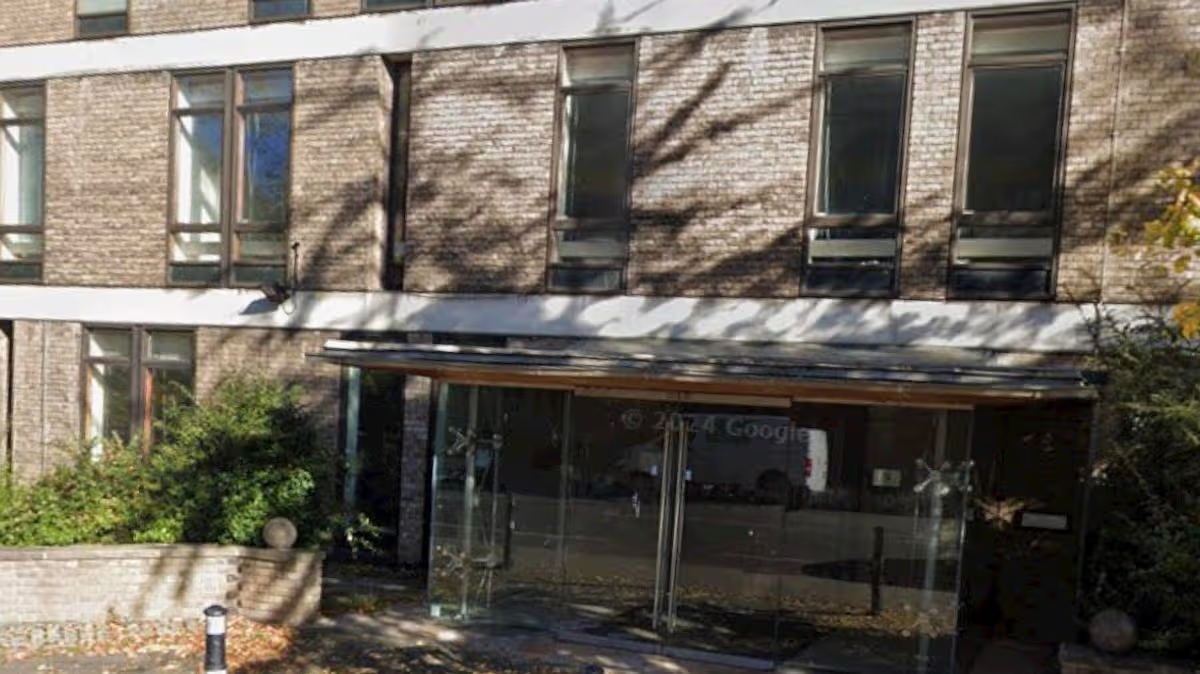
A large building on a busy Cambridge road is set to be transformed into an ‘innovation hub’. Social media users recently questioned what is happening with the building at 1-3 Hills Road.
Advertisement
The building was previously used by Cambridge Assessment and is owned by the University of Cambridge. It is set to become into an ‘innovation hub’ as part of a £500 million funding package for the Oxford-Cambridge corridor.
The University of Cambridge said: “Designed to drive UK growth, the Hub will connect entrepreneurs, investors, corporates, and researchers on a 2.7-acre site in Hills Road, in the centre of Cambridge, as the UK’s answer to Boston’s Lab Central and Paris’s Station F. The new facility will support science start ups to grow and compete on the world stage.”
It is unclear how or whether the building will be changed for this purpose. There is no clear timeline yet on the innovation hub.
In an address at the beginning of the year, University of Cambridge vice chancellor, Professor Deborah Prentice said: “In the centre of Cambridge, we are building an Innovation Hub that will bring together startups, scaling companies, corporate investment teams, venture capitalists, entrepreneurs, and our world-class research community, all in a facility located at 1-3 Hills Road, just a short walk from the train station.”
Advertisement
Science Minister and Oxford-Cambridge Innovation Champion, Lord Vallance, said when the £500 million funding was announced in October: “Cambridge is one of the world’s most fertile grounds for innovation to take root, and blossom into opportunities for investment, job creation, and progress in fields ranging from life sciences to deep tech.
“As impressive as these figures are, there is still more potential here for us to unleash. This is precisely why we are backing the Cambridge Innovation Hub, as part of our programme of work across Government to boost the entire Oxford to Cambridge Growth Corridor, and fulfil its promise as an economic engine the whole nation benefits from.”
The man accused of murdering pregnant Lurgan woman Natalie McNally “did believe and does believe always and forever” that her ex-boyfriend killed her, a court heard today.
The 32-year old was 15 weeks pregnant when she was beaten, strangled and stabbed in her Silverwood Green home on the evening of Sunday December 18, 2022.
The father of her unborn child, 36-year old Stephen McCullagh from Woodland Gardens in Lisburn, has been accused of and has denied her murder.
Now in its fourth week, evidence in the murder trial at Belfast Crown Court has now concluded and today McCullagh’s barrister John Kearney KC addressed the jury with the defence’s closing speech.
Mr Kearney told the six men and women it was their role to “step back” and “bring surgeon-like objective scrutiny” to the case and to the evidence they have heard.
The barrister spoke of several pieces of the Crown’s “jigsaw” not fitting together and said “there are multiple pieces” that pointed away from McCullagh.
Advertisement
Instead, he said told the jurors that when they “scratch the surface” they will find “nagging, reasonable doubt.”
Reminding the jury that at this point McCullagh was “an innocent man unless or until you find otherwise”, Mr Kearney said the real issue was the identity of the killer.
He told the jury: “If you think he (McCullagh) probably is, that is not enough. If you are almost sure, that is not enough.
“If you are left with a reasonable doubt that someone else … could have been the killer, your job is to acquit. Not because I say so, but because these are the rules.”
Advertisement
Describing the evidence against his client as circumstantial, Mr Kearney said: “We suggest there are holes in this case, there are gaps in this case, there is reasonable doubt in this case, there are missing pieces of the jigsaw in this case.”
This, he said, included “missing CCTV evidence” regarding a motion sensor camera on Woodland Gardens which didn’t pick up anyone leaving McCullagh’s home and passing the camera on the evening of the murder.
This, the defence say, is because “he wasn’t there” which he described as a “big problem for the prosecution.”
Mr Kearney also said there was “no identification evidence in this case”, nor any clothing comparison or gait analysis.
Advertisement
Regarding the hat worn by the suspect who got into a taxi in Lurgan after the murder, Mr Kearney said the Crown had asked the jury to compare this with a similar hat worn by McCullagh in pictures on his social media.
Suggesting “they are different hats”, Mr Kearney spoke of contrasting stitching and ear flaps. He also mentioned the suspect caught on CCTV wearing a “big black coat” and “distinctive trainers”.
Mr Kearney said: “The prosecution have not been able to provide any evidence indicating that this defendant on any occasion appeared on CCTV or social media or in any way in a big black coat. The house was searched, there was no coat.”
Other areas which raised doubt, according to the defence, was a lack of evidence about whether or not McCullagh accessed Ms McNally’s phone.
Turning back to reasonable doubt, Mr Kearney spoke of the “elephant in the room” – Ms McNally’s ex-boyfriend.
Describing this man, who can’t be named due to a reporting restriction, as “walking, talking reasonable doubt”, Mr Kearney reminded the jury he was “interviewed as a suspect in this case.”
The barrister said it was McCullagh’s case that he didn’t kill Ms McNally, adding his client “did believe and does believe always and forever that the killer” was Ms McNally’s ex-boyfriend.
Advertisement
Mr Kearney said that when McCullagh was arrested on suspicion of murdering Ms McNally there “wasn’t a mark on the hands of the defendant.” This, he said, compared to the ex-boyfriend whose hands were swollen when he was arrested.
He told the jury: “We ask you to think about that very very carefully when you decide whether you can be sure this defendant and not (the ex-boyfriend) killed Ms McNally.”
The barrister also spoke of a 498-page document which contained all the WhatsApp messages exchanged between his client and Ms McNally during the course of their 133-day relationship.
Mr Kearney pointed out there was “not a word of violence or fallouts or misogyny” in the exchange.
Advertisement
Instead, he suggested the messages were of the “normal banality of life” including pets and work, all of which indicated “this was a real, loving relationship.”
He then asked the jury to compare the contents of these messages against the “disgraceful correspondence” from the ex-boyfriend.
Some of these messages, the barrister suggested, indicated he was a “hot-headed man who cannot take rejection.”
Mr Kearney also spoke of the ex-boyfriend doing a factory reset on his phone prior to his arrest in December 2022, lying to police about the last time he saw Ms McNally and being accused of domestic incidents by his former partner.
Advertisement
This former partner gave evidence at the trial and said Ms McNally’s ex-boyfriend didn’t commit the murder as he was with her in his flat all night.
In her evidence, she said that he fell asleep after drinking, that the World Cup final was on and that he didn’t leave the flat all night.
Mr Kearney asked the jury to “scrutinise the evidence to see whether they were telling the truth or telling a tale.”
He concluded the defence’s closing argument by telling the jurors that when they scrutinise the evidence they “could not, we suggest, extinguish reasonable doubt that this defendant killed Ms McNally as opposed to some other person.”
Advertisement
Following this, Mr Justice Kinney addressed the jury and said “what remains for you now is to hear from me”. He told the jurors to return to court on Friday morning when he will begin his charge, with an anticipation that they will begin deliberating next Monday morning.
The inquiry found several areas where the Welsh Government’s response should’ve been different
The Welsh NHS came “close to collapse” during the pandemic, according to the Covid-19 inquiry. Inquiry chair Baroness Hallett said the healthcare system “teetered on the brink of total collapse” throughout the pandemic and “only just” coped with the pressure it was placed under.
Advertisement
She concluded a complete collapse of the entire system was only “narrowly avoided” because of the “extraordinary efforts of all those working in the healthcare systems”.
The latest 387-page report, which looks at the impact the pandemic had on the NHS in all parts of the UK, says Covid-19’s devastating impact on the NHS was “unsurprising” given the “parlous state” the service was in at the start of the crisis.
The report forms part of the UK Covid Inquiry which is made up of 10 different modules. This latest one, released on Thursday, examines healthcare systems in all parts of the UK. Stay informed on the latest health news by signing up to our newsletter here.
Shielding letters took too long and went to wrong addresses
One area which was examined in the report was shielding letters sent out to clinically extremely vulnerable people at the start of the pandemic. The inquiry found that in Wales this was a “significant and complex task” and the time it took to produce the letters therefore led to a delay of at least two weeks in the letters arriving.
Advertisement
It was concluded the Welsh Government’s pre-pandemic planning was inadequate making the planning and delivery of the shielding programme even more challenging.
The inquiry added: “Sir Frank Atherton, chief medical officer for Wales from August 2016 to January 2025, told the Inquiry that there had been a ‘huge effort to try to improve’ the data systems required to identify at-risk people rapidly but that they were still not in place in September 2024. He told the onquiry: ‘[W]e are behind the curve in Wales on digital records.’”
It also found the content of official communications regarding the shielding programme was affected by problems with data systems and record-keeping. This led to the Welsh Government sending 13,000 of the 91,000 shielding letters to the wrong addresses and children with Down’s syndrome mistakenly receiving letters.
Birthing partner policy should’ve changed earlier
Another issue which arose in the report was the Welsh Government’s stance on whether fathers and birthing partners should be subject to the same restrictions as ‘visitors’. The inquiry highlighted how Wales was the last UK nation to amend the policy for them, on May 9, 2022, and found this change was too slow to be implemented.
Advertisement
Eluned Morgan accepted that the Welsh Government “took too long to make those changes”.
Care was not escalated for those with ‘remote’ chances of recovery
The inquiry also found how some people in Wales were not escalated to the next level of care because, as a critical care doctor in Wales told the inquiry, there was not “enough space to ‘give people a go’ who had a very remote chance of getting better”.
Lack of PPE in Welsh healthcare settings
The report also found it was clear that healthcare workers did at points lack access to appropriate PPE and outlined examples from the UK. A consultant in Wales recalled: “At the start, despite knowing of the virus spread, no PPE was provided. Not even masks let alone thinking of level two PPE for aerosolgenerating procedures. This was when many of my colleagues and I became ill.”
Abandoned 111 calls
Due to the increased demand of people calling 111 more calls were being abandoned by callers before reaching the front of the queue. In Wales 43.3% of calls to the NHS 111 service were abandoned in March 2020. However the inquiry said a change in Welsh Government advice in April 2020 led to fewer abandoned calls when they encouraged the use of the NHS Direct Wales website.
Advertisement
‘Deeply distressing’ experiences of people dying alone
The report also detailed the “devastating impact” of restrictions which led to many dying alone. It found that although such restrictions “may be unavoidable” in a pandemic visits for dying patients should be suspended “for the shortest time possible”.
One case which was highlighted was that of Sam Smith-Higgins, part of Covid-19 Bereaved Families for Justice Cymru, who had to say goodbye to her father by text message. She said: “I received a call from the doctor who told us that he had deteriorated and that he was dying.
“To not be able to be with my father and to hear that news was completely devastating. He was with a nurse and so I was constrained to saying my farewell to my father by text message with the hope that it would be read out to him.
“It is truly difficult to put into words how painful it is to say farewell to a loved one by text message.”
Advertisement
Withdrawing medicine delivery ‘premature’ in Wales
Unlike other UK nations medicine delivery support in Wales was not funded and available throughout the second wave of the pandemic. Instead it was ended on August 16, 2020, and never reinstated.
The inquiry found it was clear this support, which helped clinically vulnerable people receive medications, would’ve been needed in Wales throughout the second wave and had therefore been withdrawn prematurely. It also detailed how community pharmacists had been key in ensuring vulnerable individuals could access their medications.
One community pharmacist in Wales, Jonathan Rees, told the inquiry: “My wife and I would walk around our village delivering on the weekend with our three young children to ensure everybody received what they needed.”
First Minister Eluned Morgan said in a written statement: “The pandemic placed significant pressures on health and care services in Wales and across the UK. We acknowledge the considerable impact this had on patients, staff, the wider workforce and families affected by Covid-19.
Advertisement
“The Welsh Government continues to engage with the inquiry in an open and constructive manner as we have done in relation to the first two reports.
“The inquiry requires a response to the module three report and recommendations within six months of publication.”
Get daily breaking news updates on your phone by joining our WhatsApp community here. We occasionally treat members to special offers, promotions and ads from us and our partners. See our Privacy Notice.
People close to Vance told The Washington Postthat if the conflict with Iran lasts for months, it could pose a political problem for whoever secures the Republican presidential nomination in 2028. However, Vance still hasn’t decided whether he’ll run, the outlet’s sources also said.
A prolonged conflict with Iran could politically damage the 2028 Republican nominee, a new report says (Getty)
“You’re trying to drive a wedge between members of the administration, between me and the president. What the president has said consistently, going back to 2015, and I agreed with him, is that Iran should not have a nuclear weapon,” he added.
Still, the president has said Vance was “maybe less enthusiastic” at the beginning of the conflict.
“We get along very well on this,” Trump told reporters last week. “He was, I would say, philosophically a little bit different than me. I think he was maybe less enthusiastic about going, but he was quite enthusiastic.”
“But I felt it was something we had to do. I didn’t feel we had a choice,” he continued. “If we didn’t do it, they would have done it to us.”
Vice President JD Vance has long been considered a 2028 front-runner, but sources close to him told The Washington Post he hasn’t yet decided whether to launch a campaign (Getty)
Vance also reportedly met with Joe Kent, the former director of the National Counterterrorism Center, who resigned over the war with Iran. The vice president urged him to “go quietly” and not make his resignation a “big thing,” a U.S. official told TheWashington Post.
The Independent has contacted Vance’s office for comment.
White House spokesperson Anna Kelly previously told The Independent that “efforts to drive a wedge between President Trump and Vice President Vance are totally misguided.” Vance spokesperson Taylor Van Kirk told Politico the vice president is “a proud member of the President’s national security team” and “keeps his counsel to the President private.”
When asked by CNN’s Pamela Brown if the Iran war could hurt the vice president’s chances of becoming Trump’s successor, the ex-lawmaker replied: “The longer it goes on, it definitely does hurt JD Vance.”
The new price increases will see some people paying £239.50
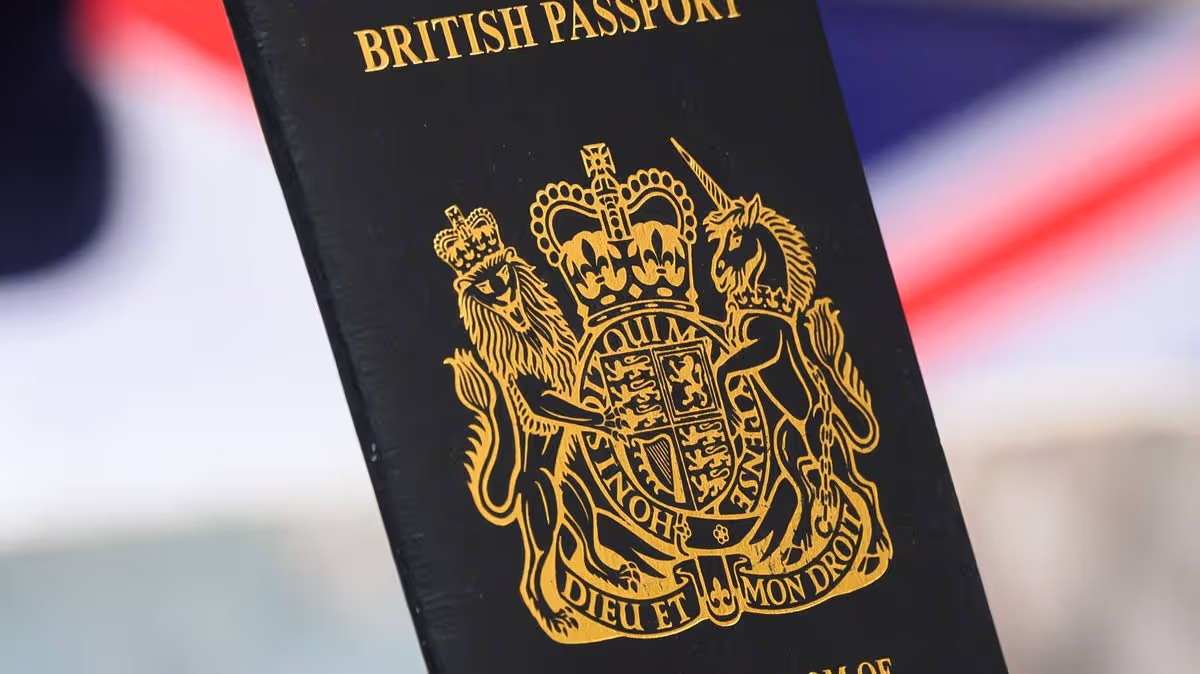
The UK Government has announced a price increase for passport applications from next month. New fee for passport applications will be implemented from April 8.
The exact amount the fee will rise is subject to approval by Parliament but a proposal from the UK Government sets out for the increase to as much as £239.50 for some.
Funds raised by application fees reduces the Home Office’s reliance on funding from general taxation and the government does not profit from the costs.
Advertisement
In 2025 a total of 99.7% of standard passport applications from the UK were processed within three weeks if they did not require further information. For money-saving tips, sign up to our Money newsletter here.
The proposals for the fee change are as follows:
the fee for a standard online application made from within the UK will rise from £94.50 to £102 for adults and £61.50 to £66.50 for children
postal applications will increase from £107 to £115.50 for adults and £74 to £80 for children
the fee for a premium service (one-day) application made from within the UK will rise from £222 to £239.50
the fee for a standard online application when applying from overseas for a UK passport will rise from £108 to £116.50 for adults and £70 to £75.50 for children
overseas standard paper applications will increase from £120.50 to £130 for adults and £82.50 to £89 for children
The fees contribute to the cost of processing passport applications, consular support overseas including for lost or stolen passports, and the cost of processing British citizens at UK borders.

















































You must be logged in to post a comment Login