Both Emily and I have experience testing mattresses, having contributed numerous reviews across our different mattress guides. It’s a difficult job for one obvious reason – they’re huge.
So, for this guide, you’ll find a mixture of products that Emily tested at home and ones I (Rebecca) tested after a week visiting dozens of showrooms across London. I tested sofa beds at the same time, if you’re in the market.
It’s important to note that the best mattress for each individual varies enormously, based on weight, height, pressure points, sleeping position and whether or not you share a bed.
Advertisement
Memory foam mattresses tested at home were slept on for at least a month, to get a true feel for how each one adjusted to the person sleeping on it and whether it helped regulate their temperature, and how durable it was. Edge support (being able to sleep at the edge of the mattress without rolling off) was also considered.
In the showroom, I judged the mattresses on more objective criteria: foam density and thickness, number of layers, temperature-regulating features, sustainability of materials and, of course, comfort.
All reviews are based on independent expert opinion and our hands-on testing. Visit our Who We Are page to learn more.
Well, the dream was fun while it lasted … all two-ish hours of it.
The bid for a perfect NCAA Tournament bracket disappeared for over 25 million people by mid-afternoon on Thursday, fueled by 12th-seeded High Point’s first-round stunner over fifth-seeded Wisconsin.
ESPN reported that just under 900,000 blemish-free brackets remained after the opening wave of games. That’s just over 3% of the total brackets entered.
TCU, a 9 seed, nicked some brackets in the first game of the tournament by edging eighth-seeded Ohio State. Nebraska, a 4 seed, picked up its first-ever March Madness victory by racing past Troy.
Advertisement
The results also took a toll over at Yahoo, where 83% of the entries included a win by Wisconsin in the first round.
The odds of going 67 for 67 (or 63 for 63 if you don’t pick the First Four) in the bracket are longer than one of those 3-pointers hoisted up by High Point’s Chase Johnston. Way longer.
The NCAA estimates the chances of ending the tournament with a zero in the loss column range anywhere from one in 9.2 quintillion (if you flip a coin for every game). The odds drop a little if you make educated guesses — all the way to one in 120 billion.
The NCAA’s own bracket challenge looked a lot like ESPN’s, with about 3.5% of entries still having a shot at perfection.
Firefighters have been called to a fire in a Cambridgeshire village. Cambridgeshire Fire and Rescue were called to John Bends Way in Parson Drove at around 3.34pm on Thursday (March 19).
Advertisement
Crews from Wisbech, March, and the north roaming fire engine attended. Firefighters arrived to find a car on fire.
Smoke could be seen from nearby villages. The incident was ongoing as of 5.25pm with crews still at the scene.
A spokesperson for Cambridgeshire Fire and Rescue said: “At 3.43pm, crews were called to reports of a fire on John Bends Way, Parson Drove. Crews from Wisbech, March and the north roaming fire engine are in attendance.
“Firefighters arrived to find a car on fire that had spread to nearby gardens. The incident is ongoing.”
Advertisement
To get more news and top stories delivered directly to your phone, join our new WhatsApp community.Click this linkto receive your daily dose of CambridgeshireLive content.
We also treat our community members to special offers, promotions, and adverts from us and our partners. If you don’t like our community, you can check out any time you like. If you’re curious, you can read ourPrivacy Notice.
This week, BBC audiences watched the remaining candidates attempt to redeem themselves with a second go at the discount buying task, which launched this series in Hong Kong.
Advertisement
However, this time they were on the Isle of Wight, tasked with securing nine items at the best possible price.
Ultimately, it was project manager Kieran who found himself in the hot seat as his team fell short this week. Opting to bring Conor and Harry back into the boardroom, the trio had the challenge of persuading Lord Alan Sugar to retain them in the contest.
In the end, Harry Clough was dismissed due to his purchase of the SUP (stand-up paddleboard), which was priced too high compared to the victorious team, reports the Mirror.
Before firing the sales manager, Lord Alan Sugar delivered his verdict: “Kieran, I gave you two cracks at the whip, and you failed on both occasions.
“For that reason, you’ve kind of given me a dilemma. Do I like your character? Do I like your spirit? Yes. Conor, I like your spirit also. It is regretful when I say that my gut feeling is telling me, Harry, you’re fired.”
When questioned about how it felt to be the latest candidate to be fired, Harry admitted it wasn’t a massive surprise.
Advertisement
He remarked: “It was extraordinary. I mean, seeing Lord Sugar’s finger point and then saying ‘you’re fired’ was such a weird experience, it was pretty surreal.
“I kind of felt it coming because I was in the boardroom with Kieran and Conor, who are the biggest characters on the show. So, I thought I didn’t stand a chance against those guys.
“But then I was just really sad. I loved the whole process, filming was insane and everything was awesome. But then you just leave and you didn’t see them again and then it is just back to normal life. I was happy with how far I got, but I was definitely gutted to go.”
Advertisement
When questioned whether he believed it was the correct decision to dismiss him, Harry responded: “I don’t think that was all on me and I think there were other things that happened, but everyone did so well in that task, so it was always going to come down to the smallest thing. Someone had to be fired at the end of the day.”
Next week, the remaining candidates will be challenged with selling products on a television shopping channel. Within their teams, they’ll need to choose the products they believe will appeal to the nation in an effort to generate the greatest profit.
The Apprentice is available to watch on BBC iPlayer.
The trillions of microbes living in the human gut are increasingly recognised as important partners in human health. Scientists have linked the gut microbiome to several aspects of health, from metabolism and immunity to mental health.
A recent study suggests that these microbes may also influence an important aspect of fitness – muscle strength.
Muscle strength is a crucial feature of health for many reasons. It supports our joints and keeps our bones healthy, boosts athletic performance and even plays a role in metabolic health.
Muscle strength also helps us maintain independence later in life. As muscles gradually weaken as we get older, everyday tasks become harder and the risk of falls increases. Understanding what influences muscle strength is therefore an important part of healthy ageing research.
A recent study explored whether specific gut bacteria might be linked to muscle strength. Researchers analysed the gut microbiomes of two groups of adults: 90 young adults aged 18 to 25 and 33 older adults aged 65 to 75.
Participants provided stool samples so researchers could identify the microbes living in their gut. The researchers used DNA sequencing to read genetic material from the microbes in each sample. By comparing these sequences with large reference databases, they could determine which bacterial species were present and how abundant they were.
Participants also completed several tests designed to measure muscle strength, including a handgrip test. This involves squeezing a handheld device as hard as possible. Grip strength is widely used in health research because it provides a snapshot of overall muscle strength. Lower grip strength has also been linked to a higher risk of premature death.
Advertisement
When the researchers compared participants’ muscle strength with the microbes in their gut, one species stood out. Higher levels of a bacterium called Roseburia inulinivorans were linked to stronger performance across muscle strength measures.
Finding a link like this is interesting, but it does not necessarily mean the microbe is responsible. Many things can be associated without one directly causing the other. Ice-cream sales and shark attacks both increase during summer, for example – but eating ice cream does not cause shark attacks.
So to investigate whether the bacterium might actually influence muscle strength, the researchers carried out additional experiments in mice. After reducing the animals’ existing gut microbes, they introduced Roseburia inulinivorans into the mice’s digestive systems.
Mice that received the bacterium developed noticeably stronger grip strength in their arms than those that did not. Their muscle fibres also became larger and shifted toward a type of fibre associated with more powerful movements (called type II muscle fibres).
Advertisement
Further analysis suggested Roseburia inulinivorans may influence how muscles use energy. In mice given R inulinivorans, several energy‑related pathways inside muscle cells became more active. At the same time, levels of certain amino acids (molecules used by all living things to make proteins) decreased in the gut and bloodstream.
Older participants had lower levels of R inulinivorans. Krakenimages.com/ Shutterstock
The human data revealed another interesting pattern. Older adults in the study tended to have lower levels of Roseburia inulinivorans in their gut microbiome than the younger participants. This fits with the broader pattern of declining muscle strength that commonly occurs with age.
In humans, it’s still unclear whether gut bacteria influence muscle strength or whether stronger, more active people simply have different microbes in their gut. But the mouse experiments hint that this microbe can directly enhance muscle strength, so larger human studies will be needed to work out the direction of the relationship.
Muscle microbes
One possibility raised by this research is the future use of probiotics. These products contain live microbes intended to benefit health. If further studies confirm that Roseburia inulinivorans supports muscle strength in humans, it could be developed into a probiotic designed to help maintain muscle function as people age.
Advertisement
However, supplements are not the only way to encourage beneficial microbes in the gut. Diet plays a major role in shaping the microbiome.
Prebiotic fibres, which serve as food for gut bacteria, can also support their growth. This is because feeding these microbes allows them to become more established and active in the gut.
The name inulinivorans provides a clue about this bacterium’s preferred food source. It refers to inulin, a type of dietary fibre found naturally in foods such as onions, garlic, leeks, asparagus and chicory root. These fibres are known to support the growth of other beneficial gut bacteria, including members of the Roseburia group.
High‑fibre diets have long been associated with a range of health benefits. A large amount of research has linked higher fibre intake with lower risks of heart disease, type 2 diabetes and some cancers. These effects are probably driven by the complex activity of many different microbes rather than a single species. So at the moment, supplementation of any one individual bacterium is not a replacement for a diet high in fibre.
Advertisement
The study does have some limitations to note, however. The human groups were relatively small, and the experiments demonstrating cause and effect were conducted in mice rather than people. The older adults included in the study were also all male. Even so, the findings add to growing evidence that the gut microbiome may influence far more aspects of health than previously thought.
For now, the advice for supporting both muscle strength and a healthy microbiome remains reassuringly familiar: regular strength‑building exercise and a diet rich in fibre.
At the 2023 Women’s World Cup, 12 of the 32 head coaches were female, including England manager Sarina Wiegman.
“There are simply not enough women in coaching today. We must do more to accelerate change by creating clearer pathways, expanding opportunities, and increasing the visibility for women on our sidelines,” said Fifa’s chief football officer Jill Ellis.
“The new Fifa regulations, combined with targeted development programmes, mark an important investment in the current and future generation of female coaches.”
Fifa hopes these new regulations will see a rapid increase in female representation, including at the 2027 Women’s World Cup in Brazil.
Advertisement
Among some of the most high-profile female coaches is London-born Emma Hayes, who is joined by assistant Denise Reddy at the United States.
In 2024, Hayes told BBC Sport that a lack of female coaches in English football is “a massive issue” and urged the game’s administrators to “come up with more creative ways” to address it.
Other female English coaches at international level include Gemma Grainger at Norway, Casey Stoney at Canada and Carla Ward at the Republic of Ireland.
Canadian Rhian Wilkinson led Wales to their first major tournament at Euro 2025 last summer, while Dutchwoman Wiegman has guided England to back-to-back European titles and has been named the Fifa best women’s coach of the year on four occasions.
Advertisement
Wiegman was the only female coach in the quarter-final stage of the 2023 Women’s World Cup.
Speaking at that time, she said: “Of course what we hope is to get more female coaches at the top level and that the balance gets better than it is right now.
“Males are welcome too but if the balance is better than hopefully that will inspire more women to get involved in coaching.”
Premier League Darts is played across 16 initial weeks in the league stage with quarter-finals, semi-finals and a final each night.
Each of the eight players is guaranteed to face the other seven in the quarter-finals in weeks one to seven and 9-15, with week eight and week 16 fixtures done off the table. It means we will get fourth v fifth in Sheffield on the final league-stage night, with the play-off spots potentially on the line.
Players earn two points per quarter-final win, an additional point if they win their semi-final and five for winning the night.
The top four players after the group stage progress to the play-off night at London’s O2 Arena on 23 May, with first facing fourth and second against third in a best-of-19-leg match. The final, which is the best of 21 legs, follows.
Advertisement
If players are level on points after the 16 weeks then places are decided by nights won and then matches won.
Alex Polizzi made a return to our TV screens and helped a family transform their budget bed and breakfast
The Hotel Inspector’s Alex Polizzi was quick to issue an ultimatum to some hotel owners as she spotted a big problem. During Thursday’s (March 19) episode of the Channel 5 hit show, Alex was in the sprawling commuter town of Horley, to check into Gatwick Turret.
Advertisement
The budget bed and breakfast is run by 62-year-old Ram, 61-year-old Anj and their 37-year-old son, Rai. The 10-bedroomed Victorian guest house is just a mile down the road from Gatwick Airport, where over 250,000 flights carry up to 46 million passengers every year.
It seems like a great location for a hotel as a lot of people will be needing somewhere to stay before or after their getaways. However there is a lot of competition as Gatwick Turret is one of over 100 hotels, including big chain brands, fiercely vying for their business.
As the hotel owners wrestle with high overheads in a highly competitive market, the family have no choice but to run the hotel almost single-handedly to keep staffing costs down.
And Rai has a lot on his hands as the running of the hotel has recently been passed down to him and it’s all on him to turn things around for Mum and Dad and find a way of making a profit.
Alex knew she had a lot to do to help transform the hotel as she found mismatched décor and too many running costs. And before she could even get stuck in she was quick to spot a problem as she discovered that despite their hard work, the business is barely breaking even and the family are struggling to pay themselves.
Alex asked: “Tell me about what it cost you to put on a room?” Rai explained: “Each room costs around £4.20 for the linen. The tea, coffee tray, a bottle of water…”
Before he could finish his sentence, Alex jumped in: “It’s expensive water. I wouldn’t put a very expensive bottle of water in the room. So what does it cost?” Rai continued: “£3.20.”
Advertisement
Alex explained: “Adding to cost per room are roughly £6 on housekeeping, £9 towards the £350,000 pound mortgage, £24 on utilities and taxes and £9 commission for those pesky online booking sites.”
She continued: “So, the grand total of that, my dears, is £56. Lucky lucky you, all this work and all this headache and you’re making a profit of about £4 a night per year – not quite enough for retirement.”
Alex admitted: “There is obviously a problem.” She then asked: “Do you pay yourselves? Rai revealed: “A £1,000 each.” It was clear Alex was stunned as she gasped: “A £1,000 each a month. Gosh darling, I mean, I’m surprised the government allows it, you’re not even making minimum wage.”
Advertisement
Alex gave the owners an ultimatum as she later added: “So we either need to make more money or sell it off.”
After an intense few days of renovations and small changes, Alex managed to help the family turn things around and business seems to be heading in the right direction as Rai revealed that they are now making an extra £140 a week with their breakfast room and they managed to get some positive press.
Both sides emerge from the tunnel at Villa Park and we are moments away from kick-off. The home fans pay tribute to their manager bringing up 100 wins in charge of Villa. Here is a reminder of how the two sides line up tonight:
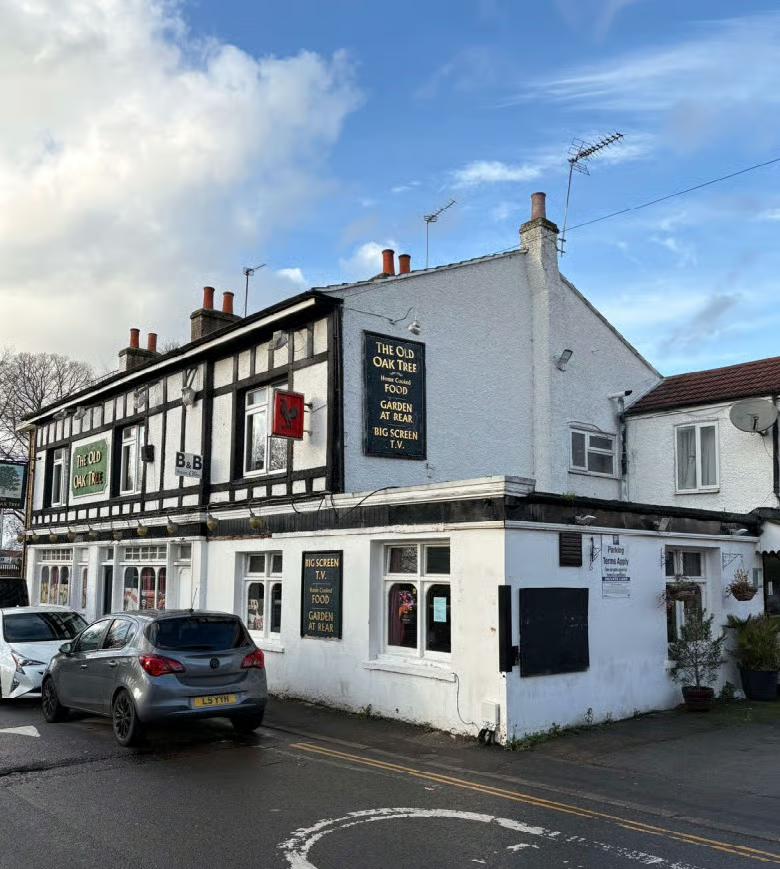
When questioned, Mr Grewal stated that this was a private booking. During Wednesday’s hearing, Mrs Grewal blamed the former manager, and claimed that as soon as she was told about what was happening they closed it down. Robert Dear, a council licence officer corrected Mrs Grewal, reminding her that it was in fact the authorities that shut down the party.
The passenger, who suffers from a severe air-borne nut allergy became unwell on the Belfast bound flight on Sunday
21:28, 19 Mar 2026Updated 21:34, 19 Mar 2026
A passenger at the centre of an emergency diversion on a Belfast-bound flight has criticised easyJet, claiming he was left stranded in France and forced to spend more than £3,000 getting home despite complying with the airline’s requirements.
The Malaga to Belfast International Airport service was diverted to Brest on Sunday after the man, who has a severe airborne nut allergy, became unwell mid-flight. Emergency services met the aircraft on arrival and he received medical treatment before being discharged.
The passenger, who asked not to be named, said he had followed all instructions given by the airline, including obtaining a medical certificate confirming he was fit to fly and providing evidence of additional medication.
“I telephoned easyJet and there was a flight from Brest to Gatwick that evening, and there was a flight then from Gatwick to Belfast International at 6 o’clock the following morning. EasyJet booked me on to both of those and my travelling companion. That was fine,” he said.
“I then said that I would find a hotel and I would be back at the airport in the morning because at that point all I wished to do was lie down. However, an exceptional lady who was the manager of check-in and ground staff approached me and said there is one problem. EasyJet were requesting a fitness to fly certificate before they would allow me on the flight to Gatwick this evening.
“I said, that’s fine and asked where the closest medical clinic was. So I went to the medical centre and a doctor carried out a head-to-toe medical. She said, you’re absolutely perfectly able to fly. There is no indication otherwise, and my blood pressure and pulse had both returned to normal.”
Advertisement
The passenger returned to the airport with the fitness-to-fly certificate, and the ground manager forwarded it to easyJet. In addition to that, easyJet then requested proof that he was travelling with more EpiPens.
“As a standard precaution, I will only put my foot onto an aircraft with six, so I produced the other four,” he said.
“They asked how I could prove they had not been used, and I explained that fully. We then waited hours before easyJet came back and said that was fine.”
The passenger said he was then stopped at the gate and told he would not be allowed to board the flight to London.
Advertisement
“I then went to the boarding gate and I was told at the boarding gate for the flight to London Gatwick that the pilot did not want me on the aircraft.
“I asked, could I speak to the pilot. The pilot refused to have any conversation. He said, no, he is not getting onto my aircraft.
“At that juncture, I then had to go back to security, be readmitted to France on my passport. And I then discovered to my horror that there were no other easyJet flights for a few days.”
He said he was ultimately forced to make his own way home via Paris, London and Dublin, incurring significant costs along the way.
Advertisement
“I had phoned easyJet, who were at best disinterested and at worst, couldn’t give a damn. I had adhered to every single thing that they had asked me to do. I had gone to a medical facility. I had had the most thorough medical I’ve ever had in my life. I produced a certificate of fitness to fly. I had proven that I had a quartet remaining of EpiPens. And then they wouldn’t allow me to fly.
“For me to be out in excess of £3000, I think is outrageous.”
He also criticised the airline’s public statement following the incident, which said the passenger had been able to continue his journey.
“When I read easyJet’s statement saying that they had got the passenger safely home on Sunday night on a later flight, I was incandescent.
Advertisement
“That is utter nonsense. I did not get home until the following day after travelling on multiple flights.
“They put me at more danger because I was sitting on longer flights. If I had not had the funds available, what was I meant to do?”
Belfast Live asked easyJet to clarify why they had initially advised that the passenger had travelled home later on Sunday, whether he would be compensated for the money that he had to spend in seeking alternative travel arrangements and whether he would be banned from other easyJet flights in the future.
An easyJet spokesperson said: “When we responded, it was our understanding that there were arrangements for the passenger to travel later that day on an alternative easyJet flight, and we had not yet become aware that he was unfortunately unable to travel on this flight, which meant he travelled with an alternative carrier the next day instead.”
Advertisement
It is understood that the easyJet customer support team have been in touch with the customer to ensure he is reimbursed for his alternative travel expenses, and to look into his feedback on his experience.

















































You must be logged in to post a comment Login