
Crypto World
Forward Industries Funds Share Buyback With Solana-Backed Loan

Forward Industries, a publicly traded company with a Solana-focused treasury strategy, has launched a share repurchase program funded through a crypto-backed loan from Galaxy Digital LLC, underscoring how digital assets are increasingly being used in traditional corporate finance.
The company said Thursday it will repurchase 6,164,324 shares of its common stock from an unnamed institutional investor for approximately $27.4 million, reducing total shares outstanding to 76,977,809.
Cointelegraph’s email to Forward seeking further information on the identity of the selling institutional investor was not answered prior to publication.

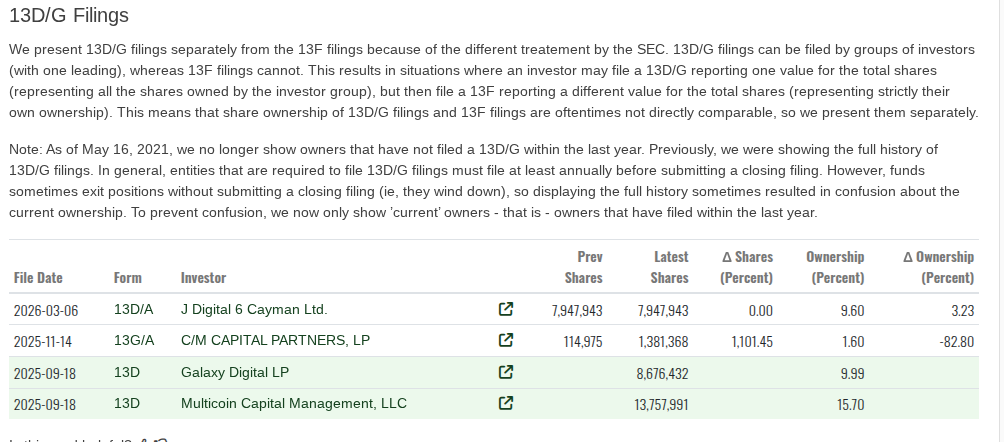
Public filings indicate that only six institutional investors in Forward Industries hold enough shares to sell that volume back to the company. According to filings data compiled by Fintel.io, one of those holders is Galaxy Digital LP (8.68 million shares, as of Sept. 18, 2025) and another is Galaxy Group Investments LLC (8.11 million shares, as of Feb. 18, 2026.)
To fund the buyback, Forward secured a $40 million loan from Galaxy Digital LLC at an interest rate of 3.4%. The loan is collateralized by the company’s Solana (SOL) holdings, which total 7,013,536 SOL — valued at approximately $613 million at current market prices.
The structure allows Forward to access liquidity without liquidating its crypto reserves, while continuing to generate yield through staking. The move reflects a broader trend of companies leveraging digital asset treasuries to optimize capital structure and potentially enhance shareholder returns.
The share repurchase appears to be part of Forward Industries’ November authorization to buy back up to $1 billion of its stock on an ongoing basis. At the time, the company said the program would provide financial flexibility amid heightened volatility in the crypto market.
That volatility has intensified in recent months, with Solana’s price falling below $90. The buyback may also help support Forward Industries’ stock, which is down 87% from its September peak.

Related: Crypto’s 2026 investment playbook: Bitcoin, stablecoin infrastructure, tokenized assets
Crypto treasury strategies face pressure
Forward Industries began aggressively accumulating Solana last year, when crypto treasury strategies gained traction during the bull market. The company has since built the largest publicly traded SOL treasury, with at least 18 other public companies adopting similar strategies, according to industry data.
By February, these companies collectively held more than $1.5 billion in unrealized losses tied to the broader crypto market downturn. A significant portion of those losses is attributed to Forward Industries, which is down roughly $972 million.

The sector’s volatility is likely to result in broad consolidation among crypto treasury companies, Wojciech Kaszycki of crypto infrastructure company BTCS told Cointelegraph.
Many treasury companies are under pressure as declining crypto prices push their valuations below the value of the digital assets they hold, while limited cash flow makes it harder to sustain operations.

Arthur Hayes, a veteran trader and co-founder of BitMEX, has once again placed a bet in ETHFI nearly a month after a possible exit from the token.
Summary
- Arthur Hayes re entered ETHFI with a $72,800 purchase shortly before Upbit announced a KRW listing, drawing attention to the timing of the move.
- ETHFI price briefly surged nearly 12% following the listing before retracing, highlighting volatility tied to exchange driven catalysts.
- Technical signals remain mixed, with a breakout above trendline resistance suggesting upside potential, while MACD and RSI indicate lingering bearish pressure.
According to a March 19 X post by on-chain tracker Lookonchain, Hayes invested around 132,730 ETHFI tokens worth $72,800 today. The tokens were received from Anchorage Digital at an average price of $0.55 each.
While such transfers are common for institutional players, the report highlighted the significance of the timing of the purchase. It revealed that the transfer from Anchorage Digital happened just five hours ahead of a KRW market listing for the token by South Korea’s largest crypto exchange, Upbit.
Typically, a KRW listing on Upbit has often acted as a major catalyst for crypto assets. As reported by crypto.news earlier, CPOOL, the native token of the DeFi institutional credit protocol Clearpool, soared over 70% in a single day following a similar listing. However, the token later gave up a portion of those gains as profit-taking set in.
Lookonchain added another twist to the development. Notably, Hayes had transferred 2.15 million ETHFI tokens worth around $1 million out of his wallet a month ago, likely exiting from the position.
The latest receipt of ETHFI tokens could likely mark a potential re-entry into the token, though at a much smaller scale than when Hayes previously exited the position. Hayes has also historically rotated capital across DeFi tokens, including PENDLE, LDO, ENA, and ETHFI, depending on market conditions.
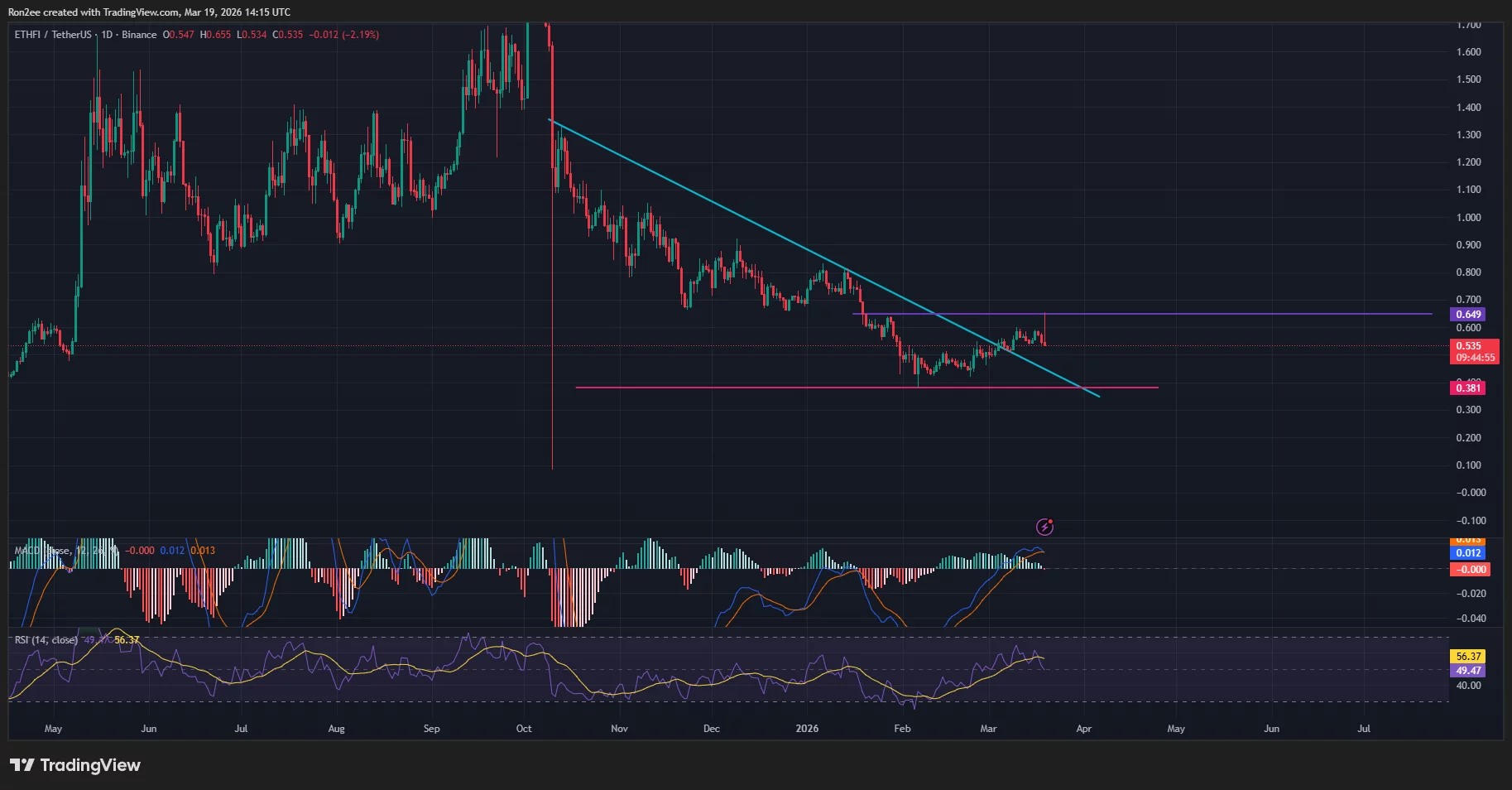
Ether.Fi (ETHFI) shot up nearly 12% to $0.60 within an hour after Upbit listed the token. It, however, retraced back to around $0.54 at press time, down 2.3% over the past 24 hours.
On the daily chart, ETHFI price has broken out of a descending trendline that had been acting as dynamic resistance for the token following its decline since early October. A sharp breakout from the pattern typically signals a potential trend reversal and opens the door for further upside if supported by volume.
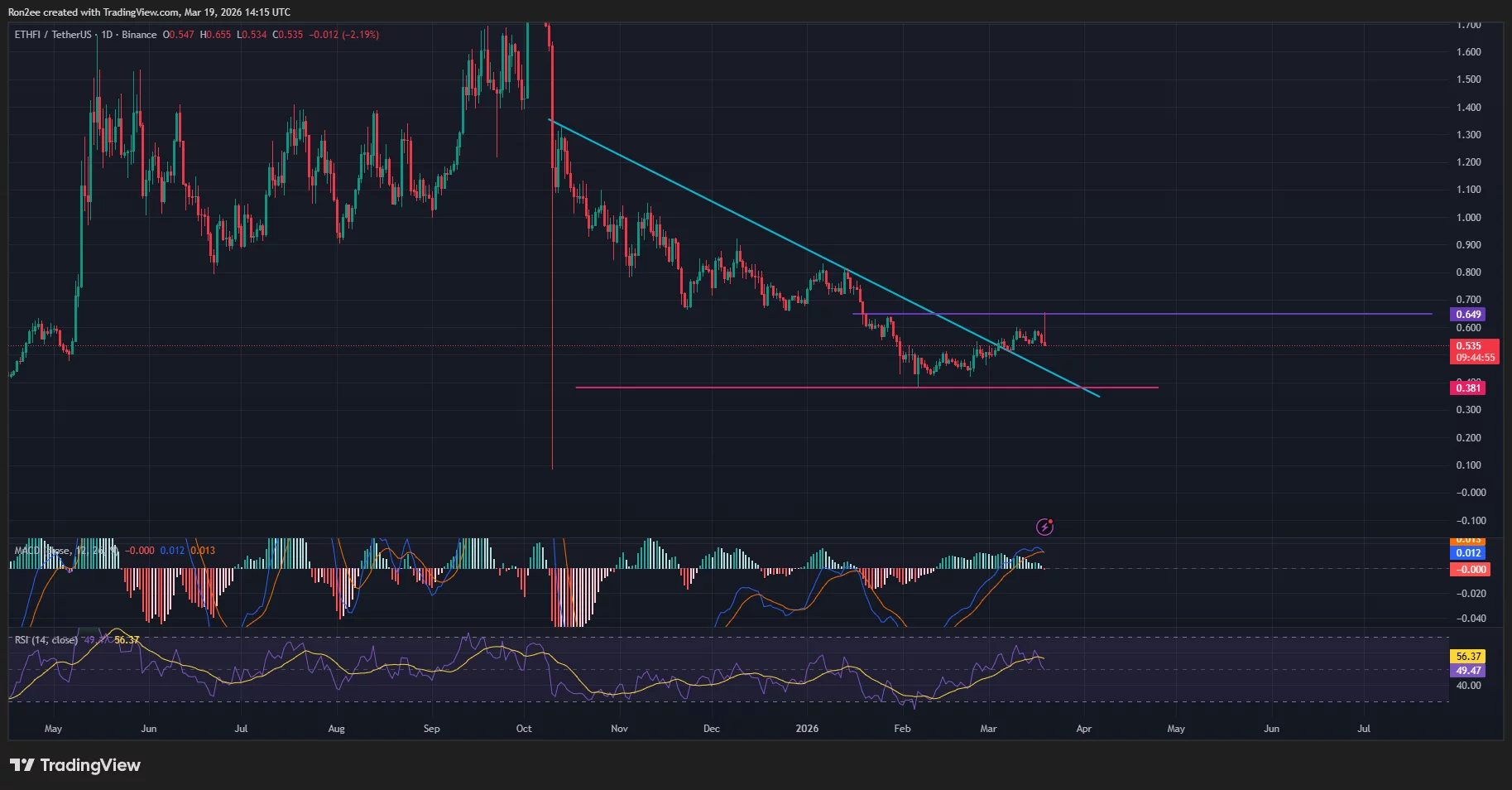
Technical indicators like the MACD and the RSI also suggest mixed momentum. Notably, the MACD lines were still pointing downwards, indicating lingering bearish pressure, while the RSI hovered near the neutral zone, reflecting indecision among traders.
For now, $0.649 would be the key resistance level traders would be keeping an eye on. A break above that could strengthen bullish momentum and push the price toward higher levels.
On the contrary, $0.500 would be the key support level. A drop below that could lead to a retest of the Feb. 6 low of $0.381.
Disclosure: This article does not represent investment advice. The content and materials featured on this page are for educational purposes only.


Bitcoin sinks below $71k as Powell’s hawkish tone and Iran’s oil shock trigger a $542M liquidation wave across leveraged crypto markets.
Summary
- Bitcoin drops to about $71,313, Ethereum to $2,201, as crypto and stocks sell off on Fed projections and oil shock fears.
- Powell flags oil-driven inflation, keeps just one 2026 rate cut in the dot plot, crushing hopes for easier policy and triggering a risk-off move.
- Over $542M in mostly long liquidations and Brent above $110 show how leveraged crypto positioning collides with Iran-driven energy turmoil.
Crypto markets extended their slide into Thursday as the combined aftershock of the Federal Reserve’s March policy meeting and an escalating oil shock from the Iran conflict continued to rattle risk assets. Bitcoin (BTC) fell to approximately $71,313 (-4.62%), Ethereum dropped to $2,201 (-5.92%), and a cascade of leveraged long positions was wiped out — with total network-wide liquidations reaching $542 million over 24 hours, of which $448 million were long positions. It was the largest liquidation event in weeks, and the most heavily one-sided since the early stages of the U.S.-Iran conflict in late February.
The proximate trigger was Wednesday’s Federal Open Market Committee decision and, more critically, the press conference that followed. The Fed held its benchmark rate at 3.5%–3.75% as universally expected, with the FOMC voting 11-1 to maintain that range. But the new Summary of Economic Projections — the first of 2026 — delivered the information markets least wanted to hear. The Fed raised its 2026 PCE inflation forecast to 2.7%, up from a prior estimate of 2.4%, citing the oil shock stemming from Iran’s blockade of the Strait of Hormuz as a direct driver. The dot plot’s median remained anchored at just one 25-basis-point cut for all of 2026, dashing residual hopes for a more accommodative path.
Fed Chair Jerome Powell was unambiguous in his press conference. “The oil shock for sure shows up,” he said, referring to its impact on the central bank’s projections. In his opening statement, he noted that near-term inflation expectations “have risen in recent weeks, likely reflecting the substantial rise in oil prices caused by the supply” disruption — a reference to the Hormuz closure that has taken roughly 20% of global oil flows offline since late February. Core PCE rose 3.0% in the 12 months through February, well above the Fed’s 2% target. Powell rejected comparisons to 1970s stagflation, arguing unemployment remains near normal levels, but acknowledged the tension between the Fed’s dual mandate goals in the current environment.
The market reaction was swift and familiar. Bitcoin dropped from approximately $74,000 to $70,900 within hours of the press conference — its eighth decline following an FOMC meeting out of the last nine. The Nasdaq closed down 1.5% on Wednesday, the Dow and S&P 500 reversed five consecutive sessions of gains to hit their lowest levels since November, and 10-year Treasury yields climbed more than 5 basis points. On Thursday, the selloff continued, with the Dow opening down 420 points (-0.91%), the S&P 500 -0.89%, and the Nasdaq -1.23%.
The liquidation breakdown tells its own story: Bitcoin longs alone accounted for $172 million in forced selling, ETH longs for $126 million, with a total of 143,776 traders liquidated globally. The largest single liquidation — an ETH position worth $17.98 million on Aster — underscores how aggressively leveraged some participants were ahead of the FOMC. Long-term Bitcoin holders were also reported to have sold over 1,650 BTC worth approximately $117 million in the wake of Powell’s remarks.
With Brent crude now above $110 per barrel following renewed Iranian attacks on regional energy facilities, and a Fed that has explicitly incorporated oil-driven inflation into its baseline forecast, the conditions for a near-term rate cut have seldom looked more remote.
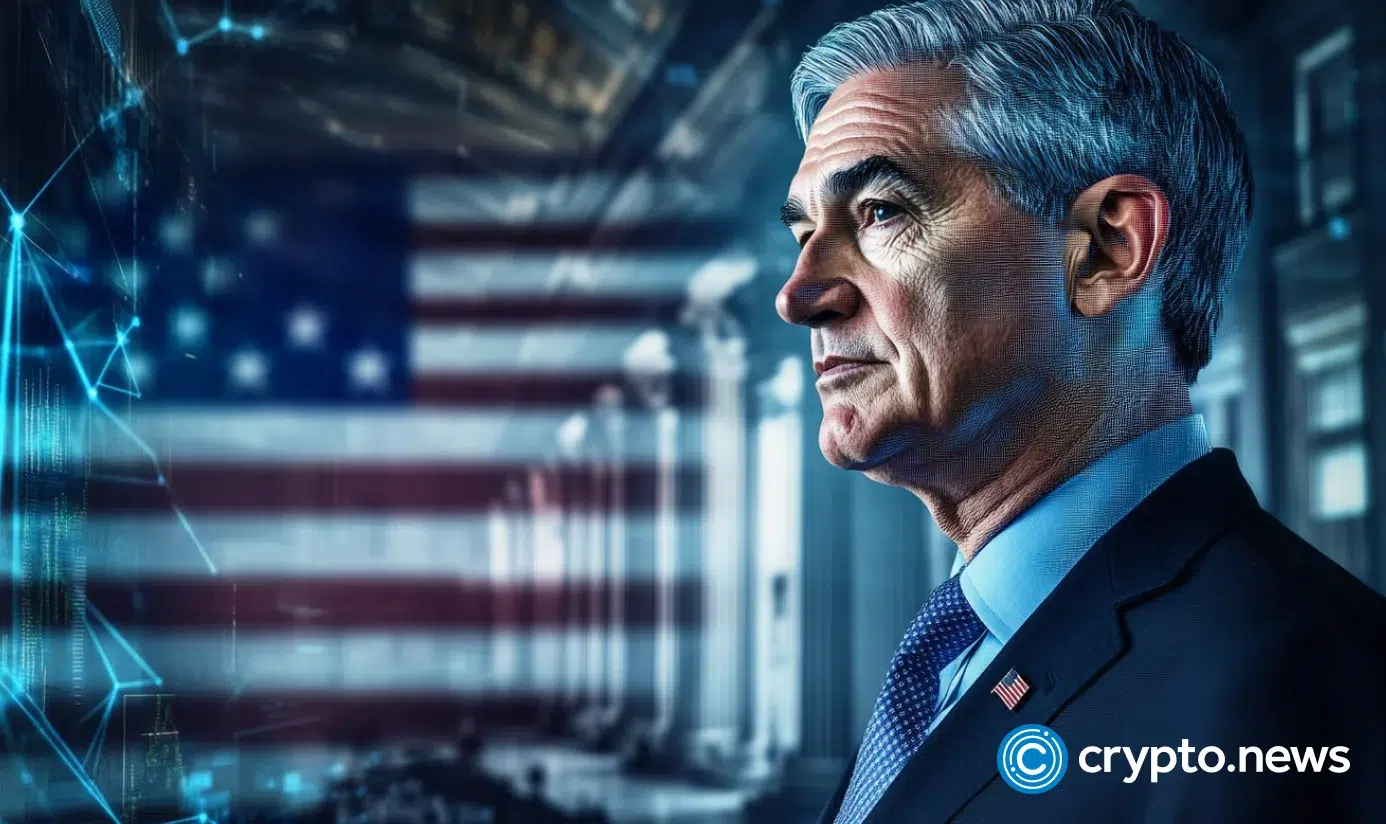
Fed unveils a 90-day comment plan to ease Basel III and G-SIB capital rules, modestly cutting requirements for large banks and more for regional lenders.
Summary
- Fed launches a 90-day comment period on proposals that slightly lower capital requirements for large banks and more materially for smaller regionals.
- Bowman’s “four pillars” overhaul spans stress tests, eSLR, Basel III and G-SIB surcharges, aiming to free credit and shareholder payouts without scrapping post-2008 safeguards.
- Industry groups cheer the recalibration as growth-friendly, while critics warn easing buffers amid oil shocks and higher-for-longer rates risks weakening prudential defenses.
The Federal Reserve voted Thursday morning to formally release a sweeping package of proposed bank capital reforms, launching a 90-day public comment period on changes that would modestly reduce capital requirements for the largest U.S. financial institutions — and more substantially ease the burden on smaller regional banks. The proposals, previewed by Fed Vice Chair for Supervision Michelle Bowman in a March 12 speech at the Cato Institute, represent the most significant overhaul of the post-2008 bank capital framework in years and a clear victory for Wall Street institutions that had spent years lobbying against an earlier, more stringent version of the rules.
The package addresses what Bowman described as “the four pillars” of the regulatory capital framework for the largest banks: stress testing, the enhanced supplementary leverage ratio (eSLR), the Basel III endgame rules, and the G-SIB surcharge applied to globally significant institutions. Together, the proposals would produce a net decrease in capital requirements for large banks “by a small amount,” while smaller banks focused on traditional lending would see “slightly larger reductions”. For major institutions such as JPMorgan Chase and Goldman Sachs, the modest increase from revised Basel III calculations would be more than offset by a recalibrated G-SIB surcharge — one Bowman argued had grown disproportionate to the risks these banks actually carry.
The philosophical underpinning of the reform is a conviction that capital requirements imposed after the 2008 financial crisis have gradually overshot their intended purpose. “When capital requirements become excessive, they hinder the banking system’s essential role of providing credit to the real economy,” Bowman said in her Cato Institute remarks. She described the proposals as a “sensible recalibration” designed to remove redundant standards and better align requirements with actual institutional risk profiles, rather than a wholesale rollback of post-crisis prudential safeguards.
The eSLR reforms are particularly significant. A final rule approved by the FDIC and Federal Reserve in November 2025 — effective April 1, 2026 — had already replaced the existing 2% eSLR buffer for global systemically important banks with a buffer equal to half of each institution’s Method 1 G-SIB surcharge, capped at 1% for subsidiary banks. FDIC staff estimated that change alone would reduce aggregate Tier 1 capital requirements by $13 billion, or under 2%, for G-SIBs, and by $219 billion — or 28% — for major bank subsidiaries. The new proposals being voted on Thursday extend that logic across the Basel III and G-SIB surcharge frameworks.
The banking industry responded favourably. The American Bankers Association, Financial Services Forum, and Bank Policy Institute issued a joint statement praising Bowman’s approach as “a thoughtful, bottom-up” resolution to the concerns raised by 97% of commenters on the prior Basel proposal, calling for a capital framework that “reflects the actual risks in the banking system, rather than over-calibrated requirements that impede economic growth”.
The timing carries broader market significance. With the Fed holding rates steady at 3.5%–3.75% and explicitly raising its 2026 inflation forecast to 2.7% on Wednesday, the capital easing offers Wall Street a degree of policy relief that monetary policy itself is not currently providing. Freeing up capital for lending, share buybacks, and dividends — precisely the stated aim of the reform — may inject some flexibility into a financial system otherwise navigating a geopolitical oil shock and a higher-for-longer rate environment.
Critics, however, argue that loosening capital buffers during a period of elevated macro uncertainty runs counter to the spirit of prudential regulation. Bowman indicated no implementation timeline beyond coordinating with other international jurisdictions — leaving the final shape of the rules subject to the 90-day comment process.

Bitcoin (BTC) dipped under $69,000 on Thursday, sliding back into its six-week range after briefly touching highs above $76,000. The retreat comes as futures selling accelerates and demand from U.S.-based investors shows signs of stalling, though analysts argue the market could still mount a renewed rally if key levels hold and the broader setup unfolds in a favorable way.
The shift reflects a shift in market dynamics where derivatives activity increasingly dominates spot flows, underscoring the ongoing tug-of-war between leveraged traders and cash-based demand. While the immediate move raised questions about momentum, a familiar chart pattern suggests a potential path back toward the region’s previous highs if the balance of risk and reward tips back in favor of buyers.
Key takeaways
- BTC briefly fell below $69,000, pulling the price back into a six-week range after testing above $76,000 in recent sessions.
- Derivatives activity has regained influence over spot demand, with the Coinbase premium turning negative and cumulative volume delta (CVD) shifting toward sellers on both spot and perpetual contracts.
- Funding rates turned modestly positive (about 0.05%), signaling a shift toward a net long bias in the futures market even as spot liquidity wanes in the near term.
- Technical patterns echo a prior bounce in early March: lower daily lows accompanied by bullish RSI divergences, bolstering case for a retest of higher levels if the price can reclaim key pivots.
- Key levels to watch include reclaiming $70,000, a possible move to $72,000–$76,000, and protection above $68,300 to prevent a slide toward $65,000–$62,000 in a downside scenario.
Derivatives leadership matches fluctuating spot demand
Recent data from on-chain analytics show a notable shift in the relationship between spot volumes and derivatives activity. After a period of robust demand for BTC on spot venues, the Coinbase Premium gap turned negative, suggesting that U.S.-based buyers did not sustain the previous pace of purchases into the dip. That pattern aligns with observations from traders watching the balance between cash markets and the leveraged side of the market.
Analysts highlighted a stark divergence in flow across the two market segments. The cumulative volume delta (CVD) for spot BTC declined by about $40.64 million, while the CVD for perpetual futures fell by roughly $506.75 million. The discrepancy indicates stronger selling pressure from leveraged traders relative to spot buyers over the same period, a dynamic that can amplify short-term price swings even when long-term bias remains mixed.
Despite the softer near-term spot demand, the funding rate has shifted into positive territory, around 0.05%. This implies long-position holders are now paying shorts, a sign of more constructive sentiment within the derivatives market and a potential tilt toward a bullish bias if funding pressures persist in favor of long exposure.
Order-book data further shows stubborn bid support around the $70,000 mark, with market depth hinting at buyers stepping in at or near that level in both spot and perpetual markets. The dynamic suggests that even as selling pressure arises from leveraged traders, a floor exists where demand can reassert itself should prices approach the pivot region.
For context, market watchers also flagged a broader pattern tying into a Bitcoin-centric DeFi push that aims to unlock native liquidity and yield on BTC without resorting to wrapped assets. While not a certainty, such developments could contribute to deeper buyers’ interest at critical levels.
Fractal pattern hints at a potential rebound
On shorter timeframes, Bitcoin’s price movement has formed a fractal pattern reminiscent of early March, when a dip and a sweep of internal liquidity levels preceded a decisive reversal higher. The current setup mirrors that sequence: successive lower lows followed by signals that momentum may be fading and buying pressure could reemerge.
From a momentum perspective, a bullish RSI divergence is unfolding. In the previous instance, the RSI held higher than its own prior low while price dipped, signaling that selling pressure was waning even as price trended downward. A comparable divergence is developing now, reinforcing the case for a fractal rebound rather than a deeper retreat.
Liquidation activity has also framed the narrative in both episodes. In each instance, long-side liquidations have briefly reduced open interest and flushed out overleveraged positions, which can set the stage for a swift reallocation of risk once buyers regain conviction. A breach of the fractal’s boundary would be a red flag, but the current data tilt toward potential stamina in the near term.
Looking ahead, reclaiming the $70,000 area is depicted as a pivotal moment. If bulls push past $72,000 and sustain the move, the door could open to retesting the higher band near $76,000. A key risk sits at $68,300: breaking below this level would widen the path toward liquidity pockets around $65,000 and $62,000, where larger time-frame orders may offer support but where the risk of a more protracted downside expands.
Industry observers have also flagged a practical anchor for bulls: the $73,000 level as a base. Ryan Scott, founder of Trading Stables, emphasized that failure to stabilize above this threshold could signal weak buyer response and raise the odds of a test of range lows around $62,000 in a less favorable scenario.
For readers tracking market sentiment and potential catalysts, these dynamics sit within a broader context. Prediction market chatter has floated scenarios where BTC could revisit declines in the mid-to-high $50,000s in more adverse cycles, but the present fractal framework suggests a more conditional path—one that hinges on continued support near $70,000 and a successful reentry into the higher rung of the range.
Related: OP_NET launches native DeFi push for Bitcoin highlights the broader trend of on-chain options aimed at expanding BTC’s utility beyond traditional spot trading, a development that could help anchor more robust demand in the event of protracted volatility.
What this means for traders and builders
The current setup underscores a broader theme in crypto markets: price action is increasingly shaped by the tug-of-war between leveraged bets and real-money demand. While the near-term risk remains tilted toward a retest of the range’s lower boundary if liquidity dries up, the structural signals favor a rebound scenario as long as price holds above the critical supports and rotating demand persists into the next session.
From an investor standpoint, the situation calls for careful risk management around the $68,300–$70,000 area. Traders aiming for a breakout to the $76,000 vicinity should monitor the 72,000–73,000 zone as a potential pivot, watching for solid acceptance in that band that could fuel a short squeeze if weak shorts get trapped. Conversely, a break below $68,300 could shift the focus to the mid- to lower-$60,000s where higher-timeframe liquidity sits, complicating a quick recovery.
Next steps to watch
Market participants should keep a close eye on bid-ask dynamics around the $70,000 mark and the flow of funding rates in the coming sessions. A sustained positive funding environment and renewed spot demand would bolster the case for a renewed ascent toward recent highs, while a renewed deterioration in derivatives positioning could reassert the range-bound dynamic. In addition, broader adoption and on-chain DeFi developments around Bitcoin may offer extra support should buyers look to deploy capital in more diverse BTC-enabled protocols.
Readers should stay tuned for how the price responds to the pivotal $70,000 to $72,000 zone and whether the fractal pattern continues to unfold. As always, ongoing monitoring of liquidity, funding, and on-chain signals will be essential to gauge whether the market is leaning toward continuation of the uptrend or a renewed test of lower bands.


Opinion by: Arthur Azizov, founder of B2 Ventures
Transaction cost analysis (TCA) has long been an important tool in equity trading. With this instrument, traders can see the hidden costs that a transaction carries and minimize the difference between the expected and the actual price.
As crypto matures, it begins to resemble traditional financial markets and functions like other tradable instruments. Crypto transactions also come with costs: fees that investors pay every time they buy or sell crypto.
Yet there is one thing that is clearly not keeping pace with this development. Execution costs for crypto analyzed systematically. Understanding how much it actually costs to execute a deal leaves much to be desired.
This opacity demands the crypto industry urgently adopt transaction cost analysis before it kills market trust.
Invisible costs in the crypto market
To the untrained eye, major crypto pairs can seem liquid; order books are deep, and quoted spreads are competitive. In the end, however, the final execution price can deviate from the expected one due to slippage.
For example, an investor wanted to buy 1 Bitcoin (BTC) for $90,000, but because of the sudden market volatility, the final price was $90,900. The slippage, in this case, would be $900, or 1% of the intended trade amount.
This problem is inherent not only in crypto; it also exists in traditional finance. In equity markets, however, these costs are measured precisely, compared and analyzed with the use of TCA, coupled with best execution.
In contrast, for crypto, the real price of entry or exit is often hard to calculate or predict manually. This is precisely where TCA becomes valuable, as it can allow crypto traders to break down the true cost of execution, knowing exactly bid-ask spreads, market effect and order routing fees.
With TCA tools, crypto transactions can become more transparent, and traders can easily identify the sources of costs associated with executing trades.
Crypto transactions can be hard to price
If it were that easy in real life, however, TCA analysis would already be an integral part of crypto markets. The main issue is that cryptocurrency prices are highly volatile, changing every millisecond and trading happens around the clock. It has a significant influence on trade execution costs, as sometimes investors are simply not on time when making purchases.
The liquidity is low, and the fragmentation, due to the existence of a number of exchanges, remains high. This situation worsens as some platforms may have outages or less available liquidity, which causes even more slippage.
Speaking of costs, things get opaque in crypto. Some costs can often be included quietly within the trade prices, complicating the “total consideration.” It’s difficult to really know the full cost of a trade.
There is an issue of a lack of data as well. A meaningful transaction cost analysis requires standardized data. For example, in equity markets, information is typically available from centralized sources. As cryptocurrencies have a decentralized nature, trading activity is fragmented across numerous exchanges and platforms, making it difficult to aggregate data and perform reliable analysis.
The crypto market also suffers from the absence of regulation and a universal definition of TCA or best execution. As a result, the portfolio performance is highly dependent on external factors such as the speed of a trade or the “health” of the venue and not on the capabilities of an asset manager or investor.
Toward measurable execution
Regulators are beginning to recognize this gap in execution. For example, in 2025, the European Securities and Markets Authority updated its standards, including best execution, to extend beyond equities to include asset classes such as foreign exchange, commodities and, most importantly, crypto.
Related: Temple Digital Group launches 24/7 institutional trading built on Canton
This does not introduce a transaction cost analysis per se and does not prescribe specific performance indicators, but it’s an important precedent. Execution transparency becomes more mandatory for digital assets.
Although regularization alone cannot solve the problem of invisible trading costs, it still makes investors think more about the need for TCA. If market participants can see how much trading really costs and how these additional fees differ between exchanges, the market will become more efficient.
The dilemma of scattered data and lack of standardization is now being solved with cloud computing and big data analysis that made it significantly easier and more cost-effective to collect large volumes of data and process it. Powered by machine learning, platforms can conduct transaction cost analysis across venues and identify patterns that were previously inaccessible.
The massive use of TCA would help traders reduce costs and increase liquidity. Trading volume flows would gradually move to a place where there are better conditions, which would stimulate competition between the exchanges and assets.
Opinion by: Arthur Azizov, founder of B2 Ventures.
This opinion article presents the author’s expert view, and it may not reflect the views of Cointelegraph.com. This content has undergone editorial review to ensure clarity and relevance. Cointelegraph remains committed to transparent reporting and upholding the highest standards of journalism. Readers are encouraged to conduct their own research before taking any actions related to the company.
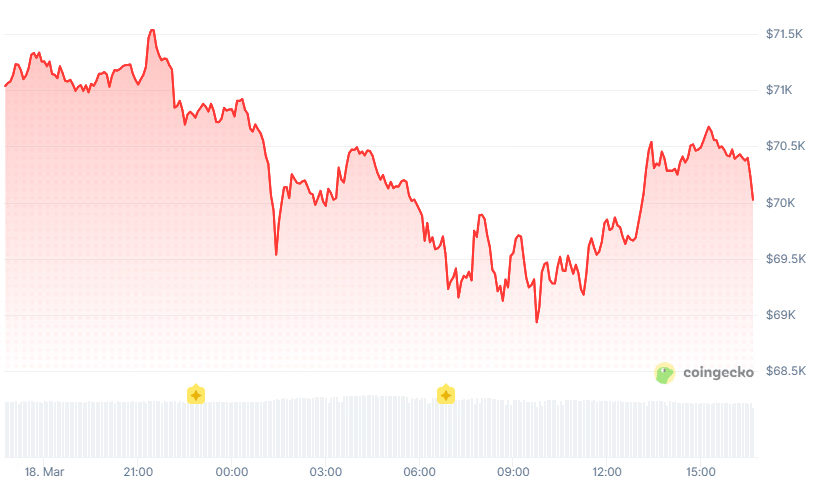
Bitcoin drops below $70,000 as the Fed raises its inflation forecast and oil-driven price pressures cloud the outlook for rate cuts.
Crypto markets deepened their losses on Thursday after the Federal Reserve left interest rates unchanged and raised its 2026 inflation forecast yesterday, compounding a selloff triggered by hotter-than-expected wholesale inflation.
Bitcoin (BTC) is trading at around $70,000, down 1.3% over the past 24 hours. ETH and SOL fell 2% to $2,135 and $88.5, respectively. Meanwhile, Ripple (XRP) slipped 1%.

Total crypto market capitalization is down 1.5% to $2.48 trillion, according to Coingecko.
Fed Raises Inflation Outlook
Yesterday, the Federal Reserve held rates steady as widely expected, but the accompanying projections delivered a hawkish surprise. Policymakers raised their 2026 PCE inflation forecast to 2.7% from 2.4%, with Chair Jerome Powell acknowledging that rising oil prices “for sure showed up” in the committee’s updated outlook.
The dot plot still shows a median expectation of one 25-basis-point cut this year, but seven of the 19 FOMC members now project zero cuts in 2026, up from six in December.
Big Movers
Nearly all of the Top 100 digital assets posted losses over the last 24 hours.
Today’s top gainers are Quant (QNT) and Pi Network (PI).
Worldcoin (WLD) and PUMP are the biggest losers, down 10% and 6%, respectively.
Around 118,000 leveraged traders were liquidated for $405 million in the past 24 hours, according to CoinGlass. Bitcoin accounted for $145 million, while ETH made up $98 million.
Bitcoin exchange-traded funds (ETFs) recorded outflows of $163.5 million on Tuesday, snapping a seven-day winning streak.

Key Takeaways
- Micron’s fiscal Q2 2026 results topped forecasts with $23.86 billion in revenue and adjusted EPS of $12.20
- The company’s Q3 2026 revenue projection of approximately $33.5 billion significantly exceeded analyst estimates
- Capital expenditure plans for fiscal 2026 now surpass $25 billion, representing a roughly $5 billion increase from earlier projections
- Shares declined following the earnings announcement as market participants digested the elevated investment requirements
- Analyst sentiment continues overwhelmingly positive, with 34 Buy/Strong Buy recommendations and no Sell ratings according to MarketBeat data
When Micron Technology unveiled its earnings results on March 19, the numbers looked impressive on paper. Yet exceptional revenue performance and unprecedented free cash flow generation couldn’t prevent the shares from sliding, as market attention fixated on substantially increased capital investment requirements.
The memory chip manufacturer reported fiscal second-quarter 2026 revenue reaching $23.86 billion alongside adjusted earnings of $12.20 per share. Management also disclosed that the period concluded with $16.7 billion in cash and investments, representing a company record for free cash flow.
The financial metrics were undeniably strong. However, the forward-looking statements captured market attention — triggering mixed reactions.
Micron projected fiscal Q3 2026 revenue approaching $33.5 billion. This forecast substantially exceeded Wall Street consensus expectations. Management attributed the robust outlook to accelerating demand for high-bandwidth memory (HBM) deployed in artificial intelligence data centers and computing accelerators.
HBM represents the most sought-after product category in memory semiconductors currently. Micron holds position among just three principal global suppliers, alongside Samsung and SK hynix. This concentrated supply landscape has provided support for pricing power and profit margins.
Understanding the Post-Earnings Decline
Notwithstanding the impressive financial performance, Micron shares retreated following the earnings disclosure. The catalyst centered on updated capital spending projections.
Micron announced that fiscal 2026 capital expenditures will now surpass $25 billion, marking an approximately $5 billion elevation from prior guidance. The company explained that expanding clean-room infrastructure and accelerating DRAM manufacturing capacity requires the additional investment to address AI-driven demand.
This represents a recognizable dynamic within semiconductor manufacturing — committing substantial resources to capture demand opportunities while navigating potential oversupply risks if market conditions shift. Memory chip producers have encountered cyclical challenges previously, and market participants retain institutional memory of those episodes.
Another consideration involves the stock’s substantial year-to-date appreciation. Micron had advanced more than 61% during 2026 prior to Thursday’s pullback, building on strong performance throughout 2025. At those valuation levels, profit-taking responses to perceived risks represent predictable market behavior.
Wall Street Maintains Positive Outlook
The analyst community demonstrated unwavering conviction. According to MarketBeat data released March 19, Micron holds five Strong Buy ratings, 29 Buy ratings, and four Hold ratings. Not a single Sell rating appears among tracked analysts.
This represents remarkably uniform bullish positioning. The four Hold recommendations suggest measured caution at prevailing price levels, yet no analysts advocate selling positions.
Price objectives adjusted following the quarterly report as analysts recalibrated their financial models. MarketBeat’s aggregated consensus range established parameters between approximately $425.62 and $446.66.
Subsequently, upward target revisions emerged. Needham elevated its price objective to $500. UBS similarly increased its target while maintaining a Buy recommendation. Both firms emphasized sustainable AI-associated memory demand as the fundamental thesis.
These $500 price targets don’t represent momentum chasing — they embody convictions that Micron’s artificial intelligence growth trajectory extends further than current market pricing reflects.
The investment narrative surrounding the stock has evolved. Questions no longer focus on whether Micron can achieve recovery. Instead, debate centers on whether the organization can sustain growth without excessive capital deployment.
Presently, analysts affirm that capability. With 34 Buy or Strong Buy ratings and zero Sell recommendations in current MarketBeat tracking, Micron remains among the most broadly endorsed equities within the AI semiconductor investment theme.
Shares declined on March 19. The analyst consensus didn’t waver.

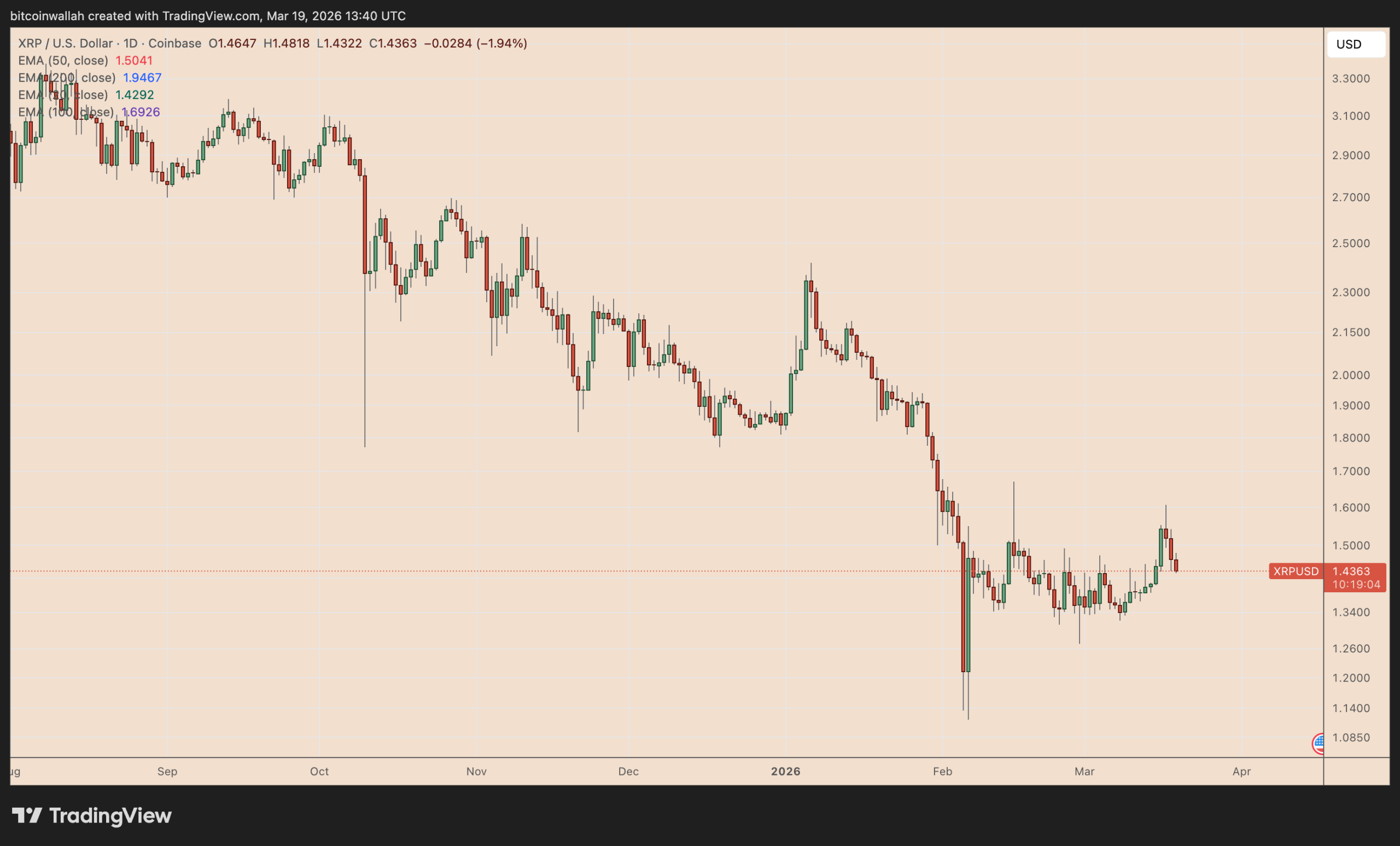
Korean traders are pulling XRP off exchanges at a rapid pace, while whale flows signal accumulation seen ahead of past rallies.
XRP (XRP) has dropped by 10.5% in the past three days, but the decline may be a typical breakout retest within a broader bullish setup, coinciding with a surge in withdrawal activity on Korea’s Upbit exchange.

Key takeaways:
XRP bull flag breakout underway
XRP broke out of its prevailing bull flag pattern last week and was pulling back on Thursday to retest the former upper trendline as new support, a common move after a breakout.

Bull flags form when price consolidates inside a downward-sloping channel following a strong rally. Once price breaks above that channel, the old resistance often becomes support on the retest.
For XRP, that key area is around the mid-$1.40s, also aligning with the 20-day exponential moving average (20-day EMA, the green line).
Holding above it would keep the breakout intact and maintain the bull flag’s upside target near $1.70–$1.72, or about 20% above current levels.
XRP record withdrawals from Upbit
XRP’s bullish technical setup aligns with a recent surge in withdrawal activity on South Korea’s Upbit, according to CryptoQuant data.
Since December 2025, wallets across nearly all size cohorts have steadily moved XRP off exchanges, reducing immediate sell-pressure. This trend is typically associated with accumulation phases.

On-chain analyst CW pointed to a similar structure between 2021 and early 2023, when elevated XRP withdrawals from Korean exchanges coincided with a broader accumulation phase.
That period preceded a sharp rally, with XRP climbing from below $1 to above $3, an increase of roughly 500%.
Related: XRP holders hit a record 7.7M: Will price break through $1.60 next?
Upbit has long been an active trading venue for XRP traders, often serving as a barometer to gauge retail sentiment. As of Thursday, XRP trades in South Korean Won (KRW) were the fourth-largest in a 24-hour rolling period.

XRP whale flows signal renewed accumulation
XRP’s whale activity is also starting to support the bullish case.
As of Thursday, the 90-day average whale flow had turned positive after staying negative for most of 2024 and early 2025, a period that saw persistent large-holder selling.

The latest reversal suggests whales are no longer distributing as aggressively and may be shifting back toward accumulation.
Historically, moves from negative to positive whale flow have appeared during the early stages of trend reversals and accumulation-led consolidations. That includes XRP’s climb to $3.55 from around $2.20 during the April–September 2025 period.
This article does not contain investment advice or recommendations. Every investment and trading move involves risk, and readers should conduct their own research when making a decision. While we strive to provide accurate and timely information, Cointelegraph does not guarantee the accuracy, completeness, or reliability of any information in this article. This article may contain forward-looking statements that are subject to risks and uncertainties. Cointelegraph will not be liable for any loss or damage arising from your reliance on this information.

Key Highlights
- TSEM shares have climbed approximately 14% Thursday and surged over 33% following Monday’s Oriole Networks announcement
- The collaboration targets deterministic, ultra-low latency networks for AI systems leveraging Tower’s silicon photonics capabilities
- Tower introduced its new BCD Gen3 power management solution designed for AI data center applications
- A separate partnership with Salience Labs advances optical circuit switching innovation
- Shares have skyrocketed more than 300% in the trailing twelve months
Tower Semiconductor (TSEM) experienced a substantial rally of approximately 14% during Thursday’s trading session, defying broader market weakness. This upward momentum continues a rally that started early this week following the company’s strategic partnership announcement with Oriole Networks.
Tower Semiconductor Ltd., TSEM
From Monday’s announcement through recent trading, TSEM has advanced more than 33%. The stock most recently traded near $161.90.
The collaboration with Oriole Networks emphasizes deterministic, ultra-low latency networking solutions built upon Tower’s established silicon photonics infrastructure. This technology addresses critical needs in AI systems, where networking performance and efficiency face mounting demands.
During the initial announcement, Oriole CEO James Regan emphasized that AI expansion is compelling the sector to reimagine conventional network designs. “As models scale, traditional architectures encounter an inflexible latency barrier — whereas Oriole’s deterministic, low-latency approach seamlessly overcomes it,” he stated.
The optical networking sector Tower is pursuing could achieve $80 billion in value by decade’s end, based on projections referenced during the partnership announcement.
Power Management Innovation Strengthens Growth Narrative
Alongside the Oriole collaboration, Tower unveiled its BCD Gen3 power management solution this week. This platform addresses AI data center requirements and mobile power applications, with Tower claiming best-in-class LDMOS capabilities.
The introduction establishes Tower’s presence in the AI power management sector, an area experiencing rising demand for efficient, high-capability semiconductor solutions.
Tower reported approximately $1.44 billion in quarterly revenue during its latest period, demonstrating the company’s breadth across diverse semiconductor segments.
Advancing Photonics Innovation with Salience Labs
Tower maintains an ongoing collaboration with Salience Labs centered on optical circuit switching technology — transmitting information via light signals instead of traditional electrical pathways.
This initiative has transitioned from research phases into pre-production stages, based on recent company communications. The approach substitutes conventional electronic switching with photonic architecture, offering enhanced capability for managing data throughput in large-scale AI computing environments.
Combined, the Oriole and Salience collaborations establish Tower’s position across multiple dimensions of AI networking technology.
TSEM has appreciated more than 300% during the past year, positioning it among the top-performing semiconductor stocks over this timeframe.
Thursday’s 14% advance occurred despite weakness across major market indices, highlighting the substantial investor focus generated by the Oriole partnership since Monday’s revelation.

Ryde Group, a Singapore-based ride-hailing and carpool platform listed on the NYSE American, said on Wednesday that it will formalize a crypto treasury strategy for its corporate reserves. The plan contemplates allocating a portion of Ryde’s treasury to Bitcoin (BTC), Ether (ETH), and Solana (SOL), with exact allocations and timing to be determined by a governance team within the company, per its announcement.
The company argues that the evolving macroeconomic environment warrants a more flexible approach to treasury management, and says holding digital assets could offer additional options for optimizing capital and liquidity. Ryde emphasized that its crypto holdings will be stored with a third-party custodian, and that it has established an investment committee to oversee portfolio decisions and a separate risk management committee to ensure safety and regulatory compliance. These governance layers are designed to balance potential upside with prudent oversight.
Ryde’s stock, which trades on the NYSE American, traded down roughly 13% in early Thursday afternoon trading, trimming a year-to-date gain of more than 122% per Yahoo Finance. The company did not immediately respond to a request for comment by publication time.
Historically, Ryde began accepting Bitcoin as an in-app payment method in 2020 and later broadened support to include some altcoins. It remains unclear whether the platform currently accepts cryptocurrency for payments, but RydePay historically allowed users to convert supported cryptocurrencies into Ryde tokens to pay for services on the platform.
The move to crypto treasuries is noteworthy as the broader sector faces mounting headwinds. Industry data cited by Cointelegraph shows that digital-asset treasury firms have struggled with a challenging environment, including a September 2025 multi-asset net asset value (mNAV) collapse that left many treasuries trading below the value of their crypto holdings. In February 2026, monthly inflows into crypto treasury firms slowed to their lowest levels since October 2024, reaching about $555 million for the month. The sector’s fragility is also reflected in corporate actions like GD Culture Group (GDC) authorizing the sale of portions of its Bitcoin reserve to finance a share buyback, and in the challenges faced by Ether-backed treasuries such as BitMine Immersion Technologies, which reported substantial paper losses as Ether prices remained far from its average acquisition price.
Key takeaways
- Ryde Group plans a formal crypto treasury, allocating reserves to BTC, ETH, and SOL, with allocations and timing set by an internal governance team.
- Assets would be held with a third-party custodian, supported by an investment committee and a separate risk management committee to oversee compliance and risk.
- The development follows Ryde’s prior crypto usage for payments (BTC in-app payments started in 2020), though current acceptance for payments is not clearly stated.
- Ryde’s stock fell about 13% in Thursday trading, after a strong year-to-date rally, highlighting the market’s sensitivity to treasury-related disclosures and crypto volatility.
- Industry-wide data show a difficult environment for corporate digital-asset treasuries, with an mNAV collapse in 2025 and subdued inflows in early 2026, alongside corporate strategies to rebalance holdings (e.g., GD Culture Group and Ether treasuries).
Ryde’s treasury pivot and the path forward for corporate crypto strategies
Ryde’s announcement positions the company within a growing, albeit cautious, cohort of corporate treasuries embracing digital assets as part of their capital management playbooks. By formalizing a governance-driven framework, Ryde aims to navigate crypto volatility while seeking potential upside from long-hold assets like BTC, ETH, and SOL. The use of a custodian and dedicated governance structures points to a desire for regulatory compliance and risk containment, two features that have separated blue-chip treasuries from opportunistic trades in the sector.
Analysts and investors will want to watch several developments in the coming quarters. First, the allocation mix and the size of the crypto position will indicate how aggressively Ryde leans into digital assets relative to traditional cash holdings. Second, governance and risk-management processes will be tested as crypto markets move through cycles of volatility and regulatory inquiry. Finally, the company’s broader treasury strategy could influence investor sentiment around Ryde’s balance sheet resilience and capital allocation priorities in a sector where market dynamics and macro factors can trigger rapid revisions in corporate crypto plans.
Industry backdrop: what the broader market is telling treasuries
The trajectory of corporate digital-asset treasuries in 2025–2026 has been a study in contrasts. After a period of rapid expansion, the sector experienced a notable mNAV collapse in September 2025, with several treasuries trading below the net value of their crypto holdings. In February 2026, monthly inflows into crypto-treasury products slowed to about $555 million—the lowest since October 2024—signaling tighter appetite among corporate treasuries despite renewed interest in blockchain-enabled treasury solutions. This environment has also seen firms take measured actions, such as GD Culture Group authorizing the sale of Bitcoin reserves to finance a share-repurchase program, while others grapple with unrealized losses tied to ether prices in the market.
Observers emphasize that these conditions complicate the decision to deploy capital into crypto while underscoring the importance of robust governance, transparent reporting, and clear regulatory alignment for corporate treasuries. The Ryde move, if executed with discipline, could serve as a case study in how mid-cap, non-crypto-specific companies approach digital assets as part of a broader treasury strategy rather than as a speculative bet.
For readers, the next milestones to monitor include the specific asset allocations Ryde approves, the cadence of rebalancing, and the outcomes of its risk-management oversight. The evolving regulatory framework around corporate crypto holdings and the development of custodian standards will also shape how aggressively other non-crypto firms contemplate digital-asset treasuries in the future.
Sources linked in coverage and sector data provide a broader context for Ryde’s move: the company’s own announcement on the crypto-treasury shift, public stock-trading records such as Yahoo Finance for Ryde’s share movement, and sector analysis detailing mNAV developments and inflows data from Cointelegraph-reported industry metrics and CoinGecko-tracked treasury charts. These inputs help frame the decision as part of a wider re-examination of how companies balance risk, liquidity, and potential upside in a volatile macro environment.
What remains uncertain is how Ryde will calibrate its crypto exposure over time, how it will adapt to any regulatory changes, and what this means for user payments and partner ecosystems if the strategy yields meaningful reserve-driven flexibility. Investors and industry watchers will be paying close attention to whether Ryde’s framework can deliver tangible treasury resilience without compromising financial stability.

Here's How Markets Are Reacting After Hotter-Than-Expected PPI

Arthur Hayes bets on ETHFI token, can it breakout?

Pacquiao sparring partner for Barrios fight honestly predicts Mayweather rematch

Smart energy pays enters the US market, targeting scalable financial infrastructure

Why Israel is blocking foreign journalists from entering

Bitcoin: We’re Entering The Most Dangerous Phase

It’s amateur hour at the Pentagon and White House

How to Build a Career in Core Finance | Best Courses to Build a Career in Core Finance | TWSS

Rs.12,000 Per Acre Financial Aid for Farmers Under Rythu Bharosa Scheme | Latest updates | DAR FOCUS
-
 Crypto World6 days ago
HYPE Token Enters Net Deflation as HyperCore Buybacks Outpace Staking Rewards
-

 Tech4 days ago
Your Legally Registered ‘Motorcycle’ Might Not Count Under Proposed US Law
-

 Fashion6 days ago
Weekend Open Thread: Addict Lip Glow
-
 Tech2 days ago
Are Split Spacebars the Next Big Gaming Keyboard Trend?
-
Sports5 days ago
Why Duke and Michigan Are Dead Even Entering Selection Sunday
-

 Business4 days ago
Search for Savannah Guthrie’s Mother Enters Seventh Week with No Arrests
-

 Business5 days ago
US Airports Launch Donation Drives for Unpaid TSA Workers as Partial Government Shutdown Enters Fifth Week
-
Crypto World5 days ago
Coinbase and Bybit in Investment Talks: Could Bybit Finally Enter the US Crypto Market?
-

 Business4 days ago
Australian shares drop as Iran war enters third week
-

 Business6 days ago
Country star Brantley Gilbert enters growing non-alcoholic beer market
-

 Crypto World4 days ago
Crypto Lender BlockFills Enters Chapter 11 with Up to $500M in Liabilities
-

 Sports6 days ago
College Basketball Best Bets: Conference Tournament Semifinal Picks
-

 Politics2 days ago
The House | The new register to protect children from their abusers shows Parliament at its best
-

 Fashion4 days ago
25 Celebrities with Curly Hair That Are Naturally Beautiful
-

 News Videos1 day ago
RBA board divided on rate cut, unusually buoyant share market | Finance Report | ABC NEWS
-

 Crypto World1 day ago
Canada’s FINTRAC revokes registrations of 23 crypto MSBs in AML crackdown
-

 Crypto World5 days ago
Crypto Losses Drop 87% in February, But Hackers Are Now Targeting People, Not Code
-
 Politics2 days ago
Real-time pollution monitoring calls after boy nearly dies
-
 NewsBeat1 day ago
Residents in North Lanarkshire reminded to register to vote in Scottish Parliament Election
-

 Business3 days ago
Meta planning major layoffs as AI spending and automation reshape workforce


You must be logged in to post a comment Login