An anonymous reader quotes a report from The Register: A lobbying trade body for smaller cloud providers is asking the European Commission to impose interim measures blocking Broadcom from terminating the VMware Cloud Service Provider program, calling the decision a death sentence for some tech suppliers and an illegal squeeze on customer choice. As The Reg revealed in January, Broadcom shuttered the scheme, a move sources claimed affects hundreds of CSPs across Europe and curtails options for enterprises buying VMware software and services. The Cloud Infrastructure Service Provider in Europe (CISPE) trade group, representing nearly 50 tech suppliers, filed the complaint today with the EC Directorates-General, accusing Broadcom of bully-boy tactics, and calling for authorities to halt what it terms as “ongoing abuse.”
Francisco Mingorance, CISPE secretary general, said of the complaint: “Businesses — both cloud providers and their customers — are being irreparably damaged by Broadcom’s unfair actions, which we believe are illegal. “After imposing outrageous and unjustified price hikes immediately following the acquisition of VMware, Broadcom is now applying the ‘coup de grace’. We need urgent intervention to force them to change. The only way to stop bullies is to stand up to them.” CISPE claims that, since Broadcom completed its $69 billion takeover of VMware in October 2023, prices have risen tenfold, payment is demanded upfront, products are bundled regardless of customer need, and minimum commitments are based on potential rather than actual consumption.
The VMware Cloud Service Provider (VCSP) program officially closed in January and all transactions must be complete by March 31. After that date, only a select group of suppliers will be able to sell VMware subscriptions — either standalone or as part of a broader service. Across Europe, we’re told this equates to hundreds of businesses losing their authorization. For some, the loss of VCSP status effectively destroys their market. Those whose operations were built around VMware must now hand customers to another authorized supplier or begin the costly migration to an alternative platform. Broadcom said in a statement responding to the complaint: “Broadcom strongly disagrees with the allegations by CISPE, an organization funded by hyperscalers, which misrepresent the realities of the market. We continue to be committed to investing significantly in our European VMware Cloud Service Provider partners… helping them offer alternatives to the hyperscalers and meet the evolving needs of European businesses and organizations.”
Adobe is making a bigger bet on AI, turning its creative apps into something that feels more like a collaborator than a traditional tool. The latest Adobe Firefly update adds an AI coworker across Photoshop, Express, and Acrobat, letting you describe edits in plain text instead of digging through menus.
At the center of this shift is a new class of AI agents that can carry out tasks for you. You explain what you want, and the system applies those changes using Adobe’s existing tools.
Firefly now acts as a unified environment where generation, editing, and guided input happen in one place. Adobe is clearly moving away from tool-first design toward something that responds more directly to intent.
Chat replaces traditional editing flow
Adobe is bringing these AI agents into Photoshop, Express, and Acrobat so you can turn simple requests into actual edits. Instead of navigating layers, panels, or menus, you describe your goal and let the app handle the execution.
Advertisement
That shift changes how everyday tasks feel. Adjusting an image, refining a layout, or updating a document can now happen through natural language, with the system applying changes and letting you refine them as needed.
Adobe FireflyAdobe
You’re still in control, but you spend less time managing the mechanics of the software and more time shaping the result.
Project Moonlight points to what’s next
Adobe is also previewing Project Moonlight, a new interface in private beta that pushes this idea further. It works across apps and helps you move from concept to a finished asset without breaking your flow.
Project MoonlightAdobe
Moonlight can recognize your style and draw from your own assets and libraries, so you’re not starting from zero each time. You guide the direction, and the system builds alongside you as the work evolves.
This is where the AI coworker idea starts to feel real. The system adapts to how you work and supports the process instead of waiting for detailed instructions.
Firefly ties it all together
All of this sits inside Adobe Firefly, which now combines generation, editing, and access to more than 30 AI models in a single environment. You can create images or video, refine them, and compare outputs without jumping between tools.
Advertisement
Different models bring different strengths, whether that’s video, illustration, or photorealism, and you can switch between them depending on what the project needs. New tools like Quick Cut and expanded image controls also tighten the loop between rough drafts and polished results.
The bigger question is how much time this actually saves. If these chat-driven tools reduce friction in real workflows, they could change how creative work gets done day to day.
AleRunner writes: “China is helping Cuba race to capture renewable solar energy as the United States imposes an effective oil blockade on the Caribbean island, creating its worst energy crisis in decades,” reports The Washington Post. Later in the article, it states that “China’s decades-long push into clean energy technology is now helping to protect it from the soaring oil and gas crisis spurred by Trump’s war against Iran,” and that “Chinese exports of solar equipment to Cuba skyrocketed from about $5 million in 2023 to $117 million in 2025 and show no sign of stopping.” According to researchers from Ember, solar could be responsible for as much as 10% of Cuba’s electricity generation. “That would be among the fastest expansions of solar energy anywhere […] and place Cuba ahead of most countries — including the U.S. — in the share of electricity generated by sun power,” the report says.
As the Iran war drives energy prices higher, countries around the world are working overtime to reduce their reliance on fossil fuels. China sees this as a big opportunity. “Chinese authorities have made clear that they intend to replicate what they’re doing in Cuba elsewhere,” reports the Washington Post.
California, Massachusetts, Connecticut and New York are leading a group of 20 other states in suing the US Environmental Protection Agency for renouncing its ability to regulate greenhouse gas emissions, The New York Times reports. The lawsuit specifically argues that the EPA’s decision to rescind a 2009 study that determined greenhouse gases are dangerous to public health was illegal. The study, which is the source of what’s called the “Endangerment Finding,” was one of several justifications — along with things like the Clean Air Act — for the agency’s ability to regulate emissions.
Rescinding the finding nullified the EPA’s evidence for things like emissions standards and a variety of other regulations that attempted to reduce the amount of greenhouse gases produced by the automotive, coal and oil industries. The Trump administration framed the rollback as a cost-saving measure, but it was also a major blow to the government’s ability to fight climate change. Greenhouse gases, which include things like carbon dioxide, methane and nitrous oxide, collect in the atmosphere and warm the planet, upsetting weather patterns and negatively impacting the environment. Determining the changes caused by greenhouse gases posed a risk to public health gave the EPA the authority to regulate them under its existing mandate to address air pollution. An authority it could have again, depending on the result of this litigation.
Of course, winning a lawsuit isn’t necessary to restore the EPA’s role in fighting climate change. Congress could do that now by passing a new law. The legal route is just faster, and potentially riskier. The New York Times writes that this new lawsuit was filed in the US Court of Appeals for the District of Columbia, and could ultimately be combined with an existing lawsuit from environmental groups. Depending on how the case fairs in the lower court, it may eventually be appealed to the US Supreme Court, who could decide on an even more restrictive interpretation of the EPA’s role.
The Nothing Phone 4a Pro is one of the most unique phones on the market, with distinctive hardware design, software and features you won’t find elsewhere. It’s a genuine joy to use for non‑demanding users, and a great choice if you’re bored of the same old glass rectangle slabs.
Unique design and wonderful metal build
Glyph matrix can actually be useful
Strong battery life
Brilliant, big display
No interactive Glyph Toys
Inconsistent camera stabilisation performance
Not the fastest phone out there
SQUIRREL_PLAYLIST_10208357
Advertisement
Key Features
Review Price:
£499
Advertisement
Unique metal build
We very rarely see all-metal phones like the Nothing Phone 4a Pro these days, offering a durable alternative to the usual glass designs.
Advertisement
Polished, stylised hardware
Nothing OS is a visual treat, offering one of the most visually interesting Android skins around, packed with unique features.
Advertisement
A big, gorgeous screen
The Nothing Phone 4a Pro’s 6.8-inch AMOLED screen feels anything but mid-range in use.
Introduction
It’s safe to say that few companies make phones the same way that Nothing does. And while it’s a bit of a departure from some of its previous efforts, there’s something quite special about the 4a Pro.
Advertisement
Sure, there might be some compromises in some parts of the experience, but there’s so much to love about it. I’ve been putting it to the test for the past few weeks, and here’s what I think.
Advertisement
Design
Mostly metal design
Glyph Matrix, but it’s not interactive
Only IP65-rated
For its first few generations of products, Nothing phones all shared a similarity in design: transparent backs. Each phone – including the regular non-Pro 4a – has that in common. With the 4a Pro, Nothing has gone in a different direction, but still has imbued it somehow with a clear sense of Nothing-ness.
Image Credit (Trusted Reviews)
Rather than have an entire back cover made of transparent glass with interesting details and texture beneath it, the phone is all metal. It’s got a solid aluminium unibody design, the likes of which we rarely see these days. In fact, apart from OnePlus’ brief flirtation with the OnePlus Nord 4, it’s generally not been seen at all in years in the Android space.
One thing that can be said about that decision is that it gives the phone a real sense of solidity. And I can’t deny it, I’ve actually missed that feeling of aluminium in my hand. It’s not as slippery as glass, and gives you that sense of security that if you drop it, that back panel isn’t going to crack.
Image Credit (Trusted Reviews)
Advertisement
It wouldn’t be Nothing without at least some playful iteration of transparency though, and so the company decided to make it a feature of the camera island. Which, again, I think is a great decision.
Advertisement
For many manufacturers, that bump on the back of the phone is very much thought of as a practical necessity to make space for the lenses needed for modern smartphone cameras. At best, they’re a featureless, inoffensive bump. At worst, they’re hideous mounds.
With Nothing, it’s a feature that catches the eye, thanks to its playful arrangement of textures, exposed screws, and the round Glyph Matrix display, along with a simple square LED that flashes when you’re recording video or audio.
Image Credit (Trusted Reviews)
That Glyph Matrix display is similar to the one introduced on the Nothing Phone 3 in 2025, but, despite being larger, isn’t as feature-rich as that version. You can still use it as a countdown timer, or to flash when notifications come in, or even use it as a very basic selfie mirror, but the interactive Glyph Toys have gone.
On the Phone 3, you could press a small button on the back of the phone to play spin the bottle, or ask a virtual Magic 8 Ball a question. There’s no button on the Phone 4a Pro, just a slightly recessed dimple in the bottom corner which looks like it could be a button, but, sadly, is not.
Advertisement
Advertisement
That’s not to say there are no Glyph Toys at all. They’re just not interactive. You can enable a feature where you have an always-on Glyph Toy when the phone is flipped on its front. In this menu, you can choose a digital clock, battery level indicator, solar path tracker, or moon phase graphic. And if you wiggle the phone, it can show a charging meter when charging or a caller ID when someone is ringing you.
Image Credit (Trusted Reviews)
Still, what it lacks in fun it more than makes up for in usefulness and customisation. You can create your own rules in the software based on notifications from specific apps, contacts or even keywords in the messages. You can even create your own custom graphic to show when a particular notification comes through.
You could, for instance, enable a custom graphic every time you get a message from a particular family member or loved one. If you have the time, it’s well worth putting it in to create the experience you want. It may not be as interactive as the Phone 3, but it’s got more going for it than the simple stack of LEDs on the regular Phone 4a.
All built into a phone which sadly doesn’t have full water and dust protection, but will give you at least splash resistance at IP65. So if you buy one, don’t go taking it underwater for photos.
Image Credit (Trusted Reviews)
Advertisement
I will say this too: the phone is pretty hefty, despite being Nothing’s thinnest phone to date. With its flat edges, large sides and weighty metal, it’s certainly not the most palm-friendly phone in the world.
Advertisement
Software
Nothing OS 4.1 based on Android 16
A very visually appealing Android skin
Plenty of unique features
As well as the industrial design of its products, the feature set and the software play a big role in creating the feeling of a company that’s different from the others.
Most Android phone makers have a unique take on software, but few of them tie the user interface’s aesthetics and features so well to the hardware design. The retro-futurism that so clearly defines the outward appearance is very evident and consistently applied throughout the software skin.
Image Credit (Trusted Reviews)
There’s a huge collection of widgets, folders, and app icons, all of which fit together really well. There’s a sense of playfulness to some of those, and an effort to make the widgets interactive too. All presented with the usual monochrome flat and dot-matrix fonts.
Advertisement
The widget collection also includes Nothing’s community-driven Playgrounds widgets, which lets community members create their own widgets for the Home Screen. There are loads in there, from clocks and F1 calendars through to mini games. Once I discovered the Pokémon hunting widget, I ignored all the rest. Because, obviously, I’ve got to catch them all now.
Image Credit (Trusted Reviews)
There’s not much new to talk about here that we haven’t mentioned in previous Nothing reviews. Essential Space remains on the new models, along with its dedicated button on the side. With this, you can save screenshots and voice memos to a dedicated space in the software. AI will then make sense of it all, transcribing any memos, creating to-do lists or just describing what’s in the screenshot.
All in all, it’s one of my favourite custom Android skins on the market, also helped by the fact that it’s incredibly light on bloat. There are no additional or duplicate apps that don’t need to be there, or where Nothing hasn’t put its own distinct stamp on the design. You will find a weather app, but Nothing is otherwise content to leave the standard app set to Google.
Advertisement
Image Credit (Trusted Reviews)
Screen
6.8-inch 144Hz AMOLED display
Excellent in everyday use
Optical fingerprint scanner
Advertisement
From a hardware performance perspective, it’s the display that stands out to me as a feature that outperforms its price tag. It’s big, bright and fluid. With a peak of 5000 nits for HDR scenes, even darker scenes in HDR movies look good on it. It can reach up to 144Hz if you enable the highest refresh rates, and has a pixel density over 400ppi.
In short, for the most part, it keeps up with the best of them and even has competitive PWM dimming levels to stop flicker at low brightness levels from straining your eyes. It’s not LTPO-based sadly, so can’t adapt refresh rates at small increments automatically. That means you may see a very slight stutter when going from a static page to a moving one as it jumps to the next refresh rate.
Image Credit (Trusted Reviews)
There’s very little negative I can say about it at all, and, as Nothing points out, it is the best display in the company’s entire portfolio. Measuring 6.83 inches diagonally, it’s super expansive, and the skinny uniform bezels around the sides mean you get an immersive view with zero distractions.
My only complaint has nothing to do with the display, but the fingerprint sensor built into it.
As more manufacturers move towards fast, instant ultrasonic fingerprint scanners, it can feel a little jarring to have to take the time to set up an optical scanner. But at this sort of price point, it’s one of the compromises you expect to find. And in truth, to use day in and day out to unlock, I rarely had an issue with its reliability. It failed to scan only once during my entire testing period.
Advertisement
Advertisement
Image Credit (Trusted Reviews)
Cameras
50MP main camera is the best performer
50MP 3.5x zoom lens works well to 30x
8MP ultrawide is a little basic
For a phone in its price range, the triple-camera system on the back of the 4a Pro is very capable. For the most part, when shooting in bright conditions, even when HDR is needed to balance bright backlighting with darker foreground objects, it can contain the highlights and deliver sharp images with great colour from all three lenses.
Image Credit (Trusted Reviews)
It’s not without its weaknesses, though. As is typical of most phones, the ultrawide camera appears to be the weakest. It’s not horrendous at all, but there was some noticeable distortion towards the edges of the photos from that camera in the daytime. And at nighttime, it can’t draw in as much light as the main camera. Neither can the telephoto 3.5x zoom lens.
That telephoto zoom can go further, using a mix of machine learning, processing and digital cropping, you can go all the way up to around 140x. But I found that once I’d reached the 30x mark, I didn’t want to push any further, as the image quality started to look a little rough.
Advertisement
And while it is great for zooming further into far away scenes, its strength I think is in taking photos of small leaves, plants and flowers in the medium distance. It can’t focus super closely, but it’s close enough that it almost passes as a solid macro lens. And it delivers great detail and a lovely depth-of-field effect.
Advertisement
There were a couple of general weaknesses I found with the system as a whole, though. Regardless of which lens I used, there were times when the camera struggled with motion blur and focus. So I’d have shots, particularly at night time when the night mode was keeping the shutter open for longer, when photo results were blurry or soft.
Compared to much more expensive phones I have also been testing around the same time, that’s the one thing that stood out to me. It’s that consistency in that when you press the shutter, it instantly captures an in-focus, blur-free shot, where the Phone 4a Pro didn’t. If you keep your hands steady, that shouldn’t often be a problem.
Like the Phone 4a, you get access to a number of different photo styles too, adding what are essentially filters to the photos to add grain, contrast and adjust the temperature for a particular vibe.
Advertisement
Advertisement
Performance
Mid-range Snapdragon 7 Gen 4 power
Runs smoothly in everyday use
Not the most powerful chipset for the money
Just like the Nothing Phone 4a, the performance of the company’s Pro variant won’t blow anyone away, but with the Snapdragon 7 Gen 4 inside, it’s got more oomph than its non-Pro sibling with either 8- or 12GB of RAM.
Those who really care about gaming performance and how a phone handles demanding graphics would be better off looking at phones from the likes of Poco, with the recently announced X8 Pro series definitely worth a look.
Image Credit (Trusted Reviews)
Running it through our usual suite of benchmarks, it became clear quite quickly that this phone doesn’t sit at the top of the pile. But at the same time, it can keep its performance running consistently for long periods, even if it doesn’t blow you away with mega frame rate stats.
Still, for most tasks, especially the everyday, casual type use-cases, there’s enough speed and responsiveness here to keep most people happy. I’d be perfectly happy using it as my daily device for communication, less-demanding games, and social media.
Advertisement
Test Data
Nothing Phone 4a Pro
Nothing Phone 4a
Google Pixel 10a
Oppo Reno 13 5G
Geekbench 6 single core
1315
1236
1753
1322
Geekbench 6 multi core
4169
3312
4551
3846
Geekbench 6 GPU
4701
3549
8803
–
3D Mark – Wild Life
2076
–
2608
–
3D Mark – Wild Life Stress Test
97.2 %
–
91 %
–
On the communication theme, it’s worth noting that the 4a Pro supports eSIM. At least, it does in markets except India, where you’ll get an extra beefy battery at 5400mAh, rather than the 5080mAh you’d get in other markets.
Advertisement
Battery life
5000mAh battery
Easily lasts all day
50W wired charging
Battery life depends largely on how you use a phone, where it’s used, and how many of its features you enable. Cranking the display up to 144Hz and keeping the Glyph Matrix on all the time while travelling around a lot in a busy urban 5G environment will drain more than if you’re someone like me in a quiet rural 4G-only area with the display set to its automatic defaults.
Image Credit (Trusted Reviews)
Still, my sense from using this particular phone is that the battery should last even the most demanding users a full day on a fully topped-up battery. Even on the days when testing the camera, video recording and benchmark stress tests, I wasn’t able to completely drain it. And most days I’d have more than half of the battery left over with my typical quite light usage.
Advertisement
I rarely use more than three hours of screen time in a day, and when I do, it’s pretty casual gaming, YouTube, reading news, sports, social media and messaging. At just over 5000mAh, it’s not the largest battery around, but the software appears well optimised to make the most of it.
And when it’s empty, it takes just over an hour to fully refill it using a 50W charger, providing you have a compatible one handy.
SQUIRREL_PLAYLIST_10208357
Advertisement
Should you buy it?
You want a stylish phone with equally stylish software
Very few manufacturers marry the style of hardware and software as well as Nothing.
Advertisement
You want the best performance possible
The Snapdragon 7 Gen 4 is fine for everyday use, but it’s not the most powerful you can get for the money.
Advertisement
Final Thoughts
The Nothing Phone 4a Pro is one of the most unique phones on the market, for a number of reasons. Nothing’s approach to hardware design, software and features means there’s nothing quite like it available from anyone else.
It’s a genuine joy to use, and as long as you’re not super demanding, you’ll have a great time using it, and maybe even be delighted by those little touches that make it special. If you’re bored with the same old glass rectangle slabs, give it a go, but if not, our list of the best mid-range phones should point you in the right direction.
Advertisement
How We Test
We test every mobile phone we review thoroughly. We use industry-standard tests to compare features properly and we use the phone as our main device over the review period. We’ll always tell you what we find and we never, ever, accept money to review a product.
Used as a main phone for over a week
Thorough camera testing in a variety of conditions
Tested and benchmarked using respected industry tests and real-world data
Ten days after founder Jay Graber stepped aside as CEO, the decentralised social platform has disclosed a $100 million Series B led by Bain Capital Crypto, a round that closed last April but was never announced. The timing tells its own story.
There is a quiet irony in the fact that the person who built Bluesky shares her given name with it. Lantian Graber -“blue sky” in Mandarin, a name her mother gave her as a wish for boundless freedom, spent four years turning a Twitter research project into a platform of over 43 million users, a functioning decentralised protocol, and a genuine alternative to the platforms her users had fled. Then, on March 9, 2026, she stepped back.
The company announced on Thursday that it had raised $100 million in a Series B round led by Bain Capital Crypto, with participation from Alumni Ventures, True Ventures, Anthos Capital, Bloomberg Beta, and the Knight Foundation. The round closed in April 2025. Bluesky is only disclosing it now.
The gap between closing and announcing is itself worth pausing on. For most startups, fresh funding is a press release and a celebratory tweet. Bluesky’s choice to sit on $100 million for nearly a year, and to surface it only after a leadership transition, suggests a company more focused on building than on performing momentum.
Advertisement
The 💜 of EU tech
The latest rumblings from the EU tech scene, a story from our wise ol’ founder Boris, and some questionable AI art. It’s free, every week, in your inbox. Sign up now!
That leadership now belongs, on an interim basis, to Toni Schneider. The former CEO of Automattic, the company behind WordPress.com, and a partner at True Ventures, Schneider had been advising Graber and the company for over a year before agreeing to step in as the board runs a permanent search.
Graber, for her part, is not going anywhere: she moves into a newly created role as chief innovation officer, focused on building out the AT Protocol, the open social infrastructure that underpins Bluesky’s ambitions.
Advertisement
The split is, by tech company standards, unusually clean. Graber’s own framing was precise: “As Bluesky matures, the company needs a seasoned operator focused on scaling and execution, while I return to what I do best: building new things.” That is not the language of a forced exit. It is the language of a founder who knows what she is good at and, more unusually, what she is not.
Graber was hired by Jack Dorsey in August 2021 to lead what was then a Twitter-funded research initiative into decentralised social media. When she incorporated the project as an independent company later that year, she inherited both an audacious technical premise and a nearly impossible PR challenge: how do you build a decentralised network for people who are, by definition, not yet there?
She managed it. By the time of its $15 million Series A, led by Blockchain Capital in October 2024, the platform had 13 million users. It now has 43 million.
The jump from $15 million to $100 million in a single round reflects more than user growth. It reflects a shift in how investors are reading the decentralised social space, and specifically, Bluesky’s position within it. Where early rounds were bets on a protocol and an idea, this one is a bet on a platform with real scale and a community with demonstrated loyalty.
Advertisement
Bain Capital Crypto’s lead role is worth noting. The firm invests across crypto and web infrastructure, and the AT Protocol, which separates a user’s identity, data, and social graph from any single application, has structural similarities to blockchain-era promises of user ownership, but with far more practical traction.
Knight Foundation’s involvement signals that the press freedom and open-internet communities continue to see Bluesky as infrastructure worth backing, not merely a product.
The money arrives at a moment when Bluesky needs to resolve a tension it has so far managed to defer: how does a platform that has built its identity around rejecting surveillance advertising and algorithmic manipulation actually make money?
The company’s stated model involves subscription services and domain registration fees, functional, but modest. It has not yet demonstrated that this can support a company of its ambitions at the scale it is reaching.
Advertisement
Schneider’s appointment is, in part, an answer to that question. Automattic navigated a similar challenge: it built a massive open-source ecosystem around WordPress and then constructed a sustainable commercial layer on top of it, largely through premium hosting and business services.
If Bluesky follows a comparable path, open protocol beneath, paid services above,it has a template. Whether social networking, with its shorter attention spans and higher churn, tolerates the same approach is not obvious.
The competitive context has shifted considerably since Bluesky’s early days as a curiosity for journalists and tech workers fleeing Elon Musk’s rebranded X. Meta’s Threads, which uses the rival ActivityPub protocol and has been gradually federating with the broader Fediverse, has grown into a formidable alternative with a user base an order of magnitude larger. X itself remains the dominant venue for real-time public discourse, despite persistent predictions of its collapse.
Bluesky’s differentiator has always been structural rather than purely social. The AT Protocol’s architecture, in which a user’s identity and social graph are portable, not locked to any single server, is meaningfully different from both X’s centralised model and Mastodon’s federated but technically demanding alternative.
Advertisement
What is clear is that the company Graber built has survived its first real test: not the technical challenge of building a decentralised protocol, which it managed, but the organisational challenge of outgrowing its founder without losing what made it worth building in the first place. Schneider’s job is to turn that survival into something more permanent. The AT Protocol, and the 43 million people who have joined so far, will be watching.
A total investment of €260m will boost clean electricity generation, reduce reliance on imported energy and support the delivery of 2030 climate targets, said the Government.
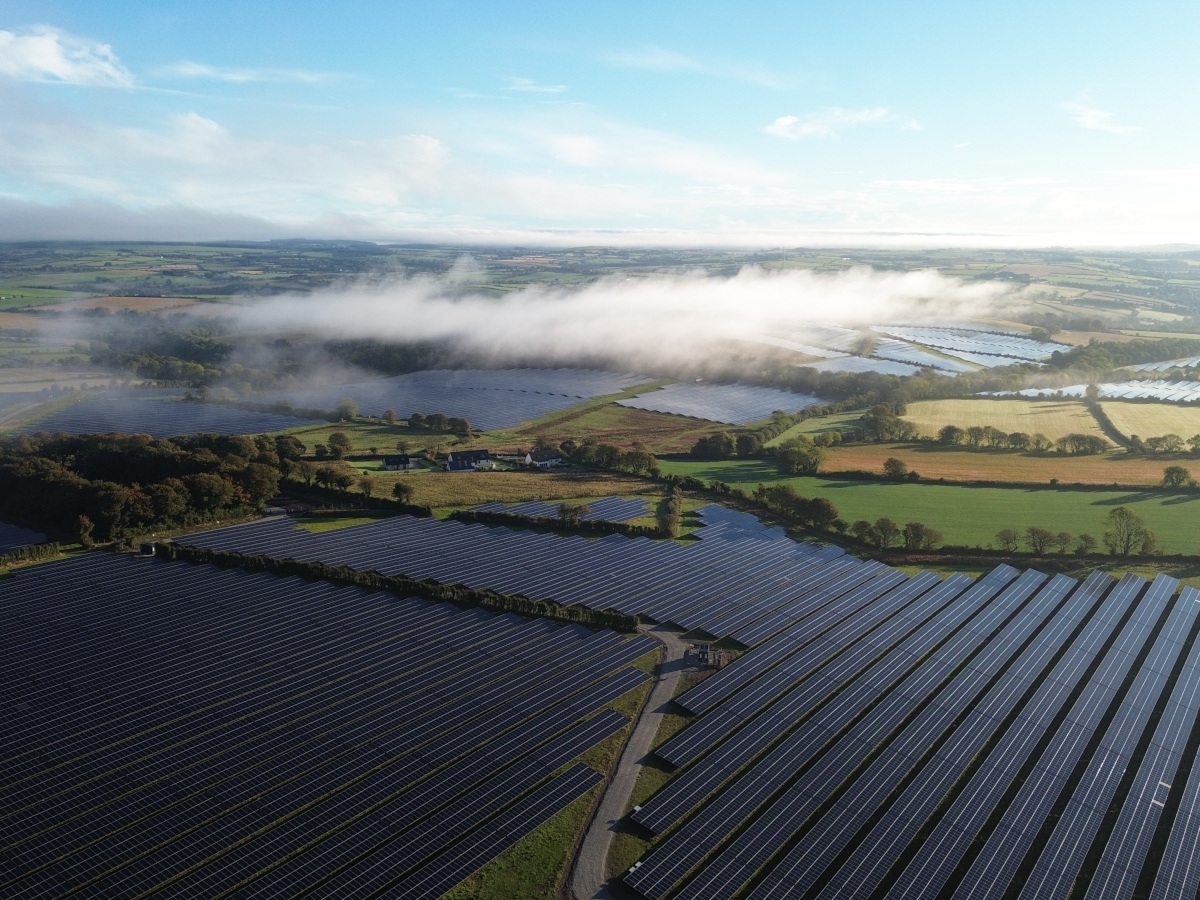
The European Investment Bank (EIB) will support the construction and operation of four new utility-scale solar photovoltaic projects across Ireland via a €100m project finance loan to Dolmen Solar Ltd, a holding company of Power Capital Renewable Energy.
The overall investment – which, in total, will be worth €260m – will see four new solar power operations developed in Clare, Wicklow, Wexford and Tipperary, generating around 367GWh of clean electricity per annum, which is equivalent to the annual consumption of roughly 79,900 households. The funding and development is also expected to create new jobs in construction, civil works, grid connections and maintenance services.
The scheme is among the largest single solar investments financed in Ireland to date and could contribute significantly to Ireland’s target of 80pc renewable electricity by 2030, as well as see out the national ambition for roughly 8GW of installed solar capacity under the Renewable Electricity Support Scheme.
Advertisement
Ballinaclough, Co Wicklow will host a 15.5MWp solar farm, with construction expected to start this month. Tullabeg, Co Wexford will be home to the largest scheme in the portfolio – a 181.6MWp plant – and construction is planned from April.
In Tipperary, Barnaleen-Cauteen will be the site of a 98MWp farm, and construction is expected to begin this month. Lastly, in Clare, Manusmore near Ennis is earmarked for a 99.5MWp plant, with construction also expected to commence in March.
Work on some of the projects will run into 2028.
Commenting on the investment, the Minister for Climate, Energy and the Environment Darragh O’Brien, TD said: “Ireland is sometimes seen as an unlikely home for solar power, but projects like this show how quickly that perception is changing and how strong the investor appetite now is for Irish renewables.
Advertisement
“This is a very welcome €260m investment, spread across Clare, Tipperary, Wicklow and Wexford, which will boost clean electricity generation right across the country, reduce our reliance on imported energy and support delivery of our 2030 climate targets. The European Investment Bank is playing a key role as a long‑term partner for Ireland’s energy transition”.
The EIB vice-president Ioannis Tsakiris added: “By backing Ireland’s first solar project financed on a pure project finance basis, the EIB is helping to unlock almost 400MW of new renewable capacity that will strengthen Ireland’s energy security and cut greenhouse gas emissions.”
In February of this year, SunArc, a renewable energy company based in Carlow, announced plans to create up to 50 new jobs as a result of a €20m investment into the organisation. The company offers a ‘solar-as-a-service’ model which it said is a significant step towards accelerating Ireland’s transition to clean energy.
SunArc has stated that the solar-as-a-service model will enable businesses to access solar power and energy independence with no upfront costs, removing what it believes to be one of the biggest barriers to solar power adoption.
Advertisement
Don’t miss out on the knowledge you need to succeed. Sign up for the Daily Brief, Silicon Republic’s digest of need-to-know sci-tech news.
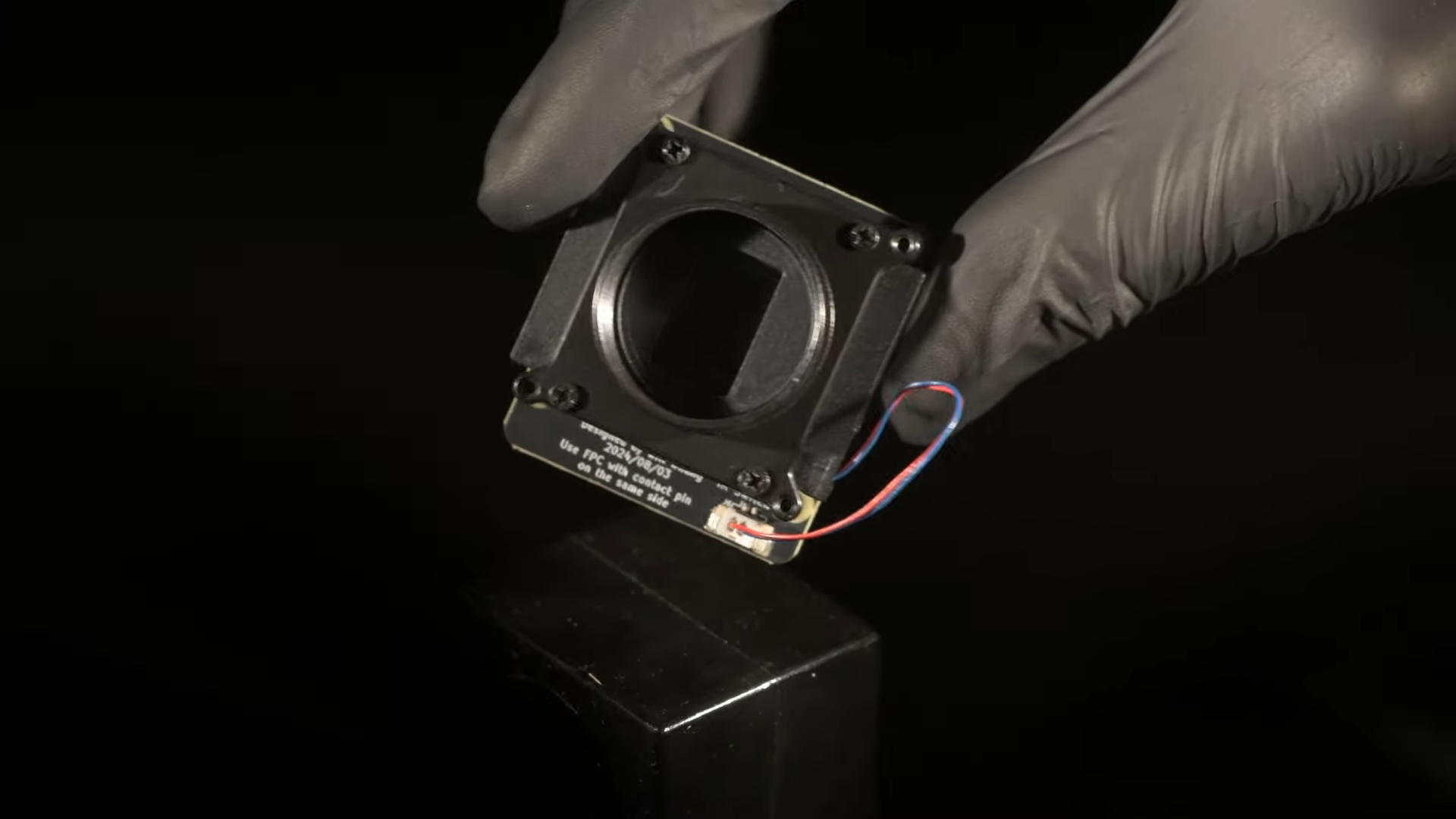
The Raspberry Pi line of single-board computers can be hooked up with a wide range of compatible cameras. There are a number of first party options, but you don’t have to stick with those—there are other sensors out there with interesting capabilities, too. [Collimated Beard] has been exploring the use of the IMX585 camera sensor, exploiting its abilities to capture HDR content on the Raspberry Pi.
The IMX585 sensor from Sony is a neat part, capable of shooting at up to 3840 x 2160 resolution (4K) in high-dynamic range if so desired. Camera boards with this sensor that suit the Raspberry Pi aren’t that easy to find, but there are designs out there that you can look up if you really want one. There are also some tricks you’ll have to do to get this part working on the platform. As [Collimated Beard] explains, in the HDR modes, a lot of the standard white balance and image control algorithms don’t work, and image preview can be unusable at times due to the vagaries of the IMX585’s data format. You’ll also need to jump some hurdles with the Video4Linux2 tools to enable the full functionality of these modes.
Do all that, recompile the kernel with some tweaks and the right drivers, though, and you’ll finally be able to capture in 16-bit HDR modes. Oh, and don’t forget—you’ll need to find a way deal with the weird RAW video files this setup generates. It’s a lot of work, but that’s the price of entry to work with this sensor right now. If it helps convince you, the sample shots shared by [Collimated Beard] are pretty good.
Humanoid robotics is advancing rapidly, yet engineers continue to face formidable barriers in locomotion stability, real-time perception, safe human interaction, and power-constrained hardware design. As the industry approaches a projected shift from small-scale prototyping to mass commercialisation in the late 2020s, understanding the component-level decisions that affect system reliability, cost, and performance is becoming critical. This guide examines the technical landscape across sensing, motion, control, and battery subsystems — outlining the design trade-offs, modular architecture trends, and supply chain considerations that will shape the next generation of deployable humanoid platforms.
A North Carolina man was found guilty of extorting a D.C.-based technology company while still being employed as a data analyst contractor.
While a Justice Department press release published on Thursday doesn’t name the victim, court documents reveal that he targeted Brightly Software, a Software-as-a-Service (SaaS) company previously known as SchoolDude, which Siemens acquired in August 2022.
Brightly has been in business for more than 20 years, employs over 700 people, and provides intelligent asset management and maintenance software to over 12,000 clients worldwide, mainly in the United States, Canada, the United Kingdom, and Australia.
As revealed in the indictment, 27-year-old Cameron Curry (also known as “Loot”) took advantage of his access to Brightly’s payroll information and corporate data to steal sensitive documents, which he used as leverage in an extortion scheme after learning that his six-month contract wouldn’t be extended.
Advertisement
One day after his contract ended on December 10, Curry began sending over 60 extortion emails to Brightly employees using the lootsoftware@outlook.com Microsoft email address and the Loot alias, threatening to leak sensitive information stolen between August and December 2023 unless he was paid a $2.5 million ransom.
With the extortion messages, Curry also attached screenshots of spreadsheets listing the personal identification information (PII) of Brightly employees, including names, dates of birth, home addresses, and compensation information. He also threatened to report the company to the U.S. Securities and Exchange Commission (SEC) for failing to disclose the breach as required by law.
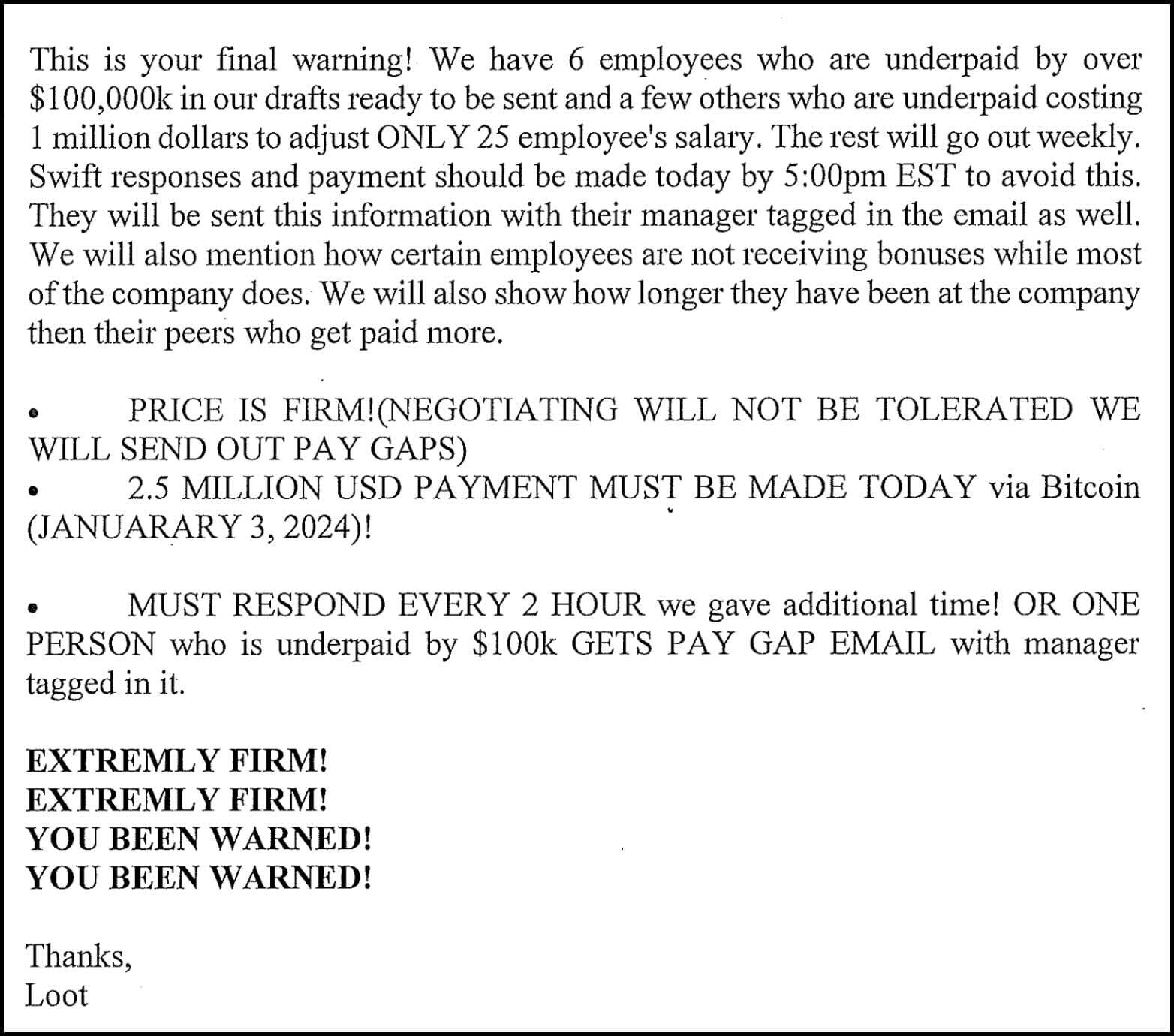
“We will commence the process of disseminating salary information starting January 1,2024 in phases to all employees and will report you to the SEC after for not reporting the breach,” Curry threatened in one of the extortion emails.
“If you wish to reclaim your data, we recommend doing so promptly at 2.5 million USD in order to save your company and stocks, as each subsequent month will incur a $100,000 USD increase. Discrepancies in your books are currently over 16 million USD, posing a potential risk for retention issues, a hostile work environment, resentment, and more.”
Advertisement
Extortion email sample (Justice Department)
Following Curry’s numerous extortion emails, Brightly paid $7,540 in Bitcoin, which was transferred to a cryptocurrency wallet controlled by Curry.
The FBI searched Curry’s residence on January 24 after the company reported the incident and seized various electronic devices containing evidence of his extortion scheme.
Curry was released on bond in January 2024 and now faces up to 12 years in prison for six counts of transmitting or willfully causing interstate communications with the intent to extort a victim company.
Brightly also notified customers of a data breach unrelated to this case in May 2023 after attackers gained access to the database of its SchoolDude online platform and stole credentials and personal data (including names, email addresses, account passwords, phone numbers).
Information filed with the Office of the Maine Attorney General revealed that the intrusion was discovered 8 days after the attackers breached Brightly’s systems on April 20, and that the data breach affected nearly 3 million SchoolDude customers and users.
Advertisement
Malware is getting smarter. The Red Report 2026 reveals how new threats use math to detect sandboxes and hide in plain sight.
Download our analysis of 1.1 million malicious samples to uncover the top 10 techniques and see if your security stack is blinded.





















































You must be logged in to post a comment Login