HANOI, Vietnam (AP) — The war in Iran is exposing the world’s reliance on fragile fossil fuel routes, lending urgency to calls for hastening the shift to renewable energy.
Asia, where most of the oil was headed, has been hit hardest, but the disruptions also are a strain for Europe, where policymakers are looking for ways to cut energy demand, and for Africa, which is bracing for rising fuel costs and inflation.
Unlike during previous oil shocks, renewable power is now competitive with fossil fuels in many places. More than 90% of new renewable power projects worldwide in 2024 were cheaper than fossil-fuel alternatives, according to the International Renewable Energy Agency.
Advertisement
Oil is used in many industries beyond generating electricity, such as fertilizer and plastics production. So most countries are feeling the impact, while those with more renewable power are more insulated since renewables rely on domestic resources like sun and wind, not imported fuels.
“These crises regularly occur,” said James Bowen of the Australia-based consultancy, ReMap Research. “They are a feature, not a bug, of a fossil fuel-based energy system.”
China and India built renewable buffers, but China’s is larger
Advertisement
A worker stacks single solar cells at a ReNew manufacturing plant on the outskirts of Jaipur, India, Thursday, Aug. 21, 2025. (AP Photo/Manish Swarup, File)
Advertisement
A worker stacks single solar cells at a ReNew manufacturing plant on the outskirts of Jaipur, India, Thursday, Aug. 21, 2025. (AP Photo/Manish Swarup, File)
Advertisement
Advertisement
China and India, the world’s two most populous countries, face the same challenge of generating enough electricity to power growth for over a billion people. Both have expanded renewable energy, but China did so on a far larger scale despite its continued reliance on coal-fired power.
Today China leads the world in renewables. About one in 10 cars in China are electric, found the International Energy Agency. It’s still the world’s largest importer of crude oil and the biggest buyer of Iranian oil. But electrifying parts of its economy with renewables has reduced its reliance on imports.
Advertisement
Attendees look at the electric Han EV sedan from Chinese automaker BYD during the Auto Shanghai 2023 show in Shanghai, Wednesday, April 19, 2023. (AP Photo/Ng Han Guan)
Advertisement
Attendees look at the electric Han EV sedan from Chinese automaker BYD during the Auto Shanghai 2023 show in Shanghai, Wednesday, April 19, 2023. (AP Photo/Ng Han Guan)
Advertisement
Advertisement
Advertisement
Without that shift, China would be “far more vulnerable to supply and price shocks,” said Lauri Myllyvirta of the Centre for Research on Energy and Clean Air. China also can rely on reserves built when prices were low and shift between using coal and oil as fuel in factories, he said.
Advertisement
India also has expanded its use of clean energy, especially solar power, but more slowly and with less government support for manufacturing renewable energy equipment and connecting solar to its power grid.
After Russia’s invasion of Ukraine in 2022, India prioritized energy security by buying discounted Russian oil and boosting coal production. It also ramped up solar and wind, helping to cushion supply disruptions but not avoid them entirely, said Duttatreya Das of the think tank Ember.
“Everyone cannot be China,” Das said.
India is now facing a shortage of cooking gas. That’s driving a rush to buy induction cooktops and raising fears of restaurant shutdowns. Fertilizers and ceramics industries may also be hit.
Advertisement
A cook at a restaurant prepares food over a charcoal stove following a shortage of liquefied petroleum gas in Mumbai, India, Wednesday, March 11, 2026. (AP Photo/Rafiq Maqbool)
Advertisement
A cook at a restaurant prepares food over a charcoal stove following a shortage of liquefied petroleum gas in Mumbai, India, Wednesday, March 11, 2026. (AP Photo/Rafiq Maqbool)
Advertisement
Advertisement
Advertisement
Rich countries fallback on fossil fuels
The energy shock is familiar to wealthy countries in Europe and East Asia.
Advertisement
In 2022, some European governments tried to cut dependence on fossil fuels. But many soon focused on finding new fossil fuel suppliers instead, said Pauline Heinrichs, who studies climate and energy at King’s College London.
Germany rushed to build LNG terminals to replace Russian gas with mostly American fuel while the energy transition, including efforts to cut demand, slowed, she said.
Europe’s excess spending on fossil fuels since the Russia-Ukraine War amounted to about 40% of the investment needed to transition its power system to clean energy, according to a 2023 study.
“In Europe, we learned the wrong lesson,” Heinrichs said.
Advertisement
The coal-fired power plant Uniper Scholven and a nearby BP refinery shine in the evening behind illuminated appartments in Gelsenkirchen, Germany, Monday, Oct. 2, 2023. (AP Photo/Martin Meissner, File)
Advertisement
The coal-fired power plant Uniper Scholven and a nearby BP refinery shine in the evening behind illuminated appartments in Gelsenkirchen, Germany, Monday, Oct. 2, 2023. (AP Photo/Martin Meissner, File)
Advertisement
Advertisement
Advertisement
In import-dependent Japan, policy responses to past shocks have focused on diversifying fossil fuel imports rather than investing in domestic renewables, said Ayumi Fukakusa of Friends of the Earth Japan.
Advertisement
Solar and wind make up just 11% of Japan’s energy production, on a par with India but behind China’s 18%, according to Ember. Japan’s energy use is much lower than both nations.
The Iran war led the agenda during Japanese Prime Minister Sanae Takaichi ‘s meeting this week with U.S. President Donald Trump. Trump, who has long urged Japan to buy more American LNG, recently called on allied nations like Japan to “step up” in assisting secure The Strait of Hormuz.
South Korean President Lee Jae-myung said the crisis could be “a good opportunity” to shift faster to renewable energy.
Poor countries are the most exposed
Poorer nations in Asia and Africa are competing with wealthy European and Asian countries and big buyers like India and China for limited gas supplies, pushing up prices.
Advertisement
Import-dependent economies — such as Benin and Zambia in Africa and Bangladesh and Thailand in Asia — could face some of the biggest shocks. Costly fuel makes transport and food more expensive, and many countries have limited foreign-exchange reserves, restricting their ability to pay for imports if prices stay high.
Africa may be especially exposed because many countries rely on imported oil to run their transport and supply chains.
It makes strategic sense for African countries to build their long-term energy security by investing in cleaner energy, said Kennedy Mbeva, a research associate at the Centre for the Study of Existential Risk at the University of Cambridge.
Advertisement
Women push wheelbarrows on a coal mine dump at the coal-powered Duvha power station, near Emalahleni east of Johannesburg, Nov. 17, 2022. (AP Photo/Denis Farrell, File)
Women push wheelbarrows on a coal mine dump at the coal-powered Duvha power station, near Emalahleni east of Johannesburg, Nov. 17, 2022. (AP Photo/Denis Farrell, File)
Advertisement
Advertisement
Advertisement
A shepherd watches livestock near Khi Solar One, a solar thermal plant that converts the sun’s light energy into electricity, outside Upington, South Africa, in the Northern Cape province, Friday, Aug. 29, 2025. (AP Photo/Themba Hadebe)
A shepherd watches livestock near Khi Solar One, a solar thermal plant that converts the sun’s light energy into electricity, outside Upington, South Africa, in the Northern Cape province, Friday, Aug. 29, 2025. (AP Photo/Themba Hadebe)
Advertisement
Advertisement
Advertisement
But not all are opting for renewables: South Africa is considering building an LNG import terminal and new gas-fired power plants.
The real challenge is not just to withstand the next shock, but to ensure it doesn’t “derail the country’s development trajectory,” said Hanan Hassen, an analyst at Ethiopia’s government-linked think tank, the Institute of Foreign Affairs.
Advertisement
Renewables provide a cushion for some
Workers travel in a vehicle toward the construction site of Adani Green Energy Limited’s Renewable Energy Park in the salt desert of Karim Shahi village, near Khavda, Bhuj district near the India-Pakistan border in the western state of Gujarat, India, on Sept. 21, 2023. (AP Photo/Rafiq Maqbool, File)
Advertisement
Workers travel in a vehicle toward the construction site of Adani Green Energy Limited’s Renewable Energy Park in the salt desert of Karim Shahi village, near Khavda, Bhuj district near the India-Pakistan border in the western state of Gujarat, India, on Sept. 21, 2023. (AP Photo/Rafiq Maqbool, File)
Advertisement
Advertisement
Advertisement
Increased use of renewable energy has helped shield some Asian countries from the energy shock.
Advertisement
Pakistan’s solar boom has preempted more than $12 billion in fossil fuel imports since 2020 and could save another $6.3 billion in 2026 at current prices, according to think tanks Renewables First and the Centre for Research on Energy and Clean Air.
Vietnam’s current solar generation will help the country save hundreds of millions of dollars in potential coal and gas imports in the coming year, based on current high prices, according to the research group, Zero Carbon Analytics.
Other countries are stretching tight supplies.
Bangladesh has closed universities to save electricity. It has limited storage capacity to absorb supply shocks, so the government started rationing fuel after a flurry of panic buying at filling stations, said Khondaker Golam Moazzem, an economist with the Centre for Policy Dialogue in Dhaka.
Advertisement
Students leave Dhaka University after the government ordered all universities to close, moving forward the Eid al-Fitr break as part of emergency measures to conserve electricity, in Dhaka, Bangladesh, Monday, March 9, 2026. (AP Photo/Mahmud Hossain Opu)
Advertisement
Students leave Dhaka University after the government ordered all universities to close, moving forward the Eid al-Fitr break as part of emergency measures to conserve electricity, in Dhaka, Bangladesh, Monday, March 9, 2026. (AP Photo/Mahmud Hossain Opu)
Advertisement
Advertisement
Advertisement
For now, governments must just manage shortages and control prices. Thailand has suspended petroleum exports, boosted its gas production and begun drawing on reserves.
Advertisement
If the conflict bleeds into April, Thailand’s finite reserves and limited budget for subsidies mean prices will shoot higher, warned Areeporn Asawinpongphan, a research fellow with the Thailand Development Research Institute.
“The time for promoting domestic renewables should have happened a long time ago,” Asawinpongphan said.
___
Delgado reported from Bangkok, Thailand, and Olingo reported from Nairobi, Kenya.
Advertisement
___
The Associated Press’ climate and environmental coverage receives financial support from multiple private foundations. The AP is solely responsible for all content. Find AP’s standards for working with philanthropies, a list of supporters and funded coverage areas at AP.org.
Jesy’s daugthers Ocean Jade and Story Monroe Nelson-Foster were diagnosed with the severe muscular disease SMA1
Jesy Nelson has said that ‘it’s really sad’ as the Little Mix singer provided an emotional health update about her twin daughters.
Advertisement
Jesy gave birth to twins Ocean Jade and Story Monroe Nelson-Foster prematurely in May last year with fiancé Zion Foster. She announced in January that her daughters have been diagnosed with the severe muscular disease SMA1 (spinal muscular atrophy).
Get MEN Premium now for just £1 HERE – or get involved in our WhatsApp group by clicking HERE. And don’t miss out on our brilliant selection of newsletters HERE.
The 34-year-old has since begun campaigning to get screening for the condition added to the newborn heel prick test and has been raising awareness about the condition. According to the NHS website, the test is offered to every baby at five days old.
It involves taking a blood sample to find out if it has one of nine rare but serious health conditions. Scotland has announced it will start screening babies for SMA from the spring, but the test is not currently available for newborns elsewhere in the UK.
Advertisement
Providing frequent updates about her daughters ever since sharing their diagnosis, Jesy returned to Instagram on Thursday (March 20). Posting a video, Jesy said that they will be using leg splints to flatten out their ‘pointed’ feet.
Speaking to her 9.7 million followers on the social media app, Jesy admitted that she’s ‘really sad’ that Ocean and Story need the splits. Additionally, she feels that it’s another ‘reminder’ of their health struggles.
She told her followers that she was ‘sad’ to see her babies would need the splints, as it was another ‘reminder’ of their health struggles they were facing.
Advertisement
Jesy said: “So today, I had to go pick up the girls’ splints because their feet are pointing, and they need to be flattened out. It made me really sad.” Jesy went on to show the leg splints her daughters would be wearing, with Story’s decorated with love hearts while Ocean’s had butterflies on them.
“Have you ever seen anything cuter in your life… Made me sad though, because it’s just another reminder.”
Meanwhile, Jesy revealed in a Q&A last month that she is going to continue filming her Prime Video series as she attempts to ‘make a change’. Jesy Nelson: Life After Little Mix was released on the streaming service last month and brought fans inside her family life.
“I just hope people continue to watch the next part of the journey. When the girls got their diagnosis, we decided that we wanted to continue filming.
Advertisement
“As hard as it was, we were like, ‘You know what? There’s a reason you guys are here, and we’ve got to make the best out of this situation’,” she said.
The singer continued: “I’m sure you guys are aware, like, I’m trying to get it [SMA] made part of the heel prick test. That’s my main goal right now, as well as looking after my beautiful girls.
“I haven’t even seen it back yet, but I already know it’s going to be tough. But I’m just so happy that we’ve been able to document everything, because I really believe that we’re going to make a change. Like, I feel it.
“I love how dedicated people are to spreading awareness about everything that I’ve been through and this [programme] is going to shed even more.”
The increasingly urban lifestyles of seagulls in the UK and around Europe has made them experts at grabbing food from unsuspecting outdoor diners. Herring gulls in particular are gaining a reputation for food theft in seaside towns like Falmouth in Cornwall, where I live.
On a day out at the beach last summer, I watched as one rummaged through an unattended bag and hopped off with a packet of crisps. Sadly, the gull didn’t hang around long enough for me to see whether it successfully opened the packaging.
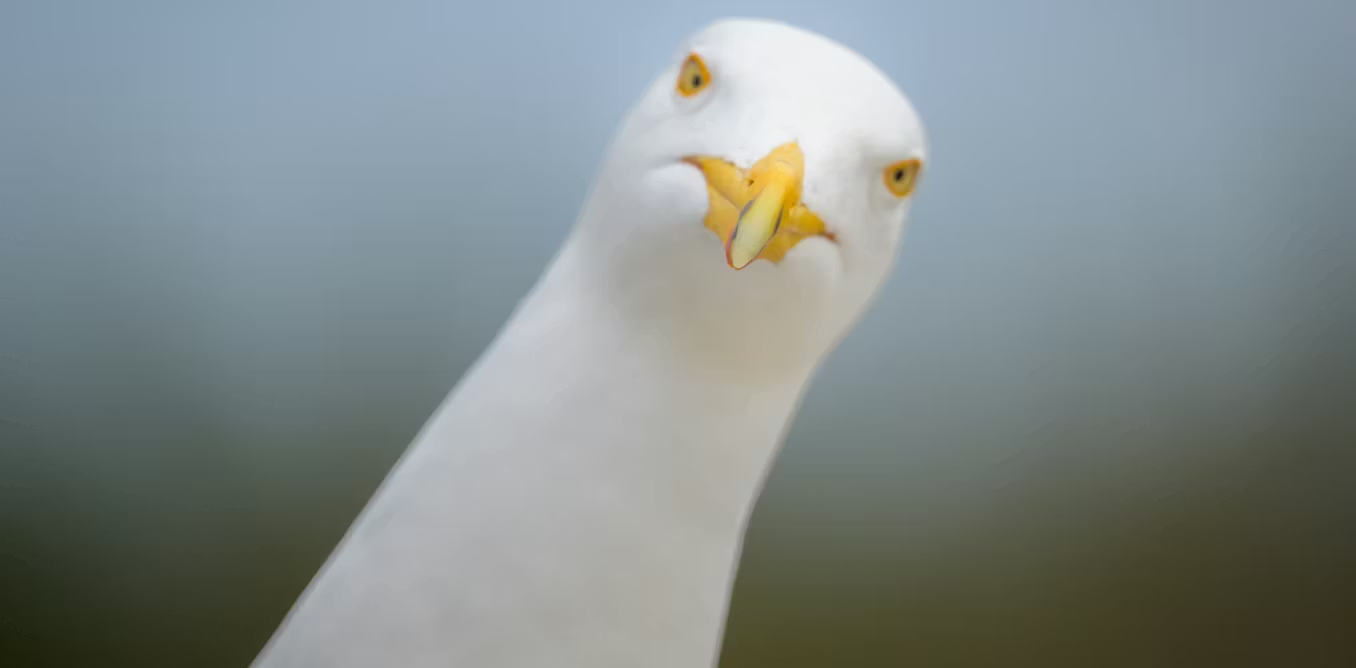
Watching this kind of behaviour led me and my colleague Neeltje Boogert to explore new ways of deterring these resourceful birds. Our new research shows that displaying a pair of eyes on food packaging can be enough to stop some gulls from pinching your food.
This builds on our previous work which showed herring gulls approach food more slowly when someone is looking at them directly, compared with if they are looking away.
Advertisement
Many animals – both wild and domesticated – are very aware of eyes, which can indicate the presence of a predator or be used to communicate intent. Direct eye contact often conveys aggression, while looking away indicates a lack of threat.
Animals generally respond defensively when they see eyes staring at them. This is probably an instinctive tendency, since avoiding being eaten by a predator can be a split-second response.
Some animals may have evolved markings to exploit this behaviour. So-called eyespots are found on many insects, amphibians and fish, and they come in a variety of colour, size and pattern combinations.
Exactly how eyespots might deter predators has been hotly debated by scientists for over a century. They may increase predator wariness by being mistaken for predator eyes, or divert attacks to less important parts of the body.
Advertisement
Given that evolution suggests eyes are a good way of increasing animal wariness, the idea of mimicking nature by using fake eyes to deter other animals has been tried in a variety of settings.
Eyes were painted on the rears of cows in Botswana to put off predators. Communications Biology
In Botswana, livestock are at risk of being eaten by ambush predators such as lions and leopards, which causes conflict with farmers. To test whether eyespots could reduce the risk of predation, experimenters painted pairs of eyes or crosses on the rumps of cattle, or left them unmarked. This was repeated across multiple cattle herds, and any attacks on cattle were recorded.
During the study, 19 cattle were killed by lions or leopards – but none of the cattle with eyespots on their rumps were among them. They were also attacked less than either cattle with crosses or unmarked cattle, suggesting that eyespots can be an effective deterrent for a wide range of animals.
Advertisement
Put off by the eyes
For our study of herring gulls, we tested this idea in coastal towns in Cornwall where gulls are known to take food from people eating outside. We stuck pairs of eyes onto food takeaway boxes and presented individual gulls with a choice of two boxes placed two metres apart on the ground: one box with eyes and one plain box.
Gulls appeared to be put off by the eyes, as they were slower to approach and less likely to peck at these boxes, compared with the ones without eyes.
We also wanted to know whether gulls would, over time, figure out that the eyes on boxes were not really threatening. To test this, we presented 30 gulls with one takeaway box either with or without eyes, but did this three times for each gull over a short amount of time.
Around half the birds never pecked at the box with eyes, whereas the other half quickly approached and pecked. This suggests there could be a sustained effect from the fake eyes for some gulls that do not realise they are being tricked.
Advertisement
We now want to test this in a more realistic setting, by teaming up with food vendors and asking them to use takeaway boxes with eyes on. While this might only ever deter half of gulls from stealing food, perhaps when paired with other deterrents – including shouting – it can have an impact on the amount of food theft.
Eye-like markings have already been used to exclude birds from certain areas, including keeping starlings away from crops, seabirds from fishing nets and raptors from airports.
Video: SciShow Psych.
Humans respond to eyes too
It’s interesting to note that people, like gulls and many other animals, also pay attention to eyes. Images of human eyes have been found to reduce bicycle theft, reinforce honesty, and even increase charitable donations – all by creating the impression of being watched. This is probably because we are a social species, and tend to act more honestly if we feel we might be judged by an onlooker.
Advertisement
But as with herring gulls, the effect on human behaviour is inconsistent. Images of eyes can nudge behaviour in certain situations, but they don’t work on everyone.
Whether protecting chips, bicycles or cattle, the next step is to understand why some animals (and people) do not find eyes aversive. But already, the evidence is clear that fake eyes can offer a cheap, simple way to mitigate conflict with humans and other animals.
The way we watch TV, listen to music, order groceries and take photos has changed in the past decade or so. For many of us, all of these activities involve a monthly payment.
Subscriptions have quietly become a major part of household spending across the world. But many people underestimate how much they actually pay. And there is evidence which suggests that the design of subscription services – combined with common human traits – can make these payments easy to overlook.
In the UK, consumers spend around £26 billion a year subscribing to everything from digital media to cosmetics and coffee. (Around 69% of UK households subscribe to at least one video streaming service such as Netflix or Amazon Prime Video.)
And a few small monthly payments can quickly add up. Data from Barclays bank suggests that individual consumers spend £50.60 on – so more than £600 a year. It also shows that spending on digital content and subscription services has increased by nearly 50% since 2020. In households where several people hold subscriptions, the combined spending can be considerably higher.
Advertisement
The result is a subscription economy that is growing faster than many consumers realise. And one reason households underestimate their spending is that some subscriptions continue running even when people no longer use them.
The UK government estimates that of the 155 million subscriptions currently active in the UK, nearly 10 million are unwanted – at a cost to consumers of £1.6 billion each year.
The charity Citizens Advice has calculated that over £300 million a year is spent on subscriptions that people are not actually using, often because they automatically renewed after a free trial.
In many cases the individual payments are small, which makes them easy to miss in a bank statement.
Advertisement
Behavioural economics offers one explanation. Research shows that people tend to evaluate spending using what’s known as “mental accounting” – the tendency to treat small payments separately instead of thinking about how they add up overall. As a result, people group purchases into categories rather than looking at the total amount leaving their bank account.
A £9.99 streaming subscription or a £4.99 app service may not feel significant on its own. But when several subscriptions accumulate, the combined cost can become substantial.
Another factor is automatic renewal. Many services continue charging unless customers actively cancel. This interacts with what behavioural scientists call “status quo bias”, the tendency to stick with the default option.
When cancelling requires effort or attention, people often postpone the decision and continue paying.
Advertisement
Consumer groups have also raised concerns about so called subscription traps. These occur when people are unintentionally signed up to recurring payments or find it difficult to cancel them.
It has been claimed that more than 20 million adults in the UK have signed up to a subscription without realising it and about 4.7 million people are still paying for one they did not knowingly sign up to.
These cases often involve free trials that automatically convert into paid subscriptions or online sign up processes where the recurring payment is not clearly explained.
The growing scale of the problem has attracted regulatory attention. The UK government has introduced measures aimed at tackling subscription traps, including clearer information about recurring payments and easier cancellation processes. A consultation is now taking place on how these rules will be implemented before they come fully into force.
Unsubscribing is not so simple. Grustock/Shutterstock
The goal is to ensure that consumers understand the financial commitment they are entering when signing up to a subscription service.
The new measures will probably help reduce some accidental subscriptions, particularly those created through unclear sign-up processes or free trials that automatically convert into paid plans. And it seems sensible to make sure that subscription contracts contain clearer information and easier cancellation rights to help consumers avoid unwanted recurring payments.
But behavioural factors such as inertia and automatic renewal mean the problem may not disappear entirely. Even when cancellation is straightforward, consumers often delay reviewing small recurring payments, allowing subscriptions to continue.
Advertisement
For households, digital spending often feels invisible. Subscriptions are typically spread across multiple platforms and paid automatically through bank cards or direct debits. Without a deliberate review of monthly statements, it can be difficult to see how much these payments add up to.
Subscriptions can offer convenience and flexibility. But as the subscription economy continues to grow, it can also quietly increase household spending in ways that many consumers barely notice.
Today marks 10 years since the tragedy that claimed the lives of five people
Today marks 10 years since five people tragically lost their lives when their jeep plunged off a pier after a family day out.
Advertisement
Sean McGrotty, 49, drowned along with his sons Mark, 12, and Evan, eight, his wife Louise James’ 14-year-old sister, Jodie-Lee Daniels, and his wife’s mother, Ruth Daniels, 59 in the tragedy in Buncrana, Co Donegal on this day 10 years ago when their car slid off a pier and sank in Lough Swilly shortly after 7.30pm.
Hero bystander Davitt Walsh quickly stripped down to his boxers and dived into the water, saving four month-old baby girl Rioghnach-Ann who was handed to him by her father. Hero Davitt then swam back to shore with the tot.
The car sank shortly afterwards as it became full of water leading to the five other occupants sadly losing their lives. While coastguard and RNLI crews arrived on the scene within minutes, they were too late, recovering the five bodies from Lough Swilly shortly after.
Advertisement
Mr McGrotty lived with his partner Louise and their children in their family home at St Eithne’s Park in the Ballymagroarty area of Derry. Ruth Daniels lived with her daughter Jodie Lee and her four sons Joshua, Kyle, Nathan and Jonathan at Ederowen, also in Derry.
Heartbroken Louise had returned from a family event in England only to be told that her husband, her two sons, her mother and her sister had all died in the incident.
The tragedy sent shockwaves across Ireland, with tributes pouring in from around the country for the five tragic victims. An inquest held just over a year later recorded a finding of misadventure in Mr McGrotty’s death.
Advertisement
To mark the decade anniversary of the heartbreaking crash, a number of events are being organised in Donegal to celebrate the lives of the five amazing family members who were taken too soon.
The Derry Journal reports that a walk will take place on Sunday, March 22 from Buncrana Play Park to the RNLI station at Ned’s Point, while a Gala Ball will also be held later this year on May 8, the day of Ruth’s birthday. A remembrance mass will also take place on March 20 at 7pm in Holy Family Church, Ballymagroarty.
The walk will begin at 11am this Sunday, and Louise has requested those in attendance wear red or white as a tribute. You can register for the walk here.
When it opens, it’ll offer coaching programmes, including school outreach and inclusive sessions
A much anticipated new padel centre in Peterborough has applied for a licence that will enable it to sell alcohol and offer live entertainment. Smash Haus Padel Ltd is looking to make further use of the Lincoln Road warehouse unit it secured as a sports venue at the end of last year.
Advertisement
In its application to Peterborough City Council on March 10, the company applied for a Premises Licence that would allow it to offer three activities:
‘On sales’ of alcohol from 10am to 10.30pm, Monday to Sunday
Film screenings from 7am to 10.30pm, Monday to Sunday
Indoor sporting events and live & recorded music from 7am to 11pm
Peterborough City Council granted Smash Haus Padel Ltd permission to construct four padel courts within a then empty warehouse at 1184 Lincoln Road on November 4, 2025. When it opens, padel fans will be able to book padel sessions by the hour between 7am and 10pm, Monday to Saturday and between 8am and 9pm on Sundays and Bank Holidays.
In addition, the venue will also offer coaching programmes, including school outreach and inclusive sessions for women and girls, and disability introduction sessions. It is believed the centre – the third padel development to be approved in Peterborough over the past year – will eventually employ four full-time staff members.
Any person wishing to have their say on the issue of Smash Haus Padel Ltd’s Premises Licence application must make their representation to Peterborough City Council at Sand Martin House by April 6, 2026.
Toyota says throughout 2025 the team focused on core values – meeting the customer’s needs and making consistent improvements in operations and behaviours.
Dipash Chauhan, Centre Principal, Vantage Toyota York said: “Awards are amazing, but they’re earned daily. We’ll keep focusing on people first: our customers, our colleagues and developing the next generation of leaders within the business.”
The Ichiban Award (Small Retailer) was won by Vantage Toyota Scarborough.
Advertisement
Peter Stableford, Centre Principal for the Centre said: “It was great when we found out we had won the Ichiban Award. We always try to do the basics right and put customers at the heart of everything we do. We never set our goal out to be number one in the BRIT awards, we just do our best every day and the results then follow.”
The Vantage Motor Group (North Yorkshire CDA) also won Best Toyota CDA.
The blaze at Tenants March, just outside West Calder, took hold at around 8pm on March 18.
Residents of a sleepy West Lothian street were forced into action after a gang of youths reportedly started a fire in a field opposite their homes.
Advertisement
The blaze at Tenants March, just outside West Calder, took hold at around 8pm on March 18.
A local claims around eight teens dressed all in black are said to have set alight grass next to a wooden fence bordering a lane running from the road into the village, before fleeing and worrying sheep in another field.
The Scottish Fire and Rescue Service were called by a passing motorist. One local explained how he and his neighbour had to act quickly to control the flames before crews arrived.
He told Edinburgh Live: “I was more worried about it spreading down the lane . It was grass that they had lit and it was travelling quickly along the fence line and causing further fire in the opposite hedge. It could easily have spread.
“The kids were also in fields at back of my house same ones chasing and shouting at the sheep which are all in lamb just now.”
Pictures from the scene show the flames roaring around wooden fence posts, and the charred state of the grass on Thursday morning.
Police Scotland have confirmed nobody was injured, but enquiries are underway.
Advertisement
The resident also shared his concerns about other incidents involving youths in the village, including riding motorbikes and e-bikes in farmers’ fields.
He added: “I get it young people do make mistakes but they also need to be held responsible for their actions. And parents need to try their best to be aware of what their children are doing and not ignore concerning behaviour like this.”
A Scottish Fire and Rescue Service spokesperson said: “We were alerted at 8.10pm on Wednesday, March 18, to reports of a fire in the open at Tenants March, West Calder, West Lothian.
Advertisement
“Operations Control mobilised one appliance to the scene and firefighters extinguished a hedge fire. Crews left the scene at 8.24pm once ensuring the area was made safe.”
A Police Scotland spokesperson said: “We were made aware of a fire on Tenants March, West Calder, around 8pm on Wednesday, March 18.
“There were no reports of any injuries and enquiries are at an early stage.”
Utility Meters Warehouse Ltd, based in Manchester, launched back in March 2013 and is “the UK’s Premier One-Stop Solution Company for Gas Pressure Control & Measurement Equipment”.
The company deals with gas pressure regulators, gas meter modules, and gas volume converters.
The Utility Meters Warehouse Ltd website adds: “Our mission as the UK’s Premier One-Stop Solution Company for Gas Pressure Control & Measurement Equipment is to make a significant contribution to the reduction in consumption of natural gas by technically advancing gas control methodologies and the adoption of the same across the Utilities Industry.”
Advertisement
British gas company enters administration
After 13 years, Utility Meters Warehouse Ltd is now at risk of closing.
Michael Lennon and Mark Blackman from KR8 Advisory Limited were appointed joint administrators on March 12 and will now manage the company’s affairs.
What happens when a company goes into administration?
Put simply, when a company enters administration, it means that it is unable to pay expenses, debts, or other liabilities, according to SquareUp.com.
Advertisement
Companies House adds: “When a company goes into administration, they have entered a legal process (under the Insolvency Act 1986) with the aim of achieving one of the statutory objectives of an administration. This may be to rescue a viable business that is insolvent due to cashflow problems.
“An appointment of an administrator (a licensed insolvency practitioner) will be made by directors, a creditor or the court to fulfil the administration process.”
A statutory moratorium is put in place once a company enters administration, giving it “breathing space” to allow for financial restructuring plans to be drawn up free from creditor enforcement actions.
Advertisement
A company can continue to trade while in administration, but daily management and control is handed over to the administrators.
Companies House continues: “Within 8 weeks it is the administrators’ role to formulate administration proposals.
“Creditors are then asked to vote by a decision procedure to approve the administrators’ proposals.
“If the administration involves a sale of all or part of the company’s business, the proceeds (after the costs of the procedure) will be distributed to creditors in a statutory order of priority.”
Advertisement
Administration will end automatically after 12 months unless the administrator asks the court or creditors for an extension.
Through administration, a company can be:
Rescued and passed back to the directors
Enter liquidation
Be dissolved
Turbulent start to 2026 for UK high street
It has been a rough start to 2026 for the UK high street, with several retailers entering administration and others announcing widespread store closures.
Major high street retailers, including River Island, Primark, and Poundland, have already been forced to close stores in 2026, while Revolution and BrewDog have shut the doors to 21 and 38 pubs, respectively.
Advertisement
Several other retailers have fallen into administration recently, including:
Meanwhile, four UK travel companies have closed in the opening weeks of 2026:
EcoJet Airlines, billed as “the world’s first Electric Airline”, has also entered liquidation after just three years, resulting in the cancellation of all planned flights.
Tesco also recently revealed plans to cut 380 jobs in stores across the UK, while it’s been reported that Morrisons is looking to sell some of its in-store pharmacies as it continues to cut costs.
It’s not been all bad news for the UK high street, with several major brands announcing new store openings for 2026, including Aldi, M&S, and Superdrug.
Advertisement
Would the closure of Utility Meters Warehouse Ltd impact you? Let us know in the poll above or in the comments below.
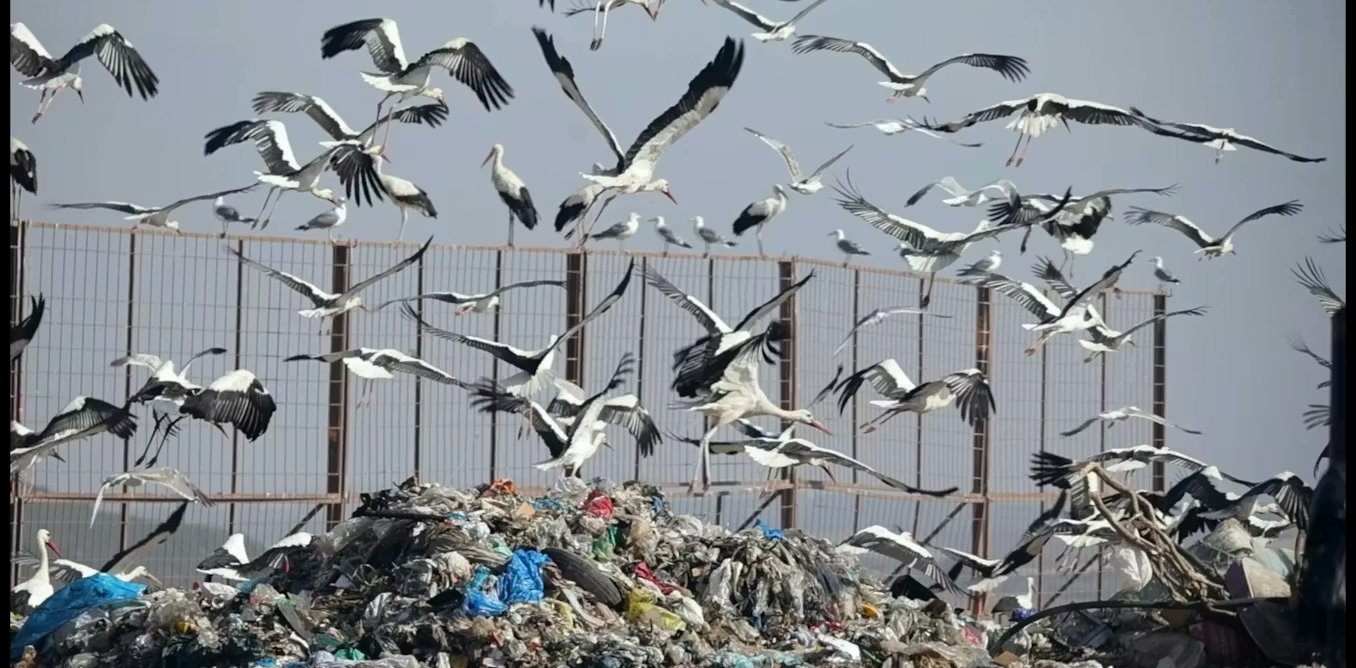
Hungry gulls do not only steal our chips and sandwiches. They learn our habits, and look for reliable sources of food. That includes waste treatment centres, landfill or anywhere food waste is concentrated. Many gull populations have moved inland from the coast to exploit these sources of food.
Wherever our waste is processed, gulls and other birds can forage. At landfills, gulls feed on waste before it is covered up. If there are plastic or glass pieces covered in food that are small enough, gulls will swallow them whole. Only the food itself gets digested, and when the gull flies back to its roost site, the waste gets regurgitated, polluting that site. This movement of pollutants is known as “biovectoring”.
For the first time, scientists like me are now quantifying just how much plastic and other waste is being leaked into important nature areas through the daily movements of birds.
Many lesser black-backed gulls breeding in the UK and other parts of northern Europe migrate to Andalusia in southern Spain, where they form a wintering population of over 100,000 feeding mainly in rice fields and landfills. Fortunately, many of these birds are fitted with GPS tags while breeding. This enables detailed tracking of their movements.
Fuente de Piedra lake in Málaga is a hotspot for migrating lesser black-backed gulls. This wetland has such special natural significance, it’s designated as an internationally important site under a global convention known as Ramsar. It’s most famous for the largest breeding colony of flamingos in Spain. Gulls fly up to 50 miles to landfills to feed, then fly back to roost.
By combining GPS data with waterbird counts, and analyses of regurgitated pellets, scientists have estimated that an average of 400kg of plastics, plus more than two tonnes of other debris such as glass, textiles or ceramics, are deposited by this gull species into the lake each year. This lake has no outflow, making it salty and hence flamingo friendly. Those imported plastics remain in the lake, breaking down into microplastics. They can be ingested by flamingo chicks, aquatic insects and other animals.
Two yellow-legged gulls chase a white stork that is carrying plastic in its bill, which it picked up at a landfill. Enrique García Muñoz (FotoConCiencia), CC BY-NC-ND
In coastal Andalusia, these gulls join the resident yellow-legged gulls (equivalent to our herring gulls) and a mixture of migratory and resident white storks as the three major waterbird visitors to landfills.
In the Cádiz Bay wetlands (another Ramsar site), surrounding the historical city that is now a favourite stop for cruise ships, the three species combine to spread different types and sizes of plastics into different microhabitats. Annually, 530kg of plastics are deposited into wetlands via regurgitated pellets. Although a stork is bigger, so transports more waste per bird, most of the plastic is again moved by the lesser black-backed gulls that winter there in larger numbers.
Plastic film regurgitated by a gull roosting in a field in Atherton, Greater Manchester. Kane Brides, CC BY-NC-ND
This waste ingestion has strong effects on the birds themselves, through direct mortality from diseases, choking or becoming entangled with plastics, and toxic effects of the additives within them. Then after regurgitation in pellets, those plastics are a threat to all fauna and readily enter our food supply through aquaculture and table salt production, both important in Cádiz Bay.
These studies in Spain address a problem that is ongoing all over Europe. There are no comparable quantitative studies yet in the UK, but similar problems occur wherever gulls concentrate to feed on our waste. If white storks become abundant in the UK future, they will probably visit our landfills, together with gulls and perhaps cattle egrets.
The sealing of many landfills, and improvements in waste management may have contributed to recent declines in many gull populations in the UK and elsewhere. But these problems of plastic leakage will continue so long as our consumer society generates so much waste. Reducing waste, and reusing things is better than recycling, partly because food containers may get eaten by birds before they can be recycled. Cleaning our food containers before we bin them, and composting our own food waste, can also help to reduce this phenomenon.
It’s understood the young man, who was aged in his 30s, was working on a roof at the farm
Tributes have been paid to a young man who died in a tragic farm accident.
Advertisement
Emergency services were called to reports of a sudden death on a farm in Co Tyrone on Thursday. The incident occurred in the Drumenny Road area of Cookstown.
The victim, who has been named locally as Richard Wallace, was from the Moneymore area of Co Derry. It’s understood Mr Wallace, who was aged in his 30s, was working on a roof at the farm.
The death is not being treated as suspicious and the Northern Ireland Health and Safety Executive is investigating.
A death notice described Mr Wallace as the ‘precious and much adored youngest son of Stephen and Julie, dearly loved brother of Graeme, much loved grandson of Danny and Elizabeth (Robinson) and the late Sammy and Josie (Wallace) and a cherished nephew and cousin’.
Many tributes have also been paid on social media with many remembering him as a true character and gentleman” and “one of the best.”
One heartbroken friend said: “Was an absolute pleasure to call this man my friend for the best part of 20years. From cycling the roads in the summer as cubs to countless nights out, you were always the soul of the party and I have memories il cherish forever. You will be missed greatly. Until we meet again Our boy.”
Advertisement
Another said: “Ballyeglish will never be the same without u buddy! The hardest working and honest lad taken from us to soon. Sleep easy.”
“Great memories in school and the band growing up, always with a smile on his face! Thinking of the family at this heartbreaking time,” said a third.
Another added: “Such awful news! Such fond memories of school days. Richard was always the class clown, who made everyone laugh! RIP Richard!”
Meanwhile Bruce’s True Blues Accordion Band in Bellaghy said: “Our thoughts are with Stephen, Julie and Graeme following the tragic death earlier today of Richard.
Advertisement
“A dedicated bandsman, Richard in his youth was a member of Ballymoughan Purple Guards Magherafelt, following his Dad & brother, although as a drummer not a fluter like them. In more recent years he drummed with Dunamoney Flute Band and we also think of his band families in both bands.
“We also have in our thoughts the wider Robinson & Wallace family circle, especially his grandparents Danny & Elizabeth Robinson & Aunts & Uncles Amanda (David), Glenn (Kathryn), Susan (Melvyn) and their families.”
Desertmartin Accordion Band added: “As a band we wish to pass on our condolences to Stephen, Julie, and Graeme on the tragic passing of Richard. Trying to process how and why a young lad was tragically killed is very difficult for any of us, never mind the family.
“We pray for God’s grace for the family and fellow band members to get through this. None of us know the hour.”
Advertisement
A PSNI spokesperson said: “Police and other emergency services attended a sudden death in the Drumenny Road area of Cookstown on Thursday morning, March 19.
“The death is not being treated as suspicious and the Health and Safety Executive has been informed.”



















































You must be logged in to post a comment Login