
Crypto World
Super Micro co-founder’s arrest in alleged $2.5B AI chip-smuggling case

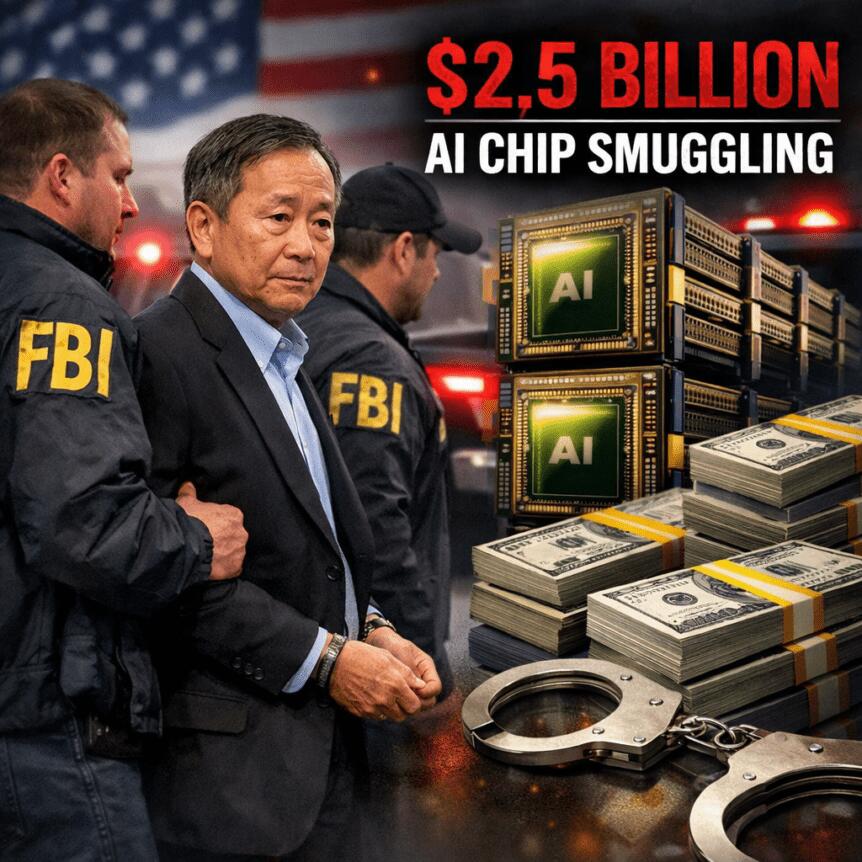
The U.S. Justice Department has unsealed an indictment charging Yih-Shyan “Wally” Liaw, the co-founder of Super Micro Computer, Inc., along with sales executives Ruei-Tsang “Steven” Chang and Ting-Wei “Willy” Sun, in what prosecutors describe as a multi-billion-dollar scheme to route advanced artificial intelligence server hardware to China. Super Micro itself was not charged, and the company says it is cooperating with investigators and distancing itself from the alleged actions.
According to the Justice Department, the defendants conspired to sell billions of dollars’ worth of servers containing sensitive, controlled GPUs to buyers in China, in violation of U.S. export-control laws. The alleged scheme, spanning 2024 and 2025, involved concealing the true nature of the clientele and the shipments, with prosecutors asserting that roughly $2.5 billion in servers were moved to a Chinese company, including about $510 million in sales during April and May 2025 alone.
Federal investigators described a range of concealment techniques, including fabricating documents, staging counterfeit equipment to pass audits, and using a pass-through intermediary to mask the true end customer. The FBI’s New York Field Office linked the scheme to the defendants’ efforts to obscure the sale of high-performance server hardware used in data centers and other critical operations.
“These defendants allegedly fabricated documents, staged bogus equipment to pass audit inventories, and used a pass-through company to conceal their misconduct and true clientele list,” said James Barnacle, Jr., FBI assistant director in charge of the New York Field Office. The defendants will face proceedings in the Northern District of California, with Liaw and Sun already in custody and Chang listed as a fugitive outside the United States.
Key takeaways
- The Justice Department indicted Yih-Shyan Liaw, Ruei-Tsang Chang, and Ting-Wei Sun for alleged export-control violations tied to selling servers with advanced GPUs to China; Super Micro is not charged.
- The alleged scheme spanned 2024–2025, involving about $2.5 billion in server sales, including $510 million in April–May 2025.
- Liaw and Sun have been arrested and are to appear in U.S. court, while Chang remains a fugitive.
- Super Micro publicly distanced itself from the actions, stating they contravene the company’s policies and controls and stressing ongoing cooperation with investigators.
- Trading after the announcement showed immediate market reaction, with Super Micro’s stock falling in after-hours trading by about 13% to around $26.71.
Allegations, scope and the case timeline
At the center of the indictment is a concerted effort to export cutting-edge server technology to China in ways that circumvent U.S. export controls. Prosecutors describe a pattern of misrepresentation and mislabeling designed to obscure the true buyers and destinations of the servers, which included high-end GPUs subject to regulatory restrictions. The government says the defendants blended legitimate sales with false documentation and a network of intermediaries to mask the ultimate customer, enabling billions of dollars in transactions that should have faced heightened scrutiny.
The scope of the alleged activity, as laid out by the DOJ, covers deals executed over a period that extended into 2025, with particular emphasis on shipments and the corresponding audit trails used to validate those shipments. The department’s filing highlights the alleged use of fake inventories and other deceptive practices to facilitate the export of controlled hardware.
Corporate response and investor lens on Super Micro
In a statement shared with Cointelegraph, Super Micro said the defendants’ actions would be treated as a violation of its internal policies and compliance controls. The company asserted that it has not been named as a defendant in the indictment and emphasized its commitment to cooperating with authorities as the case proceeds.
From an investor perspective, the development raises questions about governance, supply-chain compliance, and the risk profile of suppliers involved in high-performance data-center hardware. Super Micro’s public response signals an attempt to isolate the enterprise from the criminal allegations while acknowledging the seriousness of the DOJ’s findings. The firm’s stock reaction underscores the market’s sensitivity to regulatory actions, particularly when a supplier in the high-stakes AI infrastructure space faces potential enforcement risk.
Regulatory backdrop and broader implications for the sector
The charges come amid heightened scrutiny of export controls related to advanced semiconductors, GPUs, and other high-performance components that enable AI workloads. Authorities have increasingly scrutinized how hardware can be channeled to jurisdictions where policy constraints are tight, prompting suppliers to strengthen due-diligence, due-process, and auditing across their distribution networks. The case may serve as a testbed for enforcement approaches and risk management practices among tech manufacturers with global supply chains.
For buyers and partners, the episode underscores the importance of transparent procurement, rigorous compliance testing, and robust record-keeping. It also highlights the reputational and financial exposure companies face when allegations of illicit export practices surface, even if the company itself is not charged.
What comes next for the case and the market
The DOJ’s indictment sets the stage for judicial proceedings in the Northern District of California. Liaw and Sun have been detained and are scheduled for court appearances, while Chang remains at large. As the legal process unfolds, observers will watch for additional charges, potential settlements, and further disclosures about the supply chain arrangements involved in the alleged scheme.
In the near term, investors and industry stakeholders will assess how the case could influence export-control enforcement, supplier risk assessments, and collaboration agreements with major tech players that rely on advanced AI-capable hardware. Market participants will also be watching whether the charges prompt broader due-diligence changes among data-center buyers and integrators who source cutting-edge GPUs and servers.
According to the Justice Department, the investigation reflects the government’s continued vigilance over sensitive technologies and the channels through which they reach restricted markets. As authorities press forward, the industry will need to navigate tighter compliance requirements and the potential for further enforcement actions tied to similar cross-border technology transfers.
Readers should stay tuned for court developments and any additional detail about Chang’s status, as well as updates on how Super Micro and its partners adjust governance practices in response to this high-profile case.

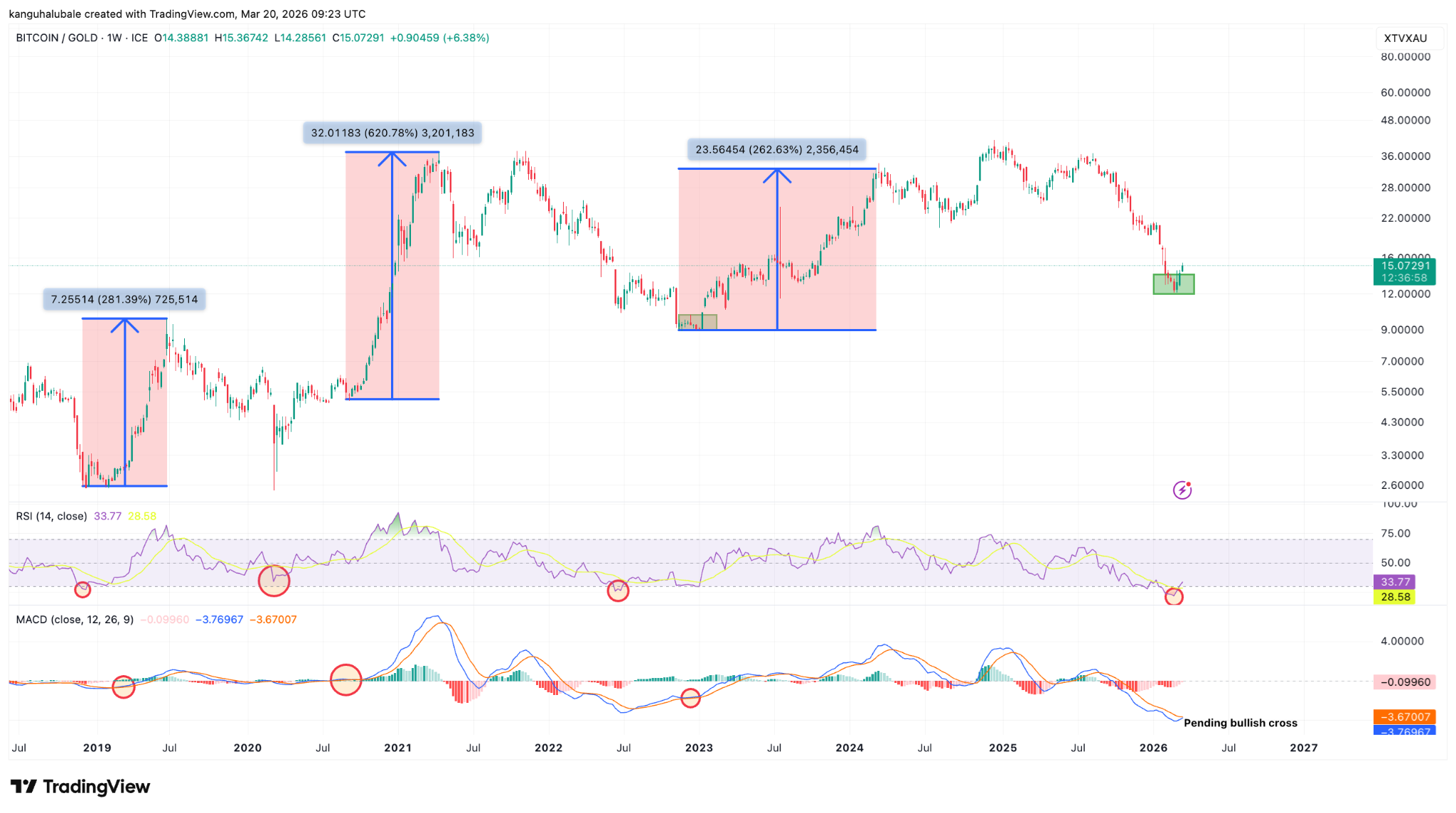
Bitcoin (BTC) has endured a 14-month bear market against gold, with the BTC/gold ratio and momentum indicators at historic lows that previously marked cycle bottoms.
Key takeaways:
-
The BTC/GOLD ratio is at historic lows as multiple indicators hint at a cycle bottom.
-
Bitcoin price must hold $70,000 to avoid a deeper drop over the coming weeks.
BTC/GOLD RSI, MACD print classic reversal signal
Data from TradingView reveals that the relative strength index (RSI) of the BTC/GOLD ratio has begun climbing.
The weekly RSI reached its most oversold level of 21 in mid-February, signaling fading bearish momentum.
Related: Bitcoin tests old 2021 top as gold falls to six-week lows under $4.7K
Similarly, the moving average convergence divergence (MACD) indicator has dropped to its lowest level ever and is about to produce a bullish cross.
Note that previous bullish crosses, particularly coming after the RSI has recovered from oversold conditions, have marked macro bottoms for the ratio.
This ultimately led to 280%-620% Bitcoin price breakout against gold, as seen in 2019, 2021, and 2023.

The RSI has now recovered to 33 from 21 in mid-February. When combined with a buy signal on the MACD, the picture begins to resemble previous cycles.
“Bottom is in for $BTC vs Gold,” technical analyst James Easto said in an X post on Friday, adding that the “stage is set” for Bitcoin’s recovery.
The last time Bitcoin bottomed against gold was in November 2022. It marked the beginning of a 700% BTC price rally to its current all-time high of $126,000.
Analysts at GeoMetric said the past 3 BTC/GOLD bear markets have taken between 12-14 months, with the drawdowns ranging from 75% to 84%.
About 13 months have elapsed in the current cycle, which has “so far gone down 81%, surpassing the 2021 bear market,” the analysts said, adding:
“I think there is a solid case for a potential bottom here.”

Investor and analyst Crypto Fergani echoed both scenarios discussed above saying:
“For over 13 years, we’ve seen the same pattern: Bitcoin enters a bear market against gold that lasts roughly 400 days. During that time, the RSI falls into deeply oversold territory. Historically, these phases have always marked the bottom.”
Bitcoin price must hold above $70,000
Meanwhile, BTC/USD remains cautiously bullish as long as it holds the $68,000-$70,000 support zone. This is where the 200-week exponential moving average (EMA) and 50-day simple moving average sit.
The 200-week EMA forms a key support band for BTC price during bear markets, and analysts warn that its reliability could be tested on Sunday’s weekly close.
Bitcoin analyst AlphaBTC said he had faith that Bitcoin will recover to $80,000 before dropping toward $50,000, as long as the price stayed above the weekly low at $68,800.
“I don’t want to see this week’s low lost, otherwise it’s going to break back down to range lows or lower!”

As Cointelegraph reported, holding $70,000 would align with a previous fractal recovery path, opening a move toward $76,000-$80,000.
This article does not contain investment advice or recommendations. Every investment and trading move involves risk, and readers should conduct their own research when making a decision. While we strive to provide accurate and timely information, Cointelegraph does not guarantee the accuracy, completeness, or reliability of any information in this article. This article may contain forward-looking statements that are subject to risks and uncertainties. Cointelegraph will not be liable for any loss or damage arising from your reliance on this information.
Crypto World
Bitcoin (BTC) price holds steady, with one analyst seeing the upside emerging: Crypto Daybook Americas
By Francisco Rodrigues (All times ET unless indicated otherwise)
Bitcoin has stabilized above $70,000. Its relative strength is noteworthy given the selloff over the week, which saw it drop from over $75,000.
Most assets saw sharp downturns over the period as the conflict in Iran escalated, damaging vital energy infrastructure. A hotter-than-expected February U.S. PPI print compounded the effect.
Traditional havens, including gold and silver, also tumbled while Brent crude surged above $110 a barrel owing to supply disruptions caused by the closure of the Strait of Hormuz.
The Fed didn’t help. While the U.S. central bank held interest rates steady on Wednesday, as expected, its tone turned hawkish. The conflict’s effects have damped rate-cut expectations, and, in fact, the perceived odds of rate increases surge from 8% to top 24% on prediction markets.
André Dragosch, head of research for Europe at Bitwise, told CoinDesk the bitcoin sits at the intersection of two powerful and opposing forces, and that the balance may already be tipping in the token’s favour.
On one side, rising inflation expectations are supportive, Dragosch said. Bitcoin bull runs have historically aligned with expansions in the ISM Manufacturing Index, which rose sharply this year, and rising inflation expectations.
“This combination of rising economic activity and inflation expectations is probably one of the key reasons why bitcoin recently managed to outperform other traditional assets like gold and US equities,” he said. “Bitcoin is also generally less interest rate-sensitive than gold, which is why it wasn’t so much affected by the rise in bond yields. “
On the other hand, tighter financial conditions are a headwind. Bitcoin, however, may have been acting as the canary in what Dragosch called the “macro coal mine.”
“Bitcoin appears to have already priced in much of this tightening, exhibiting a record “macro discount” and front-running the recent deterioration in forward-looking indicators,” Dragosch said.
Looking ahead, a key catalyst will remain improving financial conditions. That means the conflict in the Middle East ending and the Strait of Hormuz reopening, even as developments in the crypto space show growing adoption. Stay alert!
Read more: For analysis of today’s activity in altcoins and derivatives, see Crypto Markets Today
What to Watch
For a more comprehensive list of events this week, see CoinDesk’s “Crypto Week Ahead“.
- Crypto
- Macro
- March 20, 8:30 a.m.: Canada PPI YoY (Prev. 5.4%); MoM (Prev. 2.7%)
- Earnings (Estimates based on FactSet data)
- March 20: BitFuFu (FUFU), pre-market, $0.01
Token Events
For a more comprehensive list of events this week, see CoinDesk’s “Crypto Week Ahead“.
- Governance votes & calls
- Lightchain AI DAO is voting on a temporary 90-day team authority proposal, which grants the core team short-term operational authority to make day-to-day and strategic decisions. Voting ends March 22.
- Unlocks
- March 20: LayerZero (ZRO) to unlock 5.64% of its circulating supply worth $52.45 million.
- Token Launches
Conferences
For a more comprehensive list of events this week, see CoinDesk’s “Crypto Week Ahead“.
Market Movements
- BTC is up 0.29% from 4 p.m. ET Thursday at $70,608.19 (24hrs: +0.69%)
- ETH is down 0.55% at $2,148.07 (24hrs: -1.14%)
- CoinDesk 20 is up 0.34% at 2,044.85 (24hrs: unchanged)
- Ether CESR Composite Staking Rate is up 2 bps at 2.76%
- BTC funding rate is at -0.0020% (-2.1703% annualized) on Binance

- DXY is down 0.38% at 99.70
- Gold futures are up 1.58% at $4,673.60
- Silver futures are up 1.75% at $72.14
- Nikkei 225 closed down 3.38% at 53,372.53
- Hang Seng closed down 0.88% at 25,277.32
- FTSE 100 is down 2.16% at 10,082.61
- Euro Stoxx 50 is down 1.71% at 5,638.54
- DJIA closed on Thursday down 0.44% at 46,021.43
- S&P 500 closed down 0.27% at 6,606.49
- Nasdaq Composite closed down 0.28% at 22,090.69
- S&P/TSX Composite closed down 1.42% at 31,854.98
- S&P 40 Latin America closed up 0.22% at 3,466.80
- U.S. 10-Year Treasury rate is up 2 bps at 4.28%
- E-mini S&P 500 futures are down 0.52% at 6,625.50
- E-mini Nasdaq-100 futures are down 0.68% at 24,412.50
- E-mini Dow Jones Industrial Average Index are down 0.43% at 46,140.00
Bitcoin Stats
- BTC Dominance: 58.90% (0.18%)
- Ether-bitcoin ratio: 0.03043 (-0.49%)
- Hashrate (seven-day moving average): 925 EH/s
- Hashprice (spot): $30.68
- Total fees: 2.95 BTC / $206,875
- CME Futures Open Interest: 117,190 BTC
- BTC priced in gold: 15.2 oz.
- BTC vs gold market cap: 4.72%
Technical Analysis

- BTC/SPX may be showing signs of bottoming out – with RSI bouncing off from oversold levels and the line maintaining its trend.
- The ratio is currently below the 50-week exponential moving average, which implies more range-bound performance until we see a breakout above the average.
Crypto Equities
- Coinbase Global (COIN): closed on Thursday at $202.91 (+0.31%), -0.45% at $201.99 in pre-market
- Circle Internet Group (CRCL): closed at $128.33 (-3.40%), -2.20% at $125.51
- Galaxy Digital (GLXY): closed at $21.05 (-2.46%), -0.71% at $20.90
- MARA Holdings (MARA): closed at $9.22 (+3.36%), -0.33% at $9.19
- Riot Platforms (RIOT): closed at $14.14 (+0.28%), +0.28% at $14.18
- Core Scientific (CORZ): closed at $16.48 (+0.80%)
- CleanSpark (CLSK): closed at $9.83 (-0.51%), -0.31% at $9.80
- Exodus Movement (EXOD): closed at $7.73 (-4.57%)
- CoinShares Bitcoin Mining ETF (WGMI): closed at $39.10 (+0.00%)
- Bullish (BLSH): closed at $39.60 (+3.45%), -0.98% at $39.21
Crypto Treasury Companies
- Strategy (MSTR): closed at $138.24 (-1.65%), +0.54% at $138.99
- Strive Asset Management (ASST): closed at $10.26 (+2.24%), +0.49% at $10.31
- SharpLink (SBET): closed at $7.68 (-2.41%), +1.04% at $7.76
- Upexi (UPXI): closed at $1.07 (+0.00%), +1.87% at $1.09
- Lite Strategy (LITS): closed at $1.17 (-0.85%)
ETF Flows
Spot BTC ETFs
- Daily net flows: -$90.2 million
- Cumulative net flows: $56.26 billion
- Total BTC holdings ~1.29 million
Spot ETH ETFs
- Daily net flows: -$136.4 million
- Cumulative net flows: $11.8 billion
- Total ETH holdings ~5.76 million
Source: Farside Investors
While You Were Sleeping


South Korea’s National Tax Service (NTS) is moving to select a private custody provider for seized crypto assets after a February press release exposed a wallet recovery phrase and triggered the unauthorized transfer of confiscated tokens.
On Feb. 26, the NTS accidentally exposed a crypto wallet seed phrase in an official press release, resulting in the unauthorized transfer of crypto tokens valued at about $4.8 million. The release included an image of a Ledger cold wallet and a sheet of paper showing the mnemonic phrase without being blurred.
Citing people familiar with the matter, ZDNet Korea reported that the agency is reviewing a plan to outsource custody of confiscated crypto and is drafting selection criteria for providers. The NTS is reportedly aiming to select a provider within the first half of 2026.
The agency plans to evaluate candidates based on several factors, including security requirements, company size, and whether the firm holds insurance under South Korea’s Virtual Asset User Protection Act, ZDNet Korea reported.
The move shows South Korean authorities are trying to formalize custody of seized crypto after a series of handling failures exposed weaknesses in how confiscated digital assets are stored and managed.
New task force to oversee custody provider selection process
The custody selection will reportedly be led by a newly-formed task force focused on advancing digital asset management systems.
The task force is reportedly working on several initiatives, including improving operational manuals covering the full life cycle of seized assets, from seizure to storage and liquidation. It would also conduct assessments and personnel training.
Related: South Korea opposition party pushes to scrap planned 22% crypto tax
The group is also preparing to establish a dedicated division to oversee crypto-related work.
An NTS official said that since crypto is relatively new, responsibilities are split across departments. However, preparations are underway to create a centralized unit, ZDNet Korea reported.
NTS wallet seed leak prompts inter-agency probe
The NTS’s wallet leak and a separate custody failure in which Seoul’s Gangnam police allegedly lost 22 BTC seized prompted authorities to conduct an inter-agency review of seized crypto assets.
On March 1, South Korea’s Deputy Prime Minister and Minister of Economy and Finance, Koo Yun-cheol, announced a cross-agency probe on how the government handles seized digital assets.
Magazine: Metaplanet’s Japan Bitcoin bet, Bithumb ordered suspension: Asia Express
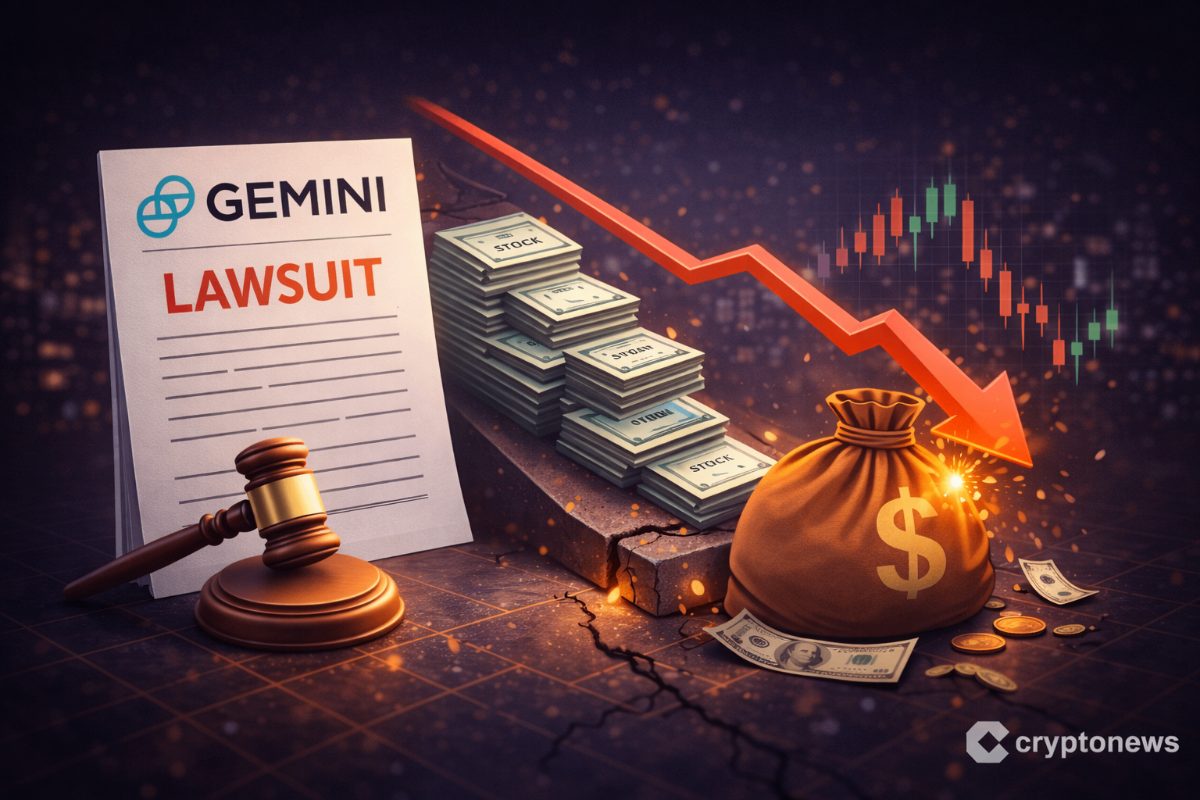

Gemini Crypto is getting sued.
Shareholders filed a class-action in Manhattan federal court claiming the exchange lied to investors during its September IPO.
The target is the company itself and the Winklevoss twins. The allegation is that Gemini raised capital on a growth story, then quietly ditched it for prediction markets and cost-cutting the moment the money was in.
The stock tells the rest of the story. From a post-IPO high of $40 down to around $6. That is an 80% collapse, and now the people who bought in want answers.
- Lawsuit Details: Plaintiff Marc Methvin filed the class-action in Manhattan, accusing Gemini executives of misleading shareholders about the company’s business model.
- Stock Collapse: After pricing its IPO at $28 and touching $40, Gemini shares handled on Nasdaq have plummeted more than 80% to trade near $6.
- Strategic Pivot: The complaint alleges Gemini secretly planned to pivot from its core exchange product to a prediction market model while cutting staff and exiting key regions.
The Mechanics of the Bait-and-Switch Allegation: What the Lawsuit Claims
The lawsuit comes down to one thing: what Gemini told investors and what it actually did.
Gemini listed on the Nasdaq in September at $28. The pitch was global expansion, user growth, and a central exchange built to scale internationally. Shareholders bought in. Then the story changed fast.
By November, executives were still talking up key global markets. By February, the Winklevoss brothers scrapped the entire narrative.
They announced Gemini 2.0, a pivot toward prediction markets, alongside a 25% workforce reduction. Then came the exits. EU, UK, Australia. Every market flagged as a growth opportunity, gone.
The plaintiff argues this was not a reaction to market conditions. It was a planned strategy shift that made the IPO materials misleading from the start.
If internal communications contradict what was in the prospectus, that is a serious problem. Dismissing a misleading disclosure charge is hard when the paper trail works against you.
The regulatory environment does not help Gemini here either. When shareholder litigation runs on securities law, and securities law does not bend for sentiment. This is also a different fight from the Earn program settlement. That was about unregistered securities. This is about whether investors were sold a business model that was already being abandoned.
The pivot to prediction markets trades a large addressable market for a speculative niche. Gemini capped its own ceiling and the stock reflects it.
Discover: The best new crypto in the world
The post Gemini Crypto Sued Over Post-IPO Strategy Shift and Stock Decline appeared first on Cryptonews.
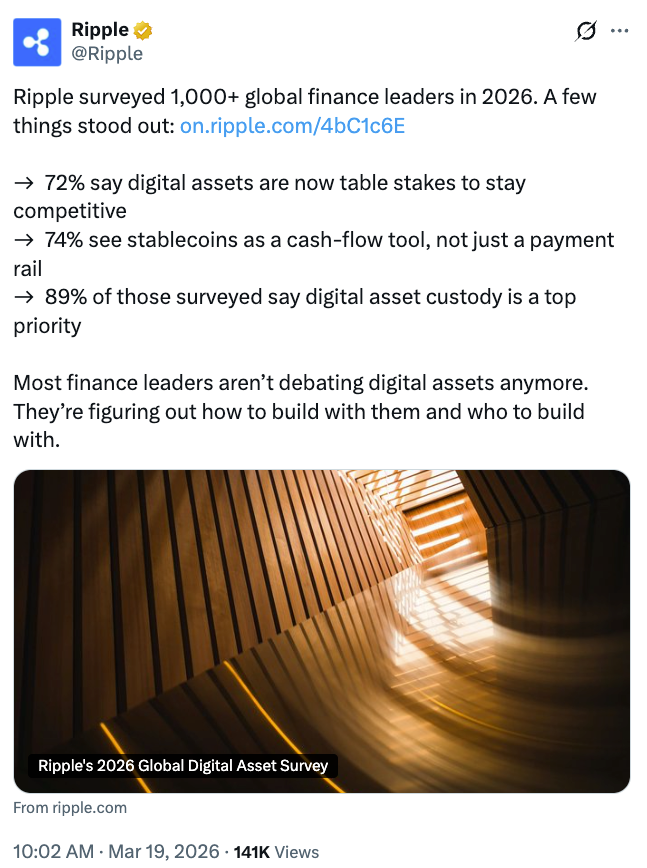
In a survey released on Thursday, Ripple said 72% of more than 1,000 global finance leaders believe companies must offer digital asset solutions to stay competitive.
The survey found stablecoins were the most prominent use case, with 74% of respondents saying they can boost cash flow and unlock trapped capital.
The report polled around 1,000 finance firms globally, including banks, asset managers, fintechs and corporates, on adoption, stablecoins, tokenization and custody priorities.
The findings suggest many financial firms are focusing less on whether to engage with digital assets and more on how to buy, build or partner for the infrastructure needed to support them.
Ripple said the shift toward digital assets is being driven by evolving regulation, growing interest from large banks, increased use of fintech services and the rise of stablecoins.
Stablecoins top the survey’s digital asset use cases
Respondents showed the strongest interest in stablecoins. “That unanimity makes it clear that finance leaders are thinking about stablecoins as more than just a new way to execute payments,” Ripple said, adding that institutions increasingly view them as tools for treasury management.

The survey suggests fintech firms are leading adoption. Around 47% of fintech respondents said they plan to build their own digital asset solutions, compared to 14% of corporates. In contrast, 74% of corporates said they intend to work with external providers.
Banks and asset managers prioritize digital asset custody
The survey showed growing interest in tokenization, with banks and asset managers prioritizing digital asset custody, or secure storage. Some 89% of those evaluating tokenization partners cited secure storage as a top concern, while token lifecycle management and primary distribution ranked at 82% and 80%, respectively.
Bank respondents also indicated strong demand for advisory support, with 85% citing pre-issuance structuring as important, compared to 76% of asset managers.
Related: 74% of institutions expect crypto prices to rise in 12 months: Survey
“This indicates that many institutions are seeking experienced partners to guide implementation alongside technology deployment,” Ripple said.
When choosing infrastructure partners, 97% of respondents highlighted the importance of security certifications such as ISO and SOC II.
The survey underscores that digital assets are no longer optional. “Most finance leaders aren’t debating digital assets anymore,” Ripple said in a post on X, adding: “They’re figuring out how to build with them and who to build with.”
Magazine: Are DeFi devs liable for the illegal activity of others on their platforms?
XRP price rebounded back above $1.45 on Friday after bulls managed to defend the $1.40 support during the market-wide bloodbath over the past day.
Summary
- XRP rebounded above $1.45 after defending $1.40 support, despite broader market weakness driven by geopolitical tensions and risk-off sentiment.
- Whale accumulation of over 200 million XRP and $150 million in institutional holdings signals renewed interest, alongside speculation of a potential XRP treasury.
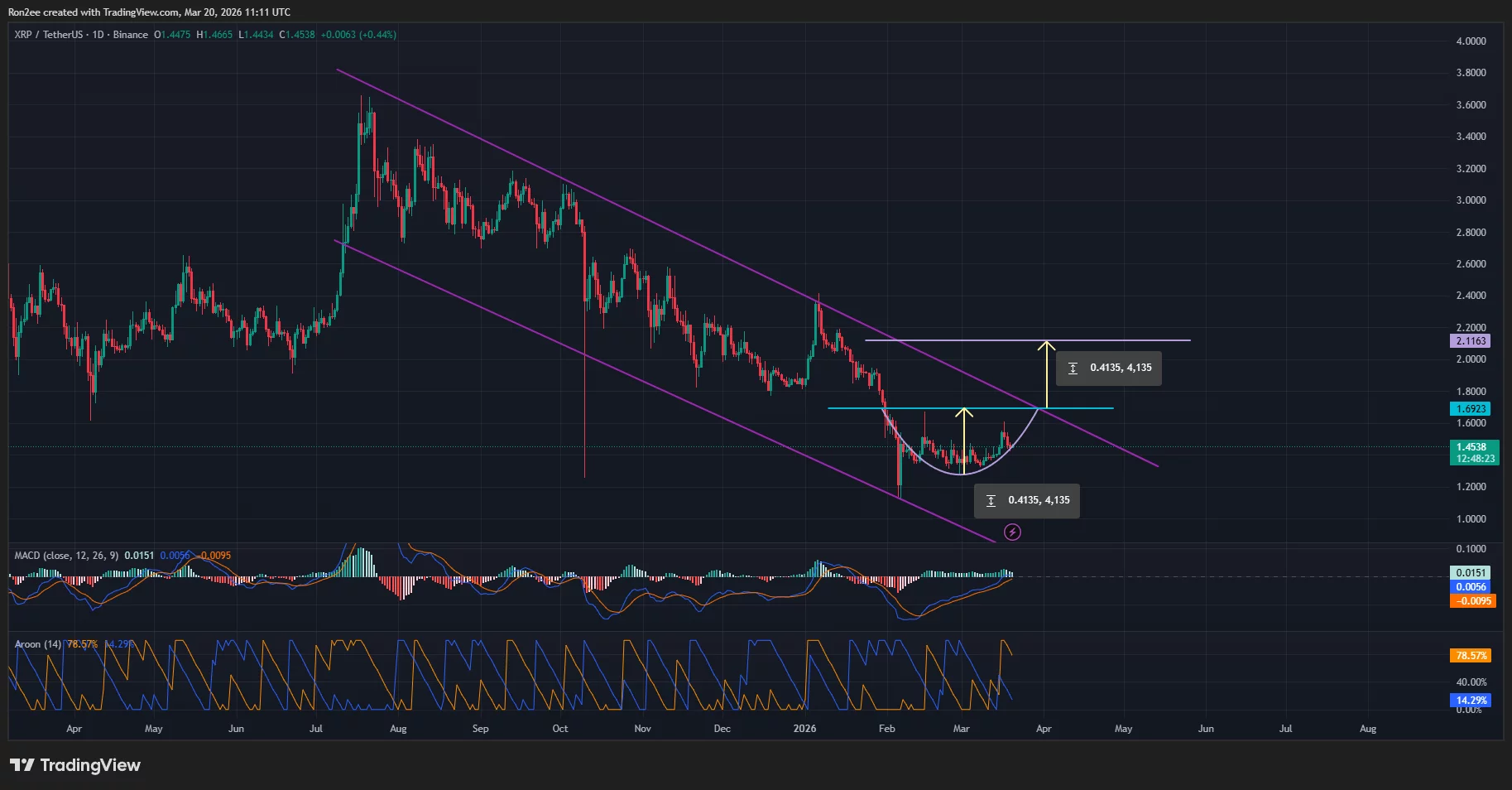
- Technical setup shows a descending channel and a rounded bottom, with a breakout above $1.69 potentially opening upside toward $2.1.
After falling nearly 11% from its weekly high to $1.45 on March 19, XRP (XRP) price bounced back to $1.45 at the last check on Friday, March 20.
XRP price fell as the broader crypto market tanked amid escalating war concerns in the Middle East, which has left investors to move to a derisking mode as they turn toward gold and other safe-haven assets to park their capital until concerns cool off.
Despite the recent volatility, a few key developments could support a potential recovery for the asset.
First, whales have returned to accumulation mode in recent weeks, a major signal that often influences retail sentiment.
In a recent X post, market analyst Ali Martinez shared on-chain data that shows XRP whales have accumulated at least 200 million XRP over the past two weeks.
Second, Goldman Sachs, one of the world’s leading investment banks, has now become the largest institutional holder of XRP in the U.S. The banking giant reportedly holds over $150 million worth of XRP across four spot XRP funds, more than the combined holdings of the next 29 institutional holders in line.
Such massive endorsements from prominent financial institutions could drive greater appeal for the token as it transitions into a mainstream investment vehicle.
Third, investor hype is also building over an XRP treasury reserve being established by Evernorth. Such a move could mirror the approach taken by Michael Saylor with Bitcoin at Strategy and help to solidify XRP as a cornerstone institutional asset.
The firm said it will be the largest XRP holder after its public listing. The strategic move could give XRP more visibility and prestige in the eyes of traditional investors who are looking for regulated exposure to the crypto market.
On the daily chart, XRP price has respected a descending parallel channel pattern in which it has been trading since mid-July 2025. A breakout from such a bullish reversal pattern has typically been a precursor to a sustained rally as it signals the end of a long-term corrective phase.
More recently, XRP price has also been forming a rounded bottom pattern, which has historically been followed by a gradual shift from bearish to bullish sentiment as buyers slowly regain control.
For now, the key resistance level to watch is $1.69, which serves as the neckline of the rounded bottom pattern. A move past this point would confirm both a breakout from the pattern and the descending channel at the same time.
A decisive break above this level could lift XRP up to $2.1, a target that has been calculated by adding the height of the rounded bottom to the point at which the breakout occurs.
Momentum indicators seem to present a strengthening case for the bulls. Notably, the MACD lines have pointed upwards while the Aroon Up at 78.57% sits far above the Aroon Down at 14.29%, also confirming that the upward trend is currently gaining significant steam.
Disclosure: This article does not represent investment advice. The content and materials featured on this page are for educational purposes only.
Crypto World
Bitcoin consolidates as traders hedge and macro uncertainty lingers: Crypto Markets Today
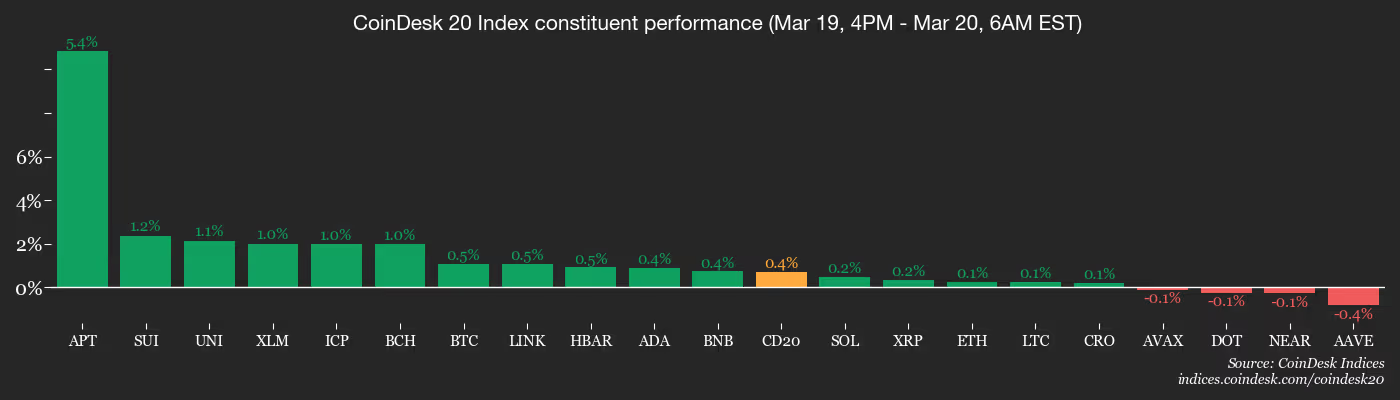
Crypto markets were little changed Friday, with the CoinDesk 20 Index (CD20) virtually unchanged. Bitcoin has gained just 0.8% since midnight UTC and ether (ETH) added less than 0.1%.
Crude oil prices dropped below $100 on Thursday and were recently trading at $96 per barrel as the U.S. was said to be assessing whether it should release sanctioned Iranian oil to increase supply and reduce pressure on prices.
This gave a momentary boost to risk assets with U.S. equities showing signs of recovery, but that move has now reversed. Nasdaq 100 and S&P 500 futures are down by 0.6% and 0.4%, respectively, since midnight, indicating continued market fragility.
Precious metals are now trading back in line with crypto after a ferocious rally to record highs at the start of the year. Gold is at $4,660 after putting in a top at $5,600 on Jan. 29.
Derivatives positioning
- Bitcoin open interest (OI) stabilized at $16.9 billion, roughly mirroring last week’s $17 billion and suggesting speculative activity has leveled off.
- Funding rates across most platforms have returned to a neutral range of 0%-10%, with the negative rates observed over the previous two days probably fueling an initial relief rally through short covering before contributing to the recent crash.
- The three-month annualized basis is holding steady at 2.8%, a sign that institutional conviction remains cautious.
- The options market reflects defensive positioning: The 24-hour call-to-put volume split has shifted to 43/56.
- Risk aversion is tightening, with the one-week 25-delta skew rising to 14% from 9%, notably increasing the cost of downside protection.
- The implied volatility term structure confirms a sharp front-end spike into backwardation, a signal that traders are bracing for an immediate, high-impact volatility event, prioritizing short-term hedging over stable mid-term growth expectations.
- Long-dated implied volatility (IV) remains anchored near 50%,
- Coinglass data shows $308 million in 24-hour liquidations, with a 63-37 split between longs and shorts. BTC (93 million), ETH ($81 million) and others ($19 million) were the leaders in terms of notional liquidations.
- The Binance liquidation heatmap indicates $68,500 as a core liquidation level to monitor in case of a price drop.
Token talk
- The altcoin market continues to show signs of optimism despite many of the crypto majors remaining trapped in a tight trading range since early February.
- Quant (QNT) is up by 7.5% since midnight following a spot listing on popular trading app Robinhood, while AI token FET has extended its rich vein of form, rising by 6.5%.
- CoinMarketCap’s Altcoin Season index is currently at 46/100, falling back slightly but still well above February’s lows, when it languished in the low 20s.
- While the CoinDesk 20 (CD20) Index is flat since midnight, the altcoin-dominant CoinDesk 80 (CD80) is up by 0.3%, indicating a slight outperformance.
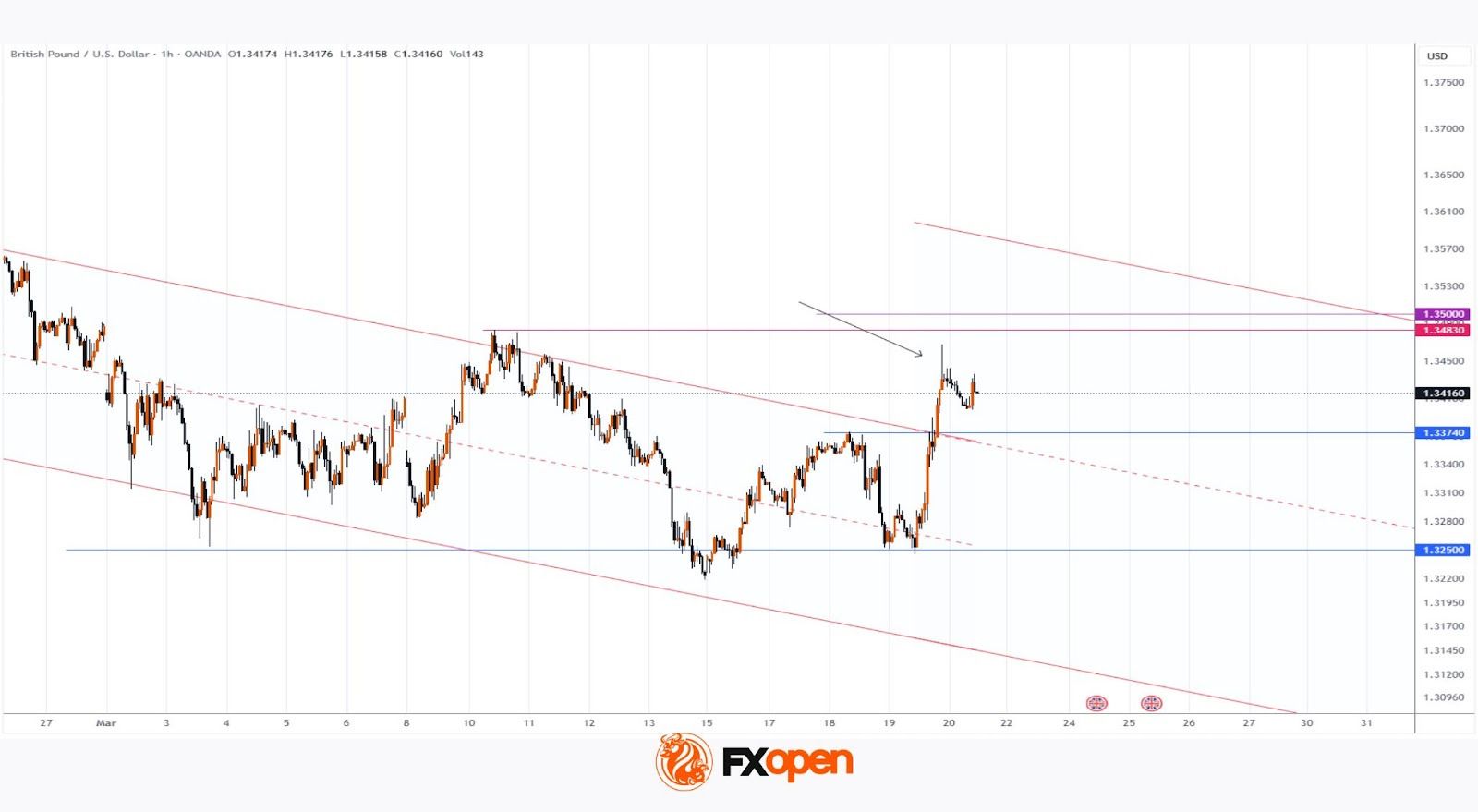
Yesterday, the Bank of England’s decision had a significant impact on the pound, which strengthened against other currencies. Although the Official Bank Rate remained unchanged at 3.75%, the market was surprised by the “hawkish” signals, which sharply contrasted with the dovish statements made at the February meeting.
According to media reports:
→ None of the nine committee members voted to cut the rate;
→ The phrase stating that the rate “could be lowered in the future” was removed from the final statement.
Thus, the Bank of England indicated that it is ready to raise rates if the energy shock caused by the Middle East conflict accelerates inflation.
The hawkish stance contributed to the pound rising above the upper boundary of the channel in which it had been trading since late January.
Technical Analysis – GBP/USD
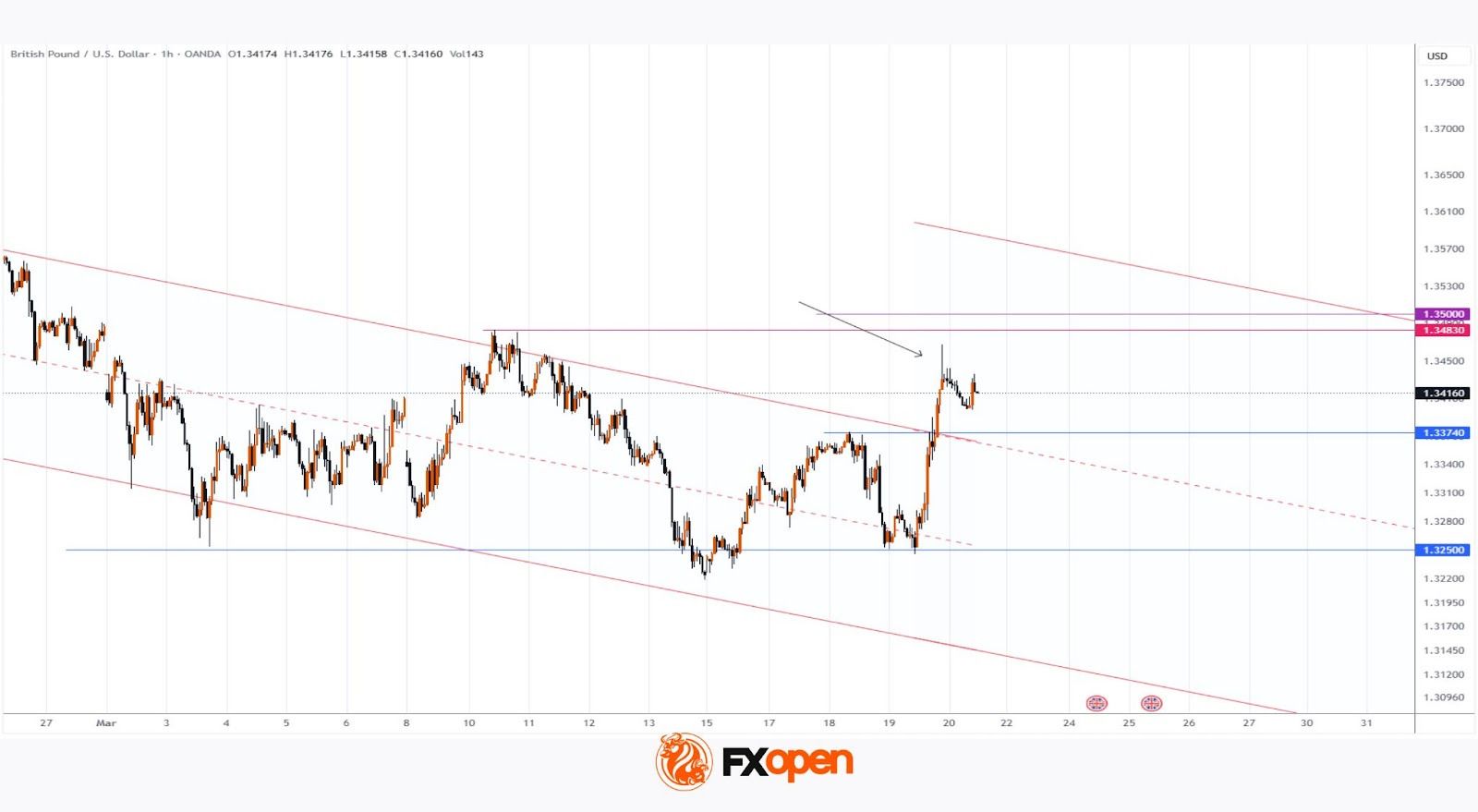
Movements in GBP/USD during March suggest that 1.3250 serves as an important support level. Additionally, following yesterday’s news, bulls may find support around 1.3374, where:
→ On 18 March, the market encountered resistance;
→ The upper boundary of the channel was broken yesterday.
On the other hand, the long upper wick on yesterday’s candle (as indicated by the arrow) points to bear activity. Even if the bullish momentum has not yet exhausted itself, further gains in GBP/USD may face resistance at higher levels, including:
→ Psychological level at 1.3500;
→ The high of 10 March;
→ The upper boundary of the expanded double red descending channel.
Trade over 50 forex markets 24 hours a day with FXOpen. Take advantage of low commissions, deep liquidity, and spreads from 0.0 pips (additional fees may apply). Open your FXOpen account now or learn more about trading forex with FXOpen.
This article represents the opinion of the Companies operating under the FXOpen brand only. It is not to be construed as an offer, solicitation, or recommendation with respect to products and services provided by the Companies operating under the FXOpen brand, nor is it to be considered financial advice.

Key Highlights
- XPeng achieved its maiden quarterly net profit of 383.2 million yuan (approximately $55.5M) during Q4 2025
- Quarterly revenue surged 38% compared to the prior year, reaching 22.25 billion yuan and exceeding Wall Street expectations
- Gross profit margin expanded to 21.3%, representing a significant improvement from the 14.4% recorded one year prior
- Shares gained roughly 2% during early market hours; American Depositary Receipts advanced 0.8% to $19.30 in pre-market activity
- China’s three leading emerging electric vehicle manufacturers — XPeng, NIO, and Li Auto — have all crossed into profitability territory
The Chinese electric vehicle manufacturer shipped 116,249 vehicles during the fourth quarter, establishing a new company benchmark, although falling short of its previously issued guidance range of 125,000–132,000 units. Despite the delivery miss, the financial outcome caught Wall Street off guard — market analysts had anticipated a net loss approaching 200 million yuan.
Across the entire 2025 fiscal year, the company’s net loss contracted dramatically to 1.14 billion yuan compared to 5.79 billion yuan recorded in 2024. Annual revenue exploded 88% higher to reach 76.72 billion yuan.
The margin expansion narrative proves equally compelling. Fourth-quarter gross margin reached 21.3%, climbing from 14.4% in the comparable period last year. Full-year gross margin registered at 18.9%, a substantial improvement over 2024’s 14.3% figure. Company executives attributed the margin gains to persistent cost optimization initiatives and an enhanced vehicle portfolio mix.
The earnings surprise arrives amid an intense pricing battle within China’s electric vehicle sector. Competitive pressure from domestic rivals has remained fierce, and XPeng shares remain down 12% across the trailing twelve months despite Friday’s positive momentum.
NIO announced its own maiden quarterly profit just last week, supported by record-breaking sales figures. Li Auto, which became profitable before its peers, delivered a modest profit despite experiencing softer sales volumes — highlighting that achieving profitability doesn’t guarantee consistent success in China’s saturated automotive landscape.
Beyond vehicle sales, XPeng has been expanding its technological footprint. The automaker recently introduced its VLA 2.0 autonomous-driving platform, developed using proprietary silicon, with worldwide rollout scheduled for 2027.
The company also intends to introduce three robotaxi variants this year targeting ride-sharing operations throughout China, with pilot programs anticipated to commence later in 2026.
Expansion Into Robotaxis and Humanoid Robotics
XPeng has been strategically repositioning itself as what management describes as a “physical AI company,” advancing into autonomous taxi services and humanoid robotics alongside its primary electric vehicle operations. While these represent longer-term strategic initiatives, they’re beginning to materialize with concrete implementation schedules.
First-quarter 2026 projections, however, signal a near-term deceleration. The company anticipates delivering between 61,000 and 66,000 vehicles, generating revenue in the range of 12.20–13.28 billion yuan. This guidance represents a 16% to 23% contraction compared to the corresponding period in the previous year — marking a considerable retreat from fourth-quarter performance levels.
First Quarter 2026 Outlook Indicates Sequential Slowdown
The subdued Q1 delivery projection mirrors customary seasonal patterns in Chinese automotive demand following robust year-end purchasing activity. XPeng management has not indicated any fundamental business concerns, characterizing the softness as consistent with typical first-quarter dynamics.
XPeng American Depositary Receipts traded 0.8% higher at $19.30 during premarket hours on Friday in response to the earnings announcement.

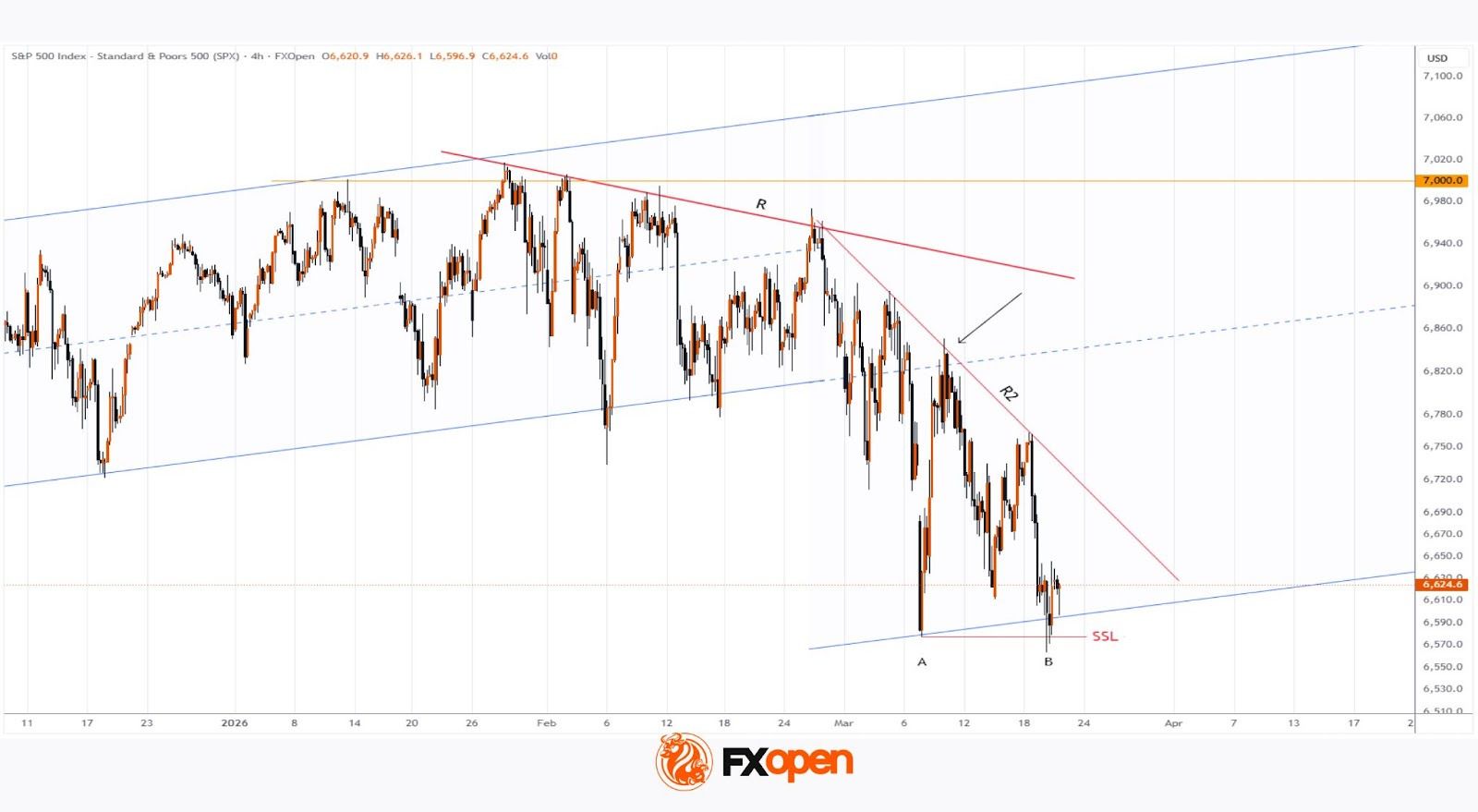
As the S&P 500 chart (US SPX 500 mini on FXOpen) shows, the index dropped below the 6,570 level yesterday for the first time in 2026. As a result, the equity market may be on track to post a fourth consecutive weekly decline, closing below its 200-day moving average.
Why Are Equities Falling?
Bearish sentiment is likely being driven by the ongoing military conflict in the Middle East:
→ Elevated oil prices are fuelling expectations of a renewed inflationary surge. This suggests the Federal Reserve will keep interest rates higher for longer (as reinforced by Powell’s remarks this week), putting pressure on both the economy and corporate performance.
→ Investors are also concerned that the United States could become drawn into a prolonged conflict with Iran, which may pose significant challenges for the country, despite efforts by officials to calm market sentiment.
According to Trading Economics:
→ US President Donald Trump stated that the US is not considering deploying ground troops to the Middle East;
→ Treasury Secretary Scott Bessent noted that the Iranian regime could face internal collapse;
→ Israeli Prime Minister Benjamin Netanyahu said Israel may refrain from further strikes on Iran’s energy infrastructure, suggesting the conflict could end sooner than expected.
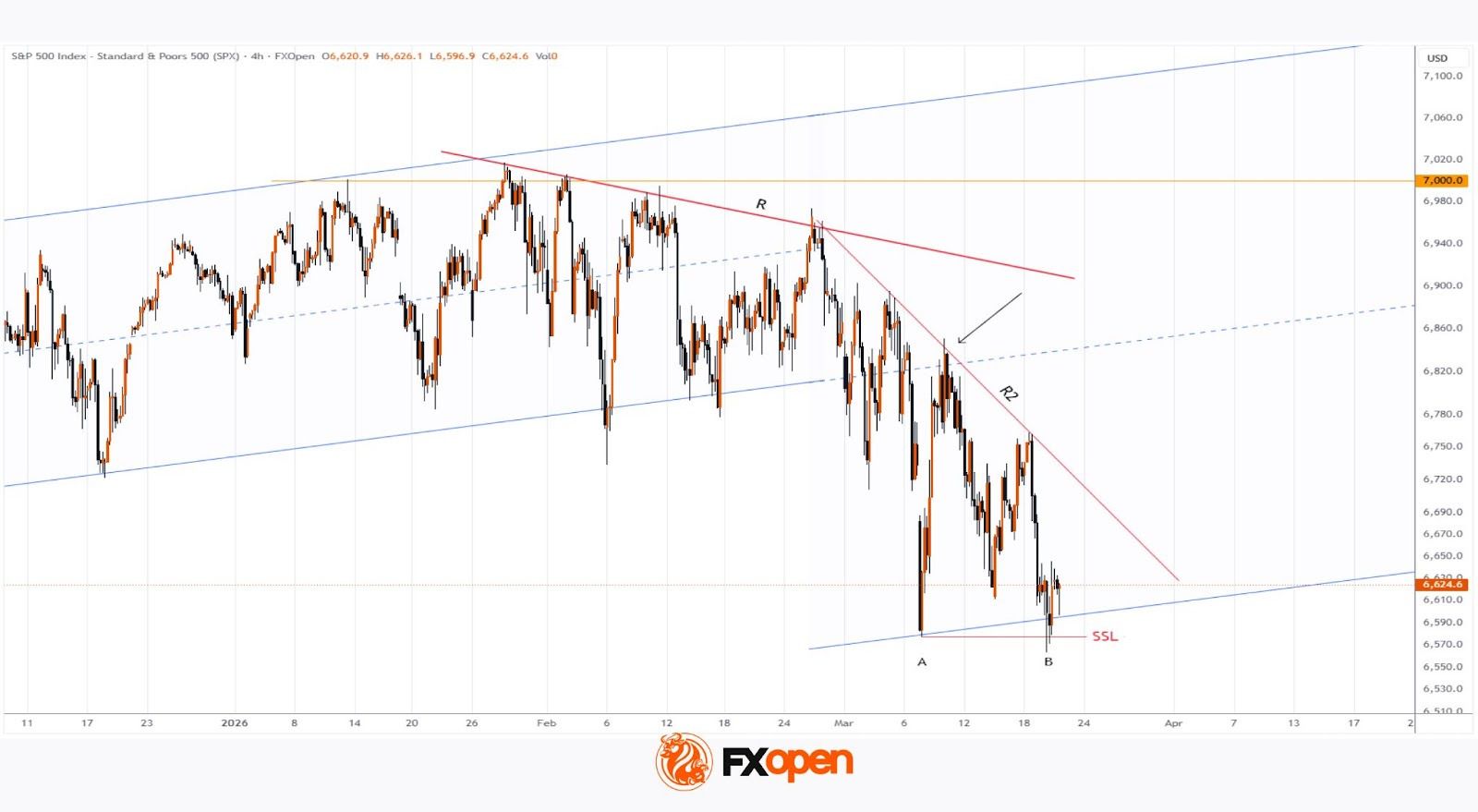
Technical Analysis of the S&P 500
On 11 March, we analysed the index chart and noted that the lower boundary of the broader channel was acting as support (point A), while the median line served as resistance (as indicated by the arrow).
Since then, selling pressure has led to:
→ the formation of a steeper descending trendline (R2);
→ a move down to a new low at point B, below the previously mentioned channel boundary.
From a Smart Money Concepts perspective, it is reasonable to assume that price has entered a Sell-Side Liquidity zone. If so, traders should consider the possibility that the recent bearish breakout below the channel may prove to be false. In that case, the S&P 500 could stage a recovery in the coming sessions, potentially moving back towards the R2 trendline.
Trade global index CFDs with zero commission and tight spreads (additional fees may apply). Open your FXOpen account now or learn more about trading index CFDs with FXOpen.
This article represents the opinion of the Companies operating under the FXOpen brand only. It is not to be construed as an offer, solicitation, or recommendation with respect to products and services provided by the Companies operating under the FXOpen brand, nor is it to be considered financial advice.

HBO’s 88% RT Thriller Miniseries Is Already One of Its Best

Ripple XRP DAVID SCHWARTZ WARNS OF JAPAN TRIGGER INCOMING!!!

Ex-CEO Bronwyn Barnes accuses Ivanhoe Atlantic of illegal laptop seize


-
 Crypto World6 days ago
HYPE Token Enters Net Deflation as HyperCore Buybacks Outpace Staking Rewards
-

 Tech5 days ago
Your Legally Registered ‘Motorcycle’ Might Not Count Under Proposed US Law
-

 Fashion7 days ago
Weekend Open Thread: Addict Lip Glow
-
 Tech3 days ago
Are Split Spacebars the Next Big Gaming Keyboard Trend?
-
Sports6 days ago
Why Duke and Michigan Are Dead Even Entering Selection Sunday
-

 Business5 days ago
Search for Savannah Guthrie’s Mother Enters Seventh Week with No Arrests
-

 Business6 days ago
US Airports Launch Donation Drives for Unpaid TSA Workers as Partial Government Shutdown Enters Fifth Week
-
Crypto World6 days ago
Coinbase and Bybit in Investment Talks: Could Bybit Finally Enter the US Crypto Market?
-

 Business4 days ago
Australian shares drop as Iran war enters third week
-

 Business6 days ago
Country star Brantley Gilbert enters growing non-alcoholic beer market
-

 Crypto World4 days ago
Crypto Lender BlockFills Enters Chapter 11 with Up to $500M in Liabilities
-

 Sports7 days ago
College Basketball Best Bets: Conference Tournament Semifinal Picks
-

 Politics2 days ago
The House | The new register to protect children from their abusers shows Parliament at its best
-

 News Videos2 days ago
RBA board divided on rate cut, unusually buoyant share market | Finance Report | ABC NEWS
-

 Fashion4 days ago
25 Celebrities with Curly Hair That Are Naturally Beautiful
-

 Tech7 hours ago
inKONBINI Lets You Spend Summer Days Behind the Register
-

 Crypto World2 days ago
Canada’s FINTRAC revokes registrations of 23 crypto MSBs in AML crackdown
-
 Politics3 days ago
Real-time pollution monitoring calls after boy nearly dies
-

 Crypto World6 days ago
Crypto Losses Drop 87% in February, But Hackers Are Now Targeting People, Not Code
-
 NewsBeat2 days ago
Residents in North Lanarkshire reminded to register to vote in Scottish Parliament Election


You must be logged in to post a comment Login