
Business
Labour to allow 30m wind turbines at schools and hospitals under new planning rules


Labour has unveiled plans to allow wind turbines up to 30 metres tall to be installed at schools, hospitals and farms without full planning permission, in a significant shift aimed at accelerating the rollout of small-scale renewable energy across the UK.
Under the proposed changes, ministers will extend permitted development rights, currently limited largely to domestic properties, to cover non-domestic sites including public sector buildings and commercial premises. The move is designed to enable organisations to generate their own electricity and reduce exposure to volatile energy costs.
At present, homeowners can install small turbines without planning approval, but these are capped at 15 metres when mounted on a building and 11.1 metres when placed in a garden. The new framework would more than double that height limit for non-domestic use, allowing turbines comparable in scale to mature trees to be deployed more widely.
A turbine of this size can generate up to 50 kilowatts of power, which the government says is sufficient to meet the full electricity demand of a medium-sized farm or significantly offset consumption at sites such as schools and hospitals.
Energy minister Michael Shanks said the reforms would give organisations “the tools to lower their bills and make the best use of their land”, describing onshore wind as one of the cheapest and quickest forms of energy to deploy.
The policy comes against a backdrop of heightened energy price volatility driven by global geopolitical tensions, with ministers increasingly focused on boosting domestic generation to improve long-term resilience.
However, the proposals have already drawn criticism from opposition politicians and rural campaign groups, who warn the changes could sideline local communities.
Richard Tice, Reform UK’s deputy leader and energy spokesman, described the move as “intrusive”, accusing the government of weakening planning protections in pursuit of its net zero agenda.
Similarly, Sarah Lee of the Countryside Alliance cautioned that the reforms risk setting a precedent for wider development without adequate consultation. She said the key issue was not the turbines themselves, but “location, density and consent”, adding that planning rules exist to ensure local voices are heard.
Despite the relaxation of rules, planning permission will still be required for installations in sensitive areas, including conservation zones, listed buildings and designated habitats.
Industry figures have broadly welcomed the shift, arguing it could help address one of the UK’s core energy challenges, its reliance on imported gas. Nigel Pocklington of renewable supplier Good Energy said scaling domestic renewables is “the most effective way to bring prices down over the long term”.
The reforms also attempt to address the slow uptake of small-scale wind technology in the UK. Despite permitted development rights for homes being in place since 2011, adoption has remained limited, with just 128 installations recorded over the past decade.
That lack of traction has been attributed to a combination of planning constraints, cost barriers and public resistance, challenges the government now hopes to overcome by targeting larger, non-domestic sites where energy demand is higher and installations can deliver more meaningful savings.
For businesses and public sector organisations facing rising energy costs, the policy signals a shift towards decentralised, site-level generation, but its success will likely depend on how effectively ministers balance speed of deployment with local acceptance.

Amy Ingham
Amy is a newly qualified journalist specialising in business journalism at Business Matters with responsibility for news content for what is now the UK’s largest print and online source of current business news.


Check out what’s clicking on FoxBusiness.com.
Hyundai Motor Company is recalling more than 61,000 Palisade SUVs in the U.S. after an issue with powered seats was linked to the death of a child, federal regulators said.
The recall affects model year 2026 Palisade and Palisade Hybrid vehicles equipped with the Limited and Calligraphy trim packages, the automaker said in a recall report filed with the National Highway Traffic Safety Administration.
“The 2nd and 3rd row power seat assemblies equipped in the subject vehicles may not respond to contact with an occupant or object as intended during activation of certain powered seat functions, including the automatic power-folding (stow) function and the ‘one-touch’ tilt-and-slide (walk-in) feature of the 2nd row power seat assembly,” the report said.
HYUNDAI STOPS SALES OF CERTAIN SUVS AFTER 2-YEAR-OLD GIRL’S DEATH

The 2026 Hyundai Palisade SUV during the New York International Auto Show Press Preview in New York City April 16, 2025. (Shannon Stapleton/Reuters)
The announcement comes after a young child died in an incident involving a Palisade that is still under investigation, according to the automaker.
Reuters reported the victim was a 2-year-old girl from Ohio who was killed March 7.
“Hyundai is aware of a tragic incident involving a Palisade,” the company said in a press release March 13. “While Hyundai does not yet have the full details and the incident is still under investigation, a young child lost her life. Hyundai extends its deepest sympathies to her family.”
TOYOTA RECALLS 550,000 VEHICLES OVER SEAT DEFECT

A view from the interior of a Hyundai Palisade showing the gray leather upholstery of the second-row power-folding seats. (Hyundai USA)
The South Korean automaker said last week it is pausing sales of the Palisades with the Limited and Calligraphy trim packages following the incident.
Hyundai said in the recall notice it received four reports of minor injuries related to second-row seat operation.

Hyundai issued a stop-sale and plans for a recall for 2026 Palisade Limited and Calligraphy models March 13, 2026. (Hyundai USA)
FORD RECALLS MORE THAN 83,000 VEHICLES OVER HEADLIGHT, ENGINE VALVE ISSUES
A recall remedy is under development. Until it becomes available, the automaker warned owners of the affected vehicles to use caution when operating the second- and third-row power-folding seat functions.
Hyundai also said owners should “avoid contacting the ‘one-touch’ tilt-and-slide button located on the 2nd row setback … during entry and exit of the 3rd row and take measures to prevent inadvertent activation of this feature.”
CLICK HERE TO GET FOX BUSINESS ON THE GO
FOX Business’ Ashley Carnahan contributed to this report.

Form 8K C1 Fund Inc For: 20 March


Argentina’s economy expands 4.4% in 2025
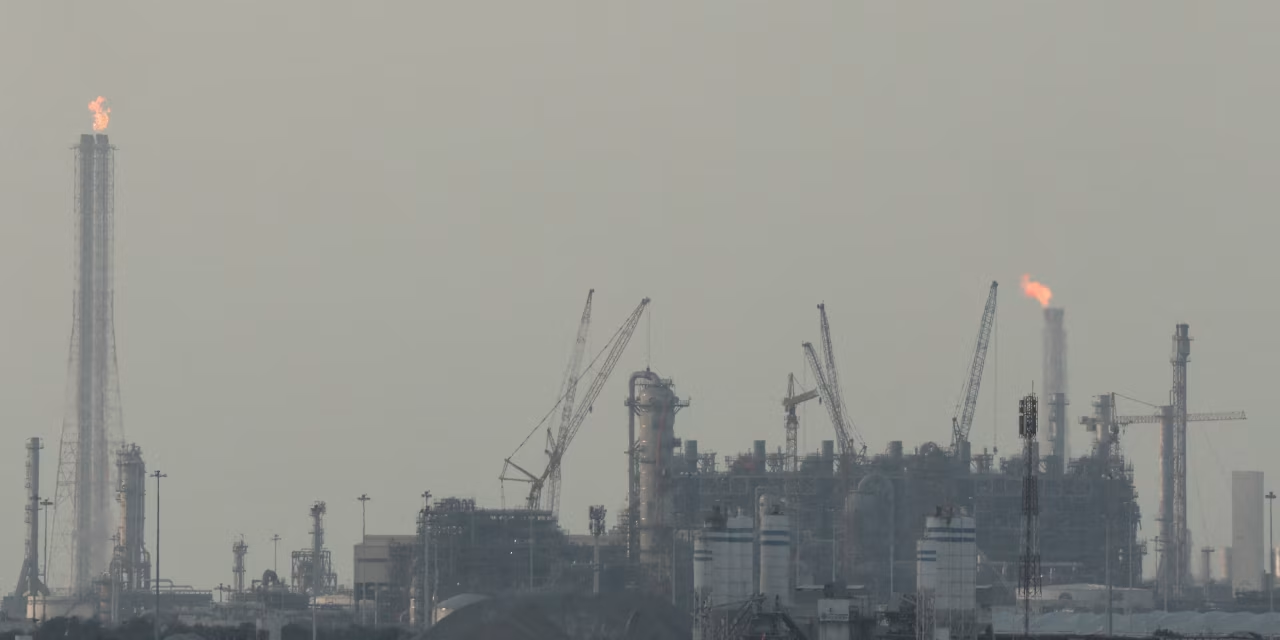
Oil and gas prices surged Thursday after some of the world’s most critical energy facilities were hit in a fresh wave of attacks in the Middle East, stoking fears of deeper and more prolonged disruptions to global supplies.
In mid-morning European trade, Brent crude climbed 10% to $118.50 a barrel and was up 65% on the month. West Texas Intermediate, the U.S. oil gauge, rose 2.9% to $95.08 a barrel. Natural-gas prices spiked 26%, with the front-month Dutch TTF contract—the European benchmark—trading at 68.70 euros a megawatt-hour after briefly touching 70 euros at the open.
Copyright ©2026 Dow Jones & Company, Inc. All Rights Reserved. 87990cbe856818d5eddac44c7b1cdeb8

Asian stocks fell sharply Thursday as investors digested a series of attacks on energy infrastructure in the Middle East and the weakness on Wall Street in the previous session.
South Korea’s KOSPI Composite index declined 2.7% after its 5% jump in the previous session. The red-hot stock market is up 37% so far in 2026 but has been very volatile since the Iran war began.
China’s Shanghai Composite slipped 1.4%, while Japan’s Nikkei index closed 3.4% down, after jumping 2.9% in the previous session.

SAN FRANCISCO—During the tech boom of the 2010s, coding teams here spent months building apps that changed the way we live.
Now, that’s just a Saturday night for an 11-year-old.
Copyright ©2026 Dow Jones & Company, Inc. All Rights Reserved. 87990cbe856818d5eddac44c7b1cdeb8


Wall Street tumbles as Middle East turmoil fans inflation fear

Argentina’s economy grows 4.4% in 2025, slightly below forecasts
Form 6K NatWest Group plc For: 20 March
Gold prices plunged below $4,800 a troy ounce, pressured by a stronger dollar and dimming hopes for further interest-rate cuts in the near term.
In early European trading, futures fell 2.9% to $4,755 an ounce, while the U.S. dollar index was up 0.1% to 100.18, making dollar-denominated commodities more expensive for overseas buyers.
The Federal Reserve held interest rates steady on Wednesday, as widely expected, but highlighted the risks that higher energy prices will lift inflation. “The rally in oil followed renewed escalation in the Middle East, with markets increasingly pricing the risk of disruptions to energy supplies and shipping routes,” ING analysts said.

Corey Pritchett Jr. Kidnapping Charges Dismissed In Houston Case

MONEY SPEAK – YAYA BLR & SNIPER BLR (Clip Officiel)

BBC Woman’s Hour icon Dame Jenni Murray dies aged 75 as tributes flood in


-
 Crypto World7 days ago
HYPE Token Enters Net Deflation as HyperCore Buybacks Outpace Staking Rewards
-

 Tech5 days ago
Your Legally Registered ‘Motorcycle’ Might Not Count Under Proposed US Law
-
 Tech3 days ago
Are Split Spacebars the Next Big Gaming Keyboard Trend?
-
Sports6 days ago
Why Duke and Michigan Are Dead Even Entering Selection Sunday
-

 Business5 days ago
Search for Savannah Guthrie’s Mother Enters Seventh Week with No Arrests
-

 Business6 days ago
US Airports Launch Donation Drives for Unpaid TSA Workers as Partial Government Shutdown Enters Fifth Week
-
Crypto World6 days ago
Coinbase and Bybit in Investment Talks: Could Bybit Finally Enter the US Crypto Market?
-

 Business4 days ago
Australian shares drop as Iran war enters third week
-

 Business6 days ago
Country star Brantley Gilbert enters growing non-alcoholic beer market
-

 Politics2 days ago
The House | The new register to protect children from their abusers shows Parliament at its best
-

 Crypto World4 days ago
Crypto Lender BlockFills Enters Chapter 11 with Up to $500M in Liabilities
-

 News Videos2 days ago
RBA board divided on rate cut, unusually buoyant share market | Finance Report | ABC NEWS
-

 Fashion4 days ago
25 Celebrities with Curly Hair That Are Naturally Beautiful
-

 Tech15 hours ago
inKONBINI Lets You Spend Summer Days Behind the Register
-

 Crypto World2 days ago
Canada’s FINTRAC revokes registrations of 23 crypto MSBs in AML crackdown
-
 Politics3 days ago
Real-time pollution monitoring calls after boy nearly dies
-

 Crypto World6 days ago
Crypto Losses Drop 87% in February, But Hackers Are Now Targeting People, Not Code
-
 NewsBeat2 days ago
Residents in North Lanarkshire reminded to register to vote in Scottish Parliament Election
-

 Business4 days ago
Meta planning major layoffs as AI spending and automation reshape workforce
-

 Politics5 days ago
9 Stylish Leather Jackets Perfect For Spring 2026


You must be logged in to post a comment Login