




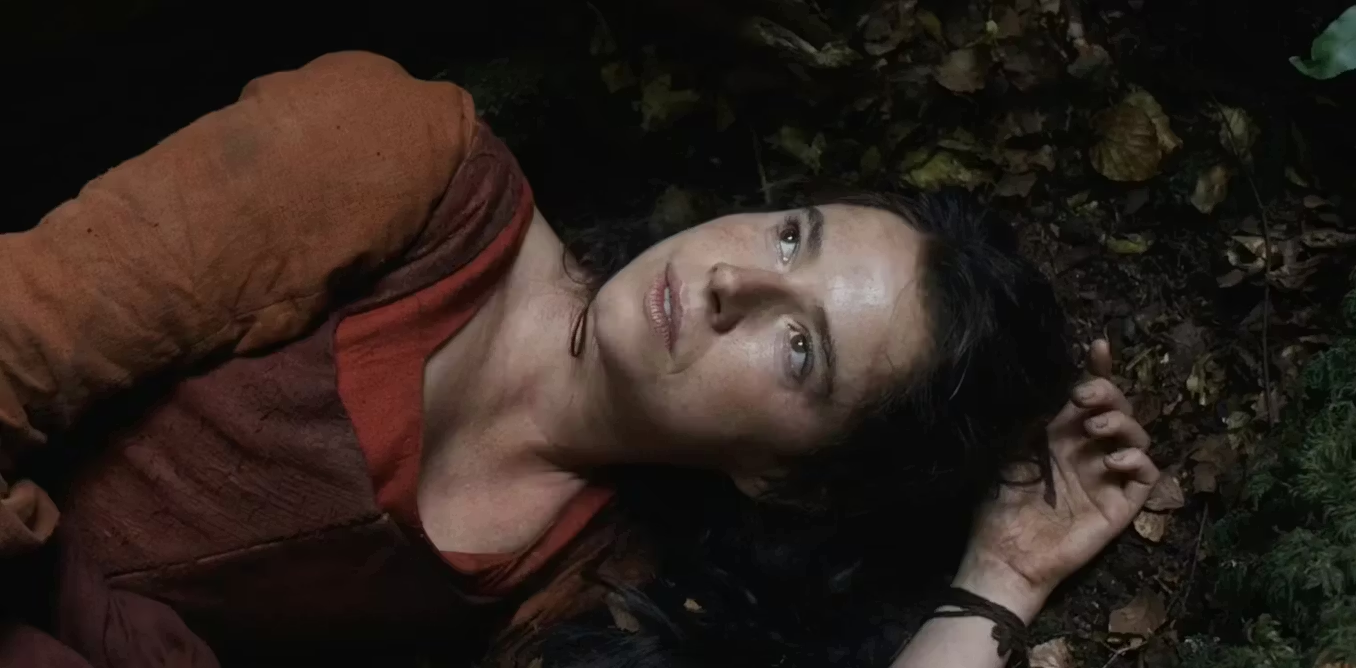
The 2026 Oscars saw Jessie Buckley win best actress for her searing portrayal of a mother’s grief in Hamnet. But the film is also a story about a “green witch”, for Agnes Hathaway is no ordinary woman. She is a herbalist, healer and daughter of a “forest witch”.
In Maggie O’Farrell’s prize-winning novel of the same name, we first meet Agnes in her “witch garden” as her stepmother disparagingly calls it. We learn of her love of nature and that she has the gift of second sight, tuning into nature’s signs. There are other hints too: she has a “familiar”, a kestrel, which represents Agnes’s wild nature.
When her future husband Will Shakespeare first meets her he is struck by her direct gaze, her almost masculine energy. Her searching fingers grip the flesh between his thumb and forefinger to glean his essence. Agnes is independent, unruly, a creature of the forest. In the film’s opening scene she is curled up asleep among the tangled roots of a huge tree which serves as an arresting motif in the film.
Focus Features
The powerful story of Agnes the healer and forest witch highlights an aspect of witchcraft often overlooked in more sensationalised and darker versions of witchcraft, such as in the TV series Mayfair Witches. It also points to a growing form of modern witchcraft today, known as “green witchcraft”.
This form has its roots in “natural magic” – the practice of using plants, herbs and the natural world for benevolent purposes. Doreen Valiente, who wrote the book Natural Magic in 1975, refers to “green magic” in her text, foreshadowing what was to become a popular form of witchcraft 40 years later.
Green witchcraft also has close links with goddess spirituality, which celebrates the divine feminine as a counterbalance to the divine masculine dominance of traditional religions.
As the name suggests, green witchcraft draws on environmental concerns and often has an eco-feminist emphasis – women caring for the earth and all living entities on it, and opposing the exploitation of nature for human ends.
Green witchcraft has become so popularised that my colleague Pauline Maclaran and I devote a chapter to it in our forthcoming book, Bewitching Consumer Culture: Witchcraft, Feminism and Markets.
Historically in Britain, the witch figure inspired fear, fascination and suspicion. The brutal witch-hunts and widespread persecution of women that occurred from the mid-16th to the mid-18th centuries have made the witch a powerful figure for feminism. Our book explores the growing interest in witchcraft in the marketplace, revealing how the witch has evolved into a feminist heroine for our times.
Growing interest
Interest in the subject has burgeoned in recent years. When working on our book, a google search on “green witchcraft” resulted in 675 million hits, and “green witch” had 705 million hits. An Amazon search returned over 2,000 publications, mostly published in the last five years. There is now a plethora of books on the topic, and numerous podcasts, blogs and YouTube videos devoted to the subject.
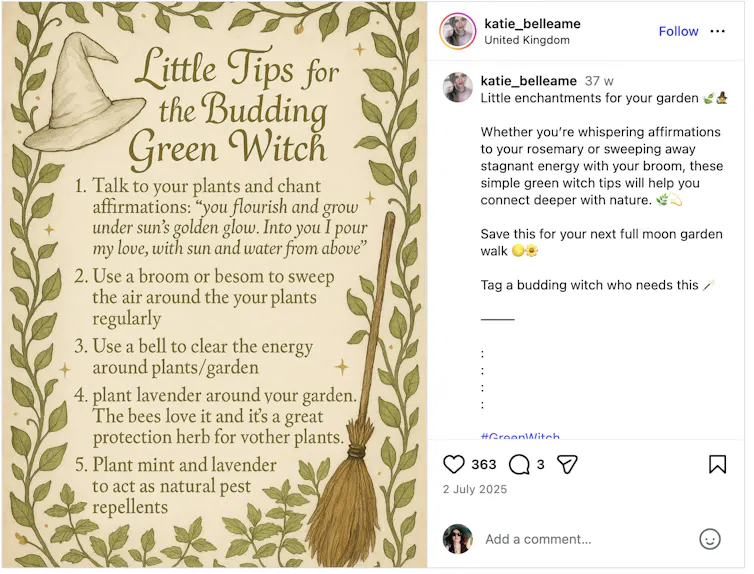
Many green witches have huge followings, and share their practices on social media sites such as TikTok (aka WitchTok), YouTube and Instagram. These visual mediums enable them to share potions, spells, tips and advice on their practice of walking the green path. They also display their green witch aesthetic in terms of lifestyle, home décor, and especially green altars or shrines dedicated to nature. Posts often take the form of inspirational quotes, invocations or affirmations.
Green witchcraft particularly attracts young women concerned about climate change and living sustainably. This might include organic gardening, growing plants and foraging, appealing to those seeking alternative, nature-based spiritual paths. Its emphasis on balance, wellbeing and mindfulness is another important part of its appeal.
It speaks to a feminist perspective too, as it advocates a feminine ethic of care and respect for nature and living in harmony with the earth, as well as offering a means for empowerment, self-determination and self-growth.
Instagram
Central to green witchcraft practices is the creation of ritual altars dedicated to nature. These shrines may be inside on a windowsill or outdoors in a corner of the garden. The altar faces the direction of the element the green witch most identifies with (north for air, south for water, east for fire and west for earth).
Ritual artefacts used by green witches include white-handled knives (bolines) for cutting herbs, cauldrons, chalices, wands, candles, crystals, smudge sticks for cleansing energy (using white sage, juniper, lavender or cedar), and divination tools such as oracle cards and witches’ runes. These are a set of symbols, such as the sun, moon or other elemental designs that each have their own meaning. The symbols are inscribed on things like candles or stones and are then “cast” to answer a question asked.
Some practices, when shared, also enable green witches to inspire others in the community to follow the green path. Common to other forms of contemporary witchcraft, green witchcraft has its grounding and centring practices, setting intentions, manifesting, affirmations and of course “spellcasting”.
In many ways green witchcraft reinforces the age-old association of women as nature’s guardians. Importantly, it also recasts the witch figure as a caring, benign force for good. The green witch plants, tends and respects nature. She is nature’s healer, close to nature’s secrets and respectful of its power, much like Agnes in Hamnet.
In their solitary practices and through their online and offline communities, green witches can be seen as powerful counter-cultural influencers. They encourage young women in particular to feel empowered to harness the healing power of the feminine aspect through a spiritual practice rooted in respect for nature and its cycles.
Across a variety of social media platforms, ever-growing numbers of green witches inspire others to follow the nurturing, soulful and environmentally kind green path. The sympathetic and moving portrayal of Agnes in the 16th-century setting of Hamnet will probably be an additional source of inspiration.











































You must be logged in to post a comment Login