
Crypto World
Ethereum Approaches Cycle Low as Bitmain Indicates Violent Belief


The present perspective is determined by historical correlations
Lee based part of his opinion on the analysis of a market technician named Tom DeMark. The data indicate that the recent price trend of Ethereum is highly correlated with the S&P 500 during the crash of 1987 and the correction of 2011. These trends suggest that Ethereum might already be at a bottom or nearing one.
As of today, Ethereum is trading at an approximate 22 percent discount to its real price of 2,241. The measure represents the mean price floor of every coin on-chain. Moreover, the same discounts were observed at the bottoms of past cycles, which supports the idea that selling pressure could be declining.
Bitmain has over 3 million staked Ether worth approximately 6.6 billion. The company also has close to 10 billion in crypto assets. The exposure indicates high confidence in Ethereum’s long-term recovery and has helped lift its stock during premarket trading on March 16. In addition, the size of its stake reflects growing institutional readiness to hold large crypto positions in bear markets. This movement continues to influence mood in digital-asset markets.
Bullish signals notwithstanding, mixed sentiment prevails
The bottom call does not find support among all market participants, regardless of the available data. Individual traders have reported that such claims have been made in the past few months without validation. Nonetheless, others refer to Ethereum’s historical trend, which has involved strong recoveries following extensive corrections. Ethereum has delivered high returns over the long run in the last ten years. In addition, analysts note that past cycles tended to experience prolonged periods of consolidation followed by recovery. This supports the view that the current market structure can be consistent with previous turning points.



A bitcoin whale wallet dormant since 2012 has moved 2,100 BTC worth $147 million after 13.7 years, stoking debate over lost coins, whale psychology, and market risk.
Summary
- A wallet inactive since 2012 moved 2,100 BTC on March 20, 2026, now worth about $147 million versus just $13,685 when last touched.
- The move, flagged by Whale Alert, comes as over $1.87 billion in leveraged bitcoin longs sit near liquidation if price slips below $66,827.
- Analysts say such awakenings highlight both psychological overhang from early whales and how much BTC supply is locked in long-dormant or lost wallets.
A Bitcoin (BTC) address that had sat completely untouched for nearly 14 years was activated on March 20, 2026, sending shockwaves through the on-chain analytics community. The wallet, which had been dormant since 2012, held 2,100 BTC — worth approximately $147 million at current prices. When the coins were last moved, they were valued at just $13,685 in total.
The movement was flagged by Whale Alert, a blockchain tracking service that monitors large and unusual cryptocurrency transfers. The activation of wallets this old is an exceptionally rare event and typically draws intense scrutiny from analysts, traders, and the broader crypto community — both for what it signals about early adopter behavior and for the potential market impact of such a large, sudden transfer.
The 2,100 BTC tranche represents a staggering return. At the 2012 price implied by the $13,685 valuation, Bitcoin was trading at roughly $6.50 per coin. With BTC now hovering around $69,700, the holder is sitting on a return of more than 10,000x — one of the most extraordinary wealth preservation stories the asset class has produced.
The identity of the wallet’s owner remains unknown, as is standard with pseudonymous Bitcoin addresses. Speculation has already begun as to whether the coins belong to a long-forgotten early miner, a pioneer investor from Bitcoin’s earliest days, or potentially a wallet connected to a now-dormant project or exchange from that era. Some analysts have also raised the question of whether the movement could be linked to estate activity, with heirs or executors accessing wallets belonging to early adopters who have since passed away.
What makes the timing notable is the current market context. Bitcoin has been navigating a period of uncertain momentum, with CoinGlass data flagging over $1.87 billion in leveraged long positions at risk of liquidation if the price falls below $66,827. The sudden reactivation of a wallet of this size naturally raises concerns about potential selling pressure — though a single transfer does not necessarily indicate an intent to sell, as coins may simply be moving to a new custody arrangement or cold storage solution.
Historically, the reactivation of very old Bitcoin wallets has served as a psychological trigger for the market, prompting debate about the long-term conviction of early holders and the nature of Bitcoin’s supply dynamics. With roughly 4 million BTC estimated to be permanently lost and millions more held by long-term holders who have never sold, movements like this are a reminder that Bitcoin’s available supply is far more constrained than its total circulating figure suggests.
Whether these coins ultimately hit the open market or simply settle into new cold storage, the awakening of a 13.7-year dormant whale is a stark illustration of just how long Bitcoin’s history now runs — and how much early wealth remains locked in its blockchain.


Crypto hardware provider Ledger has appointed former Circle executive John Andrews as chief financial officer and opened a New York office as part of its US expansion. Andrews previously led capital markets and investor relations at Circle.
According to Friday’s announcement, the New York office is part of a multi-million-dollar investment in Ledger’s US operations and will create dozens of roles across enterprise and marketing teams. It will serve as a hub for the company’s institutional business, including its Ledger Enterprise platform, which provides custody and governance tools for digital assets.
The expansion comes as the company says demand is growing from banks, asset managers, custodians and stablecoin issuers seeking secure digital asset infrastructure.
In January, reports indicated that Ledger was exploring a US initial public offering that could value the French company at more than $4 billion, with discussions involving Goldman Sachs, Jefferies and Barclays. In 2025, the company reported a record year in terms of revenue.
Related: Nasdaq partners with Kraken for issuer-centric tokenized equities
Crypto IPOs expected in 2026
Ledger’s expansion comes as a growing number of crypto companies explore public listings in 2026.
In November, Animoca Brands founder Yat Siu told Cointelegraph the company is targeting a public listing through a reverse merger this year, positioning it as a vehicle for exposure to the broader crypto market.
In March, digital asset wealth platform Abra announced plans to go public via a reverse merger with special purpose acquisition company New Providence Acquisition Corp. III, valuing the company at $750 million.
Kraken, one of the larger US-based crypto exchanges, has been the subject of IPO speculation since 2024. On Nov. 18, the company reached a $20 billion valuation following an $800 million funding round, and less than a day later, confidentially filed a draft registration statement with the Securities and Exchange Commission for a potential public offering.
However, the filing came less than a week after co-CEO Arjun Sethi said the exchange was not “racing” to go public. This week, Reuters reported that Kraken has paused its IPO plans until market conditions improve.
In 2025, crypto and AI-related IPOs returned 13.9% on a weighted average basis, underperforming the S&P 500’s 16% gain.
Magazine: All 21 million Bitcoin is at risk from quantum computers


BlackRock moved 47,728 ETH and 544 BTC worth about $140m to Coinbase Prime on March 20, as markets sit on heavy leverage and looming liquidation levels.
Summary
- BlackRock transferred 47,728 ETH (≈$102m) and 544 BTC (≈$38.3m) to Coinbase Prime on March 20, signaling continued large-scale crypto engagement.
- The move comes as Coinglass data shows roughly $1.8b in BTC longs could be liquidated if price drops below $65,181, with similar pressure building in ETH.
- While the transfer could reflect custody or portfolio rebalancing rather than outright selling, traders are watching it as a proxy for institutional sentiment.
BlackRock, the world’s largest asset manager, transferred approximately $140 million worth of Bitcoin (BTC) and Ethereum (ETH) to Coinbase Prime on March 20, according to on-chain monitoring by Lookonchain. The move involved 47,728 ETH valued at roughly $102 million and 544 BTC worth approximately $38.3 million — a combined deposit that underscores the firm’s continued and active engagement with digital asset markets.
Coinbase Prime is the institutional custody and trading arm of Coinbase, purpose-built for large-scale clients such as hedge funds, asset managers, and sovereign wealth vehicles. Transfers of this magnitude into Prime are typically associated with portfolio rebalancing, preparation for over-the-counter trades, or adjustments to custody arrangements — though the precise intent behind the movement has not been disclosed.
The timing is notable. Both Bitcoin and Ethereum have been under moderate pressure in recent sessions, with BTC trading around $69,700 and ETH hovering near $2,130. Coinglass data published earlier today flagged significant liquidation risk on both assets: more than $1.87 billion in BTC longs could be wiped out if the price drops below $66,827, while ETH faces over $1.2 billion in long liquidations below the $2,029 level. Against this backdrop, the movement of significant institutional capital into a prime brokerage platform invites speculation about whether BlackRock is positioning for a directional trade or simply managing operational custody.
BlackRock entered the crypto space aggressively in 2023 with the filing of its spot Bitcoin ETF application, eventually launching the iShares Bitcoin Trust (IBIT) — which rapidly became one of the fastest-growing ETF products in history. The firm subsequently launched a spot Ethereum ETF, further deepening its exposure to digital assets. Since then, on-chain observers have tracked BlackRock-affiliated wallet activity closely as a proxy for institutional sentiment.
Large deposits into Coinbase Prime do not automatically translate into selling pressure on the open market. Institutional players of BlackRock’s scale routinely move assets between custody solutions for operational, compliance, or risk management reasons. However, given current market conditions — with Bitcoin struggling to confirm a clean directional trend and open interest data suggesting range-bound behavior — any hint of institutional distribution tends to be scrutinized carefully by traders.
What the transfer does confirm, regardless of intent, is that BlackRock remains one of the most active institutional participants in the crypto market. Its continued on-chain activity serves as a reminder that the integration of traditional finance and digital assets is no longer hypothetical — it is a daily operational reality, playing out in real time on public blockchains for anyone to see.


The FBI and Thai police froze about $580m in crypto and seized 8,000 phones in a joint strike on Southeast Asian pig butchering gangs targeting American victims.
Summary
- U.S. federal agents and Thai police froze roughly $580 million in crypto and confiscated around 8,000 phones used by organized scam gangs targeting Americans.
- The operation hits Southeast Asian pig butchering networks that run factory-sized fraud compounds, often staffed by trafficking victims forced to run fake crypto investment scams.
- Authorities say the scale of the seizure shows both the industrial nature of crypto fraud and how advanced on-chain tracing is becoming for dismantling these networks at the infrastructure level.
United States federal law enforcement and Thai authorities have jointly frozen approximately $580 million in cryptocurrency assets as part of a sweeping international operation targeting organized fraud gangs preying on American victims, according to intelligence monitoring service Solid Intel.
The operation, conducted in coordination between the FBI and the Royal Thai Police, also resulted in the seizure of around 8,000 mobile phones — a scale that points to the industrialized, factory-like nature of modern crypto fraud networks. These devices are typically used by fraud operators to manage large volumes of simultaneous scam conversations, impersonate contacts, and move stolen funds across multiple wallets and exchanges in rapid succession.
The $580 million figure places this operation among the largest cryptocurrency seizures ever executed in a single enforcement action, underscoring the enormous scale at which crypto-enabled fraud has grown as a global criminal enterprise. Southeast Asia has emerged over the past several years as a key operational hub for these networks, with countries including Myanmar, Cambodia, Laos, and Thailand hosting compounds where fraud workers — many of them trafficking victims themselves — are compelled to run scams targeting victims in the United States, Europe, and beyond.
The dominant fraud typology in this region is so-called “pig butchering” — a form of long-con investment fraud in which criminals build trust with victims over weeks or months through romantic or social connections before luring them into fake cryptocurrency investment platforms. Victims are encouraged to make increasingly large deposits, shown fabricated returns, and ultimately stripped of their funds when they attempt to withdraw. The use of crypto as the payment rail is deliberate: it enables rapid cross-border transfers, is difficult to reverse, and can be quickly obfuscated through mixing services and chain-hopping techniques.
The FBI’s engagement in Thailand reflects a broader strategic shift in how U.S. law enforcement approaches crypto crime internationally. Rather than pursuing individual actors after the fact, agencies have increasingly moved toward proactive, coordinated operations with foreign partners designed to dismantle the infrastructure of fraud at source. The freezing of $580 million in assets — rather than simply identifying suspects — suggests authorities have developed sophisticated on-chain tracing capabilities that allow them to track and lock funds even across complex multi-hop transaction chains.
For the crypto industry, the operation sends a dual message. On one hand, it demonstrates that blockchain’s inherent transparency remains a powerful tool for law enforcement. On the other, it highlights that crypto’s utility as a frictionless, borderless payment system continues to be systematically exploited by criminal networks at a scale that demands ongoing vigilance from exchanges, regulators, and the broader ecosystem.


Bitcoin’s latest recovery toward $69,700 is unfolding with almost no change in futures open interest, a pattern CoinGlass says fits a range-bound, leverage-heavy market rather than the start of a durable bullish trend.
Summary
- CoinGlass notes that open interest rose as Bitcoin fell to about $68,750, signaling shorts adding into weakness, then barely changed during the rebound near $69,700.
- BTC now trades between a long-liquidation pocket below $66,827, where roughly $1.878b in longs sit, and a short-squeeze zone above $73,757 holding about $1.062b in shorts.
- Macro headwinds, a VIX spike to 25.44, Middle East tensions, and BlackRock’s $140m Coinbase Prime deposit leave traders watching price–OI alignment for the next real trend.
Bitcoin’s (BTC) recent price recovery is showing signs of weakness under the hood, with on-chain and derivatives data suggesting the rebound is not backed by genuine buying demand — and that the market may be settling into a period of directionless consolidation rather than staging a meaningful trend reversal.
That is the assessment of CoinGlass, a leading crypto derivatives analytics platform, which flagged a telling divergence in Bitcoin’s open interest data during the most recent price swing. According to the firm, during yesterday’s decline, Bitcoin’s open interest actually increased as the price fell — a classic signal that short sellers were actively adding new positions into the weakness rather than capitulating. The move ultimately found a floor around $68,750 before prices bounced.
However, the subsequent recovery has done little to shift the underlying picture. Open interest has shown almost no significant change during the rebound, which CoinGlass interprets as a sign that the recovery is not being driven by an influx of new long positions. In other words, buyers have not stepped in with conviction — the price has risen, but the market has not built fresh bullish infrastructure to support it.
This type of pattern — where a price decline attracts short sellers, followed by a tepid recovery that fails to attract new longs — is characteristic of range-bound markets. Rather than a trend reversal gathering momentum, it more closely resembles a market grinding between established support and resistance levels, waiting for a catalyst to break the impasse in either direction.
The broader context makes this reading more significant. Bitcoin is currently trading around $69,700, sandwiched between a critical long liquidation zone below $66,827 — where Coinglass estimates $1.878 billion in leveraged longs would be forced to close — and a short squeeze level above $73,757, where $1.062 billion in short positions sit exposed. With the market coiled between these two clusters of leveraged exposure, the next decisive move could be amplified significantly by cascading liquidations on whichever side breaks first.
For traders, the implication is a market that punishes directional bets in either direction until conditions change. Macro factors add to the uncertainty: U.S. equity markets opened lower, the VIX fear gauge climbed to 25.44, and geopolitical tensions in the Middle East continue to simmer with no clear resolution in sight. Institutional flows, meanwhile — such as BlackRock’s $140 million deposit into Coinbase Prime earlier today — have yet to produce a clear directional signal.
CoinGlass concluded its note with a straightforward directive: watch the relationship between Bitcoin’s price and open interest closely. When the two begin moving in tandem — prices rising alongside growing OI, or falling with declining OI — that will be the signal that a genuine trend is emerging from the noise.
Bitcoin’s mining difficulty is set to drop about 7.5% tonight, the sharpest fall since the 2022 bear, as hash rate leaves the network and miner margins get relief.
Summary
- CoinWarz estimates difficulty will fall from 145.04 trillion to 134.09 trillion at around 20:51 UTC, a roughly 7.55% drop and the steepest since the 2022 bear phase.
- The adjustment reflects slower blocks at about 10.82 minutes on average as unprofitable miners switch off, compressing hash price and forcing out higher-cost operators.
- A drop of this size often signals miner capitulation; weaker players exit while survivors gain share and margins, potentially reducing forced sell pressure on BTC down the line.
Bitcoin’s (BTC) mining difficulty is on the verge of its steepest downward adjustment in years, with the network recalibration expected to take place tonight at approximately 20:51 UTC (21:51 CET). According to live data from CoinWarz, difficulty will fall from the current level of 145.04 trillion to an estimated 134.09 trillion — a decline of roughly 7.55%.
If confirmed, this will be the largest single difficulty drop since China’s 2021 mining ban triggered a mass exodus of hash rate, and it would rival — or exceed — the severity of drops seen during the depths of the 2022 bear market, according to analysis from The Miner Mag. The adjustment covers the current 2,016-block epoch, during which average block times have stretched to approximately against the 10-minute target — a clear signal that hash rate has been leaving the network at a meaningful pace.
The timing could hardly be more pointed. Bitcoin has fallen roughly 10% from the $76,000 level it briefly tested earlier this month, and is currently trading around $69,600. For miners operating on thin margins, the combination of a lower BTC price and the same — or higher — difficulty level creates a brutal squeeze on profitability. Hash price, a key metric measuring expected revenue per unit of computing power, has been compressed for weeks, forcing less efficient operators to scale back or shut down rigs entirely.
The outgoing hash rate is the direct cause of this adjustment. When miners go offline — whether due to unprofitable economics, rising energy costs, or hardware upgrades — blocks take longer to find. The Bitcoin protocol detects this slowdown over the 2,016-block window and automatically lowers the difficulty target to bring block production back toward the intended 10-minute interval. It is a self-correcting mechanism that has operated without interruption since Bitcoin’s earliest days.
For surviving miners, the adjustment delivers immediate relief. A lower difficulty means less computational effort is required per block, reducing the effective cost of mining each BTC. All else equal, the ~7.5% drop will improve miner revenue margins proportionally — a meaningful lifeline for operations that have been grinding through a period of compressed hash price and falling BTC revenue in USD terms.
The broader market implication is also worth watching. Difficulty drops of this magnitude have historically coincided with miner capitulation phases — periods when the weakest hands exit the network, after which the remaining miners consolidate market share and cost structures improve. Historically, such capitulation events have preceded price recoveries, as the sell pressure from distressed miners eases. Whether that pattern holds in the current macro environment — marked by Middle East tensions, risk-off equity markets, and a cautious Federal Reserve — remains to be seen. But tonight’s difficulty adjustment will at minimum reset the playing field for Bitcoin’s mining industry heading into the weekend.


Robert Kiyosaki says an imminent “biggest financial bubble in history” will end in a crash that sends Bitcoin to $750k and Ethereum to $95k within a year, even as critics doubt his methods.
Summary
- Kiyosaki argues a financial bubble inflated since 2008 will soon burst and forecasts Bitcoin at $750,000 and Ethereum at $95,000 within one year of that crash, alongside gold at $35,000 and silver at $200.
- He frames BTC, ETH, gold, and silver as scarce “escape hatches” from fiat, noting he recently bought another 1 BTC around $67,000 and claims he would still buy more even if price fell to $6,000.
- Critics highlight his decade-long record of missed crash calls and say his numbers lack rigorous modeling, but his alarm now lands amid tighter Fed policy and rising geopolitical risk.
Robert Kiyosaki, the author of Rich Dad Poor Dad and one of the crypto space’s most vocal mainstream advocates, has issued his most dramatic price predictions yet — forecasting Bitcoin (BTC) at $750,000 and Ethereum at $95,000 within one year of what he describes as an imminent and catastrophic global financial crash.
Speaking on X, Kiyosaki framed his outlook around the thesis that the world is approaching the “biggest financial bubble in history” — one he argues has been inflating since the root causes of the 2008 financial crisis were papered over with stimulus and monetary expansion rather than resolved structurally. His message was unambiguous: the question is no longer whether a crash will happen, but when.
The post-crash price targets Kiyosaki outlined are striking in their scale. For Bitcoin, he projects a rise to $750,000 per coin within a year of the collapse — a roughly 10x move from current levels near $69,900. For Ethereum, his target of $95,000 implies an approximately 45x gain from where ETH trades today at around $2,130. He also projected gold reaching $35,000 per ounce and silver hitting $200 in the same post-crash window — suggesting a broad revaluation of scarce, non-sovereign assets as confidence in fiat currencies erodes.
The underlying logic Kiyosaki applies is consistent with his long-held worldview: when the traditional financial system fractures, assets with capped supply or physical scarcity — Bitcoin, gold, silver — will be the primary beneficiaries of the capital flight that follows. He has continued to put his money where his mouth is, most recently disclosing the purchase of an additional 1 BTC at approximately $67,000, and stating he would consider buying more if prices fell to $6,000.
Critics, however, are quick to note the limitations of Kiyosaki’s track record. His crash predictions span more than a decade, with calls for collapses in 2016 and 2020 that did not materialize as forecast. One response to his latest post on X summarized the skeptical view plainly: his forecasts are “big numbers to grab attention,” lacking the methodological grounding of rigorous financial analysis. Others pointed out that major crashes rarely stem from a single trigger, but rather from compounding pressures — tighter monetary policy, credit contraction, and forced asset repricing — a dynamic already partly visible in current market conditions.
That said, Kiyosaki’s warnings land at a moment when macro conditions are unusually fraught. The Federal Reserve held rates steady this week while signaling fewer cuts ahead. Geopolitical tensions in the Middle East are escalating. Bitcoin’s 30-day correlation with equities is at its highest of 2026. Whatever one thinks of his methodology, the macro backdrop he has been warning about for years looks more plausible today than at any point in recent memory.

Key Takeaways
- Coinbase generated $6.9B in total revenue for 2025 with $1.26B net profit, though Q4 showed a net loss
- Robinhood achieved all-time high 2025 revenue of $4.5B and record diluted EPS of $2.05
- Coinbase operates as a dedicated cryptocurrency exchange; Robinhood diversifies across crypto, equities, derivatives, and memberships
- Analysts assign Coinbase a Hold rating while Robinhood receives a Moderate Buy
- Average analyst price targets: Coinbase at $272.31, Robinhood at $120.59
When it comes to cryptocurrency-linked equities, Coinbase and Robinhood dominate investor conversations. However, these platforms represent fundamentally distinct investment opportunities with contrasting business models.
Coinbase operates as a dedicated cryptocurrency platform. The company’s core revenue drivers include digital asset trading, stablecoin operations, institutional custody services, and blockchain infrastructure solutions. The business thrives during bull markets but can experience significant headwinds when crypto sentiment deteriorates.
Robinhood functions as a comprehensive retail investment ecosystem. Revenue flows from equity trading, derivatives, cryptocurrency transactions, premium memberships, and interest earnings. While crypto contributes meaningfully, it represents just one component of a diversified revenue model.
Throughout 2025, Coinbase recorded approximately $6.9 billion in net revenue. Transaction fees contributed roughly $4.1 billion, while subscription-based and service offerings generated $2.8 billion. Annual net income reached approximately $1.26 billion.
Yet Coinbase’s fourth quarter 2025 performance highlighted the business’s inherent volatility. Despite annual profitability, the company posted a quarterly net loss, underscoring its continued dependence on fluctuating trading activity.
Robinhood Delivers Breakthrough Performance
Robinhood experienced an exceptional 2025 fiscal year. The platform reported all-time high revenue of $4.5 billion, with Q4 alone contributing $1.28 billion. Annual diluted earnings per share reached a record $2.05, while Q4 EPS came in at $0.66.
The company also attracted unprecedented net deposits totaling $68 billion throughout 2025. Its premium offering, Robinhood Gold, expanded to 4.2 million paying subscribers.
These metrics demonstrate a platform successfully evolving beyond simple trade execution into a comprehensive financial services provider. This diversification strategy provides insulation when individual market segments experience downturns.
Wall Street Analyst Perspectives
Current Wall Street consensus assigns Coinbase a Hold rating. According to MarketBeat tracking, the stock carries 19 Buy recommendations, 11 Hold ratings, and 3 Sell calls. The average analyst price target sits at $272.31.
Robinhood commands a Moderate Buy consensus rating. Analyst coverage includes 17 Buy ratings, 6 Hold recommendations, and 1 Sell call. The consensus target price stands at $120.59.
Essentially, the analyst community exhibits slightly greater optimism toward Robinhood presently. Coinbase receives more cautious treatment due to its concentrated exposure to cryptocurrency market fluctuations.
The bullish thesis for Coinbase centers on pure-play cryptocurrency exposure. When digital asset trading accelerates or stablecoin adoption increases, Coinbase captures upside across multiple business segments.
The bearish counterargument focuses on earnings volatility. Financial results can swing dramatically based on market conditions, exemplified by the Q4 quarterly loss despite full-year profitability.
Regarding Robinhood, the optimistic case emphasizes platform diversity. Multiple independent revenue channels reduce dependence on any single market segment.
The skeptical perspective questions valuation and growth sustainability. Should user acquisition or product innovation decelerate, the premium valuation investors currently assign may contract.
Robinhood Gold membership climbed to 4.2 million subscribers in 2025, while the platform captured record net deposits of $68 billion annually.
Bottom Line
Both equities provide cryptocurrency market exposure through distinctly different mechanisms. Coinbase represents the higher-volatility, potentially higher-return pure cryptocurrency play. Robinhood offers greater stability through diversification. The optimal selection depends on your individual risk tolerance and investment objectives.


Key Highlights
- Q4 2025 earnings scheduled for pre-market release on March 24, 2026
- Wall Street consensus: $0.37 earnings per share (compared to $0.30 last year) and $1.47 billion in revenue (15% year-over-year increase)
- Shares have gained approximately 14% in 2026, currently trading near $23.27 within a 52-week span of $19.93–$35.81
- Balance sheet features $8.8 billion cash reserves plus Bitcoin assets valued at roughly $519 million
- Insider buying totaled 517,000 shares over three months; consensus analyst rating stays at “Reduce” with $13.50 price objective
GameStop enters its fourth-quarter fiscal 2025 earnings announcement riding positive momentum. Shares have climbed about 14% since January, driven by revived retail investor interest and confidence in CEO Ryan Cohen’s transformation plan.
The financial release is scheduled for Tuesday morning, March 24, followed by a conference call at 4:00 PM Eastern Time.
Analyst consensus calls for earnings per share of $0.37, representing growth from the $0.30 figure reported in the corresponding period last year. Top-line expectations stand at $1.47 billion, which would mark a 15% year-over-year expansion, based on TipRanks compilation.
This forecast represents a notable improvement over the third quarter, when GameStop delivered adjusted earnings of $0.24 per share — surpassing the $0.18 projection — while revenue declined 4.6% year-over-year to $821 million. The revenue shortfall highlighted persistent challenges from the gaming industry’s ongoing digital transformation.
Shares currently hover around $23.27, bracketed by a 52-week trading range spanning $19.93 to $35.81. Technical indicators show the 50-day moving average at $23.34 and the 200-day at $23.11. The company carries a market capitalization of $10.43 billion, with a price-to-earnings multiple of 28.38 and volatility coefficient (beta) of 2.12.
Critical Investor Considerations
Investors are concentrating on three primary factors as the earnings date approaches. First, developments regarding GameStop’s cryptocurrency treasury initiative — specifically acquisition volumes and valuation implications. Second, evidence of sustainable top-line expansion after consecutive quarters of revenue contraction. Third, management commentary from Cohen regarding capital deployment plans, particularly potential merger and acquisition activity.
GameStop’s financial position commands attention. The retailer concluded Q3 holding $8.8 billion in cash and marketable securities, nearly doubling the $4.6 billion reported twelve months prior. Additionally, the company maintained Bitcoin holdings valued at approximately $519 million — an intentional element of its treasury management approach.
Liquidity metrics remain robust, with the quick ratio reaching 9.77 and the current ratio standing at 10.39, indicating strong financial stability despite ongoing revenue headwinds.
Wall Street Sentiment and Internal Trading Activity Show Divergence
Analyst perspectives remain conservative. Weiss Ratings elevated GME from “sell (D+)” to “hold (C-)” during February. However, the MarketBeat consensus rating continues at “Reduce,” accompanied by a $13.50 price target — substantially below present market prices.
Insider transactions paint a contrasting picture. Throughout the previous 90 days, company insiders executed net purchases totaling 517,000 shares valued at approximately $10.9 million. Director Lawrence Cheng acquired 5,000 shares at $22.87 during January. Conversely, General Counsel Mark Robinson divested 12,200 shares at $21.00 in the identical timeframe, reducing his stake by 10.4%.
Institutional investors control 29.21% of outstanding shares. Multiple asset managers — including Panagora Asset Management and UMB Bank — incrementally expanded their holdings during the third and fourth quarters.
GME concluded fiscal Q4 2025 with Bitcoin assets approximating $519 million, and investors will scrutinize whether March 24’s financial data justifies the year-to-date price appreciation.
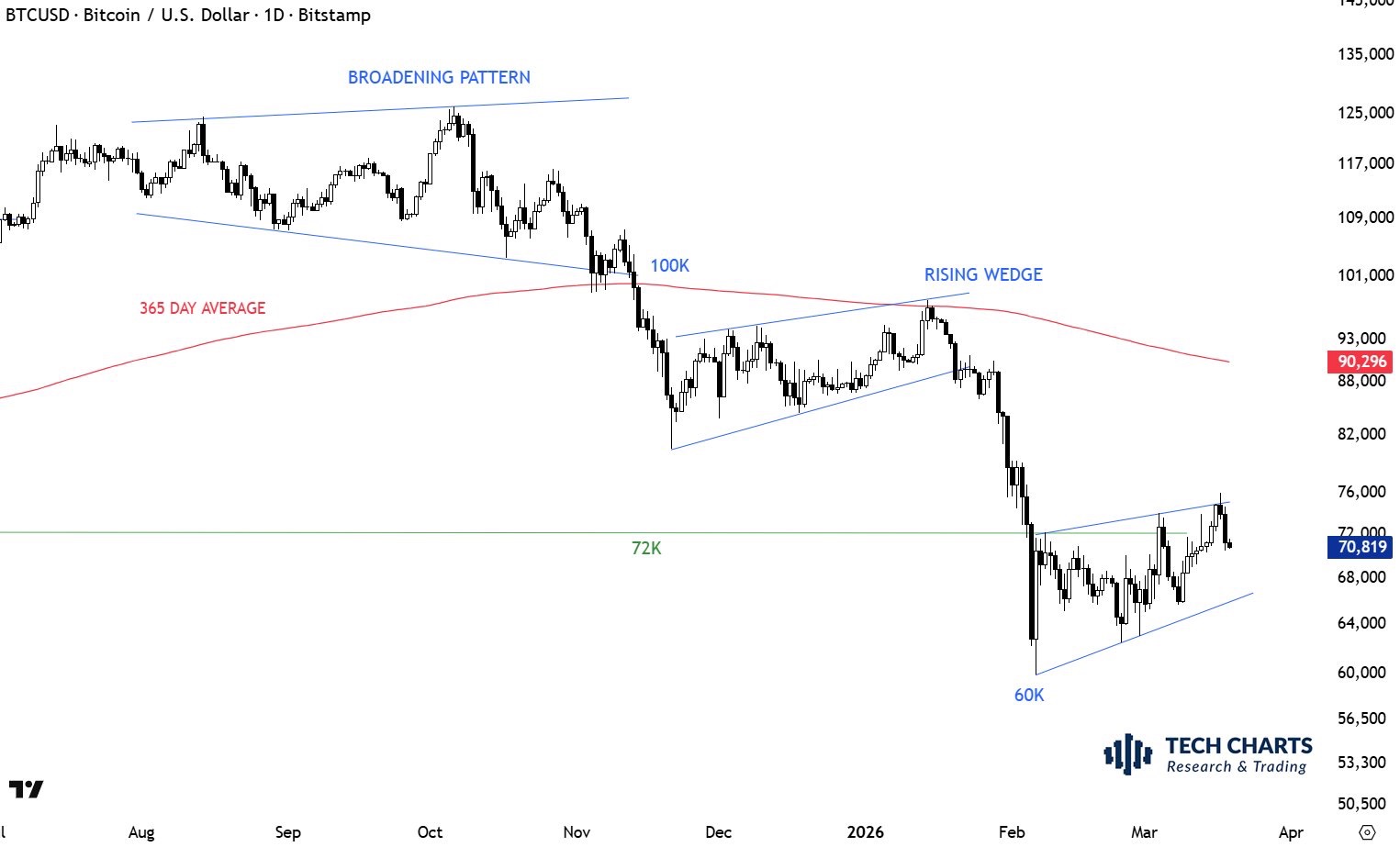
Bitcoin searches for equilibrium at $70,000 while rising crude oil prices and tanking stock markets have investors worried over the future of inflation in the US.
Bitcoin’s (BTC) swift rejection from its $76,000 range high on Tuesday, and the subsequent sell-off below $70,000, raised concerns among traders that the bottom is not in for BTC.
Chartered market technician Aksel Kibar suggested that a bearish wedge pattern similar to the one seen from December 2025 to early January 2026 may be forming again.
Kibar said,
“Breakdown of the lower boundary will be the signal for a possible move towards $52.5K.”

Kibar also referenced an X social post from Jan. 18, 2026, where he explained that BTC would need to respect its year-long average as “part of the chop and search for a base.”
Kibar said that “the pattern can become a rising wedge, usually bearish in an attempt to test $73.7K-$76.5K support area.”
Bitcoin follows US stocks as high oil prices and rising inflation rock markets
Bitcoin’s tumble below $70,000 followed sharp selling in US stocks, where traders’ concerns over crude oil prices, the cost of the US and Israel-Iran war and its impact on inflation zapped investor confidence.
Related: Bitcoin vs gold shows potential bottom signals as BTC bulls defend $70K
In a post discussing how the current decisions by the Trump administration could impact inflation, The Kobeissi Letter said,
“The market now sees a 50% chance of a US Fed rate HIKE by the end of 2026. Just months ago, markets saw as many as four rate CUTS this year.”
In its BTC Options Weekly report, Glassnode analysts concluded that “Bitcoin has reintegrated its range after a short-lived deviation above the $75K level.”
The analysts explained that within the options market, Bitcoin’s “short gamma at $75K has been unwound.”
“Beneath the pullback, the breakout has lost momentum and range conditions are returning.”
This article does not contain investment advice or recommendations. Every investment and trading move involves risk, and readers should conduct their own research when making a decision. While we strive to provide accurate and timely information, Cointelegraph does not guarantee the accuracy, completeness, or reliability of any information in this article. This article may contain forward-looking statements that are subject to risks and uncertainties. Cointelegraph will not be liable for any loss or damage arising from your reliance on this information.

Bitcoin whale dormant since 2012 moves $147 million in BTC

Bruno Fernandes fumes over controversial penalty decisions as Manchester United draw at Bournemouth

Tech Moves: Carbon Robotics’ new CFO; Microsoft gaming GM goes to Netflix; Nordstrom gets VP of AI

Smart energy pays enters the US market, targeting scalable financial infrastructure

Why Israel is blocking foreign journalists from entering

Bitcoin: We’re Entering The Most Dangerous Phase

Top Crystals for Business Growth & Financial Success | Rupesh Kapoor | Angel Crystal Healing

SELL THESE ALTCOINS! (These Chains Are DEAD)

What do you think #calebhammer #podcast #financialaudit #financialfreedom #finance #interview
-
 Crypto World7 days ago
HYPE Token Enters Net Deflation as HyperCore Buybacks Outpace Staking Rewards
-

 Tech5 days ago
Your Legally Registered ‘Motorcycle’ Might Not Count Under Proposed US Law
-
 Tech3 days ago
Are Split Spacebars the Next Big Gaming Keyboard Trend?
-
Sports6 days ago
Why Duke and Michigan Are Dead Even Entering Selection Sunday
-

 Politics4 hours ago
Jenni Murray, Long-Serving Woman’s Hour Presenter, Dies Aged 75
-

 Business5 days ago
Search for Savannah Guthrie’s Mother Enters Seventh Week with No Arrests
-

 Business6 days ago
US Airports Launch Donation Drives for Unpaid TSA Workers as Partial Government Shutdown Enters Fifth Week
-
Crypto World6 days ago
Coinbase and Bybit in Investment Talks: Could Bybit Finally Enter the US Crypto Market?
-

 Business5 days ago
Australian shares drop as Iran war enters third week
-

 Business6 days ago
Country star Brantley Gilbert enters growing non-alcoholic beer market
-

 Politics3 days ago
The House | The new register to protect children from their abusers shows Parliament at its best
-

 Crypto World5 days ago
Crypto Lender BlockFills Enters Chapter 11 with Up to $500M in Liabilities
-

 News Videos2 days ago
RBA board divided on rate cut, unusually buoyant share market | Finance Report | ABC NEWS
-

 Fashion5 days ago
25 Celebrities with Curly Hair That Are Naturally Beautiful
-

 Tech18 hours ago
inKONBINI Lets You Spend Summer Days Behind the Register
-

 Fashion5 hours ago
Weekend Open Thread: Adidas – Corporette.com
-

 Crypto World2 days ago
Canada’s FINTRAC revokes registrations of 23 crypto MSBs in AML crackdown
-
 Politics3 days ago
Real-time pollution monitoring calls after boy nearly dies
-

 Crypto World6 days ago
Crypto Losses Drop 87% in February, But Hackers Are Now Targeting People, Not Code
-
 NewsBeat2 days ago
Residents in North Lanarkshire reminded to register to vote in Scottish Parliament Election


You must be logged in to post a comment Login