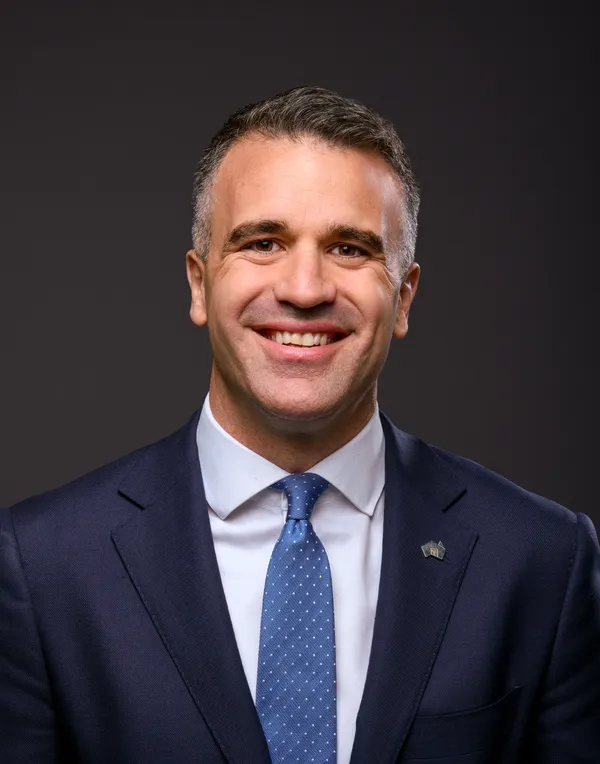
ADELAIDE, Australia — South Australians head to the polls Saturday, March 21, 2026, for a state election widely expected to deliver Premier Peter Malinauskas and the Labor Party a historic landslide victory. Polls consistently show Labor commanding massive leads, while Pauline Hanson’s One Nation threatens to eclipse the Liberal Party as the main opposition force in a dramatic realignment of the state’s political landscape.
Peter Malinauskas
The election, for all 47 seats in the House of Assembly and half the Legislative Council, follows a campaign dominated by cost-of-living relief, housing affordability and regional discontent. Early voting shattered records, with more than 361,000 ballots cast by March 20 — over 28% of enrolled voters — according to the South Australian Electoral Commission (ECSA). Polling booths open 8 a.m. to 6 p.m. Saturday, with results expected to flow from 7 p.m. onward.
Multiple final polls paint a grim picture for the opposition. A Newspoll survey (March 12-18) gave Labor 40% primary vote, One Nation 22%, Liberals 16% and Greens 12%. YouGov (March 9-17) showed Labor at 38%, One Nation 22% and Liberals 19%, with Labor leading 59-41 on two-party preferred against both rivals — a potential record margin since the state’s Labor Party formed in 1891. Resolve and DemosAU polls echoed similar trends, placing Labor around 32-37% primary and One Nation ahead of or close to the Liberals.
Analysts describe the result as a “transitional moment” in South Australian politics. Emeritus Professor Clement Macintyre from Adelaide University called a strong One Nation showing a potential “slap in the face” to the major parties, particularly if it relegates the Liberals to third place on primary vote. The Liberals, led by new Opposition Leader Ashton Hurn since December 2025, face their worst historical primary result, possibly below 20%. Hurn, contesting her seat, expressed hope for an upset but acknowledged the uphill battle.
Premier Malinauskas, enjoying approval ratings above 60% in recent surveys, campaigned on free school fees, energy rebates and infrastructure promises. Labor’s pitch emphasized stability and cost-of-living support, contrasting with Liberal offers like 50-cent public transport fares. One Nation surged in regional areas with anti-establishment messaging, immigration critiques and economic populism under Pauline Hanson’s active involvement.
Advertisement
Controversies marked the final days. A One Nation candidate in Adelaide faced UK extradition questions over a sexual touching charge, drawing media scrutiny. Labor ramped up attacks on One Nation’s policies and funding. Pauline Hanson and Cory Bernardi faced pointed questions in McLaren Vale about promise costs and travel.
The campaign featured record candidate numbers — 388 in the lower house — driven by right-wing and independent slates. This fragmentation could influence preference flows in marginal seats, though Labor’s strong two-party lead suggests limited impact on the overall outcome.
ECSA reported smooth early voting, with innovations like telephone-assisted voting debuting for accessibility. Media alerts highlighted record turnout and special arrangements in remote areas like Coober Pedy.
Malinauskas, in power since 2022, seeks to consolidate after a strong first term. His popularity contrasts with Liberal turmoil, including former leader Vincent Tarzia’s resignation in late 2025 and internal challenges.
Advertisement
If projections hold, Labor could secure its largest two-party preferred vote ever, potentially challenging national landslide records. One Nation’s performance will be watched nationally as a test of its appeal beyond Queensland and New South Wales.
Voters prioritize cost-of-living pressures, housing and health amid economic strains. Final pitches from leaders emphasized these issues, with Malinauskas urging continued support and Hurn calling for change.
As polling day arrives, attention turns to turnout, preference distributions and whether independents or minors claim seats. Results will shape South Australia’s direction for the next four years, with Labor poised for dominance and the Liberals facing existential questions.
ECSA urges voters to check enrollment and bring ID if needed. Live coverage begins Saturday evening across major networks.
I am a freelance business writer. I formerly wrote articles for the Motley Fool Blogging Network, where I won several editor’s choice awards. After that, I wrote articles for the main Motley Fool site. I typically focus on restaurants, retailers, and food manufacturers, considering both growth opportunities and valuation metrics. I usually look for long term investment opportunities and plan to hold stocks for several years.
Analyst’s Disclosure: I/we have no stock, option or similar derivative position in any of the companies mentioned, and no plans to initiate any such positions within the next 72 hours. I wrote this article myself, and it expresses my own opinions. I am not receiving compensation for it (other than from Seeking Alpha). I have no business relationship with any company whose stock is mentioned in this article.
Seeking Alpha’s Disclosure: Past performance is no guarantee of future results. No recommendation or advice is being given as to whether any investment is suitable for a particular investor. Any views or opinions expressed above may not reflect those of Seeking Alpha as a whole. Seeking Alpha is not a licensed securities dealer, broker or US investment adviser or investment bank. Our analysts are third party authors that include both professional investors and individual investors who may not be licensed or certified by any institute or regulatory body.
Joseph Shaefer is a geopolitical, economic, and resource analyst. He is a retired senior military officer with deep experience in Special Operations and Intelligence. He is also a former university professor and a retired Senior V.P. at Charles Schwab & Co. He is today the leader of the investing group The Investor’s Edge®. His approach to investing is both specific and universal. On one end of the “barbell,” he makes especially deep dives into Energy, Resources, Aerospace and Defense, and Infrastructure. On the other end, a thorough research into the safest and best-paying income ETFs and companies and their preferred shares. Unique features exclusively for subscribers at The Investors Edge® include the Growth & Value sample portfolio, early notification of articles likely to be discussed with the general Seeking Alpha audience, notification of purchases and sales prior to execution, and short notes and articles for subscribers on an as-it-happens basis. Five decades of experience, 2 to 4 articles monthly exclusively for subscribers, and access to Joseph and his community in a chat corner that is reviewed daily.
Analyst’s Disclosure: I/we have a beneficial long position in the shares of SARO either through stock ownership, options, or other derivatives. I wrote this article myself, and it expresses my own opinions. I am not receiving compensation for it (other than from Seeking Alpha). I have no business relationship with any company whose stock is mentioned in this article.
I write about SARO exclusively for your due diligence.
Advertisement
Seeking Alpha’s Disclosure: Past performance is no guarantee of future results. No recommendation or advice is being given as to whether any investment is suitable for a particular investor. Any views or opinions expressed above may not reflect those of Seeking Alpha as a whole. Seeking Alpha is not a licensed securities dealer, broker or US investment adviser or investment bank. Our analysts are third party authors that include both professional investors and individual investors who may not be licensed or certified by any institute or regulatory body.
The next leg of our corporate series here. We’re really excited to have Lucid here with us today. Lucid is an auto tech company that IPOed in 2021 and is focused on the design, development, customer experience, sale and service of premium electric vehicles, primarily, at least currently targeting the luxury consumer market. Its flagship consumer vehicles include the Lucid Air Sedan, Lucid Gravity three-row SUV and currently actively developing its Midsized platform, which I think we’re going to talk a lot about. So really, really excited to have Lucid here with us today.
Today, we have Marc Winterhoff, Lucid’s Interim Chief Executive Officer; as well as Taoufiq Boussaid, Chief Financial Officer. So thank you both for being here. We appreciate it.
Advertisement
Question-and-Answer Session
Unknown Analyst
So I guess maybe just to start, you just hosted your Investor Day. So I think timing is really good here. And you shared a number of updates. For investors who may have not been able to see the full presentation, can you maybe just walk us through what the most important takeaways you want sort of investors to focus on, on the back of your Investor Day that you hosted?
Advertisement
Taoufiq Boussaid Chief Financial Officer
Yes. I think that there are a couple of key messages. The first one and probably in my mind, the most important one is that we are at a pivotal time, a pivotal time where we’re transitioning from a period of heavy investment because we needed to establish our manufacturing system. We have 2026 being the last year of this heavy investment cycle and then we’re moving to
Good afternoon. This is the Chorus Call conference operator. Welcome, and thank you for joining the DiaSorin Full Year 2025 Results Conference Call. [Operator Instructions]
At this time, I would like to turn the conference over to Mr. Carlo Rosa, CEO of DiaSorin. Please go ahead, sir.
Advertisement
Carlo Rosa CEO, GM & Executive Director
Thank you, operator. Ladies and gentlemen, good afternoon, and welcome to the DiaSorin full year results.
Today, we have a busy agenda. I’m going to make some business remarks. Then our current CFO, Mr. Pedron is going to take us through the 2025 financials, our future CFO, Mr. Alberto is going to discuss about guidance 2026, and then collectively, we’re going to take questions.
So let me start from 2025 business comments. 2025, I think, marked a year of good achievement for our company with success for our strategy in the different technologies with Immuno delivering 7% growth, Molecular Diagnostics year-on-year flat and we’ll see later primarily related to the fact that the flu season this year is — has been very weak. And then LTG delivering to expectation flattish compared to previous year. And again, we will discuss later, primarily due to the fact that on the Life Science segment, as I think is very well known by everybody, 2025 has not been an exciting year.




















































You must be logged in to post a comment Login