
Crypto World
Crypto markets edge higher as gold sinks 43-year drop amid Iran war


Gold slid 3.5% on Friday, trading around $4,488 per ounce, as geopolitical volatility and uncertainty in the Middle East weighed on sentiment. The decline pushed the metal’s weekly drop to about 11%, the steepest weekly decline since 1983, underscoring how a risk-off environment can erode the appeal of traditional safe-havens when energy and geopolitical risks dominate markets.
From late February, when US and allied actions in the region intensified, gold has fallen more than 15%, erasing a portion of a rapid rally that had lifted prices toward the $5,500 mark in late January. TradingView data highlighted that March 16–20 marked gold’s worst-performing week since 1983, underscoring how quickly the narrative can shift in times of geopolitical strain. TradingView noted the week’s move as historically significant for the yellow metal.
Analysts say the conflict is disrupting global energy flows, particularly through the Strait of Hormuz, feeding fears of a prolonged energy crisis as markets weigh the balance between safe-haven demand and the impact of higher energy costs on inflation and growth. In such an environment, investors are furling into risk-off assets while considering how energy-market dynamics might influence central-bank policy in the near term.
Amid the regional tensions, US President Donald Trump said he was weighing a winding-down of some Middle East military efforts. While talk of reducing troop deployments emerged, the United States has continued to bolster its regional presence, and airstrikes in the area persisted. The evolving stance adds another layer of uncertainty for traders trying to gauge the risk premium priced into gold and other assets.
Market watchers are also focusing on the Federal Reserve’s policy outlook. The broader expectation remains that the Fed will hold interest rates steady for the year, which could keep fixed-income yields attractive relative to gold in the near term. In a related note, Fed Chair Jerome Powell signaled that higher energy prices could push inflation higher in the near term, complicating the inflation trajectory and potentially influencing the demand for both gold and crypto assets as hedges or diversifiers.
Bitcoin finds footing as gold wobbles
Over the past year, gold has outperformed many traditional assets, rising roughly 48.5% while the broader crypto market has retraced about 16.5% in the same period. In the current environment, Bitcoin has shown a degree of resilience, trading near $70,000 and having risen more than 11% since the initial Iran-related attacks. The latest move reflects a common pattern where crypto markets react to geopolitical shocks differently than traditional safe-havens, sometimes offering a counterbalance to gold’s shifts.
Bitcoin’s relative performance this month has been notable. While gold has faced renewed pressure from the energy and geopolitical backdrop, BTC’s pullback earlier this year has shifted into a recovery phase, with the digital asset reclaiming some ground as investors evaluate risk, liquidity, and the potential for institutional and retail adoption to influence price trajectories. The dynamics illustrate a broader theme in crypto markets: while gold’s role as a hedge remains debated in times of energy-market stress, Bitcoin can exhibit outsized sensitivity to policy signals, global risk appetite, and liquidity conditions.
That said, the longer-term relationship between gold and crypto remains nuanced. The twelve-month lens shows gold’s robust rally vs. a broader crypto retracement, highlighting ongoing debates about which assets best weather macro shocks and how central-bank policy, energy volatility, and geopolitical risks reweight those choices for investors, traders, and builders in the crypto ecosystem.
What this means for markets and readers
The current environment underscores a few persistent themes for crypto markets and traditional assets alike. First, geopolitical risk can simultaneously depress traditional safe havens like gold and alter risk sentiment in crypto, where Bitcoin and other digital assets may trade as high-beta instruments in the short term. Second, energy-price dynamics and central-bank policy expectations are closely linked; if energy costs push inflation higher longer than anticipated, monetary policy paths may shift, affecting both gold’s appeal and crypto liquidity environments. Lastly, as the Strait of Hormuz and related chokepoints remain in focus, traders will continue to monitor oil-flow disruptions and their implications for global growth and asset correlations.
Investors should watch how central banks respond to evolving energy and inflation signals in the coming weeks, alongside any escalation or de-escalation in regional tensions. Crypto traders may look for catalysts in liquidity shifts, exchange flows, and macro scenarios that could widen the divergence between traditional safe-havens and digital-asset assets.
Looking ahead, the market will be attentive to any developments that could alter the risk calculus: a clear shift in Middle East policy, updates from the Fed on rate guidance, and how energy markets respond to supply-and-demand dynamics. In these conditions, gold and Bitcoin continue to offer distinct narratives about hedging, risk-taking, and the evolving role of crypto in a macro-driven market backdrop.
Readers should stay tuned for updates on geopolitical developments, central-bank communications, and energy-market signals, as they will shape the relative performance of gold, Bitcoin, and the broader crypto landscape in the near term.


Key Takeaways
- CEG shares closed at $281.99, marking a 10.9% decline that significantly outpaced the S&P 500’s 1.51% retreat
- Major technology companies are reportedly scaling back commitments to large-scale power agreements, undermining key growth assumptions
- Federal regulators proposed a rate ceiling for the PJM mid-Atlantic grid that could restrict CEG’s pricing power
- An industrial chemical incident at a Constellation facility resulted in employee hospitalizations, raising operational questions
- Wall Street forecasts remain intact with Q1 EPS projected at $2.70, representing 26% annual growth, and full-year sales estimated at $38.71 billion
Shares of Constellation Energy (CEG) took a beating on Thursday, plummeting 10.9% to finish at $281.99. The decline was particularly brutal given that broader equity indexes faced only modest weakness.
Constellation Energy Corporation, CEG
The stock faced simultaneous headwinds from three distinct angles — each serious enough to move shares on its own.
The most significant development centered on emerging reports that major hyperscale technology firms are reconsidering their long-term power procurement strategies. These agreements had formed a critical pillar of CEG’s investment thesis, particularly around powering next-generation artificial intelligence infrastructure.
With that narrative showing cracks, market participants began reassessing whether the stock’s valuation premium remained justified.
Regulatory developments compounded the damage. News surfaced of a proposed federal cap on electricity rates within the PJM Interconnection, a regional transmission grid spanning the mid-Atlantic where Constellation maintains substantial nuclear generation capacity. Such restrictions would effectively limit the company’s ability to capture higher margins during peak demand periods.
The market’s reaction was swift and unforgiving.
Facility Incident Compounds Negative Sentiment
Operational concerns added another layer of uncertainty. A chemical release at one of the company’s power generation sites resulted in multiple workers requiring medical treatment, introducing safety and operational risk questions into the mix.
While the incident’s scope wasn’t large-scale, its timing couldn’t have been worse. When investor confidence in a growth story is already fragile, even secondary concerns can accelerate selling pressure.
The convergence of demand skepticism, regulatory constraints, and operational mishaps created a perfect storm for shareholders.
Wall Street Forecasts Remain Unchanged
Interestingly, sell-side expectations for the company’s financial performance haven’t shifted materially despite the stock’s tumble. Analysts continue to anticipate first-quarter earnings per share of $2.70, marking a 26% improvement compared to the prior-year period.
For the full fiscal year, consensus estimates project earnings of $11.63 per share on revenue reaching $38.71 billion — which would represent a substantial 51.6% top-line expansion if realized.
The Zacks consensus earnings estimate has actually increased 2.41% during the past 30 days, while CEG maintains a Zacks Rank of #3, indicating a Hold rating.
The company’s forward price-to-earnings multiple stands at 27.22 — notably higher than the industry benchmark of 18.86 — suggesting the market had been pricing in robust growth prospects before this week’s turbulence.
Its PEG ratio of 1.77 sits below the Alternative Energy sector’s 2.0 average, offering some relative value support.
It bears mentioning that prior to Thursday’s collapse, CEG had gained 8.51% over the preceding month — indicating the stock had been building momentum before this abrupt reversal.
Year-to-date performance now registers at -10.3%, illustrating how dramatically sentiment has shifted in early 2026.
Market participants will be scrutinizing the company’s next earnings report for management commentary on the status of technology sector power agreements and any additional details regarding the facility incident.


Quick Overview
- CleanSpark delivered fiscal 2025 revenue expansion exceeding 100% and maintains a Moderate Buy rating from 15 Wall Street analysts
- MARA Holdings receives a Hold rating but brings significant scale plus a Bitcoin balance sheet approach that may prove valuable if crypto remains elevated
- Riot Platforms saw expanding revenue momentum through 2025 while analysts monitor its energy infrastructure and data center operations
- Bitdeer shows the steepest potential gains with analyst targets suggesting 200%+ upside, contingent on successful SEALMINER chip deployment
- Galaxy Digital operates across trading desks, fund management, advisory services, and mining, earning a Moderate Buy from 15 analysts
With Bitcoin showing renewed vigor in 2026, Wall Street has turned its focus back to a select group of cryptocurrency-exposed equities. Five companies have emerged as particularly interesting: CleanSpark, MARA Holdings, Riot Platforms, Bitdeer Technologies, and Galaxy Digital. This cohort represents the full spectrum of Bitcoin mining operations, energy management, proprietary hardware development, and comprehensive digital asset financial services.
CleanSpark
CleanSpark stands out as having among the most compelling operational narratives in the space currently.
The firm delivered fiscal 2025 top-line expansion exceeding 100%. Growth at that magnitude commands investor attention.
According to MarketBeat tracking, the stock holds a Moderate Buy rating based on 15 analyst opinions — comprising 13 buy recommendations, 1 hold, and 1 sell. The thesis centers on consistent operational delivery paired with a valuation multiple that appears attractive when benchmarked against comparable crypto infrastructure businesses.
MARA Holdings
MARA Holdings generates more debate among the analyst community, which is precisely why certain investors identify opportunity.
Marathon Digital Holdings, Inc., MARA
While the company delivered robust annual revenue expansion, it currently holds a Hold rating on MarketBeat based on 7 buy ratings, 3 holds, and 2 sells. The more measured outlook probably stems from the stock’s track record of sharp price swings.
What distinguishes MARA from traditional mining operations is its corporate Bitcoin accumulation approach. Should cryptocurrency valuations hold steady and the company enhance operational margins, analyst sentiment could turn more favorable.
Riot Platforms
Riot Platforms experienced notably stronger revenue momentum throughout 2025. MarketBeat shows a Moderate Buy rating across 18 analysts — broken down as 16 buys, 1 hold, and 1 sell.
Riot’s investment case extends beyond Bitcoin production. Market participants are increasingly focused on its power generation capabilities and expanding high-performance computing facilities.
This strategic diversification may enable the shares to command a premium valuation as investors begin viewing it through an infrastructure lens rather than solely as a cryptocurrency miner.
Bitdeer Technologies
Bitdeer represents the most speculative opportunity within this cohort.
MarketBeat data indicates an average Wall Street price objective of $26.60, suggesting potential appreciation exceeding 200% from current trading levels. Multiple firms maintain constructive ratings despite moderating their price targets recently.
The optimistic scenario hinges on accelerating revenue, expansion of proprietary mining operations, and successful commercialization of its SEALMINER chip technology. Execution challenges are substantial, yet so are the potential returns if management delivers on its roadmap.
Galaxy Digital
Galaxy Digital operates the most diversified business model among these five companies.
Instead of concentrating exclusively on mining or acting as a proxy for exchange activity, Galaxy maintains operations spanning proprietary trading, venture capital, wealth management, corporate advisory, and Bitcoin production. MarketBeat reflects a Moderate Buy consensus including 1 strong buy, 11 buys, 2 holds, and 1 sell. Average analyst price targets cluster between $42.54 and $42.77.
Galaxy’s market capitalization appears modest relative to the breadth of its revenue streams, especially considering its involvement in high-performance computing expansion via its Helios infrastructure project.
Final Thoughts
These five enterprises represent distinct risk-return profiles. CleanSpark and Riot present more balanced propositions. MARA delivers scale but faces ongoing valuation questions. Bitdeer offers the steepest potential appreciation alongside the greatest execution uncertainty. Galaxy provides the broadest exposure across crypto sector verticals.
Key near-term factors influencing this group include Bitcoin price stability, energy cost trajectories, mining hardware efficiency improvements, and advancement of their respective data center initiatives. Among company-specific developments, Galaxy’s Helios buildout and Bitdeer’s SEALMINER deployment timeline represent the most closely monitored milestones as 2026 progresses.


Grayscale has filed with the U.S. Securities and Exchange Commission to launch the Grayscale HYPE ETF, a proposed spot exchange-traded fund tied to Hyperliquid’s native token, HYPE.
Summary
- Grayscale filed for a Nasdaq-listed HYPE ETF tied to Hyperliquid’s native token price movement.
- The proposed fund may add staking later, though it will not offer staking initially.
- Hyperliquid remains the largest onchain perps venue despite slower volumes and growing competition from rivals.
If approved, the fund would trade on Nasdaq under the ticker GHYP and would give investors listed market access to the token without holding it directly.
Meanwhile, the filing adds Grayscale to a growing list of firms seeking investment products linked to Hyperliquid, a blockchain focused on decentralized perpetual futures trading. The move also comes as crypto ETF issuers continue to expand beyond Bitcoin and Ether into newer digital assets.
Grayscale’s S-1 filing said the proposed fund would track the price of HYPE. The company named Coinbase Custody as custodian and said it would use CoinDesk benchmark pricing data for valuation. The filing did not disclose a management fee.
The application places Grayscale alongside other issuers already pursuing similar products. Bitwise and 21Shares filed for Hyperliquid-linked funds earlier, showing that asset managers are starting to test investor demand for exchange-traded products tied to newer crypto tokens.
Filing includes possible future staking option
The filing said staking is not allowed for the fund at launch. It also noted a “Staking Condition” that could be satisfied later, which may allow the product to add staking in the future.
That part of the filing follows a broader trend in crypto ETFs. Fund issuers have shown interest in adding staking rewards, but U.S. regulators have moved more slowly on that issue than on basic spot fund approvals. Grayscale said it may consider staking later if conditions permit.
Moreover, Hyperliquid has become one of the best-known platforms in decentralized perpetual futures trading. Market data cited in the report said the network remains the largest onchain venue for perps, even as new competitors entered the market in 2025.
Weekly trading volume on Hyperliquid has ranged from about $40 billion to $100 billion this year, according to DeFiLlama data cited in the report. While volumes have cooled from earlier peaks, the platform remains ahead of rivals such as Aster, Lighter, and edgeX.
Broader ETF push expands beyond major tokens
The Grayscale filing comes during a period of wider crypto ETF activity in the United States. Under SEC Chair Paul Atkins, the agency has approved a broader set of crypto-related funds, though rules around staking remain less clear.
Hyperliquid is still not available to U.S. users on its core platform, but its profile has grown as more firms watch decentralized trading infrastructure.
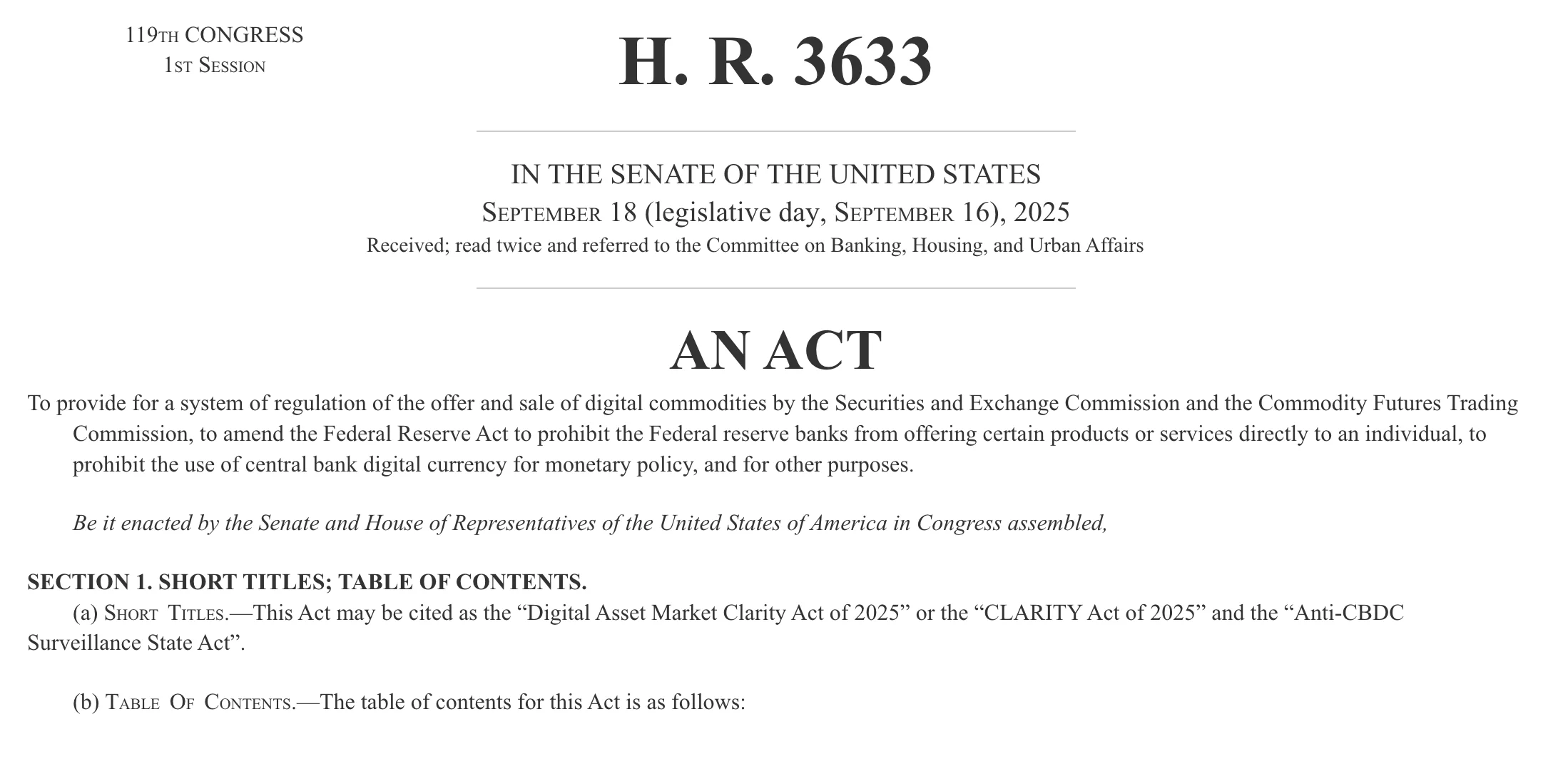
A tentative agreement on stablecoin yield may help restart progress on the CLARITY Act in Washington. Reports said White House officials and US lawmakers are working on terms that could address one of the main disputes that slowed the crypto market structure bill earlier this year.
Summary
- A reported agreement in principle may help restart stalled progress on the CLARITY Act.
- Lawmakers are weighing limits on stablecoin yield to address bank deposit flight concerns carefully.
- Crypto industry review is still pending before any stablecoin yield compromise becomes final law.
The talks center on whether stablecoin issuers should be allowed to offer yield to holders. That issue has divided crypto firms and banks, with both sides watching closely as lawmakers try to move the bill forward.
A Politico report said Senator Thom Tillis and Senator Angela Alsobrooks reached an “agreement in principle” on stablecoin yield. Both senators sit on the Senate Banking Committee, which has played a central role in digital asset policy talks.
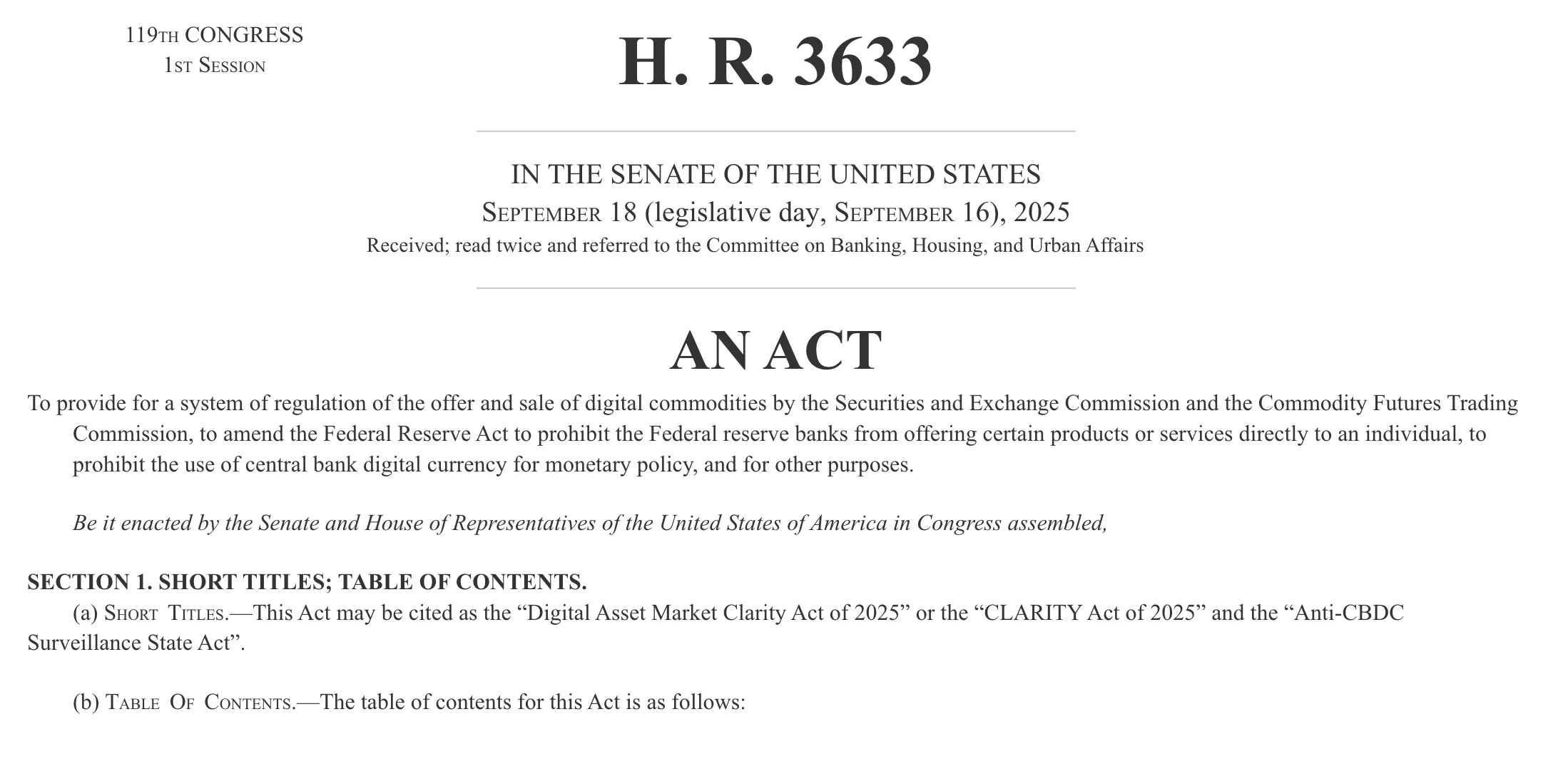
Alsobrooks said the deal would help “protect innovation” while also limiting the risk of deposit flight from the banking system. She added that the agreement would block stablecoin yield on “passive balances,” pointing to a narrower path for how yield could work under future rules.
CLARITY Act remains stalled over key questions
The Digital Asset Market Clarity Act of 2025 had been expected to move ahead after the GENIUS stablecoin framework became law. That changed when debate grew around whether stablecoin issuers could share yield directly with token holders.
Industry groups and lawmakers have treated that issue as a central point in the bill. Senator Tillis said the crypto industry still needs to review the emerging agreement before anything is finalized, which means the text may still change before formal action.
Speaking at the DC Blockchain Summit, Senator Cynthia Lummis said, “We are so close” to passing a broader crypto framework. A spokesperson for Lummis also said a deal could come together within days as work continues on ethics language tied to the bill.
Those comments suggest lawmakers are still trying to package stablecoin policy and market structure rules into a wider crypto framework. The timing remains uncertain, but the latest talks show that negotiations are active again after the January slowdown.
Banks and crypto firms remain split
Banks have opposed yield-bearing stablecoins, saying they could pull deposits away from traditional accounts. That concern has been one of the strongest arguments against allowing broad yield features in stablecoin products.
The White House has also heard the opposite case. Patrick Witt, executive director of the White House Council of Advisors for Digital Assets, said those concerns are overstated and argued that regulated yield-bearing stablecoins could bring new capital into the US banking system.

Key Takeaways
- United Airlines shares declined 4.46% Friday following CEO Scott Kirby’s announcement of a 5% reduction in planned flights.
- Since late February, jet fuel prices have surged nearly 100% amid the Iran conflict.
- The carrier is scenario-planning for crude oil reaching $175 per barrel, with prices potentially remaining above $100 until late 2027.
- At present fuel price levels, United faces an additional $11 billion in annual fuel expenses.
- Despite capacity cuts, United will maintain its aircraft delivery schedule and avoid employee furloughs.
United Airlines (UAL) saw its shares fall 4.46% Friday after CEO Scott Kirby informed employees the airline would reduce its flight schedule by approximately 5%. The decision follows a dramatic spike in jet fuel costs, which have almost doubled since late February due to escalating conflict in Iran.
United Airlines Holdings, Inc., UAL
In an internal memo published on the company’s official website, Kirby detailed the challenging outlook ahead. The airline is preparing contingency plans for crude oil prices potentially reaching $175 per barrel, with expectations that prices could remain above $100 through 2027’s end.
If these projections materialize, the additional fuel expenditure would approach $11 billion annually — exceeding twice the profit United generated during what Kirby described as the company’s most successful year on record.
The airline has been systematically eliminating underperforming routes. This includes certain midweek departures, Saturday services, and red-eye flights experiencing softer passenger demand.
According to the revised operational plan, United will eliminate approximately three percentage points of lower-demand flying during the second and third quarters. Additionally, the carrier will reduce roughly one percentage point of capacity from its Chicago O’Hare hub.
Routes to Tel Aviv and Dubai remain suspended indefinitely. Combined, these adjustments represent approximately five percentage points of the airline’s annual capacity projections.
Kirby indicated that United intends to resume full scheduling this autumn — provided fuel costs stabilize rather than continue climbing.
Rising Ticket Prices Provide Some Relief
Strong travel demand is offering partial relief from mounting costs. Major U.S. carriers have successfully implemented two consecutive fare increases of approximately $10 per direction. Kirby noted that bookings completed over the past week showed fare increases of 15% to 20%.
According to Melius Research analysts, robust booking trends could support an additional 5% to 7% fare adjustment. United revealed that the initial 10 weeks of 2026 represented the strongest booking period in company history.
Competitor Delta Air Lines has similarly signaled willingness to reduce capacity if elevated prices persist, following an upward revision to its first-quarter revenue guidance this week.
U.S. carriers face particular vulnerability compared to certain European and Asian competitors — the majority don’t employ fuel hedging strategies, leaving them significantly exposed to volatile price fluctuations.
Growth Plans Remain Intact
Notwithstanding immediate capacity reductions, Kirby assured employees that United’s broader expansion strategy remains unchanged.
The airline will proceed with accepting delivery of approximately 120 new aircraft throughout this year, including 20 Boeing 787 wide-body jets. An additional 130 aircraft are scheduled for delivery by April 2028.
Kirby emphasized that United will avoid employee furloughs and maintain planned investments — marking a departure from strategies employed during previous industry downturns.
In after-hours trading Friday, UAL stock recovered slightly, gaining 1.49% to reach $91.29, clawing back some of the session’s losses.

Key Highlights
- A temporary restraining order from Nevada’s First Judicial District Court was issued against Kalshi on Friday, lasting 14 days
- Kalshi must cease offering sports, entertainment, and election-related contracts within Nevada
- Nevada’s Gaming Control Board initially ordered Kalshi to discontinue sports contracts in 2025
- A jurisdictional battle is underway between the CFTC and state authorities over prediction market oversight
- Kalshi faces additional charges in Arizona for operating without a gambling license
A Nevada court has mandated that prediction market operator Kalshi suspend its event contract offerings within the state for a minimum of two weeks. On Friday, March 20, the First Judicial District Court of Nevada handed down this temporary restraining order.
The judicial order encompasses all sports-related, entertainment, and election wagering contracts available through the platform. A subsequent court hearing has been calendared for April 3.
This legal conflict has been ongoing. Nevada’s Gaming Control Board initially sent a cease-and-desist directive to Kalshi in 2025, demanding the platform discontinue all sports-related event contracts operating within state boundaries.
Kalshi contested this action, maintaining that its federal regulatory oversight should take precedence over state-level jurisdiction. The platform attempted to transfer the proceedings to federal court.
This strategy was unsuccessful. The U.S. Court of Appeals for the Ninth Circuit rejected Kalshi’s request for a stay on Thursday and remanded the matter to Nevada’s state court system.
The Nevada judge determined that the gaming board’s regulatory functions are compromised while Kalshi continues operations without obtaining a state license. The ruling stated that an “unlicensed participant beyond the Board’s control” interferes with the board’s statutory responsibilities.
Kalshi has not issued a statement regarding the Nevada decision.
Federal Regulator Asserts Authority
On the federal front, U.S. Commodity Futures Trading Commission Chair Michael Selig has been actively challenging state enforcement actions. He submitted a legal brief contending that the CFTC, rather than individual states, possesses proper regulatory authority over prediction market platforms.
Selig has reiterated this position during multiple public appearances and has committed that his agency will maintain its jurisdictional claims. The CFTC has additionally issued regulatory guidance informing exchanges that list event contracts that compliance with the Commodity Exchange Act is mandatory.
Major League Baseball has aligned with the federal regulatory framework, executing a memorandum of understanding with the CFTC regarding prediction market supervision. MLB separately announced a collaborative arrangement with Polymarket this week.
Escalating State Actions
Nevada represents just one jurisdiction taking action against Kalshi. Earlier in the week, Arizona’s attorney general filed charges against the company for conducting an unlicensed gambling operation and facilitating illegal election betting.
Tennessee has similarly initiated legal proceedings against prediction market platforms concerning sports-related contracts.
Federal legislators have also expressed concerns. In January, Democratic Representative Ritchie Torres proposed legislation to restrict how elected officials engage with prediction markets, prompted by wagers placed on the potential capture of former Venezuelan President Nicolás Maduro.
Last week, Democratic lawmakers unveiled the “Death Bets Act,” proposing a prohibition on prediction market contracts related to death, armed conflict, or political assassination.
The Nevada court acknowledged that federal preemption questions in this regulatory space are “nuanced and rapidly evolving.”
The upcoming hearing in the Nevada proceedings is scheduled for April 3, 2026.
Crypto World
Federal Reserve Rate Hike Probability Surges to 25% as Iran Conflict Escalates Oil Prices
Key Takeaways
- Bank of America analysts suggest Federal Reserve could increase interest rates if ongoing Iran conflict pushes crude oil beyond the $80 threshold
- Rate hike probability has surged to 25% by year-end, jumping from virtually zero just five days earlier
- Federal Reserve Chairman Powell indicated rate reductions remain off the table without demonstrable inflation improvements
- Bitcoin faces significant headwinds, battling to maintain the $70,000 support level amid growing macroeconomic uncertainty
- Typically dovish Fed Governor Chris Waller shifted his stance, voting to maintain current rates citing escalating inflation concerns
The Federal Reserve’s policy trajectory has undergone a dramatic reversal. Market expectations have flipped from anticipating rate reductions just days ago to seriously considering the prospect of monetary tightening for the first time in years.
This remarkable transformation stems from escalating U.S.-Iran tensions that erupted on February 28, driving crude oil prices upward and reigniting inflation anxieties. Bank of America’s analysis identifies three critical catalysts that could trigger a Fed rate increase: continued labor market resilience, Jerome Powell’s extended tenure as Federal Reserve chair beyond current expectations, and persistent oil price elevation driven by Middle East conflict.
According to BofA strategists, the likelihood of tightening intensifies significantly should oil prices sustain levels above $80 per barrel. Recent weeks have seen crude trading consistently near this critical threshold.
Powell’s Recent Commentary
During this week’s FOMC press conference, Federal Reserve Chairman Jerome Powell emphasized that rate reductions will not materialize without concrete evidence of inflation moderation. While he avoided explicitly forecasting a rate increase, Powell acknowledged such action doesn’t represent the consensus baseline among policymakers.
Powell further disclosed he may remain in his current position until his anticipated successor, Kevin Warsh, completes the Senate confirmation process. This timeline remains uncertain. Should Powell continue leading the Fed through the June FOMC meeting while Iran-related oil price pressures persist, the case for tightening could strengthen considerably.
Market pricing reflected zero expectation of rate increases just five days ago. Current CME FedWatch interest rate futures now indicate approximately 25% probability of a hike materializing by December. This represents an extraordinary sentiment shift over an exceptionally brief period.
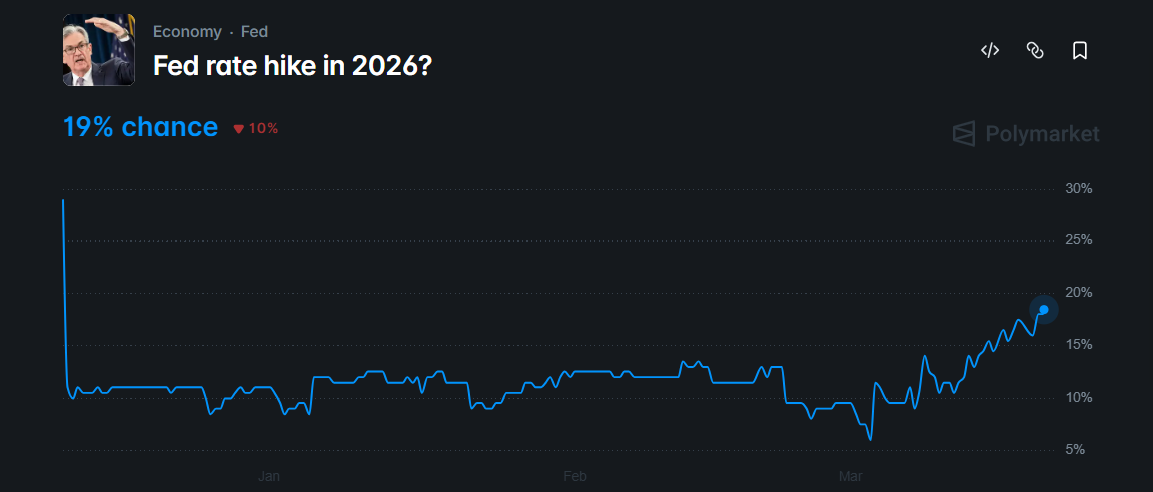
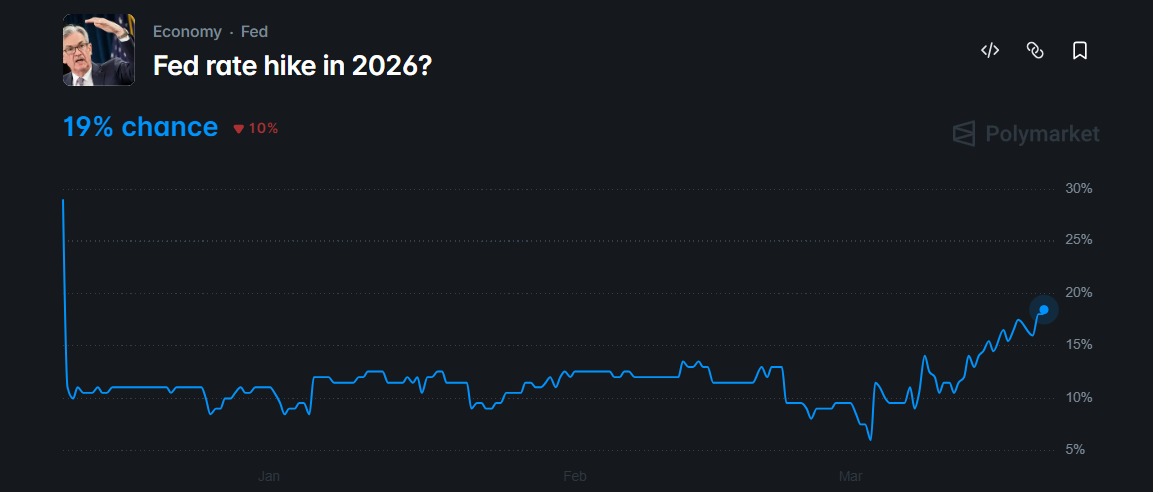
Polymarket prediction markets show 35% odds that the Federal Reserve implements zero rate cuts throughout 2024. The probability of an outright rate hike has climbed to 19%, nearly doubling from the 8% level recorded when the conflict initially erupted.
Cryptocurrency Market Response
Bitcoin is experiencing considerable strain. The leading cryptocurrency has encountered difficulty maintaining the $70,000 level as inflation concerns mount and rate cut expectations evaporate. The aggregate cryptocurrency market capitalization declined from an intraday peak of $2.4 trillion to $2.37 trillion within a single trading session.
Crypto assets experienced a temporary relief bounce before resuming their downward trajectory alongside equity markets. Two-year Treasury yields surged to 3.89%, marking the widest spread above the Fed’s policy rate in three years. This development signals bond market participants are incorporating expectations of tighter monetary conditions ahead.
Polymarket data indicates the probability of a U.S.-Iran ceasefire has declined to 42%, suggesting traders anticipate continued conflict.
Fed Governor Chris Waller, who previously advocated for rate cuts following a disappointing February employment report, reversed his position this week. He cited elevated inflation risks connected to the Iran situation as the decisive factor in his vote to maintain current rates. Waller emphasized the prudence of adopting a wait-and-see approach before committing to any policy easing measures.
Quick Overview
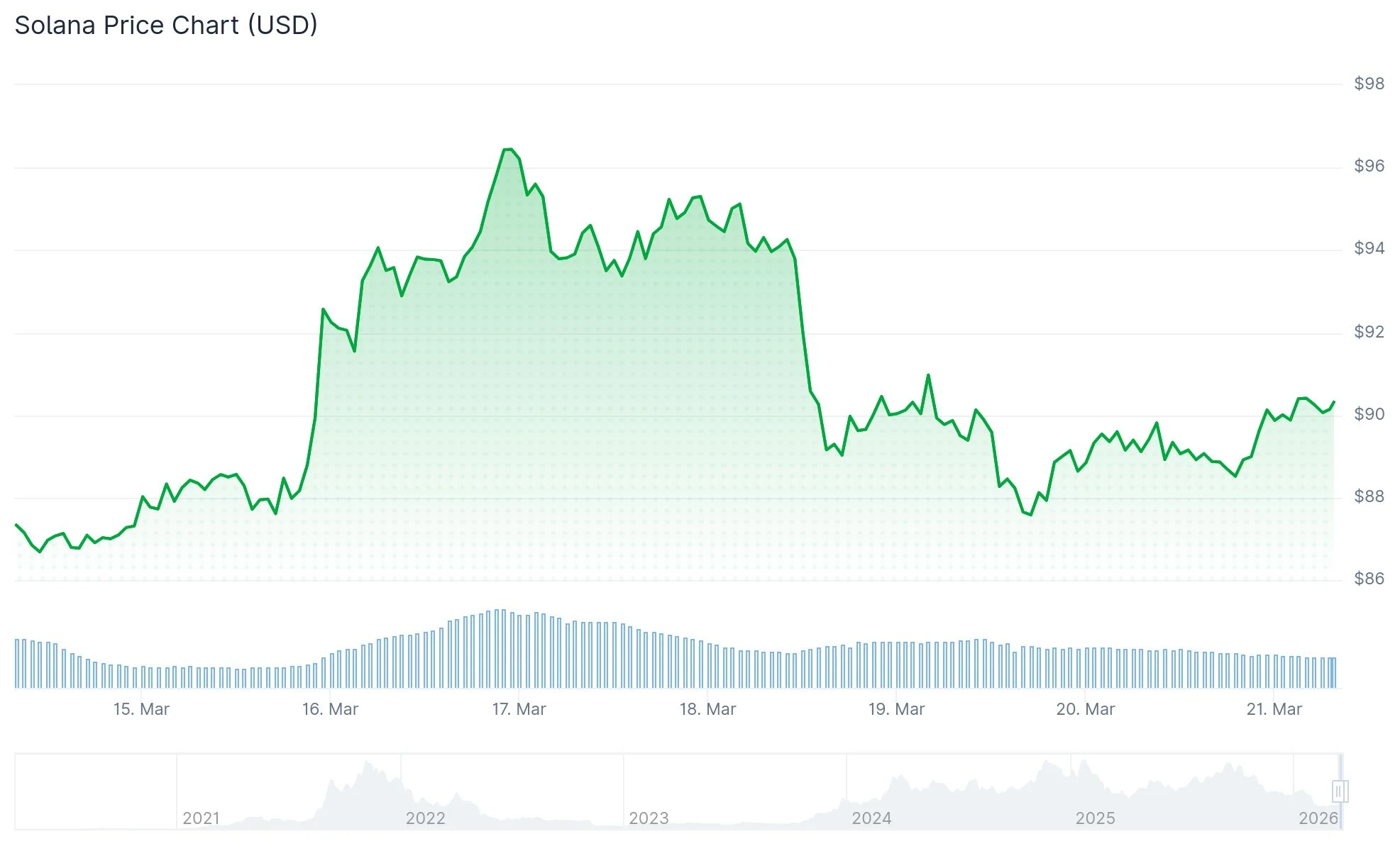
- SOL maintains position near $88, defending critical trendline support following retreat from $95 resistance
- Market sentiment deteriorated to 30 (Fear) on the Fear and Greed Index after Fed Chair Powell’s remarks regarding Iran conflict economic implications
- The network handled more than 880 million transactions in the past week, though weekly fee generation stayed modest at $4.6 million
- Real-world asset tokenization on Solana has exceeded $1.82 billion, while RWA-focused DeFi protocols reached $465 million in total value locked
- Market observers identify the $50–$80 zone as a prime accumulation area, with optimistic long-term projections ranging from $500 to $1,000
Solana continues to trade near the $88 mark following its recent decline from $95 highs. The digital asset remains supported by a critical trendline that market participants are monitoring with heightened attention.
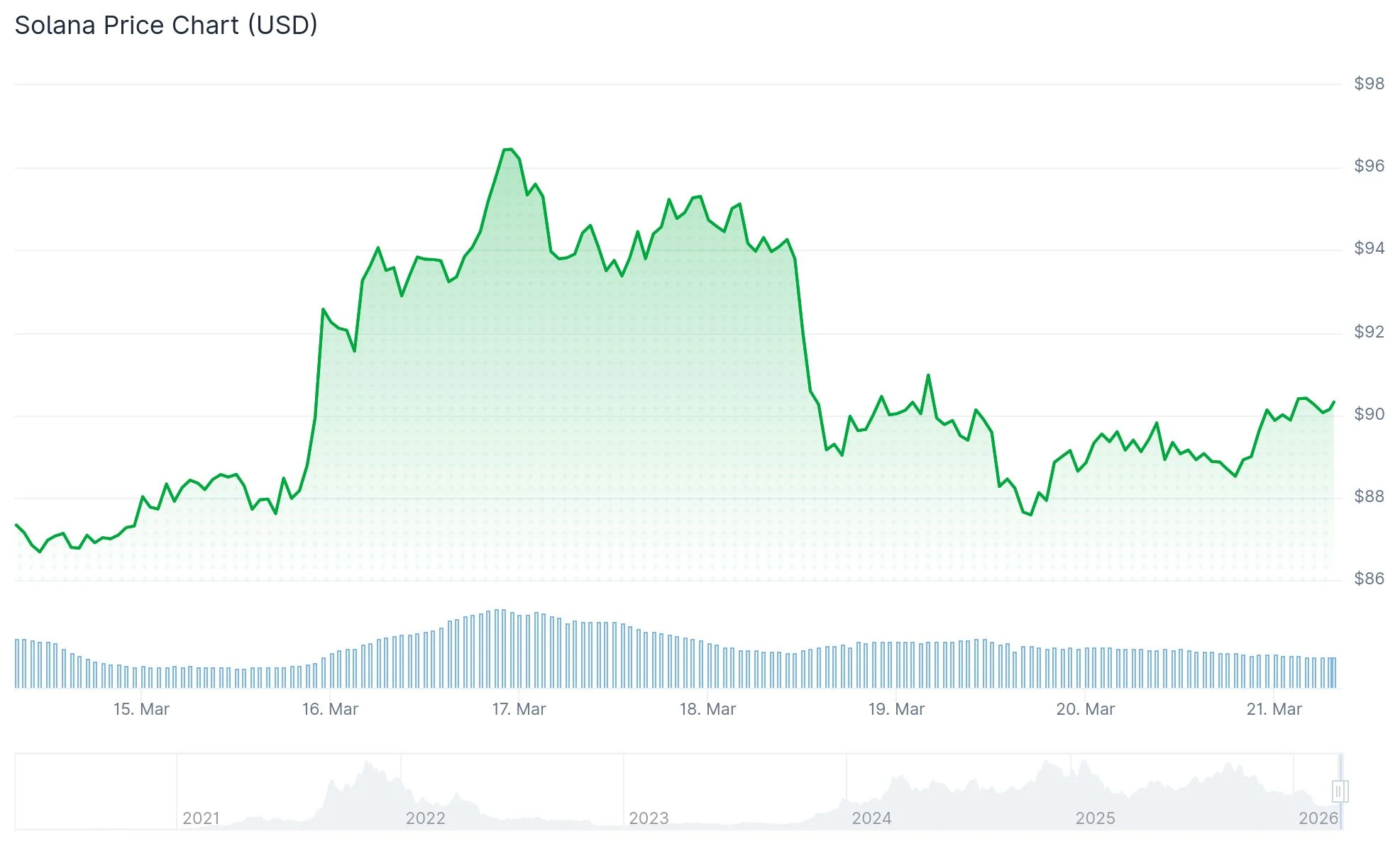
Daily trading volume has contracted to $3.3 billion, representing a significant decrease from the $6.5 billion recorded on March 16 when SOL momentarily reached $95. Market bulls seem to be securing gains prematurely during upward movements as overall crypto market confidence weakens.
The Crypto Fear and Greed Index experienced a notable shift from 46 (Neutral) down to 30 (Fear) following Federal Reserve Chairman Jerome Powell’s statement characterizing the economic consequences of the Iran conflict as “uncertain.” Rising crude oil prices could potentially fuel inflation, possibly forcing the Fed to postpone or abandon planned interest rate reductions in 2025.
Network Usage Outpaces Fee Generation
The Solana blockchain handled upwards of 880 million transactions throughout the previous week. This figure approaches the network’s peak of 959 million transactions recorded during the week concluding February 8.
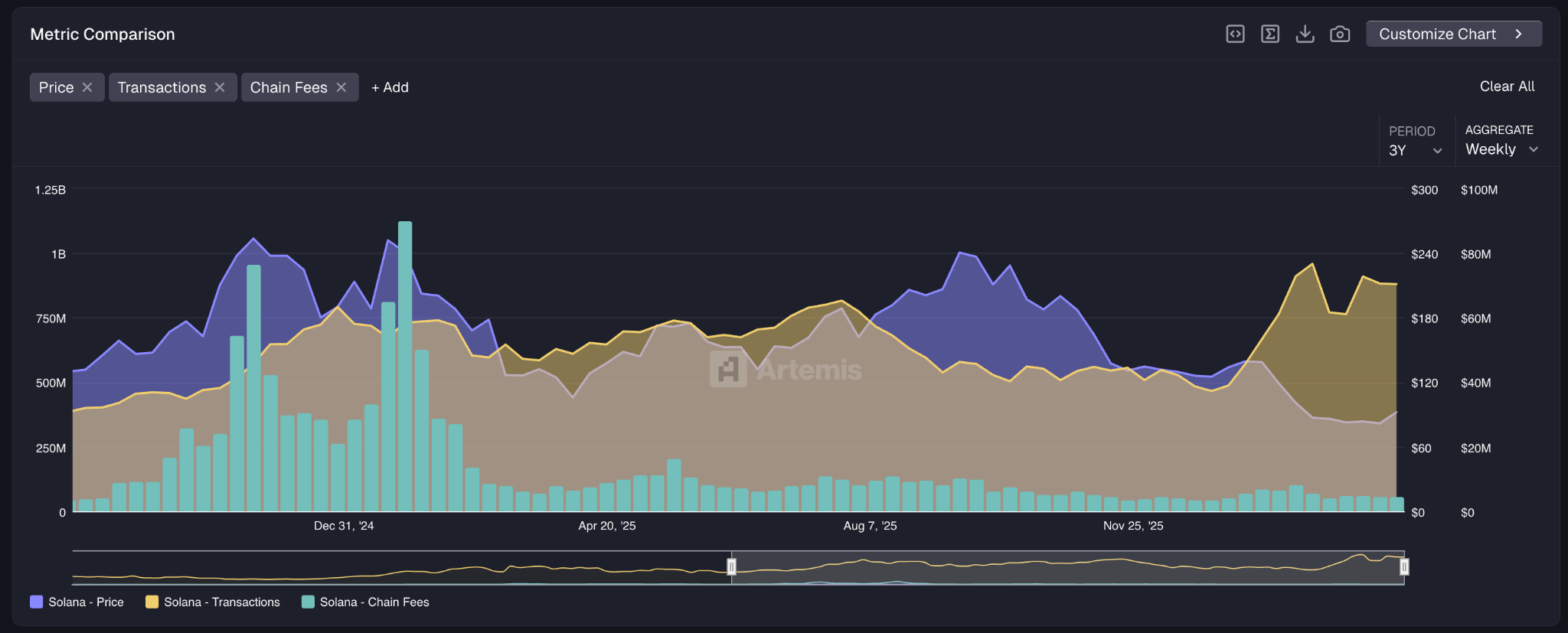
Despite robust network utilization, weekly fee collection totaled merely $4.6 million. This represents a 50% reduction compared to fees generated during Solana’s June–September 2025 price surge, when transaction volumes were comparatively lower at 700–800 million weekly.
Reduced fee generation typically signals diminished network valuation prospects. Market analysts interpret the existing disconnect between transaction throughput and revenue generation as a potentially bearish indicator for the intermediate term.
From a technical perspective, SOL confronts critical resistance at the $87 threshold. Failure to maintain this level could trigger a descent toward $77, representing an 11.5% downward move. Conversely, successful defense coupled with substantial volume during U.S. market hours might catalyze a recovery attempt toward $100.
Real-World Asset Tokenization Achieves New Milestone
Solana’s real-world asset infrastructure surpassed $1.82 billion in tokenized holdings on March 20. This encompasses digitized debt instruments, equity securities, and investment funds deployed on the blockchain.
DeFi applications focused on RWA integration within the Solana ecosystem achieved a record $465 million in total value locked. Although Ethereum maintains dominance in absolute RWA market capitalization, Solana continues expanding its footprint in this emerging sector.
Digital asset analyst Crypto Patel shared observations on X platform indicating that monthly timeframe charts demonstrate a validated breakout, successful support retest, and robust defense of technical levels. Patel emphasized that Fibonacci retracement zones are properly established and characterized the $50–$80 range as an exceptional accumulation opportunity. Drawing from historical cycle analysis, Patel projected SOL could potentially climb to $500–$1,000 if previous market patterns materialize again.
SOL presently hovers around $88, with the $87 support zone serving as the immediate critical threshold for near-term price direction.
Crypto World
$7 Trillion Quadruple Witching Friday Triggers Historic Derivatives Expiration on Wall Street
TLDR:
- An estimated $5.7 to $7.1 trillion in derivatives expired on March 20, marking the largest March witching in history.
- The CBOE Volatility Index surged past 30 as institutional investors rushed to roll over massive expiring positions.
- NVIDIA, Microsoft, and Amazon faced heavy selling pressure amid AI fatigue and forced index rebalancing on Friday.
- CME Group, Cboe Global Markets, and Virtu Financial emerged as key winners from record trading volumes and volatility.
Quadruple Witching Friday, March 20, 2026, sent shockwaves across Wall Street as an estimated $5.7 to $7.1 trillion in financial derivatives expired simultaneously.
Stock options, index options, and index futures all converged in one trading session. Analysts are calling this the largest March expiration on record.
The CBOE Volatility Index surged past 30 as institutional investors scrambled to roll over massive positions. The event exposed deep anxieties about inflation, geopolitical risk, and AI sector valuations.
Record-Breaking Expiration Rattles Equity Markets
The scale of Friday’s expiration was unprecedented, representing roughly 10.2% of the Russell 3000’s total market capitalization. That alone set the session apart from any prior March expiration in history.
Market journalist Kristen Shaughnessy captured the mood on social media, noting: “It was a Quadruple Witching Friday. ‘The $7 Trillion Witching Hour: Derivatives Avalanche Triggers Historic Volatility on Wall Street.’”
Hedge funds and institutional desks spent weeks hedging against rising geopolitical tensions. Brent Crude prices pushed toward $110 per barrel amid the Strait of Hormuz crisis, creating a stagflationary cloud over markets.
The Federal Reserve’s hawkish hold, keeping rates between 3.50% and 3.75%, further fueled bearish sentiment. Roughly 60% of S&P 500 options activity on Friday was tilted toward put positions.
The Nasdaq-100 dropped 1.2% within the opening thirty minutes before recovering half those losses by mid-morning. This whipsaw action is a trademark of Quadruple Witching sessions driven by high-frequency trading algorithms.
AI-Centric Tech Stocks Bear the Brunt of Rebalancing Pressure
NVIDIA faced notable selling pressure as institutional funds trimmed winners to meet new index weightings. After a strong run through 2024 and 2025, the chipmaker now faces growing skepticism about AI infrastructure returns.
Microsoft and Amazon also saw heavy outflows. Their large market capitalizations made them primary liquidity sources for funds needing to rebalance portfolios during the expiration window.
Apple and Meta were similarly caught in the crosshairs. Apple’s lengthening smartphone replacement cycle made it a frequent put target, while Meta’s 2026 infrastructure spending is projected to exceed $100 billion.
Meanwhile, exchange operators emerged as clear winners. CME Group and Cboe Global Markets posted strong transaction volumes.
Electronic market maker Virtu Financial also stood to benefit from wider bid-ask spreads and elevated retail options activity.
The broader market felt the ripple effects across asset classes. A brief inversion in parts of the Treasury curve occurred as investors sought safety in short-term bills amid the liquidity crunch.
Looking ahead, the week following March 20 is expected to bring a volatility hangover as traders reassess second-quarter positions.
Jerome Powell’s departure from the Federal Reserve in May adds another layer of uncertainty to the market outlook.
If inflation data cools in April, sidelined capital could return quickly. However, a sustained break below the 6,700 level on the S&P 500 could signal the start of a broader downturn.
The market’s ability to hold key moving averages will remain the most watched indicator in the near term.

Bitcoin started the week buoyant but quickly pared gains as a broad risk-off mood took hold across markets. The flagship cryptocurrency dipped about 5% as the S&P 500, Dow Jones, Nasdaq and gold trended lower, while crude oil surged roughly 7.3% and remained up about 53% since the conflict in the Middle East escalated on Feb. 28. The scale of the move points to a coordinated capital reallocation as traders reassess risk in a geopolitically tense environment.
Analysts frame the move as part of a wider cycle where liquidity, inflation dynamics and headline risk interact in ways that can stretch even established markets. The evolving backdrop—tied to the ongoing conflict in the region—has traders recalibrating exposures across traditional assets and crypto-linked vehicles alike.
Key takeaways
- Bitcoin trades down near 5% as major risk assets retreat; oil climbs about 7.3%, underscoring a broad bid for energy and a shift in risk appetite since the Feb. 28 escalation.
- The Kobeissi Letter reports a combined $64 billion outflow from the SPY and QQQ ETFs over the last three months, the largest on record and roughly 5% of total assets under management, reversing a prior flow in November.
- Spot Bitcoin ETFs recorded $253 million in outflows over the past two days, while monthly crypto-spot ETF inflows stay positive at about $1.48 billion—yet cumulative outflows from November through February total around $6.3 billion, signaling a fragile recovery in demand.
- On-chain signals from Glassnode show profit-taking pressures and a market that struggles to absorb realizations, with the net realization flow temporarily surging before BTC slipped back below $70,000. Glassnode cautions that geopolitical uncertainty is compressing demand depth.
- Analysts offer divergent views on the path forward: some recall a Russia-Ukraine-era pattern of a brief rally followed by a sharper downturn, while others warn that a protracted Iran-related conflict could prolong a risk-off regime, with a potential bottom near $55,000 before any meaningful rebound.
Geopolitics, liquidity, and Bitcoin’s price arc
Market participants are watching how geopolitical developments shape liquidity and investor risk tolerance. After an initial uptick, Bitcoin’s price momentum softened as traders weighed the implications of prolonged conflict and rising energy costs. While oil has rallied, broad risk assets have faced a renewed bout of selling, with traders seeking liquidity and hedges in a more uncertain macro environment.
“Broader geopolitical uncertainty appears to be compressing demand depth, limiting the market’s capacity to absorb even moderate realization events.”
Industry observers have highlighted that the pattern mirrors episodes when major geopolitical events interact with liquidity constraints. While BTC showcased some resilience during earlier periods of turmoil, persistent stress on liquidity and energy prices tends to dampen the impulse to chase short-term rebounds, potentially extending the stabilization phase before a sustained rally can take hold.
ETF flows and the uphill climb for crypto exposure
The latest flow data illustrate a bifurcated landscape. On the one hand, there is continued resilience in aggregate crypto-spot ETF inflows for the month, roughly totaling $1.48 billion, signaling ongoing demand for regulated exposure to digital assets. On the other hand, the two-day outflows from spot Bitcoin ETFs—around $253 million—underscore how capital remains sensitive to macro headlines and risk-off episodes. In the longer horizon, cumulative outflows from November through February tally around $6.3 billion, suggesting that institutional demand for crypto, while positive on a monthly basis, has yet to regain the footing seen in the pre-crisis period.
In a separate but related frame, the Kobeissi Letter highlighted a record outflow sweep from major equity ETFs tracking the broader market—the SPY and QQQ—over the last three months, totaling roughly $64 billion. That figure marks the largest such exodus on record and translates to about 5% of assets under management moving away from those benchmarks, illustrating a broad risk-off shift that also ripples into crypto markets as investors recalibrate holdings across asset classes.
On-chain signals and analyst mood music
On-chain analytics provider Glassnode offered a lens into the day-to-day dynamics underpinning price moves. The firm noted a burst of net realized profit-taking, briefly accelerating to around $17 million per hour on a 24-hour basis, before momentum faded and BTC slipped again below the $70,000 level. Glassnode framed the development as evidence of a market struggling to absorb moderate realizations in the current geopolitical climate.
The analysis captures a broader tension: as risk assets wobble, liquidity becomes more expensive or harder to source, and traders face a squeeze from energy costs and forced selling during stress periods. In such a setup, even modest realizations can ripple through order books, damping price durability and delaying a more decisive rebound.
Different voices on the near-term trajectory
Market commentary in recent days has coalesced around two plausible narratives. One perspective, echoing patterns observed during the Russia-Ukraine war in 2022, suggests Bitcoin may experience an initial rally before a more pronounced pullback, as risk-off dynamics persist and traders reassess hedges and exposure. The other view centers on the Iran-related dimension of the current conflict: in a social media thread, a trader argued that until the Iran situation is resolved, upside for BTC could remain capped as macro risk-off dominates markets. The analyst suggested a potential bottom around the $55,000 area before a more durable recovery might unfold.
It’s a reminder that the near-term path for Bitcoin remains tethered to a complex mix of geopolitical developments, liquidity conditions, and risk appetite. Traders should remain attentive to energy prices, the pace of capital withdrawals from traditional equity ETFs, and shifts in on-chain activity that could offer hints about whether demand depth is gradually returning or staying restrained.
What to watch next
As the conflict continues to shape market sentiment, several threads could inform the next leg for Bitcoin and the broader crypto market. Oil prices and energy costs will likely influence risk tolerance and macro liquidity. Equity ETF flows—particularly the behavior of SPY and QQQ—offer a useful barometer of institutions’ comfort with taking or avoiding risk. On-chain metrics, including realized profit and loss, will continue to reflect the balance between holders looking to realize gains and new buyers stepping in to absorb selling pressure.
In the immediate term, traders should monitor whether the market stabilizes around key levels or if the risk-off regime intensifies, prolonging a period of consolidation. If liquidity conditions ease and geopolitical headlines move toward resolution, Bitcoin could regain momentum; if not, the market may test lower supports before a more sustainable recovery emerges.
Readers should stay tuned for updates on both macro developments and crypto-specific fund flows, as these two threads remain tightly linked in shaping Bitcoin’s trajectory in the weeks ahead.

My Top Crypto Coin to Get Rich (Without Getting Lucky)

Is Hamad International Airport Open Today? Airport in Doha Operates with Limited Flights

Mike Tindall unleashes on his best friends in X-rated rant alongside Joe Marler


-

 Tech5 days ago
Your Legally Registered ‘Motorcycle’ Might Not Count Under Proposed US Law
-

 Politics14 hours ago
Jenni Murray, Long-Serving Woman’s Hour Presenter, Dies Aged 75
-
 Tech4 days ago
Are Split Spacebars the Next Big Gaming Keyboard Trend?
-
Sports7 days ago
Why Duke and Michigan Are Dead Even Entering Selection Sunday
-

 Fashion15 hours ago
Weekend Open Thread: Adidas – Corporette.com
-

 Business6 days ago
Search for Savannah Guthrie’s Mother Enters Seventh Week with No Arrests
-

 Business7 days ago
US Airports Launch Donation Drives for Unpaid TSA Workers as Partial Government Shutdown Enters Fifth Week
-
Crypto World7 days ago
Coinbase and Bybit in Investment Talks: Could Bybit Finally Enter the US Crypto Market?
-
 Crypto World9 hours ago
NIO (NIO) Stock Plunges 6.5% as Shelf Registration Sparks Dilution Worries
-

 Business5 days ago
Australian shares drop as Iran war enters third week
-

 Business7 days ago
Country star Brantley Gilbert enters growing non-alcoholic beer market
-

 Politics3 days ago
The House | The new register to protect children from their abusers shows Parliament at its best
-

 Crypto World5 days ago
Crypto Lender BlockFills Enters Chapter 11 with Up to $500M in Liabilities
-

 News Videos3 days ago
RBA board divided on rate cut, unusually buoyant share market | Finance Report | ABC NEWS
-

 Fashion5 days ago
25 Celebrities with Curly Hair That Are Naturally Beautiful
-

 Tech1 day ago
inKONBINI Lets You Spend Summer Days Behind the Register
-

 Crypto World3 days ago
Canada’s FINTRAC revokes registrations of 23 crypto MSBs in AML crackdown
-
 Politics4 days ago
Real-time pollution monitoring calls after boy nearly dies
-

 Crypto World7 days ago
Crypto Losses Drop 87% in February, But Hackers Are Now Targeting People, Not Code
-
 NewsBeat2 days ago
Residents in North Lanarkshire reminded to register to vote in Scottish Parliament Election


You must be logged in to post a comment Login