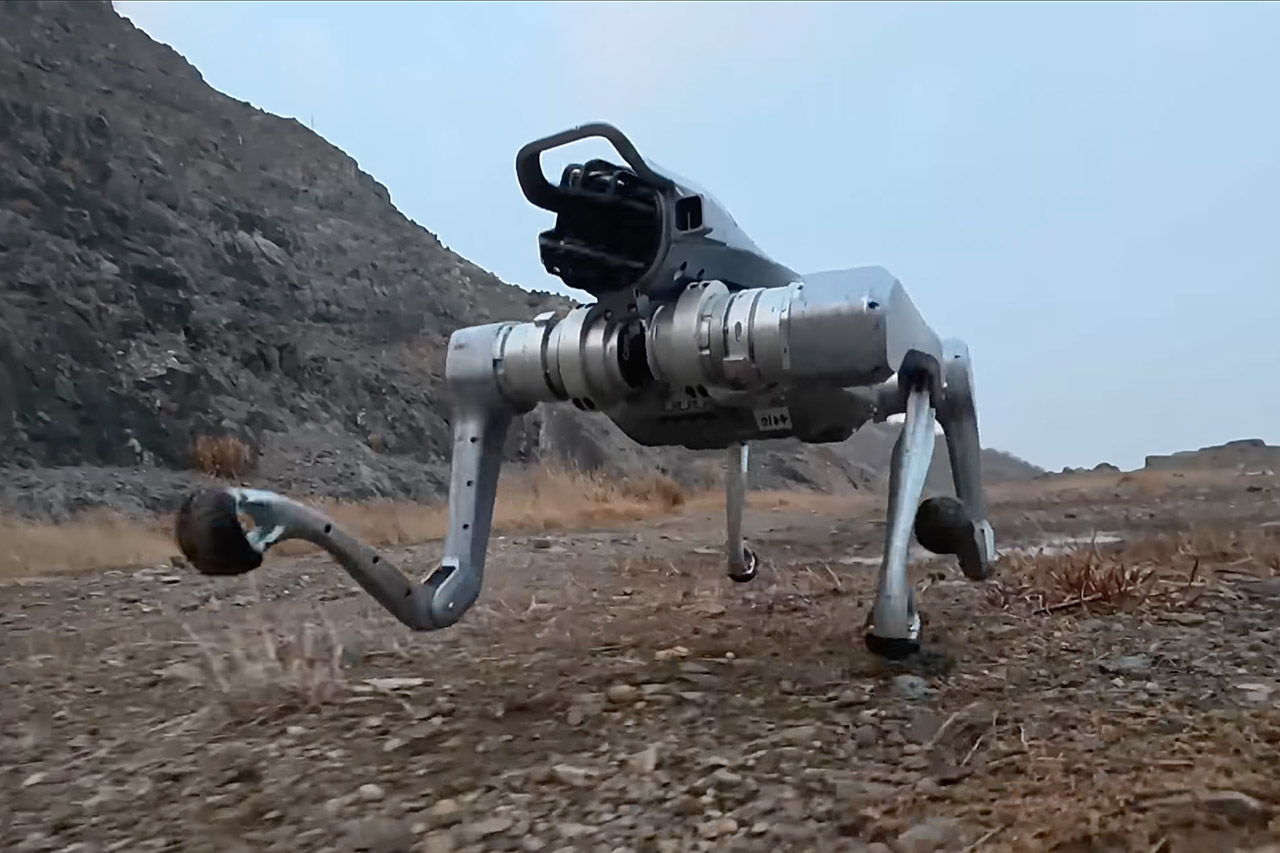
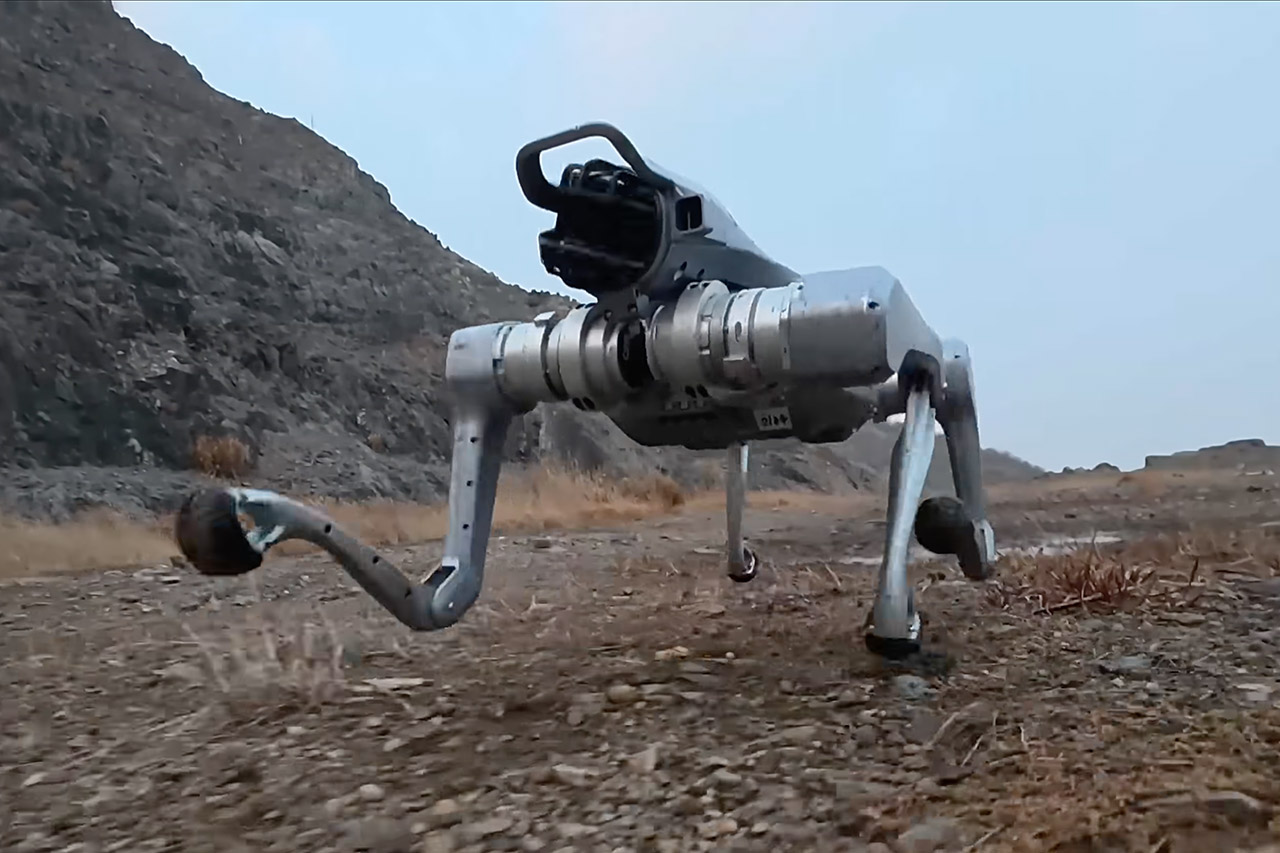
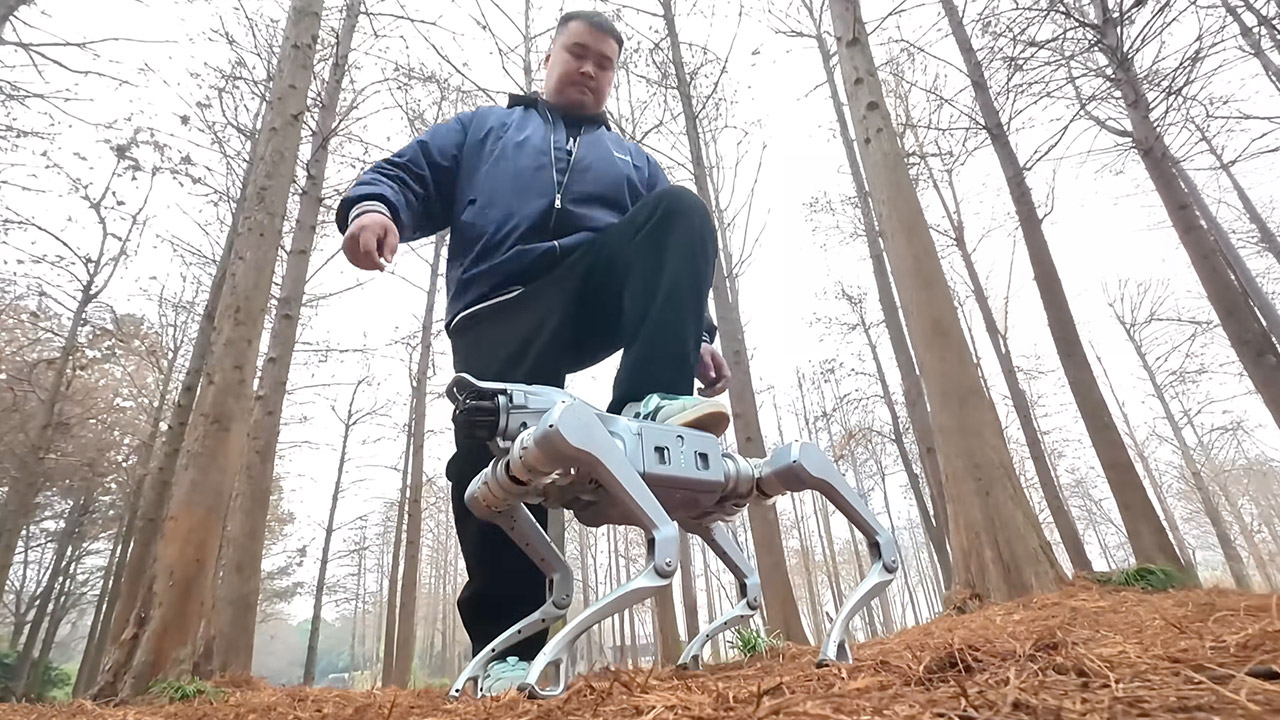
The Unitree As2 is not your typical robot dog. Compact enough to squeeze into spaces where larger machines simply cannot follow, it measures 720 by 378 by 457 millimeters standing upright and tips the scales at just 18 kilograms with the battery fitted, yet it is built to handle the kind of heavy duty work you would not normally expect from something this size.
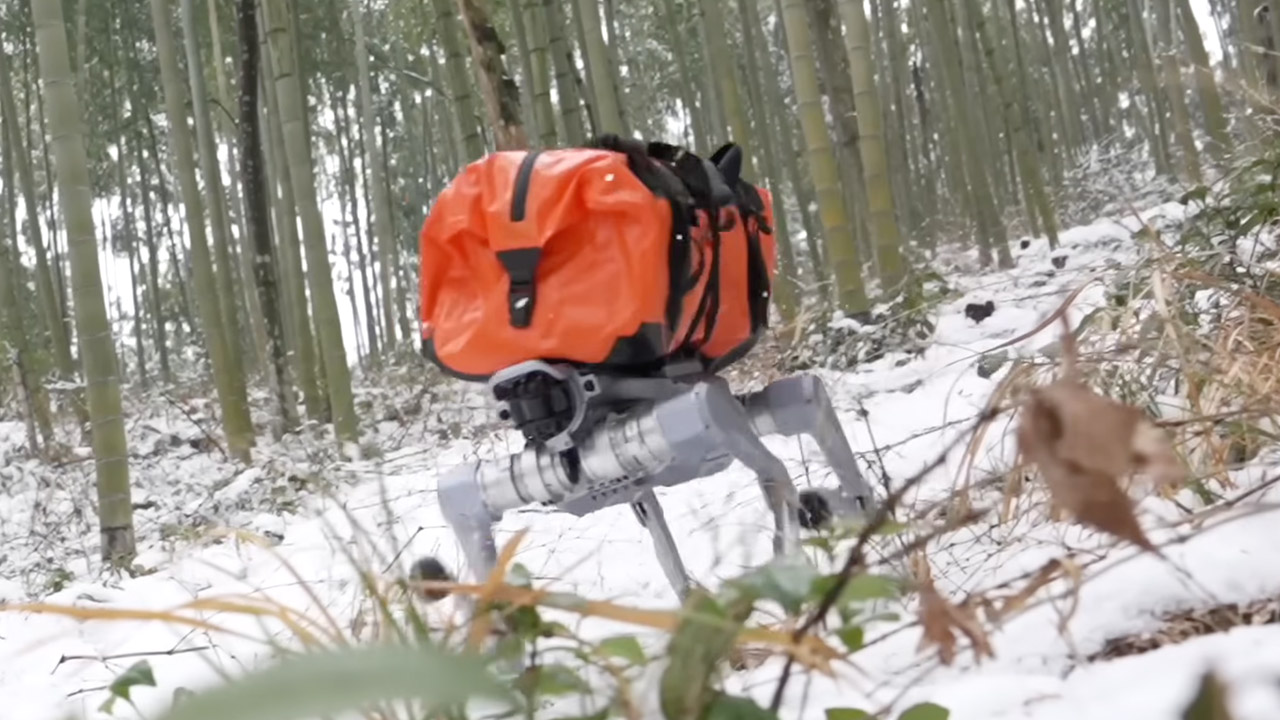
The As2 moves at speeds of over five meters per second (11.1+ mph) and delivers up to 90 Newton meters of joint torque, giving it the muscle to stay stable under a 65 kilogram (143.3 pound) load or push steadily across uneven ground with 15 kilograms of cargo on its back. Battery life is where things get particularly impressive. The higher end variants will run for over four hours unloaded, and even carrying that 15 kilogram payload it keeps going for more than two and a half hours and covers upwards of 13 kilometers before needing a charge.
Sleek & Durable Design: Standing at 132cm tall and weighing only approx. 35kg, the G1 is constructed with aerospace-grade aluminum alloy and carbon…
High Flexibility & Safe Movement: Boasting 23 joint degrees of freedom (6 per leg, 5 per arm), it offers an extensive range of motion. For safety, it…
Smart Interaction & Connectivity: Powered by an 8-core high-performance CPU and equipped with a depth camera and 3D LiDAR. It supports Wi-Fi 6 and…
The Pro and Edu models carry an IP54 rating, meaning rain, dust, and temperatures anywhere between minus 20 and 50 degrees Celsius are all handled without complaint. Built in lighting and a front facing camera keep things visible in any conditions, and a lidar system clears the path day or night. When person following mode is active it tracks its target with centimeter level accuracy, with side sensors and an onboard eight core CPU working together to keep the movement smooth and consistent. Higher tier models add remote control options and the ability to bolt on additional processing modules as the job demands.
Three variants are on offer, starting with the Air, which handles everyday tasks reliably and serves as the straightforward entry point, while the Pro steps up endurance, speed, as well as weather resistance for more demanding environments. The Edu is aimed squarely at developers who want to build and run their own custom applications on top of the platform. All three share the same core frame, with the hardware scaled to match whatever the job requires.
The As2 is built for a wide range of real world applications, from carrying equipment across difficult terrain and handling delivery routes to conducting industrial inspections and outdoor security patrols. The ability to push through challenging environments without slowing down is one of its strongest selling points. Pricing is handled through direct sales conversations, but early indications suggest it will land well below the six figure territory that most industrial robots occupy. Software updates arrive automatically as well, meaning the machine keeps improving over time without requiring any new hardware.
From runway collisions to engine explosions to door plugs blowing out in mid-air, the seemingly ever-increasing number of aircraft accidents in recent years has probably made you think twice about boarding a commercial airline. However, based on all available evidence, the old adage is still true: it’s safer to fly the friendly skies than it is to climb into your car and go to work every day. Still, knowing which passenger jets have the worst safety record isn’t a bad idea.
According to USAFacts, during the 20-year span between 2003 and 2023, only 675 serious injuries aboard domestic airlines (about 32 per year) were documented. Before shouting that’s too many, ponder this: more than 47 million passenger vehicle occupants were hurt on highways in the U.S. during that same period, which breaks down to 2.2 million per year. In 2023 alone, commercial airplanes in the U.S. flew more than 773 billion miles, yet only 33 passengers were injured. For the mathletes out there, this shakes out to just 0.004 injuries for every 100 million miles flown. By comparison, vehicle occupant injuries in 2023 occurred at a far greater clip — 42.2 per 100 million miles driven.
One of the many safety measures the Federal Aviation Administration (FAA) mandates to help keep air passengers safe specifically concerns airport runway safety. Unless you’re an aviation geek, you’ve probably never heard of the Engineered Materials Arresting System (EMAS). This key safety feature can literally stop an aircraft after it’s touched down in mere seconds, which might seem hard to fathom given the speeds at which these big commercial airplanes are going when they land (between 130 and 160 mph), but it’s true.
Advertisement
The EMAS will catch ’em
If a plane shoots past the end of a runway, EMAS will rapidly stop it thanks to lightweight, crushable material that lies beyond. The most common form — currently installed on 116 runways at 69 airports – is known as “EMASMAX” and uses collapsible cellular concrete blocks. The newer version is called “greenEMAS” — installed on four runways at just one airport — and uses silica foam made from recycled glass poured into a plastic mesh attached to the pavement, covered by cement, and topped with a layer of sealant.
Advertisement
A plane going as fast as 80 mph will be caught and stopped, its own weight causing the wheels to sink deeply into the crushable material, regardless of how the jet’s suspension works. Think of it as the airplane’s version of a runaway-truck ramp found at the bottom of steep highway grades. According to the FAA, this system has safely stopped 25 planes carrying a total of 491 crew and passengers.
EMAS has only been around since 1996, when it was first installed at New York’s JFK International Airport. It’s actually one part of a broader safety feature you may not be aware of, one that was first adopted in the 1980s after the FAA concluded that pre-existing obstacles like water, dense population, train tracks, and highways constricted existing runway safety areas (RSAs). All-encompassing RSAs surround the runway and can range between 250 and 500 feet to either side and 1,000 feet at both the beginning and end of the airstrip. When an airport doesn’t have the necessary land available to create the required RSA zone, they install the engineered materials.
According to a Nikkei report, the update will allow consumers to remove and replace batteries using ordinary tools, without special equipment or risking damage to the device. The more easily repairable model is expected to debut in Europe, with the design expanding to other markets if required by similar legal… Read Entire Article Source link
If you have an old Amazon Echo or Echo Dot sitting in the drawer, don’t just give it away or toss it in the trash. That little plastic speaker is still a capable, interconnected computer. Even if the music quality is not great compared to the new one, the voice controls and smart features are perfectly fine for other tasks.
Whether you want to keep your kids busy without handing them a pricey tablet, keep your dog calm when you are away, or use it as a personal assistant inside your old car, that old Amazon Echo can be put to good use. In this guide, we have compiled five creative ways to repurpose your old Amazon Echo.
Advertisement
Use it as a bathroom assistant
People often use their smartphones in the bathroom. Smartphones may be water-resistant, but it’s still risky. Besides, you’ll get better sound quality from a dedicated speaker. This is where you can put your old Amazon Echo to good use. Your Amazon Echo can play your favorite music with easy voice commands instead of wet fingers on a slippery screen. Remember, Amazon Echo isn’t water-resistant, either, but it’s much cheaper than your smartphone.
Beyond just playing your favorite songs in the shower, Echo helps stock up on bathroom supplies. Imagine you’re showering and you find your shampoo bottle is empty. Instead of making a mental note and swiftly forgetting, you can instruct Amazon Echo to add shampoo to your shopping list. Also, if you’re guilty of losing track of time under the warm, relaxing water, get Alexa to add a timer.
Advertisement
Use it as a dedicated language tutor
Grandbrothers/Getty Images
Learning a new language is difficult. Daily practice is necessary, and an Amazon Echo can be your personal language tutor. Using the Alexa app on your phone, you can change the default language on your Echo without changing the rest of the devices in your house.
For instance, if you want to learn Spanish for your next trip to Mexico, you can set the speaker entirely to Spanish and talk to it at will. You can start with greetings and small talk, ask for the time, or request music. Since the speaker needs clear pronunciation to understand, it will give you instant feedback on the clarity of your accent. Your confidence should grow with everyday conversation, and you can start having longer chats with Alexa. You can also test yourself with language apps.
Advertisement
Set it up as an automatic pet sitter
milatiger/Shutterstock
Leaving your pets at home can be tough, but the Amazon Echo can act as a digital pet sitter. By using the Alexa app on your phone, you can set the smart speaker to listen to specific sounds in your home, such as barking or whimpering. All you need to do is place the Amazon Echo speaker close to your pet’s bed or crate.
Once set up, turn on the sound detection feature, and it will automatically start as soon as the speaker hears a loud sound. For example, if your nervous dog wakes up from sleep only to find you nowhere in the house, the speaker will hear their barking and react. You can set it to play classical music or whatever calms your dog.
Advertisement
You can record your own voice saying things like “good boy” or your pet’s name and have the speaker play it back. This trick will help distract your dog from outside noise and calm them down.
Advertisement
Upgrade your old car’s stereo
Older cars are charming and refreshingly tech-lite. However, even a committed digital detoxer will concede the perks of smartphones and infotainment systems, and that’s where the Amazon Echo can come in.
If your retro car has a cigarette lighter, you can plug in an AUX adapter to accommodate your Amazon Echo, which will need a USB charger for power. Once you have connected your smartphone to the Echo via a hotspot, you will have transformed your old dashboard into a fully working, hands-free smart assistant. You no longer need to look at your phone screen to play music, call contacts, set up navigation, and much more.
Advertisement
Let kids use it as a magic box
Sharomka/Shutterstock
Finding things for your kids that do not involve a screen can be difficult. You have your work and daily chores to look after, and constantly playing with your kid is not possible. Here is where you can put your old Amazon Echo device to good use. Instead of handing them a tablet, you can hand them the old Amazon device.
But before you do that, make sure to set parental controls, which will block bad words, stop them from buying stuff, and set bedtimes. Once the speaker is locked down, your kids can use their voice to play adventure games where they have to choose to unlock the next clue. They can ask Alexa for bedtime stories or play background noise for their little pirate adventure.
If they feel like dancing, they can easily ask for kid-friendly dancing songs or movie soundtracks. This keeps them away from the flashy colors of a tablet or smartphone screen. The best part is that you do not have to worry about the device breaking. Yes, the speaker can get damaged, but it won’t hurt your pocket as much as fixing a shattered iPad display.
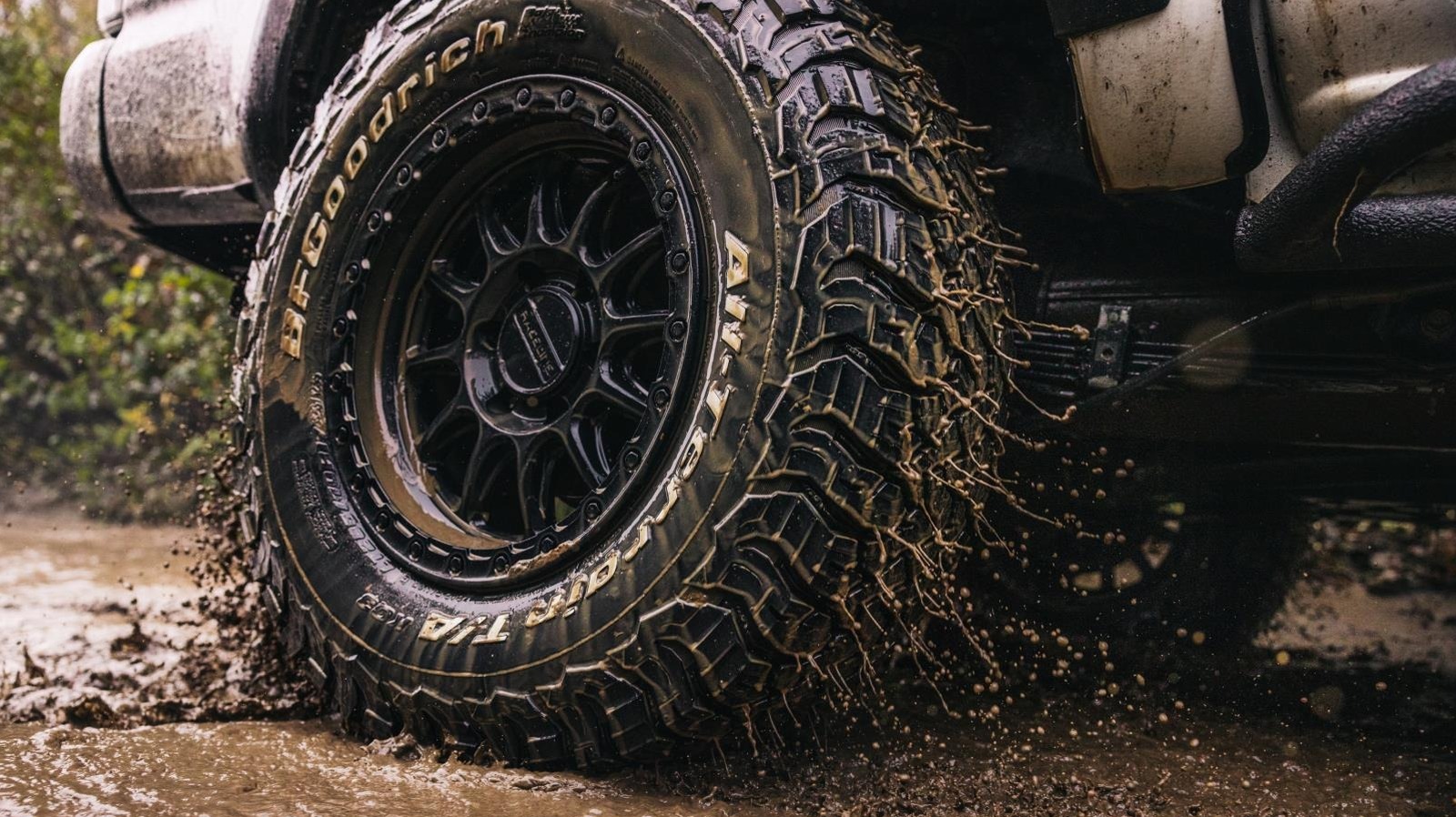
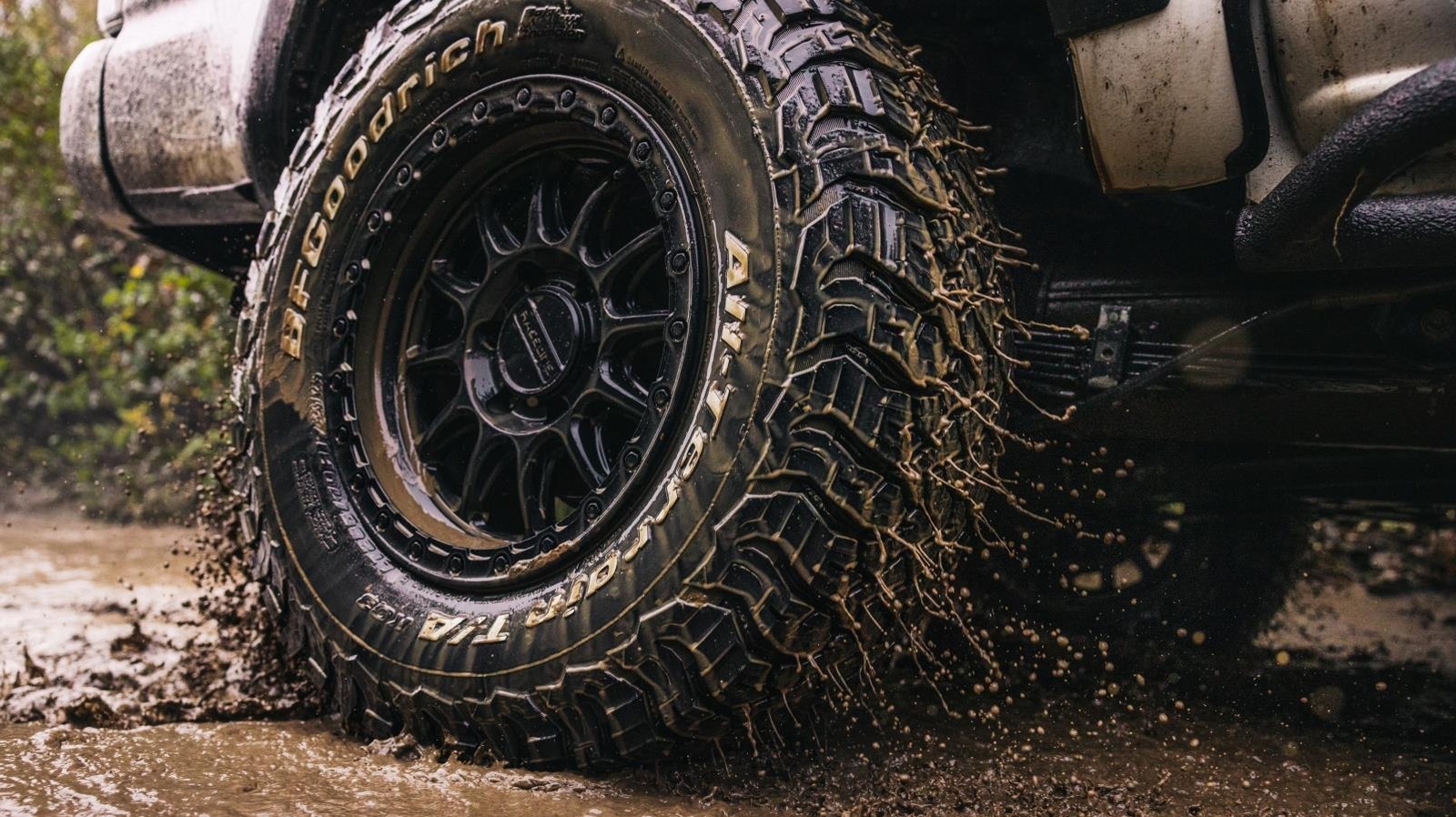
When picturing an off-road oriented truck or 4×4, what are some thoughts that come to mind? A lift kit with increased suspension travel, that’s a given, or maybe even camping gear if you’re going overlanding. One universal mainstay of all of these is the specialized off-road tire, and possibly the most famous of them all is the traditional BFGoodrich Radial All-Terrain T/A, a tire which celebrates its 50th birthday in 2026. Yes, really — BFGoodrich debuted this universally-beloved tire some 50 years ago, an incredible milestone to reach for any automotive part, much less something as vital and technically demanding as tires.
It’s not hyperbole to say that this tire revolutionized the world of off-roading, providing the footprint for everything from basic all-terrain 4x4s like Jeep CJs and Ford Broncos, all the way up to Baja desert racers. It was present at the inception and popularization of desert racing as a sport, in fact, a point of pride reflected in the tire’s earliest advertisement campaigns. But what’s so special about it? After all, off-road tires existed well before BFGoodrich entered the chat.
Advertisement
What makes this tire special isn’t in its specialization, but rather its lack thereof. Unlike other dedicated off-road tires, the Radial All-Terrain T/A is a radial. In fact, it was the world’s first off-road radial tire. This grants an unparalleled level of capability versus previous tires, providing adequate grip on both on and off-highway surfaces, though lacking the exceptionalism of dedicated tires for these surfaces. Let’s take a deep dive and explore the tire’s history and what makes it so special that people continue using it to this day.
Advertisement
A tire developed from motorsports
BFGoodrich is no stranger to auto racing; in fact, the company was the first in the world to assemble a street-legal radial racing tire, the BFGoodrich Tirebird in 1969. Several years later, the 1973 Oil Crisis struck a death blow to the Muscle Car Era, but motorsports continued unabated, and that includes off-road racing, and one of the most well-known and infamous races of that era was the Baja 1000. First run in 1969, the race encompasses a brutal 934-mile course through the Mexican desert. It was for this event, which BFGoodrich called America’s most torturous race, that the company first developed the Radial All-Terrain T/A.
There was one problem plaguing the off-road community — a lack of flexibility. Up to that point, all tires were either specialized for on or off-highway use, but nothing could do both. The tire market had a hole, and that provided a lucrative business opportunity for an enterprising company with racing expertise. So in 1975, the American tire manufacturer approached Baja racer Frank “Scoop” Vessels to test out a new design they were creating for the demanding race. Scoop obliged the request, fitting his Ford F-100 with the first Radial All-Terrain T/A, and ultimately securing wins in both the 1977 Baja 500 and 1000.
Marketing had a field day after these victories, advertising the Radial All-Terrain T/A as a 4×4 tire that was compliant for the road — quiet, smooth, and refined, with a long tread life to boot. It helped that the tire was bold and distinctive, with its aggressive pattern, radial construction, and distinctive white lettering, which BFGoodrich says made it a hot-ticket and iconic package.
Advertisement
A continuing legacy
The success of the BFGoodrich Radial All-Terrain T/A didn’t diminish whatsoever in the following years. In fact, it served as the basis upon which the company has built a long and storied line of tires for different market segments, with the centerpiece remaining that same pivotal tire from 1976 — albeit with some updates since then, of course. These days, the Radial All-Terrain T/A is in its fourth generation, debuting in 2024 with the KO3 pattern, which the company claims has a 50,000 mile warranty, 15 percent better wear performance, and 20 percent more durability on gravel roads versus the KO2.
BFGoodrich is also expanding its portfolio to celebrate the tire’s 50th anniversary, offering the All-Terrain T/A in 12 additional sizes ranging from 30×9.50R15/Cs; up to 35×12.50R22/Es as part of the KO3 Phase 8 launch package. This latest tire incorporates all the usual bells and whistles we’ve come to expect after 50 years of innovation, though it still features that same durability and iconic look that made the original so beloved.
Advertisement
Let’s not forget BFGoodrich’s racing commitments, which are still ongoing — in fact, the American manufacturer is the current sponsor of the SCORE Baja 1000. As such, these tires are virtually ubiquitous in the race, dominating the highest classes and remaining a perennial favorite among competitors. Moreover, because they maintained the same general look since 1976, they’re one of the few modern tires that still look correct on classics, tthough they’re still not dedicated classic car tires.
Directors Phil Lord and Christopher Miller have delivered one of the must-see movies of 2026 with the new sci-fi comedy, Project Hail Mary. Based on the novel by Andy Weir, Project Hail Mary begins with Dr. Ryland Grace (Ryan Gosling) waking on a spaceship with no memory of who he is. He eventually remembers that he was sent into space to help prevent the Sun and humanity from dying, and he befriends a “crab-rock” alien (James Ortiz) on a similar quest.
Driven by a talented cast and crew, Project Hail Mary delivers a massive, majestic blockbuster that blends a thrilling alien adventure with heartfelt human drama. Fans of classic sci-fi movies like The Martian,2001: A Space Odyssey, and Interstellarwill enjoy Project Hail Mary, which has already established itself as a modern masterpiece.
Ryan Gosling and Rocky are a dynamic duo
Sony Pictures UK / Sony Pictures UK
Similar to The Martian, another Andy Weir book adaptation, Project Hail Mary depicts a comedic everyman’s journey of survival in space. Unlike Matt Damon in the former, Ryan Gosling’s character seems like the last person who should be an astronaut. From minute one, Gosling sells the fact that Grace is just an ordinary guy thrown way out of his element when he is called to save humanity from extinction.
Gosling has proven himself capable of leading thrilling sci-fi films like Blade Runner 2049 and First Man. However, Grace is not the cool, confident hero seen in those films. Instead, we see him as the kind of bumbling fool role Gosling played in The Nice Guys, re-establishing the latter’s range as an actor.
Amazon MGM Studios / Amazon MGM Studios
Project Hail Mary has also given us a new alien icon in Rocky, whose chemistry with Grace is off the charts. He rolls into Grace’s ship with the excitement and curiosity of a golden retriever, and they become like college roommates as they try to live and work together.
His garbled, rapid-fire dialogue brings plenty of comic relief to the story, harkening back to the robots seen in The Mitchells vs. The Machines. He also brings plenty of love, showing extraordinary care and loyalty to Grace as he tries to save his people and the people of Earth. Whatever Rocky’s body is made out of, his heart is pure gold.
Advertisement
Phil Lord and Christopher Miller’s unique direction
Amazon MGM Studios / Amazon MGM Studios
Phil Lord and Christopher Miller shared the director’s chair for Project Hail Mary for the first time since briefly helming 2018’s Solo: A Star Wars Story. While it was a while since the duo directed a feature film, we’ve seen their clever, subversive storytelling in their animated Spider-Man movies, which feature the kind of quirky, self-referential humor found in Project Hail Mary.
Much like Lord and Miller’s previous films, Project Hail Mary is a metamodern space movie that references and pays homage to classics like Apollo 13, Close Encounters of the Third Kind, and 2001. It’s not trying to be a groundbreaking film, but it does deliver a fresh and enjoyable cinematic experience. It’s not every day you see Ryan Gosling singing karaoke on a holodeck with an alien crab-rock.
“One thing about this story that’s unique is that a lot of films are about someone who feels at home on Earth, wakes up in space, and they feel lonely. This is a movie about someone who feels lonely on Earth. They go to space and find a friend,” Lord said to BFI. We wanted space to be, in a funny way, inviting. The old vacuum of space is actually warm and inviting. You’re closer to heaven. The way the film is textured visually, we wanted it to feel more homey.”
Amazon MGM Studios / Amazon MGM Studios
In Project Hail Mary, Lord and Miller continue to infuse their comedic stories with genuine heart and hope. Behind Grace’s star-faring adventure with an alien rock is a portrait of a man discovering his courage after suffering crippling self-doubt. He’s an unconventional hero, but he discovers his courage by learning to believe in himself and finding a friend to fight for.
However, Lord and Miller can’t take all the credit, as the film’s witty, soulful writing was put to paper by Oscar-nominated screenwriter Drew Goddard. Having penned the scripts for sci-fi classics like Cloverfield and The Martian, Goddard helped Lord and Miller bring Grace and Rocky’s story to the big screen with great humor and humanity.
“In Project Hail Mary, the main character is a fish out of water,” Goddard said in an interview with Variety. “You need it to feel rough around the edges, even a little sloppy. We don’t want to feel like he’s a perfect astronaut. And then there’s the character of Rocky…Phil and Chris thrive in finding the humanity inside of these crazy characters. That’s what this film required.”
Advertisement
A spectacular feat of filmmaking
Sony Pictures / Sony Pictures
While Lord and Miller led Project Hail Mary to success, they had some other incredible artists helping them bring Weir’s story to the big screen. They scored big when they hired Greig Fraser, who has proven himself one of Hollywood’s best cinematographers with his stunning work on Rogue One, The Batman, and Dune: Part One and Part Two.
Fraser dazzles his audience once again with his radiant visuals in Project Hail Mary, capturing the scale and beauty of Grace and Rocky’s journey through space. The cinematography reaches its peak when Grace harvests Astrophage from the planet Adrian, floating in a sparkling red stream that leaves us staring in awe.
The cinematography is especially mind-blowing considering that not a single green or blue screen was used to create the film’s shots, according to Lord and Miller. The film becomes even more stellar thanks to a beautiful original score from composer Daniel Pemberton (Spider-Man: Across the Spider-Verse).
Much like the film itself, the music blends different tracks and genres to create a unique experience for audiences. One minute, Grace and Rocky waltz across the stars to the sound of a French accordion. The next, Grace launches probes into space as The Beatles rock out in the background.
With such incredible characters, writing, visuals, and music, Project Hail Mary has lit up cinemas like no other film this year so far. We still have plenty of exciting sci-fi films to look forward to, such as Spider-Man: Brand New Day, Dune: Part Three, Disclosure Day, and Avengers: Doomsday. However, it is safe to say that Project Hail Mary will go down as one of the best and biggest blockbusters of 2026.
A free built-in VPN is coming to Firefox on Tuesday, Mozilla announced this week:
Free VPNs can sometimes mean sketchy arrangements that end up compromising your privacy, but ours is built from our data principles and commitment to be the world’s most trusted browser. It routes your browser traffic through a proxy to hide your IP address and location while you browse, giving you stronger privacy and protection online with no extra downloads. Users will have 50 gigabytes of data monthly in the U.S., France, Germany and U.K. to start. Available in Firefox 149 starting March 24.
“The roadmap for Firefox this year is the most exciting one we’ve developed in quite a while,” says Firefox head Ajit Varma. “We’re improving the fundamentals like speed and performance. We’re also launching innovative new open standards in Gecko to ensure the future of the web is open, diverse, and not controlled by a single engine.
“At the same time we’re prioritizing features that give users real power, choice and strong privacy protections, built in a way that only Firefox can. And as always, we’ll keep listening, inviting users to help shape what comes next and giving them more reasons to love Firefox.”
Advertisement
Two new features coming next week:
Split View puts two webpages side by side in one window, making it easy to compare, copy and multitask without bouncing between tabs. Rolling out in Firefox 149 on March 24.
Tab Notes let you add notes to any tab, another tool to help with multitasking and picking up where you left off. Available in Firefox Labs 149 starting March 24.
Apple is about to roll out iOS 26.4, and the final release notes suggest this is a feature-heavy update rather than a minor tweak.
With the release candidate now in the hands of developers, the public launch is expected as early as next week.
A big chunk of the update focuses on Apple Music. There’s a new Playlist Playground (beta) feature that builds playlists from simple text prompts, generating everything from the tracklist to a title and description. A new Concerts tool surfaces nearby gigs based on your listening habits.
Meanwhile, offline music recognition means you can identify songs even without a connection, with results appearing once you’re back online. Apple is also adding an Ambient Music widget for quick access to curated playlists. Additionally, you’ll see full-screen animated artwork for a more immersive look.
Advertisement
Advertisement
Accessibility also gets a meaningful boost. A new Reduce bright effects setting tones down flashes when interacting with UI elements. Subtitle and caption controls are now easier to access directly from the media player. In addition, Apple has refined its Reduce Motion setting to better limit the movement-heavy Liquid Glass interface introduced in iOS 26.
Elsewhere, iOS 26.4 adds eight new emoji, including an orca, a trombone and a slightly odd, distorted face. The Freeform app is picking up expanded image creation tools and access to a premium content library. Meanwhile, Reminders now lets you mark tasks as urgent and filter them more easily.
There are a few practical upgrades, too. Purchase Sharing allows family members to use their own payment methods within Family Sharing. Apple also says keyboard accuracy has been improved when typing quickly.
Advertisement
As with most updates, some features won’t be available on all devices or in every region. And while Apple continues to support iOS 18 with security updates for now, newer releases like iOS 26.4 make it increasingly clear where the company’s focus lies.
As AI technology continues to develop and evolve, one of the key use cases is set to be robotics, as humans employ some extra assistance across work and home lives.
Nvidia has been one of the biggest proponents of next-gen robotics, with CEO Jensen Huang outlining at its GTC 2026 event how every major company is working with Nvidia in some way.
But what is it actually like to engage with these robots? I got the chance to see the future up close and personal at Nvidia GTC 2026 – here’s how I got on…
Advertisement
Article continues below
Hands-on with the Humanoid
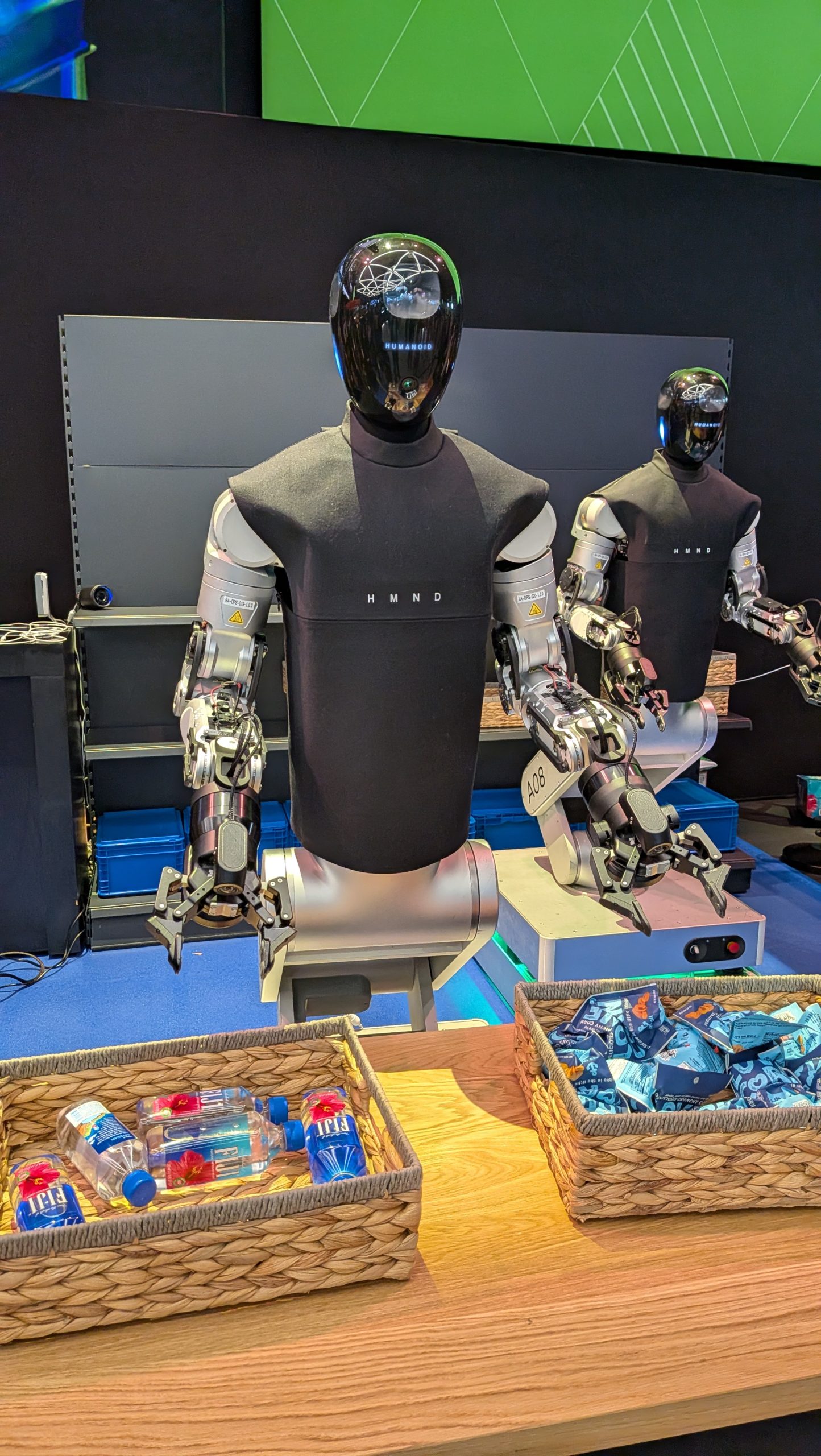
Retail and customer service has been one of the most commonly-mooted use cases for the future of robotics, and on Nvidia’s stand at GTC 2026 was a demo from Humanoid showing just that.
Advertisement
The company’s (slightly terrifying-looking) robots, currently available in wheeled and bidpedal editions have become one of the pace-setters in the industry, with customers already including the likes of Siemens and Schaeffler.
We were confronted with two of the wheeled models, which we saw in action swapping out different products by picking up separate boxes, but their size means you would need a fairly sizeable space for them to operate effectively.
(Image credit: Future / Mike Moore)
We were told to speak into a microphone to pick our order, choosing from a handful of products. The robot server told us it had received the order (a bottle of water and a packet of dried mango fruit), and asked us to confirm, again via the microphone.
Sign up to the TechRadar Pro newsletter to get all the top news, opinion, features and guidance your business needs to succeed!
Advertisement
We were then asked to stand in front of the robot and extend our hand, so it knew where to place the item – we had picked items from two different boxes, so one robot delivered the water, and the other the dried mango.
Overall the order was largely successful – in fact, a little too successful, as the second robot gifted us an extra portion of the dried mango (winner!). The first robot did seem to struggle picking up the water bottle, but once it got its grip, it was delivered successfully.
Start-to-finish, the entire process took around 45 seconds – not too bad, but certainly slower than a human worker would have taken. The technology is clearly still at an early stage, but if this initial demo is anything to go by, we may soon start seeing humanoid robots in a store near you sooner than you might expect.
CEO Hou Zelong anticipates the S$45 million Chinese spa to reach breakeven in four years
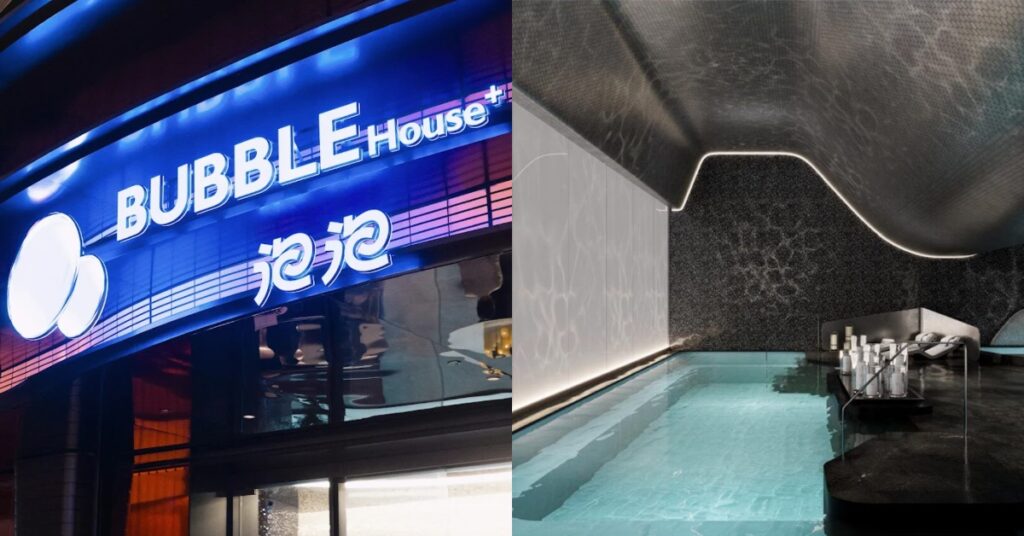
When House+ Bubble announced its arrival in Singapore, it quickly became one of the most talked-about spa openings here.
But the buzz has proven short-lived. The S$45 million Chinese spa complex, touted as Singapore’s largest 24-hour facility of its kind, has come under scrutiny over hygiene lapses, inconsistent service, and even allegations of staff mistreatment—issues that have sparked debate online and dampened initial excitement.
Still, CEO Hou Zelong is taking it in stride.
“Though we have received criticism, we humbly accept it and will improve,” he said in a recent interview with The Straits Times, adding that the business continues to see support despite the backlash.
Advertisement
“We still have many supporters; we just have to sort ourselves out.”
Even as the company works to regain footing, its rollout has hit a few bumps.
The spa claims to have an average of 300 visitors per day
Image Credit: House+ Bubble
House+ Bubble is currently operating in a half-open state following its soft launch, during which guests could access the spa, massage services, pools, and dining areas for a S$49 entry fee.
In response to the backlash, the spa temporarily closed its bathing pools on Mar 3 for what it described as “internal facility adjustments,” while reducing the fee to S$39.
Image Credit: House+ Bubble
The spa was initially slated for an official opening in mid-Mar, but this has since been pushed back to an unconfirmed date before May as the team continues to fine-tune operations.
If the May opening goes according to plan, it will span approximately 49,000 sq ft, eventually reaching nearly 100,000 sq ft once fully completed.
Advertisement
Despite the delay, House+ Bubble is already looking ahead. According to Hou, the operator is scouting new locations, confident that demand could support one or two additional outlets.
Currently, the spa claims to welcome an average of 300 visitors each day, about 60% of whom are locals. Hou anticipates the business will reach breakeven within four years.
Earlier this month, reports highlighted that House+ Bubble’s launch had been overshadowed by mounting criticism, just about a week into its operations.
Online reviews and social media posts have highlighted hygiene issues, inconsistent pool temperatures, and misleading advertising—such as claims of “unlimited massages” that only applied to massage chairs during the soft launch.
Bathrooms and shared amenities were also reportedly in poor condition, with combs showing visible dandruff and communal skincare bottles containing stray hairs.
Advertisement
A Google Review accompanying photos shows wet floors and towels left on the ground. The user also claimed that toilet bowls were clogged, and urinals were broken with “water running non-stop,” and a lack of toilet paper or paper towels./ Image Credit: Google Maps
Staffing concerns have also emerged.
Some employees reportedly left after short stints due to “poor management” and limited breaks during long shifts, creating manpower shortages that have compounded operational issues.
While the spa did not respond to Vulcan Post’s queries, Hou told The Straits Times that it has become clear a faithful reproduction of the Chinese spa business model does not translate seamlessly to the Singapore market.
One key change underway is the revamp of its membership scheme.
The original model had tiered memberships starting at S$500, which granted preferential rates on add-ons such as restaurant buffets and a range of treatments—a setup that drew criticism from some early customers.
Advertisement
The new approach will bundle access and remove unpopular add-on costs, aiming to provide clearer value, Hou said.
Close to a month since its soft launch, which served as a testing period, Hou concluded that a simpler and more straightforward approach resonates better with Singaporean customers.
“We are not just a bathhouse or spa”
Adding to House+ Bubble’s challenges is growing competition in Singapore’s wellness scene, with at least 10 recovery-focused venues having opened over the past two years.
Yet, Hou remains unfazed.
Advertisement
“We’re not just a bathhouse or spa. We have attractions for many different groups. It is a comprehensive leisure complex,” he told The Straits Times.
Some of the facilities shown on the House+ Bubble website include private pools and even an esports room./ Image Credit: House+ Bubble
The spa’s current offerings include hot spring pools, steam rooms, and massage services. The women’s section features a Himalayan salt therapy room, while the men’s area offers a mugwort herbal room.
Soon, a VIP KTV room the size of a small apartment and a teppanyaki grill to complement an expanded buffet menu are expected to open.
When fully operational, House+ Bubble will expand its range of offerings to include a cinema, meditation room, and e-sports lounge alongside its hot pools and saunas. It will also introduce kid-friendly zones, ice baths, mixed-gender pools, and a storm bath designed to simulate squalls and lightning.
Read other articles we’ve written on Singaporean businesses here.





















































You must be logged in to post a comment Login