Connect with us
DAPA Banner

Tech

Stripe’s crypto joint venture Tempo launches payments protocol for AI

Published

on

Stripe describes Machine Payments Protocol as an ‘internet-native way for agents to pay’.

Big Tech leaders are convinced that consumers will soon be using AI to shop online, despite public sentiment reflecting some level of apprehension.

McKinsey has found that most European consumers already use AI to help shape their purchase decisions, but not at checkout, where money passes hands. However, it noted that this sentiment could change, and fast.

McKinsey also found that by 2030, agentic commerce could orchestrate up to $5trn globally. But Morgan Stanley research earlier this year noted that only 1pc of shoppers currently choose the agentic route, leaving much to speculation and a hope that consumers will let AI shop for them.

Advertisement

Regardless, many – such as Revolut, Google and PayPal – are already trying to build protocols to support this new incoming age of AI-led shopping.

Adding to that is Stripe’s joint venture with Paradigm, Tempo, which has launched the ‘Machine Payments Protocol’ (MPP). Described as an “internet-native way for agents to pay”, MPP is attempting to create an alternate financial system built specifically for AI agents to use.

The protocol is offering a system where AI agents are not met with the challenges of navigating a financial system built for humans, such as the need to create shopping accounts, navigate pricing pages, choose between subscription tiers, enter payment details, and set up billing.

“The tools of the current financial system were built for humans, so agents struggle to use them”, noted Stripe’s agentic commerce leads in a blogpost. MPP lets agents and services coordinate payments programmatically, enabling micro-transactions and recurring payments.

Advertisement

Once Stripe users set up MPP, businesses can accept payments directly from agents in both stablecoins and fiat, as well as use features such as ‘buy now, pay later’. Companies such as browser infrastructure provider Browserbase and New York City-based Prospect Butcher Co already use MPP to allow agentic commerce.

Tempo was reportedly valued at $5bn last October, after a $500m raise. The crypto venture launched from incubation a month prior.

In November, Swedish fintech giant Klarna, whose CEO was once a crypto sceptic, became the first bank to plan to launch a stablecoin on Tempo with ‘KlarnaUSD’. The coin, set to release this year, is expected to help cut down on transaction fees.

At the time, sources told the Financial Times that the stablecoin would also help Klarna move large amounts of money globally by cutting out parties such as the Society for Worldwide Interbank Financial Telecommunications (SWIFT) network.

Advertisement

Meanwhile, Stripe acquired US billing and invoice software provider Metronome in December. Metronome enables organisations to create and manage user-based pricing models, which Stripe CEO Patrick Collison said is “the native business model for the AI era”.

Bloomberg news reported last month that Stripe was considered acquiring some or all of its long-standing fintech rival PayPal. Founded in the late 1990s, PayPal has struggled in recent years to modernise against its emerging rivals. The 2010-founded Stripe, meanwhile, was recently valued at $159bn after an employee tender offer.

Don’t miss out on the knowledge you need to succeed. Sign up for the Daily Brief, Silicon Republic’s digest of need-to-know sci-tech news.

Advertisement

Source link

Continue Reading
Click to comment

You must be logged in to post a comment Login

Leave a Reply

Tech

From Blinding Sun to Dark Streets, the Pelsee P1 Pro 4K Dashcam Keeps Every Detail Sharp on a Budget

Published

on

Pelsee P1 Pro 4K Dashcam
Every day, drivers face the occasional curveball on the road. The Pelsee P1 Pro 4K dashcam, priced at $49.99 with promotion code: 97KDCUO5 (was $110), does, however, bring clarity into focus, thanks to the footage it gets of license plates, which stay perfectly clear even when the sun is directly shining on it. Not to mention the front camera’s High Dynamic Range (HDR), which slices through glare like a hot knife through butter, leaving you with crisp, clear numerals and lettering that would otherwise be washed out.


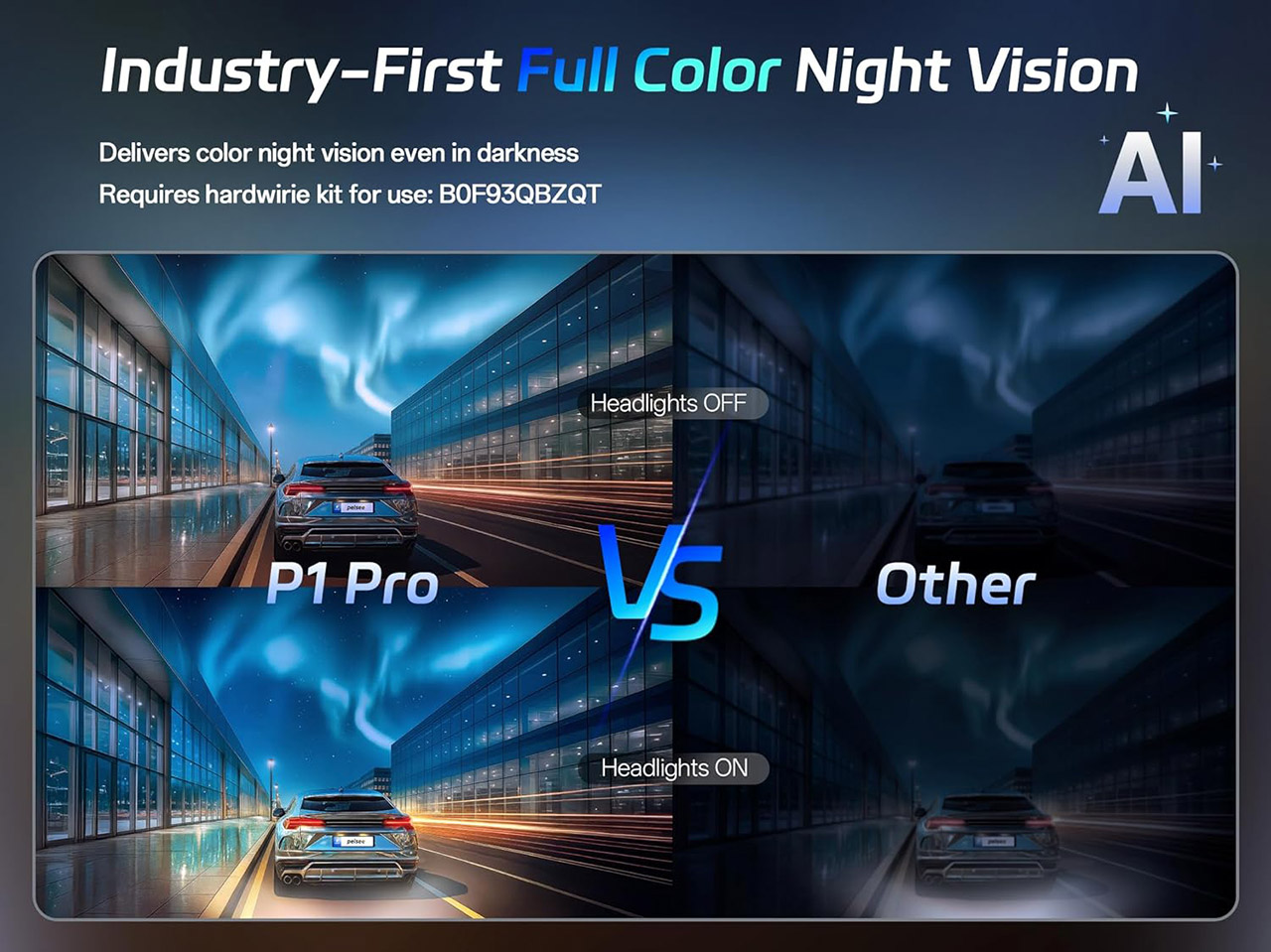
Nighttime driving is no problem since the Sony STARVIS 2 sensor on the front camera gathers light four times more efficiently than normal sensors, allowing you to see full-color details even on the darkest city streets or country roads. Furthermore, scenes remain visible even when driving in complete darkness and exiting underground parking garages. The front camera films in 4K, while the rear shoots in 1080p, and they both run seamlessly at 30 frames per second, making the motion appear lifelike.


Pelsee P1 Pro 4K Dash Cam Front and Rear, STARVIS 2 Sensor, 64GB Card, Dual Dash Camera for Cars with…
  • 【HDR Front & WDR Rear Recording】The front 4K HDR dash cam slices through blinding sunlight, capturing license plates clearly in overexposed…
  • 【STARVIS 2 Sensor & AI Night Vision】Image sensor with technology of STARVIS developed by Sony delivers 4x greater low-light sensitivity…
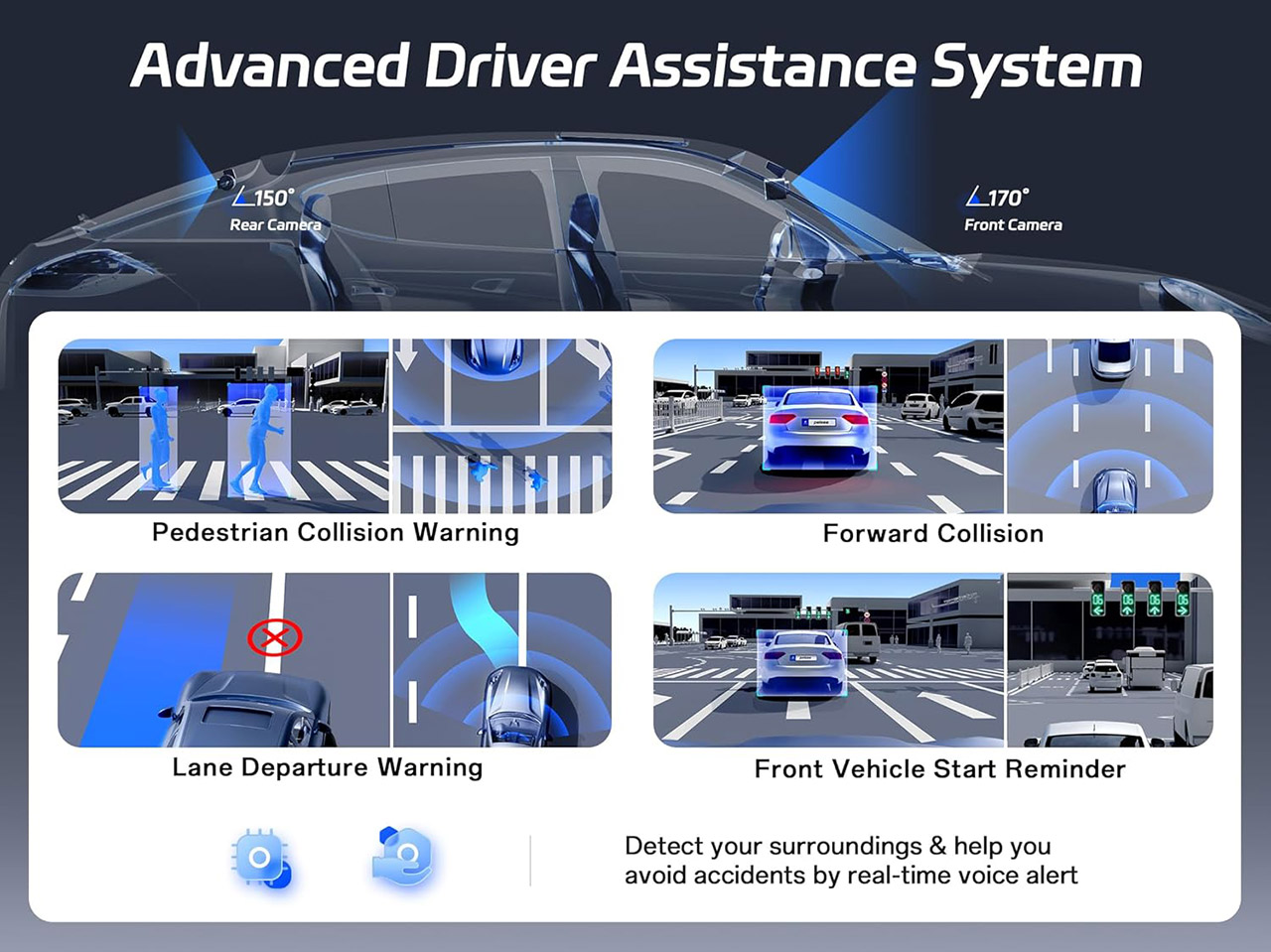
  • 【Smart Driving Assistant】Advanced Driver Assistance System (ADAS) included proactive alerts for forward collision, pedestrian collision, lane…

Pelsee P1 Pro 4K Dashcam
The rear coverage does an excellent job of balancing the shadows and tunnel lighting while retaining all of the most important details. Those huge 170-degree views of the front imply that two complete lanes, plus the shoulders, are visible, while drivers will also notice that license plates and traffic signs remain viewable until the very end. The 3.39-inch screen built into the main unit shows live views as soon as you turn it on, and you can navigate menu options and playback without having to use your phone. The ability to use voice commands provides another layer of control, which is useful because you can secure a clip or take a snapshot simply by saying a fast phrase like ‘lock it’ or’snap a photo’, all without taking your eyes off the road.

Pelsee P1 Pro 4K Dashcam
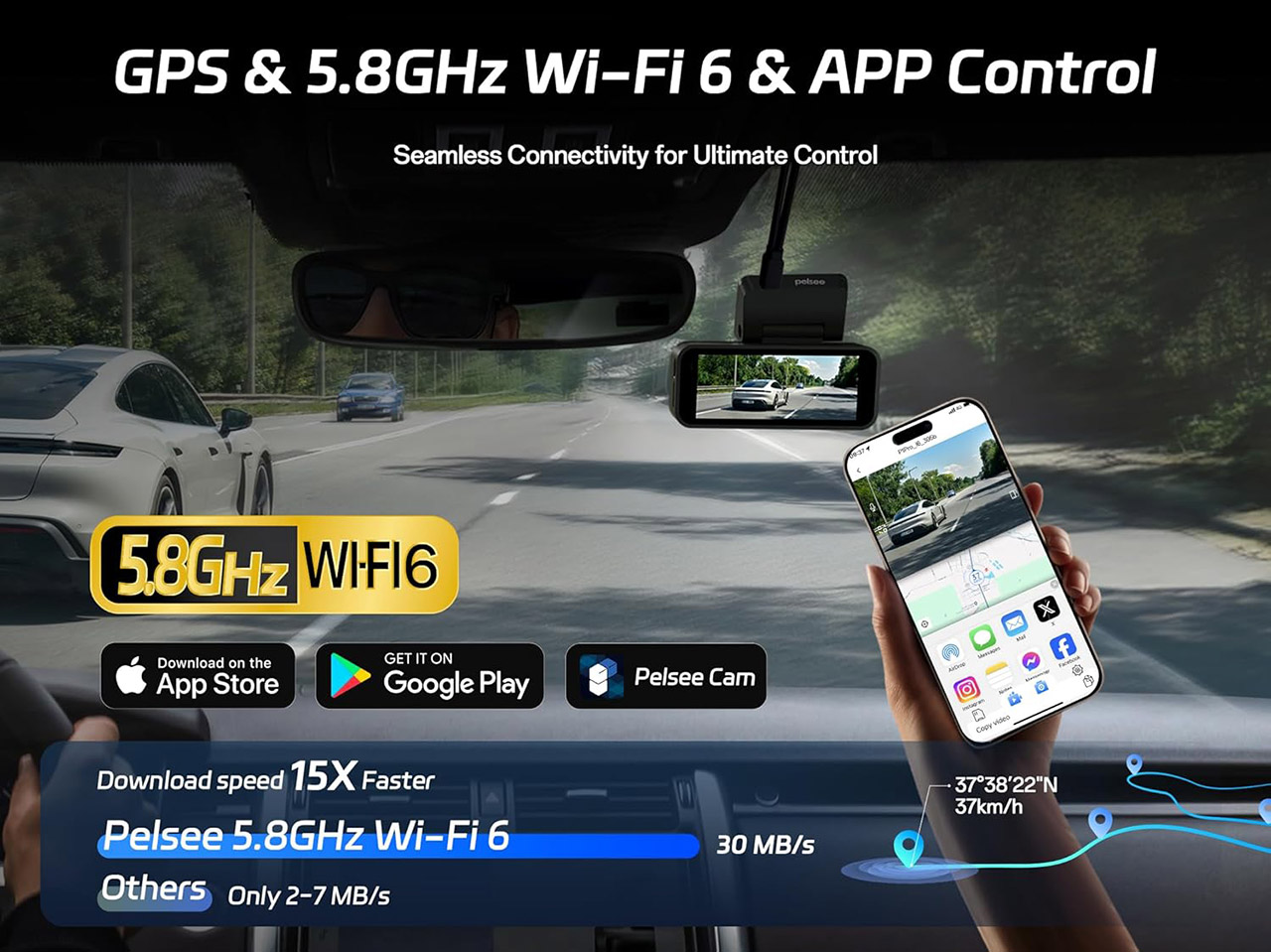
Wireless transfer transmits your clips directly to your phone over a fast 5.8 gigahertz connection. The accompanying app then handles all of the downloads and sharing for you, which takes about the same amount of time as fiddling with a memory card. Built-in GPS logs every second with speed, location, and time, which is extremely useful for insurance claims or police reports; it all adds up to solid undeniable proof in an instant.

Pelsee P1 Pro 4K Dashcam
Helpful alerts appear for frontal collisions, lane slips, and when the automobile in front of you begins to accelerate again. These notifications provide you extra time to react in slow-moving traffic or during highway merges. The cameras continue to record even when you park; owing to 24-hour monitoring, a sensor will wake them up on impact or motion, and there’s also a time-lapse option that compresses all those lengthy hours into shorter files. Furthermore, the loop recording simply overwrites previously recorded footage on the provided 64-gigabyte card, which may be expanded up to 512 gigabytes if necessary. Plus, the supercapacitor outperforms older battery designs in terms of high heat and cold tolerance.

Pelsee P1 Pro 4K Dashcam
Installing it is as simple as 1 2 3. Simply clamp the main unit onto the windshield, tuck the cables into the included guides, and connect it into the cigarette lighter. The rear camera simply snaps in at the back. Everything is ready to use in the package, including front and rear cameras, a memory card that has already been inserted, a charger, and basic equipment.

Source link

Advertisement
Continue Reading

Tech

It’s been 20 years since the first tweet

Published

on

On March 21, 2006, Jack Dorsey posted a simple message: “just setting up my twittr”.

That was, of course, the very first post on the site that is still best known as Twitter, even after being renamed X by its new owner Elon Musk (the deal is still being fought over in court). X then became part of Musk’s xAI, which itself has become part of SpaceX.

Musk cut the company’s workforce dramatically and spurred new controversies by incorporating xAI’s chatbot Grok, which dubbed itself “MechaHitler” and was used to create widespread sexual deepfakes, including of real women and children.

While X retains a strong hold on some user groups, including swaths of the tech industry, it also faces competition from services like Bluesky and Meta’s Threads. One report suggests that Threads recently overtook X in daily mobile users. (All of these primarily text-based services are dwarfed by apps like Instagram and TikTok.)

Advertisement

As for Dorsey’s original tweet, the Twitter co-founder later sold it as an NFT for $2.9 million. But its value has reportedly plummeted, with the buyer unable to resell it.

Source link

Continue Reading

Tech

Reddit is weighing identity verification methods to combat its bot problem

Published

on

There could be one more step required before creating an account and posting on Reddit in the future. According to Reddit’s CEO, Steve Huffman, the social media platform is exploring different ways to verify a user is human and not a bot. When asked by the TBPN podcast how to confirm that it’s a human using Reddit, Huffman responded with several verification methods with varying degrees of heavy-handedness.

“The most lightweight way is with something like Face ID or Touch ID,” Huffman said during the interview. “They actually require a human presence, like a human has to touch, or do or look at something, so that actually just proves there’s a person there or gets you pretty far.”

Besides these passkey methods that use biometrics data, Huffman said there are other options like relying on third-party services that are decentralized or don’t require ID. On the other end of the spectrum, Huffman also mentioned more burdensome options, like ID-checking services.

Recent years have brought a rise in bots flooding social media platforms including Reddit, where they’ve even been used to conduct secret experiments. It doesn’t sound like Reddit has landed on how to verify its users’ human identity yet, but Huffman did emphasize that the platform still wants to prioritize anonymity for its users. However, verifying humanity through identifiable and personal data could end up as a dealbreaker for Reddit users who value the anonymity of the platform.

Advertisement

“Part of our promise for our users is we don’t know your name but we do want to know you’re a person,” Huffman said. “It’ll be an evolution for us for a while, and probably every platform to find the right middle ground here.”

Reddit co-founder and former executive chair, Alexis Ohanian, said on X that Reddit requiring Face ID wasn’t something he expected but agreed that something had to be done about the fake content from bots, adding that, “I just don’t know how to sell face-scanning to Redditors or even lurkers.” We reached out to Reddit’s communications team and will update the story when we hear back.

Source link

Advertisement
Continue Reading

Tech

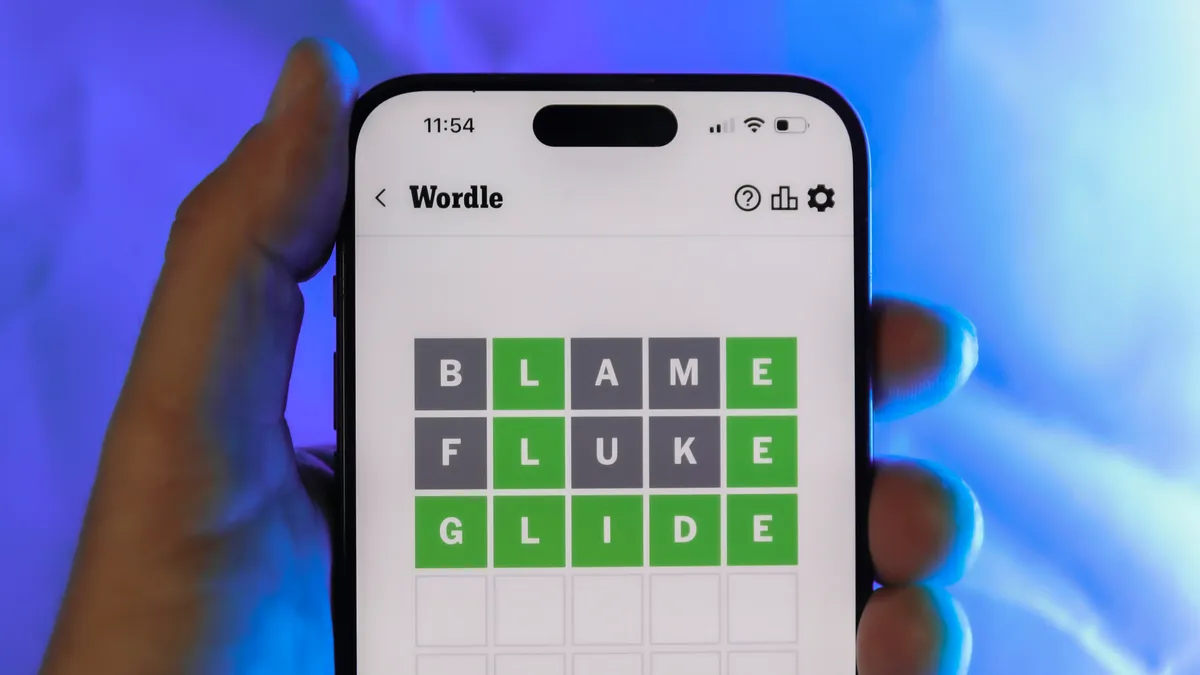
Today’s NYT Wordle Hints, Answer and Help for March 22 #1737

Published

on

Looking for the most recent Wordle answer? Click here for today’s Wordle hints, as well as our daily answers and hints for The New York Times Mini Crossword, Connections, Connections: Sports Edition and Strands puzzles.


Today’s Wordle puzzle isn’t too tough, though the first letter is one I rarely ever guess. If you need a new starter word, check out our list of which letters show up the most in English words. If you need hints and the answer, read on.

Read more: New Study Reveals Wordle’s Top 10 Toughest Words of 2025

Advertisement

Today’s Wordle hints

Before we show you today’s Wordle answer, we’ll give you some hints. If you don’t want a spoiler, look away now.

Wordle hint No. 1: Repeats

Today’s Wordle answer has no repeated letters.

Wordle hint No. 2: Vowels

Today’s Wordle answer has two vowels.

Wordle hint No. 3: First letter

Today’s Wordle answer begins with B.

Advertisement

Wordle hint No. 4: Last letter

Today’s Wordle answer ends with L.

Wordle hint No. 5: Meaning

Today’s Wordle answer can refer to an aromatic herb in the mint family.

TODAY’S WORDLE ANSWER

Today’s Wordle answer is BASIL.

Yesterday’s Wordle answer

Advertisement

Yesterday’s Wordle answer, March 21, No. 1736, was SLICK.

Recent Wordle answers

March 17, No. 1732: CLASP

March 18, No. 1733: AMPLY

March 19, No. 1734: REHAB

Advertisement

March 20, No. 1735: OASIS

Source link

Advertisement
Continue Reading

Tech

Using lived experience to address the digital accessibility gap

Published

on

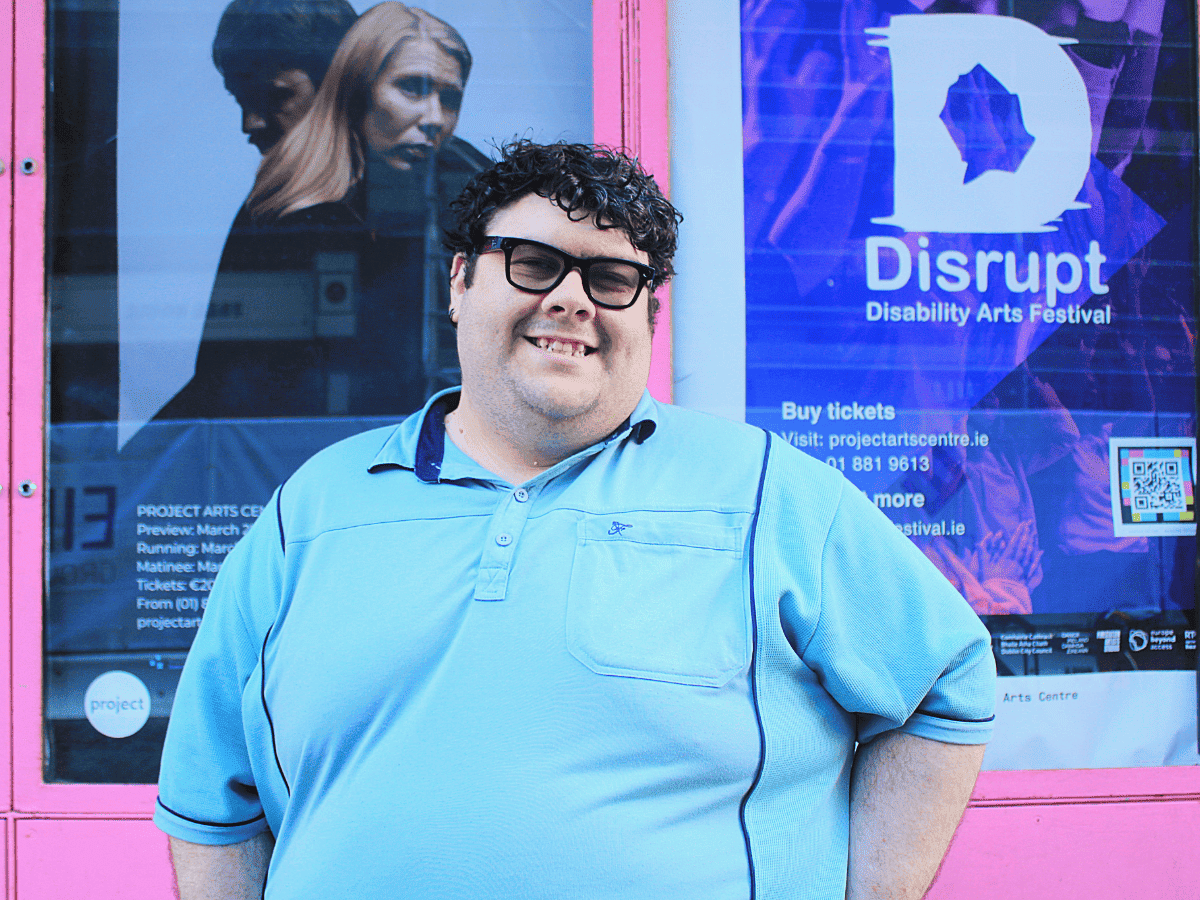
Patrick Fitzgerald bridges the often unaddressed gap in helping people adopt accessibility tools.

The Disrupt Disability Arts Festival was well underway by the time I reached Projects Arts Centre in Temple Bar. A sunny evening had added to the day’s apparent success, with many milling about the building as a sold-out 5pm theatre performance on life as a non-speaker begins.

In the busy foyer, a volunteer from the centre approaches me with a box of surgical masks, asking if I need one. I catch a small table with snacks and Palestine cola from the corner of my eye.

I’m here to meet Patrick Fitzgerald: a coach, not a teacher. He is persistent about that distinction. He approaches me, walking behind his colleague Sarah Boland, who would be facilitating our conversation.

Advertisement

Fitzgerald needs to use assistive technology (AT). During our chat, he describes screen readers and AI tools such as ChatGPT as essential to his day-to-day life (note how AI presents as a ‘tool of a lifetime’ for people with disabilities).

His Meta Ray-Ban glasses are a new addition to his arsenal. They bleep when I put them on, and after a few quick instructions, the glasses are able to recite text from a poster in front of me. It also translates speech in real-time on command. I concur that these might feel somewhat liberating to an AT user.

Still not a prerequisite

People who, like Fitzgerald, live with disabilities make up around 22pc of Ireland’s population, amounting to around 1.1m.

This population – perhaps still invisible to many – might require AT and other accessibility supports to thrive in their everyday lives. But such supports are still outside the grasp of many. Boland explains that it is likely that “hundreds of thousands” in Ireland could be without the AT support that they need.

Advertisement

And despite the significant disabled population in Ireland, other basic necessities such as internet accessibility (as mandated by law in the EU) are also not a given.

The National Disability Authority finds that websites in Ireland only have an average accessibility score of around 55.2pc when evaluated for features such as colour contrasts, text alternatives and file types. Around 96pc of all websites across the globe fail to meet basic accessibility standards.

Meanwhile, a global survey from 2025 reported that 84pc of its more than 1,500 participants (comprising software developers, engineers, user experience and legal professionals) said digital accessibility is a key priority for their company. Reality seems to be far different.

As an AT user-turned-coach, Fitzgerald uses his lived experience to encourage others and help bridge the AT adoption gap.

Advertisement

Among his many roles, Fitzgerald helps co-design websites and apps alongside developers to ensure accessibility is ingrained in tools from the get-go. Last year, he took part in the Carlow Arts Festival as a co-designer, where he also facilitated a workshop to discuss accessibility barriers.

Meanwhile, St John of God Services – Liffey – where Fitzgerald once learned how to use AT, and now works as a ‘digi-coach’ – has been co-designing websites with Technological University Dublin’s computer science students for a decade now.

In 2023, Boland and Fitzgerald bagged the only Irish win for the annual Zero Project at the UN for their co-designed toolkit for St John of God, which has nine digi-coaches working across its services in Dublin and Kerry. These coaches go into schools to work with students and staff to improve AT adoption.

The disability service also works in collaboration with the Dublin-based Fighting Blindness, which employs six digi-coaches to help with their cause. These coaches run workshops, including for those who don’t need AT in their daily lives.

Advertisement

Among the many tools available to him, Fitzgerald tells me about Osmo, a hands-on learning tool that he uses in his coaching lessons with young school students. Osmo uses computer vision to interact with physical objects. The platform helps with literacy and problem-solving. Other apps such as Book Creator and TD Snap are also in his day-to-day rotation for work.

Wary of technology

Despite the many wins, the stats are still worrying. The Disability Federation of Ireland notes that 14.4pc of disabled people over 15 who have ceased their education only ever completed primary level education. The number is nearly halved – at 7.4pc – for the general population. Boland tells me that a majority of those that St John of God supports don’t have literacy.

Meanwhile, only 12.4pc of new entrants to higher education in 2020 were students with disabilities. Plus, the disability employment rate in Ireland is just upwards of 32pc, nearly 20pc lower than the EU average of 51.3pc.

There is no standalone budget for digital assistive technology in Ireland, which makes it challenging to assert exactly how much is allocated towards improving digital inclusion.

Advertisement

However, the Government has several different schemes to help support AT pick-up, including the HSE Aids and Appliances Scheme, the Disability Services Budget, the Fund for Students with Disabilities, and the Assistive Technology Grant for schools.

Still, AT inaccessibility is a systemic issue, as availability of supports does not automatically translate into adoption. “The gap isn’t just about access, it’s about awareness, confidence, training and whether technology is designed with different types of people and needs in mind,” Boland says.

People can be hesitant to use new technology because of a lack of support when it comes to learning to use it safely and confidently. Fitzgerald notes that some staff members are “terrified that something will come up [in new tools]”. He tells me that some are still wary of commonly used tools such as Microsoft Teams despite the many accessibility supports available in the platform.

“No one knows about these tools so that’s why we get trained up,” Fitzgerald says.

Advertisement

“Looking back, it was very hard for me to communicate [without AT],” Fitzgerald adds. “It was hard with no technology and skills … no one there to support me [with] reading or writing [or] speech”.

He says he picked up AT in his late teens and got completely “caught out” by the tech. A Dublin native from Walkinstown, Fitzgerald went to the St John of God School Islandbridge before joining the charity’s day services.

As he sits up – still with his Meta glasses on – Fitzgerald, now 30, says he wasn’t wary of AT. “I wanted [to] kind of challenge myself and then I kind of got used to it, and then I want[ed] to show other people [including] friends and family.”

While he does much more than just show people how to use accessibility features on their devices, it is undeniable that this simple lesson is enough to begin changing lives.

Advertisement

“Patrick is demystifying [technology], because he’s going in and showing staff [that] this is easy [and] it’s a really great way to communicate,” Boland says.

Meanwhile, outside of the charity landscape, Ireland has a number of upcoming start-ups that focus on providing digital inclusion.

Last year, SiliconRepublic.com interviewed Nexus Inclusion’s Kyran O’Mahoney, whose start-up works alongside businesses to improve digital accessibility. O’Mahoney recently took home an award for his work.

Similarly, accessibility start-up DevAlly enables businesses to audit and fix accessibility issues without requiring specialised expertise or outsourcing.

Advertisement

Don’t miss out on the knowledge you need to succeed. Sign up for the Daily Brief, Silicon Republic’s digest of need-to-know sci-tech news.

Source link

Advertisement
Continue Reading

Tech

Nissan Torture-Tested This Engine For 100 Hours And The Results Are Impressive

Published

on


What does it mean for an engine to be durable? If one were to ask the engineers at Nissan’s Decherd Powertrain Assembly Plant, they would likely say a durable engine can withstand a level of punishment so severe that components begin to glow with heat — and keep working. That’s something of a bold statement coming from Nissan, a corporation struggling with average reliability across its mid-2020s lineup, including a massive engine recall affecting 480,000 SUVs in August 2025 – one of the worst engine recalls of the year.

Nissan’s powertrain engineers hope to buck that trend by putting engines through a punishing trial. More specifically, the naturally-aspirated VQ38 3.8-liter V6 that powers the third-generation Nissan Frontier, which is mated to a 9-speed auto transmission. The test itself involves running the engine at full throttle for 100 hours straight under maximum load, basically four 24 Hours of Le Mans races (and then some) run back-to-back without a single break, well beyond what owners are likely to do. The Frontier is a work truck that aims to compete with midsize offerings like the Toyota Tacoma and Jeep Gladiator, and it seems Nissan is attempting to double down on durability.

Advertisement

Decherd analyzes the test results using X-ray imaging, sort of like an MRI for the engine, taking photos in “slices” to peer inside without going invasive. This lets the team further refine the design, finding stress points without disturbing the engine’s configuration by tearing it down and cutting metal. Let’s take a closer look at the process and why such tests are important.

Advertisement

Nissan’s testing process

The test involves setting up the engine on a dynamometer, a device that measures various specifications of an engine, such as peak horsepower and torque, its power curve, and its stress points. It involves mounting a standalone powertrain to a test stand and running it through specific tests, in this case focusing on a powertrain’s endurance under heavy load. While Nissan doesn’t go into specific details in its press release, this sort of test typically involves running the engine under a set load for a specified timeframe; in this case, from several hours to 300 hours.

These test cycles determine the longevity of specific parts by heating metal components well beyond what one would reasonably expect, effectively putting 130,000 miles on these engines within a couple of weeks, by Nissan’s estimates. The grueling 100-hour stress test is one component of this larger battery of examinations. For a real-world comparison, imagine driving a Frontier hauling a fully-loaded two-car trailer up a mountain, at full throttle, for four straight days.

Nissan selects engines straight from the production line, checking roughly one of every 100 engine blocks produced, to the tune of several engines per day. If one were to go off sales figures, the facility would’ve tested around 6,500 engines for model year 2025. These engines are then examined for defects using the aforementioned X-ray scans, with the 100-hour test offering insight into factors like heat buildup and internal metallurgy. 

Advertisement

Why these tests are important

These trucks are nothing without their utility, and the beating heart is, of course, the engine. Without a reliable, powerful engine, businesses would have little use for a pickup. However, while every manufacturer presumably keeps this in mind when building pickup trucks, not all get it right: Toyota, for example, has had recalls related to engine manufacturing defects in its pickups and SUVs. Procedures like those outlined in Nissan’s press release will, at least in principle, help prevent such incidents from happening by detecting longevity issues before they arise on the road.

Engines are incredibly violent places, especially in high-stress, high-power situations. Stressing metal components to the point that they’re glowing hot can push them quite literally to the breaking point, but Nissan’s engineers are confident that its engines will pass muster every time.

Advertisement

In practical terms, this means that the owner can expect the engines to hold up under various conditions, be they high-heat environments, high-load scenarios, or extended road trips with plenty of cargo. Will a test detect everything? Likely not, but it will certainly give engineers some insight into where to refine the designs. Nissan’s engineers, for their part, are confident in the engines — provided owners get their oil changed (or change it themselves) on time.


Advertisement

Source link

Continue Reading

Tech

MSI launches $85,000 XpertStation WS300 with Nvidia GB300 Ultra and massive memory that redefines local AI performance

Published

on


  • XpertStation WS300 supports trillion-parameter models without relying on cloud infrastructure
  • Dual 400GbE LAN ports enable high-speed distributed multi-node AI workloads
  • Unified HBM3e GPU and LPDDR5X CPU memory maximizes bandwidth for AI

MSI has officially launched the XpertStation WS300, a deskside AI workstation based on Nvidia’s DGX Station architecture.

This system is designed to handle demanding large language models, generative AI, and advanced data science workloads.

Advertisement

Source link

Continue Reading

Tech

Apple wanted to buy Halide, co-founder lawsuit reveals

Published

on

A lawsuit has revealed Apple was close to acquiring Lux Optics, the developer of the Halide camera app for iOS, but the partnership between the cofounders later broke down over the alleged misuse of funds.

iPhone screen showing camera interface photographing an Apple Vision Pro headset, next to a silver app icon with a circular geometric logo on a dark gradient background
Halide for iOS

Apple’s acquisitions are big news, but discussions are typically held with utmost secrecy, as per Apple’s usual way of operating. While confirmations of acquisitions often surface after they have been agreed upon by both sides, it’s rare to find out about failed acquisition attempts.
One such instance occurred to Lux Optics, makers of the third-party camera app Halide and video app Kino. The Information reports that Lux Optics was in talks with Apple for a potential acquisition during the summer of 2025.
Continue Reading on AppleInsider | Discuss on our Forums

Source link

Continue Reading

Tech

Fifth Circuit: Actually, Putting The Ten Commandments In Schools Is Probably Fine

Published

on

from the fifth-circus dept

Last June, the Fifth Circuit Appeals Court upheld a lower court’s ruling declaring a Louisiana law mandating the posting of the Ten Commandments in public schools to be a violation of the Constitution.

This decision made immediate sense, given that courts elsewhere in the nation (including the US Supreme Court) had repeatedly ruled that laws like these destroyed the separation of church and state. These laws were extremely obvious violations of the First Amendment that elevated one particular religion to a position of prominence with the backing of government power.

That hasn’t stopped MAGA legislators from creating similarly unconstitutional laws around the nation. These opportunists are hoping to convert their Trump coattail-riding into local iterations of Trump’s white Christian nationalist efforts.

Last June may as well be a lifetime ago. In that ruling, the Fifth Circuit made it clear the law was nothing more than an unconstitutional way for the state government to shove its preferred deity down students’ throats.

Advertisement

The statute does not require that the Ten Commandments be integrated into a curriculum of study. On the contrary, under the statute’s minimum requirements, the posters must be indiscriminately displayed in every public school classroom in Louisiana regardless of class subject-matter. See La. R.S. § 17:2124(B)(1). Louisiana insists, however, that unlike Kentucky, its Legislature has a valid “secular historical and educational purpose” for displaying the Ten Commandments in classrooms, which is reflected in the statute.

[…]

Louisiana’s purported legislative purpose states:
It is the Legislature’s intent to apply the decision set forth by the Supreme Court of the United States in Van Orden v. Perry, 545 U.S. 677 (2005), to continue the rich tradition [of including the Ten Commandments in the education of our children] and ensure that the students in our public schools may understand and appreciate the foundational documents of our state and national government.

[…]

It is also unclear how H.B. 71 ensures that students in Louisiana public schools “understand and appreciate the foundational documents of [its] state and national government” when it makes displaying those “foundational” documents optional, and does not require that they also be printed in a large, easily readable font. La. R.S. § 17:2124(A)(9). When the Ten Commandments must be posted prominently and legibly, while the other “contextual” materials need not be visible at all, the disparity lays bare the pretext.

That was the court refusing to let Louisiana lawmakers have their cake and eat it too by pretending the Ten Commandments were both “optional” and essential to students’ instruction.

Advertisement

The en banc opinion [PDF] — released in late February — goes in a completely different direction. The majority somehow reaches the conclusion that the lawsuit is premature. It lifts the injunction preventing the law from taking effect. The court contorts itself to give Louisiana a free pass to post the Ten Commandments prominently in public schools by pretending it doesn’t know how this mandate will actually look in practice.

While H.B. 71 sets certain “minimum requirement[s]” regarding the text, size, and accompanying “context statement” of the displays, it leaves “[t]he nature of the display” entirely to the discretion of local school boards. La. Rev. Stat. § 17:2124(B)(1)–(3). That delegation and those minimum requirements—necessarily leave numerous essential questions unanswered. We do not know, for example, how prominently the displays will appear, what other materials might accompany them, or how—if at all— teachers will reference them during instruction. More fundamentally, we do not even know the full content of the displays themselves. Although the statute requires inclusion of the Commandments and a context statement, it expressly permits additional content—such as “the Mayflower Compact, the Declaration of Independence, and the Northwest Ordinance”—to appear alongside them. Id. § 2124(B)(4).

Simply put, we cannot evaluate “how the text is used,” Van Orden, 545 U.S. at 701 (Breyer, J., concurring in the judgment) (emphasis omitted), because we do not yet know—and cannot yet know—how the text will be used.

But we do actually know all of these things. And the Court does too, even if it has conveniently chosen to ignore the law to give the GOP what it wants yet again. (See also: this, this, this, this, etc.) As Rachel Lager — one of the attorneys representing the plaintiffs in this case — points out in her article for The Hill, the state’s lawyers and the bill’s proponents have already answered the questions the Fifth Circuit is now pretending are in need of further examination.

This law intends for the government (public schools) to convey that the words of the Ten Commandments — including “I AM the LORD thy God. Thou shalt have no other gods before me,” and “Remember the Sabbath day, to keep it holy” — are mandates for all children, regardless of whether they and their families are Hindu and believe in many gods or nonreligious and believe in none.

Lest there be any doubt that this law was written to proselytize students, state Rep. Dodie Horton (R), the law’s sponsor, told us so when she proposed the bill: “I’m not concerned with an atheist. I’m not concerned with a Muslim, I’m concerned with our children looking and seeing what God’s law is.” Judge James Dennis was on point in his dissent when he called the court’s reasoning “procedural artifice.”

Advertisement

That vast gap between the Fifth Circuit’s “narrow” holding and the facts on the ground likely explain why there’s only a single published concurrence and several dissents. The sole concurrence was written by Judge James Ho, who boldly, baldly declares Supreme Court precedent on the subject is “no longer good law,” despite the Supreme Court never having said so itself. Ho also says the lawsuit isn’t just premature, but entirely without merit.

Multiple dissents disagree. The first, written by James Dennis and co-signed by three other judges — says James Ho and the rest of the majority are wrong. Pretending Supreme Court precedent regarding the mandated posting of the Ten Commandments (via a Kentucky state law) is no longer relevant because the Supreme Court ruled in favor of a coach who was fired for engaging in post-game prayers with his players is deliberately ignoring the difference between state action and personal action in order to reach the conclusion these pro-Bible-down-your-throat judges had already decided was the correct ruling.

Bound by Stone v. Graham and its progeny, and mindful that we are not the Supreme Court, I conclude that permanently posting the Ten Commandments in every public school classroom, without curricular incorporation and with compulsory attendance, violates the Establishment Clause. Our court avoids confronting that conclusion only through procedural artifice. I dissent.

Another dissent points out what the state, its legislators, and the majority of Fifth Circuit judges have also chosen to ignore: that religious leaders don’t even want the state to do what it’s doing.

Indeed, every faith-based organization before us—on behalf of thousands of members—and every clergy and devout plaintiff agree that Louisiana must not pick and post specific scripture that the state commands will confront children in state classrooms. All religious voices submitted to us, barring one individual, oppose Louisiana’s attempt to select, inculcate, and enforce this version of gospel text in compulsory public education.

The only people left arguing for this are arguing in bad faith. Parents and religious leaders who pretend any instruction in anything they’re opposed to (gender issues, evolution, socialism, etc.) is a form of indoctrination are more than willing to sign off on literal government indoctrination so long as it’s the sort of indoctrination they like.

Advertisement

Even if the en banc court felt this might need more discussion, it should have erred on the side of plaintiffs. In choosing to do otherwise, it’s basically telling plaintiffs in the Fifth Circuit that their rights need to be violated first because they can start questioning the constitutionality of enacted laws. That’s insane. But it’s the sort of insane the Fifth Circuit is known for. The only question now is whether the Supreme Court still has enough honest justices left to reverse this obviously unconstitutional decision by the Fifth.

Filed Under: 10 commandments, 1st amendment, 5th circuit, church and state, establishment clause, freedom of religion, james ho, louisiana

Advertisement

Source link

Continue Reading

Tech

Apple’s foldable iPhone is coming… not just when you thought

Published

on

Apple loyalists hoping to snap shut their foldable iPhone by autumn may need to exercise a little more patience. The iPhone Fold, initially expected to launch alongside the iPhone 18 Pro and iPhone 18 Pro Max at Apple’s September event, might not ship with these iPhones. 

According to Apple analyst Tim Long, the iPhone Fold will likely begin shipping in December, rather than in September. This contradicts previous reports suggesting a September release (via MacRumors).

So, what will Apple showcase in September 2026?

To me, it sounds like Apple could still showcase the iPhone Fold at the iPhone 18 Pro launch (as a teaser or brief preview of the technology that has gone into the smartphone), while clearly indicating that it will start shipping in a few months. 

The reason behind delaying the iPhone Fold’s shipments could be simple. By releasing the iPhone 18 Pro in September and the iPhone Fold in December, the Pro series gets two months of undivided attention from buyers. 

I know plenty of buyers in India who align their upgrade cycle with Apple’s September launches, and the staggered strategy could be to protect the iPhone 18 Pro’s early sales. Meanwhile, the iPhone Fold would get another two months of hype, with rumors and leaks coming in from all directions, keeping potential buyers on their toes. 

Advertisement

Historically, Apple has done the same thing with the iPhone X. It was available to purchase roughly 10 days after the iPhone 8 and iPhone 8 Plus went on sale. 

Apple might want to launch the iPhone Fold at the safest time

Now, the gap between the iPhone 18 Pro and the iPhone Fold isn’t the same, but the iPhone Fold is going to be the most expensive model in Apple’s lineup so far. Apple might want to launch it when there’s no potential threat to its sales. Further, the foldable could also benefit from the holiday shopping season. 

Along with the iPhone Fold’s launch, the analyst also shared some information about the company’s future roadmap. First, the regular iPhone 18 could launch in March 2027 alongside an iPhone 18e. Second, these phones could be accompanied by either an iPhone 18 Plus or an iPhone Air 2

I am not sure about the iPhone 18 Plus, as there haven’t been any recent leaks or chatter about the handset since Apple killed it with the iPhone 17 lineup. The Air 2, on the other hand, could very well be a part of Apple’s March 2027 product list.

Advertisement

Source link

Continue Reading

Trending

Copyright © 2025