

Connect with us
DAPA Banner

NewsBeat

Kim’s surprise new ally against Graham in Emmerdale will shake things up | Soaps

Published

on

Kim's surprise new ally against Graham in Emmerdale will shake things up | Soaps
Oh look out (Picture: ITV)

Not sure what’s happened here, but we’re actually feeling sorry for Kim Tate (Claire King) in Emmerdale.

Kim is our favourite Emmerdale tyrant and we’re feeling a bit protective of her in her new vulnerable state. If Joe Tate (Ned Porteous) thinks he’s taking her crown, he can do one.

Although he’s not the one who’s hurt our little Kim, it’s Graham Foster (Andrew Scarborough), who is messing with our heads as much as Kim’s. One minute we’re rooting for him as mister nice guy, helping ailing Cain Dingle (Jeff Hordley) with his farming predicaments, the next he’s trying to break up Rhona Goskirk’s (Zoe Henry) marriage and manipulating Kim into bed.

His arrival back in the Dales threw Kim into a spin, given that she thought he’d been dead for six years. Ever since he returned, he’s been plotting to discredit Kim in Joe’s eyes, encouraging him to break ties with the Home Farm matriarch.

Advertisement

To view this video please enable JavaScript, and consider upgrading to a web
browser that
supports HTML5
video

Kim has been fighting her feelings for her ex, putting on a frosty front while admitting to Lydia Dingle (Karen Blick) that there is regrettably something still there. When Graham gave Rhona an ultimatum that she seemingly refused (only because her child got sick, who knows what would have happened if Rhona had met Graham on that bridge?!), he took his battered ego and lured Kim into bed.

Advertisement

The next day he brushed her off, leaving her in a bad head space. Humiliated, she admitted to Lydia she’d never again let him get close – and yet he continues to live in her house.

Scorned Kim is now thinking up new ways to protect herself and forms an unusual alliance – she hires Ross Barton (Mike Parr) to take on the very important role of her Director of Operations, aka a glorified bodyguard.

Kim Tate looking unhappy as she stands in Home Farm in Emmerdale.
Kim’s got a plan (Picture: ITV)
Ross confronts Graham in Home Farm in Emmerdale
Ross is brought in as Director of Operations aka a glorified bodyguard (Picture: ITV)

Slowly, Kim plans to build an army against Graham.

Graham reacts badly to this news, just as Kim hopes he would. He knows Ross and Dawn have a history, so the first thing he does is go in heavy and warns Ross off.

Ross is not one to be intimidated and finds Graham’s attempt laughable, instead lauding it over him that he’s now Kim’s ‘extra muscle’. Has Graham met his match?

Advertisement

Source link

Advertisement
Continue Reading
Click to comment

You must be logged in to post a comment Login

Leave a Reply

NewsBeat

Can British drones help secure the strait of Hormuz for international shipping?

Published

on

Can British drones help secure the strait of Hormuz for international shipping?

After pressing allies for support – and being rebuffed – US president Donald Trump now insists that the United States can reopen the Strait of Hormuz alone. However, this would focus the risk on US forces and stretch limited naval resources.

Some 20% of global oil flows ordinarily passing through Hormuz; closure of the strait has caused oil prices to soar. British prime minister Keir Starmer has refused to let the UK be drawn into a wider war in the Middle East. However, he has said he is “looking through the options” on helping secure the strait for shipping.

The UK military has already stated that it is considering sending two drone types to the strait of Hormuz: interceptors, to counter Iranian drones, and mine-hunters. These could help ensure the security of shipping in the region, but their task will not be straightforward.

Iran is believed to have around 6,000 sea mines, ranging from simple contact types like the Maham-1 – anchored in place and triggered on impact – to more advanced systems such as the Chinese-designed EM-52, which sit on the seabed and fire a rocket at ships with specific acoustic or magnetic signatures.

Advertisement

So far, only a handful of mines are understood to have been deployed, often covertly at night or using traditional sailing ships to evade detection.

Divers are also used, in the case of limpet mines, to manually attach these devices to a ship’s hull and detonate them remotely. Even limited mining efforts deter commercial shipping, as crews, insurers and operators refuse to risk transit.

The mine threat is only one layer. Iran’s Islamic Revolutionary Guard Corps has built a broader anti-access system: fast attack craft, shore-based anti-ship missiles – such as the Noor/C802 – and one-way attack drones, such as the Shahed-136, which is so effective the Americans are now copying it. These can be launched from concealed positions along the coastline, allowing Tehran to threaten vessels across the strait.

The result is a multi-domain problem. A ship attempting to transit must contend simultaneously with threats from below the water, across the surface and from the air.

Advertisement
The Royal Navy’s Sweep system uses an uncrewed surface vessel towing three sensor boats.
Royal Navy / MOD

This technology enables selective disruption. Iran is targeting the vessels of specific countries while allowing others to pass, preserving its own oil exports while exerting pressure on the US and its allies.

In theory, reopening the strait is straightforward: clear the mines, escort shipping and deter further attacks. In practice, western navies are poorly configured for this. Mine warfare has been deprioritised for decades. The US has historically devoted less than 1% of its naval budget to it, despite mines accounting for 80% of US warships sunk or damaged since 1945.

Its Avenger-class minesweepers are being retired, replaced by platforms reliant on unmanned systems. European fleets face similar constraints. The Royal Navy’s last minehunter in the Gulf, HMS Middleton, left for maintenance shortly before the current crisis. Of the seven vessels in the fleet, four are unavailable, with the remaining three earmarked to protect home waters and UK submarines.

Vulnerable to attack

Even where mine countermeasure vessels exist, they are ill-suited to Hormuz. They operate slowly and close to the threat, using sonar and remotely operated vehicles to locate and neutralise mines. In a contested environment, this places them within range of missiles and drones, requiring escort ships – which are similarly scarce.

Advertisement

Autonomous minehunters include the Royal Navy’s Sweep system. Instead of detecting and then destroying mines in separate stages and with separate tools, Sweep uses an uncrewed surface vessel towing three sensor boats that replicate the magnetic, acoustic and electrical signature of a ship. This effectively tricks mines into detonating harmlessly at a distance. It entered service in 2025 and can be controlled remotely from a ship or portable platform.
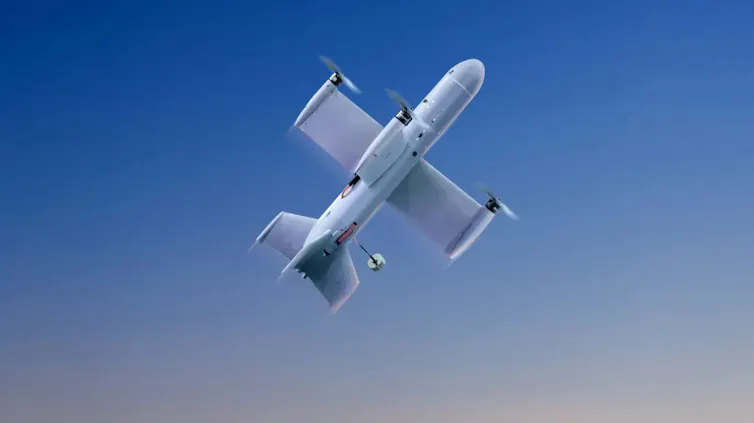
Octopus
The UK-produced Octopus system is designed to collide with drones like Iran’s Shahed-136.
Ukraine MOD, Author provided (no reuse)

These systems nevertheless remain limited in number and untested in combat. The control ships and command nodes may also have to operate within range of Iranian aerial weapons.

That includes Shahed drones. With a cost of US$35,000 (£26,000) each, these are effective at overwhelming traditional air defences, exhausting expensive interceptor stocks like the Patriot, which costs $4 million per missile.

The economics are forcing the development of cheaper responses. Interceptor drones, such as the UK-produced Octopus system, use onboard sensors and AI-driven image recognition to physically collide with incoming drones like the Shahed. Costing less than a tenth of the target, they offer a far more scalable defence than high-end missiles.

The US faces challenges if it intends to go it alone on reopening the strait. Mine clearance is inherently slow. The last major western operation of this kind, after the 1991 Gulf war, took more than seven weeks. Doing this alone would concentrate risk on US forces and stretch already limited mine countermeasure capacity.

Advertisement

Other possibilities like helicopters with anti-mine capabilities would not be able to overcome the threat posed by drones or missiles.

At the same time, Washington has targeted Iranian minelaying vessels and naval facilities. A marine force is also en route, raising the possibility of operations against Iranian coastal drone and missile launch sites. But this would involve putting boots on the ground – something unpalatable to many, even within the Trump administration.

Immediate impact

Europe, despite political hesitation, is unlikely to remain absent. The economic impact of disruption in Hormuz is immediate. Deploying autonomous counter-mine and counter-drone systems already in the region could be framed not as joining a controversial war, but as restoring freedom of navigation in a vital international waterway.

There are reputational factors at play, too. The untimely withdrawal of mine-hunting vessels has strained trust with Gulf partners, particularly for countries like the UK that had committed to their security. Reinforcing capabilities to the region could help repair that relationship.

Advertisement

However, systems like Octopus are currently needed in Ukraine. Diverting them to the Middle East to defend against Iranian Shaheds would deny Kyiv a vital capability. Already, more Patriot missiles have been launched by the Gulf states to protect their airspace than Ukraine has in four years of war.

While Trump may be right that the US does not need European assistance, that is not the most important question. The real dilemma is whether any western military – acting alone or together – can quickly, safely and sustainably secure one of the world’s most critical waterways against a layered, modern threat. That is a much harder test.
Source link

Advertisement
Continue Reading

NewsBeat

Coach carrying Man City fans bursts into flames on way to Carabao Cup final

Published

on

Wales Online

Manchester City face Arsenal in Sunday afternoon’s Carabao Cup final at Wembley

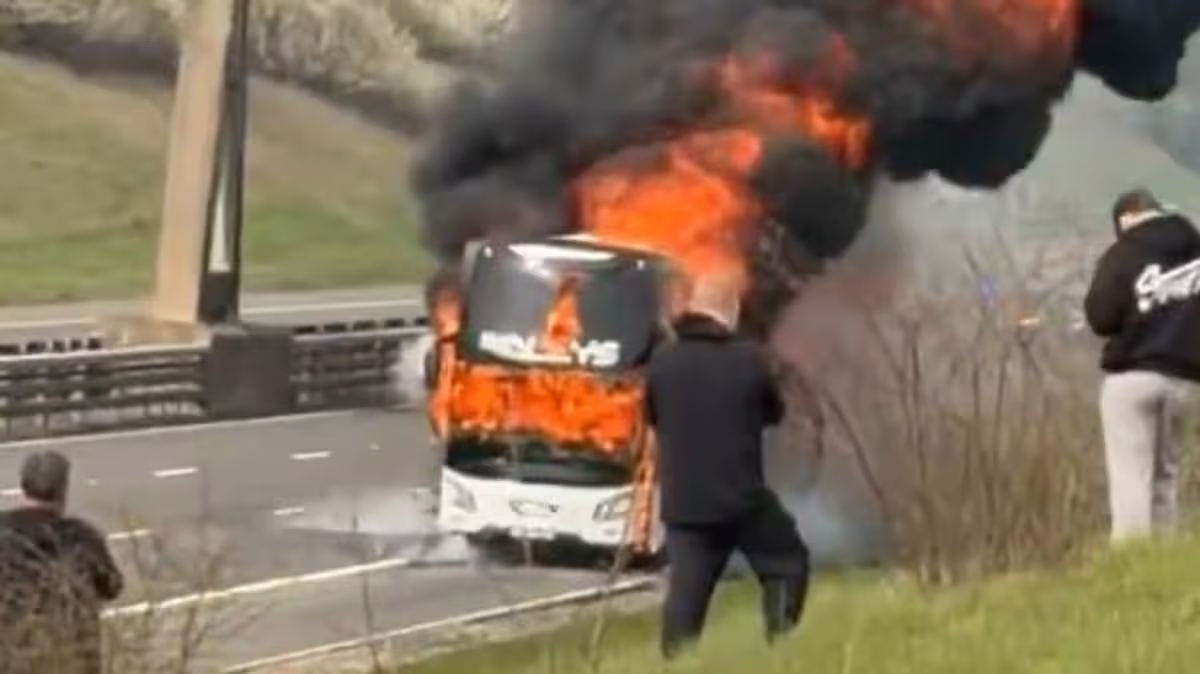
A coach carrying Manchester City fans has burst into the flames on the way to the Carabao Cup final at Wembley Stadium.

Pep Guardiola’s side face Mikel Arteta’s Arsenal in Sunday afternoon’s final, with the two Premier League giants competing for their first silverware of the season.

The match is sold out, with 90,000 fans set to descend on north-west London to watch their teams in action.

Advertisement

However, fans travelling to the game from the north of England are being held up following a huge coach fire on the M6 Toll in the West Midlands.

The coach is believed to be a Man City supporters’ coach heading to the game, with pictures shared on social media showing a fire ripping through the vehicle as fire crews tackle the blaze.

A large section of the M6 has been closed off while crews work at the scene, our sister title Manchester Evening News reports.

The incident has caused lengthy delays on the motorway, with traffic said to be at a standstill.

Advertisement

“Anyone en route to Wembley, lots of delays on M6 toll due to coach setting on fire,” one person wrote on X.

Another said: “Man City fan coach on way to Wembley on fire on M6 just after the toll, so we are at a standstill. Hope everyone is ok.”

“Bus fire on the M6 toll,” wrote a third person. “My mate is behind it and the whole road is stood still. People playing padel on the motorway.”

A witness told the MEN passengers were evacuated before being left waiting on the grass verge.

Advertisement

She said: “I wanted to report an incident currently unfolding on the M6 involving a coach carrying Manchester City fans travelling to Wembley.

“The coach has caught fire and is now severely damaged, with large plumes of smoke visible.

“Emergency services are on scene, and parts of the motorway appear to be closed, causing significant delays.

“Passengers have been evacuated and are currently waiting on the grass verge.

Advertisement

“No serious injuries have been reported so far.”

More follows

Source link

Advertisement
Continue Reading

NewsBeat

BBC in Cuba as island plunged into darkness

Published

on

BBC in Cuba as island plunged into darkness

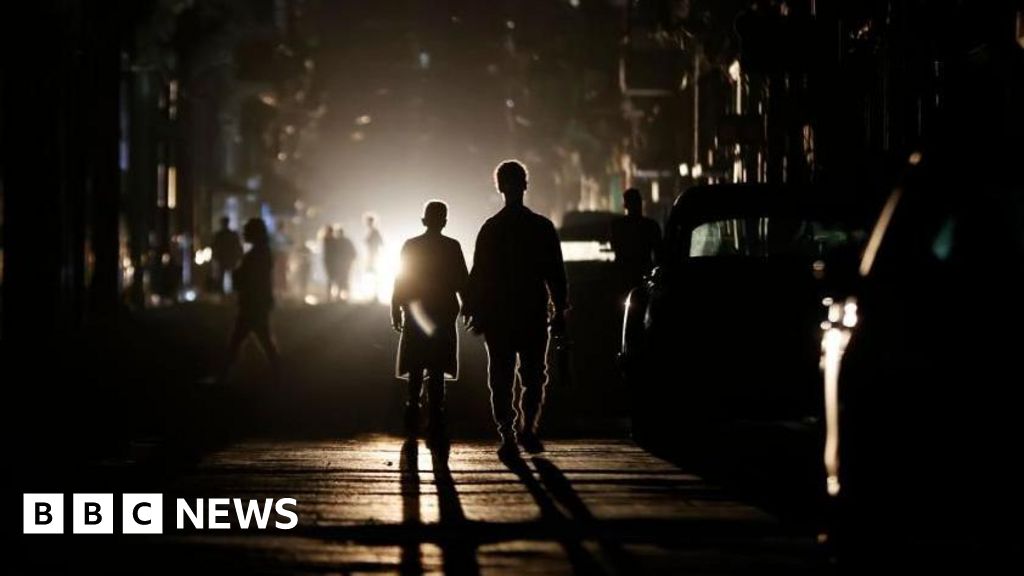
More than 10 million people in Cuba have had power cut to their homes and businesses after the country’s national electrical grid collapsed.

The Caribbean island has been hit with several blackouts this month, as a result of a US fuel blockade that cuts off the foreign oil imports needed to keep power stations running.

The Communist-run country has an ageing electricity infrastructure and chronic fuel shortages.

The BBC’s Will Grant reports from the capital Havana.

Advertisement

Source link

Continue Reading

NewsBeat

Ukraine constantly adapts its drones on the battlefield

Published

on

Ukraine constantly adapts its drones on the battlefield

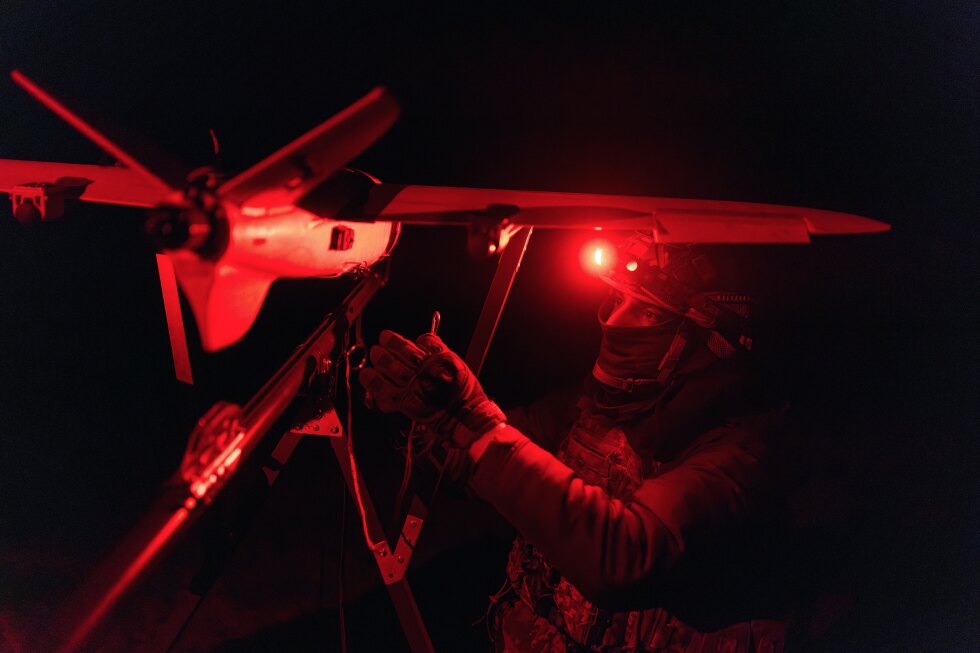
KHARKIV, Ukraine (AP) — The night air in eastern Ukraine is crisp, and a myriad of stars scatter above a small crew of soldiers watching for Iranian-designed Shahed drones that Russia launches in waves.

Such teams are deployed across the country as part of a constantly evolving effort to counter the low-cost loitering munitions that have become a deadly weapon of modern warfare, from Ukraine to the Middle East.

While waiting, the crew from the 127th Brigade tests and fine-tunes their self-made interceptor drones, searching for flaws that could undermine performance once the buzzing threat appears. When Shahed drones first appeared in autumn 2022, Ukraine had few ways to stop them. Today, drone crews intercept them in flight with continually adapting technology.

In recent years, Ukraine’s domestic drone interceptor market has burgeoned, producing some key players who tout their products at international arms shows. But it’s on the front line where small teams have become laboratories of rapid military innovation — grassroots technology born of battlefield necessity that now draw international interest.

Advertisement

President Volodymyr Zelenskyy says U.S. allies in the Middle East have approached Ukraine for help in defending against Iranian drones, the same type that Russia has fired by the tens of thousands in the 4-year-old war.

Iran has also used the same drones in retaliation for joint U.S.-Israeli strikes, at times overwhelming far more sophisticated Western-made air defenses and highlighting the need for cheaper and more flexible countermeasures.

“It’s not like we sat down one day and decided to fight with drones,” said a pilot with Ukraine’s 127th Brigade, sitting at his monitor after completing a preflight check. “We did it because we had nothing else.”

How the drone war began

Moments earlier, the pilot carefully landed his interceptor drone to avoid damaging it. He spoke on condition of anonymity because military rules did not allow him to be quoted by name.

Advertisement

Though designed to be disposable, limited resources mean Ukrainian crews try to preserve every tool they have, often reusing even single-use drones to study their weaknesses and improve them.

“Just imagine — a Patriot missile costs about $2 million, and here you have a small aircraft worth about $2,200,” the pilot said. “And if it doesn’t hit the target, I can land it, fix it a bit and send it back into the air. The difference is huge. And the effect? Not any worse.”

Ukraine’s 127th Brigade is building an air defense unit centered on interceptor drone crews — a model increasingly adopted across the military.

Leading the brigade’s effort is a 27-year-old captain, who previously served in another formation where he had already helped organize a similar system. He also spoke on condition of anonymity because military rules did not allow him to be quoted by name.

Advertisement

He clearly remembers the moment about two years ago when everything changed. He said he was assigned to lead a group of soldiers ordered to intercept Russian reconnaissance drones using shoulder-fired air-defense missiles.

The approach quickly proved ineffective. Agile drones equipped with cameras could easily maneuver away from the slower, less-flexible weapons, he said.

Determined to find a better solution, the young officer began searching for alternatives, asking fellow soldiers and volunteers supporting the front.

The answer turned out to be simple: another drone.

Advertisement

The captain still remembers the day a Russian Orlan reconnaissance drone hung above a Ukrainian position, transmitting coordinates to guide Russian artillery. A pilot from his unit downed it by using another drone, he added.

“That’s when I realized — this is a drone war. It had begun,” he said. “We had been moving toward it for some time, but that was the moment I saw it with my own eyes.”

They never found the wreckage of the Orlan, which burned as it fell to the ground.

Downing Shaheds

Another challenge soon emerged: how to intercept the hundreds of fast, durable Shahed drones flying far beyond the front line.

Advertisement

The young captain’s search for a solution led him to the 127th Brigade in Kharkiv and to cooperation with a local defense company. Their joint efforts resulted in aircraft-style interceptor drones capable of matching the speed of the Shaheds.

Kharkiv is not only where they work — it’s where their families live, a city that regularly comes under Shahed attacks.

Working with the company allows soldiers to test interceptor drones in real conditions and quickly refine the technology through direct feedback.

The company’s Skystriker drone differs from more widely known interceptor systems such as Sting or P1-Sun, which are based on modified first-person view, or FPV, drones. Instead, it resembles a small aircraft with wings, allowing it to stay aloft longer.

Advertisement

“Yes, this is a joint effort,” said the director of the company, who spoke on condition he not disclose the name of the firm or his own identity for security reasons.

“It’s not enough just to build it. It has to work — and work properly — and perform real combat tasks,” he said. “That’s why communication with the military is so important. They give us feedback and help us improve it every time.”

Nonprofits and volunteers

In Ukraine, cooperation often goes beyond the military and manufacturers. Volunteers frequently act as intermediaries between the two, sometimes even helping them find one another.

The Come Back Alive Foundation, a nonprofit think tank and charity that raises money to equip Ukraine’s forces, launched a project called “Dronopad,” loosely translated as “Dronefall,” in summer 2024.

Advertisement

The idea grew from battlefield reports that FPV drone pilots were occasionally able to track and intercept aerial targets — early cases that helped shape efforts to counter the Shaheds.

“At that moment it wasn’t clear whether this was even a scalable solution or just isolated incidents,” said Taras Tymochko, who leads the project. “Our goal was to turn it into a system — to help units that already had their first successful cases build the capability and scale what they had achieved.”

The foundation worked with drone manufacturers to better understand what systems soldiers needed. As the project developed, the capabilities of interceptor drones evolved.

“At some point they were able to reach speeds of more than 200 kilometers per hour (124 mph), which made it possible to intercept targets like Shaheds in the air,” Tymochko said.

Advertisement

The team closely monitored the rapidly growing drone market. A key factor, he said, was ensuring close cooperation between manufacturers and the military so that engineers could receive feedback quickly from battlefield tests.

“It’s always action and counteraction,” Tymochko said, noting both sides develop ways to counter enemy drones and improve their technology to neutralize each other’s responses. “That cycle is what drives the evolution of drone warfare.”

The technology itself, he said, is not especially difficult to copy. The real value lies in how it is used — and in the experience of the pilots who have learned to operate it effectively.

“People were very skeptical about the technology,” Tymochko said of the early days of interceptor drones. “Some thought it wouldn’t work, that within a month the Russians would come up with countermeasures and the drones would become useless.”

Advertisement

Nearly two years later, the results suggest otherwise.

“Many people called it air defense for the poor,” he said. “But it turns out that air defense for the poor can sometimes be more effective than air defense for the rich.”

___

Associated Press journalist Vasilisa Stepanenko contributed to this report.

Advertisement

___

Follow AP’s coverage of the Ukraine war at https://apnews.com/hub/russia-ukraine

Advertisement

Source link

Continue Reading

NewsBeat

Person rushed to hospital ‘seriously unwell’ ahead of derby

Published

on

Person rushed to hospital 'seriously unwell' ahead of derby

Emergency services were called to the scene outside the Shark Bar on Gallowgate in Newcastle at around 11am.

An ambulance attended and took the patient to the RVI for further treatment.

The Northern Echo understands the incident does not appear to be linked to any disorder or “fan clashes”.

Scenes in Newcastle today ahead of the Tyne-Wear derby clash (Image: THE NORTHERN ECHO)

A spokesperson for the North East Ambulance Service (NEAS) said: “We received a call at 11am this morning to reports of a person seriously unwell outside the Shark Bar on Gallowgate in Newcastle.

Advertisement

“We sent one emergency ambulance crew and took the patient to the RVI for treatment.”

Source link

Advertisement
Continue Reading

NewsBeat

Cyclist dies after horror crash with 4×4 on Shetland

Published

on

Daily Record

The 51-year-old male cyclist was taken to hospital, where he was pronounced dead a short time later.

A cyclist has died after a horror crash involving a 4×4 in Shetland.

Advertisement

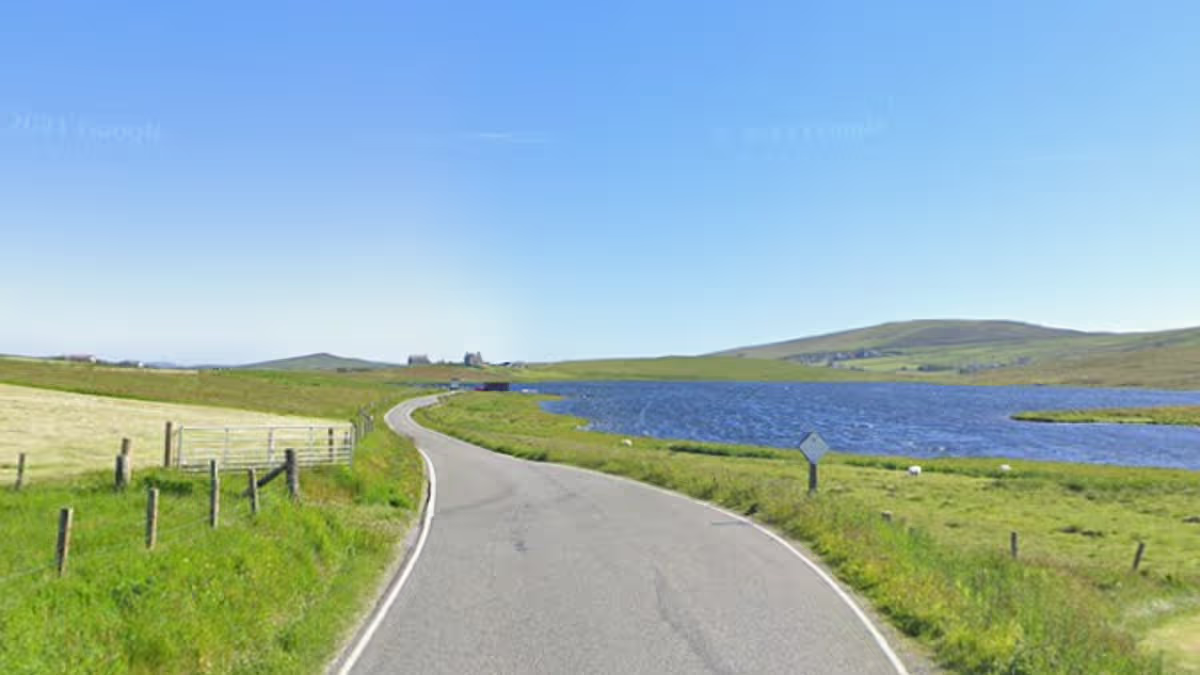
Emergency services raced to the incident involving a black Ford Ranger and a cyclist on the B9074 in Trondra at 10pm on Saturday, March 21. Crews attended and the 51-year-old male cyclist was taken to hospital, where he was pronounced dead a short time later.

His next of kin have been made aware. The occupants of the Ford were not injured.

The road will remain closed on Sunday, March 22 to allow investigation work to take place. Officers have asked any witnesses of the fatal collision to come forward.

Sergeant Ewan Calder said: “My thoughts are with the family and friends of the man who died and we’ll continue to offer them support.

Advertisement

“I’m appealing to anyone who was in the area at the time and may have any information which could assist our investigation to come forward.”

Anyone who can help is urged to call Police Scotland on 101 quoting reference 3319 of 21 March.

Get more Daily Record exclusives by signing up for free to Google’s preferred sources. Click HERE.

Source link

Advertisement
Continue Reading

NewsBeat

Jorginho criticises Chappell Roan security guard for making daughter cry

Published

on

Jorginho and Chappell Roan

Former Chelsea and Arsenal player Jorginho may be best known as a defensive midfielder – but he has gone viral on social media for his attack on pop singer Chappell Roan, alleging her security guard reduced his 11-year-old daughter to tears.

The 34-year-old Italy international, who has dual Brazilian citizenship and now plays for Flamengo in Rio de Janeiro, claimed in a post on Instagram, external that his family suffered the “very upsetting situation” over breakfast at a hotel in Sao Paulo, Brazil.

The former Premier League midfielder said his daughter was a big Chappell Roan fan and had made a sign to take to the Lollapalooza music festival in Sao Paulo, which the singer was headlining.

He says his daughter recognised the star while eating at a nearby table and walked past her, smiled, then went back to her seat without saying anything or asking anything of the Pink Pony Club singer.

Advertisement

“What happened next was completely disproportionate,” he wrote.

“A large security guard came over to their table while they were still having breakfast and began speaking in an extremely aggressive manner to both my wife [Catherine Harding] and my daughter, saying that she shouldn’t allow my daughter to ‘disrespect’ or ‘harass’ other people.”

He added: “He even said he would file a complaint against them with the hotel, while my 11-year-old daughter was sitting there in tears. My daughter was extremely shaken and cried a lot.”

Chappell Roan has not responded to his claims.

Advertisement

Jorginho said he understood well the pressures of public exposure after playing 57 times for Italy – helping them win the European title in 2021 by beating England at Wembley.

He has also played for elite clubs across Europe and Brazil – winning the Champions League and Europa League with Chelsea and silverware in Italy with Napoli.

But he added: “I understand very well what respect and boundaries are. What happened there was not that. It was just a child admiring someone.

“It’s sad to see this kind of treatment coming from those who should understand the importance of fans. At the end of the day, they are the ones who build all of this.

Advertisement

“I sincerely hope this serves as a moment of reflection. No-one should have to go through this, especially not a child.”

Jorginho finished his impassioned post with a direct message to Chappell Roan, written in capital letters: “WITHOUT YOUR FANS, YOU WOULD BE NOTHING. AND TO THE FANS, SHE DOES NOT DESERVE YOUR AFFECTION.”

The “unexpected beef”, as described by some commentators, led to a flood of responses on social media in support of Jorginho and his family – some serious, some tongue-in-cheek.

Rio de Janeiro’s mayor, Eduardo Cavaliere, wrote that he intended to ban Chappell Roan from performing in his city, adding that Jorginho’s daughter would be invited as a guest of honour to the city’s Todo Mundo music festival in May.

Advertisement

Others cited her previous comments about fans’ “creepy” and “stalker-like-behaviour”, external.

Some also poked fun at the Grammy Award winner for lacking the credentials to play in the Premier League.

Source link

Advertisement
Continue Reading

NewsBeat

‘A bright light’: Tributes paid to 8-year-old Co Tyrone child who passed away following brain tumour battle

Published

on

Belfast Live

“Odhrán had a deep love for sport and embraced life with kindness, energy and joy”

Tributes have been paid to an eight-year-old Co Tyrone boy who has passed away following a battle with a rare form of brain tumour.

Advertisement

Odhrán McGirr, a player with Errigal Ciaran GAA, was diagnosed with an aggressive High Grade Glioblastoma, an extremely difficult tumour to treat.

Following his diagnosis, Odhrán faced chemotherapy and surgery. His local community rallied behind him throughout, helping to raise £136,000 to help his family and supportive charities through the diagnosis.

READ MORE: Co Tyrone community rallies to support eight-year-old with rare brain tumourREAD MORE: Special service at his ‘much-loved farm’ for Moneymore man who died in tragic incident

An enthusiastic GAA player, Odhrán had the honour of leading out his beloved Tyrone senior team when they played Offaly in the National Football League in Dungannon.

Advertisement

Tyrone GAA paid tribute to the young boy who “showed extraordinary courage, strength and positivity beyond his years”.

They said: “Coiste Chontae Thír Eoghain is deeply saddened to learn of the passing of Odhrán McGirr.

“A proud member of Errigal Ciarán, Odhrán had a deep love for sport and embraced life with kindness, energy and joy.

“A caring child and a wonderful big brother to Ruairí and Saoirse, he showed extraordinary courage, strength and positivity beyond his years in the face of an unimaginably difficult illness.

Advertisement

“Only a few weeks ago, he led the Tyrone Senior Footballers onto the field in Dún Geanainn – a moment of immense pride that will live long in the memory of all those in attendance.

“Our heartfelt condolences are with his parents Patrick and Catriona, his brother and sister, and the entire McGirr family, as well as his friends and teammates.”

In a statement, his GAA club Errigal Ciaran, said his passing has been met with “unimaginable heartbreak and profound sadness.”

Advertisement

A touching tribute read: “Our thoughts and prayers are with his heartbroken parents Patrick and Catriona, his brother Ruairí, his sister Saoirse, and the entire McGirr and Carmody families at this incredibly difficult time.

“Odhrán was a cherished member of Aireagal Chiaráin GAC – a bright light within our club whose presence brought joy, energy and pride to all who had the privilege of knowing him.

“From his earliest days in our colours, he embodied everything that is good about our games – friendship, spirit, resilience and a deep, unwavering love for his club.

“The McGirr name is woven deeply into the fabric of Aireagal Chiaráin. Odhrán’s grandfather Johnny has given over 30 years of dedicated service as a volunteer; his father Patrick a committed youth coach; his uncle Dermot a longstanding youth officer – alongside a wider family who have been true stalwarts of our club.

Advertisement

“Odhrán carried that legacy with quiet pride each time he stepped onto the field. He wore the jersey with honour, determination and a smile that will never be forgotten.

“As a club, we are honoured to have shared in memories that will be treasured forever – from Odhrán’s unforgettable day on the hallowed turf of Croke Park to that special Saturday morning in Glencull and Dunmoyle that will live long in all our hearts.

“There are no words that can truly capture the depth of sorrow we feel as a club and community. A life taken far too soon leaves a silence that echoes through our pitches, our dressing rooms and our hearts. In the difficult days, weeks and months ahead we will stand shoulder to shoulder with Patrick, Catriona and the entire family, just as they have always stood with us.

“We will forever remember Odhrán – his laughter, his kindness, his teammates and the pure joy he brought to the game. He was and always will be, one of our own.

Advertisement

“May his noble soul rest in peace. Loved and remembered always, Now playing with the angels. Go raibh suaimhneas síoraí ar a anam uasal. Grá agus cuimhne i gcónaí air, Ag imirt leis na haingil anois.”

For all the latest news, visit the Belfast Live homepage here and sign up to our daily newsletter

Source link

Advertisement
Continue Reading

NewsBeat

2025 visitor numbers for York attractions released

Published

on

2025 visitor numbers for York attractions released

But one attraction in the city saw its visitor numbers rise by over a quarter.

For months, there was little or no rain in York and North Yorkshire last Spring and Summer.

The continuous sun was welcomed by visitors at Harlow Carr Gardens in Harrogate where visitors were up to 8 per cent to 527,724; Dalby Forest, also up 8 per cent to 440,298, and Fountains Abbey, up 4 per cent to 436,630, according to the Association of Leading Visitor Attractions (ALVA).

Advertisement

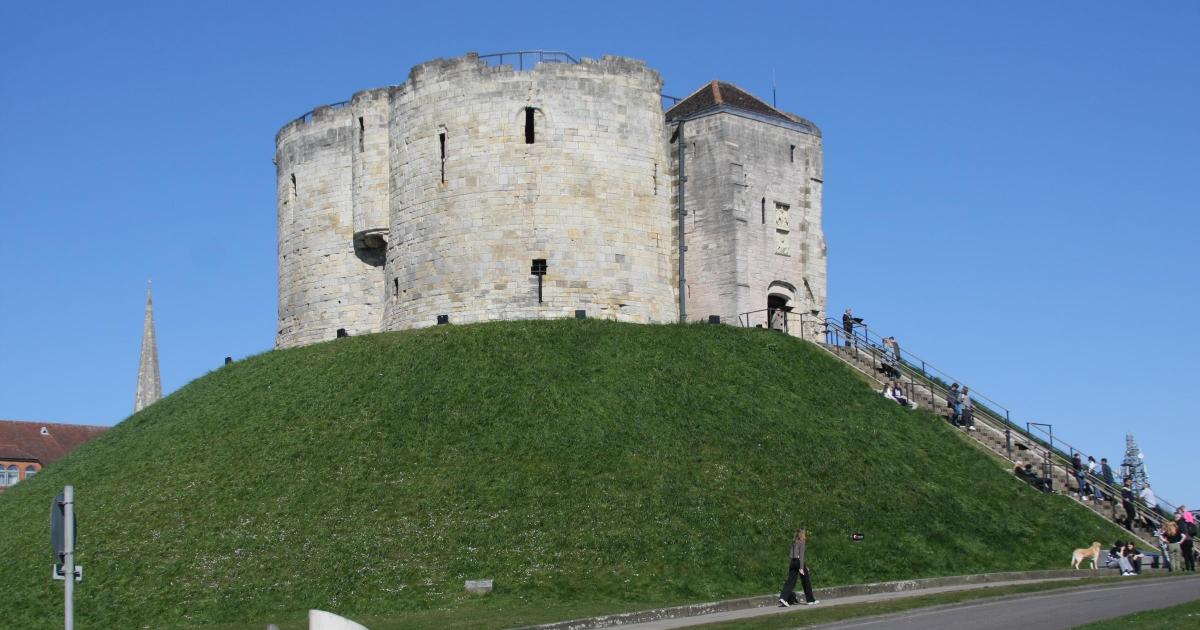
In York, Cliffords Tower saw a drop of 7 per cent to 150,673, the National Railway Museum saw a drop of 5 per cent to 656,205 and York Minster 4 per cent to 437,204.

Jorvik Viking Centre is not included in the figures, which only features attractions run by ALVA members.

Figures for York Museums Trust were mixed. Yorkshire Museum saw the biggest rise in the city of 29 per cent to 79,260, thanks to a major exhibition. The Trust’s most popular attraction, Castle Museum, saw its numbers rise by 5 per cent to 221,170. But York Art Gallery had a drop of 53 per cent to 52,560.

All figures are compared to the visitor numbers in 2024.

Advertisement

Source link

Continue Reading

NewsBeat

Residents have say on next use of Stanley board school site

Published

on

Residents have say on next use of Stanley board school site

It comes after the demolition of the former Stanley Board School on the town’s Front Street, with many in the area urging that the cleared site be put to use for young people.

The former school, derelict for more than a decade, was demolished in January due to “substantial structural defects” that made the building financially impossible to save.

Karbon Homes, which owns the Front Street site, has said it wants the land to “benefit the community” while long-term plans for redevelopment are explored, including a forthcoming consultation.

Now residents have had their say on what they want to see from the site, including Pamela Halliday, 49, from Stanley who said the site should be: “Anything but a HMO.”

Advertisement

“It could be something for kids to stop the anti-social behaviour in the bus station,” she added.

Forty-nine-year-old Pamela Halliday said it should be ‘anything but a HMO.’ (Image: THE NORTHERN ECHO)

Brian Hutchinson, 70, said: “They need to make it something for the young people to stop them rampaging around town.

“A community centre would be good.”

Karbon Homes, which took the decision to demolish the site, said: “The investment required to retain it was financially unviable for us to undertake.”

Advertisement

Others welcomed the tidier appearance of the street since demolition, though some lamented the loss of the historic building.

The site has been levelled. (Image: THE NORTHERN ECHO)

One unnamed resident said: “It’s definitely better than it used to be, that’s for sure.”

Another described it as a missed heritage opportunity, adding: “They shouldn’t have torn it down.

“When it started to get bad, they should have taken it to Beamish and restored it.”

Advertisement

Robert Scott, 72, said: “Anything is better than what it is at the moment.

“It would be a good site for a Tesco, we don’t have one of those in the town.

“But if not, instead of it being rubble for the next 10 years it would make a nice little park.”

Lily Beckwith, 70, has lived in Stanley all her life. (Image: THE NORTHERN ECHO)

Long-term resident Lily Beckwith, 70, said: “It would be nice to have a play area for the young children and something for the whole community to be able to use.

Advertisement

“I remember when it used to be a bustling high street. We need that community spirit back.”

Karbon Homes said it is working with partners and the public on the site’s future.

The company said: “We will be exploring these ideas and will continue to engage with our community partners, as well as Stanley Town Council, Durham County Council and the North East Combined Authority.”

Karbon has also increased security at the site with CCTV and weekly inspections to prevent anti-social behaviour.

Advertisement

Previously, Graham Wood, economic development manager at Durham County Council, said of the site: “Its demolition is an opportunity to breathe fresh life into a prominent town centre location and, while we have not owned the building for many years, we have been working with its owner, Karbon Homes, as it explores future options for the site.

“We are committed to revitalising town centres across the county and are currently creating a new Strategic Place Plan for Stanley. This follows a series of engagement events last year in which we asked residents and businesses to share their ambitions for the town.

“Securing new uses for vacant sites in the town centre is a key priority and the redevelopment of Stanley Board School supports this goal.”

Advertisement

Source link

Continue Reading

Trending

Copyright © 2025