
Crypto World
Mark Zuckerberg Deploys Personal AI Agent to Revolutionize Meta’s Operations


Quick Overview
- Zuckerberg’s personal AI assistant eliminates information bottlenecks in executive workflows.
- The technology enables Meta to reduce hierarchical layers and enhance operational efficiency.
- Executive-level AI aggregates documents, communications, and project data in real-time.
- Advanced automation allows complex multi-phase tasks with reduced human intervention.
- Meta is rolling out AI agents across teams to transform corporate structure.
Mark Zuckerberg, CEO of Meta, is currently piloting an innovative AI agent designed to enhance his operational efficiency and decision-making capabilities. This intelligent assistant focuses on delivering direct information access, eliminating bottlenecks created by traditional organizational chains. The initiative represents Meta’s strategic approach to operational optimization and enhanced productivity.
The experimental AI assistant is in active testing phases to accelerate data retrieval throughout Meta’s operations. By circumventing conventional management hierarchies, it enables rapid executive decisions and enhanced operational flow. Meta envisions this AI agent as a critical tool for simplifying high-level administrative functions.
This AI deployment reflects the company’s comprehensive strategy to embed advanced technology throughout its operations. Meta maintains a workforce of roughly 78,000 employees and continuously seeks methods to minimize organizational inefficiencies. The AI agent initiative demonstrates a commitment to enhanced leadership effectiveness while simultaneously enabling individual team members.
Executive AI Assistant Transforms Data Accessibility
The intelligent agent designed for Zuckerberg provides immediate data access, dramatically reducing dependence on traditional organizational hierarchies. It seamlessly aggregates internal documentation, conversation histories, and project intelligence for instantaneous retrieval. Through optimized information delivery, the AI assistant eliminates typical delays that hinder executive-level decisions.
Meta’s AI solution integrates with existing employee platforms that handle documentation, messaging, and team collaboration. These integrated systems facilitate enhanced workflow dynamics and connect personnel directly with necessary information. Deploying the AI agent at the executive level illustrates Meta’s dedication to cutting-edge operational excellence.
Initial testing reveals the AI assistant can autonomously handle sophisticated multi-phase workflows, supporting intricate decision-making processes. While complementing human judgment, it significantly reduces coordination time across departments. This technology exemplifies the growing trend of automation-enhanced executive operations.
Company-Wide AI Integration and Structural Evolution
Meta is broadening AI agent deployment throughout its entire workforce to optimize projects and decrease interdepartmental dependencies. Staff members utilize platforms such as MyClaw and Second Brain for efficient data access and workflow organization. These solutions operate in concert with the CEO’s AI assistant, establishing an enterprise-wide intelligent support ecosystem.
The AI agent program facilitates a more horizontal organizational framework, empowering teams to function with greater autonomy. Through reduced management tiers, Meta promotes accelerated decision cycles and enhanced individual responsibility. This operational model mirrors agile, AI-enabled organizations with streamlined structures.
Zuckerberg envisions 2026 as a pivotal year for comprehensive AI agent integration into everyday operations. The organization maintains substantial investments in cutting-edge technologies via its Meta Superintelligence Labs. Expanding AI agent utilization indicates a fundamental transformation in Meta’s approach to leadership, project execution, and internal collaboration.
The AI agent now serves as a cornerstone of Meta’s efficiency framework, optimizing executive responsibilities while empowering the broader workforce. This demonstrates that artificial intelligence has evolved beyond routine tasks to influence strategic corporate management. Meta’s implementation strategy positions the organization for accelerated, unified operations within the highly competitive technology sector.




Coinbase users are complaining about receiving multiple push notifications per day urging them to “predict” sports gameplay during “March Madness” college basketball.
Indeed, so many complaints were reported via X that it became a trending topic yesterday.
Many customers, echoing allegations by state attorneys general in Michigan and Arizona, described the annoying promotions as de facto advertisements to gamble on sports.
Coinbase, is one of the longest continually-operated bitcoin (BTC) exchanges which safeguards billions of dollars’ worth of assets for customers.
However, rather than focus on long-term investments like BTC, Coinbase regularly floods its app with short-term promotions, all-or-nothing predictions, memecoins, leveraged derivatives, and other high-risk wagers.
Full-screen promotions tempt many users into risky trades while many customers don’t see a single mention of BTC during their entire Coinbase app experience.
Indeed, the homepage of the app as of Protos’ last check, featured a “March Madness” advertisement at the top of the homescreen with no mention of BTC above the fold.
One customer and Coinbase stockholder posted screenshots of the basketball notifications, which arrived several times daily. “This is essentially encouraging me to gamble,” he wrote.
‘Very bad for our industry’
CEO Brian Armstrong responded the same afternoon, calling it “a fair point” and promising customization options. However, the concession only drew sharper criticism.
Alexander Leishman, founder of BTC exchange River, replied to Armstrong: “It’s long term very bad for our industry to be pushing sports betting. The blowback will impact all of us.”
Days earlier, a Messari researcher had posted a nearly identical complaint. “Why am I getting notifications from Coinbase about betting odds for college basketball games?” he wrote.
“This is just reinforcing the notion that crypto is just another gambling product, and not an actual investment to be taken seriously.”
Crypto attorney Ariel Givner compared the moment to Juul’s rise and fall.
Other users were more blunt. “Every time I open your d*** app, I’m getting bombarded with gambling notifications,” one wrote, tagging Coinbase directly.
Read more: NHS exec warns that crypto trading could fuel problem gambling
Coinbase sports ‘event contracts’
Coinbase launched prediction markets in all 50 states in January 2026 through a partnership with Kalshi.
Users can place “prediction” trades on sports, politics, and culture outcomes, funding trades with cash or USDC. Under federal law, these are legally “event contracts,” not sports bets.
Coinbase has sued regulators in Connecticut, Michigan, and Illinois who disagree.
The legal distinction hasn’t convinced everyone.
Nevada, Illinois, and Connecticut have all argued these contracts are functionally gambling while a class action lawsuit in New York alleged that Kalshi “dupes consumers… when they are actually gambling against the house.”
Illinois regulators stated plainly that athletic competitions aren’t economic instruments. Chris Christie told CNBC, “If it looks like a duck and quacks like a duck, it’s a duck. It’s a sports bet.”
Coinbase disagrees entirely and is suing various regulators who have likened its prediction markets to gambling.
Got a tip? Send us an email securely via Protos Leaks. For more informed news, follow us on X, Bluesky, and Google News, or subscribe to our YouTube channel.
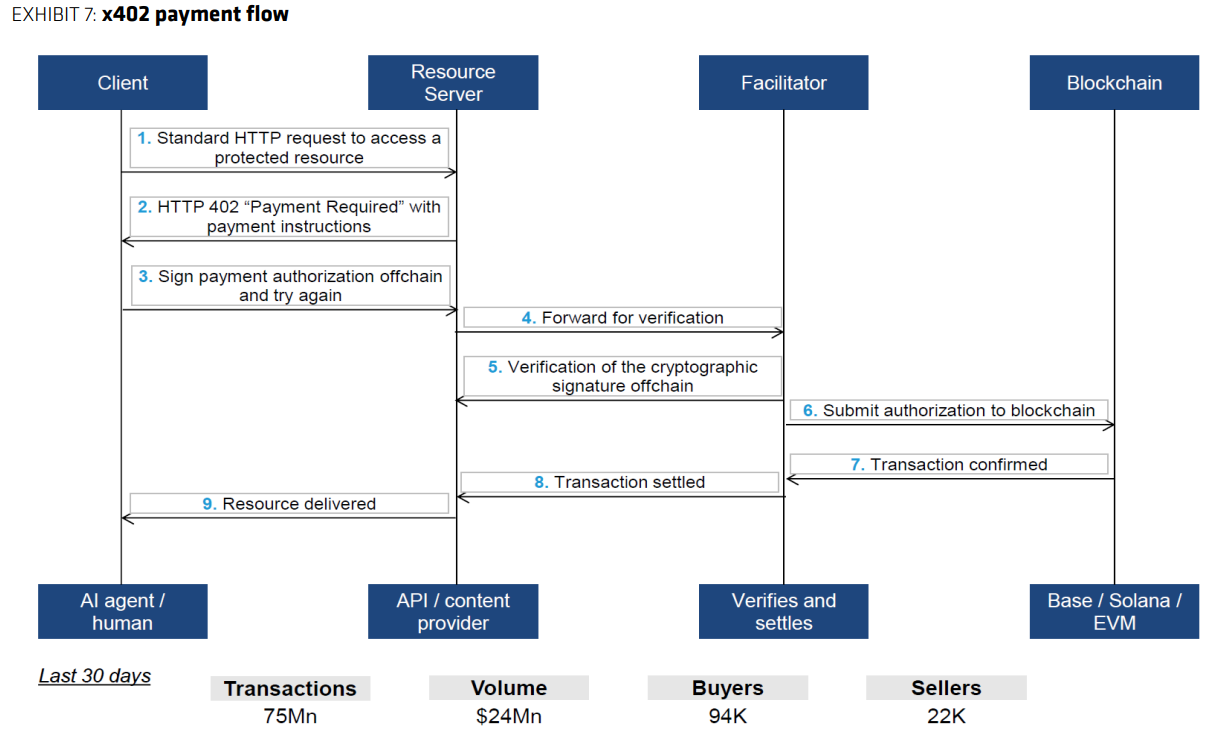
Stablecoins could benefit from the rise of AI-driven payments over time, even as early adoption remains limited and contested, according to a new report from Bernstein.
In a Monday note shared with Cointelegraph, the broker said stablecoins could help unlock machine-to-machine payments by making microtransactions viable and enabling programmable, conditional payments between software agents without a human in the loop.
But Bernstein said traction so far has been limited. The note said Stripe and Tempo’s machine payments protocol recorded about $5,000 in stablecoin volume in its first week, while Coinbase’s x402 protocol handled no more than $25 million over the last 30 days.
Bernstein’s chart put x402 volume at about $24 million over that period. x402 is a payment standard developed by Coinbase that lets AI agents automatically make payments over the internet.
The bigger point for Bernstein was that stablecoins do not need machine payments to succeed in order to keep growing. The note said stablecoin demand is already being driven by cross-border business payments, remittances, card-linked products and neobanking, making AI payments an upside case rather than the core thesis.
The report follows growing interest in autonomous payment solutions. On Thursday, Visa’s crypto division launched a tool allowing AI agents to make same-day payments, while Stripe-backed Tempo launched its blockchain and payment protocol.

Bernstein said broader payment use cases are still the real growth engine for stablecoins. Its note estimated total stablecoin payment volume rose to $375 billion in 2025 from $213 billion in 2024, led by consumer-to-consumer flows, while business-to-consumer, business-to-business and consumer-to-business activity also increased.
Related: Stablecoin issuers and fintechs race to own payment rails
Coinbase, Circle remain best “proxies” for stablecoin adoption
Cryptocurrency exchange Coinbase and stablecoin issuer Circle remain the “best proxies for stablecoin upside” due to their USDC (USDC) partnership, according to Bernstein.
It also argued that USDC is likely to capture a dominant share of machine-payment activity because it is the most liquid and regulated stablecoin among likely candidates.
So far in 2026, USDC recorded $2.4 trillion in adjusted transaction volume while Tether’s USDt (USDT) recorded $1.4 trillion.

Wash trading concerns cloud early metrics
Some of the headline machine-payment numbers have already drawn skepticism.
AI Agent payment volume on x402 only amounted to $1.6 million after applying the wash trading filter developed by Artemis Analytics, which is significantly lower than the initial $24 million reported by news outlet Bloomberg, according to a16z partner Noah Levine.

“$1.6 million is not a big number. But the infrastructure being built around it is,” wrote Levine in a March 11 X post, adding that x402 was already integrated by the likes of Stripe, Cloudflare, Vercel and Google’s agent payments protocol.
Magazine: Crypto wanted to overthrow banks, now it’s becoming them in stablecoin fight

Key Highlights
- Bipartisan Senate legislation seeks to prohibit CFTC-overseen platforms such as Kalshi and Polymarket from facilitating sports wagering contracts
- Shares of DraftKings (DKNG) and Flutter Entertainment (FLUT) each climbed approximately 8% during premarket hours Monday
- The proposed legislation would additionally prohibit casino-style gaming products including slots, video poker, and blackjack on prediction platforms
- Senators Adam Schiff and John Curtis are jointly backing the measure — representing the first cross-party Senate initiative to regulate prediction markets
- Multiple states such as Nevada, Arizona, Massachusetts, and Michigan have already pursued independent legal challenges against Kalshi
Shares of DraftKings (DKNG) surged approximately 8% during premarket hours Monday following a Wall Street Journal report revealing that a bipartisan coalition of U.S. senators plans to unveil legislation banning prediction market platforms from facilitating sports betting contracts.
The development represented positive momentum for conventional sports betting companies, which have faced ongoing competition from platforms like Kalshi and Polymarket vying for the same sports gambling audience.
The draft legislation would prohibit entities under Commodity Futures Trading Commission (CFTC) oversight from listing contracts connected to athletic competitions. This would have a direct effect on Kalshi and Polymarket’s domestic operations — two prominent players in the prediction market space.
The proposal would further prohibit casino-style entertainment offerings on these platforms, encompassing slot machines, video poker, blackjack, and bingo games.
Sen. Adam Schiff (D., Calif.) stated that the CFTC is “greenlighting these markets and even promoting their growth,” further noting that “it’s time for Congress to step in and eliminate this backdoor which violates state consumer protections, intrudes upon tribal sovereignty and offers no public revenue.”
Joint sponsor Sen. John Curtis (R., Utah) described the matter as particularly relevant to his constituency. “Too many young people in Utah are getting exposed to addictive sports betting and casino-style gaming contracts that belong under state control, not under federal regulators,” he stated.
This represents the inaugural bipartisan Senate measure focused on prediction market oversight — a significant development in the escalating conflict between state authorities, federal agencies, and the platforms in question.
Flutter Entertainment (FLUT), parent company of FanDuel, similarly experienced an approximate 8% premarket increase following the announcement, as the legislation would eliminate a significant competitive challenge to its primary operations.
Ongoing Legal Confrontations
The congressional initiative arrives amid existing state-level actions against Kalshi. Nevada obtained a temporary restraining order preventing Kalshi from providing contracts related to sports, elections, and entertainment events.
Arizona escalated matters by filing criminal charges against Kalshi’s parent entities for purportedly conducting an unlicensed illegal gambling operation — though Kalshi has contested these allegations and called on the state to dismiss the charges.
Massachusetts and Michigan have both initiated lawsuits against Kalshi, contending that its prediction markets constitute unauthorized sports gambling activities. Polymarket has similarly filed suit against Michigan seeking to block enforcement of state gambling regulations against its platform.
On the federal front, the CFTC has asserted it possesses exclusive authority over commodities derivatives, including event-based contracts. In February, the agency submitted a brief to the Ninth Circuit defending this jurisdictional position.
Sports League Perspectives
Most prominent U.S. sports organizations have generally favored legalized sports wagering. However, their stance on prediction markets has been more nuanced — reflecting apprehensions about competition integrity and potential misuse of inside information.
Nevertheless, Major League Baseball recently entered into a licensing agreement with Polymarket, providing the platform access to league information while establishing collaborative monitoring of baseball-related wagers on the service.
DraftKings had not issued any official response regarding the proposed legislation as of Monday morning.
Key Highlights
- Share-based acquisition structure maintains proportional bitcoin exposure for all stakeholders.
- H100’s bitcoin treasury will grow to approximately 3,501 BTC upon deal closure.
- No shareholder dilution as transaction preserves bitcoin-for-bitcoin value.
- Acquisition adds systematic trading and hedge fund management expertise.
- Deal strengthens H100’s competitive position in European capital markets.
H100 has entered into a letter of intent for the acquisition of two Norwegian entities: Moonshot AS and Never Say Die AS. Under the terms of the agreement, H100 will issue new shares in exchange for the bitcoin assets held by both target firms. Once finalized, the transaction will bring H100’s total bitcoin holdings to roughly 3,501 BTC, reinforcing its status among Europe’s prominent publicly listed bitcoin treasury enterprises.
The agreement employs a bitcoin-for-bitcoin exchange mechanism, ensuring that existing shareholders maintain their proportional cryptocurrency exposure. This acquisition will provide H100 with an enhanced balance sheet and greater market significance. The strategic move is designed to advance H100’s presence in capital markets while safeguarding the fundamental bitcoin exposure across the shareholder base.
This deal introduces a seasoned team of technology and investment professionals to H100. Their specialized knowledge will integrate seamlessly with H100’s current treasury management and capital markets functions. The expanded network incorporates notable bitcoin industry veterans, strengthening H100’s strategic footprint within the cryptocurrency sector.
Deal Framework and Business Logic
The acquisition agreement between H100 and the Norwegian companies will be executed entirely through share issuance. Post-transaction ownership stakes in H100 will be determined solely by the amount of bitcoin each participating entity contributes. The structure ensures zero dilution of bitcoin exposure while simultaneously expanding the company’s financial scale.
Moonshot AS and Never Say Die AS collectively control approximately 2,450 bitcoin, whereas H100’s present holdings stand at roughly 1,051 BTC. The merged entity will command a bitcoin treasury exceeding 3,500 BTC, substantially enhancing H100’s asset base. This consolidation also positions H100 to access improved liquidity conditions and attract institutional investor interest.
H100 seeks to strengthen its operational capabilities in bitcoin acquisition and treasury oversight. With the addition of the target companies’ teams, the firm will advance its capital markets initiatives with enhanced resources. This acquisition strategy aligns directly with H100’s ambition to establish itself as the preeminent European publicly traded bitcoin treasury corporation.
Acquired Entities and Management Structure
Both Moonshot AS and Never Say Die AS specialize in bitcoin acquisition methodologies and investment portfolio management. These Norwegian firms are helmed by seasoned professionals who bring extensive experience in systematic trading operations and hedge fund administration. Their capabilities directly support H100’s extended-term bitcoin treasury objectives.
The target companies are owned by Geir Harald Hansen, who established the Bitminter mining pool. Throughout its operational history, Bitminter successfully mined more than 208,000 BTC, accounting for roughly 1% of bitcoin’s total circulating supply. This acquisition therefore imports substantial bitcoin market intelligence into H100’s organizational framework.
H100 will maintain its current management structure, with Johannes Wiik continuing as CEO and Sander Andersen remaining as Chairman. Key personnel from Moonshot AS and Never Say Die AS will join H100’s board of directors and management team. This organizational approach ensures business continuity while capitalizing on synergistic expertise to enhance the company’s competitive standing in the market.

Key Takeaways
- VST shares began trading 12.6% lower at $146.23 following weaker-than-expected quarterly results
- Quarterly earnings per share reached $2.18, missing the Street’s $2.45 estimate; sales totaled $4.58B against a $5.75B forecast
- Executive Vice President offloaded 10,000 shares on March 9th at a price of $160.31 per share
- Wall Street maintains a Buy consensus rating with a mean target of $236.87
- JPMorgan increased its target price to $240 from $239 while keeping an Overweight stance
Vistra Corp’s fourth-quarter financial results disappointed investors significantly. The energy company failed to meet both earnings and sales projections by considerable margins, triggering a sharp decline in share price at Monday’s market open.
Shares of VST commenced trading at $146.23, representing a 12.6% decline for the session. This marked a substantial retreat from the stock’s 50-day moving average of $163.60 and an even more pronounced distance from its 200-day moving average of $177.24.
The financial results painted a clear picture. The company reported fourth-quarter earnings per share of $2.18, undershooting analyst projections of $2.45. Quarterly revenue registered at $4.58 billion, substantially below the anticipated $5.75 billion. The company’s net profit margin came in at 5.32%.
Considering the stock’s 12-month trading pattern provides perspective on the selloff. VST has fluctuated between $90.51 and $219.82 throughout the past year, indicating that despite the painful decline, shares remain considerably elevated from their 52-week floor.
Wall Street’s Perspective
Notwithstanding the earnings shortfall, financial analysts maintain their optimistic stance on the stock. The prevailing consensus rating stands at Buy, with analysts projecting an average price target of $236.87 — representing significant upside from current trading levels.
JPMorgan revised its financial model following the earnings release and slightly raised its price target to $240 from $239, maintaining an Overweight designation. Goldman Sachs elevated VST to Buy status in February, establishing a $205 price objective. Jefferies similarly upgraded the stock to Buy during the same period, setting a $203 target.
Bank of America reduced its target from $231 to $218 while preserving its Buy recommendation. Scotiabank maintains a $293 target accompanied by an Outperform rating. Among the firms providing coverage, three assign a Strong Buy rating, twelve recommend Buy, and one maintains a Hold position.
Analysts project Vistra will generate $7 in earnings per share for the complete fiscal year.
Share Transactions and Shareholder Returns
Significant insider trading activity occurred prior to the earnings announcement. EVP Stephanie Zapata Moore disposed of 10,000 VST shares on March 9th at an average transaction price of $160.31, generating proceeds of approximately $1.6 million. Following the transaction, she maintains ownership of 114,409 shares.
Vistra announced a quarterly dividend distribution of $0.228, scheduled for payment on March 31st to shareholders registered as of March 20th. This represents a marginal increase from the previous quarterly payment of $0.23. On an annualized basis, this equals $0.91 per share, translating to approximately 0.6% yield. The company’s dividend payout ratio stands at 41.94%.
Regarding institutional ownership, multiple investment firms expanded their positions during the fourth quarter. Teamwork Financial Advisors boosted its stake by 39.9%, acquiring an additional 22,492 shares for a total holding of 78,855 shares, valued at $12.72 million at quarter’s conclusion. Procyon Advisors expanded its position by 395.2%. Harbor Investment Advisory surged 495.7% in its ownership, albeit from a modest starting point. Institutional investors collectively control 90.88% of outstanding shares.
The company’s financial structure carries considerable leverage. Vistra operates with a debt-to-equity ratio of 6.01, maintains a current ratio of 0.78, and trades at a price-to-earnings ratio of 67.39. The company’s market capitalization totals $49.51 billion.

Key Highlights
- Elon Musk revealed “Terafab,” an ambitious semiconductor manufacturing venture in Austin, Texas, uniting Tesla, SpaceX, and xAI
- Two distinct chips will be manufactured — one for Tesla’s cars and Optimus robots, another for space-based AI satellites
- According to Musk, current worldwide chip production satisfies merely 3% of his companies’ projected requirements
- First chips expected in late 2027, with full-scale manufacturing planned for 2028
- Tesla shares declined approximately 2–3% during premarket hours following the revelation
Elon Musk revealed ambitious plans for a substantial semiconductor manufacturing operation dubbed “Terafab” over the weekend, confirming it as a collaborative effort among Tesla, SpaceX, and xAI. The disclosure triggered a decline in Tesla’s stock price during Monday’s premarket session.
The announcement took place at a decommissioned power facility in Austin, Texas. Musk characterized Terafab as comprising two distinct manufacturing plants, each dedicated to producing a unique chip architecture.
The first chip will serve Tesla’s automotive fleet and the Optimus humanoid robot platform. The second will support AI processing in orbital environments, engineered to withstand extreme conditions and elevated operating temperatures.
According to Musk, current worldwide semiconductor manufacturing capacity would fulfill just 3% of what his enterprises will ultimately require. While acknowledging Samsung, TSMC, and Micron as existing suppliers, he emphasized that future demand will surpass total global production capabilities.
The “Terafab” designation reflects Musk’s ambition to manufacture chips requiring one terawatt of power consumption — approximately equal to one billion Nvidia Blackwell processors annually.
SpaceX’s participation came as a surprise to many observers. The aerospace company, which recently consolidated with xAI, is gearing up for a public offering that analysts estimate could reach a $1.75 trillion valuation.
Financial Investment and Production Timeline
Early-stage development will demand tens of billions in capital expenditure. Tesla has already earmarked approximately $20 billion for new equipment purchases in 2026, a significant increase from the sub-$9 billion spent in 2025. Terafab investments are separate from these existing allocations.
Musk’s timeline calls for initial chip production in late 2027, ramping to maximum output throughout 2028. As reference, semiconductor fabrication plants generally require roughly three years from construction start to volume production.
Musk indicated Terafab will ultimately deliver one terawatt of computational power annually. To put this in perspective, the entire U.S. currently generates approximately half that capacity.
Space-Based Computing Takes Priority
One notable revelation: Musk projects that 80% of Terafab’s production will support space-based artificial intelligence computing. SpaceX intends to replicate in orbit what cloud computing giants currently perform in terrestrial data centers.
The facility will concentrate on two-nanometer process technology, representing the cutting edge of current semiconductor manufacturing.
Tesla’s stock price fell roughly 3.2% on Monday. The company entered the week with an 18% year-to-date decline, though maintaining a 48% gain over the trailing twelve months.
Shares currently trade at approximately 190 times projected 2026 earnings, with market valuations incorporating anticipated AI-driven revenue from autonomous taxi services and robotics divisions.
Tesla initiated its robo-taxi program in Austin during June but has yet to expand operations to additional markets. The company is simultaneously developing a third-generation Optimus robot.
Musk has not announced a specific construction start date for Terafab.
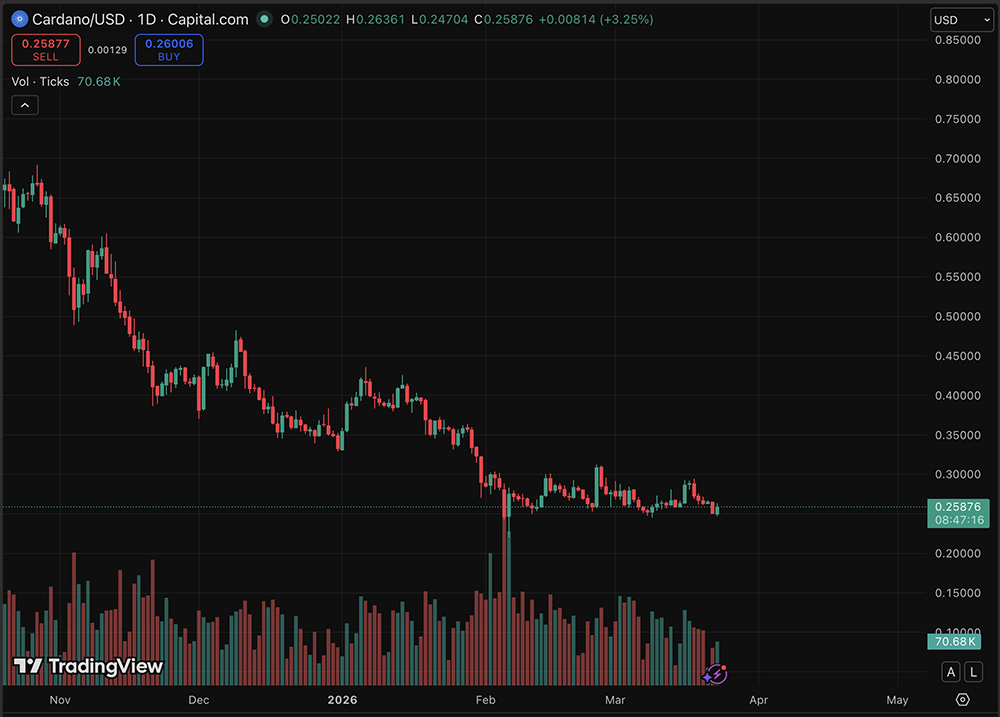
Cardano (ADA) is currently engaged in a high-stakes price standoff, trading tightly between $0.26 and $0.27 as we await a decisive breakout in a bullish prediction.
While Bitcoin has pushed past $70,000 just now, ADA has lagged significantly, posting a 24-hour change oscillating between -2% and +2%. The technical landscape suggests a “squeeze” on the 15-minute timeframe, forming a textbook symmetrical triangle that typically precedes a major volatility event.
Fundamentally, the network is gearing up for the Van Rossem hard fork to protocol v11 and the Node 10.7.0 update scheduled for late March 2026. This technical pivot coincides with legitimate regulatory relief; on March 17, joint SEC and CFTC guidance reportedly clarified ADA’s status as a digital commodity, potentially removing long-standing regulatory overhangs.
Despite these fundamental wins, the market reaction has been muted. Investors are now questioning whether the upcoming infrastructure upgrades can catalyze a reversal, or if the broader altcoin malaise will drag the token lower.
Discover: The Best New Crypto
Can Cardano Price Reclaim $0.32 Before April Fork?
The immediate technical picture for Cardano is defined by compression. Trading at $0.26 at press time, the asset remains pinned below its 50-day Simple Moving Average (SMA) of approximately $0.30, signaling sustained bearish pressure.
Volume indicators reveal a tightening of momentum, a classic precursor to a directional move. If bulls can leverage liquidity from the recent LayerZero integration (accessing over $1 billion in cross-chain capital), a breakout above the $0.27 ceiling could target the March high of $0.32.

However, the downside risks are palpable. Failure to hold the current symmetrical triangle pattern risks a retest of the recent support low at $0.2.
Long-term indicators remain heavy; the price sits well below the 200-day SMA of $0.50, suggesting that any rally remains a counter-trend move until proven otherwise. Analysts anticipate short-term targets near $0.25, a calm and steady Cardano price prediction.
Bitcoin Hyper Targets Early Mover Upside as Cardano Tests Key Levels
While legacy altcoins like Cardano struggle to reclaim yearly highs, capital is aggressively rotating into high-performance infrastructure layers.
The math is simple: a heavy-cap asset like ADA requires billions in new inflow to move 2x, whereas pre-market entrants offer significantly higher volatility and upside potential. This shift is evident in the surge of interest surrounding Bitcoin Hyper ($HYPER), as investors rotate toward infrastructure assets during market pullbacks.
Positioning itself as the first-ever Bitcoin Layer 2 with Solana Virtual Machine (SVM) integration, Bitcoin Hyper aims to solve Bitcoin’s core latency and cost issues. The project has already raised more than $32 million, signaling massive institutional appetite for Bitcoin-native smart contracts.
Currently priced at $0.0136, the token offers a high 66% APY staking incentives for early participants.
The post Cardano Price Prediction: Hard Fork and Expectations appeared first on Cryptonews.
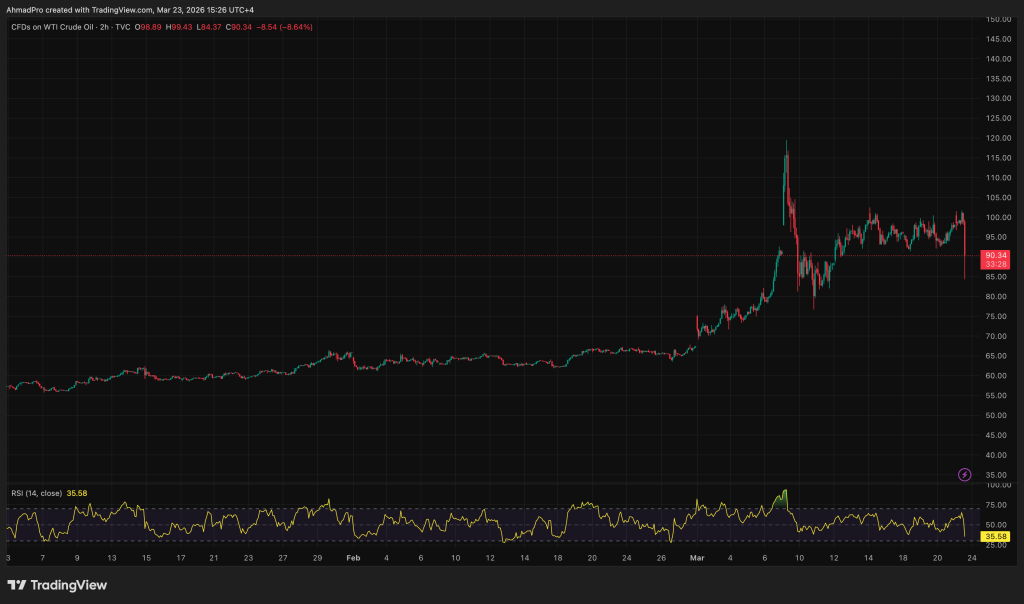
Bitcoin is failing its biggest safe-haven test of 2026 as the Strait of Hormuz crisis pushes oil toward $113. Instead of decoupling, BTC is showing a dangerous 0.68 positive correlation with crude prices, signaling that digital gold is currently trading like a risk asset.
- Correlation Spike: The Bitcoin-WTI correlation coefficient has hit 0.68, a dramatic shift from historical averages below 0.3.
- Oil Impact: Goldman Sachs projects Brent crude will average $110 through April if Hormuz flows remain at 5% capacity.
- BTC Level to Watch: Bulls must defend the $65,000 support zone to prevent a technical breakdown toward $58,000.
The Correlation Trap: Why $100 Oil Hurts Bitcoin This Time
The Strait of Hormuz is choking off 20% of global oil supply, and the crypto market is reacting with volatility rather than validation. Goldman Sachs analysts sharply raised forecasts on Monday, projecting Brent to average $110 in March and April. Futures have already reacted, with Brent hitting $113.32 and WTI climbing to $101.01 alongside President Trump’s ultimatum to Tehran.

Historically, this geopolitical chaos fuels the digital gold narrative. But the data shows a regime shift. The Bitcoin correlation with oil prices has climbed to 0.68. Why? Because the oil price crypto impact is now transmitted through inflation expectations. $110 oil ensures inflation stays sticky. Sticky inflation forces the Federal Reserve to keep rates high. High rates drain the global liquidity that Bitcoin feeds on.
Bitcoin trails money supply growth and struggles when energy costs spike. The mechanics are brutal: rising energy costs act as a tax on the consumer and the miner simultaneously. If Hormuz flows stay at 5% through April 10, Goldman’s base case, we are looking at a stagflationary environment that punishes all risk assets, crypto included.
The trade fingerprint tells you everything. Bitcoin is not bidding up on “war fear”; it is selling off on “liquidity fear.” Until the correlation breaks or oil stabilizes, the upside above $70,000 is capped by macro headwinds.
Can Whales Absorb the Macro Risk Shock?
While the paper market panics, on-chain flows suggest a divergence in conviction. Retail sentiment has fractured, but whale wallets holding 1,000 to 10,000 BTC continue to accumulate in the $65,000 to $70,000 range.
This implies smart money views the macro risk as temporary or expects a policy response, like a massive liquidity injection, to counter the oil shock.

Morgan Stanley’s recent ETF filing reinforces this institutional floor. The infrastructure is being built regardless of where crude trades next week. However, price respects levels, not narratives. The 0.68 correlation means Bitcoin is vulnerable to any further escalation in the Middle East.
The invalidation level for the bear case is clear. If Bitcoin can reclaim $72,000 while oil remains above $100, the decoupling thesis is back in play. Until then, you are trading a risk asset tethered to energy markets.
The post Bitcoin ‘Digital Gold’ vs. Hormuz Crisis: Is BTC Decoupling? appeared first on Cryptonews.
Key Takeaways
- Stock futures plummeted Monday as Iran launched retaliatory attacks after Trump threatened to target Iranian energy sites
- President Trump subsequently announced a postponement of planned military action following diplomatic discussions with Iranian officials
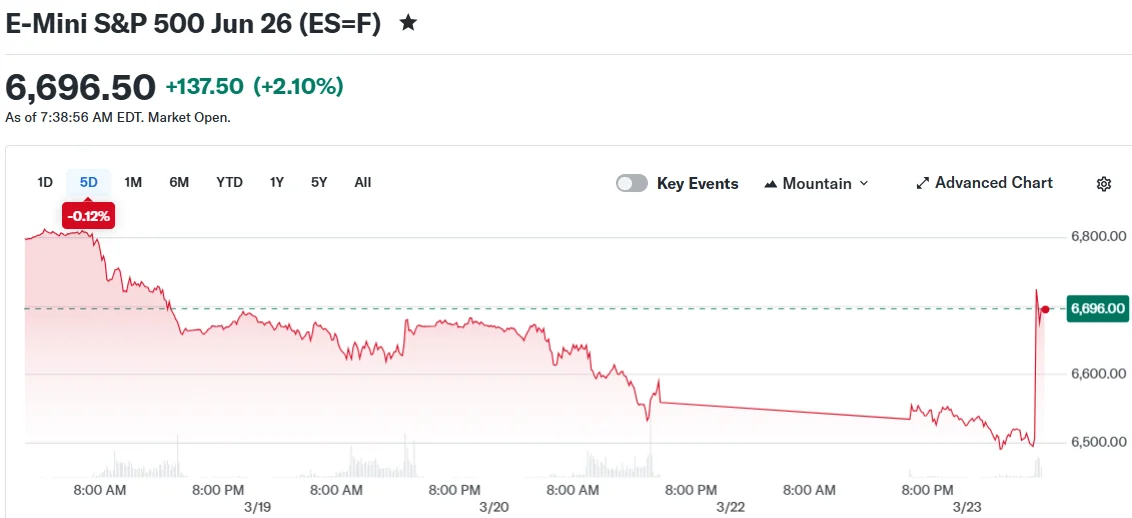
- Major index futures surged more than 2%, with Dow, S&P 500, and Nasdaq all reversing earlier losses
- Crude oil briefly exceeded $100 per barrel before retreating following Trump’s postponement announcement
- The Russell 2000 index had officially entered correction, trading over 10% beneath its January peak
Wall Street experienced dramatic volatility Monday as equities initially tumbled before mounting an impressive comeback following President Trump’s decision to delay planned military operations against Iran after engaging in what he described as “productive conversations” with Iranian leadership.
During early trading, Dow Jones Industrial Average futures declined approximately 0.8%. The S&P 500 futures dropped 0.7%, while Nasdaq 100 futures experienced the steepest declines, sliding nearly 1%.
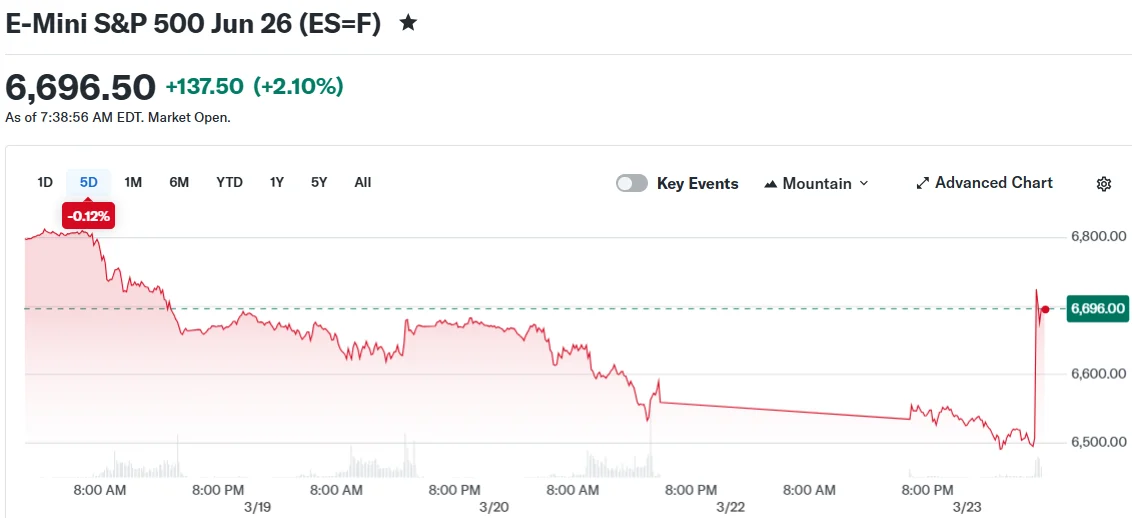
Iran had executed new offensive operations early Monday. These strikes occurred following Trump’s weekend ultimatum, in which he warned of imminent attacks on Iranian energy infrastructure should the Strait of Hormuz remain blocked beyond a 48-hour window.
Iran’s Revolutionary Guards had issued counter-threats, promising to strike Israeli power installations and facilities servicing American military bases throughout the Gulf region if Trump proceeded with his pledge to dismantle Iran’s electrical grid.
Investors were already anxious following four consecutive weeks of declining markets. The technology-heavy Nasdaq registered its largest weekly percentage drop since early February during the previous trading week.
Crude Prices Breach $100 Before Reversing
Oil prices skyrocketed as Middle East tensions intensified. West Texas Intermediate crude contracts spiked to touch the $100 per barrel threshold. Brent crude, serving as the international pricing benchmark, surged beyond $113 per barrel.
Elevated crude prices heighten inflation anxieties and complicate the Federal Reserve’s interest rate policy outlook. Gold contracts, which had maintained positive year-to-date performance, wiped out all 2026 gains amid speculation that the Fed might maintain elevated rates for an extended period.
Markets pivoted dramatically when Trump reversed direction. He declared the US military would delay planned strikes following successful diplomatic engagement with Iran. Trading sentiment shifted immediately.
Equities Mount Dramatic Turnaround
By late morning hours, Dow futures had rocketed upward more than 1,100 points, representing approximately a 2.5% gain. S&P 500 futures advanced beyond 2.3%, while Nasdaq 100 futures climbed 2.4%.
Europe’s STOXX 600 benchmark index reversed into positive territory. Precious metal commodities also registered gains. Crude oil prices tumbled sharply following the strike postponement news.
The CBOE Volatility Index, widely regarded as the market’s fear indicator, retreated after reaching two-week highs. The index last traded down roughly 4 points at 22.79.
Russell 2000 futures, representing small-capitalization equities, soared 4.7% after trading down more than 1% during the opening session. The small-cap benchmark had concluded Friday’s trading session more than 10% below its January 22 all-time closing high, officially confirming correction status.
Chris Beauchamp, chief market analyst at IG Markets, commented: “This is obviously a postponement, not a complete ceasefire, and we will see what happens from here. What’s done is still not undone, so the impact has yet to be seen, but obviously, markets are breathing a sigh of relief.”
The Russell 2000’s correction confirmation and the Nasdaq’s month-long losing streak represented the most significant concerns for traders entering Monday’s session.


Brazil’s new finance minister, Dario Durigan, is expected to delay a public consultation on applying a tax on financial operations, locally known as Imposto sobre Operações Financeiras (IOF) to some cryptocurrency transactions, Reuters reported, citing sources familiar with the matter.
Durigan took office on March 20 after Fernando Haddad stepped down to run for governor of São Paulo. Reuters said the new minister wants to focus on microeconomic measures and avoid proposals that could trigger conflict with Congress during an election year.
The postponed consultation centered on a draft decree that could classify some crypto transactions as foreign exchange operations.
That matters because foreign exchange deals in Brazil can face IOF rates ranging from 0.38% on some inbound flows to as much as 3.5% on overseas purchases, remittances and card spending abroad. Transfers for overseas investment can face a 1.1% rate.
The proposal has already drawn pushback from major industry groups. In a joint statement ABcripto, ABFintechs, Abracam, ABToken and Zetta, which together represent more than 850 companies, said applying IOF to stablecoin transactions would be illegal under Brazil’s constitution and the country’s 2022 Virtual Assets Law.
They argued that stablecoins are not fiat currency and cannot be treated as foreign exchange instruments by decree or administrative rule.
The proposal drew attention in February after the central bank classified part of the crypto market, especially some stablecoin activity, within the scope of foreign exchange rules. That gave the Finance Ministry and tax authorities a base to study whether those transactions should fall under IOF.
The ministry may also shelve a separate proposal to end tax breaks on some investment securities.

‘DTF St. Louis’ Makes Unexpected Progress in Its Twisty Love Triangle Murder Mystery

MORNING CALL E ABERTURA DE MERCADO – 17/03/2026 | CNN MONEY

VetMedi moves to new purpose-built premises near York


-

 Fashion3 days ago
Weekend Open Thread: Adidas – Corporette.com
-
 Crypto World3 days ago
NIO (NIO) Stock Plunges 6.5% as Shelf Registration Sparks Dilution Worries
-

 Politics3 days ago
Jenni Murray, Long-Serving Woman’s Hour Presenter, Dies Aged 75
-
 Tech6 days ago
Are Split Spacebars the Next Big Gaming Keyboard Trend?
-

 Crypto World2 days ago
Best Crypto to Buy Now: Strategy Just Spent $1.57 Billion on Bitcoin During Fear While Early Investors Quietly Enter Pepeto for 150x Potential
-

 News Videos5 days ago
RBA board divided on rate cut, unusually buoyant share market | Finance Report | ABC NEWS
-

 Crypto World2 days ago
Bitcoin Price News: Bhutan Sells $72 Million in BTC Under Fiscal Pressure, but the Smart Money Entering Pepeto Sees What the Market Does Not
-

 Business7 days ago
How the UK and China Trade Agreement Could Shape UK Businesses in 2026
-

 Politics5 days ago
The House | The new register to protect children from their abusers shows Parliament at its best
-

 Tech3 days ago
inKONBINI Lets You Spend Summer Days Behind the Register
-
 Politics6 days ago
Real-time pollution monitoring calls after boy nearly dies
-

 Crypto World5 days ago
Canada’s FINTRAC revokes registrations of 23 crypto MSBs in AML crackdown
-
 NewsBeat5 days ago
Residents in North Lanarkshire reminded to register to vote in Scottish Parliament Election
-

 Business7 days ago
Meta planning major layoffs as AI spending and automation reshape workforce
-

 News Videos5 days ago
PARLIAMENT OF MALAWI – PAC MEETING WITH REGISTRAR OF FINANCIAL ON AMARYLLIS HOTEL – INQUIRY LIVE
-

 Business21 hours ago
No Winner in March 21 Drawing as Prize Rolls to $133 Million for Next
-

 Sports1 hour ago
Remo Stars and Kano Pillars Strengthen Survival Hopes in NPFL
-

 Politics4 days ago
Gender equality discussions at UN face pushbacks and US resistance
-

 Business5 days ago
Who Was Alex Pretti? 5 Key Facts About the ICU Nurse Killed by Federal Agents in Minneapolis
-

 Tech17 hours ago
Give Your Phone a Huge (and Free) Upgrade by Switching to Another Keyboard
You must be logged in to post a comment Login