

Crypto World
Backpack Exchange launches BP token with 25% airdrop, no insider allocation

Backpack Exchange, a Solana-based cryptocurrency trading platform, launched on Monday its native token, BP, detailing a token generation event (TGE) that includes a mix of user distribution, lockups and a mechanism tied to company equity.
At launch, 25% of the token’s 1 billion total supply—around 250 million BP—will be distributed, primarily through an airdrop to existing users. Most of that allocation is set aside for participants in Backpack’s points program, with a smaller portion reserved for holders of its “Mad Lads NFT collection.”
The company said no tokens have been allocated to founders, team members or investors at inception, a departure from many exchange token rollouts. The structure places a larger share of the initial distribution with users rather than insiders.
The remaining supply will be released through a multi-phase unlock schedule tied to company growth and potential public listing plans. About 37.5% of tokens are set to unlock over time based on operational milestones, such as market expansion or product launches, while another 37.5% will remain locked in a corporate treasury until after a potential IPO.
Backpack also said long-term stakers may be able to convert BP into company equity, representing a share of the firm’s ownership. The mechanism links the token to the company’s broader capital markets plans, rather than limiting its role to trading incentives or governance.
“Backpack was founded by former FTX and Alameda Research employees and faced early scrutiny following the collapse of FTX in 2022. The company later acquired the defunct exchange’s European arm, relaunching it as Backpack EU as part of its push into regulated markets.
Read more: Backpack Opens Regulated Perpetuals Exchange in Europe After FTX EU Acquisition


- GoBTC Pay is a protocol that lets consumers make native and instant payments on Bitcoin’s base layer.
- GoMining launches its own mining pool to prioritize GoBTC Pay transaction confirmation, targeting a 12-hour final on-chain settlement by the end of 2026.
- The launch marks a strategic expansion for GoMining, a platform with 5 million users. GoBTC Pay extends this ecosystem into everyday payments.
GoMining launches GoBTC Pay a Bitcoin payment protocol that delivers on what the 2008 whitepaper promised: peer-to-peer electronic payments. GoBTC Pay enables free and instant Bitcoin payments on the core Bitcoin layer. This makes it practical to use Bitcoin at the point of sale for everyday purchases. Payments are free for end-users and merchants pay a small acquiring fee that undercuts traditional card processing.
GoBTC Pay is designed as an open infrastructure. GoMining operates the reference implementation, but any wallet provider — from Ledger to Trust Wallet to MetaMask — can integrate the protocol to offer instant Bitcoin payments to their users.
Why this matters
Bitcoin is the dominant cryptocurrency with a market cap above $1.5 trillion. Over 150 public companies hold BTC on their balance sheets. Spot Bitcoin ETFs, which didn’t exist two years ago, now manage roughly $100 billion in assets across a dozen funds. The U.S. government holds approximately 328,000 BTC. But Bitcoin still can’t process a retail transaction quickly and reliably.
The Lightning Network, introduced in 2018 to solve this problem, took seven years to reach $1 billion in monthly volume and its average transaction of $223 mostly reflects exchange-to-exchange flows, not someone paying for groceries. In the US, about 22% of adults own Bitcoin, yet there are only 2,300 U.S. businesses that accept Bitcoin directly, and the gap between how many people own Bitcoin and how many places accept it is widening.
“The first line of the Bitcoin whitepaper describes a peer-to-peer electronic cash system. Bitcoin was designed to be money, not just an asset. That promise is still unfulfilled, and we intend to deliver on it,” said Mark Zalan, CEO of GoMining. “We already serve millions of users, and run data centers on three continents. All of this provides us a unique position to enable native Bitcoin payments with GoBTC Pay.”
Mining-powered confirmation
GoBTC Pay enables free and instant payments in Bitcoin, using GoMining’s own mining infrastructure to confirm the transactions. It uses a 2-of-3 multi-signature architecture shared between the user, GoMining, and a regulated third-party custodian.
GoMining serves 5 million users globally. The company has created a dedicated mining pool for processing GoBTC Pay transactions, aiming for a 12-hour on-chain settlement by the end of 2026. Where most payment companies depend on third-party pools for confirmation, GoMining mines the blocks itself.
The pool also serves GoMining’s “digital miners” — users who own tokenized hashrate through GoMining’s app. A portion of GoBTC Pay transaction fees flows back to these miners as additional BTC yield: consumers pay with BTC, merchants earn BTC, miners earn a share of payment fees, and GoMining’s pool processes the transactions.
Any wallet provider, whether hardware, software, or custodial, can connect to the GoBTC Pay network and enable instant Bitcoin payments for their users.
Bitcoin payments for Merchants
For merchants, GoBTC Pay is a Bitcoin-native acquiring network that undercuts every major card processor on cost. Its acquiring fee of 0.2% is substantially lower than traditional card processing, which range from 1.5% to 3.5% in the US. On a $100 sale, the merchant keeps $99.80.
GoMining distributes the entire fee back into the ecosystem: half goes to the miners who confirm transactions, and half goes to the wallet provider that initiated the payment. GoMining retains nothing on third-party transactions to incentivize wallet integrations and accelerate adoption.
Merchants can receive BTC directly to their own wallet, or use GoMining’s custodial merchant solution, which offers yield on their BTC balance — including during the settlement window — and an off-ramp to fiat. GoBTC Pay will ship with a dedicated PoS terminal, a web merchant dashboard, a developer SDK, and plugins for Shopify and WooCommerce in the coming months.
The launch coincides with GoMining’s major expansion in the United States. The company is building combined data centers for Bitcoin mining and AI workloads, with a target of securing 1 GW of compute capacity in 2026.
GoMining presented a live demo of GoBTC Pay at Consensus Miami 2026 (May 5–7, Miami Beach Convention Center).
About GoMining
GoMining is an all-in-one Bitcoin ecosystem that makes it simple and secure to mine, earn, and use Bitcoin every day. GoMining serves 5 million users and ranks among the top-10 Bitcoin miners by hashrate globally, with data centers in the U.S. and internationally. The company makes Bitcoin accessible through tokenized hashrate, daily BTC rewards, and an expanding suite of payment and earning products. For more information, please visit https://gomining.com/
The post GoMining Launches GoBTC Pay to Bring Native Instant Payments to Bitcoin appeared first on BeInCrypto.
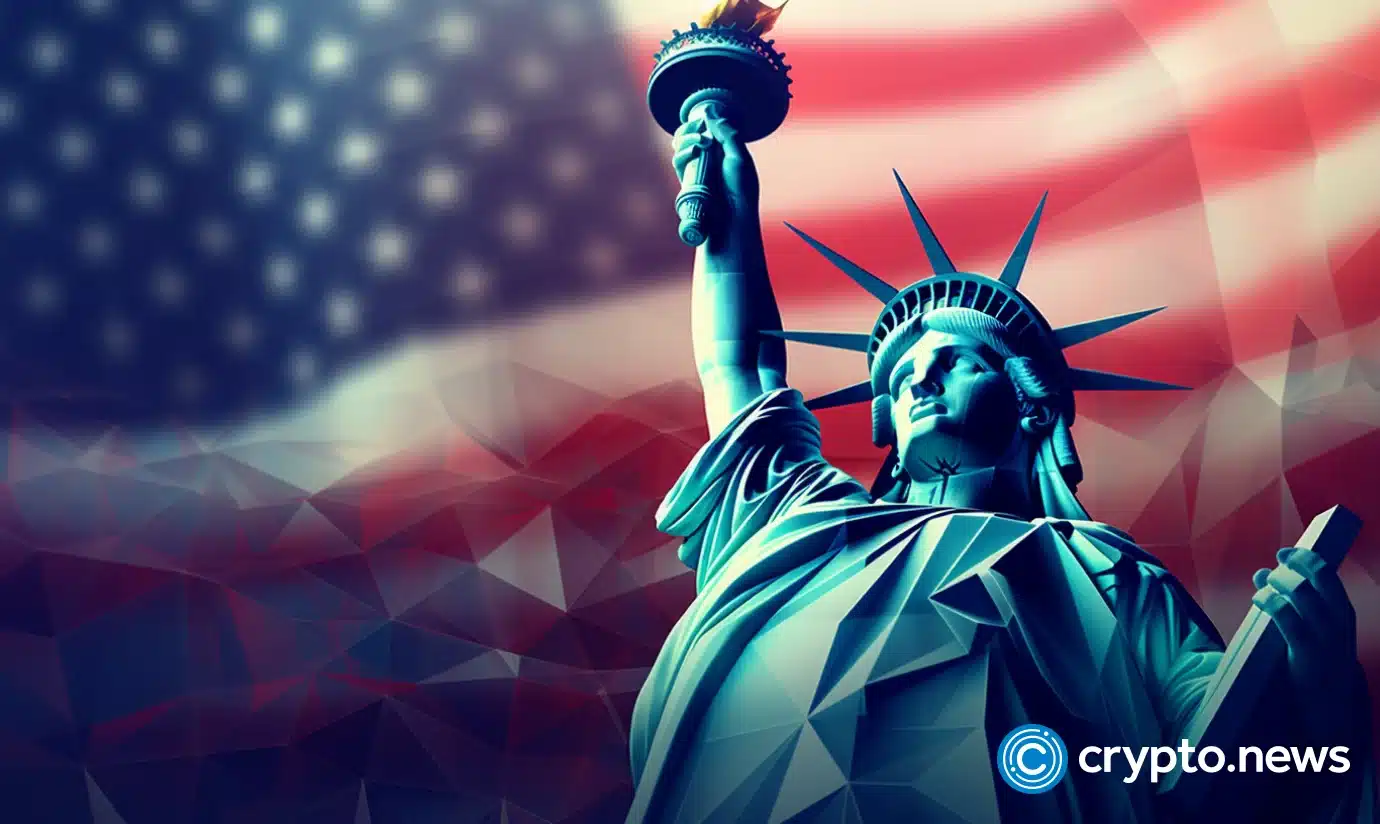
NATO allies are openly questioning whether the US should still lead the alliance following Trump’s decision to launch strikes on Iran without consulting them.
Summary
- European leaders are seriously considering a future in which the US no longer leads NATO, following disputes over the Iran war.
- Trump left NATO in the dark before launching strikes on Iran and then demanded alliance support to reopen the Strait of Hormuz.
- Analysts say Germany, France, the UK, and Poland are the most likely bloc to assume collective NATO leadership if the US retreats.
NATO allies are questioning US leadership after Trump launched strikes on Iran without consulting the alliance, with fresh disputes over the Middle East conflict pushing European leaders to consider a future in which the US no longer runs the alliance.
Former US ambassador to NATO Ivo Daalder told NPR that “something fundamental has broken,” arguing that Trump does not believe America’s security depends on European security, a break from decades of foreign policy logic dating back to NATO’s founding.
The tensions have been simmering since Trump began threatening to seize control of NATO-linked Greenland and annex Canada, but the Iran war has sharpened the dispute into a concrete institutional question.
Trump launched strikes on Iran in late February without notifying alliance members, and subsequently demanded NATO support in reopening the Strait of Hormuz. Allies including Spain, France, and the UK all refused in various forms, drawing a sharp rebuke from Washington.
What European leaders are doing
German Chancellor Friedrich Merz said publicly that the US appeared to lack a clear exit strategy in Iran and that Tehran had “humiliated” Washington in peace talks.
Trump responded with a list of NATO allies he wanted to punish for their lack of cooperation, including floated proposals to suspend Spain and return the Falkland Islands to Argentina.
As crypto.news tracked, each round of Iran war escalation has weighed on global markets, with the Hormuz dispute pushing oil toward $100 and compressing Federal Reserve flexibility on rate cuts.
NATO Secretary-General Mark Rutte acknowledged Trump’s frustrations but pushed back on the broader criticism, noting that a “large majority of European nations” had provided logistical support, basing rights, and overflights that enabled US operations. “What the US did with Iran, they could do because so many European countries lived up to those commitments,” Rutte said.
What comes next for the alliance
Analysts who spoke to NPR said they do not expect Trump to actually withdraw from NATO, partly because a 2023 law bars a unilateral exit. Former NATO Supreme Allied Commander James Townsend said the alliance will survive but predicted: “It’s going to be a European NATO, if you will. It won’t be NATO guided by the United States.”
Germany, France, the UK, and Poland are seen as the most likely bloc to assume collective leadership. NATO officials are also considering scaling back major alliance meetings for the remainder of Trump’s second term to avoid creating new crises.
Tron, Cardano and Solana led weekly gains among the Top 10, while Bitcoin and Ether lagged as US spot ETF demand cooled on Thursday.
Crypto World
Telegram’s TON Could Become the World’s Biggest Retail Blockchain After Explosive 100% Surge
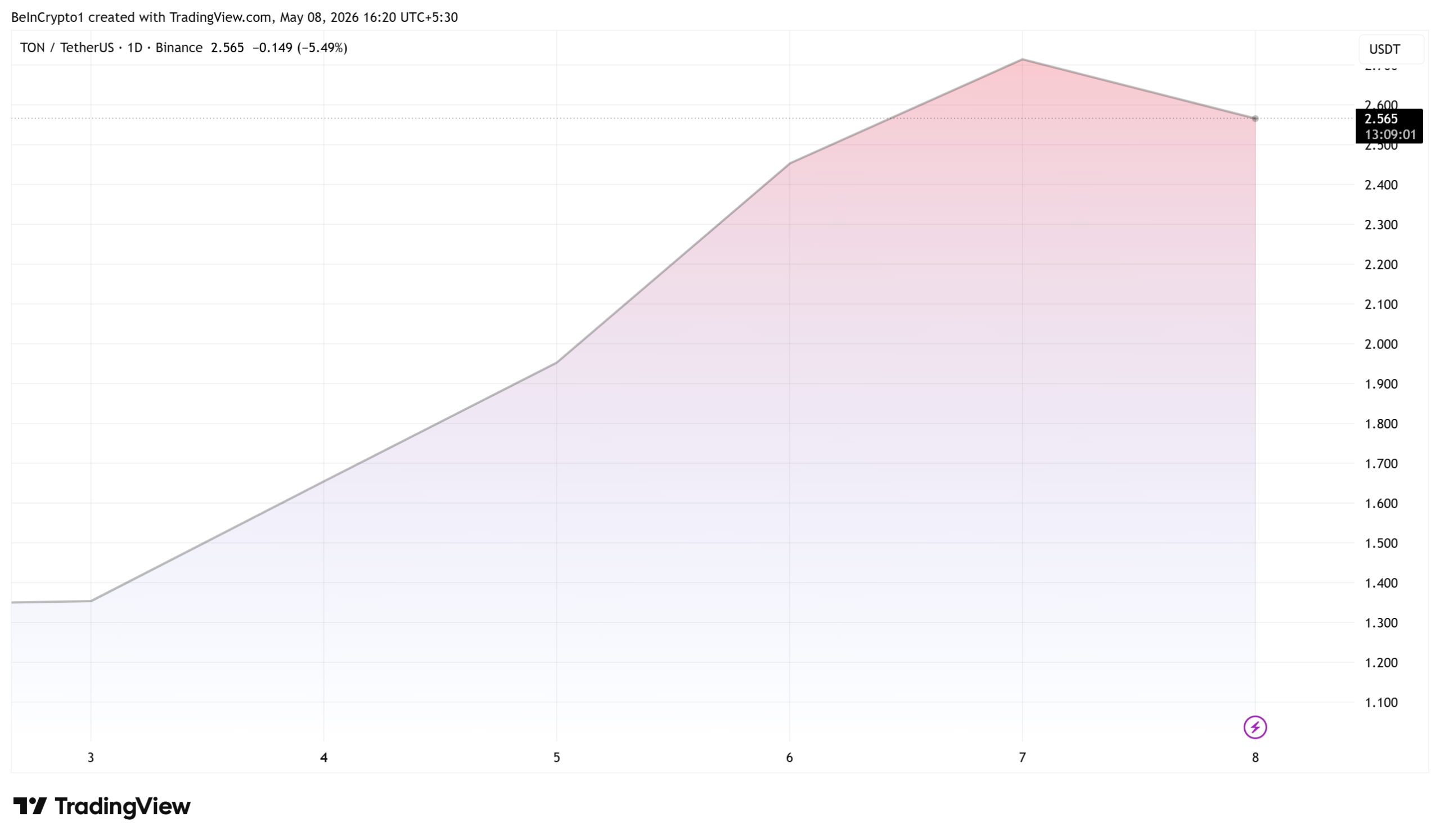
Telegram has formally replaced the TON Foundation as the main force behind The Open Network (TON), with founder Pavel Durov confirming the messenger will become the chain’s largest validator. Toncoin (TON) responded by rallying more than 100%.
The takeover, the third stage of Durov’s “Make TON Great Again” program, places Telegram at the center of TON’s infrastructure. Investors read it as the strongest signal that the messenger plans to anchor a billion-user crypto economy on the chain.
Why TON Is Rising
TON’s gains track Telegram’s renewed control over the network’s roadmap and validation. Alexander Tobol, chief technology officer at Wallet in Telegram, spoke with BeInCrypto. He said the chain was originally built by Telegram’s team before spinning out as an open-source project.
Tobol said the validator move signals deeper commitment from Telegram. It lifts interest in TON as a core part of the messenger’s stack.

The messenger’s reach makes any default crypto layer immediately consequential. Telegram counts more than one billion users, giving the chain a distribution edge few rivals can match.
Beyond architecture, Durov’s team staked about 2.2 million TON to claim the largest validator slot. The move deepens Telegram’s stake in network security.
Transfers, payments and mini-app services could all settle on TON. In that scenario, Tobol expects the network to lead all chains by active retail wallets.
“In such a scenario, TON could potentially become the leading blockchain by number of active wallets thanks to retail usage inside Telegram,” Tobol told BeInCrypto.
Network Speed and Cost Reset
Meanwhile, recent infrastructure work strengthens the case. Storm Trade founder Denis Vasin pointed to the Catchain 2.0 upgrade.
It cut block times from about 2.5 seconds to 400 milliseconds. Finality fell from roughly ten seconds to one.
The same upgrade lowered fees about sixfold, to around $0.0005. The network can also process more than 100,000 transactions per second.
Vasin said the exclusivity of the Telegram-TON pairing now matches the architecture investors expected in 2018.
He described TON as one of the highest-throughput Layer-1 chains. Fast finality and low cost position it for frequent small-value transactions.
If this integration is implemented consistently, TON gains what most Layer-1 blockchains lack — native distribution and real user use cases,” Vasin said in remarks shared with BeInCrypto.
Pricing the Telegram TON Takeover
Tobol expects the next leg of growth to depend on bots and mini-apps. Users would transact directly inside Telegram. Staking yields, currently around 15% annually, support liquidity retention.
However, Vasin urged caution. Markets have already repriced TON sharply. Any pullback would test whether Telegram can convert distribution into recurring on-chain revenue. The rally leaves limited margin for execution missteps.
Last year’s large Telegram-led sales of Toncoin reminded holders the messenger has acted as both buyer and seller.
Investors will watch for evidence the validator role binds Telegram more tightly to TON’s long-term value.
Whether TON returns to the top 10 of CoinMarketCap depends on transaction activity rather than announcements.

The next several weeks should reveal if the chain is gaining real economic gravity.
The post Telegram’s TON Could Become the World’s Biggest Retail Blockchain After Explosive 100% Surge appeared first on BeInCrypto.
Future repurchases will follow a preset schedule and be routed through on-chain markets.
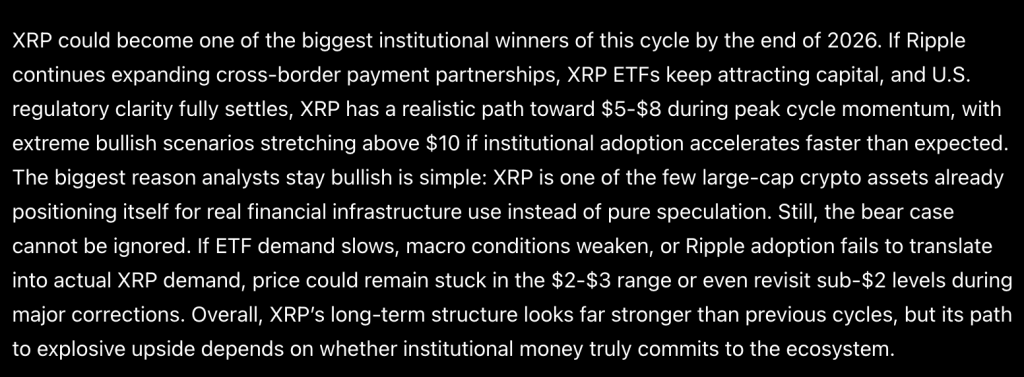
ChatGPT AI draws on large-scale datasets and market patterns to generate forward-looking crypto analysis, and when prompted with a well-defined framework, the AI predicts head-turning 2026 price outlooks for XRP.
The core thesis is simple but powerful. XRP could benefit from something most crypto assets still lack.
Actual integration into real payment and settlement systems. Ripple keeps expanding cross-border partnerships. ETF speculation around XRP is growing. And regulatory clarity in the US is no longer the same brick wall it was a few years ago, AKA the Clarity Act.
If those pieces keep aligning, ChatGPT argues XRP pushes into the $5 to $8 range during peak cycle momentum. Extreme upside above $10 if institutional adoption accelerates aggressively.
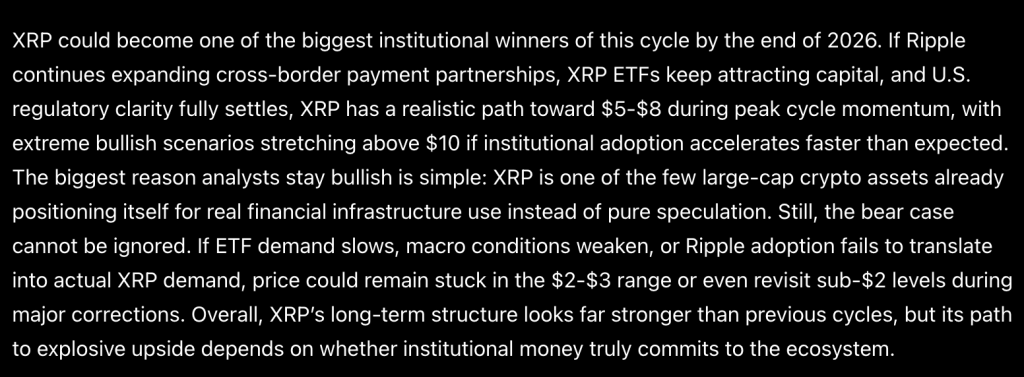
That sounds ambitious until you consider the logic is tied less to retail hype and more to whether XRP gets treated as a legitimate financial layer rather than just another speculative token.
The model is honest about the biggest weakness, though. Adoption does not automatically translate into price appreciation.
XRP has spent years building partnerships while the market consistently questions how much of that activity actually drives token demand.

XRP Price Prediction: Is a Move Toward $5–$8 Actually Possible as ChatGPT AI Predicts?
XRP is sitting at $1.379 on the daily chart, still trading well below ChatGPT’s target range. The institutional narrative exists. The price has not been priced in yet.
The big picture is ugly, but potentially at a turning point. Price has been in a downtrend since the August peak near $3.80, grinding lower for nearly 10 months through a series of lower highs and lower lows.
The February bottom around $1.10 is the last real floor on this chart.
The base building since February is the most constructive thing happening right now. Three months of higher lows off that $1.10 bottom without making new lows is the first sign the downtrend may be exhausting itself.
The projected recovery path targets a move all the way back toward $3.60 if momentum gains traction.
But the path is not clean. $1.50 is the first ceiling that needs to flip. Then $2.00 and $2.40 are both significant resistance levels from prior consolidation zones that need to be worked through before anything near the upper targets comes into view.
For the $5 to $8 scenario to become realistic, XRP needs to prove it can sustain momentum through all of those levels rather than just producing short-term spikes that fade. When momentum compounds on this asset it moves aggressively. But the forecast only works if adoption, liquidity, and sentiment all reinforce each other simultaneously.
The immediate risk is simple. Base fails, XRP breaks below $1.10, fresh lows reset the entire recovery narrative.
Discover: The best crypto to diversify your portfolio with
ChatGPT Projects That Bitcoin Hyper Could Outperform XRP Next
Early-stage infrastructure plays sit at a different part of the risk curve, which is exactly why some traders rotate into them once large-cap upside starts looking capped.
Bitcoin Hyper is targeting that window directly. The project is building a Bitcoin Layer 2 with Solana Virtual Machine integration, bringing faster smart contracts and lower-cost execution into the Bitcoin ecosystem. The pitch is simple: Bitcoin’s security combined with Solana-style speed and programmability.
The presale is sitting at $0.013679 with over $32 million raised, alongside staking incentives for early participants. The market gap it is targeting is real. Bitcoin still lacks a native high-speed smart contract environment compared to Ethereum or Solana.
But this is still early-stage infrastructure. Execution, liquidity, and adoption are all unknowns. The appeal is earlier positioning and higher upside potential, paired with significantly higher risk than established majors.
The post Sam Altman ChatGPT AI Predicts the Price of XRP By the End of 2026 appeared first on Cryptonews.
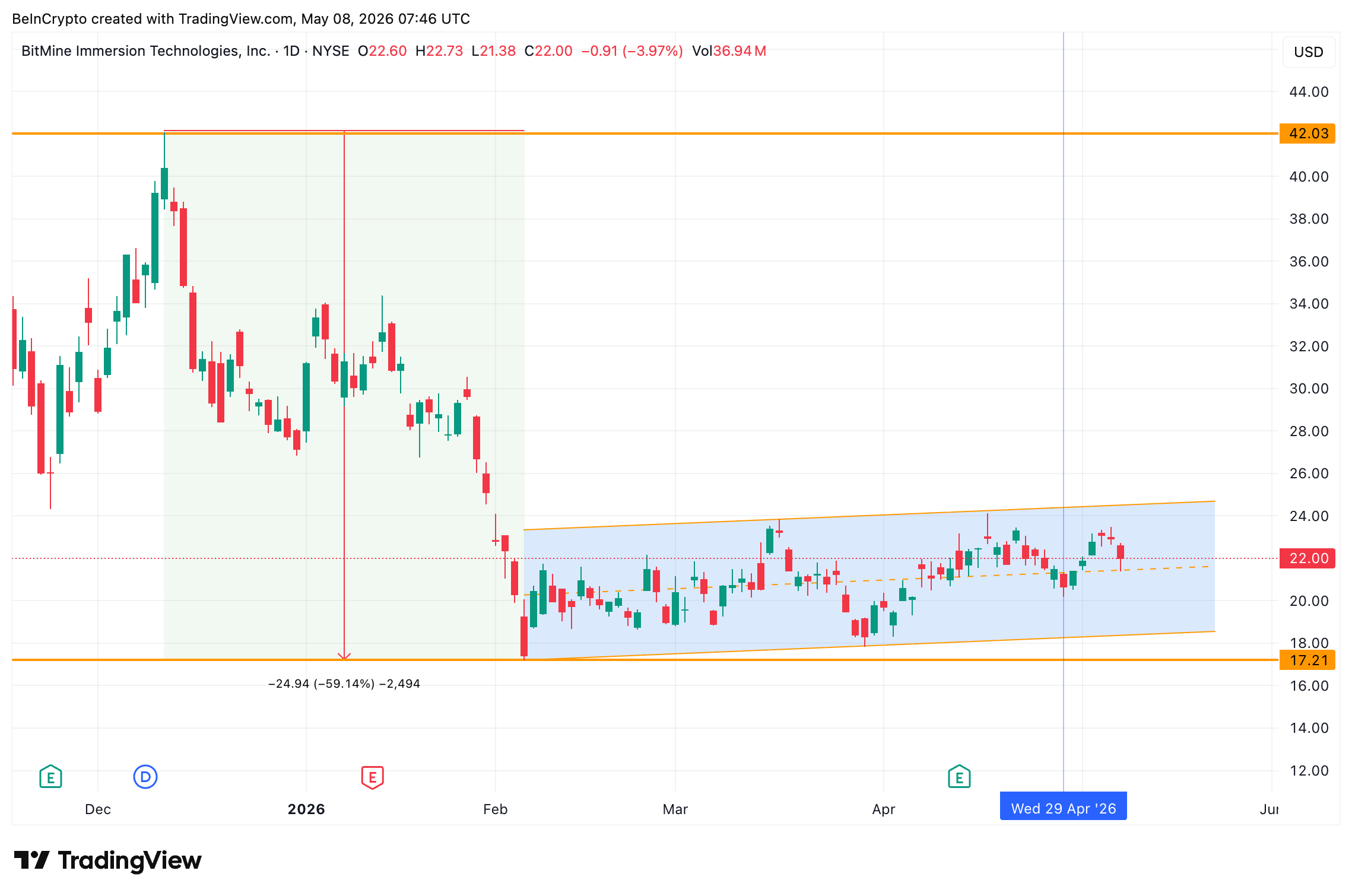
BMNR stock price trades at $22.00 after a 4% drop on May 7, sliding alongside the broader crypto-treasury complex as chairman Tom Lee signaled BitMine may slow its Ethereum accumulation pace.
The stock sits within an ascending channel that appears bullish on the surface, but multiple flow and positioning signals suggest a deeper test is ahead.
BMNR Stock Price Holds an Ascending Channel After a 59% Drop
BitMine Immersion Technologies (BMNR) traded at $22.00 on May 7, down 3.97%. Chairman Tom Lee said at Consensus Miami that the company may slow its Ethereum (ETH) purchases as it nears its 5% supply target. BitMine currently holds 5.18 million ETH, roughly 4.29% of the circulating supply.
The slowdown signal hit a stock that was already structurally weak. BMNR is down 46% over the past six months. The share price sits 86% below its 52-week high of $161 set in mid-2025.
Want more insights like this? Sign up for Editor Harsh Notariya’s Daily Newsletter here.
The daily chart shows an ascending channel forming since early February. The pattern emerged after a 59.14% drop from the December 10 high of $42.03. Channels that form after sharp declines often act as continuation patterns rather than reversal structures. They tend to resolve in the direction of the prior trend, which in this case is down.

Tom Lee also pointed to BitMine’s $4 billion share repurchase program as an alternative use of capital. Capital may rotate away from ETH and toward buybacks, weakening the ETH treasury narrative that has supported BMNR’s premium.
That structural backdrop sets the stage for the technical signals.
EMAs Are the Last Line of Defense
Inside the ascending channel, BMNR is grappling with two exponential moving averages (EMAs). EMAs are trend indicators that give weight to recent price action, with shorter EMAs tracking near-term momentum.
The 20-day EMA sits at $21.92 and the 50-day at $22.17. With BMNR at $22.00, the stock is wedged directly between them, a tight zone where the next move is binary.

History suggests the 20-day matters most. Each prior break of the 20-day EMA in 2026 has produced a sharp correction. On April 27, BMNR dropped 6.48% in one session after losing the 20-day. On March 25, the same break delivered a 15.62% slide.
If the 20-day EMA at $21.92 breaks again, the same cascade pattern is likely. The 100-day EMA at $24.80 and the 200-day EMA at $27.06 sit well above the current price. Both cap any rally attempt and reinforce the longer-term bearish lean.
CMF Divergence and Put-Call Ratio Flag Smart Money Caution
While retail traders may read the ascending channel as bullish, the flow data tells a different story. The Chaikin Money Flow (CMF) is showing weakness despite the higher prices. CMF measures money flow volume to gauge buying or selling pressure over a set period.
CMF currently reads 0.03, technically still above zero. The indicator has, however, broken its own ascending trendline that connected the lows since late March.
Also, between April 29 and May 6, BMNR’s price trended higher while CMF trended lower. That bearish divergence suggests institutional buying pressure is fading even as price holds.

Options positioning adds another layer. The put-call ratio, a sentiment gauge that compares put contracts to call contracts, has shifted in a contradictory way. The volume put-call ratio dropped from 0.38 on April 29 to 0.29 on May 7. The shift indicates more long positions are being placed.

Open interest tells a quieter story. The OI put-call ratio drifted lower from 0.44 to 0.42 in the same window. Retail is adding fresh long bets while existing positions are being closed. That mix often precedes a long squeeze if the stock breaks lower, adding another layer of risk.
BMNR Stock Price Levels Set Up a 9% Move Either Way
With structure, EMAs, CMF, and options positioning all pointing in one direction, the price ladder reveals what each scenario unlocks.
The bullish path requires BMNR to first reclaim $22.47. That level sits just above the 50-day EMA. A clean reclaim signals the stock is comfortably above its moving averages. The next test is $24.09, the 0 Fibonacci anchor at the upper trendline.
A break above the $24 zone represents 9.57% upside from the current price and would weaken the continuation thesis.

The bearish path is more layered. Below the EMA support at $21.92, BMNR opens at $21.47 and $20.65 as immediate floors. The most critical downside level is $19.84, the 0.618 Fibonacci level. A daily close below $19.84 marks a 9.75% drop from the current price and confirms the bearish structure.
Below $19.84, the path opens to $18.69 and $17.22. The longer-range extension at $12.96 (1.618 Fibonacci) becomes a deep continuation target if the entire ascending channel breaks down.
The post BitMine Stock Faces Risk as Tom Lee Cools on Ethereum Buying appeared first on BeInCrypto.

TLDR:
- Polkadot’s new economic model cut annual DOT issuance by 53.6% and capped total supply at 2.1 billion.
- Validators now need a minimum of 10,000 DOT self-stake or face removal from the active set.
- Acurast surpassed 750 million on-chain transactions on Polkadot, powered by 250,000+ global devices.
- The Polkadot Docs MCP launched as an interactive expert tool for developers building on the network.
Polkadot closed April 2026 as its first full month operating under a revised economic model. The new framework, approved through OpenGov, went live on March 14, 2026. It introduced lower issuance rates, a hard supply cap, and planned step reductions over time.
Across the ecosystem, staking rules were updated, network activity expanded, and community-facing tools continued to improve. The month reflected steady, consistent progress rather than a single standout development.
Polkadot’s New Economic Model Reshapes Staking Structure
The revised model reduced annual DOT issuance by 53.6% at launch. A maximum supply cap of 2.1 billion DOT was introduced alongside this change.
Planned step reductions of approximately 13–14% every two years are now also scheduled. Together, these parameters establish a more structured and predictable issuance path.
On the validator side, the 10,000 DOT minimum self-stake requirement is now actively enforced. Any validator falling below that level is automatically removed from the active set.
This change raises the accountability standard for those securing the Polkadot network. It also makes the entry bar for validators more clearly defined.
Nomination pools remain accessible from just 1 DOT, keeping participation open for smaller holders. Under the updated rules, only a validator’s own bonded stake is at risk during a slashing event.
Nominators are no longer exposed to penalties from validator misconduct. This separation meaningfully reduces risk for everyday participants.
By mid-June, another update is expected. Validators will receive dedicated rewards from the Dynamic Allocation Pool, separate from what nominators earn.
These rewards will come directly from protocol issuance. The change further distinguishes the incentive structure between validators and nominators.
Ecosystem Tools and Activity Continue to Expand on Polkadot
Acurast crossed 750 million on-chain transactions on Polkadot in April. As posted on April 23, more than 250,000 devices across 175 countries powered this activity.
The project noted it remains 250 million transactions away from reaching one billion. This level of usage reflects real-world adoption of decentralized physical infrastructure at scale.
The Polkadot Docs MCP also went live during the month as a developer-facing resource. It turns official documentation into an interactive reference for builders.
Users can query it on XCM fees, OpenGov tracks, validators, Asset Hub, and PolkaVM versus EVM. It also serves structured data to agents and RAG systems working within Polkadot’s context.
Nova Wallet continued refining its mobile experience throughout April. A thread from Parity Technologies on April 9 described it as one of the most polished apps in the ecosystem.
The wallet focuses on simplifying staking, governance, and multi-chain management for mobile users. Its approach keeps Polkadot accessible without requiring technical depth.
Web3 Summit is also set to return to Berlin on June 18–19, 2026. Announced on April 21, the event is expanding its format toward a festival model this year.
Developers, designers, researchers, and artists are all expected to attend. The summit centers on building systems shaped by privacy, participation, and digital agency.

Crypto World
Payward Files OCC Trust Charter Application to Advance Kraken’s Federal Crypto Custody Push
TLDR:
-
- Payward filed for an OCC national trust charter to establish a federally regulated crypto custody entity called PNTC.
- The proposed PNTC would serve institutional clients requiring bank-level custody protections under direct OCC oversight.
- Kraken Financial remains the first digital-asset bank to secure a Federal Reserve master account since 2020.
- Payward’s multi-charter strategy pairs its Wyoming SPDI with the proposed OCC trust charter for broader regulatory coverage.
- Payward filed for an OCC national trust charter to establish a federally regulated crypto custody entity called PNTC.
Payward, the parent company of Kraken, has applied for a national trust company charter with the OCC. The move aims to build a federally regulated digital asset custody entity for institutional clients.
Kraken Pursues Federal Oversight Through OCC Application
If approved, the charter would establish Payward National Trust Company (PNTC). This new entity would focus on fiduciary custody and related digital asset services.
The trust would primarily serve institutions seeking bank-level custody protections. It would operate under direct OCC oversight, adding federal legitimacy to Kraken’s regulated framework.
The application marks a deliberate step in Payward’s U.S. regulatory expansion strategy. Crypto firms have increasingly pursued traditional financial charters to attract institutional clients.
PNTC would rely on Payward’s existing compliance, risk management, and custody infrastructure. This structure is designed to extend access to clients requiring a federally regulated qualified custodian.
Co-CEO Arjun Sethi addressed the rationale behind the application directly. “A national trust company provides the certainty institutions require,” Sethi stated.
He further noted that it “establishes the infrastructure to build the next generation of custody.” His comments point to a deliberate push to serve institutional clients at the federal level.
National trust charters overseen by the OCC have been pursued by crypto-native firms before. These charters offer broader legitimacy and nationwide operations.
They also reduce reliance on state-by-state licensing, which can be fragmented and inconsistent. Payward’s application reflects this broader industry trend toward federal regulatory frameworks.
Kraken Builds Multi-Charter Strategy Alongside Major Acquisitions
The OCC application builds on the foundation of Kraken Financial’s Wyoming SPDI charter, granted in 2020. Kraken Financial was the first digital-asset bank to secure a Federal Reserve master account.
That access gave it a direct link to the U.S. payments system. Sethi described the Wyoming SPDI and prospective OCC trust charter as “complementary pillars” of Payward’s banking strategy.
Payward has also pursued growth through a series of major acquisitions. In 2025, it acquired retail futures platform NinjaTrader for $1.5 billion.
In April, Payward agreed to acquire crypto derivatives exchange Bitnomial for up to $550 million. That deal adds a full suite of CFTC licenses covering brokerage, clearing, and exchange operations.
This week, Payward also announced a $600 million deal to acquire Hong Kong-based payments firm Reap Technologies.
The deal expands Kraken’s presence in stablecoin-powered cross-border payments. It also strengthens Kraken’s card infrastructure across Asia. Together, these moves reflect Kraken’s preparation for a potential IPO.
The U.S. regulatory climate under the current administration has become more industry-friendly toward digital assets. This shift has encouraged crypto firms to seek federal charters, licenses, and banking approvals.
Payward’s approach aligns with this environment, positioning Kraken as a fully regulated financial institution. The OCC application is the latest step in that direction.
The White House says voluntary partnerships, not strict mandates, are the right approach to AI regulation.
Summary
- The White House released its National AI Policy Framework in March 2026, favoring voluntary tech agreements over prescriptive federal rules.
- The framework directs Congress to preempt state AI laws deemed to impose undue burdens on innovation and industry.
- Democratic lawmakers introduced the GUARDRAILS Act to block federal preemption and preserve state authority over AI oversight.
The Trump administration released its National Policy Framework for AI regulation in March 2026, built around voluntary industry agreements rather than top-down mandates.
The framework signals a move away from prescriptive regulation toward an innovation-friendly approach, positioning itself as a clear alternative to the European Union’s AI Act.
The framework cites a March 2026 Ratepayer Protection Pledge, a voluntary agreement signed by major technology companies not to raise electricity bills for households, as a model for the partnership-first approach it prefers over binding rules. The administration’s central premise is that US leadership in AI depends on uniform national standards, not a growing patchwork of state laws.
Federal preemption versus state authority
The framework outlines six objectives: protecting children online, safeguarding against AI harms, respecting intellectual property, preventing AI censorship, promoting innovation, and developing an AI-ready workforce.
It calls on Congress to adopt legislation broadly preempting state AI laws deemed to impose undue burdens, while preserving state authority over consumer protection, child safety, and fraud. Critics argue the approach could hollow out oversight of high-risk AI systems in healthcare, employment, and housing.
Democrats pushed back directly. Representative Beyer and colleagues introduced the GUARDRAILS Act on March 20, 2026, which would repeal the Trump administration’s AI executive order and block any federal moratorium on state AI regulation. Senator Schatz is expected to introduce companion legislation in the Senate.
What changes and what does not
The framework does not itself create new legal obligations or direct agencies to take specific regulatory action. State AI laws remain in effect unless and until Congress passes new legislation or courts strike them down.
Colorado’s comprehensive AI law is scheduled to take effect on June 30, 2026. California’s AI Transparency Act and Texas’s Responsible AI Governance Act are already in force, each imposing disclosure and governance requirements on companies deploying AI in consequential decisions.
The CFTC has separately deployed AI tools to fill regulatory surveillance gaps as Washington’s broader framework battle plays out. The administration has not said whether it will challenge active state laws directly, leaving companies navigating two parallel and potentially conflicting regulatory tracks.

FIFA, Fanatics announce major collectibles partnership

GoMining Launches GoBTC Pay to Bring Native Instant Payments to Bitcoin

10 Greatest Action Movies That Are Pure Cinema, Ranked

Manchester United reach agreement with Casemiro over contract clause amid transfer speculation

US brings back mandatory military draft registration

Steven Gerrard disagrees with Gary Neville over ‘shock’ Chelsea and Arsenal claim | Football

Crypto Gold Live Trading 7 May | Market Trader | #goldtrading #cryptotrading #bitcoin

Lord, I Have Done Everything Right, I Have Nothing | Financial Breakthrough Prayer | Morning Prayer

New York City Chief Financial Officer| Jobs OPEN
-

 NewsBeat5 days ago
Channel 5 – All Creatures Great and Small series 7 new post
-
 Crypto World11 hours ago
HarrisX Poll Found 52% of Registered Voters Support the CLARITY Act
-

 Crypto World2 days ago
Upbit adds B3 Korean won pair as Base token gains Korea access
-

 Tech4 days ago
Image AI models now drive app growth, beating chatbot upgrades
-
 NewsBeat2 days ago
NCP car park operator enters administration putting 340 UK sites at risk of closure
-

 Entertainment7 days ago
Kylie Jenner Hit With Second Lawsuit From Ex-Housekeeper
-

 Sports7 days ago
Cavaliers vs. Raptors Game 6 live score, updates, highlights from 2026 NBA playoffs first-round series
-

 Entertainment7 days ago
Young and the Restless Next Week: Cane Arrested & Matt’s Deadly New Scheme!
-
Entertainment6 days ago
New Netflix Movies in May 2026 — My Top 3 Picks to Stream
-

 Entertainment6 days ago
Melissa Joan Hart and More Stars Attend 2026 Kentucky Derby
-
 Sports7 days ago
David Benavidez responds to team Canelo saying the fight will never happen
-
 Sports7 days ago
IPL 2026: ‘Love you darling’- Hardik Pandya’s reaction to MS Dhoni steals the show |Watch | Cricket News
-
Entertainment6 days ago
Anna Nicole Smith’s Daughter Attends 2026 Kentucky Derby
-
Crypto World6 days ago
Pi Network Mandates Protocol 23 Upgrade for All Mainnet Nodes Before May 15 Deadline
-

 Crypto World6 days ago
Bitcoin mining equities rise in 2026 as BTC lags behind
-

 Business6 days ago
Luka Doncic Injury Update: Doncic’s Hamstring Recovery Slows Lakers’ Hopes Against Thunder: Can He Run Yet?
-

 Business7 days ago
Can Victor Wembanyama Bring the NBA Ring to Spurs in 2026? Historic Playoff Run Fuels Title Dreams
-

 Sports7 days ago
Plane crash in Wimberley, Texas kills 5 pickleball players at tournament
-
Entertainment6 days ago
Venus Williams’ Best Met Gala Looks Over the Years
-

 Entertainment7 days ago
Jennifer Lawrence’s Infamously Raunchy, Extremely R-Rated Comedy Is Suddenly Topping Streaming Charts
You must be logged in to post a comment Login