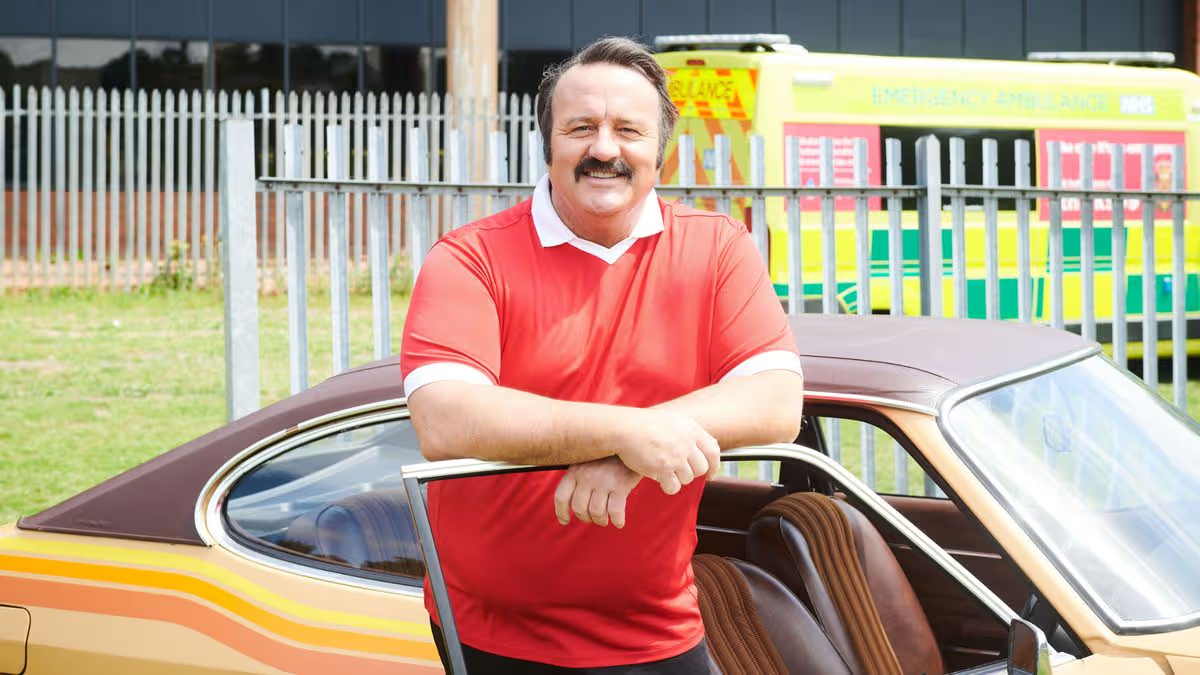
The popular series, which started in 2024, has been called ‘comedy gold’ by viewers
A BBC series hailed as “cracking” and “comedy gold” is reportedly set to return for a third run.
Advertisement
Mammoth, following a 1970s PE teacher given a fresh shot at life, launched in 2024 and proved an instant hit with viewers. According to The Sun, production on the third series is scheduled to commence in June.
Starring Mike Bubbins as Tony Mammoth and Car Share actor Sian Gibson as his daughter, the programme – which was produced and shot in Cardiff – followed the teacher when his body was found preserved in ice. He had previously been presumed dead in an avalanche during a school trip in 1979.
Following his revival, he has to navigate a world that has totally changed, reports the Mirror.
A BBC synopsis previously explained: “In the Seventies he was a carefree Cardiff bachelor, teaching PE and generally living la vida loca. In 2024, he thought the world would still be his oyster, but Mammoth never really liked oysters, he was more of a pint and a packet of crisps sort of bloke. All he wanted was his old life back; the same job, the same clothes, the same car and the same soundtrack.”
Mammoth debuted in 2024, with its second series airing last year.
Audiences embraced the show, with one viewer posting on Imdb.com that it was “a cracking comedy” that “feels remarkably relevant”, stating: “It is inoffensive yet sharp, poking fun at 1970s attitudes whilst highlighting the absurdities of modern life.”
Advertisement
“There were many genuine laugh out loud moments and some wonderful hilarious situations created by the writers,” one person commented.
Another viewer observed: “Bubbins is wonderfully understated as the titular star and delivers the punch lines with little fanfare but lots of laughs. The supporting cast is brilliant, but this is very much Bubbins show and plays it to perfection.”
“Love it, a much needed slice of comedy gold and well done to the BBC for backing it,” remarked another viewer.
Advertisement
“The writing is so strong, when you sit down you just know you’re in for some happy, silly, uncomplicated good fun and it’s been great to watch the series develop.”
9.59pm: McCullagh arrives at Ms McNally’s house in Lurgan and makes a 10-minute 999 call. He tells emergency services “Please come as soon as you can, she’s pregnant, she’s cold”. He is asked by the call handler: “Is the patient breathing?” and responds tearfully “No, she’s gone”, adding “there’s blood everywhere”. He tells the call handler Ms McNally was 15 weeks’ pregnant.
Coronation Street fans are worried about Bernie Winter following a series of “gross” scenes that aired on Monday night’s episode of the world’s longest-running TV soap
20:45, 23 Mar 2026Updated 20:47, 23 Mar 2026
Coronation Street fans are worried about Bernie Winter following a series of “gross” scenes. The cafe waitress, played by Jane Hazlegrove, ended up crossing paths with Mal Roper on an ill-fated night out earlier this year, and she ended up in his hotel room, where they shared a kiss.
Almost immediately after they shared an evening taking drugs in his hotel room, he began working alongside her at Roy’s Rolls as an electrician, and she ended up spending some time in prison when he was mysteriously attacked in the night. Bernie later worked out that her long-lost son Kit, a police officer, was behind the attack, but hasn’t said anything, seemingly aware of the trouble it could land him in.
As the world’s longest-running TV soap continued on Monday evening, Bernie and her husband Dev, who has forgiven Bernie fort her infidelity, returned home from their holiday only to find Mal walking the cobbles once more, having enjoyed a miraculous recovery that had him on life support mere weeks ago.
Advertisement
**Ensure our latest headlines always appear at the top of your Google Search by making us a Preferred Source. **Click here to activate** or add us as your Preferred Source in your Google search settings.**
Dev instantly reminded Mal that he wasn’t welcome, but he shot back: “How nice of you to ask how I am after my recent attack and life-saving treatment. They still haven’t caught who did it, you know.”
Later that day, Mal casually walked into the café and stirred up trouble as soon as he saw Bernie and Dev. Bernie said: “We don’t wanna be rude, Mal, but wouldn’t it be best if you didn’t hang out round here any more?” It was then that Dev raged: “No, you are hanging around my wife like a bad smell. And I’ve had enough!” Mal continued to ask them how their holiday was, but Dev chased Mal out of the cafe.
Advertisement
Mal said: “You can’t treat me like this,” and feigned injury when Dev ushered him out of the way. All of this took place in front of DS Lisa Swain, who immediately read the situation, and simply warned Dev not to do it again. Fans instantly reacted the the worrying development with Mal, and shared their concerns for Bernie.
One wrote on Reddit: “Bernie and Mal…frankly that is just gross and sensationalist. Gross because it comes out of nowhere. Gross because it is not a part of a larger character or plot development or an issue being explored. Gross because the story is completely unmoored from anything or anyone else in the show…
“So it all comes down to someone deciding to show a loud-mouthed, middle-aged woman being sexually humiliated for the sake of it! Like, why?! Why?! Ugh, just ugh. I’m up for an outrageous soap plot as much as anyone but at least make it grounded in something likely for the character OR developed as part of a long-running plot.
Another wrote: “I can’t blame Dev for confronting Mal and making him leave Roy’s. He wants you to leave his wife alone,” and a third said: “Bernie and Deb have arrived home! Sucks Mal is out and had to ruin that. He needs to leave but nope he’s going to stick around still”
Advertisement
Actress Jane Hazlegrove, who joined Corrie as Bernie in 2019 but previously had a short stint as Sue Clayton in the 1990s, recently explained that her alter-ego had been left “absolutely terrified” by Mal.
She revealed: “She’s really quite frightened, and she’s been on the end of an aggressive, violent man a lot. So this is absolutely terrifying, she’s in deep now. It is really dangerous.” She added: “She’s made herself vulnerable—somehow she thinks she can kind of pull down her armour. That’s her superpower, the way she has this hard shell that keeps her safe and. But this is really bad.
“He’s unhinged. Then she also then discovers that someone has cut her head out of her wedding picture. I mean, this is stalker territory, he’s been in the house!” Mal attempted to kiss Bernie when they first met, and she tried to keep this from Dev before deciding that coming clean was the best option. Jane added: “Bernie decides Dev must know the truth in order to remove Mal’s power over her.
Advertisement
“Then everything is laid out, isn’t it? She’s being fully transparent finally, it has taken weeks and weeks on end, but it is the only option over to her. She knows that if Dev knows what Mal has been up to, it will all be okay.” She added: “It takes away Mal’s power, he’s got no power whatsoever. Because that’s what he’s been blackmailing her with.”
East Riding of Yorkshire Council were granted the orders against the homes in Kirkgate Mews and Southback Lane in Bridlington by Beverley Magistrate’s Court on Friday (March 20).
Each home was owned by the council, who said it was “continuing” to work with Humberside Police to ensure the area was safe to live in.
Recommended reading:
Advertisement
The council said that allegations arising from the property in Southback Lane included stabbings, threats of violence and damages to resident’s property, domestic violence, drug dealing and organised crime groups who used the property.
In Kirkgate Mews, reports included drug dealing, rowdiness, large dogs kept off the lead and not muzzled, and a large quantity of cars left in “severe disrepair” in the communal car park.
The council said activities at both properties had had a “detrimental” affect on locals, particularly older residents who felt “unsafe” and “intimidated”.
A council spokesperson said: “Many reported to have feared reprisals for speaking out and were unwilling to give named testimony.”
Advertisement
The order for the home in Southback Lane bans anyone from entering the property for three months, other than the resident and two named people, officers from the council, police, other emergency services or utility providers.
Anyone entering the home in Kirkgate Mews within the three-month period, aside from police, the council or emergency services, could be fined, imprisoned, or both, police have said.
Served by the council’s anti-social behaviour team on March 20, the order will run until June 19.
Council cabinet member for communities and public protection, Cllr Lyn Healing, said: “We are dedicated to supporting safe and welcoming communities and taking firm action against anti-social behaviour.
Advertisement
“We will continue to work with Humberside Police to ensure that the East Riding remains a good place to live for all residents.”
It is “outrageous” that a convicted fraudster tracked down by Sky News in Tenerife is still on the run, the Speaker of the House of Commons has said.
Pamela Gwinnett isolated 89-year-old Joan Green from her family during the COVID-19 pandemic, convinced Joan to give her lasting power of attorney, then raided her life savings.
She fled to Tenerife and did not attend her trial, but was given a six-year prison sentence in her absence last year for theft and fraud by abuse of position.
Advertisement
Image: Pamela Gwinnett and Joan Green.
Commons Speaker Sir Lindsay Hoyle, who is the local MP for Ms Green’s family, told Sky News: “Here she was, found guilty, sentenced to six years.
“What a way to have your sentence, in the sun in Tenerife! Lap of luxury.
“Living in an apartment, taking the sun every day, going out for meals.”
He added: “People will be asking – why? I’m also asking why. That extradition order needs to take place now. Enough is enough. Let’s get on with it.”
Advertisement
Image: The moment Sky News confronted Gwinnett at her home in Tenerife.
The Speaker said he fears there could be other victims out there.
“My worry is, how many others have also lost money in the same way?” he said.
He added: “She was a master of manipulation of vulnerable people. So please, if there are other people out there, do come forward. I don’t think this is a one-off. I hope it is, but I suspect not.”
Gwinnett, 63, fled to Tenerife in breach of her bail conditions while awaiting trial and has been living in a picturesque seaside apartment in the south of the island for the last 11 months.
When Sky News caught up with her, despite her conviction, she claimed Joan’s family had taken the money, adding: “They have made me a scapegoat.”
The Speaker said it was “appalling” that Lancashire Police had initially dismissed Joan’s family’s concerns as a civil matter.
When presented with the same evidence – gaping holes in Joan’s bank accounts – Greater Manchester Police launched a criminal investigation.
Lancashire Police said: “We can confirm that in March 2023 we were contacted in relation to an allegation of fraud.
Image: Gwinnett had been charged and was awaiting trial when she fled to Tenerife. Pic: GMP
“Our handling of that allegation is currently subject to an ongoing complaint which is with our Professional Standards Department and for that reason it would be inappropriate to comment any further at this time.”
The Speaker thanked Sky News for our investigation into Gwinnett.
Advertisement
“These people are scamming vulnerable people,” he said. “Without you, we wouldn’t be highlighting this case nationally and internationally”.
Witnesses to the incident, which took place over the weekend, are asked to contact police as soon as possible.
Cops are appealing for information after an individual was sexually assaulted in Edinburgh. The early morning attack took place at around 2am on Saturday, March 14 on Brunswick Road in the Leith area of the capital.
Advertisement
A 29-year-old man was arrested and released pending further enquiries. Police Scotland say an investigation has been launched and is continuing.
In the meantime, anyone who may have seen what happened, or has any information on the incident, is being urged to come forward.
Sergeant Paul Gray said: “Our enquiries are ongoing and we are asking anyone who witnessed the incident to get in touch.
“If you think you can help, please contact us on 101 quoting incident number 1631 of 14 March, 2026.”
Advertisement
Get more Daily Record exclusives by signing up for free to Google’s preferred sources. Click HERE.
“Her bubbly character and fun-loving spirit lifted the hearts of all who met her.”
18:24, 23 Mar 2026Updated 18:41, 23 Mar 2026
The family of a woman murdered in Derry at the weekend say they are “crushed with disbelief, sadness and pain”.
Detectives from the PSNI‘s Major Investigation Team have launched a murder inquiry following the death of young mum-of-two Amy Doherty.
Amy, aged 28, was found injured in a house in the Summer Meadows Mews area of the city on Saturday morning, 21 March. Her death marks the 30th adult female to be killed in Northern Ireland since 2020.
Paying tribute her parents, Patrick and Sharon, said: “Her bubbly character and fun-loving spirit lifted the hearts of all who met her.”
They said Amy was the best mother to her two children, Rhea and Ronan, and that she loved her brothers Shane and Ryan.
They paid tribute to her career in caring for the “sick and elderly” before asking people to “please pray for us all at this time”.
Advertisement
In a statement on Monday afternoon, a police spokesperson said: “Amy was found, badly injured, at around 10.20am on Saturday. She was taken to hospital by colleagues from the Ambulance Service but, sadly, passed away a short time later.
“At 28 years old, Amy was just a young woman. And my thoughts are, first and foremost, with her family and friends at this unimaginably distressing time.”
They added: “A 30-year-old man was arrested on suspicion of murder, and remains in custody at this time. Our enquiries are continuing, and the local community will continue to see a police presence in the Summer Meadows area over the coming days.
Advertisement
“I am appealing to anyone with information to contact us on 101, quoting reference 469 of 21/03/2026.”
Alternatively information can be provided, with total anonymity, to the independent charity Crimestoppers on 0800 555 111 or online at www.crimestoppers-uk.org.
The BBC has verified footage of several damaged hospitals, including the 17-story private Gandhi hospital in Tehran, close to the headquarters of the state broadcaster which was the target, a Red Crescent hospital in the town of Mahabad in western Iran, and a hospital in the southern port of Bushehr, from which babies in incubators were seen being evacuated on 3 March.
Run by volunteers, it has served the north London community of Golders Green, which has a large Jewish population, since 1979. There are dozens of synagogues throughout the area and according to the London Data Store, 49% of residents in the Golders Green ward identify as Jewish.
Paul Fish, 47, from Cardiff, kicked his £3k-a-month cocaine habit and lost 6.5 stone by walking 12,000 steps daily and fasting
20:06, 23 Mar 2026Updated 20:08, 23 Mar 2026
A man who battled a £3,000-a-month cocaine addiction and would binge eat up to 10 times a day has conquered his drug dependency and lost 6.5 stone through fasting and walking 12,000 steps each day. Paul Fish, 47, struggled with binge eating and substance abuse after accumulating £100,000 in debt during the financial crash.
At his lowest, the sports massage therapist, from Cardiff weighed 22.5 stone and wore size XXXL clothing, binging 10 times a day while spending £700 on cocaine per week. Never miss a Cardiff story by signing up to our daily newsletter here
After he was rejected from a wisdom tooth procedure due to his high BMI, Paul started walking for fitness, but whilst still eating poorly and using drugs, he managed to lose just three stone over four years.
Advertisement
He then discovered fasting on YouTube. Paul now waits until 2pm to eat, trains six days a week, and has swapped crisps and chocolate for salmon and avocados, resulting in him slimming down to 15.8 stone.
After experiencing a “spiritual awakening” on October 31, 2025, Paul finally ended his 25-year drug habit, and has started a walking group in Cardiff to help motivate others.
Paul, who initially shared his story with Talk To The Press, said: “There was a point where a dealer would throw two grams of cocaine in a fag packet over the fence at 9am every day, and I’d just be in the house sniffing all day.
Advertisement
“I’d go out to the pub getting pissed every night as well, and I’d get my partner at the time to go to the Co-op to buy me flakes, and salt and vinegar Squares and full fat coke.
“In 2021, I was denied wisdom tooth surgery because I was 22.5 stone, and doctors said my BMI was too high.
“I put on my trainers the next day and started walking. I did a 150km charity walk for Great Ormond Street, but I was still sniffing cocaine and eating crap, so I wasn’t getting anywhere.
“I started fasting and now I don’t eat until 2pm, sometimes 4pm. I eat things like avocado, salmon, chicken, it’s changed my life.
Advertisement
“Then on October 31st 2025, I had a spiritual awakening, and I haven’t touched cocaine since.
“Fixing my food was the final piece of the jigsaw, my mental health has improved so much, because I’m giving my body what it wants.
“I feel like I’ve been released from prison, I’ve got so much more energy. I’m now on a mission to help other people.”
Paul initially began battling addiction during the 2007 financial crisis, when he found himself drowning in debt which he couldn’t manage on his modest salary as a car salesman.
“I was struggling with drink due to the pressure of the payments,” he said.
As his financial troubles continued to grow, Paul separated from his partner, which resulted in him comfort eating whilst also drinking excessively and using cocaine.
He moved to South Africa with a new partner, but when that relationship ended in 2016, he found himself back at his mum’s small bungalow.
Advertisement
“I felt like a spare part. I would just end up going to the pub and sniffing coke.”
At his lowest point, Paul would arrange for a dealer to throw two grams of cocaine over his garden fence each morning, setting him back approximately £100 a day.
He would then spend the entire day indoors “sniffing”, and binge eating on crisps and chocolate.
He eventually lost his job in car sales due to his drug habit, prompting him to retrain as a sports massage therapist.
Advertisement
When he was refused wisdom tooth surgery, Paul was launched into action, and the next day he put his trainers on and began walking 12,000 steps a day.
He set up an Instagram account for fellow male walkers in his area, and walked 150km in 14 days to raise funds for Great Ormond Street Hospital.
However, despite his new passion for exercise, Paul was still using cocaine and eating poorly, meaning he was “getting nowhere”.
Advertisement
Between 2021 and 2025, Paul lost just over three stone, bringing him from 22.5 stone down to 18 stone 10. He then started watching videos on nutrition on YouTube, and decided to experiment with fasting.
Having previously indulged in Gregg’s chicken and mayo sandwiches and crisps for lunch, eating up to 10 times a day, he now eats less than 40g of carbohydrates from Monday to Saturday, and does a “carb refeed” on Sunday, where he eats 450g.
Paul eats nothing until 2pm or sometimes as late as 4pm each day, and maintains an exceptionally healthy diet of salmon, avocado, Greek yoghurt, chicken and steak. He also lifts weights six times a week, and takes a range of supplements, including collagen, magnesium and ashwagandha.
He explained: “I’d been to Cocaine Anonymous for years, I’d been through counselling, and lost relationships and nothing worked, but after my spiritual awakening, I haven’t thought about using cocaine once.”
Since Paul’s “spiritual awakening”, he has lost a further three stone, bringing him down to 15 stone eight.
Eager to help others, Paul has now set up a walking group in Cardiff called the Monday Reset Project, as well as sharing his journey on his TikTok channel @paulfish.ckd.
Welsh boxer Joe Cordina attended his first walking event earlier in March and he is now expecting over 100 attendees at his next event, on March 29.
The conflict between the US – and its partner Israel – and Iran was nearly half a century in the making. Many explanations have been offered: strategic miscalculation, nuclear brinkmanship, regional rivalry and the failure of deterrence of Iran’s nuclear programme. But there is also the nature of the language through which each side has come to perceive the other.
Over 47 years, the language on each side has progressively hardened from assessments of behaviour into verdicts about the moral nature of each side’s adversary. It not only describes the enemy, but actively participates in creating it.
The language of American enmity towards Iran did not begin as a full moral verdict. In the 1980s and 1990s, Iran’s clerical leadership appeared in western media and policy discourse as the “mad mullahs”. It was a label that personalised the conflict and cast Iranian leaders as irrational rather than simply hostile. By the 1990s, the “rogue state” frame took hold, still defining Iran by its behaviour rather than its nature: a rogue, in principle, could change course.
A significant shift occurred in January 2002 when George W. Bush designated Iran as part of the “axis of evil”. His speechwriter David Frum later recalled drafting “axis of hatred”, but Bush insisted on using “evil” instead. This choice was unsurprising, as Bush’s was widely seen a “faith-based” presidency, influenced by deeply internalised evangelical Christianity.
Advertisement
George W. Bush labeled Iran as part of an ‘axis of evil’ in his state of the union speeh in January 2002. AP Photo/Doug Mills, File
By February 2026, the vocabulary had reached its most extreme register. Donald Trump described Iran’s supreme leader, Ayatollah Ali Khamenei, as “one of the most evil people in history”, killed along with “his gang of bloodthirsty THUGS”. In a video posted on his Truth Social, Trump explained the collapse of negotiations by stating that Iran’s leaders “just wanted to practise evil”. The Israeli prime minister, Benjamin Netanyahu, invoked the Book of Esther, equating the Iranian leadership with Haman — the inherently evil villain of Jewish scripture. He framed the operation as the fulfilment of a 2,500-year moral obligation.
Iran had its own vocabulary, with roots that were theological before becoming political. The designation of America by the Islamic Republic’s first supreme leader, Ayatollah Ruhollah Khomeini as the “Great Satan” drew on the Quranic figure of shaitan ar-rajim (accursed one/outcast devil). It eventually became a category through which American actions – the 1953 coup and decades of support for the deposed shah — were interpreted. The term also served a domestic purpose: the Great Satan depicted any Iranian advocate of rapprochement as a collaborator with Satan. This made moderation seem less like a policy dispute and more like a form of moral treason.
When Bush named Iran in his axis of evil, a parallel mechanism emerged on the other side. Political analysts found Iranian elites overwhelmingly viewed the designation as a boon for conservative factions in Iran – the metaphor appearing to reinforce the intransigence it claimed to criticise. Over the following two decades, Tehran increasingly framed its regional alignment as an axis of resistance: a loosely connected network of allied movements presented not as acts of aggression but as heroic solidarity against a cosmic aggressor.
What stands out across this arc is a pattern of accumulation. Each new label — Great Satan, mad mullahs, rogue state, axis of evil, axis of resistance — added another layer to the adversary’s story, making it progressively more resistant to revision. Both sides converged on the same device, each attributing a corrupted moral nature to the other, an entity whose soul was the central issue.
Advertisement
A soul to condemn
National anthropomorphism — the metaphorical attribution of human traits to a nation-state — is a common feature of political language. “Mother Russia”, “Uncle Sam”, and “Homeland-Mother China” each give the country a face, a will and a singular identity that can be addressed, celebrated or defended. Such figures allow citizens to experience attachment, obligation and hurt as if directed toward a single person.
The framings were not just hostile but asymmetrical, with clear geopolitical implications. Iran’s language depicted the US as untrustworthy yet highly capable – powerful, calculating, world‑devouring. This portrays an adversary whose strengths you resent and feel compelled to match. It carries an emotional logic of envy in the technical sense – a rivalrous resentment towards an opponent you tacitly admit is formidable. Seen through such a lens, Iran’s nuclear ambitions appear less as pure aggression and more as an effort to close a capability gap with an opponent whose strength its own rhetoric acknowledges.
The US framing attributes untrustworthiness and malevolent incompetence to Iran. They are a country of mad mullahs, a rogue state, a gang of bloodthirsty thugs whose leaders “just wanted to practise evil”. This does not sketch a formidable rival – it conjures something menacing in intent yet incapable of reason, operating below the threshold of rational calculation. Groups framed in this manner tend to elicit contempt. An enemy framed as contemptuous is less likely to register as an adversary that can be deterred and more likely to appear as a problem to be removed.
Advertisement
Its members cease to exist as reasoning agents. Their stated aims are no longer believed, their experiences no longer imagined and their inner life no longer granted as grounds for negotiation.
When that perception becomes embedded within political leadership, the arguments for engagement with the adversary start to disintegrate.
What the words have led to
The US-Israeli strikes happened in the middle of active diplomacy, not after its failure. Iran had proposed a pause on enrichment and zero stockpiling. But within a framework that had spent 47 years defining Iran’s nature rather than its behaviour as the key issue, no such proposal could be seen as genuine by Washington. When a nation’s nature is repeatedly portrayed as irredeemably evil, what it does at the negotiating table becomes insignificant. The nature precedes the behaviour, and no behaviour can change it.
To each side, the identity judgements of nearly half a century have become almost a self-fulfilling prophecy. Each side will interpret what follows as confirmation of what it has always believed. That is what 47 years of presupposed moral condemnation can become: a frame so absolute and impenetrable that the violence it accompanies becomes a vindication.
You must be logged in to post a comment Login