Connect with us
DAPA Banner

NewsBeat

Why the damage to Qatar’s gas infrastructure could push costs higher for years to come

Published

on

Why the damage to Qatar’s gas infrastructure could push costs higher for years to come

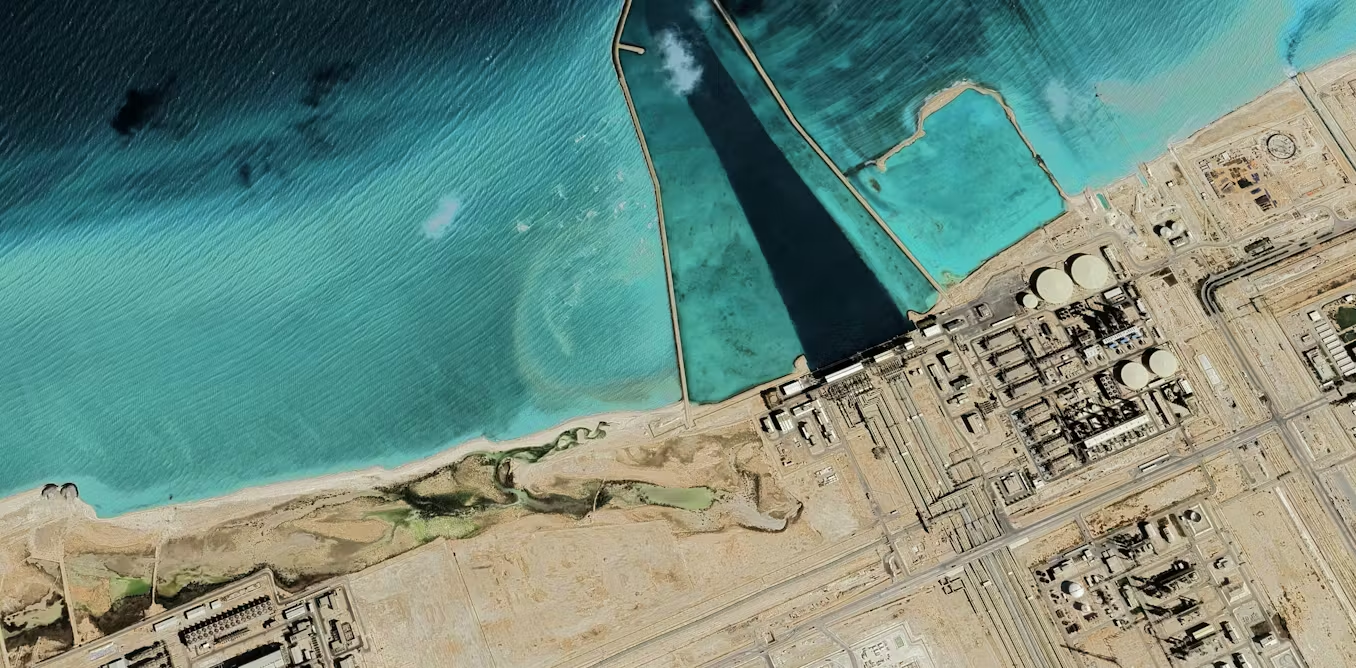
On March 19, Ras Laffan, the largest liquified natural gas (LNG) terminal in the world, supplying one-fifth of the world’s super-chilled fuel, was hit by Iranian missiles and drones. The Qatari terminal suffered substantial damage in the strikes – fires were raging across the gas-to-liquids facility within the complex, which covers 295 square kilometres – the size of a large city.

Investments worth tens if not hundreds of millions of dollars disappeared into thin air. Damage was estimated to be so extensive that QatarEnergy’s CEO, Saad Sherida al-Kaabi, said the company may have to declare a “force majeure” (non-fulfilment of orders due to circumstances outside their control) on long-term contracts. He said this could affect LNG supplies to Italy, Belgium, Korea and China “for up to five years”.

Similar to oil, gas exports from the Persian Gulf supplied about 20% of world demand. But gas (mostly methane) is a very different fuel from crude oil. To move it in liquified form, methane must be chilled to below -162°C.

But at these temperatures steel becomes brittle and shatters. So storing and transporting LNG in ships is expensive and very energy-intensive. Liquefaction and transportation of methane can easily consume 15% of the initial natural gas extracted.

Advertisement

It also means that the infrastructure that enables a highly flammable and explosive fuel to be handled at these extreme conditions has to be complex and consequently very expensive. Ras Laffan, for example, was built over decades and in several phases, costing tens of billions of dollars.

No quick fix

Interestingly, Qatar’s North Field and Iran’s South Pars gas field are part of the same massive geological structure, separated only by a maritime border in the Persian Gulf. Together, they form the world’s largest natural gas field.

So, Iran and Qatar are essentially exploiting the same gas reservoir the same way two people would use straws to drink from the same bottle. The US president, Donald Trump, now appears to have retreated from his threats to blow up “the entirety” of the Iranian gas field – but this geological fact had always made his comments quite ridiculous.

While Qatar exports most of its production, Iran uses the bulk of its gas domestically (although some exports go via pipeline to Turkey and Iraq).

Advertisement

Iran’s South Pars gas field is separated from Qatar’s North Field only by the maritime border in the Persian Gulf.
EPA/ABEDIN TAHERKENAREH

But the damage to the complex has been done, and it affects some 17% of the country’s LNG infrastructure. Repairing it will take a long time, precisely because of the complexity of LNG projects.

The plant must be warmed up slowly before repairs and cooled down slowly after. Rapid temperature changes can cause pipes to bend or even snap. And parts of the plant are bulky and hard to transport. The main heat exchangers can be more than 50 metres long, and compressors, turbines and liquefaction trains can easily weigh 5,000 metric tonnes. Storage tanks must be built of special alloys with double walls and customised insulation.

In other words, gas is very different to oil. Recent events have shown just how vulnerable the LNG supplies from the Gulf region are. They are going to affect Asia most, as about three-quarters of Qatar’s LNG ends up there – particularly China, India, Taiwan, South Korea and Pakistan, as well as others.

Advertisement

Most of the rest ends up in Europe – Italy, Belgium, Poland and a small amount to the UK (the UK imported only about 1% of its supply from Qatar last year). The majority of the UK’s imports come from its own UK production in the North Sea and imports from Norway and the US.

However, LNG is a part of the global energy market and the shortfall in production will result in higher prices globally. Gas will end up with the highest bidder, while some nations will probably go back to using coal. This may especially be the case with India, Pakistan, Bangladesh and a few other Asian countries that are very sensitive to high fuel prices.

Some European countries may even see coal as a cheaper option. Following the events in the Gulf, this “spark spread” (the profit margin from gas-fired electricity generation) has fallen, narrowing the gap in Europe with the “dark spread” (profit from generating power using coal).

The benchmark for European gas prices, the Dutch Title Transfer Facility, has more than doubled since mid-January. Coal prices have picked up due to higher demand, but not as much. Unlike oil, the LNG shortage has turned from a logistical problem – the closure of the strait of Hormuz – into a structural one. The damage to the Qatari production facility may take several years to repair. This means that gas prices – already high – are likely to remain elevated for some time.

Advertisement

Source link

Continue Reading
Click to comment

You must be logged in to post a comment Login

Leave a Reply

NewsBeat

‘Every indicator is flashing red,’ says UN as it warns of record ‘climate imbalance’ | Science, Climate & Tech News

Published

on

A woman cools herself with a hand fan in Hamburg during a heatwave in Germany in July 2025. Pic: AP

The Earth’s climate is in a “state of emergency”, according to the United Nations which has warned it is more out of balance than at any other time in observed history. 

The World Meteorological Organisation (WMO), which is the UN’s weather agency, predicted that rapid and large-scale changes to the global climate in recent decades would trigger harmful repercussions lasting centuries.

It comes as rising greenhouse gas concentrations in the atmosphere drive global warming and melt ice.

The WMO’s annual “state of the global climate” report, released on Monday, also highlighted the impact in 2025 of intense heatwaves, heavy rainfall, wildfires, drought, tropical cyclones, storms, and flooding, including widespread death and vast economic losses.

Advertisement
Image:
United Nations secretary-general Antonio Guterres. Pic: Reuters

It further demonstrated the cascading impacts that extreme weather events were having worldwide, including food insecurity and displacement, and health risks driven by shifting rainfall patterns, like mosquito-borne dengue disease and heat stress.

UN secretary-general Antonio Guterres warned the global climate is in a “state of emergency”.

“Planet Earth is being pushed beyond its limits,” he said. “Every key climate indicator is flashing red.”

The report confirmed that 2015 to 2025 represented the hottest 11 years on record, with data showing last year as the second or third hottest ever documented.

Advertisement

It also revealed that Earth is close to breaching the key warming threshold of 1.5C – beyond which increasingly severe and compounding climate impacts are triggered – with the figure recorded at 1.43C last year.

Advertisement

Trump’s most sweeping climate reversal to date

Furthermore, the WMO found the accelerating amount of heat in the world’s oceans, which stores more than 91% of the excess heat in the Earth’s system, means the planet is moving to timescales of committed climate change for centuries.

Meanwhile, the planet’s energy imbalance – the rate at which energy from the sun enters and leaves the Earth – reached a new high in 2025.

Advertisement
A man cools off with water in Athens, Greece, amid a heatwave in July 2025. Pic: AP
Image:
A man cools off with water in Athens, Greece, amid a heatwave in July 2025. Pic: AP

Read more:
Earth’s lungs are collapsing – is net zero dead?
Wettest winter on record for parts of the UK, says Met Office

At the same time, heat-trapping greenhouse gases like carbon dioxide, methane and nitrous oxide have risen to their highest level in at least 800,000 years.

WMO secretary-general Celeste Saulo said: “Human activities are increasingly disrupting the natural equilibrium and we will live with these consequences for hundreds and thousands of years.

“On a day-to-day basis, our weather has become more extreme.”

The report also outlined how climate data, early warning systems, and integrated climate services for health can protect people as the temperature rises.

Advertisement

Source link

Continue Reading

NewsBeat

Two rushed to hospital after crash on country road

Published

on

Cambridgeshire Live

Fire crews cut off a door to allow emergency services to work

Fire crews had to cut off a car door to allow emergency services to work after a crash. Saffron Walden fire crews were called to a crash in Ickleton at about 8am on Monday (March 23).

Advertisement

At the scene, crews removed the driver’s door from one of the vehicles to allow paramedics access. Two patients were taken to hospital after the crash.

A spokesperson for Saffron Walden fire station said: “Shortly after 8am this morning, both of our fire engines were mobilised to a road traffic collision between Strethall and Elmdon. Using specialist equipment, we quickly removed the drivers [sic] door off one of the vehicles to give our colleagues in the ambulance service some more space to work.

“We, the crew, wish both drivers a speedy recovery. This incident serves as a reminder of the importance of wearing seat belts and taking extra care when navigating our country roads.”

An East of England Ambulance Service spokesperson said: “We were called at 8.10am to a road traffic collision on Elmdon Road in Ickleton. Two ambulances were sent to the scene and two patients were transported to Addenbrooke’s Hospital for further treatment.”

Advertisement

Source link

Continue Reading

NewsBeat

Chief Rabbi: British Jews saddened by ambulance attack but will not be cowed

Published

on

Chief Rabbi: British Jews saddened by ambulance attack but will not be cowed

Worshippers Melvin Cravitz and Adrian Daulby were killed when 35-year-old Jihad Al-Shamie, a Syrian-born British citizen, drove into the gates of the Heaton Park synagogue in Crumpsall, Manchester, in October last year, and then began attacking with a knife, wearing a fake suicide belt.

Source link

Continue Reading

NewsBeat

I asked experts for the best paint colours for refreshing bedrooms this spring

Published

on

Wales Online

Transform your bedroom this spring

Spring has officially arrived, bringing with it brighter and lengthier days. The changing of the seasons naturally encourages a fresh beginning, particularly if you’re contemplating revitalising your home.

DIY enthusiasts and professionals have identified spring as the perfect moment to refresh your property, whether through applying a new coat of paint, replacing heavy winter textiles with lighter alternatives, or undertaking a thorough spring clean. Girls Aloud’s Kimberley recently spoke with DailyExpress.co.uk at the unveiling of her latest paint partnership with Wickes, sharing insights on home improvements and DIY projects.

Advertisement

Your bedroom should serve as a peaceful retreat, with an ambience that helps you unwind before sleep. Yet, if you’re uncertain where to begin, DIY specialists from Wickes and Kimberley have revealed their favourite paint selections for revamping your bedroom this spring, reports the Express.

Lewis Janes, Head of Decorating & Storage at Wickes, believes spring offers the optimal opportunity to refresh your living space: “This time of year is perfect for bringing natural light into your interiors and making rooms feel more open. The right shades can lift the mood whilst enhancing the sense of space.”

Always add panelling

Kimberley noted that individuals typically understand which colours suit their bedroom environment, particularly those that promote restful sleep. To enhance a basic bedroom, she suggests incorporating panelling to introduce depth and texture to the room. She explained: “In my bedroom, I focus more on the panelling, and I made the feature that rather than a strong, bold colour. And that really works, it just elevates the space…”

Advertisement

She added: “There’s the new acoustic panelling I did in my son’s room. Those kinds of things can really bring the room to life, but still keep it quite earthly and tonal if you don’t want to go too wild with colour.”

Soft Honey from Kimberley Walsh by Wickes

Lewis highlighted Kimberley’s latest interior paint Soft Honey (2.5l, £13) as an excellent choice to help brighten any bedroom space. He characterised it as “a warm, uplifting yellow with honeyed undertones that reflects daylight beautifully, creating a cosy, welcoming, and effortlessly elegant space.”

During the paint’s development, Kimberley sought assistance from her son, Bobby, whose room now showcases the inviting yellow shade.

Wheatgrass by Crown

Lewis noted that this gentle “clay hue” is ideal for those who prefer to maintain neutral walls. He characterised Wheatgrass (5l, £29) as “neutral yet inviting”.

Sage No.85 by Wickes

Green tones can help your home welcome the spring season, introducing a sense of freshness and vitality from outdoors. Lewis’ selection for spring is the Sage No.85 (2.5l, £13).

He characterised the paint colour as introducing a “gentle, timeless pastel green to the room”.

Moonlight Bay by Crown

Moonlight Bay (2.5l, £20) is a subdued pastel blue, an ideal springtime refresh for bedrooms. Lewis noted that the Crown paint “introduces a softness ideal for creating a calm, restful space.”

Kimberley’s new interior paint shade, Soft Honey, and new garden paint, Pale Clover, are now available to purchase at Wickes. Browse the Kimberley Walsh by Wickes collection here.

Source link

Advertisement
Continue Reading

NewsBeat

Danny Brown review: Sober, settled down, but somehow even wilder than before

Published

on

Danny Brown review: Sober, settled down, but somehow even wilder than before

It’s a brief set considering the cost of entry, with Brown on and off within an hour, but the sheer pace goes some way to making up for it, leaving barely room to breathe between world-class bangers. Tonight’s gig shows that Danny Brown hit his mid-40s, got sober, settled down, and somehow came back even wilder than before.

Source link

Continue Reading

NewsBeat

US attacks on Cuban medical missions risk damaging healthcare for poor people in developing countries

Published

on

US attacks on Cuban medical missions risk damaging healthcare for poor people in developing countries

There were tearful scenes in the central American nation of Honduras on February 23, as locals said goodbye to the Cuban healthcare professionals who had been treating them for free for around two years. It came after the Honduran government abruptly ended the Cuban medical mission under pressure from the administration of the US president, Donald Trump.

That same day, a “sensitive” US State Department memo was sent to the secretary of state, Marco Rubio. It discussed the US strategy to sabotage Cuba’s medical internationalism, which has been an integral part of the island nation’s foreign policy since 1960. In recent years it has also become a key pillar of its economy.

The US has imposed unilateral sanctions on Cuba for more than 60 years. These prevent Cuba from engaging in “normal” international trade – for example, third parties cannot sell goods to Cuba if 10% of their components are from US companies or subsidiaries. And Cuba cannot export goods to the US. On top of that, the US blockade severely restricts Cuba’s access to the international financial system.

In this context, the export of medical professionals has become vital to the Cuban economy. For decades the Cuban government sent medical missions around the world as a donation to developing nations. But over the past two decades, it has developed cooperation agreements under which governments or local authorities pay the Cuban government for the medical services of its healthcare professionals.

Advertisement

Attacking that revenue looks to be a key component of the US push for regime change in Cuba by the end of the year. This is alongside the total oil blockade imposed by Trump’s executive order on January 29, which has now caused multiple national blackouts that have left the entire island in the dark.

It is a policy of carrots and sticks. Countries kicking out Cuban medics are offered US support for “infrastructure modernisation” – things like telemedicine and virtual training. A year earlier, Rubio had announced visa restrictions for current and former officials and their families from anywhere in the world who took part in Cuban programmes.

By mid-March this year, neighbouring governments fell into line. Guatemala, Paraguay, the Bahamas, Guyana and Jamaica terminated Cuban medical missions, ending decades of cooperation. In Guatemala, more than 400 Cuban healthcare professionals, most of them doctors, are serving indigenous communities under a three decades-long partnership. The last doctors will leave by the end of the year.

Advertisement
Cuban doctors leaving Honduras in February 2026.

The US government’s attack on Cuban medical internationalism is not new. It began in 2006, the year after the oil-for-doctors programme between Cuba and Venezuela transformed the export of healthcare professionals into Cuba’s greatest revenue source.

US policy sought to eliminate this income and undermine the prestige the programmes earned the island. The then US president, George W Bush, set up the Cuban Medical Professional Parole (CMPP) Program, encouraging Cuban medics abroad to abandon missions and defect to the US. The programme was ended only in 2017, in Barack Obama’s final days as president.

Despite this, and reflecting the deficit in healthcare globally, Cuba’s earnings from the export of healthcare services rose. Revenues in 2018 (the first year Cuba published separate data for health services) were US$6.4 billion (£4.8 billion). Trump’s first administration developed policies, and funding, to sabotage these programmes.

Cuba’s bill of health

It also devised a new justification for doing this. The US government could not openly demand that countries sacrifice the health and wellbeing of their populations just to deny Cuba revenue. So instead, it accused Cuba of human trafficking and equated its healthcare professionals to slaves.

Advertisement

Anyone who has spoken to Cuban participants – as I have – knows the overseas service contracts they sign provide them with their regular Cuban salary, plus extra remuneration from the host country. They are guaranteed holidays and contact with families.

Even with tens of thousands of medical workers overseas, the state’s investment in healthcare and medical training means that the Cuban population has the highest ratio of doctors per person in the world. In 2022, it was said to have nine doctors and nine nurses for every 1,000 citizens. In the US, there are 2.6 doctors per 1,000 citizens and in the UK the figure is 3.2.

For many Cuban healthcare professionals, it signifies the fulfilment of an internationalist duty; for others a way to travel or increase their income. The Cuban government takes the lion’s share of revenues and puts them back into Cuba’s universal free public healthcare provision and medical training.

Advertisement

But under Trump’s second administration, Rubio, the son of Cuban migrants who left the island during the Batista dictatorship, has spearheaded a renewed attack on the island’s international medical programmes. The recent State Department memo stated that Cuban medical brigades were a key source of “hard cash” for the regime.

The four forms of Cuban medical internationalism practices established in the 1960s are:

  1. emergency medical brigades overseas
  2. treatment of foreign patients in Cuba
  3. training foreign students as healthcare professionals, and,
  4. establishment of public healthcare facilities overseas.

This contribution to developing nations has often been ignored or censored. But it translates into millions of lives saved and improved globally every year. Sabotaging medical internationalism would devastate Cuba. But it would also leave millions of people around the world without the vital medical attention that they had previously enjoyed.

Source link

Advertisement
Continue Reading

NewsBeat

Man facing court after Air Support Team tracked ‘dangerous’ scrambler rider in West Belfast

Published

on

Belfast Live

The man was spotted driving dangerously in West Belfast by PSNI officers

A teenager has been charged after he was observed driving a scrambler in a dangerous manner by PSNI Air Support Team officers on Sunday afternoon, March 22.

The 19-year-old man has been charged to court with several offences, including dangerous driving. He was spotted driving the scrambler dangerously in the Glen Road area before being arrested.

Advertisement

The man was also charged with resisting police, using a motor vehicle without insurance, no driving licence and failing to wear protective headgear.

READ MORE: PSNI appeal after charity box stolen from Portadown Train StationREAD MORE: Motorcyclist in critical condition after Lisburn Road crash

He is due to appear before Belfast Magistrates’ Court on Friday, April 17.As is usual procedure, PSNI said the charges will be reviewed by the Public Prosecution Service.

For all the latest news, visit the Belfast Live homepage here and sign up to our daily newsletter here.

Advertisement

Source link

Continue Reading

NewsBeat

Armed patrols deployed to protect London Jewish sites as Met Police chief condemns ‘attack on us all’

Published

on

Armed patrols deployed to protect London Jewish sites as Met Police chief condemns ‘attack on us all’

Meanwhile, at the rally organised by Our Fight UK Gideon Falter, chief executive of the Campaign Against Antisemitism, told the crowd : “Burning that ambulance service down, waiting for a moment when all four of its ambulances were in one place, not on call, it’s premeditated, it’s calculated, it’s despicable.”

Source link

Continue Reading

NewsBeat

Sophie Habboo on moment she ‘didn’t want to film’ that made final cut of Disney series

Published

on

Daily Mirror

The Made in Chelsea star’s new Disney+ parenting documentary is just days away from release

Made in Chelsea stars Sophie Habboo and Jamie Laing are making their pregnancy journey public in an eye-opening new Disney+ documentary that releases in a matter of days.

Raising Chelsea charts the couple’s experience preparing for the arrival of their new baby through to the labour itself across three episodes. The official synopsis reads: “An intimate three-part series following the former Made in Chelsea stars, Jamie Laing and Sophie Habboo, as they face the messy, scary and hilarious reality of becoming parents.

Advertisement

“Pregnancy begins with joy, before panic quickly sets in, as medical jargon, home renovations and family opinions pile up. Fun-loving, workaholic Jamie, says he’s the boy who won’t grow up and struggles to see himself in the role of dad.

“Meanwhile Sophie balances career highs and the thrill of becoming a mum, with raging hormones and fears of maternity leave and motherhood impacting her career. Jamie and Sophie run headlong into the drama of labour to finally meet their baby – and with family and friends never far away, they laugh and cry their way through the joy and the chaos.”

A release date for the new series has been announced today (March 24), with the series landing on the streaming platform on April 2. However, ahead of its release, the couple revealed there was one moment that features in the series that they had never anticipated including.

Advertisement

“We always have this struggle in our relationship with the podcast, with social media, online, everything. Jamie would want to share every single thing, and I more so find that a little bit scary,” Sophie admitted. “However, with this TV show, after we started filming, we quickly realised, well, I realised, that it wasn’t going to work unless we showed everything.”

She continued: “And with the birth scene, we really didn’t expect to go in there. I didn’t actually want to film that, but it’s there and it’s real and that is the story and that is what happened. I’ve just gone for it.”

Get Disney+ for £5.99

This article contains affiliate links, we will receive a commission on any sales we generate from it. Learn more
Content Image

£5.99

Disney+

Advertisement

Get Disney+ here

A Disney+ subscription now starts at £5.99 and includes hit series like Rivals, Only Murders in the Building and The Bear, plus countless titles from Marvel, Star Wars, Pixar and more.

Jamie was quick to jump in, adding: “I didn’t force Sophie to film the birth scene,” as his wife went on to share the sweet reason she wanted to keep it in.

“What actually happened was my anaesthetist took my phone and filmed the whole thing! When I’d given birth and we were looking through the photos, we were like, ‘Oh my God, the whole thing’s been filmed’,” she recalled.

“And actually, it made us feel really emotional and obviously it was the greatest day of our lives. We thought ‘Do you know what? It happens, it’s real life’ and we put it in there.”

Advertisement

The couple became parents to baby Ziggy in December following a love story that began on reality series Made in Chelsea. Following years of dating, Jamie proposed at the Rosewood London hotel in December 2021 – the same spot where they had their first date.

Raising Chelsea will be available to stream on Disney+ from April 2.

Source link

Advertisement
Continue Reading

NewsBeat

Corrie fans issue same ‘plea’ in Todd and Theo ‘had enough’ admission

Published

on

Manchester Evening News

Fans of the ITV soap are hoping that soap bosses end the storyline soon

Coronation Street fans have issued the same plea for Todd Grimshaw and Theo Silverton as they’ve “had enough”.

Advertisement

Ever since Theo Silverton was introduced to the cobbles of Weatherfield last year, his character has left a sour taste in many Coronation Street viewers mouths as his behaviour continues to escalate dangerously.

Get MEN Premium now for just £1 HERE – or get involved in our WhatsApp group by clicking HERE. And don’t miss out on our brilliant selection of newsletters HERE.

With Todd Grimshaw falling head over heels for Theo, it appeared the couple could resolve the issues Theo faced from his previous marriage. However, Theo consistently lashed out and belittled Todd, leaving him to become a shell of his former self.

In the lead up to Corriedale, Todd finally confided in good friend Billy Mayhew who saw footage of Theo attacking Todd in their flat. Offering Todd a safe space, he promised to get him back home and away from Theo.

Advertisement

However, as the events of that night unfolded Theo made sure Billy wouldn’t escape the burning minibus, and Todd was left with no one to protect him.

Over recent episodes, Theo decided to break things off with Todd but still tracked him on his phone to show up wherever Todd was as a form of control. During Monday’s (March 23) installment, Todd woke up drowsy after Theo slipped drugs into his drink, and felt ashamed when he realised he’d missed the marathon he was running in memory of Billy and Paul.

Theo found Todd in the corner shop and gloated that he’d managed to get a medal, as he promised that he’d tell everyone a lie to save Todd from the embarrassment.

Later, Theo pleaded with Todd to take him back, and unfortunately Todd wasted no time in accepting the offer, relieved to have Theo back in his life.

Over on X (formerly known as Twitter), viewers expressed their frustration over the situation as @kliceanicole_xo wrote: “i wish this Theo & Todd situation would come to an end now i honestly can’t deal with it at all”.

@lornawatts added: “Please let Theo be taken down soon and punished, same with Megan” as @cupofteakim penned: “why has no one caught on about theo yet? every time they’re around each other in public todd has a face like a slapped arse. i’ve had enough of this storyline now ffs”.

Another viewer, @xxalicia89 expressed the same annoyance over the storyline and added: “Can’t wait for Theo to get exposed next week”.

Advertisement

Source link

Continue Reading

Trending

Copyright © 2025