
Crypto World
DeFi TVL holds up despite crypto sell-off as yield seekers stay put

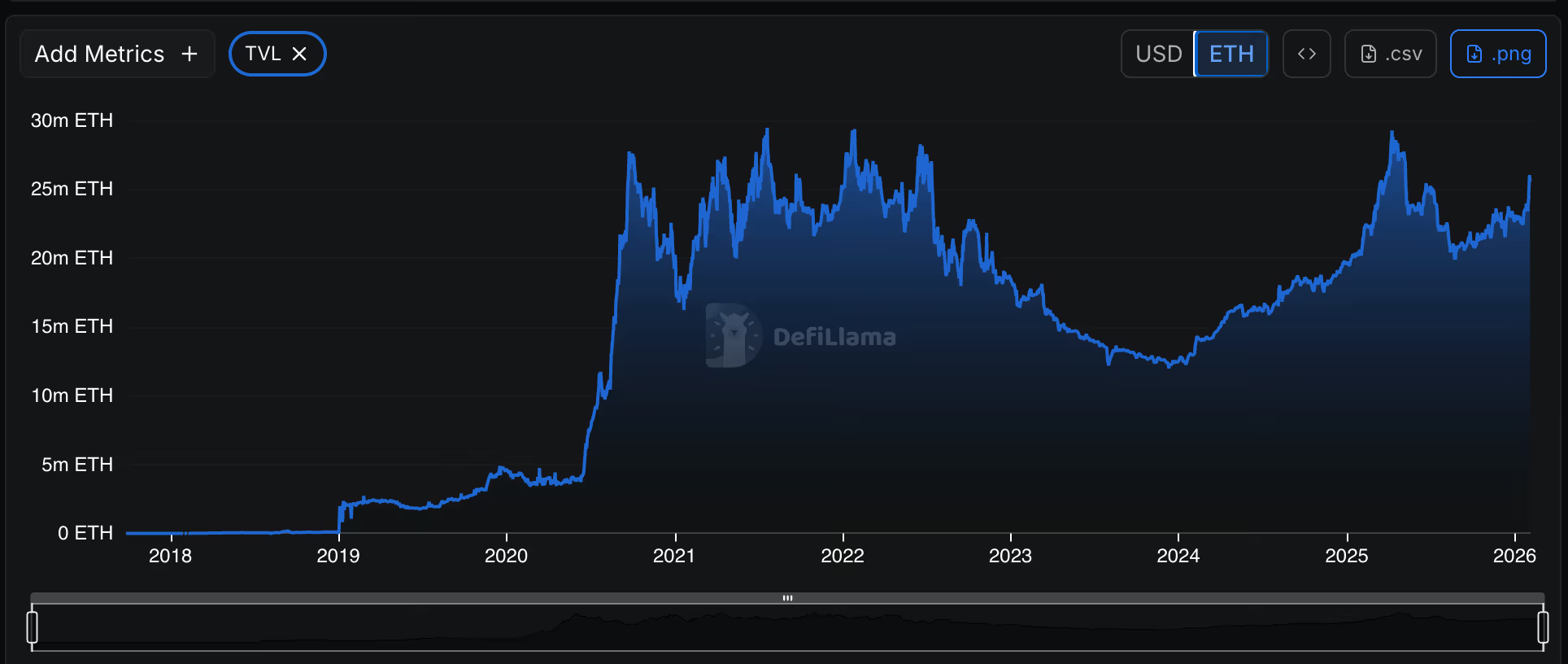
Despite broad market weakness and waves of forced liquidations across crypto, DeFi’s total value locked (TVL) has proven surprisingly resilient — a signal that traders are still attempting to generate yields despite bearish sentiment flooding the crypto market.
Over the past week crypto majors BTC, ETH, XRP and SOL fell to multi-year lows, with ETH now losing 21% of its value over the past seven days alone.
But that drop off didn’t translate into outflows from DeFi protocols. Total value locked fell from $120 billion to $105 billion, a 12% downturn as it outperformed the market.
The 12% drop off can be attributed to dwindling asset prices as opposed to yield farmers rushing for the exits. The amount of ether deployed across the DeFi market has increased from 22.6 million ETH at the start of the year to 25.3 million, with 1.6 million ETH being added in the last week alone, according to DefiLlama.

Onchain liquidations muted
In February last year the crypto market experienced a similar drop following Donald Trumps ascent to becoming U.S. president. Then, the DeFi market was far more fragile, with a mammoth set of $340 million in onchain liquidations on the cusp of being triggered.
This time around, the DeFi market is better collateralized with just $53 million in liquidatable positions within 20% of the current price. Positions on algorithmic interest rate protocol Compound only become at risk if ETH slides below $1,800, although the largest danger zone is between $1,200 and $1,400 — which contains $1 billion worth of liquidatable positions, DefiLlama data shows.
Resilience shows maturing sector
In previous cycles, the DeFi market was the first to implode. In 2022 investors succumbed to overly tempting yields on the Terra blockchain by staking the algorithmic UST stablecoin, only for the entire ecosystem to collapse months later during a market plunge that reduced the value of crypto assets backing the stablecoin.
This led to contagion across all DeFi markets, with TVL dropping from $142 billion to $52 billion between April and June of that year.
This time around the downside risk is minimal, yields are steady and inflows are quietly increasing — suggesting the sector has matured along a backdrop of institutional adoption and broader market volatility.


Court Orders Remedial Reflex
In Buenos Aires, a court directed regulators to impose tight controls of access. The telecom regulator ENACOM also liaised with the internet companies to shut down the site. Google and Apple were also asked to take the app out of their stores. The reason why these actions are taken is to restrict access to the users in the country.
This has caused regulators to tighten their belts due to apprehension caused by activity associated with inflation data. It was reported that the platform made predictions of Argentina’s inflation rate in February before it was officially released. Besides, authorities reported that the prediction was altered minutes before publishing. This chain of events triggered the need to further research how the platform functions.
Researchers came to the conclusion that the platform served as a web-based betting platform. Regulators also said it enabled the users to participate in wagering without licenses. Also regulators were worried about access by minors. These results resulted in even tougher steps to be taken against the platform.
Latin America’s Crackdown Continues
The move is in line with other actions taken by Colombia. Polymarket was later blocked in the country due to similar complaints raised against unlicensed gambling services. Therefore, Argentina became the second country to ban the platform in the region. Such a trend underscores the developing regional integration in the area of regulatory enforcement.
Regulatory examination does not just end at Latin America; it extends to other markets. It has been reported that websites like Kalshi have been involved in court cases in the United States due to allegations of unregulated betting services. It has also been reported that unpaid wagers have been involved in cases of dispute that are associated with geopolitical activities. Regulators and legal authorities have paid more attention to such developments.
Polymarket has also addressed criticism by eliminating some of the markets. Additionally, the site has recently shut down a market for nuclear risk forecasts after being pressured by the publicity. More so, the shutdown was done through the high geopolitical tensions. This is in response to efforts to deal with concerns as the regulatory pressure persists. Argentina has imposed a nationwide ban on Polymarket following the discovery of unlicensed betting operations and a ban on platforms. The relocation is in line with the larger international desire to control prediction market sites and restrict illegal gambling solutions.
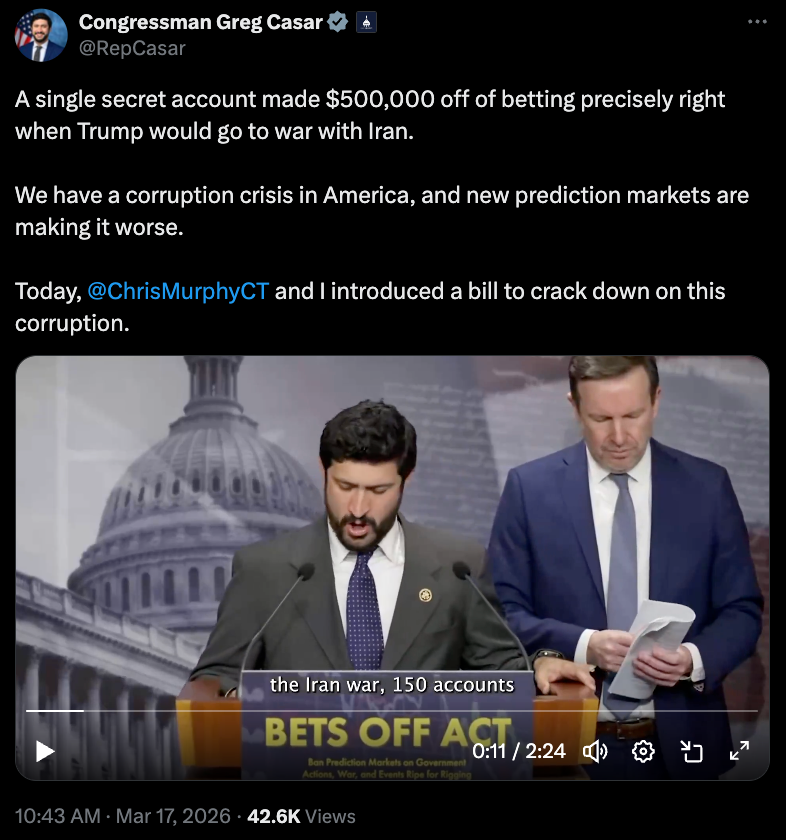
Two Democratic lawmakers in the US Congress have introduced legislation in response to “government corruption” over bets on prediction markets platforms.
In a Tuesday announcement, Texas Representative Greg Casar and Connecticut Senator Chris Murphy said they had introduced the Banning Event Trading on Sensitive Operations and Federal Functions (BETS OFF) Act after several Polymarket accounts made “highly unusual bets” that a war between the US and Israel against Iran would begin.
Murphy said on March 4 that it was likely that people with “inside information” of US President Donald Trump’s plan to bomb Iran had made the bets.
“We shouldn’t live in a country where someone sitting in the situation room making decisions about whether to invade or to bomb, decisions about war and peace, life and death, that those decisions could be driven by the fact that they have hundreds of thousands of dollars riding on the decision,” said Casar.

The bill is the latest twist in US lawmakers’ efforts to crack down on prediction market platforms and accounts allegedly using insider information to profit from government actions. Last week, California Senator Adam Schiff introduced the DEATH BETS Act to prevent prediction markets platforms from listing events contracts related to war, terrorism, assassination and individual deaths.
Related: Arizona AG files charges against Kalshi over ‘illegal gambling‘
Platforms like Polymarket and Kalshi offer bets on a variety of outcomes, including sporting events and US politics. However, users betting on the specifics of the US-Israel conflict with Iran have ignited controversy in many areas of government. On Monday, a military correspondent with the Times of Israel said that he had received death threats over his report of the date when an Iranian missile had struck Israel, all “in order to resolve a prediction on Polymarket.”
War-related bets still live on Polymarket
As of Tuesday, Polymarket still offered users the opportunity to place bets on the outcomes of several potential decisions in the US-Israel conflict against Iran, including on whether the US would send ground forces into the country, when a ceasefire might happen, and changes to Iranian leadership.
“The promise of prediction markets is to harness the wisdom of the crowd to create accurate, unbiased forecasts for the most important events to society,” said Polymarket in a note on Middle East markets. “That ability is particularly invaluable in gut-wrenching times like today. After discussing with those directly affected by the attacks, who had dozens of questions, we realized that prediction markets could give them the answers they needed in ways TV news and [X, formerly Twitter] could not.”
Kalshi, in contrast, offered event contracts related to the Iranian conflict but not on specific military actions, such as if the country might reach a nuclear deal with the US and whether Trump or other elected officials might visit Iran.
Magazine: Would Bitcoin really be at $200K if not for Jane Street? Trade Secrets
Crypto World
Ripple to expand in Brazil with custody, payments, and brokerage services ahead of central bank approval push: Ripple
Ripple is adding custody, payments, and brokerage tools for digital asset management in Brazil as it prepares to seek regulatory approval from the country’s central bank.
Ripple is expanding its services in Brazil by adding custody, payments, and brokerage tools for digital asset management and tokenization. The blockchain firm plans to apply for regulatory approval from Brazil’s central bank to support these new offerings, marking a significant expansion of its presence in the Latin American market.
The move builds on Ripple’s earlier partnership with Mercado Bitcoin, Brazil’s largest cryptocurrency exchange, which launched Ripple Payments as the first customer to utilize the firm’s managed end-to-end payments solution. This expansion reflects Ripple’s broader strategy to establish regulated operations across key markets while enabling faster and more efficient cross-border payment infrastructure.
Sources: Ripple Press
This article was generated automatically by The Defiant’s AI news system from publicly available sources.


Justin Sun-owned Poloniex has announced fee-free trading for any user who enrols in its “Poloniex Super” membership, which currently offers 30 days’ worth of fee-free “spot, margin, and futures trading.”
Poloniex has yet to announce what this membership will cost once the 30-day period has elapsed, though it does mention that “[a]fter the trial period ends, you will be automatically enrolled in the basic Super plan by default.”
This product announcement has led users to ask how Poloniex will make money without fees. Sun quickly explained that Poloniex has no need to make more money because “we already made enough from the bitcoin (BTC) we bought in 2012.”
Poloniex was founded in 2014 and therefore couldn’t possibly purchase any BTC in 2012, so presumably Sun is referring to BTC he purchased.
This statement that Poloniex can continue to operate based only on these profits brings to the forefront concerns about how Poloniex has managed the BTC in its reserves.
In 2020 Poloniex offered a new product, which it described at different times as “BTC on TRON” and “BTCTRON.”
This initial announcement described BTCTRON as “a type of wrapped BTC token that exists on the TRON blockchain.”
Poloniex’s Help Center provides us the contract address for this token, TN3W4H6rK2ce4vX9YnFQHwKENnHjoxb3m9.
Reviewing this contract address reveals that this token currently has a circulating supply of 17,545 BTC, worth approximately $1.3 billion.
Disturbingly, Poloniex’s so-called “proof of reserves” claims that Poloniex has a balance of only 11,090 BTC in its entire reserves and 11,082 of those are “User Balance.”
This is insufficient to reserve this tokenized BTC product.
Protos has previously repeatedly reached out to Poloniex during our past reporting on this product, and it has never been willing to provide the addresses that hold the BTC for this tokenized product.
We attempted to reach out to Poloniex again; however, it didn’t provide these addresses before publication.
Read more: FTX estate says Justin Sun still owes it millions
Increasing the concern about this product is how deeply it has been integrated into another Sun-owned exchange, HTX.
At HTX, typically there is more of this mysterious BTCTRON product, which provides no transparency, than real BTC.
As of the most recent HTX snapshot, dated March 1, there were a total of 21,362 BTC on HTX. BTCTRON accounted for 10,291 of those.
There are also an additional 1,212 BTC that are in the form of Sun-advised Wrapped Bitcoin.
What this means, taken as a whole, is that Poloniex will not disclose where the $1.3 billion in BTC that is supposed to collateralize this product is located.
Yet despite that fact, HTX is willing to make it a massive portion of its reserves, all while Sun claims that Poloniex can afford to offer “fee-free” trading because of the appreciation in the price of bitcoin.
Perhaps instead of making grandiose claims about the value of his BTC, Sun should instead work on solving the apparent BTC shortfall at the exchanges he owns.
Got a tip? Send us an email securely via Protos Leaks. For more informed news, follow us on X, Bluesky, and Google News, or subscribe to our YouTube channel.
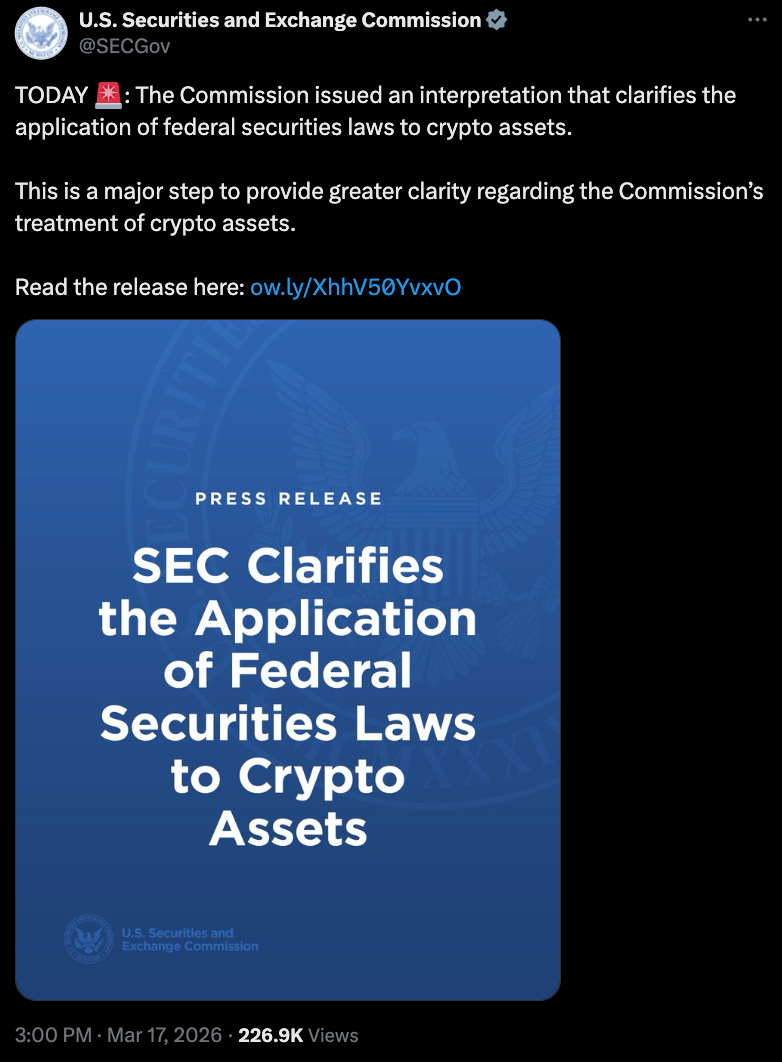
In one of its first actions since signing a memorandum of understanding with the Commodity Futures Trading Commission (CFTC), the US Securities and Exchange Commission (SEC) said it would interpret how “non-security crypto assets” fall under federal securities laws.
In a Tuesday notice, the SEC said its interpretation of how to address crypto assets would serve as an “important bridge” as lawmakers in the US Congress consider market structure legislation which will codify how financial regulators oversee digital assets.
The commission said the interpretation would provide a “coherent token taxonomy for digital commodities, digital collectibles, digital tools, stablecoins, and digital securities,” address how a “non-security crypto asset” may or may not be considered an investment contract under the SEC’s purview, and clarify federal securities laws on “airdrops, protocol mining, protocol staking, and the wrapping of a non-security crypto asset.”
“This is what regulatory agencies are supposed to do: draw clear lines in clear terms,” said SEC Chair Paul Atkins. “It also acknowledges what the former administration refused to recognize -– that most crypto assets are not themselves securities. And it reflects the reality that investment contracts can come to an end.”

According to Atkins’ prepared remarks for the DC Blockchain Summit on Tuesday, “only one crypto asset class remains subject to the securities laws” under the interpretation, and those were “traditional securities that are tokenized.” The commission called on market participants to review the interpretation to “better understand the regulatory jurisdiction between the SEC and CFTC” on cryptocurrencies.
Related: SEC, CFTC sign memo to regulate crypto, other markets in harmony
The SEC notice came as lawmakers in the US Senate continue to negotiate terms under which they may reach an agreement on a digital asset market structure bill. The legislation is expected to give the CFTC more authority in overseeing cryptocurrencies.
Shakeup in SEC enforcement leadership draws criticism
On Monday, the SEC announced that its enforcement division director, Margaret Ryan, resigned from the agency. Its principal deputy director, Sam Waldon, was named as acting enforcement director.
In response to Ryan’s departure, former SEC official John Reed Stark said “not a single person on this planet” believed the commission’s claims that the enforcement director prioritized investor protection and “renewed focus on holding individual wrongdoers accountable” at the agency.
“The SEC has abandoned its identity,” said Stark on Monday. “It has transformed from the cop on Wall Street’s beat into something far more troubling, a regulatory body that functions less like a law enforcement agency and more like a concierge service for the largest financial players in the country.”
A 19-year veteran of the regulator, Stark was founder and chief of the SEC’s Office of Internet Enforcement, according to his LinkedIn profile.
Atkins, along with SEC Commissioners Mark Uyeda and Hester Peirce — all Republicans — remain the only three leaders at the agency on a panel intended to consist of a bipartisan group of five members. As of Tuesday, US President Donald Trump had not announced any plans to nominate other commissioners to the SEC or CFTC, which had only one Senate-confirmed member.
Magazine: Clarity Act risks repeat of Europe’s mistakes, crypto lawyer warns


Institutional holders quietly added roughly 26,600 BTC to ETF positions during the recent recovery, a 2% increase in total holdings.
Bitcoin (BTC) touched $76,000 on March 17 to register its highest price level since early February, as institutional investors continued to put money into U.S. spot ETFs, extending a multi-day recovery streak coming after heavy outflows in February.
However, the rebound in demand is running into a key constraint, according to analyst Axel Adler Jr., with ETF investors still sitting on an average unrealized loss of $5,174, which he says could affect price action around the $80,000 mark.
ETF Flows Recover, But the $79,962 Realized Price Looms
In his latest market update, Adler said that spot Bitcoin ETF flows have gone through what he called a “full cycle” over the past month, going from capitulation in mid-February to a steady recovery in the last few weeks. According to him, from February 15 to 24, the seven-day average of ETF net flows stayed negative, hitting a low of about -1,883 BTC per day on February 18.
However, around February 25, the trend changed, with flows turning positive and peaking at about +3,387 BTC per day on March 2. Adler currently puts the seven-day average at around +1,472 BTC per day, with liquidity conditions also getting better. During the same period, the total number of ETF holdings rose by about 26,600 BTC, which is a little over 2%.
The analyst sees this change as a return of institutional demand after the earlier outflows. He does, however, point out that this demand is below a clearly defined level of resistance.
That level is the realized price for the ETF cohort, which Adler mapped at $79,962, an amount showing the average cost of buying an ETF for all investors. And with BTC trading just above $74,000 after earlier hitting a six-week high, it means the group still has an overall paper loss of over $5,000.
Adler described the gap as one of the most important structural features of the current market. This is because, as Bitcoin gets closer to the realized price, more investors will get closer to breaking even, which can make it more likely for them to sell. For that reason, the market technician says that the $80,000 region is a place where upward movement may slow down unless demand is strong enough to take in the potential extra supply.
You may also like:
Market to Test Resistance Condition
At the time of writing, data from CoinGecko showed BTC up over 5% in the last 7 days and the same across 30 days. However, the uptick was almost 9% over two weeks, although performance still lagged year-on-year, with the asset shedding nearly 11% from its value in that time, keeping it over 41% below its all-time high.
For now, Adler is watching the $80,000 level as the key battleground.
“A spot close above $79,962 combined with sustained ETF net inflow above +2,000 BTC per day would signal a regime change,” he wrote in his analysis.
Binance Free $600 (CryptoPotato Exclusive): Use this link to register a new account and receive $600 exclusive welcome offer on Binance (full details).
LIMITED OFFER for CryptoPotato readers at Bybit: Use this link to register and open a $500 FREE position on any coin!


South Korea’s National Police Agency has introduced new guidelines for handling seized cryptocurrencies after multiple security lapses.
Summary
- South Korea’s National Police Agency has drafted new guidelines to standardize how seized cryptocurrencies are stored and managed, including provisions for privacy-focused assets.
- The move follows a series of security lapses, including lost Bitcoin linked to custody failures.
The KNPA has drafted a directive outlining compliance requirements across multiple stages of crypto seizure, storage, and management, local media outlet Asiae reported on Tuesday.
As part of the measures, law enforcement would have to follow standardized procedures for managing wallet addresses, private keys, and software wallets, including specific provisions for handling privacy-focused assets that cannot be easily stored in hardware wallets.
“In the past, seized assets were stored in warehouses. Now we must manage wallet addresses and private keys,” a police spokesperson said in an accompanying statement.
Last month, South Korea’s finance minister Koo said the government, alongside the Financial Services Commission and the Financial Supervisory Service, would conduct a full inspection of digital assets held by public institutions and review how they are managed under enforcement processes.
Comments from the minister followed back-to-back security incidents that exposed weaknesses in custody practices across agencies.
In one case, Bitcoin seized in 2021 was lost after authorities relied on a third-party custodian without maintaining control over private keys, with the issue only coming to light following an internal probe.
Police arrested two suspects related to the theft of Bitcoin from wallets linked to seized assets, further underscoring gaps in internal controls.
A separate incident led to the Gwangju District Prosecutors’ Office losing roughly 70 billion won, about $48 million, in seized Bitcoin due to a phishing attack that exposed login credentials and enabled unauthorized transfers from a state-controlled wallet.
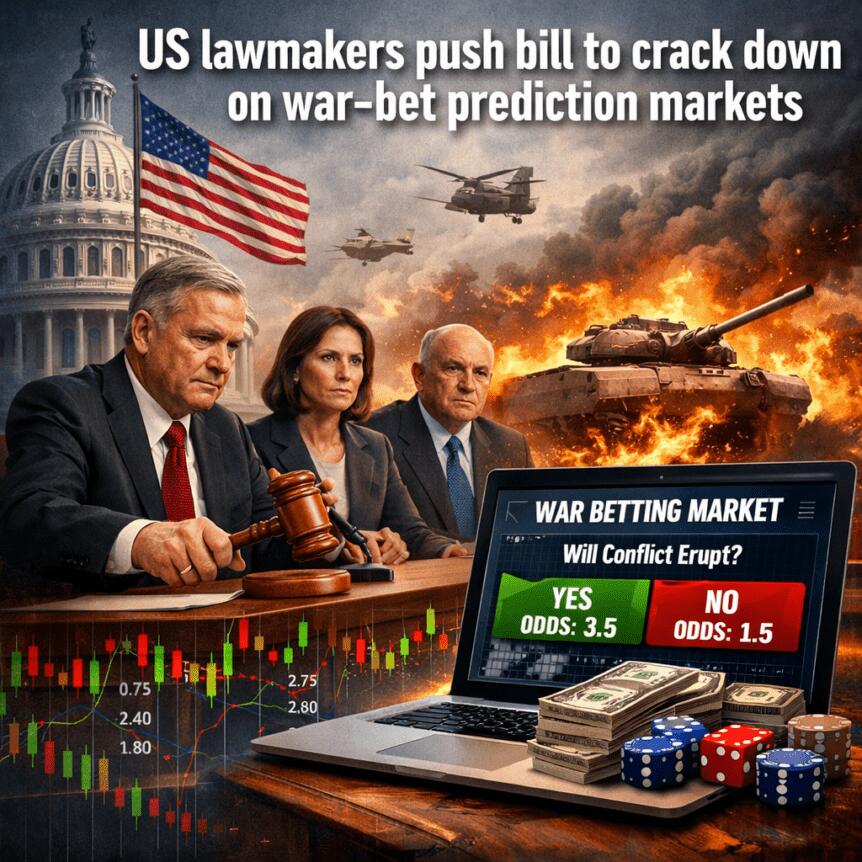
Two Democratic lawmakers in the United States have formally introduced a bill aimed at curbing what they describe as government-insider trading risk tied to prediction markets. The BETS OFF Act, unveiled in a joint effort by Representative Greg Casar of Texas and Senator Chris Murphy of Connecticut, targets platforms whose markets place bets on sensitive government actions. The move follows a spate of high-profile bets linked to potential U.S. action in the Middle East, prompting questions about the role of real-time markets in shaping or amplifying political decisions.
Key takeaways
- The BETS OFF Act was introduced by Rep. Greg Casar and Sen. Chris Murphy in response to suspicious bets on international conflict scenarios, including a possible war involving the U.S., Israel, and Iran.
- The bill seeks to prohibit event contracts tied to sensitive government decisions and federal functions, effectively narrowing the scope of markets like Polymarket and Kalshi.
- The push comes amid continued regulatory scrutiny of prediction markets, following earlier proposals such as Sen. Adam Schiff’s DEATH BETS Act targeting war, terrorism, assassination, and deaths.
- Public discourse around insider information is central: lawmakers argue decisions in the Situation Room should not be swayed by financial positions on open markets.
- Industry声音 remains mixed—Polymarket defends the value of crowd wisdom, while Kalshi limits certain military action forecasts, reflecting divergent approaches to risk and governance in prediction markets.
Market context: The debate over prediction markets sits at the intersection of financial innovation, governance, and national security. As lawmakers push for tighter controls, market operators face clarifications on what kinds of forecasts can be legally listed, while observers watch whether broader crypto-asset and derivatives markets will influence or respond to policy changes.
Why it matters
At the heart of the BETS OFF Act is a concern that insider information—or access to non-public policy deliberations—could be translated into lucrative bets on the outcomes of military or other sensitive actions. Rep. Casar framed the issue around the possibility that “someone sitting in the situation room” could be empowered by market positions in decisions of life and death. The proposed legislation would restrict event contracts tied to government operations and major federal actions, which would notably limit the kinds of bets that platforms like Polymarket and Kalshi can offer on foreign policy and national security events.
The controversy is not purely theoretical. Earlier in the year, Sen. Schiff introduced the DEATH BETS Act, which emphasizes prohibition of markets listing events connected to war, terrorism, assassination, and deaths. The parallel push from multiple offices signals a growing concern among U.S. lawmakers about how prediction markets intersect with public policy and accountability. As markets, regulators, and political actors continue to navigate these questions, the debate intensifies around whether such platforms should be allowed to operate with the same latitude as other forms of speculative markets—and what safeguards are necessary to prevent misuse.
On the platforms themselves, Polymarket has positioned its operations as a way to harness collective intelligence for better forecasting, emphasizing the value of crowd-sourced signals during volatile periods. Kalshi, by contrast, has taken a more constrained stance for certain high-stakes scenarios, choosing not to list contracts on specific military actions or other sensitive geopolitical outcomes. The tension underscores a broader governance question: can prediction markets deliver genuine societal value without creating incentives that could distort policy or provoke manipulation?
Concerns about safety and legitimacy have also resonated beyond the markets’ floors. A Times of Israel military correspondent reported receiving death threats related to coverage of the Iranian missile strike date, underscoring the real-world stakes involved when financial markets entwine with geopolitics. Such incidents amplify the call for clearer boundaries around which events can be bet on and under what conditions, particularly when coverage intersects with ongoing conflict and public safety considerations.
Why it matters
Prediction markets have long claimed to distill “wisdom of the crowd” into probabilistic forecasts on a range of topics, from elections to sporting events. The current controversy places a sharp spotlight on how such frameworks function when sensitive geopolitical actions are on the line. If lawmakers succeed in restricting certain classes of contracts, the markets’ ability to reflect near-term probabilities on foreign policy may be curtailed. That could alter how information flows in high-stakes environments and potentially shift shifts in risk pricing across related derivative markets.
For policymakers, the BETS OFF Act represents a legislative attempt to recalibrate the balance between innovation and guardrails. The bill’s proponents argue that ensuring decisions about war and peace are not influenced by betting markets is essential to preserving the integrity of national security processes. Critics, however, may contend that market-based signals can illuminate risk and improve transparency—if properly designed with safeguards. The unfolding policy discussion will likely test the resilience and adaptability of prediction-market platforms, as well as the broader ecosystem of crypto- and mainstream financial markets intertwined with these services.
What to watch next
- Prospective committee hearings and floor votes on the BETS OFF Act, including potential amendments clarifying the scope of prohibited contracts.
- Regulatory clarifications from U.S. agencies overseeing prediction markets and related financial instruments, potentially addressing enforcement mechanisms and permissible product design.
- Updates on Kalshi’s and Polymarket’s product offerings in response to any new regulatory guidance or legislative actions.
- Ongoing reporting on insider-information concerns connected to policy decisions and how such concerns may influence market design and investor protection measures.
Sources & verification
- Official statements from Representative Greg Casar and Senator Chris Murphy announcing the BETS OFF Act, and the legislative text when released.
- Public statements and policy positions from Polymarket on the role and limits of prediction markets in current events.
- Kalshi’s publicly stated market scope and its approach to sensitive geopolitical contracts, including any restrictions on military action forecasts.
- Past congressional actions and debates around prediction markets, such as the DEATH BETS Act introduced by Senator Adam Schiff.
Key figures and next steps
Market participants and policy observers will be watching how lawmakers articulate the balance between innovation and safeguards in prediction markets. The BETS OFF Act joins a broader set of questions about the accountability of platforms that monetize forecasts on sensitive events. If enacted, the legislation could reorient product design, risk controls, and the permissible scope of bets offered to the public. Until then, Polymarket and Kalshi—along with other platforms—continue to operate within the existing regulatory framework while navigating the evolving political discourse surrounding insider information, elections, and foreign policy risk.
What to watch next (summary)
- Legislative votes or committee actions on the BETS OFF Act and its potential amendments.
- Regulatory clarifications issued by relevant U.S. agencies about prediction-market operations.
- Platform policy adjustments by Polymarket and Kalshi in response to new rules or enforcement actions.
- Ongoing media reporting on insider-information concerns and related safety incidents tied to market-driven forecasts.
The popular Solana wallet can now partner with registered exchanges to offer in-app access to derivatives and event contracts without registering as a broker.
Phantom, a popular self-custodial crypto wallet, has obtained no-action relief from the Commodity Futures Trading Commission (CFTC), allowing it to connect users to derivatives trading through registered market participants without registering as an introducing broker.
The relief allows Phantom to act as a technology service vendor (TSV) to Designated Contract Markets (DCMs), registered futures commission merchants (FCMs), or introducing brokers (collectively, “Collaborators”), enabling users to access event contracts, perpetual contracts, and other CFTC-regulated derivatives through Phantom’s interface.
Phantom described the relief as “first-of-its-kind,” signaling a potential regulatory template for other crypto wallet providers looking to bridge crypto-native users into traditional financial markets. Phantom also said it proactively engaged with the CFTC to clarify how a non-custodial interface could provide access to regulated markets.
The letter imposes 10 conditions, including: providing users with risk disclosures consistent with CFTC regulations; complying with National Futures Association rules on public communications; executing joint-and-several-liability undertakings with each Collaborator; and maintaining records in line with CFTC standards. The relief remains in effect until the Commission issues formal rulemaking addressing broker registration requirements for software providers.
This article was written with the assistance of AI workflows. All our stories are curated, edited and fact-checked by a human.
Crypto World
Best Crypto Presale: DeepSnitch AI Surges 200% as Web3 Companies Go All-In on AI Technology
Messari just replaced its CEO and laid off staff to become an AI company. The crypto data firm that built its reputation on human-driven research is now opening its data layer to autonomous AI agents and repositioning entirely around artificial intelligence.
Messari spent years building the human research model before concluding AI had to replace it. DeepSnitch AI started there. Five live AI agents running today, and a TGE confirmed for March 31st on Uniswap.
While Messari restructures its entire company to catch up to where AI-native crypto intelligence is heading, DSNT is already operating inside that future, and the best crypto presale opportunity closes in weeks.

Messari pivots to an AI-first strategy
Messari has announced layoffs alongside a leadership transition, with founder-era CEO Eric Turner stepping down in favor of longtime CTO Diran Li, who is repositioning the crypto data firm as an “AI-first company serving institutions through research and AI products.”
The restructuring follows previous workforce reductions in 2023 and 2025, suggesting ongoing pressure on crypto-native data businesses to find sustainable revenue models.
Messari’s transformation reflects a broader industry pattern: crypto-native companies are increasingly reorienting around AI as the primary growth vector. As institutional demand shifts toward AI-powered research and autonomous agent infrastructure, the line between crypto data providers and AI companies is rapidly dissolving.
Top 3 best crypto presales to buy in 2026
DeepSnitch AI
Messari just concluded that human-driven crypto research can’t compete with AI-native intelligence, and restructured its entire company around that conclusion. DeepSnitch AI reached the same conclusion before writing a single line of fundraising copy and built the product first.
That sequencing matters. Messari is now racing to open its data layer to autonomous agents. DeepSnitch AI’s five AI agents have been running continuously since before this presale launched.
The same institutional demand that forced Messari’s restructuring is the demand DeepSnitch AI was designed to serve at the retail level: real-time, AI-driven market intelligence that doesn’t require a research team or a Bloomberg terminal to access.
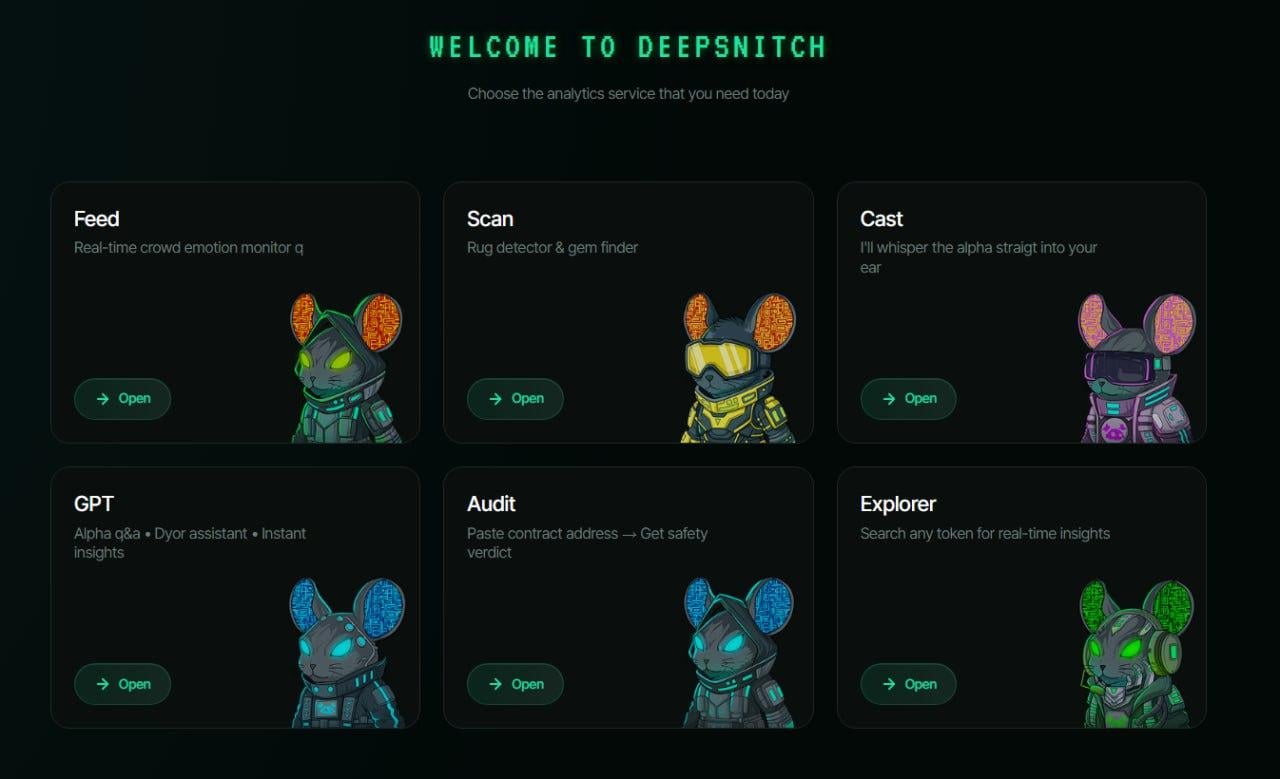
The market has already started pricing that in, naming DeepSnitch AI the best crypto presale of 2026.
$2.2M raised during a bear market, the same conditions Messari called difficult enough to justify layoffs. That capital arrived because investors looked at a working platform and made a deliberate call about where AI-native crypto intelligence is heading.
The March 31st TGE is the fixed point that everything converges on. After the presale closes, a 7-day claim period opens for tokens, presale bonuses, and staking rewards.
Messari took years to conclude that AI had to replace its old model. The market won’t wait that long to reprice a live AI-native trading platform hitting public markets for the first time. At $0.04487, that repricing hasn’t happened yet for DeepSnitch AI.
Based Eggman
Based Eggman (GGs) sold out two presale stages and raised over $311,000. Built on Base, the project accesses low fees and institutional ecosystem credibility that meme coins on congested networks can’t match.
The token combines play-to-earn gaming and community events in one ecosystem. Multiple demand drivers give holders real reasons to hold beyond listing day. That’s more ambitious than the single-feature offerings crowding this space.
The ambition is also the risk. Building gaming, streaming, and social infrastructure simultaneously at the presale stage is complex. Projects that spread across too many verticals early tend to underdeliver across all of them.
Pepeto
Pepeto raised over $8M, building dedicated infrastructure for the meme coin ecosystem. Dual audits from SolidProof and Coinsult add security credibility that most projects at this stage skip.
The differentiation challenge is real. DEX functionality, bridging, and staking have become baseline expectations, not advantages. The crowded field moved while Pepeto was building.
The broader headwind compounds it. Investors rotate toward utility-focused and TradFi-adjacent projects. Building infrastructure for a contracting market segment creates structural demand risk that community enthusiasm alone doesn’t solve.
Closing thoughts
Messari fired staff to become an AI company. The writing is on the wall: manual crypto research is ending, and AI-native intelligence is taking over. DeepSnitch AI was already there, which is why it is considered the best crypto presale of this year. Live tools, $2.2M raised, 200% presale gains, and a March 31st Uniswap launch confirmed.
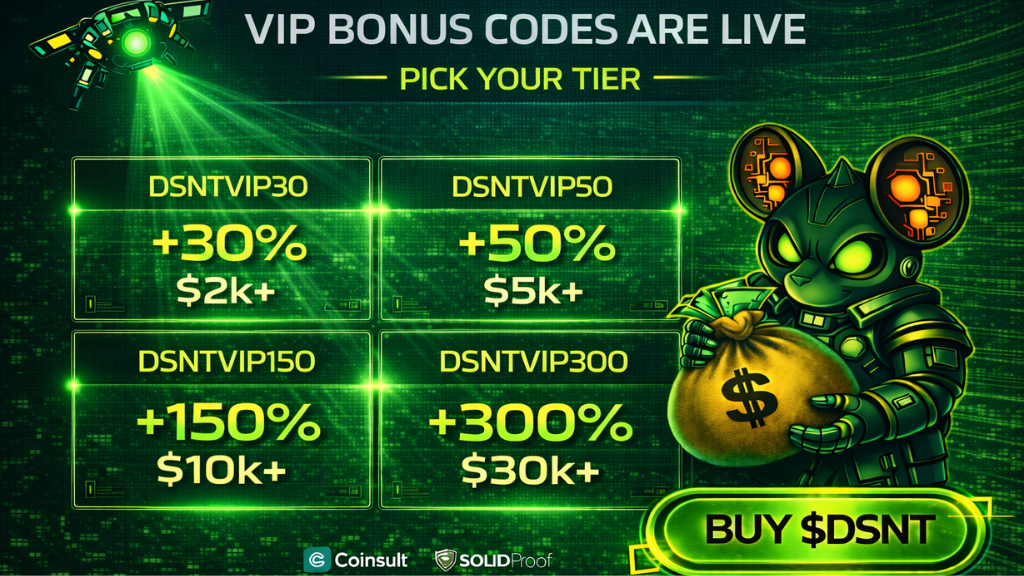
DSNT delivers a working AI intelligence layer at the exact moment Messari’s restructuring confirms that’s where the industry is heading. A $10,000 position with the DSNTVIP150 code adds a 150% token bonus before the first listing candle prints.
Visit the official website for more information, and join X and Telegram for community updates.
FAQs
Which crypto presale coins offer the strongest early investor opportunities as AI reshapes the market?
The best crypto presales right now are DeepSnitch AI, Ozak AI, and Pepeto. DSNT leads with $2.2M raised, five live AI agents, and a confirmed March 31st Uniswap launch with 1,000x return potential backed by a working product.
What makes DeepSnitch AI one of the best early investor crypto deals heading into Q2 2026?
DeepSnitch AI stands out among early investor crypto deals because the product is already live. The protocol has five AI agents running daily, 200% presale gains, and a hard March 31st deadline before Uniswap listing and major CEX additions could follow shortly after.
How do token presale opportunities like Ozak AI and Pepeto compare to DeepSnitch AI right now?
Among current token presale opportunities, Ozak AI raised $6.4M with promising analytics tools, and Pepeto raised $7.8M with meme infrastructure, but DeepSnitch AI’s confirmed launch date and AI-first positioning make it the strongest complete opportunity available before Q2.
The post Best Crypto Presale: DeepSnitch AI Surges 200% as Web3 Companies Go All-In on AI Technology appeared first on Blockonomi.

4 Dead, Including Child, in Fast-Moving Queens Apartment Fire

Argentina Blocks Polymarket as Crackdown on Prediction Markets Expands

‘Shocking’ ruling strips Senegal of AFCON title, declares Morocco winner


-
 Tech7 days ago
A 1,300-Pound NASA Spacecraft To Re-Enter Earth’s Atmosphere
-
 Crypto World4 days ago
HYPE Token Enters Net Deflation as HyperCore Buybacks Outpace Staking Rewards
-

 Fashion4 days ago
Weekend Open Thread: Addict Lip Glow
-

 Tech2 days ago
Your Legally Registered ‘Motorcycle’ Might Not Count Under Proposed US Law
-
Sports3 days ago
Why Duke and Michigan Are Dead Even Entering Selection Sunday
-

 NewsBeat6 days ago
Residents reaction as Shildon murder probe enters second day
-

 Business2 days ago
Search for Savannah Guthrie’s Mother Enters Seventh Week with No Arrests
-

 Business7 days ago
Search Enters Sixth Week With New Leads in Tucson Abduction Case
-

 Sports6 days ago
PWHL, Senators discussing plan to keep Charge in Ottawa
-

 Business3 days ago
US Airports Launch Donation Drives for Unpaid TSA Workers as Partial Government Shutdown Enters Fifth Week
-
 Tech6 hours ago
Are Split Spacebars the Next Big Gaming Keyboard Trend?
-
Crypto World3 days ago
Coinbase and Bybit in Investment Talks: Could Bybit Finally Enter the US Crypto Market?
-

 NewsBeat6 days ago
I Entered The Manosphere. Nothing Could Prepare Me For What I Found.
-

 Business3 days ago
Country star Brantley Gilbert enters growing non-alcoholic beer market
-

 Business2 days ago
Australian shares drop as Iran war enters third week
-

 Sports4 days ago
College Basketball Best Bets: Conference Tournament Semifinal Picks
-

 Crypto World2 days ago
Crypto Lender BlockFills Enters Chapter 11 with Up to $500M in Liabilities
-

 Politics7 days ago
Trump Says Middle East Is ‘Very Lucky’ That He’s President
-

 Crypto World6 days ago
Three Binance Charts May Be Hinting at Bitcoin’s Next Move
-

 Business5 days ago
Trump demands Powell cut rates as Iran conflict raises energy prices


You must be logged in to post a comment Login