
Crypto World
TAO hits four-month high as Bittensor halving draws more eyes now

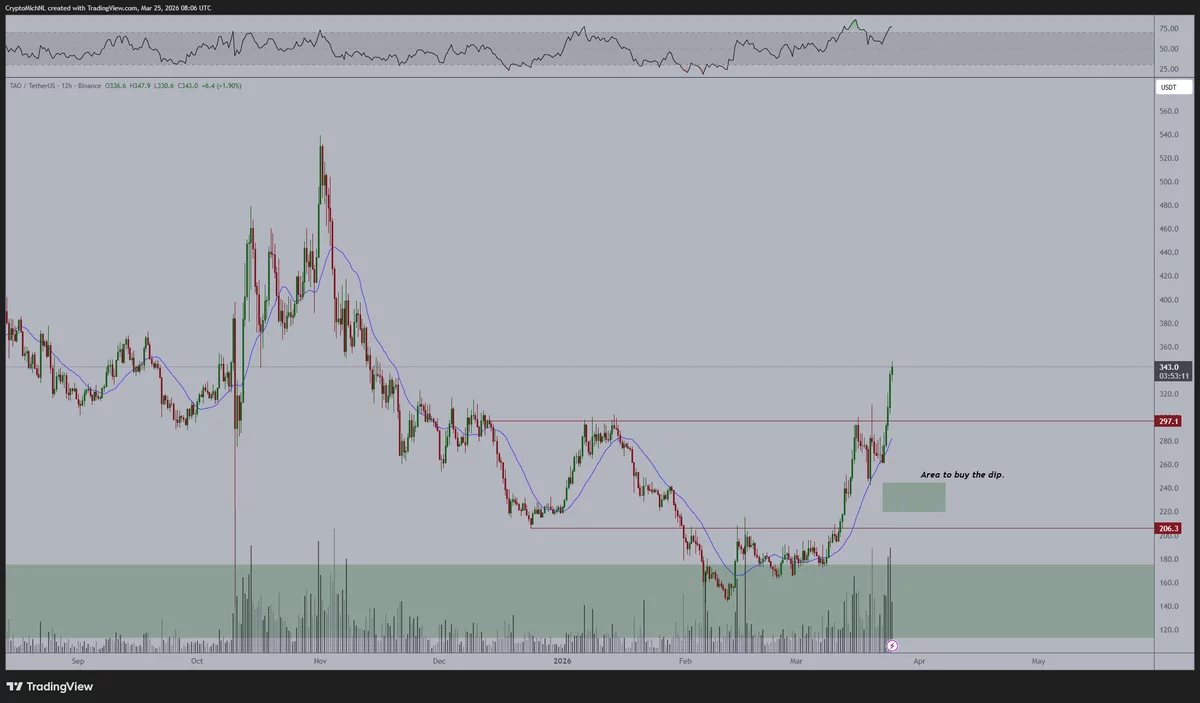
Bittensor’s native token TAO (TAO) moved higher on March 25 as traders tracked rising subnet activity, fresh staking data, and the network’s first halving event.
Summary
- AO rose to $350 as traders tracked subnet growth, halving effects, and stronger market activity.
- TAO staked across Bittensor subnets jumped past $620 million as the ecosystem expanded over months.
- Only part of TAO sits in subnets, leaving room for more rotation from Root staking.
Consequently, the token traded at $350 at press time, with a 24-hour trading volume of $887.8 million, a daily gain of 12%, and a seven-day increase of 25%.
The move came as Bittensor’s subnet ecosystem posted rapid growth over the past year. Market participants also watched new comments from analysts and ecosystem figures as TAO reached its highest level since November 2025.
Moreover, Bittensor held a market capitalization of $3.35 billion, based on a circulating supply of 9.6 million TAO. The token ranked among the better-performing digital assets in the top 100 by market value over the past 24 hours.
Recent gains followed a broader move that started earlier in March. TAO had already moved above $300 after Nvidia CEO Jensen Huang referred to the Covenant-72B model during an appearance on the All-In Podcast, while market data also pointed to buying pressure and a short squeeze during the run-up.
CryptoRank data showed that the total TAO staked across subnets rose from about $74,400 to more than $620 million over the past 12 months. The increase came as more users moved into subnet participation, which plays a central role in Bittensor’s decentralized AI network.
Network activity also grew through the number of subnets. The count rose from about 80 to more than 120 over the same period, while several subnet projects posted monthly gains, including Templar at 171%, Quasar at 146%, NOVA at 66%, Targon at 36%, and iota at 29%.
Most TAO still sits outside subnets
Despite the rise in subnet staking, a large share of TAO remains outside subnet allocations. Mark Jeffrey, partner at Bittensor Fund and Stillcore Capital, said only 19% of TAO is staked in subnets, while about 48% remains in Root. He said,
“Once the first subnet zooms to $1B+, I expect Root stakers will start rushing into Subnets. Even if NO NEW TAO is bought, Subnets could 3x or 4x just because of that alone.”
His comment pointed to the scale of capital that could rotate within the ecosystem without fresh buying.
In addition, CoinGecko said TAO gains came after the network completed its first halving event, which cut token emissions by half. The reduced issuance added a new catalyst as traders assessed supply dynamics alongside ecosystem growth.
Crypto analyst Michaël van de Poppe also commented on the move. He wrote,
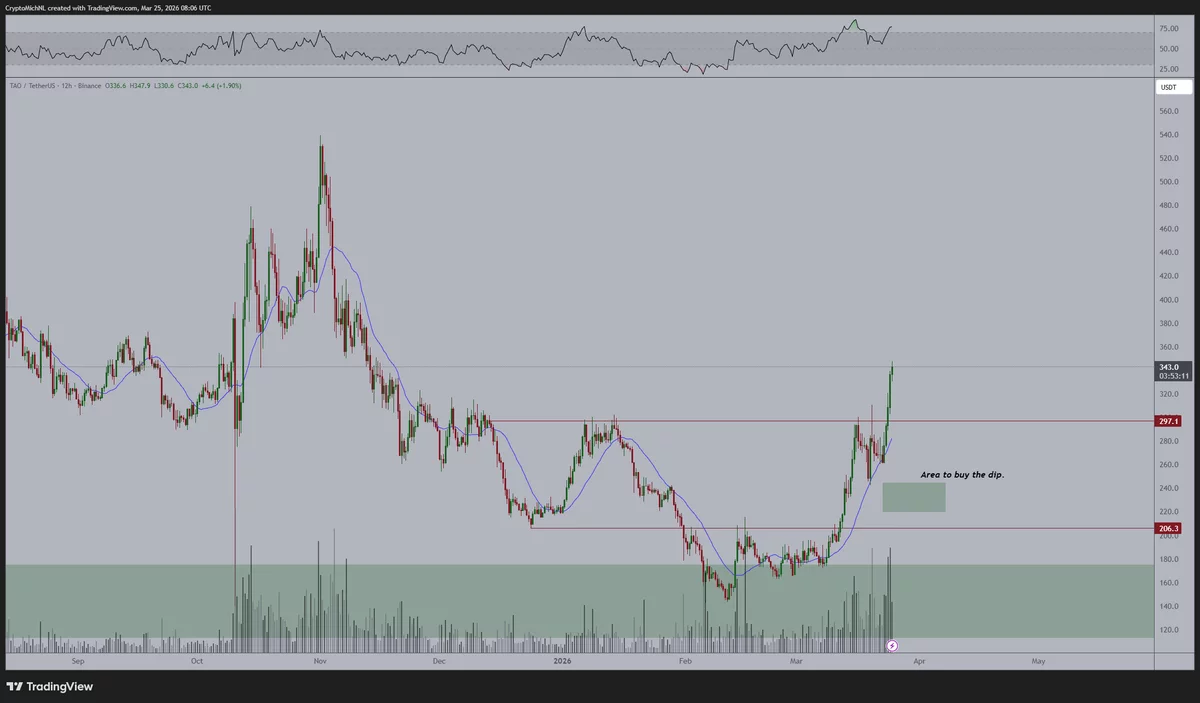
“What an absolutely wonderful morning with the strength of $TAO. Again; it’s in a new bull run, higher lows, higher highs. Next area of resistance: $500.”
Disclosure: This article does not represent investment advice. The content and materials featured on this page are for educational purposes only.


Key Takeaways
- Memory chip stocks tumbled approximately 10% in recent weeks, with Micron and Sandisk each declining more than 10% following Google’s TurboQuant announcement
- Google’s new TurboQuant technology promises to cut AI memory requirements by a factor of six, triggering investor anxiety
- Morgan Stanley characterizes the recent decline as a constructive correction rather than a fundamental concern
- Memory capacity has emerged as the primary constraint for AI infrastructure expansion, surpassing GPU availability
- Morgan Stanley maintains Overweight recommendations on both Micron and Sandisk with $520 and $690 price objectives
Morgan Stanley continues to back memory semiconductor manufacturers following a significant market downturn that shook investor confidence in late March.
The iShares Semiconductor ETF experienced approximately a 10% decline during the past month. Multiple factors contributed to the downturn, including valuation concerns, questions about demand sustainability, and emerging AI innovations.
On March 24, Google introduced a novel compression technology dubbed TurboQuant. The innovation reportedly slashes memory requirements for operating AI models by as much as six times. The announcement triggered widespread investor unease.
Both Micron and Sandisk experienced declines exceeding 10% in the immediate aftermath of the disclosure. Micron finished trading at $357 on March 27, though the stock maintained a 25% gain for the year-to-date period.
Morgan Stanley’s Joseph Moore challenged the negative sentiment in a research communication distributed on March 26.
Moore reaffirmed Overweight recommendations for both Micron and Sandisk. The firm’s price objectives remain unchanged at $520 and $690, respectively.
According to Moore, the selloff represents “a healthy pricing in of durability concerns” instead of indicating a fundamental transformation in market dynamics. The financial institution contends that memory manufacturers’ business strength is “more durable than the market thinks.”
Memory Capacity Emerges as Primary AI Infrastructure Constraint
Throughout the previous two years, Nvidia’s graphics processing units dominated conversations as the critical component driving AI infrastructure investments. While this remains accurate, Morgan Stanley argues that memory has evolved into the primary limiting element.
“Memory is a bottleneck, increasingly the bottleneck, to AI builds,” the research team stated. They observed that clients are now making advance payments for substantial volume commitments, indicating how constrained supply has become.
According to Moore, DRAM excess capacity has been completely absorbed. “Everywhere we look we see indications that it is a true bottleneck,” he noted.
AI’s portion of semiconductor expenditure could reach “well north of 50%,” according to the bank’s analysis. Increasing supply appears unlikely to match that intensity of demand.
Morgan Stanley’s Assessment of TurboQuant’s Impact
Morgan Stanley specifically analyzed Google’s TurboQuant announcement, arguing that market participants misinterpreted its implications.
The compression technology exclusively targets KV Cache memory, not total memory consumption. “They are just talking about KV Cache memory, not memory overall,” the firm clarified.
KV Cache typically resides in high-bandwidth memory, which represents a specialized and constrained category. Morgan Stanley characterized TurboQuant as “normal course productivity improvement,” rather than a demand-destructive breakthrough.
The investment bank doesn’t anticipate gross margins approaching 81% to persist indefinitely. However, it identifies minimal justification for near-term margin compression.
Morgan Stanley additionally highlighted robust prospects for free cash flow production from memory sector companies. The firm determined that “duration is all that matters,” and by that standard, market signals “all appear positive.”
Micron and Sandisk retained their Overweight designations as of March 26, 2026.



A new report about possible US ground action in Iran has added fresh tension to global markets.
Summary
- Washington Post said planners reviewed Iran ground raid options while Bitcoin held near $66,500 Sunday.
- Bitcoin stayed flat through Sunday trading as investors waited for traditional markets to reopen overnight.
- Officials kept diplomacy in focus even as reports outlined possible raids near Iran’s Kharg Island.
Bitcoin stayed near $66,500 on Sunday, but traders are watching whether broader risk assets react more sharply when US markets reopen.
The Washington Post reported that the Pentagon is preparing options for ground operations in Iran that could last for weeks. The planning includes Special Operations forces and conventional infantry, though it remains unclear whether President Donald Trump would approve that step.
The reported options include moves against Kharg Island and other coastal targets near the Strait of Hormuz. The report described the planning as limited raids rather than a full invasion, with US officials weighing how far to push military pressure while the war enters its fifth week.
Even with those reports, public statements from top officials still point to a diplomatic track. On March 26 that Secretary of State Marco Rubio said the war should last “weeks, not months” and that the United States could meet its goals without ground troops, even as contingency plans stay in place.
At the same time, regional diplomacy has not ended. The Associated Press reported that mediators gathered in Pakistan for talks aimed at ending the monthlong war, even as fighting continued and both sides kept pressure on key energy and security routes.
Bitcoin holds steady as traders wait for market reaction
Bitcoin showed a muted reaction over the weekend. It traded at about $66,561 on Sunday, with a narrow intraday range, after earlier war-related swings pushed the asset below $69,000 during the past week.
That price action fits a recent pattern. Earlier this month crypto markets sold off when conflict headlines intensified, while other reports this week showed Bitcoin losing ground as risk appetite weakened.
Key Takeaways
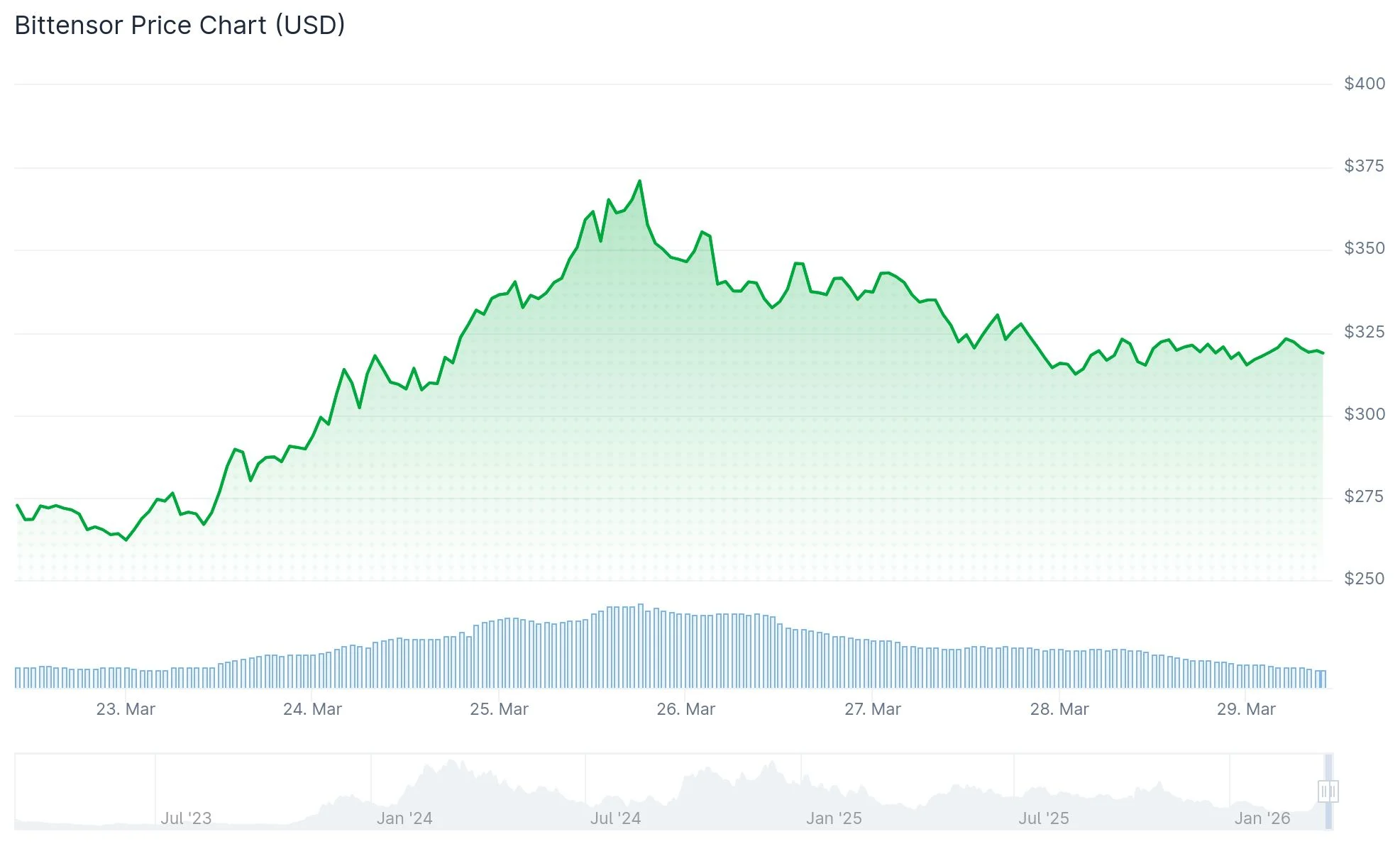
- Bittensor (TAO) surged more than 160% from $144 to $375 following a TD Sequential buy signal confirmation.
- The TD Sequential has now triggered a sell signal on the 3-day chart, suggesting potential trend exhaustion.
- TAO currently trades at $322.33, confronting critical resistance levels at $322.33 and $358.34.
- The RSI indicator registers 55.86, indicating moderate bullish momentum, while MACD stays beneath its signal line.
- Critical support exists around $300, with a potential decline targeting the $260–$280 range if broken.
Bittensor (TAO) has delivered an impressive performance recently. The cryptocurrency surged over 160% from its $144 low to reach $375 after the TD Sequential indicator confirmed a buy opportunity. However, this same technical tool is now displaying a sell signal, capturing the attention of market participants anticipating a possible correction.
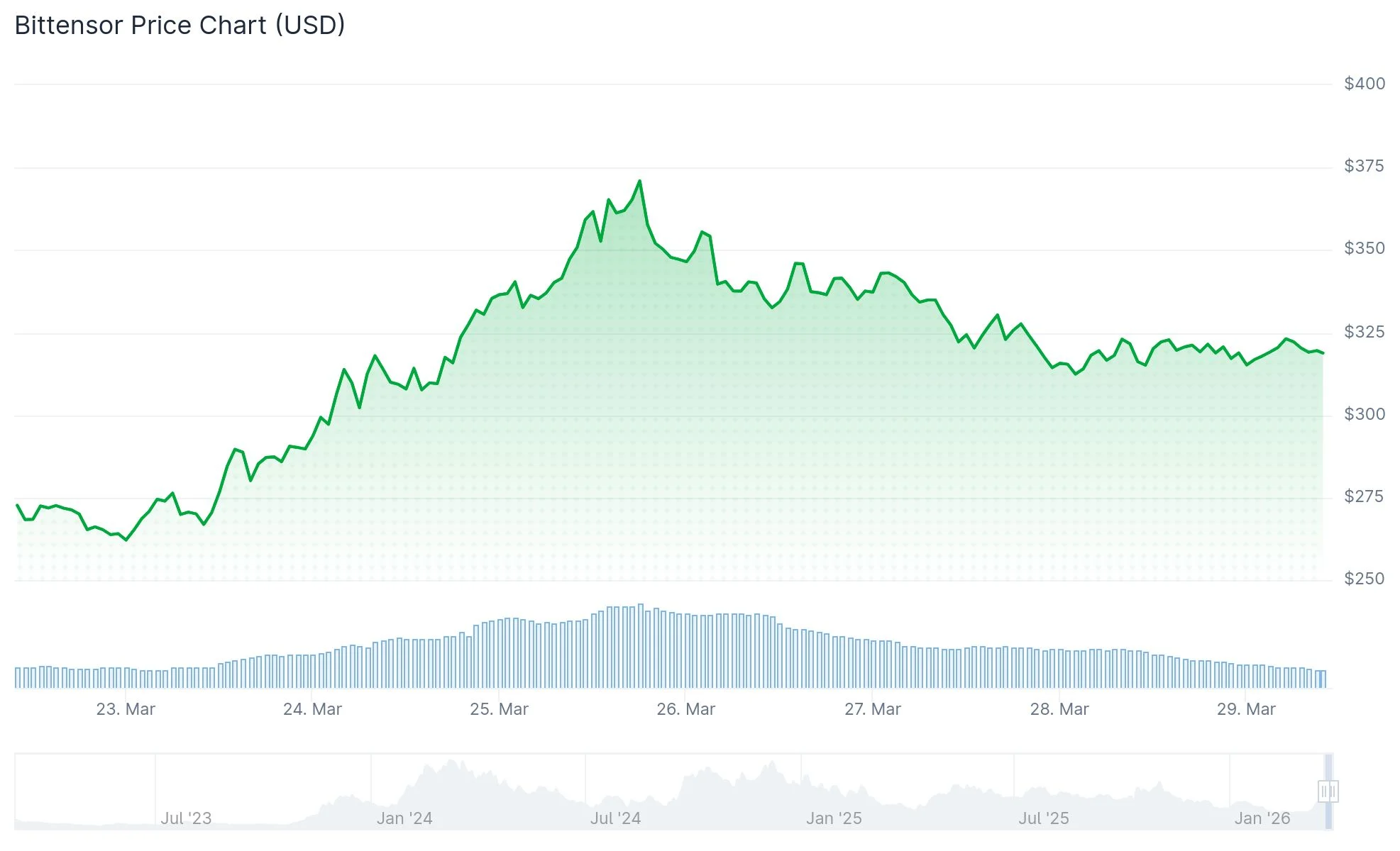
Currently, TAO is valued at $322.33. Trading volume over the past 24 hours reached $1.19 billion, while the market capitalization stands at $3.47 billion. The token registered a modest gain of 0.39% during the last trading day.
On March 28, 2026, cryptocurrency analyst Ali Martinez shared insights via X, emphasizing how the TD Sequential indicator accurately forecasted the buy opportunity ahead of TAO’s significant upward movement. Martinez observed that this identical indicator has now generated a sell signal, implying that traders might want to consider securing profits in the near term.
Understanding the TD Sequential Sell Signal
The TD Sequential represents a popular technical analysis instrument designed to spot potential trend reversal points. This indicator successfully identified the entry opportunity preceding TAO’s 160% advance. Currently, on the 3-day timeframe, it has switched to a sell configuration.
This development doesn’t necessarily mean an instant price decline is imminent. Nevertheless, following such a substantial upward move, the signal modifies the risk-reward equation. Early investors typically engage in profit-taking activities when these signals emerge.
TAO is presently positioned exactly at the $322.33 resistance threshold. An additional significant level exists at $358.34 on the MA Ribbon. The cryptocurrency successfully broke above its short-term moving average at $244.18, which provided momentum for the rally.
The RSI currently stands at 55.86, reflecting strengthening momentum without entering overbought territory. The MACD shows a reading of 12.26 but remains underneath its signal line at -22.87. The MACD histogram registers -35.13, indicating momentum is shifting toward positive territory though definitive confirmation remains absent.
Critical Support and Resistance Zones
Should TAO fail to penetrate $358.34 and maintain levels above $380, bearish pressure may intensify. The initial crucial support zone lies near $300, a level with significant psychological importance. A breakdown beneath this threshold could drive prices toward the $260–$280 region, where substantial buying activity previously occurred.
For those with bullish positions, a decisive breakthrough above $380 accompanied by robust volume would indicate continuation of the uptrend. In the absence of such movement, current price behavior appears more characteristic of consolidation or potential distribution.
Several market analysts have highlighted TAO’s capped supply of 21 million tokens and its integration with decentralized AI infrastructure as catalysts for sustained long-term interest. The appetite for AI-focused blockchain initiatives has been expanding.
TAO presently maintains its position above short-term moving average support levels, with resistance at $322.33 and $358.34 serving as focal points as market participants monitor for the next directional shift.


Kalshi is facing a new legal challenge after Washington state sued the prediction market operator over its event-based contracts.
Summary
- Washington sued Kalshi, alleging its contracts broke gambling and consumer protection laws in the state.
- Kalshi moved the Washington case to federal court and said the state gave no warning.
- Nevada and Arizona also challenged Kalshi as pressure on prediction markets grew across several states.
The case adds to a growing list of state actions against the company as regulators question whether its products amount to unlicensed gambling.
Washington Attorney General Nick Brown filed the complaint on Friday, alleging that Kalshi violated state gambling rules through its website and app. The state said the platform offered consumers a way to place money on future events and receive payouts based on outcomes.
The complaint said Kalshi breached the Washington Consumer Protection Act, the Gambling Act, and the Recovery of Money Lost at Gambling Act. State officials pointed to Washington’s ban on online gambling and its tight control of the gaming market as the basis for the lawsuit.
Brown’s office said Kalshi’s platform worked like a sportsbook. In its statement, the office said,
”Kalshi’s website and app show consumers a range of events that they can bet on and the odds for those various events, which dictate how much the bettor will be paid out if the event occurs.”
Washington said the company’s products fall under the state’s definition of gambling. Under state law, gambling includes risking something of value on the outcome of a contest of chance or a future contingent event.
The attorney general’s office said each Kalshi contract involved money, chance, and a payout to winners. It also argued that calling the service a prediction market did not change how the products function under state law. The complaint said Kalshi let users ”bet on anything” while avoiding the gambling label.
Kalshi moved quickly to shift the case to federal court. In its filing, the company said the issues raised in Washington were already being fought in other federal courts and that there had been ”no warning or dialogue” from the state before the lawsuit.
Legal pressure grows across several US states
The Washington case follows other recent legal setbacks for Kalshi. Earlier this month, a Nevada judge temporarily blocked the company from operating in the state after finding that regulators were likely to succeed in their case.
Arizona also moved against the company days earlier. Attorney General Kris Mayes announced charges, alleging that Kalshi ran an illegal gambling business in the state without a license and offered illegal election wagering.
Kalshi has argued that the US Commodity Futures Trading Commission has exclusive authority over its event contracts. Even so, state regulators and lawmakers continue to challenge the platform as scrutiny around prediction markets grows across the United States.


BNP Paribas is widening its digital asset offering in France by adding six crypto-linked exchange-traded notes for retail investors.
Summary
- BNP Paribas will launch six Bitcoin and Ether ETNs for clients in France on Monday.
- Clients can access crypto price exposure through securities accounts without buying or storing Bitcoin directly.
- The launch extends BNP Paribas’ digital asset push after tokenized fund and blockchain bond activity.
Meanwhile, the move gives clients access to Bitcoin and Ether through regulated market products without requiring direct crypto custody. The launch also adds to the bank’s wider blockchain and tokenization activity across Europe.
BNP Paribas will offer six crypto-linked ETNs to retail clients in France from Monday through standard securities accounts. The products track the price of Bitcoin and Ether and will be available to individual investors, entrepreneurs, private banking clients, and users of Hello bank!.
The bank may later extend access to wealth management clients outside France. This step places BNP Paribas among the large European banks expanding digital asset exposure through listed and regulated investment products rather than direct token trading.
The ETNs allow investors to follow the performance of Bitcoin and Ether without buying or storing the assets directly. This structure removes the need for private wallets or direct handling of crypto holdings through an exchange.
At the same time, the products carry credit risk because the investment depends on the issuer’s ability to meet its obligations. The offering gives clients a regulated route into crypto-linked exposure while keeping the investment within a traditional securities account framework.
In addition, the new offering follows BNP Paribas’ broader work in digital finance. In 2024, the bank arranged and placed Slovenia’s first digital sovereign bond, which marked the European Union’s first blockchain-based government bond issuance.
The bank has also expanded its role in institutional blockchain networks. In September last year, BNP Paribas and HSBC joined the Canton Foundation, which oversees the Canton Network, a blockchain system built for institutional finance and tokenized real-world assets.
European market shows wider crypto ETN growth
BNP Paribas’ move comes as more European institutions add crypto-linked products to their investment platforms. ING Germany recently expanded its range with crypto ETNs from Bitwise and VanEck, showing continued demand for listed digital asset exposure.
The market has also reopened in the United Kingdom. Crypto ETNs returned to UK retail trading in October 2025 after the Financial Conduct Authority reversed its earlier ban.
BNP Paribas’ launch adds France to that broader regional trend as banks test regulated crypto access through existing investment channels.

Gold price might just get a big push from Singapore, and the analysis for the metal is getting bullish. Singapore is making a calculated push to become the Asia-Pacific’s dominant gold trading hub, and the institutional machinery backing that move is significant.
The Monetary Authority of Singapore announced on March 27, 2026, that it would build out a full gold ecosystem, covering physical vaulting, capital market products, OTC clearing, and central bank storage services. Gold price has held elevated as institutional demand accelerates.
Singapore is planning to expand its gold storage capacity, positioning itself as a key custodian of bullion for foreign central banks. — Gold Telegraph
It’s also developing “gold-related capital market products to promote price discovery and build liquidity”
Big news…
 (@GoldTelegraph_) March 27, 2026
MAS Deputy Chairman Chee Hong Tat confirmed the initiative alongside the Singapore Bullion Market Association, framing it explicitly as a new pillar for Singapore’s wealth management sector.
“What we’re doing is to create an ecosystem that enables gold trading activities based out of Singapore,” Chee said, describing the effort as “planting trees in an ecosystem.”
The working group, formed in January 2026, includes heavyweights DBS, JPMorgan, UBS, UOB, ICBC Standard Bank, SGX, and the World Gold Council. The LionGlobal Singapore Physical Gold ETF debuted on SGX just one day prior, on March 26, offering fractional exposure in both SGD and USD through vault operators Brink’s, Loomis, and Malca-Amit.
The convergence of sovereign-level institutional infrastructure and a brand-new ETF launch positions Singapore’s gold market at an inflection point, one that increasingly intersects with blockchain-based settlement and tokenized real-world asset infrastructure.
Discover: The best pre-launch token sales
Gold Price Analysis: Can Singapore’s Gold Push Sustain Bullion’s Institutional Bid?
Gold’s macro setup remains structurally bullish. Central bank accumulation, persistent dollar uncertainty, and now Singapore’s formal vaulting ambitions for foreign sovereign entities are layering new demand floors beneath spot prices.
The MAS initiative targets four pillars: physical infrastructure for storage and transport, gold-related capital market products for price discovery, a clearing and settlement system for large bars (12.4kg, the London standard) and kilobars (1kg, the Asian standard), and vaulting services for foreign central banks potentially held within MAS’s own vault.
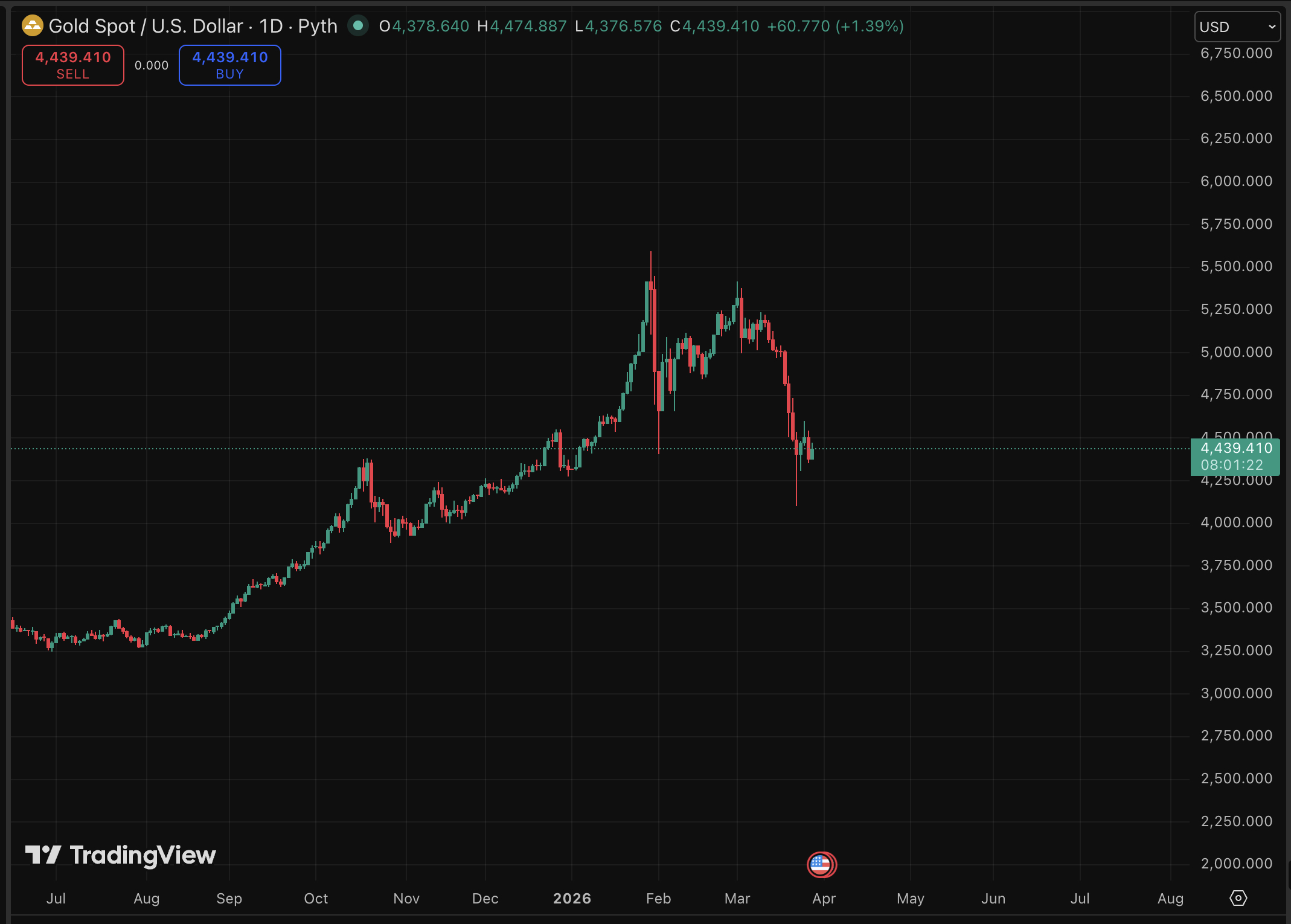
That last point deserves attention. Sovereign vaulting demand doesn’t fluctuate with retail sentiment, it anchors long-term institutional positioning. Industry analysts note Singapore is now positioning directly alongside Dubai, Shanghai, and Hong Kong as a primary Asian bullion hub. Job creation across vaulting, trading, and analysis is expected as the ecosystem matures through 2026.
Gold price is falling right now, but Singapore might push it higher than the previous highs.
Discover: The best crypto to diversify your portfolio with
LiquidChain Targets Early Mover Upside as Gold’s Digital Infrastructure Layer Heats Up
Singapore’s gold push isn’t happening in isolation. The settlement infrastructure, clearing systems, and capital market products Chee described all point toward the same destination: programmable, verifiable asset settlement on-chain.
Institutional blockchain infrastructure is already moving in this direction, and tokenized real-world asset protocols are scaling fast. Spot gold, at current elevated prices, offers limited asymmetric upside for late-stage entries; the structural gains increasingly accrue at the infrastructure layer underneath it.
That’s the thesis behind LiquidChain ($LIQUID), an L3 infrastructure project currently in presale at $0.01435, with over $600K raised to date. LiquidChain fuses Bitcoin, Ethereum, and Solana liquidity into a single execution environment. Its Unified Liquidity Layer enables Single-Step Execution across all three ecosystems without bridging friction. Developers deploy once and access all.
A new layer emerges. Only a few see it first. — LiquidChain (@getliquidchain) March 24, 2026
The future is LiquidChain  ⟁https://t.co/vqvBcdSj94 pic.twitter.com/R7ZeZ0NPGl
Verifiable Settlement in Liquid Chain bakes auditability directly into the execution layer. As cross-chain interoperability becomes the backbone of institutional DeFi, early-stage L3 infrastructure plays carry the kind of asymmetric upside that spot gold simply can’t match at this market cap.
Research LiquidChain’s presale terms here.
This article is for informational purposes only and does not constitute financial advice. Crypto assets are highly volatile. Always conduct your own research before investing.
The post Gold Price Analysis: Singapore To Tap Gold Ecosystem appeared first on Cryptonews.

Key Takeaways
- Dogecoin currently hovers around $0.09106, residing in what historical cycles indicate as a prolonged consolidation period.
- Technical analysis from Bitcoinsensus reveals Cycle 3 displaying structural similarities to Cycles 1 and 2, which delivered returns of 5,800% and 21,000% respectively.
- Progressive higher lows characterize each DOGE cycle — Cycle 1 bottomed around $0.000020, Cycle 2 near $0.00070, and Cycle 3 maintaining support above $0.09.
- Trader sentiment on Binance leans bullish, with long-to-short ratios climbing across both account counts and trading volume.
- ETF activity shows no momentum, maintaining zero daily net inflow while total net assets hover near $9.12 million without institutional participation.
Dogecoin (DOGE) currently changes hands at approximately $0.09106. The popular meme cryptocurrency has captured renewed interest following a technical analysis shared by crypto analyst Bitcoinsensus, which examines three distinct DOGE market cycles in parallel.
The first cycle delivered explosive returns exceeding 5,800%. The second cycle surpassed expectations with staggering gains topping 21,000%. Both cycles exhibited identical structural characteristics: gradual accumulation, explosive upward momentum, followed by substantial retracement. The current Cycle 3 demonstrates striking similarities to this established framework.
DOGE achieved a cycle high approaching $0.70 before entering a correction phase. The asset has subsequently declined and currently finds equilibrium within the $0.09 to $0.10 trading corridor.
$DOGE Macro Cycles Overview 📈🔥#Dogecoin has historically followed repeating cycle patterns, often tracking alongside #Bitcoin
This current cycle seems a bit more prolonged compared to previous ones 🚀
While no outcome is guaranteed, this chart provides a possible roadmap… pic.twitter.com/7TOehiVyQq
— Bitcoinsensus (@Bitcoinsensus) March 27, 2026
A notable consistency spanning all three cycles involves progressively higher cyclical lows. The first cycle established its base near $0.000020. The second cycle formed support around $0.00070. The third cycle has successfully defended levels above $0.09 throughout its current retracement.
This ascending low structure indicates buyer conviction intensifying at progressively higher valuations with each successive cycle. The pattern demonstrates Dogecoin attracting an expanding participant base across time.
Binance Trading Activity Reveals Bullish Sentiment
Recent Binance metrics reveal a notable shift in trader positioning. The long-to-short ratio among experienced traders has expanded, evident in both participant count and capital allocation. This development indicates increasing numbers of traders establishing long positions on DOGE appreciation, with many expanding position sizes rather than reducing exposure.
Binance Top Trader’s $XRP long positions are increasing.
Long and short positions were similar, but now long positions are shifting to the upper hand. pic.twitter.com/kr5bNlEyHC
— CW (@CW8900) March 25, 2026
Such positioning typically reflects strengthening market conviction, though it simultaneously creates conditions for crowded trades. When trader sentiment becomes excessively one-directional, brief corrections frequently emerge.
Nevertheless, current positioning data confirms active accumulation at prevailing price levels, representing deliberate strategy rather than reactive trading to existing price movement.
Technical Indicators Suggest Market Coiling for Breakout
Examining technical metrics, the RSI registers near 42 — occupying neutral territory between overbought and oversold conditions. The MACD displays minimal momentum. The ADX reads approximately 15, validating the absence of directional trend strength currently.
Bollinger Bands have contracted significantly, establishing resistance around $0.10 and support near $0.09. Historical precedent shows compressed bands typically precede volatility expansion.
A decisive move above $0.10 could establish a trajectory toward $0.15. Conversely, if support at $0.09 fails, additional downside becomes probable.
Regarding ETF activity, daily net inflows register at zero. Total net assets remain around $9.12 million without expansion. Institutional capital flows through this vehicle have remained dormant.
$DOGE is sitting at generational buying zone (imho)!! There’s no reason why this thing can’t hit $10+ this cycle! #DOGE has done 100x before, it can do it again. pic.twitter.com/Kkox1VuG9i
— Vuori Trading (@VuoriTrading) March 26, 2026
Market analyst Vuori Trading shared on X that DOGE currently occupies what they characterized as a “generational buying zone,” asserting that “there is no reason why this thing can’t hit $10+ this cycle.”
ETF inflows continue showing zero activity on a daily basis, with total net assets stabilized around $9.12 million.
Key Highlights
- Solana has achieved the highest number of all-time unique developers at 10,864, overtaking Ethereum’s 9,017 total
- Current SOL price sits at approximately $82.70, representing a massive decline from the 2025 high-water mark, with technical analyst Wealthmanager forecasting a decline toward $60
- Three consecutive rejections at the $250 resistance zone demonstrate persistent selling pressure at that critical threshold
- The number of active DEX traders on Solana has collapsed to levels not seen in three years, indicating diminished on-chain engagement
- Technical analyst Crypto Patel identifies the present price zone near the 0.618 Fibonacci level as a possible long-term buying opportunity spanning $75 to $45
Solana (SOL) currently hovers around the $82.70 price point, maintaining a market capitalization exceeding $47 billion. The digital asset has experienced a dramatic pullback of more than 77% from its 2025 record high. Widespread cryptocurrency market turbulence has significantly impacted the token’s valuation despite impressive underlying network statistics.
Network performance metrics remain robust. Solana has overtaken Ethereum in cumulative unique developer participation, boasting 10,864 contributors versus Ethereum’s 9,017 count. Polkadot occupies third position with 8,995 developers. The blockchain consistently handles more than 3,000 transactions every second on an ongoing basis.
However, solid fundamental indicators have failed to drive upward price momentum. SOL has encountered rejection at the $250 resistance threshold on three separate occasions. This price level has established itself as a formidable barrier where selling pressure reliably materializes.
Futures trading volume has experienced a pronounced decline following the previous peak. Bubble map analytics reveal diminishing demand throughout the market, with the intense buying activity that previously fueled the surge now notably absent.
Bearish Outlook: $60 Target Emerges
Technical analyst Wealthmanager identifies a well-defined macro bearish trend extending from the 2025 apex. SOL continues forming successive lower peaks and troughs. Resistance spanning $100 to $120 has consistently repelled every upward correction effort.
Wealthmanager holds a short position outlook and anticipates a decline reaching the $60 threshold within a fortnight. Unconvincing bounce formations indicate that buyers currently lack sufficient strength to counteract prevailing downward pressure.
Should this support level fail, the $60–$65 demand area represents the subsequent critical zone for observation. This price range previously provided foundation during the 2024 uptrend.
$SOL 2D
Rising wedge + weakening momentum
Looks like breakdownDownside expansion likely
(Trend continuation) pic.twitter.com/bQwxdTrBSM— Crypto Patel (@CryptoPatel) March 26, 2026
Examining the two-day timeframe, price movements are developing what analyst Crypto Patel characterizes as a rising wedge configuration. This technical structure has emerged beneath the 200-week moving average. The pattern generally functions as a bearish continuation indicator when appearing following a substantial downturn.
The chart displays a rejection area positioned near the wedge’s upper boundary. A breakdown through the lower trendline would potentially trigger another downward wave.
On-Chain Metrics Show Deterioration
An additional chart published by analyst Sweep using Dune Analytics reveals DEX trader participation on Solana descending to approximately three-year lows. Wallet counts across Solana-based decentralized exchanges experienced substantial growth throughout 2024 but have subsequently undergone sharp reversal.
The metric monitors trader quantity rather than aggregate transaction value. Nevertheless, the retreat to multi-year minimums underscores a pronounced deceleration in speculative network activity.
Contrarian Long-Term Perspective Remains
Crypto Patel interprets the current trading zone through an alternative lens focused on extended timeframes. He observes Solana is positioned near the 0.618 Fibonacci retracement boundary, spanning $75 to $45. This region corresponds with historical support zones and previous consolidation phases.
Where Are All The Solana Maxis Now? 🤔
They Told Their Followers To Buy $SOL Above $250. Screamed “To The Moon” At ATH.
Now Price Is Below $80… And They’re Silent. Not A Single Tweet Saying “Buy Now.”
Funny How That Works Right?
Bullish At $250. Silent At $80. That Tells You… pic.twitter.com/SRiCYSIr5N— Crypto Patel (@CryptoPatel) March 28, 2026
He designates this as a prospective accumulation territory, projecting long-term price objectives between $500 and $1,000 across multiple market cycles. He maintains this technical framework remains valid provided price action avoids a definitive breach below $45.
Analyst Moonbag shares a comparable perspective, highlighting price consolidation between support around $80 and resistance approaching $200. He envisions a potential upside breakout targeting $400–$600 should broader market sentiment strengthen.
As of publication, SOL is valued at $82.70.
Key Takeaways
- Cardano is currently priced at $0.2449, resting on a crucial support zone dating back multiple years
- Futures market indicators reflect pessimism — declining open interest and negative funding rates
- Large wallet holders added 270 million ADA between midweek and Friday’s close
- The Cardano network continues to see daily active users below 900, significantly under previous peaks
- Technical analyst Ali Charts identifies $0.245 as the pivotal support threshold to monitor
As of this writing, Cardano (ADA) is changing hands at $0.2449, clinging to a support zone that has held significance since 2022. Over recent sessions, the token has shed close to 6%, effectively erasing gains that emerged earlier in the week.
Price movement has largely been range-bound throughout February. This week’s session saw selling pressure intensify, driving ADA back toward the bottom boundary of its established trading channel.
The cryptocurrency is presently positioned beneath both its 50-day and 100-day Exponential Moving Averages (EMAs). On the daily timeframe, the Relative Strength Index (RSI) registers approximately 43, dipping below the neutral 50 threshold and indicating subdued bullish momentum.
Meanwhile, the MACD indicator has crossed beneath its signal line around the zero mark. This technical development confirms the absence of robust buying interest and indicates ADA continues navigating through a prolonged correction.
Futures Open Interest has contracted to $402.94 million, experiencing a steady decline since the middle of March. This reduction reflects diminishing market participation and validates a conservative short-term perspective.
According to CoinGlass, the current long-to-short ratio stands at 0.83, marking its lowest reading in more than 30 days. When this metric falls below 1.0, it indicates that more market participants are betting on downward price movement rather than upward.
Additionally, funding rates have turned negative at -0.0015%. Under these conditions, short position holders compensate long position holders to maintain their trades, demonstrating that pessimistic sentiment prevails in the derivatives landscape.
Large Holders Increase Positions Near Support Zone
While derivatives markets flash warning signs, blockchain data reveals a more complex picture. Addresses containing 100,000 to 1 million ADA, alongside those holding 10 million to 100 million ADA, collectively acquired 270 million tokens from Wednesday through Friday.
Meanwhile, wallets managing 1 million to 10 million ADA reduced their holdings by approximately 20 million tokens over the same timeframe, suggesting this segment may have surrendered positions while bigger players purchased at lower levels.
According to CoinGlass metrics, there’s considerable buying support clustering around $0.24, with whale participants establishing $31 million in net long exposure through Binance and OKX perpetual contracts. Spot trading volumes, however, continue at modest levels, potentially signaling that major buyers await clearer trend direction before increasing exposure.
On-Chain Engagement Stays Muted
Throughout March, Cardano’s network engagement has displayed persistent weakness. Since mid-December, daily active users have consistently registered below 900, a stark contrast to the tens of thousands the platform routinely saw during more active periods.
Cardano address count has experienced modest growth, expanding from 4.3 million to 4.44 million, potentially signaling gradual accumulation at reduced price levels during this consolidation period.
Critical Support and Resistance Zones
Looking at downside risk, initial support is located at $0.24. Should ADA close below this threshold on a daily basis, it would expose the $0.23–$0.22 range. For upside potential, the nearest resistance barrier appears at $0.27, with a more substantial obstacle positioned around $0.30.
$0.245 is the key support level to watch for Cardano $ADA. pic.twitter.com/JlSk80SnNM
— Ali Charts (@alicharts) March 28, 2026
Technical analyst Ali Charts has highlighted $0.245 as the crucial support zone deserving attention for ADA, which corresponds closely with current trading levels.


French multinational universal bank BNP Paribas is expanding its investment offering to include six crypto-linked exchange-traded notes (ETNs), giving retail clients in France access to Bitcoin and Ether exposure through regulated products.
The new ETNs, indexed to the price of Bitcoin (BTC) and Ether (ETH), will be available from Monday via standard securities accounts, according to the company. The products are open to individual investors, entrepreneurs, private banking clients and users of the bank’s digital platform, Hello bank!. The rollout may later extend to wealth management clients outside France.
Unlike direct crypto purchases, ETNs allow investors to track the performance of digital assets without holding them. ETNs have credit risk (if the bank fails, you lose money), no tracking error and tax advantages.
The move builds on the French bank’s broader digital asset efforts. In 2024, BNP Paribas arranged and placed Slovenia’s first digital sovereign bond, marking the European Union’s debut issuance of a blockchain-based government bond.
Related: Trading 212 let UK retail trade crypto ETNs without FCA approval: FT
BNP Paribas join Canton Network
In September last year, BNP Paribas and HSBC joined the Canton Foundation, which governs the Canton Network, a blockchain focused on institutional finance and real-world asset tokenization.
Prior to this, BNP Paribas joined Goldman Sachs, Citadel and other major financial players in backing Digital Asset’s $135 million funding round. Digital Asset is the firm behind Canton.
Last month, BNP Paribas Asset Management also launched a tokenized share class of a money market fund on the Ethereum blockchain, expanding its push into fund tokenization using public infrastructure. The move builds on an earlier private blockchain issuance in Luxembourg.
Related: Germany‘s central bank president touts stablecoin and CBDC benefits for EU
Crypto ETN adoption grows in Europe
Adoption of crypto-linked ETNs is expanding across Europe, with ING Germany adding new products from Bitwise and VanEck to its investment offering.
Crypto ETNs also returned to the UK retail market in October 2025 after the Financial Conduct Authority (FCA) reversed a ban imposed in 2021.
Magazine: Bitcoin may take 7 years to upgrade to post-quantum — BIP-360 co-author

It Was a Busy Week for Videogames. Keep An Eye on These Stocks.

Jason Momoa’s Forgotten Western Will Be a Must-Watch for Taylor Sheridan Fans Next Month

Gold, Steel, or Two-Tone: Which Watch Metal Suits Your Wardrobe


-
 NewsBeat4 days ago
Manchester United reach agreement with Casemiro over contract clause amid transfer speculation
-

 News Videos3 days ago
Parliament publishes latest register of MPs’ financial interests
-

 Sports6 days ago
Remo Stars and Kano Pillars Strengthen Survival Hopes in NPFL
-

 Sports6 days ago
Gary Kirsten Accuses Pakistan Cricket Board Of ‘Interference’, Mohsin Naqvi Responds
-

 Business7 days ago
No Winner in March 21 Drawing as Prize Rolls to $133 Million for Next
-

 Tech7 days ago
Give Your Phone a Huge (and Free) Upgrade by Switching to Another Keyboard
-

 Tech7 days ago
AI enters the chat: New Seattle dating app relies on tech to facilitate meaningful human connections
-

 Business3 days ago
Instagram, YouTube Found Responsible for Teen’s Mental Health Struggle in Historic Ruling
-

 News Videos6 days ago
Ch 9 Financial Management Part 1 | Detailed One Shot | Class 12 Business Studies Boards 2026
-

 NewsBeat2 days ago
The Story hosts event on Durham’s historic registers
-
 NewsBeat4 days ago
Tesco is selling new Cadbury Dairy Milk bar and people can’t wait to try it
-

 Sports6 days ago
2026 Kentucky Derby horses, odds, futures, preview, date: Expert who hit 12 Derby-Oaks Doubles enters picks
-
 Entertainment13 hours ago
Lana Del Rey Celebrates Her Husband’s 51st Birthday In New Post
-
 NewsBeat7 days ago
Update on Wisbech river crash as search for teenage boy enters fifth day
-

 Tech6 days ago
Samsung will soon let you control smart home devices from your car’s dashboard
-
 Entertainment6 days ago
Cynthia Bailey Dishes on ‘RHOA’ Season 17, Discusses Kandi
-

 Fashion5 days ago
Does It Matter What You Wear When You’re Laid Off and Looking?
-
 NewsBeat6 days ago
Colombian military plane with 110 soldiers onboard crashes following takeoff
-

 Business5 days ago
More women enter wealth management, but few in advisory roles: study
-

 Sports4 days ago
Fantasy Baseball Week 1 Preview: Top sleeper hitters for both five- and 12-day period led by Munetaka Murakami
You must be logged in to post a comment Login